Feeds:
Posts
Comments

For my analysis of how the US elite will ‘bring Trump around’ to their positions on domestic and foreign policy issues, and create a new ‘Neoliberalism 2.0’, listen to my Nov. 28 Alternative Visions Radio show at:

http://www.alternativevisions.podbean.com

or at:

http://prn.fm/alternative-visions-taming-trump-11-25-16/

SHOW ANNOUNCEMENT:

‘Trump’s ‘faux’ populism from the right is replacing Obama’s ‘faux’ populism from the left. Rasmus discusses how Trump will govern on economic issues (tax cuts, trade, business deregulation) no different than past mainstream establishment politicians. But will govern more repressively and radically on social issues, especially immigration, law and order, environment, health care privatization (ACA and Medicare), and Education privatization. How Trump’s trade policy is still free trade by another name and his Infrastructure proposals will not boost jobs as promised. Rasmus argues Trump represents an attempt to forge a ‘Neoliberalism 2.0’, i.e. more intense economic support for corporations-investors amidst more reactionary social measures—to appeal to the establishment as well as his base. Examples of Trump’s retreat already, revealed by interviews this past week. Rasmus also reviews Trump cabinet appointments to date as well as those to soon come as indicators of how he’ll govern from two directions to placate his base and the Republican-business elites. Jack concludes with a review of the various measures by which the Republican-Capitalist elites will continue to pressure Trump on main neoliberal policies (taxes, trade, deregulation) to ensure they continue: his business conflicts, his foundation, his tax returns, charges of nepotism and alleged violations of law by him and his cabinet representatives. For Trump’s taming, watch especially appointments to Treasury, State, and Defense. NEXT WEEK: the upcoming Italian vote and the political unraveling of Europe in 2017.

Jerry Mead Lucero, Host of Chicago’s Labor Express Radio,
Interviews Jack Rasmus, November 20, 2016 (43 min 41 sec)

To Listen GO TO Dr. Rasmus’s Website at:

http://www.kyklosproductions.com/talks.html

ANNOUNCEMENT:
Jerry Mead Lucero: On tonight’s episode of Labor Express Radio we take a look at the presidential election and ask what happened, why and what can we expect in regards to the impact on working people in the next 4 years. While much of the mainstream press is rightly lamenting the level of racism, sexism and xenophobia in this country that was revealed by Trump’s victory, few media outlets have focused on a class perspective and analysis of the election. This despite the fact that much like the Brexit vote in Britain last Summer, the vote from Trump was primarily rooted in the white working class. It is therefore essential that we understand why so much of the white working class was willing to take such a dangerous gamble on such dangerous candidate. Luckily friend of Labor Express Radio and regular guest, economist Dr. Jack Rasmus has taken on a class analysis. And he was willing to discuss his interpretation of the election results by phone yesterday. Tonight’s program will be devoted entirely to that interview.

For an assessment of the early effects of Trump economic policies on the US dollar, interest rates, exports, manufacturing, construction, and jobs–and globally on oil prices, currency volatility, Europe-Japan-China-and emerging markets–listen to my Alternative Visions show of November 18, 2016: (56min.)

GO TO:

http://prn.fm/alternative-visions-trumponomics-1-0-initial-economic-effects-anticipated-trump-policies-11-18-16/

Or Go To:

http://www.alternativevisions.podbean.com

SHOW ANNOUNCEMENT:

Dr. Rasmus reviews the early effects of anticipated Trump policies, which are already significant: How the rising value of the US $dollar and long term interest rates, in expectation of Trump proposals for infrastructure fiscal spending, are already having major consequences for the US and global economies. Jack explains how the current rise in the dollar and long term rates ensure rising Fed short term rates, lower global oil prices, will result in a decline in US net exports and thus manufacturing production and jobs in the US. Why rising rates may negate Trump fiscal-infrastructure spending and job effects? How the rising dollar and US rates will have negative effects in Europe and Japan; will force China’s currency to devalue and accelerate a global currency war; and why Latin American other emerging markets economies destabilization will now intensify with more capital flight, currency collapse, inflation and recessions. Jack concludes with a discussion of Trump tax proposals to repatriate US multinational corporations’ $2.5 trillion offshore cash hoard by reducing their tax rate from 35% to 10%, explaining how that was tried with disastrous results already in 2005. How Trump tax proposals are a continuation of established Republican neoliberal tax policy since Reagan and will mean another $4.5$ trillion in corporate tax reduction—following Obama’s $6.1 trillion corporate-investor cuts 2009-2013 and GW Bush’s $3.4 trillion handouts in 2001-04.

For a deeper analysis of why Trump won, and what the immediate and longer term economic consequences of a Trump presidency might be, listen to my Nov. 11 Alternative Visions Radio show commentary. To listen to the 57 min. commentary,

GO TO:
http://prn.fm/category/archives/alternative-visions/

Or Go To:
http://alternativevisions.podbean.com

SHOW ANNOUNCEMENT

Jack Rasmus discusses the economics behind why Trump won the election, and the economic legacies of the Obama regime behind why the white working class in the great lakes region—from Pennsylvania to Wisconsin—abandoned the Democrats and voted against the political elites and Clinton. Jack refers listeners to his shows earlier this year and predictions this would happen. (see also articles on his blog, jackrasmus.com). The no-college white working class vote was key, along with lower turnout for Clinton among Latinos, youth, and even African-Americans compared to 2008 and even 2012. The show then reviews the areas of economic consequences expected from a Trump election, including: booming stock markets, rising bond interest rates, big corporate tax cuts coming quickly, Infrastructure spending, more price gouging by pharmaceutical companies and health insurers, the early dismantling of Obamacare and Dodd-Frank bank regulation acts, likely repeal of alternative energy credits, restoration of the Keystone pipeline project, gutting of the EPA’s funding, suspension of proposed industrial plant emissions, refusal to implement the Paris climate accords, boosted production of gas fracking, pipelines, and coal production, an immediate Federal Reserve rate hike in December and more likely in 2017 now, renewed attacks on social security, surging government deficits and debt, general deregulation of business and across the board repeal of Obama executive orders and passage of anti-Latino immigration legislation. The consequences for the global economy are also considered, with focus on emergency markets currency collapse, capital flight and further recessions, rising US dollar and falling oil prices, China’s currency devaluation, Europe and Japan QE policies, and likely measures addressing free trade including NAFTA, TPP, and TTIP.

The following is my follow up article, soon published, analyzing the Trump election win and its consequences. Dr. Jack Rasmus

Why Trump Won—And What’s Next
Copyright 2016

“US real estate billionaire, Donald Trump, is president-elect. In an age when 97% of all GDP-national income gains since 2010 have accrued to the wealthiest 1%–of which Trump is one—how could American voters come to elect Trump? How could they vote for a candidate that they simultaneously were giving a ‘negative rating’ of 60% to 80%? That fundamental question will ever haunt this election.

What the election shows is that American voters in electing Trump wanted ‘anything but the above’ Obama policies of the previous eight years, policies which were just extensions of the neoliberal regime established in the 1980s in the US since Reagan. And voters didn’t care about the political warts, past or present, of Trump. They just wanted something different. They wanted to ‘stick their thumb in the eye’ of the ruling political elites (of both parties).

The voters’ message was: ‘you, the political elite, have hurt and harmed us these past eight years. You have ignored us and left us behind while ensuring your wealthy friends recovered quickly and well from the 2009 crash. We have experienced great anxiety and insecurity. Now have a taste of that yourself!’

Trump’s campaign gaffs, his personal character, his missteps and outrageous ‘off the cuff’ statements, his lack of any government experience, only enhanced the view that he was not just another elite politician. His lack of TV ad spending, absence of a so-called ‘ground game’ organization to turn out the vote, his having lost all three TV debates according to pundits and the press, his lack of ‘field organization’ and a poorly run Republican Party convention—all that was irrelevant. What his win, in spite of all that conventional political wisdom of what it takes to win an election, reflects is that the equation of politics is changing in the US as the people, the ‘masses’ to use jargon of prior times, are entering the political arena as a political force.

And that fact is not just revealed in Trump’s election. It was evident in Britain’s recent ‘Brexit’ referendum to leave the European Union. It will next be reflected in Italy’s vote this coming December, in which political elite proposals for political reform to give them more power will also be rejected. It will reflect thereafter in the increasingly likely election of the far right ‘national front’ in French elections next year. And could further reflect in German elections thereafter, in which that country’s long standing and presumably untouchable political leader, Angela Merkel, may also be over-turned.

Obama’s Vanished Coalition

Trump’s election can be traced to the shift in key groups of voters who had supported Obama in 2008 and who gave Obama his ‘one more chance’ to do something in 2012, and who were deeply disappointed when he failed to do so since 2012. At the forefront of these groups was the white non-college educated working class, especially those concentrated in the great lakes industrial states in that geographic ‘arc’ from Pennsylvania to Wisconsin. This group not only turned from Democrats but turned to Trump—as they had in 1980 as the so-called ‘Reagan Democrats’—in response to another economic crisis of the 1970s during which they were also abandoned by the Democratic Party. Clinton 2016 thus lost key swing states of Pennsylvania, Wisconsin, Ohio, Iowa, and Michigan that helped put Obama ‘over the top’ a second time in those states.

Another important voter group that delivered for Obama in 2012 and did not for Clinton in 2016 in similar percentages were Latinos. They voted by a margin of 44% for Obama 2012, but only 36% for Clinton. Apparently, Trump insults of Latinos were less important than Obama deportation policies in recent years. Women voters were supposed to vote overwhelmingly for Clinton, but white women aged 45 and over did not. And 75 million ‘millennials, 34 and under, were driven away by Clinton and the Democratic Party’s treatment of the Sanders campaign during the primaries and by offering no solution to the hopeless scenario of insecure, low pay service jobs in exchange for record student debt. In short, white non-college educated workers abandoned the Democrats, while other groups simply ‘stayed home’ and did not vote in the numbers they previously had in 2012. (For my 2012 analysis of why Obama was given one more chance by these groups, see articles on this blog written during that election).

Somehow over recent years the Democrats, once a party purporting to represent workers, abandoned them to free trade, to low paid insecure service jobs, and to the wholesale privatization of retirement and healthcare systems in America. What was begun under Bill Clinton, expanded under George W. Bush, was allowed to accelerate under Obama. Democrat leaders instead came to envision themselves as the ‘corporate light’ party, agreeing to extending and expanding George Bush tax cuts for the rich and their corporations, free money interest rates, and focusing instead on educated suburbanites as their prime voter base.

The Origins of Trump’s Victory—Or, It’s Still the Economy Stupid!

The root of the Trump victory lies in the history of the past eight years and the deep failure of the Democratic Party—and its now lameduck president, Barack Obama—to ensure that Main St. America recovered from the economic crisis of 2007-09 and not just the wealthiest 1% and their corporations.

Hillary Clinton was not defeated so much by Trump, but by the failed performance of the Obama administration the past eight years, and her obvious inability to separate herself clearly from policies associated with the past eight years and to offer an alternative more radically different—as Trump clearly did.
We hear today from pundits and talking heads, who just yesterday were declaring that Hillary Clinton was a ‘shoe-in’, that the election has been a reaction of the ‘have nots’—i.e. those left behind. That’s true. The Trump victory is clearly another expression of the global wave of working class and non-elite reaction against the political elite, their parties, and the so-called neoliberal policy ‘Establishment’. But ‘left behind’ what?

The data show clearly that US corporate profits more than doubled after 2009. The US Dow stock market tripled in value. Bond market prices accelerated to record levels. And returns from derivatives and other forms of financial speculation, conveniently kept opaque from public scrutiny, no doubt surged to record levels as well.

The record US corporate profits alone were generously distributed to stock and bond shareholders—the 5% and especially 1% of wealthiest US households: since 2010 more than $5 trillion has been distributed in stock dividend payouts and stock buybacks alone in the US and in the past two years at a rate of more than $1 trillion a year. And to ensure that the corporations and wealthiest 1% got to keep most of that distributed income, corporate and investor taxes under Obama since 2009 were cut by more than $6 trillion—extending the Bush tax cuts and then some. And all that’s not counting other forms of capital incomes earned by the wealthiest 1%.

Augmenting this historic massive profits gains and income redistribution favoring the 1% and corporate America, US businesses have had access to trillions of dollars more in virtually free money, made possible by the US central bank’s policies of quantitative easing and zero bound interest rates. In each of the last three years corporations ‘borrowed’ $2 trillion a year by issuing corporate bonds. They then hoarded the cash instead of investing and creating jobs. The zero rates also accelerated real estate property prices benefitting the wealthiest. Since 2009, commercial real estate property has boomed in price, as has high end residential housing.

And what did the ‘have nots’ get since 2009? Stagnant wage gains. Low paid service jobs—often part time, temp, contract, and ‘gig’—in exchange for the higher paid jobs they lost. And tens of millions of young millennials with little hope of anything better for decades to come. The near zero rates for eight years engineered by the Federal Reserve, in turn meant 50 million retirees—grandpa and grandma— earned no interest income whatsoever for the past eight years and still don’t. Meanwhile, more pensions collapsed and medical costs rose. The ‘have nots’ got to deal instead with 13 million home foreclosures and trillions of dollars of home values ‘under water’ as they say, where the home value is less than the mortgage. And millions of homeowners still struggle with that. Mortgage companies and banks were quickly ‘bailed out’ by the Obama administration by 2010, but millions of small homeowners were ‘left behind’ and still are.

During the last eight years no bankers went to jail for their actions after 2009 and have steadily chipped away at any remnants of financial regulation. Big tech companies continued to hoard trillions of dollars of their cash overseas in subsidiaries to avoid paying taxes, while bringing hundreds of thousands of skilled tech workers every year into the US (legal immigration) on H1-B and L-1 visas to take prime jobs that should have gone to US workers. Big Pharmaceutical companies continued to price gouge, causing thousands to die as a consequence of unaffordable prescription drugs. Millions of college students accrued more than a trillion dollars in debt. Latino minorities were deported in record numbers, breaking up thousands of families; police militarization and violence repressed African-Americans in the inner cities; unchecked fracking poisoned water supplies and air; and the country’s infrastructure continued to rot from the inside out at an accelerating rate.

After previous administrations failed to privatize health care in the US, Obama succeeded with the Affordable Care Act—aka ‘Obamacare’. At a cost of nearly $1 trillion a year, covering less than 15 million of the former 50 million uninsured, Obamacare redistributed income to provide subsidies to those covered. In exchange the subsidized who bought Obamacare policies got super-high deductible, low coverage, health insurance. Health insurance companies in turn got tens of millions new customers guaranteed and paid for by taxpayers, and then continued to game the system for more profits. Obamacare became less a health care system reform act than a health insurance company subsidy act. It was the logical consequence of Obama’s withdrawal of the ‘public option’ and Democrats’ refusal to even allow debate on extending Medicare for all. It will be repealed very shortly.

Not least, the Obama administration championed an acceleration of free trade deals that promised to send even more jobs offshore, after having pledged to oppose free trade when he was first elected. Bilateral trade deals were signed by him, TPP and TTIP (Europe) pushed, and the worst effects of NAFTA and CAFTA were ignored. Obama not only became the greatest deporter of immigrants in US history, as H1-B legal immigration was expanded by several hundreds of thousands.

In foreign policy, the US continued its constant wars in the middle east that were never won or ended, as Obama promised. Hillary herself was the prime instigator of the Libyan fiasco, a proponent of more direct military intervention in Syria, and probably supported the coup in Ukraine behind the scenes. All that did not win her votes, especially among millennials. American voters have become sick and tired of the incessant war policies of the administration.

By not fundamentally breaking from this destructive economic and political legacy—the legacy of Obama and neoliberalism itself since 1980—Clinton all but ensured her fate and abandoned the field to Trump on the real issues. Trump didn’t even have to offer specifics of what he’d do different; just the impression that he somehow would reverse the policies quickly and in some way.

What’s Next: The Immediate Consequences of Trump’s Election

• Contrary to predictions of financial collapse, the Trump victory has already meant a big gain in stock markets, as corporations and investors prepare for what they believe will be further big tax cuts quickly. After more than $10 trillion in business-investor tax cuts since George W. Bush in 2003 to the present, trillions more are coming, and fast.
• The fate of the TPP is also now questionable—unless of course some way is arranged to push it through Congress rapidly in a lame duck session before Trump is sworn in as president in January, and providing he turns a blind eye to that (which is likely).
• The US Supreme Court will now become even more conservative and for decades to come, as Trump delivers on appointing ‘two, three’ Antonin Scalia-like nominees to the court. It is unlikely Democrats in the Senate can successfully oppose that until 2018.
• Racist elements at the grass roots will be greatly heartened by the Trump victory. As will militarized police forces. More clashes with immigrant and minority citizens on these issues will almost certainly grow in the period ahead.
• Obamacare will be repealed in toto in early 2017. Tens of millions will be left back where they were in 2008. Health care premiums and drug prices will surge still further.
• Dodd-Frank financial reform will also disappear, as weak as it was. Bankers will escalate their policies of financial speculation creating more financial instability. Consumer financial protections will be rolled back.
• Environmental policies will be rolled back. The EPA will be gutted and reduced to a token function in the government. Recent global climate deal in Paris will now unravel.
• Infrastructure spending by government will be on the table, passed by a Republican Congress in exchange for further massive corporate tax cuts. Infrastructure spending will be insufficient and will not significantly boost US growth and jobs.
• An immigration bill will pass, but will prove harsh and harmful for immigrants from Latin America. H1-B and L-1 visas will expand, bringing more skilled foreign workers to the US to take high paying US jobs.
• In foreign policy areas, NATO policies of the US will shift. Europe will reconsider Russian sanctions. The recent Iran deal will get a ‘new look’. A US-Russia deal on Syria will be explored. More Asian countries, like the Philippines, will consider closer ties to China as US influence wanes in Asia.

Of course, all the above shifts and changes are based on the assumption that Trump’s campaign positions and promises will actually translate into domestic and foreign policy changes. That may not happen. It may have been all campaign rhetoric. Time will tell. Watch whether the US political and economic elites in the immediate weeks again can successfully maneuver Trump into appointing their kind to the key policy implementation roles in a Trump administration—as they did with Obama and other neoliberal presidents before. My guess is that they will, for the real power in US politics lies with the elites behind the political parties and their formal political institutions.

Trump made his billions by simply providing his name to properties and assets that he himself doesn’t not even own. We may soon see a political form of this celebrity economic strategy.

US Neoliberal policy may not change fundamentally in a Trump regime; just its appearance. Neoliberalism formed under Reagan-Clinton-Bush imploded in 2007-09. Obama has not been able to fundamentally restore it in its original form. A new form of Neoliberalism will now be attempted—a form even more harsh than before.

US voters may come to realize that their ‘rebellion against the political elite’ cannot be achieved through either wings of the single party of that elite—whether Republicans or Democrats. The rebellion will have to move outside the neoliberal political party structure. That may be the next major political lesson to be learned.

Jack Rasmus, November 9, 2016

To quote my previous article of Nov. 4, posted on this blog two days ago:

“What the preceding analysis suggests is that Trump’s ability to turnout a highly disaffected white working class base in the Pennsylvania to Wisconsin geographic ‘arc’ may prove the determining factor in the election. Whether Hillary can neutralize that turnout by counter-mobilizing suburbanites, minorities, and millennials (the least likely) in those same great lakes region ‘swing states’ is the fundamental question in this election”

This election was, as I continually have said since summer, a ‘rebellion of the working class’ against the political elite of both Democrat and Republican parties. Trump was able to mobilize and turnout his base of non-college educated working class (combined with the traditional conservative rural, small town, small business base) more effectively than Hillary Clinton was able to turn out her base of suburbanites, minorities, college educated, and women.

More white non-college workers switched from Democrat and voted Trump in 2016 than they switched and voted for Reagan in 1980.

Clinton Latinos turned out to vote significantly less than they did for Obama in 2012. Obama’s Latino margin over Romney was 44%; Clinton’s only 36%. Women over 45 went for Trump, and millennials turned out in less percent for Clinton in 2016 than for Obama in 2012.

The states that put Trump over the top were once heavily working class and Democratic Pennsylvania, Wisconsin, with Michigan and Minnesota likely to follow as well when the final vote is tallied. These are the states most severely impacted by free trade, offshoring of jobs, and declining living standards.

Public Opinion polls totally mis-forecast the US election, as they did with the UK Brexit referendum vote last June. They predicted a 3-5% vote in favor of Clinton. The popular vote was in favor of Trump.

For a more in-depth analysis, and ‘what happens next’, see my follow up article to be published later today.

Dr. Jack Rasmus

Jack Rasmus
Copyright 2016

Almost all national polls are irrelevant. A growing number of small college statistics departments and wannabe start up polling companies have been producing numerous, and questionable, national opinion polls on who supports Trump vs. Clinton.

Not so for the ‘FiveThirtyEight’ group, a well-established non-partisan forecasting organization that has been remarkably successfully predicting US election outcomes for several election cycles now. FiveThirtyEight has the November 8 election close to a virtual electoral college‘toss up’.

As of November 4, FiveThirtyEight forecasts Clinton with 289 electoral votes to Trump’s 247 electoral votes. In popular opinion, it has 48% of the national vote for Clinton and 45% for Trump. But forget about national popular opinion polls, whatever the source.

As the US electorate almost daily now swings widely between the two candidates with each Wikileaks revelation about Clinton and each new revelation about Trump’s finances, business, and wild statements, it is clear so far as national opinion polls are concerned that US voters in general can’t make up their minds which candidate they dislike the most. Both now register, at minimum, a 60-65% ‘dislike’ and in some estimates as high as 80% dislike for either candidate, Trump or Clinton. That makes national opinion polls highly unstable.

All that matters is the electoral college vote, not the popular vote, and the electoral vote primarily in the swing states at this point.

FiveThirtyEight estimates there is at the moment, November 4, a 289 v. 247 electoral vote division between Clinton vs. Trump. That means a switch from either camp of two, or even one state, can tip in either direction by next Tuesday, November 8.

That tipping may easily occur in any of the 8-9 swing states, based on the relative turnout of the base of each candidate in those eight or so swing states. So what are the swing states? And what’s the base of each candidate that could ‘tip’ the electoral vote of a state?

The swing states are Ohio, Florida, North Carolina, Pennsylvania, Iowa, Michigan, Wisconsin, Colorado, and maybe Nevada. Trump’s key turnout base is the non-college educated working class, mostly white. Hillary’s is the suburban, college educated, minorities, and women. Millennials (age 35 and under) are a toss up, regardless of race, sex or age and may not vote equally for either candidate.

So why may this election be so close? And could it result in another contested 2000 election, where disputed votes in just one or two states could determine the outcome? Yes, quite possibly. Here’s why:

FiveThirtyEight predictions show that Trump has voters in Iowa and Ohio, with 6 and 18 electoral votes respectively, firmly in his camp. It also predicts that Florida (29) and North Carolina (15) are close but are both leaning in his direction with momentum on his side. And contrary to media spin, Arizona (11) and Georgia (16) are not ‘in play’. They will likely go Trump.

The remaining swing states, according to FiveThirtyEight, are leaning in various degrees to Clinton. They include Pennsylvania (20), Michigan (16), Virginia (13), Wisconsin (10), Minnesota (10) and Colorado (9). That’s 78 electoral ‘swing state votes’ leaning to Hillary.

Summed up, that’s 78 leaning Clinton and 68 leaning Trump. 270 electoral votes are needed to win.

So if Trump retains Ohio and Iowa, and carries Florida and North Carolina, he needs to take two of the following three states now leaning Clinton to win: Pennsylvania, Michigan, and/or Wisconsin.

And it’s those same states that happen to be where free trade, offshoring, and working class job destruction, that has been going on from Bill Clinton to George W. Bush to Barack Obama, have taken their greatest toll. It’s the region where the non-college working class has been most devastated. It’s where Obama job creation since 2009 has been the weakest in terms of both quantity and especially quality of jobs, creating only low paid, part time, service jobs. It’s where US cities have deteriorated the most severely, along with rising crime, collapse of social services (think Detroit and Flint), and general living standards. It’s where Trump has his base.

This same white working class base was once a stronghold of the Democratic Party. But Bill Clinton and Obama, with the help of GW Bush for an intervening eight years, have destroyed its once traditional support for their party.

The Democratic Party has become the party of the upscale, suburban, and college educated. A now devastated union labor movement—a mere shadow of its once political self—cannot deliver their white working class members’ votes in those swing states any longer. Thanks again to free trade, job offshoring, and the collapse of manufacturing in those states.

The US electorate has been quietly turning upside down since 2000, and the Democratic Party elite have no one to thank for that but themselves. (Obama’s record Latino deportations may have also had the same effect for the tens of millions potential voters in that group as well. The election’s outcome will soon verify that or not as well).

Can the Democrats and Hillary win without that traditional non-college white working class base? They didn’t win in 1980, when that group turned to Reagan in the aftermath of a prior economic crisis in the 1970s.

What the preceding analysis suggests is that Trump’s ability to turnout a highly disaffected white working class base in the Pennsylvania to Wisconsin geographic ‘arc’ may prove the determining factor in the election. Whether Hillary can neutralize that turnout by counter-mobilizing suburbanites, minorities, and millennials (the least likely) in those same great lakes region ‘swing states’ is the fundamental question in this election.

Hillary’s real opponent in this election, in other words, is not Donald Trump, but the economic track record and performance of the Obama administration over the past eight years.

The election next week will likely be incredibly close, decided perhaps by a matter of a handful of electoral votes. There’s one more wildcard, however, in the swing state equation: That’s Nevada with a mere 6 electoral votes where FiveThirtyEight has that state in a virtual tie. If Clinton is to win there, she will need the overwhelming turnout and support of Latino working class voters. Will their memory of Obama deportations outweigh their indignation of Trump insults of workers of Latin American heritage there? Next week will also tell.

Whatever the electoral vote, predictions by FiveThirtyEIght are the election may prove extremely close. Trump only needs to turn two states now in Hillary’s camp and hold onto Florida, Ohio and the other states leaning his way.

But the closer the final vote, the more likely that Trump will refuse to accept it and will contest it legally should he lose. And don’t expect him to ‘cave in’ like former political elite members Gore in Florida in 2000. Or Kerry in Ohio in 2004.

And if Trump loses, watch for Hillary and the established elite of both parties (now firmly behind her) and their media go after Trump legally and economically (by attacking his business interests) to try to discourage him from contesting the results. And should Trump win, watch for him and his backers counterpunch and go after Hillary (and Bill) with charges of criminal indictments.

As the overall crisis in the US deepens, the political and economic elites are engaging increasingly in internecine political warfare. If we think the current election cycle has been incredibly dirty, decadent, and disturbing so far, we may not have seen anything yet. What follows post-election may prove even more disruptive and destabilizing.

Dr. Jack Rasmus
November 4, 2016

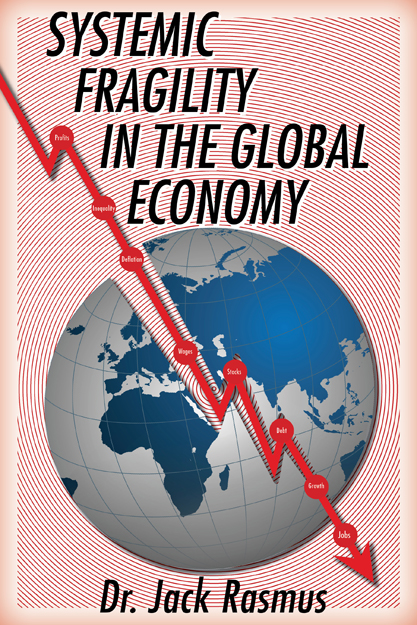
Dr. Rasmus is the author of the recently published, ‘Systemic Fragility in the Global Economy’, 2016, by Clarity Press, and ‘Looting Greece: A New Financial Imperialism Emerges’, Sept. 2016, by Clarity Press. He blog at jackrasmus.com.

Alternative Visions – Interview with Jill Stein, Green Party Presidential Candidate – 11.04.16

To listen go to:

http://prn.fm/category/archives/alternative-visions/

Or go to:

http://www.alternativevisions.podbean.com

SHOW ANNOUNCEMENT

Dr. Rasmus interviews Jill Stein, Green Party presidential candidate, discussing the real issues of the presidential election and her Party’s positions and solutions to the deepening political and economic crisis in the USA. Topics addressed include Green party proposals for tax reform. Reversing job destroying NAFTA, TPP, and free trade treaties. What to do about escalating healthcare costs and prescription drug price gouging. How to eliminate student debt and provide free public college education. Solutions to the growing retirement crisis and how to fund doubling of social security benefits and Medicare for All. Who Jill would appoint to the Supreme Court and reverse Citizens United. Her proposals for immigration reform. And Green party positions on preventing US military confrontation with Russia in Syria, East Europe and with China in the south China seas, toward which the US continues to drift. How claims of ‘lesser evilism’ to vote Democrat to oppose Trump is a dead end and why voting a third party is the only way forward.

THE FOLLOWING IS THE TRANSCRIPT OF AN INTERVIEW by MINTPRESS NEWS of Dr. Jack Rasmus on the Eurozone, Euro Debt, and Rasmus’s two latest books, LOOTING GREECE and SYSTEMIC FRAGILITY IN THE GLOBAL ECONOMY.

ATHENS — This has been another eventful year in Greece. Almost one year after it turned its back on the July 2015 referendum result which rejected further austerity, the Syriza-led government has pushed forward a program of even harsher austerity, spending cuts, and privatizations.

Following the British vote to proceed with “Brexit,” or a departure from the European Union, fears that Greece might follow suit led Greece’s lenders to demand even more austerity measures from a country already mired in an economic depression.

In this interview, Dr. Jack Rasmus, a professor of economics and politics at St. Mary’s College of California, analyzes these issues and the many challenges facing the Greek and European economies today.

The author of such books as “Looting Greece” and “Systemic Fragility in the Global Economy,” Dr. Rasmus shares his insights into the consequences of austerity for Greece and other peripheral European economies, and presents his proposed solutions for an end to the crisis and austerity.

MintPress News (MPN):

In September, Greek Prime Minister Alexis Tsipras gave his annual “state of the nation” address, where he boasted that the Greek economy has turned the corner, that unemployment is going down, that salaries will be increased, and that the country is returning to growth. Is this what Greece’s economic indicators actually show?

Protesters march to the Greek Parliament in Athens on Tuesday Nov. 6, 2012. Greece’s unions are holding their third general strike in six weeks to press dissenters in the country’s troubled coalition government not to back a major new austerity program that will doom Greeks to further hardship in a sixth year of recession. Two days of demonstrations are planned to start Tuesday, continuing until lawmakers vote late Wednesday on the bill to slash euro13.5 billion ($17.3 billion) from budget spending over two years.

Dr. Jack Rasmus (JR):

No, not quite. Greece’s debt is still the same as it was in 2011, roughly 180 percent of GDP. Unemployment has come down by only 3 to 4 percent, so instead of 27 percent, it’s about 23 to 24 percent. That’s depression-level unemployment. All the other indicators in the economy are flat or declining, so I don’t see anywhere that Greece is really “recovering,” and neither, really, is the entire eurozone economy. It’s been bouncing along the bottom.
As I said in my book “Systemic Fragility,” it’s a case of chronic stagnation. [The eurozone] might grow a little, 0.5 percent or 1 percent above GDP, mostly as a result of Germany’s growth, then it flattens out or goes below. Most of the periphery economies in Europe are stagnant or in a recession, as they have been for quite some time.

As far as raising wages, Greece cannot raise, at least in the public sector, any wages without the approval of the troika [Greece’s three major lenders: the European Commission, European Central Bank, and the International Monetary Fund]. It’s a real stretch to say that Greece is recovering. It’s kind of moving sideways, in the condition of still chronic economic depression.

MPN:

One of the perceptions that has been prevalent in global public opinion with regard to the economic crisis in Greece is that the country has been “bailed out” with billions upon billions of euros in free money. Is this really the case, and where has the so-called “bailout” money to Greece actually gone?

JR:

Countries don’t get bailed out. Governments, banks, businesses, and sometimes, though not so frequently, households get bailed out. So the question is, who got bailed out here, in the debt restructuring deals of 2010, 2012, 2015, and this past spring? The banks got bailed out several times. Foreign investors and speculators in Greek bonds and other securities clearly got bailed out in 2012. If you look at where the money has gone, there’s $400 billion in debt in Greece still, that they have to pay off, with an economy that is less than half that size, so it’s impossible.

Where has all this money gone? Recent studies by the European School of Management and Technology documenting the 2010 and 2012 bailouts indicate that 95 percent of all the loans to “bail out” the Greek government, which then bailed out the Greek banks — 95 percent of that went back to Northern Europe, mostly to the German and Northern European banks that had loaned so much money to Greece. [Bailout funds also went] to the troika, particularly the European Commission, that then distributed it to the banking system and investors in turn. The EC is the big player here, and to some extent the European Central Bank, and to a minor extent now the International Monetary Fund. So, 95 percent of all the money loaned to Greece went right back to [Europe] and less than 5 percent of that went back into the Greek economy. Greece has been subsidizing the financial system elsewhere in Europe.

MPN:

What do you believe needs to be done about the Greek debt?

JR:

You might ask what needs to be done about debt throughout the eurozone, because it’s not just Greece. Greece is perhaps the most serious case, but other places in the periphery of Europe are still heavily indebted. You cannot sustain, with austerity measures designed to pay the interest and principal on debt, a $400-plus billion debt based on an economy that’s less than $200 billion. Even the IMF has come to that conclusion and is maneuvering with the other troika members on that particular point.

Is [the debt] legitimate? Well, you have to understand the origins of this debt. It was originally private sector debt that was created as a result of the formation of the eurozone in 1999, the ECB as part of that creation, and other elements of the eurozone agreements, particularly the Lisbon Strategy that Germany adopted. Germany and other Northern European businesses and bankers pumped money and capital into the periphery, including Greece, from 2005 onward. Germany had a strong competitive advantage in exports, so a lot of the money and capital was pumped into the periphery, including Greece, in order to purchase German and other exports. So the money went in and circulated around, leaving a pile of private sector debt in Greece, Italy, and other places.

Then we had the crash of 2008-2009 and the debt could not be repaid, and the troika stepped in to [offer] the governments of Greece and other countries money in order to continue to bail out the private sector and enable the repayment of the private debt. So it starts out as private debt, because of this great imbalance in exports within the eurozone, and then that gets converted to government debt, and then the big crash of 2008-2009 adds even more debt, and then you have the recession of 2011-2013 in the eurozone and the 2012 bailout, which piled on more debt in order to pay the old debt, and then in 2015 the same thing. So the troika’s piling more debt on Greece in order for Greece to pay the previous debt, and that’s totally unsustainable. They’re going to have to expunge some of that debt.

Of course, the Germans, Wolfgang Schauble [the German finance minister] and the coalition in the north, does not want to allow that. And they don’t really want to change the eurozone, because the eurozone, while very imbalanced for the periphery, has benefited Germany significantly. [The Germans] dominate the finance ministers’ council in the EC and they dominate the ECB, and they’re just keeping the situation the way it is because it’s profitable for them.

MPN: Why must Greek banks be nationalized, in your view?

JR:

Look at the debt negotiations of 2010, 2012, and 2015. What happened was the ECB, which pretty much controls the Greek central bank — the ECB is just a council of central banks dominated by the Bundesbank [the German central bank] and its allies, so they have control — and what you saw in the negotiations is that in 2015, the ECB put the screws to the Greek economy, and Syriza collapsed and agreed each time the screws were tightened, bringing the economy to a halt. They couldn’t deal with the squeeze on the economy by the ECB. This brought the economy to a halt, squeezing it and of course not releasing loans that [the troika] had agreed to provide Greece under previous agreements. There was an economic squeeze that Syriza did not have a strategy to deal with, and eventually it capitulated.

You’ve got to nationalize, make the Greek central bank and the banking systems independent of the ECB. Gain control over your economy once again, and that is one of several key steps to prevent the squeeze every time you attempt to renegotiate the debt or restructure the debt. Without an independent, Greek, people-controlled banking system, the eurozone and the troika will squeeze and bring Greece to its knees every time. We’ve seen that three times. You’ve got to nationalize the banking system, including the central bank, or if you want to just leave the central bank as part of the ECB structure, go ahead, but create an independent central bank authority elsewhere in the Greek government.

In the U.S. during the Great Depression, the U.S. central bank had screwed up badly, and [President Franklin Delano] Roosevelt took over and had his Treasury Department take over and run the economy. Greece would have to set up a parallel central bank in its finance sector, and isolate and bypass the influence of the ECB through the Greek central bank. You would have to create a parallel currency as part of this and impose serious controls on bank withdrawals and capital flows outside the country, which Syriza did not really do, because the ECB and the troika opposed it. When you have all the capital, bank withdrawals and capital flight is another way of squeezing the country economically.

MPN:

The current government in Greece has been continuing a policy of massive privatizations of Greek public assets, with profitable airports and harbors having been privatized in the past year, in addition to the recent selloff of the Greek national railroad for a total of €45 million ($49 million). What are the short- and long-term impacts of the privatization of such public assets?

JR:

The short-term is that when you privatize them, under the aegis of the troika, if you sell below market prices, which a lot of these assets are being sold at, that’s profit on the sale for the investors who are buying up these assets. But once the assets are in private hands, where does the revenue go? Does it go back into Greece or does it go back into the pockets of the investors and the corporations and the banks outside Greece that are buying it up? Well, it goes out. It’s a form of capital flight. Money that is needed in Greece flows out of Greece.

This is a new form of financial imperialism, wealth extraction in other words, that is being structured and managed on a state-to-state basis. It’s not 19th century British imperialism where they set up a factory in India, paid them low wages, and brought the textiles back to London to re-sell at a higher price. It’s not that kind of production imperialism. This is financial imperialism imposed on Greece, and it’s a new form that’s emerging everywhere, where you indebt the country and then you force the country to engage in austerity in order to pay the principal and interest on the debt, and you extract the income from the country. Privatizations are another form of that.

You privatize public goods, you get them at fire-sale prices, and then the income flows from those assets flow back to the coffers of the private companies or the banks, outside of Greece.

The other consequence is when you privatize, they come in and they cut costs, which means they lay off people in mass numbers, they put a hold on wages, they get rid of benefits, and they do everything else to maximize their revenue.
Finally, longer term, it means that Greece has less control over its own economy if it can’t control its infrastructure and everything is owned by foreigners. Then you can’t influence it as much, and if you’re part of the eurozone, you’re legally prohibited from what you can do to make sure that these foreign-owned infrastructure companies are behaving in terms of the benefit for the public sector, for the rest of Greece.

MPN:

You have argued in your book, “Systemic Fragility in the Global Economy,” that there are nine major trends which account for the economic troubles that are seen on a global scale. What are some of these trends?

JR:

Everywhere, and particularly since 2008, we see central banks and monetary policy to be ascendant, and that means creating money, pumping it into the economy to bail out the financial systems, the financial institutions, the banks and the shadow banks, meaning speculators, hedge funds, private equity firms, asset management companies, and so forth. We’ve seen bailouts of tens of trillions of dollars since 2008. All of that liquidity injection into the economy has driven interest rates down to zero or even, in Europe and Japan and elsewhere, negative rates, and that fuels debt. With rates that cheap, corporations and businesses float new corporate bonds, and they use the money not to invest necessarily, they use it to buy back the stock and drive up the stock prices and pay out dividends, or they sit on it, they hoard it, or they send it to emerging markets. That’s a problem everywhere, and that’s the result of massive liquidity injections, which have really been escalating since the 1980s, when controls on international capital flows were eliminated everywhere.

After the 1970s, when the Bretton Woods system collapsed and central banks took over, the combination of those has led to the financialization of the global economy in the 21st century, where profits are far greater for investing and speculating in financial securities than they are in investing in real assets and real things that create real jobs and real income and real consumption. We’re becoming dependent on debt more and more. The economy is increasingly credit- and debt-driven, and that’s the result of this massive liquidity injection, and it also leads to a shift from real asset investment — investing in real things that create jobs that people need — toward financial asset investment. That means that real investment collapses over time and productivity collapses over time as well, and we see that happening everywhere.

That’s a major point that I argued about in my book, “Systemic Fragility,” this financialization of the global economy based on liquidity and debt and squeezing out. It’s diverting money and capital from real investment into financial speculation. What’s going on in Greece is a concrete expression of this, the reliance on financial means and financial manipulation. The periphery in the eurozone is at a great disadvantage to Germany and others, and they’re being manipulated financially. All the payments on interest and the debt flow back to the north. This is all flowing through the EC to the private sector, and it’s a nice constant money capital flow from interest payments and privatization and speculation on government bonds and securities and stocks in these countries as the volatility occurs.

It’s a reflection, in Greece, of what’s happening on a broader scale elsewhere in the global economy, and that’s why we haven’t seen much of a recovery in the global economy. Global trade is stagnant and real investment everywhere is drifting toward zero, productivity is negative almost everywhere, even in the U.S., and we’re seeing growth rates of barely 1 percent, 1.5 percent, at best, when it should be double that. We see these growing, non-performing bank loans, almost $2 trillion in Europe, the worst in Italy with about $400 billion. We see the same thing in Japan and in China. We’re becoming more systemically fragile financially because of this shift to financial speculation.

MintPress:

What is your outlook for the eurozone economy and the difficulties that it is currently facing?

JR:

The European banking system has never fully recovered from the 2008-2009 crash. The ECB is pumping money into the banking system in various ways, long-term refinancing options and all the bailout funds and qualitative easing and negative interest rates and so forth. They’re desperately pumping money into the banking system, but the banks aren’t really lending, at least to those businesses that would reinvest in real assets to create jobs. It’s far more profitable to make money now. Investors make more money from financial speculation than they do from investing long-term and expecting to get a return over 10 to 20 years for investment in a real company that creates real things.
We can see the strains now with the non-performing loans, in particular in Italy. Of course, we know the situation with the non-performing bank loans in Greece. Portugal is in bad shape as well in terms of non-performing loans, and now we see even institutions like [Germany’s] Deutsche Bank and others beginning to feel this strain, and the further impact on the European banking system of the “Brexit” [the departure of Great Britain from the European Union].

The problem is that the private banks are either hoarding the cash, they won’t invest in real growth, or they’re sending their money offshore to emerging markets, or they’re using it, as in the U.S., to buy back stock and pay out dividends and loaning money to companies to do just that. The global economy has changed dramatically in ways that make it much more fragile than ever before. A lot of debt has been building up everywhere: Over $50 trillion in additional debt has occurred since 2009, and when the next recession comes, how are they going to pay that debt?

When times are stable or growing, you can add debt without a great crisis emerging, but when you have a recession or a downturn that’s significant, where are you going to get the money capital to pay the principal and interest on the debt? Then you start seeing defaults and you start seeing financial asset price collapses going on, and now you’re back in 2008-2009. That’s the picture of the global economy.

MPN:

What would be the steps for Greece to follow, in your view, in order to escape the spiral of economic depression and austerity?

JR:

Syriza made it clear, when it came into power, that it was not in favor of “Grexit” [a Greek departure from the eurozone], and it has always maintained that position. An unprepared, “we’re leaving the eurozone and the euro” kind of decision would cause a collapse of values, particularly among those who have investments in some savings in Greece. To some extent, Syriza was caught between a rock and a hard place here. They couldn’t or didn’t want to advocate an exit, and at least those who had investments didn’t want it because of the potential effect on their investments. The broader Greek populace thinks, still, that to be European you have to be in the eurozone. That’s a big mistake.
I think what Greece and Syriza should have done is to create a parallel currency and to take over its banking system. In other words, make the banking system truly independent, including the Greek central bank, and if that was not possible, bypass the Greek central bank and set up a central banking function in the finance ministry, as the U.S. has done at different times. Create a parallel currency, and policies and programs to get people to convert their euros into the parallel currency. Maybe declare that henceforth all taxes to the Greek government will be paid with the parallel currency, and that means that people would then trade in their euros for the parallel currency to pay their taxes.
Then tell the troika [the EC, the ECB, and the IMF — collectively, Greece’s lenders] that we’re going to pay you in your euros, but if we run out of euros here as a result of the conversion, well, tough luck, we don’t have a way of paying you, let’s negotiate a final deal where you expunge some of it and we pay you off and we go our separate ways. Of course, you would have to create significant capital flow controls, which has always been a problem every time there’s been a crisis; the money flows out of Greece. Take the economy out of the control of the troika without a formal exit.

That could have been done, but for some reason Syriza and its finance advisers either didn’t want to do that or didn’t know how to do that.

MPN:

Arguments that have been heard against a parallel currency include the claim that the existence of two currencies would create a situation where there would be “haves” and “have nots” — between those who would hold a stronger, hard currency, compared to those holding a weaker, devalued currency. How do you respond to this?

JR:

There are policies and approaches you can take that entice and require people to convert their euros into the new currency. That would raise the demand and therefore the value, the price of the new currency. If you just had the currency and you didn’t have this forced trade-in, then of course you would have “haves” and “have nots,” the new currency would collapse, and pretty soon no one would want to use it. But, for example, saying that taxes could only be paid with the new currency, would force people who had corporations and businesses and so forth to purchase the new currency with the euro. It would undermine the value of the euro in Greece and it would raise the value of the new currency in Greece as well. That might set off a parallel elsewhere in the eurozone with other countries thinking the same thing, which would undermine the value of the euro and put the squeeze on the troika for once. Greece never put the squeeze on the troika, it was just the opposite in all of these negotiations that occurred, they never really hurt the troika in negotiations, and that’s the only way you prevail in negotiations. You’ve got to make it unpleasant for the opposition. Syriza never did that, they played along and made concession after concession.

Syriza thought that their example would strike a spark elsewhere in Europe of other social democratic forces and governments. They thought that they would get the rest of the social democracies behind them and together they would reform the eurozone. That was a fiction, a fantasy thought on the part of Alexis Tsipras and others, but that was the core of their whole strategy. European social democracy is a dying force, and that’s why you see the growth on the fringes, both to the right and the left.

Tsipras and [former Greek finance minister] Yanis Varoufakis’ problem was that they thought they could get all these elements behind them and that together they would have enough weight to force Schauble and other finance ministers to make concessions. Well, Schauble and the other ministers, the “German faction,” as I call it, within the finance ministers’ council in the EC, remained dominant. At every step along the way, whenever Syriza and its few allies tried to make a compromise where some concessions were made to them, the German faction squelched it. We saw that, for example, at the very end, when [Greece held] the referendum in July 2015. Greece held the vote, and the vote said “go back and negotiate a better deal for us,” and what did Tsipras do? He totally caved in to the Schauble faction, and then the Schauble faction said, “The offer we made last week is now off the table, you’re going to have to accept an even worse one.” So they put the screws to Syriza, and Syriza looked to its allies in the EC, and they totally caved in as well. Things just got worse and worse until you had the final [austerity] agreement on August 20, 2015.

It was a step-by-step retreat from [Syriza’s election in] January 2015, because Syriza had the wrong strategy and was not engaged in certain necessary tactics. Of course, the troika itself had a lot of cards to play. It would have been an uphill fight for Syriza. The time where they might have been able to strike some concessions from the troika was 2012, but New Democracy [the center-right party in power at the time in Greece] was totally in the pocket of the troika, so that was impossible.

[This past spring], the IMF and the troika were worried about “Brexit” and what impact that might have on renewing “Grexit.” So they put the screws to Greece again, raised the debt even more, austerity even more, and I think another round of that is coming, because the IMF wants out of the troika deal. We’ll see what happens at the IMF meeting, but they haven’t endorsed even the 2015 agreement because they know it’s unsustainable. I think the IMF is maneuvering to have the EC to buy its portion of the debt, and once that happens, the EC will demand even more austerity from Greece.

MPN:

In the event that a parallel currency is implemented and steps are taken to maintain or strengthen its value, could that be a prelude to a switch to a national, domestic currency?

JR:

Yes. At some point, one currency will become dominant. You can’t have two equal currencies like that. Another advantage of the new currency is that it will start out at less value than the euro, and that will be used as the trading currency. That will stimulate Greek exports to elsewhere, outside the eurozone.
Part of the problem is that the periphery in Europe is so dependent on exports and imports to Germany and the north, that it can’t really engage in its own independent export strategy without cutting wages. Throughout Europe, you have what’s called “internal devaluation,” when you are stuck with a currency and someone else’s central bank, the ECB and the euro. You can’t really engage in independent monetary policy to stimulate your economy and you can’t engage in lowering your currency in order to gain some advantage in exports. You’re stuck, and only the most powerful country that’s most efficient and has the lowest costs is able to take advantage of global exports, and that’s Germany. The weaker economies of the periphery will always be at a disadvantage to Germany when it comes to trying to push their exports anywhere else outside the eurozone.

That’s the lesson. The lesson is that you’ve got a 1999 agreement in which you have this quasi-central bank, the ECB, and you have [the euro], and that arrangement significantly benefits the most efficient, low-cost producer, which is Germany, at the expense of the periphery. Until you have a true central bank and fiscal union to some extent, that will pump the money into the periphery to help it grow when it doesn’t, you will always have the situation you have in Europe right now.

Compare that to the U.S., where there’s a fiscal union, so that if certain states have economic problems … the federal government can pump money into those specific locations. If you don’t have a true federal government and fiscal union, you can’t do that, and if your central bank is dominated by the largest economy — Germany — even the monetary policy has no effect. And if it’s a single currency, it’s to the advantage of the stronger economy at the disadvantage of the weaker.

The eurozone economy is structured to emphasize the growth of the strongest economies at the expense of the weaker, and that’s not going to change. It’s built into the eurozone. You cannot create a currency union and a customs union without a true banking union and fiscal union. More and more countries in the eurozone are beginning to come to that conclusion, but it was foreordained. Economists knew this from the beginning, and that’s the tragedy. Greece has tied its tail to the eurozone, dominated by Germany, and it can never get out of this situation as long as Germany dominates the institutions, which it does, because the whole arrangement is great for Germany.

MPN:

Tell us about your most recent book, “Looting Greece.”

JR:

It’s really a case study of the consequences of financialization and globalization and integration. I argue that there is this phenomenon of the smaller economies being tied into the larger economies through free trade agreements, which lead to currency unions, which lead to banking unions, and then you’ve got a situation like Greece and the euro periphery and the problems associated with that.

The book also takes a historical look at the origins of the Greek debt, that starts in 1999 with the [creation of the] eurozone, the adoption of the euro by Greece in 2002 and the consequences of that, how the debt developed, first in the private sector because of German export domination and then conversion of the private debt in 2008-2009 to the public debt, and then the collapse of 2008-2009, which added to the government debt. Then you had the 2012 agreement where the private sector was bailed out, and that added more debt, and then 2015 and so forth. All this is described in detail in the early chapters, and then most of the book is a step-by-step look at the negotiations between Syriza and the troika, from [Syriza’s January 2015 election] through the spring of 2016, and what were the strategic and tactical errors of Syriza and the strategic and tactical moves by the troika which enabled it to prevail.

At the end, [the book discusses] how this is a form of a new emerging financial and wealth extraction from smaller economies by the larger economies, because of the globalization and integration arrangement that exists, the emergence of financial extraction and financial exploitation, and how central banks are feeding that all. This will lead to my next book, which is about global central banks and the problems they’ve created as we move to another crisis, which I think is coming in the next five years.

The 3rd US presidential debate held October 19, 2016 between Donald Trump and Hillary Clinton was perhaps the most critically important of the three presidential debates—not so much for what was said, or even how it was said, but for what it portends for US policy in the post-election period regardless which candidate is elected in November.

The 3rd debate began with a reasonably rational discussion covering topics of Supreme Court appointments, 2nd amendment gun rights, abortion and then immigration—each subject revealing the deep differences in positions between the candidates. But then, as in the 1st and 2nd debates, it quickly exploded.

As the debate addressed the topic of immigration, Trump noted that Barack Obama was the biggest deporter of undocumented Latinos in US history—a fact which Clinton has consistently avoided, he charged. Trump then referred to the recent Wikileaks revelations, where Clinton declared she was in favor of ‘open borders’ throughout the western hemisphere and Trump suggested her ‘open borders’ remark referred not only to more free trade but also more cross border labor immigration as well.

The Wikileaks revelations have been a consistent hot ‘third rail’ in the US election and the debates. The revelations have served as a multi-edged sword against Clinton. By revealing her ‘open borders’ remark they contradict Clinton claims that she opposes the Trans Pacific Partnership trade treaty or free trade, while simultaneously suggesting she would accept more immigration to the US as part of a broad hemisphere free trade deal. Wikileaks further touches another Clinton political ‘raw nerve’: her emails cover-up. And they also reveal Clinton’s cynical ‘dual communications strategy’, in which she consciously says one thing to bankers and big business and another to the US public. The Wikileaks revelations are thus a kind of strategic lynchpin for the Trump campaign in the election, raising multiple issues on which Clinton is vulnerable.

It was not surprising therefore that, almost on cue when Wikileaks was first raised by Trump in the 3rd debate, Clinton angrily went on the offensive and diverted the discussion from the revelations. Her offense-defense was to redirect the debate to an attack on Wikileaks itself. From Wikileaks suggesting free trade, open immigration, email cover ups, and double talking to bankers and voters the discussion was diverted to Wikileaks as Russian hacking of senior Democrat party leaders, Wikileaks as Russian vehicle to disrupt US elections, and from there to Russian aggression in Syria, demonizing Putin as war criminal, and then demonizing Trump by association as a friend of Putin.

In redefining the Wikileaks debate, Clinton’s words and her visual countenance response revealed a deep anger. How dare any country interfere with US elections. How ironic, given the US long and consistent interference in other countries’ elections. Clinton’s comments reflected the US elite’s growing frustration with Russia’s recent military offensive and gains in Syria. Clinton’s counter-attack on Wikileaks then set up the segway to Putin as the cause of continuing war in Syria, Putin as Saddam Hussein incarnate, Putin as the source of subversion of US democracy, and, then in turn, to Trump as the buddy of Putin and therefore, by association, all the above as well.

Wikileaks was clearly the nexus point of the 3rd debate. Clinton declared Wikileaks “the most important issue tonight”, charging Trump with “willing to spout the Putin line”, declaring “you continue to get help from him” (Putin) and that “you are his favorite in this race”. Trump countered with the charge Putin has outsmarted her and Obama at every foreign policy turn and that’s why she, Clinton, is trying to attack him by a desperate attempt to associate him with Putin.

The even more disturbing quote from Clinton in the exchange, however, was her repeated call, first raised in the 2nd debate, to establish ‘no fly zones’ in Syria. When the debate moderator noted that US generals have said such zones would likely lead to war with Russia, Clinton suggested ‘no fly’ would correspond to ‘safe zones’ on the ground. But ‘no fly’ was necessary to confront Putin and Russia in Syria. “We have to up our game” there, she concluded.

The debates reveal that, if elected, Clinton and the US war faction are likely to engage in new military adventures in the middle east, in particular in Syria. Or perhaps try to counter Russia with a more assertive military challenge in the Baltics, Eastern Europe or the Ukraine as a bargaining chip with Russia in Syria. The 2nd and 3rd presidential debates indirectly reveal something is afoot in that regard, no matter what the outcome of the election in November, but especially if Clinton is elected.

The debates also reveal a new offensive is brewing, indeed already underway, to shut down Wikileaks and to further restrict free speech and civil liberties. Already, Wikileaks’ internet connection at the Ecuadoran embassy in London has been cut. Concurrently, in recent days British banks have indicated they will no longer service the accounts Russia TV in the UK. This is a ‘shot across the bow’ to Russia media as well. A similar move is likely in the US for Russia TV soon after the elections. US government and US banks have initiated similar financial disruption tactics against Latin American progressive media, as the US renewed neoliberal offensive in Latin American continues to deepen. And should Trump lose the US election, it is likely his voice too will be muffled, if not ‘silenced’, in US media.

That muffling is especially true should Trump refuse to abide by the election outcome in the US. Another Trump ‘verbal bombshell’ in the 3rd debate was his refusal to say whether he would accept the outcome of the US election if he were defeated. Before the debate, Trump also continually raised the charge the election was being ‘rigged’.

That view of media bias and election manipulation resonates with much of the US voting electorate, especially his base of at least 40% of hard core pro-Trump voters. The charge of ‘rigging’ and potential to refuse to accept the election results may prove a ‘game changer’ in US elections. It reflects the deep distrust by broad segments of the US populace of the political elites in the US and their two parties. That distrust is not going away after the election, but will take new forms of protest in 2017 and beyond.

For there is clearly a rebellion underway against the ‘political class’ in the US. That rebellion is not yet reflected in independent political organization and opposition. It is still being expressed through and within the two wings of the Corporate Party of America—Republicans and Democrats. But that may break down, should Trump lose and the US economy continue to falter in 2017. What the debates reflect is growing disenchantment with the two parties’ organizational cocoon. A ‘rebellion within’ those two wings could evolve post-November easily and quickly to a challenge ‘from without’.

Should he lose, Trump will almost certainly launch a new political party. A Trump new party initiative could also stimulate something similar on the left in the US. Bernie Sanders’ millennials are still clearly not in the Clinton corner, despite their erstwhile leader having thrown in with Clinton. The election may come down to whether, in the 8-9 swing states, Trump can turn out more non-college educated white workers than Clinton can turn out educated urban professionals, women, suburbanites, and Latino-African Americans.

Neither candidate has the millennial vote, now the largest population segment. Millennials may in the end vote for ‘none of the above’. Clinton is trailing well behind Obama for the millennials. Trump too is losing their support, at least among the better educated. Polls show only 54% of the under-35 years old group is currently at all interested in the election. And that will not soon change.

Third party candidates, Jill Stein of the Green Party and Gary Johnson of the Libertarians, are polling 22% of likely voters aged 18 to 29. According to a Harvard University survey this past summer, a third of Americans aged 18-29 support Socialism, while not even half back Capitalism. For them, the economy is the main issue and that is going to get worse in 2017 and beyond, not better, regardless who wins in November.

In summary, apart from all the personal mudslinging and the occasional, tangential references to real issues in the debates, what the 3rd—and indeed all three debates—reveal beneath the surface is in 2017 and beyond what’s in store is more military adventures, more limits on civil liberties, a growing loss of legitimacy by the US political elite and their parties among broad segments of the US population, deeper splits and more internecine conflict within the political class and each of their two parties, a growing potential for new forms of independent politics, and more instability within the US political system in general.

Jack Rasmus is the author of the just-released book, “Looting Greece: A New Financial Imperialism Emerges,” and the previous, “Systemic Fragility in the Global Economy.”, both published by Clarity Press, 2016. He blogs at jackrasmus.com.