Feeds:
Posts
Comments

I recent gave an interview with Global Research in Canada, on the significance of Trump and whether the US traditional elites will eventually ‘tame’ him. (The interview will be posted on my website shortly and will be announced here). A listener of the Global Research radio interview replied to me on the subjects covered in the interview, making some very good points. I replied briefly. The exchange follows below:

“Jack,

I was very interested to hear you’re recent interview on the GLOBALRESEARCHNEWSHOUR, and then was
BLOWN AWAY by the volume of serious material you have
on your websites.

As a dedicated observer of “events,” critical websites, etc, I was shocked that I had not heard your name before; and there… recalled yet another affirmation of the mainstream media’s success in isolating our eyes and ears from the wealth of wisdom which is ours to enjoy, so soon as we’re able to connect.

Listening to the interview and your latest podcast, I found myself agreeing on so many points: Trump’s rhetoric vs. real intent, (tax cuts for rich, de-regulation); pivot to China; neo-liberal-con 2.0; Japanese re-armament, etc.

I’m writing to you today because I believe you’re able to see what many otherwise-intelligent critics lately do not; namely, that Trump is NOT anti-establishment.

As you know, there’s a whole campaign underway, (by the corp-rat “liberal” media and CIA) attacking Trump with the lamest, most ridiculous charges.

“Russia did it.”

This would be laughable if it weren’t for the many serious critics who are taking this as evidence of Trump’s “opposition” to the establishment.

Some, like Michel Chussudovsky, describe this as the friction between two factions of the Elite. Chris Hedges speaks of a possible “coup.” Many take this as an opportunity to expose the thoroughly-corrupt, presstitute media and state, (“a shocking, unprecedented intrusion”, etc).

By acknowledging such charges as “attacks,” progressive observers affirm his “anti-establishment” credentials… the core of his credibility amongst intelligent conservatives.

Yet the weak, lame, luridly-absurd nature of the “attacks” on Trump could only be expected to strengthen him; for the very essence of his persona is STRENGTH – the “winner against all odds,” brushing off criticism with nary a care.

In keeping with their character, the Lamestream ‘liberal’ media and the Demoncratic Party are INTENTIONALLY flinging weak, irrelevant shit at him in order to STRENGTHEN his credibility, and then poison/hijack the real resistance.

(Chussudovsky speaks of this latter point quite succinctly… infiltrators, provocateurs, etc).

They’re infecting the widespread shock/outrage over Trump’s seizure-of-power with ridiculous, (facile) self-defeating logic. They’re turning the movement’s eyes away from those liberal/Demoncrats who laid the foundation for Trump, and who keep propping him up in various forms.

This further makes impossible any effective communication with intelligent conservatives, who then see such anti-Trump protests as NOTHING MORE than Demoncratic, liberal mainstream machinations.

Now, it’s true that some are using the term “fascist” quite loosely. Comparisons with Hitler are usually clumsy, at best. Yet lost in the muddle is the historical fact that the Nazis, (and mussolinin’s blackshirts) first represented themselves as REBELS… against “the establishment” – first against the Conservative
Parties, before moving to destroy the liberal state and the left.

While Trump today may be more thug than fascist, the trajectory of his play is certainly FASCISTIC, and the character of his cabinet is decidely so.

Trump is simply serving as a useful front-man for the nasty business going on behind the scenes. TPTB may certainly bump him off or depose him if/when it serves their interests; but for now, the “Trump as rebel “meme is strengthening his position.

On the international scale, the Trump phenom is falling in with a long line of reactionary, anti-immigrant,”strong-man” parties… on the rise in Europe, each… but a few steps away from an openly fascist declaration.

This is entirely in keeping with the decay of capitalism, and the last refuge of the Elite, (for maintaining power): the descent into barbarism, chaos as a tool for social re-organization along military lines, mass murder.

(This may also help to explain a “deal” that may have been made with Putin’s Russia, backing off in return for support of the “populist” movements in Europe, and the “pivot to Asia” instead).

We’ve entered a dangerous new phase, yes?

Yet so long as our critical community, (progressives, left, etc) continues to allow the “anti-establishment Trump” meme to linger, so long as don’t denounce such Demoncratic/liberal attacks as FALSE criticism, then we allow them to hijack the resistance and give fresh (stale) wind to Trump’s sails.

So I’m writing to you, Jack, to encourage you to get the word out wherever you can.

Trump is a con-man/front-man for a fascist advance; and the so-called “liberal” establishment, (media, CIA, Demoncrat Party) are providing a PHONY, (weak, baseless) “opposition” in order to STRENGTHEN him and poison the resistance.

We must dump the Trump and the Demoncrats at the same time, in the same breath.

We must denounce the lying “liberal” presstitute, corp-rat media as useful tools of Trump’s ascendancy, and utterly purge every ounce of Demoncratic influence from the ranks of our resistance.

Thanks for listening Jack,

keep up the great work.

Anthony”

.
Jack Rasmus reply to Anthony

“Thanks for your commentary, and for watching, listening, reading my perspective. I agree, Trump is not yet fascist (in the 1930s sense, but that sense by no means is the only form fascism may take). We should see him as a forerunner, with the potential to become one, a kind of ante-room or proto-fascist form. But first he must neutralize the liberal democratic media, which he is out to do. And he must solidify working class support with more jobs, appearance of anti-free trade, etc. And deliver on the ‘enemy within’ (jews in Germany; immigrants in the US), while appealing to nativist pride (the new nationalism) and identifying with ‘greatness’ (myths mostly) of the past (roman imperialism, the aryan ‘volk’, for US ‘founding fathers’-US Constitution), and reestablishing ‘law and order’ (crush the commies and unions in 1930s; now the central american immigrants killing our kids and muslim immmigrants planning terrorism). This is a fight between two wings of capitalism–one a liberal order that tolerated a certain amount of ‘freedom’ (i.e. minimal voting democracy, minimal civil rights, etc.) but an order that has failed to prevent the collapse of standards of living for millions–and a new virulent wing of capitalists (wheeler-dealer property developers, shadow bankers, big oil, right wing generals, and financial speculators) who want to roll the dice and take bigger risks to re-establish US total control the global economy (as in the 1950s-60s) and bring more ‘law and order’ (aka less democracy, civil rights, liberties, contain protests, check any opposition media–left, internet, NYT-Post-CNN-hollywood crowd)–that might challenge them in re-establishing that total dominance.

If Trump fails to deliver, he will ‘double-down’. And the liberal democratic traditional wing will meantime build a case for his removal in the short run, which they’ll employ if and when he fails (if he doesn’t bring himself to heel). But Trump could also take bigger risks if he feels he is failing, That could also mean more direct conflict with China which is the real target now, not the middle east or Russia. The US elite’s won’t touch him if he is about to get into a war there, or if he delivers jobs, law and order, etc. to his US popular base. In the meantime, as they develop the real ‘dossier’ on him, he will launch his own anti-media offensive against them. You can’t have fascism without taming the media and the press, without crushing popular opposition movements, and without neutralizing the potential opposition from within the more ‘liberal’ and tolerant wing of the capitalist class itself. We’ll see what happens in the coming year. The crisis will erupt no earlier than 2018 I believe.

To listen to my discussion of the key economic events of the past week as Trump takes office, listen to my January 20, 2017 Alternative Visions radio show,

go to:

http://alternativevisions.podbean.com

or to:

http://prn.fm/alternative-visions-key-economic-events-past-week-trump-inauguration-01-20-17/

SHOW ANNOUNCEMENT:

Jack Rasmus reviews the key economic events, US and global, in the run-up to the Trump inauguration: China President Xi warning of trade war with US, the European Central Bank’s continuation of its QE policy, the United Kingdom’s Prime Minister, May, signals a ‘hard Brexit’, Trump cabinet nominees tell Congress what they want to hear (and not what they intend to do), Indonesia slaps down Chase Bank and UUS bond rating agencies, US Banks announce accelerating profits and stock prices with much more to come, Janet Yellen, chair of the US Federal Reserve, warns Trump not to spend on infrastructure because US economy is ‘too hot’, the real heat globally rises with hottest climate on record in 2016, and various US elites ‘warn’ Trump about foreign policy shifts without their consent. Jack explains that Trump enters office with elites willing to tolerate him so long as he delivers quickly on massive tax cuts, business deregulation, and eliminating the costs to them in Obamacare and Dodd-Frank, but don’t dismantle NAFTA and China trade or mess with NATO. Rasmus predicts Trump will eventually be ‘brought to heel’ by the US economic elites, and a new Neoliberalism 2.0 will be launched. (next week: Trump’s inaugural address and what it means for US policy)

By
Jack Rasmus
Copyright 2017

Last night, January 10, 2017, Barack Obama gave his farewell address to the nation. The scene was a strange and disappointing attempt that failed, to replicate the hope, the energy, and optimism of his first 2008 address to the nation. Instead of celebrating the unity of all those who joined to put him in office, the mood was downbeat, with Obama warning listeners that the country had become more divided than ever during his intervening years in office, that Democracy was threatened on many fronts—cultural, legal, and economic—and that the people to whom he was speaking, and throughout America, now had the task to take up the fight to protect what’s left and restore it–for clearly he had not been able to do so.

At times the fire of hope, dominant in his 2008 victory speech, briefly returned. Obama declared, referring to 2008 and 2012, that “maybe you still can’t believe we pulled this whole thing off”. But what exactly was ‘pulled off’? What was accomplished that was so great is hard to know. But he apparently thinks something was.

During the speech he listed a series of accomplishments that represent, in his view, the high marks of his presidency: As he put it, he ‘reversed the Great Recession, rebooted the auto industry, generated the longest job creation period in Us economic history, got 20 million people health insurance coverage, halved US dependency on foreign oil, negotiated the Iran nuclear proliferation deal, killed Osama Bin Laden, prevented foreign terrorist attacks on the US homeland, ended torture, passed laws to protect citizens from surveillance, and worked to close GITMO.’ Sounds good, unless one considers the facts behind the ‘hurrah for me’ claims.

The auto industry was rescued, true, but auto workers wages and benefits are less today than 2008 and jobs in the industry are still below 2008 levels. So too are higher paid construction jobs. Half of the jobs created since 2008 include those lost in 2008-2010, and the rest net gains in new jobs since 2010 have been low paid, no benefits, part time, temp, ‘gig’ service jobs that leave no fewer than 40% of young workers under thirty today forced to live at home with parents. More people are working two and three part time jobs than ever before. Five million have left the workforce altogether which doesn’t get counted in the official employment and unemployment rate figures. If one counts the part time, temp and those who’ve left the labor force or not entered altogether, the jobless rate is not today’s official 4.9% but 10% of the workforce. That’s 15 million or more still, after eight years. Meanwhile, those who do have jobs are victims of the great ‘job churn’, from high to lower wage, from a few, if any, benefits to none at all.

As for ending the Great Recession, that depends ending ‘for whom’ and what constitutes an ‘end’. The US economy grew after 2009, but at the slowest rate of growth historically post-recession since the 1930s.

But he did end the great recession for the wealthy and their corporations. Corporations have distributed more than $5 trillion in stock buybacks and dividends to their shareholders since 2010, as corporate profits more than doubled, as stock and bond markets tripled in value, and as more than $6 trillion in new tax cuts for corporations and investors (beyond the $3.5 trillion G.W. Bush provided) were passed on Obama’s watch. (Not to be outdone by Obama and the Democrats, Trump and the Republican Congress are now about to pass another $6.2 trillion for investors and businesses, to be paid for in large part by tax hikes for the rest of us and the slashing of education spending, Medicare, Medicaid, healthcare, housing, and what’s left of the US social safety net).

In his farewell address Obama also cited how the country ‘halved its dependency on foreign oil’. True enough, at the cost of environmental disasters from Texas to the Dakotas to Pennsylvania, as oil fracking replaced Saudi sources, and in the process generating irreversible water and air contamination in the US. In foreign policy, he noted he signed the Iran deal, but left out mentioning that during his administration the US set the entire middle east aflame with failed policy responses to the ‘Arab Spring’, with Hillary’s coup in Libya, to support of various terrorist groups (including Al Queda) in Syria, and to the arming of Saudis to attack Yemen.

Looking farther east, Obama foreign policy outcomes are no better. The US is still fighting in Afghanistan 16 years later, the longest war in US history, as the Afghan government now collapses again in a cesspool of corruption and graft. And the US is still engaged in Iraq. A related consequence of the failed US middle east policy has been the destabilization of Europe with mass refugee migrations, that have been only temporarily suspended by equally massive payoffs to Turkey’s proto-fascist Erdogan government (which also blames the US for the recent failed coup there by the way).

Other failures on the Obama foreign policy front must include the US militarization of the Baltics and East Europe, following Obama’s inability to rein in Hillary’s US State Department neocons in 2013-14, who made a mess out of their US financed coup in the Ukraine in 2014. That debacle has driven the US and Russia further toward confrontation, which perhaps Hillary and the neocons may have wanted in the first place (along with a US land invasion of Syria at the time which, in this case, Obama to his credit resisted).

And what about Obama’s much heralded ‘pivot to China’? On his watch China’s currency achieved global reserve status, that country launched a major trade expansion, and a government Asia-wide investment bank. The collapse of the US sponsored TPP will also mean a China-Southeast Asia ‘TPP’, which was already well underway.

On the domestic front, Obama’s legacies must include the most massive deportation of Latinos in US history on his watch, nothing but words spoken from the comfort of the White House about police and gun violence and black lives murders on the streets of the US, and the rollback of voting rights across the country. And let’s not forget about Barack the great promoter of free trade, signing bilateral deals from the very beginning of his administration, and then the TPP, all of which gave Trump one of his biggest weapons during the recent election.

The media and press incessantly refer to the 2010 Obamacare Act and the 2010 bank regulating Dodd-Frank Act as two of his prime achievements. But Obamacare is about to implode because it failed to control health care costs, now more than $3 trillion of the US total GDP of $19 trillion—the highest in the advanced economy world at nearly 18% of GDP (compared to Europe and elsewhere that spend on average 10% of their GDP on healthcare). The 8% difference, more than $1 trillion a year, going to the pockets of middle men and paper pushers, like insurance companies, that provide not one iota of health care services.

In his address Obama touted the fact that on his watch 20 of the 50 million uninsured got health insurance coverage, half of them covered by Medicaid which provides well less than even ‘bare bones’(provided one can even find a doctor willing to provide medical services). The rest covered by Obamacare mostly got high deductible insurance, often at an out of pocket cost of $2-$4 thousand a year. 10 million thus got minimal coverage, and the health insurance industry got $900 billion a year, what the program costs. No wonder the health insurance companies did not oppose such a windfall. Obamacare is best described therefore as a ‘health insurance industry subsidy act’, not a health care reform act.

Obama will be remembered for scuttling his own program in 2010 by unilaterally caving in to the insurance companies and withdrawing the ‘public option’ and for his party refusing to even allow discussion of expanding Medicare for all—the only solution to the continuing US health care crisis. In the wake of Obamacare’s passage, big Pharmaceutical companies have also been allowed to price gouge at will, driving up not only private health insurance premiums but Medicare costs as well, and softening up that latter program for coming Republican-Trump attacks.

As for Dodd-Frank, that’s been known as a joke for some time, providing no real controls on greedy bankers and investors who were given five years after its passage in 2010 to lobby and pick it apart, which they’ve done. The one provision in Dodd-Frank worth anything, the Consumer Protection Agency, is about to disappear under Trump. And for the first time in US economic history, no banker or investor responsible for the 2008 crash went to jail on Obama’s watch.

So much for Obamacare and banking reform as his most notable ‘legacies’.

The true legacies that will be remembered long term will be the accelerating rate of income inequality, the real basis for the growing divisions in America, and the near collapse of the Democratic Party itself.

Under Obama, the wealthiest 1% accrued no less than 97% of all the net national income gains since 2008—as stock markets tripled, bond markets and corporate profits doubled, and $5 trillion was passed through to investors as $6 more trillion in their taxes were cut. Under George Bush the wealthiest 1% households was 65%. Under Clinton 48%. So the rate accelerated rapidly during Obama’s term. Apart from talking about it, Obama did nothing the last 8 years to abate, let alone reverse, the trend.

The other true legacy will be the virtual implosion of the Democratic Party itself during his administration. As the leader of a party, one would think ensuring its success in the future would be a priority. But it wasn’t. On his watch, nearly two thirds of all state legislatures and governorships, and countless court positions, have been captured by the Republicans. To be fair, the Democratic Party has been in decline for decades. It has won at the presidential level only when the Republicans split their vote, as in 1992 when Ross Perot challenged daddy Bush, and when baby Bush, George W., aka ‘the shrub’, crashed the entire US, and much of the global, economy in 2008.

Obama and the Democrats had an historic opportunity to turn the country in a progressive direction for a decade or more, as Roosevelt did in 1932 and then 1934—by bailing out Main St. with another ‘New Deal’. But Obama chose to double down in 2010 on bailing out Wall St. and the big corporations with another $800 billion tax cut, leaving Main St. America behind. Unlike FDR in 1934, who swept the midterm elections that year, giving him a Congress to pass the New Deal in 1935, Obama doubled down on more for investors and corporations and the 1%. He paid dearly for that in 2010 losing control of Congress. American voters gave him one more chance in 2012, but he again failed to deliver. The result is a Democratic Party ‘debacle 2.0’ in 2016 and he leaves a Democratic Party in shambles. That too will be remembered as his longer term legacy.

Returning to his farewell address, the affair was a poorly rehearsed caricature of his 2008 inaugural, during which so many had so much hope of change, but ended up with so little in the end. Like a touring theater troupe putting on its last performance blandly, eager to change into street clothes and get out of town. True, the Republicans played hard ball and blocked much of his initiatives, but Obama did little to fight back in kind. If he was a community organizer, he was of the most timid of his genre. He kept extending a hand to the Republican dog that kept biting it at every overture. He wanted everyone to unite and pull together. But in politics winning is not achieved by reasoning with the better nature of one’s opponents. That’s considered weakness, and the biting thereafter is ever more vicious.

But perhaps Obama’s greater political error was he never went to the American people to mobilize support, instead sitting comfortably within the oval office in the White House and enjoying the elite circus that is ‘inside the beltway’ Washington. He never put anything personal or physical on the line. And that does not an organizer make. He repeatedly talked the talk, and never walked. The results were predictable as the Republican hardballers—McConnell, Ryan and crew—threw him beanballs every time he came up to bat. He struck out, time and again, calmly walking back to his White House dugout every time.

So farewell Barack. Your speech was a nostalgic call to your hometown fans in Chicago, to go out and organize for American democracy because it’s now in deep ‘doo-doo’. Take up where I left off, your message? Fair enough. Do what I failed to accomplish, you say? OK. See you at the country club, buddy, after your lunch with Penny Pritzger, the Chicago Hilton Hotels billionairess, who put you in office back when in 2008.
And now America changes one real estate wheeler-dealer for another, this time one who takes the direct reins of government. And he’s Obama’s legacy as well….

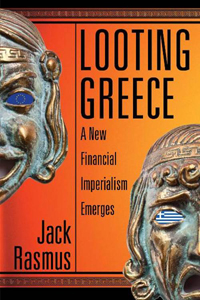
THE FOLLOWING ARE SELECTIONS FROM MY RECENTLY PUBLISHED BOOK, “LOOTING GREECE: A NEW FINANCIAL IMPERIALISM EMERGES”. WHAT IS “FINANCIAL IMPERIALISM? HOW IS IT FUNCTIONING IN GREECE TODAY? AND IS IT A GROWING CHARACTERISTIC OF 21st CENTURY GLOBAL CAPITALIST ECONOMY? ARE TOPICS ADDRESSED. (See the Concluding Chapter in the book for the complete analysis)

The recurring Greek debt crises represent a new emerging form of Financial Imperialism. What, then, is imperialism, and especially what, when described is financial imperialism? How does what has been emerging in Greece under the Eurozone constitute a new form of Imperialism? How is the new Financial Imperialism emerging in Greece both similar and different from other forms of Imperialism? And how does this represent a broader development, beyond Greece, of a new 21st century form of Imperialism in development?

The Many Meanings of Imperialism

Imperialism is a term that carries both political-military as well as economic meaning. It generally refers to one State, or pre-State set of political institutions and society, conquering and subjugating another. The conquest/subjugation may occur for largely geopolitical reasons—to obtain territories that are strategically located and/or to deny one’s competitors from acquiring the same. It may result as the consequence of the nationalist fervor or domestic instability in one State then being diverted by its elites who are under domestic threat, toward the conquest of an external State as a means to avoid challenges to their rule at home. Conquest and acquisition may be undertaken as well as a means to enable population overflow, from the old to the new territory. These political reasons for Imperialism have been driving it from time immemorial. Rome attacked Carthage in the third century BCE in part to drive it from its threatening strategic positions in Sicily and Sardinia, and also to prevent it from expanding northward in the Iberian Peninsula. Domestic nationalist fervor explains much of why in post-1789 revolutionary France the French bourgeois elites turned to Napoleon who then diverted domestic discontent and redirected it toward military conquest. Imperialism as an outlet for German eastward population settlement has been argued as the rationale behind Hitler’s ‘Lebensraum’ doctrine. And US ‘Manifest Destiny’ doctrine, to populate the western continent of North America, was used in the 19th century as a justification, in part, for US imperialist wars with Mexico and native American populations at the time.

But what may appear as purely political or social motives behind Imperialist expansion—even in pre-Capitalist or early Capitalist periods—has almost always had a more fundamental economic origin. It could be argued, for example, that Rome provoked and attacked Carthage to drive it from its colonies on the western coast of Sicily and thus deny it access to grain production there; to deny it strategic ports on the eastern Iberian coast from which to trade; and eventually to acquire the lucrative silver mines in the southernmost region of the peninsula at the time. Nazi Germany’s Lebensraum doctrine, it may be argued, was but a cover for acquiring agricultural lands of southern Russia and Ukraine and as a stepping stone to the oil fields of Azerbaijan, Persia and Iraq. And US western expansion was less to achieve a population outlet than to remove foreign (Mexico, Britain) and native American impediments to securing natural resources exclusively for US use. US acquisitions still further ‘west’—i.e. of Hawaii, the Philippines and other pacific islands were even less about population overflow and more about ensuring access to western pacific trade and markets in the face of European imperialists scrambling to wrap up the remaining Asian markets and resources.

Imperialism is often associated with military action, as one State subdues and then rules the other and its peoples. But imperialist expansion is not always associated with military conquest. The dominating State may so threaten a competitor state with war or de facto acquisition that the latter simply cedes control by treaty over the new territory it itself had conquered by force—as did Spain in the case of Florida or Britain with the US Pacific Northwest territories. Or the new territory may be inherited from the rulers of that territory. Historically, much of the Roman Empire’s territory in the eastern Mediterranean was acquired this way. Or the new territory may be purchased, one state from the other—as with France and the Louisiana Purchase, Spanish Florida accession, and Russia’s sale of Alaska to the US.

In other words, imperialism does not always require open warfare as the means to acquisition but it is virtually always associated with economic objectives, even when it appears to be geo-political maneuvering or due to social (i.e. nationalist ideology, domestic crises, population diversion, etc.) causes.

,,,,,,,,,,,,,,,,,,,,,,,,,,,,,,,,,,,,,,,,,,,,,

Wealth Extraction as Basic Imperialist Objective

Whether via a bona-fide colony, near-colony, economic protectorate, or dependency the basic economic purpose of imperialism is to extract wealth from the dominated state and society, to enrich the Imperialist state and its economic elites. But some forms of Imperialism and colonial arrangements are more ‘profitable’ than others. Imperialism extracts wealth via many forms—natural resources ‘harvesting’ and relocation back to the Imperial economy, favorable and exploitive terms of trade for exports/imports to and from the dominated state, low cost-low wage production of commodities and semi-finished goods, exclusive control of markets in the dominion country, and other ways of obtaining goods at lower than market price for resale at a higher market price.

Wealth extraction by such measures is exploitive—meaning the Imperial economy removes a greater share of the value of the wealth than it allows the dominated state and economy to retain. There are least five historical ways that classic forms of imperialism thus extract wealth. They include:

Natural Resource Exploitation

This is where the imperial economy simply takes the natural resources from the land and sends them back to its economy. The resource can be minerals, precious metals, scarce or highly demanded agricultural products, or even human beings—such as occurred with the slave trade.

Production Exploitation

Instead of relocating the resources and production in the home market at a higher cost, the production of the goods is arranged in the colony, and then shipped back to the host imperial country for resale domestically or abroad. The semi-finished or finished goods are more profitable due to the lower cost of production throughout the supply chain.

Landed Property Exploitation

The imperialist elites claim ownership of the land, then rent it out to the local population that once owned it to produce on it. In exchange, the imperialist elites extract a ‘rent’ for the use of the land.

Commercial Exploitation

Here the imperialist elites of the home country, in the form of merchants, ship owners, and bankers, arrange to trade and transport goods both to and from the dominated economy on terms favorable to their costs. By controlling the source of money, either as currency, credit, or precious metals, they are able to dictate the arrangements and terms of trade finance.

Direct Taxation Exploitation

More typical in former times, this is simple theft of a share of production and trade by the administration of the imperialist elite. The classic case, once again, was Imperial Rome and its economic relations with its provinces. It left the production and initial extraction of wealth up to the local population, while its imperial bureaucracy, imposed locally, was simply concerned with ensuring it received a majority percentage of goods produced or traded—either in money form or ‘in kind’ that it then shipped back to its home economy Italy for resale. A vestige of this in modern colonial times was the imposition of taxation on the local populace, to pay for the costs of the Imperial bureaucracy and especially the cost of the imperial military apparatus stationed in the dominated state to protect the bureaucracy and the wealth extraction.

The preceding five basic forms of exploitation and wealth extraction have been the subject of critical analyses of imperialism and colonialism for more than a century. What all the above share is a focus on the production and trade of real goods and on land as the source of the wealth transfer. However, the five classical types of exploitation and extraction disregard independent financial forms of wealth extraction. Both capitalist critics and anti-capitalist critics of imperialism, including Marxists, have based their analysis of imperialism on the production of real goods. This theoretical bias has resulted in a disregard of the forms of financial exploitation and imperialism, which have been growing as finance capital itself has been assuming a growing role relative to 21st century global capitalism.
,,,,,,,,,,,,,,,,,,,,,,,,,,,,,,,,,,

Classical 19th century British Imperialism extracted wealth by means of production exploitation, commercial-trade, and all the five basic means noted above. It imposed political structures to ensure the continuation of the wealth extraction, including crown colonies, lesser colonies, protectorates, other dependency relationships, and even annexation in the case of Ireland and before that Scotland. The British organized low wage cost production of goods exported back to Britain and resold at higher prices there or re-exported. It manipulated its currency and terms of trade to ensure profit from goods imported to the colony as well. Its banks and currency became the institutions of the colony. Access to other currencies and banks was not allowed. Monopoly of credit sources allowed British banks to extract rentier profits from in-country investment lending and trade credits. They obtained direct ownership of the prime agricultural and mining lands of the colony. They preferred and promoted highly intensive and low cost labor production. Production and trade was structured to allow only those goods that allowed Britain investors the greatest profits, and prohibited production and trade that might compete with Britain’s home production. But the colonial system was inefficient, in the sense that was costly to administer. The cost of administration was imposed on the local country in part, but also on the British taxpayer.

Twentieth century US Imperialism proved a more efficient system. It avoided direct, and even indirect, political control. State legislatures, governments, and bureaucracies were locally elected or selected by local elites. There were few direct costs of administration. The local elites were given a bigger share of the exploitation pie, as joint production and investment partnerships in production and trade were established with local capitalists as ‘passive’ minority partners who enjoyed the economic returns without the management role. Only when their populace rebelled did the US provide military assistance, covertly or overtly, either from afar or from within as the US set up hundreds of military bases globally throughout its sphere of economic interests. The US and local militaries were tightly integrated, as the US trained local officer ranks, and even local police. Security intelligence was provided by the US at no cost. The offspring of the local elites were allowed to enter private US higher education establishments and thereby favorably socialized toward US interests and cooperation. Foreign aid from the US ended up in the hands of local elites as a form of windfall payment for cooperation. US sales and provision of military hardware to the local elites provided built-in ‘kickback’ payment schemes to the leading politicians and senior military ranks of the local elites. Local military forces became mere appendages of the US military, willing to engage in coups d’etat when necessary to tame local elites that might stray from the economic arrangements favoring more local economic independence beyond that permitted by US interests.

US multinational corporations were the primary institution of economic dominance. They provided critical tax revenues to the local government, employment to a share of the local workforce, and financial credits from US globally banking interests. The US also controlled the dominated states’ economies through a series of new international institutions established in the post-1945 period. These included the International Monetary Fund, established to address local management of currency and export-import flows when they became unbalanced; the World Bank, which provided funding for infrastructure project development; and the World Trade Organization and free trade agreements—bilateral or regional—which enabled selective access to US markets in exchange for unrestricted US corporate foreign direct investment into dominated state economies, financed by US financial interests. These investment and trade arrangements were tied together by the primacy of the US currency, the dollar, as the only acceptable trade currency in financial and goods exchanges between the US and the local economy.

This new ‘form’ of economic imperialism—a system of political dominance sometimes referred to as ‘neo-colonialism—was a far more efficient and profitable (for US capitalists and local capitalist elites as well) system of exploitation and wealth extraction than the 19th century British system of more direct imperial and colonial rule. And within it were the seeds of yet a new form of imperialism based on financial exploitation. As the US economy evolved toward a more financialized system after 1980, the system of imperial dominance associated with it began to evolve as well. Imperialism began to rely increasingly on forms of financial exploitation, while not completely abandoning the more traditional production and commerce forms of wealth extraction.

The question is: What are the new forms of imperialist financial exploitation developed in recent decades? Are new ways of extracting wealth on a national scale emerging in the 21st century? Are the new forms sufficiently widespread, and have they become sufficiently dominant as the primary method of exploitation and wealth extraction, to enable the argument that a new form of financial imperialism has been emerging? If so, what are the methods of finance-based wealth extraction, and the associated political structures enabling it? If what is occurring is not colonialization in the sense of a ‘crown colony’ or even dependent ‘neo-colony’, and if not a political protectorate or outright annexation, what is it, then?

These queries raise the point directly relevant to our current analysis: to what extent does Greece and its continuing debt crises represent a case example of a new financial imperialism emerging?
,,,,,,,,,,,,,,,,,,,,,,,,,,,,,,,,,,

Greece as a Case Example of Financial Imperialism

There are five basic ways financial imperialism exploits an economy—i.e. functions to extract wealth from the exploited economy—in this case Greece.

• Private sector interest charges for financing private production or commerce
• State to State debt aggregation and ‘interest on interest’ wealth extraction
• Privatization and sale of public assets at fire sale prices plus subsequent income stream diversion from the private acquisition of the public assets
• Foreign investor speculative manipulation of government bonds
• Foreign investor speculation on stock, derivatives, and other financial securities’ as a result of price volatility precipitated by the debt crisis

The first example represents financial exploitation related to financing of private production and trade. It is associated with traditional enterprise-to-enterprise, private sector economic relations where interest is charged on credit extended for production or trade. This occurs under general economic conditions, however, unrelated to debt crises. The remaining four ways represent financial exploitation enable by State to State economic relations and unrelated to financing private production or trading of goods.

One such form of financial exploitation involves state-to-state institutions, public sector economic relations where interest is charged on government (sovereign) debt and compounded as additional debt is added to make payments on initial debt.

Another involves financial exploitation via the privatization and sale of public assets—i.e. ports, utilities, public transport systems, etc.—of the dominated State, often at firesale’ or below market prices. Privatization is mandated as part of austerity measures dictated by the imperialist state.as a precondition for refinancing government debt. This too involves State to State economic relations.

Yet a third example of financial exploitation also involving States occurs with private sector investor speculation on sovereign (Greek government) bonds that experience price volatility during debt crises. State involvement involvement occurs in the form of government bonds as the vehicle of financial speculation.

Even more indirect case, but nonetheless still involving State-State relations indirectly, is private investor speculation in private financial asset markets like stocks, futures and options on commodities, derivatives based on sovereign bonds, and so on, associated with the dominated State. This still involves State to State relations, in that the investor speculation is a consequence of the economic instability caused by the State-State debt negotiations.

Finance capitalists ‘capitalize’ on the debt crises that create price volatility of financial securities, making speculative bets on the financial securities’ volatility (and in the process contributing to that volatility) in order to reap a financial gain from changes in financial asset prices. And they do this not just with sovereign bonds, but with stocks, futures options, commodities, and other financial securities.

All the examples—i.e. interest on government debt, returns from firesale prices of public assets, investor speculative gains on sovereign bonds, as well as from financial securities’ price volatility caused by the crisis—represent pure financial wealth extraction. That is, financial exploitation separate from wealth extraction from financing private production. All represents ‘money made from money’, in contrast to money made from financing the production or trading of real assets.
,,,,,,,,,,,,,,,,,,,,,,,,,,,,,,,,,,,

During the pre-2008 boom cycle years, credit flowed to Greece and the periphery to enable the purchase of core exports of goods. When the core stopped the flow of credit after 2008, what was left was debt. But interest on debt was as lucrative to the core banker interests as was purchase of export goods. Repayment of loans and other credit extended by the Troika to Greece’s government and central bank were recycled back to Eurozone core private interests—95% of same, to be exact. Without true economic recovery after 2009 for the periphery, each time more debt had to be extended in order to repay old debt, and interest payments were added to interest payments and compounded. Financial imperialism increasingly assumed the form of state-to-state debt and interest flows, accruing eventually in the northern core banks and financial institutions. New means for financial exploitation were spun off and added in the process—financial gains from privatization and financial gains from government bonds and financial securities speculation. Greece was sucked into the debt machine where the fix itself became the cause of ongoing and ever worsening entanglement, with no release in sight.

For Eurozone bankers, it was just too good a ‘deal’ to terminate: perpetual debt interest money flows back to them, guaranteed by credit extended by the Troika institutions. Overlay on top of that, cycles of opportunity for financial speculation on bonds, stocks, derivatives, and other financial securities. It was even better than Greeks buying German and northern core exports of real goods to Greece. Exports might decline with economic conditions and competition. But debt repayments were guaranteed to continue—for as long as Greece remained in the Euro system at least. Financial imperialism may just prove more profitable than older forms of imperialism based on production and commerce of goods.

This shift to financial exploitation and therefore financial imperialism is a harbinger of things to come for smaller economies and states that allow themselves to be integrated into 21st century capitalism’s drive to concentrate and integrate economies into broader customs (goods trade) unions, currency unions, and banking unions in which the larger, more economically powerful states and economies will naturally dominate and exploit financially their weaker members. A new form of integrated financial imperialism is thus in the making. Greece is likely to be but the forerunner.

For my year end review of key economic events and trends in 2016, and predictions for 2017, listen to my December 30 Alternative Visions Radio show at:

http://alternativevisions.podbean.com

SHOW ANNOUNCEMENT

Dr. Jack Rasmus reviews the major economic events of 2016 and their likely continuing impact in the year ahead. Topics includes global trade stagnation, Federal Reserve rate hikes, global oil and commodity prices, property financial bubbles in China and capital flight and devaluation, Europe events involving the ECB, Italian and Europe banks, the UK economy post-Brexit, negative rates and non performing bank loans worldwide, the failure of Abenomics and bank of Japan’s QE, Latin American recessions, and the global corporate debt bubble. Also addressed are the US economy’s first quarter collapse and recovery, Fed rates, the shift to fiscal-infrastructure spending, the unwinding bond bubble and emerging stock bubble, health care and drug price inflation, and the rising US dollar and its impact on emerging markets. Jack offers his predictions for 2017 for the US economy, Europe, Japan, China, India, Latin America, emerging markets, and global commodity prices. (Next week show: review of major political events of 2016 and political predictions 2017).

(Complimentary Chapter 2 from ‘Looting Greece’, October 2016, Clarity Press, by Dr. Jack Rasmus)

by Dr. Jack Rasmus
copyright 2016

To read, go to Dr. Rasmus’s website, at:

http://www.kyklosproductions.com/articles.html

The following entry is chapter 2 from my October 2016 published book, ‘Looting Greece’. It is a somewhat lengthy article, that explains how the creation of the Eurozone in 1999 has led to excessive indebtedness of the Euro periphery economies, to be benefit of the German and northern economies. The chapter is a ‘case study’ of how this imbalance was created in Greece. The logic applies, however, for many of the southern periphery economies in the Eurozone, including Spain, Portugal, Italy and others. German and northern ‘core’ Europe bankers have especially benefited, but so have producers and exporters in the ‘core’ economies. The ‘losers’ in the Eurozone arrangement have been left with a mountain of debt, both sovereign and private. The larger consequence has been a Eurozone banking system in general that is still fragile–eight years after the 2008-09 global banking crash. That fragility is again 2016-17 being revealed in crises emerging in the Italian banks, BBVA bank in Spain, Austrian and French banks, and event the giant Deutsche bank at the core of the system. Along with China, the Euro banks may prove to be the ‘weak links’ in the next global financial crisis. In the Greek case, it appears yet another Greek debt crisis event is on the agenda for 2017, proving the Euro debt crisis in general (and its fragile near-insolvent banking system) will almost certainly erupt once again.

Also to read, click on the icon on the right of this main blog page, to go to Dr. Rasmus’s website

Lately readers of this blog have reading the review of my 2010 book, ‘Epic Recession: Prelude to Global Depression’, by Dr. Yiqing Tang, in which I first laid out my views in the wake of the 2008 bank crash how financial crises and general economic contractions (recessions, great recessions, depressions) interact; that is, how financial cycles and real cycles mutually determine each other.

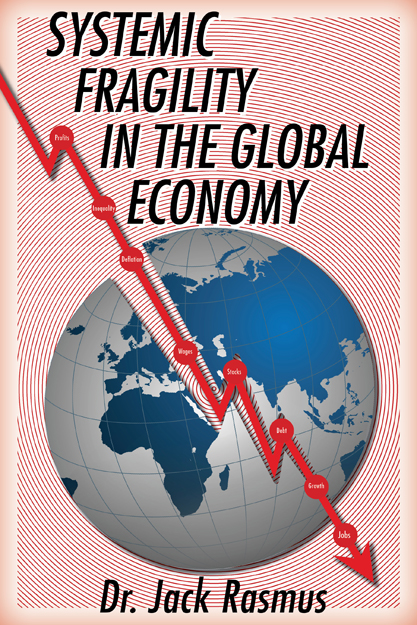
Earlier this year, 2016, I published an updated theoretical book, ‘Systemic Fragility in the Global Economy’, The first part was an empirical overview of the state of the global economy and its growing financial instability. The book concluded with my own explanation, a ‘Theory of Systemic Fragility’, that was neither mainstream economics nor contemporary Marxist, but based on a fundamental expansion of Minskyan concepts of fragility as an indicator of imminent instability and crisis eruption. The book concluded with a set of equations that summarized the theory, a work still in progress. Excellent reviews of the book were provided by professors, Bob Jessop, of the UK and Jan Pieterse, at the University of California, Santa Barbara. Their reviews are available on this blog posted earlier this year as well.

Between 2010 and 2016 other ‘case descriptions’ of economies I published were my ‘Obama’s Economy: Recovery for the Few’ 2012 and, most recently, ‘Looting Greece: A New Financial Imperialism Emerges’, Clarity Press, October 2016.

I thought readers might be interested in a transition summary, written in 2013, of my views on financial-real cycle crises’ interactions. This summary set forth in succinct 20 propositions how I viewed the interaction of financial and non-financial forces in 21st century global capitalism, three years after ‘Epic Recession’ and three before publication of ‘Systemic Fragility in the Global Economy’ earlier this year.

(The new financial forces consist of a new global finance capital elite, spreading highly liquid financial securities markets worldwide, the proliferation and trading of new financial securities being created, and the growing influence of non-regulated global ‘shadow bank’ system through which the new finance capital elite invest (and destabilize the global capitalist system. The changed real forces include the explosion of debt worldwide, stagnating real investment, productivity, wages, drift toward deflation, collapse of unions and social democratic parties, and increasing reliance by capitalist elites on monetary policy and fiscal austerity.)

I am offering here a re-publication of this interim 2013 Summary statement, “20 Propositions On Fragility and Instability in the Global Economy”, for those readers with such a theoretical interest. It reflects an evolution of my thought, and transition, from ‘Epic Recession’ in 2010 to ‘Systemic Fragility’ in 2016.

“20 Propositions On Instability in the Global Economy: How Financial and Real Cycles Mutually Interact and Drive Fragility”

Proposition 1:
Deep capitalist cycle contractions (depressions and epic recessions) are driven by endogenous forces, both real and financial, that mutually determine each other, with different relative magnitudes and directions of causality that vary with the phase of the long run boom-bust cycle.

Proposition 2:
The key endogenous Independent variable is not profits but Investment—the latter comprised of two fundamental components: real asset investment (Ig) and financial asset investment (If).

Proposition 3:
Over the boom phase of the cycle, the composition and relative weight of total investment shifts from Ig to If. In the early boom phase, financial assets are created as a one-to-one representation of the market value of real assets. A mortgage is equivalent to the original market value of a new structure, for example. But as the boom phase of the cycle progresses, If expansion becomes increasingly independent of Ig—driven by excess money liquidity, proliferating forms of credit decoupled from money, increasingly leveraged debt financing, and the increasing demand driven character of financial asset price inflation over the boom phase of the cycle.

Proposition 4:
Money may serve as credit; but credit is not limited to the money form. Credit is simultaneously money and more than money. Money may function as ‘outside credit’, but credit is also created ‘inside’ and autonomous of money. Money and autonomous credit are key to understanding the relative shift from Ig to If over the boom phase of the cycle.

Proposition 5:
The relative and absolute shift from Ig to If over the boom phase of the cycle creates destabilizing asset price bubbles and financial crashes that in turn produce deeper and more durable contractions of the real economy than typically occurs in the case of ‘normal’ recessions that are not precipitated by, or associated with, financial instability events. Depressions and epic recessions are not normal recessions ‘writ large’, but reflect the outcome of unique qualitative forces associated with financial cycle volatility.

Proposition 6:
An explosion of both money credit and autonomous credit has been occurring since 1945—the process accelerating with the collapse of the Bretton Woods International Monetary System after 1973; with the global ending of international capital flow controls in the 1980s; with the digitization of financial transfers in the 1990s; and with the global expansion of shadow banking institutions, very high net worth professional investors, highly liquid secondary financial markets, and the proliferation of multiple new forms of financial asset instruments.

Proposition 7:
Decades of excessive liquidity and autonomous credit creation has resulted in a shift to greater debt and growing debt-leveraged financing, which accelerates If forms of investment more than Ig, and short term speculative financial forms of If in particular. Rising debt leveraged financing results in more frequent, larger, and more globalized asset price bubbles and corresponding financial instability.

Proposition 8:
There is no such thing as ‘the’ capitalist price system. There are several price systems. They do not behave alike. The system of financial asset prices is more volatile, in terms of both inflation and deflation, than product or factor (e.g. wage) input prices. Unlike the latter, financial asset prices are driven increasingly by speculative demand over the course of the boom phase of the cycle, and late boom phase in particular. Financial asset prices are subject to little or no supply force constraints during the boom phase, unlike product or factor prices. As financial asset inflation occurs, demand drives prices higher, invoking still more demand, until further price increases are unsustainable and the asset price bubble collapses. Asset price deflation following the financial bust in turn drives product and factor (wage) deflation. All three price systems mutually determine each other in a negatively reinforcing way during the initial stage of the bust phase of the cycle. Asset and product price deflation together dampen Ig, leading to employment declines, wage deflation, and falling household income and consumption. Business and household defaults follow, in turning provoking more asset, product, and factor price deflation that result in rising real debt levels. A generalized downward spiral of debt-deflation-default sets in, resulting in a deeper and more durable contraction of the real economy. The capitalist price mechanism thus plays a central role in destabilizing the system—both in the boom and bust phase—contrary to prevailing mainstream economic ideology that the price system works to restore equilibrium and stability.

Proposition 9:
The forces driving financial asset investment, If, slow real asset investment, Ig, during the late boom phase by diverting financing from Ig to If, and thereafter subsequently accelerating the already declining Ig during the initial bust phase. The growing frequency, magnitude, scope, and duration of financial investment, bubbles, and crashes over the long run thus have a combined negative impact on Ig—i. e. more slowly during the boom phase (a structural effect) and more rapidly during the bust phase (a cyclical effect). This long run decline of Ig relative to If due to both structural and cyclical causes convinces successful real asset investment companies to shift more toward If forms of investment. Thus, a company like General Electric, for example, perhaps the largest manufacturer in the world, increasingly shifts to and relies upon portfolio (e.g. financial asset) investing over the longer term.

Proposition 10:
This overall ‘Financial Shift Effect’ further results in non-financial capitalist enterprises seeking to reduce labor and other factor input costs over the longer term by various measures—i.e. reducing labor costs by moving to offshore markets, demanding further tax concessions and subsidies from the state, reducing inter-capitalist competition costs (free trade), shifting operating cost burden to workers and consumers (industry deregulation), and restructuring labor costs in the home market (de-unionization, more part time-temp labor, cutting social security-medicare and private pension ‘deferred’ wages, shifting medical costs to its workforce, reducing paid time off, delaying minimum wage adjustments, etc.), to name but the most obvious.

Proposition 11:
Income for the ‘bottom 80%’ primarily wage earning households progressively stagnates and declines over the boom phase of the cycle, as operating income for both financial and non-financial corporations in contrast rises. To offset declining real income for the 80%, consumer household credit and debt grow—especially mortgage, student loan, credit card, and installment loan forms. Terms and conditions of debt repayment are typically ‘lenient’ during the boom phase, thus serving to accelerate credit and debt accumulation. Financial institutions are more than willing to extend credit and debt to such households, charging interest that in effect represents a claim on future, not yet paid wages.

Proposition 12
Systemic Fragility grows over the boom phase, accelerating in its later stages, composed initially of both business Financial Fragility and household Consumption Fragility. Fragility is a ratio and a function of three elements: rising indebtedness, declining liquid income, and the terms and conditions for which payment on incurred debt is made. Mainstream economics bifurcates this ratio: the Hybrid Keynesian wing considers income but largely disregards finance, credit and debt as equivalently important variables; the Retro Classicalist wing considers credit and debt but de-emphasizes the role of income. Both minimize the importance of ‘terms and conditions’ of repayment by focusing only on a subset—the interest rate—of this third element determining fragility.

Proposition 13:
Over the boom phase, rising household indebtedness amidst stagnating and declining household income represents rising ‘Consumption Fragility’ (CF) within the system. Similarly over the boom phase, rising financial institution (banks, shadow banks, and portfolio operations of large corporations) indebtedness that occurs with the increasing shift to debt-leveraging financing of If, represents ‘Financial Fragility’ (FF). Financial fragility during the boom phase is obscured by rising financial asset inflation. Consumption fragility is obscured by the continuing growth of consumption driven by debt. Both obscured effects disappear with the onset of the boom phase, revealing the true condition of fragility deterioration during the boom.

Proposition 14:
During the boom phase, a third form of fragility—Government Balance Sheet Fragility (GBSF)—also grows, as successive financial instability events of growing intensity require repeated government bailouts of financial institutions and as fiscal stimulus policies are introduced in successive (normal) recessions to assist recovery of non-financial corporations. In addition to these cyclical contributions to GBSF, structural causes also contribute to GBSF, as legislated tax cuts and subsidies for corporations adds further to government debt and thus GBSF. Thirdly, in the particular case of the United States, the policy choice since the 1980s to run annual and growing trade deficits adds still further to total deficits and debt levels. Dollars accumulate abroad due to the trade deficits and US trading partners agree to recycle the dollars back to the US by purchasing US Treasury bonds. Knowing the bond purchases will continue, the US federal government cuts taxes and increases spending further still, thus raising the deficit and total government debt. Federal debt consequently grows from less than $1 trillion to more than $15 trillion in the process. GBSF rises due to rising debt and falling (tax revenue) income.

Proposition 15:
During the initial bust phase following a financial crash, financial asset prices collapse and financial fragility accelerates, with its consequent effects on real Ig, employment declines, and the debt-deflation-default processes previously noted. Simultaneously, Consumption Fragility—already rising during the boom phase—deteriorates even more rapidly, driven by income declines due to mass layoffs, wage-benefit reductions, shorter hours of work and weekly earnings, and negative wealth effects as savings levels and rates of growth collapse. The financial crash thus precipitates a further ‘fracturing’ of both financial and consumption fragility. By means of the price system and the debt-deflation-default process, Financial and Consumption Fragility thus exacerbate each other in the course of the downturn. Just as the financial side of the economy causes a deterioration of real side conditions, the latter in turn cause a further deterioration of the financial side. The internal transmission mechanism of this mutual feedback is the debt-deflation-default process, which also contains its own inter-causal feedback effects.

Proposition 16:

Rising real debt, deflation across the three price systems, declining cash flow and disposable income, and the corresponding collapse of available credit transmits to the real economy in the form of a rapid decline in business and consumer spending, which in turn feedback upon each other. A faster, deeper and more protracted recession results, not a ‘normal’ recession precipitated by external demand or supply shocks, but an ‘epic’ recession precipitated by a financial crash and accelerated by an endogenous condition of extreme ‘systemic fragility’.

Proposition 17:
As the bust phase of the cycle continues and recession deepens, Government Balance Sheet Fragility—already growing per forces noted in proposition #14 above—rises further as well, as government fiscal-monetary stimulus policies attempt to halt the downturn. However, GBSF is not without limits. Under particularly severe conditions of Financial and Consumption Fragility, attempts to halt the momentum of decline by means of tax cuts and spending may prove insufficient while nonetheless adding to GBSF. The result is an extended period of ‘stop-go’ recovery, with short and brief real economic growth punctuated by repeated relapses, and even double dip recessions. This ‘stop-go’ recovery trajectory may continue for years, and even decades, should Systemic Fragility rise or remain high.

Proposition 18:
Systemic fragility in its three basic forms, and their mutual amplifying feedback effects, transmit to the real economy by means of reductions in fiscal and monetary multiplier effects. In the attempted recovery phase, the State engages in fiscal stimuli to bail out banks, corporations and investors. However, Systemic Fragility means business tax cut multipliers have sharply declined, to less than 1.0. State fiscal stimulus consequently results in business, and especially Multinational Corporations, cash hoarding. Cash hoarded is then diverted to corporate stock buybacks and dividend payouts, diversion of real asset investment to offshore emerging markets, and into new financial asset speculative investing in an effort to resort collapsed asset values and corporate balance sheets. Real investment and thus job creation subsequently lags and a stagnant stop-go recovery results.

Proposition 19: Systemic fragility and its amplifying effects also serves to reduce money multipliers. Massive money supply injections by central banks are initially hoarded, then redirected to lending offshore, to financial speculation, and to ‘safer’ large corporations. Banks reduce lending to ‘less safe’ smaller businesses and households, further reducing investment, jobs and consumption demand. Money demand and money velocity thus offset money supply injection by central banks. Central bank QE and zero interest policies provoke instead new financial bubbles in stocks, junk bonds, real estate, foreign exchange and derivatives trading. Currency wars erupt as money injection policies depress currency exchange rates. Banks and financial markets become increasingly addicted (dependent upon) central banks money injections. Globally, financial speculation raises the specter of further financial instability on a real economy base further weakened by the preceding cycle of economic contraction. The risk of bona fide global depression rises in time.

Proposition 20:
In the context of conditions noted above—of systemic fragility and growing feedback amplitude effects—traditional fiscal-monetary policy tools attempting to expand the economy are rendered increasingly ‘inelastic’ (i.e. less sensitive or effective) in generating a sustained economic recovery. Conversely, when such tools are employed to contract the economy, via austerity fiscal policies and/or central bank raising of interest rates, the effects are more ‘elastic’ (i.e. more sensitive and effective) in contracting the real economy. Fiscal-monetary policies are therefore not simply increasingly non-productive but, over time, become counter-productive in generating recovery. Solutions to recovery consequently lie in the necessity of a major restructuring of the economy along multiple key sectors including, but not limited to, the tax system, banking system, retirement and healthcare systems, labor markets and public investment—with the purpose of redistributing income while simultaneously reducing debt. That is, reducing systemic fragility in aggregate as well as its mutual amplifying effects.

Jack Rasmus, copyright April 2013

I

For my assessment of the effects of the US central bank’s raising US interest rates last week (and plans for more), the impacts on US and global, and coming US tax cuts and infrastructure spending, listen to my Alternative Visions radio show…

Go to:

http://alternativevisions.podbean.com

SHOW ANNOUNCEMENT:

Dec 16th, 2016 by progressiveradionetwork

Dr. Rasmus reviews the US central bank’s decision this past week to raise rates, with three more hikes coming in 2017 (and more after in 2018-19). What’s really behind the Fed’s rate hikes’ decision? Why US economic elites have decided to shift policy to boost corporate and investor incomes more from fiscal policy in 2017 and after than from monetary policy over the past eight years, 2008-2016. What’s the impact on the US real economy from the shift and why it may not be as great as pundits predict. Why rising rates for the rest of the rest of the US economy may destroy more jobs than infrastructure spending may generate, and the former happen faster than the latter. The outlook for US housing, autos, retail sales. Why real wages may fall. How the euphoria of US stock markets conceals areas of real economic weakness that continue and may grow worse. Jack further reviews the effects of US Fed rate hikes on Europe, China and emerging market economies in Latin America and South Asia. How emerging markets are already now experiencing currency declines, capital outflows, financial instability, and will experience deeper recessions in the year ahead; why Europe will continued slow growth and stagnation and why China’s currency, the Yuan, will devalue beyond its trading band in coming months due to US rate hikes and dollar rise, and may intensify a US-China trade war.

Listen to my December 9 Alternative Visions radio show on the growing bubble in US stock markets (S&P 500, DOW, Nasdaq, Russell). What are the various drivers and causes, US and global, behind the bubble and what its consequences in 2017-18.

To listen, go to:

http://prn.fm/category/archives/alternative-visions/

or go to:

http://www.alternativevisions.podbean.com

SHOW ANNOUNCEMENT

Dec 9th, 2016 by progressiveradionetwork

Jack focuses on the bubble growing in US stock markets, as money capital surges out of bonds and from Europe and emerging markets into US stocks. All US markets are at record levels, with the DOW having tripled since 2009 in value. Jack discusses the various causes and origins of the current bubble, including the global rotation from bonds, anticipated Trump infrastructure spending and massive corporate tax cuts, multi-industry deregulations coming, and devaluing foreign currencies. The recent Saez report on income inequality trends is reviewed in contrast. Why capitalists are switching from monetary, central bank policy now to fiscal policy to continue massive gains for the 1%. Other negative data for the US is reviewed, including productivity trends and public debt. The show concludes with a discussion of the recent Italian referendum and Italian banks and China’s pending currency devaluation and bank problems.

Taming Trump (print)

The following is a forthcoming article expanding at length on how US elites are maneuvering with the Trump administration and transition team, compromising in the short run but preparing in the longer to ‘tame Trump’ by various means should he depart too radically from mainstream elite policies. The piece is offered here to readers, despite its length more appropriate for a magazine than a blog.

Taming Trump, by Jack Rasmus, copyright 2016

“In the weeks since the November 8 US presidential election, the dim outlines of what a Trump presidency might look like are beginning to appear. Trump continues to retreat on several fronts from his campaign ‘right populist’ positions, while doubling-down on other radical positions he previously proposed during the campaign. How to make sense of his apparent evolving policy divergence?

One the one hand, Trump appears to moving closer to traditional Republican party elite positions on big reductions of taxes on corporate-investor elites and on delivering long standing elite demands to deregulate business; at the same time he appears to be moderating his position with regard to that third top priority of the US neoliberal elite—i.e. free trade—as he back-peddles rapidly from his campaign attacks on trade and free trade agreements.

At the same time Trump appears to be doubling down on his campaign’s radical social policy issues like immigration (promising to immediately deport or jail 3 million), taking a harder line position on law and order and civil liberties (declaring those who burn the flag should lose their US citizenship or go to jail), reaffirming his intent to privatize education services (by appointing a hard liner as Education Secretary who strongly favors charter schools and school vouchers), attacking environmental programs and protestors (calling for restoration of the Keystone pipeline), while showing early signs of moving closer toward Congressional Republican elite leaders, like Paul Ryan, and Ryan’s radical proposal to replace current Medicare with a federal ‘voucher’ system that would freeze the amount Medicare would pay doctors and hospitals as health care costs continued to escalate.

Areas Still Vague: Infrastructure Spending and Foreign Policy

Less clear than Trump’s above policy bifurcation are what policy positions he will take on fiscal and monetary matters.

Trump campaign promises of more government spending on ‘infrastructure’ still remain too vague. Will that mean more oil and gas pipelines and coal mining? More tax cuts to construction companies? More direct subsidies to businesses? And how much ‘spending’ is involved? Early indications are the infrastructure program may be mostly tax credits for businesses—and in addition to his massive corporate-investor tax cuts also planned. Trump in the past has called for $1 trillion. (Clinton had called for a $250 billion program over five years. That $50 billion was just about the amount the US now provides in subsidies to agribusiness). And so far as infrastructure spending’s impact on the US economy, $50 billion a year is insignificant. $1 trillion and $100 billion a year over ten years, Trump’s campaign proposal, might have some effect on US GDP. But GDP growth does not necessarily translate into benefits in income to all—as the last eight years has clearly shown as 97% of all GDP-income gains under Obama have gone to the wealthiest 1% households. Nor will infrastructure spending likely translate much into job creation—and could especially result in little positive impact on jobs if infrastructure spending is composed mostly of tax cuts, business subsidies, and high capital-intensive projects that may take years to realize. It is highly unlikely Trump is talking about a 1930s-like ‘public works program’. It’s more likely to be the federal government writing checks to big construction companies, pocketing nice profit margins in the process.

Trump’s influence over monetary policy in general—and interest rates in particular—will be even more minimal. The US elites will strongly oppose any Trump attempts, as promised during the election, to ‘reform’ the US central bank, the Federal Reserve. And the Federal Reserve’s interest rate hike cat is already out of the bag. Long term rates have been already rising rapidly and will continue to do so, as will the US dollar in turn, as the two—rates and the dollar—are highly correlated. And the Federal Reserve is clearly on track to raise short term rates soon.

The question is whether the rise in interest rates—short and long term–will discourage investment, thus hiring and job creation, in those industries not directly affected by infrastructure spending? Will the negative effect of rate rises on investment and job creation be greater than the positive effect of infrastructure spending? Will those negative effects emerge sooner than the positive from infrastructure investment? And will the rising dollar associated with the rate hikes further reduce manufacturing exports and jobs in that sector? The dollar rise has already stagnated manufacturing output and employment. Further increases will almost certainly result in a contraction of manufacturing exports and jobs.

‘Yes’ is probably the answer to all the above, which means Trump job creation net effects during his first two years in office may not materialize. Moderate at best job creation from delayed infrastructure spending could be more than offset by job loss from rising rates and the US dollar.

The other major Trump policy area that still remains vague is foreign policy. It is not clear as yet what Trump’s true positions will be on NATO and China. But the US elite are intent on bringing him around to their positions and will exert extreme pressure on Trump in order to do so. They have already begun to do so. They will not let up on the pressure.

Trump’s intent is to become more militarily aggressive against ISIS in the middle east, and possibly ‘partnering’ with Russia to do so. That latter possibility is currently causing fits with US elites behind the scene. Backing off from NATO military deployment provocations in eastern Europe, the US-NATO current policy, while looking favorably on Europe’s backing off of economic sanctions against Russia, may also become Trump policy.

Trump’s Big Three Cabinet Appointments

Whether that foreign policy redirection occurs under Trump is now playing out in backroom maneuverings within the Trump administration with regard to key Trump cabinet appointments involving departments of State, Defense, and remaining national security positions. The elite want Romney. Populist right forces in the Trump camp do not. And behind the appointment issue is whether a Secretary of State position under Trump becomes a mere figurehead to Trump foreign policy decided in the White House by Trump and his close aides like General Flynn and others.

The US elite want Romney and they want their Secretary of State to have independence. Should Romney get the appointment here, it will signal they have prevailed. The result will be a bifurcation on foreign policy directions in the Trump administration which will ultimately break down at some point.

Obama’s recent ‘tour’ of NATO countries should be viewed as an effort by US elites to try to ensure NATO allies that Trump’s campaign proposals targeting NATO will not be the final position of the Trump regime. The Obama tour was in part at least to hold NATO allies’ hands and ask them to be patient—i.e. the elite will bring Trump around to reality. Be patient. We will eventually ‘tame’ Trump is no doubt the message. After Europe, Obama scurried back to Asia, attending the APEC economic summit, and providing no doubt similar assurances to US allies there that Trump would ‘come to his senses’ as cooler elite heads advised him.

Trump appears to have just appointed General (nicknamed ‘mad dog’) Mattis. Petraeus, a more establishment figure under consideration is out; or maybe Petraeus decided himself that hitching a ride on a Trump administration was not the greatest career restoration move. But the Mattis appointment still leaves the direction of a Trump administration’s policies on NATO, Russia, or Asia up in the air.

The third key cabinet appointment is Secretary of the Treasury. Here Trump’s transition team initially appeared to favor the CEO of the biggest US bank, Chase’s Jaime Dimon. Treasury secretaries in recent decades, under US Neoliberalism since Reagan, have always been heads of some big financial institution. And in recent decades, the Treasury Secretaries have repeatedly been alumni of the big investment bank, Goldman Sachs. And so too is Mnuchin, continuing the trend of the wheeling-dealing ‘shadow banking’ sector still dominating the Treasury.

Together with Wilbur Ross, appointed to Commerce Secretary, also a ‘shadow banker’ and former Private Equity Firm owner, the Mnuchin-Ross team will determine banking and economic policy in the Trump administration. Their initial target will no doubt be dismantling what’s left of the skeleton of the Dodd-Frank banking regulation bill.

Trump ‘Free Trade’ Policy

Trade as a policy has both foreign policy and economic dimensions. The US elite is now facing a major challenge, having temporarily lost the TPP and with the Europe TTIP in trouble, given a year of intense political instability on the horizon in Europe. They will focus on just keeping the prospects alive temporarily. In the meantime, the thrust is to prevent the deterioration of NAFTA, CAFTA, and other bilateral free trade deals signed under Bush and Obama. The objective will be to stop Trump from making any changes in NAFTA in the short term, and ensuring whatever changes after is cosmetic and token in the longer term.

Taming Trump may prove more difficult with regard to Free Trade, however, compared to getting Trump to implement US elite objectives on matters of tax cuts and deregulation. Trump’s positions during the election were strongly anti-Trade. It played a key role in his election victory, and clearly in the key states of Pennsylvania, Michigan and Wisconsin. It will be more difficult for him to renege and about-face on the trade issue. Taming Trump will prove more difficult.

But here’s how it nonetheless may develop:

Reversing the worst effects of NAFTA cannot be done in the short term. The elites have many ways to slow and block his efforts. Some token renegotiation of NAFTA will eventually take place, resulting in minor adjustments. In the meantime, however, Trump can gain publicity and placate his base on this issue by achieving ‘victories’ discouraging specific companies to abandon plans to relocate to Mexico or abroad. Recent events involving Ford Autos and the Carrier company are examples of what may be the Trump short term policy direction with regard to trade.

As for other multilateral free trade treaties, Trump has declared he would stop the TPP, Transpacific Partnership Asia-US free trade deal. But that was already dead in Congress. And the US-Europe counterpart to the TPP, the TTIP, is impossible in 2017 with the accelerating upheaval in European politics and coming unraveling of the Eurozone after next week elections in Italy and Austria, and with elections in France, Netherlands and Germany on the agenda in 2017.
What will Trump’s longer term free trade policy look like? It is important to understand that Trump is not against free trade. He opposed multilateral programs, which were at the center of US neoliberal elite objectives. Trump’s free trade policy will be to negotiate country-by-country free trade deals. Renegotiating free trade will make it appear as if he’s dismantling it. But the process will take a longer time, certainly not in the first year or two. The US elite can probably live with that. Their task in ‘taming Trump’ is to ensure he does not take precipitative action against current free trade deals, that he puts off such action, and settles into a longer term bilateral renegotiating policy. In the meantime, it will be more highly visible personal actions like the Ford and Carrier deals, to make it appear he is doing something on the matter.

What that all means is that except for token company examples like Ford and Carrier, free trade deals will continue. The US elite will get to continue their Neoliberal policy priority of free trade, just in another form that emphasizes slow, token changes to existing agreements and bilateral new free trade agreements. But free trade bilaterally is still free trade. And job losses and wage compression, the two major consequences of free trade deals, will continue. It’s just free trade in another form.

Trump is betting that the lack of job creation, from a retreat from is promises to ‘bring back jobs’ lost to trade, will be offset by job creation from infrastructure spending. Meanwhile, he can and will claim he is saving jobs by talking down Ford, Carrier, and other companies. Alongside this, bilateral free trade deals will go forward.

Massive Tax Cuts and Business Deregulation

The other two major priorities of the US elite are big corporate-investor tax cuts and deregulation. Here Trump has signaled he is in full agreement with the elite. No need to ‘tame’ Trump here. These policies will be forthcoming almost immediately in the new Trump regime.

Trump has proposed to cut corporate taxes even more than the Ryan-Republican Party faction in Congress. From the current 35% corporate rate, Trump proposed reducing it to 15% while Ryan and friends to 20%. Both are in agreement to reduce the top income tax rate for their wealthy friends, from current 39.6% to 33%. The Capital gains tax, now 23.8%, is scheduled for a cut to 20% by Trump and 16.5% by Congress. Both Trump and Ryan plan to abolish the Estate Tax, reducing taxation on estates worth $7 million (now the threshold) altogether. Both are strong proponents of allowing big US multinational corporations in Tech, Pharma, Banking and others to ‘repatriate’ $2.5 trillion in taxes they have been hoarding in profits offshore to avoid paying the US 35% rate to a low of 10%. The 4.8% surtax on the wealthiest to help fund Obamacare will also certainly disappear. Also notable is that net taxes on the middle class will rise under both plans, and the countless loopholes for investors will continue.

It should be noted that this massive tax cut package amounts to $4.3 trillion, according to Trump. But according to the Tax Policy Center research group, it will reduce federal revenues by $6.2 trillion. The wealthiest 1% would realize a 13.5% cut in their taxes, while the rest of all households would have a 4.1 % rise in their taxes.

This $4.3 or $6.2 trillion follows a $5 trillion tax cut agreed to by Obama, Democrats and Republicans in Congress that took place in early 2013 as part of the then phony ‘fiscal cliff’ crisis. That followed a $800 billion tax cut pushed by Obama at the end of 2010, in which Obama continued the previous Bush tax cuts for another two years and then some. That followed a preceding $300 billion tax cut in Obama’s 2009 initial recovery program. And all that came after George W. Bush’s estimated $3.4 trillion in tax cuts in 2001-04, 80% of which accrued the wealthiest households and businesses. So under Bush-Obama, taxes for the rich and their corporations totaled approximately $9.5 trillion, and now Trump-Ryan propose another $4.3-$6.2 trillion minimum, running the total up to more than $15 trillion.

And corporations and their lobbyists won’t wait for the tax cut legislation. They are already pressing for a Trump reversal of Obama administration measures over the past year to slow the rampant ‘tax inversion’ scams by big multinational tech, pharma and banks, that have been avoiding taxes by shifting their company headquarters offshore on paper. Corporations have avoided paying hundreds of billions of dollars in US taxes in just the past three years by means of ‘inversion’ scams. Trump doesn’t have to wait for Congress, for him to open the floodgates allowing massive corporate tax avoidance through unlimited ‘inversions’ once again. Big business lobbying arms, like the Business Roundtable, American Bankers Association, and National Association of Manufacturers are reportedly already demanding Trump lift all restrictions on ‘inversions’.

Trump and Ryan-Congress are no less in synch on the third policy priority of US elites—deregulation. Like corporate-investor tax cutting, Trump and the US elite are on the same page when it comes to deregulation. High on this agenda will be slicing the Affordable Care Act (Obamacare). Trump will not need to repeal it and won’t. It will be given a ‘death by a thousand cuts’ and allowed to collapse. Already in big trouble as a program unable to control health insurance costs or prescription drug price gouging, ACA provisions like mandatory insurance purchases and the 4.8% surtax on the wealth to help pay for the subsidies are likely to go quickly. A similar major deregulation will be the Dodd-Frank banking regulation act, which has already had much of its provisions defanged since its passage in 2010. A main target will be the Consumer Financial Protection Agency.

To gain public awareness of his pledges to deregulate, Trump will immediately in 2017 repeal, however, as many Obama Executive Orders as possible. Receiving the brunt of this will be immigration provisions, like the Dream Act, and numerous Environmental regulations. Trump’s EPA head will no doubt immediately reverse the regulations involving the industrial plant pollution proposals not yet or just recently proposed. In Labor matters, overtime pay rules and private pension rules are targets as well. Trump will immediately in 2017 reverse all the regulations he possibly can by Executive Order. That includes the Dream Act for youth of immigrants in the first 100 days, and new Executive Orders giving new powers of detention and arrest to border and police officials. Efforts by cities and universities to provide sanctuary to undocumented immigrants will result in immediate harsh financial and other actions against those same. Recent minimal rulings by the National Labor Relations Board favoring union workers and institutions will be quickly reversed as well.

The US elite, in Congress and beyond, will tolerate much of this deregulation, as well as a significant assault on immigration, law and order, policy repression of ethnic communities, deportations, limits on civil liberties, cuts in social programs, and privatization proposals across the board involving education, Medicare, and healthcare. Their priority is passage of policy in the areas of tax cuts, deregulation, and delaying any potential actions that might endanger existing free trade agreements.

Getting Trump to back off his campaign promises—i.e. his right wing populism—in areas of foreign policy and trade redirection are also elite priority issues. Trump has never needed ‘taming’ on tax and deregulation issues. And he will be allowed to proceed with elements of his right wing populism that involve attacks on environment, law and order, civil liberties, and immigration—so long as the latter involves low paid undocumented immigration from Latin America and does not interfere with the 500,000 high paid tech jobs legally given to Chinese and Indian immigrants on H1-B and L-1/2 visas. And so long as he doesn’t proceed so fast that it precipitates excessive social unrest. Go slow, he will be told. Nothing too extreme. And ensure that taxes, deregulation, trade and foreign policy are priority and are concluded first.

The US elite will abandon Trump if he doesn’t play ball on taxes, deregulation, going slow on Trade, and if he upsets long-standing foreign policy directions too radically. They will let him run amuck on issues of immigration, civil liberties, law and order, environment, and privatizing of social programs. So how might that elite ‘tame trump’ if and when necessary? The preparations just in case are already underway. They include the following:

How To Tame Trump

There are at least six ways by which they can, and are now preparing, to control him.

1. Trump Business Conflicts

Trump has 111 businesses in 18 countries. It is not possible to even put these in a blind trust, as previous presidents have done with their business interests. The elite will gather all the incriminating evidence they can to reveal his conflicts of interests, if necessary, at some point. They will threaten Trump quietly first to reveal and proceed against him and, if he doesn’t respond in their favor on some issue or policy, start the process of undermining his reputation and credibility in the media and with public opinion. Keeping the heat on will be mainstream media like the New York Times, Washington Post, and major broadcast TV sources. It won’t be difficult to dig up the dirt.

2. Trump Foundation

Like the Clinton Foundation, as with foundations of many of the super wealthy, the Trump Foundation is a source of potential major scandal. Incriminating or even insinuating investigations will be undertaken quietly, and then publicly if necessary.

3. Nepotism Charges

Trump has already shown a preference for family member involvement in his administration. That opens him to criticism of nepotism. That becomes the nexus for alleging Trump using the presidency to enrich himself indirectly through his family connections.

4. Trump’s Tax Returns

Trump may not have released his returns during the campaign, and probably for good reason. Few in the wheeling-dealing commercial real estate sector are squeaky clean when it comes to tax avoidance and even fraud. The worse of his tax matters will be quietly passed on to the New York Times and other media. They can be revealed at the appropriate juncture, if Trump doesn’t ‘play ball’ with the elite on matter of policy the latter consider strategic.

5. Attacks on Trump Appointees and Family

Trump can be damaged and undermined by attacking his appointments and family members. Favorite targets will be radicals like Steve Bannon of Breitbart who has been brought into the Trump White House as advisor. Trump’s son-in-law may prove another favorite target. So might even be his appointed national security adviser, General Flynn. Already major feature pieces on Bannon have appeared in the Times and media. The media continues to keep alive Flynn’s alleged pro-Russia views and contacts. Meanwhile, talking heads experts continue to appear on the mainstream press TV shows like CNN, MSNBC, CBS and others continuing the press the election themes of Trump’s character limits and dangerous personal traits. The elite will keep these issues of Trump judgment and volatility before the public, until Trump comes around and adopts US elite policies, especially on foreign policy, trade, and other matters.

6. Violations of Law

Trump’s proclivity to engage in tweets may yet get him in serious legal trouble. So too may any precipitous incitement of radical elements and actions that result from his public statements. Or any premature over-reaching Executive Orders.

From ‘Faux Left’ to ‘Faux Right’ Populism

In 2008 Barack Obama ran for president based on a program that in some ways was clearly populism. Entering the president primary race late, in early 2008, Obama’s advisers vaulted him to the nomination six months later by employing a strategy that consistently was to the left of the other Democrat candidates, Hillary Clinton and John Edwards. Obama appeared the popular left candidate. Many voters were sufficiently misled. Immediately after elected, however, Obama proceeded to appoint advisers and cabinet members who were clearly representatives of the banking industry and business interests in general. Neoliberal policies were given a ‘left cover’, as Obama then ruled from the ‘center-right’ on key matters of economic policy of primary interest to the elite—i.e. bailing out the banks, rescuing big businesses from bankruptcy, ensuring the stock and bond markets boomed, pressing for free trade deals, going slow and minimalizing banking regulation, ensuring healthcare reform did not include the ‘public option’ or even consider Medicare expansion, and turning over US jobs and trade policy to figures like Jeff Immelt, CEO of General Electric. Mortgage companies were given preference over bailing out homeowners facing foreclosure and ‘negative equity’. Latinos were deported in record numbers, students allowed to accumulate more than $1 trillion in debt, job creation involved mostly low paid, contingent service work, pensions were allowed to collapse, senior citizens’ savings evaporate while investors enjoyed eight years of near zero interest rates, and progressive labor legislation was quickly shelved.

What started as a hope of a resurrected left populism quickly and progressively decayed into a comprehensive program that delivered 97% of all income gains to the wealthiest 1% households.

Voters chose a black president in 2008 because they wanted change. They didn’t care about his race. They didn’t get it. In 2016 they now voted again—for change. Those voters did not become racist in the past eight years, even though the candidate they just voted for indicated in many ways he himself was racist and misogynist, to name but a few of his apparent character faults. Those voters who in 2008 chose a ‘left populism’ that turned out to be false, chose in 2016 a ‘right populism’. But what they will get is not populism but another disappointment.

Like the Obama regime, the Trump regime will retreat to a neoliberal US elite regime. It will be a ‘Neoliberalism 2.0’. An evolved new form of Neoliberalism based on the continuation of pro-investor, pro-corporate, pro-wealthy elite economic policies—with an overlay of even more repressive social policies involving immigration, law and order, privatizations, cuts in social programs, more police repressions of ethnic communities, environmental retreat, limits on civil liberties, more insecurity and more fear. This is the new form of Neoliberalism, necessary to continue its economic dimensions by intensifying its forms of social repression and control.

We predict Trump will concede to elite neoliberal policies on Trade and Foreign Policy eventually, as he already is about to do with regard to elite policy preferences on taxation and deregulation. If he does not, elite interests are waiting in the wings, gathering the evidence and ammunition to attack Trump more directly if necessary, should he not comply. So long as he plays ball with them, they’ll just hold their ammunition at the ready. They will lock and load, and cock the hammer, taking aim and give a warning.

Trump will respond. He will come around to their demands. After all, he has more personally to even lose than did Obama. Faux left is replaced by faux right in American politics.

Jack Rasmus

Jack is the author of Systemic Fragility in the Global Economy, by Clarity Press, 2016, ‘Looting Greece: An Emerging New Financial Imperialism’, by Clarity Press, October 2016, and the forthcoming ‘Central Bankers at the End of Their Ropes’, Clarity Press, March 2017. He blogs at jackrasmus.com. His website is jackrasmusproductions.com. His twitter handle is @drjackrasmus.