Feeds:
Posts
Comments

Bond markets in Europe and US are in rapid retreat this past week, in the wake of central bank announcements of coming rate hikes and balance sheet sell-offs. Will it spread to bubbles in stock markets in the US and elsewhere? Listen to the Alternative Visions radio show of June 30, 2017 for the discussion.

Go To:

http://prn.fm/?s=Alternative+Visions

Or Go to:

http://alternativevisions.podbean.com

SHOW ANNOUNCEMENT:

Dr. Rasmus reviews key decisions by central banks this past week that are making investors nervous about stock and bond market bubbles that have been created since 2008. Heads of central banks in Europe—the ECB and Bank of England—this week signaled they too may raise interest rates and sell off their QE balance sheets—following the US Fed’s announcements of last week. Is the free money provided by central banks to private bankers and investors now coming to an end? QE free money alone has amounted to $15 trillion since 2009—feeding the financial bubbles in stocks, bonds, currencies and derivatives. Pulling this ‘life support’ of free money from the banks—i.e. off the free money oxygen ventilator—has investors now nervous, Rasmus explains. An emerging ‘bond rout’ may be the tip of the financial iceberg. At the same time, the US Fed this past week also announced its annual phony bank stress tests and it will allow banks to reduce their capital safety cushions by accelerating bank dividend and stock buyback payouts to shareholders. US banks are projected to increase payouts to 100% of this year’s profits. (Chase to 110% and $27 billion). Bank stock prices surged driving US stocks higher into bubble territory. Will the bond rout spread? Will the stock bubble end? Central banks now perform a new function of ‘permanent subsidization of private banks’ in the 21st. century, Rasmus explains.

Listen to the past two Alternative Visions shows on the Federal Reserve Bank topic. June 16 on the recent Fed Interest Rate hike and June 23 on How the private banks really control the Fed, not the government. (Additional comments on Trump’s failed job promises and what’s really happened at Carrier Corp., Ford, and jobs).

TO listen go to:

http://alternativevisions.podbean.com/

or go to:

http://prn.fm/?s=Alternative+Visions

2 Show Announcements:

JUNE 23 SHOW ANNOUNCEMENT:

Dr. Rasmus continues the review of the Federal Reserve Bank, showing how the private banks today control the Fed more than ever in recent decades. How the Fed’s structure permits private banking interests to dominate strategic decisions of the central bank, and how there control of the Fed is about to deepen further under Trump. Jack explains how the expansion of Debt before 2008 was the source of the crisis, and how $50 trillion more debt has been added globally since 2009. Debt is the appearance of the crisis. Excess credit has enabled it but excess liquidity provided for decades by the Fed and other central banks is the source of the excess credit and debt. How the Fed and other central banks contributed to the last financial crisis and have been creating the next. The explosion of central bank liquidity under Greenspan from 1986 to 2006 is detailed, leading to multiple financial bubbles and culminating in the 2008 financial crash. Jack previews the show with comments on ‘Donald the Trumpet’s claim he saved 1100 jobs at Carrier Corp, but facts show Carrier is sending 600 jobs to Mexico and automating away the rest in the US. How ‘The Trumpet’ claims of jobs in auto and mining also are false. (Next week: The Fed under Bernanke and Yellen).

JUNE 16 SHOW ANNOUNCEMENT:

Dr. Rasmus reviews the Federal Reserve’s interest rate hike decision this past week, showing how the Fed’s justifications for the rate hike based on ‘data’ are contradictory. How the data show no hike was justified. Rasmus explains how the Fed has been manipulating reporting the data on prices, unemployment and wages in order to justify 8 years of zero rate borrowing by the banks—i.e. 7 years after the banks were fully bailed out in 2010. More than $15 trillion in virtually free money was provided by the Fed to bankers and investors since 2009 as a result. Rasmus also addresses the Fed’s announcement this past week to begin selling off its $4.5 trillion balance sheet, but explains that will be token and temporary. Rasmus predicts the Fed’s recent string of 3 rate hikes has reached its limit now that the US economy is weakening once again. The second half of the show returns to the theme of ‘Central Banks at the End of Their Ropes’ and the origins of the Fed as a creation of the private banks, a corporation funded by and run by the private banks. (Next week: The Fed under Greenspan and Bernanke).

To listen to my continuing analysis and critique of central banks (and the collapse last week of Banco Popular in Europe), go to my Alternative Visions show of June 9:

Go to:

http://prn.fm/?s=Alternative+Visions

Or go to:

http://alternativevisions.podbean.com

SHOW ANNOUNCEMENT:

In the first half of the show, Dr. Rasmus reviews key economic events of the past week, including the collapseof ‘Banco Popular’ bank in Europe and what it might mean in coming weeks to Europe’s fragile banking system, the emerging problems in Junk Bonds and the retail sector in the US, renewed falling oil prices, the US House passing the ‘Financial Choice Act’ and new bank deregulation, and Turmp’s phony ‘Infrastructure Week’ announced this past week and why ‘infrastructure’ really means privatization. Rasmus then discusses the origins of the US central bank, the Federal Reserve, in 1913 and how central banks evolved out of private banks and still retain deep connections to private banking systems. How the Federal Reserve originated from the Financial Crisis of 1907 and was developed by big New York banks as a way to capture control of a monopoly of a single currency, become the national ‘clearing house’ of all banks, and create an institution, the Fed, that would provide money to bail themselves out during periodic bank crises instead of having to bail themselves. Jack describes the early structure of the Fed, and how it was owned, financed, and directly controlled by the private banks, with the New York Fed operating as the ‘central bank of the central bank’. (Next Week: The Evolution of the Federal Reserve from the great depression to the crash of 2008).

To watch my June 6, 2017 Interview on the TV show, ‘Other Voices’, on the Trump Budget’s $1 trillion spending cuts and attack on the working poor, and why central bank monetary policies of 8 years of free money to the banks is the ‘new policy norm’,

Go to:

Or go to:

Video: War on the Poor (And just about everyone else)

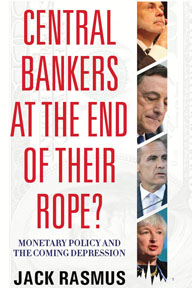
Why did the Federal Reserve bail out the banks by 2010 to the tune of more than $10 trillion–and keep providing them free money for the next 7 years? Listen to the first of a four part series by Dr. Rasmus, summarizing his forthcoming June 2017 new book, ‘Central Bankers at the End of Their Ropes? Monetary Policy and the Next Depression’, by Clarity Press, June 2017.

To listen to the Alternative Visions show of June 2 on the Progressive Radio Network on this first of a four part series, go to:

http://prn.fm/?s=Alternative+Visions

Or Go to:

http://alternativevisions.podbean.com

SHOW ANNOUNCEMENT:

Dr. Rasmus begins a four part series examining the role and function of central banks in the global capitalist system, and how that role evolved through the 20th century and is changing again in the 21st. In Part 1 of a proposed four part presentation, Rasmus explains how central banks have been the primary source of runaway money and liquidity generation that is the root cause of accelerating global debt. Debt is but the reflection of the more fundamental problem of excess liquidity creation by central banks since the 1970s. It is liquidity that enables debt accumulation, which then leads to financial asset bubbles, busts, deflation, defaults, which then transmits the crisis to the real side of the economy producing ‘great recessions’ and eventually depressions. Central banks then bail out the banks—injecting still more liquidity again—leading to a renewed cycle of debt, bubbles, and crisis. Rasmus asks why the Fed, which bailed out US banks by 2010 has nonetheless continued for 7 more years providing free money to the banks to the tune of more than $10 trillion? Their ole of central banks has expanded beyond its primary task of bank bailouts this century, Rasmus argues. Continued injection of trillions of free money has become their new 21st century primary function—i.e. to continue to subsidize the financial sector and financial markets (stocks, bonds, derivatives, forex, etc.) . Central banks are evolving, Rasmus argues, along with the rest of the capitalist State toward an ever growing subsidization of Capital in general. Can global capital survive without expanding State subsidization of profits—central banks subsidizing financial markets and finance capital and other sectors of the State other non-financial forms of capital. (Next week Part 2: The origins of the US central bank, its 20th century performance, and why in the 21st it is failing as it evolves toward its new subsidization role).

To listen to my analysis of Trump’s budget released this past week–and other recent global and US economic news–listen to my Alternative Visions radio show of May 26, 2017. GO TO

http://alternativevisions.podbean.com

or go to:

http://prn.fm/?s=Alternative+Visions

SHOW ANNOUNCEMENT:

Dr. Rasmus examines the Trump budget released this past week, which is based on a crude restatement of Supply Side economics bullshit that has had no evidence in reality since it was first introduced under Reagan in 1981. Rasmus explains why the budget’s ridiculous assumption of 3-3.5% GDP for the next decade is nonsense. How the budget double counts tax revenues that won’t materialize. And why corporate-business tax cuts historically have not created jobs and won’t this time again. A background to the budget is explained, including how the US neoliberal ‘twin deficits’ of trade deficits enabling budget deficits has worked since 1980 and why falling tax revenues since 2000 accounts for more than 60% of US budget deficits since 2001 along with war spending increases and health care system price gouging. The show previews with a review of last week’s falling oil prices, protests in Greece and Brazil, warnings about China’s business debt and new US economy potholes of collapsing bank lending and stalling home sales. (Next week: Part 1 of a four part series previewing Dr. Rasmus’ new book to be released in June, “Central Bankers at the End of Their Rope: Monetary Policy and the Next Depression”, by Clarity Press—a thorough debunking of central banks and why they are failing).

Brazil is transitioning to a greater political crisis based on events of the past week, May 2017. The origins of the political crisis, however, are economic. Business and right wing forces precipitated the legal coup of 2016 to put their political representatives in direct control to enrich themselves again. The coup, however, was made possible only by the Brazilian economy’s deep recession of recent years, which was precipitated by its central bank raising interest rates to 14.25%, in order to prop up the value of its currency and prevent the collapse of assets of the wealthy.

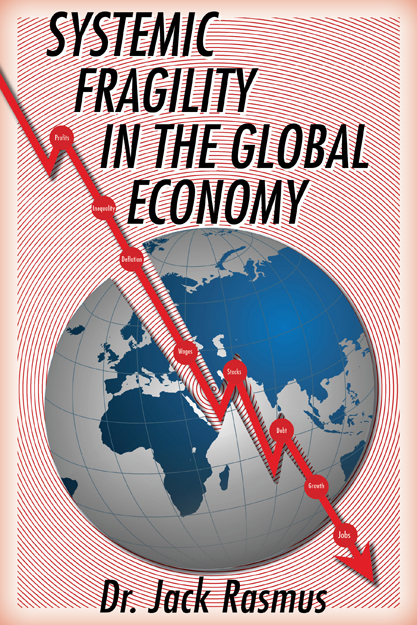
How the Brazilian economy collapsed into recession was addressed in chapter 3, ‘Emerging Markets Perfect Storm’, in my 2016 book, “Systemic Fragility in the Global Economy”, Clarity press, 2016. (see the book icon on the front webpage of this website for reviews and more detail).

To read the chapter’s excerpt on Brazil’s economy, go to the following url to the ‘articles’ subpage on my website.

http://www.kyklosproductions.com/articles.html

While pundits, press and politicians hype a US economic recovery underway today, listen to my contrarian view focusing on some of the weakspots in the US economy that may result in a continuation of the sub-par trend that has been the hallmark of the US economy since 2010.

To listen go to:

http://www.alternativevisions.podbean.com

or go to:

http://prn.fm/?s=Alternative+Visions

SHOW ANNOUNCEMENT

Last week the US stock market experienced a major hiccup as it now appears the US economy is softening in areas and the ‘Trump Trade’ may not materialize. Dr. Rasmus explores the soft spots in the US economy in US policy, business spending, household consumption, trade and government spending. Consumer and Corporate debt data released by the NY Federal Reserve raises a red flag. Rasmus explains the relationship between debt, income to service debt, and terms and conditions affecting debt payments and the importance of these relationships to the US economy. Why jobs and real wages are not going to improve much more, why household debt is now greater than in 2008 and business debt twice the levels it was in 2008. Rasmus predicts the US economy will grow less than 2% for the entire year, far less than the Trump administration’s prediction of 3-3.5%, and explains why this will be so. (Next week: review of the Trump final budget proposal of spending cuts, defense spending increases, and tax cuts).

Greek people are again protesting against yet another annual tightening of austerity by the Troika. The Syriza government agrees again, as in 2016, 2015, 2012, and 2012 to demands by the Troika to impose even harsher austerity terms.

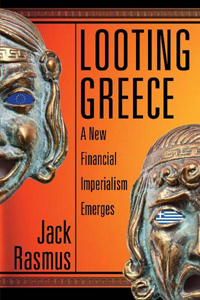
Watch my 10 minute video interview summarizing the emerging protests and strikes. (Check out my 2016 book, Looting Greece, on this blog)

To watch the interview, go to:

http://newsvideo.su/video/6799384

Today France elected Emmanuel Macron, the former banker, as its next president. The voting result was 65% for Macron, a newcomer in the election cycle who didn’t even have a political party, but who did have the massive business backing and traditional political elites united behind him, providing unlimited media and financial assistance to his campaign.

Approximately 25% of all voters in France, the most in nearly fifty years (since 1969), abstained from voting, however. It is also estimated that 25% of Macron’s 65% vote margin were voters who voted ‘against Le Pen’ and the far right national front party, and did not vote ‘for’ Macron. How solid is Macron’s support, and whether the French people support what will be his continuation of European neoliberalism, remains to be seen.

Macron’s victory as an ‘independent’, with no party, just a ‘movement’ called En Marche, was made possible by several unique developments during the recent election cycle.

First was the convenient scandals that early on knocked out of the election cycle his other business-backed challengers, Juppe and Fillon. It appears the political elite may have encouraged the publicizing of the scandals in order to unite business, bureaucracy, traditional elites, and professional classes behind one candidate, the newcomer Macron. Business interests were thus united, while the left and right alternative parties were divided.

Another convenient development enabling Macron’s election victory was the failure of the French left to unite early behind a challenger. The Socialist party’s candidate, Benoit, was burdened with the massive failure of the Socialist Party that ruled France under Francois Holland, the outgoing president, who leaves office with barely 5% popularity. Benoit’s candidacy in part split the left alternative. The strongest ‘left challenge’ was led by a new face, Melenchon, who started late in the campaign and could not shift the election media-driven message from ‘vote for Macron to stop Le Pen and the far right’. Other left parties failed to unite behind Melenchon as well.

A tactical failure in the campaign appears to have been the ‘leaks’ posted on the internet about Macron’s campaign and backers. Whoever was behind them is unknown, but the leaks appeared just a hour before the ‘black out’ on the election last friday, not enough time for voters to digest the results. As in the US, the media and Macron are now claiming Russian hackers were behind the leaks.

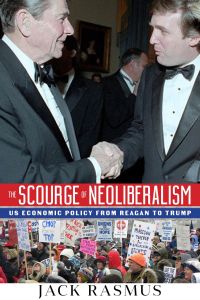
Other similarities with the US 2016 election are also interesting. US voters last November rejected the US Democrat party’s neoliberal policies advocated and defended by Hillary Clinton, thinking they would get something else in Trump. Trump won by creating the appearance he was against these policies. However, in just 100 days it is now clear Trump represents a continuation of the same US neoliberalism–with a nasty social twist of anti-immigrant, anti-environment, anti-social program overlaid on traditional pro-business tax cuts, deregulation, and bilateral free trade proposals.

Macron further represents a strategy to save European neoliberalism similar to that which Britain and the US economic elites put forward in the 1990s when they put Tony Blair and Bill Clinton in office.–i.e. so-called ‘new democrats’ at the time. Emmanuel Macron is France’s ‘new democrat’, and a reflection of elites in France putting a ‘shiny new young face’ on its prime politician just as UK elites did with Tony Blair and US with Bill Clinton. Macron is thus the ‘Tony Clinton’ (or ‘Bill Blair’ if you prefer) of France. However sustaining a ‘Tony Blair’ or ‘Bill Clinton’ strategy and solution in France may not be possible at this juncture, nor in the case of France in general. Time will tell if the ‘shiny young new face’ solution works in France, given its current discrediting in UK and US.

Macron is also a former banker, and therefore also represents the trend of a deepening influence and control of bankers and finance capitalists in the governments of the advanced economies like the US, UK, Japan and Europe in general.

In the US, big bankers like Goldman Sachs now run nearly all the key cabinet positions and agencies in the US administration under Trump. Under Obama in 2008, all the recommendations for cabinet-agency positions put forward by the megabank, Citigroup, were eventually adopted by Obama. France 2016 appears a continuation of this trend, as banker-finance capitalists maneuver in new ways to retain their dominance of the political system in the advanced economies in an age of growing economic disruptions.

Macron has promised to pick up the baton of ‘labor reform’ in France introduced by Socialist Party Holland. That means laws that will weaken unions, collective bargaining, allow firing of workers, eliminate strikes, cut social benefits, privatize the healthcare and education systems in France. So now the conflict in France moves from the electoral arena to the workplace. During the recent election cycle shopfloor resistance in France continued to grow rapidly. Many unreported short strikes were called to protest the plans to implement the new anti-worker labor laws. It is not unlike what began to occur in 1967 as DeGaulle and the capitalist parties laid out plans to strip workers of rights and benefits. That plan resulted in nationwide strikes and a shutdown of the economy and widespread protests called ‘May 1968’, which in turn led to the resignation of then president, DeGaulle. Will Macron’s presidency be a repeat? Is France now embarking on the same trajectory with Macron, who like deGaulle, has vowed to aggressively implement the anti labor reform laws? The largest union in France, the CGT, has already called for more intense opposition at the company level and preparation for a general strike. Whether Macron, a champion of the anti-labor laws is willing to stake his presidency on the direct conflict with labor at the economic level will be interesting to watch.

As US workers today cross their fingers and hope that Trump isn’t lying about bringing jobs back to the US (which he is), France’s workers may be preparing for a confrontation in coming months of a more united and militant kind. It will be interesting to see how far the Macron-Business-Banker elites in France are willing to go to face off the growing militancy ‘from below’ in the coming months.

In any event, with the election they have bought themselves some additional time. Watch the stock markets boom in Europe on Monday, as investors intensify their financial bets on the rise in stock markets in France, Europe and elsewhere and cash in on yet more capital gains and financial profits.