Feeds:
Posts
Comments

In France a general strike has been underway now for days (all but ignored by the US press and media). The demands of the strikers are to prevent France’s president, Macron, from imposing what is in essence the ‘American Retirement System model’ on France’s workers. That ‘American Model’ itself has been a gross failure in the US–as more than half of all US workers now have no savings whatsoever; as 401k private pensions have replaced traditional defined benefit pension plans; as 401ks now provide barely $50k in total retirement resources for those at retirement age; and as Social Security monthly benefits barely average $1,200.

More cuts of pensions and social security benefits are forthcoming in 2021, moreover, as US budget deficits now exceed more than $1 trillion per year and as the US National Debt exceeds $23 trillion, projected to grow further by more than $1 trillion throughout the next decade.

As tens of millions of US retirees now face a growing crisis of incomes insufficient in retirement, more of them 65 and older are re-entering the labor force to try to make ends meet, making the 65 and over age group the fastest growing in the US labor force. The ‘American Model’ itself has failed terribly and continues to unravel still further next decade–as savings collapse and disappear, more defined benefit pension plans disappear, and as attacks on social security intensify after the 2020 election to pay for US deficits and debt.

LISTEN TO MY December 20, 2019 Alternative Visions radio show on the evolution and collapse of the US retirement system from 1980 to the present, and how France’s elites are trying to impose a similar failing American Model retirement system–and why French workers are protesting in the streets across the country in an epic struggle that may topple France’s president Macron.

GO TO: http://alternativevisions.podbean.com

SHOW ANNOUNCEMENT:

For the past week a general strike has been happening in France, the focus of which is to protest and prevent President Macron from introducing an ‘American Model’ of retirement system that would raise retirement age and reduce pension retirement benefits. What’s the ‘American Model’? Dr. Rasmus provides a historical overview of that model, created in the late 1940s based on the so-called ‘triple stool’ of retirement: social security, defined benefit pension plans (DBPs), and personal savings. Each was supposed to provide one-third of income of a reasonable retirement. Rasmus explains the evolution of social security, DBPs, and savings since Reagan and how all three have been steadily undermined, reduced, or destroyed since the 1980s—replaced by 401ks, cash balance plans, raised retirement years, and privatization of pensions. Today more than half of workers have no savings whatsoever, 401ks provide less than $50k on average for the rest of lifetimes, and social security averages less than $1,200 a month. Retirees are forced to work until they drop now, the fastest growing segment of the US labor force as they return to part time employment. Tens of millions are now facing a retirement crisis of unimaginable dimensions. (Next week: a guest, Alan Benjamin, an eyewitness to the strike in progress, will describe what’s actually going on in the French strike to prevent the ‘Americanization’ of the retirement system in France).

Check out my radio interview last week on the state of the much hyped US-China Phase 1 trade deal. (Listen to first 5 minutes of Critical Hour radio show for my comments, from link posted at end of this article post).

Since Trump and US trade rep, Lighthizer, declared last week that US-China have a ‘done deal’, it has been increasingly reported the deal is not done or signed off. In the interim, Trump and friends continue to exaggerate dimensions of China commitment to buy US farm and other goods. From an initial declaration of $8B more (over $24B in 2017 base) in each of next two years–i.e. $16B–Trump hyperbole now saying $40-$50B in each of the next two years for farm goods purchases by China, and $200B over the next two years ($100B per year) for all China purchases.

But China refuses to say how much and when it will increase purchases. Why? Because it has always made clear the amount purchased will depend on the amount of still existing tariffs Trump will remove. For China, it is always a ‘quid pro quo’ for tariff reductions.

But Trump wants to keep tariffs on $250B (at 25%) and on $130B (at 7.5%) to go after China again in a Phase 2 next year. So China won’t agree to buy more unless Trump reduces tariffs more, and Trump won’t do it. (Did he make some assurance to his neocon, anti-China, pro-US Pentagon trade faction he’d keep the tariffs if they went along to decouple tech demands on China to allow Trump to sign a Phase 1 min-deal trading tariffs for farm purchases?).

So Trump now between a rock and a hard place, as they say: Cut tariffs more to get China to buy more farm goods (as his midwestern farm base gets more antsy and threatens to drop their support in 2020), or keep the tariffs to retain support of his anti-China neocon and military industrial complex wing?

If no more tariff reductions, then Trade War with China is over. What you see is what you get in 2020: Half of Trump tariffs on China remain and China buys token more farm goods no more than $8-$16B. China may ‘talk’ about buying more but that’s just enticement talk to get Trump to reduce more.

China total imports from US on everything–farm, energy, services, etc.–in 2017 was $186B. Trump’s declared $100B overnight increase, in both 2020 & 2021, an impossible ramp up.

Per the Wall St. Journal December 19, 2019, China government to date “has made no mention of the purchase targets announced by U.S. officials”. US economists and trade experts don’t see how China could ramp up to $50B a year, let alone $100B. So, just more typical Trump unbelievable exaggeration and hyperbole. But stock market lemming investors love it.

TO LISTEN TO MY INTERVIEW by the Critical Hour Radio Show, (timeline 0-4:40 minutes into the show) on the China-US trade deal ‘fiction’,

GO TO: https://drive.google.com/file/d/1Qj2qrjf5CKWoAUF3h9TLeiThkGN1YtZs/view

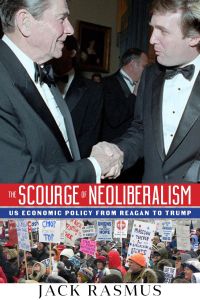
(And for my 20 page coverage of the origins and evolution of the US-China trade war, read my Chapter 8 (Trump’s Neoliberal 2.0 Restoration) in my just published book, ‘The Scourge of Neoliberalism: US Economic Policy from Reagan to Trump’, Clarity Press, January 2020).

Yesterday, December 12, 2019,\ the British parliamentary election gave conservative Boris Johnson a big victory, and leveled an historic defeat on the British Labour Party not witnessed since 1935. Johnson now has an absolute majority in Parliament and his quick march to a hard Brexit is now very likely.

Once the leading global capitalist economic world power, Britain is now doomed eventually to decline economically to a force in the global economy more or less equal to that of northern Italy in terms of GDP. Its last major role in the global economy, as a world financial center, will now atrophy as well, as finance capital exits Britain in the aftermath of the election and Brexit to points elsewhere: to Frankfurt, Paris, Singapore, and New York.

It is important to understand why Boris won big, why Brexit is now on the fast track once again, and what are the likely consequences. One immediate consequence is Jeremy Corbyn has already announced he will not lead the party further after its crushing defeat. That means the ‘moderate’ interests will now ascend to control of the Labour party again and purge the progressives that were behind Corbyn. It also means the Scottish Nationalist Party will demand a second vote on leaving the UK. Its leaders have already so declared. The British Constitutional crisis is again on the agenda.

It is important not only to assess the short term failures or success of the Conservative vs. Labour parties’ respective election strategies, but to understand the longer term historical forces at work that have been undermining Social Democracy and social democratic politics (and thus the Labour Party) in the advanced economies in recent decades. Those long term historical forces have been building and accumulating for decades. They have played at least as great a role as election strategy and tactics in Labour’s now historic defeat.

There are no doubt several reasons why British voters handed Labour its defeat and opened the door again, now even wider, to Boris Johnson to leave the European Union. The election shows that a large number of voters still wanted to leave the EU, despite three and a half years of British Parliamentary maneuvering and delay. Another voter block that weren’t so sure of leaving the EU perhaps probably voted conservative because they just wanted to ‘get the damn thing over with’. Three and half years of debate and parliamentary maneuvers since the original 2016 Brexit vote have left many disgusted with the political efforts of the British elite to block the 2016 democratic vote of the will of the majority in the country. Another short term factor in the election outcome no doubt is that Johnson cleverly manipulated voter sentiment with promises he would protect–and even expand–social programs, add more government spending, end austerity, save the health service, etc. That’s a cynical tactic directly out of the Trump playbook. Another factor probably was the slanderous business-media campaign to depict Corbyn and the Labour party as anti-semitic. As in the US with Trump, manipulating the ‘jewish vote’ and painting Corbyn-Labour as discriminatory, or even racist, played a role in Boris’ victory. Corbyn and Labour fell for the ploy and spent too much time defending against it, instead of pushing their own proposals more forcefully. They were caught off guard and didn’t know how to respond, and did so only after losing valuable time. Of course, having the capitalist media and press running interference on the issue on behalf of Boris and the Conservatives didn’t help either. As in France in support of Macron, British capitalists rallied and united together against Corbyn, terrified that if he and Labour won it would mean the re-nationalization of industries long privatized under British Neoliberalism since the 1980s. Finally, Labour’s strategy was itself equivocating at times and on a number of fronts insufficiently differentiating from the Conservatives. In many voters minds, especially youth, Labour was viewed as still the junior partner in pro-business Neoliberal policies and not to be fully trusted. The legacies of Blair and Gordon continue to haunt the part (just as Clinton and Obama do in the USA for the Democrats).

But there’s more than just electoral strategies and tactics that explain yesterday’s vote outcome and Labour’s historic defeat in the British Parliamentary election.

In Britain, as well as in the USA and Europe and elsewhere, the capitalist system has clearly entered an era of ‘nationalist reaction’ to its now declining growth prospects. Nationalism is the ideological reaction to that decline. More prescient and clever capitalists, and the political class that represents them, have grabbed on to nationalist appeals and policies and are riding that horse into office on the backs of growing economic discontent. Brexit thus represents a nationalist response to Britain’s economic decline. “Its the fault of those Europeans and the EU. If only we can leave the EU, Britain will return to its glory days of economic power”. So goes the political refrain–in the UK and elsewhere.

Overlaid on this ideological appeal in England, Wales and Northern Ireland is the curious counter ideological ‘nationalist’ appeal of the Scots, who employ Scottish nationalism as the justification for staying in the EU instead of leaving it. So we have two nationalisms–one countering the other–in the case of the UK and Brexit. Scotland will no doubt soon vote somehow again to leave the UK–becoming a kind of ‘Catalonia Writ Large’. Unlike the latter, however, it is unlikely that members of the Scottish Nationalist party will be successfully charged with treason and jailed. Watch for Boris and his conservatives to try to cleverly structure some solution similar to the so-called Northern Ireland ‘backstop’ for Scotland in relation to the EU. Boris and buddies will try to keep Scotland politically in the UK by allowing it to economically remain in the EU. Or allow Scotland to keep all the North Sea oil and US trade revenue for itself, which is also what Scotland staying in the EU is mostly about.

Nationalism is undermining national unity in the UK–just as it is doing so in the USA…and in Spain, Italy, and elsewhere in Europe, and let’s not forget India and Kashmir, and other locales in Asia. Capitalism in crisis always turns to nationalism as a shield to divert blame for its economic and social troubles on ‘the others’. The extreme version of this nationalist ‘blame it on the outsiders game’ is called Fascism.

There’s another longer term historic force also at play here in the Brexit phenomenon–apart from Nationalism and the short term electoral strategy and tactic failures. That’s the decline and collapse of traditional Social Democracy and social democratic parties. That decline is partly due to decades of mis-leadership by the social democratic parties’ leadership who have aligned themselves with the Neoliberal policies of the business parties in their countries. By partnering with business interests, in the hope of obtaining some minor concessions, they have painted themselves with the consequences of those Neoliberal pro-business, pro-investor policies. Those policies for their social democratic constituencies have meant: declining job opportunities, stagnant wages, privatization and loss of social insurance and benefits, loss of retirement and pension guarantees, and destruction of their unions that once protected those war time and post-1945 gains of the early 20th century. Of course, social democracy party leaders personally gained by securing a junior role at the political table with business and their capitalist parties. The Tony Blairs and Bill Clintons are today multi-millionaires serving on corporate boards and as business consultants being nicely rewarded for their past services. But they traded that role and personal gain for the the living standards of their working class members.

At its extreme, and in the worst case, the collaboration of the social democratic parties over the last 40 years with their business party ‘opponents’ has meant allowing the mass reverse immigration–i.e. deportation–of tens of millions of industrial working class jobs from the UK, the USA, Europe, and Japan to emerging market economies. (Where their respective corporations also migrated for cheap labor, open markets, and indigenous local politicians on the make). Ultimately, that reverse immigration of jobs and deportation of living standards explains in large part the collapse of electoral support for the social democratic parties in the ‘West’.

Entire generations of workers in the UK, USA, and Europe–who are today condemned to part time, temp, gig, and precarious work, to small service company employment, and with no experience of belonging to unions–no longer see any affinity with the traditional social democratic parties. This development is not only relevant to the UK and the collapse of British Labour as an electoral force. It is true of that even weaker and lesser ‘social democratic’ party organization called the Democrat Party in the USA. As it is true for the Socialist Party in France that was recently defeated and has all but disappeared from the electoral scene. And as it is becoming as well for the SPD party in Germany, as it continues its partnership and collaboration with business parties and interests in that country.

The Social Democratic parties in the west have been hollowed out by the deportation of their industrial jobs (aka offshoring or sometimes euphemistically called by the business media as ‘supply chain relocation’). And parallel structural changes in western economy labor markets have chipped away at the margins of what working class support that remained for those parties by throwing many not deported into precarious and contingent work that fragments and de-politicizes the class.

The core industrial working class backbone of those parties has thus been shipped offshore in the Neoliberal era and otherwise captured by nationalist appeals or who see nothing in it for them to vote for anyone. Social Democratic party leaders in recent decades have thus participated in, and presided over, the destruction of their own organizations and their own erstwhile political-electoral base. And as they allowed the decimation of their own industrial working class, the atrophy and disappearance of the unions as an organized electoral support force followed.

Today neither the class nor the unions existed to deliver the vote for Labour (or for the Democrats, or the Socialist Party, or the SPD, etc.) in strategic contests like the recent British election and Brexit votes.

Corbyn in the UK represented a last futile effort to re-transform the British Labour party, trying to turn the clock back into what it was once. But the core and base for that reconstitution no longer exists. And that’s also, at least in part, why Labour suffered the historic defeat yesterday. And why Nationalism is on the ascend once again.

And why, after the next crisis, even ascendant Nationalism as we see it today may not be sufficient for the continuation of late Neoliberal rule for global capitalism.

Dr. Jack Rasmus is author of the just published book, ‘The Scourge of Neoliberalism: US Economic Policy from Reagan to Trump’, Clarity Press, January 2020, which is available from his blog, jackrasmus.com, and his website, http://kyklosproductions.com, and publicly everywhere after December 20.

A China-US trade deal will be announced later today, per business media reports: Trump caves in, agrees not only to add no new $160b tariffs but also to a 50% cut in existing US tariffs. Trade war is over! Trump puts re-election & farm base before neocon-military demand for tech rollback by China. US-China Tech War now begins in earnest no longer under the cover of trade and tariffs but by other means. 2020 will mean more talks on Phase 2 trade deal with China, but it will be only talk. Nothing new will be agreed to (unless Trump removes all remaining China tariffs which is highly unlikely) during the US election year. Watch Trump to boast, exaggerate and lie about the terms of the deal. Ditto the just also announced USMCA free trade treaty. But after 18 months of Trump trade war little to nothing new has been gained–with China or with all other trade partners.

Trump’s business tax cuts of 2018 ($4T) and trade deals of 2019 + massive business deregulations of 2017 make him the darling of the US business-investor class. Stock market will continue to surge benefiting the investor class and income inequality will now intensify even further. The Trump media machine will now shift into high gear. Democrats’ impeachment message will be drowned out in the noise.

(More detailed analysis soon to follow)

Dr. Jack Rasmus, 3pm, pst, December 12

Listen to two perspectives on current trade issues: Trump’s imposing of tariffs on Brazil-Argentina steel imports & China phase 1 trade deal deadline

And in latest development, watch for Trump’s decision Thursday, December 12, on whether he’ll raise additional $160B in tariffs on China consumer goods imports to the US, due December 15, or whether he’ll postpone the deadline another 60-90 days. US Trade team continues to be split on further tariff increases: anti-China neocon, Navarro, wants Trump to add $160b more–this time on consumer goods. Treasury Secretary Mnuchin doesn’t. Kudlow goes with whatever Trump decides. Lighthizer will follows the interests of the US military lobby. Trump will decide which way tomorrow. In the past always deferred to Navarro-Lighthizer (May 2018, May 2019, August 2019) scuttling pending agreement with China. Will he do it again? Or postpone December 15 deadline for another 60-90 days. If more tariffs, watch the stock market contract friday or monday. (My bet: 60-40 he’ll extend the deadline).

To listen my two interviews on the Critical Hour radio show

GO TO

https://drive.google.com/file/d/1_93AHxAamSGyWEbc9rFKY_ushtJvGM48/view

and TO:

https://drive.google.com/file/d/1HsSn_ybFZ3fXJ-ANP7ebGuREMTn8P5Bh/view

(Coming next: radio interview on the USMCA treaty (NAFTA 2.0) just signed off by the Democrats and Trump)

Today the Trump administration, with Democrats & AFLCIO leaders in tow, announced new final revisions and deal with Mexico on the new NAFTA 2.0 free trade agreement called the USMCA.

According to the corporate media, revisions to the USMCA demanded by Democrats since the initial agreement was reached with Mexico a year ago, have been agreed to by Trump, Pelosi, and the president of Mexico, Lopez-Obrador. The revisions reportedly mean more protections for US labor in particular. However, all we have at the moment is what’s reported in the corporate and mainstream media about the revisions. We’ll have to wait to read the final print of the actual agreement. But even the media reports are not much more than vague generalities about the terms and conditions of the revisions. The much heralded improvements to US labor interests in particular don’t appear that different from Trump’s originally negotiated deal a year ago.

The official media story line is that the new revisions provide protections for American workers now that did not exist previously during the 20+ years of NAFTA 1.0. During that period, easily 4-5 million US jobs were diverted to Mexico.

At issue during negotiations on revisions to NAFTA–now called the USMCA–was whether US inspectors would be allowed access to Mexico factories and businesses to ensure that the new labor terms of the revised USMCA trade deal were being enforced. Lopez Obrador and Mexican business have been adamantly opposed to allowing US inspectors access to Mexican factories, which suggests they had something to hide. (Mexico and AMLO both are in agreement on this issue). THey demanded that, instead of inspectors, there would be a joint US-Mexican panel to arbitrate labor disputes. But the issue is independent inspection, not a panel to rule on disputes that may never rise due to absence of inspection. What good is a panel of any kind ruling on a dispute that doesn’t get raised because there’s no independent inspection in the first place? Also important is whether the inspectors inspect unannounced, or whether they have to give a pre-notice before they inspect (that phony arrangement is how the US OSHA law has functioned with little effect for decades). Moreover, if there’s panel, how is it determined and what is its composition? If it’s equal US-Mexico representation, it might never come to a final decision.

In other words, if the final terms and conditions in print for the USMCA provide only for panels, in lieu of unannounced inspectors, then the so-called great labor protections touted by Democrats as part of a final deal are really just another fig leaf of labor protection.

While the mainstream media and Democrats talk up the labor revisions in today’s final deal, the real substance of the recent revisions–sought by Trump and US corporations and bankers–has had more to do with protecting the interests of US big pharma companies and US oil and bankers.

Big pharma has always wanted NAFTA-USMCA to include what it wanted in the Trans Pacific Partnership (TPP) deal it didn’t get in 2017: i.e. protections on pricing of its drugs in Mexico at levels closer to its price gouging levels in the US. The fine print in the USMCA will tell whether it got this, or at least got a big change from Mexico’s current rules that keep the price of drugs lower in Mexico than in the US.

Another reported big concession by Mexico in the recent revisions apparently addresses the protection of US oil and energy, telecom and banker interests. Since assuming the Mexico presidency, Lopez-Obrador (AMLO) has been moving toward re-nationalizing Mexico’s PEMEX oil company that had come increasingly under financial control in recent decades by US investors and banks. AMLO wants to restore it to its former Mexican government ownership, or at least to control by Mexican banks and capital. Legislation has been drawn up by the AMLO adminstration to enable re-nationalization. US bankers and oil interests in response have wanted changes in the NAFTA-USMCA (NAFTA 2.0) to protect them from re-nationalization. They apparently have gotten it. Reportedly language in the USMCA now exempts oil, gas, power, transport, cement, banks and telecom from any potential future Mexican re-nationalization.

Free trade treaties are always more about money capital flows (from the US into the host country) than about goods flows across borders, even though the goods flows is what’s mostly reported in the media and press. NAFTA has been no different. Free trade–whether the original NAFTA 1.0 or the current 2.0 revisions called the USMCA–is about financing the relocation of US business and manufacturing from the US to the host country.Then about allowing US companies thereafter doing business in the host country to ship their lower cost goods back into the US market without having to pay tariffs. US corporations make greater profits, not only from cheaper production costs and absence of tariffs, but from continuing to charge higher prices in the US when they ship them back, tariff free, as well. But this is all greater profits from production and goods flows.

Free trade provides even greater profits for US investors and bankers who ‘grease the wheels’, so to speak, of the money capital flows in the first place. The money flows are what make profits from production of goods flows all possible int he first place. Banks charge the interest on the loans, and big fees on mergers and acquisitions by US business in the host country, now allowed by the free trade treaty. Banks also buy up the banks in the host country and make more money from lending to host country businesses. Offshore production and lending also allow US multinational corporations to engage in what’s called ‘intra-company’ price manipulation which permit them to reduce taxes on lower reported profits in the US. The offshored, foreign subsidiary operations ‘book’ all the profits–kept offshore and reduced in the US by means of intra-company price manipulation. Profits are still further boosted as now, under Trump, US multinational corporations get to avoid virtually all taxes on their offshore operations, as a result of Trump’s 2018 multi-trillion dollar tax cuts for multinationals.

Yet Trump, the Democrats, and the US corporate media would have us think the USMCA revisions are all about protecting US workers’ interests by introducing dispute panels. The five million US workers who have lost their jobs under NAFTA gained nothing, and paid everything in lost jobs, under NAFTA 1.0. And that’s not changing one iota under NAFTA 2.0, e.g. USMCA by introducing panels–or even if actual independent inspections were allowed. Under Trump no jobs have come back to the US due to any of his trade wars; and none will after USMCA revisions are signed off either.

Free trade is about enriching bankers and investors who ‘grease the wheels’ of US corporate foreign direct investment into the host country, now permitted by the free trade deal. Free trade is about raising profits and stock prices of US multinational corporations once they set up operations or buy up companies in the host country. Free trade is about politicians in both wings of the Corporate Party of America (aka Democrats and Republicans) fooling workers that they are somehow protecting their interests.

So why the closing of the USMCA deal and revisions now? After a year of stalemate in Congress? Likely because Democrat leaders are desperate to show their impeachment proceedings against Trump are not preventing them from passing legislation otherwise. But does anyone think that Trump, his Trumpublicans in Congress, i.e. Mitch McConnell and other Republican political sycophants, would likewise sign a deal if they were in the Democrats place? No, they’d play hardball and continue to refuse to agree to anything right up to the 2020 election.

Trump has recently softened his USMCA position as well in an attempt to close a USMCA deal with Congress and Mexico. Why now? Because Trump’s trade war with China has stumbled and stalled. It appears, per the Wall St. Journal today, that Trump will postpone his scheduled December 15 additional tariffs on China as a concession to get China to buy more of US farm goods. Trump needs to show something from his 18 months of trade wars. The US trade deficit has barely shifted at all during the period, still running near $50b a month. He desperately needs the USMCA deal–any deal–given that the China-US ‘mini’ trade deal is going nowhere and may not even get signed next year. (And it won’t if Trump does not agree in 2020 to further cut US tariffs if he wants more China farm purchases).

Trump’s recent re-imposition of tariffs on Brazil-Argentina steel should also be viewed as part of the mix of trade events in recent weeks. as the China mini-deal stalled, he had to look tough somewhere. Re-imposing steel tariffs was also a not so veiled threat to Brazil-Argentina (which hardly import any steel to the US at all) that they should think twice about increasing sales of wheat and soybeans to China. Trump’s tariffs on their steel is a shot across their trade bow. Both Trump’s concessions on USMCA and his re-imposing of steel tariffs on Brazil-Argentina are indications of his failing trade policy and his weakening bargaining position on such policy as the US 2020 election grows nearer.

Both he and the Democrats want to ‘look good’ for 2020 election purposes: Trump wants to show (and later exaggerate) what he achieved in the revisions to USMCA. Pelosi-Shumer want to argue (and will also exaggerate) the phony labor protections they achieved in the revised USMCA.

But US workers will get, as they have been getting, nothing out of the USMCA or any Trump trade deal so far, more lost jobs and higher prices on imported goods– to be exact $42 billion more in higher prices, according to the NY Fed, and $1000 per month in reduced household income due to the higher import prices, according to estimates by Chase Bank research.

Jack Rasmus is author of the just released book, ‘The Scourge of Neoliberalism: US Economic Policy from Reagan to Trump’, Clarity Press, January 2020, which is now available for purchase at 20% discount from his blog, jackrasmus.com, and website, http://kyklosproductions.com. (Chapter 8 addresses the origins and evolution of US trade negotiations under Trump in further detail).

This past friday, December 6, the BLS reported a jobs gain in November of 266,000, surprising just about every estimated forecast. At least 70,000 or so were not actually ‘new’ jobs, but the return to work of GM auto workers and related auto industry suppliers. But the 190-200,000 net jobs gain reported was nonetheless way above any expectations.

What’s the contrary evidence?

The independent enterprise payroll company, ADP, which reports out job numbers a few days before the BLS every month, based on its tens of thousands of companies it gathers data from, had estimated a mere 67,000 jobs net gain. 266,000 v. 67,000 was perhaps the biggest gap ever between the two reports–one private and the other government. Thus far no explanation has been provided for the massive gap in job forecast, by either ADP or the government.

Also worth noting is that the bLS, the government, this past summer adjusted its total jobs number for 2018 by reducing the total job creation in 2018 by a massive 500,000. How reliable are the monthly numbers when they have to be adjusted by 40-50,000 a month on average? Recently the government announced it expected that 2019 total jobs would likely have to be reduced by at least 500,000 when it did its annual adjustment and reductions again this coming February 2020. Again, that makes the monthly numbers suspect. Why the massive adjustments the past two years? Are the monthly numbers not reliable for some reason? What’s the reason?

It’s important that readers understand that the monthly jobs numbers don’t represent actual jobs. They are a statistic. That means the raw actual number of jobs are not what’s reported. It’s a statistical manipulation–based on a series of complex assumptions and even more complex mathematical formula adjustments of the raw jobs data–that gets reported monthly as the job numbers.

Moreover, the monthly numbers reflect jobs, not actual workers getting new employment. There may be workers adding second and third jobs, reflecting the jobs increase, but not actual new employment increase. The US Labor Dept. claims it captures added jobs by those already employed, but the numbers suggest its methodology may not be that accurate. The US labor markets have radically changed since the late 1990s and the BLS methods may no longer be accurate for picking up 2nd and 3rd jobs. The changes also suggest that maybe the government’s statistical adjustments for seasonality are not that accurate any more.

There has been greatly volatility in the monthly jobs numbers this past year. Some months well below 100,000, representing the fact that more new workers are entering the job market and not finding jobs. It takes at least 125,000 to 150,000 to absorb all new entrants. The great volatility suggests the BLS is not picking up the seasonal changes month to month very well; and only does so with its annual adjustments to the prior year’s data–hence the 500,000 annual reduction in the total numbers of jobs for the year.

Then there’s the adjustments in the statistical manipulation of the raw jobs data for what’s called ‘New Business Formation’. This is the adding of jobs to the raw data numbers by assumptions of new business formation. It’s assumed every month that several hundred thousand net new businesses are formed. Each has a number of new jobs assumed associated with the formation. Problem is that the New Business Formation is from 6-9 months previous to the current month. In other words, the BLS assumes a net gain of jobs from March-May 2019, adds that to the raw jobs data for November, then does a number of statistical manipulations on the combined actual jobs for November plus 9 month lagged jobs from New Business Formation, and that’s what is reported out as the November jobs number. Except in times of deep recession the added jobs from business formation are always positive. So the raw jobs data is always increased for the month–even before other statistical manipulations of the combined raw data are performed for that month, i.e. for seasonality and other reasons.

It’s difficult to assume that’s all OK with the monthly jobs numbers reporting for these and related additional reasons.

Jobs and employment lagged the general direction of the economy. But that real economy has been contracting in various dimensions. For example, net new business investment has been contracting ever since the 2nd quarter of 2019. Manufacturing has been contracting for four consecutive months. Commercial construction for longer. Residential housing construction contracted for most of 2018-19, rose slightly for several months due to interest rate cuts, but is contracting once again. Export driven job creation is unchanged, as net exports (exports minus imports) has hovered steadily around a negative $50b a month throughout the period of Trump’s trade war for the past 20 months. So where’s the real economic growth coming from that would produce 200,000 plus jobs? If employment is a lagging indicator, it’s certainly lagging as never before.

We’re told that it’s the service sector and household consumption that’s holding up the real economy. But services growth has been slowing its growth rate in recent months as well. Consumption is being driven by the wealthiest 10% of the labor force (where wage gains for professionals, tech, healthcare, managers, etc. are concentrated) and by record credit creation for the rest of consumers. But that hardly explains the unexpected big surge of 266,000 jobs last month. Neither services nor consumption explains companies hiring by that big an increase in one month. Some argue that its the government growth in census workers, but reportedly that was largely concluded by October.

So where’s the explanation for the big gap in BLS November jobs numbers from the private payroll estimates of ADP? The ADP numbers are actual payroll data. The BLS government numbers are the result of statistical operations and manipulations piled on one another to get a ‘statistic’ and thus estimate of actual jobs.

This writer still argues that the labor market changes in the US have caused the BLS government methods and statistical manipulations to become less accurate and more volatile from month to month (only adjusted more accurately when the annual reductions are made by half a million jobs or m ore). The BLS seasonality and New Business Formation assumptions are less and less accurate. And its methods for estimating 2nd and 3rd jobs taken on by the already employed over-estimate the job numbers monthly, and the government still grossly underestimates the effect of millions it dumps into its ‘catch-all’ category of the ‘missing labor force’.

For the real jobs numbers we’ll have to wait until February 2020 when the BLS does its annual adjustment for 2019–and likely reduces again the job number reported for November and 2019 by another 500,000 or more!

Dr. Jack Rasmus is author of the just published book, ‘The Scourge of Neoliberalism: US Economic Policy from Reagan to Trump’, Clarity Press, January 2020. The book is available at 20% discount from his blog, jackrasmus.com, and website, http://kyklosproductions.com.

Trump vs. Democracy

by Jack Rasmus, December 6, 2019

The US House of Representatives marked a milestone today, December 6, 2019, as it decided to report out articles of impeachment on Trump. But there’s a bigger picture to consider. The impeachment represents a new stage in the political ‘food fight’ between the two wings of the political-economic elite in the USA. It also represents a further escalation in the crisis and decline of American Democracy–a decline that’s been going on since at least the early 1990s, when Newt Gingrich and the radical right took over the House of Representatives and declared publicly that their objective was to create a dysfunctional US government. In retrospect, Gingrich certainly succeeded.

But it’s not just since Newt. US Democracy has been in decline on a number of fronts since the late 1970s, which corresponds to the rise of Neoliberal economic policies in the US. Late stage Neoliberalism today, 2019, is in crisis. Since the 2008 crash political elites and policy makers have been attempting to restore its pre-2008 momentum but have failed. Obama failed throughout his eight year term in office. And Trump’s regime should be viewed as an attempt to restore it in a new, virulent aggressive Neoliberalism 2.0 form.

But Trump has been only partially successful to date as well, and will likely fail as well regardless of the 2020 election outcome. A new crisis is around the corner in the 2020s, driven by accelerating fundamental changes in the nature of capitalism itself that have been ripening and developing in the last decade.

At least three forces will further exacerbate the internal contradictions developing since 2008 within the neoliberal policy regime. They are 1) the deepening of Artificial Intelligence technologies that will further devastate and already rapidly changing labor market, eliminating or reducing tens of millions of simple decision making jobs. AI will radically transform as well product markets and distribution systems of 21st century capitalism. It will also change the nature of money itself. All these trends are already well underway and will continue to intensify in the years immediately ahead. 2) Indications are growing that Neoliberal capitalism will also not be able to resolve the climate crisis. Third, 3) 21st century capitalism has already generated a level of unsustainable debt—corporate, financial, household and government—which inevitably must lead to the next general financial markets implosion sometime early in the next decade.

These basic material forces will generate a long term crisis in the 2020s, as contradictions within the neoliberal policy regime continue to intensify as well. There are four elements that constitute the Neoliberal policy regime—i.e. Neoliberalism in practice. They are Fiscal Policy (tax, war spending, social program spending, deficit-national debt management); Monetary Policy (low interest rates, money supply); Industrial Policy (deregulation, privatization, de-unionization, real wage compression, job restructuring); and External Policy (free trade, Free global money capital flows, currency exchange rate management, and the twin deficits). But since 2008 the advancement of neoliberal policy in one or more of these four elements has been thwarted by its own growing contradictions. Advancement in one or more of the four policy areas is negating the restoration or advancement of the other three. The contradictions within Neoliberalism are intensifying, in other words, just as technological and capitalist system restructuring is deepening as well.

What the last quarter century in particular has shown is that In order for Neoliberal policies to deepen and expand Neoliberalism has had to restructure the US political system as well and to eliminate long standing elements of Democracy in the political system. Neoliberalism and Democracy, even in the limited American form of Democracy, are essentially incompatible. The historical record since the 1980s confirms this. On a number of levels, as Neoliberal policies have advanced, US Democracy has atrophied. This is not by accident; nor is it a mere correlation.

Democracy in America has been in decline since at least the 1990s, and especially so after 2000. It is evident in the collapse of any semblance of campaign finance reform, in the transformation of the two political parties into vehicles increasingly focused on ensuring corporate and investor wealth subsidization, in the Supreme Court interfering with electoral processes on behalf of corporations and investors, in the spread of voter suppression in various form throughout the so-called ‘Red’ states (i.e. a new Jim Crow also endorsed by the Supreme Court), in widespread gerrymandering concentrated largely in the same region, in a greater role played by the electoral college in preventing popular sovereignty, in the creation of special courts embedded in free trade treaties that further negate popular sovereignty, in the expansion of the ‘lobbyist state’, in the deepening attacks on civil liberties (patriot act, NDAA spying and surveillance, etc.) and undermining of the guarantees of the Bill of Rights, in a transformation of the so-called ‘fourth estate’ of media-press into vehicles of ideology propagation, in the transformation of the two political parties into institutions more tightly controlled by money interests–the list is long and growing. And after the crisis of 2008-09, all these processes of Democracy decline have been accelerating.

The process of decline, moreover, has reached a new milestone with the articles of impeachment of Trump just announced. For the behavior of Trump has clearly violated numerous provisions of the US constitution and is unraveling what Democratic norms and practices that have defined even the limited form of Democracy that exists in America. What we have under Trump is an assault on Representative government itself and, indeed, the US Constitution and the very formal institutions of Democracy.

The decline of Democracy in the US is likely, moreover, to get still worse in the year ahead in the run up to the 2020 November election. It is clear that the 2020 election will be close. Trump probably has an electoral college advantage, even if he loses the popular vote by even more than he did in 2016. His control of Red state electors has solidified further in the wake of more widespread voter suppression, gerrymandering, support by a sycophant Republic party, and a Supreme Court ready to do his bidding. Behind the sycophant Republican party is a base of at least 30% of the population that would vote for him regardless of any crime he has, or might, commit. He has his ideological bullhorn in Fox News, Breitbart, and Twitter and he will use it increasingly aggressively.

Should he lose the election, chances are more than even he will refuse to acknowledge that loss, setting off a constitutional crisis unlike any ever experienced in the US to date. Should he win narrowly, he will likely turn vindictively against those who have opposed him. Even more draconian attacks on government and institutional Democracy will almost certainly follow. Trump is a ‘down and dirty’ street fighter, weaned on the corrupt and questionable practices of New York commercial property speculators. In short, a narrow win or a narrow loss—the likely outcome—will mean there will likely be a constitutional crisis circa the November 2020 election, comparable only to the 1850s American political debacle. (Trump himself has said if he’s not elected there will be a ‘civil war’ again in the USA).

In short, American Democracy and the US political system is about to enter a period of instability it has heretofore not witnessed. Also not witnessed, the political crisis of Democracy in America will likely overlap with the next economic contraction and financial system implosion on the horizon as well. Hold onto your seats, folks, the real show hasn’t even yet begun!

The following passages summarize my views in further detail on the deepening contradictions of Neoliberalism and its fundamental incompatibility with Democracy in the era of Trump. The passages are an excerpt from the concluding chapter, ‘Neoliberalism v. Democracy’, in my recently published book, The Scourge of Neoliberalism: US Economic Policy From Reagan to Trump, Clarity press, January 2020).

TRUMP’S NEOLIBERAL ASSAULT ON DEMOCRACY

“As Neoliberalism has become more aggressive under Trump, so too have the attacks on democracy and democratic government.

After three years in power, and with the House of Representatives and much of the mainstream media challenging him after the November 2018 elections, the President is clearly drifting toward usurping the authority and, in some cases, even the functions allocated by the US Constitution to Congress—specifically to the US House of Representatives—toward a view he is above the law and unimpeachable. Toward a view that his presidency is more than a ‘co-equal’ branch of government. Toward a view he can and should govern when necessary by bypassing Congress. Toward a view the Constitution means he can force states to abandon their rights to govern. And toward a view the president can publicly attack, vilify, insult, coerce, and threaten opponents, critics, and whomever he chooses.

That drift includes the expansion of Executive branch rule-making at the expense of Congress and the legislative branch; the broadening use of ‘national security’ declarations by the president to bypass Congressional authority; and the refusal to recognize US House authority as it exercises its Constitutional responsibility to undertake investigations of corruption in the executive branch.

Usurpation of Legislative Authority

Presidential rule making by Executive Order has been long embedded in the US political system. In the past, however, Executive Orders by presidents have been issued where the president clearly has authority to issue such, or else in cases where Congress has not passed specific legislation—such as Obama’s EOs enabling children born in or brought to the US by non-citizen immigrant parents to have deferment from deportation . EOs have not been typically issued, however, that directly change the intent or the funding authorization of legislation passed by Congress. Not so in the case of Trump.

Passing laws requires their accompanying funding authorization. The monies allocated to a program by Congress are required to be spent on that specific program. However, under the cover of invoking a national emergency, Trump recently unilaterally transferred money allocated by Congress and authorized by the US House for defense spending to fund his border wall. This creates a dangerous precedent. Might Trump now divert authorized spending by Congress to other programs? This is clearly a constitutional issue now. Trump is in effect governing by ‘national security decree’ in direct challenge to Congressional legislative authority. The much heralded ‘separation of powers’ in US government has been undermined to a degree.

Drift Toward Tyranny

In addition to expanding Executive rule-making at the expense of Congress and the legislative branch, and his refusal to cooperate with Congressional subpoena and investigation rights under the Constitution, worrisome signs keep arising that indicate Trump also considers himself personally ‘above the law’.

The US political system has always given the President authority to pardon individuals, which is usually undertaken at the end of their term in office. It’s a curious and decidedly un-democratic practice that has been increasingly institutionalized in recent decades under Neoliberalism, by both Republican and Democrat presidents and governors. A hallmark of American political ideology proclaims to the public that ‘no one is above the law’. Yet, some are, as executive pardons have become increasingly commonplace. But these are presidential (and governor) executive pardons of others. No president to date has publicly suggested that he himself might be above the law or has the right to ‘self pardon’. But Trump has.

The process of usurping legislative authority, to fund his preferred programs at the expense of Congress, may have just begun, but the drift by Trump toward an imperial presidency in domestic legislation may well expand as his confrontation with Congress grows. Second, his suggestion of the right to assume power of self-pardon smacks of Tyranny. These trends—toward usurpation and tyranny—represent decided undemocratic principles that the president feels comfortable with.

Although in early form, the trends suggest a view by Trump that the presidency is an institution ‘more equal’ than the other branches of government. It has long been obvious that, in foreign affairs, the presidency since the 1960s—and even before—has been becoming more ‘imperial’. Presidents go to war without obtaining a war declaration by Congress, as was clearly intended by the US Constitution—token limits by the 1970s era ‘war powers act’ notwithstanding. The Trump presidency may reflect an extension of this imperial attitude to domestic US politics, i.e the emergence of what might be called the imperial presidency in domestic affairs.

Redefining Separation of Powers

The Trump presidency’s disregard for Constitutional norms in its relationship with Congress, and in particular the US House of Representatives, has recently become evident as well in Trump’s outright refusal to allow executive branch employees to testify to Congress, subpoenas notwithstanding. This stonewalling is but another example of the Trump presidency’s view that the Executive and Legislative branches are perhaps not ‘co-equal’ under the Constitution. Constitutional authority clearly provides the US House with investigative powers. Trump’s refusal to cooperate with that Congressional authority represents yet another reinterpretation of Constitutional separation of powers.

Reinterpreting the Constitution’s Supremacy Clause

Trump’s offensive against California’s auto emissions rule exemplifies his reinterpretation of the Constitution’s ‘supremacy clause’ and states’ rights. It has long been accepted that state laws cannot provide less than a similar federal law. For example, states cannot pass a minimum wage lower than the federal minimum wage. But they can pass legislation providing more than the federal minimum wage. Trump’s attack on California emissions in effect means the state cannot pass tougher emission standards than the federal standards, which are far less stringent. If that becomes a legal precedent, states logically could not pass legislation that is either less than or greater than the federal requirements. It’s a violation of the federalism principle in the Constitution.

Assuming the Power of the Purse

Trump’s trade wars represent yet another example of Executive powers expansion. The trade wars have generated tens of billions in additional tariff revenues for the executive branch. These funds have been used in part by the president to issue direct subsidies to US farm interests in the amount of $28 billion over the past year. A constitutional argument can be made that payment of subsidies in such amount should be authorized only by legislation raised and authorized by the US House. The Constitution’s intent gave the US House the authority of ‘power of the purse’ to raise and authorize spending of revenues—and not the Executive.

Disregarding Democratic Norms & Practices

Other disturbing examples abound of the Trump presidency disregard for accepted democratic norms and practices. Never before has a president so blatantly attacked the press and media that criticized him. Or vilified political opponents as ‘traitors’ and ‘criminals’; or publicly demanded candidates be ‘arrested and locked up’; or incited popular mobilizations against protestors and his critics; or launched purges within his own bureaucracy (in particular the intelligence agencies) and political party; or declared if Congress were to try to impeach him it would mean a new civil war in the country. These are not just the verbal railings of an aberrant personality who by chance attained the highest office of US government.

These are actions that reflect a calculated and fundamental disregard for even the limited form of democracy that still prevails in US government institutions today. They are views that reflect a belief that Executive powers of the president should and must be expanded—even if at the expense of the authority of legislative branch of government (Congress or states); even if it at the expense of the legitimacy of the press and ‘fourth estate’; even if it deepens the polarization of US society and incites citizen to citizen violence. Trump believes it is all necessary in order to implement his policies and programs—and this is what we must keep foremost in mind—it’s a Neoliberal program.

The key question for assessing the future of Neoliberalism is whether Trump is a product of the evolution of Neoliberalism and its impact on political institutions and practices—or whether the Trump presidency is an aberration outside that evolution?

Trump: Inevitable or Aberration

Is a Trump-like political figure the inevitable consequence of the need to introduce post 2008-09 a more aggressive, virulent form of Neoliberalism? Would an alternative president have to have moved in the same anti-democracy direction to get his/her agenda passed in the era of deepening domestic and global opposition to Neoliberalism? Perhaps that alternative president might have been less crude, less brash, less apt to ‘shoot from the hip’ on policy and political initiative—less likely to engage in early morning social media excesses; and indeed therefore have been even more clever and effective.

But one should make no mistake. Trump is not a lone wolf who slipped into the US presidency by accident or ineptitude of his opponents. Neoliberalism required a more aggressive restored form following the crisis it faced in the wake of the 2008-09 crash. Certain moneyed interests were in 2016, and are still, behind Trump. And if it wasn’t him, it would have been another chosen to shake up the old political establishment that was beginning to lose control over growing discontent at home and growing capitalist competition abroad.

The problem with Trump in the end has been his style, which has made it impossible for him to unite US business interests, and the traditional political elites, behind him in an effort to jointly restore the Neoliberal policy regime. Instead, he has precipitated an internecine political fight within the ruling class in America—i.e. a classic post-crisis political ‘food fight’ between two wings of the American economic and political elite.

A similar post-crisis split and internecine ruling class conflict has been occurring globally elsewhere as well—not just in Trump’s America. In the UK (Brexit), in France (the National Front), Germany (the rise of Afd), in several eastern European countries (Hungary, Austria, Poland), in various countries in Latin America (Argentina, Brazil, Ecuador), and in Asia in India and Philippines. All are trying to come to terms with slowing economies and an emerging global recession, as Neoliberal policies failed globally after 2008-09, giving rise to right wing autocrats and anti-democratic politicians. And in virtually all cases, including the US, in attempting to re-establish Neoliberalism on firmer ground, democracy, democratic norms, and institutions have been the victims.

The Trump era represents only the deepening of anti-democracy trends in the US that have been evolving since the introduction of Neoliberal policies circa 1980. In the Neoliberal era the two mainstream political parties became more oligarchic in their programs and representation. Money deepened its hold on government and politics steadily over the decades. Electoral processes became more the purview of the rich and powerful. Gerrymandering and voter suppression became more the norm than the exception. Popular sovereignty and representative government for all, more a fiction than fact. Public wants and needs that can only be fulfilled by government have been increasingly ignored, in favor of interests and requests of tens of thousands of paid lobbyists. And citizens’ civil liberties and rights have been increasingly limited, circumscribed, and surveilled.

The correlation between the rise and expansion of Neoliberalism and the decline of democracy in the US is irrefutable. Whether the correlation also represents a direct causation depends on whether each milestone event associated with the expansion of Neoliberalism occurs in tandem with, or in consequence of, an event marking a further deterioration of democracy.

And here the evidence and examples abound: the transformation of the political parties in the 1980s and early 1990s and rise Neoliberal tax and monetary policy. The radical right takeover of the US House in 1994 and advent of free trade. Gore v. Bush, the selection of the president by the judiciary in 2000 and still more tax cuts, war spending, the end of campaign finance reform, the Patriot and NDAA Acts and the attacks on civil liberties and democratic rights, and free trade treaties with their capitalist courts and negation of representative government. Thereafter, Obama followed by the Supreme Court’s Citizens United and related decisions, widespread gerrymandering, intensifying voter suppression, more war spending, more business tax cuts, more deficits, more free money to investors and bankers, more attacks on unions, more wage compression. And now Trump.

It’s more than just a ‘smoking gun’. It’s certainly not just coincidental that democracy in America has been in decline—and on so many fronts—during the era of Neoliberalism. Nor is it coincidental that under Trump the decline of democracy in America has intensified, and has begun to assume an attack on the prevailing constitutional form of government itself.”

Jack Rasmus is author of the just published book, ‘The Scourge of Neoliberalism: US Economic Policy from Reagan to Trump’, Clarity press, January 2020. (The book is available at discount from his blog, jackrasmus.com, and his website, http://kyklosproductions.com, where reviews of the book are also available

.

The following are some of my Twitter posts for the past month of November 2019. Brief takes on events, surveys, reports, and matters of interest on US and global economy and politics–including trade wars, the Fed, healthcare costs, US wages & productivity, recession, and commentary on Trump and Democrat political candidates for President.

Dec 2
#Tariffwars

Trump reinstates tariffs on Brazil/Argentina steel. Why? USMCA trade deal frozen + China mini deal in trouble. So open trade wars elsewhere to divert attention from failing trade policy. Besides, how dare Brazil-Argentina dare cut deals on soybeans & wheat with China!

Dec 2
#Democrats

Wave of Bloomberg TV ads now hitting all sections of country as he launches his presidential bid. Details suggest he’s more ‘left’ than Warren and a flaming NY progressive. But billionaires say what they think folks want to hear, then deliver for the rich (aka Donald)

Nov 27
#tradewar

A report just released by NY Fed concludes US consumers & businesses are paying for Trump’s 25% China tariffs. Tariffs cost them $40B a year, per Fed. Trump’s 25% tariffs should=20% cut in China prices on US imports if China were paying. But China prices fell only 2%

Nov 26
#Democrats

Obama comes out publicly against ‘left’ wing of party (Sanders-Warren) & on behalf of corporate wing of party as it seeks a backup to Biden & tries to stop Sanders-Warren. Obama always part of corporate wing, financed in 2008 by real estate, Chicago $, & NY hedge funds

Nov 26
#Democrats

Billionaire Bloomberg enters race for Dem party nominee. Latest in moneybag wing of party to bet on ‘brokered convention’, as Biden fades as their choice. Their strategy now is stop Sanders-Warren on first vote at convention, then push their ‘centrist’ to nomination.

Nov 26
#Fed

Chair Powell says US labor mkt strong. But monthly job gains now half that of 2018, even with tens of thousands of current census job & holiday hires. Watch for big job contractions early 2020, when census & holiday hiring stop/reverse. Then watch consumer spending plummet

Nov 24
#Buttigieg

New darling of moneybag wing of the Dems. Backup if Biden fails. But who’s really funding ‘Butt’? Finance capitalists like Paul Tudor Jones & other shadow bankers. Deja vu, like when Chicago money & NY hedge funds pushed Obama into the race at the last minute in 2008.

Nov 20
#tradewar

Signs growing that Trump’s Phase 1 mini-trade deal with China may not get signed off by Dec. 15. Trump getting nervous. Financial markets too, returning to pre-deal safe havens of US Ts. Should deal not get signed Dec. 15, watch for financial markets’ sharp contraction

Nov 19
#debt

Institute Int’l Finance says global debt rose from $78T in 2008 to $250T today. Debt can rise if income gains cover principal & interest; or if P&I is paid by raising more debt. Crises begin when income falls & debt refi freezes up. It’s a debt driven economy-until it’s not

Nov 16
#impeachment

What’s different Trump v. Nixon impeachment?: Fox news, social media, Trump Sup. Court majority, sycophant Republican party, strategically inept Dem Party leadership, no recession, 2yr before elections. As someone said: “First as tragedy; second as farce.”

Nov 12
#Healthcare

New Gallup poll finds 34% adults know a family or friend who died last 5 yrs because couldn’t afford health cost. 17% of adults under 45 knew of family or friend who died because of unaffordable cost (compared to 6.6% adults over 65 who knew. Medicare for All anyone?)

Nov 12
#USWages

Trump & US media keep saying US wages rose ave. 3.1% this past yr. But US Labor Dept. data show real median wage Dec 2016 at $10.70/hr. Same wage rose by Sept. 2019 only $10.96/hr. That’s 9 cents/yr & well less than 1%. Maybe managers, tech, professionals got 50%+ raises

Nov 11
#Obamacare

10 yrs of Obamacare+Trumpcare results: Employer health ins. premiums up 50% + premium prices rising 3x the CPI. Ave. deductibles up 3X, to $1,655 (82% plans now with v. 50% 10yrs ago). ACA out of pocket expenses raised to $16,400 for families. Only 10m insured. 40m not

Nov 10
#Trump

says US Economy “greatest in history of world”. Here’s ‘for whom’: Fortune 500 corps distributed $2T in stock buybacks+dividends to shareholders 2017-18; another $1.3T due 2019 + more buybacks-dividends payouts by remaining 2m US corps + $300b tax cuts to corps & investors

Nov 9
#Trump

says US economy today “greatest in history of world”. But for whom? New Financial Times/Petersen Institute poll shows 65% say ‘no better off or worse off’ since Trump. But investors will get $1.3 trillion in stock buybacks+dividends this year, after $1.2T last year.

Nov 8
#tariffwar

China officials today say Trump agrees to reduce tariffs. Trump says he hasn’t (while admin. spokespersons say he has). What’s up? Prediction: Trump will retract some Dec. 15 tariffs he hasn’t even yet imposed. Will it be enough for China to sign Phase 1? Maybe not

Nov 6
#productivity

US data today show productivity 3rd quarter negative–1st time in 4yrs–due to prior 2 quarters of contracting bus. investment & manuf. Unit labor costs (ULCs) in turn now rising. Coming next? Less hiring & slower job growth as business moves to offset rising ULCs.

Nov 6
#tradewar

Anonymous Trump admin. official says signing Phase 1 mini-trade deal with China not likely in November. Maybe December. Why the delay? Dispute whether US will withdraw some tariffs–a ‘must have’ per China. Market lemmings now assuming a ‘done deal’ may be surprised.

Nov 5
#USeconomy

Just released Financial Times/Peterson Foundation voter poll: 31% say worse off compared to before Trump; another 33% say no change. Causes: low wage & no income change + high debts. So much for distorted news re. wage growth & “Greatest Economy in US History” (Trump)

Nov 3
#UStaxes

US treasury (UST) announces looser rules for corp. ‘inversions’-i.e. where US multinational corps (MNC) move their HQs offshore to book lower taxes. Result: less net US tax revenues, more US deficit & debt, but more MNC profits after $2T 2018-28 from Trump 2018 tax cuts

The debate among marxist economists has intensified once again. On the one side is the German economist, a marxist, Michael Heinrich. Once again Heinrich has raised questions about Marx’s notes in Vol. II, III of Capital assigning primary causation of capitalist crises to the variable of the falling rate of profit. Long an adherent to explaining the evolution and business cycle contractions to the falling rate of profit, Michael Roberts takes on Heinrich’s more ‘open view’ of Marx.

From time to time I have debated as well with Roberts, taking a position similar to Heinrich’s and urging Marxist economists to get off of Marx’s falling rate of profit theory as the primary explanation of crises and cycles. The reasons are Marx’s definition, similar to classical economics in general, is too narrow. More important, contemporary definitions and data collection of profit globally result in data on profit used to determine the rate of profit which are grossly different from Marx’s concept of profit. Furthermore, the profit data available are deeply corrupted for various reasons and therefore unreliable.

The following are some of my comments offered to both Heinrich and Roberts on the ‘Taking Sides’ blog in their debate:

“I have long disagreed publicly with Michael Roberts’ view on the rate of profit thesis. There is just no way to determine actual profits–levels or therefore rates. This is for various reasons. Here’s just a few: first, at the core of global capitalism is the multinational corporation. Numerous studies show that their profits are at least a third determined by financial asset investments, what’s called ‘portfolio’ investment. The MNCs have become, and are increasingly becoming, financial institutions. Marx’s theory of profit defines profit in production as the result of exploitation of productive labor only (or some labor necessary to the distribution and commerce of productive labor). In other words, only labor that produces discrete goods. It’s a narrow, classical economics definition going back to Smith and others. But global MNCs not only create profit from the production of goods (and not all of them either). They create profit from financial asset investment and speculation. That means if one were to keep to the definition of Marx on profit, that one would have to somehow subtract out portfolio investing profit from total profit. This would have to be done for all MNCs that do portfolio investing, in order to get some kind of average profit minus portfolio profits. Michael Roberts and other largely anglo-american Marxists don’t do this. Because they can’t. There is no data retrieving formula for this, or even access to MNC balance sheets to determine this.

Roberts and others rely on government provided data on profit that doesn’t distinguish between the aggregation of real productive profit and financial speculative profits. So his profit rate data is corrupted and cannot be used to determine the falling rate of profit.

There’s a further problem: To get even total profit data, it is necessary to adjust for accounting rules that differ country to country, that influence the level and therefore the rate of change of profit. There’s also the problem that in many countries the economic data is insufficient and distorted by collection processes. Definitions of profit are also different. This corrupts the profit data when trying to aggregate it across countries and economies.

Apart from all these data definition and collection issues that make determination of the real profit rate difficult, there’s the problem of taxation that render after tax profits as the variable even more problematic. For example, in the US alone, in 2018 Fortune 500 profits rose about 27%. But 22% of that 27% was attributed to Trump’s corporate tax windfall alone. This goes on at the US state level as well. And it differs in Europe and elsewhere as capitalist states ‘race to the bottom’ in granting tax cuts to business and investors. So forget after tax profit data altogether.

In short, data on profits are grossly unreliable for accuracy, and this is especially so globally and for multinational corporations, that typically adjust their internal pricing arbitrarily to lower or raise profits in different subsidiaries producing semi-finished goods between the subsidiaries. Roberts has no access to this internal pricing data manipulation, that makes profits artificially appear higher in one subsidiary and lower in the other. How much should nominal profits then be adjusted for real profits when the internal pricing effect is unknown and clearly would differ greatly across different corporations? Roberts doesn’t know because the data is proprietary and internal to the MNCs.

I agree with many of the critiques of Heinrich, as well as the view that Marx was not completely sure of the falling rate of profit tendency as a predictor of business cycle contractions. If he had been sure, he would not have left it just as unpublished notes.

Then there’s the related critique that even if he had been convinced, it is clear that Marx was not talking about short term business cycle contractions (which include recessions, great recessions and even depressions). Marx’s theory applies to the long run crisis and breakdown of capitalism. This is a focus very typical of classical economics, which lacked the detailed empirical data to develop a theory of business cycle contractions. Nevertheless, Roberts and friends try to ‘fit’ this long term crisis theory into an explanation of short term contractions when they argue the rate of profit determines the outcome of crises like 2008-09 or depressions.

Marxists should get off the fixation on rate of profit as the key determinative variable. Marx’s economics is about the accumulation of capital, a deeper and broader concept than profit rates. A Marxist theory of investment (aka capital accumulation) in the 21st century, which accounts for both destabilizing financial portfolio investment as well as real asset investment, is what the focus of analysis of capital in the 21sts century should be.

But Roberts & friends say wait a minute, it’s profits that determine capitalist investment and capital accumulation, so profits and profit rate are really the key. But here again, what might have been true of 1850s British economy is not the case in 21st century global capitalism. Numerous studies show that profits are responsible for less than one-third of business investment. Real asset investment is determined far more by what’s called equity and debt–i.e. business raising funding through stock issuing and corporate bonds and, increasingly now, by other financial instrument creation (now including Bitcoin and other digital currencies). So it’s not profits that drive investment; it’s financial asset creation. But Marxists like Roberts disregard this characteristic of 21st century capital and ignore it simply as irrelevant ‘fictitious’ capital. They don’t understand the nature of contemporary finance capital.

The fixation of mechanical Marxists on the rate of profit and the constant reference to Marx’s notes as proof this is the key variable is more an exercise in philology than it is an analysis of the character of contemporary capitalism.