Feeds:
Posts
Comments

Introduction

The Wall St. Journal page one article of November 18, 2019 broadcast: “Europe’s New Jobs Stoke Discontent”.

It asked: ‘why are workers so angry’, when millions more jobs have been created since Europe’s last recessions (2008-09 and 2011-13), when millions more job openings remain, and when minimum wages have been raised in most countries’?

The article then goes on to try to answer some of these questions. It suggested one problem is that the vast majority of new jobs created in Europe have been contingent (i.e. temp, part time, independent contractor, etc.). That has meant, in turn, lower aggregate pay and a lack of insurance, disability, pension (deferred wage) benefits. It also has meant less job security and longer total hours worked and more costs to workers trying to cobble together multiple part time jobs. Europe has developed a two tier labor force, of those that ‘have somewhat’ and those who ‘definitely have not’.

These 2nd tier conditions afflict mostly younger, under 35 years old workers. Apart from the substandard wages and benefits, the contingent work has left them with a sense of hopelessness that they’ll ever be able to get out of the ‘2nd tier worker’ hole, a kind of 21st century indentureship, that they know prevents them from living a normal life, having a family, obtaining reasonable housing, and so on.

The condition is not picked up by mainstream media referring to economy-wide gains in ‘average wages’, which mostly apply to regular, 1st tier workers. Job creation numbers also do not distinguish between the two tiers and the low quality (contingent, precarious) jobs that account for the vast majority of jobs created in recent years in Europe (as well as in the USA and Japan). Nor are contingent jobs reflected in the large number of unfilled job openings, which are for the highly skilled, technical workers that capitalism needs in greater numbers today but which the educational systems have failed to produce. In short, the data that mainstream media articles like the Wall St. Journal keep referencing as indications of a strong labor force and good job gains are irrelevant to the growing problem of temp and part time jobs that official government data either ignore or don’t accurately reflect.

Furthermore, the official mainstream press and media don’t connect the mass protests and demonstrations breaking out worldwide to the growing problem of contingent employment and its discontent. Beneath the apparent causes of the growing mass demonstrations and protests lies the mass discontent and growing hopeless of young people over their deteriorating work and living conditions.
Look beneath what’s happening with Yellow Vests in France, Hong Kong demonstrations, mass demonstrations across the South American continent, in North Africa and the Middle East, and what you will find is young workers growing desperate over their working conditions, over income inequality, the lack of jobs that provide a basic living, and their sense of hopelessness of change any time soon. In other words, discontent over their fate in emerging 21st century capitalism.

But the worse is still yet to come. Contingent, or so-called precarious, work and its condemning of workers to a ‘new indentureship’—a kind of 21st century capitalist serfdom—is now being intensified by new capitalist business models and technological change.

The new models are creating even more precarious work. They are what I call the ‘Amazon Effect’ and the ‘Uber Effect’. But these new business models are not the worst of it. Overlaid on contingency, precarious work, and the intensification by these new business models is the even greater negative impact now just emerging due to Artificial Intelligence. AI promises to exacerbate the problems of low pay, long hours, job insecurity and general hopelessness caused by precarious work, and the revolutions in capitalist business models from Amazon and Uber that are making that precarious employment even worse.

Europe’s economy has been even more devastated than America’s by the recent contingent-precarious job trends of capitalism. And AI will prove even more destructive when it comes.

This past spring 2019, this writer was interviewed for a book of interviews to be published soon in Poland. The following excerpt from the interview addresses the destruction of labor markets, jobs, incomes and lives of workers, going on in recent decades and coming in Europe in the decade ahead. Already reeling under the effects of precarious work and new business models, Europe’s workers are about to be further impacted by Artificial Intelligence. AI will come later in Europe than in the US and Asia. Its introduction will therefore be more intense and its effects therefore even more disruptive.

    INTERVIEWER:

I was talking with Aleksandr Dugin, he is one of the top ideologists for Kremlin right now and he told me something quite interesting. He said that, the problem in Europe is not so economical problem, there is a deeper problem. He said that firstly, the whole population of Europe will be replaced by people from Africa and Middle East, and all these people will be replaced by robots, the whole labor will be replaced by automation, what do you think about that.

    DR. RASMUS:

Yes, well I don’t agree that you’re going to have a mass immigration into Europe. Europe is already closing off its’ borders in various ways from the immigration from North Africa and the Middle East. The problems in North Africa are part of the problems of global lack of real global economic recovery and the greater ease of transportation and communication of recent decades, so these folks are coming to Europe but that’s a symptom of the bigger problem. Not the problem itself.

The second part of your point is much more fundamental and structural, and that is what we are seeing now is changes in the labor markets and product markets globally and capitalist economies changing at a very rapid rate. What that means is that in order for capitalists to compete with each other globally and individually they have got to cut costs even more rapidly and the new technologies and business models are enabling it to do just that. Artificial intelligence is the next wave of massive change in the labour markets.

We’ve already seen the change in Europe where we’ve already had a shift to contingent employment, part time and temp jobs, in recent decades. Over the last ten years, most of the jobs created in Europe have been these second tier kind of jobs, part time, temp contingent jobs. Low paid, service jobs with no rights, less benefits than first tier. That labor market change is behind a lot of the yellow vests and protest in Europe. It’s economic, it’s jobs, hopeless jobs and hopeless futures and the elite’s ignoring that as it erupts. That’s already a big problem in Europe, where even in Germany 60% to 70% of the jobs created, according to data I’ve seen, have been these second-tier jobs and these second-tier workers are rebelling now.

Their unions are tied into the state apparatus, pretty much, so workers just expressing this individually, spontaneously. So that problem of widespread 2nd tier employment already exists in Europe, but now we’re going to have overlaid on it this new wave of technology, driven by A.I. that will make it much worse. And what is Artificial Intelligence? It’s simply eliminating decision making, simple decision making in the economy. More sophisticated decision making, more complex will still be there. In fact you’ll see an increase in jobs in data science and statistical analysis and so forth but these are high level and highly skilled jobs and not everyone can do them. And the education system has not been preparing people to do those jobs. So we’re going to see the jobs that were simple decisions jobs, a lot of these second tier contingent jobs, are even going to disappear.

A McKinsey report in the United States, McKinsey Consultants, recently came out this year and said in the U.S alone AI will mean 30% of the occupations will either be eliminated or significantly reduced in terms of hours worked. 30% of occupations, that’s roughly of one third of 165 million jobs in the US, are going to be either eliminated or reduced in hours and therefore pay. The same thing’s going to happen in Europe. This is artificial intelligence, which is simply large databases, massive computing power and statistical analysis to develop machine learning so that the machinery, the automation, makes the decisions and you don’t need simple people making simple decisions. Well that’s going to have a massive impact by the middle of the next decade to the economies. It’s going to allow business that make this shift—those who don’t will go under—to be more profitable and to survive the new capitalist competition that will continue to intensify. But it’s going to wipe out a lot of businesses and a lot of jobs in the process. Now all that AI effect is coming on top of the crisis of slow economic growth since 2009 that already exists as well as the economic recession that’s just around the corner. How will they deal with that, how will the elites of these countries in Europe, and the U.S and Japan, deal with this convergence of AI, slow growth, and recession is going to be interesting because we are going to have far more people unemployed and under-employed and we’re going to be in a situation of very low growth in general with segments, pockets, of explosive economic growth by those companies and industries that are able to exploit these changes in technology. It will be a very ‘dual track’ world economy, with the gap between haves and have nots growing even more than today.

    INTERVIEWER

I’m still wondering what will happen with this working class in Europe, and basically everywhere, who cannot compete with Artificial intelligence. Young people are going to study something, but they know they cannot compete in one decade or two decades, they won’t be able to get any job in the market because the Artificial Intelligence can just replace you. So, I was talking with people who are involved deeply with artificial intelligence, they are building artificial intelligence at MIT or wherever and they just told me “OK, maybe the government will send you some money every month and that will fix the problem” but this from my perspective sounds like bullshit to be honest.

    DR. RASMUS

Well you know, there will be more chronic unemployment and especially underemployment. We will have a larger based of unemployed in relationship to the employed. There will be many more underemployed than we have now, that’s going to get even worse. The question is how that affects the consumption potential of the system when we don’t have job growth. We already see a chronic slow economic growth since 2010. It will mean there will be more debt-financed consumption. They will allow more people to survive more on borrowing, more on credit. Which is just a way of taking away your future wages, but they’ll rely on debt much more. More underemployed, more unemployed, and more credit and household debt. Some people are talking that a universal basic income will have to occur.

I think that might be a partial solution in theory but it will never fly politically, at least not in the USA. The political forces will never agree to UBI, universal basic income, as long as they have control of the political system to the extent they do. So I don’t see that actually happening over the next decade. Not in the USA. I think the recession is coming soon and it will accelerate AI. You know the McKinsey study predicted that by 2025 you’re going to have maybe thirty to fifty percent of all the companies implementing some form of AI. And again, A.I.is just a new business model to reduce cost even more. That’s what it’s all about. AI is very much like Amazon and it’s very much like the sharing economy. See this is the new product revolution in capitalism.

Capitalism is evolving and changing more rapidly than ever before. It’s always been a dynamic system. But It’s accelerating in its rate of change and we see this is in the labor markets and we see this in the product markets and these new business models now emerging. And we see it in changes in fiscal and monetary policy and we’re seeing it in trade policy. What is Trump’s trade offensive all about? Well it’s about positioning the U.S capitalist class, and U.S business elite, to maintain hegemony over the global economy as all these changes occur over the next decade. They are restructuring particularly the relationship with China, the biggest US competitor, so the U.S business elite can remain dominant and the dollar, the global trading currency, can remain dominant. They are preparing for this and that’s how I see all this Trump trade war.

Trade is a response to capitalist restructuring underway. Changes in trade relations have to occur after we have had all these structural changes in the finance markets, product markets and the labor markets. Capitalism is changing.

Capitalist change means that if you’re not a capitalist, you’re going to make even less, they’re going to squeeze you with these new business models, you the worker, and they’re going to squeeze their capitalist competitors to whatever extent they can with these new business models. If you look at France, what are all the changes Macron is trying to do? Well he wants to change the product market, he wants France to become more like the U.S in terms of Uber, Amazon and A.I. and that’s true for all of Europe.

They are all trying to do this. Germany is still based on the old business model largely, i.e. to make things, but it knows it’s going to have to change more rapidly in the future. Europe knows this, they know they’ve got to make these changes and they know they are behind the global curve.

They’re playing catch up to the USA and China. The changes are coming rapidly in China and in the U.S. Britain wants to attach itself more to the U.S, that’s partly why you have this Brexit thing. It knows what the future is going to be, France knows, but they can’t make the change fast enough you see because they don’t have the banking system, the financial system, to pull off the financial restructuring. They don’t have the higher education system to prepare the labor markets for AI and the new models, and to be able to do this on the massive scale necessary, that’s already occurring in the U.S and China.

So Europe is the weak link, as I said, because it’s not been able to make this capitalist evolution fast enough in product markets, and its attempts to radically change labour markets in favor of capitalists is producing blowback and discontent and creating working class eruptions both in the streets, like in France, and at the ballot box, like in Brexit in England and other places, in Italy.

    INTERVIEWER

Well it sounds like some dystopian movie from the future, so what do you think is inclusive capitalism is some kind of solution for this? For example, like Lynn Forester de Rothschild she’s proposing inclusive capitalism as a solution for economy right now, so what do you think about that, is it a real solution or some kind of hoax?

    DR. RASMUS

Well I think that’s an ideological phrase, we’re all inclusive in capitalism, we’re all a part of capitalism. If she thinks that the solution is to make everyone a capitalist, that’s nonsense. That kind of ideology has always been around in one form or another, in other words. It’s a way of deflecting the problem of capitalism itself by saying we’re going to reform capitalism and you can all be capitalists. In other words you’re all going to make more money. It’s an ideological response to a crisis of the system itself in my view. You know, it’s a phrase, sounds nice: inclusive. You don’t have to be a worker and worry about whether you’ve got a job or you can feed your family, you can be a capitalist too. How that actually works, I don’t know. It’s more a way of deflecting discontent than any realistic solution

    INTERVIEWER

What do you think is the real solution here, because people are proposing the sharing of the economy which is new.

    DR. RASMUS:

Yeah, the sharing economy, or the gig-economy, whatever you want to call it, this is one of the new business models at the leading edge of capitalism. Whether or you talk about Uber or Airbnb or all the other “sharing”. What is the essence of the sharing economy? Well it’s a way of capitalist businesses to figure out how to pass their cost of production off to the work themselves. Let’s take Uber. It’s model makes them more profitable than other businesses models. With the changes of technology, we’re getting new business models. Uber is an example of a new business model of the gig-economy. Amazon is an example of a new kind of business model as well.

Artificial intelligence, and the businesses and industries they will spin off, are the ‘next generation’ of the shift to new capitalist business models. The old industrial business model where you make things, make goods, where you have a chain of suppliers and you hire workers to make the things… that is dying. It is not dead by any means, but the leading edge of capitalist evolution are the new business models. Take the Uber business model. Think about it right, Uber has software and Uber has control of the customer, but instead of Uber building a physical infrastructure or investing in physical capital, i.e. the transport equipment, it gets their worker to use his physical capital, his car and to use his working capital meaning paying for insurance and gasoline and so forth. So they are making the worker bear the cost of the physical and working capital, which reduces the money wage Uber pays the worker. It’s a form of intensifying exploitation. Uber sits back, and it controls the cost, it has no cost of goods. It’s a service that doesn’t have to produce anything physical. It doesn’t have to pay the worker a higher union wage, in fact the laws prevent the workers from organising as workers because they’re supposedly small businesses themselves you see. It’s a new form of more intense exploitation of the working class, that result in greater profits for Uber. Why do you think Uber is able to raise billions of dollars? Because investors know the business model is so profitable. And this is what all the sharing economy is about, whether it’s Airbnb or whatever. In Airbnb, you get the homeowner to use his own physical capital, his home, as the hotel. The sharing economy company has the software that identifies the customers and puts the customer in connection with the ‘worker’, whether he is the car-driver or the homeowner, and reaps super profits off the top. You see it’s a much more efficient, much more profitable business model and that’s why it’s booming.

We’re going to see the same thing happen with Amazon where you’ve got a new business model as well. Where you don’t have brick and mortar and no worries of the cost of facilities and so forth. You just have transport and moving goods around, that’s another new business model that’s already wiping out other big box retail stores and small retailers everywhere in the cities it does business. It will soon destroy millions of trucking jobs as well and automate out its warehouse jobs. That’s a new business model. Then we’re going to see newer business models with AI, because it’s all software manipulation and eliminating the cost of production, the cost of goods, and putting that cost on the backs of workers, who are hired as small businesspeople. That’s the AI model.

    INTERVIEWER

Exactly, so it is in other terms the person who is involved in that kind of sharing economy is in some way a capitalist.

    DR. RASMUS

Yeah, In other words you make the worker assume the worst part of being a capitalist, in other words, the costs. You don’t let the worker, who becomes a kind of blended worker, part worker/part small businessperson, share in the profits. It’s the company sitting on top of it all, the Uber, the Airbnb, whatever that skims off the lion’s share of the profits, and you don’t even allow the new worker businessperson to organize collectively amongst themselves to negotiate a share of the super profits for themselves. You use the laws to prevent that. Maybe that’s what this other person meant by inclusive capitalism. The worker becomes a businessperson in the view of the law, and his exploitation is intensified in the process. You know it’s simply a justification for the intense exploitation these new business models represent.

    INTERVIEWER:

So what is the solution here for this sharing economy, to be shareholder of Airbnb or other platform or whatever it is, I’m not just a worker who is involved with Airbnb, I am a shareholder of this stock of this company, maybe this is the solution if you know what I mean?

    DR. RASMUS

Yeah, well I know what you mean but individual share holding of stock of a company doesn’t give you any control over their business practices and strategies and policies of that company. It just means you’ve given some of your money to someone else to invest somewhere. You need to have sufficient control of the stock, 5 or 10 percent to affect the business policies of the company. So just owning stock, if you’re a small stockholder, doesn’t provide any control, it’s control that we should be talking about not ownership of a piece of paper and a formal, infinitesimal share of a company.

What needs to happen is that the laws need to change so that the worker-employee/small businessperson, whatever this new blend of worker is in the labour market, can organize collectively to get a collective voice to defend themselves. That hasn’t happened yet, and you’re not going to stop this new business model of capitalism, but the question is how vulnerable do you leave those whose are being exploited by it. I really think they need to unionize in a new form of union. Not the old form of union based on the old company structures, but some kind of new form. But the capitalist states are making sure that they block that by legal means. And as far as the rest of society is concerned, what we got in the 21st century here is the state, and the government, engaging increasingly in subsidizing business and capital incomes. Both with monetary and fiscal policy. With monetary policy they’ve bailed out the banks and investors, then they’ve given them free money for ten years now. Everywhere in the advanced economies, and especially in Japan, and to some extent in Europe, they’re propping up bond and stock markets by central banks buying private securities. That increases the demand for bonds and stocks that keeps up the price of both that protects the wealth of investors.

Financial assets like stocks and bonds keep rising, but it’s all artificial. They’re being subsiding more and more by the state. Fiscal policy in the form of tax cuts for corporations, investors, and the rich more and more. In the U.S in 2018 they’ve passed four trillion dollars in tax cuts for businesses and investors. So the state, fiscal and monetary policy and other forms of policy, like trade policy, are being employed by states to subsidize capital incomes like never before. we now see a trade war with Trump who is trying to restructure the global trading system for that purpose. The state is increasing propping up the capitalist economy and capital incomes.

Before, state policies would share with labor, and small businesses, but now you’ve got capital, big capital, particularly finance capital which has absorbed more and more political control, and thus we see fiscal monetary policies more and more reflecting the interest of corporations, professional investors, and the wealthy at the expense of the rest, until you get an eruption like the yellow vests in France. There the government had to back off a little, Macron backed off a little, threw a few crumbs to pacify it. Teresa May backs off a little bit, reduces austerity just a little, and throws a few crumbs, to the working classes of Britain. These responses are temporary responses, however, to relieve the pressure while the main policies continue to subsidize with monetary and fiscal measures, i.e. subsidize the business class. How long can that go on, well history will tell.

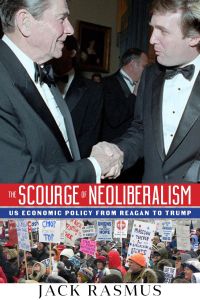
Dr. Rasmus is author of the just published book, ‘The Scourge of Neoliberalism: US Economic Policy from Reagan to Trump‘, Clarity Press, October 2019, available for purchase at discount from this blog. Click on the book icon.

Listen to my Alternative Visions radio show continuing analysis of Neoliberalism, today, focusing on the ‘balance sheet’ of Trump’s effort to restore US Neoliberalism in a more aggressive, virulent 2.0 form; where it has succeeded and where it is not doing so.

TO Listen GO TO:

http://alternativevisions.podbean.com

    SHOW ANNOUNCEMENT

In the first half hour of today’s radio show, Dr. Rasmus reviews the latest developments in the US-China mini-trade deal negotiations and provides the latest snapshot of US economic data releases on manufacturing, investment, and retail sales-consumption.

In the second half hour, Dr. Rasmus continues the analysis of Neoliberalism in crisis topic of last week, explaining how Obama failed to restore it to full effect in the wake of the 2008-09 crash and how Trump represents the attempt to restore it in a new, more virulent 2.0 form. The fundamental main policy propositions of Neoliberalism are restated and how Trump has fared to date in each area are addressed. Big success by Trump in restoration have occurred in business-investor tax cutting and increases in war-defense spending, but failure in social program spending cuts and containing escalating deficits and debt. Trump industrial policy has also been successful, with deepening of deregulation, privatization, continued wage compression, benefits cost reductions, and other areas. Neoliberal monetary policy of chronic low interest rates remains a work in progress as Trump fights the Fed over rate reduction but the Fed slowly falls in line. Neoliberal ‘External’ policy (trade, currency exchange rate, FDI money flows) represents Trump’s major failure at restoration, however, as the trade war produces little result and reduces investment and growth globally and increasingly as well in the US. (A more complete analysis is available in Dr. Rasmus’ just released book, ‘The Scourge of Neoliberalism: US Economic Policy from Reagan to Trump’ available on his blog, jackrasmus.com, along with recent articles on the topic). Next week: the material forces at work undermining a restoration of Neoliberalism under Trump and his successors.

The following extended article will appear in the next issue of ‘Z’ magazine. It is a summary of the major themes and articles in chapters 1&2 of my just released book, ‘The Scourge of Neoliberalism: US Economic Policy from Reagan to Trump’, now available for purchase at discount from the book icon on this blog page, via Paypal, and from the icon on the front web page of Dr. Rasmus’s website, http://kyklosproductions.com.

“Hundreds of books and articles, perhaps thousands, have been written to date on the meaning and consequences of what’s called Neoliberalism. But clarity as to what it means, what has driven its evolution for the past four decades, and what’s its likely future trajectory remain insufficient at best.

Critics of Neoliberalism have yet to explain it fully or adequately. They are therefore unable to say little about its future evolution.

Some key questions that remain unanswered are: Has Neoliberalism been unraveling since the 2008-09 recent economic crisis and the slow growth, often stagnant recovery that followed? Is it being restored under Trump? Will it survive the next capitalist crisis almost certain to occur by the early 2020s? What are the material forces maturing within 21st century capitalist economy that will precipitate and drive that next crisis, and will Neoliberalism be able to successfully adapt? If not, what ideas and policies might replace the current Neoliberal era (1979-2019) of capitalism?

Most analyses concur that Neoliberalism represents an economic shift introduced by capitalists and their political elites—initially in the US and UK—in response to the crisis capitalism encountered in the 1970s decade. In other words, it has something to do with capitalist economy in crisis.

Other accounts attempt to explain its origins and evolution primarily from the perspective of an Idea that inspired, defined, and enabled US and UK capitalist-elites’ to respond successfully to the 1970s crisis.

Still others explain Neoliberalism as an historical practice, i.e. as a new regime of policies introduced in the late 1970s in the US and UK—later adopted by other capitalist economies worldwide to varying degree and form—-that emphasizes austerity in government spending and reliance in policy matters on free markets.
But all that doesn’t really tell us much. Defined that way leaves its meaning still opaque and ambiguous-—and therefore able to predict where and how Neoliberalism may evolve in the future.

The analysis of Neoliberalism to date has produced so many interpretations, often contradictory, that readers remain confused as to what exactly it means. Is it about introducing free market principles into economic and social policy? Is it about austerity in fiscal spending? Is it just a substitute term for what was formerly referred to as Imperialism abroad and class exploitation at home? As one analysis concluded, “imprecision would seem to characterize its use, sometimes even among those for whom the concept is central to their analysis, and its over-use is seen to have resulted in a loss of analytical value.”

The Ideology of Neoliberalism

According to those approaching Neoliberalism from the perspective of the evolution of an Idea, the Neoliberal Idea originates around mid-20th century among ultra conservative intellectuals like Friedrich Hayek and Milton Friedman in economics; in the philosophy of radical individualism by Karl Popper and Robert Nozick; and later in policy proposals from right wing pundits like Charles Krauthammer, William Kristol and Robert Kagan—to name but a few or the more notable.

As these intellectual originators viewed it, their task was to adapt, repackage and resell some of the main tenets of classical liberalism. To plant and nurture the seeds of new ideas, and counterpose those ideas to the prevailing dominant Keynesian economic and social compact views that prevailed after world war II. The new ideas would be resurrected classic Liberal ideas adapted to the post-war environment. New ideas that were new-Liberal or Neoliberal, designed to displace the dominant Keynesian-social compact ideas of the period and encourage and usher in a new set of policies based on the new ideas that would, in effect, represent a return pre-Keynesian, pre-social compact ideas once again, now adapted to the post-war reality. It was to be old classic Liberal wine in the new Neoliberal bottle.

But is Neoliberalism actually ‘Liberal’? How does it compare with the classic liberal economic and social theory ideas of the 17th-18th century? Neoliberalism as an Idea claims it is based on classic liberal ideas of free markets and individual freedom. It claims that by adapting classic liberal principles and propositions to new economic and social policies the new policies will succeed in promoting economic growth and stability, whereas the old Keynesian-collectivist policies failed to do so. Thus it is Neoliberal Ideas that drove the eventual policies that came to be known as ‘Reaganomics’ in the US and ‘Thatcherism’ in the UK in the late 1970s early 1980s.

But Neoliberal Ideas have actually little in common with the classical Liberal; and it is an intellectual conceit to argue that Neoliberal Ideas drove and determined the Neoliberal policies that were eventually introduced in the late 1970s-early 1980s. In fact, a reasonable argument may be made to the contrary: it is Neoliberalism in Practice that reached back and adopted Neoliberal Ideas and propositions in order to justify and legitimize Neoliberal policies.

What then exactly are the basic propositions of the Idea of Neoliberalism? What congruence is there between those propositions and 17th-18th century Classic Liberalism? And do either—i.e. Classic Liberal and Neoliberal Ideas—have anything to do with Neoliberalism in Practice?

The Basic Propositions of Neoliberalism as Idea:

• Markets should always be free of government interference and the economy and policies should be based on free markets
• Free markets require deregulation of business, as well as privatization of all public ownership of production of goods or services
• Free markets are always and everywhere more ‘efficient’ than regulated markets or government provided goods and services
• Free trade should always and everywhere govern the exchange of goods and services between economies and countries
• Government should never intervene in markets—whether to provide public works, correct negative ‘externalities’ created by those markets, or even to provide public education, health care, or other services
• Taxes should be cut to stimulate economic growth—especially taxes on business and investors. Cutting taxes creates additional investment and therefore employment and growth
• Government budgets should always be ‘balanced’, avoiding deficits and therefore accumulation of government debt
• To ensure stable economic growth, the money supply should be increased according to a ‘monetary growth rule’—i.e. a set amount every year.

But these elements of the Neoliberal Idea have very little to do with Classic Liberalism. And have even less to do with Neoliberalism in actual historical practice.

The Basic Ideas of Classic Liberalism:

• Markets should be free only to the extent that they fostered superior moral behavior and enable the development of the individual.
• Free markets were more efficient only if they promoted competition among capitalists, resulting in goods being produced at the lowest cost, and therefore lowest price, while providing the greatest possible amount of goods to the greatest number of individuals.
• Not all business activity should be deregulated or privatized. Some things markets would not produce, even if socially necessary and demanded by the public; or they would produce them for only a wealthy minority who might afford them only at the much high prices that markets might have to charge a smaller, privileged number of buyers.
• Markets sometime behave badly and at times must be regulated. Not all government services should be privatized. In fact, services like public education must be provided by government since markets would not find it profitable to provide them.
• Free trade is not always appropriate everywhere. Nor beneficial to all.
• Economic growth is stimulated by raising taxes on business, not cutting taxes. Higher taxes force business to introduce more efficient ways of producing to offset the cost of the tax increase. New technology that results actually increase jobs and stimulate economic growth.
• Budget deficits are justified for purposes of spending on defense, public safety, and critical social services (education) and public works that markets may not provide
• Money is ‘neutral’. An increase in its supply cannot, by itself, lead to economic growth and stability. Growth is generated only by increasing available land, labor, and capital and by raising its productiveness.

A close reading of the actual works of 17th-18th century Classic Liberal economists like Adam Smith, David Hume, and others shows the preceding points represent the fundamental propositions of Classic Liberalism. But, as a comparative reading clearly shows, they are in sharp contrast to the basic propositions that define Neoliberalism that emerged in the late 1970s and evolved after.

In short, in so far as classic liberalism is concerned, Neoliberalism is not ‘Liberal’ at all. Neoliberalism is not ‘new’ Liberalism or any kind of Liberalism. What it represents is something quite the contrary.

Comparing Neoliberalism as Idea with Neoliberalism in Practice

What about Neoliberalism in actual, historic practice? How does it compare—to Classic Liberalism as well as Neoliberalism as Idea? Neoliberalism in Practice differs from both. It is even further removed from Classic Liberalism. And in a number of ways it is even the opposite of Neoliberalism as Idea.

First, Neoliberalism in practice is not at all about expanding free markets. There are few, if any, free markets under Neoliberal capitalism. The fiction is created by Neoliberalism as Idea writers is that, just because industry is deregulated and public goods privatized, deregulation is equivalent to the creation of ‘free markets’. Neoliberal capitalism is about the destruction of market competition and the concentration of economic power among fewer and fewer remaining businesses in an industry. It is about eliminating ‘free markets’ whenever and wherever possible. Capitalism always drives toward eliminating competition, and without competition there are no ‘free’ markets in the Liberal sense. So Neoliberalism in Practice is the antithesis of free markets.

Secondly, it is different in that, in historical practice, Governments in the Neoliberal era of capitalism are deeply and increasingly involved in the economy on behalf of capitalist interests in general, in subsidizing capital in increasing ways, in redistributing income to capital from other classes, and in assisting mergers and acquisitions and thus advancing the concentration of capital and business into fewer producers and sellers. And the larger and the fewer the remaining producers, the less ‘efficient’ they become. That is, the higher the costs of their production become and in turn the higher the prices they charge consumers. Markets in effect become more concentrated, less efficient, and less ‘free’ as a consequence of Neoliberalism in Practice.

One might add to this view of Neoliberalism’s contribution to ‘micro’ level inefficiency an even more massive macro inefficiency that results from Neoliberalism: How efficient is Neoliberal capitalism when it creates economic crashes like 2008-09, when 14 million homeowners in the US alone were foreclosed and lost their homes? When 20 million were left unemployed, and thereafter underemployed for years after 2009. Or when $4T in lost interest income occurred for retirees as a result of the near zero interest rate policy of the central bank, the Federal Reserve, that remained in effect from 2009 to 2016? Or what about the macro efficiency of the additional $4T in collapsed retirement pension benefits values that happened during the crash and aftermath? Meanwhile, while all this inefficiency was occurring, the same central bank Neoliberal zero rate policies resulted, in more than a $1T a year on average in stock buybacks and dividend payouts distributed to shareholders every year from 2010 through 2019. Neoliberal monetary policy meant Corporations borrowed virtually ‘free’ money at near zero interest rates—-either from loans or by issuing corporate bonds—-and turned around and distributed most of it to shareholders at the rate of $1T plus a year. And what of the macro-inefficiency of spending $7 trillion in US wars and products that were either blown up or dumped in deserts when declared obsolete. The ‘macro-inefficiencies’ of Neoliberal capitalism are massive and almost incalculable, in the US economy alone.

In short, there is nothing ‘free’ or ‘efficient’ about markets in the Neoliberal era in practice. Quite to the contrary of the ideological propositions falsely identified with Neoliberalism as Idea. The founding and later defending intellectuals of Neoliberalism, when promoting that notion as free and efficient markets, are therefore simply peddling a lie—-i.e. they are promoting the ideology of Neoliberalism not its reality. They are peddling a notion of Neoliberalism that doesn’t exist in the real world of Neoliberal practice. What Neoliberalism in Practice has done is simply used the lie that free markets are more efficient in order to justify and to ‘sell’ the actual policies of industry deregulation and public goods privatizations and related false notions. In other words, deregulation, privatization, etc., have nothing to do with free and efficient markets. The latter are just the intellectual veil, the cover to justify the Neoliberal policy, the true aim of which is to reduce business costs and open up new public markets for profitable exploitation.

Fourth, the Neoliberal idea that tax cuts create jobs and economic growth is no more accurate in fact than privatization, deregulation, free-efficient markets result in more economic growth that benefits all. Tax cutting under in the Neoliberal era since 2000 alone has amounted to more than $15 trillion—80% of which has accrued to investors, businesses, and the wealthiest households. In turn, that $15 trillion has resulted in the weakest rate of investment, job creation, wage increases, and general economic growth in the US in the past half century. In other words, business-investor tax cuts did not create jobs. They destroyed them, as tax incentives strongly encouraged US multinational corporations to move operations offshore. Trump’s 2018 tax cuts—the latest iteration of this ‘business tax cuts create jobs’ shell game alone provide another $2 trillion for US multinational corporations over the next decade. They can now produce offshore tax free. Why then should they expand production and jobs in the US, one might ask, when they can henceforth produce offshore and pay no taxes?

Neoliberalism as Idea further maintains that free trade should be the norm everywhere. But in Neoliberal Practice free trade means incentives to further move US production offshore. US businesses then produce offshore at lower cost and ship the goods produced back into the US, now without tariffs, for US workers to buy, now with lower paid service jobs replacing the higher paid manufacturing jobs that were offshored due to free trade. Instead of higher wages, workers are now allowed to borrow (credit) to buy the products, incurring debt, the interest of which they now pay banks and stores issuing the credit cards. Free trade also means banks and finance capitalists, who get to borrow at near zero interest rates, invest the money offshore instead of in the US. Free trade is more about such international money flows from the US as it is about goods and product flows produced abroad back to the US. All this is the reality of Neoliberal free trade, compared to the fiction of the Neoliberal Idea of free trade where all parties somehow benefit from free trade—workers, consumers, as well as capitalist producers and bankers.

But perhaps nowhere is the chasm greater between Neoliberalism as Idea and Neoliberalism in Practice than on the question of deficits and debt. The former declares Neoliberalism is about balancing the budget and reducing government debt; whereas Neoliberalism in Practice is actually about allowing the uncontrolled escalation of annual budget deficits and therefore government debt. At barely $1 trillion when Neoliberalism in Practice began in 1979-80, US budget deficits and debt had escalated to $4T by 2000, rising to $10T by 2009, and thereafter to nearly $23T by year end 2019. The main causes have been trillions in tax cuts for corporations and investors, uncontrolled wars and defense spending, and deregulation and privatization of healthcare industry that has permitted decades of price gouging. Trump’s 2018 tax cuts and his war spending escalation will raise the $22T current US national debt to more than $35T by 2028.

Finally, the monetary growth rule of Neoliberalism as Idea also contrasts sharply with the practice of Neoliberalism in monetary policy. Instead of allowing the central bank to slowly and steadily increase the supply of money in the economy according to an objective rule, or fixed formula, the practice of Neoliberalism has been to have the central bank continually inject massive amounts of money into the economy. In times of banking crises and after as well. The result is chronic, low interest rates, which enable lending at low cost to investors and corporations alike, much of which borrowed is then diverted to offshore investments, to re-investment in stock, bond and other financial markets, to distribution to shareholders in the form of stock buybacks and dividend payments, or into merger and acquisition of competitors by businesses. The Idea of Neoliberalism thus has little in common with its practice so far as money is concerned.

What the foregoing paragraphs reveal is that Neoliberalism as Idea has little in common with Classical Liberalism, and even less in common with Neoliberalism as Practice. The function of Neoliberalism as Idea is therefore to provide a false economic analysis, and pro-individual, pro-personal freedom moral arguments, designed to justify the Neoliberal policies that occur in practice—-i.e. policies that are often quite contrary to those arguments and that Idea. The practice of Neoliberalism is thus neither classical liberal nor even Neoliberal.

Contrary to many accounts of Neoliberalism–both defensive and critical alike–the Idea of Neoliberalism does not give rise to or enable Neoliberalism as actual historical practice. The role of Neoliberal Ideas is to legitimize—-after the fact—-the actual policies and practice of Neoliberalism.

A problem with many accounts and analyses of Neoliberalism is that they assume that Neoliberalism as an Idea is what gave rise from the mid-1970s on to Neoliberalism as an actual historical practice. Somehow the ideas are what convince capitalists, their lobbyists, their business organizations, their trade associations, etc. to propose to their political elites in Congress and legislatures the actual Neoliberal policies, The policies are thus a reflection of their ideas. However, as just shown, Neoliberal ideas have little in common with the actual policies and practices of Neoliberalism that get introduced and implemented. So how can the ideas drive the actual historical practice, i.e. the policies, if they are different?

More likely is that the causation is actually the reverse: the policies and practices are developed by the capitalists and their political elites. The ideas of Neoliberalism—-a strange amalgam of classic and non-classic liberal propositions—-are after the fact then employed as justifications and legitimization of those policies.

Embalmed in a veneer of personal freedom, individualism, efficiency, growth benefiting all, etc., the dead body of Liberalism is resurrected in decayed form to argue that the corpse is still alive and liberal even though it has long deceased.

Nonetheless, many critics of Neoliberalism simply slip back and forth between the Idea and the Practice of Neoliberalism, with little explanation of how the one, the Idea or the Practice, causally determines the other.

More on Neoliberalism in Practice

What then are the actual policies associated with actual, historical Neoliberalism? Here too critics of Neoliberalism fail to provide a comprehensive explanation. Major attention is given to Neoliberalism as Austerity policy, or as industry deregulation and privatization, or as free trade. But little attention is paid to Neoliberal monetary policy or Neoliberal external policies apart from freetrade—i.e. currency exchange rate policy or what is called the ‘twin deficits’ policy solution. Nor is much explanation given to how Neoliberal policy promotes the financialization of the global economy, financial deregulation, and cross border money capital flows. While fiscal policy and industrial policy (i.e. deregulation, privatization, de-unionization, wage compression, etc.) are addressed narrowly in most accounts of Neoliberalism, not much in the way of analysis and critique is given to External Policy and Monetary Policy. But Neoliberalism in Practice is more than just austerity in Fiscal Policy or deregulation-privatization in Industrial Policy.

Neoliberalism in Practice represents a particular policy regime, consisting of Fiscal policy (tax, spending, deficit-debt management), Industrial policy (deregulation, privatization, de-unionization, wage compression, financialization), Monetary policy (excess liquidity injection, chronic low interest rates), and External Policy (trade, low US dollar exchange rate, twin deficits).

Neoliberalism represents a particular mix of these policies. Before Neoliberalism, the four main policy areas also existed but in a different mix and different relationship to each other. It was a different policy ‘regime’.

US Neoliberalism as the 3rd Capitalist Restructuring

The policy regime before the Neoliberal policy shift originated in the wake of of the second world war, originating roughly in the period, 1944-53. A still different policy regime was created in the US just prior to world war one, in the period 1908-13. Thus the US experience has been to restructure the economy in a major way at least three times in the last century: 1908-13, 1944-53, and 1979-88. The latter, 3rd restructuring is simply called the Neoliberal. Its policy mix or regime differed from the two prior regimes.

The policy restructuring in all three cases was designed to change policies in order for US capitalism to confront a challenge or crisis. In 1908-13 US capitalism prepared to restructure its economy in anticipation of becoming a more or less equal competitor with the UK and European capital in general on the stage of the world economy after world war one. In 1944-53, capitalists restructured once again as the US became the sole hegemon in the global economy following world war two. Both restructurings represent US capital shifting policy fundamentally in order to confront a major crisis and opportunity. In each case the restructurings were accompanied by a particular policy reordering. That reordering occurred a third time as a response to the crisis of the 1970s, not war. In that sense it differed from the earlier two restructurings and policy shifts.
In the Neoliberal case, the US re-established itself as the hegemon in the global capitalist economy for at least several more decades. Challenges domestically and abroad in the 1970s were successfully contained, and US capital emerged once again globally and internally as the key dominant player in the global economy.

Neoliberalism in Practice—i.e. as a particular new policy mix of the four areas—continued to expand and evolve throughout the 1990s and after 2000. The global crash of 2008-09 halted its development and evolution, however. As argued in this writers’ book, ‘The Scourge of Neoliberalism’, Neoliberal policy evolution hit a wall with the 2008-09 crash. Obama tried but failed to restore it and regain its momentum. Trump’s policies should be viewed as a future attempt to restore Neoliberalism as policy, albeit in a new virulent and aggression form that is still in progress.

Whether Trump will succeed remains to be seen. However, there are fundamental real and material forces in development—involving changes in technology, AI & machine/deep learning, the nature of money, production processes and distribution channels, new business models, product-capital-labor markets, and in political resistance both domestic and foreign—that may well prevent Trump’s restoration attempt.

The Main Policy Propositions of US Neoliberalism in Practice

Over the past four decades Neoliberal policy has evolved and expanded. It has also begun to develop its own internal contradictions—as discussed in more detail in the aforementioned book. As a partial summary of Neoliberalism in Practice at this point, the following elements may be said to now constitute Neoliberalism in Practice as of 2019:

• Social program policy cuts, focused heavily on reducing and eliminating government programs introduced from 1934 through 1965;
• Aggressive deregulation of industries, especially banking & finance, communications, public and private transport, education and healthcare;
• Privatization of employer contributed healthcare and retirement services introduced with the 2nd restructuring, privatization of military services, and privatization of public goods and services including federal lands access;
• Deep reduction of business-investor-wealthy household taxation on profits and capital incomes (interest, dividends, business rent, etc.);
• Chronic escalation of war and defense spending amidst social spending austerity;
• Tolerance of rising budget deficits, the national debt, and interest on that debt;
• Central bank monetary policies based on chronic liquidity injections designed to ensure long term low bank interest rates that subsidize business costs of investment;
• Incremental de-unionization and weakening of collective bargaining, as well as compression of wage incomes;
• Promotion by government of radical changes in the labor markets, creating millions of contingent labor employment, low paid service jobs, atrophy of minimum wages, massive offshoring of manufacturing employment, and encouragement of on-shoring of skilled labor visa policies;
• Substituting free trade for traditional trade policy measures based on tariffs, quotas, and administrative measures as the primary means to maximize US corporate exports;
• Acceptance of US trade deficits in exchange for a ‘twin deficits’ solution ensuring US offshore dollar recycling arrangements with major allies and global trading partners;
• Encouraging a long term low US dollar exchange rate and US money capital outflows and foreign direct investment;
• Promotion of financialization of the US economy at the direct expense of real asset investment based economic growth;

Thus Neoliberalism in Practice is not simply a set of policies associated with social program cutbacks and fiscal austerity, or industry deregulation or privatization, as many identify. It is much broader than that. It represents a basic economic system restructuring that involves a resurgence and aggressive expansion at the expense of both foreign capitalist competitors as well as domestic working classes. It is an attempt to re-establish US economic hegemony in the late 20th century and well into the 21st. In that it succeeded…until the crash of 2008-09, from which it is yet to fully recover.


What’s Missing in Critiques of Neoliberalism

Apart from not adequately addressing the material origins of the restructuring that gives rise to Neoliberalism, critics of Neoliberal policy fail to address key elements of its unique policy and program mix. To begin with there’s the lack of analysis of what’s called external policy—i.e. twin deficits, external debt, currency exchange rates, foreign direct investment and global money capital flows—are often largely missing. Neoliberalism is characterized by a particular set of external policies that differ from prior restructurings. Consideration of trade or goods flows, and perhaps free trade treaties, are the limited focus of most critiques. Another area where critics fall short is a superficial treatment of Industrial policy. While de-unionization, job offshoring, general wage compression, and industry deregulation are addressed by critics, fundamental developments like the rise of contingent labor and the even more destructive now just emerging phenomenon—artificial intelligence and machine learning—are ignored for their effects on labor markets and the shift in capitalist vs. worker relative power they represent. Also missing, in all but minor terms, is the financialization of the global capitalist economy. Here the role of capital markets, shadow banks, derivatives, the rise of the new global finance capital elite, and the relative shift to financial asset investing, crowding out real investment, are left largely unconsidered; in other words, that which might be classified as the new phase of imperialism and US vs. global capitalist class competition and conflict is not adequately addressed. Not least, what is also missing in most accounts of Neoliberalism is how its advance is closely correlated with the atrophying and decline of Democracy in America—i.e. the norms, practices, parties, the electoral system, and even government institutions.

Dr. Jack Rasmus
copyright October 2019

Dr. Jack Rasmus is author of the just released book, ‘The Scourge of Neoliberalism: US Economic Policy from Reagan to Trump’, Clarity Press, October 2019, which is available for purchase at discount from the author’s blog, jackrasmus.com, and website, http://kyklosproductions.com. Jack hosts the weekly radio show, Alternative Visions, and tweets at @drjackrasmus.

For my continued discussion of Neoliberalism, and why it is failing, listen to my Alternative visions radio show of Nov. 8. (fast forward to the second half hour of the show for this discussion). The show’s first half comments on economic developments of the past week re. China-US differences over tariff reductions, what’s driving the US stock markets to further record levels when earnings and fundamentals forecast problems, why Europe’s sinking into recession, and why speculators are exacerbating the Repo Market problem.

TO LISTEN GO TO:

http://alternativevisions.podbean.com

    SHOW ANNOUNCEMENT

In the second half hour of the show Dr. Rasmus continues the discussion of Neoliberalism, focusing on the internal contradictions inherent in its policy regime, now intensifying after the 2008-09 economic crisis. Rasmus explains the four policies of Neoliberalism—fiscal, monetary, external-trade, and industrial—and how they represent the post-1970s restructuring of the US and global capitalist economies. Earlier restructurings before world war I and following world war II are contracted to the 3rd, Neoliberal restructuring. Examples of contradictions within, and between, the four policy areas are explained: How fiscal war spending and tax cutting clashes with deficits/deb management; how monetary policy exacerbates trade and currency policies; how trade policies exacerbate industrial policy; how monetary policy contradicts both fiscal and trade policies. In the first half of the show, Rasmus provides updates and analyses on the tariff dispute between China-Trump, why US stock markets keep rising despite fundamentals, how Europe’s economy continues to stagnate, and new evidence how speculation is contributing to the instability in the US Repo market. (Next week: ‘Why Trump’s Attempt to Restore Neoliberalism 2.0 Is Failing’)

Listen to my friday, November 1, Alternative Visions radio show presentation and my part 2 analysis of Neoliberalism in the US from Reagan to Trump–based on my just released latest book, ‘The Scourge of Neoliberalism: US Economic Policy from Reagan to Trump‘. (see book icon on this blog to order at discount)

The following Part 2 radio show podcast presentation on the nature and evolution of contemporary Neoliberalism explains why US Neoliberal policies, originating in late 1970s, accompanied and facilitated a major capitalist restructuring in America (the two prior restructurings occurring 1908-13 and 1944-53, also discussed). The show explains the material origins of Neoliberalism in the 1970s, but also explains why new fundamental material changes in the US economy, that have been occurring since 2000, are again creating new contradictions to the Neoliberal policy regime and why these new contradictions will mean the demise of Neoliberalism in the 2020s and its replacement by a new economic policy regime–i.e. either more progressive or more proto-fascist as the policy crisis unfolds. What most writings and left critiques of Neoliberalism miss in their analysis. (Next week: Part 3: Trump’s attempt to restore a more virulent Neoliberal 2.0, and why it will fail.)

TO LISTEN GO TO:

http://alternativevisions.podbean.com

    SHOW ANNOUNCEMENT

Dr. Rasmus continues the critique of Neoliberalism, explaining how it entered a crisis under Obama and how Trump is attempting to restore it in a new aggressive form. How material forces give rise to capitalist restructurings of which Neoliberalism is just the latest. And how material forces now developing beneath the surface are undermining the Neoliberal policy regime, with growing contradictions, that will give rise to a new restructuring in the 2020s. Why Neoliberalism is not ‘Liberal’ at all but in many ways its opposite. What critics of Neoliberalism miss in their analyses. Neoliberalism as just the latest policy response to capitalist restructuring which has occurred before WW1 and after WW2. Why Neoliberalism will not survive the next crisis. (Check out Dr. Rasmus’s latest book ‘The Scourge of Neoliberalism’, from his blog and website, jackrasmus.com and http://kyklosproductions.com)

To watch my Sept. 20, 2019 40 minute TV interview with the ‘Other Voices’ show, on Trump’s economy, including trade war and growing evidence of coming recession,

GO TO:

https://youtu.be/nu7fxV7PerQ

Today’s Alternative Visions show briefly reviews latest events on the Repo market and pending decisions by central banks worldwide (1st 15 mins of show). The remainder 45 mins of the show is my discussion of the major themes in my now available book,The Scourge of Neoliberalism: US Policy From Reagan to Trump,Clarity Press, October 2019, as described in the show announcement below. (Book orders are now available, at discount, via paypal from book icons on both my blog, jackrasmus.com, and my website, kyklosproductions.com, starting saturday, October 26. Click on the order button near the book icon).

    TO LISTEN GO TO:

http://www.alternativevisions.podbean.com

    SHOW ANNOUNCEMENT:

.
Dr. Rasmus discusses the main themes and predictions of his just released latest book, ‘The Scourge of Neoliberalism: US Policy From Reagan to Trump’: Neoliberalism as just the latest US capitalist restructuring to ensure US continued hegemony over domestic opposition (unions, social movements, etc.) and global capitalist competitors (China today; Japan-Europe before). Prior capitalist restructurings before WW1 and after WW2 are compared to the Neoliberal. Why Neoliberalism is not ‘Liberal’. Neoliberalism as historical practice vs. Neoliberalism as Idea is differentiated. What’s missing in prior critiques of Neoliberalism. The 4 basic policies of the Neoliberal policy regime are explained: Fiscal (tax, war-defense, social program spending), Monetary (low interest rates), Industrial (deregulation, privatization, anti-union, pension, jobs, wage compression), and External (trade, free trade, $US exchange rate, global money flows, twin deficit solution). Rasmus describes the major contradictions developing within Neoliberalism in recent years, why Neoliberalism hit a crisis under Obama, and why Trump policies represent a new virulent Neoliberalism 2.0. Why Trump’s restoration of Neoliberalism is doomed due to new technological changes, money forms, and rising political opposition (domestic and global) to it. The coming crisis of 2020s. Why Neoliberalism must remove Democracy as an obstacle if it is to further expand. Trump as example of decline of Democracy in late Neoliberalism. (For more on the book, check out Dr. Rasmus’s blog, jackrasmus.com, or website, http://kyklosproductions.com, where book copies may be ordered starting tomorrow, October 26, at discount).

Pundits & politicians alike keep saying US manufacturing, business investment, construction etc. all may be contracting but ‘US households balance sheets are in fine shape and consumer spending will hold up the US economy’. But indications are now emerging that show retail sales contracting and job growth (and therefore wage income for consumption) over the past four months is now only half that of a year ago. On the financial side, the strategic Repo market is far from stabilized. Why more instability is inevitable in Repos, which could spread to other financial markets. Will auto workers ratify the pending deal with GM? Reasons why they may not.

To listen to the analysis on my Alternative Visions radio show GO TO

http://alternativevisions.podbean.com

    SHOW ANNOUNCEMENT:

A review of latest data on US economy, now showing retail sales and consumer joining the contractions in manufacturing, industrial production, business investment and construction. Why the Repo Market instability and problem is not going away, as bankers refuse to sell Treasuries back to the Fed (who’s trying to buy them in order to pump more cash needed into the market)—i.e. the Fed’s strategy to pump $400b more into Repos (QE Lite?) may not work. Then what? A third show topic is an assessment of the just announced ‘deal’ between the UAW and GM and why it may not be approved by the autoworkers themselves in their now scheduled contract ratification vote. How management ‘moves the money around’ in last minute negotiations. How it can manipulate the temp workers offer. How it will reduce its contract offer by not reopening plants in the US and increasing jobs in Mexico. Why lump sum payments actually reduce costs for the company and take home pay for the workers. The politics behind union contract ratification voting. The show concludes with Dr. Rasmus outlining his forthcoming book (next week), ‘The Scourge of Neoliberalism: US Economic Policy from Reagan to Trump’, Clarity Press, October 2019. Why ‘neoliberalism’ is not really liberalism at all, and not really about free markets but an idea created by conservative economists to obfuscate policies designed to restore hegemony for US capitalists at home and abroad.

I was recently asked by a media source to answer the followning questions for an interview about the future of capitalism in general, and about recent comments on that theme by economist, Joseph Stiglitz, and France’s president, Macron. Here are my responses to the questions asked by the reporter:

    TOPIC:

It is broadly understood that capitalism as a social, political, and economic system is dead. Or is it? What marks the end of capitalism? Capitalism’s failures arise from purchasing on credit, perpetual growth on a finite planet leading inexorably to environmental calamity

QUESTIONS:

1. Capitalism is defined as an economic system in which a country’s trade, industry, and profits are controlled by private companies. Is that an accurate definition of capitalism, and is it going strong or is it dead?

2. Anti-capitalists view capitalism as an inhuman, anti-democratic, unsustainable, deeply exploitative system that must be dismantled. Do you agree?

3. In a capitalist country, the focus is on profits over anything. The Nobel economist Joseph Stiglitz sought to distinguish between good capitalism, which he called “wealth creation”, and bad capitalism, which he called “wealth grabbing”. Hasn’t this wealth grabbing led to inequality and poverty?

4. In the most recent G7 meeting held in France, G7 leaders especially France’s Emanuelle Macron concluded that there needs to be a rethink of capitalism as risk of recession looms. Emanuelle Macron said We are experiencing a “deep crisis of democracy,” urging his fellow leaders to reinvent multilateralism and rethink capitalism: can u break this down for us?

Sincerely,

Hamid Reza
Admin, Newsroom

    My Reply to Hamid

“I would describe capitalism as an economic system in which the production and distribution of goods and services is for the market, with the purpose of realizing a profit in excess of the costs of producing and distributing those goods and services, and where the owners of capital secure as much of the excess for themselves and as little as possible for others who are those who make the goods and services–i.e. workers and everyone else involved in the process.

Capitalism in the modern era is also about more than just exploitation of workers in the act of producing and distributing goods and services. That’s the limited classic Marxist notion. Increasingly Capitalism is about making ‘money from money’, i.e. from creating financial securities and financial assets and speculating on the price instability of those financial assets. It needs no worker exploitation for that. Capitalism is also in the modern period about intensification of extraction of natural resources with the purpose of excess wealth creation. We often forget the role of nature itself in the process. Yes, no goods get made without workers. But all the materials used in making goods and delivering services ultimately come from nature itself. Nothing gets produced or distributed without workers and without nature.

So Capitalism is about creating wealth for the few who control the means of production, extraction, and financial asset creation–at the expense of all others who participate in these processes as well as at the expense of the destruction of nature itself.

Capitalism is immoral, as your second statement notes but not simply because it is exploitative and inhuman. It is immoral because it will, if left unchecked, destroy all human society itself as we know it. All morality is of human origin. And if human society as we k now it is destroyed, so is the essence of all morality.

I don’t agree Capitalism should be simply ‘dismantled’. It must be replaced with something better (which is getting easier to offer since capitalism is becoming more destructive with its wars, climate chaos, global poverty, etc.). A better alternative must be described and shown as possible before people will give up what they know, even if what they know is killing them.

Stiglitz’s differentiation between ‘wealth creation’ and ‘wealth grabbing’ is a hoax. Why doesn’t he simply say it’s about wealth production and wealth distribution? They are one and the same, not counterposed. There is no wealth (goods and services) distribution without its production and creation; and there’s no incentive to produce anything unless it can be distributed and consumed.

Economists recognized centuries ago that Wealth is created with the goods and services that are produced.

Wealth ‘grabbing’ is when the value of those goods and services are increasingly distributed to only the few (capitalists). Counterposing the terms ‘creation’ and ‘grabbing’ obfuscates the fact that the distribution of wealth is increasingly being skewed to the few, even as wealth production is growing under capitalism.

It’s thus a false dichotomy to counterpose ‘wealth creation’ to ‘wealth grabbing’. It’s all about the maldistribution of the wealth between classes, capitalists on the one hand and workers and everyone else on the other. Stiglitz likes to talk about income and wealth inequality, but he refuses to go further and describe how the maldistribution of income and wealth under Capitalism today is occurring (and accelerating) and what measures need to be taken, economic and political, to reverse the trend. he likes to identify the fact and the problem, then avoids proposing measures and ways to rectify the problem. If he did the latter, he would have to identify the role of the capitalist state today in the acceleration of that inequality, and identify his friends in the Democrat Party as being responsible in part for the increasing inequality. Nearly everyone knows that inequality of wealth creation and income distribution is a problem today. What’s missing is a serious discussion about what are the solutions, what needs to change and how, in the economy and in the political-state structure that increasingly serves that inequality.

Macron says there’s a need ‘to rethink capitalism’. What he really means is that the capitalists better figure out quick what to do about the increasing inequality and rising discontent–right wing and left–with that inequality, if he and his capitalist friends want to continue to rule in the decades to come.

And along with the trend of inequality and its political reaction underway, he’s worried that Capitalist forms of (limited) Democracy might give way to more radical forms as people organize and rise up against it–as capitalism fails to deliver, destroys the environment, and provokes more wars. And those more radical forms may be neo- or proto-fascist in character next decade.

Macron realizes that Democracy cannot continue ‘as is’ in the face of contemporary capitalist economic fiscal-monetary-trade policies which are failing both to stabilize capitalism more and more and are failing to ensure a necessdary level of economic growth. Capitalist inequality is worsening because the capitalist class, with the help of their state, are being driven to more aggressively ensure their own wealth grows, as the ability of the system to create wealth enough to share with other classes is weakening. (In my forthcoming book, ‘The Scourge of Neoliberalism: US Policy from Reagan to Trump’ (clarity press, October 2019), I explain how current capitalist economic policies continued existence require the destruction of capitalist Democracy in the US, which has been going on since Reagan, and now is accelerating under Trump).”

After months of escalating tit-for-tat tariff increases, and bringing the global economy to the precipice of a global currency war, the US and China agreed to a partial deal on their trade dispute this past week.

Trump heralds the deal as Phase 1 of an historic agreement, subsequent phases to follow. But is this the end of the US-China trade conflict? Will phase 2, to begin after the signing of Phase 1 five weeks from now, wrap up the remaining issues? Or will Phase 1 just announced be all that the parties will agree to over restructuring their trade relations (and money capital flows)? Other questions of import include: who got the better end of the Phase 1 deal—China or Trump?

Why did Trump settle for the partial deal that China was calling for, and not the ‘big deal’ that Trump was declaring publicly he wanted or else there’d be no deal? Why did Trump concede to a lesser partial deal now instead of pressing for his ‘big deal’? Not least, what is the likelihood the remaining, unresolved issues will be concluded before the US 2020 elections?

A Brief Historical Recap

The US-China trade dispute erupted publicly in March 2018. Its origins, however, go back to August 2017, when the Office of US Trade Representative (USTR) issued a preliminary report charging that China’s ‘2025 Plan’ projected passing the US in next generation technology development (5G wireless, Artificial Intelligence, Cybersecurity). China’s plan represented a fundamental challenge to US global economic—and military—hegemony next decade, according to the USTR. That initial USTR report was followed by a second report released in March 2018 that concluded and confirmed what the first had raised: i.e. China represented a threat in nextgen technology development that the US could not ignore. The trade war with China only then commenced, with Trump imposing an initial $50 billion in tariffs on China imports.

An initial tentative agreement was reached between the main negotiators, the US team led at the time by US Treasury Secretary, Steve Mnuchin, in May 2018. That tentative deal was quickly scuttled, however, as US neocons, China hardliners, Pentagon, and the US Military Industrial Complex and friends in Congressional defense appropriations committees organized their forces and got Trump to nix the deal. The scuttled deal included China agreeing to buy $1 trillion more in US farm goods over five years and agreeing to allow US banks and financial institutions to have 51% ownership control of their operations in China. China reiterated the concessions over the summer of 2018, to no avail. The main issue was not the US trade deficit. Nor IP guarantees. Nor tech sharing of US companies in China. Nor even majority ownership of US operations in China. The main issue was the development of nextgen technologies—AI, 5G, and cyber. US Neocons aligned with the Pentagon-Military Industrial Complex, now led by Robert Lighthizer, the head of the USTR, Peter Navarro, special trade adviser to Trump, and subsequently later in 2019, John Bolton, demanded China slow, and even share its nextgen technology development with the US, or else no deal!

Negotiations stalled thereafter as Trump turned his focus to the NAFTA 2.0 negotiations and the 2020 midterm elections approached. Negotiations were restarted in January 2019 after the midterm elections, and another five months of negotiations between the parties took place until another tentative deal was reached in May 2019. That tentative deal once again was blown up at the last minute by the Lighthizer-Navarro neocon faction now in control of negotiations, with Mnuchin in tow as a co-chair. As the China delegation prepared to come to the US to sign off in May 2019, the US raised new demands: China had to share its nextgen technology development with the US, cease subsidizing its state owned enterprises, and provide assurances it would not devalue its currency to offset US tariffs (which now totaled $200 billion). Furthermore, US tariffs would remain in effect even if an agreement were reached, according to the US. All these demands were publicly communicated in the week prior to the May 2019 meeting in Washington D.C. when the deal was scheduled to be signed off. Understandably, the China delegation came and returned home in a day. The Neocons had scuttled a deal once again. Nextgen technology was the crux. Either China capitulated on nextgen tech or there was no deal, according to the Neocon-Pentagon position.

Trump thereafter met China president, Xi, in Osaka Japan at the G20 meeting and both agreed once again to restart negotiations. Both also agreed to keep a hold on the level of existing tariffs and not raise them further in the meantime. But Trump broke the pledge in late July 2019 when, on advice of his neocon trade negotiators, he raised tariffs on the remaining $250 billion of China imports. The understanding with Xi not to raise more tariffs was thus shattered. China raised tariffs of its own on US goods in response.

Trump threatened to raise existing tariffs by another 5%, to 25% and 30%, and levy more on all remaining China imports in December 2019. The trade war was intensifying. China stopped intervening briefly in global money markets to prevent its currency, the Yuan, from devaluing and allowed it to fall 5%-7%–a move that essentially negated Trump’s additional 5% tariff hike. Stock and bond markets swooned on the prospect of a trade war now morphing into a currency war. The trade war, based mostly on tariff hikes, was about to expand the economic conflict beyond mere tariff measures. Tariffs were already slowing the global economy; a currency war would quickly spread beyond US and China and inject even more instability into the slowing global economy. Both China and Trump peered over the cliff of a pending broader economic war between the two economies—and then backed off.

Trump’s September 2019 Retreat

Fast forward, the outcome by September 2019 was yet another resumption of negotiations between the two parties, followed by the announcement last week of a ‘Phase 1’ deal on trade.

So why did Trump ‘stand down’ and agree to a deal now, after escalating his threats and actions over the summer? The reasons clearly have to do with the US economy softening in the 3rd quarter combined with a growing discontent in the farm sector over Trump’s handling of a trade dispute that was beginning to bite hard on US farm sector sales that were heavily dependent on exports to China.

As the trade dispute between the countries had intensified over 2018-19, Trump had placated farm interests by providing an extra $28 billion in direct farm subsidies. But it wasn’t enough. According to some sources, no fewer than 12,000 farms went bankrupt in 2018 alone. The $28 billion was going mostly to agribusiness and not getting down to independent farmers who needed it most. Farm sector trade associations were demanding Trump settle the trade dispute and their voices grew louder after the August escalation between the US and China.

So too were other notable business groups, like the US Chamber of Commerce and Business Roundtable, raising their complaints about the now rapid deterioration of the negotiations. The trade war was beginning to clearly impact general business investment and manufacturing in the Midwest US, and not only in the US but worldwide. US business investment on new plant and equipment turned negative in the 2nd quarter and promised to continue to slump, while business inventory investment was also being pared. The trade war was beginning to impact beyond the farm sector. By August the US manufacturing sector began to contract, joining what had now become a global manufacturing recession. Moreover, at the end of August it was also beginning to appear that the manufacturing contraction in the US was potentially spilling over to the larger services sector. While manufacturing PMIs were contracting in the US, the even larger Services sector PMI had begun to decelerate sharply in terms of growth rate. Of equal concern, the new round of Trump tariffs on consumer goods now threatened to slow US consumer spending—the only sector of the economy still holding up in terms of growth. Chase bank research was estimating that, with the new Trump tariffs on China consumer good imports set for September and December, consumer spending would be reduced on average by no less than $1,000 per household.

It was this growing economic slowdown in the US—combined with the growing political discontent in the farm sector and from other major non-farm business organizations—that pushed Trump to concede into last week’s Phase 1 deal. Trump’s 2020 election interests had become more paramount than the concerns of the neocons and militarists who were demanding China capitulate on the nextgen tech issue or no deal. A rapid about face by Trump occurred by late August-early September and China was once again invited to resume talks in Washington in early October.

The content of the Phase 1 deal reached October 11, 2019 last week reveals that Trump abandoned his ‘big deal or no deal’ position and retreated from the neocon ‘non negotiable’ demand, that was holding up a deal since May 2018, that China capitulate on the nextgen tech issue or no deal.

Placating his farm sector political base to get China to resume purchases, and taking China’s 51% ownership concession desperately wanted by US big banks (i.e. the primary demand of the Mnuchin faction on the US negotiating team), became Trump’s new priority demand in Phase 1. The nextgen technology issue so critical to the neocons was clearly demoted and removed from the bargaining table by the US. In Phase 1 China got its ‘partial’ deal—and absent any concessions on the nextgen tech issue. That was left for a Phase 2 or even Phase 3, as Trump put it in his press conference the same day. Trump got what the China delegation had already offered way back in 2018: i.e. 51% ownership and resumption of big purchases of US farm products.

In short, Trump caved in and in effect “took the money and ran”. His 2020 re-election interests took precedence over the neocon-military concerns over China’s nextgen tech development.

What’s In the Phase 1 Deal?

Important to note, the Phase 1 deal itself is not yet a signed agreement. It’s a verbal understanding between Trump and China’s vice-premier and chief negotiator, Liu He. In his press conference announcing the deal on October 11, Trump admitted the parties were yet to sign off even on Phase 1 but hoped that it could be done within 5 weeks; that is by the time Trump and Xi meet again at the APEC conference in Chile in November.

Trump boasted repeatedly the Phase 1 deal included up to $40-$50 billion in new US farm purchases by China. Over what period was not clear, however. Trump vacillated from saying current levels of China farm purchases were $8 billion, or maybe $16 billion, or was $17 billion at prior peaks. He really didn’t know. Or maybe it was $20 billion, as one side comment was made in the press conference. It sounded like $40 billion was the target agreed to in principle and over the course of the next two years. But that was the ceiling apparently. Trump declared there’s “never been a deal of this magnitude for the American farmer”. Of course that wasn’t true. But the Trump hyperbole and spin was in.

Another major agreement area in Phase 1, according to Trump, was China’s confirmation it would allow US companies to own 51% of their operations in China. As Trump put it, “banks will be very very happy”. More US multinational corporations could now shift even more production to China.
What was agreed to in ‘IP, or intellectual property’ protections was left vague in Phase 1. Trump admitted only some IP issues were included in Phase 1 but didn’t say what. IP was mostly left to Phase 2, per Trump.

Equally vague was the understanding in Phase 1 on how China might agree not to devalue the Yuan, its currency. That was key to the US since devaluation would offset Trump tariffs. Trade representative, Lighthizer, provided some vague commentary during the Trump press conference about how China and the US would meet to work out some rules in that regard. But the devaluation issue itself was irrelevant. China had consistently over the preceding 15 months of trade war intervened in money markets to keep its currency from devaluing, and did so even as the rising US dollar was the primary cause of the pressure on the Yuan to devalue, as it other currencies worldwide as well. If anything was driving the devaluation it was the rising US dollar, not a policy action by China to enact a devaluation.

On the important tariff front, in Phase 1 Trump agreed only to suspend his threatened 5% tariff hike (raising rates from 25% to 30%) due the following week of October.

What’s NOT In Phase 1

What’s not in Phase 1 reveals clearly that Trump clearly capitulated on the nextgen tech issue in exchange for resumption of farm purchases and the 51% US bank ownership in China offer.

Tech issues were in general put off. As Trump declared, would be “largely done in Phase 2”, or maybe even a Phase 3. And Phase 2 would not begin until and if Phase 1 verbal understandings were ‘signed off’ in writing five weeks from now by Trump and Xi in Chile.

Further revealing no agreement on the strategic nextgen tech issue, Trump indicated the US would continue its policy attacking China’s 5G tech company, Huawei, as well as selectively ‘blacklist’ other Chinese AI companies in the US. That was, he added, “a separate process”. So the nextgen tech issue is now a separate track, in effect decoupled from the trade negotiations. It is very unlikely it will be reintroduced in Phase 2, should that subsequent round even occur, which is not likely in any substantive way before the 2020 US elections.

Also left out of Phase 1 was any US reduction of existing tariffs on China imports. That continuation of tariff levels included the $160 billion of China consumer goods exports to the US scheduled for December 15, 2019.

The US also apparently failed to attain its demand that China reduce its subsidies to its state owned enterprises—a strange proposal given that the US just subsidized its business sector with trillions of dollars with Trump’s 2018 tax cuts.

Some Predictions

For more than a year now this writer has been predicting that there would be no deal with China so long as the US negotiating team was dominated by the neocons and they continued to insist China capitulate on nextgen tech, or else no deal.

The related prediction, however, was that Trump would abandon the neocon-military interests’ prioritization of tech issues, and Trump would settle for concessions China already offered concerning US 51% majority ownership and farm purchases. The shift would occur, it was predicted, when the US economy significantly weakened—i.e. threatening Trump’s support in the farm sector and among US big business, and therefore his election in 2020.

The Phase 1 deal reflects just those predictions: Trump has decided to forego resolution of the tech issue and decided to take the money (farm purchases) and run. He has the full support of US big banks and manufacturing in so doing for their priority demand has always been the 51% ownership concession by China.
It is highly unlike there will be a ‘Phase 2’ in anything but a token discussion level.

And if there is, it is extremely unlikely it will include any meaningful concessions by China on next gen tech—i.e. AI, 5G, cybersecurity. China has now clearly prevailed in blunting Trump and the neocon offensive in that regard. For their part, Trump and US military-industrial-Pentagon interests will continue to pursue blocking China on the tech issue in ways decoupled from trade negotiations. Various other measures will now be the focus, such as attacking and blacklisting China tech companies in the US and even elsewhere among US allies. Perhaps even delisting them from US stock exchanges, as a recent Washington ‘trial balloon’ proposed. Trump did not go there on the eve of the recent negotiations. It would certainly have ‘blown up’ the trade deal once again if he had. But that—blacklisting and delisting—remain as likely US tactics in the months to come. For the technology war—i.e. the real war behind the tariffs and trade war—has only just begun between the two countries. And a broader economic war involving non-tariff measures is almost certain to erupt after the 2020 elections.

A ‘Phase 2’ follow up negotiations is tentatively set for after the Phase 1 sign off in November in Chile. Not much will come of it, however, so long as Trump insists on maintaining the current level of 25% tariffs on China imports to the US. Trump likes the current level of tariffs and the revenue it brings in, which allows him a somewhat independent source of financing for his domestic programs independent of the US Congress passing legislation and authorization bills which he now won’t get. On the other hand, Trump may temporarily suspend the planned tariff hikes on $160 billion of consumer goods due December 15, 2019 should the US economy continue to weaken in the 4th quarter, which is more likely than not. But it will be a temporary suspension, not a dropping of the tariffs.

The 15 month long US-China so-called trade war is over. There will be further discussions but no significant changes before the US 2020 election. What Trump got in Phase 1 is all he’s going to get. He’s probably promised the neocons, who have lost out on this Phase 1 deal, even more aggressive action against China companies doing business in the US. That’s there ‘concession prize’. Worst case, Phase 1 might not even be finalized, should the neocon-Pentagon-Military Industrial Complex faction regroup and try to scuttle the deal, once again for a third time. There’s always that possibility. Especially should Trump’s legitimacy fade further due to impeachment proceedings. It’s not impossible the Phase 1 verbal deal might also collapse but not likely at this point.

A Failed Trump Trade Policy

Trump’s trade war with China is clearly a net failure. Trump could have gotten the same deal back in 2018, more than a year ago. Instead, the dispute was allowed to escalate, with the effect of causing business uncertainty and slowing investment in the US and worldwide due to the 15 month trade war. The trade war has clearly played a part in the global manufacturing recession now underway, which threatens now to spread to services and consumption and precipitate a general recession in the US economy and possibly even worldwide.
Trump has pushed the global economy to the brink of a worldwide currency war in the process as well. He has drained $28 billion thus far from business and consumer spending in order to collect tariff revenues that he’s diverted in turn to the farm sector in subsidies that otherwise might not have been necessary. Small business, household consumers, and failing small farmers have paid the price and will continue to do so in higher prices from continuing tariffs.

Despite 15 months of trade war with China—and a series of ‘softball’ trade deals with South Korea, Japan, and Mexico-Canada—the US trade deficit as of August 2019 has reached record deficit levels of $55 billion that month and an annual rate of nearly $700 billion a year. The trade wars have been totally ineffective in reducing the US trade deficit—if that was ever the goal.

Who Benefits?

In net terms, the Trump trade wars have produced little for US capitalist business interests compared to what they already had going into the conflict in March 2018. Conversely, China has clearly prevailed in protecting its nextgen technology plans—i.e. the main target behind the US trade war identified back in August 2017 and launched March 2018 by the USTR and Trump. US agribusiness got their farm purchases renewed—and $28 billion in subsidies to boot. US big banks and multinational companies got their 51%. Trump got an independent executive branch source of revenue flow in the form of tariffs. The US consumer and small goods manufacturers and businesses get to pay for much of it all in the form of rising prices. And more US multinational companies will likely move more productions—and jobs—to China now that they have 51% ownership control.

In a broader picture of ensuring US global economic hegemony in the years ahead, if the Trump trade wars were to be about restructuring global capitalist trade relations favoring the US for another decade, then the outcome is also clearly a dismal failure. The Trump trade war with China has produced few net results in that sense. China prevailed this round in the technology war and will now seriously challenge the US in the 2020s in nextgen technology and the new industries it would create—as well as the new military technologies it portends. Meanwhile, Trump’s ‘other trade wars’ with US allies has similarly produced few net strategic results. They have been thus far ‘token softball’ deals that have merely tweaked existing trade relationships.

Trump’s trade wars have proven to be a lot of bombast, hyperbole, and smoke with no fire. Trump set up straw men opponents, to knock down and allow him to declare he has out-negotiated his president predecessors by rearranging global trade and money flow relations. But this is in fact not so, as history and the next decade will undoubtedly show.

Dr. Jack Rasmus
October 12, 2019

Dr. Rasmus is author of the forthcoming book, ‘The Scourge of Neoliberalism: US Policy from Reagan to Trump’, Clarity Press, October 2019. He blogs at jackrasmus.com, his website is http://kyklosproductions.com, and he tweets at @drjackrasmus. Listen to his weekly radio show at http://alternativevisions.podbean.com .

.