Feeds:
Posts
Comments

Check out my tweets for December-January, providing a quick look, short analysis, data, and reports on impeachment, China-US trade deal, USMCA, US jobs reports, Trump’s continuing tax cuts 2019, the Fed, Repo Market instability, US stock markets, student debt, Trump’s $1T budget deficit, Brexit, UK election, pensions crisis, and more. Get my tweets immediately when posted by linking to my twitter at @drjackrasmus.

Jan 20
#impeachment

McConnell’s announces rule: witnesses must be deposed first in secret. Then based on what they say, it will take 51 senators to allow witnesses in trial. That way McConnell screens beforehand what witness testimony is allowed–his fallback if he loses witnesses fight

Jan 20
#impeachment

US Constitutional convention of 1787 debates made it clear: executive privilege is not absolute. Need of evidence takes precedence over executive privilege. Founders then left out of actual Constitution all reference to executive privilege

Jan 19
#impeachment

Republicans’ main argument: House should not ask Senate to conduct trial with insufficient evidence House itself didn’t gather. But insufficient evidence due to Trump refusing to allow witnesses & docs to appear in House hearings. Transparent rhetoric. Circular logic

Jan 18
#Fed

announces will issue new 20 yr. T-bonds. Why? 3 reasons: 1)raise funds to cover>$1 trillion annual US budget deficits in 2020; 2)need for more liquidity for Repo mkt injections; 3)Fed can’t raise rates due to Trump threats. Thus 20yr T bonds alternative. Fed policy a mess

Jan 16
#ChinaTradeDeal

For my more detailed summary and analysis of the just signed US-China Phase 1 Trade Deal, check out my latest blog post at jackrasmus.com

Jan 16
#Chinatradedeal

Trump says China has agreed to buy $40b farm goods in 2020. Fact: China’s Liu He says will buy “as consumer needs and market conditions determine” (read: as Trump reduces tariffs).

Jan 16
#ChinaTradeDeal

The spin is in, exaggerating China trade deal. After 22 mos. & $500b tariffs, US deficit with China down only $56B (Per WSJ today). Per Fed, tariffs cost US business $42B & reduced US households real spending by $806. China still won’t admit to buy $100B in 2020

Jan 15
#ChinaTradeDeal

Phase 1 Mini trade deal today. But ‘mini’ stands for ‘minimum’ gained not ‘small’. Trump keeps $370B tariffs. Says Phase 2 starts soon. China says no plans to start phase 2. China-US trade war now over; US-China tech war by other means than tariffs now escalates

Jan 15
#Yuan

Trump declares China no longer a currency manipulator. A phony claim from the start. China has intervened in mkts to keep Yuan in stable range for years. Rising US $ has stoked global currency devaluations, not Yuan. But Trump claims trade deal cause of stable Yuan

Jan 14
#budgetdeficit

It’s official: US deficit 2019 at $1.02 trillion. (Add another $80-$100B if counting military ‘black budget’ on new weapons that doesn’t show up in print anywhere). Trump’s 2 yrs budget increases>20%/yr on ave. each yr. Causes? tax cuts (60%)+military-social prgms

Jan 12
#jobsreport

Friday’s Dec. US jobs report showed 145,000 net new jobs created. But that should be reduced by thousands as 45,000 GM strikers still returning to work & thousands of US 2020 census workers (500,000 total) still being hired. Real Dec. jobs number closer to 100,000

Jan 10
#USstocks

Wonder why US equity mkts just keep powering ahead? Fed keeps flooding mkts with liquidity: $83B in repos 1-9-20 + $46b on 1-8-20. Add wall of money offshore coming to US+record profits+corp. bond finance+ institutional structure & indexing/ETFs=record demand for stocks

Jan 7
#repomarket

Fed injects another $77b into repo market in just its first week of January 2020. Who now believes the fiction any longer that the Fed only targets real GDP, 2% goods inflation (PCE), or employment? Since December 2018 Fed rates clearly targeting financial asset mkts

Jan 6
#repomarket

after providing $255B to repos in 2019, Fed to continue same vol. thru Jan. & more at least thru April. Dealers now borrowing via Repo Mkt cheaper than from private mkt before Sept. TD Securities: “The repo operations are a band-aid, but the wound isnt’ fully healed”

Jan 5
#Neoliberalism

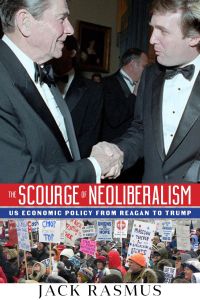
Read David Baker’s review of my just released book, ‘The Scourge of Neoliberalism: US Economic Policy from Reagan to Trump’, Jan. 2020 at https://jackrasmus.com/2020/01/01/book-review-1-the-scourge-of-neoliberalism-us-economic-policy-from-reagan-to-trump-by-dr-jack-rasmus-reviewed-by-david-baker/

Jan 3
#USeconomy

US manufacturing index (PMI) contracts for 5th month in December, from 48.1 to 47.2. Worst since June 2009. Watch US real investment continue to fall 4Q19 as well, extending decline to 9 mos. US CEOs #1 fear: recession 2020, up from #3 last yr. Now same as world CEOs

Jan 2
#Repomarket

Fed reports it provided net $255 billion in Repos since Sept. That’s ‘net’. Many more billions rolled over. But no year end crisis emerged. What’s next? Permanent Fed Repo (& reverse Repo) facility, a 2nd channel & the sleuth NEW QE. Fed balance sheet now $4.17T again

Jan 1
#Trump

For my analysis of Trump’s economic policies, their deep historical origins since 1978, successes & failures to date, and future prospects, read my just published book, ‘The Scourge of Neoliberalism: US Policy from Reagan to Trump’, now at my blog,

Dec 31, 2019
#Taxcuts

NY Times is 2 yrs too late. In its 12-31-19 feature story admits Trump’s 2018 law cut taxes $5.5T for corps & wealthy. This writer estimated $4.5T at the time (see my blog http://jackrasmus.com). NYT & mainstream media said $1.5T for 2 yrs. Now 2 yrs late admit $5.5T

Dec 30, 2019
#S&P500

27% gain in 2018 refers to S&P profits. Prices were up about same for 9 months until major stock correction in 4Q that reduced stock prices by more than 20%. That loss was gained back immediately in 1Q19.

Dec 30, 2019
#stocks #2:

More reason for record S&P up 30% (& why US real asset investment & productivity now negative): Corp bond debt 2019>$1T and now $10T total. Most goes to stocks & fin. mkts. Gap real v. financial investment 2010 was $60B. Gap 2018 now $540B. Financial > real investment

Dec 30, 2019
#stocks

S&P500

up 30% 2019; after 27% 2018. Why: 1)$1.3 trillion stock buybacks+dividend payouts 2)Fed lower rates 3)US multinational corps record profit repatriation 4)foreign investors sending Wall of Money to US as recessions & global econ slow offshore 5)Fed pumps $ into Repos

Dec 26, 2019
#studentdebt

Now $1.5 trillion. US Govt charges 6.8% interest while banks charge half that to many businesses. Why is govt ripping off students? Sen. Rand Paul proposes 401ks withdrawal tax free to pay student debt. But more than 1/2 households have none & less than $400 savings.

Dec 24, 2019
#NorthKorea

China, Japan, So. Korea meet & ask Trump to restart discussions with Kim. Trump’s Neocon advisors opposed after scuttling last Trump-Kim meet. Don’t want new Trump-Kim meeting. Meanwhile, China playing mediator role re. So. Korea-Japan. What else are the 3 discussing?

Dec 22, 2019
#stockmarkets

Per Reuters, global stock markets’ value in 2019 rose by $10 trillion. US up 30%. Japan, Europe, China 20%. Wage incomes flat to declining for 90%. Income inequality accelerating at record pace. So why all the demonstrating from Hong Kong to France to So. America?

Dec 22, 2019
#tariffs

3 wks ago Trump announced tariffs on Brazil steel. Now he announces their repeal. After 20 mos. of 25% steel tariffs, higher prices, & $1B profits last yr, US steel buying competitors, not expanding output. Cuts pensions 40% & now jobs as USS shuts down mills. Thanks DJT

Dec 21, 2019
#PensionsCrisis

Congress passes SECURE ACT to annuitize 401ks (& let Insurance corps charge 3.6% fees instead of current 401k fees ave. of 0.25%). USA facing retirement system crisis: >half US popul. have no savings; retirees 401k ave. balance only $50k; real pensions collapsing

Dec 21, 2019
#USsanctions

US sanctions EU-Russia gas pipeline Co. Allseas. Why? Sen. Ted Cruz inserts sanctions rider in new US Defense bill for Texas oil buddies. Wants EU stop buying cheaper Russia gas & buy Texas gas now in excess supply glut. Germany won’t agree, so US sanctions Allseas

Dec 19, 2019
#impeachment

An addendum: Pelosi won’t send impeach articles to Senate, if McConnell refuses to allow witnesses in trial. Pelosi: Founding fathers feared a rogue president thus impeachment power. But McConnell also a ‘rogue Senate leader’. Not what Founders thought would happen.

Dec 19, 2019
#impeachment

Pelosi adopts McConnell stonewall strategy: refuse to send impeach articles to Senate unless McConnell lets witnesses testify. Leave impeachment hanging over Trump with new charges possible in 2020. US Constitut. crisis spreads, from Trump v. House to House v. Senate

Dec 18, 2019
#Pensions

French planning general strike to prevent govt raising retirement age. While in USA ave. 401k balance only $18k as real pensions disappear & $4T household savings from interest lost since 2009 due to Fed low rates. Fastest labor force growth=over 65yrs returning to work

Dec 18, 2019
#taxcuts

With US budget deficit set to exceed $1 trillion ($209b in November alone), Congress just voted to give special interests another $427 billion cut: i.e. brewers, winemakers, racehorse owners, health insurers, parking lot owners, etc. Add that to $4T in 2017-18 tax cuts

Dec 17, 2019
#USMCA

US says labor inspectors at Mexico plants are attaches who won’t inspect. Per Mexico’s demand, labor panels composed of US & Mexico reps come first. If panel can’t agree first, no inspector is sent to plant. It’s all a cover up to allow Dems to say they got a better deal

Dec 16, 2019
#USMCA

Are Trump & Democrats lying about final USMCA trade deal? US claims inspectors have access to Mexico factories; Mexico says no. Access rule is in an annex (side letter) not main doc. Was it ever signed by both? Did US make it up so Trump could claim deal? How much is real?

Dec 13, 2019
#Brexit

Check out my blog, http://jackrasmus.com, for my more detailed analysis of why Johnson & conservatives won overwhelming victory over Corbyn & Labour. Short run strategic-tactic reasons but also longer run reasons: rise of nationalism & decline of Social Democracy in EU

Dec 10, 2019
#tradewar

As I predicted weeks ago, US & Trump will put off Dec. 15 additional tariffs on China, per Wall St. Journal today. Which means China won’t buy more US farm goods unless US agrees to remove existing tariffs. Closer to the 2020 election, weaker Trump’s position becomes.

Dec 9, 2019
#Repomarket

Bus. media continues red flag on Repo Mkt. Bank of International Settlements (BIS), bank of central banks, warns again but no answer why Repos still in trouble: tech cause, Fed debt financing, big 4 banks, FX swaps, hedgies arbitraging derivatives? BIS warns of more trouble

Dec 8, 2019
#USjobs

For my take on the veracity of the US recent November jobs numbers, check out my just posted blog piece ‘On Those Questionable Jobs Numbers…Again!’

Dec 6, 2019
#USjobs

Official US jobs grow by 266,000 in Nov. Private sources (ADP) had estimated 67,000. Never in 50 yrs has the gap in forecast been so great. What’s going on? US reduced 2018 numbers by 500,000 earlier this yr; says another 500,000 reduction coming in Feb. Why so big adjust?

Dec 5, 2019
#impeachment For my analysis in depth of the forthcoming articles of impeachment of Trump in historical perspective, in relation to the continuing atrophy of Democracy in America, read my latest blog piece at my blog,

Dec 5, 2019
#USjobs

The largest private payroll processor, ADP, forecasts only 67,000 new jobs created in November. USDL/BLS official figures likely to be higher, as 50,000 GM workers return to work. But those 50,000 are not ‘new jobs’ created. Real number will be what BLS reports minus 50,000

Dec 4, 2019
#USjobs

Watch for possible shocking jobs report this friday. With US manuf. & construction contracting, and services slowing, & hiring of census workers & part time warehouse help now over, jobs may come in at around 90,000, as jobs data join other contracting econ indicators

Dec 4, 2019
#taxcuts

Trump’s Treasury Dept. (run by ex-Goldman banker Mnuchin) is changing rules taxing US multinational corps, cutting another $112B from minimum tax + $150B more allowing taxable US profits diverted to offshore subsidiaries where not taxed. All this after $4T 2018 tax cuts

Dec 3, 2019
#Brazil/Argentina.

Trump claims US tariffs needed cuz Brazil/Argentina manipulating their currencies. Wrong. Peso/real devaluing because $US rising due to US interest rates + offshore money flowing into US mkts. That due to Latin America recessions, provoked by Trump trade policy

Dec 3, 2019
#tradewar

Trump signals China mini-deal may not happen. Source of problem: US won’t agree to lower tariffs but wants China to buy more farm goods nonetheless. Trump ratchets up trade war elsewhere as cover: Brazil-Argentina, Europe farm goods, intensifying attacks on China corps

Dec 2, 2019
#Tariffwars

Trump reinstates tariffs on Brazil/Argentina steel. Why? USMCA trade deal frozen + China mini deal in trouble. So open trade wars elsewhere to divert attention from failing trade policy. Besides, how dare Brazil-Argentina dare cut deals on soybeans & wheat with China!

Dec 2, 2019
#Democrats

Wave of Bloomberg TV ads now hitting all sections of country as he launches his presidential bid. Details suggest he’s more ‘left’ than Warren and a flaming NY progressive. But billionaires say what they think folks want to hear, then deliver for the rich (aka Donald)

By
Dr. Jack Rasmus
Copyright 1-16-20

With the announcement today, January 16, 2020 of the signing of the US-China Phase 1 ‘mini’ trade deal, and the US Senate’s simultaneous ratification of the USMCA ‘NAFTA 2.0’ trade agreement, Trump’s so-called ‘trade wars’ are at an end. In election year 2020 nothing of additional significance will be achieved by Trump with regard to restructure US and global trade relations. While Trump himself will make further threats and claims, likely aimed at the Europeans, no country will agree to any changes this year when the possibility exists of Trump leaving the presidency next November 2020. To repeat once again, the Trump trade wars are over. As the comedian once said: ‘what you see is what you get, baby’.

And what do we see in the much-hyped and grossly exaggerated Phase 1 US-China trade deal?

China Phase 1 Deal: A Feeble Deal on Trade

Behind the typical Trump bombast, hyperbole, and outright lies, the China Phase 1 deal was perhaps best summed up in the front page of the Wall St. Journal on January 13, 2020, by the Ben Steil, Director for International Economics for the Council on Foreign Relations (i.e. the major think tank for the US capitalist class): “China is set to do little more than restore agriculture purchases and offer some nice words on financial services and intellectual property…Trump could have had that two years ago without the tariff damage”.

What’s really in the Phase 1 deal? What has Trump actually achieved through nearly two years of negotiations, tariffs, and threats and intimidation in the nearly two year long China trade negotiations? And what have been the consequent negative impacts on US households, businesses, farmers, and the US and global economy?

(51% Majority Ownership)

First, in Phase 1 there’s the claim that US business, especially US bankers, now have more access to China markets. They can have 51% ownership control of their operations in China. Trump claims he achieved that. But it’s just another Trump lie. The fact is China began implementing the 51% financial ownership rule back in 2018. European banks have already set up full ownership operations there. So has Goldman-Sachs, the premier US investment (shadow) bank. Trump didn’t get anything there China already offered and gave to others.

(Currency Manipulation)

Trump says the deal means China has agreed to no longer ‘manipulate’ its currency. Trump this past week then officially removed the US declaration that China was a currency manipulator. The importance of currency manipulation is that Trump wants to block China’s potential to devalue its currency, the Yuan, which would offset any US tariffs easily. But China has not been a currency manipulator at all. In fact, it has been entering global money markets to buy and sell its currency to ensure that it remains within a stable range of exchange to the US dollar no greater than 7.1 to the $. If anything China has committed significant resources to ensure the Yuan does not devalue. That’s the opposite of a currency manipulation to devalue and offset US tariffs. China could have easily done so throughout the last 22 months of trade negotiations with the US, but it didn’t. The claim of China as currency manipulator has been a lie from the beginning, used by Trump (and others before) to try to label China as the problem with the American media and public. It’s worth noting as well that while China has spent billions to ensure its currency does not devalue or rise, the US dollar has been allowed to rise significantly the past two years. That has caused other global currencies, especially those of emerging market economies like Latin America, to devalue dramatically and plunge those economies into recession. The US has been the great currency manipulator and destabilizer—not China.

(IP and Tech Transfer)

Trump also claims the China Phase 1 deal means new limits on China forcing technology transfer of US companies doing business in China and on intellectual property. (Protecting intellectual property mostly means for the US that US pharma companies will enjoy better patent protection—i.e. prevent competition).
But whether IP or tech transfer, there have been no details released by the Trump administration as to how this is so. In fact, as if January 15, 2020 the text of the Phase 1 deal is still not available in either English or Chinese, according to the New York Times.

All we’ve got in the Phase 1 deal, according to those who have had access to date, is China’s promise to punish China firms that obtain sensitive tech information via acquisitions; or stop requiring that foreign companies turn over technology to China as a condition of doing business in joint ventures in China.
But certainly in any joint venture tech information can be obtained by means other than formally turning it over to China government officials. And doesn’t a company that acquires another have legal right to all its product information? According to a Derek Scissors of the American Enterprise Institute, in the Phase 1 deal the Chinese “have committed to continue doing the same thing they have always been doing”. What China refused to agree to is to refrain from engaging in cybertheft of companies—since of course the US refused to agree to the same.
So forget about any big breakthrough in the Phase 1 deal associated with IP and/or tech transfer as well.

($100B in US Farm Goods Purchases?)

Trump’s big claim about Phase 1 is that China has agreed to buy $200b more in goods over the next two years, $100b a year roughly divided between $50b for farm and $50b nonfarm goods and services. But was this a new gain from negotiations and tariff intimidation? And will it be actually realized over the next two years? And is it really $50b a year more in farm purchases?

First, China had already offered in 2018 to increase its purchases of US goods and services by $1 trillion over the next five years. So it already put that number, $200b a year, on the negotiating table. But that was two years ago.

But most economists today doubt that China will buy anything near $50b a year in additional farm products from the US. According to the January 15, 2020 New York Times, those who have actually seen the agreement indicate China has actually agreed to buy only $16b more a year over two years. The $50b claim by Trump thus quickly lowered to $40B. Furthermore, the $40B was not new additional purchases.

That $40b is comprised of $24B/yr in farm goods bought by China in 2017, plus the $16B more commitment per yr. for 2020 and 2021. Farm purchases fell in 2018 and 2019. So the $32B just mostly makes up for the shortfall the last two years. At one point in spring 2019 China farm purchases were as low as $7B a year.

So the $16B more per yr. represents a restoration of what China was buying in 2017, adjusted to make for the declines while the trade war was underway, and it all expires after just two years. So Trump’s boast of $100B in farm goods reduces to $32B in fact, which mostly makes up for reduced purchases the past two years, and returns to the pre-trade war 2017 level of $24B! Nearly two years of trade war to return to the status quo ante of 2017!

Moreover, trade experts are also saying that even the $16b more in farm good purchases will be difficult to achieve. During the last two years China has diverted its purchases of soybeans and other farm goods to Brazil and other countries. And China has said the Phase 1 will not mean any change in its prior contracts with other countries. It won’t cancel Brazil in order to fulfill US commitments under Phase 1. So where’s the big surge in China purchases of US farm goods? It’s more like a restoration, with no commitment to increase after two years. And it leaves US farmers with a lot of uncertainty as to future sales plus not enough time, and thus greater risk, to invest in expanded production to meet China’s purchases.

Furthermore, China sees even Phase 1 farm purchases as a goal, not a firm absolute commitment. Its chief trade negotiator, Liu He, has been quoted as saying purchases will occur “according to the needs of the (Chinese) consumer and as market conditions determine”. Think of the latter phrase “as market conditions determine” as a code word that means China may purchase more depending on whether Trump reduces US tariffs more in tandem.

(Trump $370B Tariffs Remain)

Trump has declared he won’t reduce tariffs on China any further. It now stands as 7.5% on $120B and another 25% on $250B. Trump says he needs to retain the tariffs in order to ensure China abides by the other terms of the agreement. But he can’t have his cake and eat it—i.e. China purchases $100B more a year but Trump keeps $370B. China has made it clear, more purchases are linked to lower tariffs.

So long as Trump’s $370B tariffs remain, it will become increasingly clear that China intends to purchase far less than the $100B a year. It just won’t happen regardless what Phase 1 says. Farm purchases in particular won’t come anything near to even the $32B more ($16B/yr), reported January 15 in the New York Times, let alone to Trump’s inflated claim of $40-$50B.

Trump may believe he needs the continued tariffs to enforce the agreement’s terms by China. But China’s quid pro quo enforcement ‘tool’ is to simply slow or delay its official purchases “as consumer demand and market conditions” dictate. Its tariffs vs. not fulfilling purchase commitments due to ‘market conditions’.

(Manufacturing & Services)

In addition to the $32B more in farm purchases, reportedly Phase 1 calls for another $78B in manufacturing and $38B services purchases over next two years as part of the Phase 1 deal as well. But that too might not be realized. Most of China’s manufacturing purchases is for Boeing planes, now plagued with shipment cancellations worldwide due to the 737max; and the $38B in services purchases involve mostly Chinese purchase of US education services and tourism, both of which are being sharply cut back by Trump as the US policy now is to discourage Chinese students and research academics coming to the US, and as China tourism to the US slows as relations between the two countries continue to deteriorate.

US auto exports to China will not be affected much either. There’s a major slump in China auto sales, China is committed to rapidly building up its own auto industry, and US companies are racing to move production to China anyway, all of which would reduce the need for China to import autos from the US over the next two years.

Finally, there’s the commitment of China to buy $27B a year more in US energy products, oil and natural gas. The US benefits having an outlet for its rising glut of natural gas and oil, which it is betting on exporting in order to keep supply and prices high in the US market. But should a global recession occur in 2020 or after, China ‘market needs’ and demand for US oil and gas will certainly decline and the commitment to buy in this area will likely fall far short of the annual $27B as well.

(Nextgen Tech War)

Behind the trade was with China has always been the more important tech war between the two countries. The tech war is not be confused with IP or even with tech transfer by US companies in China. It’s much bigger. It’s about next generation technologies like Artificial Intelligence, Cybersecurity, and 5G wireless. These are the technologies of the industries of the next decade. They are also the military technologies of the future. Which country dominates these technologies achieves military hegemony by 2030. Both China and the US know it. And the ‘war’ between them has been occurring behind the cover of tariffs and trade war.
But with the Phase 1 trade deal it is clear that the tech war has been now decoupled from the trade war. It will be (and has continued to be) conducted by other means than tariffs. The US will continue to go after its allies with sanctions should they adopt China tech in these areas. The offensive against the giant China telecom company, Huawei, now the world leader in 5G, is the harbinger of a much greater, wider, and longer conflict between the US and China over nextgen tech.

The China-US tariff/trade war may be over, but the China-US tech war has just begun and will now accelerate.

Trump believes he can engage China over tech in Phase 2 negotiations. But Phase 2 is a fiction. It will not happen. Even if the two countries’ representatives meet it will be a fruitless discussion. Neither will ever come to an agreement. China will never trade next gen technology for tariff reduction. It won’t trade tech for anything the US can offer.

Artificially Intelligence and 5G are key to the development and functioning of next generation hypersonic missiles and hyper-smart torpedoes; for future military drone technology and targeting; and for future battlefield communication and coordination between machine and human. So far the US is ahead in AI but behind in 5G. It has no latter product of its own. Globally, its Huawei and Europe’s Ericsson that are leaders in the product development. The US once premier tech company, AT&T, is now preoccupied with investing in entertainment software and content, driven by its shadow bankers demanding more profits sooner than later. The US is thus forced to try to stop Huawei instead of out-competing it in tech development of 5G.

(Subsidizing State Owned Enterprises)

Not in the Phase 1 deal is the Trump-US complaint that China continues to subsidize its government owned enterprises by enabling low priced costs and inputs to production paid for by China government. But the US engages in massive subsidization of US companies worldwide as well. It does so by other means. Consider the massive $5.5 trillion tax cut of 2018 for corporations, businesses and investors. The US subsidizes and aids US corporate competitiveness worldwide by tax relief. It also subsidizes the cost of financing exports with the US Export-Import bank. It provides business virtually free R&D from US taxpayer financed technology developed by DARPA, the NSA, National Institutes of Health, and many other means. So it’s really a joke for the US to charge China is engaging in uncompetitive subsidization of its government owned companies.

The Cost of China-US Trade War

Any proper assessment of the Phase 1 deal requires consideration not only of what has been gained (or not gained) but also what has been the cost of the 22 month trade war to the US economy.

Has the trade war actually reduced the US trade deficit—with China and with the rest of the world? Not really.

The deficit in goods with China was just under $350b when Trump assumed office, according to the US Census Bureau. It surged to about $410B by end of 2018. It has since come down to about $350B again. So Trump has merely reduced the trade deficit with China equal to the amount of the deficit increase he oversaw in 2017-18! With the Phase 1 deal the deficit will almost certainly begin to rise once again.

On a global scale, as the deficit with China ballooned and then leveled off at pre-Trump levels, under Trump the US goods trade deficit with the rest of the world continued to accelerate rapidly under Trump and still continues to do so. From roughly $375B when Trump entered office in January 2017, the US deficit has surged beyond $500B by end of 2019. So much for Trump’s trade wars apart from China!

What was the cost of reducing the surge in the China trade deficit he created?
The US National Bureau of Economic Research estimated that Trump’s China tariffs were fully passed on to US companies in all industries except steel, where half were passed on. It cost US businesses $42 billion. And they passed most of it on to consumers and US households.

A study by the Federal Reserve Bank of New York (authors Weinstein and Redding), “found that approximately 100 percent of import taxes fell on American buyers” (New York Times, January 7, 2020, p. B4).

US farmers took a big hit. Trump provided $28B to the farm sector in new subsidies, the cost of which added to the US budget deficit (now more than $1 trillion) and rising national debt (now more than $23 trillion). Most of the subsidy went to large farmers and agribusiness, however. Farm income contracted throughout 2018-19. Farm loan delinquency rates have now risen to a six year high, per the FDIC, and Chapter 12 farm bankruptcy filings are highest since 2012.

The trade war devastated US business confidence with the result that business investment in the US contracted throughout 2019.

US consumer households experienced a reduction of $806 dollars in real income spending due to the tariffs.

And estimates are that Trump’s trade wars have reduced global investment and GDP by as much as $700 billion.

Concluding Remarks

Trump administration spokespersons—Larry Kudlow Trump’s Economic Advisor and Steve Mnuchin, Treasury Secretary—are, per latest report, peddling the prediction that the US economy will grow by up to 0.75% more in GDP terms in 2020 as a result of the Phase 1 China deal. But that is based on the absurd assumption that China will buy $100B-$150B more in US imports in 2020—a misrepresentation which, as was explained above, is as ridiculous as it is false.
No doubt the media will continue to spin the exaggerations, although nearly all economists’ estimates of the Phase 1 deal conclude ‘there’s no there there’, at best.

As minimal are the gains from the Phase 1 agreement with China, Trump’s ‘other’ trade wars and deals, including the also much heralded USMCA (NAFTA 2.0), produce even less in net terms. Whether the US-South Korea free trade agreement, the Trump tariffs on steel and aluminum worldwide, Trump’s recent tariffs on European wine and spirits, or his verbal understandings with Japan on trade—all represent even less achieved than the minimal recent agreement with China.

Dr. Jack Rasmus
January 16, 2020

Dr. Rasmus is author of the just published book, ‘The Scourge of Neoliberalism: US Economic Policy from Reagan to Trump’, Clarity Press, January 2020, where chapter 8 addresses the origins and evolution of Trump’s trade wars in further detail. The book is now available at jackrasmus.com, Clarity Press, Amazon, and other locations. Dr. Rasmus hosts the Alternative Visions radio show on the Progressive Radio Network, blogs at jackrasmus.com, and tweets at @drjackrasmus. His website is http://kyklosproductions.com

Listen to my radio show of friday, January 10, 2020, for my summary of the past week’s events involving Trump’s assassination of Iran’s general Soleimani and subsequent developments bringing the US and Iran to the brink of war. Why both parties, US and Iran, temporarily pulled back. What’s likely next to occur in weeks and months ahead in run-up to the US 2020 election in November.

To Listen GO TO:

http://alternativevisions.podbean.com

    SHOW ANNOUNCEMENT

Dr. Rasmus provides an analysis of the events of the past week involving Trump’s ordered assassination of Iran’s general, Soleimani, and how it represents the way the USA typically precipitates military confrontation that often lead to war. (Read Rasmus’s article, Trump’s Déjà vu Wartime Playbook and 2 other articles posted on the blog, jackrasmus.com). How the US wartime playbook involves a definable pattern of provocations followed by issuing an unacceptable demand that often leads to military action—similar case examples from Vietnam to the 1st Gulf War to Afghanistan to the Iraq war and now being repeated in the Trump provocation (assassination) and eventual unacceptable demand aimed at Iran.

In the second half of the show Dr. Rasmus follows up his last week discussion of the 10 most important US Economic events of 2019 with a discussion of the 10 most notable US political developments of 2019: the Trump v. Iran provocation set in motion in December 2019, Trump’s Impeachment; the Mueller Report; the growing US Constitutional crisis; Trump’s packing of federal courts; Neocons taking over US foreign policy; US ‘Red’ states continued anti-democracy drift expanding voter suppression and gerrymandering; US social-cultural decline (record levels in opioids deaths, suicides, gun deaths, homelessness, millions still without health insurance or access, and growing US household debt crisis); Trump’s ‘Space Force’; and the continued internal realignment of the Republican (aka Trumpublican) and Democratic Parties.

Trump’s assassination of Iran’s general and senior diplomat, Soleimani, was a clear provocation by the US, designed to produce a further escalated military response by Iran. That did not happen. Iran did not take the bait. It responded minimally and appears to have done so in a way to avoid US deaths or even major US asset destruction.

If Iran had escalated militarily, which it was capable of doing, it would have fallen into Trump’s trap. Trump was prepared to unleash a greater military response on Iran. He would have had his ‘war’, i.e. his great distraction from his pending impeachment trial, as well as a major boost to his political base in the current election year.

Trump’s Baiting Iran To Escalate

Had Iran taken the bait, Trump would also have been able to bypass the War Powers Act before militarily escalating. The Act allows an unlimited and immediate US attack on an adversary that has attacked US forces. Up to now, Trump has had to explain to Congress, especially the US House of Representatives, why he had assassinated Soleimani in the first place. That was clearly an ‘act or war’ according to international law. And Trump had bypassed Congress before doing so, which the Act and prior precedents have required. A major Iran counterattack on the US would have put the issue of Trump’s bypassing the Act by assassinating Soleimani without discussing with Congress to bed. The new escalation and conflict would have become the center of debate in the US–not the assassination and how Congress was bypassed and ignored.

Iran’s missile launch yesterday against two Iraqi bases, one of which reportedly had no US forces, was clearly a measured and minimal response. It appears the missile launch may have been purposely designed to do minimal damage even to US military assets. That no photos of any damage have been released by the US suggests there wasn’t much. And no US forces were killed. Either Iran’s missiles and targeting are worthless; or Iran purposely intended minimal, or even no, effective damage.

Without physical evidence of extensive damage, and no American deaths from the missiles, it was, and remains, difficult for Trump to escalate military action further thereafter. Moreover, Iran’s statement after the launch that it had “concluded” its response made it further difficult for Trump to escalate a US military response after the launch.

Trump therefore trotted out before the cameras and declared a ‘victory’ in the exchange: a successful assassination in exchange for a dozen missiles that largely missed their targets and did no damage. In other words, Iran had done little in response to the US assassinating it leading general. Trump got to look tough to his political base at home after engaging in a foreign policy adventure, as the 2020 election takes off.

But the Trump/US/Neocon assault on Iran is not over. As neocon John Bolton has recently tweeted, the US was planning to assassinate Soleimani for some months now and had its plan ready to go. It just now pulled the trigger. Trump and the US were escalating the conflict steadily throughout December, as the US launched attacks on Iranian militia bases in Iraq, provoking the desired response of the militias assault on the US embassy in Baghdad. Trump in turn escalated the confrontation by assassinating Soleimani. Time will reveal what happened between the period of the US successful provocation of the militias and the subsequent assassination.

As the 2020 election year in the US continues, Trump will almost certainly replay this Iran provocation card again. It’s proved successful thus far. Iran is in a box: if it responds minimally, Trump declares a short term victory and looks good to his base in the election year; if it responds in kind militarily, Trump gets an even bigger distraction–both from the impeachment and all the growing concerns about his personal instability coming to the fore in the election season. A major war with Iran will rally support by the American people and push all other issues and Trump policy failures to the background. Trump will therefore undoubtedly resort once more to a major provocation, or even several, before the election.

Iran knows it is Trump’s foreign policy punching bag. It has been since Trump came to office. More blows against Iran are yet to come in this election year.

Iran’s Response: Past and Future

Iran has responded minimally to date. No doubt it will publicize and declare domestically that its missiles did great damage and more is to come to drive the US out of the middle east. But that’s for domestic consumption. Iran’s strategy is to wait out the Trump presidency. And to continue to use its refusal to escalate as evidence to the Europeans that it is the sane party in the US-Iran confrontation.Why? Iran wants Europe to continue to trade with it, to buy its oil. More importantly, it wants Europe to implement what it had suggested with regard to establishing a more independent international payments system.

The current system is called SWIFT, and is controlled by the US and US banks. With SWIFT the US can see who is complying with its sanctions on Iran (or sanctions on any other country). SWIFT is a key institution for US imperialism globally–along with the dollar, the global trading currency, US control of the IMF, dominance of the US central bank, the Federal Reserve, influencing global money flows and interest rates, and so on. Europe and Iran had been discussing setting up an independent international payments system, called INSTEX. The Europeans have been balking, however. Trump has been threatening them with sanctions should they do so. (Or should they install 5G wireless systems by China’s Huawei company. Or should they go forward with new Russian gas pipelines in the Baltic sea. And so on.)

In the 21st century, especially since 2008-09, the USA has been acting increasingly aggressive against allies and adversaries alike as US global economic hegemony begins to weaken. Thus we see tariffs as a more frequent foreign policy tool, economic sanctions imposed by the US increasingly the rule, US actions to destroy adversary economies’ currencies (e.g. Venezuela) as central to US goals of regime change, US direct assistance to indigenous capitalists to overturn democratic governments (Argentina, Brazil, Ecuador, Bolivia), and use of the SWIFT as a means to enforce sanctions and deny dollar access to targeted adversaries.

Should Europe and Iran establish an alternate INSTEX payment system it would mark a major blow to the US global economic empire and hegemony. Such an alternative payments system would likely be joined quickly by Russia, China, and others.

Iran therefore is keeping an eye on a possible agreement with Europe on such an alternative payment system that would enable it to avoid US sanctions. The US would then have no alternative but to blockade Iranian shipments physically. And that would be another act of war by Trump per international law.

Iran had much to lose, in other words, by escalating the conflict militarily with the US. And it didn’t fall for the Trump-Neocon provocation. Not yet. Its minimal response in recent days has made it impossible for Trump to escalate further, in turn, and unleash a greater US military conflict with Iran. Trump may have gained a propaganda victory in the election year with his base, but Trump’s inability to escalate still further means he won’t get his big distraction from his upcoming impeachment trial. Nor will he be able now to bypass the War Powers Act or smother the charge he has already ignored the Act’s limits by unilaterally assassinating a foreign government representative without consulting Congress first.

Iran will continue to avoid an all out war with the US, which Trump’s neocon advisers would prefer to see before the US November 2020 election. Iran leaves the door open to the Europeans. That door would have closed had it, Iran, escalated the conflict.

Trump and the neocons running US foreign policy had to acknowledge today the limits on any further US escalation, given Iran’s minimal response. Had the Trump decided to ratchet up the conflict military in reply to Iran’s minimal response, he would have reaffirmed himself to the world as the aggressor. Political concern about Trump bypassing the War Powers Act would have increased. He would have appeared even more ‘out of control’ to US allies and US voters. Trump has therefore declared a ‘victory’ by assassinating Soleimani and getting away with it. And since it ‘worked’, Trump will no doubt attempt it all again.

If Trump really wanted to renegotiate a new deal with Iran, this would have been an opportunity. He could have declared he was removing some sanctions as a offer to start negotiations. Instead, he ‘doubled down’, as he said, imposing new sanctions on Iran. Trump does not want a new deal with Iran. He never did. Trump has always planned to use Iran and a possible attack on it as his foreign policy punching bag for re-election. So he will keep on ‘punching’ as the 2020 election year progresses.

Every time Iran does not escalate, Trump can declare a partial victory and look tough on foreign policy to his base. And should Iran finally escalate in turn, then Trump has his excuse to intensify his military response.

Trump and his advisers see escalating the confrontation with Iran as a win-win situation. That’s why the provocations will continue. US provocations of Iran will not stop with the Soleimani assassination. They have only just begun.

The year ahead will tell whether Iran has the will to successfully wait out Trump until the US election, or whether US further provocations will result in Iran’s eventually responding more aggressively in kind in turn–i.e. whether Iran takes Trump’s bait and falls into the trap the US has set. This writer’s guess is they will find a way to wait him out, regardless of US efforts to continue to escalate the confrontation.

Provoking Iran is all about the US 2020 election. Trump is in the tradition of a long line of US Presidents (or would be-presidents), facing election or domestic troubles, who choose their own careers over War and the death of others: from Lyndon Johnson (Vietnam), to George H.W. Bush (Panama, 1st Gulf War), Bill Clinton (Bosnia), George W. Bush (Iraq war), and Hillary Clinton (Libya). None of these countries constituted a strategic threat to the USA. But all of them a convenient target to help them advance their political careers.

Dr. Jack Rasmus
January 8, 2020
Dr. Rasmus is author of the just published book, ‘The Scourge of Neoliberalism: US Economic Policy from Reagan to Trump’, Clarity Press, January 2020, available at discount on this blog, and on Amazon and other sources as of January 15, 2020. He hosts the Alternative Visions radio show on the progressive radio network. His website is: http://kyklosproductions.com. His twitter handle @drjackrasmus.

To listen to a 3 panel discussion, including this writer, on the most recent Trump march to war with Iran, as of Monday, January 6.

GO TO:

https://drive.google.com/file/d/1YV_WCEmTL0CKOsJmhFt2zyG2yUzAgF4h/view

History repeats itself, as they say. But in the age of American empire, not just twice. Or even three times. But with disturbing regularity.

The past half century shows two things about how America goes to war:

First, it creates a provocation based on a lie. Second, it then makes its target adversary an ‘offer they can only refuse’, as the final justification for US military action once the adversary rejects the unacceptable offer.

Here’s how it has worked in the past half century–a playbook to war that Trump is now clearly following in the case of Iran with his recent ordered assassination of that country’s general and government diplomat.

As for the initial provocations based on a lie:

1. In 1964 there was the infamous ‘Tonkin Gulf’ incident that provided then president Johnson the cover to escalate US involvement in Vietnam. Later Pentagon documents made public revealed the alleged attacks on US ships off Vietnam by North Vietnamese patrol boats was a total fabrication. 58,000 US and 2 million Vietnamese deaths later, the evidence came out that it was all a hoax.

2. Then there was the 1991 Gulf War. The convenient provocation that turned out to be a lie once again was the Bush administration claim that Iraq was killing babies in incubators in Kuwait. That too turned out to be false, propagated by a family member of the Kuwaiti royal elite who stood before US cameras showing the broken incubators. The US media of course did not properly identify her, instead depicting her as a concerned woman protesting the deaths of premature babies. The US media flooded the American evening news to create final public support for the subsequent US invasion. After the invasion of Kuwait and Iraq forces it was revealed it was all a staged event. Also revealed afterward was how the Bush Sr. administration, through the US ambassador, had told Saddam Hussein, that the US would not intervene if Saddam invaded Kuwait in the first place.

3. In 2001 immediately after 9-11 events in the US the excuse for invading Afghanistan was that the Taliban government in power at the time had assisted Bin Laden in attacking New York and Washington. It later came out the Taliban had nothing to do with planning or launching the attacks of 9-11. And little was said in the weeks, after 9-11 and preceding the US invasion of Afghanistan, that 18 of the 20 or so terrorists who flew the planes into the Twin Towers in New York and the Pentagon were in fact Saudi Arabian Wahhabi sect terrorists aided and supported by the Saudi government. Saudis in the US at the time of 9-11 were quickly flown out of the US by a plane arranged by the George W. Bush administration. Who left on the US aided flight is still publicly unknown to this day. The US ‘unacceptable offer’ to the Taliban was the demand it turn over Bin Laden and all his supporters in Afghanistan–i.e. something impossible without the Taliban provoking its own internal civil war.

4, Then we have the 2003 decision by Bush Jr. invading Iraq. Now the cover lie was that Iraq had weapons of mass destruction, having amassed ‘yellow cake’ uranium material with which to make a nuclear weapon. That too proved totally false after the fact. After the US invasion, nothing remotely representing weapons of mass destruction could be found anywhere despite intense US military efforts to discover such. But in the run-up to war in 2002-03 the lie provided the cover to start the war. And the US demand that Saddam allow US military personnel to roam free anywhere in Iraq–i.e. accept the invasion without resistance–constituted the ‘unacceptable offer’ that the US bet Saddam would reject.

All these lies as bases for provocation represent the standard approach by the US when it wants to go to war. The provocations are then followed by extending an unacceptable ‘offer they cannot accept’ to the targeted adversary. The unacceptable offer is the signal the US has already decided to go to war and is setting up a pretext to justify military action. By refusing the unacceptable offer, the adversary thus gives the US no alternative but to commence the military action.

In the case of the 2nd Gulf War the unacceptable offer was the US demand that US forces be allowed to enter Iraq, roam free unannounced wherever they wanted, and inspect all military bases and other government institutions without interference. In the first Gulf War, it was the similar demand that Saddam pull out all his forces from Kuwait,redeploy far from its borders, and permit US coalition inspectors into Iraq. In Vietnam, it was the Vietcong should disband and both it and North Vietnam should accept a permanent two-state solution, forever dividing North and South Vietnam.

In all cases the US way to war is to make an offer it knows will be refused so that it appears further negotiation or diplomatic efforts are fruitless. Thus only military action is left.

Trump’s Deja Vu Provocation

Trump’s recently ordered assassination of Iran’s senior military leader (who was also a senior Iranian diplomat, Soleimani, is being justified by the Trump administration based on claims that Soleimani and Iran were planning widespread terrorist actions that would have killed scores, if not hundreds, of Americans, if he weren’t assassinated. But no evidence of such a threat is being produced by Trump or his government to date. Evidence of the threat was noot even given to members of Congress, after the fact over this past weekend, as Trump post-hoc gave Congress an initial briefing on the action already taken. According to the War Powers Act, and well established precedent, Trump was required to consult Congress before the action, not after. And it has been leaked, though not picked up much by the US press, that that post-hoc briefing was considered seriously insufficient by many members of Congress in attendance.

Evidence lately is leaking out that Trump and his neocon foreign policy radical advisors have been planning the assassination at least since late December, and probably earlier. The Trump administration has been escalating its provocations since at least then. A mercenary US contractor was killed and the US compound in Baghdad was ‘attacked’ by protestors. That in itself was insufficient to launch the assassination provocation. For that, we now have the story of imminent threat to hundreds of Americans that Soleimani and Iran were planning.

In the case of Vietnam there at least was something tangible, in the false photos of the Tonkin Gulf incident. In the first Gulf War they flooded the US media with pictures of broken baby incubators. In 2003 we had then ambassador Colin Powell showing the United Nations his fake placards of installations in Baghdad where ‘yellow cake’ might be stored. Now with Trump all we get is to believe his claim widespread terrorist operations against the US were being planned. Claims from an administration already notorious for its lying, fake news, and fantasy tweets.

What’s Trump’s ‘Unacceptable Offer’?

Events in the days and weeks ahead (surely not months) will reveal what will be Trump’s ‘unacceptable offer’.

Following the assassination, Trump is now clearly waiting on Iran to take some kind of military action against US forces first. The US will use that attack by Iran as an excuse to reciprocate, which is what it apparently has decided to do in the first place back in late December. Since December Trump has been clearly engaged in escalating acts of provocation. The US is betting on Iran falling into the trap–a trap it can hardly avoid given its domestic politics and international commitments.

But in the current domestic US political climate, Trump cannot take military action first. He is prevented by the War Powers Act from doing so. He is also engaged in a domestic political fight over impeachment. A violation of the War Powers Act could potentially add another article of impeachment for violating the War Powers Act law. So he needs to provoke further military action by Iran. That will enable him to actually use the War Powers Act to reciprocate militarily against Iran, and remain still within the War Powers Act. For the Act permits the president to ‘protect US forces’ immediately and later come back to Congress for justification of the action. Trump will launch an attack on Iran should the latter attack US forces, and he’ll then argue his response was protected by the War Powers Act and not a violation of it.

Trump’s latest tweets identifying Iranian targets, including cultural targets, are also designed to threaten and infuriate Iran and get them to attack US forces first. Iran has already indicated it considers the assassination an ‘act of war’. Having said such, for it to do nothing would be politically unacceptable. Iran has publicly declared, however, its targets would be only US military. The likeliest military targets are in Iraq. Once Iran makes the next move, and where, and how, will define what Trump America’s ‘unacceptable offer’ as a prelude to war might well be.

The provocation (assassination of Soleimani) has been made. The US ‘unacceptable offer’ may not be long in coming.

Postscript On the Origins of War in the Period of Late American Empire

The past half century shows that America’s wars are more often than not precipitated by its presidents and their bureaucrat-intellectual advisors. The reasons are some combination of ideology, over-estimation of US power (and under-estimation of adversaries), and decisions by politicians to divert attention from domestic troubles, economic or political, to buttress their political standing or re-elections.

In the case of LBJ in the 1960s, it was clearly ideological in part. LBJ was obsessed with not losing Vietnam on his watch, as Truman ‘lost China’ on his, as he often said. Stop communism and the ‘domino theory’ was widely held by politicians and bureaucrats alike. LBJ was also surrounded by bureaucrat-intellectuals who believed US military power was omnipotent. How could jungle guerrillas in pajamas and sandals dare to resist US military might! Like the Japanese attack on the US in 1941, the thinking was to overwhelm them (guerrillas or USA) with a massive initial force and attack and they’d sue for peace and negotiate. The war would be short. But the USA in 1965 made the same miscalculation as did the militarists in Japan in 1941.

In 1991 the domestic political scene clearly played a role. The US had just experienced a deep financial crisis and a recession in 1990-91. The first Gulf War was a convenient distraction, and a way for then president George Bush Sr. to hopefully boost his re-election bid in 1992–by boosting the economy with war spending and by wearing the mantle of war victor.

In 2003 George W. Bush faced a similar economic and re-election dilemma. The recovery from the 2001 recession was weak. Military spending in Afghanistan was limited. There was no clear military victory. While US forces took over Kabul, the Taliban simply slipped away into the mountains to fight another day. The US economy began to weaken noticeably in 2002 once again. Bush and his neocon advisors had identified and targeted what they called an ‘Axis of Evil’ of countries that were not willing to abide by its rules of American global empire. The countries were: Libya, Iraq, Syria, and North Korea. Except for the latter, they were all easy military targets. Moreover, little evidence of ‘defeat’ of terrorists post 9-11 called for a necessary military action before the 2004 elections. Invading Iraq in 2003 would also boost the US economy in 2004. Bush Jr. would enter the 2004 race with a military-spending boosted economy and with military victory under his belt. Once again, distraction from domestic problems and/or boosting re-election were the main determinants–along with neocon-ultra conservative ideological rationalization for military action.

Something of a similar scenario exists today with Trump. Despite Trump hyperbole on the economy, deep weaknesses exist and threaten to emerge more full blown in an election year. Trump’s trade wars have produced little economic gain after two years. Domestic politics have left Trump with a pending impeachment hanging over his head, and unknown developments about his personal finances, deals made with foreign powers, and failures to deliver in foreign policy nearly everywhere.

Precipitating a war in his final year in office–should impeachment move forward and the economy move backward–is a card Trump the reckless, high risk taker, convinced of his own personal ego and superiority is very likely to play. He is clearly setting the stage for his big bet: will war with Iran boost his re-election plans and re-energize a weakening economy? Or will it lead to his political demise–as in the case of Johnson or Bush Sr.?

Which road will Trump take? (Which has he already decided to take?). Given the nature of his pre-war provocation in the recent assassination–and Iran’s apparent decision to take Trump’s bait–the odds are great that Trump is ‘rolling the dice’ and willing to engage in a risky military adventure. The ‘unacceptable offer’ when it comes will not be difficult to identify. It appears just a matter of time, and more likely sooner rather than later.

Trump’s imminent military adventure holds little in strategic gain for the USA, and great possible loss globally politically as well. But Trump has always been most concerned with his own personal interests, in this case his political re-election. He will, as he already has, sacrifice US long term interests. Trump is about Trump. And nothing else. Americans will not be made safer but less so. So too the world. And before it’s all over, political instability as we enter the current 2020s decade may well precipitate economic instability on a scale not yet seen.

Dr. Jack Rasmus
January 4, 2020

Dr. Rasmus is author of the just published, January 2020 book, ‘The Scourge of Neoliberalism: US Economic Policy from Reagan to Trump’, Clarity Press, available on his blog at discount at jackrasmus.com. He hosts the Alternative Visions radio show on the Progressive Radio Network and tweets at @drjackrasmus.

Wars occur when ideologues and/or reckless leaders in position of power are willing to engage in high risk brinksmanship in foreign policy military adventures–often as a distraction from their growing domestic problems. Their megolomania often leads them to misread the potential response of their targeted adversary, setting off a process of unavoidable tit for tat escalation by both sides until war actually breaks out.

The historical examples are undeniable of the role of personality in the precipitation of War in the 20th-21st Century:

Germany’s Kaiser 1914 mobilization of allies in response to Serbian archduke’s assassination that set in motion quid pro quo escalations; Hitler’s assumption that Britain-France would do nothing in the case of Poland as they in Czechoslovakia; Japan Tojo’s belief that war with the USA would be short should the US navy’s pacific forces be decimated in Hawaii and driven from Philippines; South Korea president Syngman Rhee’s incursion into North Korea in 1950 that started the Korean war. LBJ’s Tonkin Gulf lie and subsequent military escalation in Vietnam to destroy the Vietcong, based on the assumption that North Vietnam forces would thereafter not join the conflict. Saddam Hussein’s miscalculation to invade Kuwait, based on (false) assurances from the US that the US would not respond. Osama bin Laden’s and Taliban’s assumption US would not mobilize and invade after 9-11. George W. Bush’s embracing of US neocons’ advice that military conquest of Iraq would mean the end of war there, not just the beginning. And now Trump’s provocation of war with Iran by assassinating its most senior military general. Miscalculations all, by reckless, high risk-taking political leaders, with little understanding of the dynamics that often lead up to war.

Three questions to consider in light of the recent US killing of Iran’s top general:

Does anyone doubt what would be the response of the USA if its top general and commander in Europe were assassinated by Iran–and Iran followed it up with a declaration that they did it and he deserved it?

Is it just coincidence that Trump’s ‘crossing the Rubicon latest escalation’ has nothing to do with the timing of impeachment proceedings in Congress? Or what appears to be an increasing probability of US economic recession in an election year.

Trump could not unilaterally go to war with Iran without US Congress approval beforehand, given the US War Powers Act. Were he to do so it would constitute yet another violation of the US Constitution. But he could provoke Iran to start one, attack US military forces, which under that same Act would allow him to respond militarily with as much force as he wanted. Is Trump trying to provoke Iran, in order to have it precipitate an equivalent response so that he, Trump, can bypass a Congressional vote to go to war he knows he won’t get?

Who’s Running the Trump Foreign Policy Show?

Trump has already fired or driven out all the military generals and advisers from his administration who might have cautioned him on his growing military brinksmanship. US foreign policy for months has now been the policy of US neocons now running his administration in State, Defense, and elsewhere. (And recall it was the Neocons back in 2002-03 that advised and drove Bush to attack Iraq).

In all the foregoing historical cases, wars are precipitated by radical ideologue and non-military intellectuals and bureaucrats who advise the high risk taking and brinksmanship action by political leaders willing to ‘roll the dice’ on military adventures. Politicians who are short sighted about the dynamics of how wars are started, and once started aren’t easily stopped (if at all). Politicians and intellectuals-advisers precipitate the conflict; but the conflict soon sets in motion forces of its own that are not controllable. The reckless, high risk politicians are then dragged along by the forces of war, controlled by it instead of controlling it.

Trump is dragging the US toward war, whether by choice (by creating a distraction from domestic troubles); or by advice (by intellectuals-advisers Neocons whose ideologies serve their fantasy imaginations of wielding power and advancing empire); or by the inevitable accident forthcoming once escalation passes a point of no return (as it always does if allowed to continue).

Know Them by the Company They Keep

Trump is now in infamous company: with the Kaiser, Tojo, Hitler, and all the others after who have always miscalculated and pushed their countries to the brink of war–and over.

All reckless, high risk taking, believers in their own egos, and over-estimators of their ability to judge their opponents, the course of events, and their outcomes.

The similarity in personalities–and the errors they typically make that lead to war and destruction–is not easily ignored.

You can know the person by the company they keep! And that goes for Trump

By Dr. Jack Rasmus
January 3, 2020

Dr. Rasmus is author of the just published book, ‘The Scourge of Neoliberalism: US Economic Policy from Reagan to Trump’, Clarity Press, January 2020, available on this blog, jackrasmus.com, at discount. He hosts the weekly radio show, Alternative Visions, and his twitter handle is @drjackrasmus.

As the New Year begins, and the final year of Trump’s first term commences, readers may be interested in the following review of my just released book, ‘The Scourge of Neoliberalism: US Economic Policy from Reagan to Trump‘, Clarity Press, 2020, by David Baker.

The book takes a different perspective than most to date on the subject of Neoliberalism. One of its major themes is that Neoliberal policies, which had dominated US economic policy since the late 1970s decade, entered a crisis with the crash of 2008-09 and the weak global recovery that followed. The Obama administration could not fully restore the Neoliberal project in original form, and the material conditions responsible for Obama’s failure to restore Neoliberalism on its original trajectory, it is argued, gave rise to the ascendance of Trump in 2016. Trump should therefore be understood as representing a more aggressive attempt to restore US Neoliberalism, albeit in a new, more virulent ‘neoliberalism 2.0’ form.

After three years of Trump, the book assesses the Trump more aggressive restoration effort, its ‘successes’ and where it still has thus far failed to restore. Nearly 100 pages of the book’s analysis addresses the evolution of Trump policies in Neoliberalism’s four major dimensions of Neoliberalism: Industrial Policy, Fiscal Policy, Monetary Policy, and External-Trade-Currency Policy.

The book also critiques most prior accounts of Neoliberalism and their excessive estimation of the role of Ideas in lieu of the role of material forces in its rise, evolution, and now emerging crisis as its internal contradictions have multiplied since 2000. Most accounts to date fail to distinguish the Ideology of Neoliberalism from its actual, historical practice, it is argued.

The book thus places more causation on material factors and forces explaining the rise, evolution, and now emerging crisis of Neoliberal policies in the US. It predicts Trump’s 2.0 restoration will ultimately fail.

The next to last chapter describes the material-technological forces emerging and developing in the US and global capitalist economies that will bring about that failure, now in development and soon to emerge in the 2020s decade full blown.

And in the final chapter, the unstable relationship between Neoliberal economic policy and the US political system is addressed. It is argued that Neoliberalism has always been incompatible with even the limited form of capitalist democracy in the US and the ‘west’. And that incompatibility has been intensifying since 2000 in the US. As it has entered a crisis, it is now becoming more clear that democratic forms, norms, and institutions are now giving way–creating Constitutional Crises in the ‘heartland’ of Neoliberalism (USA and UK)–that will lead to a US political system crisis next decade as well as economic.

The following is David Baker’s early review of the book, which is available at discount on this blog via Paypal, and available on Amazon and other public outlets by mid-January 2020:

Dr. Jack Rasmus
January 1, 2020

The Scourge of Neoliberalism: US Economic Policy from Reagan to Trump, by Dr. Jack Rasmus, Clarity Press, January 2020 ; A REVIEW by David Baker, (forthcoming next issue of Z magazine)

At 272 pages, Dr, Jack Rasmus’s new book “The Scourge of Neoliberalism: US Economic Policy From Reagan to Trump” is a big little book. To understand its importance a comparison to another big little book by John Maynard Keynes entitled The Economic Consequences of the Peace, “Economic Consequences” is helpful.

Economic Consequences grew out of Keynes’s participation in the post-World War I peace negotiation as an English representative. When Keynes discovered the extraordinary punitive nature of the peace being imposed upon Germany he walked out in protest. His book explains why.

Economic Consequences begins with a careful, common sense explanation as to how the economies of Germany France and England had become interlocked and interdependent which we would now describe as a global economy in the making. So to punish one, in this case Germany, was to punish all. Likewise, the punitive economic sanctions imposed upon Germany were so severe that Keynes predicted that a political monster would arise in Germany. That political monster was ultimately embodied in the person of Adolf Hitler.

Although our present political monsters, Trump and the Republican Party, have not reached the level of Hitler, it was not a rhetorical flourish when Noam Chomsky called them worse than ISIS. The Scourge describes how our home-going grown political monsters came into being.

Rasmus excels at economic history. His brief account of American economic history since 1900 rings true. His baseline is that economic structures are not static but constantly changing to control an evolving economy as well as political changes.

He divides the American economy since 1900 into three periods; roughly Pre World War I, during and after World War II, and the Reagan era which kicked off neoliberalism. In the two World War eras, America faced a happy challenge: how to manage America’s growing economic might so it would become an unsurpassed superpower. The first restructuring, the Pre WWI restructuring was to make the US capitalists a co equal partner with Britain and European capital; the second, during and immediately after WWII, was to make the US a global economic superpower. The third era, was and is, an unhappy time for America’s policymakers because they are and were faced with real challenges and real decline; the goal was to defeat domestic challengers, such as unions, as well as global challengers, such as Japan and Germany, for decades to come.

The stage was set for the third era in the early 1970s. Unions were extremely powerful and had made unprecedented wage gains of up to 25% in the early as 1970’s . Meanwhile America could not compete with Japan and Europe due to its lagging and aging industrial infrastructure. So the policymakers faced a real dilemma: what to do? Their choice came to be called neoliberalism which is neither new or liberal but a marketing term exploited by an all too compliant intellectual class.

Neoliberalism is essentially a set of crude policies that maintains high short-term profits at the expense of long-term profits and prosperity for all. The policymakers did not want to plunge say 35% of GDP into research and development and infrastructure upgrades because that would cut into their profits. Instead they took the easy way out: they cut taxes for businesses and the wealthy; they destroyed unions; the offshored US manufacturing to low-wage countries; they repealed decades of important regulations; they destroyed real pension plans for the lower 90%; robbed Social Security; they onshored cheap high-tech help from foreign country; they unleashed rivers of capital across the globe; they let the banks gamble with esoteric financial instruments; they destroyed public education and crippled the young with more than $1.5 trillion in student loans; they poured at least $5 trillion of virtually free money into the banks and investors from the Fed and on and on and on.

The Democratic Party’s response to all this was appalling: one campaign promise after another was broken and the lower 90% were faced with an active enabler of neoliberal policies—— Bill Clinton—– or a passive enabler of neoliberal policies, Barack Obama.

Rasmus also excels at the economic consequences of these policies: stagnating incomes and standard of living for the lower 90%; grotesque income inequality; a rotting infrastructure; lack of access by the lower 90% to adequate housing, healthcare, transportation and education. America has become a second rate country with an angry precariat.

Rasmus is also gifted at demonstrating how this intricate web of policies create negative feedback systems and leads us into an economic and political dead end. Two important issues may help demonstrate how this is occurring. His discussion of war/defense spending is illuminating. At no time since 1900 was any country a military threat to the United States. That ended in 1812. And yet, beginning with Reagan and continuing through Obama/Trump war/defense spending has gone through the roof. Why? A variety of reasons.

First, war/defense spending is an easy money conduit for the Fortune 500 since by definition there is no foreign competition. Likewise, it is a major way of funding research and development without calling it that: who would be willing to pour tens of billions of tax dollars into IT to make, say, Bill Gates rich? So we label it defense spending. But third and finally there was a tacit acknowledgment that since America could not compete economically then it would continue to compete militarily. Rasmus excels at demonstrating how this is a complete policy dead-end.

This war/defense policy created the dilemma of double deficits. That is, how can America cut taxes and increase war/defense spending? Answer: the double deficit. The US agreed to allow its allies to import significantly more to the US than the US was exporting to them but to fund this chronic and growing trade deficit the allies agreed to buy by large quantities of US debt to close the gap in deficit spending. Likewise taxes for businesses and wealthy investors have been cut by $15 Trillion since 2001 which also pushed the domestic deficit through the roof. But this rising debt generated huge interest payments, which the Congressional Budget Office estimates in ten years will be about $1 trillion in interest payments alone per year. Meanwhile the lack of real research and development investment by the US led to low productivity growth which in turn led to the further compression of wages/income for the lower 90%. The US economy has become a zero-sum game where the gains of the upper percentiles are taken from the lower 90% and is part of the reason we have the grotesque inequality of income and wealth we have.

Then finally there is what I call the China Challenge which demonstrates the dead end of this policy choice. Several years ago, China announced its 2025 policy plan which would put China in the lead of new IT development such as G5, cybersecurity and artificial intelligence. This is a real and significant threat to military leadership by the US because new IT developments have obvious and long-term military applications. This in turn prompted Trump’s trade war with China that ultimately collapsed.

As trade war talk intensified, the purchase of American debt by Asian countries slowed; equally important the Chinese stopped buying American agricultural products which was one of the core political constituencies of Trump: Midwest farmers, large and small, many of whom went bankrupt, started screaming at the Trump administration to back off from China. So Trump backed off despite his public announcements that he had won the trade war. The Chinese will steam ahead to become the world leader in IT while the US falls farther and farther behind which critically impairs even its grotesque military supremacy.

The Chinese Challenge is just one example of how Rasmus demonstrates the long-term failure of neoliberal policy. Another important policy dead end is the Greenspan “put”. The Greenspan put is to maintain low interest rates through the Federal Reserve. Those low interest rates allows multinationals to achieve high profits on their foreign manufacture subsidiaries. How? Low rates keep the value of the US dollar low and therefore the exchange rate value of the foreign currency of multinationals in the country of their operation high. This in turn allows the multinationals to “buy” more dollars and thus return more profits in US dollars to their main offices. It also allows US exporters to other countries to sell more, raise profits, and beat out competitors. But the low interest rate also allows financial institutions to gamble in financial instruments which has prompted one asset spike after another and the inevitable collapse of the same, such as Dot.com bust, the savings-and-loan collapse, the subprime meltdown. Each collapse becomes more severe than the prior but the regulated banks and the unregulated banks—-shadow banks—— continue to speculate in financial assets because of the billions of dollars in immediate profits.

Likewise, the low interest rates benefits major businesses by allowing stock buy backs, dividend payouts, mergers and acquisitions and offshoring of jobs. Little if anything goes into the real economy in the US to improve productivity and create full time jobs for Americans.

This makes financial markets more more unstable and requires the Federal Reserve to pump more and more money into the system——– trillions of dollars which should have gone into real jobs in the real economy in the US. Instead, they went into stock buybacks, mergers and acquisitions, dividend payouts, off shoring of manufacturing units, and the hoarding of hundreds of billions of dollars offshore by major multinationals. Apple alone is hoarding over $250 billion in various countries outside of the US.

And then the problem becomes that even a modest spike in interest rates causes a collapse in assets such as 35% decline in the stock market in 2018 which prompted a fight between the Fed and Trump which Trump “won” so the Fed lowered rates which only means the next collapse will be more severe than the last one as the scared bankers well understood who protested against Trump’s non negotiable demand to lower interest rates.

Rasmus has a wonderful way of describing the natural and structural changes that are coming to the economy. The key driver is energy production which has moved from water, to coal, to gas and oil, and is now moving toward solar and hydrogen production. At each stage of this transformation of energy production, the economy has to be retooled and refitted to meet the challenges of the transformation in question. This in turn stretches many businesses to the breaking point, i.e. bankruptcy.

The energy component is changing at the same time that IT development is pushing economic structures into a whole new dimension through artificial intelligence, cybersecurity, G5 Communications Systems, and biotechnology. The problem is that neoliberalism has no answer to these significant problems and has no means of dealing with for example what I’ve called the China Challenge. Bloated with debt the major multinationals cannot and will not make the necessary investments required to meet the challenges of these new developments and remain competitive. It is a bizarre situation where one of the most undemocratic countries in the world is leaping ahead of us toward the new challenges that we are facing while the US becomes a second and perhaps even third rate country.

But Rasmus pushes the future even farther and describes how our political institutions are becoming more and more distorted and less and less democratic. The means of making America oligarchic is through a multitude of devices such as the electoral college, the US Supreme Court, gerrymandering, voter suppression, and the rivers upon rivers of money that flow from the 1% throughout our political institutions utterly corrupting them.
Even a great book has flaws. Missing from The Scourge is a discussion of how the war on drugs originally launched by Reagan which continues to this day is a potent weapon of neoliberalism to permanently disenfranchise tens of millions of poor people of color from any meaningful participation in US society by labeling them felons. The obvious economic and political use of the drug wars is to criminalize a potentially political disruptive segment of our society and make sure that the US has no obligation to help them with decent jobs, housing, education or healthcare. See The New Jim Crow.

The New Jim Crow brings up a related issue re Neo Liberalism: over determination of policies, that is a policy has multiple uses. As with the drug wars, students loans now at $1.5 trillion have the same result of disabling a large potentially politically disruptive element of society that the “drug wars” have: student loans disable the young from political activism, forcing them to spend much of their adult lives just managing debt. Likewise, as David Stockman observed the unrelenting march toward the ocean of debt called the deficit is a weapon to destroy socially important programs such as social security and Medicare.

Rasmus’s relentless drumbeat that the future only holds endless job losses to automation is true but there is a deeper issue. Automation, artificial intelligence and other IT developments, could free up critical and needed human resources to meet the challenges of the future. Think about climate change. Think about the tens of millions of jobs that could be created that are not only necessary but fundamental to avoid the coming environmental collapse. Every building and every parking lot in the United States should have solar panels on them; all of the hundreds of oil refineries must be dismantled; all of the tens of thousands of miles of gas and oil lines must be removed. Please see Bill McKibben’s description of this job creation which he has called World War III to emphasize the huge job creation and necessary fiscal injections on the level of WWII which soared from 35% to 70% of GDP.

Rasmus is a powerful advocate for Medicare for all but should also consider that this also would demand huge human resources—-the training of thousands of healthcare workers in the US. Healthcare workers, like IT workers, are on shored by the thousands. We must train our own to take on the difficult task of caring for all throughout the country and not just in wealthy areas along the coasts. The lack of access to quality health care by the rural poor is criminal; it is not a “mistake” that many of Trump’s most ardent supporters are the rural poor.

Finally, I wish Rasmus would provide a glossary. Such terms as median versus average income and negative interest rates, continuously escape me despite the fact that I’ve read about them in context at least 10 times.
The Scourge a powerful, important book. We ignore it at our peril. The utter daily degradation which results in the stunted lives of hundreds of millions of Americans is at stake, who now lash out at each other about such nonsense as race and gender while Trump and his kind laugh and the world spins out of control into environmental hell. In many of his other writings Rasmus has given a clear road map out of the dead end of Neo-Liberalism; at the risk of repetition it would help to have that map articulated again.

David Baker
December 2019

Listen to my recent radio interview discussion on the oft-reported 3.1% wage growth for US workers by the mainstream media. How Bankrate, Gallup, EPI, and other surveys contradict the official media mantra about how well US workers are doing.

TO LISTEN GO TO: http://television.data99.com.ar/video/paDBXVlP_X0

A couple weeks ago on this blog I posted an article once again raising doubts about the official US Labor Dept. stats on jobs. The November jobs report showed an official 266,000 jobs created, while the respected business payroll company, ADP, showed a mere 66,000. I noted other reasons for the severe discrepancy.

For months this blog has been raising alternative estimates and sources on US jobs and US GDP numbers.

We’ve also been doing the same questioning the oft-cited official (and widespread mainstream press reported) 3.1% annual rise in US wages the past year. As has been explained previously, this 3.1% is a worthless statistic that gross over-estimates wage gains in the US.

To reiterate, the 3.1% wage increase reported figure is not adjusted for inflation, so it doesn’t reflect real wage change. Even underestimated official inflation data would reduce real wages to no more than 1.5% per the US PCE price index. Or even less if the official CPI index is used to adjust for inflation. In addition to reducing for inflation, the 3.1% is also an ‘average’, with actual wage increases highly skewed to the top 10% of the work force, so workers at the median or below are likely seeing no wage increases or even wage reductions and the top getting more than 1.5%. Moreover, as it has been pointed out, the 3.1% figure is for full time employed workers only, and ignores therefore the 50 million or so part time, temp, gig, contract and other workers in the estimate. Factor all that in and the real wage change for the vast majority of the US work force is flat at best and falling for many–not rising at 3.1%

Various independent business, bank and other wage surveys support this ‘unofficial’ view that wages have hardly risen at all–either under Trump or before under Obama. Or for decades now for that matter.

Here’s two more recent, independent surveys support that conclusion.

The latest Bankrate survey, released just this past week, showed that 51% of all workers (about 82 million) in the US DID NOT GET A WAGE INCREASE at all this past year. (And 22% of the remaining 49%, who did get a raise, got it by moving to another job and not from their employer actually hiking their pay. Moreover, the employer they changed to may have not actually raised their wage on their new job, even if the worker who changed jobs realized a high wage. But the Labor Dept. considers that a wage increase, even if in the real economy no wages were actually raised. So for the economy as a whole even that 22% is likely overestimated as well, even if the individual worker realized a wage hike).

The same Bankrate survey showed that last year nearly two-thirds (62% or 99 million) of US workers said got no wage increase whatsoever.

According to mainstream economists, standard economic theory says that a labor market as tight as today’s (3.7% unemployment) should result in a big demand for labor and therefore a big rise in wages. But it has not, which must mean either the 3.1% wage increase numbers are false; or the unemployment numbers (3.7%) are wrong and the labor market is not as ‘tight’ as they are saying; or that economists’ theory about the relationship of wages to employment is just bullshit. Or maybe all the above!

As this blog has argued in the past, it is likely the wage hikes are going to the top 10% of professionals, tech workers, managers & supervisors, etc. And the majority of jobs being created are actually added-on 2nd and 3rd part time, temp, contingent, contract jobs that the Labor Dept. stats aren’t reflecting accurately; that is, the official Labor Dept. stats are picking up those contingent jobs that are primary (first) jobs and not counting second or third jobs.

An interesting alternative source also throwing light on the questionable official labor stats is the report released last month by the Brookings Institute. Among the report’s other interesting results, it found that 44% of all US workers, age 18-64 (53 million) now hold low wage jobs with median annual earning of just $17,950. With the cutoff of age 64, that 53 million should be even higher, since the fastest growing segment of new entrants to the labor force are senior workers older than 64, going back to work because they can’t make ends meet in retirement any longer (given the collapse of savings, minimal pensions, and the rise of social security retirement to age 67–soon to go higher). So add at least another 5 million of senior returnees to the labor force to the Brookings’ estimate of 53 million making less than $18,000 a year in wage income.

The 58 million working part time/temp/gig jobs and earning barely $8/hr. likely constitute the majority of the 51% of all US who received no wage hike from their employers this past year (and 62% the year before) per the aforementioned Bankrate Survey.

This has been going on for decades, and not just in recent years: more and more part time/temp/contract/gig jobs are being created while wages are stagnating or even declining. What capitalists, employers, and politicians are saying to 90% of the work force is: “if you want a raise, get a second or third job. Work longer hours for more pay. Don’t expect to get a wage increase for the primary job you’re working. Only if you’re really critical for boosting our productivity and therefore profits, or are highly skilled and necessary for our new tech industry, or if you’re one of us managers–will we give you a wage increase. If not, work more and work harder!”

Talking about working harder, according to the Economic Policy Institute, Americans’ productivity went up 70% from 1979-2019, but wages rose by a mere 12%. That’s an ‘average’ annual wage gain of 12% over the last 40 years! Or about 0.3% of one percent per year. And again even that’s an average. Reduce it for inflation and it’s been a wage reduction for most that’s been going on for a generation and more!

In yet another survey, reported last week by Jonathan Rothwell of the New York Times, the IRS data on jobs increasingly contradicts the official US Labor Dept. data: The latter indicates self-employed (contract, gig, etc.) at only 10% of the labor force, and actually declining in per cent terms last year. Whereas the IRS data indicates 17% and rising in per cent terms. The difference suggested by Rothwell is that the Labor Dept. data shows part time and contract work only for those whose part time job is primary–i.e. is the majority of their work time. Second, third such jobs, cobbled together to try to make ends meet are not being reflected in the Labor Dept. data on contingent jobs (part time, temp, contractor, gig, etc.).

The Labor Dept. officially estimates only 5% of workers (8 million) now hold multiple jobs. That’s of course a joke that few really believe. Even a Gallup survey estimates 28% (45 million) now hold multiple jobs. In other words, like the Labor Dept.’s 3.1% wage increase official estimate, it’s jobs data is also inaccurate and suspect.

Yet another study just released questioning the official data, called ‘Our Great Jobs Demonstration Survey’, the results of which are available in the December 20, 2019 New York Times, showed that 36% of the work force are no longer employed in the traditional one-job with one-employer relationship that the Labor Dept. seems to be myopically focused on. That’s equal to about 57.6 million–and thus about equivalent to our 53-58 million estimate of workers earning $8 an hour or less who likely received no wage increase at all (unless the blue state in which they lived raised its minimum wage above the still federal minimum of only $7.2 an hour).

To summarize, accumulating evidence from various respected independent research and survey sources–including business research companies like Bankrate, ADP, and others–are providing mounting evidence that the official US government estimate of a 3.1% wage increase is a gross misrepresentation of reality which the mainstream press is more than happy to propagate to maintain the myth that the US economy is doing great for everyone. Ditto for the official jobs data that inaccurately reflects what’s going on with part time/temp/contract/gig work where the absence of wage increases are predominantly located.

And once the next recession around the corner hits with full impact, the wage and job numbers will no doubt be even worse. Not even the official obfuscation will be able to cover it up.

The majority of the American public knows from their everyday experience that the official government economic data trumpeted daily in the press and from the mouths of politicians does not reflect their actual experience. They know this isn’t the ‘greatest economy in US history’ (Trump’s tweet). Even the chairman of the executive committee of the US Chamber of Commerce, Mr. Wilson, admitted to the Wall St. Journal last week (December 13, 20109, p. R2): “We’re in a place where people’s lives have not been made better off”. To which he added “A good portion of the public has lost faith in the capitalist system”.

Got that right, Wilson.

Dr. Jack Rasmus is author of the just published book, ‘The Scourge of Neoliberalism: US Economic Policy from Reagan to Trump’, Clarity Press, January 2020, which is available at discount from his blog and website at http://jackrasmus.com