Feeds:
Posts
Comments

The following is an excerpt from my forthcoming article by the same title in the december-january issue of the European Financial Review. Many of the themes covered in my last friday’s Alternative Visions radio show on the topic of the Bitcoin-Crypto bubble are addressed in the article in print form.

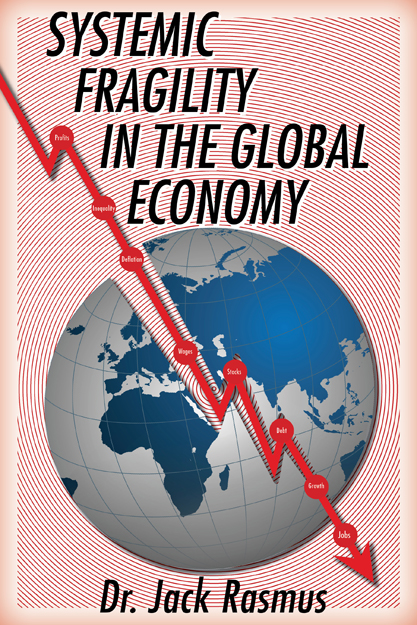
The US and global economy are approached the latter stages in the credit cycle, during which financial asset bubbles begin to appear and the real economy appears to be at peak performance (the calm before the storm). This scenario was explained in my 2016 book, ‘Systemic Fragility in the Global Economy‘. In coming weeks I will be posting in serial form the concluding chapter of that book for readers on this blog, entitled ‘A Theory of Systemic Global Fragility‘.

Here’s the excerpt from the forthcoming European Financial Review article; (a book review of my most recent book, ‘Central Bankers at the End of Their Ropes?’ by Dr. Larry Souza will also appear in that coming EFR issue).

………………………..
Is Bitcoin a Bona Fide ‘Bubble’?
……………………………
“What’s a financial asset bubble? Few agree. But few would argue that Bitcoins and other crypto currencies are today clearly in a global financial asset bubble. Bitcoin and other crypto currencies are the speculative investing canary in the global financial asset coalmine.

One can debate what constitutes a financial bubble—i.e. how much prices must rise short term or how much above long term average rates of increase—but there’s no doubt that Bitcoin price appreciation in 2017 is a bubble by any definition. At less than $1000 per coin in January, Bitcoin prices surged past $11,000 this past November. It then corrected back to $9,000, only to surge again by early December to more than $15,000. Given the forces behind Bitcoin, that scenario is likely to continue into 2018 before the bubble bursts. The question of the moment, however, is what might be the contagion effects on other markets?”

……………………………..
What’s Driving the Bitcoin Bubble?
……………………………..
If Blockchain and software tech company ICOs are driving Bitcoin and other crypto pricing, what’s additionally creating the bubble?…..Who is buying Bitcoin and cryptos, driving up prices, apart from early investors in the companies? ……the absence of government regulation and potential taxation of speculative profits from price appreciation has served as another important driver of the Bitcoin bubble bringing in still more investors and demand and therefore price appreciation. No regulation, no taxation has also led to price manipulation by ‘pumping and dumping’ by well positioned investors….. Another factor driving price is that Bitcoin has become a substitute product for Gold and Gold futures……But what’s really driving Bitcoin pricing in recent months well into bubble territory is its emerging legitimation by traditional financial institutions………futures and derivatives trading on Bitcoin are set to begin in December 2017 in official commodity futures clearing houses, like CME and CBOE…..Bitcoin ETFs derivatives trading are likely not far behind……….big US hedge funds are also poised to go ‘all in’ once CME options and futures trading is established…… Declarations of support for Bitcoin has also come lately from some sovereign countries………While CEOs of big traditional commercial banks, like JPM Chase’s Jamie Dimon, have called Bitcoin “a fraud”, they simultaneously have declared plans to facilitate trading in the Bitcoin-Crypto market.

…………………………………………….
Bitcoin as ‘Digital Tulips’
…………………………………………….
Bitcoin demand and price appreciation may also be understood as the consequence of the historic levels of excess liquidity in financial markets today. Like technology forces, that liquidity is the second fundamental force behind its bubble. To explain the fundamental role of excess liquidity driving the bubble, one should understand Bitcoin as ‘digital tulips’, to employ a metaphor.

The Bitcoin bubble is not much different from the 17th century Dutch tulip bulb mania. Tulips had no intrinsic use value but did have a ‘store of value’ simply because Dutch society of financial speculators assigned and accepted it as having such. Once the price of tulips collapsed, however, it no longer had any form of value, save for horticultural enthusiasts.

What fundamentally drove the tulip bubble was the massive inflow of money capital to Holland that came from its colonial trade in spices and other commodities in Asia. The excess liquidity generated could not be fully re-invested in real projects in Holland. When that happens, holders of the excess liquidity create new financial markets in which to invest the liquidity—not unlike what’s happened in recent decades with the rise of unregulated global shadow banking, financial engineering of new securities, proliferating liquid markets in which securities are exchanged, and a new layer of professional financial elite as ‘agents’ behind the proliferating new markets for the new securities.

……………………………………………
Bitcoin Potential Contagion Effects to Other Markets
…………………………………………….
A subject of current debate is whether Bitcoin and other cryptos can destabilize other financial asset markets and therefore the banking system in turn, in effect provoking a 2008-09 like financial crisis………….Deniers of the prospect point to the fact that Cryptos constitute only about $400 billion in market capitalization today. That is dwarfed by the $55 Trillion equities and $94 trillion bond markets. The ‘tail’ cannot wag the dog, it is argued. But quantitative measures are irrelevant. What matters is investor psychology. ……For example, should cryptos develop their own ETFs, a collapse of crypto ETFs might very easily spill over to stock and bond ETFs—which are a source themselves of inherent instability today in the equities market. A related contagion effect may occur within the Clearing Houses themselves. If trading in Bitcoin and cryptos as a commodity becomes particularly large, and then the price collapses deeply and at a rapid rate, it might well raise issues of Clearing House liquidity available for non-crypto commodities trading. A bitcoin-crypto crash could thus have a contagion effect on other commodity prices; or on ETFs in general and thus stock and bond ETF prices.”

copyright Jack Rasmus, 2017

Bitcoin prices surge over $15,000 (a 1500% rise in 2017) while real wages rise only 0.5% the past year. That sums up succinctly what the 21st century US Trump economy is fundamentally about!

Listen to my Friday, December 8, 2017 Alternative Visions radio show for an in depth analysis of what’s behind the bubble in Bitcoin, and where it’s going.

GO TO:

http://prn.fm/?s=Alternative+Visions

or Go To

http://alternativevisions.podbean.com

SHOW ANNOUNCEMENT

Dr. Rasmus goes in depth on the bitcoin mania and the bubble, now at more than $15,000 a coin—a 1500% increase in speculative profits in 2017…and rising. What are the determinants and drivers of the Bitcoin mania, the ‘digital tulips’ bubble of today? Rasmus discusses the fundamental causes as blockchain technology and central bankers’ decades of massive liquidity injection into the global economy, incenting speculative investors to search ever more desperately for ‘yield’, with inflows to digital currencies absorbing more and more of the massive liquidity accumulated on the sidelines today by the professional investing class (aka new global finance capital elite). Additional ‘enabling’ factors have been driving prices as well, including proliferating ICOs, entry of traditional investor-speculators, diversion of financing from gold futures, and most important, increasing legitimation of Bitcoin and crypto currencies by established commodity clearing houses in the US (CME, CBOE), some countries’ direct endorsement and plans(Japan), hedge funds preparation to enter the market, and even commercial banks (Chase, Goldman) announcing partial participation. Bitcoin is a commodity, not yet a currency, and a speculative ‘play’ not unlike oil futures, gold futures (as were tulips in 17th century Holland). Rasmus concludes with a discussion of government regulation, taxation, and potential channels of contagion to other financial asset markets (also approaching bubble territory), when the Bitcoin and cryptos price busts occur. Capital gains from Bitcoin commodity speculation at 1500% contrasts sharply with today’s just announced real wage gains of only 0.5% in the US. (Next week: the House-Senate final Trump Tax Cuts and latest acceleration of income inequality)

Trump has often been described as playing ‘fast and loose’ with the facts. That would be too polite a description. When it comes to statements about the economy, what we get from ‘The Trump-et’ is more often inane and absurd statements and declarations.

On my twitter account (@drjackrasmus) I’ve initiated a running commentary on the Trumpet’s continuing stupidities concerning economics.

Here’s the first five, commenting on his press conference today, Wednesday, December 5, where he bragged about the (‘very, very, great, incredible, fabulous, very great, very fabulous) US economy that doesn’t exist except in his own mind:

“Trump Economic Absurdity #5
: most ridiculous of all Trump claims today is that a 6% GDP growth rate will now occur. What can one say besides, just more inane hyperbole from the ‘Trump-et’!

“Trump Economic Absurdity #4: Trump says he’ll now focus on getting jobs for 100 million not working. With US labor force at 166m and population 320m, that means all retirees, prisoners, and mentally ill will go back to work.

“Trump Economic Absurdity #3: In press conference today Trump declares his tax cut will mean middle class gets “tremendous benefit”. In fact, middle class taxes will rise $3 trillion from ending exemptions, deductions, education credit, & raising rates from 10% to 12% for poorest

“Trump Economic Absurdity #2: Trump today claimed more than $4T in cash is held by US multinational corps offshore to avoid paying taxes. Trump tax cuts will bring all that back per Trump. Actual cash hoard by MNCs is $2.8T. How they will bring back >$4T is another Trump mystery.

“Trump Economic Absurdities #1: today in his press conference Trump claims he’s created 2mil jobs so far. Then says for every 1% rise in US GDP, 10 mil. jobs are created. 1% further rise in GDP in 2017 over 2016 produced 2mil. 10m minus 2m = 8 mil. shortfall in Trump logic”

To get all my daily tweets on Trump and the US economy, sign on to my twitter account at: @drjackrasmus

With the Senate and House all but assured to pass the US$4.5 trillion in tax cuts for businesses, investors, and the wealthiest 1 percent households by the end of this week, phases two and three of the Trump-Republican fiscal strategy have begun quickly to take shape.

Phase two is to maneuver the inept Democrats in Congress into passing a temporary budget deficit-debt extension in order to allow the tax cuts to be implemented quickly. That’s already a ‘done deal’.

Phase three is the drumbeat growing to attack social security, Medicare, food stamps, Medicaid, and other ‘safety net’ laws, in order to pay for the deficit created by cutting taxes on the rich. To justify the attack, a whole new set of lies are resurrected and being peddled by the media and pro-business pundits and politicians.

Deficits and Debt: Resurrecting Old Lies and Misrepresentations

Nonsense like social security and Medicare will be insolvent by 2030. When in fact social security retirement fund has created a multi-trillion dollar surplus since 1986, which the U.S. government has annually ‘borrowed’, exchanging the real money in the fund created by the payroll tax and its indexed threshold, for Treasury bonds deposited in the fund. The government then uses the social security surplus to pay for decades of tax cuts for the rich and corporations and to fund endless war in the middle east.

As for Medicare, the real culprit undermining the Medicare part A and B funds has been the decades-long escalating of prices charged by insurance companies, for-profit hospital chains (financed by Wall St.), medical devices companies, and doctor partnerships investing in real estate and other speculative markets and raising their prices to pay for it.

As for Part D, prescription drugs for Medicare, the big Pharma price gouging is even more rampant, driving up the cost of the Part D fund. By the way, the prescription drug provision, Part D, passed in 2005, was intentionally never funded by Congress and George Bush. It became law without any dedicated tax, payroll or other, to fund it. Its US$50 billion plus a year costs were thus designed from the outset to be paid by means of the deficit and not funded with any tax.

Social Security Disability, SSI, has risen in costs, as a million more have joined its numbers since the 2008 crisis. That rise coincides with Congress and Obama cutting unemployment insurance benefits. A million workers today, who would otherwise be unemployed (and raising the unemployment rate by a million) went on SSI instead of risking cuts in unemployment benefits. So Congress’s reducing the cost of unemployment benefits in effect raised the cost of SSI. And now conservatives like Congressman Paul Ryan, the would be social security ‘hatchet man’ for the rich, want to slash SSI as well as social security retirement, Medicare benefits for grandma and grandpa, Medicaid for single moms and the disabled (the largest group by far on Medicaid), as well as for food stamps.

Food stamp costs have also risen sharply since 2008. But that’s because real wages have stagnated or fallen for tens of millions of workers, making them eligible under Congress’s own rules for food stamp distribution. Now Ryan and his friends want to literally take food out of the mouths of the poorest by changing eligibility rules.

They want to cut and end benefits and take an already shredded social safety net completely apart–while giving US$4.5 trillion to their rich friends (who are their election campaign contributors). The rich and their businesses are getting $4.5 trillion in tax cuts in Trump’s tax proposal—not the $1.4 trillion referenced in the corporate press. The $1.4 trillion is after they raise $3 trillion in tax hikes on the middle class.

Whatever financing issues exist for Social Security retirement, Medicare, Medicaid, disability insurance, food stamps, etc., they can be simply and easily adjusted, and without cutting any benefits and making average households pay for the tax cuts for the rich in Trump’s tax cut bill.

Social security retirement, still in surplus, can be kept in surplus by simply one measure: raise the ‘cap’ on social security to cover all earned wage income. Today the ‘cap’, at roughly US$118,000 a year, exempts almost 20 percent of the highest paid wage earners. Once their annual salary exceeds that amount, they no longer pay any payroll tax. They get a nice tax cut of 6.2 percent for the rest of the year. (Businesses also get to keep 6.2% more). Furthermore, if capital income earners (interest, rent, dividends, etc.) were to pay the same 6.2% it would permit social security retirement benefits to be paid at two thirds one’s prior earned wages, and starting with age 62. The retirement age could thus be lowered by five years, instead of raised as Ryan and others propose.

As for Medicare Parts A and B, raising the ridiculously low 1.45 percent tax just another 0.25 percent would end all financial stress in the A & B Medicare funds for decades to come.

For SSI, if Congress would restore the real value of unemployment benefits back to what it was in the 1960s, maybe millions more would return to work. (It’s also one of the reasons why the labor force participation rate in the U.S. has collapsed the past decade). But then Congress would have to admit the real unemployment rate is not 4.2 percent but several percentages higher. (Actually, it’s still over 10 percent, once other forms of ‘hidden unemployment’ and underemployment are accurately accounted for).

As for food stamps’ rising costs, if there were a decent minimum wage (at least US$15 an hour), then millions would no longer be eligible for food stamps and those on it would significantly decline.

In other words, the U.S. Congress and Republican-Democrat administrations have caused the Medicare, Part D, SSI, and food stamp cost problems. They also permitted Wall St. to get its claws into the health insurance, prescription drugs, and hospital industries–financing mergers and acquisitions activity and demanding in exchange for lending to companies in those industries that the companies raise their prices to generate excess profits to repay Wall St. for the loans for the M&A activity.

The Real Causes of Deficits and the Debt

So if social security, Medicare-Medicaid, SSI, food stamps, and other social safety net programs are not the cause of the deficits, what then are the causes?

In the year 2000, the U.S. federal government debt was about US$4 trillion. By 2008 under George Bush it had risen to nearly US$9 trillion. The rise was due to the US$3.4 trillion in Bush tax cuts, 80 percent of which went to investors and businesses, plus another US$300 billion to U.S. multinational corporations due to Bush’s offshore repatriation tax cut. Multinationals were allowed to bring US$320 billion of their US$750 billion offshore cash hoard back to the U.S. and pay only a 5.25 percent tax rate instead of the normal 35 percent. (By the way, they accumulated the US$750 billion hoard was a result of Bill Clinton in 1997 allowing them to keep profits offshore untaxed if not brought back to the U.S. Thus the Democrats originally created the problem of refusing to pay taxes on offshore profits, and then George Bush, Obama, and now Trump simply used it as an excuse to propose lower tax rates for repatriated the offshore profits cash hoard of US multinational companies. From $750 billion in 2004, it’s now $2.8 trillion).

So the Bush tax cuts whacked the U.S. deficit and debt. The Bush wars in the middle east did as well. By 2008 an additional US$2 to US$3 trillion was spent on the wars. Then Bush policies of financial deregulation precipitated the 2007-09 crash and recession. That reduced federal tax revenue collection due to collapse economic growth further. Then there was Bush’s 2008 futile $180 billion tax cut to stem the crisis, which it didn’t. And let’s not forget Bush’s 2005 prescription drug plan–a boondoggle for big pharmaceutical companies–that added US$50 billion a year more. As did a new Homeland Security $50 billion a year and rising budget costs.

There’s your additional US$5 trillion added by Bush to the budget deficit and U.S. debt–from largely wars, defense spending, tax cuts, and windfalls for various sectors of the healthcare industry.

Obama would go beyond Bush. First, there was the US$300 billion tax cuts in his 2009 so-called ‘recovery act’, mostly again to businesses and investors. (The Democrat Congress in 2009 wanted an additional US$120 billion in consumer tax cuts but Obama, on advice of Larry Summers, rejected that). What followed 2009 was the weakest recovery from recession in the post-1945 period, as Obama policies failed to implement a serious fiscal stimulus. Slow recovery meant lower federal tax revenues for years thereafter.

Studies show that at least 60 percent of the deficit and debt since 2000 is attributable to insufficient taxation, due both to tax cutting and slow economic growth below historical rates.

Obama then extended the Bush-era tax cuts another US$803 billion at year-end 2010 and then agreed to extend them another decade in January 2013, at a cost of US$5 trillion. The middle east war spending continued as well to the tune of another $3 trillion at minimum. Continuing the prescription drug subsidy to big Pharma and Homeland Security costs added another $500 billion.

In short, Bush added US$5 trillion to the US debt and Obama another US$10 trillion. That’s how we get from US$4 trillion in 2000 to US$19 trillion at the end of 2016. (US$20 trillion today, about to rise another US$10 trillion by 2027 once again with the Trump tax cuts fast-tracking through Congress today).

To sum up, the problem with chronic U.S. federal deficits and escalating Debt is not social security, Medicare, or any of the other social programs. The causes of the deficits and debt are directly the consequence of financing wars in the middle east without raising taxes to pay for them (the first time in U.S. history of war financing), rising homeland security and other non-war defense costs, massive tax cuts for businesses and investors since 2001, economic growth at two thirds of normal the past decade (generating less tax revenues), government health program costs escalation due to healthcare sector price gouging, and no real wage growth for the 80 percent of the labor force resulting in rising costs for food stamps, SSI, and other benefits.

Notwithstanding all these facts, what we’ll hear increasingly from the Paul Ryans and other paid-for politicians of the rich is that the victims (retirees, single moms, disabled, underemployed, jobless, etc.) are the cause of the deficits and debt. Therefore they must pay for it.

But what they’re really paying for will be more tax cuts for the wealthy, more war spending (in various forms), and more subsidization of price-gouging big pharmaceuticals, health insurance companies, and for-profit hospitals which now front for, and are indirectly run by, Wall St.

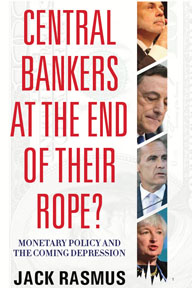
Jack Rasmus is the author of the recently published book, “Central Bankers at the End of Their Ropes: Monetary Policy and the Coming Depression.” He blogs at jackrasmus.com and his twitter handle is @drjackrasmus.

.

by Dr. Jack Rasmus,

Republicans will now ‘sharpen their knives’ to go after grandma and grandpa, to cut social security and medicare–and medicaid for single moms and disabled, to pay for $2T deficit (not $1 or $1.5T) in Trump tax cuts

Senate bill means beginning of the end of ACA healthcare Act: Ending individual mandate will raise premiums for all by minimum 10% in 2018 and more thereafter. 4 million will immediately drop; 13m will drop by 2027, per independent estimates.

Senate tax bill means 3200 of the richest 0.1% households no longer will pay inheritance tax whatsoever; the remaining 1800 will have new threshold of $22 million before paying. Fewer than 0.1% households will now pay Inheritance tax.

Senate version off Trump Tax cuts reshuffles the House bill: Corps still get $1.5T; pass thru business $476B;Multinational corps $500B + bigger loopholes for real estate, autos, oil, depreciation=$3T business cuts paid by $3T tax hikes for middle class.

Trump’s latest ‘big lie’: the tax cuts “will cost me millions”. Trump’s 2005 tax returns show he paid only paid taxes due to AMT; doubling AMT exemption will halve his taxes. Trump’s 500 ‘business income pass through’ companies also gain from rate cut from 39.6% to 25% (or less 23% in Senate)

Multinational US corps past history with 2005 repatriation tax windfall tax cut (from 35% to 5.25%) showed 90% of windfall was used for stock buyback, dividends, and financing mergers and acquisitions.

Trump Tax cut based on faulty economic theory: give business more disposable income & they will invest it short run, leading to jobs, wages, GDP. US businesses now sit on $2 trillion cash in US +$2.8T offshore. If they aren’t investing with $4.8T, why would they with another $3t?

Senate tax bill deficit of $1 trillion based on absurd assumptions of economic growth. Past historical GDP trend for next decade will at least double the $1 to $2 trillion deficit or more. Decade from now, US debt will exceed $30 trillion

Listen to my 20 minute interview friday, December 1, on KPFK-LA ‘Beneath the Surface’ show, and my take on the Senate version of the Trump tax cuts. Where the tax cuts of $3 trillion minimum for business are paid by $3 trillion tax hikes on the middle class. The tax cuts in historical context, and their relation to central bank monetary policy, and the growing subsidization of capital incomes by government policy (fiscal and monetary) int he 21st century.

To listen to the show, GO TO: http://archive.kpfk.org/index.php?shokey=bts_friday

By Jack Rasmus
Copyright 2017

As this Thanksgiving holiday comes to an end and the Xmas season approaches, let’s not forget to give thanks to our richest 1% fellow Americans and their corporations. Thanks to all 1.25 million of you from the 130 million of us 99 percenter households.

Your stewardship of the US economy has allowed us to keep 5% of all the national income created since the last recession in 2009; while you wealthiest 1% got to keep the other 95% (see UC Berkeley economist, Emmanuel Saez’s annual income inequality analyses).

But the more you get to keep, the more you can ‘trickle down’ to the rest of us, right? So say your politicians, talking media heads, economists, and other assorted hirelings. So thanks very much for at least sharing something with us.
If not sharing wages equally, we certainly got more jobs to be thankful for from you—who lose no opportunity to proclaim you are the source of all job creation.

Since 2009, you ‘gave’ us millions of part time, temp, contract, on call, and gig jobs. True, mostly low paid, without pensions or benefits jobs. Better than nothing jobs. And while it took you 8 years to re-create the level of jobs we had back in 2007, better late than never, right? Even if our pre-2008, higher paid jobs were replaced mostly by lower paid after 2008, it sure beats unemployment benefits. So thank all of you 1% self-proclaimed job creators for all the low paid, no benefit, service jobs you eventually did create for us.

As owners of the system you certainly had a difficult task managing your complex, mega-corporation called the USA economy, keeping all those foreign competitors and troublemakers in line with the US economic empire. You know, those ‘russkies’ that just won’t lay down and play dead anymore, those too clever Chinese, and all those assorted ‘rocket men’. But that’s what our 1000 offshore military bases are for, aren’t they? Our trillion dollar a year defense budget is well worth it.

And getting us out of the worst economic crisis since the great depression of the 1930s in 2008-09 was no easy task for you, we know. So all of you 1.25 million wealthiest 1% households deserve every dollar you’ve diverted to yourselves in the process of economic recovery these past 8 years, including:

• The $6 trillion in stock buybacks and dividend payouts paid out to you from your corporations since 2008 (see Yardeni Research, November 2017);
• The nearly 400% increase in the value of your stock holdings (see the DOW, S&P 500 and Nasdaq combined market gains since 2008);
• The additional $ trillions in capital gains income you earned on bond interest and capital gains since the last recession;
• Your share of half of the $1.9 trillions in ‘pass through’ non-corporate business income net gains since 2007 (see US national income accounts);
• The unknown $ trillions more you earned from investing in derivatives in offshore markets that you don’t report, which even the US government cannot discover;
• The still additional $ trillions more you stuffed in your offshore accounts to avoid paying US taxes (see recent revelations from the so-called ‘Paradise Papers’);
• The $2 trillion cash your bank and non-bank US corporations are still sitting on in the US, and another $2 trillion your multinational corporations are hoarding offshore—together earmarked at least in part for your personal future distribution (see Moody’s Analytics).

That’s easily more than $15 trillion in cash, near-cash, and easily convertible to cash sources of income accumulated over the past 8 years (and excludes the earnings from real estate and real property)—to be shared amongst the 1.25 million of you.

In total wealth and assets, not just income, American households held $58 trillion in net worth in 2009; that has since risen to $105 trillion, according to the US Federal Reserve bank’s latest 2017 report. Since median US Households’ net worth is still 30% below 2007 levels—and 90% of all US households are still below 2007 levels (per the New York Times, September 28, 2017)—the lion’s share of that $47 trillion total gain in net worth must therefore have gone to you one percenters. Congratulations. (Can’t wait to get my trickle down share. Please send by way of this blog address).

Let’s not forget to thank in particular the bankers among you. While it’s true they gave us the 2007-09 financial crash that led to 14 million home foreclosures and $4 trillion in our lost savings, your bankers did allow us to offset our stagnant wages these past 8 years with more loans and debt.

So thank you bankers, for the $1.4 trillion in student debt, the $1.2 trillion in credit card debt, and the more than $1 trillion in auto loan debt. That’s $3.6 trillion! Who needs wage increases when we can borrow our way to prosperity!
And while we’re talking about banks, let’s not forget to thank our central bankers, Ben Bernanke and Janet Yellen, for buying up all bad investments you one percenters made before the 2008 crash. I mean the subprime mortgage bonds and other securities you got stuck with and couldn’t sell, that Ben and Janet generously bought from you at above market prices. That was another $5 to $6 trillion cash subsidy to your professional investor class.

By the way, I hear Ben is now making the speech circuit rounds, speaking to your bankers and companies for a fee of $200k per pop, and is serving on your corporate boards? And Janet has just announced she’ll soon also be leaving the Fed and joining him. Reward them well, Mr. and Mrs. 1%. They’ve done yeoman work for your banks, providing loans at 0.15% for 7 years, while the US government charged students 6.8% student loan rates and grandma and grandpa retirees lost more than $1 trillion in fixed income savings as result of near zero interest rates.

And let’s not forget your great multinational corporations who’ve been offshoring our high paying jobs made possible by free trade treaties like NAFTA. You know, the tech companies, big pharmaceutical companies, auto parts and textiles, and all the rest. Now we can buy cheaper priced products at Walmart and Target from you that they make in Mexico, China, and Indonesia.

Like loading up on Loan debt, free trade is so much better than getting wage increases!

And this season let’s not forget to thank your politicians whose elections you finance. Thanks to George W. Bush for cutting taxes by $3.4 trillion. And Obama and the Democrats for cutting your taxes by another $1.1 trillion during the recession, and then extending the Bush tax cuts in 2013 for another decade by a further $5 trillion. Now their heir to the presidency, Uncle Donald, is proposing another $4.5 trillion tax cut for you one percenters, for yet another decade. I can’t wait for all the ‘trickle down’ that’s finally coming.

Your Republican party politicians (aka one wing of your Corporate Party of America) can’t take all the credit. Your Democrat wing deserves some.

So thanks to Nancy Pelosi and Chuck Shumer, for their current efforts to broker a deal with Uncle Donald to let the 800,000 ‘Dreamers’ kids stay in America—in exchange for agreeing to deport their parents and for funding the border Wall with Mexico.

I do hope that next year Nancy and Uncle Donald can revisit the repeal of the ACA-Obamacare Act. It will mean another $592 billion tax cut for you one percenters and your corporations, and maybe then even more trickle down to us 99%. All those single moms with kids, disabled persons, and mentally ill don’t really need the improvements in Medicaid they got from the ACA. They were doing just fine before. You one percenters need the tax cuts more.

In conclusion, I’d like to give special thanks to your most famous one percenter, Don Trumpeone, a member of the wealthiest .01% (or 12,600) super richest households within your ranks, whose income gains in 2016 averaged $65 million.

Thank you, Don Trumpeone, for keeping us 99% safe in 2017. We ‘kiss your hand’. This year not one American was killed by the North Koreans, or by the Russians in the Ukraine, or by those violent Yemenis and world domination seeking Iranians—even though 60,000 Americans have died from the Opioid epidemic (started by the big Pharma companies) this past year; another 38,000 of us died from guns made in the US (291,000 since 2007); and the USA has continued to fall below its 20th ranking in infant mortality among the advanced nations while our teen suicide rate has doubled since 2007.

We 99% have so much to be thankful for this holiday season. And you 1%–and your corporations, politicians, and media pundits—are largely responsible.

So God keep blessing America. Let’s all stand for the flag. And thank you, our wealthiest 1% fellow Americans, the richest and greatest generation the world has ever seen.

Jack Rasmus is author of the just published book, ‘Central Bankers at the End of Their Ropes: Monetary Policy and the Coming Depression’, Clarity Press, August 2017. He blogs at jackrasmus.com, twitters @drjackrasmus, and his website is http://kyklosproductions.com

For my current analysis of the escalating bubble in Bitcoin and other crypto-digital currencies, listen to my interview this week on RT news. Both short term and long term forces behind the digital currency price bubble are explained–including ‘blockchain’ technology and, more importantly short term, professional speculators searching for yield, multiplying initial public stock offerings (ICOs), and the excess liquidity (provided by central banks worldwide) that is driving leveraging to finance the crypto-currency mania.

To listen to the 4 minute interview, go to Youtube at:

For my updated view on growing financial asset market bubbles in the US, specifically US Stock Markets, corporate Junk bonds, Covenant-Lite Loans, Pension Funds, and Bitcoin-Crypto Currency markets, listen to my Alternative Visions radio show of friday, November 17, 2017.

GO TO:

http://prn.fm/?s=Alternative+Visions

Or GOT TO:

http://alternativevisions.podbean.com

SHOW ANNOUNCEMENT

Dr. Rasmus reviews conditions in the three financial markets approaching or at bubble levels. Causes of excess demand driving prices in US equity markets are discussed—including Fed near zero interest rate policies since 2008; record corporate profits and $1 trillion annual stock buybacks and dividend payouts; multi-trillion $ corporate bond issuance; shift to ETFs and passive investing in stock markets; foreign money capital inflows to US; record margin debt issues in stocks; and Trump policies of multi-trillion dollar corporate/investor tax cuts, business deregulation, low US$ exchange rate policy, and expectations of infrastructure spending and free trade deal renegotiations. Trump policies as new subsidization of capital incomes via fiscal-trade policy, as central bank (Fed) reduces its subsidization of capital monetary policies. Warnings of financial instability growing by Bank of America and hedge fund multi-billionaire, Paul Singer. Rasmus looks at other candidates for financial instability as well—pension funds’ hike risk investing practices, trend toward ‘covenant-lite’ lending, emerging junk bond selloff underway in Telecom sector and in China, and Bitcoin and crypto currencies extreme price bubbles. (Next week: The US Senate’s Trump Tax Cuts).

Signs are beginning to multiply that financial markets are beginning to peak, both in the US and worldwide, many having reached bubble proportions. On this blog, on my website (http://kyklosproductions.com) and on my weekly radio show, Alternative Visions, I have been focusing more on this topic of emerging financial instability. (see forthcoming friday, November 17, Alternative Visions radio show, where I take up this theme once again of emerging financial instability, 2pm eastern time at http://prn.fm/?s=Alternative+Visions, live and podcast afterward.)

My views on the subject of growing financial bubbles and instability–and its threat to the real economy–originate from and were summarized in my early 2016 book, ‘Systemic Fragility in the Global Economy’, Clarity Press. (see this blog for access to the book). ‘Systemic Fragility’ book is a theoretical foundation for my subsequent publications, ‘Looting Greece‘ (how financial markets and finance capitalists are developing a new form of financial imperialism) and ‘Central Bankers at the End of Their Ropes’ (how central banks have been largely responsible for providing the liquidity for the acceleration of leveraged debt that fuels financial bubbles worldwide). See reviews of the latter two books on this blog as well.

In the coming weeks I will be sharing with readers the concluding chapter of the Systemic Fragility book, entitled ‘A Theory of Systemic Fragility’.

In the interim, the following is a review of the 2016 book by Dr. Jan Pieterse at UC Santa Barbara, which appeared earlier this year, 2017, in the Journal of Post Keynesian Economics. Readers may find Pieterse’s review a useful introduction to my subsequent serialized publication here (and on my website) of the summary chapter of the book where I explain my theory of financial instability in greater detail.

JOURNAL OF POST KEYNESIAN ECONOMICS
2017, VOL. 40, NO. 2, 272–277

BOOK REVIEW

Dr. Jan Pieterse, ‘From Economic Stagnation to Systemic Fragility?’

Review of: Dr. Jack Rasmus, Systemic Fragility in the Global Economy
(Atlanta, GA: Clarity Press, 2016), ISBN: 978- 0-986769-4-7, 490 pp., $29.95

ABSTRACT
Advanced economies are in a rut of slow growth. Growth in emerging economies has also slowed. Explanations are meager and policies have not worked or have made problems worse. The Trump administration of hard-line billionaires will likely exacerbate problems. Jack Rasmus’s book Systemic Fragility in the Global Economy offers a penetrating analysis of economic stagnation in advanced economies by providing a sustained and systemic focus on the role of finance, an analysis that probes further than mainstream economic analysis. Rasmus has made a signal contribution to contemporary economics and provided a vitally important X-ray of the political economy of stagnation.

“Advanced economies are in a rut of slow growth, the new normal (El-Erian), or is it the end of normal (Galbraith, 2014)? Growth was slim before the 2008 crisis and recovery after the crisis has been sluggish as well, with growth around 2 percent in the United States (2.2 percent in 2017, by International Monetary Fund estimates), 1.5 percent in the European Union (EU) (2017), 0.9 percent in Japan (2017). An ordinary period headline is, “U.S. in weakest recovery since ‘49” (Morath, 2016).

Emerging economies and developing countries face a “middle-income trap” and “premature deindustrialization”; energy exporters see oil prices collapse from above $100 per barrel to below $50 (2014) and advanced economies are in a “stagnation trap.”

Explanations of the conundrum are perplexingly meager. Many accounts
are merely descriptive, such as secular stagnation (Summers, 2013) and the “new mediocre” (IMF, Harding, 2016) —noted, but why? (Secular stagnation derives from Alvin Hansen’s 1938 adaptation of Marx’s tendency of the rate of profit to decline, hence real interest rates decline, therefore policy interest must decline, notes Sinn [2016].)Or, uncertainty—which is odd because policies have not changed for years. Or, corporate hoarding—corporations, particularly in the United States, are sitting on mounds of cash, buy back their own stock, buy other companies and reshuffle, but are not investing—noted, but why? Or, a general account is that advanced economies are on a technological plateau, broadly since the 1970s (Cowen, 2011; Gordon, 2016). With the rise of the knowledge economy and the digital economy (along with the gig economy as in Uber, Airbnb, and freelance telework), contributions of Silicon Valley (Apple, Google, etc.), innovations in pharma and military industries, also in emerging economies, and the “fourth industrial revolution,” innovations abound. However, as Martin Wolf (2016) notes, “today’s innovations are narrower in effect than those of the past.” Besides, the shift to services in postindustrial societies means a shift toward sectors (such as health care, education, and personal care) where it is hard to raise productivity. If we consider policies, the picture gets worse because (a) implemented year after year, they clearly do not work, and (b) indications are that they make things worse.

Fiscal policy is generally ruled out because of fear of deficits. The policy instrument that remains is monetary—low interest rates and quantitative easing (QE), implemented in the United States, United Kingdom (UK), (EU), and Japan. Other standard policies are, in the EU, austerity—which may cut deficits but obviously does not generate growth (and, by depressing tax revenues over time, worsens deficits)—and structural reform. Besides privatization, the main component of reform is labor market flexibilization, in other words depressing wages and incomes. This has been implemented in the United States since the 1970s and 1980s, in the UK in the 1990s, in Germany and South Korea in the 2000s, and is now on the scaffolds in Japan, France, and Spain (and possibly Italy). The objective is to boost international competitiveness by depressing wages and benefits, which (a) ceases to have an effect when every country is doing the same, (b) assumes the key problem is cheap supply, whereas supply is actually abundant and what is lacking is demand, and (c) by depressing wage incomes, it further reduces domestic demand. No wonder these policies make matters worse. Thus, explanations of slow growth fall short and policies have been counterproductive. This is where Jack Rasmus’s book comes in. It offers the most pertinent analysis of the stagnation trap I have seen.

There are many steps to the analysis but it boils down to his theory of systemic fragility. I review the main points of his approach, for brevity’s sake in bullet form.

• Taking finance seriously, not just as an intermediary between stations of the “real economy” (as in most mainstream economics) but with feedback loops and transmission mechanisms that affect the real economy of goods directly and indirectly.

• A three-price analysis—beyond the single price of neoclassical economics (the price of goods), the two-price theory of Keynes and Minsky (goods prices and capital assets prices), Rasmus adds financial assets and securities prices.

• The long-term, secular slowdown of investment in the real economy (chapter 7) and the shift to investment in financial assets (chapter 11). This has been occurring because financial asset prices rise faster than the prices of goods; their production cost is lower; their supply can be increased at will; the markets are highly liquid so entry and exit are rapid; new institutional and agent structures are available; financial securities are taxed lower than goods; in sum, they yield easier and higher profits. Financial asset investment has been on the increase for decades, has expanded rapidly since 2000, and “from less than $100 trillion in 2007 to more than $200 in just the past 8 years” (p. 212).

• In government policy there has been a shift from fiscal policy to monetary policy. “Central banks in the advanced economies have kept interest rates at near zero for more than five years, providing tens of trillions of dollars to traditional banks almost cost free” (p. 220). Low interest rates and zero interest rate policies (ZIRP) benefit governments (by lowering their debt and interest payments) and banks (by affording easy money) while they lower household income (by lowering return on savings and lower value of pensions), so in effect households subsidize banks (p. 471).

• Quantitative easing policies, massive injections of money capital by the US ($4 trillion), UK ($1 trillion), EU ($1.4 trillion), and Japan ($1.7 trillion) since 2008, or “about $9 trillion in just five years” (pp. 185, 262). Add China ($1–4 trillion) and add government bank bailouts over time and, according to Rasmus, the total global liquidity injected by states and central banks is on the order of $25 trillion (p. 263). The injections of liquidity into the system allegedly aim to stimulate investment in the real economy (by raising stock and bond prices), which raises several problems: a) Investment in the real economy is not determined by liquidity but by expectations of profit. b) Funds that are invested in the goods economy leak overseas via multinational corporations (MNCs) investing in economically more developed countries (EMDC), where returns are higher (and more volatile). c) Most additional liquidity goes into financial assets, boosting commodities, stocks, and real estate, and leading to price bubbles (p. 177). “The sea of liquid capital awash in the global economy sloshes around from one highly liquid financial market to another, driving up asset prices as a tsunami of investor demand rushes in, taking profit as the price surge is about to ebb, leaving a field of economic destruction of the real economy in its wake” (p. 473).

• The post-crisis attempts at bank regulation overlook the shadow banks, even though the 2007–8 crisis originated in the shadow banks rather than the banks. (Shadow banks include hedge funds, private equity firms, investment banks, broker-dealers, pension funds, insurance companies, mortgage companies, venture capitalists, mutual funds, sovereign wealth funds, peer-to-peer lending groups, the financial departments of corporations, and so on; a typology is on p. 224.) The integration of commercial and shadow banks is a further variable. Shadow banks control on the order of $100 trillion in liquid or near liquid investible assets (2016, p. 446).

• Add up these trends and policies and they contribute to several forms of fragility, which is the culmination of Rasmus’s argument. Rasmus distinguishes fundamental, enabling, and precipitating trends that contribute to fragility (p. 457).

• The explosion of excess liquidity goes back to the 1970s and has taken many forms since then. QE policies amplify this liquidity and have led to financial sector fragility, which has been passed on to government balance sheet fragility (via bank bailouts, low interest rates, and QE), which have been passed on to household debt and fragility (via austerity policies). “Austerity tax policy amounts to a transfer of debt/income and fragility from banks and nonbanks to households and consumers, through the medium of government” (p. 472). This in turn leads to growing overall system fragility.

While Rasmus aims to provide a theory of system fragility, in the process
his analysis gives an incisive account of the stagnation trap. Many elements are not new. Note work on austerity and finance (Blyth, 2013, Goetzmann, 2016) and note, for instance: “The world has turned into Japan,” according to the head of a Hong Kong-based hedge fund.“When rates are this low, returns are low. There is too much money and too few opportunities” (Sender, 2016). However, by providing an organized and systemic focus on finance and liquidity, Rasmus makes clear that the policies that aim to remedy stagnation (low interest rates, QE, competitive devaluation, and bank bailouts) and provide stability are destabilizing, act as a break on growth, and worsen the problem. According to Karl Kraus, psychoanalysis is a symptom of the diseasethat it claims to be the remedy for, and the same holds for the central bank policies of crisis management.

This does not mean that the usual arguments for stimulating growth (spend on infrastructure, green innovation, etc.) are wrong, but they look in the wrong direction. For one thing, the money is not there. Courtesy of central banks, the money has gone by billions and trillions to banks, shadow banks, and thus to financial elites and the 1 percent. Surprise at corporations not investing is also beside the point when government policies at the same time are undercutting household income and consumer demand, reproducing an environment of low expectations. Criticism of QE has been mounting, even in bank circles (“it’s the real economy, stupid”). Yet the role of finance remains generally underestimated. Rasmus’s analysis of central bank policies overlaps with that of El-Erian (2016), but his critique of economics is more fundamental and his theory of fragility and its policy implications are more radical. A turnaround would require fundamentally different policies and, in turn, different economic analytics.

Let me note some reservations about Rasmus’s approach. One concerns the unit of analysis—the global economy. His analysis overlooks or underestimates the extent to which East Asian countries stand apart from general financial fragility. Asian countries have been less dependent on western finance than Latin America and Africa and having learned from the Asian crisis of 1997, have built buffer funds against financial turbulence, stand apart from general financial fragility, and tend to ring-fence their economies from Wall Street operations. Of course, this remains work in progress.

Second, Rasmus adds China’s stimulus spending to the liquidity injections of western central banks. However, the bulk of China’s stimulus funding has been invested in the real economy of infrastructure, productive assets, and urbanization, which has led to overinvestment, but has next led to major initiatives of externalizing investment-led growth in new Silk Road projects in Asia and far beyond (One Belt, One Road, Maritime Silk Road, Asian Infrastructure Investment Bank, Silk Road Fund, etc.; Nederveen Pieterse, 2017). Even so, China also faces a huge debt overhang (Pettis, 2013, 2014).

It may be appropriate to add notes about the trend break of the Trump administration. First, a general ongoing shift from monetary to fiscal policies and the shift toward protectionism in advanced economies have been in motion regardless of the election of Trump. In the case of the United States, this includes rejection of the Trans-Pacific Partnership (TPP) as well as the Transatlantic Trade and Investment Partnership (TTIP). The Trump administration represents “a bonfire of certainties,” yet in macroeconomic policy in many respects the likely scenario is back to the old normal of supply-side economics and trickle down, the Reagan-era package. Deregulation now goes into overdrive. What institutional buffers there are to rein in banks, shadow banks, and corporations will shrink further. Those who advocate dismantling government agencies are appointed to head the agencies (such as labor, education, energy, environment, housing, and justice) to better implement deregulation from the inside. Corporate tax cuts come with attempts to bring back funds from overseas. American corporations are hoarding cash already and corporate tax cuts adding more will boost stock buybacks and chief executive officer stock options, but investment? The American middle class is shrinking, malls are closing, and department stores are downsizing. The Trump cabinet of billionaires, a return to the Gilded Age with generals for muscle, is an entrepreneurial state, not in an ordinary sense but the entrepreneurialism of plutocracy, the state apparatus placed in the service of capitalism with a big C. A no-pretense version of the anti-government ethos adopted since the Reagan administration (“get government off our backs”), anti-government government, gloves off. Pundits have sternly criticized emerging economies for disrupting the liberal international order, but now an American government changes the rules by sliding to transactional deal making. If the old problem was double standards, the new problem is no standards.

This is part of a slow deterioration of institutions that has been in motion since the Reagan era. A cover headline of the Economist is “The debasing of American politics” (2016), but it is the debasing of institutions that matters more. If market incentives lead and everything is for profit—health care, utilities, prisons, media, education, and warfare—institutions gradually decline, such is the logic of liberal market economies bereft of countervailing powers. Corporate media are a major factor in the decline of the public sphere. Part of the profile of emerging economies and developing countries is rickety institutions. Investigations and trials for corruption in several emerging economies indicate that norms and standards have been rising during recent years, while in the United States, the reverse is happening and the country may be slipping to emerging economy status. Several emerging economies no longer tolerate Big Boss behavior (e.g., South Korea, South Africa) while in the United States it becomes the new normal. Meanwhile, Rasmus has made a signal contribution to contemporary economics and provided a vitally important X-ray of the political economy of stagnation.

References

Blyth, M. Austerity: The History of a Dangerous Idea. New York, NY: Oxford University Press, 2013.

Cowen, T. The Great Stagnation. New York, NY: Dutton, 2011.

The Economist. “The Debasing of American Politics.” October 15–21, 2016.

El-Erian, M.A. The Only Game in Town: Central Banks, Instability, and Avoiding the Next Collapse. New York, NY: Random House, 2016.

Galbraith, J.K. The End of Normal. New York, NY: Simon and Schuster, 2014.

Goetzmann, W.N. Money Changes Everything. Princeton, NJ: Princeton University Press, 2016.

Gordon, Robert J. 2016 The rise and fall of American growth. Princeton University Press

Harding, R. “Lagarde warns of ‘new mediocre’ era.” Financial Times, October 2, 2014.

Morath, E. “U.S. in Weakest Recovery Since ‘49.” Wall Street Journal, July 30–31, 2016.

Nederveen Pieterse, J.
Multipolar Globalization: Emerging Economies and Development. London, UK: Routledge, 2017.

Pettis, M. Avoiding the Fall: China’s Economic Restructuring. Washington, DC: Carnegie Endowment for International Peace, 2013.

———. The Great Rebalancing. Princeton, NJ: Princeton University Press, 2014.

Sender, H. “Short-term Relief for Hedge Funds Belies Tough Search for Yield.”
Financial Times, July 12, 2016.

Sinn, H.-W. “Secular Stagnation or Self-inflicted Malaise?.” Project Syndicate, September 27, 2016.

Summers, L. “Why Stagnation Might Prove to Be the New Normal.”
Financial Times, December 15, 2013.

Wolf, M. “An End to Facile Optimism About the Future.”
Financial Times, July 13, 2016.

Jan Nederveen Pieterse
University of California, Santa Barbara, Global Studies