Feeds:
Posts
Comments

Evidence is now emerging where the lion’s share of Trump tax cuts are going. Just as Bush and Obama business tax cuts throughout the post-2008 period, they’re flowing again into: US stock buybacks and EU-Japan stock markets–as well as now into corporate mergers & acquisitions.

Also discussed on the Alternative Visions show posted here: how foreign buyers of US Treasury debt is falling from 55% of total Treasury debt issued in 2008 to only 16% in the last few months as the Fed ramps up its bond issues in order to finance the annual $trillion deficits now coming due to Trump tax cuts and defense spending hikes. That means the Fed will have to raise interest rates even more than projected in coming months in order to finance the US projected $1.2 trillion budget deficit next year. As I have argued, that will precipitate a recession in 2019 and a major stock market contraction, when the key benchmark federal funds rate exceeds 2.5% from its current 1.75%.

To Listen GO TO:

http://prn.fm/alternative-visions-key-economic-reports-evidence-trumps-5t-tax-cuts-going-05-04-18/

Or GO TO:

http://alternativevisions.podbean.com

SHOW ANNOUNCEMENT:

Jack Rasmus comments on today’s Jobs Report, explaining why little wage growth is occurring, and on the Federal Reserve Bank’s plans for interest rate hikes in 2018-19. The Fed is raising rates not because of a 2% inflation target, but to finance $1 trillion annual budget deficits for the next decade and a total Federal debt of more than $33 trillion by 2027 due largely to Trump’s $5t tax cuts. Early evidence of where the tax windfall for business and investors is going is discussed: stock buybacks-dividend payouts now exceeding last year’s $1 total by as much as 50% for 2018. Apple’s record $100 billion buyback plan. Also, tax windfall funneling into Mergers & Acquisitions activity, now running at $1.7 trillion and double the pace of 2016-17. Third, US investors’ tax windfall being diverted to Japan and Europe stock markets, projected at $1.2 trillion now compared to $350 billion a year earlier. Another report discussed is Deutsche Bank’s warning that US government debt levels have doubled the probability of a US debt crisis. And a final report that foreign investors are slowing new purchases of their US Treasury $6.3 trillion debt significantly: Foreign held US debt has fallen from 55% in 2008 to 43% in 2017, and foreign buyers of current accelerating Fed auctions of Treasuries now constitute only 16% to the total.

What’s the connection between China’s military presence in Djibouti, South China Sea, and US-China Trade disputes? Listen to my commentary on Loud and Clear radio on May 4.

Go to: https://www.spreaker.com/user/radiosputnik/geopolitics-and-trade-collide-in-u-s-chi

Dr. Jack Rasmus
Copyright 2018

What’s going on with Trump’s trade offensive? There’s a dual track policy underway: One a phony trade war with US allies; the other a potential (but not yet) trade war with China, that may also in the end prove less than a bonafide ‘trade war’ as well.

Trump’s trade team heads off to Beijing this week to attempt to negotiate terms of a new US-China trade deal. The US decision whether to continue the exemptions on Steel and Aluminum tariffs with the European Union occurs comes due this week as well. And this past week Trump also declared “we’re doing very nicely with NAFTA”.

So what’s all the talk about a Trump ‘trade war’? Is it media hype? Typical Trump hyperbole? Is there really a trade war in the making? Indeed, was there ever? And how much of it is really about reducing the US global trade deficit—and how much about the resurrection of Trump’s ‘economic nationalism’ theme for the consumption of his domestic political base in an election year?

One thing for certain, what’s underway is not a ‘trade war’.

Trump announced his 25% steel and 10% aluminum tariffs in early March, getting the attention of the US press with his typical Trump bombast, off-the-wall tweets and extremist statements. The steel-aluminum tariffs were originally to apply worldwide. But the exemptions began almost immediately. In fact, all US major trading partners were quickly suspended from the tariffs—except for China.

By mid-March, Canada and Mexico were let off the tariff hook, even though they were among the top four largest steel importers to the US, with Canada largest and Mexico fourth largest. Thereafter, Brazil (second largest steel importer), Germany, and others steel importers were exempted as well. And Canada, by far the largest aluminum importer to the US, accounting for 43% of US aluminum imports, was exempted for imports of that product.

South Korea ‘Softball’ Trade Template

The Trump administration’s signal to its allies was the US-South Korea deal that soon followed. The South Koreans were pitched a ‘softball’ trade deal. South Korea, the third largest US steel importer last year, was exempted from steel tariffs, now permanently as part of the final deal. So much for steel tariffs. Moreover, no other significant tariffs were imposed on South Korea as part of the bilateral treaty revisions. No wonder the South Koreans were described as ‘ecstatic’ about the deal.

What the US got in the quickly renegotiated US-South Korea free trade deal was more access for US auto makers into Korea’s auto markets. And quotas on Korean truck imports into the US. Korean auto companies, Kia and Hyundai, had already made significant inroads to the US auto market. US auto makers have become dependent on US truck sales to stay afloat; they didn’t want Korean to challenge them in the truck market as well. Except for these auto agreements, there were no major tariffs or other obstructions to South Korea imports to the US. Not surprising, the South Koreans were ecstatic they got off so easily in the negotiations. Clearly, the US-South Korea deal had nothing to do with Steel or Aluminum. If anything, it was a token adjustment of US-Korea auto trade and little more.

So the Korean deal was a ‘big nothing’ trade renegotiation. And so far as US trade deficits are concerned, steel-aluminum imports are insignificant. Steel-aluminum tariffs do nothing for the US global trade deficit. US steel and aluminum imports combined make up only $47 billion—a fraction of total US imports of $2.36 trillion in 2017.

The steel-aluminum tariffs were more of a Trump publicity tactic, to get the attention of the media and US trade allies. And if the tariffs were the signal, then the South Korea deal is now the template. It’s not about steel or aluminum tariffs. But you wouldn’t know that if you listened to Trump’s speech in Pennsylvania. Canada and Mexico import more steel to the US than South Korea. But in a final NAFTA revision they too will be virtually exempted from steel-aluminum tariffs when those negotiations are completed.

NAFTA as South Korea Redux

According to reports of the NAFTA negotiations, most details have already been negotiated with Mexico and Canada and the parties are close to a final deal. Typical of the ‘softball’ US approach with NAFTA—like South Korea—is the US recent dropping of its key demand that half the value of US autos and parts imported to the US be made in the US. That’s now gone. So a deal on NAFTA is imminent. Certainly before the Mexican elections this summer. But it will have little besides token adjustments to steel or autos. Trump threats to withdraw from NAFTA were never real. They were always merely to tell his base what they wanted to hear.

For what Trump wants from NAFTA is not a significant reduction of steel, auto, or any other imports to the US. What the US wants is more access for US corporations’ investment into Mexico and Canada; more protection for patents of US pharmaceutical companies to gouge consumers in those countries like they do in the US; and a shift in power to the trade dispute tribunals favoring the US. He’ll sell the exaggerated token adjustments to his political base, which will applaud his latest, inflated ‘fake news’—while the big corporations and financial elites in the US will silently nod their heads in agreement for the incremental gains he’s obtained for them.

In the most recent development concerning NAFTA negotiations, Trump has extended the deadline for a final revision for another thirty days—a development which means the parties are very close to a final resolution. The revisions will most likely look like the South Korean deal in many details—with quotas (not tariffs) on auto parts trade and more US access for US business investment and token limits on imports to the US.

Launching US-Europe Trade Negotiations: Macron’s Visit/Merkel’s Snub

After NAFTA comes Europe, later this year and in 2019. Like the NAFTA negotiations, Europe deadlines on steel and aluminum tariffs were just extended another thirty days. That’s just the beginning of likely further extensions. Europe will be less amenable to steel, aluminum or any other tariffs than the US NAFTA or South Korean partners. French president Macron’s visit last week to the US should be viewed as the opening of negotiations on trade between the US and Europe. But the European economy is again weakening and France, Germany, the UK and others are desperate to maintain export levels, which is the main means by which they keep their economies going.

Europe also wants to keep the Iran Deal in place, which means important exports and trade for it, while Trump wants to end the deal as he’s promised his domestic political base. A tentative agreement may have been reached between Trump and Macron during the latter’s recent visit to the US: Trump will formally pull the US out of the Iran Deal by May 12 but then will do nothing real apart from the announcement—much like the US withdrawal from the Climate Treaty. Europe will continue its trade deals with Iran. The US and Europe will then jointly try to negotiate an addendum with Iran. In short, France and Europe get to keep their business deals and Trump gets to pander to his political base before the elections in November. Like the Europe steel-aluminum tariff exemptions due this week, that announcement will soon follow as well within a week.

While Macron was treated like royalty by Trump during his visit to the US, German Chancellor Merkel, who followed within days, was treated more like a minor partner and snubbed. The snubbing wasn’t about trade, however. It was more about Germany’s refusal to participate in the Syrian bombings, as well as US dislike for the growing resistance in Germany to go along with extreme economic sanctions on Russia. Long run, what the US has always wanted from Germany is to substitute US natural gas imports (which the US now has a surplus due to fracking technology) for Russian gas and for Germany to stop building gas pipelines with Russia. Trump will likely focus on political concessions from Europe while seeking only token changes to imports from Europe to the US. In other words, the content of a US-Europe trade deal may differ from NAFTA of South Korea but the ‘form’ will remain dominated by token adjustments, with little net import reduction to the US.

The UK economy is slowing rapidly, German industrial production has slowed in the last three of four months. And signs are accumulating that globally trade, upon which Europe is especially dependent, is slowing once again. The UK in particular is an economic basket case. Brexit negotiations are in shambles. And the Conservative Party’s days are numbered. Trump therefore will not demand extreme concessions from the UK. Nor will he from the rest of Europe, also now slowing economically—though not as severe as the UK—and important to Trump-US interests in concluding any trade deal with China, providing cover for US policy in the middle East, and with regard to Russian sanctions and US support for a collapsed Ukraine. Politics will dictate token trade adjustments with Europe.

Trump’s Political Objectives

Except for the case of China, therefore, the Trump trade war is mostly tough talking trade for show. Trump wants some token concessions from its US allies trading partners. Token concessions he can then ‘sell’ to his political base in an election year. He’s playing to his ‘America First’ economic nationalist political base, agitating it for electoral purposes next November. He is in election mode, giving campaign speeches throughout the US as if this were September 2016 again. He may also be mobilizing that base in anticipation of the eventual firing of Mueller he plans and the political firestorm that may provoke from the traditional elites in the US. He’s given them massive tax cuts and now some gains from trade negotiations without upsetting the global capitalist trade structure he once promised to do.

Trump is betting that delivering on taxes and trade to the elite will keep enough of them at bay. While delivering on immigration, the wall, and hyped (but phony) trade deals with US allies will convince his ‘America First’ political base he’s delivering for them as well. The so-called trade war is phony because it is designed to produce token adjustments to US trade relations with allies, which Trump will then inflate, exaggerate and lie about to his domestic political base, as they fall for his economic nationalism theme once again.

Is China the Trade Target?

But where does that leave US-China trade? Certainly many believe that is headed for a ‘trade war’. Tit-for-tat $50 billion tariffs have been levied by both the US and China on each other. Trump has threatened another $100 billion and China has said it will similarly follow suit. Even the products to be tariffed have been identified—the US targeted a wide range of imports from China and China in turn targeting US agricultural products and other industrial goods from the US Midwest, and thus Trump’s political base.

Trump’s trade team is by now in Beijing. It represents the major interest groups of Trump’s administration: Treasury Secretary Mnuchin—the bankers and big US multinational corporations. Trade representative hardliners, Robert Lighthizer and Peter Navarro—the Pentagon and US war production industries. And Larry Kudlow the Trump administration’s economic nationalists. Will the Trump phony trade war apply to China as well? Or will it be an actual economic war? Is it really about reducing the US $375 billion annual trade deficit with China? Or about US bankers wanting more access and ownership of operations in China? Or is it about China’s attempt to technologically leapfrog the US in the next generation war-making and cyber security software capability?

The second part of this three part series will address the China-US element of Trump trade policy and strategy.

Jack Rasmus is author of the recently published book, ‘Central Bankers at the End of Their Ropes: Monetary Policy and the Coming Depression’, Clarity Press, August 2017. He blogs at jackrasmus.com and his twitter handle is @drjackrasmus. His website is http://kyklosproductions.com.
(Note to publisher: Please use this preceding byline)

As Trump’s trade team (Lighthizer, Navarro, Mnuchin. Kudlow) prepare to head off to China to ‘negotiate’ trade, what will be the main objectives? Will it be reducing the trade deficit, gaining more access of US multinational corporations and US banks to China’s market, or reducing US technology transfer to China? And what is the role of Trump’s domestic political objectives in the mix? Listen to my 28 minute discussion and ‘debate’ on Loud and Clear Radio on the topic, and my view that technology transfer (US defense establishment) and domestic politics (Trump’s red state base) are the primary objectives, while trade deficit and market access are secondary. China will offer access to its markets and provide token adjustments to its tariff policy to allow more US agricultural goods access–but will not be so ‘easy’ on the matter of technology (AI, cybersecurity, 5G) transfer. Who will prevail on the US team–the defense establishment (Navarro, Lighthizer)–as the Trump team goes to China next week? Or will US big capitalists (Mnuchin) who want more access to China? Or Kudlow (some trade deficit reduction and reduced China imports tot he US) that will allow Trump to boast to his political base some exaggerated achievement?

To listen go to: https://www.spreaker.com/user/radiosputnik/trumps-trade-war-with-china-debate-rages_2

#FED If 2% inflation is FED’s target, and inflation now 2.2%, why is Fed still raising rates 3 more times this year? Answer: to finance annual $trillion dollar US deficits 2018-28 (and $12.4t more US debt). That means FED’s 2% target inflation is phony goal, and always has been.
@drjackrasmus

#tradewar What does the US want from China trade negotiations? Limits on tech transfer and access for US banks. Trump will back off tariffs for that. What’s the US domestic politics behind it? Listen to my weekend interview. To watch go to Youtube at:
‏ @drjackrasmus

#USStockBubble Listen to my analysis of the current state of US stock and financial market bubbles and the growing likelihood of a second major ‘correction’. A look at the forces driving the bubble, and the countervailing forces beginning to build. Go to
0 replies 0 retweets 0 likes
‏ @drjackrasmus

#KORUS trade agreement. Listen to my 10 min. radio interview analyzing the just signed US-Korea trade deal. There’s no ‘trade war’ emerging. Korean deal is template for NAFTA & Europe. US steel tariffs phony tactic. US-China deal will be concluded. Go to:
‏ @drjackrasmus

#Fed For my just published article in the World Financial Review, on the direction of the Powell Fed’s current rate hike policy and its consequences for the US and global economies, go to: http://www.worldfinancialreview.com.
‏ @drjackrasmus

#Fed Read my analysis of Powell Fed rate policy & consequences, in my just published article in World Financial Review. Go to http://www.kyklosproductions.com/articles.html , or to the WFReview’s website. For reviews of my book, Central Bankers at the End of Their Ropes, go to: http://www.kyklosproductions.com/reviews.html
@drjackrasmus

#Fed Is there a connection between Fed rate hiking and Trump’s $1.3 trillion spending bill & $300b more deficits&debt? Yes, Fed must now sell trillions more T-bonds ($400b just this week) to finance the deficits. That increases T-bond supply, lowers T prices, and raises rates.
‏ @drjackrasmus

#Fed Is there a connection between Fed rate hiking and Trump tariff-trade policy? Yes, as Fed raises rates it will slow the economy and make 2% rate target harder to get; Trump tariffs will raise prices on imports and allow US protected companies to raise prices as well
‏ @drjackrasmus

#Fed Why will liquidity-credit crisis 2018 occur sooner than it did in 2008 with rate hikes? Answer: collapse of interest rate elasticity to real investment relationship. Reason: new global finance structure & shift to financial asset investing at expense of real asset investing
‏ @drjackrasmus

#Fed Fed raised rates to 5.25% in 2008 precipitating the crash of 2008. It won’t take that in 2018 for same. Max is 2.5% fed funds rate, 3% rate 3mo. LIBOR, 3.5% 10yrTreasury bond. Why less this time? $70 trillion total US debt vs. $50T in 2007. Business more leveraged today
‏ @drjackrasmus

#Fed Fed chair Powell cites low inflation (1.5%) as excuse TO raise rates; Yellen- Bernanke for 7 years cited low inflation (1%) as reason NOT to raise rates. Who’s right? Neither. Rates rising now to sell T-bonds to pay for $10T Trump deficit from tax cuts &. spending 2018-27
‏ @drjackrasmus

Fed raised rates to 5.25% in 2008 precipitating the crash of 2008. It won’t take that in 2018 for same. Max is 3.5% fed funds rate, 3.5% 10 year Treasury bond rate, or 3.5% LIBOR. Why less this time? $70 trillion total US debt vs. $50T in 2007. Business even more leveraged today
‏ @drjackrasmus

DOW drops 724 pts. If no recovery tomorrow, trajectory is a 10%-20% correction. Why the drop? Triple witching: Fed rate hike + 6 more 2018-19, Trump trade war with China and retaliations, and Facebook event as beginning of Tech sector correction.
‏ @drjackrasmus

Why is Trump on the campaign trail, holding public meetings everywhere with his base? Because the base still supports him, despite chaos and mass defections in govt. It’s his best defense when he soon fires prosecutor Mueller when he reveals Trump’s Russian oligarch connections
‏ @drjackrasmus

Tillerson out; Pompeio in. The consequences: 70-30 chance Trump will break the Iran treaty by June. If he does, no chance of any deal with No.Korea. 60-40 chance Trump will never meet with Kim. The CIA just took over the State Dept. Mass exodus of career personnel underway
‏ @drjackrasmus

What’s behind Trump’s tweeting about steel, auto and other tariffs? Start of a trade war? No way. Just playing to his base. Trying to inject himself into negotiations via tweets. Changes to NAFTA will be via ‘tweaks, not tweets’. And by US elites, not Trump. No big changes coming

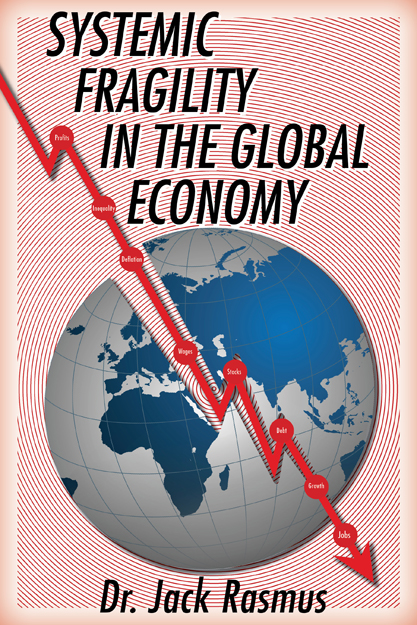
The following is the most recent review of my 2016 book, ‘Systemic Fragility in the Global Economy’, Clarity Press, 2016, which will appear shortly in the ICT Journal, Beijing, China, summarizing my theory of why and how the US and global economies are growing more fragile and therefore prone to a major financial instability event and recession in the next 2-3 years. (See my prior post on this blog, on ‘A Theory of Systemic Fragility’, i.e. the concluding chapter of the book, for more detail).

“SYSTEMIC FRAGILITY IN THE GLOBAL ECONOMY
BY DR. JACK RASMUS
Institute for Critical Thought (ICT), Beijing, China

INTRODUCTION
Most major monetary, fiscal, and macroeconomic economists, and financial institution and capital market experts agree, the global economy and financial system is more systemically fragile than ever before: $10 trillion bank NPLs, $13 trillion Negative Interest Rate Policy (NIRP), rotating financial bubbles – China (private loans $30 trillion), and $152 trillion global debt ($100 trillion private) – 225% GDP.

According to Dr. Rasmus, Global Financial Fragility (FF) is positively related to: total financial asset investment in the system, and with interest rate maturity optimization, elasticity of inside (shadow banking) credit, and available income to service total debt levels; with inflation expectations to the change in total debt levels; with credit default and reinvestment risk; and with fiscal and monetary government subsidies, support, credit facilities, QE, bailouts, etc. (See Appendix).

Financial instability in the global system is reflected in: dueling QEs and currency wars, trouble with large systemic banks (Italian/Deutsche), government and corporate bond bubbles, emerging markets dollarization of corporate debt/liabilities, oil and commodity deflation, energy junk bonds, massive flows into ETFs and U.S. equity markets, flash crashes and high speed trading systems, on-line and peer-to-pear shadow banking-lending networks, Yuan/U.S. dollar devaluation-revaluation-appreciation-depreciation volatilities, BREXIT, EU Entropy, U.S. populous election outcomes, South China Sea aggression, global GDP and trade volume secular downward decline, CAPEX under investment, labor productivity collapse, real wage-income decline-stagnation, commodity goods deflation, etc.

Dr. Jack Rasmus book, “Systemic Fragility in the Global Economy” is another example of the continuing growth of literature showing how fragile the global economic and financial system really is. Dr. Rasmus builds a methodical case of the systematic fragility of the global financial-economic system, and how current central bank economic ideologies and orthodoxy have been deficient and unorthodox.

Their financial-real cycle analysis is poor, their reliance on the Phillips Curve as a policy rule is flawed, they have a linearity bias, measurements of debt-income feedback effects are underdeveloped, they have a misunderstanding of financial asset price determination, their models are missing finance transmission mechanisms, etc.

Their policies have made matters worse, by driving the cost of capital to zero (negative), replacing real assets for financial assets, printing trillions to bail out and purchase bad debt and defective financial products, allowing massive leakage of capital to flow unregulated (shadow banking) across globe platforms, etc.; and all with no real affect on real economic growth, wage growth, labor participation rates, inflation rates, and more importantly standards of living or social welfare.

OVERVIEW

The first part of the book is an overview of the five major economies as of 2016; the second part addresses the nine major variables that drive systematic fragility.

These factors are the definition of fragility:

1) The relationship between debt (levels, rates of change, etc.),
2) The ability to service debt (forms of income and price as a determinant of income),
3) Terms and conditions of debt servicing (covenants and term structure of rates).

Dr. Rasmus defines fragility as: the mutual inter-determination of these three variables; moreover, the variables function within the three main sectors of the economy: household consumption, business (financial and non-financial), and government sector.

The debt-income-terms of servicing, mutually determine each other within the three sectors. The three sectors are also mutually determinative of each other; there are feedback effects between the three sectors, as well as within them.

Fragility is measured as a quantitative index variable. By producing a leading index of fragility, it can forecast imminent systemic instability events. A time series (cross-section, factor analysis, data mining, simultaneous equation) regression analysis is needed of all nine (three within each of the three sectors) to determine the weights, and causal interactions. This can be done via machine learning (AI) and neural network analysis. This work is being prepared, and is ‘a work in progress’.

OUTLINE

In the first part of the book, Chapters 1 -to- 6, are an overview of the degree of fragility as of 2016, in the major economies: Europe, Japan, China, Emerging Markets, and U.S.; and Chapters 7 -to- 15 are a consideration of the main drivers of financial instability: slowing investment and deflation, explosion of money-credit-debt, shift to financial assets and restructuring of financial markets, structural change in labor markets, and central bank and government fragility, the key being the change in financial structure and investment.

The third part of the book, Chapters 16 -to- 18, is a critique of mainstream economics, Keynsian and Classical economic theory, Marxist and Minskyan economics, and the failure of these theories to address financial variables in post-modern macroeconomic-monetary policy theory, models and analyses.

In Chapter 19, Dr. Rasmus, offers his own Theory of Systematic Fragility, as of 2016; where it is Central bankers and massive liquidity injections that are fundamental originating causes of systemic fragility, but these alone do not completely explain fragility.

Stagnation and Instability in the Global Economy

In the U.S., China, Japan, Europe there is a coordinated effort to correct the failures of capitalism (under investment, employment, consumption, price stability, etc.), and the response by all central banks have been the same, a constant injection of massive amounts (trillions of U.S. Dollars, Yen, Euros, Pounds, Yuan, Peso, Rubble, etc.) of liquidity (credit) to back-stop, set a support, and prop up asset prices.

However, this leads to asset price bubbles and asset price collapse (financial/currency crisis/stagnation/deflation/under employment-investment), crisis more frequent since 1995 (Peso Crisis, Thai Baht, Russian Default, Y2K/911, Housing Bubble, Financial Crisis, etc.), and global central bankers (governments) now do not have the balance sheets to deal with future crisis; and have not fixed the real problem underlying the economy, they have only created a monetary illusion of policy effectiveness: dead-cat bounce recoveries, emerging market currency collapse, Japanese perpetual recessions, Europe’s stagnation, and China’s asset price hyper-inflation and debt crisis.

The perfect example of this financial-economic fragility is Japan.

Japan’ Perpetual Recession

Over the last 17 years (1990 – 2017), the Bank of Japan (BOJ) implemented aggressive forms of unorthodox monetary policy (Negative – Nominal/Real — Interest Rate Policy/Quantitative Easing): printing massive amounts of money, buying massive amounts of sovereign-corporate (infrastructure) bonds, driving bonds yields negative, and driving domestic investors/savers (negative effective rates), and financial institutions (disintermediation), literally crazy.

Japan will be the ultimate experiment in monetary-fiscal policy mistakes, as they will have to resort to even more extreme measures to try to get themselves out of their existential structural crisis. The ultimate fiscal-monetary response could be, with unintended political-economic-cultural consequences, from a massive and coordinated debt forgiveness, by both fiscal/monetary authorities, is unknown and untested in modern monetary history.

Japan is extremely fragile, as at some point they will not have the tax revenues to service the sovereign debt payments, and will theoretically fall into default, and will ask for forgiveness, not from bond holders, but from the BOJ, that owns the majority of the debt.

Not only is Japan’s economy and financial system extremely fragile, but so is Europe.

Europe’s Chronic Stagnation

The actual European Central Bank (ECB) structure (dominated by Germany – Bundesbank) is a major impediment in its ability to respond to current crisis: fiscal austerity, inability to devalue the Euro, fear of hyper-inflationary trends, and misspecification of monetary policy targets (inflation, productivity, employment, wages, and exchange rates).

Poor performance (contagion), bank crisis (runs on banks), social unrest (extreme right-wing populism), massive debt issuance, and deflation (liquidity trap/collapse of money velocity) is the costly (stagnation) result of policy mistakes. This — along with the lack and hesitant response to bank runs in Spain-Greece-other EU countries — has had a significant negative impact on ECB independence and credibility, in regards to the ability to respond to future financial and economic crisis.

Not only is Europe’s economy and financial system extremely fragile, but so is China.

China: Bubbles, Bubbles, Debt and Troubles

The Asian Contagion of the late 1990s required massive bank and corporate bailouts (recapitalizations). The 2000s, witnessed a modernization of the Peoples Bank of China (PBOC), as a central banking institution through banking reforms, conversion of State Owned Entities (SOEs) to private-public firms (privatization toward a more Japanese Keiretsu system), pushing for more export-oriented policies (higher-value commodities-services), and larger government sponsored infrastructure projects (commercial-residential-dams-roads-power plants, etc.).
Excessive industrial and monetary policy is unsustainable, and will have significant negative externalities on the global economy. The next financial crisis, in China, will come from the excessive extension of credit from both fiscal and monetary authorities, and will come from government and corporate bond market defaults, as the system is severely over-leveraged. China is using more and more debt to fix bad debt problems, and the simulative multiplier-accelerator effect on the economy is deteriorating (decelerating) quickly.
Systematic fragility is not only experienced at the microeconomic (country/market) level, but manifests at the macroeconomic (systemic/systematic/institutional) level.

Trends in Systematic Fragility

Systematic fragility is made up of financial, consumption and government fragility; and intra-sector fragility, is caused by debt levels (rate of change), income (servicing of debt), and terms and conditions of servicing of debt. Transmission mechanisms between these factors and sectors are price systems (financial/commodity), government policy (monetary/fiscal), and psychological expectations (investors/consumers).

What is important, is fundamental forces and enabling factors driving fragility are: the end of Bretton Woods, central bank managed float systems, ending of international capital controls, the liquidity explosion, debt escalation, financial asset investment shift, and the rise of the new global finance capital elite; and financial deregulation, global digital-network technology, financial engineering (derivatives) revolution, highly liquid financial markets, financial restructuring and emergence of the shadow banking system.

Globalization, technologicalization and deregulation/integration is accelerating capital flows and accumulation, and concentration of capital to targeted and non-targeted markets across the world, fundamentally restructuring markets and institutions. This process is continuing at a rapid pace, and depending on the recipients, is economically, financially and politically (institutionally) destabilizing, destructing and deconstructing liberal-democratic-capitalism.
Financial product innovation and advancements in the use of technology for trading purposes, is accelerating the shift from real to financial asset investment — and with the rise of global equity, debt, and derivative markets – is changing the institutional structure, and exacerbating the fragility and instability, of the global financial system.

Central Banks and Fragility

Central banks bailed out the private banking system, and will again – along with other strategic affiliated institutions, corporations, businesses and brokerages — by printing massive amounts of fiat currency (seigniorage), to buy (defective/defaulted) securities product (derivatives), accumulate more sovereign-corporate-personal debt, with even more crowding out effects, and with no real eventual long-term impacts on real economic growth, wages, and productivity; and social welfare or standards of living.

Only asset prices bubbles and a massive redistribution and concentration of wealth will occur. Global capital markets, financial institutions, governments, businesses, and consumers are sitting on an extremely fragile system. This is obvious when looking at the level of government debt, service.

Government Debt and Government Fragility

It is estimated, between the U.S Federal Reserve Bank, Bank of England, and European Central Bank, $15 trillion direct liquidity injections, loans, guarantees, tax reductions, direct subsidies, etc. have been used. If you add in China and Japan, the total gets to as high as $25 trillion, and if you add in other emerging country (Asian, Latin America, and Middle-East) central banks, the total gets as high $40 trillion. Add in inter-temporal substitution (opportunity costs) over 40 years, we are looking at hundreds of trillions of debt, and debt service.

What perpetuates this reliance on debt, and debt service, is the misconception of valid economic theory and analysis, and its real application.

Failed Conceptual Frameworks of Contemporary Economic Analysis

It is obvious, global monetary and fiscal policy responses have made the global financial and economic system even more fragile, and eventually insolvent and bankrupt, and modern central banking is ineffective and has put us into a perpetual liquidity trap, the velocity of money has collapsed. There is no money going into real long-term (capital budgets) assets, only short-term financial assets (equity, fixed-income, ETFs, derivatives, structured products, crypto-currencies, etc.).

This has led us into the contradiction of macroeconomic theory, monetary policy and central banking: liquidity-debt-insolvency nexus, the moral (immoral) hazard of perpetual bail-outs, growing concentration of wealth at the extremes, growing perception that Negative/Zero Interest Rate Policy (N/ZIRP) can fix under-investment in capital (human/physical) and deflationary (disinflationary) trends, and that current banking regulation-supervision is bad for the economy, financial services (institutions) industry, and for institutional and retail investors (savers) in the long run.

And unfortunately, these techniques and tools have been used by other Global Central Governments and Banks (BOJ/ECB/BOE/PBOC), with similar, disastrous, and disappointing outcomes. The focus is on saving the financial institutional system in the short-run, using extreme and un-orthodox monetary policies (tools), with a lack of concern or understanding of long-run economic, social, cultural, and political consequences and outcomes. This is the true reflection, of failed conceptual frameworks, of contemporary economic analysis.

A Theory and Application of Systematic Fragility

Dr. Rasmus presents a true theory (model), of Systematic Fragility, a proxy for instability, a measure and quantitative score, used to forecast financial instability events, measuring pre-post-crash-recession cycle phases, it is a simultaneous equation-solution, the weights and factors are non-linear relationships, and are determined through the use of machine-learning (AI) algorithms, that adjust the factors, equations, and outcomes in real (continuous) time.

For example, over the last 10 years, the Fed accumulated over $4.5 trillion in bank reserves/balance sheet (bonds), made up mostly of mortgage backed securities and U.S. government Treasury notes and bonds, the average size of the balance sheet prior to the financial crisis was $500-to-$800 billion. Since these were mainly reserves creation, and an addition to the monetary base, and not really the money supply, the policy effects (QE/(Zero-Negative Real Interest Rate policy) have been mute.

The real cause of deficient real-macroeconomic performance, is a collapse in the velocity of money, driven by alternative forms of money creation and flows across the globe (cryptic-digital currencies-shadow banking, etc.); the lack of fiscal labor market policy to lower under-employment and raise labor market participation rates; and resolve to solve other social, cultural, political and economic disruptions. Making it now impossible to conduct monetary policy.
With the U.S. fiscal debt totaling over $22 trillion (interest payments +$1.0 trillion per year), the Feds Balance Sheet totaling $4.3 trillion, the potential for continued -perpetual war (defense spending) and entitlement expenditures, and political and policy uncertainty (next Federal Reserve President) there is little room for monetary and fiscal solutions to fight the next financial and economic crisis.

Neoliberal new-classical macroeconomic theory is flawed, at best, as it relies on the primacy of central bank monetary policy, tax structure shifts, free trade theory, running of twin deficit systems, allows for major labor market restructuring, leading to wage compression, drives toward privatization of public goods and institutions, and fiscal austerity, and financialization-fiscalization of elites, institutions and products.

CONCLUSIONS

Most major monetary, fiscal, and macroeconomic economists, and financial institution and capital market experts agree, the global economy and financial system is more systemically fragile than ever before.

According to Dr. Rasmus, shows us that global Financial Fragility (FF) is positively related to total financial asset investment in the system, and with interest rate maturity optimization, elasticity of inside (shadow bank) credit, and available income to total debt levels; with inflation expectations to change in total debt levels; with credit default and reinvestment risk; and with fiscal and monetary government subsidies, support, credit facilities, QE, bailouts, etc. (See Appendix).

Government policies have made matters worse, by driving the cost of capital to zero (negative), replacing real assets for financial assets, printing trillions to bail-out and purchase bad debt and defective financial products, allowing massive leakage of capital to flow unregulated (shadow banking) across the globe, etc.; all with no real effect on real economic growth, wage growth, labor participation, inflation, standards of living or social welfare.

These failures and fragility are reflected in increased volatility in social and economic indicators, capital market pricing and investment risk, and resulting reductions risk-adjusted returns, inefficient allocation investment capital and resources, and falling employment and real income growth rates, standards of living and overall social welfare.

The conclusion, if this system of unorthodoxy continues — and I believe it is too late to address the systemic and systematic risks associated with the economy, government, and central banking — exposes the economy, financial institutions and capital markets, to failure, again, at an ever higher social price.

The reality is our economic and financial system are extremely fragile, and we are facing ever higher systematic-systemic credit default (illiquidity) risk, and another severe financial crisis, great recession and depression, as our tools and system are ineffective and broken.

By Dr. Larry Souza
April 1, 2018
Dr. Souza has 27 years of experience in commercial and residential real estate economic research; and is Real Estate, Financial and Investment Economist for: Pillar6 Advisors, LLC; Johnson Souza Group, Inc.; CapitalBrain.co, and GreenSparc. Dr. Souza holds degrees in: accounting, finance, economics, public administration, information systems and political science; and Doctorate in Business Administration (DBA) with a concentration in Corporate Finance, and his dissertation is titled: Modern Real Estate Portfolio Management (MREPM): Applications in Modern (MREPT) and Post-Modern (PMREPT) Real Estate Portfolio Theory. He has been teaching college level finance, economics and real estate courses for the past 22 years, and is currently a full-time adjunct professor in the School of Economics and Business Administration (SEBA) at Saint Mary’s College (SMC) of California.

The final part 5 in the series ‘A Theory of Systemic Fragility in the Global Economy’ is now available on my website. From the concluding chapter of my 2016 book, ‘Systemic Fragility in the Global Economy’, the summary chapter 19, here serialized in 5 parts, looks at 9 key variables involving credit, debt, income, and terms & conditions of debt repayment, and how their mutual interaction leads to growing ‘fragility’ in the economy making it prone to financial instability events. Fragility is considered across household consumer, business investment, and government fiscal-monetary policy dimensions. How variables exacerbate each other over time and the transmission mechanisms between the three sectors and nine variables.

The US and global economy are growing more fragile since 2010, drawing the economy nearer to yet another major financial instability event.

TO READ: GO TO http://www.kyklosproductions.com/articles.html

To listen to my analysis of the latest developments of the Trump trade war with China,

GO TO:

http://prn.fm/alternative-visions-trumps-dejavu-china-trade-war-04-06-18/

Or go to:

http://alternativevisions.podbean.com

SHOW ANNOUNCEMENT

Dr. Rasmus assesses the past week’s Trump trade offensive, showing its ‘dual track’ focus: go soft on trade and tariffs for US allies (example the recent Korean trade deal and exemptions on steel-aluminum tariffs) while playing ‘hardball’ with China trade. The steel and Korean deals are summarized. Rasmus argues this phony trade ‘track’ is for domestic political consumption for Trump’s base as November elections in the US approach and as Trump prepares to fire investigator Mueller. Trump is using trade to agitate and mobilize his domestic base on nationalist appeals once again. Rasmus argues the second, ‘hard’ track of China trade is about stemming US technology transfer to China that is militarily sensitive, especially AI, G5, and cyber security tech. That’s Trump’s No. 1 objective, for which he’ll trade tariffs on other China imports to the US. The Trump trade offensive is then discussed in historical perspective, comparing it to Nixon’s 1971-73 attack on Europe corporate competitors and Reagan’s 1985 attack on Japan. Why the US periodically engages in rewriting the trade ‘rules of the game’ to ensure US business interests are protected. The Trump trade offensive in relation to recent Trump taxes, deficits, and central bank interest rate hiking underway. Trade as the third policy initiative of Trump’s effort to re-establish a neoliberalism 2.0 policy regime.

Watch my latest interview on the status of the US-China trade dispute (as of this past weekend). What the US wants is limits on Tech Transfer to China as next generation tech (G5, AI, etc.) takes off. Trump will concede on China imports in exchange for Tech transfer limits and agreement. How does the US-China Trump ‘trade war’ compare to past aggressive trade actions by Reagan against Japan 1985 and Nixon against Europe 1971? To watch go to Youtube at:

My analysis of the current state of US stock and financial market bubbles and the growing likelihood of a second major ‘correction’. A look at the forces driving the bubble and the countervailing forces beginning to build that would cause its contraction. Also, how Trump’s trade ‘war’ relates to it all. To listen

Go To:

http://prn.fm/alternative-visions-us-stock-markets-turn-03-30-18/

Or go to:

http://alternativevisions.podbean.com

SHOW ANNOUNCEMENT

Dr. Rasmus looks at the forces pumping up US stocks, especially Tech stocks and S&P500, and the emerging counter forces that may soon prevail to send US stock markets into another major correction. Forces driving the bubble are continuing record stock buybacks and dividend payouts, and now record levels of merger & acquisitions (up 67% in 2018 and $1.2 trillion) and the Trump tax cuts boosting profits 10%-31% and their distribution into buybacks, dividends, and M&A activity. Forces growing that may reverse the trend and bubbles include: tech stocks peaking and attacks on Tech companies by politicians, Federal Reserve continued interest rate hikes, derivatives exposures to ETFs, cryptos, VIX, a renewed slowing of global economies and trade, China stock market contraction, European non-performing bank loans, and the Bank of Japan’s destruction of corporate bond markets with its QE purchases. Rasmus concludes with the talk of ‘Trade War’ under Trump as a factor threatening stocks. The trade war is phony, and really a ‘war’ targeting China while exempting US allies except for token changes, as evidenced by the just concluded US-South Korean agreement. Trump’s ‘trade war’ with China is discussed in historical context with Reagan’s ‘trade war’ on Japan in 1985 and Nixon’s targeting Europe in 1971. Rasmus concludes Trump vs. China will prove less successful than Reagan-Japan and Nixon-Europe.