by Dr. Jack Rasmus
The business and mainstream press this month, September 2018, has been publishing numerous accounts of the 2008 financial crash on its tenth anniversary. This month attention has been focused on the Lehman Brothers investment bank crash that accelerated the general financial system implosion in the US, and worldwide, ten years ago. Next month, October, we’ll no doubt hear more about the crash as it spread to the giant insurance company, AIG, and beyond that to other brokerages (Merrill Lynch), mid-sized banks (Washington Mutual), to the finance arms of the auto companies (GMAC) and big conglomerates (GE Credit), to the ‘too big to fail’ banks like Bank of America and Citigroup and beyond. These ‘reports’ are typically narrative in nature, however, and provide little in the way of deeper historical and theoretical analysis.
Parallels & Comparisons 1929 & 2008
It is often said that the initial months of the 2008-09 crash set the US economy on a trajectory of collapse eerily similar to that of 1929-30. Job losses were occurring at a rate of 1 million a month on average from October 2008 through March 2009. One might therefore think that mainstream economists would look closely at the two time periods—i.e. 1929-30 and 2008-09—to determine with patterns or similar causes were occurring. Or to a deep analysis of the periods immediately preceding 1929 and 2008 to see what similarities prevailed. But they haven’t.
What we got post-2009 from the economic establishment was a declaration simply that the 2008-09 crash was a ‘great recession’, and not a ‘normal’ recession as had been occurring from 1947 to 2007 in the US. But they provide no clarification quantitatively or qualitatively as to what distinguished a ‘great’ from ‘normal’ recession. Paul Krugman coined the term, ‘great’, but then failed to explain how great was different than normal. It was somehow just worse than a normal recession and not as bad as a bona fide depression. But that’s just economic analysis by adverbs.
It would be important to provide a better, more detailed explanation of 1929 vs. 2008, since the 1929-30 crash eventually led to a bona fide great depression as the US economy continued to descend further and deeper from October 1929 through the summer of 1933, driven by a series of four banking crashes from late 1930 through spring 1933 after the initial stock market crash of October 1929. In contrast, the 2008-09 financial crash leveled off after mid-2009.
Another similarity between 1929 and 2008 was the US economy stagnated 1933-34—neither robustly recovering nor collapsing further—and the US economy stagnated as well 2009-12. Upon assuming office in March 1933 President Roosevelt introduced a pro-business recovery program, 1933-34, focused on raising business prices, plus initiated a massive bank bailout. That bailout stopped further financial collapse but didn’t generate much real economic recovery. Similarly, Obama bailed out the banks (actually the Federal Reserve did) in 2009 but his recovery program of 2009-10, much like Roosevelt’s 1933-34, didn’t generate real economic recovery much as well.
After the failed business-focused recoveries, the differences between Roosevelt and Obama begin to show. Roosevelt during the 1934 midterm elections shifted policies to promising, then introducing, the New Deal programs. The economy thereafter sharply recovered 1935-37. In contrast, Obama stayed the course and doubled down on his business focused recovery program in 2010. He provided $800 billion more business tax cuts, paid for by $1 trillion in austerity programs for the rest of us in August 2011.
Not surprising, unlike Roosevelt’s ‘New Deal’, which boosted the economy significantly starting in 1935 after the midterms, Obama’s ‘Phony Deal’ recovery of 2009-11 resulted in the US real economy continuing to stagnate after 2009.
The historical comparisons suggest that both the great depression of 1929-33 (a phase of continuous collapse) and the so-called ‘great’ recession of 2008-09 share interesting similarities. Both the initial period of the 1930s depression—October 1929 through fall of 1930—and the roughly nine month period of October September 2008 through May 2009 appear very similar: A financial crash led in both cases to a dramatic follow on collapse of the real economy and employment.
But the 1929 event continues on, deepening for another four years, while the latter post 2009 event levels off in terms of economic decline. Thereafter, similar pro-business subsidy policies (1933-34) and (2009-11) lead to a similar period of stagnation. Obama continues the pro-business policies and stagnation, while Roosevelt breaks from the business policies and focuses on the New Deal to restore jobs, wages, and family incomes and recovery accelerates. Unlike Roosevelt who stimulates fiscal spending targeting household incomes, Obama focuses on further business tax cutting—i.e. another $1.7 trillion ($800 billion December 2010 plus another $900 billion in extending George W. Bush’s tax cuts for another two years—thereafter cutting social programs by $1 trillion in August 2011 to pay for the business tax cuts of 2010-11.
The policy comparisons associated with the recovery and non-recovery are clearly determinative of the comparative outcomes of 1935-37 and 2010-11, as are the comparisons of the business-focused strategies 1933-34 and 2009-10 that resulted in stagnant recoveries. But the political outcomes of the policy differences are especially divergent and interesting.
No less interesting are the political consequences for the Democratic Party. Roosevelt’s 1934 campaigning on the promise of a New Deal resulted in the Democrats sweeping Congress further than they did even in 1932. They gained seats in 1934 so that by 1935 they could push through the New Deal that Roosevelt proposed despite Republican opposition. In contrast, Obama retained, and even deepened, his pro-business programs before the 2010 midterms which resulted in the Democrats experiencing a massive loss in Congress in the 2010 midterm elections. Thereafter, the Democrats were stymied by a Republican House and Senate that blocked everything. Obama nonetheless kept reaching out and asking for a compromise with Republicans, but the Republican dog bit his hand with every overture.
Obama pleaded with American voters for one more chance in 2012 and they gave it to him. The outcome was more of the same of naïve requests for compromise, rejection, and a continued stagnation of the US economy. Republicans meanwhile also deepened their control of state and local level governorships, legislatures, and local judiciary throughout the Obama period.
The final consequence of all this was Trump in 2016 as the Obama Democrats promised more of the same in the 2016 presidential election. We know what happened after that.
Consequences for US Midterm 2018 Elections
As yet another midterm election approaches, November 2018, we are once again inundated with mainstream media projections of a ‘blue (Democrat) wave’ coming. But they are today the same pollsters of that same media that were proclaiming in October 2016 that Trump had only a 15% chance of winning the 2016 election. What’s changed that we should believe the pollsters, the media, and the Democrats this time around again that Democrats have the big lead?
Granted, there have been a few notable progressive victories in solid, highly urban constituencies But this does not necessarily ensure their optimistic projections. A likely greater voter turnout in these urban Congressional districts must be weighed against the continued Republican-Trump efforts to deny millions of their voting rights, the continued gerrymandered reality of Republican-led governorships and legislatures, and the massive money machine of ultra-right wing billionaires like the Koch brothers, the Mercers, the Adelmans and other radical right billionaire families behind Trump that is now cranking up to provide a wall of money for Trump sycophants running for office. And let’s not forget those millions of phony religious-moral Americans who support Trump regardless of his misogyny, racism, attacks on the press and immigrants, or his obvious disregard for the even limited democratic institutions and precedents that barely still prevail today in the US. Like Germans who loved Hitler, but not necessarily the Nazi philosophy, they will follow him over any cliff.
Will Millenials now turn out to vote in 2018 when they didn’t in 2016? What have Democrats promised to them this time that they will believe? Why should they think Democrats are any different now? Will Latinos and Hispanics turn out this time, when the Democrats promised last February a ‘line in the sand’ for a Dreamers bill or no approval of the US debt ceiling extension—and then caved in once again? Women and professionals (independents) tired of Trump’s antics and misogyny may come back to vote for the Dems. Maybe some union workers in the Midwest this time, who abandoned Hillary in 2016, as well. But will that be enough?
What will the public think and feel should Trump and his now converted radical Republican party maintain control of the House and Senate for another two years? They’ve been told of the coming ‘blue wave’. But what if that wave dissipates on the reactionary shore that has been deepening in America now for decades? What will the anti-Trump camp do? Say ‘Ok, let’s try again in 2020’? And go away further demoralized?
The opposite outcome in November—a defeat for Trump in the House—will have a similar ‘shock’ to public consciousness, only this time on the right. What will the far right do should it appear that the Dems win the House and announce Trump impeachment proceedings? Trump’s 30% of the electorate are beholden to him only—and not to the remaining, limited democratic institutions of America. He can do no wrong, even if it means dismantling the vestiges of democracy in America.
Should Trump lose the House and face the threat of impeachment, or even an indictment by special prosecutor Mueller, the radical right will mobilize at the grass roots. Bannon at his ilk, fueled by the money of the Mercers et. al., may well shift to popular right wing mass protests and demonstrations. They will want to ‘warn’ the Dems and others to proceed with caution toward impeachment or face the advent of a proto-civil war in the country. A threat of such, if not actual.
The linking of Trump, his wealthy backers, and releasing grass roots Trump supporters into a real street movement will mean yet another step toward a US fascist-like phenomenon. We are not there yet. Trump is not a fascist. To throw around the charge, as a part of the progressive left does, is like crying ‘wolf’ before it actually appears’. If and when it does appear, what should the real wolf then be called?
If Trump is not a fascist he clearly has proclivities toward tyranny and dictatorship: he obviously considers himself above the law (definition of Tyrant), as he has already declared he would pardon himself if indicted. And he clearly identifies with, and is fond of other, authoritarian strong men like Kim, Duterte, and others who rule by dictate. A crisis period Trump administration might be expected to ‘rule by executive order’, with the permission of Congress perhaps. But he is not yet a fascist (as so many progressives mistakenly declare). For that he needs a movement in the streets. Bannon, the Mercers and friends may yet give him that should he be actually impeached.
That street movement may be sufficient to scare the timid liberals and Democrats in Congress from proceeding with impeachment in all but talk should they win the House in November. The leadership of the Democrats will likely back off, once again, should Trump-Bannon turn to the streets. Therefore Democrats, should they win the House, will be all talk and no action. We’ll hear instead the real message, the real strategy: “complete the anti-Trump change by electing a Democrat president in 2020.” Once again, as Trump and the right leverage grass roots movements, the Dems try to funnel all discontent into their re-elections. Trump spends most of his time at rallies in the field. Obama sat on his butt in the White House and was rarely seen or heard.
But hasn’t that been the problem of the last several decades? Republicans link up with the Teaparty, go for the juggler, release the political demons in America always simmering below the surface, mobilize right wing money bags, pervert what remains of democratic institutions, block and thwart all progressive legislation, and ‘kick ass and take names’ of the Democrats—who respond timidly, try to play by the old rules, mouth bipartisanship ad infinitum, and continually retreat in the face of the right wing onslaught
With more than 100 of its Democrat National Committee, DNC, composed of business CEOs and business lobbyists, there’s little chance the Democratic Party will really directly confront Trump and his minions. Should the Democrats even win the House in November, it will be mostly talk of impeachment and token moves for the media, while re-directing discontent to electing still more Dems in 2020 as the real strategy. Meanwhile, Trump and the radical right will continue to mobilize in defense—legislatively, financially, and at the grass roots in increasingly confrontational ways.
To sum up: 1929 gave us Roosevelt and the ‘New Deal’. 2008 gave us Obama and a ‘Phony Deal’. The 2018 midterm elections and the next financial crisis, which is no more than 2-3 years away, may give us Trump’s ‘Final Deal’.
Whether Trump survives November, and his now transformed in-his- image Republican party continues to shield him and allow him to deepen his radical policies, or whether the Democrats take the House and commence talking impeachment proceedings—the result in either case will be a shattering of public consciousness from its prevailing mode once again, as occurred in November 2016. Either way, the next two years will undoubtedly prove more politically unsettling and economically destabilizing than the last.
The Next Crisis
The next financial crisis—and subsequent severe contraction of the real economy once again—is inevitable. And it is closer than many think, mesmerized by all the talk of a robust US economy that is benefiting the top 10% and not the rest. Why so soon?
The answer to that question will not be provided by mainstream economics. They are too busy heralding the current US economic expansion—which is being grossly over-estimated by GDP and other data and which fails to capture the fundamental forces underlying the US and global economy today, a global economy that is growing more fragile and thus prone to another major financial instability event.
The forces which led to the 2008 banking crash were associated with property bubbles (US and global) and the derivatives markets which allowed the bubbles to expand to unsustainable levels, derivatives which then propagated and accelerated the contagion across financial markets in general once the property bubbles began to collapse.
The 2008 crash was thus not simply a subprime housing crisis, as most economists declare. It was just as much, perhaps more so, a derivatives financial asset (MBS, CMBs, CDOs, CDSs, etc.) crisis.
More fundamentally than the appearance of a collapse in prices of subprime mortgages, and even derivatives thereafter, 2008 was a crisis of excess credit and debt that enabled the boom in subprimes and derivatives to escalate to bubble proportions.
But subprimes and derivatives were still the appearance, the symptoms of the crisis. Even more fundamentally causative, the 2008 crash had its most basic origins in the massive liquidity injections by the central banks, led by the US Fed, that has occurred from the mid-1980s to the present. The massive liquidity provided the cheap credit that fueled the excess debt that flowed into subprimes and derivatives by 2008. (And before than into tech stocks in 1998-2000, and before that into Asian currencies (1996-97), and into Japanese banks and financial markets and US junk bonds and savings & loans in the 1980s, and so forth).
Excessive debt accumulation is not the sole cause of financial crises, however. It is an enabling precondition. Enabling the debt in the first place is the excess liquidity and credit. That liquidity-credit-debt buildup is what occurred in the 1920s decade leading up to the October 1929 stock crash. It’s what occurred in the decades preceding 2008, especially accelerating after the escalation of financial derivatives in the 1990s.
Excessive debt creates the preconditions for the crisis, but the collapse of financial asset prices is what precipitates the crisis, as the excessive debt built up cannot be repaid (i.e. principal and interest payments ‘serviced). So if liquidity provides the debt fuel for the crisis, what sets off the conflagration is the collapse of prices that lights the flame.
The collapse of stock prices in October 1929 precipitated the subsequent four banking crashes of 1930-33. The collapse of property prices (residential subprime and also commercial) in 2006-07 precipitated the collapse of investment banks in 2008, thereafter quickly spilling over to other financial institutions (brokerages, insurance companies, mutual funds, auto finance companies, etc.) after the collapse of Lehman Brothers investment bank in September 2008.
Today in 2018 we have had a continued debt acceleration since 2008. As estimated by the Bank of International Settlements (BIS) in Geneva, Switzerland, total US debt has risen from roughly $50 trillion in 2008 to $70 trillion at end of 2017. The majority of this is business debt, and especially non-financial business debt. That’s different from 2008 when it was centered on mortgage debt. It is also potentially more dangerous.
The US government since 2008 has also increased its federal debt by trillions, as it continued to borrow from investors worldwide in order to ‘finance’ and cut business-investor taxes and continue escalation of war spending since 2008. US household debt also rose further after 2008, as the lack of real wage and income growth over the post-2008 decade has resulted in $1.5 trillion student debt, $1 trillion plus in auto and in credit card debt, and $7-$8 trillion more in mortgage debt. Globally, according to the BIS, non-financial business debt has also been the major element responsible for accelerating global debt levels—especially borrowing in dollars from US banks and investors (i.e. dollarized debt) by emerging market economies, as well as business debt in China issued to maintain state owned enterprises and to finance local building construction.
So the debt driver has continued unabated as a problem since 2008, and has even accelerated. Financial asset bubbles have appeared worldwide as a result—not least of which is the current bubble in US stocks. This time it’s not real estate mortgages. It’s non-financial business and corporate debt that is the likely locus of the next crisis, whether in the US or globally or both.
Since 2008 US and global debt bubbles have been fueled once again—as in the 1920s and after 1985 by the excess liquidity provided by the US central bank, and other advanced economy central banks. The central bank, the Fed, alone has subsidized US banks and investors to the tune of $6 trillion from 2009 to 2016, as a consequence of its QE and near zero interest rate policies.
Since 2008, excessive and sustained low interest rates for investors and business have resulted in at least $1 trillion a year in corporate debt buildup, as corporate bond issues have accelerated due to ultra cheap Fed money. The easy money has allowed countless ‘junk’ grade US companies to survive the past decade, as they piled debt on debt to service old debt. Cheap money has also fueled corporate stock buybacks and dividend payouts to investors, which have been re-funneled back into stock prices and bubbles. So has the doubling and tripling of corporate profits from 2008 to 2017 enabled record buybacks and dividend distributions to shareholders.
Most recently, in 2017-18 the subsidization locus has shifted to Trump tax cuts that have artificially boosted US profits by a further 20% and more. As data has begun showing in 2018, most of that is now being re-plowed back into stock buybacks and dividend payouts—this year totaling more than $1.4 trillion, after six years of already $1 trillion a year in buybacks and payouts. That’s more than $7 trillion in distribution by corporate America in buybacks and dividends to its wealthy shareholders.
Where’s the mountain of money provided investors all gone? Certainly not in raising wages for workers. Certainly not in paying more taxes to government. It’s been diverted into financial markets in the US and globally—stocks, bonds, derivatives, currency, property, etc.—into mergers & acquisitions in the US, or just hoarded on balance sheets in anticipation of the next crisis approaching. Or sent into emerging markets (financial markets, mergers & acquisitions, joint ventures, expanding production, etc.) when they were booming 2010-2016.
So where will the financial asset prices start collapsing in the many bubbles that have been created globally and in the US so far—and thus precipitating once again the next financial crisis? The BIS has been warning to watch US corporate junk bonds and leveraged loan markets. Watch out for the new derivatives replacing the old ‘subprimes’ and CDSs—i.e. the Exchange Traded Funds, ETFs, passive index funds, dark pools, etc. Watch also the US stock markets responding to US political events, to a real trade war with China perhaps in 2019, a continuing collapse of emerging market economies and currencies, to a crisis in repayment of non-performing bank loans in Italy, India and elsewhere, or a tanking of the British economy in the wake of a ‘hard’ Brexit next spring, or Asian economies contracting in response to China slowing or its currency devaluing, or to any yet unseen development. Collapsing prices in any of the above may be the origin of the next financial asset contraction that will spread by contagion of derivatives across global markets. And the even larger debt magnitudes built up since 2008 may make the eventual price deflation even more rapid and deeper. And the new derivatives may accelerate the contagion across markets even faster.
The financial kindling is there. All it now takes is a spark to set it off. The next financial crisis is coming. The last decade, 2008-18, is eerily similar to the periods 1921-1929 and 1996-2007.
Only now it will come with the US challenging foreign competitors and former allies alike as it tries to retain its share of slowing global trade; with a US economy having devastated households economically for a decade; with a massive US federal debt now $21 trillion and going to $33 trillion due to Trump tax cuts; with a US crisis in retirement income, healthcare access and costs, and a crumbling education system; with an economy having created only low pay and mostly contingent service jobs; with a virtually destroyed union movement; with a big Pharma initiated opioid crisis killing more Americans per year than lost during the entire 9 year Vietnam war; with a culture allowing 40,000 of its citizens a year killed by guns and doing nothing; with an internal transformation and retreat of the two established political parties; and with a Trump and right wing radical movement ascendant and poised to move to the streets to defend itself.
Jack Rasmus
September 24, 2018
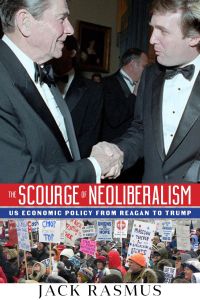
Dr. Rasmus is author of the forthcoming book ‘The Scourge of Neoliberalism: US Policy from Reagan to Trump’, Clarity Press, 2019. He blogs at jackrasmus.com and his twitter handle is @drjackrasmus. (For a more detailed analysis of the similarities and differences between 1929 and 2008, and how Roosevelt and Obama treated the crisis differently, read the except from Dr. Rasmus’s 2010 book, ‘Epic Recession: Prelude to Global Depression’, Plutobooks, now posted on his website, http://kyklosproductions.com).
.
 Dr. Jack Rasmus @drjackrasmus