Watch my 15 minute Youtube interview and discussion on approaching global recession, collapsing US stock and global financial markets, and Trump’s trade war fiasco.
To Watch Go To:
Watch my 15 minute Youtube interview and discussion on approaching global recession, collapsing US stock and global financial markets, and Trump’s trade war fiasco.
To Watch Go To:
Posted in Uncategorized | 1 Comment »
One of the readers of my recent post on Argentina and the growing instability in global financial markets just asked me the above question: ‘Are Ordinary Americans Screwed? My reply given events of today and recent weeks are shared as follows:
“If by ‘ordinary Americans’ you mean those of us whose income is in the ‘bottom 90%’, the answer is ‘yes, we get screwed when the rich and their politicians get filthy rich by causing an economic crisis, then get richer off that crisis once it happens’.
More than a trillion dollars every year since 2011 on average has been distributed by their corporations to them in stock buybacks and dividends. last year it was $1.2 trillion. This year it will be closer to $1.5 trillion.
Meanwhile we get to work more part time and temp jobs (2nd and 3rd jobs which is where most of the job creation has been occurring) and we get little or no wage increases (most of the wage gains are going to the top 10% of the workforce, leaving the middle stagnating and below the middle falling in real wage terms). The official 3.1% wage gain is just an ‘average’, with most of the gains skewed to the top 10%. Nor does that 3.1% include part time wages, just wages of full time workers. Nor does it account for inflation offsetting the 3.1% nominal wage gains (inflation which is greater than reported as well). And if you’re one of the unfortunate getting hit with accelerating health care insurance premiums and drug costs, or student loan debt, or rising rent costs, then you’re going backward in wages even more.
In short, the policies since 2008–both Obama’s and Trump’s–for ten years now have been subsidizing the rich,the elites, the owners of capital incomes like never before in US history. Tax cuts and Fed policies have subsidized (i.e. redistributed) tens of trillions of dollars for the elites from fiscal and monetary policies. The redistribution/subsidization has been so extreme that that fiscal and monetary policies are now effectively ‘dead in the water’ when it comes to try to stimulate the real US economy once it descends into recession–which is less than 12 months away for the US and already happening in Europe, Latin America, and parts of Asia.
Fiscal policy in the US is now dead-ended as an effective stimulus policy tool due to the $22 trillion current US national debt levels and annual $1 trillion plus budget deficits. National debt in the US will be $34 trillion by 2027, or even more if there’s a deep recession (which will happen). Interest on that $34 trillion debt, per the CBO, will reach $900 billion a year. Increasing government spending or reducing middle class taxes to try to stimulate the economy out of recession is thus largely neutralized.
Monetary policy is also now largely neutralized I believe. Fed monetary policy interest rates will soon fall to zero, or even turn negative as in Europe and Japan, and will stay there for years. Interest rate policy to stimulate recovery of the real economy is thus now ‘dead’ as well, as a policy tool. (which was my prediction in my 2017 book, ‘Central Bankers at the End of Their Ropes’). Fed rates are at 2% and will soon fall further. But it will have little effect on the real economy, now or in the near future.
So with both fiscal and monetary policy essentially neutralized in the coming recession, the recession may descend deeper and last longer than politicians and capitalists now think.
This is part of the analysis I made back in 2010 in my other book, ‘Epic Recession: Prelude to Global Depression, where I predicted the recovery from the 2008-09 ‘great recession’ (what I called ‘epic recession’) would follow a trajectory long term of short shallow (weak) recoveries of the real economy, punctuated by short and shallow returns to recession. Meanwhile, stock and other financial markets would boom as the monetary stimulus flowed into financial asset markets and not the real economy. That is what clearly has been happening since 2008 in both Europe and Japan that have experienced repeated recessions, and are now in yet another recession.
In the US this ‘epic’ recession scenario–of short shallow contractions and recoveries amidst booming financial markets–has been muted somewhat because of the US global economic dominance and therefore its ability to ‘export’ some of its economic weakness offshore (mostly to Japan and Europe). But epic recession did not bypass the US. Its effect was only muted compared to Europe and Japan. The US also experienced two brief periods of essential real GDP stagnation, and even decline, in 2012 and 2015. This was obfuscated as well in part by the US redefining its GDP numbers in 2013 to cover up the short, shallow contractions.
Both the global and US economies are now on another trajectory for another contraction, both in the advanced economies (US, Japan, Europe, etc.) but also now increasingly among emerging market economies worldwide. Watch for the economic events in Argentina to spread throughout Latin America.Markets and currencies will continue to fall from Argentina to Mexico. Watch also for big bank and credit problems in India to intensify. Watch for Australia-New Zealand-Southeast Asia (and even So. Korea) economies now weakening. The global economy is now experiencing worldwide financial asset market price declines everywhere–in stock markets, bonds, property values, derivatives, currencies, and of course oil and other commodity futures.
That global financial asset deflation is a harbinger of possible renewed global financial crisis coming. Should the current global manufacturing recession spill over to other sectors of the real economy, which it is now doing in Europe and elsewhere (and beginning now in the US as well), and should this real economic contraction overlap with an accelerating deflation of financial markets (now appearing), then the next recession will likely appear more serious than prior ‘normal’ recessions. The inability and ineffectiveness of fiscal and monetary policies to do much about it will exacerbate the dual trends even further. The on-going ‘epic’ recession is now reasserting itself and intensifying in another downward cycle swinging toward economic contraction again.”
Posted in Uncategorized | 1 Comment »
by Dr. Jack Rasmus, copyright 2019
On August 12, 2019, financial markets in Argentina crashed. The stock market contracted 38% in just one day. The currency, the Peso, fell 20% after falling as low as 30% and recovered to 20% only when Argentina’s central bank raised its interest rate to 75%. Watch next for bond prices, both government and corporate, and especially dollarized bonds which Argentina has loaded up on in recent years, to freefall as well.
What’s going on in Argentina? What’s likely to happen next? And what do the events in Argentina have to do with falling financial asset prices—i.e. stocks, currencies, derivatives, commodity futures, real estate prices, etc.—now underway globally as well?
The precipitating cause of yesterday’s crash in Argentina stocks, peso, bond rates, etc. was the primary presidential election results over the weekend. The election was a preview for the general election that will happen this October. Macri, the current president, a businessman whose election in 2015 was assisted by US interests, lost heavily to his challenger, Alberto Fernandez. Fernandez got 48% of the vote; Macri only 32%. A gap that is likely insurmountable for Macri. It’s almost certain now that Macri will now lose in October. That prospect has global bankers and investors quite worried. For Fernandez is associated with the Kirchner government that held office prior to Macri from 2002 to 2015, and that government refused to pay US hedge funds and other investors the exorbitant rates on Argentina bonds they demanded ever since the last crisis in 2001-02.
The US media and business press today expressed deep confusion over the weekend’s political results. They just can’t understand how Macri could have done so poorly in the primary. As the talking heads put it, ‘Macri’s been putting the economy in order’, why did he lose so badly to Fernandez?
But all the perplexed ‘talking heads’ in the US media needed to do was to look at the facts: Inflation has been running at 56% per year, one of the highest in the world. The pundits say Macri has done well, bringing inflation down from 70% in 2018. But annual inflation rates, whether 56% or 70%, have been devastating real incomes of workers and small businesses. The currency has also been collapsing for two years now, having fallen from an exchange rate of roughly 16 to the US$ in 2017 to 52 to the dollar, after hitting a 60 to the dollar low yesterday. That falling will almost certainly continue in coming weeks. And with the 20% collapse of the peso this past weekend, inflation will now accelerate even faster once again.
Add to that the Argentine real economy has been in recession, contracting the past four quarters on average by more than -5%, with unemployment officially at double digit levels and likely much higher. Industrial production has fallen nearly -10% over the past 12 months, with manufacturing double that, at around -20%.
In other words, living standards have been falling sharply due to both accelerating inflation and chronic double digit job loss for the vast majority of workers and small businesses ever since Macri took office in 2015 and instituted his austerity reforms demanded by the IMF. That austerity has included cutting pensions, slashing government jobs, raising utility costs, eliminating past household subsidies. A third of all Argentina households now officially live in poverty. Is it any wonder then that Argentinians expressed their discontent in the primaries this past weekend? US business media and pundits of course don’t choose to look at this human cost of US neoliberal policies and its corollary of Argentina austerity. For them, it’s just about whether Argentina continues to service its debt to global bankers and whether the stock market in Argentina, the Merval, continues to produce capital gains profits for investors.
But wait. Didn’t Argentina recently receive a record $56 billion loan from the IMF? Isn’t that boosting the economy? No, it isn’t. Because the $56 billion is not going into the real economy. So where is the $56B IMF loan going? It’s going to pay the debt that Argentina owes to global bankers and investors, including the ‘vulture capitalist’ hedge funds, who Macri welcomed back in 2015 after he took office.
The IMF never gives money to a country to spend on stimulating its real economy. Quite the opposite. It extends loans with the condition that the country introduces austerity measures that reduce government spending or raise taxes. So what if that does the opposite—i.e. slows and contracts the real economy. That’s not its objective.
The IMF officially says it lends money to help stabilize a country’s currency. Translated, however, that means lending with the understanding the country first pays off foreign investors to whom it owes money. In fact, IMF loans never even get routed directly to the country. The IMF loan goes directly to paying of principal and interest to the investment banks, hedge funds, and billionaire ‘vulture capitalists’ who get the country indebted in the first place. The IMF actually pays them off and then send the ‘bill’ to the country for repayment—i.e. payment of the principal and interest on the debt it owes the IMF now instead of the private investors. And the debt payments are made with the money extracted from austerity programs levied on workers and the real economy. The IMF is thus the bill collector for big finance capital, and transfers the debt owed from their private investor and banker balance sheets onto its own IMF balance sheet.
The IMF recently loaned Argentina the largest amount it has ever loaned a country, the $56 billion. But it wasn’t the first time it did so. In 2001, caught in a recession that originated in the USA, Argentina couldn’t repay interest on the $100 billion debt it had incurred with private investors in the late 1990s. The IMF stepped in and did its duty. It loaned Argentina money to bail out the private investors. But some of them—led by hedge fund US billionaire Paul Singer—didn’t think the IMF loan terms didn’t pay them enough. Singer and his consortium of vulture capitalist hedge funds kept demanding Argentina pay more. The dispute went on until 2015, when the pre-Macri government was replaced by Macri, an election engineered with the assistance, financial and otherwise, of the Obama government on behalf of Singer and his buddies.
The first thing Macri did when he took office was to pay off Singer and friends the full amount they were demanding since 2001. Where did he get the money for that? From the IMF of course, which loaned Argentina the $56 billion. The payoff also opened the door for Macri & his business friends to get more private loans from US investors. They immediately trotted off to New York, met with the US bankers, and came back with a bag full of private loans. In other words, they loaded up on more private investor debt after ‘borrowing’ from the IMF to pay off the old private investor hedge fund debt.
So how is it that Macri—with big loans from not only the IMF but from New York bankers as well—couldn’t get the Argentina real economy back on its feet the past four years? The IMF money went directly to the hedge funds and vultures. But where did the new private money go? It certainly didn’t go into the real economy—i.e. investment, jobs, household income for consumption, and thus GDP. Likely it’s been skimmed off the top by Macri and his friends in part. The rest diverted to financial markets in Argentina, in the USA, or Europe.
Despite the nearly $100 billion in capital provided by the IMF and New York investors, the Argentina economy has performed poorly ever since Macri took office. In 2016 the Argentina economy contracted. It recovered briefly and slightly from recession in 2017. But in 2018-19 it has fallen into recession once again, this time more deeply as its currency has collapsed, from 16 to the dollar to more than 50 to the $US—with more collapse to come. The loans it arranged since 2015 from New York investors, moreover, have been heavily denominated in US dollars. Argentina has one of the worst run-ups in dollarized private bond debt in the world. That means as the US dollar rises the cost of making payments on that debt also rises.
Not only is the prospect of default on the IMF $56 billion debt in the near future now rising, but the parallel default on corporate debt is also rising. The value of a US dollar denominated bond dropped since last week to 58 cents on the dollar, from 77 cents. Defaults are on the horizon, both government and private, in other words.
The peso’s precipitous collapse also has further ‘knock on’ negative effects that are now intensifying the crisis in the country. Here’s how: As currencies fall in relation to the dollar, what happens is capital flight accelerates from the country. That reduces investment further in the country, in turn exacerbating the recession and layoffs even more. To slow the capital flight from the country, its central bank then typically raises interest rates dramatically. Argentina’s central bank benchmark rate is now an amazing 75%. Rising domestic interest rates further slow the real economy. In turn, the slowing real economy results in domestic stock and bond markets collapsing further—thus feeding back into the financial sector and making it even more unstable and driving financial asset price deflation even more.
What results, in other words, is a negative feedback effect between all financial markets in the country, an effect that dries up the availability of credit in general forcing more layoffs and a deeper recession. That’s what is going on now in Argentina.
But Argentina is just the leading edge of a similar general process of global financial asset price deflation. Argentina is just an intense example of financial asset markets declining everywhere globally. And in that sense its current financial and economic collapse may be the harbinger of things soon to come.
USA and other emerging market economies’ stock markets are now contracting sharply since the beginning of August. The 20%-30% decline of US stock markets last November-December 2018 has resumed. We are beginning to see November-December 2018 events déjà vu all over again. The 2018 stock market contraction was halted temporarily by the US central bank, the Fed, capitulating in late December to Trump and financial interests demanding the bank stop raising interest rates. The Fed halted raising interest rates in January 2019 and both US and emerging market economies’ financial markets regained their losses in the first quarter 2019. Aiding the halt of rate hikes by the Fed was the appearance of an imminent agreement between the US-China on trade, as negotiations resumed between February to May 2019, which also helped to restore stock market losses of 2018.
But two events happened in late July-early August 2019 that have resulted in stock and other financial markets resuming their trajectory of decline of last November-December 2018: the US Federal Reserve cut rates on July 28 by only a token 0.25% when financial markets expected more aggressive action by the Fed; and Trump a day later scuttled the prospect of a trade deal with China by raising more tariffs on $300 billion of China imports. Add to these two events the rise of Boris Johnson as the new UK prime minister and the almost now certain ‘hard Brexit’ coming after October 2019; evidence of German and Italian banks increasingly in trouble; and central banks around the world in a ‘race to the bottom’ to cut their domestic interest rates to lower their currencies exchange value to boost exports as global trade stagnates—now growing at only 0.5% annually and is about to contract for the first time since the 1930s.
Together, all these current events have translated into investors worldwide selling their stocks and other financial assets, and diverting the money into ‘safe havens’—like US Treasuries, the Japanese Yen, and gold. Argentina’s economic mismanagement by Macri has occurred in the context of a global financial asset deflation that only exacerbates Argentina’s crisis—and makes it increasingly difficult to deal with by Argentina alone, notwithstanding the record $56 billion IMF loan.
Look around. The global economy is on the precipice of a potential financial asset market price deflation not seen since 2008. It’s not quite there yet. But the momentum is now clearly in that direction.
Not only have stock prices globally contracted sharply worldwide in just a few weeks, but so too have other financial market prices:
Government bond interest rates are falling rapidly everywhere in the advanced economies. More than $15 trillion in bonds globally are now yielding negative rates. Trillions of Euro bonds are now in negative territory, up more than a $trillion in just the past year, including in Germany, and are continuing to fall further. Currencies are also contracting everywhere (driving up the value of the US dollar). Property prices are leveling off, and have begun to drop. Global oil futures, a financial asset, have fallen 20% again, from $75 a barrel to the low $50s and may soon to fall below $50. The same for many other commodities.
Financial asset prices are deflating across the board and investors are dumping them and converting to cash—i.e. a sure sign of pending global recession. What’s rising in price are the ‘safe havens’ into which the cash is flowing: gold, the Yen, US Treasuries, high end residential properties in select markets in the advanced economies, art works, and even cryptocurrencies. Also rising sharply is the cost of insuring bonds with credit default swap derivatives. In Argentina the CDS cost has accelerated to $38 for every $100 of Argentina debt, and that’s in addition to regular debt principal and interest payments.
But Argentina is just the ‘worst case’ scenario of this global financial asset deflation underway. Its financial asset prices are deflating faster and deeper than others at the moment. It is just the worst case of a more general scenario emerging globally. Global trade volumes have already collapsed, and a recession in the global economy will necessarily follow. Global manufacturing is already in recession. And a global recession tomorrow will only exacerbate Argentina’s current recession today.
Argentina today is therefore likely a harbinger of things to come, i.e. the canary in the global economy coal mine, and the victim of a ‘made in the USA’ global slowdown driven by Trump trade and US monetary policies. Of course, Argentina’s economic crisis can’t be explained alone by US government policies. Macri’s austerity and loading up again on private foreign investor debt and IMF loans since 2015 is also responsible. And Macri’s recent austerity policies to pay for that debt by cutting more pensions, social subsidies, raising utility costs and taxes on households has contributed heavily to Argentina’s current crisis. But that debt and austerity too can be traced back to US vulture capitalists and their friends in the IMF and among New York bankers.
Dr. Jack Rasmus is author of the forthcoming book, ‘The Scourge of Neoliberalism: US Economic Policy from Reagan to Trump’, Clarity press, October 1, 2019. He blogs at jackrasmus.com and his website is http://kyklosproductions.com. He tweets at @drjackrasmus and hosts the Alternative Visions radio show weekly on the Progressive Radio network.
Posted in Uncategorized | 8 Comments »
In the wake of last week’s Trump-China Trade War tariff hike, the fallout continues: No trade deal 2019 for certain. More market instability coming. Central banks worldwide rushing to lower interest rates and currencies falling–aka the currency war has arrived. Europe’s 3 imminent crises brewing. And watch out for India Economy as Modi engages in classic political diversion in Kashmir to distract from coming economic instability. To listen to analyses of these and related topics on the global economy, listen to my August 9 Alternative Visions radio show:
GO TO: http://alternativevisions.podbean.com
Dr. Rasmus reviews events associated with the US-China trade war, from the Shanghai meeting of early August to today’s announcement by Trump that he expects no deal with China. Why China is not manipulating currency but the opposite. Why there’ll now be no further Trump tariff hikes. Why the trade war is really a war over nextgen technology between US and China and only part of a growing economic war between the two countries. Rasmus discusses global central banks’ now cutting rates in a ‘race to the bottom’ anticipating further Fed, ECB and BOJ rate cuts coming. The global manufacturing recession now as transmission mechanism to global recession. Europe’s growing economic problems: Recessions in Germany, Italy and UK now. Brexit will exacerbate. Italy will break EU fiscal rules after elections. Rasmus refocuses on the growing problems in India, soon the world’s 5thlargest economy: bank problems, looming defaults, currency decline. Modi’s current distraction from problems with nationalist offensive in Kashmir. (Check out Dr. Rasmus’ latest update on the US-China trade-tech war at jackrasmus.com blog).
Posted in Uncategorized | Leave a Comment »
Listen to my view on meaning of ‘currency manipulation’ by China vs. emerging currency war, global economic slowdown, and Trump trade policy. Why Trump, not China, is manipulating currencies and provoking a currency war as latest stage in evolving US-China ‘economic’ war’. China’s ‘shot across the bow’ to Trump tariff hikes. Trump tariff war driving business investment collapse, pushing US and global economies into recession. For 20 minute discussion and debate,
GO TO:
https://drive.google.com/file/d/1CoKgJea10HBUDZVoqGjmdbhhRz9C1TdN/view
Posted in Uncategorized | 1 Comment »
Listen to my August 2 ‘Alternative Visions’ radio show discussion of last week’s Fed rate cut and Trump tariff hike announcements and their fall out. The show also addresses my prediction that both fiscal and monetary policies will have little effect at stimulus in the next recession, and why. (Check out my tweets daily for updates to the trade and Fed, and other, economic events at @drjackrasmus.)
http://alternativevisions.podbean.com
:
Dr. Rasmus reviews the two major events of this past week: the Fed’s first rate cut since 2009 and Trump’s announcement of 10% more (maybe 25%) on remaining $300B of China imports to US. How the two announcements are related. The response of markets and investors to the Fed cut + the response of China to Trump’s latest trade tantrum. Why the Fed cut will have little to no effect on the real economy and investment and won’t stop the US economic slowdown. Why it also has had a negative effect on financial markets. Trump’s next moves vs. Powell and the Fed. The likely responses of China, as the US and China continue to slip from a tariff spat to a full blow economic war. No trade deal in 2019 but possible in 2020 as US and global economy slip toward recession. The bigger consequences: why fiscal and monetary policy were once tools used to stabilize the economy (per mainstream economics) but now have been neutralized after having been used since 2008 as means to redistribute income to corporations, investors and wealthy 1%. What are consequences for next recession around the corner?
Posted in Uncategorized | 1 Comment »
Over this weekend, China’s Yuan currency broke out of its band and devalued to more than 7 to $1. At the same time China announced it would not purchase more US agricultural goods. The Trump-US Neocon trade strategy has just imploded. As this writer has been predicting, the threshold has now been passed, from a tariff-trade war to a broader economic war between the US and China where other tactics and measures are now being implemented.
Trump will no doubt declare that China is manipulating its currency. A devaluation of the Yuan has the effect of negating Trump tariffs imposed on China. But China isn’t manipulating its currency. Manipulation is defined as entering global money markets to buy and/or sell one’s currency in exchange for dollars (the global trading currency) in order to influence the price (exchange rate) of one’s currency in relation to the dollar. But China is not doing that, so it’s not manipulating. What’s happening is the US dollar is rising in value (or expected to) and that rise in effect lowers the value of the Yuan. The same is happening to other currencies as well,as the dollar rises. Why is the dollar then rising? There’s a global stampede to safety and that means buying US Treasuries–which are now in freefall in terms of interest rates (and escalating in terms of price). Prices from one year or even less, to 10 and 30 year Treasuries are accelerating. But to buy Treasuries, foreign investors must sell their currencies and buy dollars before buying Treasuries. That escalating demand for dollars is what drives up the value of the dollar, which in turn drives down the value–i.e. devalues-the Yuan in relation to the dollar.
In other words, the slowing global economy which is being driven by the Trump trade wars is what is causing the flight to the dollar and to the safe haven of US Treasuries. Trump’s policies are at the heart of the global slowdown (already in progress due to fundamental forces stalling investment and growth). That slowdown is what’s driving the dollar and in turn lowering the Yuan. Trump policies are ‘manipulating’ the Yuan.
China is of course allowing the devaluation to occur. Previously, it was entering money markets to buy Yuan in order to keep it from devaluing. Now it’s just allowing the process to occur. This is China’s response to Trump’s imposing an additional 10% tariffs on $300 billion of China imports last week. It signals that the ‘trade’ war (now becoming an economic war) has moved beyond tariffs.
With Trump’s recent actions, and China’s now response, the potential for a trade agreement in 2019 looks even more unlikely than before.
What will Trump now do? If he remains true to his past behavior when bargaining partners stand up to him, he’ll try to find a way to ‘up the ante’ as they say, and take additional action. He could step up his attack on Huawei and on other China corporations’ partnerships and investments in the US. China will in turn impose restrictions on US corporations doing business in China (i.e. more licensing, more customs inspections, and imposing more non-tariff barriers). It could unleash an anti-American goods boycott in China. It could reduce the export supply of critical ‘rare earths’ it has. It could suspend its previous decision to allow US corporations doing business in China to have a 51% ownership of those operations. And then it has its ‘nuclear options’, as they say: to cut back sharply or cease purchasing US Treasuries and thus recycling US dollars back to the US. Should that happen, the US government would have to borrow more from other sources to offset its annual budget deficit. That would raise the national debt annually even faster than it has been growing–now more than $22 trillion and projected now to rise more than $1 trillion this year. Should recession occur, the deficits and debt could rise as much as $1.7 trillion, according to the US Congressional Budget Office, CBO, research arm.
But with demand for dollars to buy Treasuries surging, the US Treasury and Fed would have more difficulty selling Treasuries, equal to China’s decline of purchases, given that Treasury prices are escalating and interest rates falling.
In short, the US-China trade war, the slowing global economy (now about to spill over to the US economy), the US budget deficit, and Fed interest rates are all inter-related. Trump policies are creating economic havoc on all these fronts.
What are some of the likely responses therefore to the China responses to Trump’s hardball strategy-driven by US neocons since May?
The neocons will have attained their goal, which has always been to scuttle negotiations with China unless the latter capitulated on the technology issue. Behind the tariffs, behind the trade war, has always been the war over next generation technologies (cybersecurity, 5G, and AI). It’s now clear that China will not capitulate, so no trade deal is possible so long as the US neocons remain in control of the trade negotiations which, at this point, they still do. The neocons will now use China’s strong response to Trump’s latest tariffs to convince Trump to take an even harder line against China corporations in the US and abroad with obsequious US allies like the UK and Canada.
Trump’s campaign re-election staff will see this as an opportunity to start blaming China for the slowing US economy. Themes of ‘China the currency manipulator’ and ‘China the source of US opioids’ may become the mantra from the White House.
US big business and multinational corporations will be further motivated to put pressure on Trump to go back to the negotiating table and settle. To date, however, they’ve been largely unsuccessful with influencing Trump and the trade negotiations. The Pentagon, military industrial complex, and US war industries have Trump’s ear and they’re shouting ‘technology capitulation’ or no deal’.
The US Farm sector will be in dire straits now. It’s almost certain that within the next six months Trump will have to provide them a third bailout, costing $20 billion or more. That will mean a total of $50 billion cost in farm subsidies due to the China-US trade war.
Globally, emerging market economies are likely to be big losers from the worsening trade relations between Trump and China. Their currencies will decline like the Yuan. But they have far fewer resources than China has to weather the crisis. Declining currency values in emerging market economies (EMEs) will mean more capital flight from their economies, seeking ‘safe haven’ in US Treasuries, in other currencies (Japan’s Yen as ‘carrying trade’), or in gold. That capital flight will slow their domestic investment. Their central banks will then raise interest rates to slow the flight, but that will slow their domestic economies further. The declining currencies will also mean rising import goods inflation and drive their domestic inflation levels higher, as their economies simultaneously slow. EMEs will face both more recession amidst rising inflation.
The China-US trade deterioration will also likely exacerbate inter-capitalist conflicts, as is already beginning to appear in the current South Korea-Japan trade dispute.
The worsening US-China situation will also have a negative effect on Europe’s economy, already about to slip into recession soon. More dependent on exports, especially Germany, the deterioration of global trade will accelerate Europe’s slowdown. The growing likelihood of a ‘hard’ Brexit coming at the same time in October, will almost certainly plunge Europe into another major recession as well, even before the US.
As the global economy slows and contracts, financial markets–already declining sharply from record highs–can be expected to become increasingly unstable. High on the list of ‘fragile’ financial markets are the non-performing bank loans in Europe, Japan, and especially in India. India’s ‘shadow banks’ are especially unstable. Corporate dollar based bond markets in Latin America are another locus of fragility. And in the US, junk bond, triple B investment grade corporate bonds (also junk), and leveraged loans (i.e. junk loans) are candidates for financial instability events following the next US recession.
In short, Trump has been making a mess of US economic policy. And the Fed and monetary policy of lower interest rates cannot ‘save’ him. Recent (and future) cuts in interest rates will have virtually no effect on the real US economy in coming months as it slows. And Trump has essentially negated fiscal policy as a source of stimulus. His massive 2018 tax cuts ($4 trillion over the next decade) has played a primary role in the US annual $1 trillion budget deficits now baked into the US economy every year for another decade. US national debt will go to $34 trillion and, according to the CBO, interest on the debt alone will rise to $900 billion a year by 2027. So fiscal policy as tax policy is now painted into a corner along with central bank interest rate policy. And massive deficits and debt mitigate against political action to increase government spending as a way out of Trump’s crisis.
For the past decade or more, US policy has been to use both monetary policy and tax policy to subsidize capital incomes to the tune of trillions of dollars a year, every year. It used to be that monetary (Fed) and fiscal policy were used to ‘stabilize’ the economy in the event of recession or inflation. No longer. A decade and more of using these policies to subsidize capital incomes has led to the negation of the effectiveness of these policies for purposes of economic stabilization.
The US is now headed for a major recession, with neither ‘monetary ammunition’ nor fiscal ammunition at its disposal with which to try to stimulate the economy as it enters recession. This has never happened before. But its consequences could be enormous–for the depth and duration of any recession to come.
Dr. Jack Rasmus is author of the forthcoming book, ‘The Scourge of Neoliberalism: US Policy from Reagan to Trump’, Clarity Press, September 30, 2019. Dr. Rasmus blogs at jackrasmus.com. His website is kyklosproductions.com. His twitter handle @drjackrasmus.
Posted in Uncategorized | 12 Comments »
Check out some of the data points in my recent tweets on the economy for July and June–including deficits, debt, trade, tax, interest rates, global slowdown, US GDP, etc. These are short term data points and observations that supplement my longer blog posts and analyses. (To get my tweets as they are made go to @drjackrasmus.
Jul 30
Trump talks tough on China today as trade deal likelihood wanes for 2019. Tough talk designed to give cover for imminent failed deal, and to prepare US investors and public for what’s coming (i.e. no deal in 2019, which means highly unlikely in 2020 as well).
.
Jul 29
Rate cut July. Why? Slowing US real investment, Manuf., & Construction? Stock Mkt. boost from 2018 US tax cuts fading? Other central banks cutting rates to devalue currency to grow exports? Answer: all above. Will Fed 0.25% cut work? No. Rate cuts at zero bound=little effect
.
Jul 28
US-China trade deal slipping away, as I predicted. Trump today admits no deal likely soon, even 2020. His offer to allow some Huawei sales for big China US farm purchases not accepted. For my analysis of negotiations, see my recent article at (link: http://www.kyklosproductions.com/posts/index.php?p=391) kyklosproductions.com/posts/index.ph…
.
Jul 25
ECB chair Draghi signals more rate cuts. Will wait for Fed first. Markets yawn. So much for ‘forward guidance’ nonsense. EU govt neg. bond rates to fall to -0.5. Rapid German econ slowdown+Brexit will mean more QE. Watch for ECB eventual buying stock ETFs (like Japan).
.
Jul 24
3 questions Dems didn’t ask Mueller today: 1.why didn’t you depose (interview) Trump? 2.why didn’t you depose Trump Jr.? 3.Why were you only a ‘special counsel’ and not an ‘independent counsel’–which have enabled you to make a recommendation to impeach for obstruction?
.
Jul 24
Dem leaders agree $320B more spending 2 yrs. $150B 2019-20. Split roughly $75B defense-$75B nondefense. But wait! Deal includes $77B in cuts. Mostly non-defense. So Pelosi agrees to zero net non-defense, in exchange for $75B more defense? More ‘smoke&mirror’ politics.
.
Jul 19
has been at war with American people for 2 decades. Prescription drugs account for 53,000 of 68,557 overdose deaths last year. That’s more in 1 yr than the 8 yr. long Vietnam war. Irony: it charges us more to pay for the murders. (& politicians give them the bullets).
.
Jul 19
Why does US spend $333b/yr on retail prescription drugs(+hospitals more)=>$500 billion? Cuz Pharma needs Wall St. money for $400B M&A this year & Wall St. demands higher prices & profits for its lending. Meanwhile 68,557 died last yr from opioid & other drug overdoses
.
Jul 18
Why is Trump pushing Treasury to intervene to lower the $? Because slowing global economy mean investors buying $ as hedge, raising value of $. That lowers China Yuan, threatening Yuan devaluation that offsets US tariffs. Also, rising $=less profits of US corps offshore
.
Jul 18
Latest report shows Big 5 US banks’ tax rates fall to 15%-17%, from 35% before Trump 2018 tax cuts. Fed stress tests last month let them now buyback stocks. Big 4 alone plan $135 billion in buybacks in 2019.
.
Jul 16
Here’s more on primary cause of Income Inequality in US: Combined stock buybacks + dividends in 2005: $500B; In 2007: $800B; in 2014-2016: $1T per yr.; 2018: $1.3 trillion. Est. 2019? $1.5 trillion. Causes? Fed cheap money and Congress investor-corporate tax cuts
.
Jul 16
Emerging market economies (30 largest) now total $69.1 trillion, per Institute of Intl Finance report. 216.4% of their GDP. Up 50% since before 2008 crash. Mostly concentrated in corporate sector.
.
Jul 14
US Treasury reports budget deficit up 23% first 9 months, at $747b. (not counting est. $75b more in ‘offbudget’ military). Full yr =>$1 trillion. Causes? Trump tax cuts +$100b more Military spending + interest on national debt (to rise to $900b/yr. by 2028 per CBO)
.
Jul 13
Who’s ‘winning’ the US-China trade war? Trump says he is. But China’s goods trade surplus with US rising: from $27B in May to $30B June. China exports to US -7.8% over the last 12 months; but China imports from US -31% over past year, falling 4 times faster.
.
Jul 10
Powell signals today certain 0.25% rate cut this month. Thus Fed rates peaked at 2.375% this cycle, compared to 5.25% in 2007, 6.5% in 2000, and 8% in 1990 prior recessions. Next recession, watch for more QE, corporate bond buying, and even ‘bail ins’ if recession severe
.
Jul 7
Announces 18,000 layoffs and creation of a ‘bad bank’ unit to dispose of 74 billion euros of bad loans and assets, as it plans to largely shut down its NY and London operations. Will it be enough? No. Its crisis has just begun
.
Jul 5
Is Deutschebank headed for a ‘Lehman Brothers’ event? For my analysis of its current condition and potential role in causing financial contagion through its $45 trillion derivatives contracts, read my blog piece today at
Jack Rasmus
.
Jul 4
Europe launches alternative intl payments system, INSTEX, in challenge to US$ global hegemony. More countries start to trade outside dollar. For my view watch the attached video at:
How EU is ditching dollar to evade Iran sanctions Brazil, India, Russia, China and South Africa are moving to integrate their payment systems and bypass the …
youtube.com
.
Jul 2
. Here’s 2018-19 data that tell much of the cause of income inequality in US: Stock buybacks+ dividends = $1 trillion a year since 2011. Last year $1.3T. This year forecast $1.5T. Compare to Labor’s share of US natl income, now 56%, down from 65%. That’s -$1.5T.
.
Jun 30
For my analysis of the G20 meeting in Japan and the status of the US-China trade war, check out my latest blog post, ‘China vs. US: From Trade War to Economic War’. Go to
Jack Rasmus
Predicting the Global Economic Crisis
.
Jun 29
Buybacks + dividend payouts 2018= $1.3 trillion; 2011-17 ave.=$1T/year. 2019 to be $1.5T, as Fed gives big banks OK re. buybacks. Big 4 banks est. $102-$136B + big 31 + 2nd tier more =$200B at minimum. Buyback totals 2019 thus easily $1T. Add dividends = $1.5T 2019
.
Jun 28
US Sup. Court decision today to allow gerrymandering turns democracy on its head: instead of voters in voting booths selecting their representatives, now representatives meet in back rooms to select their voters.
·
Jun 27
Republican/Trump’s US Supreme Court rules 5-4 to allow Republican red state gerrymandering to go untouched. One more blow to democracy; one big leg up for Trump’s political base. Watch for even more egregious gerrymandering now.
.
Jun 27
Fed’s Powell agrees with my analysis that 1QGDP boosted by temporary inventory-trade effects, now fading. Adjusted for both & inflation, 1Q19 GDP grew 1%. Consumer spending revised down to 0.9%. Bus. spending neg. 1%. Income revised down to 1%. Current 2Q19 will be worse.
Jun 21
How accurate is official US figure of wages rising 3.2% last year? (It’s an average, covers full time workers only, unadjusted for cost of living). Check out (link: http://Payscale.com) Payscale.com recent survey showing only a -0.8% adjusted wage gain last 12 mos. and -9.0% since 2006.
.
Jun 19
Both Fed & Europe ECB growing worried re. global economy: ECB says more stimulus coming as Germany, Italy & other economies enter recession. Fed’s Powell today signals rate cuts soon (July?)due to new ‘uncertainties’ in US mfg., investment, trade wars, brexit, etc.
.
Jun 18
Draghi action to lower EU rates& resurrect QE to create even more negative rates (now $12T). EXB driving Euro lower to protect EU exports before Fed moves. ECB & China now replying to Trump tariff war with currency war as Euro & Yuan devalue. Watch Trump now settle with Xi.
.
Jun 18
Will FB’s Libra lead to more regulatory oversight of cryptos? You bet. Fed & other central banks won’t tolerate independent money supply creation, when they’re already losing control of it: ditto big banks with the competition. Big lobbyists battle now to follow.
.
Jun 18
Facebook’s Libra plan is to enter Fintech and become a ‘shadow’ bank, with new profit center & revenue stream. Forex transactions now will lead to financial services, to compete with Tencent in Asia & Telegram. Global financial system restructuring accelerates.
.
Jun 16
US labor stats count jobs, not workers finding new work. Could jobs data be counting 2nd- 3rd jobs? Govt data says no. But Bankrate survey shows 2018 part time work pay up, from $686 to $1,122/mo. in 1 yr. Either pt wages rose 69% last yr. or pay rose due to added 2nd jobs
.
Jun 13
& Debt: $739B for 8 mos. So run rate on 2019 total deficit & debt more like $1.1-$1.2T. Not counting the $75b minimum in ‘black budget/off budget’ (Defense secret projects) that doesn’t get into print.
.
Jun 6
Central banks worldwide have begun lowering their rates in anticipation of Fed action soon. Are ‘Central Banks at the End of Their Ropes’ (title of my 2017 book)? To listen to my interview why they are, go to (link: http://jackrasmus.com) jackrasmus.com for my 2-part interview by ‘Radio4All’
.
Jun 5
Watch for possible shocker US jobs report on friday. If happens, big stock correction and further surge in bond prices as investors rush to safety accelerates.
.
·
Jun 5
What’s behind Trump’s 25% more tariffs? Not economics. Not just immigration. It’s election 2020 & Trump’s wall. Trump to use tariff revenues to fund wall. That’s why he says he’ll keep tariffs even if agreement. Tariffs are independent revenue source to bypass Congress.
Dr. Jack Rasmus
@drjackrasmus
·
.
Posted in Uncategorized | Leave a Comment »
Listen to my 17 minute radio interview this past week on Trump’s negotiating strategy and its role in the collapse of US-China trade negotiations. How Trump runs US foreign policy like he ran his businesses, and why he failed repeatedly in business and now his trade-foreign policy strategy is failing as well.
TO Listen GO TO:
https://drive.google.com/file/d/1Ti88gA8W_hQfCQUQjZALuFrw-Arex0PI/view
Posted in Uncategorized | 1 Comment »
This week, July 28-Aug 2, marks the escalation of trade conflict between China and US. US trade envoys met in Shanghai and negotiations went nowhere. In response, Trump announced today, August 1, another 10% additional tariffs on $300 billion of China imports to the US. Stock markets worldwide swooned and a global rush to bond safe havens followed. What might China do in response to Trump’s escalation? The US and China may have crossed the ‘trade rubicon’ and headed for a transformation of what has been a ‘tariff fight’ thus far into a broader economic war, where currencies, buying of US treasuries, national boycotts of US goods in China, allowing a de facto devaluation of the Yuan, and other measures now become the ground on which the US-China continue the conflict. An economic war between US and China will all but guarantee the global economy slipping into recession within the next 12 months–and the US as well.
Last month I predicted this potential scenario of a failed trade deal. Read my article of June 30, reposted from this, and other public, blogs at the time.
The Following Original Post:
This past weekend, June 29, 2019 Trump and China president, Xi, met again at the G20 in Japan in the midst of a potential further escalating trade war. But the outcome looks eerily similar to that of the prior G20 meeting in Buenos Aires on December 2, 2018, when Trump and Xi also met.
Once more, the same post-G20 ‘spin is in’: i.e. Trump declares publicly he has such a great relationship with Xi. There’s a great trade deal soon forthcoming between the two countries. US and China trade teams will now begin to thrash out the details on the remaining 10% or so of US-China trade differences. In the interim, once again, Trump announced he will withhold imposing more tariffs (this time on an additional $325 billion of China imports to the US). In other words, coming out of the latest G20 it’s almost an exact déjà vu all over again to the outcome which occurred at last December 2, 2018’s G20 meeting between Trump and Xi in Buenos Aires.
Will it be different this time? Will there by an agreement? Or will Trump once again just be buying time—i.e. until just before the 2020 elections? Until he sees China’s economy softening further and he raises US demands further again? Or maybe Trump and his neocon trade advisers—Lighthizer, Navarro, Bolton who are now driving US trade (and most of US foreign) policy—don’t want to compromise and will accept nothing less than China’s capitulation on the nextgen technology issue that was at the core of the blow up of negotiations in May 2019?
It’s probably becoming increasingly clear to the Chinese that the US did not just launch a ‘tariff war’ back in March 2018. US policy is driving toward a bonafide economic war between the US and China longer term.
In the nearer term, the current differences may well transform the ‘tariff’ war into a ‘currency war’ that will spread contagion and reverberate globally across other economies—at a time at which the global capitalist economy is slowing fast and approaching as well a new financial instability. All China has to do is allow its currency, the Yuan-Renminbi, to devalue naturally in response to US policy and the slowing global economy. That devaluation would more than offset US tariffs. Thus far, China has intervened in global money exchange markets to prevent this. But all it needs to do is allow it to occur according to prevailing economic and market forces and just not intervene in global money markets further to prop up the Yuan. That will become inevitable as the China, US, and global economy weaken further in coming months. China doesn’t have to manipulate its currency. It only has to allow global market forces, unleased in large part by Trump policies, to naturally devalue the Yuan.
Then there’s China’s $1.3 trillion of US assets, mostly US Treasuries. It could slow its purchase of new US government debt, which it appears it may now be doing. Should the tariff-currency war intensify, if necessary it could stop or even sell off its dollar hoard of US Treasuries. It’s been moving toward that since September 2018, as its purchases of US securities first slowed and then declined in March 2019. That reduction of purchases, if not offset by other economies buying more, would drive up long term interest rates in the US and in turn the value of the US dollar still more—all of which further slows global growth.
Rising US rates and the dollar will likely precipitate another US stock and junk bond sell-off, similar to that which occurred late 2018. And we know Trump doesn’t like stock market declines.
There are numerous other ‘actions’ the Chinese could take in response to US neocons intensifying or prolonging the US-China tariff-trade war, further driving the differences into a broader economic war. Various bureaucratic obstacles to US corporations’ majority ownership of operations in China, ‘buy China’ not America in China movements, restrictions on the sale of what’s called ‘rare earths’ minerals key to technology and military production would likely be imposed. Even if US neocons don’t understand this, or don’t care, widespread business and banking interests do and could intervene more forcefully should Trump’s drift toward economic war continue.
Economic Slowdown & Recession ‘Wild Card’
And there’s a wild card in the trade war deck that may check the neocons influence perhaps. That’s the current softening of the US and China economies. That could force both sides to an agreement. Trump may grab the major concessions on China purchases and US majority ownership rights in China and announce a big victory—just before the 2020 US elections.
China’s economy is clearly slowing, growing likely no more than 4%-5%, not the official 6.5%. But so too is the US economy as well, which will start to become more obvious once the data for the 2nd quarter US GDP start to come in by late July.
The US 1st Quarter GDP numbers were propped up by temporary factors associated with inventory over-investment and net exports, both of which are fading rapidly this quarter. Moreover, US household consumer spending is barely growing, most recently at less than 1%. The housing sector has slowed for the past 17 months. Manufacturing orders and production is now stagnant and business investment has turned negative. Lagging indicators, like jobs, are now beginning to turn down as well. The US Central bank’s lowering of interest rates in the second half of 2019, which is helping to drive the massive $1.5 trillion in stock buybacks and dividend payouts scheduled for this year, may succeed in putting a temporary floor under stock markets. But the real side of the US economy is being driven to slowdown, or even worse by year end. More bank research departments, big finance capitalists, and even some economists, a notorious conservative and timid forecasting lot, have begun to predict recession by year end 2019.
A more rapidly slowing US economy, now clearly beginning, may thus change the trade negotiations dynamic, forcing both sides to some kind of a deal. And if the US slips into recession by winter 2019-20, which this writer has also been predicting the past year, the pressure to cut a deal will grow.
Trump may yet be convinced to take the China concessions already on the table—and temporarily suspend the US demand for China’s capitulation on the technology issue. Trump could yet take what’s been offered by China—i.e. to buy $1 trillion more US farm goods and allow US corporations majority ownership of operations in China—and declare a major victory in the trade negotiations in 2020 just before the elections. The nextgen tech-military confrontation—the real core of the US-China dispute—could be re-raised and revisited thereafter later. That’s one possible scenario. Because for Trump a ‘deal is never a deal’, it’s never concluded, but subject to reopening whenever he so chooses.
Breaking an agreement is standard practice for Trump. Just ask the Mexicans, where Trump recently threatened to levy 25% more tariffs even after US concluding a new NAFTA 2.0 deal last year. Or ask the Iranians, who thought they had an agreement with the US. Or the Europeans who thought they had a Climate deal. For Trump, negotiations are a continuing process, punctuated by happy talk events stroking foreign leaders, followed by more threats of sanctions, and personal insults and intimidations, to force a reopening of deals once thought concluded by trading partners—allied and challengers alike.
In other words, even if a China-US trade deal is done, perhaps next year, the trade war with China will not be over. It will have just begun, as it evolves toward a broader ‘economic’ war after the 2020 elections, perhaps even before.
The key to a China trade deal occurring sooner. rather than later, is whether Trump and US big bankers and multinational capitalists can convince the neocons and the military industrial complex to agree to a short term deal with China now that provides only token nextgen technology concessions—backed by the Trump-Neocon assurance that the US will reopen and resume the technology offensive after the 2020 elections once again.
For the US economic and political elites are in basic agreement with the neocons behind the Trump daily circus on the nextgen technology issue. Neither will allow China to challenge US global hegemony next decade by leveraging nextgen technologies that are the key to both economic and military hegemony. It’s just a question of timing by the US—elites, Trump, neocons. Take two bites of the bargaining apple from the Chinese, and come back later for the big bite: i.e. the fight over nextgen technology. Either that or Trump and the Neocons will continue to insist on three bites all at once.
This writer’s guess and prediction is that the now slowing US and global economy will result in the former, and the US will reopen any deal reached and renew its technology demands after the 2020 elections. For the current tariff-trade war is just the opening salvo in an epic struggle between the US and China. The technology war has already begun, albeit in early stages. The Trump trade war today is just the opening move today to a more fundamental technology war tomorrow.
Historical Precedents
Just as European and American imperialists jockeyed and maneuvered in the years leading up to 1914 and the first world war, with their focus on disputes over markets and global natural resource control, in the 21st century the jockeying and maneuvering has similarly begun—albeit this time with a different focus on nextgen technologies, over who controls global money flows, whose currency will continue to dominant, over who calls the shots in global institutions like the IMF, World Bank, WTO, and so on.
The 2020s decade ahead will prove a highly dangerous period. The global capitalist economy is slowing, as has always done periodically. A new restructuring of global capitalism is on the agenda, as it was in the late 1970s, in the mid-1940s, and during the years immediately leading up to 1914.
Trump’s trade wars and other policies should be understood as part of a broad reordering of US economic and political policies, and relations with other nation States allied and adversary alike, to ensure the continuation of US global economic and military hegemony for the coming decade. Nextgen technology development is at the core of that restructuring and restoration of US hegemony. Trump is just the appearance, the historic vehicle, behind the deeper global capitalist transformation in progress.
Dr. Jack Rasmus is author of the forthcoming book, ‘The Scourge of Neoliberalism: US Policy from Reagan to Trump, Clarity Press, September 2019; and the recently published ‘Alexander Hamilton and the Origins of the Fed’, Lexington books, March 2019. He blogs at jackrasmus.com and his website is http://www.kyklosproductions.com . Dr. Rasmus tweets at @drjackrasmus and hosts the Alternative Visions radio show on the Progressive Radio Network.
Posted in Uncategorized | Leave a Comment »
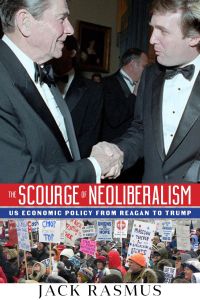
While the capitalist system has undergone numerous restructurings throughout its history, capitalist elites purpose in restructuring has remained the same: to restore and/or extend their hegemony. The current restructuring, operative since 1978, is called Neoliberalism. The book examines Neoliberalism as both an Idea and an historical practice composed of a particular mix of fiscal-monetary-trade-industrial policies that began with the latest US capitalist restructuring in the late 1970s, continuing to evolve to this day. The book further explains the deeper material forces giving rise to - as well as now undermining - the Neoliberal policy regime, with special focus given to the crisis of Neoliberalism in the wake of the 2008-09 global crash, Obama's failure to resurrect it, and Trump's current doomed effort to restore it in a new, more aggressive form. Evidence why Neoliberalism is destroying US Democracy concludes the book's analysis.
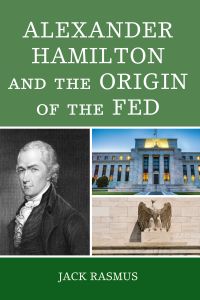
Describes how US federal governments, often in cooperation with the largest US private banks, introduced and expanded central banking functions from 1781 through the creation of the Federal Reserve Act of 1913. Based on an analysis of the evolution of the US banking system - from pre-1781, through the 1787 US Constitutional Convention, Congressional debates on Hamilton's reports to Congress, the rise and fall of the 1st and 2nd Banks of the United States, and through the long period of the National Banking System form 1862-1913, the book shows how central banking in the US evolved out of the private banking system, and how following the financial crash of 1907 big New York banks pushed through Congress the Federal Reserve Act of 1913, creating a central bank which they then managed for their interests.
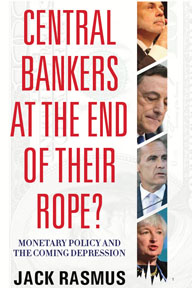
(Click on image) CENTRAL BANKERS is a comprehensive critique of central banks’ policies in the 21st century, explaining why the massive injections of free money to the banking system since the 1970s enabled the creation of excess corporate debt that has led to financial bubbles and repeated crises. The book addresses the growing contradictions of central banking, why they are failing in their functions, targets and tools, and proposes a radical democratization and restructuring to transform them to serve the public interest and not the private banks.
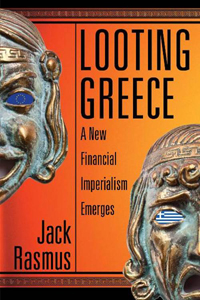
(Click on image) LOOTING GREECE, A New Financial Imperialism Emerges. This book - Reveals clearly who calls the shots in the Eurozone—the hardliners, not the remnants and political residue of what was once European social democracy, - Follows the negotiations in their excruciating detail as the Troika tightens the screws from 2009 to the present, - Shows how Europe’s financial elite enriches itself on Greek debt, privatizations and financial manipulations, turning Greece into an Economic Protectorate.
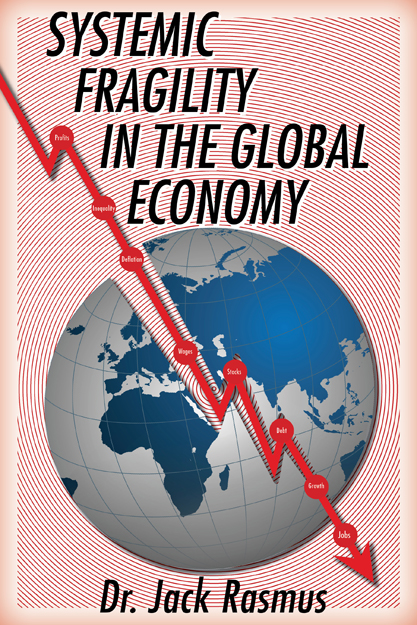
(Click on image): This book offers a new approach to explaining why mainstream economic analyses have repeatedly failed and why fiscal and monetary policies have been incapable of producing a sustained recovery. It explains why the global economy is slowing long term and becoming more unstable, why policies to date have largely failed the trend, and why the next crisis may therefore prove even worse than that of 2008-09.
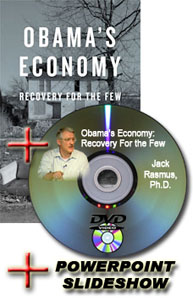
(Click on image) Obama's Economy: Recovery for the Few, explains how the weakest and most lopsided economic recovery since 1947 has been the direct outcome of failed economic policies of the Obama administration and US Federal Reserve bank since February 2009. Includes a detailed 'alternative program' in the final chapter. Includes the book, a video DVD presentation, and 66-slide PPT slideshow.

(Click on image) Obama's Economy: Recovery for the Few, explains how the weakest and most lopsided economic recovery since 1947 has been the direct outcome of failed economic policies of the Obama administration and US Federal Reserve bank since February 2009. Includes a detailed 'alternative program' in the final chapter.

(Click on image) A theoretical analysis, with historical case examples, of origins, causes and future evolution of the recent--and continuing--economic crisis in the U.S. and global economy. Includes predictions in 2009 of the inevitable failure of Obama policies and more serious crisis to come, 2013-15.

(Click on image) Seven specific reasons why economic recovery under Obama since 2009 has failed for all but the wealthiest few and largest corporations. The book spells out eight specific areas as an Alternative Economic Recovery Program.

(Click on image) The War At Home: The Corporate Offensive From Ronald Reagan to George W. Bush, is a 534 page, extensively researched, nonfiction book that describes the evolution of corporate-government policies from 1980 to 2005 that have shifted more than a $1 trillion dollars a year, every year, from 90 million American middle and working class households to the wealthiest 10% and corporations.
 Dr. Jack Rasmus @drjackrasmus
 Jack Rasmus