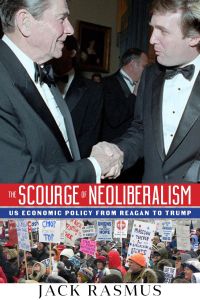
The following extended article will appear in the next issue of ‘Z’ magazine. It is a summary of the major themes and articles in chapters 1&2 of my just released book, ‘The Scourge of Neoliberalism: US Economic Policy from Reagan to Trump’, now available for purchase at discount from the book icon on this blog page, via Paypal, and from the icon on the front web page of Dr. Rasmus’s website, http://kyklosproductions.com.
“Hundreds of books and articles, perhaps thousands, have been written to date on the meaning and consequences of what’s called Neoliberalism. But clarity as to what it means, what has driven its evolution for the past four decades, and what’s its likely future trajectory remain insufficient at best.
Critics of Neoliberalism have yet to explain it fully or adequately. They are therefore unable to say little about its future evolution.
Some key questions that remain unanswered are: Has Neoliberalism been unraveling since the 2008-09 recent economic crisis and the slow growth, often stagnant recovery that followed? Is it being restored under Trump? Will it survive the next capitalist crisis almost certain to occur by the early 2020s? What are the material forces maturing within 21st century capitalist economy that will precipitate and drive that next crisis, and will Neoliberalism be able to successfully adapt? If not, what ideas and policies might replace the current Neoliberal era (1979-2019) of capitalism?
Most analyses concur that Neoliberalism represents an economic shift introduced by capitalists and their political elites—initially in the US and UK—in response to the crisis capitalism encountered in the 1970s decade. In other words, it has something to do with capitalist economy in crisis.
Other accounts attempt to explain its origins and evolution primarily from the perspective of an Idea that inspired, defined, and enabled US and UK capitalist-elites’ to respond successfully to the 1970s crisis.
Still others explain Neoliberalism as an historical practice, i.e. as a new regime of policies introduced in the late 1970s in the US and UK—later adopted by other capitalist economies worldwide to varying degree and form—-that emphasizes austerity in government spending and reliance in policy matters on free markets.
But all that doesn’t really tell us much. Defined that way leaves its meaning still opaque and ambiguous-—and therefore able to predict where and how Neoliberalism may evolve in the future.
The analysis of Neoliberalism to date has produced so many interpretations, often contradictory, that readers remain confused as to what exactly it means. Is it about introducing free market principles into economic and social policy? Is it about austerity in fiscal spending? Is it just a substitute term for what was formerly referred to as Imperialism abroad and class exploitation at home? As one analysis concluded, “imprecision would seem to characterize its use, sometimes even among those for whom the concept is central to their analysis, and its over-use is seen to have resulted in a loss of analytical value.”
The Ideology of Neoliberalism
According to those approaching Neoliberalism from the perspective of the evolution of an Idea, the Neoliberal Idea originates around mid-20th century among ultra conservative intellectuals like Friedrich Hayek and Milton Friedman in economics; in the philosophy of radical individualism by Karl Popper and Robert Nozick; and later in policy proposals from right wing pundits like Charles Krauthammer, William Kristol and Robert Kagan—to name but a few or the more notable.
As these intellectual originators viewed it, their task was to adapt, repackage and resell some of the main tenets of classical liberalism. To plant and nurture the seeds of new ideas, and counterpose those ideas to the prevailing dominant Keynesian economic and social compact views that prevailed after world war II. The new ideas would be resurrected classic Liberal ideas adapted to the post-war environment. New ideas that were new-Liberal or Neoliberal, designed to displace the dominant Keynesian-social compact ideas of the period and encourage and usher in a new set of policies based on the new ideas that would, in effect, represent a return pre-Keynesian, pre-social compact ideas once again, now adapted to the post-war reality. It was to be old classic Liberal wine in the new Neoliberal bottle.
But is Neoliberalism actually ‘Liberal’? How does it compare with the classic liberal economic and social theory ideas of the 17th-18th century? Neoliberalism as an Idea claims it is based on classic liberal ideas of free markets and individual freedom. It claims that by adapting classic liberal principles and propositions to new economic and social policies the new policies will succeed in promoting economic growth and stability, whereas the old Keynesian-collectivist policies failed to do so. Thus it is Neoliberal Ideas that drove the eventual policies that came to be known as ‘Reaganomics’ in the US and ‘Thatcherism’ in the UK in the late 1970s early 1980s.
But Neoliberal Ideas have actually little in common with the classical Liberal; and it is an intellectual conceit to argue that Neoliberal Ideas drove and determined the Neoliberal policies that were eventually introduced in the late 1970s-early 1980s. In fact, a reasonable argument may be made to the contrary: it is Neoliberalism in Practice that reached back and adopted Neoliberal Ideas and propositions in order to justify and legitimize Neoliberal policies.
What then exactly are the basic propositions of the Idea of Neoliberalism? What congruence is there between those propositions and 17th-18th century Classic Liberalism? And do either—i.e. Classic Liberal and Neoliberal Ideas—have anything to do with Neoliberalism in Practice?
The Basic Propositions of Neoliberalism as Idea:
• Markets should always be free of government interference and the economy and policies should be based on free markets
• Free markets require deregulation of business, as well as privatization of all public ownership of production of goods or services
• Free markets are always and everywhere more ‘efficient’ than regulated markets or government provided goods and services
• Free trade should always and everywhere govern the exchange of goods and services between economies and countries
• Government should never intervene in markets—whether to provide public works, correct negative ‘externalities’ created by those markets, or even to provide public education, health care, or other services
• Taxes should be cut to stimulate economic growth—especially taxes on business and investors. Cutting taxes creates additional investment and therefore employment and growth
• Government budgets should always be ‘balanced’, avoiding deficits and therefore accumulation of government debt
• To ensure stable economic growth, the money supply should be increased according to a ‘monetary growth rule’—i.e. a set amount every year.
But these elements of the Neoliberal Idea have very little to do with Classic Liberalism. And have even less to do with Neoliberalism in actual historical practice.
The Basic Ideas of Classic Liberalism:
• Markets should be free only to the extent that they fostered superior moral behavior and enable the development of the individual.
• Free markets were more efficient only if they promoted competition among capitalists, resulting in goods being produced at the lowest cost, and therefore lowest price, while providing the greatest possible amount of goods to the greatest number of individuals.
• Not all business activity should be deregulated or privatized. Some things markets would not produce, even if socially necessary and demanded by the public; or they would produce them for only a wealthy minority who might afford them only at the much high prices that markets might have to charge a smaller, privileged number of buyers.
• Markets sometime behave badly and at times must be regulated. Not all government services should be privatized. In fact, services like public education must be provided by government since markets would not find it profitable to provide them.
• Free trade is not always appropriate everywhere. Nor beneficial to all.
• Economic growth is stimulated by raising taxes on business, not cutting taxes. Higher taxes force business to introduce more efficient ways of producing to offset the cost of the tax increase. New technology that results actually increase jobs and stimulate economic growth.
• Budget deficits are justified for purposes of spending on defense, public safety, and critical social services (education) and public works that markets may not provide
• Money is ‘neutral’. An increase in its supply cannot, by itself, lead to economic growth and stability. Growth is generated only by increasing available land, labor, and capital and by raising its productiveness.
A close reading of the actual works of 17th-18th century Classic Liberal economists like Adam Smith, David Hume, and others shows the preceding points represent the fundamental propositions of Classic Liberalism. But, as a comparative reading clearly shows, they are in sharp contrast to the basic propositions that define Neoliberalism that emerged in the late 1970s and evolved after.
In short, in so far as classic liberalism is concerned, Neoliberalism is not ‘Liberal’ at all. Neoliberalism is not ‘new’ Liberalism or any kind of Liberalism. What it represents is something quite the contrary.
Comparing Neoliberalism as Idea with Neoliberalism in Practice
What about Neoliberalism in actual, historic practice? How does it compare—to Classic Liberalism as well as Neoliberalism as Idea? Neoliberalism in Practice differs from both. It is even further removed from Classic Liberalism. And in a number of ways it is even the opposite of Neoliberalism as Idea.
First, Neoliberalism in practice is not at all about expanding free markets. There are few, if any, free markets under Neoliberal capitalism. The fiction is created by Neoliberalism as Idea writers is that, just because industry is deregulated and public goods privatized, deregulation is equivalent to the creation of ‘free markets’. Neoliberal capitalism is about the destruction of market competition and the concentration of economic power among fewer and fewer remaining businesses in an industry. It is about eliminating ‘free markets’ whenever and wherever possible. Capitalism always drives toward eliminating competition, and without competition there are no ‘free’ markets in the Liberal sense. So Neoliberalism in Practice is the antithesis of free markets.
Secondly, it is different in that, in historical practice, Governments in the Neoliberal era of capitalism are deeply and increasingly involved in the economy on behalf of capitalist interests in general, in subsidizing capital in increasing ways, in redistributing income to capital from other classes, and in assisting mergers and acquisitions and thus advancing the concentration of capital and business into fewer producers and sellers. And the larger and the fewer the remaining producers, the less ‘efficient’ they become. That is, the higher the costs of their production become and in turn the higher the prices they charge consumers. Markets in effect become more concentrated, less efficient, and less ‘free’ as a consequence of Neoliberalism in Practice.
One might add to this view of Neoliberalism’s contribution to ‘micro’ level inefficiency an even more massive macro inefficiency that results from Neoliberalism: How efficient is Neoliberal capitalism when it creates economic crashes like 2008-09, when 14 million homeowners in the US alone were foreclosed and lost their homes? When 20 million were left unemployed, and thereafter underemployed for years after 2009. Or when $4T in lost interest income occurred for retirees as a result of the near zero interest rate policy of the central bank, the Federal Reserve, that remained in effect from 2009 to 2016? Or what about the macro efficiency of the additional $4T in collapsed retirement pension benefits values that happened during the crash and aftermath? Meanwhile, while all this inefficiency was occurring, the same central bank Neoliberal zero rate policies resulted, in more than a $1T a year on average in stock buybacks and dividend payouts distributed to shareholders every year from 2010 through 2019. Neoliberal monetary policy meant Corporations borrowed virtually ‘free’ money at near zero interest rates—-either from loans or by issuing corporate bonds—-and turned around and distributed most of it to shareholders at the rate of $1T plus a year. And what of the macro-inefficiency of spending $7 trillion in US wars and products that were either blown up or dumped in deserts when declared obsolete. The ‘macro-inefficiencies’ of Neoliberal capitalism are massive and almost incalculable, in the US economy alone.
In short, there is nothing ‘free’ or ‘efficient’ about markets in the Neoliberal era in practice. Quite to the contrary of the ideological propositions falsely identified with Neoliberalism as Idea. The founding and later defending intellectuals of Neoliberalism, when promoting that notion as free and efficient markets, are therefore simply peddling a lie—-i.e. they are promoting the ideology of Neoliberalism not its reality. They are peddling a notion of Neoliberalism that doesn’t exist in the real world of Neoliberal practice. What Neoliberalism in Practice has done is simply used the lie that free markets are more efficient in order to justify and to ‘sell’ the actual policies of industry deregulation and public goods privatizations and related false notions. In other words, deregulation, privatization, etc., have nothing to do with free and efficient markets. The latter are just the intellectual veil, the cover to justify the Neoliberal policy, the true aim of which is to reduce business costs and open up new public markets for profitable exploitation.
Fourth, the Neoliberal idea that tax cuts create jobs and economic growth is no more accurate in fact than privatization, deregulation, free-efficient markets result in more economic growth that benefits all. Tax cutting under in the Neoliberal era since 2000 alone has amounted to more than $15 trillion—80% of which has accrued to investors, businesses, and the wealthiest households. In turn, that $15 trillion has resulted in the weakest rate of investment, job creation, wage increases, and general economic growth in the US in the past half century. In other words, business-investor tax cuts did not create jobs. They destroyed them, as tax incentives strongly encouraged US multinational corporations to move operations offshore. Trump’s 2018 tax cuts—the latest iteration of this ‘business tax cuts create jobs’ shell game alone provide another $2 trillion for US multinational corporations over the next decade. They can now produce offshore tax free. Why then should they expand production and jobs in the US, one might ask, when they can henceforth produce offshore and pay no taxes?
Neoliberalism as Idea further maintains that free trade should be the norm everywhere. But in Neoliberal Practice free trade means incentives to further move US production offshore. US businesses then produce offshore at lower cost and ship the goods produced back into the US, now without tariffs, for US workers to buy, now with lower paid service jobs replacing the higher paid manufacturing jobs that were offshored due to free trade. Instead of higher wages, workers are now allowed to borrow (credit) to buy the products, incurring debt, the interest of which they now pay banks and stores issuing the credit cards. Free trade also means banks and finance capitalists, who get to borrow at near zero interest rates, invest the money offshore instead of in the US. Free trade is more about such international money flows from the US as it is about goods and product flows produced abroad back to the US. All this is the reality of Neoliberal free trade, compared to the fiction of the Neoliberal Idea of free trade where all parties somehow benefit from free trade—workers, consumers, as well as capitalist producers and bankers.
But perhaps nowhere is the chasm greater between Neoliberalism as Idea and Neoliberalism in Practice than on the question of deficits and debt. The former declares Neoliberalism is about balancing the budget and reducing government debt; whereas Neoliberalism in Practice is actually about allowing the uncontrolled escalation of annual budget deficits and therefore government debt. At barely $1 trillion when Neoliberalism in Practice began in 1979-80, US budget deficits and debt had escalated to $4T by 2000, rising to $10T by 2009, and thereafter to nearly $23T by year end 2019. The main causes have been trillions in tax cuts for corporations and investors, uncontrolled wars and defense spending, and deregulation and privatization of healthcare industry that has permitted decades of price gouging. Trump’s 2018 tax cuts and his war spending escalation will raise the $22T current US national debt to more than $35T by 2028.
Finally, the monetary growth rule of Neoliberalism as Idea also contrasts sharply with the practice of Neoliberalism in monetary policy. Instead of allowing the central bank to slowly and steadily increase the supply of money in the economy according to an objective rule, or fixed formula, the practice of Neoliberalism has been to have the central bank continually inject massive amounts of money into the economy. In times of banking crises and after as well. The result is chronic, low interest rates, which enable lending at low cost to investors and corporations alike, much of which borrowed is then diverted to offshore investments, to re-investment in stock, bond and other financial markets, to distribution to shareholders in the form of stock buybacks and dividend payments, or into merger and acquisition of competitors by businesses. The Idea of Neoliberalism thus has little in common with its practice so far as money is concerned.
What the foregoing paragraphs reveal is that Neoliberalism as Idea has little in common with Classical Liberalism, and even less in common with Neoliberalism as Practice. The function of Neoliberalism as Idea is therefore to provide a false economic analysis, and pro-individual, pro-personal freedom moral arguments, designed to justify the Neoliberal policies that occur in practice—-i.e. policies that are often quite contrary to those arguments and that Idea. The practice of Neoliberalism is thus neither classical liberal nor even Neoliberal.
Contrary to many accounts of Neoliberalism–both defensive and critical alike–the Idea of Neoliberalism does not give rise to or enable Neoliberalism as actual historical practice. The role of Neoliberal Ideas is to legitimize—-after the fact—-the actual policies and practice of Neoliberalism.
A problem with many accounts and analyses of Neoliberalism is that they assume that Neoliberalism as an Idea is what gave rise from the mid-1970s on to Neoliberalism as an actual historical practice. Somehow the ideas are what convince capitalists, their lobbyists, their business organizations, their trade associations, etc. to propose to their political elites in Congress and legislatures the actual Neoliberal policies, The policies are thus a reflection of their ideas. However, as just shown, Neoliberal ideas have little in common with the actual policies and practices of Neoliberalism that get introduced and implemented. So how can the ideas drive the actual historical practice, i.e. the policies, if they are different?
More likely is that the causation is actually the reverse: the policies and practices are developed by the capitalists and their political elites. The ideas of Neoliberalism—-a strange amalgam of classic and non-classic liberal propositions—-are after the fact then employed as justifications and legitimization of those policies.
Embalmed in a veneer of personal freedom, individualism, efficiency, growth benefiting all, etc., the dead body of Liberalism is resurrected in decayed form to argue that the corpse is still alive and liberal even though it has long deceased.
Nonetheless, many critics of Neoliberalism simply slip back and forth between the Idea and the Practice of Neoliberalism, with little explanation of how the one, the Idea or the Practice, causally determines the other.
More on Neoliberalism in Practice
What then are the actual policies associated with actual, historical Neoliberalism? Here too critics of Neoliberalism fail to provide a comprehensive explanation. Major attention is given to Neoliberalism as Austerity policy, or as industry deregulation and privatization, or as free trade. But little attention is paid to Neoliberal monetary policy or Neoliberal external policies apart from freetrade—i.e. currency exchange rate policy or what is called the ‘twin deficits’ policy solution. Nor is much explanation given to how Neoliberal policy promotes the financialization of the global economy, financial deregulation, and cross border money capital flows. While fiscal policy and industrial policy (i.e. deregulation, privatization, de-unionization, wage compression, etc.) are addressed narrowly in most accounts of Neoliberalism, not much in the way of analysis and critique is given to External Policy and Monetary Policy. But Neoliberalism in Practice is more than just austerity in Fiscal Policy or deregulation-privatization in Industrial Policy.
Neoliberalism in Practice represents a particular policy regime, consisting of Fiscal policy (tax, spending, deficit-debt management), Industrial policy (deregulation, privatization, de-unionization, wage compression, financialization), Monetary policy (excess liquidity injection, chronic low interest rates), and External Policy (trade, low US dollar exchange rate, twin deficits).
Neoliberalism represents a particular mix of these policies. Before Neoliberalism, the four main policy areas also existed but in a different mix and different relationship to each other. It was a different policy ‘regime’.
US Neoliberalism as the 3rd Capitalist Restructuring
The policy regime before the Neoliberal policy shift originated in the wake of of the second world war, originating roughly in the period, 1944-53. A still different policy regime was created in the US just prior to world war one, in the period 1908-13. Thus the US experience has been to restructure the economy in a major way at least three times in the last century: 1908-13, 1944-53, and 1979-88. The latter, 3rd restructuring is simply called the Neoliberal. Its policy mix or regime differed from the two prior regimes.
The policy restructuring in all three cases was designed to change policies in order for US capitalism to confront a challenge or crisis. In 1908-13 US capitalism prepared to restructure its economy in anticipation of becoming a more or less equal competitor with the UK and European capital in general on the stage of the world economy after world war one. In 1944-53, capitalists restructured once again as the US became the sole hegemon in the global economy following world war two. Both restructurings represent US capital shifting policy fundamentally in order to confront a major crisis and opportunity. In each case the restructurings were accompanied by a particular policy reordering. That reordering occurred a third time as a response to the crisis of the 1970s, not war. In that sense it differed from the earlier two restructurings and policy shifts.
In the Neoliberal case, the US re-established itself as the hegemon in the global capitalist economy for at least several more decades. Challenges domestically and abroad in the 1970s were successfully contained, and US capital emerged once again globally and internally as the key dominant player in the global economy.
Neoliberalism in Practice—i.e. as a particular new policy mix of the four areas—continued to expand and evolve throughout the 1990s and after 2000. The global crash of 2008-09 halted its development and evolution, however. As argued in this writers’ book, ‘The Scourge of Neoliberalism’, Neoliberal policy evolution hit a wall with the 2008-09 crash. Obama tried but failed to restore it and regain its momentum. Trump’s policies should be viewed as a future attempt to restore Neoliberalism as policy, albeit in a new virulent and aggression form that is still in progress.
Whether Trump will succeed remains to be seen. However, there are fundamental real and material forces in development—involving changes in technology, AI & machine/deep learning, the nature of money, production processes and distribution channels, new business models, product-capital-labor markets, and in political resistance both domestic and foreign—that may well prevent Trump’s restoration attempt.
The Main Policy Propositions of US Neoliberalism in Practice
Over the past four decades Neoliberal policy has evolved and expanded. It has also begun to develop its own internal contradictions—as discussed in more detail in the aforementioned book. As a partial summary of Neoliberalism in Practice at this point, the following elements may be said to now constitute Neoliberalism in Practice as of 2019:
• Social program policy cuts, focused heavily on reducing and eliminating government programs introduced from 1934 through 1965;
• Aggressive deregulation of industries, especially banking & finance, communications, public and private transport, education and healthcare;
• Privatization of employer contributed healthcare and retirement services introduced with the 2nd restructuring, privatization of military services, and privatization of public goods and services including federal lands access;
• Deep reduction of business-investor-wealthy household taxation on profits and capital incomes (interest, dividends, business rent, etc.);
• Chronic escalation of war and defense spending amidst social spending austerity;
• Tolerance of rising budget deficits, the national debt, and interest on that debt;
• Central bank monetary policies based on chronic liquidity injections designed to ensure long term low bank interest rates that subsidize business costs of investment;
• Incremental de-unionization and weakening of collective bargaining, as well as compression of wage incomes;
• Promotion by government of radical changes in the labor markets, creating millions of contingent labor employment, low paid service jobs, atrophy of minimum wages, massive offshoring of manufacturing employment, and encouragement of on-shoring of skilled labor visa policies;
• Substituting free trade for traditional trade policy measures based on tariffs, quotas, and administrative measures as the primary means to maximize US corporate exports;
• Acceptance of US trade deficits in exchange for a ‘twin deficits’ solution ensuring US offshore dollar recycling arrangements with major allies and global trading partners;
• Encouraging a long term low US dollar exchange rate and US money capital outflows and foreign direct investment;
• Promotion of financialization of the US economy at the direct expense of real asset investment based economic growth;
Thus Neoliberalism in Practice is not simply a set of policies associated with social program cutbacks and fiscal austerity, or industry deregulation or privatization, as many identify. It is much broader than that. It represents a basic economic system restructuring that involves a resurgence and aggressive expansion at the expense of both foreign capitalist competitors as well as domestic working classes. It is an attempt to re-establish US economic hegemony in the late 20th century and well into the 21st. In that it succeeded…until the crash of 2008-09, from which it is yet to fully recover.
What’s Missing in Critiques of Neoliberalism
Apart from not adequately addressing the material origins of the restructuring that gives rise to Neoliberalism, critics of Neoliberal policy fail to address key elements of its unique policy and program mix. To begin with there’s the lack of analysis of what’s called external policy—i.e. twin deficits, external debt, currency exchange rates, foreign direct investment and global money capital flows—are often largely missing. Neoliberalism is characterized by a particular set of external policies that differ from prior restructurings. Consideration of trade or goods flows, and perhaps free trade treaties, are the limited focus of most critiques. Another area where critics fall short is a superficial treatment of Industrial policy. While de-unionization, job offshoring, general wage compression, and industry deregulation are addressed by critics, fundamental developments like the rise of contingent labor and the even more destructive now just emerging phenomenon—artificial intelligence and machine learning—are ignored for their effects on labor markets and the shift in capitalist vs. worker relative power they represent. Also missing, in all but minor terms, is the financialization of the global capitalist economy. Here the role of capital markets, shadow banks, derivatives, the rise of the new global finance capital elite, and the relative shift to financial asset investing, crowding out real investment, are left largely unconsidered; in other words, that which might be classified as the new phase of imperialism and US vs. global capitalist class competition and conflict is not adequately addressed. Not least, what is also missing in most accounts of Neoliberalism is how its advance is closely correlated with the atrophying and decline of Democracy in America—i.e. the norms, practices, parties, the electoral system, and even government institutions.
Dr. Jack Rasmus
copyright October 2019
Dr. Jack Rasmus is author of the just released book, ‘The Scourge of Neoliberalism: US Economic Policy from Reagan to Trump’, Clarity Press, October 2019, which is available for purchase at discount from the author’s blog, jackrasmus.com, and website, http://kyklosproductions.com. Jack hosts the weekly radio show, Alternative Visions, and tweets at @drjackrasmus.
 Dr. Jack Rasmus @drjackrasmus