Feeds:
Posts
Comments

In September 2018 I wrote an article predicting the next economic crisis would occur in 2-3 years. I was wrong. It’s taken only 18 months. What follows are excerpts from that article, then entitled ‘Comparing 1929 with 2008 and the Next’. It is important to understand how the now three great economic crises of the last century are in many ways similar, marked by a joint collapse of financial markets and the real economy, the one determining the other, and vice versa, in a downward general spiral. In other words, how financial cycles and crises precipitate and enable real ‘great’ contractions (not normal recessions) and how, in turn, real economic collapse exacerbates financial collapse as well. It’s not that one causes the other; both cause each other.

What follows is the verbatim reproduction of that article (minus some comments on the then upcoming 2018 midterm elections. For the full article, go to my website, http://kyklosproductions.com/articles.html)

“PART 1:
The business and mainstream press this month, September 2018, has been publishing numerous accounts of the 2008 financial crash on its tenth anniversary. This month attention has been focused on the Lehman Brothers investment bank crash that accelerated the general financial system implosion in the US, and worldwide, ten years ago. Next month, October, we’ll no doubt hear more about the crash as it spread to the giant insurance company, AIG, and beyond that to other brokerages (Merrill Lynch), mid-sized banks (Washington Mutual), to the finance arms of the auto companies (GMAC) and big conglomerates (GE Credit), to the ‘too big to fail’ banks like Bank of America and Citigroup and beyond. These ‘reports’ are typically narrative in nature, however, and provide little in the way of deeper historical and theoretical analysis.

Parallels & Comparisons 1929 & 2008

It is often said that the initial months of the 2008-09 crash set the US economy on a trajectory of collapse eerily similar to that of 1929-30. Job losses were occurring at a rate of 1 million a month on average from October 2008 through March 2009. One might therefore think that mainstream economists would look closely at the two time periods—i.e. 1929-30 and 2008-09—to determine with patterns or similar causes were occurring. Or to a deep analysis of the periods immediately preceding 1929 and 2008 to see what similarities prevailed. But they haven’t.

What we got post-2009 from the economic establishment was a declaration simply that the 2008-09 crash was a ‘great recession’, and not a ‘normal’ recession as had been occurring from 1947 to 2007 in the US. But they provide no clarification quantitatively or qualitatively as to what distinguished a ‘great’ from ‘normal’ recession was provided. Paul Krugman coined the term, ‘great’, but then failed to explain how great was different than normal. It was somehow just worse than a normal recession and not as bad as a bona-fide depression. But that’s just economic analysis by adverbs.

It would be important to provide a better, more detailed explanation of 1929 vs. 2008, since the 1929-30 crash eventually led to a bona fide great depression as the US economy continued to descend further and deeper from October 1929 through the summer of 1933, driven by a series of four banking crashes from late 1930 through spring 1933 after the initial stock market crash of October 1929. In contrast, the 2008-09 financial crash leveled off after mid-2009.

Another similarity between 1929 and 2008 was the US economy stagnated 1933-34—neither robustly recovering nor collapsing further—and the US economy stagnated as well 2009-12. Upon assuming office in March 1933 President Roosevelt introduced a pro-business recovery program, 1933-34, focused on raising business prices, plus initiated a massive bank bailout. That bailout stopped further financial collapse but didn’t generate much real economic recovery. Similarly, Obama bailed out the banks (actually the Federal Reserve did) in 2009 but his recovery program of 2009-10, much like Roosevelt’s 1933-34, didn’t generate real economic recovery much as well.

After the failed business-focused recoveries, the differences between Roosevelt and Obama begin to show. Roosevelt during the 1934 midterm elections shifted policies to promising, then introducing, the New Deal programs. The economy thereafter sharply recovered 1935-37. In contrast, Obama stayed the course and doubled down on his business focused recovery program in 2010. He provided $800 billion more business tax cuts, paid for by $1 trillion in austerity programs for the rest of us in August 2011.

Not surprising, unlike Roosevelt’s ‘New Deal’, which boosted the economy significantly starting in 1935 after the midterms, Obama’s ‘Phony Deal’ recovery of 2009-11 resulted in the US real economy continuing to stagnate after 2009.

The historical comparisons suggest that both the great depression of 1929-33 (a phase of continuous collapse) and the so-called ‘great’ recession of 2008-09 share interesting similarities. Both the initial period of the 1930s depression—October 1929 through fall of 1930—and the roughly nine month period of October September 2008 through May 2009 appear very similar: A financial crash led in both cases to a dramatic follow on collapse of the real economy and employment.

But the 1929 event continues on, deepening for another four years, while the latter post 2009 event levels off in terms of economic decline. Thereafter, similar pro-business subsidy policies (1933-34) and (2009-11) lead to a similar period of stagnation. Obama continues the pro-business policies and stagnation, while Roosevelt breaks from the business policies and focuses on the New Deal to restore jobs, wages, and family incomes and recovery accelerates. Unlike Roosevelt who stimulates fiscal spending targeting household incomes, Obama focuses on further business tax cutting—i.e. another $1.7 trillion ($800 billion December 2010 plus another $900 billion in extending George W. Bush’s tax cuts for another two years—thereafter cutting social programs by $1 trillion in August 2011 to pay for the business tax cuts of 2010-11.

The policy comparisons associated with the recovery and non-recovery are clearly determinative of the comparative outcomes of 1935-37 and 2010-11, as are the comparisons of the business-focused strategies 1933-34 and 2009-10 that resulted in stagnant recoveries. But the political outcomes of the policy differences are especially divergent and interesting.

No less interesting are the political consequences for the Democratic Party. Roosevelt’s 1934 campaigning on the promise of a New Deal resulted in the Democrats sweeping Congress further than they did even in 1932. They gained seats in 1934 so that by 1935 they could push through the New Deal that Roosevelt proposed despite Republican opposition. In contrast, Obama retained, and even deepened, his pro-business programs before the 2010 midterms which resulted in the Democrats experiencing a massive loss in Congress in the 2010 midterm elections. Thereafter, the Democrats were stymied by a Republican House and Senate that blocked everything. Obama nonetheless kept reaching out and asking for a compromise with Republicans, but the Republican dog bit his hand with every overture.

Obama pleaded with American voters for one more chance in 2012 and they gave it to him. The outcome was more of the same of naïve requests for compromise, rejection, and a continued stagnation of the US economy. Republicans meanwhile also deepened their control of state and local level governorships, legislatures, and local judiciary throughout the Obama period.

The final consequence of all this was Trump in 2016 as the Obama Democrats promised more of the same in the 2016 presidential election. We know what happened after that.

PART 3:
The Next Crisis

The next financial crisis—and subsequent severe contraction of the real economy once again—is inevitable. And it is closer than many think, mesmerized by all the talk of a robust US economy that is benefiting the top 10% and not the rest. Why so soon?

The answer to that question will not be provided by mainstream economics. They are too busy heralding the current US economic expansion—which is being grossly over-estimated by GDP and other data and which fails to capture the fundamental forces underlying the US and global economy today, a global economy that is growing more fragile and thus prone to another major financial instability event.

The forces which led to the 2008 banking crash were associated with property bubbles (US and global) and the derivatives markets which allowed the bubbles to expand to unsustainable levels, derivatives which then propagated and accelerated the contagion across financial markets in general once the property bubbles began to collapse.

The 2008 crash was thus not simply a subprime housing crisis, as most economists declare. It was just as much, perhaps more so, a derivatives financial asset (MBS, CMBs, CDOs, CDSs, etc.) crisis.

More fundamentally than the appearance of a collapse in prices of subprime mortgages, and even derivatives thereafter, 2008 was a crisis of excess credit and debt that enabled the boom in subprimes and derivatives to escalate to bubble proportions.

But subprimes and derivatives were still the appearance, the symptoms of the crisis. Even more fundamentally causative, the 2008 crash had its most basic origins in the massive liquidity injections by the central banks, led by the US Fed, that has occurred from the mid-1980s to the present. The massive liquidity provided the cheap credit that fueled the excess debt that flowed into subprimes and derivatives by 2008. (And before than into tech stocks in 1998-2000, and before that into Asian currencies (1996-97), and into Japanese banks and financial markets and US junk bonds and savings & loans in the 1980s, and so forth).

Excessive debt accumulation is not the sole cause of financial crises, however. It is an enabling precondition. Enabling the debt in the first place is the excess liquidity and credit. That liquidity-credit-debt buildup is what occurred in the 1920s decade leading up to the October 1929 stock crash. It’s what occurred in the decades preceding 2008, especially accelerating after the escalation of financial derivatives in the 1990s.

Excessive debt creates the preconditions for the crisis, but the collapse of financial asset prices is what precipitates the crisis, as the excessive debt built up cannot be repaid (i.e. principal and interest payments ‘serviced). So if liquidity provides the debt fuel for the crisis, what sets off the conflagration is the collapse of prices that lights the flame.

The collapse of stock prices in October 1929 precipitated the subsequent four banking crashes of 1930-33. The collapse of property prices (residential subprime and also commercial) in 2006-07 precipitated the collapse of investment banks in 2008, thereafter quickly spilling over to other financial institutions (brokerages, insurance companies, mutual funds, auto finance companies, etc.) after the collapse of Lehman Brothers investment bank in September 2008.

Today in 2018 we have had a continued debt acceleration since 2008. As estimated by the Bank of International Settlements (BIS) in Geneva, Switzerland, total US debt has risen from roughly $50 trillion in 2008 to $70 trillion at end of 2017. The majority of this is business debt, and especially non-financial business debt. That’s different from 2008 when it was centered on mortgage debt. It is also potentially more dangerous.

The US government since 2008 has also increased its federal debt by trillions, as it continued to borrow from investors worldwide in order to ‘finance’ and cut business-investor taxes and continue escalation of war spending since 2008. US household debt also rose further after 2008, as the lack of real wage and income growth over the post-2008 decade has resulted in $1.5 trillion student debt, $1 trillion plus in auto and in credit card debt, and $7-$8 trillion more in mortgage debt. Globally, according to the BIS, non-financial business debt has also been the major element responsible for accelerating global debt levels—especially borrowing in dollars from US banks and investors (i.e. dollarized debt) by emerging market economies, as well as business debt in China issued to maintain state owned enterprises and to finance local building construction.

So the debt driver has continued unabated as a problem since 2008, and has even accelerated. Financial asset bubbles have appeared worldwide as a result—not least of which is the current bubble in US stocks. This time it’s not real estate mortgages. It’s non-financial business and corporate debt that is the likely locus of the next crisis, whether in the US or globally or both.

Since 2008 US and global debt bubbles have been fueled once again—as in the 1920s and after 1985 by the excess liquidity provided by the US central bank, and other advanced economy central banks. The central bank, the Fed, alone has subsidized US banks and investors to the tune of $6 trillion from 2009 to 2016, as a consequence of its QE and near zero interest rate policies.

Since 2008, excessive and sustained low interest rates for investors and business have resulted in at least $1 trillion a year in corporate debt buildup, as corporate bond issues have accelerated due to ultra cheap Fed money. The easy money has allowed countless ‘junk’ grade US companies to survive the past decade, as they piled debt on debt to service old debt. Cheap money has also fueled corporate stock buybacks and dividend payouts to investors, which have been re-funneled back into stock prices and bubbles. So has the doubling and tripling of corporate profits from 2008 to 2017 enabled record buybacks and dividend distributions to shareholders.

Most recently, in 2017-18 the subsidization locus has shifted to Trump tax cuts that have artificially boosted US profits by a further 20% and more. As data has begun showing in 2018, most of that is now being re-plowed back into stock buybacks and dividend payouts—this year totaling more than $1.4 trillion, after six years of already $1 trillion a year in buybacks and payouts. That’s more than $7 trillion in distribution by corporate America in buybacks and dividends to its wealthy shareholders.

Where’s the mountain of money provided investors all gone? Certainly not in raising wages for workers. Certainly not in paying more taxes to government. It’s been diverted into financial markets in the US and globally—stocks, bonds, derivatives, currency, property, etc.—into mergers & acquisitions in the US, or just hoarded on balance sheets in anticipation of the next crisis approaching. Or sent into emerging markets (financial markets, mergers & acquisitions, joint ventures, expanding production, etc.) when they were booming 2010-2016.

So where will the financial asset prices start collapsing in the many bubbles that have been created globally and in the US so far—and thus precipitating once again the next financial crisis? The BIS has been warning to watch US corporate junk bonds and leveraged loan markets. Watch out for the new derivatives replacing the old ‘subprimes’ and CDSs—i.e. the Exchange Traded Funds, ETFs, passive index funds, dark pools, etc. Watch also the US stock markets responding to US political events, to a real trade war with China perhaps in 2019, a continuing collapse of emerging market economies and currencies, to a crisis in repayment of non-performing bank loans in Italy, India and elsewhere, or a tanking of the British economy in the wake of a ‘hard’ Brexit next spring, or Asian economies contracting in response to China slowing or its currency devaluing, or to any yet unseen development. Collapsing prices in any of the above may be the origin of the next financial asset contraction that will spread by contagion of derivatives across global markets. And the even larger debt magnitudes built up since 2008 may make the eventual price deflation even more rapid and deeper. And the new derivatives may accelerate the contagion across markets even faster.

The financial kindling is there. All it now takes is a spark to set it off. The next financial crisis is coming. The last decade, 2008-18, is eerily similar to the periods 1921-1929 and 1996-2007.

Only now it will come with the US challenging foreign competitors and former allies alike as it tries to retain its share of slowing global trade; with a US economy having devastated households economically for a decade; with a massive US federal debt now $21 trillion and going to $33 trillion due to Trump tax cuts; with a US crisis in retirement income, healthcare access and costs, and a crumbling education system; with an economy having created only low pay and mostly contingent service jobs; with a virtually destroyed union movement; with a big Pharma initiated opioid crisis killing more Americans per year than lost during the entire 9 year Vietnam war; with a culture allowing 40,000 of its citizens a year killed by guns and doing nothing; with an internal transformation and retreat of the two established political parties; and with a Trump and right wing radical movement ascendant and poised to move to the streets to defend itself.

Dr. Jack Rasmus
September 24, 2018

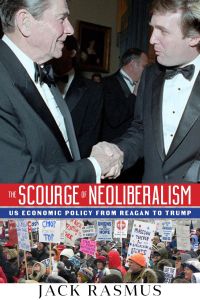
Dr. Rasmus is author of the forthcoming book ‘The Scourge of Neoliberalism: US Policy from Reagan to Trump’, Clarity Press, 2020. He blogs at jackrasmus.com and his twitter handle is @drjackrasmus. (For a more detailed analysis of the similarities and differences between 1929 and 2008, and how Roosevelt and Obama treated the crisis differently, read the except from Dr. Rasmus’s 2010 book, ‘Epic Recession: Prelude to Global Depression’, Plutobooks, now posted on his website, http://kyklosproductions.com).

Two interviews earlier this week on the channels by which the virus is impacting the US economy: supply chains, demand, financial-banking, and currency valuations. The US is in an ‘economic coma’ and why Fed rate cuts and business tax cuts won’t have an economic recovery. The ‘dash for cash’ by business. Will fiscal government spending emerge by week end? My proposals for a first phase government program.

Listen to my interviews with ‘By Any Means Necessary‘ and ‘Critical Hour’ radio shows.

GO TO:

https://www.spreaker.com/user/radiosputnik/with-the-global-economy-poised-to-collap

AND GO TO:

https://drive.google.com/file/d/1SyA1QpdmDYBXbiK5DgyZpp7eXLiW73j5/view

During World War II the US lost about 500,000. The enemies were afar, offshore. Today the Coronavirus is projected to eventually kill at least twice that number Americans. An enemy within our very midst. An enemy that has succeeded in invading us everywhere.

The enemy has already effectively shut down much of our economy, is making millions jobless, threatening to sabotage our banking & financial system. The war-like destruction of our economy is already underway.

The response must be no less an economic war as World War II economic mobilization was a war to defend the lives of millions of our citizens.

But so far politicians and policy makers in Washington, of both parties, have not much of a necessary war response mentality.

US Politicians’ Initial Response

Trump at first even denied we were being invaded and the virus enemy was not even armed. He said it would go away by April. It was not dangerous. Meanwhile the enemy was laying its biological ‘minefields’ and the actual killing had begun. Trump even opened up our major city airports to the invader. It’s not by accident that the virus took its initial foothold in Washington State, California, and the big airport cities in the northeast of the country.

Democrat leaders in Congress were more somewhat more aware of the threat than Trump, but deficiently so as well. Their response to the economic war being waged upon us is to provide more unemployment insurance, free testing, and similar measures. While necessary, such measures were, and remain, also grossly insufficient. It’s like calling out the Coast Guard to stop a military assault landing by the virus on our shores. The Democrats now have a bill in Congress costing about $750 billion in economic war defense spending. Senate Republican leader McConnell delayed and opposed even that. Now the Republicans and Trump are proposing $800 billion. Those amounts are grossly insufficient. Both parties are still well behind the curve.

US politicians of both parties have been exhibiting a mentality similar to Neville Chamberlain, the British Prime Minister, who in 1938 returned from Munich and declared he had secured ‘peace in our time’ by his deal with Hitler. Well, US politicians think they have this virus ‘under control’ and that they can reverse the destruction of the US economy by passing minimal $700-$800 billion spending bill. They think they can control the virus and its devastating impact now underway on the US economy. They can’t until they understand this is a biological-economic war and the US must be mobilized similar to what it did in 1942.

Economic Pearl Harbor 2020

Today the US economy is experiencing something similar to an ‘economic pearl harbor’ attack of 1941. It is fighting a rear guard action, retreating to a ‘Bataan-like’ peninsula.

The US war mobilization effort in 1942 was unlike any ever implemented by any country in history. It was an all-out unprecedented and effective effort. America prevailed over enemies in World War II largely because it out-produced them by tenfold in equipment and material. Once those resources began flowing in 1942 and after, neither Imperial Japan nor Nazi Germany had a chance of winning.

Now we face an enemy, the virus, that has invaded every corner of the country. An enemy that will kill many more Americans that either Japan imperialists or the Nazis. And yet we are not mobilization the US economy to confront it. The politicians are addressing it piecemeal, incrementally, little by little, and are well behind the curve in terms of economic defense and response.

The virus is not only waging biological war against us; it is simultaneously waging economic war—to destroy the resources needed to ensure victory.

In 1940-41 the federal government of the US was spending about 15-16% of total US GDP. It was less than 20% of the economy. Within a year, by end of 1942 government spending made up 40% of US GDP. By 1944 it was for a moment 70% of GDP. In the post-1945 period, spending remained at about 20% a year until the present.

The US ‘economic war mobilization’ against the virus enemy must be raised immediately to 40% of GDP again!The US central bank, the Federal Reserve, has provided at minimum and within one week, more than $2.2 trillion. That’s to pre-emptively bail out the US banking system and ‘make whole’ thousands of private investors, many of whom are billionaires!

If the Federal Reserve can bail out the banks even before they fail to the tune of $2.2 trillion so far—why can’t Congress bail out Main St. and working class families with at least a similar amount? And that’s just to start. We’ll need another $1-$2 trillion before it’s over. That total will require a doubling of US government spending from 20% to 40% as a share of GDP.

Economic War Mobilization: How to Pay for It

Some may argue where can we get the money for that kind of spending. They similarly argued that in 1942. But the money was there. And it’s here today as well.

Here’s three ways the US financed and paid for economic war mobilization in 1942-45 and how we can do the same today:

Congress in 1942 passed a massive tax increase bill to help fund the war. It followed it up with more tax increase bills in 1943, 1944, and 1945. It then issued victory bonds to help finance further. The US Treasury can do the same today. The US can also run a budget deficit, to be repaid later—again as we did in World War II.

US politicians of both parties have run up annual budget deficits since 2000 and raised the total national debt as a result from $4T in 2000 to more than $22 trillion today. Trump’s 2018 and 2019 tax cuts—most of which are enjoyed by big corporations and investors—will mean the national debt will rise to at least $31 trillion by 2028, according to the Congressional Budget Office. But that’s before the current crisis and the collapsing of the US economy (and resulting tax revenue collapse). The US national debt by 2028 will be $35 trillion or more!

The point is most of this national debt, and the annual deficits that cause it, has been due to the massive tax handouts since 2000 for the rich and big corporations. Those tax cuts amount to no less than $15 trillion, passed by both political parties! It’s time to take that back and use the funds to help fight the real war against the virus now.

It’s also time for the Federal Reserve Bank and US Treasury to not just bail out the bankers, but help bail out Main St. Instead of just buying bonds held by the rich and investors at subsidized prices, it should raise additional money by issuing special Coronavirus War bonds, the proceeds from which must be earmarked for direct spending for Main St. only—i.e. for bailing out working and middle class families losing income, losing their homes and apartments, losing their autos, and preventing small businesses of 100 employees or less from going bankrupt. I’m not talking about loans, but about grants to working families and businesses. Big corporations can fend for themselves. They’ve built up massive profit war chests over the last decade. Ditto for big bankers. In any event, the central bank, the Federal Reserve, has already indicated it will spend trillions of dollars to make them whole.

Who will make working families, the middle class, and small businesses whole? Will Congress dribble out financial support, while the central bank opens up its free money fire hose to bankers and investors?

Make no mistake, we’re in a war against the virus. It will take economic wartime mobilization to win it. But if the politicians don’t wise up fast and adopt a war time mentality, millions more Americans will perish and the death toll will dwarf that of World War II.

By Dr. Jack Rasmus
March 17, 2020

Follow Dr. Rasmus on his blog, jackrasmus.com, as he writes on developing events related to this topic. And on his twitter feed, @drjackrasmus, where hourly changes in events are commented on as well.

Some have asked how much would my own Fiscal ‘Economic Recovery Program’ cost? It can’t be quantified exactly, as the impact on working families is spreading rapidly. But here’s some financing, administrating, and implementation principles associated with my proposal:

* First, the amount of financing applied in its first phase should be no less than the same amount that the Federal Reserve bank has already allocated to spend on the banks and investors. That’s $2.2 trillion in just the last week. So if we can spend that on the bankers, why can’t we allocated the same funds to bail out workers and the middle class. Index that $2.2T to whatever further increases the Fed spends on its pre-emptive bailout of bankers and investors already under way. If the Fed can ‘create $2.2 trillion’ out of thin air to give to bankers and investors, why can’t it do the same for Main St. and working families?

*Second, use some of the money to enroll those without health insurance or whose insurance will not cover the costs of health services, apart from the actual tests only, in the Medicare system. Introduce a one page sign up for Medicare online. Create a special ‘temporary’ membership category. Have healthcare providers bill Medicare for the tests costs to workers, and for all other related costs, as well as costs for those on unpaid medical leave or unemployed due to the economic effects of the virus on the economy-i.e. economic layoffs. Immediately enroll the 30 million uninsured. Voluntarily enroll the 87 million who are under-insured with massive deductibles, copays, with no dependents covered, etc. Immediately allocate funds from the $2.2 trillion to bail out Main St. and transfer the allocated funds to the Medicare-Social Security Trust Fund. And hire as many workers in the Medicare administration as needed.

*Third, instead of reimbursing companies for continuing paying wages to workers sent home on unpaid leave, or who are laid off because of the major economic impact that’s coming (there will be mass layoffs starting in May), why not have the government ‘hire’ the laid off for the duration of the crisis–which today Trump admitted will likely continue through August. Adapt the unemployment benefits system to make the payments to those so covered. This would be a 21st century, electronic administered ‘Works Progress Administration’ that provided 8 million government jobs to the unemployed.

The administrative apparatus is there already: Medicare and Unemployment Benefits. Why not use it. And make it clear it is the government that is providing their health care and employment protection–not the private employers or bankers who would otherwise cut them loose to scramble individually to protect them and their families.

*Fourth, immediately create a ‘Public Investment Corporation‘, funded and managed by the government (Federal, State & Local) to invest in alternative energy expansion and other climate crisis mitigation that would hire workers, since the current crisis will mean private business investment will collapse across the board and such much needed investment from the private sector will not be forthcoming for some time.

Let the Federal Reserve pre-emptively bail out its bankers and billionaire private investors! But if they can spend $2.2 trillion, then the government can, and should, pre-emptively bail out Main St. as well for no less!

Further economic measures will be needed to address the current US recession, and the increasing possibility of the recession morphing into another ‘great recession’ (or worse). But the above represents an initial phase of immediate fiscal spending response in the short run to restore incomes being devastated right now.

Dr. Jack Rasmus
March 16, 2020

The Coronavirus has been wrecking the US and global economies. While focus has been on addressing the biological devastation wrought by the virus, the economic devastation keeps growing. Failure to properly address the deepening economic impact of the coronavirus has been no less shocking to date than the obvious failure of politicians and policymakers to get a handle on the medical-human impact of the virus. Trump had called the virus a ‘hoax’, said it would be over by April, declared publicly there were millions of test kits being used when there weren’t, and blamed first the Chinese then the Europeans for the obvious spread of the virus, and rising death toll, in the US. His answer thus far to the spreading and deepening economic impact of the disease has been to demand US Federal Reserve bank chair, Jay Powell, to drop interest rates further plus advocate a payroll tax cut across the board—the latter a measure that economists almost unanimously say will have no stimulus effect on the economy. Even his own advisers, Steve Mnuchin & Larry Kudlow, reportedly have advised against the payroll tax cut. The payroll tax cut was first enacted under Obama to try to stimulate consumption in the wake of the last 2008 economic crash. It is generally acknowledged not to have had much, if any, effect on economic recovery. How the Virus is Crushing the Economy There are at least four major ‘channels of contagion’ by which the virus is driving the contraction of the US, and global economy: 1. Global Supply Chain Disruption This was the easiest to see. Intermediate and final goods exported from China to the US were halted in many industries. US production began to cut back on final goods delivery in the US economy, already affected by Trump’s trade war with China during 2018-19. Not only goods from China to US directly. But supply chains in which Japan and So. Korea goods, made in China and delivered to those countries, would otherwise be shipped to the US. Or goods shipped to Mexico and then exported as final goods to the US. Or from Asia to Europe, and then to the US. The net effect was a significant drop in US production and therefore sales and the output of the US economy in general. But that channel of contagion is now being dwarfed by another. 2. Collapsing US Consumer Demand We can see this now spreading and deepening rapidly throughout the US economy. First demand for travel related spending: airlines, cruise & shipping, hotels & leisure, entertainment, etc. were initially impacted. But that’s been spreading to other industries as rapidly as the virus itself. Personal services of all kind are coming to a halt, except for healthcare. Restaurants and bars are shutting down. Education is being driven to an online underground. Malls and stores are virtually deserted. Social entertainment, including sports, is suspended everywhere. Even grocery stores are experiencing empty shelves, and consumption in basic necessities will soon fall off. Then there’s online purchasing, now developing huge backlog and delivery problems. The consumption sector is coming to a halt in industry after industry, and it’s not over yet. Social distancing required by the virus to slow its spread is, conversely accelerating the spread of the economic impact. Consumption was the only sector of the US economy in late 2019 holding it up. And it was slowing in that regard as well by year end. Now it is collapsing. Nearly 70% of the US GDP and economy, it is now joining the contraction in business investment and trade that was occurring throughout 2019. The recession is here, as of March 2020, folks. The only real question now is how deep will it go and how long will it last! And that question depends, in turn, on how quickly and seriously will US politicians respond. And the actions thus far do not portend well for a prompt ‘v-shape’ recovery. But there is yet a third & fourth channels of economic contagion emerging that may dwarf the effect of the supply chain disruption and household consumer demand collapse. It is the condition of the financial system itself. 3.& 4. Financial Markets Deflation & Default Globally and in the US financial markets are churning and fracturing, with a net effect already of having deflated by more than 20% and in some cases 30% or more. Not just stock markets. But oil and commodity futures markets. Foreign exchange currency markets. Corporate bond markets, which are far more important to capitalist economies than stock markets, are showing signs of great stress, to put it mildly. Especially unstable are markets for what’s called junk bonds (especially in oil fracking, retail, and travel & leisure). And what’s called ‘junk loans’—i.e. leveraged loans. In the US the total at risk is a combined more than $7 trillion. Add to that the fact that banks globally are sitting on $10 trillion in non-performing loans. Should prices collapse further, widespread defaults on paying principal & interest on debt will take place. That will result in mass layoffs once again, as in 2008-09; a further collapse of business investment; and a yet further acceleration of contraction of the real economy. It’s not coincidental that the US central bank, the Federal Reserve, last week pumped an extra $1.5 trillion into the banks via what’s called the Repo market, plus more through traditional bond channels, and is planning in a couple days this coming week to drop interest rates to near zero and re-institute special funding once again, as in 2008, to bail out mutual funds and other ‘shadow’ (i.e. unregulated) banks. Why? Because liquidity is rapidly drying up throughout the economy as businesses drawn down their bank credit lines to zero as well, in order to hoard cash to weather out the storm of consumption and production collapse on the horizon. The financial markets collapse, the 3rd channel, may prove to have the greatest devastation on the now already recession hitting the US economy. What began as supply chain and household demand problems will be greatly exacerbated by the financial instability.

Is Trump and the politicians preparing for this economic contingency? No, not at all. Here’s what Trump and even the Democrat leadership (Pelosi-Shumer) are proposing: Trump’s Failed Economic Stimulus ‘Program’ In the middle of last week Trump addressed the nation on TV and proposed the weakest possible response. It was so weak even investors reacted with a 2,200 point fall in the stock market. There were basically three things Trump proposed: First, a $50 billion increase in the small business administration loan fund. A hint of some kind of tax deferral extending the normal IRS April 15 deadline. And, third, a payroll tax cut costing the social security trust fund a hit of at least $800 billion. He then revisited that paltry proposal on Friday, March 14. He proposed an apparent additional $50 billion for the states to spend on emergency measures to address the spreading virus. He clarified the tax deferral would be only for ‘some’, not all. He added a suspension of interest on student debt. But failed to explain if that meant a full waiver of debt for all students, or just a temporary halt to paying interest, which would nonetheless continue to accumulate and for which students would still have to pay later after the suspension was lifted. Trump also added the proposal the US would buy more oil from US producers to fill the US strategic reserve. That was to help oil companies experiencing revenue loss from oil prices falling to the low $30s per barrel. Trump’s statements to the press indicated he still wanted the payroll tax cut, even as the Democrats were saying ‘no way’, it won’t have any effect except to further destroy social security funding. Pelosi & Democrats’ Blocked Stimulus Program As Trump was prevaricating and dribbling out minimalist economic responses to the cratering US economy, Pelosi and the Democrats were trying to address the real scope of the problem, even if not as broadly required as well. Intense discussions were being held behind the scenes between Pelosi and Trump’s Treasury Secretary, Steve Mnuchin. All that came out of that negotiation by Friday, March 14, however, was an agreement to provide free testing of the virus. But how ‘free’ was defined was not all that clear. Did that mean those sick would have to pay out of pocket and then get reimbursed by the government. If so, millions will hold off getting tested. More than half US households have less than $400 for emergencies, according to the Federal Reserve’s own data research. They can’t afford to get tested. Pelosi and the Democrats had also been proposing paid medical leave of 14 days, tax credits to small business to help pay for the leave, an increase in unemployment benefit payments in anticipation for all those, maybe not sick, who would soon be laid off or asked by their employers to stay home (on unpaid medical leave). Pelosi &company, to their credit, also refused to cut payroll taxes. They know of Trump’s leaked plans to cut social security and medicare after the November elections. While there are some good provisions in Pelosi’s proposals, the Democrat economic stimulus doesn’t go far enough as well to address the scope and magnitude of the negative economic impact that’s coming to the US economy: as it shuts down in broad industries and should the financial system crack as it did in 2008. Furthermore, it appears that both Trump and McConnell in the Senate are intent on doing their worst to refuse to agree on most of the proposals in the Pelosi plan; demanding in particular acceptance of a payroll tax cut in exchange for other proposals. So don’t expect anything big or effective in any agreement coming this week. Trump is determined not to have an effective fiscal stimulus, now that his budget deficit last year exceeded $1 trillion—and that his current budget deficit after only five months is running at a rate of $1.4 trillion for this year. An economic stimulus must focus on government spending and income restoration. It cannot focus on tax cutting. Nor on interest rate reduction. Neither of those kinds of policies will stimulate investment or consumption. Why? Because there’s a massive shift to hoarding cash underway by business and consumers will not get relief quick enough, or at all if they’re unemployed. Businesses is selling its financial assets across the board to gather in as much cash as possible, needed to continue to pay interest and principal on its $10 trillion debt run up since 2008, as its prices, sales and revenue drop precipitously in the meantime. There’s a ‘dash for cash’ underway. And no amount of tax cutting will lead to re-investing in production. The tax cuts will simply be hoarded and not spent. Ditto for households and consumers. Any payroll tax cut will be hoarded, not spent, to ensure households have enough to continue paying mortgages and car loans and student loans—assuming they still have jobs. If no jobs, it will be spent on trying to maintain current consumption, not increase it. The same applies to interest rate reductions by the Fed. Why will businesses borrow even at a lower rate to expand production, when consumers are buying less of their goods or if they can’t get parts from abroad with which to build the goods? And why would households borrow to take the risk to purchase a new auto or even a new home given the current direction of the economy? Cutting the costs of business investment is now the least important variable determining the outcome of investment. Expectations of a collapsing economy and thus falling profitability is what’s driving investment now—and the anxiety of being able to continue to pay for debt accumulated in recent years in order to avoid default. Yet that’s what exactly Trump will propose: more tax cuts, for business especially, and lower interest rates. It will prove throwing money down a rathole. My Proposal for Economic Stimulus & Recovery Make no mistake. The US is now in recession. And it will deepen considerably before it is over. Moreover, the great risk is now a spreading crisis of credit, a fracturing of the financial system as in 2008-09, and the potential emergence of another ‘Great Recession’, this time even worse than 2008-09. All the efforts by the Federal Reserve and other central banks to pump trillions of dollars more into the US and their economies may prove futile this time around. What’s needed is an immediate restoration of consumer household spending power and a protective floor under incomes that may soon also collapse should mass layoffs emerge once again in another couple months. Here’s some measures, a necessary short list, expanding on some of my earlier proposals, to provide that immediate income effect: I. Paid Medical Leave

A 14 day paid medical leave until vaccines for the virus are generally available, eligible for:
· Those tested with virus
· Those with symptoms
· All those Parents of K-8 students forced to remain home due to school closures
The 14 day paid leave should be renewable by state legislatures’ decision since the economic impact, nor the recovery from the virus, will not occur evenly across all states

II. Company Reimbursement for Paid Medical Leave

· Paid Medical Leave costs should be reimbursed by the federal government to companies with fewer than 500 workers. Reimbursement by tax credits for companies with more than 50 employees; and by means of direct subsidy payments for companies with fewer than 50.

· 50% reimbursement to companies with more than 500 workers by means of tax credits provided the company shows a full restoration of jobs for those laid off within a year of the development of a vaccine for the virus.

· Paid leave shall not result in a reduction of paid sick leave provisions already provided by a company or by union contracts, which shall otherwise remain accrued to workers

III. Employment Guarantees

· Employers are required to restore workers on paid medical leave, who return, and to their former position, pay and benefits.

· All other benefits shall continue to accrue for workers while on paid medical leave

IV. Hospital Testing & Related Costs

· Costs for hospital-clinic-doctor office entry and testing will be billed by the health provider directly to the government, not paid by the worker and then reimbursed

· Provider costs associated with the visit for testing (i.e. labs, emergency or other room charges, out patient, in patient, etc.) will similarly be billed by provider to the government

· Return or follow up visits if needed will be billed directly as well

· Pharmacy and drug costs are waived for patients determined to be infected by the virus, and all their immediate dependents under age 21, or on Medicare, Medicaid, or otherwise uninsured.

V. Health Insurance Companies Responsibility

If a worker is insured and on medical leave, or if otherwise laid off due to the economic effects of the virus on their company of primary employment, the health insurance provider shall waive the worker’s share of monthly health insurance premium. This shall apply as well as for their immediate dependents covered by the company’s insurance benefits program

· If a worker is insured, or if otherwise unemployed due to the economic effects of the virus on their company of primary employment, the health benefits insurance provider will waive all deductibles and co-pays for services for those determined infected or on leave due to school shutdowns. This shall apply as well as for their immediate dependents covered by the company’s insurance benefits program

· Premiums, deductibles, copays and coverage shall remain frozen until the State legislature declares the virus effect is declared over

· State legislatures shall review all insurance company requests to raise rates after the virus effect is over for the next 3 years. Attempts to recoup costs during the virus period by accelerating price increases or reducing coverage will be denied if greater than the rise in the local consumer price index for the urban region.

VI. Medicare & Medicaid

For those employed while receiving Medicare coverage, the monthly Medicare deductible payment shall be waived until the vaccine for the virus is made available

For those employed while receiving Medicaid, all doctor or hospital costs to the employee or unemployed shall be paid for by the State’s Medicaid authority. All doctors and hospitals shall be required by law to accept Medicaid patients until the vaccine for the virus is made available.

Refusal by doctors, hospitals or clinics to accept Medicare or Medicaid patients will result in fines levied on the health provider’s annual federal tax payment
VII. Unemployment Benefits

· The federal government shall immediately extend unemployment benefits for all layoffs for an additional six months (one year total), effective as of March 1. 2020

· Companies shall be required to continue to pay unemployment benefits taxes to their states for laid off workers for up to a year, commencing March 1, 2020.

· There shall be no suspension of the Social Security 6.2% payroll tax or Medicare 1.45% tax by companies.

VIII. General Company Requirements

· For the duration of the virus crisis period, companies shall be required to continue to pay their workers’ health insurance monthly premiums if laid off, for a period of six months from date of initial lay off

· Banks shall be required to provide lending to business customers at interest rates no greater than the original loan, if extended; or for initial loan, no more than the average rate for the local urban area in which the company is located
· Banks and mortgage companies shall institute immediately a moratorium on mortgage payments for those on paid medical leave, or for those laid off for economic reasons associated with the virus effect on their company for a period of three months or until returning to work, whichever is sooner

· Auto companies’ financial services, credit unions auto financing, and other sources of financing of vehicles shall introduce a moratorium on monthly auto loan payments for those on medical leave, or for those laid off for economic reasons associated with the virus effect on their company for a period of three months or until returning to work, whichever is sooner

IX. Federal Student Loans & School Districts

· For college students who work, but are laid off due to economic effects associated with the virus at the company or institution for which they work, student loan principal and interest payments shall be suspended until returning to work. Suspension shall be defined as permanent waiver of all interest charges. Such interest payments shall not further accrue.

School districts that shut down shall continue to receive per pupil reimbursement from their states on the same schedule as when students were attending sessions
X. Food Provisioning & Delivery System

K-8 students who were receiving meals while in attendance at their school, but are not so doing due to school shutdown, shall continue to have meals delivered to their primary residence daily. State programs providing ‘meals on wheels’ for elderly residents or similar programs shall be expanded to cover K-8 students
All former cuts to the SNAP (food stamp) program since January 2017 shall be restored for all those eligible on paid medical leave, leave from work due to school shutdowns, receiving unemployment benefit payments, or on Medicare or Medicaid

Federal & State governments shall undertake whatever measures necessary to ensure the physical delivery of food to local grocery outlets, and to remove bottlenecks to online ordering and delivery of food and necessary household items to residents or local distribution centers, including if necessary mobilization of state national guard units and requisitioning temporarily of private delivery company facilities and equipment

by Dr. Jack Rasmus
copyright March 15, 2020

Jack Rasmus is author of the recently published book, ‘The Scourge of Neoliberalism: US Economic Policy from Reagan to Trump’, Clarity Press, January 2020. He blogs at jackrasmus.com and his twitter handle is @drjackrasmus. His website is http://kyklosproductions.com.

Today my Alternative Visions radio show focuses on the growing ‘dash for cash’ (aka liquidity crisis) underway by businesses and investors, as they anticipate falling revenues, profits, and cash needed to service (i.e. pay principal & interest charges) their $10T run up in corporate debt (bonds, loans, etc.) over the past decade. How the liquidity crisis represents a potential credit crunch and crisis that could exacerbate the synchronous global declines now underway in both financial markets and real economies worldwide.

TO LISTEN GO TO:http://alternativevisions.podbean.com

    SHOW ANNOUNCEMENT

Rasmus explains how the $5T in junk bond & BBB corporate debt is especially at risk. Initial likely crisis in oil-energy junk bonds as global oil prices plummet into the $20-$30 range. How falling financial asset markets and prices are becoming synchronized globally, how the real (non-financial) global economy is falling into recession everywhere, and how the two sectors—financial markets and real economy—exacerbate each other’s downward trend. Credit crunch and crisis are the mechanism and nexus for transmitting the mutual downturns of financial & real sectors. Rasmus explains what’s going on in the credit markets and why the Fed is pumping $1.5T in just three days into just the Repo market in the US. A general liquidity crisis has emerged now. Dr. Rasmus then reviews the measures proposed by Trump and the Democrats in the House. The show concludes with Dr. Rasmus reviewing his own just published fiscal stimulus measures (also available today on his blog, jackrasmus.com, and on the Counterpunch.org blog, and soon elsewhere).

For a similar discussion, listen to Dr. Rasmus’s interview with Vermont ‘Equal Time Radio’ host, L. Traven, this past Wednesday at http://equaltimeradio.com/2020/financial-crash-underway-prelude-to-deep-recession.

Listen to my 30 minute radio interview with Equal Time Radio (Vermont) host, L. Traven, on Monday, March 9, on the nature of the current financial crash and its understanding in relation to past financial-economic crises. How financial cycles interact and mutually impact real cycles and recessions. How my past books–from Epic Recession (2010) to Systemic Fragility in the Global Economy (2016) to Central Bankers at the End of Their Ropes (2017) to The Scourge of Neoliberalism: US Economic Policy from Reagan to Trump’ (2020)–are related in their combined analysis of 21st century US and global capitalism. TO Listen to the 30 minute show, GO TO: https://equaltimeradio.com/2020/financial-crash-underway-prelude-to-deep-recession

Listen to my extended radio show interview last week on the proposals of Sanders and others on Medicare for All and how it could be paid for, as well discussion on the South Carolina and other primaries, with host Phil Farruggio.

GO TO: https://www.spreaker.com/episode/23804131
Tonight, March 11, Trump gave a TV address to the Nation that was to be his program for mobilizing the country to address the growing spread of the Covid-19 virus and its increasing negative impact on the US economy. The proposals landed with a thud. Even the financial markets gasped and went into a tailspin. The Dow Jones stock futures market immediately went into a tailspin, falling 1250 points again even before the markets reopen tomorrow morning, Thursday March 12. Not only the financial markets, but the rest of the real economy is declining rapidly. The US stock markets now have officially entered ‘bear’ territory, having lost more than 20% in value. That has nearly wiped out all of Trump’s much vaunted stock market gains since he came into office. Subsidizing Stock Markets with Tax Cuts & Interest Rates The markets under Trump have been artificially boosted since he assumed office. First by expectations of his 2016 campaign promise he would deliver a $5 trillion business-investor tax cuts immediately once elected. Secondly, his delivering on that promise in January 2018 with his $4.5 trillion tax cut for multinational corporations, businesses, and investors. (To this was added a further $427 billion in business-investor tax loopholes in 2019). And third, as a result of Trump forcing the Fed to reverse course and lower interest rates in 2019 as well. Working and middle class households end up paying $1.5T in more taxes under as a consequence of Trump’s 2018 tax cuts. That boosted already record profits to still higher profits. For example, 23% of the 27% rise in the Fortune 500 companies’ profits in 2018 were attributed to the Trump windfall tax cuts alone. Flush with record profits, the same Fortune 500 redistributed their profits bonanza to their shareholders. They gave back to shareholders $1.2T in stock buybacks and dividend payouts in 2018, plus another $1.2T in 2019. Most of the $2.4T went right back into the stock markets, driving their price levels still higher. But that wasn’t all. Added to Trump’s subsidization of Corporate America by means of tax cuts was the subsidization of Banking America. Trump browbeat, threatened and successfully forced the US central bank, the Federal Reserve, to provide cheaper money once again to America’s bankers by lowering interest rates three times in 2019. The cheaper money led to loaning out more to investors, more cheap money to speculate in stock and other financial markets. Cheap money also served to drive up stock prices even more in 2019. In other words, under Trump tax policy and Trump monetary policy have been in the service of the stock markets ever since he came into office. The tax and interest rate policies artificially pumped up corporate profits, that in turn boosted corporate stock buybacks and dividend payouts to record levels that then enabled the diverting of much of those buybacks-dividends cash into the stock markets. In the end it created an artificial stock market boom. But it all came crashing down in 2020. After risen for three years, the markets crashed 20% in just three weeks. And another 20% is likely yet to come. Accompanying the stock market crash has been the collapse of other financial asset prices in the US and worldwide. Stock markets globally have followed the US down. Oil and commodity futures prices have tanked. Oil has fallen into the low $30s per barrel, flirting with the $20s. Ditto other commodity prices. So have foreign currencies. Ditto the US Muni bond market. And corporate junk bonds in the energy sector are well on their way to mass defaults, followed by retail and other high yield bonds. Meanwhile, the real non-financial economy in the US and globally fare no better. Already slowing before the virus’s impact on global supply chains and domestic demand, only the US household consumer was holding up the US economy at year end 2019. That has now changed dramatically in 2020, however. All the indicators of the real economy are now in freefall too—not just the financial markets. The US recession, in other words, has arrived as of March 2020. The same recession is spreading now globally: in Europe, So. Korea, Japan, Latin America, Australia, and by many independent forecasts, China perhaps soon as well. Goldman Sachs research is projecting a second quarter 2020 US growth rate of zero. Others are forecasting a China growth between 2% and -2%, depending on the source. In other words, half of the global economy—the US and China—are about to stagnate at best and more likely contract now—as the rest, even weaker, economies in Europe, Japan, Latin America and elsewhere slide even deeper into recession. So there’s a globally synchronized real economic contraction underway (aka recession), as well as a spreading global contagion of deflating financial asset markets. The last time financial markets and the real economy were similarly synchronized was 2008. But this time the financial price collapse is the fastest on record. Trump’s DOA TV Address to the Nation It was in this economic context that Trump came before the cameras tonight, March 11, to tell the nation what he was going to do. But his answers were not well received—by business, the media, and I’m sure the vast majority of Americans looking for leadership and a convincing program. Nor was his delivery convincing. He appeared wooden, subdued, unconvinced of his own words, and, of course, he contradicted himself repeatedly in typical Trump fashion. Just one week ago he declared publicly that the virus was not a problem in the US. He said only 15 cases had been recorded and that number was going to zero soon. It would all disappear by April when warmer weather returned. Last week he said 43 million test kits for the virus were being distributed. And that everyone should make sure they go to work and carry on life as normal. But tonight he did not challenge the fact of more than 1200 cases in just one week, and 38 deaths, with both numbers rising rapidly. Instead of ‘going to work’, he reversed himself and said “if sick, stay home”. And normal life, he said, now means not traveling, no mass events or gatherings, closing schools. Nor did he mention why California governor, Gavin Newsom, complained today that many of the test kits sent to California have been defective and that the most recent kits received by California were sent without the biological ‘reagents’ necessary to make the kits work. As a result, 2500 travelers disembarking today from the Grand Princess cruise ship now docked in Oakland, California were not tested as they left the ship unless they showed direct symptoms of the virus. In other words, thousands were being sent on their way even if they were asymptomatic carriers of the virus because there just wasn’t enough working test kits. Nor did Trump mention New York governor, Cuomo, who has had to shut down entire communities in New York because of insufficient test kits. Following Trump’s speech, Cuomo today on CNN TV added “we don’t have testing capacity…We are way behind on testing”. And of course Trump would never say that in four weeks the US has tested fewer than 10,000 nationwide, in contrast to China’s testing 200,000 in a single day or South Korea 15,000 in a day. Nonetheless, according to Trump, the US had carried out an “unprecedented response”, and was “responding with great speed”. Trump’s speech was typical ‘reverse hyperbole’. To refute the facts and critics, just say the opposite and exaggerate to the max. It used to be called the ‘big lie’ when Nazi ideologue, Joseph Goebbels, used to employ it. In the days immediately preceding his speech, Trump and administration officials began calling the coronavirus the ‘China virus’ or the ‘Wuhan virus’, in a clear Xenophobic attempt to divert blame. But even that was contradicted in his speech tonight. Now it was Europe that was the cause of the spread of contagion in the US. As he put it directly, it was Europe that had “seeded the virus” to the US as its citizens traveled from Europe to the US. So the Europeans were now to blame as well as the Chinese. In the same breath identifying Europe as the cause, Trump announced he was “suspending all Europe travel to the US for 30 days”. However, he failed to clarify if that included cargo and freight from Europe to the US as well as passengers. If cargo were included, that of course would accelerate recession in the real economy, for Europe as well as the US as global trade between the two came to a halt. In an even more astounding clarification to all that, however, he added that the UK would be exempt from the freeze on all Europe to US travel. That remark was almost comical. What then would stop European passengers from taking the ‘Chunnel’ (the train tunnel under the English channel) from France to London and then flying to the US after a London connection? Was he trying to help his buddy, Boris Johnson, and his fast weakening UK economy by diverting all Europe travel to the US through London? Was he making a concession to Boris on upcoming US-UK trade negotiations? To point was as silly as it was transparent. After meeting with US bankers earlier in the day, Trump had made a point to mention that collapsing US stock prices was “not a financial crisis”. Oh yeah? Tell that to Fed chairman Powell who today rushed another $175 billion into the markets overnight. Or to the giant shadow banks, Blackstone and Carlyl Group, who today began telling their clients to quickly draw down their credit lines at their banks because it was likely the banks would freeze their access soon. Or tell it to the various financial analysts who are now increasingly warning of escalating defaults on the way in the junk bond market for oil-gas fracking companies. Oil at $20 a barrel. No crisis really? (Let’s not forget the oil price crash in early 2008 that preceded the collapse of Lehman Brothers and other banks in the fall of 2008). What working class America got out of Trump’s speech was that something for them was ‘on the way’ but Trump couldn’t say what that was, except there would be “relief soon”. That’s all. A ‘maybe’. Sometime. Perhaps. We’ll see. Just wait. But US business would not have to wait. What Trump did propose in his speech was a series of measures directed mostly at US small businesses. He said he would add $50 billion to the government’s small business loan fund to provide money capital to small businesses in need. Secondly, he promised deferring of tax payments due April 15. And there was the payroll tax cuts, where all businesses across the board would enjoy an immediate 6.2% tax cut—whether they were negatively affected by the virus or not. The idea of suspending the payroll tax was first introduced by President Obama in the wake of the 2008-09 crisis, when his other economic stimulus programs weren’t working too well. In retrospect, today most economists agree that Obama’s payroll tax suspension had little to no effect on stimulating the real economy—and would have even less today. What a payroll tax cut did accomplish under Obama was to further undermine the finances of the social security trust fund. But that would serve to support Trump’s announced plans this past January 2020—while talking to billionaires in Davos, Switzerland, at the World Economic Forum—to cut social security and medicare after the November 2020 US elections. Create a deficit in social security in order to order cuts in its benefits. But where was the assistance to those who needed it most? What about the millions of American workers who would now have to stay home because they were infected. Either voluntary quarantined or ordered to do so by their employers. Or the millions unable to ‘work from home’ due to their occupation. Or those too sick to go to work. What about the more than half of the 165 million US work force who, according to the Federal Reserve research, have less than $400 in emergency savings for such situations? Or the 30 million who have no health insurance whatsoever. Or the 87 million who may have some insurance but have $500, $1000 or even $2000 deductibles, plus copays? Or the millions who have no paid sick leave whatsoever, since the USA is the cheapest provider of paid sick leave among all the advanced economies. Even most union contracts provide only 6 days paid leave on average. That’s 8 less than a 14 day quarantine period. And what about the tens of millions of working class households with Kindergarten through grade 6 children who can’t afford nannys or babysitters? What if their parents have to stay home, not work and not get a paycheck because their school districts shut down? And what about the many millions who will almost certainly have to go on unemployment in the travel industry, hotel workers, restaurant workers, airline and ship workers, those who work in entertainment, sporting, and other ‘social gathering’ industries? Where were Trump’s proposals for them? Trump and his administration advisors keep referring to ‘targeted’ stimulus, but his ‘target’ is businesses whether they need it or not, while working families are not at all a ‘target’ and will have to wait to get “relief soon”. An Alternative Fiscal Stimulus Program Trump’s proposals would throw money at many who don’t need it, in particular at general businesses that won’t. And Trump’s tepid proposals noted in his speech leaves out those who do need support most, especially working class households. Here’s what could and should been announced by Trump if he were really serious about ‘targeting’ those needing the most support and really ensuring the virus effect does not further negatively impact the real US economy. What follows are measures that constitute my own ‘Alternative Fiscal Stimulus’ to address the increasingly severe impact of the virus on the US economy: I. Paid Medical Leave

A 14 day paid medical leave until vaccines for the virus are generally available, eligible for:

• Those tested with virus
• Those with symptoms
• Parents of K-8 students forced to remain home due to school closures

The 14 day paid leave renewable by state legislatures’ decision

II. Company Reimbursement for Paid Medical Leave

• Paid Medical Leave costs shall be reimbursed by the federal government to companies with fewer than 500 workers
• 50% reimbursement to companies with more than 500 workers
• Paid leave and reimbursement not in lieu of paid sick leave provisions in union contracts or company benefit plans, which shall otherwise remain accrued to workers

III. Employment Guarantees

• Employers are required to restore workers on paid medical leave, who return, to former positions, pay and benefits.
• Benefits shall continue to accrue for workers while on paid medical leave

IV. Hospital Testing & Related Costs

• Costs for hospital-clinic-doctor office entry and testing will be billed by the health provider directly to the government, not paid by the worker and then reimbursed
• Provider costs associated with the visit for testing (i.e. labs, emergency or other room charges, out patient, in patient) will similarly be billed to the government
• Return or follow up visits if needed billed directly as well
• Pharmacy and drug costs waived for the worker

V. Health Insurance Companies Responsibility

• If worker is insured, insurance health benefits provider will waive all deductibles and co-pays for services
• If worker is insured, insurance health benefits provider, will pay for worker’s share of monthly health insurance premium (including dependents if previously covered)
• Premiums, deductibles, copays and coverage shall remain frozen until the State legislature declares the virus effect is declared over
• State legislatures shall review all insurance company requests to raise rates after the virus effect is over for the next 3 years. Attempts to recoup costs during the virus period, after the fact, should be rejected.

VI. Unemployment Benefits

• The federal government shall immediately extend unemployment benefits for all layoffs for an additional six months (one year total), effective as of March 1. 2020
• Companies shall be required to continue to pay unemployment benefits taxes to their states for laid off workers for a year, commencing March 1, 2020.
• There shall be no suspension of the Social Security 6.2% payroll tax or Medicare 1.45% tax by companies.

VII. General Company Requirements

• For the duration of the virus crisis period, companies shall be required to continue to pay their workers’ health insurance monthly premiums if laid off for six months from date of lay off
• Banks shall be required to provide lending to business customers at interest rates no higher than the original loan, if extended; or for initial loan, no more than the average rate for the region in which the company is located

• Banks and mortgage companies shall institute immediately a moratorium on mortgage payments for those on paid medical leave, or for those laid off for economic reasons associated with the virus effect on their company for a period of three months or until returned to work

• Auto companies’ financial services, credit unions auto financing, and other sources of financing of vehicles shall introduce a moratorium on monthly auto loan payments for those on medical leave, or for those laid off for economic reasons associated with the virus effect on their company for a period of three months or until returned to work
VIII. Federal Student Loans

• For college students who work, but are laid off due to economic effects associated with the virus at the company for which they work, student loan principal and interest payments shall be suspended until returning to work. During the suspension, all interest charges on loans shall not further accrue.

Dr. Jack Rasmus
March 11, 2020

Dr. Rasmus is author of the just published book, ‘The Scourge of Neoliberalism: US Economic Policy from Reagan to Trump’, Clarity Press, January 2020. He blogs at jackrasmus.com. His website is http://kyklosproductions.com. And tweets at @drjackrasmus. Dr. Rasmus hosts the weekly radio show, Alternative Visions, on the Progressive Radio Network every Friday at 2pm eastern.


For my further discussion on the economic effects of the virus on global and US financial markets and the real economy, listen to my March 9 radio interview.

GO TO:

https://www.spreaker.com/user/radiosputnik/global-recession-looking-imminent-as-cor

(Further interviews and articles to soon follow)