The following is the 4th and final posting from my 2010 book, ‘Epic Recession: Prelude to Global Depression’, which provided my analysis of the 2008-09 Great Recession (which I call an ‘Epic’ recession). Understanding that event is of importance to better understanding the current emerging ‘Great Recession 2.0’ of 2020. As parts 1-3 argue, the key to understanding Great Recessions is to understand how financial cycles interact with real business cycles, and how both exacerbate the other in a downturn. In 2008-09 the mutual feedback effects were from financial cycle crash to the real economy; today’s Great Recession 2.0 has inverted that causal relationship. We have a real side of the economy crashing. Will it then precipitate a financial crisis that will in turn exacerbate the real economy contraction is the question of the day. The US central bank, the Fed, is desperately throwing trillions of dollars to bailout not only the banks and shadow banks (as in 2008-09) but the entire corporate-business non-financial sectors of the economy as well. It is a historic experiment. There is no guarantee, however, that the massive liquidity (free money) injection will prevent a financial crisis emerging. As we write, today a major warning sign the financial implosion may not be prevented is evident in the sheer collapsing of global oil prices and financial asset markets on which global oil is based. How and will this financial oil market crash spill over to other sectors of the financial system remains to be seen.
At the center of analysis of how financial instability precipitates a real more severe downturn of the economy (or how the latter precipitates a financial instability and crash) is the concept of ‘Fragility’. The debt-deflation-default nexus described in Part 3 leads to a condition of growing ‘fragility’ in the capitalist system. How that works is described in Part 4 to follow. Fragility is a condition that measures how prone, sensitive, or likely the system is approaching a financial and/or real crash once again. Debt levels and rate of change is important. But equally important in estimating fragility is the ability of businesses, households, government entities to service that debt with revenues, income, taxes in order to avoid default. Also critical are non-money decisions by govt, business or households to delay, suspend, or expunge debt servicing, in whole or part.
How fragile then is the current US and global economies? Very much so. Within the next 3 to 12 months it will become clear if another financial instability event will occur. If so, it will certainly be far worse than 2008-09.
Readers should note that the following Part 4, and the preceding Parts 1-3, represent my thinking about Great Recessions 10 years ago. My views have evolved. Five years ago I wrote a subsequent book, ‘Systemic Fragility in the Global Economy’, Clarity Press, January 2016, as an update. My writings on the current crisis, 2020, as it emerges and evolves represents my most current views on the topic of Great Recessions–and how they may transform into bona fide Great Depressions. (My forthcoming book later this year is entitled: ‘The Virus and the 2020 Great Recession’)
PART 4 of ‘The Dynamics of Epic Recession’, from the book, Epic Recession: Prelude to Global Depression, 2010.
Debt-Deflation-Default Nexus and Financial Fragility
This dynamic interactions and feedback effects between debt-deflation and, as debt-deflation intensifies, between debt-deflation and default as well, result in a further deterioration of both financial and consumption fragility.
Recall that both forms of fragility are a function of levels of debt, of the quality (terms and cost) of that debt, and of cash flow (business) or disposable income flow (consumer)—all three factors ultimately combined in the ratio of debt servicing to available cash-income flow. As debt rises or deteriorates, financial fragility rises; as the latter (cash flow) slows or declines, financial fragility rises as well.
Asset deflation drives a company toward more debt accumulation, thereby raising financial fragility. When a company’s assets are declining in value, it is not able as a rule to raise liquidity through new stock issuance. Existing stock prices in such situations are normally stagnant or declining due to public negative perceptions of the company’s future economic performance potential. Thus that door to raising cash flow to make debt payments is largely closed. In addition, the company lacks by definition necessary internal funds in such conditions. If it had sufficient internal funds it wouldn’t have to sell off assets in the first place to make debt payments.
Without internal funding or stock equity funding available, the company is necessarily driven to debt financing. Declining asset prices thus mean the company must seek more debt financing in order to make debt servicing payments. New levels of debt are added to existing debt. And if company is already overloaded with debt in the first place, new debt is normally only obtained at greater cost than old debt, which means debt quality declines and fragility rises as well. The company becomes even more financially fragile over time from debt, as asset deflation eventually forces it to acquire more debt.
But product price deflation similarly results in more financial fragility. Price deflation works on financial fragility from the cash flow side. If a company chooses to reduce product prices instead of selling assets to raise necessary cash flow, it may grow revenue and improve cash flow in the short run in order to service debt payments, but it does so by weakening its revenue base and future cash flow in the longer run. Albeit not as rapidly as asset price deflation, product price deflation therefore also eventually results in reduced cash flow to finance debt and consequently a deterioration in financial fragility.
The company can buy some time from having to resort to asset or product deflation. It may avoid reducing product prices initially by reducing planned real investment or by cutting production and operating costs, especially labor costs. Yet all three—suspending planned investment, cutting labor costs, and cutting other costs of production—also translate sooner or later into reduced revenue and cash flow. Wage cutting and wage deflation may serve as a temporary substitute for price deflation and thus delay a further deterioration of financial fragility in the short run. But wage deflation will eventually result in less productivity and thus higher costs and less cash flow. Cutting back on new investment and production also reduces productivity, with the same effects on rising costs and less cash flow. Because wage deflation’s impact on cash flow is less immediate than product price deflation, that is why businesses typically pursue wage deflation first before product price cutting. And wage cost reduction via layoffs before other forms of wage cutting, since layoffs affect productivity of remaining employees less than wage cutting for those that remain.
To summarize, there are a combination of effects from the interaction of debt-deflation-default that result in a deterioration of financial fragility. Sell off assets is the quickest way to raise liquidity with which to make debt service payments. But asset sales and asset deflation eventually lead to the need to raise more debt, locking the company in a cycle of asset sales to offset rising debt. Reducing product prices are an alternative to raising cash to cover debt payments. But it takes longer than asset sales to raise the cash and is also more uncertain. It also means the company’s real debt servicing in effect rises. Paying debt by product deflation means raising real debt. Companies if possible therefore initially turn to shutting down planned real investment and cutting operating costs, especially labor costs—first by reducing hours of work, then layoffs, then other forms of wage cuts. However, all three of these measures may result in immediate cash to service debt but ultimately result in a reduction of cash flow. All forms of deflation therefore exacerbate debt and debt servicing problems. In the real world, companies with rising debt servicing stress and facing default undertake all measures in some combination, as well seek to raise more debt (even if more costly) and delay if possible making debt payments.
Debt-Deflation-Default Nexus and Consumption Fragility
This situation is not dissimilar for consumers and consumption fragility. Consumer debt takes the form of mortgage debt, installment loan debt like auto loans and other big ticket items, credit card debt, student loan debt, and other forms of personal loans and debt. While not as massive as financial institution debt accumulation, or non-financial corporate debt growth, in the ten years leading up to the 2007 financial bust, household mortgage debt nonetheless increased by around $7 trillion in the U.S. and consumer credit from around $1.3 trillion to $2.5 trillion.
The ratio of household debt to income in the U.S. rose to 140% in 2007 and two years later still remains around 130%. This compares to the ratio’s long run historic average of around 100%, last recorded in the late 1990s. What this means is that consumers have been unable to reduce debt in any significant way since the financial crisis and recession began. They will likely remain unable to do so for some time, especially given continuing trends involving home foreclosures, rising job loss, rising credit card rates and terms, record income losses for the millions of very small unincorporated businesses, negative wealth effects due to one fourth of home values now ‘under water’, the general failure of 401k retirement plans to recover lost values—to name but the more significant factors continuing to impact consumer disposable income (i.e. consumer cash flow). The problem for consumption fragility is therefore debt, but even more fundamentally weak disposable income—especially for the bottom 80% of the households whose ratios are much worse than the 130%-140% noted above, which includes wealthy households as well as the bottom 80%. Furthermore, for the 80% at least, the problem of rising debt is a consequence, to a significant extent, of declining real disposable income.
It is important to note that this consumer debt runup was not the result of some profligate cultural attitude change. It’s not primarily that American consumers all of a sudden became reckless spendthrifts. At least not for the average American middle and/or working class family in the bottom 80% households, and in particular for the roughly 110 million who constitute the category of ‘non-supervisory production and service employees’. Their resort to credit is one of few ways that 110 million maintained their standard of living in the face of stagnating real weekly earnings and incomes over the past three decades, and since 2000 in particular. Real weekly earnings in 2007 for this group, who constitute the vast majority of consumers in the economy, were less in 2007 than in 1982, a quarter century earlier, when measured in terms of 1982 dollars. Working class living standards were propped up by credit due to a long period of wage and earnings stagnation.
The other ways in which stagnating real income were offset for a quarter century include this group’s addition of hours worked on a family basis, as spouses were sent into the labor force in record numbers and second part time jobs were taken on by primary heads of households. The group also reduced savings and even depleted retirement funds to maintain living standards. They entered the recent crisis and Epic Recession with very little income reserves and very heavy debt loads—i.e. historically severe consumption fragility. It is therefore not surprising that overall consumption in the U.S. economy nearly collapsed in late 2009 when this group was heavily impacted by massive reductions in work hours, millions of layoffs for six months running, an acceleration of wage cutting in the form of furloughs, elimination of paid leave, benefit cuts, etc., plus an escalation of home foreclosures in the millions and tens of millions of home values thrown ‘under water’. Something similar in terms of growing debt driven and income stagnating consumption fragility occurred in the 1920s through 1929-1931, according to other studies. The banking panic of September-October 2008 was an indicator of the fracturing of financial fragility. But less attention has been (and unfortunately still is) given to the fracturing of consumption fragility that quickly followed in less than a month in late 2009 as mass layoffs began.
On the income side of deteriorating consumption fragility, causes of the real earnings stagnation since the 1980s have been various: de-unionization of the general work force, atrophy of the real value of minimum wage, free trade and the relocation of much of the high paying manufacturing sector offshore and replacement of higher paying export jobs with lower paying import employment, shift from manufacturing to low paying service jobs, accelerating displacement of labor with technology, major shifts in labor market conditions from full time permanent work to part time-temporary ‘contingent’ work, shifting of costs of health care and retirement from businesses to workers, and other lesser but numerous real developments—all having some negative effect on wage and earnings levels for the 110 million in particular. These real causes better explain the shift of consumers to record levels of debt than do arguments based on consumer attitude changes.
The rising debt impact on consumption fragility is obvious. Less so is the effect of deflation. Asset deflation has little influence on consumption fragility for the ‘bottom 80%’ households, since they hold virtually no assets apart from some minor amounts in pension plans, which have declined in total value and thus had some effect. Product price deflation does not impact consumption fragility directly, but does so indirectly. Companies that engage in product price cuts to cover debt almost always introduce cuts in operations costs and labor costs. Product price deflation almost immediately results in wage deflation—i.e. layoffs and wage cutting that directly impact disposable income. Thus, rising jobless, reduced hours of work, and wage and benefit cuts translate directly into rising consumption fragility from the disposable income side.
Default for households and consumers take the form of foreclosures, auto repossessions, credit card suspensions and card rate charges and fee increases, garnishment of pay for student loan default, credit score reductions and elimination of credit availability, and ultimately in personal bankruptcy filings. Default in any of the preceding forms has a major effect on the individual and household’s consumption fragility.
As consumer fragility deteriorates from rising debt, deflation, and default it feeds back upon all three elements of the critical debt-deflation-default nexus. Increased fragility means inability to cover debt payments in a timely manner and need to borrow further to supplement insufficient household income flow. It means less consumption demand, which results in further downward pressure on product prices. And in severest situations, it translates into default—for either debt payments due on mortgages, autos, student loans, or credit card payments.
As in the case of financial fragility and its interaction with the debt-deflation-default nexus, consumption fragility similarly feeds back on the elements of the nexus, which, in turn, result in a further deterioration of consumption fragility. A dangerous potential downward spiral may subsequently set in.
Financial and Consumption Fragility Feedbacks
Financial fragility and consumption fragility also mutually determine each other, while each simultaneously reacts upon debt-deflation-default as well.
The main financial fragility to consumption fragility transmission mechanism is layoffs, hours of work reduction, and wage cutting for the remaining employed. To recall, non-financial companies facing increasing difficulty in making debt service payments may either sell assets, reduce product prices, or cut labor and other production costs; in short, resort to deflation in one or all the three forms in order to raise cash flow to service debt. Reducing operations and, in particular, labor costs are the quickest way to supplement liquid assets on hand. Selling inventories of product at lower prices and resorting to asset firesales may serve the same purpose. But those alternatives make it more costly and difficult to raise further business debt if that proves necessary. It is generally easier and less costly to replace labor than it is to replace assets and inventory. So businesses typically resort to wage deflation first (although a company in a severe economic situation may undertake all three measures simultaneously).
Wage deflation in all three forms—i.e. layoffs, hours reduction, and direct wage and benefit cuts—serves to reduce real disposable income for the company’s work force and the labor force at large. Consumption fragility subsequently grows. When wage deflation occurs broadly in scope and magnitude, when tens of millions are laid off and converted to part time, when benefits cuts and furloughs, bonus cuts, paid leave reductions, and other forms of wage cutting occur, the increase in consumption fragility becomes widespread and a major economic factor.
Financial fragility feeds consumption fragility from the debt side as well, from the direction of a contraction in bank credit and lending to consumers, which means a higher cost of borrowing for consumers. For example, credit card rates and fees rise for consumers, both for existing and future credit. Borrowing rates for consumers attempting to refinance mortgages that are delinquent, or for home values that are ‘under water’ rise as well. The unemployed consumer must pay higher rates for auto loans. Penalties for late payments on loans and credit cards are increased more aggressively and frequently. In general, the costs of credit for consumers who have no alternative but to raise more debt to cover costs becomes more expensive, while at the same time their real disposable income may be declining. Both ‘sides’ of consumption fragility therefore deteriorate as a consequence of financial fragility.
A reverse effect can also occur—consumption fragility may exacerbate financial fragility. The most obvious example is consumers who, as homeowners, default on mortgages resulting in foreclosures. Banks and financial institutions must thereafter write down or write off the loss from the defaults. Their financial fragility rises. More than a $ trillion in subprime and other mortgage write offs have occurred in the U.S. thus far in the cycle.
Credit card debt is another consumption to financial fragility mechanism. Consumers defaulting on credit card debt results in credit card companies ‘charging off’ the debt, thereby themselves becoming more financially fragile. The corporate rating agency, Moody’s Inc., estimates, for example, a 12% credit card charge off rate by 2010 in the U.S. That’s nearly $150 billion in credit card loss write offs. Card companies in response have begun raising rates on consumers still with cards to make up for the losses, even charging interest to card holders who pay off their balances monthly—all of which results in reducing consumer disposable income and increasing consumption fragility. With credit cards as a source of credit sharply reduced, and cost of usage rising rapidly, consumers are driven to default on other debt. According to some estimates, the ‘big five’ credit card companies, in order to reduce their own financial fragility, plan to cut $2.7 trillion in credit card lines of credit, that is, by more than half the estimated $5 trillion total available card credit outstanding. These draconian measures by big credit card companies represent efforts to, in effect, transfer their own financial fragility to consumers in the form of raising consumption fragility.
Just as the Federal Reserve and U.S. Treasury’s bailout of the big 19 banks represents a transfer of bank financial fragility to the U.S. government’s balance sheet, the response by banks and financial institutions, like credit card companies, to make consumers pay more for remaining credit represents a transfer of banks’ and card companies’ financial fragility to the consumer and consumption fragility.
What is described in the preceding paragraphs is not only how consumption fragility can exacerbate financial fragility, or how financial fragility in turn exacerbates consumption fragility, but how the two may continually impact each other in a negative fashion. A continuing, mutually sustaining process may potentially occur. In Epic Recessions this ‘mutuality’ of process takes place to some degree. When it especially intensifies, the momentum toward depression grows. The linkage, or economic glue, between the two forces of fragility are the mechanisms of debt-deflation-default, moreover.
Fragility and the Real Economy
Financial and consumption fragility not only partially determine each other and provide feedback on debt-deflation-default processes, but both forms of fragility drive the decline in the real economy as well. Both forms of fragility, in different yet similar ways, negatively impact real economic indicators like consumption, real investment, industrial production, exports, and employment.
Financial and consumption fragility are also the key aggregate variables that connect the processes represented by the interactions between debt-deflation-default, on the one hand, and real economic indicators like investment, consumption, production, exports, employment on the other. It is financial and consumption fragility that determine the depth, degree and duration of those indicators that define the characteristics of Epic Recession described in chapter one.
The origins of Epic Recession ultimately lie in the relationships between liquidity, the global money parade, and the growing relative shift to speculative investing. But the dynamics and the evolution of Epic Recession lie in the relationships between speculative investing, the processes of debt-deflation-default, and the conditions that define financial and consumption fragility. The processes and conditions of fragility appear, i.e. are reflected, in real economic indicators such as consumption, investment, production, export, and employment. But the essential forces and variables are those addressed in this chapter, those that produce the changes in scope and magnitude of those economic indicators that measure and differentiate Epic Recession from normal recessions.
Perhaps the most obvious impact of fragility on the real economy is the direct, negative effect of consumption fragility on the level of consumption demand in the economy. Consumption represents more than 70% of the U.S. economy today. Growing consumption fragility slows consumption over the long run, since by definition it signifies both rising debt servicing requirements and lower real disposable income. As was shown in chapter two, consumption fragility for the vast majority of consumers in the U.S. today, the ‘bottom 80%’ households, has been rising significantly due both to stagnating or declining real disposable income as well as rising debt levels and debt servicing requirements. After two years since the start of the current economic crisis, consumer debt to disposable income as a percentage has barely fallen, from around 140% to only 130%. And that’s for all households, including the top 20%. Consumers are clearly experiencing great difficulty in retiring debt and/or raising disposable real income.
Adding consumer debt in the short run to make debt payments—which has been the rule for two decades now for many consumers—only temporarily addresses the problem of consumption fragility in the short run, while actually exacerbating that fragility longer term. Increasing debt as a way to offset weakening real disposable income not only represents a temporary solution to weakening disposable income, it is at the same time a solution that exacerbates the problem of disposable income in the longer run. Assuming more debt may raise consumer income flow to enable servicing debt in the near term, but more debt raises the level of cash-income needed to pay for what will necessarily become a still larger debt servicing requirement in the longer term. Over the longer term then, rising debt actually reduces disposable income and, as a consequence, steadily slows consumption demand over time. That is why taking on more debt as a solution to lagging disposable income and consumption—the practice in recent decades—usually results in the need to take on even more debt over time. Growing consumption fragility is a reflection of this dilemma that exists in the contradictory relationship between debt and real disposable income over time.
Consumption fragility not only has a long term negative impact on consumption demand, but in times of economic crisis consumption fragility may deteriorate rapidly. When it does, it precipitate an abrupt shift in consumption demand to a lower level than had existed previously, at which it may then more or less stabilize for an extended period. This condition may be described as a ‘fracturing’ of consumption fragility, following which its feedback effects on other processes and variables intensifies.
There is an additional effect. A fracturing of consumption fragility, and consequent decline in consumption, also reduces business planned real investment, production, and in turn employment. Business expectations may shift, anticipating a lower level of future sales and rate of return (profitability) from consumers as consumption becomes more difficult to sustain. In this scenario, consumption fragility feeds back on economic indicators through the business-investment channel, as well directly via consumption as described previously. Weakening consumption can also drive companies toward allocating a greater proportion of available liquid assets to speculative forms of investing, since speculative investing depends less on (now weakening) domestic consumer demand and more on (now growing) worldwide global investor demand. That too diverts liquidity from real investment that might otherwise result in increased production and employment. So consumption fragility affects consumption directly, as well as real investment indirectly as that real investment slows or is diverted in expectation of lower levels of consumption.
Like consumption fragility, financial fragility also has both direct and indirect effects on the real economic indicators. It too may ‘fracture’ from time to time. Financial fragility fracturing is representing by banking panics, such as occurred in September-October 2008 in the U.S. Just as in the case of fracturing of consumption fragility and the abrupt decline in consumption spending that follows, financial fracturing is represented by an abrupt decline in bank spending—i.e. bank lending—that follows the banking panic. That bank lending, like consumer spending, may settle in at a lower level for an extended period—until policies sufficiently generate a return to higher levels or until another ‘fracturing’ event takes place. Whether consumption or financial fragility, fracturing does not take place in normal recessions. Depressions are characterized, in contrast, by a series or sequence of repeated fracturing events.
Considering once again the possible specific impacts of financial fragility on the real economy, an abrupt decline in a company’s cash flow amidst rising debt and debt servicing costs will first translate, in most cases, into a suspension of real investment projects in progress and a cancellation of future planned investment. Both actual and planned investment are thus negatively impacted from the outset should cash flow drop precipitously, especially when a recession is underway or imminent. A similar suspension and cancellation of investment may result from a company raising significant amounts of additional debt. Either/both a sharp rise in debt or abrupt fall in cash flow can have the same investment suspension effect. Financial fragility thus tends to have a first, and often immediate, effect on real investment. Investment is suspended or cancelled to divert needed liquidity to cash flow and debt servicing.
Concerning current production and output, it is typically the next casualty of financial fragility. Cutting operating costs, in particular labor costs, take a little longer to implement but are also preferred means by which to generate cash flow. Renegotiating contracts with suppliers, delaying payments for materials, reducing hours of work, converting full time employees to part time status, layoffs, and eventually other forms of direct wage reduction are alternative approaches to raising cash flow. But these measures have consequences in turn for consumption and consumption fragility. It increases the latter and reduces the former, for both those laid off and those who remain working with less income flow. So financial fragility works directly on investment, as well as indirectly on consumption by causing a further deterioration of consumption fragility by lowering disposal real income.
After reducing investment and production, after cutting operating and labor costs, a company that still faces severe problems of financial fragility—whether due to a collapse of sales revenue, a major credit contraction, a refusal by banks to extend credit, or lending at sharply higher interest rates—that company may also have to sell assets at reduced prices or sell inventory of products at below market prices in order to quickly raise necessary cash-flow. The need to raise additional cash might also result from a particular large collapse of asset values on the company’s balance sheet as a result of prior bad investments that failed. Resorting to deflation solutions involving asset firesales or product inventory price cutting has a long run negative impact on investment. Selling assets usually means selling the company’s better, more productive and performing assets. Those who buy the assets of a stressed company generally are not interested in buying the worst performing, but rather the best performing, assets. The loss of preferred assets usually means a weakening in productivity and thus rising costs in the longer run—with greater negative pressure on cash flow. Selling product inventory at below market prices may also initially raise additional cash, but with longer run negative consequences. Cash flow is obtained in the short run, at the expense of profitability and therefore cash flow levels in the longer run.
If sufficiently widespread among sectors and industries of the economy, the wage deflation solution to financial fragility can also have long run, offsetting, negative consequences. Should mass layoffs occur across industries, hours of work reduced in general, and wage cutting spread as a rule, then consumer demand decline will have a feedback effect on investment, production, and employment levels once again as well.
The general scenario described is one in which financial fragility impacts investment negatively in a direct way in the shorter run, and investment is impacted negatively through consumption fragility and consumer demand in the longer run; conversely, consumption fragility directly affects consumption negatively in the short run, and consumption is impacted negatively through financial fragility and investment in the longer run. The two forms of fragility are in ways mutually reinforcing. They both together affect real indictors like investment, consumption, production, exports and employment levels.
These real indicators in turn feed back upon the general process, as well as through both forms of fragility. The cycle is reinforced by both financial and consumption fragility feeding back upon the threefold processes of debt-deflation-default. The latter, in turn, exacerbate financial and consumption fragility, and so forth.
What this all produces is a tendency for the real economy to proceed in a downward trend or cycle. That trend may not be perfectly smooth. That is, it may accelerate at times of fracturing, and may thereafter settle into an extended period of more or less stagnation. That stagnation may itself also not be perfectly linear. It may represent in a series of short, shallow economic growth periods, with which may occur similar short and shallow periods of economic decline. A ‘bumping along the bottom’ with periodic bounces up and weak bounces down.
From a policy perspective this scenario suggests that checking or containing Epic Recessions, and avoiding the extended stagnation or a further descent into depression, requires policies that directly confront the key variables of financial and consumption fragility, debt-deflation-default, and the shift to speculative investing. For banks, financial institutions, and business in general, it means debt must be ‘expunged’ and not simply offset with liquidity injections by central banks. It means cash flow needs to be stabilized, not allowed to swing widely due to speculative bubbles and busts. It means consumer disposable income must be restructured fundamentally. That cannot be accomplished without some fundamental redistribution of income on a permanent footing. Consumer credit must also stabilize and not be allowed to negate consumer income. Deflation in either of the three price systems is a requirement of sustained recovery. And defaults, consumer and business alike, must be prevented. Not least, the ultimate solution requires that the shift to speculative investment is reverse and the global money parade is eventually tamed.
The following three chapters address empirical evidence in the historical record of depressions and near depressions in the 19th and 20th century in the U.S. To what extent do the three great depressions of the 19th century conform to the analysis presented in chapters one through three? And what of the two closest examples of ‘Epic Recession’ in the U.S. in the 20th century—the financial crisis of 1907-1914 and its aftermath? And the initial phase of the depression of the 1930s, the 1929-1931 stage. Both constitute forms or ‘types’ of Epic Recessions that have occurred. How the current crisis and economic contraction, 2007-2009, qualifies as an Epic Recession is discussed, as is how it is similar and different from 1907 and 1929-1931.
The final two chapters confront the question of policy, solutions and programs. To what extent has the U.S. Federal Reserve, U.S. Treasury, Congress and the President provided solutions that confront fragility, the debt-deflation-default processes, and speculation and global money parade? Are they addressing today’s Epic Recession as if it were simply a moderately more severe normal recession? Our conclusion is they have not, are not, and will likely not correctly address the problem. If not, the dynamic of Epic Recession will continue. What is necessary to successfully address the unique character of the current crisis is suggested in the final chapter.
Posted in Uncategorized | 1 Comment »
In this part 3 in the series explaining the unique characteristics of Great (aka Epic) Recessions the focus turns to how excess Debt, when combined with Deflation, leads to Defaults (by banks, corporations, or both), which exacerbate and intensify the negative feedback effects of overlapping financial cycles and real business cycles. The contraction of both accelerate and deepen. Deflation spreads from financial asset securities to real goods and services to labor and other input prices (wages). Falling prices lead eventually to defaults–i.e. failure to pay principal and interest on prior debt loads. Deflation in fact raises the real cost of the prior debt. So debt continues to rise in real terms as the ability to ‘service’ that debt (pay principal and/or interest) declines as prices deflate and revenues and cash fall. The interaction of debt with deflating prices and defaults creates a mutual feedback effect among the three factors–debt, deflation, default–and hence creates what I call the ‘debt-deflation-default’ nexus.
Here’s Part 3 describing the processes, which create within the capitalist system a condition of ‘fragility’. That is, the increasing likelihood of a major financial instability event–i.e. stock or bond market crash, commodities futures crisis, derivative securities super-contagion and contraction, property values collapse (residential and/or commercial), and so on. (In the final Part 4 to follow, it will be explained how this process and multiple feedbacks, and ‘nexus’, occurs not just in the financial side of the economy, but may occur as well in the household consumption sector and the government sector. When all three sectors–financial, households, government–become ‘fragile’ as their separate ‘nexuses’ intensify, then the entire economic system may become ‘systemically fragile’.
Debt As Driver of Deflation
The prior debt levels created by excessive leveraging and the shift to speculative investing over the business cycle mean that, once prices of speculative assets begin to fall, the greater volume of debt previously accumulated over the cycle will result in a longer fall in the price of the assets. And the poorer the quality of that debt, the more rapid the fall. Thus the level and quality of the accumulated debt will determine the asset price deflation. Speculative investing works through the medium of accumulated debt in depressing asset price deflation, by creating excess debt as a result of creating ‘tiers’ of speculative instruments, ‘layered’ leveraging, and creating a false sense of reduced risk. Details of the debt-deflation process work something like this:
During the boom cycle, debt servicing payments are not considered a major factor to the investor. He intends to sell the asset after a price rise before the debt payments are due in any great volume. But this works only so long as the price of the asset continues to rise. When it doesn’t, if it declines, and sometimes even if it just slows in its rate of rise, then debt servicing payments come due and may become a burden. That debt servicing cost burden may prove significant if a large volume of debt was taken on in the original process of asset purchase and/or if the additional debt over time was of a poorer quality (i.e. shorter term and higher interest). Rising debt servicing costs may represent only one part of the growing cost pressure on the investor. Terms of borrowing for investors are often such that, should the value of the asset purchased fall below its original purchase price, the borrower is required to ‘make up the difference’. That is, put in more money assets or put up other assets as collateral. When that point is reached the investor typically tries to ‘dump’ the asset and sell it. But that may pose a problem as well, when most investors are trying to dump the asset and sell it at the same time. The more savvy investors quickly exited the market early in order to avoid the inevitable rising debt servicing cost and losses and write-downs that can quickly follow once prices start falling. Their exiting, however, accelerates further declining asset prices and rising debt servicing costs. Unable to sell the assets for which prices are deflating, the investor may turn to selling off ‘good assets’ (i.e. other classes of assets not losing value due to price declines) in order to make the rising debt servicing costs. In this manner asset price deflation may spread between classes of assets as well. A company as investor, for example, may have to sell its better assets in order to raise cash with which to service its rising debt costs. It can all become a self-fulfilling downward spiral; general asset price deflation can quickly set in.
Deflation Feedback Effects
It has been explained how, in the runup of a financial boom rising debt and excessive debt leveraging may result in excess demand for financial assets that drives asset price inflation to extraordinary levels. But speculative investing may also drive product price inflation in several ways. Speculation in food commodities and oil drives up futures options prices for these commodities which are passed on to what is called ‘core inflation’, energy and food prices, at the food and energy wholesale and consumer levels. Rising commodity prices for metals also causes a rise in product prices of crude, intermediate and finished producers goods, as metals and other raw materials prices are passed through producer goods prices. In turn, rising producers goods prices are eventually passed on in part to consumer products made from those producer goods. The consequence is a speculative investing-debt driven asset, as well as product, price inflation. Rising debt thus drives inflation. But the opposite may occur as well. That is, asset as well as product price deflation may actually result in a still further rise in debt levels and thus debt servicing stress.
The reverse scenario in which falling prices result in rising debt works something like the following: Once a financial bust and crisis has occurred, businesses don’t only sell assets that have started to collapse in price. First, the assets rapidly collapsing in price may prove difficult. The prices of the falling assets may have declined so far that their sale provides little revenue gains with which to make debt service payments. So the company may simply hold onto the asset that might be now virtually worthless instead of selling it. That is what, in effect, happened to many banks and shadow banks after 2007 that were caught holding collapsed securitized assets. The dollar value had fallen to as low as 10 cents on the dollar. In that situation, banks just held onto the collapsed and now nearly worthless assets. But they still had to make debt servicing payments, and perhaps as well make up for the lost value on those collapsed assets on their balance sheets. They therefore first sold other ‘good’ assets that had not yet fallen in price. That applies to non-finance companies that found themselves in a similar situation. For example, GMAC, the financing arm of General Motors, had speculated in securitized assets and lost billions. It played a major role in GM’s ultimate financial decline. GMAC had to sell off ‘good’ assets to compensate for the collapse in value of the ‘bad’ assets it couldn’t sell. Similarly, GM itself had to sell at ‘firesale’ prices real assets of several of its product divisions to cover the losses in assets at GMAC.
This, by the way, is also an example of a transmission mechanism illustrating how asset price declines can spread from asset class to asset class, eventually infecting good assets and setting off a general asset price decline. Cash flow must be raised in some manner in order to service debt payments coming due from debt accumulated during the boom phase. Selling ‘good’, as well as ‘bad’, assets is one response. But selling company assets, good or bad, is not the only way to raise cash with which to cover debt payments coming due. Reducing product prices to raise revenue and cash flow is another.
If the company is a non-financial institution, another alternative available is to sell more of the company’s inventory of real products in order to raise cash to make debt payments. But with a weakening real economy, selling more products requires lowering the prices of those products in order to increase sales revenue and raise the needed cash flow for debt servicing. This is an illustration of another transmission mechanism describing how asset price deflation can spread to product price deflation.
But lowering product prices in order to raise cash to service debt payments means the company’s real debt levels rise. Specifically, falling product prices results in rising real debt and thus a rise in the servicing costs of that real debt. The company’s original debt obligation and payments have not risen, but the company’s income and cash flow available with which to make the debt payments has fallen—i.e. the real debt load for the company has risen. Sometimes referred to as the ‘Fisher Effect’, this is an important process by which paying off debt by raising cash by lowering prices actually results in rising debt. It represents the process by which deflation can feed back and cause a rise in (real) debt, just as debt can result in deflation. If left unchecked, deflation results in a spiraling down of debt and deflation as they both feed upon and further exacerbate each other.
This debt to deflation and deflation to debt spiral is typical of Epic Recessions. If not checked early in the process, it may lead to a deepening and extending of Epic Recession. And if allowed to become particularly severe and protracted, it can play a central role in transforming an Epic Recession into depression.
Asset and product price deflation may also ‘spill over’ into wage deflation as well, further exacerbating the process. As product price deflation occurs and company revenues and cash flow eventually decline further, the natural management response is to cut operating costs as well. That is typically employment and wages for those left still employed after layoffs. In fact, it is not necessarily sequential. That is, asset firesales leading to product price deflation, then to wage deflation. A company facing particularly severe debt servicing stress may engage in all three forms of deflation at the same time more or less, selling assets, reducing product prices to raise more revenue, and cutting operating costs. However, cutting product prices will eventually lead to wage deflation. First as reductions in hours of work for a company’s labor force and in the form of layoffs. Both constitute forms of wage deflation for the general labor force at large. Total wage payments decline for workers as a group. For those still employed, wage deflation can assume more traditional forms of hourly wage rate reduction, suspension of bonuses, reductions in company contributions to benefit plans, etc. In Epic Recession, resort to non-traditional forms of wage cutting frequently occurs as well, such as ‘forced monthly furloughs’ (days off without pay), cuts in paid sick leave, vacation, and holiday pay, and other forms of supplemental compensation. The key point, however, is that product price deflation eventually spills over to wage deflation in a general way in Epic Recessions.
Wage deflation also has the effect of feeding back upon and exacerbating debt. In this case it is consumer debt levels that are affected. When workers’ experience reduced income from job loss and wage cutting, in effect their ‘cash flow’ also is reduced. Their real debt thus rises as well, as does their debt servicing stress. There is also a further feedback effect. Rising real debt for consumers means less consumption and therefore less demand for products. Product prices are in turn reduced further, causing additional rising real debt for business. In other words, rising real consumer debt results in a further rise in business real debt. Debt drives debt.
Finally, as business real debt rises and reducing product prices reaches its lower bound limits, businesses’ only option is to turn to selling more assets. Thus, deflation in wages and product prices drives a second round of asset price deflation. We now have a generalized process of the three types of prices—asset, product, and wage—each driving the other in a downward spiral through the medium of rising real debt for each. The more generalized and the more multiple feedbacks that occur, the more severe the condition of Epic Recession.
Debt-Deflation As Driver of Default
These processes of deflation and debt ultimately lead to a condition of default. When a business can no longer reduce wages (beyond a point it results in an insufficient workforce to produce its product), can no longer reduce product prices (further reductions would mean producing products for a price consistently below the cost of producing those products), and has few or no remaining real assets to sell to raise cash flow to finance debt payments—then the only alternative for the business is to default. That default may be on its debt servicing payments. Or it may take the form of a more serious company level default, meaning a bankruptcy.
Default may be postponed, however, by various means. Lenders may allow the business to ‘roll over’ its debt due—in effect reducing its debt payment levels in exchange for a longer term debt obligation. The business may simply borrow additional debt in order to make the payments on the original debt. Or it may convince lenders to accept stock in exchange for debt. If it is fortunate enough, it may invoke prior ‘covenants’ that allow it to suspend or slow its debt payments. Or perhaps the company’s original lender (financial institution) is itself near insolvent so it chooses not to take the company into bankruptcy court in response to the debt default, since doing that would require the lender to register even greater losses on its own balance sheet which it may be loathe to do. There are a host of measures that are designed to ‘buy time’ for a company facing default as bankruptcy. Most measures take the form, however, of the company taking on additional levels of long term debt amortized over a longer period in order to pay for increasingly unaffordable short term debt. A favorite option in 2009, for example, was for companies having difficulty making debt payments to sell more junk bonds to cover immediate debt. But this represents a temporary solution only. It means raising long term debt levels in order to finance short term debt payments.
A similar process to that described above occurs for consumers and consumer default. Falling consumer income from job losses, wage cuts, and growing inaccessibility to credit (wage deflation) means a greater difficulty paying for debt incurred during the boom phase (real debt rise). However, unlike businesses there are fewer temporary solutions available to consumers facing default on their debt as debt servicing burdens rise dramatically. Their options are default via foreclosure, default via credit card nonpayment, default via auto repossession, or default on student loans resulting in wage garnishing by the lender.
Unlike non-financial businesses and consumers, the so-called ‘big 19’ U.S. banks and shadow banks avoided default by the U.S. Federal Reserve or Treasury giving them interest free loans to cover their debt payments (and then some). In fact, frequently the Federal Reserve ‘paid’ banks to take its loans, in effect offering negative subsidized interest loans to banks. This amounted to the U.S. government making the debt payments for the banks. This largesse did not extend, however, to the 8200 smaller regional and community banks, several hundred of which by the end of 2009 were allowed to default and were subsequently reorganized by the FDIC.
Notwithstanding possible short term or government subsidized solutions, the more protracted the period of deflation, and the greater the prior debt levels and poorer the debt quality, the more likely is default—either in its severe form of company asset liquidation or in the partial form of company restructuring involving selling off some assets and downsizing. Once again, the medium by which the rising debt is transmitted into default is deflation in either or all of its three price systems.
Default Feedback Effects
Defaults in turn provoke further price deflation. For example, bankruptcy means severe asset firesales. Bankruptcy in the form of a total liquidation of a company means all the remaining assets of the company are sold at auction at firesale prices. A good example is the late 2009 liquidation of the once hundred billion dollar valued communications equipment company, Nortel Inc. It sold its assets for less than $900 million in late 2009. Bankruptcy in the form of partial reorganization of a company, instead of total liquidation, also results in asset sales determined by the bankruptcy courts. The asset price deflation is not as severe but still quite significant. The very best assets are typically sold off at well below market prices.
Reorganizations also almost always result in a major downsizing of the company’s workforce and thus major layoffs of employees. The remaining workers are thereafter generally paid at reduced wages and extremely reduced benefits. Wage deflation thus occurs as job, hours of work, and earnings are reduced. As the restructured company re-enters the market, it typically must offer lower product prices in an effort to re-establish a new foothold once again in the market. Defaults therefore translates into more intensified deflationary pressures across all three price systems—asset, product, and wage.
While a restructured and reorganized company no longer has the burden of excessive debt and debt servicing payments, employees of that company—those laid off and those remaining—in contrast end up with less income. Their income is less but their prior incurred debt levels have not changed. In other words, their real debt has risen and their debt servicing difficulty has grown. All things equal, employees of the company must reduce their level of consumption. Lower consumption feeds back into lower product demand and further pressure to lower product prices and cut wages.
Non-bank defaults can provoke bank defaults, as well as vice-versa. When a non-financial business defaults, it means that the debt previously borrowed from its lender, a bank or other financial institution, becomes virtually worthless. The bank-lender must then write off the now ‘bad’ debt on which the non-bank defaulted. With a loss now on its own books, the bank needs to make up the loss by either adding more capital, selling more of its stock, borrowing from the government (i.e. Federal Reserve), or getting bailed out by the U.S. Treasury. Sufficiently widespread and numerous defaults by companies it lent to may result in the bank-financial institution itself defaulting. Until its losses can be offset by other measures, like asset sales, the bank or financial institution in question is generally reluctant to loan or issue credit to its business customers. Unable to obtain credit, the non-financial customers necessarily turn to asset, product and wage deflation solutions, thereby continuing the cycle. In short, debt drives deflation, which in turn drives defaults that subsequently feedback upon deflation.
A rising level of consumer defaults—housing, auto, credit card, other loans—may lead to losses and write downs and subsequent defaults of financial institutions as well. But consumer defaults more often negatively impact secondary levels of the banking system—i.e. thrift institutions, credit card companies, smaller community and regional banks, auto finance companies (GMAC, Ford Credit), credit unions, small business and consumer installment credit, etc. The effects are thus not necessarily direct on the tier one banking and financial institutions. They also impact what are called secondary credit markets as well. In the U.S. these include the securitized markets for credit card, auto, student and other loans which after 2007 virtually shut down and, at the present, have still to revive.
Epic Recessions occur when the debt-deflation process results in an increase in defaults that are sufficient in scope and magnitude to feed back upon and exacerbate debt and deflation—and in turn cause a further deterioration in both financial and consumption fragility. An Epic Recession evolves and grows in momentum, bringing it closer to depression, when the scope and magnitude of defaults significantly exceed historic averages, and when business and consumer defaults feed back upon financially fragile banks and institutions and precipitate a second round of major financial instability. In contrast to Epic Recessions, depressions are characterized by a series of banking-financial crises that take place in the context of a further deteriorating financial and consumption fragility.
Debt-Deflation-Default Nexus and Financial Fragility
This dynamic interactions and feedback effects between debt-deflation and, as debt-deflation intensifies, between debt-deflation and default as well, result in a further deterioration of both financial and consumption fragility.
Recall that both forms of fragility are a function of levels of debt, of the quality (terms and cost) of that debt, and of cash flow (business) or disposable income flow (consumer)—all three factors ultimately combined in the ratio of debt servicing to available cash-income flow. As debt rises or deteriorates, financial fragility rises; as the latter (cash flow) slows or declines, financial fragility rises as well.
Asset deflation drives a company toward more debt accumulation, thereby raising financial fragility. When a company’s assets are declining in value, it is not able as a rule to raise liquidity through new stock issuance. Existing stock prices in such situations are normally stagnant or declining due to public negative perceptions of the company’s future economic performance potential. Thus that door to raising cash flow to make debt payments is largely closed. In addition, the company lacks by definition necessary internal funds in such conditions. If it had sufficient internal funds it wouldn’t have to sell off assets in the first place to make debt payments.
Without internal funding or stock equity funding available, the company is necessarily driven to debt financing. Declining asset prices thus mean the company must seek more debt financing in order to make debt servicing payments. New levels of debt are added to existing debt. And if company is already overloaded with debt in the first place, new debt is normally only obtained at greater cost than old debt, which means debt quality declines and fragility rises as well. The company becomes even more financially fragile over time from debt, as asset deflation eventually forces it to acquire more debt.
But product price deflation similarly results in more financial fragility. Price deflation works on financial fragility from the cash flow side. If a company chooses to reduce product prices instead of selling assets to raise necessary cash flow, it may grow revenue and improve cash flow in the short run in order to service debt payments, but it does so by weakening its revenue base and future cash flow in the longer run. Albeit not as rapidly as asset price deflation, product price deflation therefore also eventually results in reduced cash flow to finance debt and consequently a deterioration in financial fragility.
The company can buy some time from having to resort to asset or product deflation. It may avoid reducing product prices initially by reducing planned real investment or by cutting production and operating costs, especially labor costs. Yet all three—suspending planned investment, cutting labor costs, and cutting other costs of production—also translate sooner or later into reduced revenue and cash flow. Wage cutting and wage deflation may serve as a temporary substitute for price deflation and thus delay a further deterioration of financial fragility in the short run. But wage deflation will eventually result in less productivity and thus higher costs and less cash flow. Cutting back on new investment and production also reduces productivity, with the same effects on rising costs and less cash flow. Because wage deflation’s impact on cash flow is less immediate than product price deflation, that is why businesses typically pursue wage deflation first before product price cutting. And wage cost reduction via layoffs before other forms of wage cutting, since layoffs affect productivity of remaining employees less than wage cutting for those that remain.
To summarize, there are a combination of effects from the interaction of debt-deflation-default that result in a deterioration of financial fragility. Sell off assets is the quickest way to raise liquidity with which to make debt service payments. But asset sales and asset deflation eventually lead to the need to raise more debt, locking the company in a cycle of asset sales to offset rising debt. Reducing product prices are an alternative to raising cash to cover debt payments. But it takes longer than asset sales to raise the cash and is also more uncertain. It also means the company’s real debt servicing in effect rises. Paying debt by product deflation means raising real debt. Companies if possible therefore initially turn to shutting down planned real investment and cutting operating costs, especially labor costs—first by reducing hours of work, then layoffs, then other forms of wage cuts. However, all three of these measures may result in immediate cash to service debt but ultimately result in a reduction of cash flow. All forms of deflation therefore exacerbate debt and debt servicing problems. In the real world, companies with rising debt servicing stress and facing default undertake all measures in some combination, as well seek to raise more debt (even if more costly) and delay if possible making debt payments.
Here’s Part 3 describing the processes, which create within the capitalist system a condition of ‘fragility’. That is, the increasing likelihood of a major financial instability event–i.e. stock or bond market crash, commodities futures crisis, derivative securities super-contagion and contraction, property values collapse (residential and/or commercial), and so on. (In the final Part 4 to follow, it will be explained how this process and multiple feedbacks, and ‘nexus’, occurs not just in the financial side of the economy, but may occur as well in the household consumption sector and the government sector. When all three sectors–financial, households, government–become ‘fragile’ as their separate ‘nexuses’ intensify, then the entire economic system may become ‘systemically fragile’.
Debt As Driver of Deflation
The prior debt levels created by excessive leveraging and the shift to speculative investing over the business cycle mean that, once prices of speculative assets begin to fall, the greater volume of debt previously accumulated over the cycle will result in a longer fall in the price of the assets. And the poorer the quality of that debt, the more rapid the fall. Thus the level and quality of the accumulated debt will determine the asset price deflation. Speculative investing works through the medium of accumulated debt in depressing asset price deflation, by creating excess debt as a result of creating ‘tiers’ of speculative instruments, ‘layered’ leveraging, and creating a false sense of reduced risk. Details of the debt-deflation process work something like this:
During the boom cycle, debt servicing payments are not considered a major factor to the investor. He intends to sell the asset after a price rise before the debt payments are due in any great volume. But this works only so long as the price of the asset continues to rise. When it doesn’t, if it declines, and sometimes even if it just slows in its rate of rise, then debt servicing payments come due and may become a burden. That debt servicing cost burden may prove significant if a large volume of debt was taken on in the original process of asset purchase and/or if the additional debt over time was of a poorer quality (i.e. shorter term and higher interest). Rising debt servicing costs may represent only one part of the growing cost pressure on the investor. Terms of borrowing for investors are often such that, should the value of the asset purchased fall below its original purchase price, the borrower is required to ‘make up the difference’. That is, put in more money assets or put up other assets as collateral. When that point is reached the investor typically tries to ‘dump’ the asset and sell it. But that may pose a problem as well, when most investors are trying to dump the asset and sell it at the same time. The more savvy investors quickly exited the market early in order to avoid the inevitable rising debt servicing cost and losses and write-downs that can quickly follow once prices start falling. Their exiting, however, accelerates further declining asset prices and rising debt servicing costs. Unable to sell the assets for which prices are deflating, the investor may turn to selling off ‘good assets’ (i.e. other classes of assets not losing value due to price declines) in order to make the rising debt servicing costs. In this manner asset price deflation may spread between classes of assets as well. A company as investor, for example, may have to sell its better assets in order to raise cash with which to service its rising debt costs. It can all become a self-fulfilling downward spiral; general asset price deflation can quickly set in.
Deflation Feedback Effects
It has been explained how, in the runup of a financial boom rising debt and excessive debt leveraging may result in excess demand for financial assets that drives asset price inflation to extraordinary levels. But speculative investing may also drive product price inflation in several ways. Speculation in food commodities and oil drives up futures options prices for these commodities which are passed on to what is called ‘core inflation’, energy and food prices, at the food and energy wholesale and consumer levels. Rising commodity prices for metals also causes a rise in product prices of crude, intermediate and finished producers goods, as metals and other raw materials prices are passed through producer goods prices. In turn, rising producers goods prices are eventually passed on in part to consumer products made from those producer goods. The consequence is a speculative investing-debt driven asset, as well as product, price inflation. Rising debt thus drives inflation. But the opposite may occur as well. That is, asset as well as product price deflation may actually result in a still further rise in debt levels and thus debt servicing stress.
The reverse scenario in which falling prices result in rising debt works something like the following: Once a financial bust and crisis has occurred, businesses don’t only sell assets that have started to collapse in price. First, the assets rapidly collapsing in price may prove difficult. The prices of the falling assets may have declined so far that their sale provides little revenue gains with which to make debt service payments. So the company may simply hold onto the asset that might be now virtually worthless instead of selling it. That is what, in effect, happened to many banks and shadow banks after 2007 that were caught holding collapsed securitized assets. The dollar value had fallen to as low as 10 cents on the dollar. In that situation, banks just held onto the collapsed and now nearly worthless assets. But they still had to make debt servicing payments, and perhaps as well make up for the lost value on those collapsed assets on their balance sheets. They therefore first sold other ‘good’ assets that had not yet fallen in price. That applies to non-finance companies that found themselves in a similar situation. For example, GMAC, the financing arm of General Motors, had speculated in securitized assets and lost billions. It played a major role in GM’s ultimate financial decline. GMAC had to sell off ‘good’ assets to compensate for the collapse in value of the ‘bad’ assets it couldn’t sell. Similarly, GM itself had to sell at ‘firesale’ prices real assets of several of its product divisions to cover the losses in assets at GMAC.
This, by the way, is also an example of a transmission mechanism illustrating how asset price declines can spread from asset class to asset class, eventually infecting good assets and setting off a general asset price decline. Cash flow must be raised in some manner in order to service debt payments coming due from debt accumulated during the boom phase. Selling ‘good’, as well as ‘bad’, assets is one response. But selling company assets, good or bad, is not the only way to raise cash with which to cover debt payments coming due. Reducing product prices to raise revenue and cash flow is another.
If the company is a non-financial institution, another alternative available is to sell more of the company’s inventory of real products in order to raise cash to make debt payments. But with a weakening real economy, selling more products requires lowering the prices of those products in order to increase sales revenue and raise the needed cash flow for debt servicing. This is an illustration of another transmission mechanism describing how asset price deflation can spread to product price deflation.
But lowering product prices in order to raise cash to service debt payments means the company’s real debt levels rise. Specifically, falling product prices results in rising real debt and thus a rise in the servicing costs of that real debt. The company’s original debt obligation and payments have not risen, but the company’s income and cash flow available with which to make the debt payments has fallen—i.e. the real debt load for the company has risen. Sometimes referred to as the ‘Fisher Effect’, this is an important process by which paying off debt by raising cash by lowering prices actually results in rising debt. It represents the process by which deflation can feed back and cause a rise in (real) debt, just as debt can result in deflation. If left unchecked, deflation results in a spiraling down of debt and deflation as they both feed upon and further exacerbate each other.
This debt to deflation and deflation to debt spiral is typical of Epic Recessions. If not checked early in the process, it may lead to a deepening and extending of Epic Recession. And if allowed to become particularly severe and protracted, it can play a central role in transforming an Epic Recession into depression.
Asset and product price deflation may also ‘spill over’ into wage deflation as well, further exacerbating the process. As product price deflation occurs and company revenues and cash flow eventually decline further, the natural management response is to cut operating costs as well. That is typically employment and wages for those left still employed after layoffs. In fact, it is not necessarily sequential. That is, asset firesales leading to product price deflation, then to wage deflation. A company facing particularly severe debt servicing stress may engage in all three forms of deflation at the same time more or less, selling assets, reducing product prices to raise more revenue, and cutting operating costs. However, cutting product prices will eventually lead to wage deflation. First as reductions in hours of work for a company’s labor force and in the form of layoffs. Both constitute forms of wage deflation for the general labor force at large. Total wage payments decline for workers as a group. For those still employed, wage deflation can assume more traditional forms of hourly wage rate reduction, suspension of bonuses, reductions in company contributions to benefit plans, etc. In Epic Recession, resort to non-traditional forms of wage cutting frequently occurs as well, such as ‘forced monthly furloughs’ (days off without pay), cuts in paid sick leave, vacation, and holiday pay, and other forms of supplemental compensation. The key point, however, is that product price deflation eventually spills over to wage deflation in a general way in Epic Recessions.
Wage deflation also has the effect of feeding back upon and exacerbating debt. In this case it is consumer debt levels that are affected. When workers’ experience reduced income from job loss and wage cutting, in effect their ‘cash flow’ also is reduced. Their real debt thus rises as well, as does their debt servicing stress. There is also a further feedback effect. Rising real debt for consumers means less consumption and therefore less demand for products. Product prices are in turn reduced further, causing additional rising real debt for business. In other words, rising real consumer debt results in a further rise in business real debt. Debt drives debt.
Finally, as business real debt rises and reducing product prices reaches its lower bound limits, businesses’ only option is to turn to selling more assets. Thus, deflation in wages and product prices drives a second round of asset price deflation. We now have a generalized process of the three types of prices—asset, product, and wage—each driving the other in a downward spiral through the medium of rising real debt for each. The more generalized and the more multiple feedbacks that occur, the more severe the condition of Epic Recession.
Debt-Deflation As Driver of Default
These processes of deflation and debt ultimately lead to a condition of default. When a business can no longer reduce wages (beyond a point it results in an insufficient workforce to produce its product), can no longer reduce product prices (further reductions would mean producing products for a price consistently below the cost of producing those products), and has few or no remaining real assets to sell to raise cash flow to finance debt payments—then the only alternative for the business is to default. That default may be on its debt servicing payments. Or it may take the form of a more serious company level default, meaning a bankruptcy.
Default may be postponed, however, by various means. Lenders may allow the business to ‘roll over’ its debt due—in effect reducing its debt payment levels in exchange for a longer term debt obligation. The business may simply borrow additional debt in order to make the payments on the original debt. Or it may convince lenders to accept stock in exchange for debt. If it is fortunate enough, it may invoke prior ‘covenants’ that allow it to suspend or slow its debt payments. Or perhaps the company’s original lender (financial institution) is itself near insolvent so it chooses not to take the company into bankruptcy court in response to the debt default, since doing that would require the lender to register even greater losses on its own balance sheet which it may be loathe to do. There are a host of measures that are designed to ‘buy time’ for a company facing default as bankruptcy. Most measures take the form, however, of the company taking on additional levels of long term debt amortized over a longer period in order to pay for increasingly unaffordable short term debt. A favorite option in 2009, for example, was for companies having difficulty making debt payments to sell more junk bonds to cover immediate debt. But this represents a temporary solution only. It means raising long term debt levels in order to finance short term debt payments.
A similar process to that described above occurs for consumers and consumer default. Falling consumer income from job losses, wage cuts, and growing inaccessibility to credit (wage deflation) means a greater difficulty paying for debt incurred during the boom phase (real debt rise). However, unlike businesses there are fewer temporary solutions available to consumers facing default on their debt as debt servicing burdens rise dramatically. Their options are default via foreclosure, default via credit card nonpayment, default via auto repossession, or default on student loans resulting in wage garnishing by the lender.
Unlike non-financial businesses and consumers, the so-called ‘big 19’ U.S. banks and shadow banks avoided default by the U.S. Federal Reserve or Treasury giving them interest free loans to cover their debt payments (and then some). In fact, frequently the Federal Reserve ‘paid’ banks to take its loans, in effect offering negative subsidized interest loans to banks. This amounted to the U.S. government making the debt payments for the banks. This largesse did not extend, however, to the 8200 smaller regional and community banks, several hundred of which by the end of 2009 were allowed to default and were subsequently reorganized by the FDIC.
Notwithstanding possible short term or government subsidized solutions, the more protracted the period of deflation, and the greater the prior debt levels and poorer the debt quality, the more likely is default—either in its severe form of company asset liquidation or in the partial form of company restructuring involving selling off some assets and downsizing. Once again, the medium by which the rising debt is transmitted into default is deflation in either or all of its three price systems.
Default Feedback Effects
Defaults in turn provoke further price deflation. For example, bankruptcy means severe asset firesales. Bankruptcy in the form of a total liquidation of a company means all the remaining assets of the company are sold at auction at firesale prices. A good example is the late 2009 liquidation of the once hundred billion dollar valued communications equipment company, Nortel Inc. It sold its assets for less than $900 million in late 2009. Bankruptcy in the form of partial reorganization of a company, instead of total liquidation, also results in asset sales determined by the bankruptcy courts. The asset price deflation is not as severe but still quite significant. The very best assets are typically sold off at well below market prices.
Reorganizations also almost always result in a major downsizing of the company’s workforce and thus major layoffs of employees. The remaining workers are thereafter generally paid at reduced wages and extremely reduced benefits. Wage deflation thus occurs as job, hours of work, and earnings are reduced. As the restructured company re-enters the market, it typically must offer lower product prices in an effort to re-establish a new foothold once again in the market. Defaults therefore translates into more intensified deflationary pressures across all three price systems—asset, product, and wage.
While a restructured and reorganized company no longer has the burden of excessive debt and debt servicing payments, employees of that company—those laid off and those remaining—in contrast end up with less income. Their income is less but their prior incurred debt levels have not changed. In other words, their real debt has risen and their debt servicing difficulty has grown. All things equal, employees of the company must reduce their level of consumption. Lower consumption feeds back into lower product demand and further pressure to lower product prices and cut wages.
Non-bank defaults can provoke bank defaults, as well as vice-versa. When a non-financial business defaults, it means that the debt previously borrowed from its lender, a bank or other financial institution, becomes virtually worthless. The bank-lender must then write off the now ‘bad’ debt on which the non-bank defaulted. With a loss now on its own books, the bank needs to make up the loss by either adding more capital, selling more of its stock, borrowing from the government (i.e. Federal Reserve), or getting bailed out by the U.S. Treasury. Sufficiently widespread and numerous defaults by companies it lent to may result in the bank-financial institution itself defaulting. Until its losses can be offset by other measures, like asset sales, the bank or financial institution in question is generally reluctant to loan or issue credit to its business customers. Unable to obtain credit, the non-financial customers necessarily turn to asset, product and wage deflation solutions, thereby continuing the cycle. In short, debt drives deflation, which in turn drives defaults that subsequently feedback upon deflation.
A rising level of consumer defaults—housing, auto, credit card, other loans—may lead to losses and write downs and subsequent defaults of financial institutions as well. But consumer defaults more often negatively impact secondary levels of the banking system—i.e. thrift institutions, credit card companies, smaller community and regional banks, auto finance companies (GMAC, Ford Credit), credit unions, small business and consumer installment credit, etc. The effects are thus not necessarily direct on the tier one banking and financial institutions. They also impact what are called secondary credit markets as well. In the U.S. these include the securitized markets for credit card, auto, student and other loans which after 2007 virtually shut down and, at the present, have still to revive.
Epic Recessions occur when the debt-deflation process results in an increase in defaults that are sufficient in scope and magnitude to feed back upon and exacerbate debt and deflation—and in turn cause a further deterioration in both financial and consumption fragility. An Epic Recession evolves and grows in momentum, bringing it closer to depression, when the scope and magnitude of defaults significantly exceed historic averages, and when business and consumer defaults feed back upon financially fragile banks and institutions and precipitate a second round of major financial instability. In contrast to Epic Recessions, depressions are characterized by a series of banking-financial crises that take place in the context of a further deteriorating financial and consumption fragility.
Debt-Deflation-Default Nexus and Financial Fragility
This dynamic interactions and feedback effects between debt-deflation and, as debt-deflation intensifies, between debt-deflation and default as well, result in a further deterioration of both financial and consumption fragility.
Recall that both forms of fragility are a function of levels of debt, of the quality (terms and cost) of that debt, and of cash flow (business) or disposable income flow (consumer)—all three factors ultimately combined in the ratio of debt servicing to available cash-income flow. As debt rises or deteriorates, financial fragility rises; as the latter (cash flow) slows or declines, financial fragility rises as well.
Asset deflation drives a company toward more debt accumulation, thereby raising financial fragility. When a company’s assets are declining in value, it is not able as a rule to raise liquidity through new stock issuance. Existing stock prices in such situations are normally stagnant or declining due to public negative perceptions of the company’s future economic performance potential. Thus that door to raising cash flow to make debt payments is largely closed. In addition, the company lacks by definition necessary internal funds in such conditions. If it had sufficient internal funds it wouldn’t have to sell off assets in the first place to make debt payments.
Without internal funding or stock equity funding available, the company is necessarily driven to debt financing. Declining asset prices thus mean the company must seek more debt financing in order to make debt servicing payments. New levels of debt are added to existing debt. And if company is already overloaded with debt in the first place, new debt is normally only obtained at greater cost than old debt, which means debt quality declines and fragility rises as well. The company becomes even more financially fragile over time from debt, as asset deflation eventually forces it to acquire more debt.
But product price deflation similarly results in more financial fragility. Price deflation works on financial fragility from the cash flow side. If a company chooses to reduce product prices instead of selling assets to raise necessary cash flow, it may grow revenue and improve cash flow in the short run in order to service debt payments, but it does so by weakening its revenue base and future cash flow in the longer run. Albeit not as rapidly as asset price deflation, product price deflation therefore also eventually results in reduced cash flow to finance debt and consequently a deterioration in financial fragility.
The company can buy some time from having to resort to asset or product deflation. It may avoid reducing product prices initially by reducing planned real investment or by cutting production and operating costs, especially labor costs. Yet all three—suspending planned investment, cutting labor costs, and cutting other costs of production—also translate sooner or later into reduced revenue and cash flow. Wage cutting and wage deflation may serve as a temporary substitute for price deflation and thus delay a further deterioration of financial fragility in the short run. But wage deflation will eventually result in less productivity and thus higher costs and less cash flow. Cutting back on new investment and production also reduces productivity, with the same effects on rising costs and less cash flow. Because wage deflation’s impact on cash flow is less immediate than product price deflation, that is why businesses typically pursue wage deflation first before product price cutting. And wage cost reduction via layoffs before other forms of wage cutting, since layoffs affect productivity of remaining employees less than wage cutting for those that remain.
To summarize, there are a combination of effects from the interaction of debt-deflation-default that result in a deterioration of financial fragility. Sell off assets is the quickest way to raise liquidity with which to make debt service payments. But asset sales and asset deflation eventually lead to the need to raise more debt, locking the company in a cycle of asset sales to offset rising debt. Reducing product prices are an alternative to raising cash to cover debt payments. But it takes longer than asset sales to raise the cash and is also more uncertain. It also means the company’s real debt servicing in effect rises. Paying debt by product deflation means raising real debt. Companies if possible therefore initially turn to shutting down planned real investment and cutting operating costs, especially labor costs—first by reducing hours of work, then layoffs, then other forms of wage cuts. However, all three of these measures may result in immediate cash to service debt but ultimately result in a reduction of cash flow. All forms of deflation therefore exacerbate debt and debt servicing problems. In the real world, companies with rising debt servicing stress and facing default undertake all measures in some combination, as well seek to raise more debt (even if more costly) and delay if possible making debt payments.
Posted in Uncategorized | 1 Comment »
A couple weeks ago I wrote an article, ‘The Forgotten Working Class’, which is posted on this blog and other public blogs. In it I asked why aren’t we honoring those workers who are keeping the entire system from collapsing, not just honoring with nice words but with appropriate compensation to recognize the key role they’re playing keeping society going. And not just the obvious first responders, healthcare workers, fire and public safety workers–but many other categories of occupations just as critical. Workers who keep going to work despite the conditions and the increasingly obvious failure of the national government in Washington to manage the crisis. Just as critical occupation category is utility workers–gas, electric, water, waste pickup, and so on.
I recently received a ‘thank you’ comment from a water utility worker for writing the article. I’m posting his comment here. And posting as well my reply to him. In my reply I close with the comment that should the crisis worsen, we will depend on folks like him even more. Management and owners of many companies may abandon their operations. In such cases, the workers themselves must take over and ensure their utilities continue to function to keep society from imploding further. Yes, they’ll have to self-manage their companies. In the utility sector this will be more imperative and necessary than in most other industries. We can’t go without electricity, water, heat, waste pickup, no less than can we go without food production & delivery.
Readers should not think a further deterioration will not occur. Anything is possible given the political mismanagement of the country we’re now experiencing. US politicians are not getting control over the effects of the virus pandemic. In many ways, it’s getting worse, especially in the now politically dysfunctional US society and economy. There is virtually no testing (only 1% of the population has been tested). But Trump and the business forces behind him are pushing to open up the economy prematurely. They are willing to accept a certain number of deaths in order to keep their revenues and profits coming.
There are already signs that countries that thought they had the virus contained are now experiencing second waves of infection (e.g. So. Korea, Japan). This virus is not a simple respiratory virus like a flu. It increasingly appears as a virus affecting the blood-hemoglobin system in humans, causing breakdowns in multiple organ systems within the body via contagion through the circulatory system. There is little understanding as yet as to the nature of the virus. Nevertheless, Trump and his business buddies are in a hurry to open up the economy. That makes a possible second wave later this year likely. How will the economy stabilize should that occur? Not well.
History shows in crises like this–caused by war, disease, and social collapse–that capitalists and their managers often abandon their posts. Workers then must save their own jobs and take over the management of the operations of their companies. They must do this not only to protect their jobs, but in the case of utility workers, food workers, health workers, in order to protect all of us.
Here’s the ‘thank you’ comment from a water utility worker, followed by my own reply to him, thanking him far more and not just in nice words.
UTILITY WORKER:
Hello dr. Rasmus,
I have just read through your much apricated article about the forgotten working class. I myself have worked in a water plant as a operator for the past 7 years and we were essential before it even because a popular word, we have to drive to work in level 3 snow emergencies when only first responders are supposed to be on the road because our job is ESSENTIAL. it has really burned me up of late that myself and other utility workers be it water, gas, or electric are completely forgotten about. They keep talking about fast food, and grocery workers getting more and more “rewards” but not a single thing about utility. In the essential workers wear capes bill that was purposed I didn’t even notice any mention at all about utility workers. It seems as long as someone has running water, lights are on, and heater kicks on… we don’t exist. I tried contacting my local senator about the issue, but as you can imagine was impossible. Then I came across your article and it was so refreshing seeing someone bring up these issues. Its about to get so bad at my plant that we are in talks discussing the operators live at work.. yes live in the plant for weeks on end. We have had our personal time canceled, and being able to take a sick day causes cascading issues to the other operators who have to pull extra hours to cover it even though we have a cover shift at all our plants they are already working extra hours as well. People say “your lucky you have your job” , well I have severe asthma and I go to work everyday risking infection like the other people who get noticed do.. But we get no credit at all, while we keep your utilities going. I signed up for this job knowing we were considered essential and had to go to work everyday no matter what was going on, but its so disheartening to see that no one in the utility field getting any sort of recognition during this time where jobs before weren’t considered essential while we were. It just goes back to the saying we have, As long as they have running water, they don’t even know we exist, but soon as it stops they yell to the heavens about it. Anyway, thank you for giving us some credit in your article, it was very apricated.
MY REPLY TO HIM:
I agree with you. And there should be not just appreciation but there should be special compensation for utility workers. Not just words but action. Without you (especially water) the entire economy would collapse in less than a week. Faster than if even the food supply were disrupted. Here’s the simple rule of thumb: humans can survive for only 3 minutes without air and oxygen. They can survive best case for 30 days without food. And they can survive only 3 days without water. 3 days. Sometime between 3 and 7 days, without water, the entire society enters chaos. Thanks to you and your brothers and sister utility workers, chaos is still held at bay. But you ought to be rewarded for it. At least time and one half emergency pay for all hours worked. And extra paid time off when (if) the current crisis is over, so you can do some R&R and recuperate from the stress. At let me say one more thing: if this crisis gets worse, companies and their senior management may walk away from the job. In that case, you workers must rescue us. I’m talking about taking over your operations and keep them going, for the benefit of the rest and indeed civilization itself. Don’t let them close it down. Take it over and managed it yourselves. You know how. Just keep that in mind. Dr. Rasmus
I recently received a ‘thank you’ comment from a water utility worker for writing the article. I’m posting his comment here. And posting as well my reply to him. In my reply I close with the comment that should the crisis worsen, we will depend on folks like him even more. Management and owners of many companies may abandon their operations. In such cases, the workers themselves must take over and ensure their utilities continue to function to keep society from imploding further. Yes, they’ll have to self-manage their companies. In the utility sector this will be more imperative and necessary than in most other industries. We can’t go without electricity, water, heat, waste pickup, no less than can we go without food production & delivery.
Readers should not think a further deterioration will not occur. Anything is possible given the political mismanagement of the country we’re now experiencing. US politicians are not getting control over the effects of the virus pandemic. In many ways, it’s getting worse, especially in the now politically dysfunctional US society and economy. There is virtually no testing (only 1% of the population has been tested). But Trump and the business forces behind him are pushing to open up the economy prematurely. They are willing to accept a certain number of deaths in order to keep their revenues and profits coming.
There are already signs that countries that thought they had the virus contained are now experiencing second waves of infection (e.g. So. Korea, Japan). This virus is not a simple respiratory virus like a flu. It increasingly appears as a virus affecting the blood-hemoglobin system in humans, causing breakdowns in multiple organ systems within the body via contagion through the circulatory system. There is little understanding as yet as to the nature of the virus. Nevertheless, Trump and his business buddies are in a hurry to open up the economy. That makes a possible second wave later this year likely. How will the economy stabilize should that occur? Not well.
History shows in crises like this–caused by war, disease, and social collapse–that capitalists and their managers often abandon their posts. Workers then must save their own jobs and take over the management of the operations of their companies. They must do this not only to protect their jobs, but in the case of utility workers, food workers, health workers, in order to protect all of us.
Here’s the ‘thank you’ comment from a water utility worker, followed by my own reply to him, thanking him far more and not just in nice words.
UTILITY WORKER:
Hello dr. Rasmus,
I have just read through your much apricated article about the forgotten working class. I myself have worked in a water plant as a operator for the past 7 years and we were essential before it even because a popular word, we have to drive to work in level 3 snow emergencies when only first responders are supposed to be on the road because our job is ESSENTIAL. it has really burned me up of late that myself and other utility workers be it water, gas, or electric are completely forgotten about. They keep talking about fast food, and grocery workers getting more and more “rewards” but not a single thing about utility. In the essential workers wear capes bill that was purposed I didn’t even notice any mention at all about utility workers. It seems as long as someone has running water, lights are on, and heater kicks on… we don’t exist. I tried contacting my local senator about the issue, but as you can imagine was impossible. Then I came across your article and it was so refreshing seeing someone bring up these issues. Its about to get so bad at my plant that we are in talks discussing the operators live at work.. yes live in the plant for weeks on end. We have had our personal time canceled, and being able to take a sick day causes cascading issues to the other operators who have to pull extra hours to cover it even though we have a cover shift at all our plants they are already working extra hours as well. People say “your lucky you have your job” , well I have severe asthma and I go to work everyday risking infection like the other people who get noticed do.. But we get no credit at all, while we keep your utilities going. I signed up for this job knowing we were considered essential and had to go to work everyday no matter what was going on, but its so disheartening to see that no one in the utility field getting any sort of recognition during this time where jobs before weren’t considered essential while we were. It just goes back to the saying we have, As long as they have running water, they don’t even know we exist, but soon as it stops they yell to the heavens about it. Anyway, thank you for giving us some credit in your article, it was very apricated.
MY REPLY TO HIM:
I agree with you. And there should be not just appreciation but there should be special compensation for utility workers. Not just words but action. Without you (especially water) the entire economy would collapse in less than a week. Faster than if even the food supply were disrupted. Here’s the simple rule of thumb: humans can survive for only 3 minutes without air and oxygen. They can survive best case for 30 days without food. And they can survive only 3 days without water. 3 days. Sometime between 3 and 7 days, without water, the entire society enters chaos. Thanks to you and your brothers and sister utility workers, chaos is still held at bay. But you ought to be rewarded for it. At least time and one half emergency pay for all hours worked. And extra paid time off when (if) the current crisis is over, so you can do some R&R and recuperate from the stress. At let me say one more thing: if this crisis gets worse, companies and their senior management may walk away from the job. In that case, you workers must rescue us. I’m talking about taking over your operations and keep them going, for the benefit of the rest and indeed civilization itself. Don’t let them close it down. Take it over and managed it yourselves. You know how. Just keep that in mind. Dr. Rasmus
Posted in Uncategorized | Leave a Comment »
Epic or ‘great’ recessions are caused by the overlapping or congruence of financial-banking crashes and the deep contraction of the non-financial real economy. A contraction in the financial economy can precipitate and exacerbate a contraction in the real economy. And vice-versa. By ‘real’ is meant GDP–that is, investment in buildings, equipment, inventories, etc., and household consumption. By ‘financial’ is meant financial assets like stocks, bonds, derivatives, options, futures, etc.
In a ‘normal’ recession, forces cause the ‘real’ economy to contract–i.e. GDP to go negative. Such real contractions are typically short lived, however, typically less than a year. And there is no corresponding financial asset price crash, credit crunch, defaults or bank failures.
In contrast, in an ‘epic’ or ‘great’ recession, either a financial crash precipitates and drives a real economy lower than ‘normal’ for a recession; or a real recession leads to an eventual financial crash and a deeper recession. In both cases, the dual contraction results in both the financial and real side of the economy exacerbating each other. The contraction thus goes deeper, and therefore lasts longer–typically in a great recession 12 to 24 months; sometimes longer, with short shallow recoveries followed by short, brief re-recessions. The latter describes Europe after 2009, with a double dip recession 2011-13 and weak recoveries followed by stagnant barely 1-2% growth. It reflects even more the case of Japan after 2009, which experienced three recessions over the next ten years and very weak recoveries between.
To understand the dynamics between financial cycles and real business cycles, it is necessary to understand the relationship and causal interactions between financial asset investing in stocks, bonds, etc., on the one hand, and real asset investment in buildings, structures, plant, equipment, inventories, etc. In both cases of financial and real investing, the growth of excess debt is a ‘marker’ of the growing potential for instability (contraction). Debt grows in late capitalism at double the normal rate. Credit is extended, creating a debt, for the expansion of real investment; but it also grows, increasingly and ever-more rapidly in the 21st century, to fuel financial asset investment. Understanding how debt makes both forms of investment ‘unstable’–or to use an alternate term ‘fragile’ and prone to crisis–is central to understanding how and why financial cycles and real business cycles overlap and exacerbate each other, in the process creating more severe downturns called ‘great recessions’.
But debt levels by themselves are not the cause of crises. What matters is the ability or inability to ‘service’ that debt–i.e. pay its principal and interest when due. So long as prices for financial assets continue to rise, and prices for real goods and services continue to rise as well, debt levels may rise in turn without creating a crisis. However, when prices deflate, and revenues and cash flow with which to ‘service’ the principal and interest on debt collapse in turn, then debt levels matter. In other words, it is the relation between debt and price deflation, and revenues/cash that is central to fragility. A third element is critical as well. Defaults, which mean failure to pay interest or principal on the debt coming due. Defaults lead to further declines in price (deflation), revenues, and available cash with which to service the debt. A downward spiral of both financial asset and real asset investment follows, the one exacerbating the other in a mutual negative feedback effect.
The following Part 2 excerpt from my 2010 book, ‘Epic Recession: Prelude to Global Recession’, described these basic relationships between financial asset and real asset investing, debt accumulation, deflation, and defaults in the run-up to the 2008-09 dual financial-real economy crash. It is the causal interaction of these variables that drive the deep, dual contraction called great recessions. In 2008-09 it was the financial contraction that precipitated and drove the real contraction; today, 2020, it appears more likely this will be reversed, with the real side driving the collapse of the financial side.
Real Investment As Basis for Financial Investing
Financial investment begins on a base of real asset investment. For example, a property, i.e. a real asset, must be built before a mortgage, or financial asset based upon that real asset, is in turn issued. Thereafter, additional financial assets may be issued based upon the initial financial asset. These are called derivatives. A mortgage forms the basis for the issuance of a mortgage bond composed of various individual mortgages or parts of mortgages. The growth in real assets thus initially provides the basis for subsequent expansion and growth of financial assets. But the process of financial asset creation soon diverges from its real asset base. And the more they diverge, the more asset price inflation is driven by forces independent of original real asset investment. And as asset inflation becomes more independent it also becomes more volatile.
Concerning the real investment side: in the early phase of a business cycle, opportunities for profitability from real asset investment are greater than in late stages of the cycle. Prices for materials and intermediate goods, and therefore costs, are relatively low. There are few pressures in labor markets to raise wages. Costs are therefore minimal and possibilities for rapid gains in productivity higher. All things equal, lower costs mean higher expected profits and therefore plans for increasing real asset investment. Expectations that prices will increase as the business cycle develops means additional expected profits and plans for investment. Product development preparation during the recession, in anticipation of recovery, provides an additional potential boost to investment. In short, expectations of profitability are higher than average in the beginning of a boom phase and therefore plans for, and actual, investment higher than average. But over the course of the business cycle, the above positive elements weaken, profitability ebbs, and with it plans for, and actual levels of, real asset investment. But that does not necessarily inhibited financial asset price inflation from accelerating.
As investment in real assets initially rises, the foundation for financial speculation also rises. In the beginning, speculative investing is based on prior real asset investing. For example, residential and commercial property real assets must be created first, before subsequent speculation on those assets is possible. Similarly, a supply of commodities—whether food, oil, metals, or in other forms—must be created before speculation on those commodities can occur. Issuing new stock with which to finance real investment results in stock price volatility, upon which speculators may then enter the market. Similarly for bonds created from bundling of mortgages. Whereas the initial mortgage represents a first tier financial instrument, the stock price appreciation and bond yields represent second tier financial instruments.
To summarize, real asset investment initially provides a basis for speculative financial asset investment. As the latter accelerates, it creates a new for additional real assets on which to create further financial assets. It may thus artificially stimulate real asset investment to a degree. But as will be described shortly, increasingly over the boom cycle speculative asset investing becomes based less on real asset investment but more on previously created financial assets. As a consequence of this shift, disproportionality grows between real asset investment and speculative asset investment.
Financial Asset Speculation As Driver of Excess Financial Investing
The preceding described how the real asset provides the basis for a speculative financial asset. The house creates a first tier ‘mortgage’ and mortgages of various homeowners are bundled to create a ‘mortgage bond’ (RMBS), a second tier financial instrument. But there are further ‘tiers’.
A third and even fourth tier occurs when yet another layer of financial instrument is created on the preceding layers. Stimulating the demand for third and fourth tier financial assets are the availability of extreme ‘leveraging’, as well as the spread of securitization and widespread availability of secondary markets in which to sell the third and fourth tier of financial products.
In the third tier, previously created second tier financial instruments are repackaged, then mixed with other short term financial issues like asset backed commercial paper, or ABS. The new repacked financial issue is marked up in terms of price, and then resold once again in other secondary markets. These resales are often global, since the product itself has no distribution costs and is available electronically. These financial ‘products’ also have virtually no production costs. Supply is not a factor and plays little or no role in pricing of these products. Price movement of third tier instruments are even more independent of the original real asset. They become virtually demand driven, and thus quite unlike prices for real asset products, where tightening supply and slowing demand over the course of a business cycle eventually constrain further price increases. Financial asset prices, in contrast, have no supply constraints and are driven by ever greater demand almost exclusively.
As prices for second and third tier financial assets begin to diverge from real asset prices, supply and demand forces begin to slow real asset price increases as expectations of profitability weaken and decline. Declining expectations for profitability leads to slowing real asset investment. Real asset investment slows, just as financial asset investment begins to accelerate. More liquidity and credit subsequently flows into speculative investing and out of real asset investing. In other words, an imbalance and disproportionality begins to emerge between real asset investment and more speculative forms of financial asset investing, as well as between their respective price systems.
In this situation, creators of financial instruments are confronted with a dilemma: either get more physical asset investment into the pipeline or create more speculative financial instruments from other financial instruments. This is what precisely occurred during the subprime mortgage boom in the U.S. Banks and other financial intermediaries in the U.S. needed a continued flow of mortgages loans in order to create their residential and commercial property mortgage-based bonds, RMBS and CMBS financial instruments, to securitize and resell into secondary markets. So they sent people into the field to instruct mortgage lenders how to develop a greater volume of mortgages and loans. This was called ‘originate and distribute’. Quantity of mortgages was all that mattered, not quality.
First and second tier financial assets are mortgages, bonds, stocks, etc., whereas third tier financial assets are even more highly leveraged, further securitized, and resold in global secondary markets. These include typically collateralized debt obligations (CDOs), collateralized loan obligations (CLOs), asset backed commercial paper (ABCPs) and other asset backed securities (ABS)
There is a fourth tier of financial instruments as well, however. That is the creation of credit default swaps (CDS) and other insurance instruments as cover for the increasingly risky character of second and third tier instruments’ quality and quantity. But CDSs quickly become more than mere insurance. There are, in effect, essentially ‘bets’ on the likely degree of failure of the prior tiered instruments. As profitability from financial speculation rises with financial asset inflation, it in turn fuels even more speculation in various ‘higher level’ derivatives like CDSs. Other fourth tier instruments include interest rate swaps, currency swaps, and other over the counter derivatives. These are all forms of ‘casino investing’, or investment as pure ‘betting’.
To partly sum up, real asset investment initially enables speculative asset investment. But as the general business cycle develops, the much greater price-driven profitability of financial speculation begins to feed upon itself. Financial speculation creates more financial speculation, thus increasingly diverting capital from real investment just at a time when growing supply constraints begin to raise costs of real asset investment, lower its expected profitability, and in turn consequently slow real asset investment. The falling real returns, actual and expected, from real investment diverts liquidity and credit even more to speculative investing, which drives the demand and price of the latter still further. Speculative asset prices begin to accelerate while real asset prices slow. The former becomes relatively and increasingly profitable and the latter less so. .
As professional investors and their ‘shadow’ institutions grow in number, weight and the liquidity they control, the overall effect is an increase in demand for speculative assets and a slowdown of the demand for real asset investment over time. Speculative forms of investing therefore have over the longer run a relative net negative impact on non-speculative asset investment. It is not that speculative investment ‘crowds out’ real investment, but that it diverts and distorts it. It over-stimulates some forms of real investment, while it slows other forms of real investment while the net effect is negative. Major disproportions and imbalances are the consequence—which become major contributing forces to financial instability.
Financial Investing and Acceleration of Excess Debt Accumulation
There are at least two ways in which speculative investing accelerates the accumulation of debt. It does this first by transforming debt simple leveraging into a kind of super ‘layered-leveraging’. By layered-leveraging is meant securitized leveraging. As previously noted, speculative investing by definition relies heavily on leveraging per se, just as it does on opportunities that are short term and price driven. However, securitization significantly increases leveraging even further (and thus levels of debt) by enabling multiple ‘tiers’ of leveraging. That is, at each tier of financial investment, the purchase of each repackaged financial asset is leveraged. Leveraging thus occurs multiple times. For example, mortgage bonds are rolled into collateralized debt obligation (CDO) securities. Those CDOs are repacked into and resold as part of a ‘synthetic’ CDO—a CDO created out of bundling other CDOs. Credit default swaps are created to ‘insure’ against the risk of the preceding. Along this chain of ‘financial instruments created out of financial instruments’, additional leveraging and borrowing—and thus debt creation—takes place at each level. In short, securitization multiplies the volume of debt by enabling levels or ‘tiers’ of leveraging. We have debt and leveraging based upon previous leveraging and debt.
Securitization additionally promotes greater investor risk taking, all things equal. With the possibility of quickly selling the asset after a short term on a secondary market, the investor develops a false sense of reduced risk that encourages further speculation and leveraging. If there’s a secondary market, investors believe they can quickly dump the asset by reselling it should its price stop rising or begin to fall. The very existence of secondary markets for securitized assets therefore encourages excess risk taking. As Keynes put it, they believe they can determine what the average investor will do better than the average investor can and that they can ‘get out’ before the market slows or collapses.
In short, securitization and secondary markets serve to increase the trend toward speculative investing by appearing to reduce risk and by enabling layered-leveraging. The greater leveraging and false sense of reduced risk translate into a greater volume (and reduced quality) of debt than otherwise would occur. The problem is that secondary markets for securitized assets work as an exit only when asset prices are rising. As soon as asset prices begin to fall rapidly, there is no secondary market in which to exit from. Everyone is trying to sell and no one is buying—and by definition there is no market when no one buys and everyone tries to sell.
(In Part 3 to follow: The Debt-Deflation-Default Nexus & Great Recessions)
Posted in Uncategorized | 1 Comment »
Much can be learned about the trajectory and nature of the current 2020 Great Recessions 2.0 underway by understanding what went on in similar deep economic contractions that are combined with financial-banking instability and crashes. The so-called ‘Great Recession of 2008-09’ was one such ‘dual’ crisis. Another occurred in early years of the Great Depression of the 1930s, from 1929 to 1931. Another is the financial crash of 1907-08 and its aftermath of four years of stagnant growth and re-recessions. What follows is an excerpt from my 2010 book, ‘Epic Recession: Prelude to Global Depression’, specifically the chapter 3 entitled ‘The Dynamics of Epic Recessions. (Note: what others called the ‘Great Recession’ I alternatively called ‘Epic Recessions’ to distinguish them from ‘normal’ recessions). In it I explain how excessive liquidity injections by central banks feeds financial instability and excess debt accumulation throughout the economic system. Excess debt build up during the ‘boom’ period makes the economic system ‘fragile’–meaning sensitive and prone to deep contractions. The contractions, when they come, generate deflation in both financial and goods prices that, together with the debt unwinding, lead to widespread defaults, in both financial and non-financial sectors of the economy. That condition drives the economy into a further deeper contraction. Banking and financial crashes follow. All great (aka epic) recessions are made of such dynamics, which differentiates them from ‘normal’ recessions. Great Depressions are when defaults provoke a sequence of multiple financial-banking crashes.
In a number of ways the current 2020 events are increasingly similar to prior ‘great’ recession events. The process is still, of course, in early stage and evolving. But the special, very severe contraction underway as of spring 2020 portends an especially severe form of Great Recession. The Fed and other central banks are desperately trying to head off a financial-banking crash by throwing unprecedented magnitudes of free money at the financial institutions. And now at the non-financial sector as well for the first time historically. Whether this ‘all in’ strategy can succeed in preventing defaults, deep financial asset price deflation, and a system wide credit crash remains to be seen. The process will take months, not weeks, to work itself out. But against the system stabilizing as a result of tens of trillions of dollars of free money is the US and world economies were especially weak on the eve of the virus impact–not strong as some politicians like to argue. Moreover, monetary policy was largely spent stabilizing the 2008-09 crashes, and thereafter in continuing to subsidize capital incomes and profits instead of preparing for the next cycle. Ditto for fiscal policy, that continued to subsidize capital incomes with massive tax cuts for investors and businesses alike–in the US no less than $10 trillion in such tax cuts, to which Trump added another $5 trillion in 2018-19. Budget deficits surged to more than $1 trillion. In short, fiscal policy like monetary policy on the eve of the current crisis was rendered largely ineffective for the coming crisis. The global economy is also decidedly much weaker this time around as well, with a global manufacturing recession the case in 2019 and trade wounded by Trump’s global trade war launched in 2018.
What follows is the excerpt from my 2010 book, ‘Epic Recession’. Its themes were picked up and developed thereafter further in my 2016 book, ‘Systemic Fragility in the Global Economy’ concluding chapter. Further excerpts from the 2010 book will follow this posts; and after that the updates in the 2016 book. So here’s Part 1 on liquidity, its role generating excess debt, and what I called at the time in 2010 the ‘debt-deflation-default nexus’.
CHAPTER THREE:
The Dynamics of Epic Recession
The two preceding chapters addressed static quantitative and qualitative characteristics of Epic Recession. This chapter is concerned with the dynamic characteristics of Epic Recessions—i.e. those characteristics that explain the processes by which Epic Recessions evolve over time.
At the top of the pyramid is the explosion in global liquidity. Liquidity is cash and near-cash forms of liquid assets that can be relatively easily and quickly converted to investment. That investment may take the form of real physical assets, like structures, equipment, inventories of products, etc.; or the form of financial assets, like bonds, commercial paper, stocks, derivatives financial instruments, and so forth. Whichever the form, the point is liquidity is the basis for investment. It is the source for issuing credit and thus debt. The extension of credit becomes the debt of the borrower of that credit. Liquidity enables banks to issue loans, corporations to issue bonds, speculators to purchase derivatives, etc.
There are several major sources responsible for the exploding liquidity in the U.S. and global economy over the last several decades. All have contributed to the growing volume of liquidity, such that today there is now a flood of liquidity awash in the global economy. The unprecedented surge in liquidity is the source of credit and corresponding debt accumulation. And it is that credit and debt acceleration that has fueled and enabled the run-up in speculative investing to historic, record levels in turn.
One source of the global liquidity explosion has been the U.S. central bank, the Federal Reserve. Since the dollar became the de facto global currency in 1944 (and the virtual de jure global currency since 1971 when the last fiction of a gold standard was abandoned), U.S. monetary policies for more than half a century have been injecting trillions of dollars into the U.S. and global economies. That’s trillions of dollars of excess liquidity that has accumulated globally in the hands of investors public and private, corporate and sovereign, individual and institutional.
It represents a record volume between $20 and $40 trillion of investible money capital that cannot lie idle and must find an outlet.
The Fed enables the expansion of credit in the commercial banking system by means of buying government bonds back from the banks, changing their minimum reserve requirements of those banks, or loaning money to individual banks directly through the Fed’s ‘discount window’. Since December 2007 it has added a fourth new ‘tool’ for injecting liquidity into the economy called targeted ‘auctions’ designed to provide massive bailout funding for banks, shadow banks, and even non-financial corporations. By means of these special auctions over the last two years, the Fed has injected or committed to provide between $2 and $11 trillion, depending on which accounting approach one chooses. But Fed actions since December 2007 constitute only the latest of a long string of liquidity pumping actions by the Fed.
When there’s a recession, the Fed injects liquidity. That occurred in response to the normal recessions that happened in 1966, 1970, 1973-75, 1980, 1982, 1990, and 2001. In addition, every time there’s a financial instability event, the Fed injects still more liquidity to offset banks’ anticipated losses to keep them from insolvency and lending. That occurred 1987-1988 in response to the stock market crash of 1987; in 1989-1992 to bail out the savings and loan and junk bond markets; 1997-1998 to rescue the Long Term Capital Management hedge fund and Asian banks and financial institutions with ties to U.S. banks; in 1999 to counter fears about computers coming to a stop with the change in the millennia (a phony mini-panic called the Y2K or ‘year 2000’); 2000-2001 to counter the tech-driven stock market bust, and 2002-2004 to keep the housing market going as the rest of the economy faltered. On occasion the Fed has even injected liquidity to assist Presidents in their election bids or war policies, such as in 1971-72 in the case of Nixon and 2003-04 for George W. Bush.
In contrast to its long term policy of pumping liquidity into the economy, the Fed has done little in the way of successfully retracting that same liquidity after recessions, major financial instability events, or following the accommodation of Presidents’ political demands. The roughly twenty years of Fed ‘net’ liquidity injections into the U.S. economy, from 1986 to 2006 under the chairmanship of Alan Greenspan, has become known as the Greenspan ‘Put’. Since 2007, an even greater net liquidity injection has occurred under its current chairman, Ben Bernanke. It will no doubt eventually become known as the ‘Bernanke Put’—i.e. a far greater amount in a much shorter period of time.
The Fed’s decades-long, pro-liquidity policies not only contributed to a build-up of liquidity within the U.S. economy, but did so throughout the global economy as well. To the extent easier credit from the Fed was accessible to U.S. banks with operations and dealings abroad—which has become the case increasingly since the early 1990s—some of that Fed-provided liquidity to those U.S. banks was undoubtedly diverted offshore. Similarly, loans to non-bank U.S. companies with foreign subsidiaries no doubt resulted in liquidity flowing offshore to those subsidiaries, as well as for those multinational companies’ growing acquisitions of additional offshore assets since 1990. The latter is called Foreign Direct Investment, or FDI, and that too has been fueled by Fed monetary policies’ creating excess liquidity in the system.
Other U.S. government policies have also contributed to the growth of dollar liquidity globally. U.S. government policies providing foreign aid to sovereign countries for decades increased the flow of dollars and liquidity from the U.S. into the global system. So did funding of U.S. military bases and operations around the world. And policies of free trade, that resulted in chronic and rising U.S. trade deficits since the 1980s. Trade deficits have meant net annual outflows of hundreds of billions of dollars every year from the U.S. economy since the 1980s, culminating in more than $700 billion trade deficits for four years running during the mid-2000s alone. A further consequence of U.S. free trade policies has been the expansion of U.S. companies’ foreign direct investment, or FDI, which, as previously noted, have transferred additional billions of dollars offshore. Then there’s the major structural changes that have occurred in the U.S. tax system since 1980 that have permitted wealthy U.S. investors, individual and institutional, to shift decades of money capital from capital gains, dividends and interest income into offshore tax havens to avoid tax payments to the U.S.—in dozens of small or island nations from Cayman Islands to Seychelles to Vanuatu to Switzerland and beyond. All the above developments have combined to enable a flow of trillions of dollars into offshore venues—going into foreign central banks, private banks and financial institutions, offshore hedge and investment funds, personal and corporate accounts in tax havens, etc. Thus, while the Fed has obviously been a major contributor to the steady growth of liquidity in the U.S. and the global economy, it hasn’t been the only source. U.S. government military, trade and tax policies have contributed as well.
In addition to the Fed, and U.S. military spending, trade and tax policies, at least two other major forces have additionally contributed to the historic expansion of liquidity worldwide in recent decades. One is what is sometimes called the ‘global savings glut’.
There are different interpretations of the meaning of the ‘global savings glut’. For former Federal Reserve chairman, Alan Greenspan, the ‘global savings glut’ represents the accumulated reserves held by foreign central banks, private banks, and investors.
It is the global savings glut, as Greenspan defines it, that caused the flood of liquidity into the U.S. between 2002-2005 that drove down mortgage interest rates, which in turn caused the subprime market boom. It wasn’t the Fed lowering short term rates to 1% and keeping them there for nearly two years that caused the speculative boom in residential housing. The housing bubble occurred worldwide, not just in the U.S. It was the excess global liquidity that flooded into the U.S. housing market that was the culprit. The cause therefore was the glut—sometimes referred to as another sanitized term, ‘global imbalances’—that was responsible. The bubble was thus beyond the Fed’s or any central bank’s control. But even if it is true, as Greenspan maintains, that the post-2002 boom occurred simultaneously in many global markets not just the U.S. and the Fed therefore could not have been responsible; even if one were to agree with him that the global savings glut washing back onto U.S. economic shores circa 2002 was the sole cause the U.S. subprime housing bubble—what then explains the origins of that ‘global savings glut’ itself?
First, data is irrefutably clear that the U.S. housing price bubble began in 1997, not in 2002. The speculation in residential housing markets preceded the Fed’s 2002 lowering of rates as well as the alleged 2002-05 foreign investment inflows by at least five years. Both the Fed’s low 1% rates and the simultaneous global liquidity inflows contributed to the subprime housing bubble. But neither was the originating cause. The subprime boom of 2002-2005 was just the culminating phase of the housing bubble. What set off the start of housing speculation and the beginning of the run-up in housing prices around 1997-1998 is the fundamental question Greenspan must answer, but doesn’t. In addition, Greenspan must explain further why the dot.com technology stocks bubble originated around 1997 as well, and why the speculative bubble in Asian currencies that led to the Asian financial meltdown in 1997-1998 (that in turn spread to Russia and Latin American economies, and required the bailout of the big hedge fund, Long Term Capital Management in 1998) occurred as well circa 1997-1998? What was beginning to happen circa 1997-1998 that precipitated all three bubbles? Was it just coincidental that all three speculative bubbles commenced around the same time? Or is there a common thread and origin to all three?
The global savings glut begins with the river of dollars with which the U.S. flooded the world for decades as a direct consequence of its monetary, fiscal, and military policies. But that flow of dollars was only the start—a kind of priming of the global liquidity pump. The ‘global savings glut’ has been equally important factor contributing to the global liquidity explosion. The glut is the product of the past three decades of unprecedented profits, income and wealth accumulation. But it is not faceless ‘savings’ or ‘reserves’, as Greenspan and others call it. Those are misleading terms that function for the purpose of obfuscating a deeper meaning. The ‘glut’ is in fact the accumulation and concentration of income and wealth among certain strata of investors worldwide, taking the form of excess money and credit capital, that is now increasingly seeking out and flowing into speculative investment opportunities globally at an increasing rate. The glut therefore has a face: the rising global ‘investor elite’ of individuals, funds, investing institutions, corporations, banks, shadow banks and central banks.
The income-wealth accumulated by that elite more than three decades now has derived from both real asset and speculative asset investment, but increasingly in recent years from the latter and decreasingly from the former. The real asset investment has concentrated in manufacturing and infrastructure investment in the so-called ‘BRIC’ countries—i.e. Brazil, Russia, India, and especially China—and to a more limited extent in certain industries like energy extraction and commercial building the petro-economies. The rising share of accumulation of income and wealth from speculative investing has come from commodities, oil, gold, metals, currency and stock speculation, futures and options trading, land and commercial properties, funding of mergers and acquisitions, infrastructure bonds, buying and selling in secondary markets, securitized financial assets, credit insurance, and a host of other derivative based financial instruments.
Once again, the ‘glut’ is therefore not really about ‘savings’ or foreign investors’ reserves. That is a misnomer for what is in essence a concentration of income and wealth among a global strata of investors with a unique control of new, as well as old, forms of money capital. The glut represents global income inequality—not between nations but between the investor classes within most nations and their non-investor countrymen. This investor elite of course includes members in the advanced economies of North America, Europe and Japan, just as it does those in Singapore, Hong Kong, Dubai, Soeul, Shanghai, Rio, Bangalore and elsewhere. It is not about third world or ‘emerging markets’ investors. It reflects a global transformation of capital, as well as a restructuring of the various constituent elements of the class in control of that capital.
In addition to the Fed and U.S. military spending, trade and tax policies, and the global savings glut, there is yet a fourth major source of the global liquidity explosion. The policies of the Fed and U.S. government that since 1945 flooded the world economy with dollars, and the policies that since 1980 set in motion the concentration of income on a global scale do not, by themselves, fully account for the explosion of liquidity of recent decades. That record liquidity was also the consequence of the revolution in credit creation that has been unleashed in large part by the shadow banking system.
Normally liquidity is created in the banking system when the central bank of a country injects money into its banking system. That money injection increases the reserves on hand in the banks with which to extend credit to borrowers. As the banks lend the money to customers the money supply increases in the economy. The actual process of credit creation occurs when the private banks actually extend loans—i.e. credit—to borrowers who subsequently make investments. This describes a traditional process by which a central bank (Fed) determines the amount and timing of liquidity injection and credit. But that liquidity creation process has been giving way progressively over recent decades to a different kind of credit creation system that is growing relatively more independent of the central bank and whatever action it may take. Central banks’ injection of money into the banking system may lead to an increase in credit as banks loan out the money to borrowers. But banks’ credit extension is not limited to this process. Banks and shadow banks provide credit, but have been doing so increasingly independent of the money supply and central banks (e.g. Fed) money supply management processes. In other words, credit is becoming unhinged from money.
In the new system of credit, financial instruments themselves are used as the basis of credit extension and thus borrowing and debt. For example, when a financial instrument, like a collateralized debt obligation derivative, is created based on a subprime mortgage, and the market value of that derivative rises, that increased market value is then used as the basis for issuing further credit to purchase yet more financial instruments. Investments are not made based on the central bank increasing or decreasing the reserves banks may have on hand. Loans and credit extension have now little or nothing to do with banks’ existing levels of loanable excess reserves. Because these financial instruments are tradable immediately on secondary markets short term, they are more or less ‘liquid’; that is, can be used like money to purchase other financial assets. And as such financial instruments grow in volume and value, they are in effect increasing the overall liquidity within the system. Such credit financing is especially appropriate for investing in financial instruments. As the value of financial instruments rises (which presumes a continued rise in their price), it enables investing in still more similar financial instruments. The process would not be possible without the development of ‘securitization’ and highly liquid secondary markets for speculative financial instruments. In a sense, therefore, securitization and secondary markets create liquidity for financing still additional speculative investing.
A couple additional concrete examples: credit default swaps (CDS) derivatives and ‘naked short selling’. With CDS an investor may speculate that a company will default, so he ‘buys’an insurance contract (a CDS) to protect against that failure. But the speculator does not actually ‘buy’ in the sense of putting real dollars up to purchase the CDS contract. At most, he may put up a very small share of the actual cost of the CDS and leverage the rest—i.e. owe it as debt. All derivatives financial securities are in a similar way ‘leveraged’. That is, credit (and debt) far beyond what is invested in real money is extended to the borrower. Credit, and corresponding debt, is created independently of bank reserves and Fed efforts to manage levels of bank reserves.
The case of what is called ‘naked short selling’ of stocks by speculators is even more blatant. Short selling has been around for some time. It is associated with stock selling. Professional stock traders borrow to buy stock at its current price with the expectation of selling it later once the price declines and pocketing the difference as pure speculative profits. The borrowing incurs a short term debt for which an interest charge or fee must be paid. The borrowing also creates downward pressure on the stock price in question.
‘Naked’ short selling takes the speculative practice one step further. ‘Naked’ means traders don’t even borrow the funds in order to buy. Naked short selling amounts to buying stock without putting a penny down—i.e. 100% leveraging. Naked short sales amount to selling something you never owned. In other words, it’s another extreme form of speculation, more like pure ‘betting’ or like ‘betting’ when purchasing credit default swaps than buying and selling of a stock per se. Naked short selling results in even greater downward pressure on a stock’s price. Naked short sellers played a major role in the collapse of Bear Stearns, Fannie Mae, and Lehman brothers in the intensifying financial crisis during 2008, as speculators turned increasingly toward ‘naked’ short selling.
Naked short selling has the eventual result of causing a rise in corporate debt for those companies targeted by the short sellers. To the extent short selling drives down stock prices it makes it increasingly difficult for corporations to raise capital by means of stock issuance. That forces them to borrow and increase their debt, or to forego real investment activity altogether, which often means a reduction in real investment and jobs. As the recent financial crisis spread globally, the practice of short selling was banned or severely restricted in many places in Asia, Australia, Europe—but not in the U.S. Naked short selling might also be considered a form of ‘financial cannibalism’, in that investors in shadow banks prey upon investors in real asset institutions like non-financial companies.
As shadow banks, hedge funds and their investors have been particular active in naked short selling during the recent financial crisis. According to the premier market research source tracking the hedge fund industry, Hedge Fund Research, hedge funds involved in short selling (including the increasing practice of naked selling) accounted for about 40% of the $3 trillion in global hedge fund assets in 2007-08.
Investing in CDSs and naked short selling represent ‘investment as betting’ and thus an extreme form of speculative investing. But they would not be possible without the new forms of liquidity creation with which they are financed. These new forms of speculative investing typically often result as well in an increase in debt levels for companies with real assets and therefore negative affect levels of real asset investment in those companies. On the other hand, profits and returns to speculators are often significant. Driven by asset price inflation, speculative profits are often several magnitudes greater than profits from investment in real assets, so long as prices continue to rise. Speculative profits also have the added enticement that they can be realized in a much shorter time period. That capital-profit turnover time makes such investments further attractive. And so long as the price of the asset continues to rise, the expectation of profitability is more certain compared, say, to investing in real assets and real products for which demand may or may not materialize at all. Despite the frequency of financial crises in the past twenty years, it appears that profits from speculative investing have grown significantly faster than from real asset investing. For every speculator who waits too long to exit a bubble, and thus loses capital, there are on net more that gain from the run-up and price bubble. That net growth in profits and wealth in turn adds to the ‘global savings glut’ and global pool of liquidity available for subsequent investing.
Financial deregulation has increased the rate and geographic spread of speculative investing. It opened up and accelerated global capital flows. It permitted and stimulated the growth of shadow banking-financial intermediaries as the prime distribution channels for speculative investing and allowed the regulated banking system to play in those same channels and markets. But it did not create the fundamental requirement for speculative investing. That fundamental requirement was the explosion of liquidity. Without that liquidity, and the new forms of leveraging that accompanied it, there would be nothing to speculate with. The new forms of leveraging that expanded it, the new financial instruments that productized it, the new forms of institutions that distributed it, and the new markets in which those financial instruments were sold—are all predicated on the creation of a massive global pool of excess liquidity.
To sum up, there exists today a massive global pool of liquid and near liquid money capital that must find an investment outlet. Estimated roughly in the range of $20 to $40 trillion worldwide, it is thus so excessively large that it cannot find sufficient real, fixed investment opportunities to absorb all of it. There is far more liquidity than real physical asset investment opportunities—notwithstanding the infrastructure growth in China, India, Brazil and the like. More critically, real asset investment may not be as profitable as speculative investing in any event. Meanwhile, that liquidity pool cannot and will not remain idle. It is therefore prone to seek out new price driven speculative opportunities, which are more easily and quickly exploited, with faster turnover and often with greater returns, than physical asset investment in structures, equipment, inventories and such.
The Global Money Parade
The flooding of both the U.S. and global economy with U.S. dollars, the global savings glut, plus new forms of credit creation have produced a historic growth in available liquidity in the global economy. The volume of liquidity is only part of the story, however. Where that liquidity resides and to what uses it is being put are equally important. In what institutions is that liquidity ‘deposited’? In what asset types is it invested? Who are the investors—institutional, corporate, and wealthy individual?
How much of the estimated $20 to $40 trillion in outstanding liquidity today resides in the global network of commercial banks, like J.P Morgan Chase and Bank of America? How much of it in those institutions referred to as ‘shadow banks’ or financial intermediaries—i.e. the investment banks like Goldman Sachs and Morgan Stanley? Giant hedge funds, like Citadel, and the hedge fund sector, which grew from just several hundred in the 1990s to more than 10,000 by 2008 with nearly $2 trillion in assets? Private equity firms like Carlyl or Blackstone that controlled several trillions more at their peak? Finance companies like GMAC and GE Credit? GSEs like Fannie Mae and Freddie Mac? Or in the allegedly more conservative investing institutions like the $4 trillion money market funds, the multi-trillion dollar pension funds, emerging market funds, sovereign wealth funds of the oil rich economies, etc.?
As noted in a previous chapter, for the U.S. alone it is estimated the network of shadow banking institutions by 2007 accounted for more than $10 trillion, about equal to the assets of the commercial banking sector. And the U.S. share of the global shadow banking network is probably no more than 40% at most. Moreover, the commercial banks have over the last decade merged with shadow banks in various ways—at least the largest of the commercial banks. So it makes less and less sense over time to even refer to the distinction of the two banking sectors. Commercial banks have turned increasingly to the higher profitable speculative forms of investing. And they have long funded the shadow banks to significant extent, set up their own hedge funds and private equity firms, established private bank operations for their wealthiest clients, and acted in part like shadow banks in fact if not in name. So part of the big commercial banks must be considered a segment of the shadow banking sector as well, and a significant amount of their lending activity has no doubt been increasingly speculative.
A testimony to that latter point is the huge amount of lending by commercial banks that has occurred since May 2009 to speculators in foreign currency and emerging markets. The banks borrow from the Fed at 0.25% and loan at substantially higher rates to clients speculating in Asian, Latin American, and Russian currencies. Less involved in highly speculative ventures as general rule are the 8200 or so smaller regional and community banks and thrift institutions in the U.S., although to the extent this group has participated in financing subprime mortgages and highly leveraged commercial property deals they too have forayed into speculative investment in major ways. All these represent a short list of institutional ‘loci’ in which much of the world liquidity resides. Add to these institutionals investing on behalf of clients (as well as on behalf of themselves as institutions), very wealthy individuals who invest directly themselves rather than via institutions, and the thousands of corporations that, to some degree, also invest directly with their companies’ retained earnings.
These investors—individual, corporate, and institutional alike—have been shifting their liquidity increasingly in recent decades into speculative investments; that is, investment opportunities of a short term, price-driven asset nature rather than in longer term enterprise, equipment, and structures that payout with a longer, amortized stream of income. That is, investments in financial asset securities. The profits are greater due to the price volatility, the costs are lower since most speculative investing is in financial securities with no costs of production and low cost of sales, there are no potential supplier bottlenecks, distribution is instantaneous and the market size is global, the turnover in profitability is as short as the investor chooses, and the short term risk is less because the assets can be quickly resold in secondary markets most of the time.
These immense relative advantages in costs of speculative investing in financial securities, compared to investing in real physical assets, combined with the possible quick returns and the potential for excess price-driven profits, together result in a kind of ‘global money parade’ that sloshes around markets internationally seeking speculative opportunities—a financial tornado that causes speculative bubbles wherever it touches down.
That parade consists fundamentally of those investors globally that have become greater in number than ever before, controlling a share of total global liquidity that is at historic record levels, and that exhibit a growing preference for speculative investing. And where has most of the liquidity they control been going? Into foreign exchange trading, over the counter derivatives trading, buying and selling of securitized asset backed securities (ABS), collateralized debt (CDOs), collateralized loans (CLOs), residential and commercial mortgages (RMBS, CMBS), credit swaps (CDSs), interest rate and currency swaps, futures and options trades of all kinds, leveraged buyouts (LBOs), emerging market funds, high yield corporate junk bonds and funds, into stock market speculation world wide, into short-selling of stocks, landed property speculation, and global commodities of all kind from food and metals to gold and oil. A global money parade marching to and fro across global financial markets, from one short term speculative opportunity to another, at times exacerbating asset price volatility, at other times precipitating it, and sometimes even pushing asset inflation to the level of financial bust.
An important dynamic characteristic of Epic Recession is that it is typically preceded by a proliferation of multiple asset bubbles fueled by the global money parade that more or less mature in tandem. When one or more of the bubbles overextends and then collapses, it quickly precipitates similar collapses in other bubbles. The magnitude of the financial bust thereafter evokes a credit contraction well beyond that which may occur in a normal recession. How deep, fast and widespread the contraction depends in part on the degree of financial fragility that has developed at the time of the financial bust; and in part on the degree of consumption fragility as well. Both forms of fragility are a function of debt, debt servicing capability, and income. As debt levels unwind in the Epic Recession, the subsequent trajectory of the Epic Recession depends thereafter on the rate of deflation and defaults, and in turn on the ability or failure of government policies to check and contain the deflation-defaults and/or to reduce debt levels that exacerbate the deflation-default levels and rates.
In a number of ways the current 2020 events are increasingly similar to prior ‘great’ recession events. The process is still, of course, in early stage and evolving. But the special, very severe contraction underway as of spring 2020 portends an especially severe form of Great Recession. The Fed and other central banks are desperately trying to head off a financial-banking crash by throwing unprecedented magnitudes of free money at the financial institutions. And now at the non-financial sector as well for the first time historically. Whether this ‘all in’ strategy can succeed in preventing defaults, deep financial asset price deflation, and a system wide credit crash remains to be seen. The process will take months, not weeks, to work itself out. But against the system stabilizing as a result of tens of trillions of dollars of free money is the US and world economies were especially weak on the eve of the virus impact–not strong as some politicians like to argue. Moreover, monetary policy was largely spent stabilizing the 2008-09 crashes, and thereafter in continuing to subsidize capital incomes and profits instead of preparing for the next cycle. Ditto for fiscal policy, that continued to subsidize capital incomes with massive tax cuts for investors and businesses alike–in the US no less than $10 trillion in such tax cuts, to which Trump added another $5 trillion in 2018-19. Budget deficits surged to more than $1 trillion. In short, fiscal policy like monetary policy on the eve of the current crisis was rendered largely ineffective for the coming crisis. The global economy is also decidedly much weaker this time around as well, with a global manufacturing recession the case in 2019 and trade wounded by Trump’s global trade war launched in 2018.
What follows is the excerpt from my 2010 book, ‘Epic Recession’. Its themes were picked up and developed thereafter further in my 2016 book, ‘Systemic Fragility in the Global Economy’ concluding chapter. Further excerpts from the 2010 book will follow this posts; and after that the updates in the 2016 book. So here’s Part 1 on liquidity, its role generating excess debt, and what I called at the time in 2010 the ‘debt-deflation-default nexus’.
CHAPTER THREE:
The Dynamics of Epic Recession
The two preceding chapters addressed static quantitative and qualitative characteristics of Epic Recession. This chapter is concerned with the dynamic characteristics of Epic Recessions—i.e. those characteristics that explain the processes by which Epic Recessions evolve over time.
At the top of the pyramid is the explosion in global liquidity. Liquidity is cash and near-cash forms of liquid assets that can be relatively easily and quickly converted to investment. That investment may take the form of real physical assets, like structures, equipment, inventories of products, etc.; or the form of financial assets, like bonds, commercial paper, stocks, derivatives financial instruments, and so forth. Whichever the form, the point is liquidity is the basis for investment. It is the source for issuing credit and thus debt. The extension of credit becomes the debt of the borrower of that credit. Liquidity enables banks to issue loans, corporations to issue bonds, speculators to purchase derivatives, etc.
There are several major sources responsible for the exploding liquidity in the U.S. and global economy over the last several decades. All have contributed to the growing volume of liquidity, such that today there is now a flood of liquidity awash in the global economy. The unprecedented surge in liquidity is the source of credit and corresponding debt accumulation. And it is that credit and debt acceleration that has fueled and enabled the run-up in speculative investing to historic, record levels in turn.
One source of the global liquidity explosion has been the U.S. central bank, the Federal Reserve. Since the dollar became the de facto global currency in 1944 (and the virtual de jure global currency since 1971 when the last fiction of a gold standard was abandoned), U.S. monetary policies for more than half a century have been injecting trillions of dollars into the U.S. and global economies. That’s trillions of dollars of excess liquidity that has accumulated globally in the hands of investors public and private, corporate and sovereign, individual and institutional.
It represents a record volume between $20 and $40 trillion of investible money capital that cannot lie idle and must find an outlet.
The Fed enables the expansion of credit in the commercial banking system by means of buying government bonds back from the banks, changing their minimum reserve requirements of those banks, or loaning money to individual banks directly through the Fed’s ‘discount window’. Since December 2007 it has added a fourth new ‘tool’ for injecting liquidity into the economy called targeted ‘auctions’ designed to provide massive bailout funding for banks, shadow banks, and even non-financial corporations. By means of these special auctions over the last two years, the Fed has injected or committed to provide between $2 and $11 trillion, depending on which accounting approach one chooses. But Fed actions since December 2007 constitute only the latest of a long string of liquidity pumping actions by the Fed.
When there’s a recession, the Fed injects liquidity. That occurred in response to the normal recessions that happened in 1966, 1970, 1973-75, 1980, 1982, 1990, and 2001. In addition, every time there’s a financial instability event, the Fed injects still more liquidity to offset banks’ anticipated losses to keep them from insolvency and lending. That occurred 1987-1988 in response to the stock market crash of 1987; in 1989-1992 to bail out the savings and loan and junk bond markets; 1997-1998 to rescue the Long Term Capital Management hedge fund and Asian banks and financial institutions with ties to U.S. banks; in 1999 to counter fears about computers coming to a stop with the change in the millennia (a phony mini-panic called the Y2K or ‘year 2000’); 2000-2001 to counter the tech-driven stock market bust, and 2002-2004 to keep the housing market going as the rest of the economy faltered. On occasion the Fed has even injected liquidity to assist Presidents in their election bids or war policies, such as in 1971-72 in the case of Nixon and 2003-04 for George W. Bush.
In contrast to its long term policy of pumping liquidity into the economy, the Fed has done little in the way of successfully retracting that same liquidity after recessions, major financial instability events, or following the accommodation of Presidents’ political demands. The roughly twenty years of Fed ‘net’ liquidity injections into the U.S. economy, from 1986 to 2006 under the chairmanship of Alan Greenspan, has become known as the Greenspan ‘Put’. Since 2007, an even greater net liquidity injection has occurred under its current chairman, Ben Bernanke. It will no doubt eventually become known as the ‘Bernanke Put’—i.e. a far greater amount in a much shorter period of time.
The Fed’s decades-long, pro-liquidity policies not only contributed to a build-up of liquidity within the U.S. economy, but did so throughout the global economy as well. To the extent easier credit from the Fed was accessible to U.S. banks with operations and dealings abroad—which has become the case increasingly since the early 1990s—some of that Fed-provided liquidity to those U.S. banks was undoubtedly diverted offshore. Similarly, loans to non-bank U.S. companies with foreign subsidiaries no doubt resulted in liquidity flowing offshore to those subsidiaries, as well as for those multinational companies’ growing acquisitions of additional offshore assets since 1990. The latter is called Foreign Direct Investment, or FDI, and that too has been fueled by Fed monetary policies’ creating excess liquidity in the system.
Other U.S. government policies have also contributed to the growth of dollar liquidity globally. U.S. government policies providing foreign aid to sovereign countries for decades increased the flow of dollars and liquidity from the U.S. into the global system. So did funding of U.S. military bases and operations around the world. And policies of free trade, that resulted in chronic and rising U.S. trade deficits since the 1980s. Trade deficits have meant net annual outflows of hundreds of billions of dollars every year from the U.S. economy since the 1980s, culminating in more than $700 billion trade deficits for four years running during the mid-2000s alone. A further consequence of U.S. free trade policies has been the expansion of U.S. companies’ foreign direct investment, or FDI, which, as previously noted, have transferred additional billions of dollars offshore. Then there’s the major structural changes that have occurred in the U.S. tax system since 1980 that have permitted wealthy U.S. investors, individual and institutional, to shift decades of money capital from capital gains, dividends and interest income into offshore tax havens to avoid tax payments to the U.S.—in dozens of small or island nations from Cayman Islands to Seychelles to Vanuatu to Switzerland and beyond. All the above developments have combined to enable a flow of trillions of dollars into offshore venues—going into foreign central banks, private banks and financial institutions, offshore hedge and investment funds, personal and corporate accounts in tax havens, etc. Thus, while the Fed has obviously been a major contributor to the steady growth of liquidity in the U.S. and the global economy, it hasn’t been the only source. U.S. government military, trade and tax policies have contributed as well.
In addition to the Fed, and U.S. military spending, trade and tax policies, at least two other major forces have additionally contributed to the historic expansion of liquidity worldwide in recent decades. One is what is sometimes called the ‘global savings glut’.
There are different interpretations of the meaning of the ‘global savings glut’. For former Federal Reserve chairman, Alan Greenspan, the ‘global savings glut’ represents the accumulated reserves held by foreign central banks, private banks, and investors.
It is the global savings glut, as Greenspan defines it, that caused the flood of liquidity into the U.S. between 2002-2005 that drove down mortgage interest rates, which in turn caused the subprime market boom. It wasn’t the Fed lowering short term rates to 1% and keeping them there for nearly two years that caused the speculative boom in residential housing. The housing bubble occurred worldwide, not just in the U.S. It was the excess global liquidity that flooded into the U.S. housing market that was the culprit. The cause therefore was the glut—sometimes referred to as another sanitized term, ‘global imbalances’—that was responsible. The bubble was thus beyond the Fed’s or any central bank’s control. But even if it is true, as Greenspan maintains, that the post-2002 boom occurred simultaneously in many global markets not just the U.S. and the Fed therefore could not have been responsible; even if one were to agree with him that the global savings glut washing back onto U.S. economic shores circa 2002 was the sole cause the U.S. subprime housing bubble—what then explains the origins of that ‘global savings glut’ itself?
First, data is irrefutably clear that the U.S. housing price bubble began in 1997, not in 2002. The speculation in residential housing markets preceded the Fed’s 2002 lowering of rates as well as the alleged 2002-05 foreign investment inflows by at least five years. Both the Fed’s low 1% rates and the simultaneous global liquidity inflows contributed to the subprime housing bubble. But neither was the originating cause. The subprime boom of 2002-2005 was just the culminating phase of the housing bubble. What set off the start of housing speculation and the beginning of the run-up in housing prices around 1997-1998 is the fundamental question Greenspan must answer, but doesn’t. In addition, Greenspan must explain further why the dot.com technology stocks bubble originated around 1997 as well, and why the speculative bubble in Asian currencies that led to the Asian financial meltdown in 1997-1998 (that in turn spread to Russia and Latin American economies, and required the bailout of the big hedge fund, Long Term Capital Management in 1998) occurred as well circa 1997-1998? What was beginning to happen circa 1997-1998 that precipitated all three bubbles? Was it just coincidental that all three speculative bubbles commenced around the same time? Or is there a common thread and origin to all three?
The global savings glut begins with the river of dollars with which the U.S. flooded the world for decades as a direct consequence of its monetary, fiscal, and military policies. But that flow of dollars was only the start—a kind of priming of the global liquidity pump. The ‘global savings glut’ has been equally important factor contributing to the global liquidity explosion. The glut is the product of the past three decades of unprecedented profits, income and wealth accumulation. But it is not faceless ‘savings’ or ‘reserves’, as Greenspan and others call it. Those are misleading terms that function for the purpose of obfuscating a deeper meaning. The ‘glut’ is in fact the accumulation and concentration of income and wealth among certain strata of investors worldwide, taking the form of excess money and credit capital, that is now increasingly seeking out and flowing into speculative investment opportunities globally at an increasing rate. The glut therefore has a face: the rising global ‘investor elite’ of individuals, funds, investing institutions, corporations, banks, shadow banks and central banks.
The income-wealth accumulated by that elite more than three decades now has derived from both real asset and speculative asset investment, but increasingly in recent years from the latter and decreasingly from the former. The real asset investment has concentrated in manufacturing and infrastructure investment in the so-called ‘BRIC’ countries—i.e. Brazil, Russia, India, and especially China—and to a more limited extent in certain industries like energy extraction and commercial building the petro-economies. The rising share of accumulation of income and wealth from speculative investing has come from commodities, oil, gold, metals, currency and stock speculation, futures and options trading, land and commercial properties, funding of mergers and acquisitions, infrastructure bonds, buying and selling in secondary markets, securitized financial assets, credit insurance, and a host of other derivative based financial instruments.
Once again, the ‘glut’ is therefore not really about ‘savings’ or foreign investors’ reserves. That is a misnomer for what is in essence a concentration of income and wealth among a global strata of investors with a unique control of new, as well as old, forms of money capital. The glut represents global income inequality—not between nations but between the investor classes within most nations and their non-investor countrymen. This investor elite of course includes members in the advanced economies of North America, Europe and Japan, just as it does those in Singapore, Hong Kong, Dubai, Soeul, Shanghai, Rio, Bangalore and elsewhere. It is not about third world or ‘emerging markets’ investors. It reflects a global transformation of capital, as well as a restructuring of the various constituent elements of the class in control of that capital.
In addition to the Fed and U.S. military spending, trade and tax policies, and the global savings glut, there is yet a fourth major source of the global liquidity explosion. The policies of the Fed and U.S. government that since 1945 flooded the world economy with dollars, and the policies that since 1980 set in motion the concentration of income on a global scale do not, by themselves, fully account for the explosion of liquidity of recent decades. That record liquidity was also the consequence of the revolution in credit creation that has been unleashed in large part by the shadow banking system.
Normally liquidity is created in the banking system when the central bank of a country injects money into its banking system. That money injection increases the reserves on hand in the banks with which to extend credit to borrowers. As the banks lend the money to customers the money supply increases in the economy. The actual process of credit creation occurs when the private banks actually extend loans—i.e. credit—to borrowers who subsequently make investments. This describes a traditional process by which a central bank (Fed) determines the amount and timing of liquidity injection and credit. But that liquidity creation process has been giving way progressively over recent decades to a different kind of credit creation system that is growing relatively more independent of the central bank and whatever action it may take. Central banks’ injection of money into the banking system may lead to an increase in credit as banks loan out the money to borrowers. But banks’ credit extension is not limited to this process. Banks and shadow banks provide credit, but have been doing so increasingly independent of the money supply and central banks (e.g. Fed) money supply management processes. In other words, credit is becoming unhinged from money.
In the new system of credit, financial instruments themselves are used as the basis of credit extension and thus borrowing and debt. For example, when a financial instrument, like a collateralized debt obligation derivative, is created based on a subprime mortgage, and the market value of that derivative rises, that increased market value is then used as the basis for issuing further credit to purchase yet more financial instruments. Investments are not made based on the central bank increasing or decreasing the reserves banks may have on hand. Loans and credit extension have now little or nothing to do with banks’ existing levels of loanable excess reserves. Because these financial instruments are tradable immediately on secondary markets short term, they are more or less ‘liquid’; that is, can be used like money to purchase other financial assets. And as such financial instruments grow in volume and value, they are in effect increasing the overall liquidity within the system. Such credit financing is especially appropriate for investing in financial instruments. As the value of financial instruments rises (which presumes a continued rise in their price), it enables investing in still more similar financial instruments. The process would not be possible without the development of ‘securitization’ and highly liquid secondary markets for speculative financial instruments. In a sense, therefore, securitization and secondary markets create liquidity for financing still additional speculative investing.
A couple additional concrete examples: credit default swaps (CDS) derivatives and ‘naked short selling’. With CDS an investor may speculate that a company will default, so he ‘buys’an insurance contract (a CDS) to protect against that failure. But the speculator does not actually ‘buy’ in the sense of putting real dollars up to purchase the CDS contract. At most, he may put up a very small share of the actual cost of the CDS and leverage the rest—i.e. owe it as debt. All derivatives financial securities are in a similar way ‘leveraged’. That is, credit (and debt) far beyond what is invested in real money is extended to the borrower. Credit, and corresponding debt, is created independently of bank reserves and Fed efforts to manage levels of bank reserves.
The case of what is called ‘naked short selling’ of stocks by speculators is even more blatant. Short selling has been around for some time. It is associated with stock selling. Professional stock traders borrow to buy stock at its current price with the expectation of selling it later once the price declines and pocketing the difference as pure speculative profits. The borrowing incurs a short term debt for which an interest charge or fee must be paid. The borrowing also creates downward pressure on the stock price in question.
‘Naked’ short selling takes the speculative practice one step further. ‘Naked’ means traders don’t even borrow the funds in order to buy. Naked short selling amounts to buying stock without putting a penny down—i.e. 100% leveraging. Naked short sales amount to selling something you never owned. In other words, it’s another extreme form of speculation, more like pure ‘betting’ or like ‘betting’ when purchasing credit default swaps than buying and selling of a stock per se. Naked short selling results in even greater downward pressure on a stock’s price. Naked short sellers played a major role in the collapse of Bear Stearns, Fannie Mae, and Lehman brothers in the intensifying financial crisis during 2008, as speculators turned increasingly toward ‘naked’ short selling.
Naked short selling has the eventual result of causing a rise in corporate debt for those companies targeted by the short sellers. To the extent short selling drives down stock prices it makes it increasingly difficult for corporations to raise capital by means of stock issuance. That forces them to borrow and increase their debt, or to forego real investment activity altogether, which often means a reduction in real investment and jobs. As the recent financial crisis spread globally, the practice of short selling was banned or severely restricted in many places in Asia, Australia, Europe—but not in the U.S. Naked short selling might also be considered a form of ‘financial cannibalism’, in that investors in shadow banks prey upon investors in real asset institutions like non-financial companies.
As shadow banks, hedge funds and their investors have been particular active in naked short selling during the recent financial crisis. According to the premier market research source tracking the hedge fund industry, Hedge Fund Research, hedge funds involved in short selling (including the increasing practice of naked selling) accounted for about 40% of the $3 trillion in global hedge fund assets in 2007-08.
Investing in CDSs and naked short selling represent ‘investment as betting’ and thus an extreme form of speculative investing. But they would not be possible without the new forms of liquidity creation with which they are financed. These new forms of speculative investing typically often result as well in an increase in debt levels for companies with real assets and therefore negative affect levels of real asset investment in those companies. On the other hand, profits and returns to speculators are often significant. Driven by asset price inflation, speculative profits are often several magnitudes greater than profits from investment in real assets, so long as prices continue to rise. Speculative profits also have the added enticement that they can be realized in a much shorter time period. That capital-profit turnover time makes such investments further attractive. And so long as the price of the asset continues to rise, the expectation of profitability is more certain compared, say, to investing in real assets and real products for which demand may or may not materialize at all. Despite the frequency of financial crises in the past twenty years, it appears that profits from speculative investing have grown significantly faster than from real asset investing. For every speculator who waits too long to exit a bubble, and thus loses capital, there are on net more that gain from the run-up and price bubble. That net growth in profits and wealth in turn adds to the ‘global savings glut’ and global pool of liquidity available for subsequent investing.
Financial deregulation has increased the rate and geographic spread of speculative investing. It opened up and accelerated global capital flows. It permitted and stimulated the growth of shadow banking-financial intermediaries as the prime distribution channels for speculative investing and allowed the regulated banking system to play in those same channels and markets. But it did not create the fundamental requirement for speculative investing. That fundamental requirement was the explosion of liquidity. Without that liquidity, and the new forms of leveraging that accompanied it, there would be nothing to speculate with. The new forms of leveraging that expanded it, the new financial instruments that productized it, the new forms of institutions that distributed it, and the new markets in which those financial instruments were sold—are all predicated on the creation of a massive global pool of excess liquidity.
To sum up, there exists today a massive global pool of liquid and near liquid money capital that must find an investment outlet. Estimated roughly in the range of $20 to $40 trillion worldwide, it is thus so excessively large that it cannot find sufficient real, fixed investment opportunities to absorb all of it. There is far more liquidity than real physical asset investment opportunities—notwithstanding the infrastructure growth in China, India, Brazil and the like. More critically, real asset investment may not be as profitable as speculative investing in any event. Meanwhile, that liquidity pool cannot and will not remain idle. It is therefore prone to seek out new price driven speculative opportunities, which are more easily and quickly exploited, with faster turnover and often with greater returns, than physical asset investment in structures, equipment, inventories and such.
The Global Money Parade
The flooding of both the U.S. and global economy with U.S. dollars, the global savings glut, plus new forms of credit creation have produced a historic growth in available liquidity in the global economy. The volume of liquidity is only part of the story, however. Where that liquidity resides and to what uses it is being put are equally important. In what institutions is that liquidity ‘deposited’? In what asset types is it invested? Who are the investors—institutional, corporate, and wealthy individual?
How much of the estimated $20 to $40 trillion in outstanding liquidity today resides in the global network of commercial banks, like J.P Morgan Chase and Bank of America? How much of it in those institutions referred to as ‘shadow banks’ or financial intermediaries—i.e. the investment banks like Goldman Sachs and Morgan Stanley? Giant hedge funds, like Citadel, and the hedge fund sector, which grew from just several hundred in the 1990s to more than 10,000 by 2008 with nearly $2 trillion in assets? Private equity firms like Carlyl or Blackstone that controlled several trillions more at their peak? Finance companies like GMAC and GE Credit? GSEs like Fannie Mae and Freddie Mac? Or in the allegedly more conservative investing institutions like the $4 trillion money market funds, the multi-trillion dollar pension funds, emerging market funds, sovereign wealth funds of the oil rich economies, etc.?
As noted in a previous chapter, for the U.S. alone it is estimated the network of shadow banking institutions by 2007 accounted for more than $10 trillion, about equal to the assets of the commercial banking sector. And the U.S. share of the global shadow banking network is probably no more than 40% at most. Moreover, the commercial banks have over the last decade merged with shadow banks in various ways—at least the largest of the commercial banks. So it makes less and less sense over time to even refer to the distinction of the two banking sectors. Commercial banks have turned increasingly to the higher profitable speculative forms of investing. And they have long funded the shadow banks to significant extent, set up their own hedge funds and private equity firms, established private bank operations for their wealthiest clients, and acted in part like shadow banks in fact if not in name. So part of the big commercial banks must be considered a segment of the shadow banking sector as well, and a significant amount of their lending activity has no doubt been increasingly speculative.
A testimony to that latter point is the huge amount of lending by commercial banks that has occurred since May 2009 to speculators in foreign currency and emerging markets. The banks borrow from the Fed at 0.25% and loan at substantially higher rates to clients speculating in Asian, Latin American, and Russian currencies. Less involved in highly speculative ventures as general rule are the 8200 or so smaller regional and community banks and thrift institutions in the U.S., although to the extent this group has participated in financing subprime mortgages and highly leveraged commercial property deals they too have forayed into speculative investment in major ways. All these represent a short list of institutional ‘loci’ in which much of the world liquidity resides. Add to these institutionals investing on behalf of clients (as well as on behalf of themselves as institutions), very wealthy individuals who invest directly themselves rather than via institutions, and the thousands of corporations that, to some degree, also invest directly with their companies’ retained earnings.
These investors—individual, corporate, and institutional alike—have been shifting their liquidity increasingly in recent decades into speculative investments; that is, investment opportunities of a short term, price-driven asset nature rather than in longer term enterprise, equipment, and structures that payout with a longer, amortized stream of income. That is, investments in financial asset securities. The profits are greater due to the price volatility, the costs are lower since most speculative investing is in financial securities with no costs of production and low cost of sales, there are no potential supplier bottlenecks, distribution is instantaneous and the market size is global, the turnover in profitability is as short as the investor chooses, and the short term risk is less because the assets can be quickly resold in secondary markets most of the time.
These immense relative advantages in costs of speculative investing in financial securities, compared to investing in real physical assets, combined with the possible quick returns and the potential for excess price-driven profits, together result in a kind of ‘global money parade’ that sloshes around markets internationally seeking speculative opportunities—a financial tornado that causes speculative bubbles wherever it touches down.
That parade consists fundamentally of those investors globally that have become greater in number than ever before, controlling a share of total global liquidity that is at historic record levels, and that exhibit a growing preference for speculative investing. And where has most of the liquidity they control been going? Into foreign exchange trading, over the counter derivatives trading, buying and selling of securitized asset backed securities (ABS), collateralized debt (CDOs), collateralized loans (CLOs), residential and commercial mortgages (RMBS, CMBS), credit swaps (CDSs), interest rate and currency swaps, futures and options trades of all kinds, leveraged buyouts (LBOs), emerging market funds, high yield corporate junk bonds and funds, into stock market speculation world wide, into short-selling of stocks, landed property speculation, and global commodities of all kind from food and metals to gold and oil. A global money parade marching to and fro across global financial markets, from one short term speculative opportunity to another, at times exacerbating asset price volatility, at other times precipitating it, and sometimes even pushing asset inflation to the level of financial bust.
An important dynamic characteristic of Epic Recession is that it is typically preceded by a proliferation of multiple asset bubbles fueled by the global money parade that more or less mature in tandem. When one or more of the bubbles overextends and then collapses, it quickly precipitates similar collapses in other bubbles. The magnitude of the financial bust thereafter evokes a credit contraction well beyond that which may occur in a normal recession. How deep, fast and widespread the contraction depends in part on the degree of financial fragility that has developed at the time of the financial bust; and in part on the degree of consumption fragility as well. Both forms of fragility are a function of debt, debt servicing capability, and income. As debt levels unwind in the Epic Recession, the subsequent trajectory of the Epic Recession depends thereafter on the rate of deflation and defaults, and in turn on the ability or failure of government policies to check and contain the deflation-defaults and/or to reduce debt levels that exacerbate the deflation-default levels and rates.
Posted in Uncategorized | 1 Comment »
In just the past four weeks the US Congress and the Federal Reserve Bank (Fed) have introduced an array of of 3 Legislative Acts (Congress) and multiple Lending Programs (Fed) in response to the deepening economic recession. What are these programs in detail? How are the Congress-Fed programs inter-related? Which address the income needs of the real economy and which that of businesses and the banks. Who’s getting how much bailout from where? Will it be enough to prevent a further downturn of the economy? Will it be sufficient to generate a ‘V-Shape’ snap back recovery in the second half of this year–or is the economy now so wounded that a dynamic has set in that means whatever the outcome in controlling the virus, the US (and global) economy will continue to contract? And what, not least, is the likelihood that a financial-banking crash might eventually occur, thus making the recession even worse? Perhaps even paralleling the 1930s?
Listen to my Friday, April 10, Alternative Visions, radio show where I address and discuss these various questions.
GO TO:
http://alternativevisions.podbean.com
Listen to my Friday, April 10, Alternative Visions, radio show where I address and discuss these various questions.
GO TO:
http://alternativevisions.podbean.com
-
SHOW ANNOUNCEMENT
Posted in Uncategorized | Leave a Comment »
Listen to my 17 min. interview today on the US economy’s latest layoffs, now totaling well over 20m. And why the US economic crisis is taking on more characteristics similar to the great depression of the 1930s, and well worse already than the 2008-09 great recession. What’s happening in China, emerging markets and world trade. Why there’s no V-shape recovery going to happen. Why the virus only precipitated and accelerated the current crisis, not caused it. And even if the health crisis is resolved, economic dynamics will continue to contract the economy.
How Neoliberal policies created the financialization and globalization of the global economy and in turn has led to increasing, deeper, and global economic crises and financial instability. The new nature of 21st century capitalism.
TO LISTEN GO TO:
https://www.spreaker.com/user/radiosputnik/as-17-million-lose-job-in-3-weeks-a-new-
How Neoliberal policies created the financialization and globalization of the global economy and in turn has led to increasing, deeper, and global economic crises and financial instability. The new nature of 21st century capitalism.
TO LISTEN GO TO:
https://www.spreaker.com/user/radiosputnik/as-17-million-lose-job-in-3-weeks-a-new-
Posted in Uncategorized | Leave a Comment »
by Dr. Jack Rasmus
April 3, 2020
Listen to my take on today’s Jobs Numbers with a loss of 701,000 jobs–even before the loss of 10 million more in the last two weeks of March are counted. In the second half of the show the discussion is why a recovery from the current deep ‘Great Recession 2.0’ will not be V-shaped, i.e. won’t ‘snap back’ later this summer. What are the economic reasons and why media talking heads, politicians, and much of mainstream professional economists like Robert Reich, Larry Summers, and others are wrong.
TO LISTEN TO THE SHOW GO TO:
http://alternativevisions.podbean.com
.
Dr. Rasmus explains why a V-shape recovery from the current crisis will not happen, despite all the marketing spin by Trump, politicians and myopic economists. The show today addresses first the employment numbers reported by the Labor Dept. Rasmus explains those numbers don’t include the last two weeks of March and the 10m workers filing for unemployment benefits. The official unemployment rate of 4.4% reported is thus a gross understatement (and also useless since it always states job losses for only full time employed). Why aren’t those still working being rewarded for hazard work is the next theme of the show, based on Dr. Rasmus’ recently published ‘Covid-19 and the Forgotten Working Class’. The last half hour addresses the theme why a V shape recovery is not going to happen. Rasmus explains why uncertainty and negative expectations by business and households alike will mean more cash hoarding, savings instead of consumption, debt pay down, slow recovery of bank lending, decline in business and household demand for credit, global trade collapse, and business cost cutting carried forward—all mean a slow and tenuous recovery of business investment and consumer spending. Two additional ‘wildcards’ that could depress recovery still further as well might be politicians returning to austerity in 2021 to offset the massive deficits ($6.7T) and $30T (from $22T) national debt + the Fed’s possible failure to prevent a financial crash in coming months. (Check out Dr. Rasmus’ blog posts on the economy today at jackrasmus.com).
April 3, 2020
Listen to my take on today’s Jobs Numbers with a loss of 701,000 jobs–even before the loss of 10 million more in the last two weeks of March are counted. In the second half of the show the discussion is why a recovery from the current deep ‘Great Recession 2.0’ will not be V-shaped, i.e. won’t ‘snap back’ later this summer. What are the economic reasons and why media talking heads, politicians, and much of mainstream professional economists like Robert Reich, Larry Summers, and others are wrong.
TO LISTEN TO THE SHOW GO TO:
http://alternativevisions.podbean.com
-
SHOW ANOUNCEMENT
.
Dr. Rasmus explains why a V-shape recovery from the current crisis will not happen, despite all the marketing spin by Trump, politicians and myopic economists. The show today addresses first the employment numbers reported by the Labor Dept. Rasmus explains those numbers don’t include the last two weeks of March and the 10m workers filing for unemployment benefits. The official unemployment rate of 4.4% reported is thus a gross understatement (and also useless since it always states job losses for only full time employed). Why aren’t those still working being rewarded for hazard work is the next theme of the show, based on Dr. Rasmus’ recently published ‘Covid-19 and the Forgotten Working Class’. The last half hour addresses the theme why a V shape recovery is not going to happen. Rasmus explains why uncertainty and negative expectations by business and households alike will mean more cash hoarding, savings instead of consumption, debt pay down, slow recovery of bank lending, decline in business and household demand for credit, global trade collapse, and business cost cutting carried forward—all mean a slow and tenuous recovery of business investment and consumer spending. Two additional ‘wildcards’ that could depress recovery still further as well might be politicians returning to austerity in 2021 to offset the massive deficits ($6.7T) and $30T (from $22T) national debt + the Fed’s possible failure to prevent a financial crash in coming months. (Check out Dr. Rasmus’ blog posts on the economy today at jackrasmus.com).
Posted in Uncategorized | Leave a Comment »
We hear a lot these days about providing benefits and income for the tens of millions of workers who are being laid off, required to ‘stay in place’ by government orders, or out of necessity have to stay home with young children now that schools have shut down. The recent passed CARES ACT provides some minimal and basic income and unemployment benefits for those without work.
But what about the working class that is still at work? Why are they being asked to sacrifice and get nothing in return but words of praise from politicians and media talking heads?
I’m talking about those workers who are required to continue essential work just in order to keep what’s left of the economy going. Those whose work keeps our increasing tenuous social system from flying apart.
I’m talking about workers who are making sure essential utility services aren’t cut off. Who are ensuring that food is available and delivered to stores and homes. Who continue to pick up our garbage in order to prevent a further health crisis. Who keep the pharmacies open so those who need essential medicines can still get them. I’m talking about all those warehouse workers at Amazon and elsewhere filling orders for food and other essentials. The firefighters who still call when emergencies happen. The workers still processing health insurance claims. The subway workers, bus drivers and railroad workers. The truck drivers, local and long haul. Postal workers who keep processing and delivering the mail. The assembly line workers still working their machines that produce the desperately needed PPE. And of course the nurses, technicians, doctors and administrative hospital staff. And let’s not forget the volunteers of all kind, who keep delivering meals to grandma and grandpa, and checking in on them to help with basic physical needs. Forget them at your peril because there are limits to what they can be asked to do.
They are the combat troops at the front line. The rest of us are on leave behind the line and not facing imminent danger.
Politicians keep telling us they are heroes. Yeah, we know that. They’re working in dangerous and hazardous and even life threatening conditions. But simply saying they’re heroes doesn’t cut it. It’s not enough. Words are cheap.
My point is this: Why aren’t we compensating and rewarding these folks too, just as we’re protecting those losing their jobs with expanded unemployment benefits? Why isn’t the ‘still working working class’ being properly rewarded for the hazardous jobs they’re doing, the long hours, the unhealthy working conditions?
We’re giving corporations and businesses trillions of dollars in grants, loans, and free money from the Federal Reserve bank. Why are we short-changing those workers who are the real source of keeping the entire system from collapsing during this crisis, who are keeping the economy—or what’s left of it—still running?
They are holding the entire economy and social system together in this crisis. Why isn’t that properly recognized? And rewarded?
Here’s what the politicians should be doing. Here’s what should be included in Congress’s next spending bill for those occupations who are now keeping the system itself from crashing during this crisis:
• Hazard pay at time and one-half base pay
• Time and one-half for all hours worked beyond 7 hours; double time beyond 10 hours
• Full health care coverage provided under an emergency new ‘Part E’ of Medicare
• 90 day moratorium on apartment rent or home mortgage payment
• Government reimbursement for minimum credit card interest charges for six months
• Government reimbursement for auto loan monthly payments
• Clothing allowance tax credit for costs of cleaning & PPE equipment purchases
There’s an analogy here that’s relevant. It’s a strike. When workers go on strike, any decent union strike fund will pick up their mortgage or rent when it comes due. The strike fund covers the monthly auto payment. It provides for food on the table. Everyone in the union pays into the strike fund during good times, so that those in need during a strike can continue.
Isn’t the country supposed to be a union? Don’t we all pay taxes into the ‘national strike fund’ that is the government budget? Well it’s time to use that budget to cover those in need. And that includes not just the unemployed but the employed as well—i.e. those who are keeping it all together during the crisis.
It’s not just the unemployed who are in need. We should recognize all those still working who are risking their lives for the rest. Who are out there on the front lines, risking their health, working extended hours, often under terrible conditions, worried about their families at home. Managers, professionals, and other occupations may be able to work from home. Or telecommute. Or use videoconferencing to keep their companies afloat as the economy shuts down. But workers who are essential must continue to go out into the world and work, or else the entire economic edifice will come down around all our ears.
So why aren’t we properly rewarding and compensating these folks who are keeping an even greater crisis and social collapse at bay?
Let’s not forget the working class still at work.
Forget them at your peril. Forget them and there’ll come a time, and maybe not too far off, when they just decide ‘the hell with this, it’s not worth it’, and just walk off the job in protest or disgust or just decide to take care of their own instead of all of us. And no nice words by politicians about being ‘heroes’ will bring them back.
Then you’ll see how important workers are to the economy and even to what we call civilization itself!
Dr. Rasmus is author of the just published book, ‘The Scourge of Neoliberalism: US Economic Policy from Reagan to Trump’, Clarity Press, January 2020. He blogs at jackrasmus.com and hosts the weekly radio show, Alternative Visions on the Progressive Radio Network. Join Dr. Rasmus for daily commentary on developments in the US economy and politics on Twitter at @drjackrasmus.
But what about the working class that is still at work? Why are they being asked to sacrifice and get nothing in return but words of praise from politicians and media talking heads?
I’m talking about those workers who are required to continue essential work just in order to keep what’s left of the economy going. Those whose work keeps our increasing tenuous social system from flying apart.
I’m talking about workers who are making sure essential utility services aren’t cut off. Who are ensuring that food is available and delivered to stores and homes. Who continue to pick up our garbage in order to prevent a further health crisis. Who keep the pharmacies open so those who need essential medicines can still get them. I’m talking about all those warehouse workers at Amazon and elsewhere filling orders for food and other essentials. The firefighters who still call when emergencies happen. The workers still processing health insurance claims. The subway workers, bus drivers and railroad workers. The truck drivers, local and long haul. Postal workers who keep processing and delivering the mail. The assembly line workers still working their machines that produce the desperately needed PPE. And of course the nurses, technicians, doctors and administrative hospital staff. And let’s not forget the volunteers of all kind, who keep delivering meals to grandma and grandpa, and checking in on them to help with basic physical needs. Forget them at your peril because there are limits to what they can be asked to do.
They are the combat troops at the front line. The rest of us are on leave behind the line and not facing imminent danger.
Politicians keep telling us they are heroes. Yeah, we know that. They’re working in dangerous and hazardous and even life threatening conditions. But simply saying they’re heroes doesn’t cut it. It’s not enough. Words are cheap.
My point is this: Why aren’t we compensating and rewarding these folks too, just as we’re protecting those losing their jobs with expanded unemployment benefits? Why isn’t the ‘still working working class’ being properly rewarded for the hazardous jobs they’re doing, the long hours, the unhealthy working conditions?
We’re giving corporations and businesses trillions of dollars in grants, loans, and free money from the Federal Reserve bank. Why are we short-changing those workers who are the real source of keeping the entire system from collapsing during this crisis, who are keeping the economy—or what’s left of it—still running?
They are holding the entire economy and social system together in this crisis. Why isn’t that properly recognized? And rewarded?
Here’s what the politicians should be doing. Here’s what should be included in Congress’s next spending bill for those occupations who are now keeping the system itself from crashing during this crisis:
• Hazard pay at time and one-half base pay
• Time and one-half for all hours worked beyond 7 hours; double time beyond 10 hours
• Full health care coverage provided under an emergency new ‘Part E’ of Medicare
• 90 day moratorium on apartment rent or home mortgage payment
• Government reimbursement for minimum credit card interest charges for six months
• Government reimbursement for auto loan monthly payments
• Clothing allowance tax credit for costs of cleaning & PPE equipment purchases
There’s an analogy here that’s relevant. It’s a strike. When workers go on strike, any decent union strike fund will pick up their mortgage or rent when it comes due. The strike fund covers the monthly auto payment. It provides for food on the table. Everyone in the union pays into the strike fund during good times, so that those in need during a strike can continue.
Isn’t the country supposed to be a union? Don’t we all pay taxes into the ‘national strike fund’ that is the government budget? Well it’s time to use that budget to cover those in need. And that includes not just the unemployed but the employed as well—i.e. those who are keeping it all together during the crisis.
It’s not just the unemployed who are in need. We should recognize all those still working who are risking their lives for the rest. Who are out there on the front lines, risking their health, working extended hours, often under terrible conditions, worried about their families at home. Managers, professionals, and other occupations may be able to work from home. Or telecommute. Or use videoconferencing to keep their companies afloat as the economy shuts down. But workers who are essential must continue to go out into the world and work, or else the entire economic edifice will come down around all our ears.
So why aren’t we properly rewarding and compensating these folks who are keeping an even greater crisis and social collapse at bay?
Let’s not forget the working class still at work.
Forget them at your peril. Forget them and there’ll come a time, and maybe not too far off, when they just decide ‘the hell with this, it’s not worth it’, and just walk off the job in protest or disgust or just decide to take care of their own instead of all of us. And no nice words by politicians about being ‘heroes’ will bring them back.
Then you’ll see how important workers are to the economy and even to what we call civilization itself!
Dr. Rasmus is author of the just published book, ‘The Scourge of Neoliberalism: US Economic Policy from Reagan to Trump’, Clarity Press, January 2020. He blogs at jackrasmus.com and hosts the weekly radio show, Alternative Visions on the Progressive Radio Network. Join Dr. Rasmus for daily commentary on developments in the US economy and politics on Twitter at @drjackrasmus.
Posted in Uncategorized | 3 Comments »
Jack Rasmus,
copyright 2020
Listening to Trump’s daily press conference, one gets injected with a healthy dose of how market based solutions are already saving us from the virus.
On a daily basis, Trump tells us what a fantastic job he’s doing, then trots out corporate CEOs before the camera, one after another, each telling us what they’re doing: US auto execs tell us of their plans to convert their idled factories and produce millions of ventilators (while states in desperate need are actually buying them from abroad, mostly China). Big Pharma companies are developing the new vaccine or interim medical treatments like hydrocholoroquinine (which Cuba has already produced and is giving free to Italy); silicon valley tech companies announce contributions of hundreds of thousands of N95 masks (from their offshore inventories purchased from Asia and elsewhere no doubt).
But the reality is that the free market and so-called free enterprise system is largely responsible for much of today’s health crisis. It is the ‘market’ that has given us the massive shortages in hospital beds, ventilators, critical personal protection equipment (PPE), and the long lag in developing interim medical treatments—let alone a vaccine.
Here’s just a few notable cases how the market has failed and continues to do so:
Hospital Beds
As others have pointed out, before the Neoliberal market system implanted itself in the USA decades ago with Ronald Reagan (deepening and expanding ever since), there were 1.5 million hospital beds in the country and an extensive non-profit public hospital system. Before 1980 there were 100 million fewer US citizens for those 1.5 million beds. Today there are 100 million more Americans, but only 925,000 hospital beds. We’ve added 100 million but reduced beds by 500,000. The reduction, of course, was all done in the name of ‘market efficiency’ by the for profit hospital chains who bought up and then shut down much of the non-profit public hospital system. Now, as the current health crisis deepens, we’re left setting up cots in auditoriums and college dorms and call them hospitals.
The crisis in hospital beds for virus patients can be traced largely to the program of Bill Clinton in 1994 called ‘managed health care’. That program permitted and incentivized the acquisition of the public hospital system by the for-profit chains who sought to reduce competition so they could raise prices. Under Clinton’s program, the for-profit chains were even exempted from US anti-trust laws that might have prevented the loss of half million hospital beds. Hospitals are one of the few industries totally exempt from anti-trust still today.
Personal Protective Equipment (PPE)
Why is the USA so short on ventilators, masks, safety clothing, even disinfectants? It’s because the market solution was to offshore the production of these critical items to Asia, Latin America, and especially China years ago. It was cheaper to move production offshore (experts call this today relocating the supply chains!). It was cheaper to import back these products to the US economy. Expanding free trade (again under Clinton) then made the cost of importing back to the US even cheaper and thus more profitable still. Offshoring and free trade are but two sides of the same coin. Add a third leg to the economic stool: tax laws were changed to provide tax breaks to corporations that actually offshored the production of PPE.
Fast forward and today we have China producing 115 million N95 and surgical masks A DAY! China’s surplus is so great it is giving ventilators and masks to Italy for free. But is the US saying anything about this in Trump’s press conferences? Has Trump ever admitted the availability of these critical PPE materials, ready for import to the US right now! No. Instead, health care providers, doctors, nurses, technicians, are told to re-use their masks and other equipment since there aren’t enough of them to go around. And we’re told by corporate representatives in Trump’s press conferences the materials are coming. Just be patient.
And then there’s the Hydrochloroquinine interim treatment for those sick with Covid-19. Trump mentioned that. But did he say where it was being already used? Some reports are now appearing that the treatment was successfully developed in Cuba, whose doctors have been sent to Italy to administer it there to the most ill patients. But no mention, however, that that treatment is taking place right now in Italy. You won’t hear that ‘non-market’ solution from market unfriendly Cuba from Trump.
Unemployment Benefits
The USA has one of the most miserly unemployment benefit payment systems among all the advanced economies. It provides barely a third of what’s needed to live on. And in many states not even that. In California, one of the more generous in relative terms, the top benefit is $450/wk. That’s about $1,800 a month. But the median rent in urban areas of California alone is $3,000 or more! In New York and other big cities, even more. And the insufficient benefits are paid for only six months.
But if you’re one of the tens of millions of temp, contract, gig workers you’re not considered an employee for the company you’re working for. You therefore are not eligible for even the insufficient unemployment benefits paid in the US.
That has temporarily changed as the US Congress CARE Act just passed. It now provides unemployment benefits for ‘gig’ and other contract workers, albeit for just four months. But the point is this: It’s not the ‘market’ that is helping the millions of gig and other contract workers with at least some benefits. It’s the government. With the CARES Act the government and taxpayer will now pick up the tab for the unemployment benefits for the millions of contract and gig workers that the ‘market’ has failed to cover. The market has allowed companies to avoid paying any unemployment benefits tax that would otherwise cover contract and gig workers. The taxpayer and government now will ‘pick up the tab’. The market failed and the government-taxpayer must clean up its mess and provide the benefits companies like Uber, Lyft, AirBnB and others have avoided and pocketed for themselves.
<br / Health Insurance
In the free market Nirvana that is the USA today, millions of companies are permitted to forego providing their employees health insurance coverage. 37 million have no insurance at all.> And 87 million are under insured. Millions with some insurance have deductibles of thousands of dollars per person a year.
Now the Cares Act once again, i.e. the government and taxpayer, is stepping in and ensure these millions—employed and unemployed—have some kind of health insurance coverage. The government is called upon to clean up the mess the market has left.
Paid Medical-Sick Leave
The richest country in the world, the USA, where the Fortune 500 largest companies have managed to distribute more than $1 trillion a year for the past nine years to their shareholders in stock buybacks and dividend payouts, only provides on average 6 paid sick leave days a year to employees. And that’s typically only where a union contract exists. Most get unpaid sick leave or none at all. Get sick, go find another job. That’s the ‘market solution’. In Europe and elsewhere, combined paid leave is typically 30 days or more a year. But not in Trump’s market solution America.
Once again, the consequence is that the government-taxpayer in the CARES Act will have to pick up the tab for paid medical leave for the millions who must stay home due to their Employer’s order, or government ‘stay in place’ guidelines, or school districts shutdowns.
Market Solutions for Worker Retraining
It used to be that companies trained their own workers to become more skilled and productive. There was once a very widespread on the job training culture in the USA. That disappeared as well with the deepening of Neoliberalism and globalization (aka free trade, offshoring, and foreign direct investment by US multinational corps). Under Bill Clinton, corporations were allowed to bring hundreds of thousands of skilled workers from their foreign operations back to the US to take some of the best US jobs. It still continues. Free market efficiency meant it was cheaper (and more profitable) just to transfer workers on H1-B and L-1/2 visas to the US. No need to train American citizens. Cheaper simply to import skilled labor. That was the ‘market solution’ to job training.
The CARES ACT: $500 Billion ‘Socialism for Corporations’
The CARES Act allocates $500 billion just to large corporations. (Another $367 billion to smaller businesses). But do the large corporations really need the $500 billion? And who will oversee the distribution of that largesse?
Take the Airlines. Do they need it for the next 60 days? Do they deserve it?
The airlines are getting $58 billion under the just passed Cares Act. Half of that in outright grants. No strings attached. Another half in loans. Reportedly, they’re now quickly taking the grants but not the loans. Why? They’re probably waiting for Congress to agree to convert the loans to outright grants later in the year.
But no one is asking how much cash on hand the airline companies have as they’re handed these tens of billions of $! And no one is mentioning that the same airline companies in recent years gave their shareholders and CEOs no less than $45 billion in stock buybacks and dividend payouts. So now they’re getting $58B to back fill the hole of $45 billion they gave away to themselves and their big investors (who together owned most of the $45B stock bought back).
Here’s another question unanswered: In recent years big corporations (Fortune 500) earned record profits and paid out more than $1T a year in buybacks and dividends. Under Trump, they’ve paid out a total of more than $3 trillion in buybacks+dividends. In addition to that, in the months immediately leading up to the March 2020 virus crisis, the same big corporations were drawing down hundreds of billions of dollars from their credit lines with banks. At the same time in recent months they have been issuing new bonds and raising billions more in cash. No less than $73 billion was raised from issuing new bonds in February, a record. Flush with mountains of cash from Trump 2018 tax cuts, from their bank credit lines, and from record corporate bond issuance, they now are being given $500 billion more by Congress in the CARES ACT. Do they really need it? Let’s open their books and see before they get even $1.
Not least, there’s the question of who will oversee who gets the $500 billion. The Democrats in Congress say the special board created must oversee. Trump in turn has said, no way. I’m personally going to oversee. Want to guess who’ll win that one?
The point is Big Corporations are loaded with cash. And they didn’t earn most of it from the ‘market’. They got it from Trump tax cuts, from bank credit lines, and from low interest corporate bond issuance made possible by convenient near zero interest loans from the Federal Reserve. Nevertheless, now the non-market sugar daddy, the US government, is giving them $500 more whether they need it or not!
Super-Socialism for Bankers & Investors
The $500 billion going to big business pales in comparison, however, to the multi-trillions that the central bank, the Federal Reserve, is now pouring into the bankers, shadow bankers (i.e. hedge funds, equity firms, investment banks, mutual funds, etc.), and even now into non-bank corporations for the first time as well.
In 2008 the Federal Reserve provided more than $4 trillion to bail out the banks. Now it is providing more than $6 trillion (thus far)—and this time the banks haven’t even failed yet!
The Fed has opened a free money spigot to investors, bankers, and to big business of all types, and has simply declared ‘come on in and take it’. And if the $6 trillion to date isn’t enough, we’ll provide more.
For the first time ever the Fed is now providing free money not only to bankers, but to credit card companies, mortgage companies, corporate bond holders, and even to investors in derivatives like Exchange Traded Funds, or ETFs. Next it will start buying stocks to prop up those markets. Its cousin central bank, the Bank of Japan, has been doing that for years now.
Subsidizing Capital Incomes by Government Not the Market
Both tax policy and central bank monetary policy are supposed to function as general economy stabilization tools, according to mainstream economists. But today that’s a fiction perpetrated by the corporate media. In recent decades, tax and central bank policy ‘tools’ have become virtual conduits for the subsidization of capital incomes.
They have become the vehicles of Corporate Socialism. The Capitalist State and its government is taking care of its own. The rest of us will be taken care of by ‘the market’, according to Trump.
Dr. Jack Rasmus
March 31, 2020
Dr. Rasmus is author of the just published book, ‘The Scourge of Neoliberalism: US Economic Policy from Reagan to Trump’, Clarity Press, January 2020. He blogs at jackrasmus.com and hosts the weekly radio show, Alternative Visions on the Progressive Radio Network. Join Dr. Rasmus for daily commentary on developments in the US economy and politics on Twitter at @drjackrasmus.
copyright 2020
Listening to Trump’s daily press conference, one gets injected with a healthy dose of how market based solutions are already saving us from the virus.
On a daily basis, Trump tells us what a fantastic job he’s doing, then trots out corporate CEOs before the camera, one after another, each telling us what they’re doing: US auto execs tell us of their plans to convert their idled factories and produce millions of ventilators (while states in desperate need are actually buying them from abroad, mostly China). Big Pharma companies are developing the new vaccine or interim medical treatments like hydrocholoroquinine (which Cuba has already produced and is giving free to Italy); silicon valley tech companies announce contributions of hundreds of thousands of N95 masks (from their offshore inventories purchased from Asia and elsewhere no doubt).
But the reality is that the free market and so-called free enterprise system is largely responsible for much of today’s health crisis. It is the ‘market’ that has given us the massive shortages in hospital beds, ventilators, critical personal protection equipment (PPE), and the long lag in developing interim medical treatments—let alone a vaccine.
Here’s just a few notable cases how the market has failed and continues to do so:
Hospital Beds
As others have pointed out, before the Neoliberal market system implanted itself in the USA decades ago with Ronald Reagan (deepening and expanding ever since), there were 1.5 million hospital beds in the country and an extensive non-profit public hospital system. Before 1980 there were 100 million fewer US citizens for those 1.5 million beds. Today there are 100 million more Americans, but only 925,000 hospital beds. We’ve added 100 million but reduced beds by 500,000. The reduction, of course, was all done in the name of ‘market efficiency’ by the for profit hospital chains who bought up and then shut down much of the non-profit public hospital system. Now, as the current health crisis deepens, we’re left setting up cots in auditoriums and college dorms and call them hospitals.
The crisis in hospital beds for virus patients can be traced largely to the program of Bill Clinton in 1994 called ‘managed health care’. That program permitted and incentivized the acquisition of the public hospital system by the for-profit chains who sought to reduce competition so they could raise prices. Under Clinton’s program, the for-profit chains were even exempted from US anti-trust laws that might have prevented the loss of half million hospital beds. Hospitals are one of the few industries totally exempt from anti-trust still today.
Personal Protective Equipment (PPE)
Why is the USA so short on ventilators, masks, safety clothing, even disinfectants? It’s because the market solution was to offshore the production of these critical items to Asia, Latin America, and especially China years ago. It was cheaper to move production offshore (experts call this today relocating the supply chains!). It was cheaper to import back these products to the US economy. Expanding free trade (again under Clinton) then made the cost of importing back to the US even cheaper and thus more profitable still. Offshoring and free trade are but two sides of the same coin. Add a third leg to the economic stool: tax laws were changed to provide tax breaks to corporations that actually offshored the production of PPE.
Fast forward and today we have China producing 115 million N95 and surgical masks A DAY! China’s surplus is so great it is giving ventilators and masks to Italy for free. But is the US saying anything about this in Trump’s press conferences? Has Trump ever admitted the availability of these critical PPE materials, ready for import to the US right now! No. Instead, health care providers, doctors, nurses, technicians, are told to re-use their masks and other equipment since there aren’t enough of them to go around. And we’re told by corporate representatives in Trump’s press conferences the materials are coming. Just be patient.
And then there’s the Hydrochloroquinine interim treatment for those sick with Covid-19. Trump mentioned that. But did he say where it was being already used? Some reports are now appearing that the treatment was successfully developed in Cuba, whose doctors have been sent to Italy to administer it there to the most ill patients. But no mention, however, that that treatment is taking place right now in Italy. You won’t hear that ‘non-market’ solution from market unfriendly Cuba from Trump.
Unemployment Benefits
The USA has one of the most miserly unemployment benefit payment systems among all the advanced economies. It provides barely a third of what’s needed to live on. And in many states not even that. In California, one of the more generous in relative terms, the top benefit is $450/wk. That’s about $1,800 a month. But the median rent in urban areas of California alone is $3,000 or more! In New York and other big cities, even more. And the insufficient benefits are paid for only six months.
But if you’re one of the tens of millions of temp, contract, gig workers you’re not considered an employee for the company you’re working for. You therefore are not eligible for even the insufficient unemployment benefits paid in the US.
That has temporarily changed as the US Congress CARE Act just passed. It now provides unemployment benefits for ‘gig’ and other contract workers, albeit for just four months. But the point is this: It’s not the ‘market’ that is helping the millions of gig and other contract workers with at least some benefits. It’s the government. With the CARES Act the government and taxpayer will now pick up the tab for the unemployment benefits for the millions of contract and gig workers that the ‘market’ has failed to cover. The market has allowed companies to avoid paying any unemployment benefits tax that would otherwise cover contract and gig workers. The taxpayer and government now will ‘pick up the tab’. The market failed and the government-taxpayer must clean up its mess and provide the benefits companies like Uber, Lyft, AirBnB and others have avoided and pocketed for themselves.
<br / Health Insurance
In the free market Nirvana that is the USA today, millions of companies are permitted to forego providing their employees health insurance coverage. 37 million have no insurance at all.> And 87 million are under insured. Millions with some insurance have deductibles of thousands of dollars per person a year.
Now the Cares Act once again, i.e. the government and taxpayer, is stepping in and ensure these millions—employed and unemployed—have some kind of health insurance coverage. The government is called upon to clean up the mess the market has left.
Paid Medical-Sick Leave
The richest country in the world, the USA, where the Fortune 500 largest companies have managed to distribute more than $1 trillion a year for the past nine years to their shareholders in stock buybacks and dividend payouts, only provides on average 6 paid sick leave days a year to employees. And that’s typically only where a union contract exists. Most get unpaid sick leave or none at all. Get sick, go find another job. That’s the ‘market solution’. In Europe and elsewhere, combined paid leave is typically 30 days or more a year. But not in Trump’s market solution America.
Once again, the consequence is that the government-taxpayer in the CARES Act will have to pick up the tab for paid medical leave for the millions who must stay home due to their Employer’s order, or government ‘stay in place’ guidelines, or school districts shutdowns.
Market Solutions for Worker Retraining
It used to be that companies trained their own workers to become more skilled and productive. There was once a very widespread on the job training culture in the USA. That disappeared as well with the deepening of Neoliberalism and globalization (aka free trade, offshoring, and foreign direct investment by US multinational corps). Under Bill Clinton, corporations were allowed to bring hundreds of thousands of skilled workers from their foreign operations back to the US to take some of the best US jobs. It still continues. Free market efficiency meant it was cheaper (and more profitable) just to transfer workers on H1-B and L-1/2 visas to the US. No need to train American citizens. Cheaper simply to import skilled labor. That was the ‘market solution’ to job training.
The CARES ACT: $500 Billion ‘Socialism for Corporations’
The CARES Act allocates $500 billion just to large corporations. (Another $367 billion to smaller businesses). But do the large corporations really need the $500 billion? And who will oversee the distribution of that largesse?
Take the Airlines. Do they need it for the next 60 days? Do they deserve it?
The airlines are getting $58 billion under the just passed Cares Act. Half of that in outright grants. No strings attached. Another half in loans. Reportedly, they’re now quickly taking the grants but not the loans. Why? They’re probably waiting for Congress to agree to convert the loans to outright grants later in the year.
But no one is asking how much cash on hand the airline companies have as they’re handed these tens of billions of $! And no one is mentioning that the same airline companies in recent years gave their shareholders and CEOs no less than $45 billion in stock buybacks and dividend payouts. So now they’re getting $58B to back fill the hole of $45 billion they gave away to themselves and their big investors (who together owned most of the $45B stock bought back).
Here’s another question unanswered: In recent years big corporations (Fortune 500) earned record profits and paid out more than $1T a year in buybacks and dividends. Under Trump, they’ve paid out a total of more than $3 trillion in buybacks+dividends. In addition to that, in the months immediately leading up to the March 2020 virus crisis, the same big corporations were drawing down hundreds of billions of dollars from their credit lines with banks. At the same time in recent months they have been issuing new bonds and raising billions more in cash. No less than $73 billion was raised from issuing new bonds in February, a record. Flush with mountains of cash from Trump 2018 tax cuts, from their bank credit lines, and from record corporate bond issuance, they now are being given $500 billion more by Congress in the CARES ACT. Do they really need it? Let’s open their books and see before they get even $1.
Not least, there’s the question of who will oversee who gets the $500 billion. The Democrats in Congress say the special board created must oversee. Trump in turn has said, no way. I’m personally going to oversee. Want to guess who’ll win that one?
The point is Big Corporations are loaded with cash. And they didn’t earn most of it from the ‘market’. They got it from Trump tax cuts, from bank credit lines, and from low interest corporate bond issuance made possible by convenient near zero interest loans from the Federal Reserve. Nevertheless, now the non-market sugar daddy, the US government, is giving them $500 more whether they need it or not!
Super-Socialism for Bankers & Investors
The $500 billion going to big business pales in comparison, however, to the multi-trillions that the central bank, the Federal Reserve, is now pouring into the bankers, shadow bankers (i.e. hedge funds, equity firms, investment banks, mutual funds, etc.), and even now into non-bank corporations for the first time as well.
In 2008 the Federal Reserve provided more than $4 trillion to bail out the banks. Now it is providing more than $6 trillion (thus far)—and this time the banks haven’t even failed yet!
The Fed has opened a free money spigot to investors, bankers, and to big business of all types, and has simply declared ‘come on in and take it’. And if the $6 trillion to date isn’t enough, we’ll provide more.
For the first time ever the Fed is now providing free money not only to bankers, but to credit card companies, mortgage companies, corporate bond holders, and even to investors in derivatives like Exchange Traded Funds, or ETFs. Next it will start buying stocks to prop up those markets. Its cousin central bank, the Bank of Japan, has been doing that for years now.
Subsidizing Capital Incomes by Government Not the Market
Both tax policy and central bank monetary policy are supposed to function as general economy stabilization tools, according to mainstream economists. But today that’s a fiction perpetrated by the corporate media. In recent decades, tax and central bank policy ‘tools’ have become virtual conduits for the subsidization of capital incomes.
They have become the vehicles of Corporate Socialism. The Capitalist State and its government is taking care of its own. The rest of us will be taken care of by ‘the market’, according to Trump.
Dr. Jack Rasmus
March 31, 2020
Dr. Rasmus is author of the just published book, ‘The Scourge of Neoliberalism: US Economic Policy from Reagan to Trump’, Clarity Press, January 2020. He blogs at jackrasmus.com and hosts the weekly radio show, Alternative Visions on the Progressive Radio Network. Join Dr. Rasmus for daily commentary on developments in the US economy and politics on Twitter at @drjackrasmus.
Posted in Uncategorized | Leave a Comment »
Dr. Rasmus on Twitter
Jack’s Weekly Radio Show, ALTERNATIVE VISIONS
NEW BOOK

While the capitalist system has undergone numerous restructurings throughout its history, capitalist elites purpose in restructuring has remained the same: to restore and/or extend their hegemony. The current restructuring, operative since 1978, is called Neoliberalism. The book examines Neoliberalism as both an Idea and an historical practice composed of a particular mix of fiscal-monetary-trade-industrial policies that began with the latest US capitalist restructuring in the late 1970s, continuing to evolve to this day. The book further explains the deeper material forces giving rise to - as well as now undermining - the Neoliberal policy regime, with special focus given to the crisis of Neoliberalism in the wake of the 2008-09 global crash, Obama's failure to resurrect it, and Trump's current doomed effort to restore it in a new, more aggressive form. Evidence why Neoliberalism is destroying US Democracy concludes the book's analysis.
NEW BOOK
Describes how US federal governments, often in cooperation with the largest US private banks, introduced and expanded central banking functions from 1781 through the creation of the Federal Reserve Act of 1913. Based on an analysis of the evolution of the US banking system - from pre-1781, through the 1787 US Constitutional Convention, Congressional debates on Hamilton's reports to Congress, the rise and fall of the 1st and 2nd Banks of the United States, and through the long period of the National Banking System form 1862-1913, the book shows how central banking in the US evolved out of the private banking system, and how following the financial crash of 1907 big New York banks pushed through Congress the Federal Reserve Act of 1913, creating a central bank which they then managed for their interests.
BOOK
(Click on image) CENTRAL BANKERS is a comprehensive critique of central banks’ policies in the 21st century, explaining why the massive injections of free money to the banking system since the 1970s enabled the creation of excess corporate debt that has led to financial bubbles and repeated crises. The book addresses the growing contradictions of central banking, why they are failing in their functions, targets and tools, and proposes a radical democratization and restructuring to transform them to serve the public interest and not the private banks.
Book:

(Click on image) LOOTING GREECE, A New Financial Imperialism Emerges. This book - Reveals clearly who calls the shots in the Eurozone—the hardliners, not the remnants and political residue of what was once European social democracy, - Follows the negotiations in their excruciating detail as the Troika tightens the screws from 2009 to the present, - Shows how Europe’s financial elite enriches itself on Greek debt, privatizations and financial manipulations, turning Greece into an Economic Protectorate.
Book:
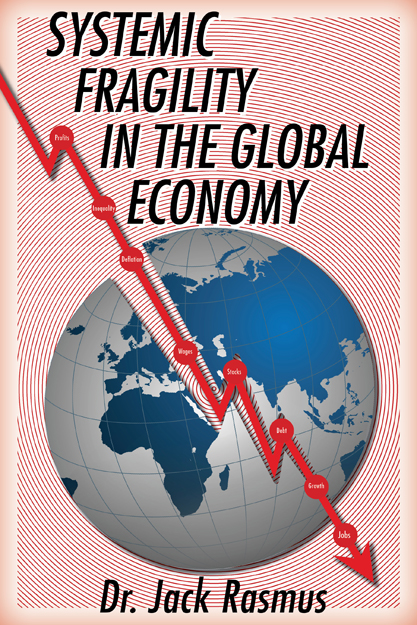
(Click on image): This book offers a new approach to explaining why mainstream economic analyses have repeatedly failed and why fiscal and monetary policies have been incapable of producing a sustained recovery. It explains why the global economy is slowing long term and becoming more unstable, why policies to date have largely failed the trend, and why the next crisis may therefore prove even worse than that of 2008-09.
Book plus DVD and Powerpoint slideshow
(Click on image) Obama's Economy: Recovery for the Few, explains how the weakest and most lopsided economic recovery since 1947 has been the direct outcome of failed economic policies of the Obama administration and US Federal Reserve bank since February 2009. Includes a detailed 'alternative program' in the final chapter. Includes the book, a video DVD presentation, and 66-slide PPT slideshow.
Book

(Click on image) Obama's Economy: Recovery for the Few, explains how the weakest and most lopsided economic recovery since 1947 has been the direct outcome of failed economic policies of the Obama administration and US Federal Reserve bank since February 2009. Includes a detailed 'alternative program' in the final chapter.
Book

(Click on image) A theoretical analysis, with historical case examples, of origins, causes and future evolution of the recent--and continuing--economic crisis in the U.S. and global economy. Includes predictions in 2009 of the inevitable failure of Obama policies and more serious crisis to come, 2013-15.
Book

(Click on image) Seven specific reasons why economic recovery under Obama since 2009 has failed for all but the wealthiest few and largest corporations. The book spells out eight specific areas as an Alternative Economic Recovery Program.
Book

(Click on image) The War At Home: The Corporate Offensive From Ronald Reagan to George W. Bush, is a 534 page, extensively researched, nonfiction book that describes the evolution of corporate-government policies from 1980 to 2005 that have shifted more than a $1 trillion dollars a year, every year, from 90 million American middle and working class households to the wealthiest 10% and corporations.
Search
-
Join 450 other subscribers
Jack Rasmus Site: KYKLOS PRODUCTIONS
 Dr. Jack Rasmus @drjackrasmus
