This past April, in the midst of the surging pandemic and collapsing US economy, I was interviewed by three sources in Europe for a US perspective on the events. The following is the second part of an interview with Polish social commentator, Konrad Stachnio, that will appear in a collection of interviews later this summer. Subsequent interview topics with Stachnio, and others in April, will be posted here in coming weeks as well.
(April 2020)
INTERVIEWER:
What do you think about China? Do you think China will be the biggest winner in this whole scenario here? For example, in terms of economy.
JACK RASMUS:
In terms of its economy, China has the ability to redirect investment into public investment a lot quicker and with less internal political opposition than the United States does. We’ll see whether it can do that. But China is very much an export-oriented economy, and the global economy has nearly collapsed. Global GDP is not coming back quickly. The supply chains are really broken, and it’s going to take quite a while to reestablish those supply chains. So globally, there’s no global V shape recovery scenario either.
Both Europe and Japan, the other two advanced capitalist economies were already in trouble economically in 2019, were stagnating or in recession, largely because they too, like the U.S., relied primarily on monetary policy as the main stimulus after the 2008-09 crash and eschewed fiscal policy. They all engaged in austerity fiscal policy. Again, that’s because the bankers are were in control of the politics and the policy since 2008-09.
Monetary policy means “give the money to the bankers first, and then we’ll decide how much we want to dribble down to the rest”; whereas fiscal policy means “give it to the household, the consumer, and they will then recover the banking system by spending.” Bankers and their bought for politicians don’t like fiscal policy because its bottom-up. They like top-down monetary policy. Europe and all the advanced capitalist countries were following this sort of policy after 2009, but now that policy has come to a dead-end. In Europe and Japan and the U.S., it was all the same but it just couldn’t be taken any further by 2019. As I say in my book about central banking, monetary policy was at a dead end and the central banks at the end of their policy rope.
It couldn’t be taken any further in the U.S. either when Trump came into office. Trump artificially pumped up the economy with his massive 2018 tax cut, but only artificially. Most of that $4.5 trillion (over a decade 2018-27) tax cut went into the financial markets and we had this big bubble, a 25-30% rise in the stock market, $3.4 trillion in stock buybacks and dividend payouts under Trump, and trillions more in corporate debt issuance due to low interest rates. And that bubble collapsed in a matter of weeks in 2020. That collapse, by the way, stabilized recently, but it’s going to go down again. This is a dead cat bounce, a classic bear market rally, as they call it in the financial markets.
So monetary policy is the primary lead policy for capitalism in the 21st century, and it has failed. It couldn’t go any further, and finance capitalists running the policy show don’t like fiscal policy. But now they’ve got to engage in fiscal policy. And now they’re going to pay a price with these massive deficits and debts they’ve run up in recent decades due to trillions of dollars in business-investor tax cuts and war spending, and no one knows how much that’s going to cause an even greater overhang and a drag on the economy after this whole virus thing runs its course.
But Europe is worse off than the U.S. Same with Japan. And now emerging markets are going to really take it in the ear, as they say, particularly countries whose currencies depend on global trade in commodities and oil. They’re already in a deep crisis, and the IMF lending a trillion dollars is not going to cover defaults in sovereign debt that are coming You can see the dimensions of the coming crisis in emerging market economies in Argentina and places in Latin America.
So the global economy is going to be very, very weak in the months and years immediately ahead. If China depends on sales into the global economy, that’s not going to recovery very fast for China. In summary, how much is that lack of export production going to play on China’s economy? China can probably make it up in other ways, but there are limits to that too. We’re going to see. China’s probably better off than the other emerging economies but its economy is not immune from broader global developments by any means.
But if there’s another wave of problems with the virus in China, then all bets are off for China recovering too. And you’ve got to remember, China engaged in massive fiscal spending after 2009. 15% of GDP, which pulled up the emerging markets selling commodities to China as well after 2012. Emerging markets in China did not suffer as much as Europe and North America and Japan after the last crisis.
But that’s not going to happen this time. If China cannot sell more goods into the global economy and trade, It’s not going to buy us much commodities from the emerging market economies, and therefore you’re not going to get that recovery in emerging market commodities or in China as sharply as occurred after the 2008-09 great recession.
I think there’ll be some recovery in China, but it won’t be very robust. It won’t be enough to pull up the EMEs, and it certainly won’t be enough to pull up the Western advanced economies.
INTERVIEWER:
Do you think that we are going in the direction of some sort of class war in Europe, or maybe even in the U.S., some sort of revolution? Because to be honest with you, I don’t see any other way to deal with this problem for people on the street who have nothing right now.
JACK RASMUS:
Yeah, I think the leadership of the western capitalist countries is grossly underestimating the discontent that’s going to occur in the working classes at the median income levels and below, in particular. They’re really going to be left behind this time. How long can they go on getting partial income support?
Or those who are working under really terrible conditions, very unsafe, unhealthy, dangerous conditions out there during this virus crisis and collapsing economy. It’s not just doctors, nurses, and first responders. The people who keep the utilities going, the people who keep the trucking and the delivery of food and necessities going, the people who keep running the warehouses and so forth – if that food delivery system breaks down, you’re going to see something very apocalyptic, I think, very dangerous.
To people who are working overtime and under hazardous conditions the politicians are saying, “You’re our heroes.” Yeah, well, that’s not enough. That’s not going to cut it. Why aren’t they getting hazard pay? Why aren’t they getting adjustments on their mortgages, rents, and so forth? We need to reward those people with extra compensation, who still have to work to keep society from collapsing. At a certain point people are going to realize, “Hey, we’re on the shitty end of this stick. They’re taking care of themselves, the bankers and so forth; what about us?” You’ll start seeing a lot of wildcat strikes in protest. Workers are going to start getting angry about having to choose between their lives, the lives of their families, and their livelihoods and jobs.
I’ll tell you one thing. Revolution isn’t around the corner for one very important reason. People engage in revolution when they have an organization that leads the way. Just having discontent over conditions is not enough. That will erupt in discontent like the Yellow Vests or Occupy Movement and so forth. That dissipates. You need an organization. You need a political party that will really represent them.
The problem is, you’ve got Social Democratic parties, whether they’re in Europe or the Democratic Party in the U.S. or whatever, who don’t really represent the working classes anymore. They threw a few crumbs their way, but they don’t rely on the working classes. They compete for the middle class, the professionals, and so forth, and the business class and small business and so forth. I don’t believe they will come up with a program and a solution that people will be able to get behind.
Already, most working class folks distrust all the political parties. Certainly in the U.S., they distrust the Democrats almost as much as the Republicans. But until you get a real organization that people feel that they can get behind, that has the answers to the crisis, you won’t really have a political revolution, I believe. It takes organization.
That’s the number one question before us today. The unions don’t seem to be that aggressive in moving in that direction. They’re tied to the Social Democratic parties and they do whatever the Social Democratic parties tell them to do. So I don’t see them leading it. I don’t see a new kind of resurrected Labor Party here or anywhere really doing it.
What will? I don’t have the answer to that. But I do know that that’s what must happen. I’m not advocating any particular organization out there. I don’t see anything that fulfills that task. But it will come. People will demand it when they see that the ruling class here has no solution to the crisis except to lower their standards of living even more to protect those who have the money. That’s the only solution that appears to be occurring. People will at some point say, “That’s not good enough.”
Posted in Uncategorized | 2 Comments »
For my 15 min. ‘quick take’ on last friday’s job numbers in general, and in particular on the Labor Dept.’s 3%-5% unemployment under-reporting ‘error’, listen to my May 8 radio interview with ‘By Any Means’ radio show. My comments as well on the connection between rising unemployment & income inequality and the deeper significance of the rising protests against police brutality.
TO LISTEN GO TO:
https://www.spreaker.com/user/radiosputnik/economist-new-unemployment-numbers-gross
TO LISTEN GO TO:
https://www.spreaker.com/user/radiosputnik/economist-new-unemployment-numbers-gross
Posted in Uncategorized | Leave a Comment »
This past April, in the midst of the surging pandemic and collapsing US economy, I was interviewed by three sources in Europe for a US perspective on the events. The following is the first part of an interview with Polish social commentator, Konrad Stachnio, that will appear in a collection of interviews later this summer. Subsequent interview topics with Stachnio, and others in April, will be posted here in coming weeks as well.
(APRIL 2020)
Interviewer: I would like to speak with you about this pandemic and the long-term scenario for Europe and United States, China. What will happen? Because we are facing a really serious situation.
Dr. Jack Rasmus: Well, let me take that question on. What will it look like after, or what will happen between now and after? There’s really a couple phases here. We’re right in the middle of it right now, in its more intense contraction phase, and we now are seeing the real economy everywhere virtually shutting down except for basic necessities.
That’s true in Europe, that’s true here in the U.S. It looks like same for much of Asia, although it looks like Asia may be coming back in terms of activity a little bit. Although it’s not clear whether that will be temporary too. There are reports of a second wave of infection beginning to occur in Asia. It’s not verified yet, but there’s some indication of that. Of course, the big risk is that if you go back to work too soon and more people get infected, then you do have a second wave.
There are forces in the U.S., I’m sure in Europe too but especially in the U.S., that want us to go back to work because they don’t like the fact they’re not making any money, and they really don’t care about how many workers get sick and die because they’re just, like good capitalists, thinking of their own bottom line here. I’ve heard there are thousands of workers in the US meatpacking industry that are now being infected.
It appears these business forces have had some influence with Trump for a while now, and Trump was talking about “We’re going to be back by Easter,” but then the reality and the science overwhelmed the ideology and the pursuit of profit and he said no by Easter, admitting we’re going to lose hundreds of thousands of people here, even if we do the best possible.” All we can do is mitigate, not stop the virus at this point. In other words slow down the process. But Trump will change his mind again about opening the economy. He constantly flip flops.
I don’t think there’ll be any real solution to this health crisis, and thus to the disruption of the economy, until they get a vaccine or some sort of treatment that clearly cures people functionally so that they could go back to work. Until you see the medical scientific solution, the pressure on the economy is going to continue. Maybe not as severe as the initial effects that we’re seeing now, in especially Europe and the U.S., but it will continue even after that. And the economy will not really fully recover, I believe, until you really have the medical solution.
I strongly disagree with all those Pollyannas who say that it’s going to be V-shaped recovery. There’s not going to be V-shaped recovery by any means. Why? Because there’s been great psychological wounds inflicted on both the psychology and expectations of consumers and businesses. That’s not going to go away very quickly. You can provide income protection to some extent; that’s going on now. But the $2.2 trillion U.S. ‘CARES’ bill just passed by Congress is just a mitigation, as even they’re now admitting, just putting a floor under the economic collapse to some extent for a couple of months at most.
But they’re going to need an even bigger stimulus bill by May/June if they want to get through the rest of the summer. Whether that happens is going to be determined by a political fight in the U.S. because, again, business interests, capitalists, do not want to drag out the economic crisis as much as we’ll probably have to in order to save lives. So there’ll be a big fight over that next stimulus bill coming in May or June.
I’ve written on my blog several articles in February-March that said, look, if there is truly a war with the virus going on – and there is– then we’re going to have to go to a war budget in the U.S. similar to what it did in 1942. If you look at 1940-41, the U.S. Government spending before World War II was about 10% of total GDP. In one year, 1942, that rose to 40% by the end of that year. And at one point in ’44, government spending was 70%.
That was a war mobilization in ’42, and I’m arguing that we have to go to 40% of again. If the government spending before this crisis in 2019 was roughly $4.5 trillion and that was 21% of GDP, we’re going to have to add another $4 trillion in direct government spending – not in business loan bailouts of bankers or investors. That’s done by the central bank, the Federal Reserve and not part of direct government spending. And not in the form of more corporate tax cuts, either, because that’s also not going to have much effect stimulating the economy in present conditions of severe contraction. It has to be direct government spending to households and small businesses.
We have some of that direct spending started but it’s not sufficient. The CARES ACT’s $500 billion to workers in the form of extended employment benefits and an initial round of household cash injection and checks, plus $367 billion to small businesses in grants, and loans that will probably convert to cash anyway. But all that’s just a 6- to 8-week solution. We’re going to have to have an even more massive stimulus, direct stimulus by the government, equal to 40% of GDP. And that has to come soon this year. Whether that happens is a political question. We’ll see.
But that’s what I believe has to happen. We have to go on a true war mobilization footing with government spending taking the lead because the psychology of investors and businesses has been so hammered – and consumers too – that even under the best of circumstances – let’s assume the very unlikely scenario that by June this health crisis element is over–the economy will still be wounded and businesses will not invest. They will be very, very cautious. They will not bring everybody back to work. Banks will not lend their own money very readily either.
Look, after the last crisis in 2008-09, we had a decline in bank lending and real investment for years after that, continually. So the banks will not lend except to the very safest, biggest customers. You’re not going to get investment snapping back. And in fact, investment wasn’t doing so good in the U.S. before the virus hit anyway. For 9 months in the last year, 2019, we had a contraction in real capital spending going on. We had a 6 month manufacturing recession. We had consumers that were showing signs that they were tapped out on credit and debt. And we had a trade war that was holding back growth as well. The real economy was therefore quite weak in 2019, not robust and strong, as Trump likes to say.
And all that was happening on the eve of this. It was not a strong economy, and this crisis has simply precipitated and accelerated the collapse. It was already slowly slowing down. And in Europe, the same scenario. Ditto Japan in late 2019. But now the virus effect has exacerbated and accelerated it all. It’s telescoped it, and now we’re in a deep, deep downturn.
The deep and rapid contraction of the real economy is going to affect the psychology of investors and businesses and the spending by consumers and households. Some of the money by the stimulus bills to date will be hoarded, because both businesses or consumers don’t know if this thing’s coming back, how long it’s going to go on. Households will buy necessities, but that’s it. They’re not going to go out and buy new homes, cars and all the rest at levels they had before. They’re going to sit on much of the bailout money; they’re going to hoard it. They’ll use some of it to pay down some of the debt they’ve accumulated to date, and businesses will spend it on stocks & bond investments, but they’ll mostly hoard it. Same for many households that will still have jobs,
As economists like to say, the multiplier effect from the CARES Act bill is going to be very, very low here for government spending. Businesses, what are they going to do? They’re going to hoard it. Banks are going to hoard it. They’re going to keep it for future debt payments, maybe, because they’ve also borrowing big time, drawing down their available bank loan credit lines and issuing record corporate bond debt. Businesses were drawing down their credit lines by hundreds of billions in February and March, as this thing began to unfold. And issuing hundreds of billions of dollars in new corporate bonds.
Record levels of corporate debt occurred in February because corporations and businesses are gathering in all the cash they can, in this dash for cash. In economist terms, it’s the return of what’s called liquidity preference by businesses, investors and households. It’s also what’s called a liquidity trap. Giving businesses more money doesn’t result in more investment, hiring, and growth in a severe and deep economic contraction. We’re in a liquidity trap with a vengeance. Monetary solutions don’t work in the current scenario. If anyone doubted John Maynard Keynes’ explanation of why business investment did not, would not, could not lead a recovery from the ’30s Depression despite near zero interest rates and free money, this is it a repeat event today revealing the same. This is a massive liquidity preference, liquidity trap going on.
Until the psychology changes, businesses are not going to open up their wallets and invest and expand production or hire everyone back tomorrow. They’re not going to expand because people aren’t going to be buying things at prior levels as well. That’s another reason. In certain industries like the oil industry, you have a total true collapse of capital expenditures going on. That’s not going to come out of it. The same is true with large sections of retail, of leisure, hospitality, travel and mass entertainment industries. They’re just not going to come ‘back to normal’, even under the best of assumptions. Not in the short term and likely not in the longer as well. The economy is now severely wounded, and ending the virus effect—even if quickly—is not going to change the economic crisis fundamentals very much. The contraction now has an economic dynamic of its own.
You’ve got to remember that every time there’s a deep recession, business looks for ways to cut costs. They focus on ways to become more efficient in using their employment. They replace jobs more with new technology and automation. That’s what they’re going to do coming out of this, too. They’re not going to hire these people back in droves, I don’t believe. As long as this virus isn’t resolved with the vaccine, the uncertainty is going to hang over everybody, business and consumer alike, and the hangover is going to keep the recovery very, very slow. And businesses will look for new ways to cut jobs, not rehire, or rehire those laid off as part time or temp workers.
Now, the big wild card with this very slow recovery, if it comes, when it comes, the big wild card is the credit system, the banking system, and by that I mean the shadow banking system as well as the commercial banking system. They’re about the same size. But the shadow banking system is far more unstable and fragile. If there’s a credit crunch, at least I’d say in financial system terms, there will be defaults and bankruptcies that will cause a major crisis in the credit system. Credit will freeze up. When that happens what you’ve got is the overlay of a financial crash on top of this already real economy collapsing.
You see, in 2008, it was different. It was the financial side that crashed that dragged down the real economy, and it was only halted when the Federal Reserve dumped $5 trillion into the banks and then engineered low interest rates for 6 years after that. The Fed at the time said, “We’re going to take the money back when we get recovery. We’ll sell off our $4.5T balance sheet.” I said at the time in my 2017 book, ‘Central Bankers at the End of Their Ropes’, it would not happen. Central bankers were at the end of their rope and would never retract the excess liquidity injected to save the banking system.
And I predicted all of this in my 2016 book, Systemic Fragility in the Global Economy as well. In fact, my central bankers book is subtitled Monetary Policy in the Coming Depression. We are certainly, certainly in a great recession here right now. The question today is will the nonfinancial corporate sector default on the massive debt they accumulate the past ten years that is now coming due? And will deflation in financial markets spill over to exacerbate deflation as well in real goods and services? The longer that we have this contraction in the real economy, the more fragile the financial system will become and the more susceptible it will be to a crash itself. When that might happen, I don’t know for certain, but the odds are increasing it could within the next six to twelve months.
But right now we have the Federal Reserve bailing out the banks even more than in 2008-09, spending even more, injecting even more liquidity to bail out the banks even before they fail this time. In 2008, they were failing and we spent $4-5 trillion to bail them out after the fact, and of course central banks globally did the same. Globally, it was a $20 trillion bailout by liquidity injection.
The problem with injecting so much liquidity is that you might save the banking system from collapsing, but you inject so much liquidity in the global economy, after it’s all over it ends up in fueling financial speculation and growing financial bubbles and fragility even further again. This is one of the great contradictions of capitalism right now. They generate banking crises caused by too much excess liquidity over decades, too much investment going into financial markets. It causes these bubbles and crashes, and then they have to bail it out with – guess what? More liquidity. So the solution to the problem becomes the problem once again.
That will be the inevitable consequence once again of the Federal Reserve now injecting trillions of dollars into the banking system. Already it has promised $6 trillion. Even before the crash came, in early 2019 the Fed had abandoned raising interest rates and started cutting rates again, providing more cheap money. And then it started its QE once again, although it didn’t call it that, last September by pumping $500 billion into repo market to keep that market from going under. And then when this virus thing started, the Fed announced still another $2.2 trillion—i.e. $1.5 for repos and $700 billion once again for buying mortgages and mortgage bonds and treasuries, call it QE5, whatever.
So going into this virus crisis in February 2020 the Fed had spent $2.7 trillion over the prior 6 months, and now it’s another $4 trillion at least promised by the Fed in March, and it may be open-ended. And right now the Fed is not only pre-bailing out the banks and the shadow banks, it’s setting up once again special lending facilities to deal with the worst fractures in the financial system that are appearing, for example right now in the municipal bond market. We also are seeing problems in the money market funds and commercial property and commercial paper markets, in the repo markets, and now they’re pre-bailing out the consumer credit. Credit cards, auto finance firms, and whatever.
The Fed is becoming a garbage can for corporate debt everywhere. It’s original mandate from its formation in 1913 up to 2008 was to bail out only the commercial banking system. In 2008-09 that was expanded to bailing out the shadow banking system as well—i.e. insurance companies, hedge funds, finance companies, and all the rest of the high risk taking and speculating financial system that had grown as large as the commercial banks. But now it’s every private financial institution and sector that holds debt. And nonfinancial corporations at all levels as well. They’re prepared to bail the whole thing out. And the Fed’s doing it even before the banks and non-banks default or go bankrupt. It’s a general pre-bailing out of the entire capitalist system. Read the Fed’s original mandate. It says nothing of that.
Well, they may bail it out in the short run, though even that’s not guaranteed – we’ll see whether we have a credit crisis nevertheless within the next 12 months or so– but even if they do bail it out in the short run, what the Fed’s doing today is such a massive injection of liquidity that for the next decade we will have nothing but financial instability occurring on a repetitive basis.
Essentially, you could say this: fiscal and monetary tools that mainstream economics says are used to stabilize the economy no longer function that way. These are tools being used to subsidize capital incomes across the board. That subsidization’s been going on for two decades now. So the capitalist state is so integrated now with maintaining values and maintaining capitalist incomes that it’s a total different animal in the 21st century. It’s become one with capital. More integrated with capital than ever before. It’s another indicator of the system’s crisis. Policy can no longer serve its primary function of stabilizing the system; it’s now a handmaiden for ensuring capital incomes first.
If you look just at tax cuts in this country since 2001, George W. Bush gave $4 trillion to corporations and investors, with some tax crumbs thrown to consumers. About 80% of the $4T went to businesses & investors; about 20% to consumers. Then we get Obama, and Obama gives $288 billion in tax cuts to business in his 2009 bailout. Then he extends Bush’s tax cuts for another two years to 2010 and passes another $800 billion in business tax cuts in 2010 on top of that. And then he takes $1.5 trillion out of government spending on social programs to pay for it in 2011, and then in 2013 he makes Bush’s tax cuts permanent at the cost of another $5 trillion.
So we had over $10 trillion in tax cuts mostly going to investors and businesses under Bush and Obama, and then we get Trump, who has already passed $5 trillion more in tax cuts, most of it, again, for businesses, multinational businesses, corporations, and all the rest. $4.5 trillion in January 2018 over the next decade and another $429B in 2019 in tax loopholes. It’s massive tax cuts since 2000. $15 trillion and rising. And on top of that, we fight these wars in the Middle East that cost $7 trillion. That brings us to the Cares Act passed this March 2020, which according to reports amounts to more than another $650 billion in tax cuts.
Well, no wonder. Add it up. $15 trillion in tax cuts, $7 trillion in wars, that’s $22 trillion. That’s the U.S. national debt last year, 2019. Of course, that national debt now is going to go to $27-28 trillion by 2022. Meanwhile, the financial side of the capitalist state is getting very unstable, and the system itself is getting very unstable.
Systems and empires crash most often because of financial instability internally. That’s what causes them to go under when they cannot continue economic growth and continue the standard of living for the people inside it. You can go back to ancient Rome. Let me go off on a historical tangent here. Why did Rome collapse? Because it lost its agricultural base. It lost the economic surplus that it used to finance its armies with when the barbarian so-called invaders took over Spain, Sicily and North Africa, where its agriculture surplus was located, its agricultural economy. It lost it. That was the fifth century. It had already lost its eastern agricultural base and surplus when Egypt went to the Eastern Roman Empire early in the 4th century.
So Rome could not afford to field an army large enough to protect its borders and it crashed. The same thing happens to all empires. Look at the British Empire. It loses its colonies after World War II and it becomes just a shadow, a shell of its former self, dependent on the rest of Europe and the United States allowing it to become a financial center. But of course, with Brexit on the horizon, Britain will no longer be that financial center. Britain is going to be an economy about the size of Northern Italy within the next decade. It’ll be totally irrelevant.
The same thing is happening within the United States now. The same thing. We have this fiscal crisis, we have a monetary crisis, and both monetary policy and fiscal policy are just conduits for the subsidization of capital incomes. It’s undercutting the standard of living for the rest of the country. At some point, people were fooled thinking that Trump was going to do something about it – and of course, the Democrats ran a stupid campaign by incompetent candidates and they lost to Trump, and now they’re trying to get back in the game. But they’re having a hard time, mostly due to incompetent leadership and continued dumb strategies.
But it’s still a 50-50 chance whether Trump might not win again because of Democratic incompetence, electoral incompetence. In fact, Trump has taken control of the Republican Party. He has control of the “red states” and therefore control of the Electoral College and the Senate, and the Supreme Court now. Don’t forget, in 2000 the Supreme Court gave the presidency to George W. Bush by stopping the vote in Florida. Something like that could happen again in another close election.
So all these institutions of government are working together to support capital in this country, and the most extreme and rapacious forms of finance capital in particular. Former bankers from Goldman Sachs investment bank are running the economic policies of the US since Trump came into office. They’re everywhere in high positions in his administration. Don’t count out the possibility that Trump may even, if this thing continues, call a national emergency and suspend the November election if this virus thing gets worse. That’s quite possible. Then we’re in a de facto political civil war in the United States, and much more disruption, and therefore much more uncertainty in the economy.
Now, that’s an extreme possibility, I admit, and I don’t want to be alarmist, but you’ve got to look forward and ask yourself what’s the worst case scenario? What’s the best case scenario? What’s the likely scenario, what’s in between the extremes? The most likely scenario, to get back to the original question, is that we’re going to have, at best, a very, very slow, rocky recovery here for the rest of this year and a very slow recovery at best for years to come.
It’s going to change the consciousness of people in this country and it’s going to change the politics in this country like we’ve never seen before. It could go further right and it can go in the direction of progressive politics. But that’s something no one can predict yet.
(Note: This interview was conducted in mid-April 2020 by Konrad Stachnio of Poland, for the publication of a collection of essays by writers in Europe and the USA on the emerging virus-driven global economic contraction.)
(APRIL 2020)
Interviewer: I would like to speak with you about this pandemic and the long-term scenario for Europe and United States, China. What will happen? Because we are facing a really serious situation.
Dr. Jack Rasmus: Well, let me take that question on. What will it look like after, or what will happen between now and after? There’s really a couple phases here. We’re right in the middle of it right now, in its more intense contraction phase, and we now are seeing the real economy everywhere virtually shutting down except for basic necessities.
That’s true in Europe, that’s true here in the U.S. It looks like same for much of Asia, although it looks like Asia may be coming back in terms of activity a little bit. Although it’s not clear whether that will be temporary too. There are reports of a second wave of infection beginning to occur in Asia. It’s not verified yet, but there’s some indication of that. Of course, the big risk is that if you go back to work too soon and more people get infected, then you do have a second wave.
There are forces in the U.S., I’m sure in Europe too but especially in the U.S., that want us to go back to work because they don’t like the fact they’re not making any money, and they really don’t care about how many workers get sick and die because they’re just, like good capitalists, thinking of their own bottom line here. I’ve heard there are thousands of workers in the US meatpacking industry that are now being infected.
It appears these business forces have had some influence with Trump for a while now, and Trump was talking about “We’re going to be back by Easter,” but then the reality and the science overwhelmed the ideology and the pursuit of profit and he said no by Easter, admitting we’re going to lose hundreds of thousands of people here, even if we do the best possible.” All we can do is mitigate, not stop the virus at this point. In other words slow down the process. But Trump will change his mind again about opening the economy. He constantly flip flops.
I don’t think there’ll be any real solution to this health crisis, and thus to the disruption of the economy, until they get a vaccine or some sort of treatment that clearly cures people functionally so that they could go back to work. Until you see the medical scientific solution, the pressure on the economy is going to continue. Maybe not as severe as the initial effects that we’re seeing now, in especially Europe and the U.S., but it will continue even after that. And the economy will not really fully recover, I believe, until you really have the medical solution.
I strongly disagree with all those Pollyannas who say that it’s going to be V-shaped recovery. There’s not going to be V-shaped recovery by any means. Why? Because there’s been great psychological wounds inflicted on both the psychology and expectations of consumers and businesses. That’s not going to go away very quickly. You can provide income protection to some extent; that’s going on now. But the $2.2 trillion U.S. ‘CARES’ bill just passed by Congress is just a mitigation, as even they’re now admitting, just putting a floor under the economic collapse to some extent for a couple of months at most.
But they’re going to need an even bigger stimulus bill by May/June if they want to get through the rest of the summer. Whether that happens is going to be determined by a political fight in the U.S. because, again, business interests, capitalists, do not want to drag out the economic crisis as much as we’ll probably have to in order to save lives. So there’ll be a big fight over that next stimulus bill coming in May or June.
I’ve written on my blog several articles in February-March that said, look, if there is truly a war with the virus going on – and there is– then we’re going to have to go to a war budget in the U.S. similar to what it did in 1942. If you look at 1940-41, the U.S. Government spending before World War II was about 10% of total GDP. In one year, 1942, that rose to 40% by the end of that year. And at one point in ’44, government spending was 70%.
That was a war mobilization in ’42, and I’m arguing that we have to go to 40% of again. If the government spending before this crisis in 2019 was roughly $4.5 trillion and that was 21% of GDP, we’re going to have to add another $4 trillion in direct government spending – not in business loan bailouts of bankers or investors. That’s done by the central bank, the Federal Reserve and not part of direct government spending. And not in the form of more corporate tax cuts, either, because that’s also not going to have much effect stimulating the economy in present conditions of severe contraction. It has to be direct government spending to households and small businesses.
We have some of that direct spending started but it’s not sufficient. The CARES ACT’s $500 billion to workers in the form of extended employment benefits and an initial round of household cash injection and checks, plus $367 billion to small businesses in grants, and loans that will probably convert to cash anyway. But all that’s just a 6- to 8-week solution. We’re going to have to have an even more massive stimulus, direct stimulus by the government, equal to 40% of GDP. And that has to come soon this year. Whether that happens is a political question. We’ll see.
But that’s what I believe has to happen. We have to go on a true war mobilization footing with government spending taking the lead because the psychology of investors and businesses has been so hammered – and consumers too – that even under the best of circumstances – let’s assume the very unlikely scenario that by June this health crisis element is over–the economy will still be wounded and businesses will not invest. They will be very, very cautious. They will not bring everybody back to work. Banks will not lend their own money very readily either.
Look, after the last crisis in 2008-09, we had a decline in bank lending and real investment for years after that, continually. So the banks will not lend except to the very safest, biggest customers. You’re not going to get investment snapping back. And in fact, investment wasn’t doing so good in the U.S. before the virus hit anyway. For 9 months in the last year, 2019, we had a contraction in real capital spending going on. We had a 6 month manufacturing recession. We had consumers that were showing signs that they were tapped out on credit and debt. And we had a trade war that was holding back growth as well. The real economy was therefore quite weak in 2019, not robust and strong, as Trump likes to say.
And all that was happening on the eve of this. It was not a strong economy, and this crisis has simply precipitated and accelerated the collapse. It was already slowly slowing down. And in Europe, the same scenario. Ditto Japan in late 2019. But now the virus effect has exacerbated and accelerated it all. It’s telescoped it, and now we’re in a deep, deep downturn.
The deep and rapid contraction of the real economy is going to affect the psychology of investors and businesses and the spending by consumers and households. Some of the money by the stimulus bills to date will be hoarded, because both businesses or consumers don’t know if this thing’s coming back, how long it’s going to go on. Households will buy necessities, but that’s it. They’re not going to go out and buy new homes, cars and all the rest at levels they had before. They’re going to sit on much of the bailout money; they’re going to hoard it. They’ll use some of it to pay down some of the debt they’ve accumulated to date, and businesses will spend it on stocks & bond investments, but they’ll mostly hoard it. Same for many households that will still have jobs,
As economists like to say, the multiplier effect from the CARES Act bill is going to be very, very low here for government spending. Businesses, what are they going to do? They’re going to hoard it. Banks are going to hoard it. They’re going to keep it for future debt payments, maybe, because they’ve also borrowing big time, drawing down their available bank loan credit lines and issuing record corporate bond debt. Businesses were drawing down their credit lines by hundreds of billions in February and March, as this thing began to unfold. And issuing hundreds of billions of dollars in new corporate bonds.
Record levels of corporate debt occurred in February because corporations and businesses are gathering in all the cash they can, in this dash for cash. In economist terms, it’s the return of what’s called liquidity preference by businesses, investors and households. It’s also what’s called a liquidity trap. Giving businesses more money doesn’t result in more investment, hiring, and growth in a severe and deep economic contraction. We’re in a liquidity trap with a vengeance. Monetary solutions don’t work in the current scenario. If anyone doubted John Maynard Keynes’ explanation of why business investment did not, would not, could not lead a recovery from the ’30s Depression despite near zero interest rates and free money, this is it a repeat event today revealing the same. This is a massive liquidity preference, liquidity trap going on.
Until the psychology changes, businesses are not going to open up their wallets and invest and expand production or hire everyone back tomorrow. They’re not going to expand because people aren’t going to be buying things at prior levels as well. That’s another reason. In certain industries like the oil industry, you have a total true collapse of capital expenditures going on. That’s not going to come out of it. The same is true with large sections of retail, of leisure, hospitality, travel and mass entertainment industries. They’re just not going to come ‘back to normal’, even under the best of assumptions. Not in the short term and likely not in the longer as well. The economy is now severely wounded, and ending the virus effect—even if quickly—is not going to change the economic crisis fundamentals very much. The contraction now has an economic dynamic of its own.
You’ve got to remember that every time there’s a deep recession, business looks for ways to cut costs. They focus on ways to become more efficient in using their employment. They replace jobs more with new technology and automation. That’s what they’re going to do coming out of this, too. They’re not going to hire these people back in droves, I don’t believe. As long as this virus isn’t resolved with the vaccine, the uncertainty is going to hang over everybody, business and consumer alike, and the hangover is going to keep the recovery very, very slow. And businesses will look for new ways to cut jobs, not rehire, or rehire those laid off as part time or temp workers.
Now, the big wild card with this very slow recovery, if it comes, when it comes, the big wild card is the credit system, the banking system, and by that I mean the shadow banking system as well as the commercial banking system. They’re about the same size. But the shadow banking system is far more unstable and fragile. If there’s a credit crunch, at least I’d say in financial system terms, there will be defaults and bankruptcies that will cause a major crisis in the credit system. Credit will freeze up. When that happens what you’ve got is the overlay of a financial crash on top of this already real economy collapsing.
You see, in 2008, it was different. It was the financial side that crashed that dragged down the real economy, and it was only halted when the Federal Reserve dumped $5 trillion into the banks and then engineered low interest rates for 6 years after that. The Fed at the time said, “We’re going to take the money back when we get recovery. We’ll sell off our $4.5T balance sheet.” I said at the time in my 2017 book, ‘Central Bankers at the End of Their Ropes’, it would not happen. Central bankers were at the end of their rope and would never retract the excess liquidity injected to save the banking system.
And I predicted all of this in my 2016 book, Systemic Fragility in the Global Economy as well. In fact, my central bankers book is subtitled Monetary Policy in the Coming Depression. We are certainly, certainly in a great recession here right now. The question today is will the nonfinancial corporate sector default on the massive debt they accumulate the past ten years that is now coming due? And will deflation in financial markets spill over to exacerbate deflation as well in real goods and services? The longer that we have this contraction in the real economy, the more fragile the financial system will become and the more susceptible it will be to a crash itself. When that might happen, I don’t know for certain, but the odds are increasing it could within the next six to twelve months.
But right now we have the Federal Reserve bailing out the banks even more than in 2008-09, spending even more, injecting even more liquidity to bail out the banks even before they fail this time. In 2008, they were failing and we spent $4-5 trillion to bail them out after the fact, and of course central banks globally did the same. Globally, it was a $20 trillion bailout by liquidity injection.
The problem with injecting so much liquidity is that you might save the banking system from collapsing, but you inject so much liquidity in the global economy, after it’s all over it ends up in fueling financial speculation and growing financial bubbles and fragility even further again. This is one of the great contradictions of capitalism right now. They generate banking crises caused by too much excess liquidity over decades, too much investment going into financial markets. It causes these bubbles and crashes, and then they have to bail it out with – guess what? More liquidity. So the solution to the problem becomes the problem once again.
That will be the inevitable consequence once again of the Federal Reserve now injecting trillions of dollars into the banking system. Already it has promised $6 trillion. Even before the crash came, in early 2019 the Fed had abandoned raising interest rates and started cutting rates again, providing more cheap money. And then it started its QE once again, although it didn’t call it that, last September by pumping $500 billion into repo market to keep that market from going under. And then when this virus thing started, the Fed announced still another $2.2 trillion—i.e. $1.5 for repos and $700 billion once again for buying mortgages and mortgage bonds and treasuries, call it QE5, whatever.
So going into this virus crisis in February 2020 the Fed had spent $2.7 trillion over the prior 6 months, and now it’s another $4 trillion at least promised by the Fed in March, and it may be open-ended. And right now the Fed is not only pre-bailing out the banks and the shadow banks, it’s setting up once again special lending facilities to deal with the worst fractures in the financial system that are appearing, for example right now in the municipal bond market. We also are seeing problems in the money market funds and commercial property and commercial paper markets, in the repo markets, and now they’re pre-bailing out the consumer credit. Credit cards, auto finance firms, and whatever.
The Fed is becoming a garbage can for corporate debt everywhere. It’s original mandate from its formation in 1913 up to 2008 was to bail out only the commercial banking system. In 2008-09 that was expanded to bailing out the shadow banking system as well—i.e. insurance companies, hedge funds, finance companies, and all the rest of the high risk taking and speculating financial system that had grown as large as the commercial banks. But now it’s every private financial institution and sector that holds debt. And nonfinancial corporations at all levels as well. They’re prepared to bail the whole thing out. And the Fed’s doing it even before the banks and non-banks default or go bankrupt. It’s a general pre-bailing out of the entire capitalist system. Read the Fed’s original mandate. It says nothing of that.
Well, they may bail it out in the short run, though even that’s not guaranteed – we’ll see whether we have a credit crisis nevertheless within the next 12 months or so– but even if they do bail it out in the short run, what the Fed’s doing today is such a massive injection of liquidity that for the next decade we will have nothing but financial instability occurring on a repetitive basis.
Essentially, you could say this: fiscal and monetary tools that mainstream economics says are used to stabilize the economy no longer function that way. These are tools being used to subsidize capital incomes across the board. That subsidization’s been going on for two decades now. So the capitalist state is so integrated now with maintaining values and maintaining capitalist incomes that it’s a total different animal in the 21st century. It’s become one with capital. More integrated with capital than ever before. It’s another indicator of the system’s crisis. Policy can no longer serve its primary function of stabilizing the system; it’s now a handmaiden for ensuring capital incomes first.
If you look just at tax cuts in this country since 2001, George W. Bush gave $4 trillion to corporations and investors, with some tax crumbs thrown to consumers. About 80% of the $4T went to businesses & investors; about 20% to consumers. Then we get Obama, and Obama gives $288 billion in tax cuts to business in his 2009 bailout. Then he extends Bush’s tax cuts for another two years to 2010 and passes another $800 billion in business tax cuts in 2010 on top of that. And then he takes $1.5 trillion out of government spending on social programs to pay for it in 2011, and then in 2013 he makes Bush’s tax cuts permanent at the cost of another $5 trillion.
So we had over $10 trillion in tax cuts mostly going to investors and businesses under Bush and Obama, and then we get Trump, who has already passed $5 trillion more in tax cuts, most of it, again, for businesses, multinational businesses, corporations, and all the rest. $4.5 trillion in January 2018 over the next decade and another $429B in 2019 in tax loopholes. It’s massive tax cuts since 2000. $15 trillion and rising. And on top of that, we fight these wars in the Middle East that cost $7 trillion. That brings us to the Cares Act passed this March 2020, which according to reports amounts to more than another $650 billion in tax cuts.
Well, no wonder. Add it up. $15 trillion in tax cuts, $7 trillion in wars, that’s $22 trillion. That’s the U.S. national debt last year, 2019. Of course, that national debt now is going to go to $27-28 trillion by 2022. Meanwhile, the financial side of the capitalist state is getting very unstable, and the system itself is getting very unstable.
Systems and empires crash most often because of financial instability internally. That’s what causes them to go under when they cannot continue economic growth and continue the standard of living for the people inside it. You can go back to ancient Rome. Let me go off on a historical tangent here. Why did Rome collapse? Because it lost its agricultural base. It lost the economic surplus that it used to finance its armies with when the barbarian so-called invaders took over Spain, Sicily and North Africa, where its agriculture surplus was located, its agricultural economy. It lost it. That was the fifth century. It had already lost its eastern agricultural base and surplus when Egypt went to the Eastern Roman Empire early in the 4th century.
So Rome could not afford to field an army large enough to protect its borders and it crashed. The same thing happens to all empires. Look at the British Empire. It loses its colonies after World War II and it becomes just a shadow, a shell of its former self, dependent on the rest of Europe and the United States allowing it to become a financial center. But of course, with Brexit on the horizon, Britain will no longer be that financial center. Britain is going to be an economy about the size of Northern Italy within the next decade. It’ll be totally irrelevant.
The same thing is happening within the United States now. The same thing. We have this fiscal crisis, we have a monetary crisis, and both monetary policy and fiscal policy are just conduits for the subsidization of capital incomes. It’s undercutting the standard of living for the rest of the country. At some point, people were fooled thinking that Trump was going to do something about it – and of course, the Democrats ran a stupid campaign by incompetent candidates and they lost to Trump, and now they’re trying to get back in the game. But they’re having a hard time, mostly due to incompetent leadership and continued dumb strategies.
But it’s still a 50-50 chance whether Trump might not win again because of Democratic incompetence, electoral incompetence. In fact, Trump has taken control of the Republican Party. He has control of the “red states” and therefore control of the Electoral College and the Senate, and the Supreme Court now. Don’t forget, in 2000 the Supreme Court gave the presidency to George W. Bush by stopping the vote in Florida. Something like that could happen again in another close election.
So all these institutions of government are working together to support capital in this country, and the most extreme and rapacious forms of finance capital in particular. Former bankers from Goldman Sachs investment bank are running the economic policies of the US since Trump came into office. They’re everywhere in high positions in his administration. Don’t count out the possibility that Trump may even, if this thing continues, call a national emergency and suspend the November election if this virus thing gets worse. That’s quite possible. Then we’re in a de facto political civil war in the United States, and much more disruption, and therefore much more uncertainty in the economy.
Now, that’s an extreme possibility, I admit, and I don’t want to be alarmist, but you’ve got to look forward and ask yourself what’s the worst case scenario? What’s the best case scenario? What’s the likely scenario, what’s in between the extremes? The most likely scenario, to get back to the original question, is that we’re going to have, at best, a very, very slow, rocky recovery here for the rest of this year and a very slow recovery at best for years to come.
It’s going to change the consciousness of people in this country and it’s going to change the politics in this country like we’ve never seen before. It could go further right and it can go in the direction of progressive politics. But that’s something no one can predict yet.
(Note: This interview was conducted in mid-April 2020 by Konrad Stachnio of Poland, for the publication of a collection of essays by writers in Europe and the USA on the emerging virus-driven global economic contraction.)
Posted in Uncategorized | 2 Comments »
A week ago in Minneapolis, for all the world to see, a black man, George Floyd, was murdered by a policeman, Derek Chauvin. Protests broke out in nearly 100 American cities, and even worldwide, and have continued now for more than a week.
Murders of black men by police in America are not new. They are endemic. So why the deep, widespread, and sustained protests this time?
Certainly the nature of this particular murder explains in large part the especially angry protests and response. But it’s not the entire explanation. Youth of all color, race and ethnicity are leading the demonstrations.
A Sadistic, Merciless & Intentional Killing
The killing of George Floyd was a particularly reprehensible police murder. It was clearly intended. It was merciless. It was sadistic. As the world has watched, Floyd was cuffed, face down on the street, pleading for his life. And the more he pleaded, the more Derek Chauvin, the cop, seemed determined and unrelenting, intent on keeping his knee on Floyd’s neck. The first six minutes, as Floyd pleaded for his life, even pitifully calling out for his mother at the end, a sure indication he felt he was nearing his last moments of life. But for almost 3 minutes more Chauvin’s knee remained after Floyd had already lost consciousness.
What angers those who observed the murder most is the lack of mercy shown by Chauvin and his three complicit partner officers. What they showed was clearly an intention to kill. Chauvin appeared almost to take pleasure in keeping his knee on Floyd’s neck for three minutes more after he lay motionless. That made it a particularly sadistic murder.
It suggested to observers of the video, especially to black folks, that the police in 2020 will show you no mercy. Plead all you want for your life when cuffed, helpless, face down in the dirt. They’ll still murder you. And apparently enjoy it in the process!
The murder act was followed soon by another typical series of events, also all too often occurring in America today: Minneapolis police and the city’s district attorney (DA) office prevaricated and hesitated taking action, only responding when protests erupted. That delay suggested a typical cover up was underway, as is so often the response of local authorities in such cases.
There’s a big problem in America today: the cozy relationships that exist between police and DA offices. Both ‘scratch each others’ backs’, as the saying goes: The DA depends on police testimony to get convictions in court; in turn the DAs go light and help protect the police in exchange for their favorable testimonies. Police unions frequently provide significant campaign donations to District Attorney candidates that favor them, creating a kind of political ‘conflict of interest’ by DAs. Coroner offices play a contributing role, by providing whatever autopsy results are necessary to support the DA. Carefully selected Grand Juries, should legal challenges to murder get that far, then endorse their joint mutual cover ups. It’s an institutional arrangement that too often thwarts the process of Justice.
So it’s not just an occasional racist cop. It’s institutionalized racism. A pattern that repeats over and over again. This is what the protesters of Floyd’s murder also realize and demonstrate against. They’ve seen it before. Time and again.
Black folks today know that pleading for your life when about to be murdered—like pleading for Justice after the fact—will more often than not fall on institutional deaf ears when police brutality is concerned. No mercy and no justice come in the same institutionalized racist package.
Protests As Acts of Solidarity
The immediate and increasingly angry protests that followed the murder of George Floyd are not due solely to the police killing of Floyd. The media would have you think so. That it’s only about the murder of Floyd and policy brutality. The politicians would like you to think so. All those leaders calling for calm and dialogue want you to believe so.
Floyd may have been murdered in nine minutes. But many youth in America today, especially but not only youth of color, feel their own lives are slowly and steadily being drained on a daily basis, sucked dry by the unfairness and injustice of ‘the system’. They feel that system—a capitalist system that increasingly rewards the wealthy and ignores the rest as never before in its history—has its knee on their necks too. And that system, that knee, is no less unrelenting, shows no mercy, and has no intent on relieving the pressure.
Working class youth of all color today know their lives are being destroyed more insidiously, step by step, year by year, as they struggle to survive: laid off and moving from low paid job to job, accumulating crushing debt laid upon debt, lacking minimal health benefits, changing apartment to apartment as rents are continually raised, with no hope of ever having a normal family life, of ever paying off student loans, in effect having to live a 21st century form of economic indentureship, a second or even third class economic citizenship—while they watch multimillionaires and billionaires almost exponentially add to their wealth.
In just the last three years under Trump, corporations registered record profits, wealthy investors and 1% were given $4.9T in tax cuts and $3.4T in stock buybacks and dividend payouts. While the rich and their corporations get richer, the rest make due with stagnant or falling wages, working two and three jobs, and constant job loss and turnover.
All those protestors on the streets this past week—virtually all young folks—are not just demonstrating against the murder of Floyd and institutionalized racism. That’s the tip of the protest spear. But it’s more than that. It goes deeper than that. There’s a deeper frustration and desperation behind it all, affecting tens of millions but especially American youth.
The youthful protesters looked at Floyd and they saw themselves. The protests are thus an eruption of social solidarity among wide sections of American youth! Not just among black and minority youth but American youth in general. Look at the composition of the demonstrators city after city. They are mostly Millennials and GenZers of all races and ethnicities and gender who feel they have been left behind by ‘the system’. Left out and declared disposable. They are virtually all working class youth. What the protests show is that Class and Race are coming together! Especially among the youth.
They are fearful of police brutality, especially blacks and youth of color. But they are fearful as well of being condemned to a life of low paid, no benefits, insecure and futureless part time and temp work. Working often two and even three jobs cobbled together just to get by.
And now, with the advent of the Coronavirus pandemic, even those mostly low paid service jobs have been wiped out by the virus and recent economic crash—many of which, they sense, aren’t coming back soon or even at all. The Congressional Budget Office today, June 2, 2020 announced it will likely take ten years for the jobs now being lost to come back, and many won’t return at all! There will be no V-shape quick recovery. It will be W Shape, extended over a decade or more, with periodic brief and weak recoveries followed by repeated relapses and recessions—whether or not there are subsequent waves of the virus. The economic die is cast. The US economy (and global) have entered a phase of chronic, long run decline.
What the protestors don’t realize yet, but will soon, is that more of their low paid jobs with no future are about to be wiped out by the coming Artificial Intelligence revolution and automation now ramping up. According to McKinsey Consulting, AI will eliminate 30% of all occupations in the next five to ten years. Even their low pay, futureless service jobs will be eliminated.
Add to all the above fears of the worsening climate crisis the protesting youth know they will have to live through. And to that the growing public awareness of a deepening political crisis in America, as the nation drifts into tyranny driven by the Trump wing of the US political elite.
The USA has entered a ‘triple crisis’: health care & environment, jobs and the economy, and a growing political crisis of Democracy in America itself. The protestors know this. They sense and feel it and are growing frustrated, angry and desperate. The youth of America are growing increasingly desperate. All that ‘social crisis kindling’ is feeding the protests. Police brutality, institutional racism, and murder is just the spark that has set it all off. It’s not just about George Floyd any more.
WHAT TO DO? SOME PROPOSALS
So what’s the solution(s)? To escalating police murders; to white supremacist provocateurs who are intent on stoking a race war (as they say in their own words); to the sub-classless looters that prey upon the protests and demonstrations; to the local institutionalized racism. What might be done?
It’s no longer acceptable to say, as elites of both parties and their media declare daily, that demonstrators should calm down, go home, and let’s dialogue about how to reform the police. That’s been done before. Many times. With little result. It’s time for black folks, protestors and demonstrators on the streets today to develop their own independent solutions to the problem of police brutality.
There are three general actions that might be undertaken immediately to confront institutional racism in America that chronically gives us murders of George Floyds:
1. Break the iron nexus between Police Departments and District Attorney Offices
2. Launch a National ‘Policing the Police’ Movement
3. Form Local Community ‘Committees of Safety’
At the core of institutional racism is the relationship between local police departments and District Attorneys. The police rely on the DAs to smother, delay and defuse investigations and prosecutions of police who have engaged in brutality and murder against black and other minorities. The DAs depend in turn on police testimony in court cases to enable them to win their cases and advance their personal careers. In exchange for police assistance, the DAs go light on police charged with brutality. Knowing they are covered, police feel more inclined to shoot first and not worry about the outcome. It’s a ‘scratch my back-I’ll scratch yours’ mentality that permeates both institutions—police departments and DA offices—nearly everywhere in America today.
Coroner’s offices play a secondary but important role in the process when a murder is involved. They assist the DA by rendering a decision of the cause of death that conveniently points away from the police action in question. The decease died of a heart attack and had underlying heart problems is often the official cause of death. It wasn’t choking of the defendant by the police. It was a heart attack that would have occurred regardless of the choke hold. The guy had a bad heart or some other underlying condition was the cause of death—not the police tactic employed.
Another institutional player in the charade is often a local Grand Jury. This archaic institution is nothing like a real ‘jury’, although called that. It is a selected group of often pro-police and so-called ‘upstanding citizens’—meaning more often than not white, conservative and business oriented. Grand juries often rule to throw out charges, giving the DA cover not to proceed to prosecution. Should the DA still proceed, the charges are reduced from murder to something less based on Grand Jury lesser recommendations. If convicted, the police in question’s penalty is often reduced to only employment termination. But he is then eligible to go to another police dept. and rehired. Police departments often have a silent understanding to rehire each other’s ‘bad apples’. Thus a cop with a long record of abusing blacks and minorities continues to work somewhere ‘down the road’. It’s not unlike the Catholic church simply moving some pederast priest to another parish.
Breaking the Police-District Attorney Cover-Up Nexus
• Local DA’s must be prohibited from prosecuting their local police in cases of racist related brutality and murder. The prosecution responsibility must be moved to an independent source outside the county or city.
• Police department unions and organizations should be prohibited from contributing to DA election campaigns
• Coroners should be selected by the murdered party’s family to ensure impartiality
• Grand Juries should be abolished, especially and starting with cases involving police brutality and killing
• A police discharged for cause, involving a racist brutality case, should be prevented from rehire by another police department anywhere
Launching a national ‘Policing the Police’ Movement
• A national ‘Policing the Police’ movement should be launched. Wherever a cop confronts and stops someone, the public should use smartphones or other photo devices to record the interaction. This is now done haphazardly and occasionally. There should be a general education effort nationwide to get everyone to engage in the practice of video recording police whenever they see a police interaction with any citizen.
• An independent national database of photos and video recording of confrontations should be created.
• A public education campaign should be launched as well, encouraging the public to immediately send all videos to the independent national database.
• The public database should be accessible to everyone online
Forming Local Community ‘Committees of Safety’
• All cities should form local community ‘Committees of Safety’ to police the police, to gather information on confrontations and make the information available to the general public
• The Committees should organize protests and demonstrations and coordinate with other Committees outside their local area to organize larger protests and demonstrations
• During protests and demonstrations, Committee members should undertake the task of identifying, confronting, and rooting out provocateurs. And distribute photo leaflets of known white supremacists and provocateurs to participants in the protests and demonstrations
• The Committees of Safety should publicize to the community at large those identified as looters during the protests and demonstrations
• Committees should endorse and run candidates for city councils, city managers, DAs, and local elected judgeships that are committed to, and supportive of, black lives matter and other minority civil rights
• Committees would raise demands for local ordnance changes and state wide legislation to protect the rights of demonstrators, and organize recalls of politicians who do not
• Committees would undertake other measures as necessary to ensure the safety of protestors from provocateurs, white supremacist violence, and other proponents of violence against people or property during demonstrations
Many of these proposals are not new. Others are being introduced by protestors right now. But the point is the protests and demonstrations should be taken to the next organizational level. They cannot go on as just spontaneous events. They will eventually dissipate without organization. Or be captured by provocateurs and looters. Or manipulated by politicians for purposes of personal election and careers. Or all the above.
Without organization, the ‘I Can’t Breathe’ anti-racist, anti-policy brutality movement that has swept the country runs the risk of eventually fading—just as had other promising popular movements like ‘Occupy’ in 2011 and the ‘Yellow Vests’ in France of a few years ago. Without organization, the provocateurs and looters will also increasingly displace the protestors in the media–providing cover for a ‘law and order’ right wing reaction that will use the violence to crush the demonstrations while ushering in still further restrictions on civil liberty rights of assembly and expression. Nor will the police and politicians rid the protests of provocateurs and looters. The protestors must do so themselves. But that cannot be done without organization.
The other even greater risk, absent organization, is that mainstream politicians will divert the energy and anger of the protestors into channels to get themselves elected.
Organization is needed as well simply in order to expand and build the protests and demonstrations, and to ensure they continue with ever larger turnout.
Forming local community ‘Committees of Safety’ are the core organizational element necessary for building the organizational power of the protests and demonstrations. Launching a ‘policing the police’ movement is a way to connect the general ranks of the demonstrators—and the public in general—to the work of the Committees of Safety. And the Committees and the public Policing the Police movement are together the means by which to independently politically attack the institutionalized racism embedded today in the relationships between police departments, district attorneys, coroners, and Grand Juries.
Breaking institutional racism requires an independent political movement, with a grass roots organizational structure. That independent movement is on the streets of America right now. Will it take the movement to the next level, a level necessary to break the embedded local institutions of racism?
Dr. Jack Rasmus
June 3, 2020
Murders of black men by police in America are not new. They are endemic. So why the deep, widespread, and sustained protests this time?
Certainly the nature of this particular murder explains in large part the especially angry protests and response. But it’s not the entire explanation. Youth of all color, race and ethnicity are leading the demonstrations.
A Sadistic, Merciless & Intentional Killing
The killing of George Floyd was a particularly reprehensible police murder. It was clearly intended. It was merciless. It was sadistic. As the world has watched, Floyd was cuffed, face down on the street, pleading for his life. And the more he pleaded, the more Derek Chauvin, the cop, seemed determined and unrelenting, intent on keeping his knee on Floyd’s neck. The first six minutes, as Floyd pleaded for his life, even pitifully calling out for his mother at the end, a sure indication he felt he was nearing his last moments of life. But for almost 3 minutes more Chauvin’s knee remained after Floyd had already lost consciousness.
What angers those who observed the murder most is the lack of mercy shown by Chauvin and his three complicit partner officers. What they showed was clearly an intention to kill. Chauvin appeared almost to take pleasure in keeping his knee on Floyd’s neck for three minutes more after he lay motionless. That made it a particularly sadistic murder.
It suggested to observers of the video, especially to black folks, that the police in 2020 will show you no mercy. Plead all you want for your life when cuffed, helpless, face down in the dirt. They’ll still murder you. And apparently enjoy it in the process!
The murder act was followed soon by another typical series of events, also all too often occurring in America today: Minneapolis police and the city’s district attorney (DA) office prevaricated and hesitated taking action, only responding when protests erupted. That delay suggested a typical cover up was underway, as is so often the response of local authorities in such cases.
There’s a big problem in America today: the cozy relationships that exist between police and DA offices. Both ‘scratch each others’ backs’, as the saying goes: The DA depends on police testimony to get convictions in court; in turn the DAs go light and help protect the police in exchange for their favorable testimonies. Police unions frequently provide significant campaign donations to District Attorney candidates that favor them, creating a kind of political ‘conflict of interest’ by DAs. Coroner offices play a contributing role, by providing whatever autopsy results are necessary to support the DA. Carefully selected Grand Juries, should legal challenges to murder get that far, then endorse their joint mutual cover ups. It’s an institutional arrangement that too often thwarts the process of Justice.
So it’s not just an occasional racist cop. It’s institutionalized racism. A pattern that repeats over and over again. This is what the protesters of Floyd’s murder also realize and demonstrate against. They’ve seen it before. Time and again.
Black folks today know that pleading for your life when about to be murdered—like pleading for Justice after the fact—will more often than not fall on institutional deaf ears when police brutality is concerned. No mercy and no justice come in the same institutionalized racist package.
Protests As Acts of Solidarity
The immediate and increasingly angry protests that followed the murder of George Floyd are not due solely to the police killing of Floyd. The media would have you think so. That it’s only about the murder of Floyd and policy brutality. The politicians would like you to think so. All those leaders calling for calm and dialogue want you to believe so.
Floyd may have been murdered in nine minutes. But many youth in America today, especially but not only youth of color, feel their own lives are slowly and steadily being drained on a daily basis, sucked dry by the unfairness and injustice of ‘the system’. They feel that system—a capitalist system that increasingly rewards the wealthy and ignores the rest as never before in its history—has its knee on their necks too. And that system, that knee, is no less unrelenting, shows no mercy, and has no intent on relieving the pressure.
Working class youth of all color today know their lives are being destroyed more insidiously, step by step, year by year, as they struggle to survive: laid off and moving from low paid job to job, accumulating crushing debt laid upon debt, lacking minimal health benefits, changing apartment to apartment as rents are continually raised, with no hope of ever having a normal family life, of ever paying off student loans, in effect having to live a 21st century form of economic indentureship, a second or even third class economic citizenship—while they watch multimillionaires and billionaires almost exponentially add to their wealth.
In just the last three years under Trump, corporations registered record profits, wealthy investors and 1% were given $4.9T in tax cuts and $3.4T in stock buybacks and dividend payouts. While the rich and their corporations get richer, the rest make due with stagnant or falling wages, working two and three jobs, and constant job loss and turnover.
All those protestors on the streets this past week—virtually all young folks—are not just demonstrating against the murder of Floyd and institutionalized racism. That’s the tip of the protest spear. But it’s more than that. It goes deeper than that. There’s a deeper frustration and desperation behind it all, affecting tens of millions but especially American youth.
The youthful protesters looked at Floyd and they saw themselves. The protests are thus an eruption of social solidarity among wide sections of American youth! Not just among black and minority youth but American youth in general. Look at the composition of the demonstrators city after city. They are mostly Millennials and GenZers of all races and ethnicities and gender who feel they have been left behind by ‘the system’. Left out and declared disposable. They are virtually all working class youth. What the protests show is that Class and Race are coming together! Especially among the youth.
They are fearful of police brutality, especially blacks and youth of color. But they are fearful as well of being condemned to a life of low paid, no benefits, insecure and futureless part time and temp work. Working often two and even three jobs cobbled together just to get by.
And now, with the advent of the Coronavirus pandemic, even those mostly low paid service jobs have been wiped out by the virus and recent economic crash—many of which, they sense, aren’t coming back soon or even at all. The Congressional Budget Office today, June 2, 2020 announced it will likely take ten years for the jobs now being lost to come back, and many won’t return at all! There will be no V-shape quick recovery. It will be W Shape, extended over a decade or more, with periodic brief and weak recoveries followed by repeated relapses and recessions—whether or not there are subsequent waves of the virus. The economic die is cast. The US economy (and global) have entered a phase of chronic, long run decline.
What the protestors don’t realize yet, but will soon, is that more of their low paid jobs with no future are about to be wiped out by the coming Artificial Intelligence revolution and automation now ramping up. According to McKinsey Consulting, AI will eliminate 30% of all occupations in the next five to ten years. Even their low pay, futureless service jobs will be eliminated.
Add to all the above fears of the worsening climate crisis the protesting youth know they will have to live through. And to that the growing public awareness of a deepening political crisis in America, as the nation drifts into tyranny driven by the Trump wing of the US political elite.
The USA has entered a ‘triple crisis’: health care & environment, jobs and the economy, and a growing political crisis of Democracy in America itself. The protestors know this. They sense and feel it and are growing frustrated, angry and desperate. The youth of America are growing increasingly desperate. All that ‘social crisis kindling’ is feeding the protests. Police brutality, institutional racism, and murder is just the spark that has set it all off. It’s not just about George Floyd any more.
WHAT TO DO? SOME PROPOSALS
So what’s the solution(s)? To escalating police murders; to white supremacist provocateurs who are intent on stoking a race war (as they say in their own words); to the sub-classless looters that prey upon the protests and demonstrations; to the local institutionalized racism. What might be done?
It’s no longer acceptable to say, as elites of both parties and their media declare daily, that demonstrators should calm down, go home, and let’s dialogue about how to reform the police. That’s been done before. Many times. With little result. It’s time for black folks, protestors and demonstrators on the streets today to develop their own independent solutions to the problem of police brutality.
There are three general actions that might be undertaken immediately to confront institutional racism in America that chronically gives us murders of George Floyds:
1. Break the iron nexus between Police Departments and District Attorney Offices
2. Launch a National ‘Policing the Police’ Movement
3. Form Local Community ‘Committees of Safety’
At the core of institutional racism is the relationship between local police departments and District Attorneys. The police rely on the DAs to smother, delay and defuse investigations and prosecutions of police who have engaged in brutality and murder against black and other minorities. The DAs depend in turn on police testimony in court cases to enable them to win their cases and advance their personal careers. In exchange for police assistance, the DAs go light on police charged with brutality. Knowing they are covered, police feel more inclined to shoot first and not worry about the outcome. It’s a ‘scratch my back-I’ll scratch yours’ mentality that permeates both institutions—police departments and DA offices—nearly everywhere in America today.
Coroner’s offices play a secondary but important role in the process when a murder is involved. They assist the DA by rendering a decision of the cause of death that conveniently points away from the police action in question. The decease died of a heart attack and had underlying heart problems is often the official cause of death. It wasn’t choking of the defendant by the police. It was a heart attack that would have occurred regardless of the choke hold. The guy had a bad heart or some other underlying condition was the cause of death—not the police tactic employed.
Another institutional player in the charade is often a local Grand Jury. This archaic institution is nothing like a real ‘jury’, although called that. It is a selected group of often pro-police and so-called ‘upstanding citizens’—meaning more often than not white, conservative and business oriented. Grand juries often rule to throw out charges, giving the DA cover not to proceed to prosecution. Should the DA still proceed, the charges are reduced from murder to something less based on Grand Jury lesser recommendations. If convicted, the police in question’s penalty is often reduced to only employment termination. But he is then eligible to go to another police dept. and rehired. Police departments often have a silent understanding to rehire each other’s ‘bad apples’. Thus a cop with a long record of abusing blacks and minorities continues to work somewhere ‘down the road’. It’s not unlike the Catholic church simply moving some pederast priest to another parish.
Breaking the Police-District Attorney Cover-Up Nexus
• Local DA’s must be prohibited from prosecuting their local police in cases of racist related brutality and murder. The prosecution responsibility must be moved to an independent source outside the county or city.
• Police department unions and organizations should be prohibited from contributing to DA election campaigns
• Coroners should be selected by the murdered party’s family to ensure impartiality
• Grand Juries should be abolished, especially and starting with cases involving police brutality and killing
• A police discharged for cause, involving a racist brutality case, should be prevented from rehire by another police department anywhere
Launching a national ‘Policing the Police’ Movement
• A national ‘Policing the Police’ movement should be launched. Wherever a cop confronts and stops someone, the public should use smartphones or other photo devices to record the interaction. This is now done haphazardly and occasionally. There should be a general education effort nationwide to get everyone to engage in the practice of video recording police whenever they see a police interaction with any citizen.
• An independent national database of photos and video recording of confrontations should be created.
• A public education campaign should be launched as well, encouraging the public to immediately send all videos to the independent national database.
• The public database should be accessible to everyone online
Forming Local Community ‘Committees of Safety’
• All cities should form local community ‘Committees of Safety’ to police the police, to gather information on confrontations and make the information available to the general public
• The Committees should organize protests and demonstrations and coordinate with other Committees outside their local area to organize larger protests and demonstrations
• During protests and demonstrations, Committee members should undertake the task of identifying, confronting, and rooting out provocateurs. And distribute photo leaflets of known white supremacists and provocateurs to participants in the protests and demonstrations
• The Committees of Safety should publicize to the community at large those identified as looters during the protests and demonstrations
• Committees should endorse and run candidates for city councils, city managers, DAs, and local elected judgeships that are committed to, and supportive of, black lives matter and other minority civil rights
• Committees would raise demands for local ordnance changes and state wide legislation to protect the rights of demonstrators, and organize recalls of politicians who do not
• Committees would undertake other measures as necessary to ensure the safety of protestors from provocateurs, white supremacist violence, and other proponents of violence against people or property during demonstrations
Many of these proposals are not new. Others are being introduced by protestors right now. But the point is the protests and demonstrations should be taken to the next organizational level. They cannot go on as just spontaneous events. They will eventually dissipate without organization. Or be captured by provocateurs and looters. Or manipulated by politicians for purposes of personal election and careers. Or all the above.
Without organization, the ‘I Can’t Breathe’ anti-racist, anti-policy brutality movement that has swept the country runs the risk of eventually fading—just as had other promising popular movements like ‘Occupy’ in 2011 and the ‘Yellow Vests’ in France of a few years ago. Without organization, the provocateurs and looters will also increasingly displace the protestors in the media–providing cover for a ‘law and order’ right wing reaction that will use the violence to crush the demonstrations while ushering in still further restrictions on civil liberty rights of assembly and expression. Nor will the police and politicians rid the protests of provocateurs and looters. The protestors must do so themselves. But that cannot be done without organization.
The other even greater risk, absent organization, is that mainstream politicians will divert the energy and anger of the protestors into channels to get themselves elected.
Organization is needed as well simply in order to expand and build the protests and demonstrations, and to ensure they continue with ever larger turnout.
Forming local community ‘Committees of Safety’ are the core organizational element necessary for building the organizational power of the protests and demonstrations. Launching a ‘policing the police’ movement is a way to connect the general ranks of the demonstrators—and the public in general—to the work of the Committees of Safety. And the Committees and the public Policing the Police movement are together the means by which to independently politically attack the institutionalized racism embedded today in the relationships between police departments, district attorneys, coroners, and Grand Juries.
Breaking institutional racism requires an independent political movement, with a grass roots organizational structure. That independent movement is on the streets of America right now. Will it take the movement to the next level, a level necessary to break the embedded local institutions of racism?
Dr. Jack Rasmus
June 3, 2020
Posted in Uncategorized | 6 Comments »
This past week two events highlighted economic news (along with the continuing rise of jobless, now approximately 50m). The first event of note was the intensifying debate within Congress on the next economic mitigation-stimulus bill called the Heroes Act. With corporations fat with cash from the bailout and wage earning households facing the expiration of effects from income checks and extra unemployment benefits, Congress and the two parties are at a crossroads. McConnell and his Republicans don’t want further stimulus for wage earners. He and they want ‘to wait and see’ the effects of the prior $1.74T bailout of business and the ‘opening of the economy’ first. Meanwhile, Pelosi and the Democrats want more income stimulus and unemployment benefits extended to January 2021 for households now beginning to face a ‘fiscal cliff’. The choice is whether a floor is still extended under 120m households to prevent economic depression, or whether that floor is allowed to collapse. The US economy is at a crossroads the next 90 days that will determine whether we experience just another ‘great recession’ or slip into a bona-fide great depression. Today’s Alternative Vision show discusses the state of the ongoing debates and concessions in Congress with regard to the Heroes Act.
The show also leads the hour with a comment about the second major economic event of the past week: Trump’s pre-declaration of economic war with China. Using the virus crisis as an excuse and diversion for his abject failure to lead the US during the current health and economic crisis, Trump threatened financial warfare and sanctions on China. How the US employs financial measures to attack other economies and countries is noted, including manipulation of the dollar (the world’s trading and reserve currency), its control over the international payments system (the SWIFT system), and sanctions to prevent other countries and economies from trading with its imperialist target (e.g. China in this case). These and other levers of financial power are increasingly employed by the US in the 21st century. With the US-China trade agreement of last December in shambles, and China not buying US goods nor likely to buy much in the future, Trump now sees China as a convenient scapegoat in an election year.
https://alternativevisions.podbean.com/e/alternative-visions-heroes-act-negotiations-us-financial-imperialism-china/
Today’s show continues in more depth the discussion last week on the pending Heroes Act in Congress. Is it another mitigation bill, stimulus bill, or a growing subsidy for business bill. What are Republicans proposing to change the original House proposals in the bill? Senate Democrat responses in progress? What’s the true unemployment rate in the US today. Why has the $1.7T in corporate loans under the March ‘Cares Act’ not being taken up by big business? And why is only $95B of the Fed’s $1.7T liquidity provisions to banks being used so far? Is the bailout of households being converted to more subsidies for business? The show concludes with a discussion of how US financial imperialism works, and why Trump is now preparing to leverage it against China marking a new stage in the China-US economic war. Some commentary on Trump’s emerging 2020 election strategy: election fraud.
The show also leads the hour with a comment about the second major economic event of the past week: Trump’s pre-declaration of economic war with China. Using the virus crisis as an excuse and diversion for his abject failure to lead the US during the current health and economic crisis, Trump threatened financial warfare and sanctions on China. How the US employs financial measures to attack other economies and countries is noted, including manipulation of the dollar (the world’s trading and reserve currency), its control over the international payments system (the SWIFT system), and sanctions to prevent other countries and economies from trading with its imperialist target (e.g. China in this case). These and other levers of financial power are increasingly employed by the US in the 21st century. With the US-China trade agreement of last December in shambles, and China not buying US goods nor likely to buy much in the future, Trump now sees China as a convenient scapegoat in an election year.
-
TO LISTEN GO TO:
https://alternativevisions.podbean.com/e/alternative-visions-heroes-act-negotiations-us-financial-imperialism-china/
-
SHOW ANNOUNCEMENT
Today’s show continues in more depth the discussion last week on the pending Heroes Act in Congress. Is it another mitigation bill, stimulus bill, or a growing subsidy for business bill. What are Republicans proposing to change the original House proposals in the bill? Senate Democrat responses in progress? What’s the true unemployment rate in the US today. Why has the $1.7T in corporate loans under the March ‘Cares Act’ not being taken up by big business? And why is only $95B of the Fed’s $1.7T liquidity provisions to banks being used so far? Is the bailout of households being converted to more subsidies for business? The show concludes with a discussion of how US financial imperialism works, and why Trump is now preparing to leverage it against China marking a new stage in the China-US economic war. Some commentary on Trump’s emerging 2020 election strategy: election fraud.
Posted in Uncategorized | Leave a Comment »
Listen to my recent radio interview with ‘The Critical Hour’ explaining why current US jobless are 50 million: 40m getting benefits+7.3m in the pipeline applying+5m more ‘not in labor force’ and thus not calculated in unemployment numbers.
Also, what’s going on in current negotiations in US Senate to end $600/wk supplemental unemployment benefit in July and replace it with a massive wage subsidy to business–US govt to directly pay business 80% of wages up to $45k per year or more! Is this the beginning of the end of unemployment insurance program? Why Senate Democrats are falling for the Republican drive to replace unemployment benefits with subsidizing business wages. .
Critical_Hour_484_Seg_2.mp3<br />
Also, what’s going on in current negotiations in US Senate to end $600/wk supplemental unemployment benefit in July and replace it with a massive wage subsidy to business–US govt to directly pay business 80% of wages up to $45k per year or more! Is this the beginning of the end of unemployment insurance program? Why Senate Democrats are falling for the Republican drive to replace unemployment benefits with subsidizing business wages. .
-
TO LISTEN GO TO:
Critical_Hour_484_Seg_2.mp3<br />
Posted in Uncategorized | Leave a Comment »
Watch my 60 minutes May 27, 2020 interview on the US economy with ‘Other Voices’ TV, Paul George.
TO Watch GO TO:
https://youtu.be/M70H0ziTovc— /wp:paragraph –>
TO Watch GO TO:
https://youtu.be/M70H0ziTovc— /wp:paragraph –>
Posted in Uncategorized | Leave a Comment »
Mainstream economics consistently fails to predict the future. I’m talking about those ‘schools’ of mis-thought, ranging from Paul Krugman on the ‘left’ to Glenn Hubbard and other apologists of business and neoliberalism on the ‘right’.
One of the favorite myths they perpetrate is that ‘wages are sticky downwards’. That means that in conditions of recession or worse, because workers won’t accept lower wages the recession tends to continue. If only workers would allow wage reductions it would mean business would have more disposable income (from wage cost savings) on hand. Business would then reinvest the extra income. Investment would rise. Workers would be rehired. Wage income would then recover and the economy would grow from more investment and consumption.
This fiction has ruled for more than a century. The economist John Maynard Keynes debunked it in the 1930s. But it was retained by the mainstream economics profession nonetheless, even to this day. Just read most of the entry college level textbooks. It’s still there. Along with at least a dozen other false propositions (like free trade benefits all; inflation is caused by too much money chasing too few goods; income inequality is due to workers not educating themselves and making themselves more productive; business tax cuts create jobs–and a host of other nonsense statements with no support in reality.
The notion that ‘wages are sticky downward’ is a clever way to argue that workers are responsible for the lack of a quick recovery from a recession. If they only would reduce their wages it would all be ok in a short while.
But take a look what’s going on right now. As of late May 2020 at least 45 million American workers are unemployed. In just two months they have lost $1.3 trillion in income. More than $1 trillion due to unemployed. Another $260B due to shorter hours of work. That’s a wage reduction of -$1.3 trillion! As in all recessions, workers do experience severe wage reduction–in joblessness (no wages), shorter hours of work, cuts and loss of benefits, lower pension contributions by employers, wage theft, etc. etc. So wages do fall, and are falling today faster and deeper than ever. And is business and investors spending and investing given the wage reductions? No. They’re hoarding the $1.74 trillion in Congressional loans and grants bailouts. And hoarding the $650 billion in business tax cuts also in the bailout legislation thus far (which one hears very little about in the media, I might add).
As journalist David Cay Johnson just revealed in a piece today, the short term cash deposits by business in just institutional money funds (only one source) has risen from $2.3 trillion before March 1, 2020 to $3.3T today. That’s a $1T rise in cash deposits by businesses, just in institutional money funds. More is being deposited in commercial banks. The long run average of business deposits in commercial banks has been around 5% (6% under Obama and 4.6% under Trump 2016-19) to 15.8% since March 1. Businesses and investors are hoarding their cash and stuffing it in their short term accounts in banks, funds, and who knows where else, on and offshore. No doubt some of that will be committed at some point to stock buybacks, dividend payouts, mergers & acquisitions, derivatives speculation, and all the rest of the financial gambling that in the 21st century defines capitalism. Don’t expect much to get into real investment that increases production, requiring the rehiring of workers, that generates wage incomes.
So wage cuts and reductions, now underway, will not result in renewed business investment and general rehiring of the 45 million laid off. Wage cuts don’t result in real investment and growth.
The nonsense economics notion that wages are sticky downwards is just pure economic bullshit today, as it has always been! And so is the parallel mainstream idea that if you can just find a way to boost business cash (via tax cuts or bailout loans) it will lead to economic recovery as well.
Dr. Jack Rasmus
March 24, 2020
Dr. Rasmus is author of the recently published book, ‘The Scourge of Neoliberalism: US Economic Policy from Reagan to Trump’, Clarity Press, January 2020, where the empirical record on wages, investment, taxes, employment thoroughly debunks the various myths and misrepresentations of mainstream economics.
One of the favorite myths they perpetrate is that ‘wages are sticky downwards’. That means that in conditions of recession or worse, because workers won’t accept lower wages the recession tends to continue. If only workers would allow wage reductions it would mean business would have more disposable income (from wage cost savings) on hand. Business would then reinvest the extra income. Investment would rise. Workers would be rehired. Wage income would then recover and the economy would grow from more investment and consumption.
This fiction has ruled for more than a century. The economist John Maynard Keynes debunked it in the 1930s. But it was retained by the mainstream economics profession nonetheless, even to this day. Just read most of the entry college level textbooks. It’s still there. Along with at least a dozen other false propositions (like free trade benefits all; inflation is caused by too much money chasing too few goods; income inequality is due to workers not educating themselves and making themselves more productive; business tax cuts create jobs–and a host of other nonsense statements with no support in reality.
The notion that ‘wages are sticky downward’ is a clever way to argue that workers are responsible for the lack of a quick recovery from a recession. If they only would reduce their wages it would all be ok in a short while.
But take a look what’s going on right now. As of late May 2020 at least 45 million American workers are unemployed. In just two months they have lost $1.3 trillion in income. More than $1 trillion due to unemployed. Another $260B due to shorter hours of work. That’s a wage reduction of -$1.3 trillion! As in all recessions, workers do experience severe wage reduction–in joblessness (no wages), shorter hours of work, cuts and loss of benefits, lower pension contributions by employers, wage theft, etc. etc. So wages do fall, and are falling today faster and deeper than ever. And is business and investors spending and investing given the wage reductions? No. They’re hoarding the $1.74 trillion in Congressional loans and grants bailouts. And hoarding the $650 billion in business tax cuts also in the bailout legislation thus far (which one hears very little about in the media, I might add).
As journalist David Cay Johnson just revealed in a piece today, the short term cash deposits by business in just institutional money funds (only one source) has risen from $2.3 trillion before March 1, 2020 to $3.3T today. That’s a $1T rise in cash deposits by businesses, just in institutional money funds. More is being deposited in commercial banks. The long run average of business deposits in commercial banks has been around 5% (6% under Obama and 4.6% under Trump 2016-19) to 15.8% since March 1. Businesses and investors are hoarding their cash and stuffing it in their short term accounts in banks, funds, and who knows where else, on and offshore. No doubt some of that will be committed at some point to stock buybacks, dividend payouts, mergers & acquisitions, derivatives speculation, and all the rest of the financial gambling that in the 21st century defines capitalism. Don’t expect much to get into real investment that increases production, requiring the rehiring of workers, that generates wage incomes.
So wage cuts and reductions, now underway, will not result in renewed business investment and general rehiring of the 45 million laid off. Wage cuts don’t result in real investment and growth.
The nonsense economics notion that wages are sticky downwards is just pure economic bullshit today, as it has always been! And so is the parallel mainstream idea that if you can just find a way to boost business cash (via tax cuts or bailout loans) it will lead to economic recovery as well.
Dr. Jack Rasmus
March 24, 2020
Dr. Rasmus is author of the recently published book, ‘The Scourge of Neoliberalism: US Economic Policy from Reagan to Trump’, Clarity Press, January 2020, where the empirical record on wages, investment, taxes, employment thoroughly debunks the various myths and misrepresentations of mainstream economics.
Posted in Uncategorized | 11 Comments »
Listen to my Alternative Visions radio show of friday, May 22, and my background analysis of the recently proposed ‘Heroes Act’, the fifth in the series of US House of Representatives (i.e. Democrats) economic mitigation bills for the US economy. Will it stimulate recovery? Is it a stimulus bill or still a mitigation bill? What’s the background leading up to the Heroes bill? What has the March ‘CARES Act’ accomplished thus far. Why businesses and corporations will commit very little of the $1.74 trillion loans & grants to investment, production and hiring back of the unemployed. Why the unemployment totals are now well over 45m, or about 30% of the work force. (Part 2 of the Heroes Act described in detail to follow next week’s Alternative Visions show on friday, May 29)
TO LISTEN GO TO:
http://alternativevisions.podbean.com
Dr. Rasmus explains the latest Congressional bill to try to stimulate the US economy, called the Heroes Act, passed a week ago. What are the elements? Will they continue to ‘mitigate’ the virus impact on the economy or actually stimulate recovery? Why is McConnell in the Senate, Republicans, and Trump opposed and blocking it? What are their arguments and are they accurate? Rasmus provides a background analysis of the four previous ‘mitigation’ bills, the central CARES ACT passed in April in particular. Why are the large corporations not taking up the $500B in loans, why is the Main St. provision for medium sized corps not even implemented yet? Why and how the small business PPP provision being ‘gamed’ by larger companies? Problems with a primary monetary stimulus strategy that is the CARES ACT.
TO LISTEN GO TO:
http://alternativevisions.podbean.com
-
SHOW ANNOUNCEMENT:
Dr. Rasmus explains the latest Congressional bill to try to stimulate the US economy, called the Heroes Act, passed a week ago. What are the elements? Will they continue to ‘mitigate’ the virus impact on the economy or actually stimulate recovery? Why is McConnell in the Senate, Republicans, and Trump opposed and blocking it? What are their arguments and are they accurate? Rasmus provides a background analysis of the four previous ‘mitigation’ bills, the central CARES ACT passed in April in particular. Why are the large corporations not taking up the $500B in loans, why is the Main St. provision for medium sized corps not even implemented yet? Why and how the small business PPP provision being ‘gamed’ by larger companies? Problems with a primary monetary stimulus strategy that is the CARES ACT.
Posted in Uncategorized | 1 Comment »
Listen to my radio interview of 5-19-20 with ‘By Any Means Necessary’ Radio and my explanation why current health-economic crisis will continue for years, in ‘W-Shape’ recovery with relapses later this year and in 2021. Why Fed central bank monetary policy will NOT lead to more investment, restoration of bank lending, business production, and return of consumer spending (given current 47m jobless and actual 28% unemployment rate). The limits of Fed monetary policy solutions, including MMT. What happens to the additional 45m now jobless health coverage come August? Or when extended unemployment benefits expire in August? Comment on Mark Cuban’s proposal for a $4k/mo guaranteed income to be spent within one week of receipt.
TO
https://www.spreaker.com/user/radiosputnik/economist-medicare-for-all-stimulus-for-
TO
-
Listen GO TO
https://www.spreaker.com/user/radiosputnik/economist-medicare-for-all-stimulus-for-
Posted in Uncategorized | 2 Comments »
Dr. Rasmus on Twitter
Jack’s Weekly Radio Show, ALTERNATIVE VISIONS
NEW BOOK
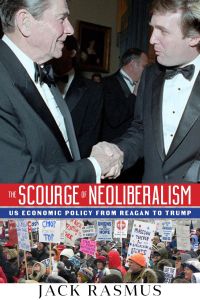
While the capitalist system has undergone numerous restructurings throughout its history, capitalist elites purpose in restructuring has remained the same: to restore and/or extend their hegemony. The current restructuring, operative since 1978, is called Neoliberalism. The book examines Neoliberalism as both an Idea and an historical practice composed of a particular mix of fiscal-monetary-trade-industrial policies that began with the latest US capitalist restructuring in the late 1970s, continuing to evolve to this day. The book further explains the deeper material forces giving rise to - as well as now undermining - the Neoliberal policy regime, with special focus given to the crisis of Neoliberalism in the wake of the 2008-09 global crash, Obama's failure to resurrect it, and Trump's current doomed effort to restore it in a new, more aggressive form. Evidence why Neoliberalism is destroying US Democracy concludes the book's analysis.
NEW BOOK
Describes how US federal governments, often in cooperation with the largest US private banks, introduced and expanded central banking functions from 1781 through the creation of the Federal Reserve Act of 1913. Based on an analysis of the evolution of the US banking system - from pre-1781, through the 1787 US Constitutional Convention, Congressional debates on Hamilton's reports to Congress, the rise and fall of the 1st and 2nd Banks of the United States, and through the long period of the National Banking System form 1862-1913, the book shows how central banking in the US evolved out of the private banking system, and how following the financial crash of 1907 big New York banks pushed through Congress the Federal Reserve Act of 1913, creating a central bank which they then managed for their interests.
BOOK
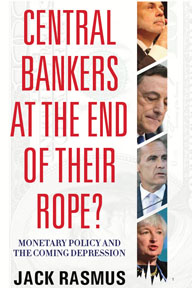
(Click on image) CENTRAL BANKERS is a comprehensive critique of central banks’ policies in the 21st century, explaining why the massive injections of free money to the banking system since the 1970s enabled the creation of excess corporate debt that has led to financial bubbles and repeated crises. The book addresses the growing contradictions of central banking, why they are failing in their functions, targets and tools, and proposes a radical democratization and restructuring to transform them to serve the public interest and not the private banks.
Book:
(Click on image) LOOTING GREECE, A New Financial Imperialism Emerges. This book - Reveals clearly who calls the shots in the Eurozone—the hardliners, not the remnants and political residue of what was once European social democracy, - Follows the negotiations in their excruciating detail as the Troika tightens the screws from 2009 to the present, - Shows how Europe’s financial elite enriches itself on Greek debt, privatizations and financial manipulations, turning Greece into an Economic Protectorate.
Book:
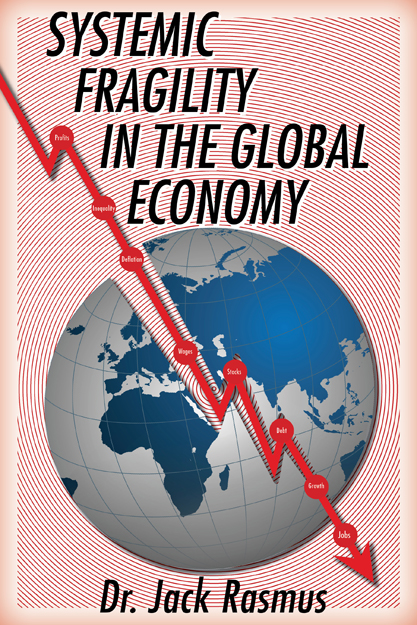
(Click on image): This book offers a new approach to explaining why mainstream economic analyses have repeatedly failed and why fiscal and monetary policies have been incapable of producing a sustained recovery. It explains why the global economy is slowing long term and becoming more unstable, why policies to date have largely failed the trend, and why the next crisis may therefore prove even worse than that of 2008-09.
Book plus DVD and Powerpoint slideshow
(Click on image) Obama's Economy: Recovery for the Few, explains how the weakest and most lopsided economic recovery since 1947 has been the direct outcome of failed economic policies of the Obama administration and US Federal Reserve bank since February 2009. Includes a detailed 'alternative program' in the final chapter. Includes the book, a video DVD presentation, and 66-slide PPT slideshow.
Book

(Click on image) Obama's Economy: Recovery for the Few, explains how the weakest and most lopsided economic recovery since 1947 has been the direct outcome of failed economic policies of the Obama administration and US Federal Reserve bank since February 2009. Includes a detailed 'alternative program' in the final chapter.
Book

(Click on image) A theoretical analysis, with historical case examples, of origins, causes and future evolution of the recent--and continuing--economic crisis in the U.S. and global economy. Includes predictions in 2009 of the inevitable failure of Obama policies and more serious crisis to come, 2013-15.
Book

(Click on image) Seven specific reasons why economic recovery under Obama since 2009 has failed for all but the wealthiest few and largest corporations. The book spells out eight specific areas as an Alternative Economic Recovery Program.
Book

(Click on image) The War At Home: The Corporate Offensive From Ronald Reagan to George W. Bush, is a 534 page, extensively researched, nonfiction book that describes the evolution of corporate-government policies from 1980 to 2005 that have shifted more than a $1 trillion dollars a year, every year, from 90 million American middle and working class households to the wealthiest 10% and corporations.
Search
-
Join 450 other subscribers
Jack Rasmus Site: KYKLOS PRODUCTIONS
 Dr. Jack Rasmus @drjackrasmus
