Feeds:
Posts
Comments

My Alternative Visions radio show of friday, April 16, 2021 discussed the recent Union election defeat at Amazon and placed it in the historical context of the 4 decade long destruction of unions in America as a result of the policy of Neoliberalism over the period.

David Baker, who listened to the show, offered a commentary on the show’s main themes. Baker’s comment follows, along with my rejoinder to his remarks.

TO LISTEN to the Radio Show GO TO:

https://alternativevisions.podbean.com/e/alternative-visions-union-labor-s-great-detour-1947-to-2021/

David Baker’s Comment

Impressive but disheartening. Disheartening because I knew so little of modern labor day history. Obviously not a mistake either by our educational institutions or mainstream media but clearly still disheartening that I was exposed to so little labor history. My other comment is that the roots of neoliberalism began with the economic defeat of this country arising out of the Indochina wars. Essentially this country could not have both guns and butter and the overheating of the economy by the war economy pushed prices out of control. That price spiral triggered a serious and successful labor movement and that movement brought on the counterattack on labor called neoliberalism. It is not a mistake that neoliberalism began with Ronald Reagan since Reagan started his political career attacking the labor movement in the film industry in Los Angeles.

Jack Rasmus’s Rejoinder to Baker

Actually, Neoliberalism began in the last two years of the Carter administration. Reagan tax policies were being formulated then by the Business Council, Business Roundtable, and Chamber of Commerce; they were then quickly launched under Reagan. Monetary policy actually began in 1980, when Carter agreed with business to replace the chair of the Fed with Volcker. Free Trade and other ‘external’ policy would have to wait until the late 1980s in Reagan’s second term; and only really implemented by Clinton thereafter in the 1990s.

But industrial and anti-union policy originated in 1979, with the Carter-Corporate imposed deal to resolve the 1979 UAW-Chrysler strike and negotiations. That’s when ‘concession bargaining’ began. Other policies to depress wages were introduced in 1980 by Reagan as well, with the deregulation of key industries legislation. Thus also passed under Carter. Tax policies to encourage offshoring of jobs were developed in 1979-80, but only implemented in 1981 and after.

So both Democrats and Republican elites were responsible for the launching of Neoliberal industrial policies that have devastated unions since 1979, and resulted in the mass offshoring of US higher paid, union manufacturing jobs, and stagnation and compression of real wages ever since 1983.

Yes, David you are right: most Americans, and union members included, have little idea of what has happened under Neoliberalism, why their benefits have eroded, why their wages have stagnated, and why their unions have almost disappeared in the private sector. In exchange for unions, decent wages, and good jobs, Neoliberalism instead has given them cheap credit (& a $12 trillion mountain of debt), multiple low pay service jobs to work more hours per week, the option to put their wives and kids to work to make up for lower wages, and cheap China made goods from Walmart, Etc. to offset the lack of wage income growth.

All that, in exchange for 40 yrs of real wage compression, less coverage & higher cost of healthcare, replacement of pensions with 401k plans, and destruction of their unions.

Destruction of unions and Neoliberal industrial policies are a big cause of the escalation of income inequality in America; the other big cause of rising income inequality has been the financialization of capitalism which has resulted in an explosion of income gains for the wealthiest 1% households and their corporations from financial markets investments. Investing in financial asset markets has meant profitability and returns are far greater than from investing in real assets that produce things requiring more jobs and wages. The shift to financial asset investing has driven wealthy incomes ever higher, while wage incomes have stagnated or fallen.

Add to that the inverting of the tax system since 1980, enabling wealthy financial asset owners of stocks, bonds, forex, derivatives, etc. to enjoy the redistribution of more than a $trillion a year, every year, for the last 20 yrs in the form of stock buybacks and dividend payouts by the corporations they own, which peaked under Trump to $1.3 trillion a year. As wages have stagnated and unions destroyed, 21st century financialized American capitalism has become a giant income redistribution machine!

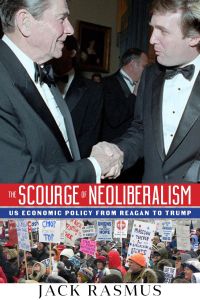
The tax system + financialization + destruction of unions, wage stagnation and benefits privatization have all resulted in accelerating income and wealth inequality in America. It’s all documentable, in my 2020 book, ‘The Scourge of Neoliberalism’, and before that in my 2005 book, ‘The (Class) War At Home’. And it’s been no accident of history. It was all policies planned in the late 1970s and evolving over the last four decades, reaching an unsustainable crescendo under Trump.

What’s going on now under Biden is a last chance attempt to try to make Neoliberal policies more palatable for workers; to restore it to a more acceptable form. We shall see if the Biden wing of US capital can pull that off. I am not optimistic they will. But history and time will tell. And it won’t take long.  In just the next 18 months it will become clear, which is all the time that Biden and the Democrats have to introduce an institutionalized and more acceptable form of Neoliberalism.

But that may be a contradiction in terms: Neoliberalism cannot be made more palatable in the end. It’s longer term dynamic is it can only become more oppressive (i.e. redistribute more income to the wealthy at the expense of the many). Otherwise it cannot survive as the main policy paradigm of US Capitalism.

Thus, longer term beyond initiatives of early 2021, Biden will not be able to restore it to a more acceptable form to the general US populace. By the end of the current 2020s decade, it will more likely be replaced–by either a more oppressive form of capitalist corporatism or by a more progressive, New Deal-like set of policies. The US is therefore in the midst of an historic juncture of sorts during the current first 2 years term of the Biden administration.

2021-2022 appears will be something similar to 1933-34, when Roosevelt had the choice to double down on corporate-first policies in response to the Great Depression, or to turn to New Deal policies that benefited the rest of the country and workers. He chose the latter. Obama had a similar juncture and opportunity in 2009-10 but, unlike Roosevelt, Obama chose to double down on pro-corporate policies. We know the result of that, in terms of both economic and political: Trump.  Carter had the same choice in 1979-80, turned to placating corporate interests, and that gave us Reagan and Neoliberalism. Biden is at a similar juncture once again. We shall see which way he turns. Turn wrong and we’ll get another Reagan, or Trump, or almost certainly something even worse.

Dr. Jack Rasmus
April 25, 2021

American unions are at an historic juncture. The recent election loss at Amazon represents an historic opportunity to regenerate the union movement that was lost. The fight to unionize Amazon is not permanently lost; it may only have just begun. But for unions to prevail down the road it will take more than the strategy and tactics used at the Bessemer, Alabama facility where labor lost by a 2 to 1 margin. Why does labor keep losing union elections when polls show more than 65% of Americans want a union? (And higher among younger workers).

Having been a union organizer myself with four different unions in previous years, what follows in my most recent Alternative Visions radio show is some of my comments on why Management strategies and tactics to defeat unionization prevail most of the time, and why Unions’ strategies and tactics mostly fail. The show commentary places the recent Amazon election in historical context of what I call union labor’s ‘Great Detour’, which began in 1947, accelerated in the 1980s under Neoliberal industrial policies, and continues to this day.

TO LISTEN GO TO:

https://alternativevisions.podbean.com/e/alternative-visions-union-labor-s-great-detour-1947-to-2021/

RADIO SHOW ANNOUNCEMENT:

Dr. Rasmus follows up last week’s analysis of the Union defeat at Amazon by placing it in historic context, from the growth of union membership in the 1930s and 1940s to the great strike wave of 1970-71 and the Great Detour and decline of unions under Neoliberal industrial parties that began with Reagan in the 1980s and continues to this day. How the 1947 Taft Hartley and 1959 Landrum Griffin Acts stopped union strikes for recognition in their tracks and how Employer-State strategy cooperation in the 1970s and beyond have rolled back union membership in the private sector from its peak of 35% (80% in basic industries like auto, steel, transport, etc.) to its barely 5% today. Rasmus explains the strategies and tactics used by employers, with aid of government, to prevent unionization in NLRB elections, such as recently occurred at Amazon. How these strategies and tactics—along with offshoring, free trade, onshoring of H1-B visas, outsourcing, contingent, gig, and other work—have together resulted in a near collapse of private sector unionization in America. Rasmus concludes with a comment on the failure of Obama administration do reform the problem of de-unionization and pass ‘card check’, as well as a review of the Biden administration’s recent PRO Act bill recently passed by the US House of Representatives but all but dead in the US Senate committee.

Watch my latest video presentation to Berkeley students and activists on the current state of the US economy, recession, and evolution of fiscal and monetary policies 2020-21. Why the US is still evolving through its Great Recession 2.0, entering a new phase, and why it still remains uncertain whether the second half 2021 will be a rebound or a sustained recovery. How today compares to 2008-10 Great Recession 1.0, and prior historical contractions in 1907-13 and 1929-30

TO WATCH GO TO:

https://drive.google.com/file/d/1D0m3rU0NM7xhh8JrE-8wWVCkUOjX-s90/view

For my initial assessment of Biden’s recently announced $2.3T Infrastructure Plan–and why it will have virtually no economic impact in 2021 and minimal even 2022-24, listen to my Alternative Visions radio show of Friday, April 2, 2021.

TO LISTEN GO TO:

https://alternativevisions.podbean.com/e/alternative-visions-biden-s-infrastructure-plan/

SHOW ANNOUNCEMENT

Today’s show focuses on Biden’s just announced Infrastructure Plan. Called a jobs plan, it will produce few jobs in 2021-22 and have virtually no impact on the near term 2021 economic recovery effort. Estimated by the Wall St. Journal at $2.3T, over 8 yrs., very little will hit the US economy in the much needed early stage of recovery in 2021. At best it will be passed no sooner that 3rd quarter 2021 and not then if filibuster in Senate is upheld. Composed of two phases, the second will not likely be passed (if at all) until 2022. Combined with the Biden prior Covid 19 Relief bill (American Rescue Plan) which projects less than $1T spending in 2021, the combined two fiscal spending bills (ARP and now American Jobs Plan, aka Infrastructure bill) will provide roughly $1 trillion stimulus to US economy in 2021, as it reopens aggressively in coming months. Dr. Rasmus discusses the outlines of Biden’s Tax plan, designed to cover part of the cost of the two stimulus bills. (see last week’s show for more details on Biden’s tax proposals).

How does Biden’s recently passed $1.8T Covid Relief Stimulus Act, just passed by Congress, compare to Franklin Roosevelt’s New Deal spending stimulus of the 1930s? For my commentary on the comparison, and related discussion, listen to my radio interview of March 31, 2021.

TO LISTEN GO TO:

Critical_Hour_689_Seg_5.mp3

Listen to my 14min. interview comparing Biden’s actual (<$1T spending in 2021) to prior stimulus measures of last December and March 2020. Why no bailout of renters, homeowners back mortgages, and students’ suspended debt payments was included in the Biden fiscal measures. Why the $1.9T is really only around $800B in 2021 spending.

TO LISTEN GO TO:

https://www.spreaker.com/user/radiosputnik/cdc-extends-eviction-moratorium-as-covid

Now that Biden’s $1.8T fiscal stimulus bill has passed Congress, and next a $2T+ Infrastructure spending bill will be soon proposed, the question is how will the multi-trillion dollar dual fiscal package be paid for? Part will be financed no doubt by federal government borrowing (i.e. selling Treasury bonds). Another part will be paid for with new Biden initiatives in the form of tax hikes on Capital (and individuals earning more than $400k per year).

During the 2020 election year Biden provided general outlines of his tax proposals–some of which were designed to reverse Trump’s massive $4T giveaway to businesses, investors and the wealthiest households.

Recently the Biden administration has begun to clarify in more details what his forthcoming tax proposals might be. That too will soon be further detailed. What are Biden’s latest tax proposals? How do they compare to his campaign year promises to voters?

For my description of the latest version of Biden’s tax policy, listen to my Alternative Visions radio show of friday, March 25, 2021.

TO LISTEN GO TO:

https://alternativevisions.podbean.com/e/alternative-visions-biden-s-tax-plan-crossroads-for-american-democracy/

SHOW ANNOUNCEMENT

Dr. Rasmus provides a first look at President Biden’s Tax proposals, designed to roll back the worst of Trump’s $4T tax cuts in 2018 for businesses and investors. Rasmus describes the 40 year historical tax shift in favor of the 1% wealthiest households, their businesses and their investments—a key hallmark of Neoliberalism policy since 1981. Biden’s 3-part economic recovery program—the $1.8T recent stimulus, the $2T-$3T infrastructure bill to be announced next week, and the tax proposals to help pay for both—are described in context of a struggling US economy and a global deterioration in Europe and elsewhere of the fight against Covid 19 and another economic downturn in many economies. What’s happening in Europe and the prospects of a third wave of Covid based on new and more dangerous variants from UK, So. Africa, and Brazil. Rasmus introduces the show with commentary on the current, intensifying fight to retain even limited democracy in America—as Republicans launch voter suppression legislation in 43 states and as Democrats offer HR 1 in Congress to ensure absentee and mail in voting. America’s ‘triple crises’ of Covid, a faltering economy, and a declining democracy are not over. Is a new phase in each on the horizon?

For my latest commentary on the growing attention in mainstream media that US government deficits are about to cause escalating inflation, check out my Friday, March 19, 2020 Alternative Visions radio show:

To Listen GO TO:

https://www.podbean.com/site/EpisodeDownload/PBFE45F4QHCDI

    SHOW ANNOUNCEMENT
:

Now that the Biden $1.9T (actually $1.8T) fiscal stimulus has passed, mainstream economists and media are pumping up the rhetoric it will soon lead to excess inflation and rising interest rates that will endanger the economic recovery. Rasmus debunks the notion that deficits and debt—or ‘too much money chasing too few goods’ cause inflation, as well as related ideological notions of mainstream economics. What has been the actually deficits in 2020-2021 due to the three bouts of economic fiscal stimulus during the pandemic (March, December, and now March again)? What have been the actual causes of the deficits (besides the fiscal stimulus)? What’s the likelihood of inflation in 2021 and beyond and its real causes apart from deficit spending? What are financial markets reacting now so negatively driving up long term Treasury interest rates? And what instability might that lead to?
Bond interest rates are rising fast, signalling a problem with business, households & local govts repaying record levels of debt recently accumulated. Financial crises occur not just when debt reaches excessive levels (which it has in the wake of the covid crisis in the real economy), but when businesses, households & govts can no long ‘service’ that debt (i.e. pay principal & interest) on the accumulated debt. A harbinger of financial system problems may be indicated by the current rapid rise of US bond rates and other interest rates that follow. On top of the excessive business and govt debt recently accumulated there’s the question of how will tens of millions of households now pay for their debt accumulated over the past year: more than $75B in back rent payments, $70B in back owed mortgages, $hundreds of billions in forbearance of student debt, etc. The current $1.2B Biden fiscal plan (yes, only $1.2B not $1.9B per the Congressional Budget Office) does not address the debt repayment problem.

How will households repay their record debt, when more than 1.3m a week are still filing for first time jobless benefits? When 24m are still unemployed? When it is clear business will recall workers to jobs very very slowly, when hours of work for those employed will be most part time and temp jobs, when wages will remain mostly stagnant, and when rising prices now taking off will reduce their real wages and real incomes even more?

Meanwhile, as businesses see bond and interest rates now rising rapidly, they too are taking on even further record levels of debt to take advantage of the soon disappearing low interest rates. Will Zombie companies be able to pay back the even greater debt load in progress? Business sectors like commercial real estate, travel, entertainment and big box retail, malls, etc. are candidates for default and bankruptcy as rate levels rise more rapidly.

Recently I was asked to explain by Michael Albert and ‘Revolution Z’ media how Wall St. stock markets work, what’s up with the recent Gamestop bubble, what’s financial speculation, what causes financial instability and crises–and how they are all related to, or unrelated to, the real economy. Presented in simple terms, the interview clarifies for laypersons how the current capitalist financial system functions to make investors ever richer, while the rest of the real economy experiences periodic great recessions, wages stagnate and fall, and the quality and quantity of jobs deteriorates.

    TO LISTEN GO TO:


https://www.patreon.com/posts/47552141
With all the hype emerging in mainstream media and among politicians about the US economy about to boom, Dr. Rasmus discusses a contrarian view based on the various warning signs in the US economy now emerging. Despite the official talk of GDP recovery underway this quarter there’s: the Fed’s warning this week of rising ‘insolvency risk’ and business bankruptcies coming; new claims for jobless benefits rising again and consistently more than 1 million/week since October; the recent retail sales bump as really a warning not good news; financial market bubbles churning as investors chase ever more risky yield in cryptocurrencies and worthless stocks; China’s introduction of its own digital currency; and growing indications of Biden’s ‘bipartisan back-tracking’.

    To Listen GO TO:


https://alternativevisions.podbean.com/e/alternative-visions-economic-red-flags-rising/