Feeds:
Posts
Comments

Archive for the ‘Uncategorized’ Category

I have just recently set up a twitter account, on which I will be posting daily choice quotes about the economy and related events that you might find interesting. You can ‘follow me’ from this blog by selecting the twitter button on the upper right hand corner of the main blogpage.

Here’s some tweets of the past two days on the presidential debate last wednesday and the recent jobs report on friday:

“Big corps sit on $2.5 trillion cash. Big banks another $1.7 trillion. Multinationals $1.4 trillion. They need more tax cuts to create jobs?”

(Quote by Obama during the presidential debate): “We both (Romney-Obama) agree corp taxes are too high” (Corp tax 2010: 12.1% of profits. Ave Corp Tax rate 1987-2008: 25.6%)

Two initial tweets on the recent presidential debate:

‘Neither candidate showed up. Romney sent his stand in who said the opposite and Obama sent an empty suit’

‘Romney pushed Obama around the ring while Obama politely jabbed and referee Lehrer failed to enforce the rules’

Read Full Post »

With the release of today’s jobs report by the bureau of labor statistics, a public controversy has erupted over the veracity of the jobs numbers. Representatives on the extreme right claim the jobs numbers are being ‘cooked’ by the labor department. One of the two jobs report, the current population survey, reported some 870,000 new jobs were created last month. In contrast, the current establishment survey, the other labor department report, noted only 114,000 jobs were created. The right wing explains this by alleging outright falsification of the jobs report by the labor department. As is the tendency of the extreme right, they are not big on rational analysis. This writer does not buy the idea that outright falsification is the explanation. However, I do think there’s something wrong with the jobs numbers and have repeatedly been saying so on this and other public blogs for more than a year now.

I have been writing consistently about the problems in the jobs reports, pointing out that for last three years in a row, from 2010 to 2012, we see an interesting trend. Every fall and winter the jobs reports show extraordinary job gains well beyond averages, while every spring-early summer the jobs gains collapse. There is indeed something going on with the jobs numbers, though it’s not falsification.

Last month’s 870,000 CPS (current population survey), which determines the unemployment rate, included nearly 600,000 involuntary part time jobs created. That indicates either of two things: employers are laying off full time workers and hiring part timers; or hiring part timers instead of full timers because they, employers, do not see sustained economic recovery on the horizon and they are hiring more easily laid off in the future part time workers. The problem with part time hires is that the jobs reports considers them–for purposes of determining the standard U-3 unemployment rate–as full time workers. They may be working part time in fact but are considered fully employed when calculating unemployment rates. Hiring that many part timers, or even several hundred thousand less, represents a continuing very weak labor market and not an improving one. This view is supported by the more stable second labor department jobs survey, the establishment report, made up of 400,000 employers reporting each month (and thus not a real ‘survey’ in fact), which showed last month a continuing bare growth in jobs. In fact, 114,000 jobs growth is still well below what it takes to even absorb new entrants into the work force.

However there may be an even more accurate explanation why the 873,000 number is a gross aberration (but not falsification) in the jobs numbers. I’ve been warning about this for some months now. It has something to do with the repeated exceptional jobs gains coming every year the last three years in the fall-winter period, followed by a repeated collapse in the jobs numbers in spring-early summer also for the past three years.  The explanation goes something like the following (bear with me, it’s a bit wonkish):

The current population survey (the 873,000) represents a statistical operation on raw jobs data that adjusts that raw (i.e. actual) jobs data by means of several statistical operations–i.e. seasonality, etc.—to get to the 873,000.  But before the raw data is statistically adjusted, another source of raw data is added to the initial data and only after that is the statistical adjustment carried out. This second source is jobs data estimated from assumptions about New Business Formation that are lagged up to nine months.

Here’s how it works. The labor department assumes net new businesses are formed nine months previous. That would be last November-December 2011. These data on new business formation are very inexact. It’s not actual new businesses but an assumed historical average of new businesses. So the past years in which new business formation was high is substitute for the more recent period when new business formation is in fact low, or even negative. It’s really a  shaky estimation process.

However, that shaky estimation, up to nine months old, ends up as additional new jobs created data that is then added to the raw data for new jobs created collected last month from the population survey. The assumed jobs created from new businesses created nine months ago and the raw data for new jobs from last month’s survey are then added together. Only then are the statistical adjustments made on that combined raw data to come up with the reported number of 870,000. That all sounds a bit technical, and it is. But some economists are highly critical of this process of adding raw data from historically averaged, assumed new business formation nine months ago to raw data from the survey, and then adjusting it and rolling it up into the publicly reported numbers. This writer is one of many skeptics of the methodology.

For a further clarification of this, readers should read my various reports on the jobs numbers in 2011 and early 2012 on my blog’s archive (jackrasmus.com) and other public blogs.

So there is definitely something wrong with the numbers on jobs. I don’t mean only last month’s jobs report. When there is so much divergence between the two jobs reports (870,000 vs. 100,000) something clearly is amiss. But more importantly, evidence of something out of the ordinary happening is reflected in the three years running of inordinate jobs growth in fall-winter followed by jobs collapse in spring-early summer. One year such extreme aberration can be disregarded. But three years in a row now is another thing. Something is wrong.

But this is not the same as saying the numbers are being ‘cooked’. The irrational right wing should do its homework instead of relying on emotional outbursts to explain the obvious anomaly in the jobs numbers. Likewise, the liberal-Democratic Party center should stop trying to apologize for the obvious terrible jobs creation record of Obama for the past three years–notwithstanding last month’s extreme divergence in the two jobs reports–and stop trying to paint a picture that the labor market is now rapidly mending, which it definitely is not. There are still 23 million jobless. That means after trillions of dollars in tax cuts to investors and businesses since 2009, and trillions more in subsidies and government spending, plus more than $10 trillion pumped into the banks by the Federal Reserve—we got barely two million net jobs created since June 2009.  That’s a costly, and horrible, jobs creation record. Period.

In the recent presidential debate last Wednesday it was abundantly clear neither candidate has anything remotely representing a jobs program, besides just giving more tax cuts for businesses (that just get hoarded and not invested) and lying about how more free trade (with the Transpacific Partnership free trade proposal) will create jobs instead of destroying them. But that’s in a nutshell the same program for jobs creation being offered by both candidates.

Dr. Jack Rasmus
Jack is the author of the book, “Obama’s Economy: Recovery for the Few”, April 2012. His blog is jackrasmus.com and website: http://www.kyklosproductions.com. He is the host of the radio show, ALTERNATIVE VISIONS, on the progressive radio network, PRN.FM, in New York, every wednesday at 2pm.


Read Full Post »

A more detailed analysis of the 1st presidential debate will be soon forthcoming, but my initial impressions may be expressed by means the following boxing metaphor:

Tonight Romney pushed Obama around the ring, throwing 10 times the number of punches of his opponent, while the president politely jabbed, and (replacement) referee Lehrer allowed the challenger to repeatedly violate the rules without a single warning”.

For more brief commentary remarks, follow me on twitter, accessible from my main blog page or @drjackrasmus

Read Full Post »

This week the first presidential candidates’ debate will be aired on television. A good part of the topic of the first debate will focus on economic programs of the respective candidates. They will say they represent fundamental differences. This is in part true. But equally true is that their positions on the economy in many important aspects are strikingly, and disturbingly, similar. Read the following except from my just published article on this topic in Z magazine.

This week the first televised debate between the two presidential candidates will be held and a good part of the debate will address programs for economic recovery for the next four years. Both parties and candidates are now proclaiming there are historic, stark differences and choices between them; that this election will mean choosing two fundamentally different paths for the country for years, and perhaps decades, to come with regard to the future of the economy in terms of jobs, taxes, deficits, housing, state and local governments, and other economic indicators. A closer examination reveals, however, that while there are some clear differences between the two candidates on economic matters, the similarities in their economic proposals are both striking and disturbing.
JOBS
OBAMA
Upon entering office in 2009 Obama promised to create 6 million jobs if his $787 billion stimulus bill of (mostly business) tax cuts and spending subsidies to states and unemployed were passed. But after 18 months neither the tax cuts nor subsidies resulted in any appreciable job creation. Between June 2009 when the recession was officially declared over, and 18 months later in December 2010, an additional 1.1 million private sector jobs were lost. By year end 2010 the president had to resort to the claim he had at least had ‘saved’ further millions of jobs. With the effects of the $787 billion stimulus mostly spent, his job creation strategy then shifted mid-2010. A second recovery program passed late 2010 composed totally of an additional $800 billion in tax cuts—including $450 billion in extended Bush tax cuts Obama promised in 2008 he would not do.
This $800 billion more in tax cuts was supplemented by a new policy focus on manufacturing and promoting exports as the primary program to create jobs. Multinational corporate CEOs , like General Electric’s Jeff Immelt, were put in charge of his job creation program. That meant more free trade agreements, more deregulation for business, and more subsidies for U.S. export companies.
In 2011-12 still more business tax cuts were proposed as the way to create jobs. In 2011 tens of billions more for small business to hire unemployed and a so-called ‘JOBS’ (Jump Start Our Business Startups). JOBS was nothing more than a cover for more tax breaks and financial deregulation for start up companies, but Obama praised it as ‘a game changer’ for employment. More subsidies to the states to hire teachers and emergency responders, now being laid off in the hundreds of thousands, was also proposed but never passed Congress.

Obama’s Jobs Programs over the past 42 months therefore amount to the following:
• Tax cuts and more tax cuts for businesses
• Manufacturing-centric policies driven by more Free Trade agreements, more manufacturing export subsidies, and more business deregulation
• More subsidies to the states to hire teachers and emergency responders
These programs have proved pretty much a total bust, however: After $3 trillion in tax cuts and spending, total private sector employment has risen by only 2 million, or about 50,500 per month, which is well less than half that needed just to even absorb new entrants to the labor force. Total unemployment, as measured by the labor department’s U-6 rate, has fallen by a mere 1.3 million—from 24.6 million in June 2009 to 23.3 million in July 2012. Between June 2009 and July 2012 a paltry 200,000 manufacturing jobs were created, for an average of a mere 5,000 per month. And Obama’s much vaunted recovery of the Auto Industry has produced 157,000 auto jobs, which is still 180,000 fewer than existed at the start of the recession in December 2007.
Despite this embarrassing record on job creation, the President in his September 6 convention speech indicated clearly he would ‘stay the path’ with this business tax cuts + manufacturing promotion + free trade as his basic approach to job creation. He made it clear his second term’s strategy would be to “export more products” and that he would continue to work with business leaders to “create 1 million more manufacturing jobs over the next 4 years”. In his speech he also proudly proclaimed he had signed free trade agreements “bringing jobs back” and declared he would sign still more—a clear reference to his proposal for creating a ‘Trans-Pacific Partnership’ (TPP), a free trade agreement with all the countries of the pacific rim which Obama has been promoting for several months and an even bolder goal than George W. Bush’s Free Trade of the Americas that was proposed in 2005 to create a free trade zone throughout all of north and south America. In other words, in terms of jobs creation programs don’t expect much different from his first term in either job creation programs or results in an Obama second term.
ROMNEY
Romney’s view on how to create jobs focuses even more heavily on tax cuts as the primary approach. Romney proposes to create 12 million jobs by 2017. The primary engine would be extending the entire $3.4 trillion in Bush tax cuts of the last decade as is for another decade (minus extending the cuts for those households earning less than $40,000 a year). Obama would extend the Bush tax cuts for all but the top 3% households. So Obama cuts out part of the ‘top tier’ of households from the Bush tax cuts extension, while Romney cuts out the ‘bottom tier’ of households. (Both support, however, reducing the top corporate tax rate from current 35%, as noted below).
To create the 12 million, however, Romney proposes more than just extending the Bush cuts: he calls for even more tax cuts for corporations (as does Obama), reduced business regulations and more Free Trade agreements (ditto Obama), but adds more oil drilling and some token worker retraining as addenda to his jobs program.
However, Romney’s 12 million jobs goal is somewhat of a sham. It amounts to creating only 180,000 jobs a month on average, i.e. just 50,000 more than needed for new entrants to the labor force each month. That means reducing the current 23 million jobless by only 50,000 a month, which would leave 20 million still unemployed by 2017. So the Romney program is not really a program to eliminate the massive jobless overhang today—apart from the question of whether more business tax cuts, free trade, oil subsidies, etc. will even create the 12 million jobs in the first place.
In short, the relationship between job creation programs and business tax cutting is just a matter of degree between the two presidential candidates. Romney advocates ‘Bush tax cuts on steroids’ to create jobs, while Obama exempts the top 3%. Both strongly propose Free Trade and more business deregulation as job creation measures. Obama proposes subsidies to states to hire teachers and firefights, while Romney doesn’t and proposes token job retraining. Romney wants still more cuts and subsidies to oil companies; Obama does not. Both support multiple handouts to small businesses. But all these programs have been proven failures to date, so the unemployed have little to expect from either candidate once elected.

TAXES
OBAMA
As previously mentioned, Obama proposes to discontinue the Bush tax cuts for the wealthiest 3%. The top marginal tax rate for individuals would be allowed to rise from 35% to the 39.6% level of the Clinton years, impacting wealthiest households earning more than $250,000 a year. Taxes on the wealthiest 1% (earning more than $600,000 a year) would rise $93,000 a year. (For millionaires a tax hike of $296,000 a year). The tax on capital gains, now at only 15%, would also increase to 20% under Obama proposals. Oil and gas industry tax breaks would be reduced.
But what Obama proposes to ‘taketh away’ from the top tier of the personal income tax he proposes ‘to giveth’ to their corporations. His proposals include reducing the top corporate tax rate from current 35% to the 28% it was under Reagan. This shift is proposed despite the fact that in 2011 corporate taxes amounted to only 12.1% of profits—compared to the 1987-2008 period when corporate taxes averaged 25.6% of profits. For all businesses, corporate and non-corporate, the super-generous ‘bonus depreciation’ provision of the past two years, in which businesses can write off the cost of all capital investment in the first year of purchase, would also be continued despite its costing a whopping $55 billion a year.
Obama also favors changing the taxing of U.S. multinational corporations, reducing taxes on their offshore profits, even though that group today is hoarding $1.4 trillion of in their offshore subsidiaries and refusing to pay US taxes on it. In exchange for this tax reduction, Obama proposes to raise taxes in a yet unspecified way on those multinationals that offshore jobs.
ROMNEY
Romney’s tax program is once again an extreme version of Obama’s but with many content similarities. In addition to extending all the Bush tax cuts of the past decade, for yet another decade, which would cost the US Treasury another $4.6 trillion according to the Congressional Budget Office research arm, Romney proposes the following tax changes:
• Cut the personal income tax rate for the rich even further than Bush, by 20% across the board.
• Cut the top corporate tax rate from 35% to 25% (vs. Obama’s 28%)
• Introduce a ‘territorial tax’ for US multinational corporations, which would in effect end the current foreign profits tax they pay (or in fact now refuse to pay)
• Repeal the Medicare 2.9% additional tax on the wealthy contained in Obama’s 2010 ‘Affordable Care Act (Obamacare) by repealing the entire Act.
• Allow tax credits for those earning less than $40,000 a year to expire (i.e. earned income, child care, and other tax credits).
• End all taxation on capital gains, dividends and interest income for households earning less than $200,000 a year.
• Keep the capital gains, dividends and interest income taxed at current 15%.
• Bigger tax cuts for business research and development
• End the Alternative Minimum Tax (AMT) altogether, which impacts those earning around $150,000 a year and above
• End the Estate Tax altogether
In summary, apart from their respective positions on extending the Bush tax cuts, both Obama and Romney are largely in synch on introducing more massive cuts in corporate income taxes, reducing corporate taxes to the 25%-28% range from current 35%–despite corporations today paying the smallest share of taxes from profits. Both have plans as well to provide multinational corporations even more tax concessions. Romney differs in proposing to give upper middle class households bigger incentives to invest in stocks, bonds and other interest bearing securities—an ultimate boon to his stock-bond market buddies. He also proposes to give the wealthy big tax bonuses by ending the Estate, Alternative Minimum, and forthcoming Medicare 2.9% taxes. Both propose more tax cuts that will not reduce the projected US budget deficits over the coming decade, but actually make them worse—and much, much worse in the case of Romney—leading in both cases to even more massive cuts in spending programs than either candidate is so far admitting to.
BUDGET DEFICITS
OBAMA
Obama’s policy with regard to US deficits is his pledge to reduce the deficit by $4 trillion over the next decade. That has been Obama’s stated goal since the deficit debates in 2011 leading up to the debt ceiling crisis of August 2011. That $4 trillion goal, moreover, is the same as proposed by his Deficit Commission (Simpson-Bowles), Paul Ryan in the House of Representatives, and various other Senate and ex-government officials. Details of the president’s $4 trillion deficit reduction plan are to be found in his 2012 budget. It is perhaps of some interest to note that Obama’s budget projections include a $5.8 trillion bill for defense spending over the decade, an amount which is 23% greater on an annual average than defense spending during the Bush years, 2001-2008.
The Congressional Budget Office has issued a different estimate of the likely budget deficits over the next decade. Given current tax cuts and spending projections, the CBO estimates the Obama deficits will amount to $6.4 trillion from 2013-2022. In January 2013 government spending will decline by $1.2 trillion over the coming decade, based on the debt ceiling deal agreed upon by Obama and the Republican House of Representatives in August 2011. Raising the debt ceiling once again will therefore become a major issue in early 2013. That means major tax increases and/or further spending cuts will be on the agenda immediately after the November 2012 elections regardless who is elected president (the challenge sometimes referred to as the coming ‘fiscal cliff’ by the media). Republican insistence on no tax increases and on raising defense spending even higher than projected by law or in the Obama budget, will mean an historic confrontation between deficit reduction and massive cuts in social program spending, including not only Medicaid but Medicare, Education, Social Security, and other discretionary spending programs. As this writer has been predicting, the confrontation will start immediately, within days, of the upcoming November 2012 elections—again regardless of who is elected president.
ROMNEY
As frightening as the upcoming budget deficit confrontation following the elections will be with the Obama budget as starting point, the Romney budget-deficit proposals represent a deficit crisis of even far greater magnitude.
Romney tax cut proposals include the major elements of a continuation of the Bush tax cuts for another decade, at a cost of $4.6 trillion, plus adding trillions more in business-investor tax cuts. The result is deficits for the next decade equivalent to approximately $10 trillion! To address this massive deficit Romney proposes cutting federal spending from its current 24% of GDP to 18%-20%. That 6% of GDP in 2013 equals an immediate reduction in spending and/or increase in working poor and middle class tax cuts amounting to $300 billion. By 2015 the estimate is $500 billion, presumably rising further thereafter. In addition, he proposes to reverse the sequestered scheduled $500 billion in defense spending cuts agreed to in Congress in August 2011. The increases in working poor and middle class tax cuts were noted above. The spending cuts would mostly come from discretionary non-defense spending on items like education, transportation, healthcare, etc., for which Romney proposes a 5% cut across the board. The 5% represents no more than $60 billion a year. As others have pointed out, the Romney proposals do not add up and it is unclear how the 5% discretionary cuts, no defense cuts, retaining Bush tax cuts, adding trillions more in corporate-wealthy individual tax cuts can cover the $10 trillion. Proposing to reduce federal spending by 6% of GDP means spending cuts and/or tax increases totaling at least $900 billion a year. It can only mean unmentioned additional massive cuts in Medicaid-Medicare-Social Security and historic reversals in middle class tax breaks that are left conveniently unmentioned.
The Romney deficits therefore mean not only massive social spending cuts but hundreds of billions more in middle class tax increases as well. High on the list of the latter would have to include the elimination of tax deductions for health care and pension contributions by workers, virtually ending the mortgage interest and state income tax deductions, new taxation on Medicare benefits, and ending most of the earned income tax deduction for the working poor. Sharply reducing, or even ending, these deductions would be necessary to accommodate Romney’s proposed business and investor tax cuts. Romney would additionally end Obama’s Affordable Healthcare Act, reducing the deficit by another $.9 trillion. The rest presumably would come from other spending cuts in education, Medicaid, Medicare, and Social Security.
In summary, whoever wins the election, get ready for massive social spending cuts and a fight over how little to raise taxes. The deficit reduction proposals of both candidates envision historic cuts in social spending. Both envision more tax cuts for corporations that would additionally have to be made up from spending cuts and/or middle class tax hikes. Obama’s deficit reduction plan envisions some tax increases on the wealthiest individuals, while Romney’s envisions trillions of dollars more tax cuts for the wealthy, paid for by tax hikes by the poor and middle class as well as historic cuts in social spending of even greater magnitude than Obama’s.
FREE TRADE
There is virtually no difference between the two candidates on trade policy, and free trade agreements in particular. Both strongly supported recent free trade agreements with Panama, Columbia, and South Korea. And Romney supports Obama’s current drive to implement the biggest expansion of free trade with the ‘Trans-Pacific Partnership’ (TPP) pacific rim free trade policy, a development that will dwarf in scope and magnitude even Bill Clinton’s passage of NAFTA and his opening of China trade. According to the Economic Policy Institute, China trade alone has cost the US 2.7 million jobs just in the past decade. NAFTA millions more. Neverthless, both candidates unreservedly advocate accelerating free trade agreements.
The battle between Romney and Obama on trade amounts to token differences on how to show they are ‘tough on China’. Romney accuses Obama of being ‘too soft’ on China and demands more punitive action. Both candidates talk in vague generalities about the ‘offshoring’ of US jobs that has occurred by the tens of millions in recent decades, but neither offers any specific proposals for addressing the issue.

HEALTHCARE-MEDICARE/MEDICAID
OBAMA
The heart of Obama’s Healthcare policy is, of course, the retention of his 2010 Affordability Care Act. Costing nearly $1 trillion over the rest of the decade, the Act does provide a number of meaningful benefits for the general populace. However, it has two great flaws: first, it amounts to a health insurance company subsidy bill. Health insurers will receive hundreds of billions of dollars of extra business. The second flaw is that it fails fundamentally to control health insurance and other health care costs. The problem of runaway healthcare costs will thus re-emerge and continue under the ACA, a problem which has already emerged as health insurance premiums and other costs have once again begun surging in 2011-12.
On the positive side, the ACA raises taxes on the wealthy by another 2.9%–which is the real source of much of the opposition to the ACA by the wealthy, transmitted through their manipulation of the Teaparty on the issue. But it also includes a reduction in payments to doctors and health providers in the amount of more than $700 billion. That will inevitably lead to doctors and providers refusing increasingly to provide services to Medicare patients. The ACA is thus a form of income shift that promises to reduce health care access. That is the price to be paid for the subsidization of health insurers and coverage extension to the tens of millions without any coverage.
It should further be noted, that Obama has signaled in July 2011, as he sought desperately an agreement with Republicans on the debt ceiling debate, that he was willing to cut Medicaid and Medicare by $700 billion despite the proposed expansion of Medicaid in his ACA. That public proposal provoked a near revolt by Democrats in Congress and was withdrawn. Nevertheless, it remains ‘on the table’, as they say, and will most certainly arise again immediately after the November elections. Voters will not hear of this during the election campaign, but will most certainly once the election is over.
ROMNEY
Romney’s program with regard to health programs and policy top priority is to repeal Obama’s health care act of 2010. Next in priority is his complete embracing of his Teaparty Vice President, Paul Ryan, view for Medicare. The Ryan plan is to voucherize Medicare, provide payments to senior to then go and buy private health insurance—an even bigger windfall for insurance companies than Obama’s subsidies to insurers in his ACA. Ryan has projected this will ‘save’ the federal government $700 billion. However, not all seniors will receive the same voucher payment. Some will get less than others, thus creating a kind of ‘two tier’ voucher system. Moreover, there are no assurances the value of vouchers will increase annually with the rising cost of healthcare services, thus requiring seniors to increasingly pay more out of pocket for healthcare insurance. The main beneficiary from this, apart from health insurance companies, is the federal government which Ryan estimates will save $700 billion in government spending over the next decade. The Romney-Ryan Medicare voucher plan thus represents an income transfer of hundreds of billions from seniors to both insurers and the government.
Romney-Ryan are also major proponents of massive reductions in the Medicaid program, proposing to cut federal and state Medicaid costs by turning it into block grants to the States—many of which would refuse to participate or would take the money in the block grant and spend it elsewhere.
SOCIAL SECURITY
Proposals by both candidates are almost identical with regard to social security. Both are purposely saying little before the election about how they would address social security. Romney proposes vaguely that the age for eligibility for retirement benefits should be raised, as does Obama. Neither say raised to what or how quickly. Both suggest cost of living adjustments annually should be lowered. Obama implies by changing the way the consumer price index is applied. Romney goes further and recommends the creation of a ‘two tier’ system in the future (similar to Medicare) in which seniors with a certain level of retirement income would receive less social security benefits. What’s left unsaid by both is their agreement to target social security disability benefits for major reductions.
HOUSING CRISIS
OBAMA
Apart from the failure to create jobs, the next greatest economic policy failure of Obama’s first term has been his reluctance to direct confront the housing crisis. The housing sector has languished in a veritable depression for three and half years, with home building and jobs stuck at only a third to half of pre-recession levels. More than 12 million of the 54 million mortgaged homeowners in the US have been forced into foreclosure, often illegally by the banks. More than 8.5 million on Obama’s watch, while than 10 million similarly languish with mortgages in ‘negative equity’.
From the beginning in 2009 Obama’s policies have focused on subsidizing mortgage lenders and mortgage servicers (big 5 banks), to help them move foreclosed homeowners out of their homes and to resell to new buyers. Early 2009 Obama programs like HAMP (Home Affordability Modification Program) are acknowledge failures, providing tens of billions of dollars of subsidies to banks and homebuilders and token assistance to homeowners.
In 2010 Obama then ignored the ‘robo-signing scandal’ that broke that summer, leaving it to state attorneys general to deal with. However, when it appeared legal suits would cost the banks potentially hundreds of billions of dollars, only then did the Obama administration intervene in 2011. That intervention was designed to help the banks—not homeowners—by limiting banks’ liability to homeowner and state legal suits. As part of that compromise, banks’ liability from legal suits arising out of robo-signing illegal foreclosures was capped at a mere $25 billion. Payments to homeowners illegally foreclosed have averaged only $1,500 each in the settlement and less than a billion of the $25 billion. Recent reports are that the $20 billion is not going to reducing loan balances for homeowners in ‘negative equity’ but is being deducted by banks against the $25 billion in the form of charges against short sales of homes in negative equity. In other words, homeowners are not being assisted to remain in their homes, but assisted in vacating them—which the banks then resell to new buyers at still further profit.
In exchange for the limits on liability, the banks were ‘encouraged’ to participate in latest OBAMA housing recovery program, his 2012 program called HARP 2.0. The HARP program was a ‘quid pro quo’ for relieving from pending massive liability action by the States. But HARP 2.0 is, in final analysis, just another ‘banker subsidy’ program. Not only are the big mortgage banks protected from further legal suits, but they are profiting nicely from the program. In exchange for refinancing homeowners in negative equity, the banks involved receive a commission of 5 ‘points’ (each point=1% of the value of the mortgage) from the quasi government mortgage agencies, Fannie Mae and Freddie Mac. Five points on a $500,000 mortgage refinancing amounts to a generous $25,000 fee paid to banks by the federal government for each refinancing. In turn, these costs incurred by Fannie and Freddie will have to be restored with funding from Congress and thus the taxpayer. HARP 2.0 remains as Obama’s latest centerpiece program for rescuing the millions of homeowners illegally foreclosed or in negative equity.
ROMNEY
Romney’s program for ending the Housing crisis includes the following measures: first, to sell the 200,000 estimated local government owned homes. Somehow that is supposed to help raise home values, according to Romney, but will actually increase the excess supply of homes on the market and thus further depress home prices in most cases. Another Romney proposal is a vague demand to ‘restart lending’ to credit worthy borrowers. How to force banks to lend to homeowners, when they have been clearly reluctant to lend to small-medium businesses, is not explained in the Romney proposals. Romney’s Housing solution also calls for major reform of the Fannie Mae-Freddie Mac government mortgage institutions as well as still further deregulation of mortgage lenders and banks—i. e. two long time conservative demands designed to further privatize and deregulate the housing market.
CONCLUSIONS
While there are several dramatic differences between the Obama and Romney economic programs, there are also several almost identical programs shared by both. Both favor major reductions in corporate taxes. Both advocate hundreds of billions in social spending cuts, including entitlement programs. Both are almost identical in their positions on Free Trade.
Concerning tax policies, both propose to extend much of the Bush tax cuts—Obama suspending the cuts for the top 3% and Romney eliminating tax credits for the working poor and lower middle class. Obama has proposed some minor tax loophole closings, while Romney proposes additional, massive tax cuts for investors and businesses on top of the Bush tax cuts. Obama’s deficit over the decade amounts to a sizeable $4-$6 trillion but Romney’s more than $10 trillion. Both mean massive cuts in social programs coming immediately after the November elections, with Romney requiring major middle class tax hikes as well. Obama’s budget is very generous to Defense, and Romney’s even more so. A big difference between the two exists with regard to healthcare programs, including Medicare and Medicaid. Romney wants to destroy Obama’s ACA immediately and Medicare eventually. Both appear quite willing to gut Medicaid spending, with Romney cutting other discretionary spending by additional trillions over the decade.
These comparisons mean that, regardless who is elected president, an historic reduction in social program spending is on the agenda for the weeks immediately following the November 2012 elections. Defense spending will be either totally or partly protected from the cuts. And taxes will be further reduced for corporations, tokenly raised for wealthy individuals, and most likely significantly raised for middle class and the working poor. Nothing of any significance will be done to address the Housing crisis and programs to create jobs will continue to fail to have much impact.
It is this scenario that has prompted this writer repeatedly to predict the likelihood of a double dip recession in 2013, especially if the Eurozone crisis continues to deteriorate and China and the rest of the global economy continue on a path to an economic ‘hard landing’. It is possible, if Obama is re-elected, the fiscal austerity coming in early 2013 may be delayed a year and effectively ‘back loaded’ to start taking its greatest effect a year later in 2014. But if Romney is elected and Republicans control either, or both, houses of Congress the more draconian austerity programs will take effect earlier in 2013. That alone will ensure a double dip recession. And if the Eurozone slides deeper in recession and banking instability, virtually guarantee a double dip.
Dr. Jack Rasmus
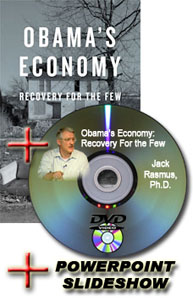
Jack is the author of the new book, “Obama’s Economy: Recovery for the Few”, April 2012, and host of the radio show, ALTERNATIVE VISIONS, on the Progressive Radio Network, PRN.FM, in New York, on Wednesdays at 2pm. His website is http://www.kyklosproductions.com and blog, jackrasmus.com. Copies of the book can be purchased at the website or blog bundled with a DVD and a 66 slide powerpoint slideshow on the current state and future direction of the US economy.

Read Full Post »

Two Announcements for Readers of this Blog:

1. Dr. Rasmus’ new book, OBAMA’s ECONOMY: RECOVERY FOR THE FEW, can be purchased now bundled with a 1.5 hour video presentation on the book and the US economy on DVD. The DVD includes an integrated 66 slide powerpoint slideshow and a separate access to the slideshow as well. All 3 item–book, DVD, and slideshow–are now available at discount for $35.00 plus shipping. Buy through Paypal by clicking on the book-DVD icon on the right hand sidebar of this blog.

2. Dr. Rasmus will be the host of a new radio show, ALTERNATIVE VISIONS, that will begin on wednesday, September 19, at 2pm New York time, and every wednesday thereafter, on the Progressive Radio Network online at PRN.FM. Past shows will be archived there and on Dr. Rasmus’ own website: http://www.kyklosproductions.com. The first show will discuss ‘OBAMA vs. ROMNEY ECONOMIC PROGRAMS in detail.

Read Full Post »

INTRODUCTORY COMMENT: THIS PAST WEEK THE US CENTRAL BANK, THE FEDERAL RESERVE, ANNOUNCED ITS THIRD ITERATION OF DIRECT MONEY INJECTION INTO THE ECONOMY, CALLED ‘QUANTITATIVE EASING’ (QE3). THIS THIRD FED MOVE WAS PREDICTED BY THIS WRITER LAST DECEMBER 2011 (see my article, ‘Z’ magazine, January 2012, ‘Economic Predictions: Present and Future’), EVEN THOUGH THE FED AT THAT TIME (December 2011) HAD JUST INTRODUCED ITS PRIOR ‘QE 2.5’ PROGRAM, CALLED ‘OPERATION TWIST’. BUT QE PROGRAMS MOSTLY BOOST STOCK & BOND MARKETS, DERIVATIVES TRADING, COMMODITIES, AND OTHER SPECULATIVE FORMS OF INVESTING–AND HAVE VERY LITTLE EFFECT ON THE REAL ECONOMY, HOUSING, OR JOB CREATION. READ BELOW WHY THE LATEST ‘QE3′ WILL HAVE THE SAME NEGLIGIBLE EFFECT AS ITS PREDECESSOR QEs BUT WILL, LIKE QEs BEFORE IT, AGAIN BOOST INVESTORS’ PROFITS STILL FURTHER.

Last Friday, Sept. 14, the US Federal Reserve announced its latest version of massive liquidity (money) injections into the US banking system. Called ‘Quantitative Easing 3’, it follows earlier QE1, QE2, and QE2.5 money injections, that already amounted to $2.75 trillion of direct purchases of mortgage and other bonds from investors by the Fed, since early 2009 nearly four years ago.

The Fed’s immediately preceding QE 2.5 program introduced in 2011 (costing $400 billion) had not yet finished and the Fed nevertheless announced its latest successor version, QE3.  Even potentially more generous than its predecessors, QE 3 will be an open ended tab of free money to banks and investors, amounting to $40 billion a month for an undetermined number of months to come. It could therefore be an even greater subsidy to banks and investors, in terms of magnitude, than previous QEs.

The Fed and the US press reported the new QE3 as necessary to boost the stagnant labor market in the US today–which has not been able to create jobs sufficient to even absorb the entry of new workers into the labor force–and to boost the housing market that continues to languish for years now at depression levels. True unemployment today hovers around 23 million, where it has remained consistently now for several years. Housing continues to ‘bump along the bottom’ in terms of nearly all indicators, as it also has for the past three years.

But QE3 will have no more effect on job creation, housing, or general economic recovery than has its predecessor QEs. QE is not about boosting jobs, housing, or the real economy. QEs are about subsidizing investors and boosting stock, bond, derivatives, and commodity futures markets and therefore the capital incomes and returns of investors, both individual and corporate.

In my article written last December 2011, ‘Economic Predictions; Present and Past’, which appeared in the January 2012 issue of Z magazine (and is available on this blog and on my website, kyklosproductions.com accessible from this blog’s sidebar), I predicted nine months ago that even though QE 2.5 (called ‘Operation Twist’) had just been introduced by the Fed last October–it would be followed by a subsequent QE3 sometime in 2012.

This prediction was based on the analysis last November, appearing in my April 2012 book, “Obama’s Economy: Recovery for the Few (also available this website), in which I showed data indicating an extremely high correlation between the introduction of QE programs and surges in stock and other financial markets: i.e. when markets begin to falter, QEs are introduced, and markets surge once again. Table 5.1 on p. 90 of my ‘Obama’s Economy’ book shows that as soon as the stock market begins to slow and decline, another QE is introduced. Following that introduction, the stock market takes off once again. When the QE in question begins to conclude and wind down, the stock market begins to falter once more, leading to talk again and eventual introduction of another QE–which again results in a resurgence of the stock market. The table 5.1 identified this relationship for QE1 and QE2, which amounted to more than $2.3 trillion injected by the Fed into banks and investors’ pockets, in the form of buying from them various subprime and other mortgages and securities at their full purchase values instead of their current depressed values in many cases. In other words, investors and banks were subsidized as a result of Federal Reserve QE money.injections.

Banks and investors then take this ‘windfall’ from the Fed and invest it into stocks, junk bonds, derivatives, commodities (oil futures being a favorite), emerging markets’ exchange traded funds, foreign exchange futures, etc.–i.e. various speculative financial instruments. Or, in the case of some banks, they just take the money and hoard it. Whether hoarded or funneled off to speculators, the QE injection is not loaned to real businesses to create jobs. In other words, what they don’t funnel offshore, or into financial securities, they just hoard, which now amounts to around $1.7 trillion in excess bank reserves the banks are simply sitting on. Bank lending to small-medium businesses stagnates or even declines. Very few jobs are the result of the trillions pumped into them by QEs that are either hoarded or diverted to financial speculation.

Nor do QE programs have much impact on housing recovery. They may reduce mortgage rates a little, but low rates are not the solution to the lack of housing recovery to date. Banks may publicly report available low mortgage rates but that doesn’t mean banks actually lend at those rates except to a very very small, select group of buyers. Despite low rates, banks the past three years have imposed numerous and onerous non-rate terms and conditions for getting a mortgage loan for most home-buyers. A buyer can get a 3.75% mortgage loan, but only if he puts 40% down, has a perfect 800 plus credit score, excess monthly income, and keep $100k in accounts in the bank’s branch.

So QE means little housing and jobs recovery, does nothing to ensure banks will actually lend to small businesses and consumers, and results either in cash hoarding by the banks or in lending to speculators (hedge funds, etc.) who then use the loan to buy up stocks, junk bonds, speculate in spot oil futures (driving up gas prices at the pump) or industrial commodities, derivatives of all kinds, foreign exchange, etc.

QE is for investors, in other words, not for homeowners or unemployed or small businesses.

Pressure for the Fed to introduce its latest QE3 began this past summer, as the stock market began to lag once again. As it became increasingly possible the Fed would introduce another QE in recent months, the stock market began to surge. And once the Fed did announce QE last week, the markets exploded. The Dow and S&P 500 are today almost where they were in 2007 before the financial crash. Stocks have surged (driven largely by 3 QEs the past three years) by almost 150%–i.e. more than doubled. Junk bond returns have been even greater. We’ve had three oil and commodities price bubbles since early 2009, and unknown fortunes have been made as well from speculative derivatives trading (unknown because they aren’t reported anywhere). In contrast, housing, jobs, and general economic recovery in the US for the rest of the non-investor/corporate population has stagnated, bouncing along the bottom, relapsing three times in as many years (also as predicted in the ‘Obama’s Economy’ book a year ago).

Fed QE policies combined with additional free money in zero interest loans available to banks (called ZIRP) together have totaled more than $10 trillion to date in what amounts to Fed subsidized money given to banks and investors–all of which has been designed to bail out the banks and investor community. But bailing out the banks does not in turn mean that the economy recovers. Bail outs to banks don’t necessary result in lending to businesses and consumers. Why? Because the bail out money is either hoarded (i.e. remains bottled up in the banks in the form of record excess reserves amounting to $ trillions) or is loaned by the banks mostly to professional speculators and investors who realize highly profitable, quick returns in speculative markets (stocks, junk bonds, derivatives, commodities futures, ETFs, etc). The Fed’s QE money injections thus do not produce sustained economic recovery for the general economy.

What we are now beginning to witness, moreover, is a growing further shift by all the major  central banks globally toward a greater reliance on QE-like policies as the primary strategy for addressing the continuing slowdown of the global economy. Not just the US Federal Reserve, but the European, Japanese, and UK central banks as well. The US today can barely generate a 1.5% economic (GDP) growth rate and is slowing, Europe is already in a recession that is deepening, and China and other once fast growth economies (India, Japan, Brazil, etc.) are all slowing rapidly now as well. The central banks are preparing to stabilize their private banking systems in anticipation of a continuing global real economic slowdown that promises to make those private banking systems even more unstable.

A growing convergence and coordination of central banks worldwide has thus begun. The European Central Bank, ECB, last week also announced another round of its version of QE as it moves toward trying to become a mirror image of the US Federal Reserve in other aspects as well. The Bank of England will soon do another QE, as it has been waiting on the Fed and the ECB first. As the Japanese economy has now begun to show signs of slowing further as well, the Bank of Japan will follow suit. In other words, central banks around the world are trying to jointly head off another banking crisis pre-emptively to avoid a repeat of 2008. That’s what’s behind the growing coordination of QEs and the continuing massive, money injections by central banks into their private banking systems now growing unstable again by the month.

But QEs, even coordinated, will do little to nothing to stop the slowing of the real economies in the US, Europe, Japan and even China that is now underway. Central bank policies, whether QE or other, cannot stop the real economic slowdown and drift toward another synchronized global recession. QE and monetary policies in general are not a solution because all the money and liquidity in the world can be pumped into the banking system by the central banks and it will still not necessarily result in lending, and therefore investing in jobs, and consequently economic recovery.

The global capitalist system today is becoming increasingly addicted to speculative forms of investing, to chasing quick returns from such investing instead of lending to real businesses that make things, employing real people, and generating real disposable income to drive the consumption necessary for real sustained economic recovery. When not investing in speculative financial securities, banks today are intent on hoarding the cash and, when not doing so, then waiting to do so. Or, if not funneling money into speculators, or waiting to do so, banks may perhaps lend offshore (the US, Europe, Japan) into emerging markets. But the latter are now slowing as well. So increasingly its hoard the QE and central bank cash, or jump in and out of speculative markets to generate quick, short term profits, and/or wait.

What this all means is that there is no shortage of capital today–whether in the US or globally– that could be invested to create jobs and a sustained economic recovery instead of the current slide toward global recession. As noted, US banks alone are hoarding about $1.7 trillion according to reports. Non-bank big businesses (many of which are also in part banks themselves and invest heavily in derivatives, stocks and the like) are hoarding another $2.5 trillion. And US multinational corporations are holding $1.4 trillion in offshore subsidiaries–money that they refuse to repatriate by law to the US and pay taxes on (until, of course, they get another corporate tax cut ‘deal’ from the president and Congress promised by both Republicans and Democrats after the November elections).

The US is not ‘broke’. Neither is the UK, Europe, or Japan. The money is there to invest and generate jobs and recovery. It’s just bottled up by those who have it and won’t spend (i.e. loan or invest) it. Ditto for the Eurozone and Japan. In the meantime, as policies drift toward convergence on the central bank side, so too does it appear a kind of convergence is also taking place–in the US, Europe, UK, and Japan–on the fiscal side in the form of continued fiscal ‘austerity’. (i.e. what is called the ‘fiscal cliff’ in the US). That means cutting government spending on social programs and government investment, selling off government properties wherever possible (privatization), and raising taxes on everyone except investors and corporations.

The significance of the Fed’s QE3 move therefore is there will continue to be free money in unlimited amounts to banks and investors to hoard or to speculate and play with, while it’s cuts in spending and disposable income for the rest of us. But ‘QEs for them’ and ‘Austerity for the rest of us’ will mean continued economic slowdown and recession, accelerating in Europe, more slowly coming in the US, and increasingly on the horizon for even Asia.

Dr. Jack Rasmus
Jack is the author of the 2012 book, “Obama’s Economy: Recovery for the Few”, available on this blog and his website at discount. (see also the new offer for the book with a DVD presentation and 60+ powerpoint slide presentation). His blog is jackrasmus.com and website: http://www.kyklosproductions.com. Follow Jack and his guests on his new forthcoming weekly radio show, ALTERNATIVE VISIONS, on the progressive radio network, every wednesday at 2pm New York time, af PRN.FM, or progressiveradionetwork.com

Read Full Post »

IN Part 8 PRIOR POSTING of ‘AMERICA’S TEN CRISES’ (The Further Corporatization of American Democracy) IT WAS ARGUED THAT THE CURRENT ECONOMIC CRISIS WILL LEAD TO AN ECONOMIC RESTRUCTURING OF THE US AND GLOBAL ECONOMY, ALREADY UNDERWAY, AND THAT A RESTRUCTURING OF POLITICAL SYSTEMS WILL NECESSARY FOLLOW IN ITS WAKE; FURTHERMORE, THAT POLITICAL CHANGE WILL BE CHARACTERIZED BY INCREASING CORPORATE INFLUENCE AND INTERFERENCE IN POLITICAL INSTITUTIONS AND POLITICAL PROCESSES TO ENSURE THE ECONOMIC RESTRUCTURING IS IMPLEMENTED IN FAVOR OF CORPORATE INTERESTS. THE NET RESULT WILL BE A FURTHER RESTRICTION OF THE EVEN LIMITED FORMS OF DEMOCRACY IN THE U.S. THE FOLLOWING Part 9 IN THE SERIES THAT FOLLOWS HERE ARGUES BRIEFLY THAT CIVIL LIBERTIES AND RIGHTS WILL ALSO PROVE A VICTIM OF THE SAME ECONOMIC-POLITICAL RESTRUCTURING.

Part 9: AMERICA’s TEN CRISES: (The Further Restriction of Civil Liberties and Civil Rights)

Occurring in parallel with the developments of deeper corporate control over political institutions and processes will be the further restriction of general civil liberties and rights. Forms of Democracy in America cannot be successfully narrowed by corporate interests without the accompanying further restriction of civil liberties and rights. The restriction process accelerated with the imposition of the PATRIOT Act in 2001. That Act was publicized at the time as temporary, but has been continued for more than a decade and, in some cases, even expanded.

Further measures that limit citizen rights of privacy have also expanded over the past decade. It is a quite widespread and common occurrence for the National Security Agency (NSA), the U.S. military intelligence units (Army, Navy, etc.), and other government agencies to regularly access millions of Americans’ webpages and emails. Government spying on its citizens has been broadened and deepened steadily over the decade.

Wiretaps and cellphone interceptions no longer require normal court orders. Plans for intercepting new forms of social media access periodically arise, reported in the public press. The initially derided Total Information Awareness (TIA) program of Admiral Poindexter that was authorized by the original Patriot Act in 2001-02, has now become an institutionalized fact. Federal budgets for Homeland Security, averaging $40 billion a year over the last decade, have recently been proposed to grow to an average of $80 billion a year for 2012-17, despite the official ending of the Iraq and Afghanistan wars and the assassinations of virtually all the top Al-Qaeda leadership globally. Much of that $40 billion increase is earmarked for internal U.S. domestic surveillance. Overall defense spending is thus not planned for reduction in 2013; it is just being redeployed to fund other electronic surveillance and cyber warfare measures (now the fifth military command officially, in addition to space, land, sea and air) and redistributed among different departments and parts of the U.S. budget.

The rights of U.S. citizens to assemble and to free speech are also being further restricted, as events involving protests this past spring in Chicago demonstrated. And in what is perhaps the most ominous recent sign of forthcoming plans to further restrict civil liberties, the Defense Authorization Act passed December 2011, signed by President Obama, authorizes the government “to order the military to pick up and imprison people, including U.S. citizens, without charging them or putting them on trial,” according to the American Civil Liberties Union (ACLU). In signing the bill, Obama said he did so with serious reservations and pledged not to use it on U.S. citizens without trial. Just as he pledged not to break up immigrant families by deportations, and put bankers who helped cause the economic crisis by fraudulent means on trial, and stop price gouging health insurance companies, and all the rest of the list of broken and shelved campaign promises.

The limitation of rights and liberties is not an isolated development. It is the other side of the coin of limiting democratic activity and expression. And that limitation of Democracy is a reflection of the growing new forms of corporatization of American government and society now being forged to ensure that, whatever new economic restructuring comes out of the current economic crises, measures can be successfully implemented that secure and protect the accumulated wealth of the 1 percent, their corporations, and their institutions in the decade ahead.

Z
________________________________________
Jack Rasmus is author of Obama’s Economy: Recovery for the Few, April 2012, published by Pluto Books and distributed by Palgrave-Macmillan in the U.S. His blog is jackrasmus.com and his website is: http://www.kyklosproductions.com. Listen to Jack’s new radio show, ‘ALTERNATIVE VISIONS’, on the progressive radio network, every Wednesday, 2pm, in New York.

Read Full Post »

THE FOLLOWING PART 8 OF THE SERIES, ‘AMERICA’S TEN CRISES’, DEPARTS FROM ECONOMICS TO POLITICS. IT ARGUES THE US AND GLOBAL ECONOMIES ARE CURRENTLY IN THE VERY EARLY STAGE OF A MAJOR ECONOMIC RESTRUCTURING. THE PRIOR MAJOR ECONOMIC RESTRUCTURING WHICH OCCURRED IN THE LATE 1970S-EARLY 1980S, IN RESPONSE TO THE GLOBAL ECONOMIC CRISIS OF THE 1970S, SERVED CORPORATE INTERESTS WELL FOR A QUARTER CENTURY. IT IMPLODED, HOWEVER, WITH THE ERUPTION OF THE BANKING AND ECONOMIC CRISES IN 2007-09. TODAY CORPORATE INTERESTS ARE ATTEMPTING TO RESTRUCTURE YET AGAIN. THAT RESTRUCTURING WILL PRODUCE A CORRESPONDING POLITICAL RESTRUCTURING IN THE U.S. AS WELL, IN ORDER TO IMPOSE ‘ORDER’ ON A POPULACE THAT WILL HAVE TO ACCEPT ‘AUSTERITY’ AS PART OF A NEW ECONOMIC ARRANGEMENT. ELEMENTS OF THE NEW POLITICAL RESTRUCTURING ARE ALREADY BECOMING EVIDENT. IT WILL MEAN A FURTHER RESTRICTION OF AMERICA’S ALREADY TRUNCATED FORM OF DEMOCRACY.

Part 8: America’s Ten Crises (The Further Corporatization of American Politics)
As the U.S. economy has continued to falter since 2000, both domestically and globally, the response of corporate America and their political elites has been to prepare to impose more draconian economic measures on the rest of American society to protect their incomes and economic interests.

To successfully implement these more draconian measures, corporations, wealthy investors, and politicians must first deepen their control of the key levers of the political system and its governments. This means the policy-making apparatus of legislatures and bureaucracies, the executive apparatus of presidents and governors, the electoral process, and the opinion-making structures like the broadcast media, Internet, and social media.

Corporate interests in American politics and government has always been significant. However, direct corporate influence was deepened qualitatively and significantly after the 1970s economic crisis as a prelude to the restructuring of the US economy that was introduced in the 1980s (sometimes referred to as ‘Neoliberalism’ or the ‘Washington Consensus’). The economic restructuring of the 1980s served corporate interests well for the next quarter century.

By 2007, however, the 1980s restructuring had run its course and imploded with the global banking crisis of 2008-09, the global recession that followed, and the stop-go faltering recovery that has characterized the US and global economies since 2009 to date.

In the wake of the new global economic crisis, a new attempt by corporate interests to once again restructure the U.S. and global economy has emerged and continues to evolve today, albeit in its early stages. In turn, the new economic restructuring requires a corresponding new political restructuring—one with less democracy—to accommodate the new economy in the making and the new draconian measures for the general public that economic restructuring will require.

The new political restructuring, also in its early stages today, will be built upon drawing the state and government in America closer into the corporate world as part of the new economic and political institutions and arrangements that will be developed over the coming decade.

The recent ‘Citizens United’ US supreme court decision of 2010 is a key element of the political restructuring, unleashing corporate money power to reframe American government, political institutions, and political processes even further in its interests. Longer term, other indicators of immanent political restructuring are also becoming increasingly evident. A short list include:

• more corporate direct funding aimed at takeovers of state governorships

• the further destruction of public employee unions, targeting first and foremost their influence over state and local governments

• widespread attempts to restrict voter registration, introducing new forms of poll taxes, and limitations on voter eligibility

• the ALEC phenomenon of billionaire-financed deeper influence of states and local government legislative agendas and legislative proposals on a national, corporate coordinated basis

• the buying of Congress and state legislatures more directly, by offering them privileged access to corporate investments and securities

• additional measures at state and local levels to further isolate third party challenges, despite a non-parliamentary system of U.S. government that already is strongly biased in favor of a two-wing single party system

• a further tightening of political control over internet and new media forms of communications

• more sophisticated coordination of police actions on a national scale against Occupy movements and other protest movements across the country

• increasing restrictions on public assembly and public speech at all levels

• the widespread introduction of drones in U.S. cities and even on U.S. college campuses, both already occurring in early stages, as means of more effective control over public protests and assemblies

With just two months to go until the November 2012 elections, two elements in particular indicating a growing corporatization of politics and government in America have become increasingly evident.

The first is the unleashing of billionaires and their bottomless pockets to buy and influence voters to support the candidates in the coming November 2012 election they have put forward and de facto financially. The flood of money involved will never be known exactly but it will amount to billions of dollars. The full impact of this is indeterminable, but will become somewhat more evident following the November elections. But it will change American politics and America’s already muted form of democracy significantly.

A second element is being quietly implemented behind the scenes and its impact also will not be fully known, even after the November elections. That is the flow of massive amounts of cash to prevent those who might vote against corporate preferred candidates from casting their votes.

The dual ‘epicenters’ of this money-funded effort to prevent popular votes will be the states of Ohio and Florida—two states already with a history of voter prevention in the last three national elections. The apparatus for vote suppression is already there; the massive money flows will now expand and fund the task as never before.

Whoever wins both Florida and Ohio in the coming November elections wins the election, given the archaic and undemocratic system of electoral college voting in the U.S. that ignores the popular vote. The popular vote in America is irrelevant in even remotely close elections. What matters is the electoral college votes in just 8 ‘swing states’, of which Florida and Ohio are the largest and together the key to the election outcome.

Corporate money is therefore now flowing into these states in massive amounts, both to convince those who might vote for corporate candidates to do so, and to prevent from voting those voters who most likely will not vote for corporate America’s interests and agendas.

America has entered a new political space in national politics, but yet does not know it.

These multiple developments—reflections and harbingers of a growing corporate domination of American politics and democracy—represent something more than just the normal development and evolution of political institutions and practices. They represent a pro-active, planned, broad attempt by corporate interests in America to further restrict even the remaining muted forms of democracy and democratic participation that exist in the U.S. today. They represent a new and aggressive corporate attempt to dominate political institutions and processes unlike ever before, that is in large part a direct consequence of the economic crisis that erupted this past decade and continues.

The new economic restructuring underway will bring forth an inevitable new political restructuring—and most of average Americans may not understand their full significance, or like what either has to offer.

Jack Rasmus, copyright September 2012

Jack is the author of the 2012 book, “Obama’s Economy: Recovery for the Few”, available at discount on this blog and online and in bookstores. He is he host of he new forthcoming radio show, TURNING POINTS, on the progressive radio network starting 2pm (New York time) wednesday, September 19, and every wednesday thereafter. His website where his other articles and TV-radio interviews may be heard is http://www.kyklosproductions.com.

Read Full Post »

IN PART 1 OF THIS 3 PART SERIES A BRIEF BACKGROUND TO THE CURRENT CRISIS IN THE EUROZONE WAS OFFERED. THE FOLLOWING IS A CONTINUATION, PROVIDING MORE INFORMATION ON THE CRITICAL PERIOD OF 2010-2012 OF THE CRISIS, FROM THE FIRST (OF SEVERAL) ERUPTION OF THE SOVEREIGN DEBT-BANKING-RECESSION FOCUSED ON GREECE.. THE MOST RECENT EVENTS COMMENCE IN THE SPRING OF 2012 WITH THE DEEPENING PROBLEMS SPREADING RAPIDLY TO SPAIN AND ITALY, THE SHIFTING OF THE PROBLEM MORE DIRECTLY TO THE EURO BANKING SYSTEM, THE CLEAR DESCENT OF THE EUROZONE INTO RECESSION THIS SUMMER, AND EFFORTS OF POLITICIANS TO FOCUS ON BANKING REFORM WHILE CONTINUING AUSTERITY–THE FOCUS OF PART 3 OF THE SERIES TO FOLLOW.

PART 2: THE EUROZONE’S TRIPLE CRISIS

Austerity—the Causes and Consequences

In the spring of 2010 the sovereign debt crisis in Greece erupted and intensified further. Prior to that event, sovereign debt problems in Greece and the periphery had been addressed by a relatively greater emphasis on imposing austerity measures on the periphery governments as a precondition for northern core governments and banks lending more to enable them to make sovereign debt payments coming due. Remember, those debt payments were to be made to northern ‘core’ banks and their bond investors, as well as to northern core governments. So austerity measures such raising taxes and cutting social spending in the periphery economies, like Greece, meant the general populace would in effect be paying the banks and bondholders. That’s a naked class-based income transfer, in other words.

Austerity measures had another contradictory effect: they reduced income in the periphery economies and therefore reduced tax receipts needed to make the debt payments to northern governments and banks even after debt was renegotiated. Austerity made debt repayments actually worse, requiring the need to lend periphery governments still more in order to make debt payments—which resulted in requiring still more spending cuts, tax hikes, less tax revenue…and so on in a downward spiral.

So why was austerity the central policy focus in the first place if it just made things worse? Focusing on austerity as the primary solution meant northern banks and bondholders did not have to take any losses in the short run on their loans to the sovereign governments. Austerity solutions are a ‘bet’ by bank and bondholder capitalists that the crisis will be short, that the populace will be able to cover the burden of debt payment for a period, that the crisis will pass eventually on its own, and that they (banks, bondholders, and their core governments) will get off free from having to pay anything. But this ‘bet’ failed.

By 2011 the crisis that initially erupted in Greece in 2010—and appeared to be stabilized by year end 2010 by means of periphery government bailouts by northern core government and rescue fund further lending—began to deteriorate once again. Austerity measures associated with the 2010 bailouts only made debt matters worse. It became increasingly clear that sovereign debt restructuring would require not only more loans and austerity measures, but also some reduction of principal by banks and bondholders. Simply rolling over debt by issuing more debt (even with austerity measures) was no longer sufficient. More aggressive debt restructuring was necessary. Some bondholders-banks would therefore have to take ‘a haircut’ and lose money as part of a restructuring of debt as a condition of more debt issuance to periphery governments. At the same time, still more austerity was also imposed, including now demands for more aggressive sales of public assets and properties.

2011: Debt Crisis Intensifies and Spreads

By late 2011 the banking system was also becoming increasingly fragile. Losses on government and other loans, combined with the deepening recessions in the periphery economies, were taking their toll on the private banking system throughout the EZ. Hardest hit were the banks in the periphery, but the tight connections between lending by the northern ‘core’ banks to the periphery banks meant the losses and declining bank revenues were penetrating the northern banks as well. In addition to the major banks in Greece, Spain, Portugal and Italy, the northern banks most heavily impacted were Credit Agricole and Societe General in France, Commerzbank and Deutsche bank in Germany, Unicredit and and Intesa in Italy, and, although formally outside the EZ but closely integrated with the EZ banks, in the United Kingdom, Lloyds and Barclays.

As the sovereign debt problem continued to grow, EZ governments collectively raised the amount in their rescue funds. Thus the EFSF was raised and supplemented by the ESM. But growing bank debt and spreading bank crisis from the periphery was another problem. The two rescue funds (EFSF and ESM) were earmarked for bailing out sovereign government debt and not banks’ debt. That left the critical question: what is to be done in the case of growing—and spreading—losses in the private banking system?

Normally that would be a task for the central bank, the ECB. But the ECB is not a normal central bank, like the US Federal Reserve Bank. Each EZ economy has its own ‘mini-Fed’ central bank. For the ECB to pump money directly into the private banks on its own meant it would in effect bypass the other national central banks. Agreement for it to do so therefore had to come first from the national central banks themselves. Unlike the U.S. Fed as well, the ECB also cannot function as a lender of last resort to bail out a failing Euro bank directly. For that it must also coordinate and get approval of the 17 Eurozone national central banks. Nor does the ECB have Fed-like authority to even supervise the private banks to ensure they do not engage in ‘Lehman-like’ excessive risk taking that leads to a bank’s collapse. The ECB thus does not have the deeper authority that the Fed has to rescue banks in trouble.

Jack is the author of the recently published book, ‘Obama’s Economy: Recovery for the Few’, available from this blog and his website, http://www.kyklosproductions.com., at discounted price. See also the website, its interviews tab on the toolbar, for full length presentations by Jack on the book and its prediction of the current US and global economic slowdown now in progress.

But the rapidly developing Euro banking system crisis in late 2011 would not wait for the EZ to work out these institutional contradictions. With Greece having erupted a second time in 2011, requiring still further debt restructuring, with the sovereign contagion clearly haven spread to Portugal, Spain and threatening Italy as well, and with the growing realization that the banking systems in those countries might spread their contagion ‘north’ as well—EZ governments added a further government bailout fund, the ESM. EZ governments also reached consensus that the ECB to preemptively bail out the private banks with massive money injections to prevent their possible collapse as well.

The ECB response in November 2011 and February 2012 was to inject more than $1.2 trillion into the EZ banking system in what was called the LTRO, or Long Term Refinancing Operations. That massive injection stabilized the banks—albeit only temporarily. Soon after, in the spring of 2012, the Greek sovereign debt crisis erupted for yet a third time in as many years. The crisis quickly spread to Spain and Italy in turn. This time it was not just the periphery governments but the banks in Greece, Spain, Italy—as well as banks in France, U.K., and elsewhere in the northern ‘core’.

Spanish and Italian banks in particular were major financial players in the EZ banking system. And they had borrowed heavily from French, Netherlands, German and UK banks, both before and after 2009. In non-banking terms, the Greek economy accounted for less than 3% of total Eurozone Gross Domestic Product (GDP). But Spain represented a significant 12% of the Euro GDP. Italy an even greater 17%. A banking crisis in either Spain or Italy clearly threatens the rest of the EZ banking system. By the summer 2012 the LTRO had clearly shown that it may have temporarily stabilized the banks, but it had virtually no impact on the EZ real (non-bank) economy or its drift toward region-wide recession.

Euro Banks Growing More Unstable

Since the spring 2012 a number of signs and indicators suggest the European banking system is becoming more unstable. One of the obvious has been the need to bail out most of the Spanish banks, at the forefront of which was the Spanish bank, Bankia. Like Bankia, most of the remaining major Spanish banks are in deep trouble. At mid-year 2012, more than $123 billion has been committed thus far to prop up the Spanish banking system. Perhaps three times that will be eventually necessary. And that does not count additional bail out costs for the Spanish federal government as well as untold amount to bail out the Spanish regional governments like Valencia, Catalonia and others—all also deeply in debt. The total bail out costs for Spain alone could exceed the total available in the EFSF fund’s $500 billion or so.

Another sure sign of growing Euro bank instability in recent months is banks’ inability to obtain short term loans from other financial institutions. For some time Spanish, Italian and other periphery banks have been unable to obtain such loans, and have had to turn to the ECB for most short term lending. Spanish banks’ borrowing from the ECB escalated to $440 billion in June alone, double the $220 for January six months earlier. The growing unavailability of bank short term lending is now spreading throughout the European banking system. A major source for short term bank funding in the past was US money market funds. However, for the past six months US money market funds have been withdrawing hundreds of billions of dollars from Europe, as concern about the EZ banking system has risen following several steep downgrades of the EZ and UK banks by rating agencies, Standard & Poor’s and Moody’s Inc.

Banks not in as serious trouble as those in the periphery have begun hoarding cash, another sign of impending instability. Capital flight from the periphery to the ‘core’ has been accelerating, with investors pulling money out from the periphery and re-depositing it in Germany, Finland, and elsewhere at zero and even below zero rates (i.e. paying the German banks to take their money without even paying interest). Instead of lending to periphery bank partners and customers, northern core banks have been depositing excess, hoarded cash with the ECB. In 2007 the total such ‘parked cash’ was only $15 billion. Today in 2012 it is more than $400 billion. Such cross border capital flight, whether back to the US or from south to north in Europe, is typically ‘the canary in the coal mine’, signaling expectations of further bank problems. Meanwhile, bank to bank lending in general throughout Europe has been drying up, prompting ECB president, Mario Draghi, this past July to remark that “inter-bank lending is very dysfunctional” and essentially “not working”.

Another major financial event in recent months that is exacerbating bank loan contraction, cash hoarding, and south-to-north and Europe-to-US capital flight was what has been the ‘LIBOR Scandal’. Libor stands for ‘London Inter-bank Offer Rate’. It is the major market in Europe and globally in which banks lend to each other. When inter-bank lending shuts down, bank to non-bank business and bank to consumer lending quickly declines, further exacerbating recession. That is what happened in 2007-08 in the US when banks stopped lending to each other, since none knew which of them was technically insolvent (bankrupt). The Libor scandal was exposed this past summer, revealing that banks had been falsifying and manipulating the inter-bank rate for years in order to maximize their profits on derivatives trades. The Libor scandal may yet become the ‘subprime mortgage’ event of the next banking crisis. Most mortgage rates, consumer loan rates, and dozens of other interest rates in the U.S. and globally are ‘set’ according to the Libor. The fraudulent practices by the biggest banks globally manipulating Libor will no doubt produce legal suits worth tens and even hundreds of billions of dollars. The full scope and magnitude of the scandal is yet to be determined, as government investigations in the US and UK will continue for months to come. In the meantime, the immediate effect is a further decline in confidence in banks and their lending practices.

From Sovereign/Banking Crises to Deeper Recession

The key transmission mechanism between the banking crisis and the spreading European recession is bank lending contraction: banks to other banks, banks to governments, and banks to non-bank businesses and consumer households. As bank lending dries up, the economies—both peripheral and core—experience a decline in GDP and employment. Add to this lending contraction the various austerity programs and the dual impact on GDP and employment in the European economies is intensified. Ironically, both governments and banks have been the dual beneficiaries of bailouts for which trillions of dollars have been put aside, but both governments (austerity programs) and the banks (lending contraction) are the two major sources contributing to the deepening recession in the Eurozone through austerity (government) programs and lending (banks) contraction.

All the periphery economies are either in a double dip recession or even bona fide depression (Greece, Spain). The UK entered a double dip early in 2012, France has begun a decline, and output in Germany has flattened out. Throughout the EZ and UK, Manufacturing activity is contracting, business and consumer confidence falling rapidly, and investment slowing. Latest EZ unemployment figures show a EZ jobless rate just short of 12% and rising. In Spain, Greece, Portugal it is more than 20%. Soon the escalating unemployment will add a third major source to the EZ recession: a contraction of household income and therefore consumption in turn.

It is further ironic that the recession and declining GDPs throughout the EZ result in a still further collapse of tax revenues and consequent additional rise in government debt and bank losses. Governments and banks must then borrow even more, thus continuing the vicious cycle of government debt crises, bank losses and instability, and more austerity.

The dilemma faced by policy makers in government and business in the EZ is how do they confront the dual banking-government debt crisis and at the same time prevent the European recession from spreading and deepening? From 2009 through June 2012 the main policy thrust has been to protect the banks from losses and ensure the peripheral governments can continue making payments on their debt to the banks—i.e. ensure bank losses don’t grow further. A combination of austerity and loans to governments were the approach. By ensuring the banks don’t experience losses it was assumed the banks would then lend, investment would occur, and the economies would grow out of the crisis. But the banks contracted lending, for the various reasons stated above. Government austerity and bank lending contraction together have made the situation worse, not better. Austerity has not worked, and banking instability has grown.

By June 2012 a growing consensus among Europe’s bankers, capitalists and politicians has grown that the previous strategy of bailing out peripheral governments with special funds and imposing austerity on their populace to help pay for the bailouts needs to be replaced with something more effective. In a special Euro Summit gathering at the end of June 2012 in Brussels a different course of policy action was laid out in general terms.

Read Full Post »

The following is the first of a 3 part serialized article by the same title that appears in the September 1, 2012 issue of ‘Z’ Magazine.

INTRODUCTORY COMMENTS: EUROPE’S ECONOMY IS IN RECESSION AND ITS BANKING SYSTEM CONTINUES TO STUMBLE TOWARD CRISIS. CHINA IS SLOWING RAPIDLY. JAPAN’S BRIEF POST-TSUNAMI RECONSTRUCTION SPENDING IS ENDING AND ITS EXPORTS DECLINING, AS IT WILL SOON ALSO ENTER ANOTHER RECESSION. ECONOMIES FROM INDIA TO BRAZIL ARE ALL FURTHER SLOW ING RAPIDLY HEADING TOWARD ZERO GROWTH.

GIVEN THIS SCENARIO, THE US ECONOMY CANNOT POSSIBLE EXPAND, REGARDLESS OF TALK ABOUT ‘FISCAL CLIFFS’. U.S. GDP REMAINS HOVERING AROUND 1%, A LEVEL UNHEARD OF IN RECENT MEMORY FOR AN ELECTION YEAR DURING WHICH ECONOMIC GROWTH TYPICALLY EXPERIENCES AT LEAST A MODEST BOOST INSTEAD OF A SLOWING.

ON THE HORIZON COME POST-NOVEMBER LOOMS THE LIKELY PROSPECT OF STILL MORE SPENDING CUTS, STILL MORE DECLINE IN CONSUMER HOUSEHOLDS’ REAL DISPOSABLE INCOME, AND CONTINUING SLUGGISH BANK LENDING AND BUSINESS INVESTING. THE SO-CALLED ‘FISCAL CLIFF’ IS A MIRAGE CONCOCTED BY CORPORATE INTERESTS TO JUSTIFY STILL MORE SOCIAL SPENDING CUTS TO PAY FOR STILL MORE BUSINESS AND INVESTOR TAX CUTS.

MIDDLE AMERICA HAS ALREADY SLID DOWN A GOOD PART OF THAT CLIFF SLOPE. ONLY BANKERS, INVESTORS, BIG CORPORATIONS, AND WEALTHIEST HOUSEHOLDS HAVE BEEN EXTENDED AN ECONOMIC RESCUE ROPE THE PAST FOUR YEARS. THEY’VE ALREADY CLIMBED BACK UP, LEAVING THE REST OF US PERCHED PRECARIOUSLY ON THE LEDGE. NEITHER ABLE TO CLIMB OUT AND TERRIFIED OF A STILL DEEPER FALL.

AS THE US APPROACHES ITS NOVEMBER ELECTION, THE MAJOR THEMES SHAPING UP AS BOTH PARTIES ENTER THEIR CONVENTION SEASON THE NEXT TWO WEEKS REDUCE TO ‘OBAMA’S ECONOMY’ VS. ‘ROMNEY THE INVESTMENT BANKER’S TAX RETURNS’.

WHICH THEME VOTERS IDENTIFY WITH COME NOVEMBER WILL DEPEND IN PART ON WHAT HAPPENS TO THE EUROZONE’S ECONOMY–THE WEAKEST LINK IN THE GLOBAL ECONOMIC LANDSCAPE AT PRESENT. THE FOLLOWING OFFERS THIS WRITER’S UNDERSTANDING OF THE RECENT EVENTS IN EUROPE AND THEIR SIGNIFICANCE FOR US ECONOMIC CONDITIONS in 2012-13:

What is the Eurozone and what does it mean to say it is in ‘crisis’? The Eurozone (EZ) is the collection of 17 european economies sharing a common currency, the ‘Euro’. The meaning of the term, crisis, does not refer to a condition that is simply serious or even severe. It means a condition in which the evolution of a problem has reached a depth of difficulty that represents a fundamental turning point. And so has the Eurozone today reached such a turning point—i.e. a bona fide ‘crisis’.

The major dimensions of the EZ crisis are threefold: Starting out as what is called a ‘sovereign debt crisis’, it has progressively evolved to a EZ-wide banking crisis. The sovereign debt-banking crisis in turn has been rapidly transmitting the past year into a region-wide deep recession throughout the rest of the non-banking and non-government sectors of the Eurozone economy as well. The Eurozone crisis is thus a simultaneous triple crisis, with each of the three elements increasingly feeding off of, and exacerbating, the other.

Current structures of government finance (taxing, spending, debt management), monetary and banking institutions and relations, and policies addressing the deepening recession have all largely failed to date. A fundamental change is therefore necessary if the EZ is to extricate itself from its triple crisis. Without such change, the EZ will continue to slide into still deeper total debt, experience eventually a classical banking crash, and drift into a more protracted recession that will draw in a still wider periphery of European economies. Britain has already been sucked into the economic vortex and is experiencing a double dip recession—as have or will other economies within the broader 27 country European Union. Similarly, the crisis in the EZ has already begun to negatively impact the rest of the global economy. It has affected the already slowing economies in the U.S., as well as China, India, Brazil and elsewhere. It is the main force in the global contraction of manufacturing underway since late 2011 which has been gaining momentum in 2012.

In short, the Eurozone crisis is the focal point and weak link today in a global economic crisis that did not end in 2009 with the temporary stabilization (not recovery) of the US economy following the banking crash of 2008. U.S. policies since 2009, moreover, have not cured the global economic cancer. They have only temporarily succeeded in suspending the US economy in a state of temporary economic remission. Furthermore, U.S. policies since 2009 have permitted the economic cancer to metastasize to Europe, where today it continues to grow.

Background to the Eurozone Crisis

With the eruption of economic problems in the ‘euro periphery’ economies (e.g. Greece, Portugal, Spain, Ireland, etc.) circa 2009-10, the EZ crisis was initially represented in the press largely as a sovereign debt crisis—i.e. where governments in the euro periphery—Greece, Portugal, Ireland, Spain, etc.—had taken on too much debt. Economies in the euro periphery were thus experiencing a ‘Sovereign debt crisis’ due to their inability to repay principal and interest on prior incurred debt that grew too large and/or too expensive to repay in full and/or on time out of normal government income flows—i.e. from government tax revenue receipts.

But behind the appearance of the sovereign debt crisis has always been a maturing banking crisis—awareness of which only coming to the fore in the press over the past year as a result of a series of banking sector events that will be described shortly. The banking crisis has therefore always been a mirror reflection of the sovereign debt crisis. It is the flip side of the coin of the sovereign debt problem.

In order to avoid default on their debt—i.e. avoid failure to pay in full and on time—Euro periphery governments since 2009 have chosen to respond with the following policy alternatives: (1) borrow more debt to meet payments on the old debt; (2) restructure the old debt (reduce principal levels, change terms of payment, etc.) to enable existing tax revenues to cover debt payments in the future; or (3) introduce ‘austerity’ measures to supplement inadequate tax revenues. Austerity measures include raising taxes, reducing government spending, and selling off government (national) assets and properties. Austerity measures are designed in theory to raise governments’ income in order to help make interest debt payments coming due. In practice, all three alternatives tend to occur simultaneously for a government facing default on debt payments.

Lenders who would issue additional loans to a sovereign government unable to make its debt payments insist the sovereign, in order to make debt payments in the future, raise sufficient government cash flow by reducing government spending, raising taxes, or by selling off public assets (i.e. austerity). Similarly for those lenders who would, instead of issuing new additional loans, restructure existing debt that hasn’t been paid. Raising government cash flow by means of austerity is thus accompanied by reducing some debt principal and/or by changing terms of repayment to something less onerous for the borrower (the periphery government). In practice, some combination of additional loans and debt restructuring typically occurs, combined with some mix of the three forms of austerity policies (i.e. government spending cuts, tax hikes, government property sales).

What the foregoing scenarios all describe, however, is that debt is always a two-way street. It takes two to dance a sovereign debt tango—i.e. a borrower (sovereign government) and a lender. So who are the lenders who issue the credit and loans to sovereign borrowers that become the sovereign debt? First and foremost, it is Eurozone banks, and specifically the northern European ‘core’ banks, that loan to the periphery governments.

Bank to peripheral government lending may be direct, but most often occurs jointly with core banks participating with banks in the periphery economies. But government debt is not just composed of direct bank to government loans. When the sovereign debt crisis appreciably worsens, other Eurozone governments also loan to those periphery governments accumulating debt. This government to government lending occurs to ensure ‘their’ northern core banks continue to get paid on their prior loans to the periphery governments. So debt may be government to government in origin, as well as bank to government.

As government debt repayment difficulties deteriorate still further, at some point core government lenders decide it is better to ‘amortize’ the need for further loans to indebted periphery governments. At that point pan-Eurozone rescue funds are created to further provide loans for purposes of sovereign debt refinancing. In the case of the EZ there are two supranational bailout funds: the European Financial Stability Fund (EFSF) and the still not yet formally or fully approved European Stability Mechanism (ESM) designed to supplement the EFSF. The EFSF and ESM together have mustered about $1 trillion for sovereign debt rescues—an amount that is totally inadequate today for the deepening Eurozone periphery Sovereign Debt crisis.

The IMF is a third possible government debt bailout fund. However, its committing of loans to rescue periphery sovereign governments requires the agreement of its other international participants, like China, Brazil and others. Unable to obtain that agreement, the IMF has proven reluctant to date to provide much lending to the Euro periphery. It remains largely on the sidelines.

There is yet a potential ‘fourth source’ of government debt bail out funding. That’s the European Central Bank (ECB). It’s ‘rescue funding’ is potentially limitless, and could be applied theoretically both to sovereigns and to private banks. But the broader European Union Treaty prohibits the ECB from providing financing to periphery or other euro governments with debt problems. Nevertheless, the ECB found a way around the prohibition in 2010 and again in 2011 when the Euro government debt crisis rapidly deteriorated. But it did so only modestly, to the tune of buying only a couple hundred billion euros of the estimated trillions of euro outstanding government debt, and furthermore did so in the face of stiff German resistance to such direct government bond buying.

The sovereign debt crisis picture is one in which the cumulative government debt amounts to several trillions of dollars, but the funds from which governments in the periphery (and increasingly elsewhere in the Eurozone) amount to only somewhere between $500 billion to $1 trillion at most. The IMF as a bailout source remains on the sidelines by choice. And a political battle continues to rage over, and to what extent, national governments in the ‘core’ north and their national central banks will allow the ECB to usurp their roles as lenders to governments. Were the latter to occur, investors in national government bonds, like the German Bunds, would experience significant losses on their already issue bonds.

The preceding provides possible means by which both peripheral sovereign governments (Greece, Spain, etc.) could theoretically be ‘rescued’, or bailed out, in the event of a further deterioration of their debt and subsequent defaults and some of the problems and political obstacles preventing that from actually happening. But it doesn’t explain how that excess sovereign became a problem in the first place. Nor how that sovereign debt is part of an even larger, more potentially disrupting, private sector banking debt and crisis.

Origins of the Eurozone Crisis

The EZ crisis has its roots in the creation of the Euro as a common currency in 1999, at a time of concurrent, expanding global financial speculation.

The introduction of the common currency, the Euro, made possible a massive increase in trade and money flows between the EZ northern ‘core’ and periphery economies. More trade in the form of more purchases by the euro periphery of goods and services produced in the northern core economies (France, Germany, Netherlands, etc.) meant more profits for businesses and banks in the ‘core’ north. So northern banks were more than eager to lend to the periphery economies. Sometimes the lending went directly to businesses in the periphery. Sometimes to periphery banks and/or branches of northern banks established in the periphery. And sometimes to northern core non-bank businesses relocating to the periphery economies—much like US businesses in the northern industrial states relocated to the south and southwest in the 1970s-1980s. Money flowed from the north to the periphery, especially its southern, Mediterranean tier. GDP and income consequently rose in the periphery, especially its southern Mediterranean tier. Periphery consumers, businesses and governments then purchased more goods and services from the northern core economies; or from businesses that relocated from the north. The lending to the periphery thus came back to the core in the form of purchases of internal ‘imports’ from the north. Germany was a particular beneficiary of this arrangement. Its banks’ lending to the periphery, and its non-bank businesses relocating to the periphery in part, resulted in a major expansion of intra-Eurozone purchases of German goods and services. German banks and businesses thus prospered significantly.

Rising GDP laid the basis in the periphery economies for a real estate boom and bubble. Even more money capital flowed from banks in the north to the periphery. Heavily involved in this lending flow were French banks such as Credit Agricole and Societe General, UK banks, German Commerzbank, and others. Combined with a global shift toward financial speculation in mortgage bonds and real estate related derivatives, the real estate boom created a housing-construction bubble not unlike that which was occurring simultaneously in the USA at the same time. Still more money flowed into investments in the periphery, especially in real estate and financial speculation based on it. Meanwhile, with GDP and income rising, peripheral economy governments appeared able to afford to borrow more as well. Booming real estate required infrastructure development in the periphery. Government would borrow to finance that infrastructure. Peripheral governments further borrowed to expand social services and transfer payments to those segments of its population not directly benefiting from the investment, real estate, and financial speculation booms. Money capital flowed south and outward to the periphery to accommodate housing, infrastructure, general business, and financial speculative investing in ever larger magnitudes. Housing booms occurred not only in Spain but in Ireland and even far off economies like Latvia.

Banks in the peripheral economies, like Spain, may have done much of the direct lending to finance the local Spanish real estate bubble, and to pump ever larger amounts of loans to local governments for infrastructure and real estate expansion—but the money for such originated in loans by northern core banks to the Spanish banks or else from the national Spanish government’s budget, the latter of which became also increasingly dependent itself on loans from the north. So northern capital flowed into local real estate, local banks, local and even national governments in the periphery. The north was more than willing to do so, since rising economies and prices in the periphery meant ever greater profits in turn for northern banks and northern businesses.

This scenario raises the question: was the build up of excess debt in the periphery—bank and government debt—a result of excessive borrowing by the periphery or the result of excessive lending by the core north? Was behavior by the periphery at fault for the debt run-up? Who benefited? Clearly, the northern ‘core’ banks and businesses that lent money and/or sold their goods in ‘internal exports’ to the south and periphery. Perhaps even more than the periphery-south so if an appropriate accounting is undertaken. It’s like saying the subprime mortgage crisis in the US was due to homeowners who took on such mortgages they couldn’t afford. As if the banks and lenders of subprimes had nothing to do with the bubble that burst in 2007, dragging the rest of the highly connected network of bank credit and speculative interlocks with it.

Despite the fact that the northern European core banks and government ‘lenders’ were just as responsible as the peripheral-southern tier economies’ governments and ‘borrowers’, the Eurozone crisis was framed initially in terms of a peripheral (and especially southern tier) ‘sovereign debt crisis’. The role of core northern banks in it all was barely mentioned. It was all due to bad government practices and not bad banking practices—i.e. a line of argument that in essence serves to absolve the banking system from its responsibility in creating the debt crisis in the first place.

When the global housing bust occurred in 2008-09 it had the effect in the EZ of collapsing housing and commercial property assets there as well as in the US. The real estate bust meant losses by banks, both local banks and those in the northern core banks that had loaned to the periphery banks. Recessions that typically set in following such financial busts reduced both general business revenues as well as government revenues, especially local governments. More loans were subsequently needed to cover losses, both to local banks, businesses, and governments. National governments borrowed more, growing national debt as GDP declined. By 2010 EZ wide government borrowing ‘rescue funds’—like the EFSF—were created to accommodate the greater volume of loan refinancing needed. Austerity programs were introduced as conditions of the further lending. Austerity reduced government revenues, requiring still more emergency loans and more government debt. A vicious cycle set in: recession causing less tax revenues, requiring more loans from core governments and funds, accompanied by more austerity that deepened and prolong recession, resulting in still less tax revenues, and so on. This scenario is just what in fact happened in the case of Greece over the course of 2009-10, when its ‘debt crisis’ erupted publicly in the spring of 2010.

PART 2: EVOLUTION OF THE EUROZONE CRISIS FROM 2010 to Spring 2012 (to follow)

Read Full Post »

« Newer Posts - Older Posts »