Feeds:
Posts
Comments

Posts Tagged ‘trump’

by Jack Rasmus

This past week President Trump proposed a 28 Pt. plan to Russia and Ukraine as a basis for negotiations to end the current Ukraine-Russia war, now approaching its fourth year.

What’s behind the Trump proposal? Is it a further revelation of verbal understandings agreed to between Trump and Putin last August in Anchorage, Alaska? Or something more?

Is it a political cover for Trump to finally cut military intelligence and surveillance aid to Ukraine—while simultaneously imposing additional sanctions on Russia, and perhaps Ukraine as well, to pressure both parties to commence negotiations in earnest?

Is it a Trump maneuver to enable the US to share in the exploitation of the $260 billion Russian assets frozen in Belgium and EU banks?

Is it a Trump tactic to justify further US withdrawal from involvement in the war, once the Europeans reject it, and to let the Europeans have ‘their war’ with Russia in Ukraine?

Is it, as some have argued, a clever ‘hard cop’ (Europe) vs. ‘soft cop’ (US) maneuver to get Russia and Putin to agree to another ‘Minsk III’-like temporary truce to halt the conflict on the ground so that Europe & Ukraine can buy time to recruit, rearm, and retrain forces in order to continue the conflict?

Or is it a preliminary step toward eventual real negotiations down the road—i.e. after further military conflict exhausts both sides creating a basis for real compromises and negotiations in 2026?

Up to the release of the 28 point proposals this past week, the fundamental positions of three of the four parties involved in the conflict—Ukraine, Russia, and Europe—have not changed much, if at all. Is Trump’s plan therefore about trying to move the parties off their prior hardened positions that prevent any serious negotiations.

Prior Positions of the Parties

To date, Russia has held firm to its June 2024 positions: No NATO in Ukraine; formal recognition by Europe-US-Ukraine of Russian sovereignty over the four provinces (Lughansk, Donestsk, Zaporozhia, Kherson) and Crimea; reduction of Ukraine armed forces to less than 100,000 to ensure no future threat to Russia; and Ukraine neutrality and denazification of its government.

Ukraine’s position has been the same since the onset of the conflict in 2022: no Ukraine land concessions including Crimea; reparations for Russian damages; full retreat of all Russian military forces to Ukraine’s 1991 borders; and no negotiations to begin until a ceasefire and Russia’s full retreat.

Europe’s position is full support for Ukraine’s positions; an immediate ceasefire along the lines of combat as precondition to negotiations; use of Russia’s $260 billion frozen assets in its banks to fund Ukraine’s war effort in the interim and thereafter for Ukraine’s eventual reconstruction post-war; no changes to borders as a result of force; Europe troops to be allowed in Ukraine after the war ends; and no limits to NATO expansion determined by any state outside NATO member states.

The US position under Biden agreed with the European and Ukrainian positions above virtually completely. Biden proposed, moreover, to continue to escalate US financial, weaponry, and military assistance for as long as it takes to force Russia to end the war.

Under Trump, the US position shifted, to seek negotiations and to end the war on terms of whatever is eventually acceptable by Russia, Europe and Ukraine—as dictated by the relationship of forces at the time of final negotiations.

Trump and the US have therefore swung between a solution preferred by the political alliance of US neocons, Europe leaders, and Ukraine to a solution advocated by other political forces within the US who have begun recognizing the impossibility of ending the war on the basis of Europe-Ukraine positions to date. Trump’s dual representatives reflect the duality of the US position: General Kellogg representing the US neocon/EU positions and Trump’s personal advisor, Steve Witkoff, the emerging more realist US view of the conflict.

US Vice-President, J.D. Vance, summarized this latter, realist view when questioned by US media this past weekend after the release of Trump’s 28 Pt. Plan: the rigid Europe-Ukraine hardline view of the past three and a half years represents the view of “failed diplomats or politicians living in fantasy land” committed to the idea that somehow “more money, more weapons, or more sanctions” will result in eventual “victory”! 

The US wants to move on from Europe’s war with Russia in Ukraine. Its imperial interests now include larger strategic concerns in the middle east (Israel-GAZA-Iran war), Latin America (Venezuela regime change plans), and western Pacific (Taiwan-China). The emerging new view is that if Europe wants to continue war with Russia, they should do so on their own, paying for it and providing Ukraine’s the military support themselves.  The new view beginning to take hold among the Trump wing of the US foreign policy elite is that the USA has more important global strategic interests and concerns beyond continuing fighting and paying for Europe’s wars or protecting Europe from its imagined threat from Russia.

Mainstream Media Complicity

The US and Europe mainstream media throughout the conflict since 2022 reflected the US neocon view that Russia’s economy was about to collapse, Putin would be overthrown by Russian political opponents, and the Russian army was weak and would quickly stop fighting.  The most recent such view is that Russia has suffered 1.5 million losses since 2022—a number even larger than the current total Russian military of 1.4 million. 

Following the announcement of the 28 Pt. plan, the New York Times provided a brief, incomplete and slanted summary of its terms.  In its very first paragraph, it described the Trump plan as one in which “Ukraine would have to capitulate on most of Putin’s demands” and that “Ukraine would gain little other than a halt to the war”.  The Times’ authors added “Russia’s economy is at its weakest since February 2022” and that Russia is facing serious economic pressures due to US sanctions—all of which is a repeat of the propaganda mantra and remains contrary to the facts stated by various western market research sources.  Another Times theme is that the Trump requirement Ukraine hold elections is about “ushering out” Zelensky—i.e. a political goal attributed to Putin.

These themes were reiterated by the European media in turn and then some. The UK Guardian clarified several important elements of the plan conveniently ignored by the New York Times. For example, it questioned who originally authored the plan? It suggested the Plan was perhaps Russia’s originally, and was passed off by US Secretary State, Rubio, as Trump’s plan. The attempt here clearly was to undermine the plan and the US role, suggesting the US was just a dupe for Russia. Rubio immediately denied the suggestion, called the Times’ suggestion “blatantly wrong” and confirmed it was a US plan, not Russia’s, reached after US discussions with both Ukraine and Russia.

That did not stop US neocon Senators from repeating the Times’ theme publicly as well, implying the plan was Russia’s not Trump’s.

Key Elements of the 28 Pt. Plan

The plan is now public and readers can review it in detail for themselves. However, the key elements are the following:

  1. Ukraine must withdraw from the two provinces, Lughansk and Donetsk. It has already been driven out of Lughansk and occupies only 25% left of Donetsk. Moreover, the area from which it withdraws in those two provinces is to remain a demilitarized zone. So per the plan Ukraine is not required to actually recognized either as Russian sovereignty.
  2. Russia must withdraw all its forces from the northern provinces of Sumy and Kharkov. Its forces in Zaporozhie and Kherson are to be frozen in place, the rest of those two provinces remaining occupied by Ukraine.
  3. The plan calls for no NATO troops deployed in Ukraine and no further NATO expansion (the latter point left unclear as to where exactly no expansion was to occur). Ukraine can join the European Union.
  4. Sanctions on Russia would be removed in steps. Russia was allowed to join the G7 as its new G8 member.
  5. The size of Ukraine’s current 900,000 military forces would be capped at 600,000.
  6. $100 billion of Russia’s $260 billion frozen assets in Europe banks would be transferred to a joint US-Russia administered fund for the reconstruction of Ukraine after the war. To which Europe will add another $100 billion but not administer.
  7. Elections in Ukraine would be held within 100 days after the final agreement to end the war.
  8. There were also numerous vague terms calling for restoration of Russian speaking Ukrainians cultural and political rights prior to the new elections.

Europe leaders initially expressed extreme displeasure with not being part of the determining of the plan, cut out of negotiations with Russia, and especially with having to provide $100 billion of Russia’s frozen assets to the joint US-Russian fund and then another $100 billion further to the reconstruction of Ukraine.

Thus, the European and US have begun early in-fighting over the spoils available after the end of the war. Whose corporations will receive the lion’s share of the proceeds from reconstruction has begun emerging as a source of contention within the NATO forces, US and European.

Responses to the 28 Pt. Plan

Russia has said the 28 Pt. proposal is a basis upon which to start negotiations. Europe has initially rejected it and it hurriedly gathered its leaders in Geneva on November 23, 2025 to craft its official rejection and alternative proposal. Zelensky and Ukraine once again took cover behind the European opposition to the latest Trump initiative, declaring its opposition to the plan as well.

Europe and Ukraine have consistently insisted that negotiations should only take place when Russia agrees to an unconditional ceasefire along all lines of combat. Ceasefire first and freezing all lines of military contact is the precondition to start negotiations. That remains the fundamental Europe-Ukraine demand, which it has been since 2022. By demanding ceasefire first, then negotiations, Europe-Ukraine in effect propose a repeat of Minsk II negotiations held in 2015 to halt Russian military activity. They want a ‘Minsk III’.

As former British diplomat, Alaistair Crooke, has explained, “they (Europe) want a ceasefire, not a solution, so they can go back in, retrain, and rearm Ukraine to continue the war”. He adds: “Europe is coaching Zelensky to say No” and it wants to continue a “controlled war”.

German Chancellor, Merz, warned if Ukraine loses it will have a profound impact on Europe politics as a whole. That’s true. Europe’s current political elite have tied their futures to the war in Ukraine and cannot retreat. To do so risks the possible fracturing of NATO and even perhaps the European Union.  So why are Europe leaders like Merz, Macron in France, and Starmer in the UK so committed to continuing the war? There are several possible explanations.

First, the war is the way to keep the USA financially, and even militarily, committed to remain in NATO in Europe. The USA military umbrella since 1945 has been profitable for Europe and politically useful for Europe’s domestic politics: not having to expend huge sums on defense (US total cost in NATO is now estimated at $32B per year) has enabled Europe to provide social benefits to its populace much greater than the US has provided to its populace.

Should the USA pull out of Europe—which Trump likely wants to do eventually to cut $32B from future US defense spending—then Europe will have to cut social benefits, raise taxes further, and/or incur more sovereign debt, in order to develop its own defense/war military industrial complex. Merz has already declared Germany will spend $1 trillion over the next five years to do so. Other European countries will have to do the same. Europe’s economy cannot sustain that expenditure without massive cuts to social benefits that will certainly result in widespread political upheaval. Europe’s economy has been limping along since 2008, growing tepidly, experiencing bouts of stagnation and mild recessions for the last decade and a half, and has been declining in terms of productivity for some time. Real wages have not risen since at least 1999 when the European Union was created.  

Europe has been steadily falling behind the US and China technologically and financially. European leaders may think a surge in military spending will energize its GDP and growth but that route holds great economic and political risks. European leaders are likely aware of the consequences. But they see continuing the war as the way to keep US involved supporting the war, to keep US in NATO providing its subsidies, and the way to buy time to transition to their own military-industrial economy. The Ukraine war is key to buy time for this economic transition. Continued war in Ukraine is the only way for Europe’s elites to justify the social benefit cuts on the agenda.

As UK diplomat Alastair Crooke has correctly observed, Europe needs the war to continue. Ukraine and Zelensky will ride the European horse into the sunset as long as they can.

Failure to end the Ukraine war is not a problem of individuals—i.e. Zelensky, or Putin, or Trump or even the ultra-nationalist/neo-nazi elements in the Ukraine government. The problem is Europe—and Europe’s US neocon allies who share its pro-war objectives as well. European leadership is committed to a long war in Ukraine, so long as Ukraine has the troops to throw into the maelstrom. However, that may be coming to an end sooner than later.

The European leadership met this past Sunday, November 23, to hammer out a response to Trump’s 28 Pts. They will inject their own demands into a new document. In essence, some new formulation of ‘ceasefire first’ and other new demands.

According to the Guardian newspaper, they will propose to amend the 28 Pt plan to include a reduction in Ukraine military forces by only 100,000 to 800,000 instead of the 600,000 indicated in Trump’s plan—neither of which Russia will agree to. They will demand the Zaporozhie nuclear power plan now occupied by Russia to be returned to Ukraine. They’ll oppose immediate reductions of sanctions on Russia or permit it in the G8. They’ll especially reject the US-Russia joint administered fund to reconstruct Ukraine. They won’t agree to no NATO in Ukraine and will reiterate European forces must be allowed in Ukraine after the war. Reports are circulating they may even call for the US to commit troops to ‘supervise’ the truce on the ground after the war, i.e. to lure the US to provide cover for future European military encroachments. Their amendments will thus constitute a ‘ceasefire’ plan, albeit couched in more clever proposals. All of which Russia will reject.

Trump’s response to Europe’s counterproposals will likely include his acceptance of whatever the Europeans propose at Geneva. He’s as much as said so. The 28 Pt plan, even with the European amendments, is just an interim document and another false start event—i.e. an ‘Anchorage 2.0’—on the road to a later more serious negotiation.

When asked by the media he admitted the plan is not the ‘final agreement’. And when queried in turn what he’ll do if Zelensky rejects it, Trump replied: “he’ll have to like it, or just keep fighting, I guess.” 

Strategically the best the US and Trump can get from the Plan is to move Ukraine and Europe off their nearly four years-long hardline positions. To create some ‘hooks’ upon which to hang future negotiations.

True negotiations will not begin until Russia takes back all the four provinces it has declared as part of sovereign Russia. Serious discussions begin only when Russia takes back all of the four provinces, stands at the Dnipr river and decides whether or not to push further west into Ukraine or to take Odessa in the south.  At that point the ‘Special Military Operation’, SMO, becomes something else. Something much larger. Alternatively, realistic negotiations might begin if and when the Ukraine army begins to collapse before Russia reaches the Dnipr, which could happen within the next 90 days given the current rate of Russian advances on the ground in the east. 

The Institute for War (IFW), a western think tank clearly allied with NATO and Ukraine, has reported up to 300,000 Ukrainian troops have deserted since the war began. At least another 500,000 have been killed or permanently disabled. Per the IFW Ukraine is recruiting 17,000 troops per month but is losing 30,000.  Russian volunteers (not draftees as in Ukraine) are joining its military at the rate of roughly 30,000/ month and its losses are much less than its recruitment. The ultimate limit to war is not finding enough money to pay for it. Nor even enough weapons. It is the manpower losses.

The war in Ukraine will end when the military conflict ends. Not vice versa—i.e. not as result of a ceasefire ending the conflict before negotiating the terms of its ending.

The Trump 28 Pt. plan will not begin the process of ending the war. On the contrary, the inevitable collapse of the plan may well lead to more escalation, not less.

Jack Rasmus

November 22, 2025

Read Full Post »

by Dr. Jack Rasmus

August 10, 2025

Putin and Trump last week agreed to meet at a location in Alaska. Indications are the meeting will occur as soon as August 15, 2025 or soon after. In other words, in just days. Or perhaps a week or so at most.

If we’re to believe the US media, the meeting is about Trump and Putin negotiating an end to the war in Ukraine. But does the meeting signify the start of serious negotiations and the beginning of the end of the war in Ukraine? Not necessarily. There are other possible interpretations for the meeting in Alaska:

A meeting with Putin may provide the cover for Trump to finally start an actual US withdrawal from the conflict. After all, during the past nine months the US has continued to send weapons, money and provide extensive military assistance to Ukraine. While calling for Ukraine and Russia to stop fighting, the US has continued to participate directly and deeply in the conflict providing general tactical planning by high level US officers, intelligence, surveillance, reconnaissance, communications, missile targeting, manning of technical equipment like Patriot systems, training, and so on. Perhaps Trump wants to withdraw from these activities. To do so he needs to show some kind of agreement with Putin as a justification.

Another interpretation is that the meeting is really about restarting discussions on future US-Russia economic relations. These began in the months before April 2025, showed some initial progress, but then were quietly suspended. Trump would no doubt like to ink some deals on Russian commodities, especially rare earths that China has recently decided not to export to the US. And perhaps deepening US-Russia economic relations sends a message to the Chinese the US is intensifying efforts to split Russia from it.

Yet another interpretation is that the purpose of the meeting is to get Putin to agree to a general ceasefire by conceding a ‘piece of the pie’, i.e. of one or two Ukraine provinces in the east where the fighting is mostly occurring. Russia has already taken all of the Lughansk province. Perhaps Trump will offer to Russia what it already has in Lughansk. More likely is the offer of the second province of Donetsk where Russia has been gaining territory daily but has only captured perhaps 60% of the total territory. By offering him the two provinces in exchange for a general ceasefire everywhere before starting negotiations on other issues, Trump is revising his original ‘Kellogg Plan’ that called for ceasefire everywhere in exchange for nothing—which Russia has consistently rejected since Trump took office.

A fourth interpretation is that the meeting is just another clever ruse by NATO and the west to lull Russia into a general ceasefire, with no intention of Ukraine actually withdrawing forces anywhere. According to this interpretation, Trump will offer a verbal or even written promise that Ukraine will then negotiate in good faith. But if this case, it is a repeat of the 2015 Minsk agreement signed by Ukraine and by Germany and France on behalf of NATO, the purpose of which was to convince Russia to halt its destruction of Ukraine’s forces at Debaltsovo that year which save the Ukraine army from defeat. The Minsk agreement of 2015 provided Ukraine and NATO with a diplomatic victory that halted Russia militarily and bought time for Ukraine to rebuild its military and defensive fortifications in the east the next six years in preparation for war.

A fifth interpretation is the most likely, however. That argues the meeting is just a last minute maneuver by Trump to stage a grand PR event, to be followed by statements of agreements in principle by US and Russia which neither side expects will take effect. Trump thereby gets a media event in which he brags he’s successfully gotten the Russians to move toward a final agreement—after he failed to do so the past six months. Trump thus declares a media ‘win’ for himself, even though nothing changes on the ground in the aftermath and the war continues. A typical Trump ‘smoke and mirrors’ event.

Putin may even agree to such an offer and let Trump have his much needed media victory. Even if it’s just a PR event enabling Trump to exaggerate, misrepresent and brag about, it still puts pressure on the Zelensky government and its European allies to respond. If Zelensky’s response is an adamant ‘no deal’—which is almost certain—then it shows Russia is willing to move off its negotiating position to get a peace deal but Ukraine (and Europe) are not. And that weakens US neocon support to continue the war in turn—undermining their current proposals so far held up in Congress to impose 500% tariffs on Russia, secondary sanctions on buyers of Russian oil, and to provide Ukraine another $55 billion from the US Treasury. If Ukraine and Europe reject outright whatever comes out of Alaska, Russia need not agree to any general ceasefire since the minimum precondition likely for such ceasefire is for Ukraine to totally withdraw its forces from Donetsk.

It is already evident Zelensky and Europe will reject anything coming out of Alaska.

Just the announcement of the possible meeting in Alaska elicited the immediate response by Zelensky and his government that they will never agree to give Russia even one province (Donetsk) in exchange for a general ceasefire. Similarly, Ukraine’s European allies also rejected the idea of any concession and within 24 hours of the Alaska announcement publicly told Zelensky he must continue the war.

US Mainstream Media Leaks

Events that got the ball rolling toward a meeting in Alaska were set in motion by Trump’s sending his second special envoy, Steve Witkoff, to Moscow last week. (Trump’s other envoy is General Kellogg who had carried the water for the US neocons’ demands for Russia to ceasefire first, then negotiate).

What provoked Trump to send Witkoff? It may have been Putin’s signal that Russia has now only two major demands: No NATO in Ukraine and Ukraine acceptance that the four provinces (+ Crimea) are now part of Russia. This appears as a concession without Russia actually making one.

Putin’s demands since June 2024, when he stated them succinctly, include both these preceding prime demands but also several more: political neutrality by Ukraine, reduction of Ukraine’s military to a force no larger than 80,000, denazification of its government, and restoration of rights for ethnic Russian Ukrainians. These latter points were not referenced by Putin who emphasized just the first two. That may have been interpreted by Witkoff, who then convinced Trump the Russians may be open to direct negotiations and a meeting. It was highly likely it was then that Trump sent Witkoff to Moscow.

That this was the likely scenario that led to the announcement of a meeting was leaked by the Wall St. Journal and Bloomberg News late last week. As the Journal suggested, Witkoff carried Trump’s proposal to Putin for Russia to agree to a general ceasefire, providing Ukraine withdraw all its forces remaining in Donetsk where fighting is the heaviest. In exchange for the withdrawal, Putin would agree to ‘freeze in place’ immediately all Russia forces elsewhere in Ukraine. The Journal and Bloomberg interpreted this to also mean Russia would in turn give up the unoccupied areas of Kherson and Zaparozhie provinces. But there’s no evidence of this and it is impossible Russia would, given that all the provinces have been formally integrated into the Russian Constitution and Putin could never agree to do so short of changing the Constitution.

Of course, Zelensky has also declared the four provinces and Crimea are part of the Ukrainian Constitution and are non-negotiable. What this means is one side or the other has to confront a Constitutional crisis in order to negotiate an end to the war. That will not happen. It is likely there can never be a compromised, negotiated settlement to the war—short of one side or the other (Ukraine or Russia) capitulating completely on the battlefield.

So why did Trump ever think he could single handedly negotiate a settlement to the war? Was he so blinded by his ego to think it was no different than negotiating some phony business deal? Was he misled by his neocon advisers the past six months not communicating the actual positions of the parties? Perhaps he wants a meeting to hear for himself? Not what his advisers tell him. Does Trump know so little about the origins and history of this conflict and their respective publics’ support? Why did Trump abandon his initial efforts to withdraw the US from the conflict and around April bend to the demands of the neocons and US Deep State and their EU allies, none of whom actually want an end to the war on any terms. Their Kellogg Plan got nowhere. Now Trump is desperate to try something else. So he grabbed at the possible shift by Putin and sent Witkoff to offer Putin something more substantial.

The Kellogg Plan is DOA, as the saying goes. So what does Trump do now? By pushing the Kellogg Plan the past six months, Trump put himself in the corner, appeared to have failed by August, thereafter threw out some threats and an ultimatum that Putin had 50 days to end the war, then cut it to 12, rattled his saber about sending US nuclear subs closer to Russia, and sent some old nuclear gravity bombs to Britain. He then flip flopped again just days before the 12 day deadline was up and sent Witkoff off to Moscow.

What’s Next Post Alaska?

It doesn’t matter what’s discussed at the Alaska meeting. Or what is or isn’t agreed to or announced afterward in the official ‘read out’ summary report of the meeting, as it’s called.

Nothing will change on the ground. The war will continue. Why?

Because Zelensky, his European backers Starmer, Merz, Macron, and their US Deep State allies (Graham, Blumenthal, CIA, State Department)—along with mainstream US corporate media outlets like NY Times, Washington Post, MSNBC et. al.—all want the war to continue.

Zelensky and the Europeans will reject whatever comes out of the Alaska meeting. Moreover, they will try to do everything they can to scuttle it before—with the cooperation and assistance of their US neocon friends. Both the Europeans and Zelensky will desperately try to get to Trump before the Alaska meeting. Both know face time is the key to turning Trump around.

It’s worked before. It was how last spring when Trump was in Rome and the Vatican they got to him personally. He flipped and assumed a neocon position and had Kellogg take the lead. Witkoff was ‘back-burnered’. Europeans have learned the formula for dealing with Trump: appeal to his ego, inveigle him with flattery, grovel if necessary. They even call him ‘daddy Trump’—as NATO’s director Rutte recently did—when they meet with him. They’ve reportedly even dangled arranging a Nobel peace prize for him.

Both Zelensky and the Europeans will try desperately to inject themselves into the Alaska meeting. They’ll work out a plan with their US neocon friends to step up the pressure on Trump at home in Congress. Their security services may even try to float a false flag threat that if Putin goes something dangerous will happen to him, hoping the Russians thereby cancel.

One should not discount any of these possible counters or that Trump may be convinced to shift gears once again. One need only remember Trump’s aborted efforts in his first term to meet with North Korea’s president Kim and with China’s Xi, both initiatives were thwarted by his neocon advisers and Deep State policy makers.

For it is increasingly clear the past half century at least that US presidents don’t determine US foreign policy or its wars. They are but one of many political ‘nodes’ in the system that do. And the neocons and Deep State—along with Israel and its deep influence over the US government—are the arbiters and deciders of US foreign policy in the 21st century.

In conclusion therefore, one should not expect much from the upcoming Alaska meeting between Trump and Putin, assuming it even comes off. Much can and will happen in the next five days. At best it will be a media and PR event by Trump. It will have little to no effect on the continuation of the war in Ukraine. And there will be no Minsk III or IV or even Istanbul 2.0. The war will be decided on the front line, as has always been the case.

The war in Ukraine will continue so long as Zelensky and his crew are in power. They will remain in power so long as the Europeans want to continue the war. European leaders want to continue in order to rescue their two decade old stagnant economy, hoping they can revive it with a $1 trillion new expenditure and weapons industry by 2030. And the US neocons who remain deeply entrenched in the US political system want it.

Their combined grand strategy is to keep Trump in check for the next three years, block and thwart his foreign policy initiatives, wait him out, replace him in 2029 with another more amenable US president again, hope that Putin disappears from the political scene by then—and then escalate the war again.

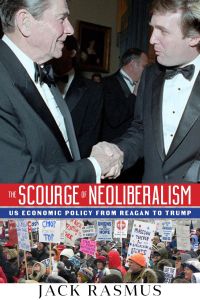
Jack Rasmus is author of the recently published book, ‘The Scourge of Neoliberalism: US Economic Policy from Reagan to Trump’, Clarity Press, 2020. He publishes at Predicting the Global Economic Crisis

Read Full Post »

This past week was punctuated by a perfect storm of negative US economic reports and events. Together they mean the door to recession in the US has now opened—quite contrary to all of Trump’s hype that the US economy is doing great.

The reports in question are the July jobs report lasts Friday and the advanced (preliminary) US GDP report for the 2nd quarter (April-June) released a few days before. The events associated with these reports were (1)Trump’s announcement imposing widespread tariff hikes ranging from 15% to 41% on more than 40 countries, with even higher tariffs previously announced on China, Russia, Mexico, Canada as well as ‘across the board’ global tariffs steel, aluminum, copper and other commodities; (2) and The Federal Reserve bank’s decision to keep US interest rates at current levels for at least another six weeks.

If last week’s 2nd quarter GDP data unlocked the door to recession, then last Friday’s Jobs data kicked it wide open. And Trump’s tariffs coming behind threaten to blow it off its hinges.

The Jobs Data Tsunami

It’s generally acknowledged that jobs are a lagging indicator of the condition of the US economy. If so, the July Jobs report shows that there’s no more lag. Jobs have caught up and Friday’s August 1, 2025 report shows Labor Market conditions in the US economy are now flashing red.

According to the US Labor Department’s Establishment Survey (CES) only 73,000 net new jobs were created in July. Moreover, this number is likely to be downward revised, since the July jobs report also revised its previous May and June reports downward big time: for May, the jobs created were reduced from an initially reported 144,000 jobs created that month to only 19,000 in fact: for June, the revision was from 147,000 to 14,000. So when July is similarly revised, it’s highly likely the 73,000 will be reduced dramatically as well. This will mean the total jobs created over the past three months will be barely 50,000!

It’s generally acknowledged the economy has 125,000 new workers entering the labor force and economy every month. The economy must therefore create that many jobs every month just to absorb new entrants, mostly youths seeking jobs for the first time. Only 50,000 created means more than 300,000 are entering the ranks of the unemployed not gainful employment.

The US Labor Department has a second jobs survey to the CES, which covers mostly large companies. The second survey is called the Current Population Survey or CPS. It covers more small and medium sized businesses as well as unemployment levels the CES does not report. The CPS report on Friday showed that new entrants’ unemployment rise by 275,000 in July.

The plight of new workers seeking employment is not the only negative indicator of a rapidly deteriorating US labor market this summer. Here’s some other telling job indicators:

  • The general level of employment in July fell by -260,000. It would have been an even greater decline had the level of part time employment not also risen by 433,000 as well. No doubt many companies converted their full time employed workers to part time in lieu of laying them off. Conversion of full time to part time typically occurs with the onset of early stages of recession.
  • Beyond just July, the CPS revealed that since May 1 the Employment level for the US economy in general declined by -863,000.
  • The unemployment rate, also indicated by the CPS only, remains at approximately 8% for the entire US labor force of 170 million—not the ‘official unemployment rate of 4.2% one consistently reported by the mainstream media and hyped by politicians. The 8% includes the 50 million plus part time, temp, discouraged, independent contractor, gig and similar job categories that the ‘official’ 4.2% excludes.
  • The 8% means there’s roughly 14 million US workers unemployed or underemployed. Of that 14 million, those unemployed long term (more than 27 weeks) has risen sharply as well over the summer. In July alone their numbers rose by 179,000.

Multiple statistics show the band-aid has been ripped off the obfuscation of the real condition of the labor market that has prevailed for at least this past year, exposing the long festering wound beneath.

The labor market has been weak for some time, as this writer has been reporting repeatedly over the past year. One needed only to look behind the mainstream media’s cherry picked reporting of the most favorable numbers in the two jobs reports, ignoring other data in the same reports that were growing consistently weaker.

What’s different the past three months, and in the July report in particular, is that the real rot in the jobs market could no longer be covered up by selective media reporting or by politicians’ hype.

Trump’s response to the recent jobs data has been to shoot the messenger, as he quickly announced his firing of the Labor Department’s statistics chief. But there’s no politically ‘cooked numbers’ to make him look bad here, as Trump claims. It’s just that the facts have now deteriorated to such an extent that even efforts to pave over the pot holes with marginal under-reporting and selective media reporting can no longer cover up the true condition of the deteriorating jobs ‘road-bed’.

The US GDP April-June Report

The second report indicating the US economy now balances on the precipice of recession is the advance (preliminary) US GDP report for the 2nd Quarter 2025. Here’s just three reasons why the announced 3% growth rate is not actually 3%.

First, readers should understand the US, virtually alone among advanced economies, puffs up its quarterly GDP numbers by multiplying the quarter change from the previous quarter by annualizing it. That is, 3% for the 2nd quarter is actually 4 times roughly what the economy actually grew from the previous 1st quarter.  3% sounds a lot better than 0.75% if one is publicly hyping the growth rate in the media.

However, even the 3%(0.75%) is grossly over-estimated for several reasons. Here’s just two of many: First, real GDP is artificially boosted by under-estimating the real rate of inflation. This occurs every report. Second, in the case of the 2nd quarter GDP report, the 3% is grossly over-estimated by temporary effects due to Trump’s current tariffs policies now rolling out which has dramatically distorted the contribution to GDP from what is called ‘net exports’—i.e. the difference and gap between imports into the US and US exports to the rest of the world.  For decades, imports have significantly exceeded exports. The result is that ‘net exports’, as the gap is called, has been a consistent subtraction from GDP from other categories like consumer spending, business investment, and government spending.

Let’s look at the under-reporting of real GDP due to low-balling inflation, and then the volatile impact of Trump’s tariffs on GDP for the entire first half of 2025.

(How Under-Estimating Inflation Over-Estimates GDP)

When the government reports GDP it’s for what’s called ‘real’ GDP. Real means adjusted for inflation (unadjusted is called ‘nominal’ GDP). The media reports the ‘real’. For the 2nd quarter that was the 3%. The problem is the inflation adjustment used greatly understates actual inflation. And the more it underestimates actual inflation, the more in turn real GDP is over-estimated.

The price index used to estimate real GDP is called the PCE. For the 2nd quarter the PCE was 2.1%. In the first quarter it was higher, at 3.7%. So simply by reducing PCE from 3.7% to 2.1%, all things equal the real GDP of 3% was boosted by a 1.6% lower PCE in the 2nd quarter.  If PCE in the 2nd quarter was 3.7% as in the 1st quarter, then 2nd quarter real GDP would be 1.4% instead of the reported 3%.

Ok. Some will argue perhaps inflation did abate significantly in the 2nd quarter compared to the first. Perhaps inflation was indeed 40%+ less in the 2nd compared to the 1st. But whichever the quarter PCE grossly underestimates actual inflation for dozens of reasons due to faulty assumptions and questionable methodologies used by the government to get PCE. Don’t think the government actually goes out and surveys price changes by businesses to get the PCE, like it does the other price index called the Consumer Price Index. It doesn’t. PCE is determined totally by estimating prices from other sources than the actual prices charged by businesses.

For example, let’s take insurance costs for home, auto, etc. which have been surging the past year. Insurance prices aren’t surveyed. They are extrapolated from insurance company profits. If the big insurance companies hide their profits in order to pay less taxes—which they do—then insurance inflation is grossly underestimated. But that’s what happens with PCE. How about rent inflation. Rents in the PCE index are calculated from reported new rental contracts from a subset of big apartment owners. Landlord price hikes for renters with existing contracts do not report price hikes within the term of the rental contract. There are dozens such examples that result in PCE underestimating actual inflation. Nonethless, PCE is used to low ball actual inflation in order in turn to over-estimate reported ‘real’ GDP. In short, 3% GDP in 2nd quarter is not actual GDP because PCE inflation is not actual inflation.

There are many other ways GDP in general is always over-estimated, apart from the faulty inflation adjustment. There are issues with seasonality adjustment methodologies. There are issues with how GDP is periodically re-defined in order to make it look larger. The latest such example was in 2013 when the government included as business investment items like business logos, trademarks, R&D expenses, IP and other similarly un-estimable values. The government simply accepts whatever businesses tell it are the increase in value (and thus price) of these ephemeral items, and then adds them to GDP.  When first introduced more than a decade ago, this boosted real GDP from business investment by more than $500 billion a year. Thus real business investment and its contribution to GDP is, and has been, less than reported every year.

Trump Tariffs & Volatile Net Exports

The even bigger reason why the 2nd quarter GDP growth of 3% is misrepresented has to do with Trump’s recent tariffs and trade policies. Briefly stated: nearly all of the 2nd quarter 3% GDP growth was due to the collapse of imports to the US economy in the quarter in response to Trump’s tariffs.

In the 1st quarter 2025, companies increased their imports excessively in anticipation of Trump’s coming tariffs. That artificially exacerbated the gap between exports from the US and imports to the US. A big negative number resulted, as imports exceeded exports by a wide margin. Imports thus subtracted from overall GDP calculation in the 1st quarter, overwhelming the effect on GDP from government spending, consumption, and business investment. GDP thus contracted by -0.5% in the first quarter. Virtually all due to the effect of import surge.

This flipped in the 2nd quarter. Imports that formerly surged in the 1st quarter collapsed in the 2nd. The difference between imports and exports now added to GDP. How much? Around 5% or 2% more than the actual 3% GDP. So what subtracted from the 5% to get the 3%? Business investment contracted, government spending flattened to virtually zero and consumption slowed. That knocked 2% off the 5% from imports-exports to get to the 3%.

Considering both quarters, it’s clear tariff policy and its impact on exports and imports, especially the latter, is distorting the numbers for GDP in the first half of the year 2025.

But beneath this what’s happening is business investment, a more permanent and less volatile factor in GDP determination, is steadily falling. In part due to tariff and trade volatility but also due to more fundamental forces and developments within the US economy. The same can be said for consumer spending, now steadily slowing even if still growing. In addition, Trump fiscal policies—spending cuts for social programs, government employment, and department dismantling are also building pressure toward less government GDP contribution.

US Economy Next 6-12 Months

The US economy is now at the precipice of recession and will likely deteriorate further over the next 6 to 12 months, and especially so in 2026. Here’s why:

Trump’s ‘big beautiful bill’ Act just passed by the Congress will have a net negative impact on GDP, and will not boost US economic growth as Trump claims.

Most of the at least $3 trillion in corporate and individual (and estate) tax cuts are just a continuation of previous 2018 cuts. The effect of the 2025 bill is just to make them permanent. That’s not net new fiscal stimulus from tax cutting. Meanwhile, the so-called working class $500 billion tax cuts in the bill—for tips, overtime pay, social security, interest on new cars, etc.—have been dramatically reduced and made temporary.

In contrast, the program and employment spending cuts in the bill—for Medicaid, ACA subsidies, education, layoffs of federal workers, and so on—amount to at least $1.5 trillion and take effect immediately. They will significantly reduce current consumer spending this year and next. Furthermore, Trump’s cuts in spending and layoffs will soon begin to spill over to state and local government spending cuts and layoffs, as the states will have to make up for reduced Federal government support and find ways to continue education, health and other spending from their own budgets. They too will have to begin layoffs and cuts to programs, both of which will exacerbate consumer spending in their states.

Add to all this what economists call the ‘multiplier effects’. Tax cut multiplier effects are less than spending cuts multiplier effects. Tax cuts don’t immediately result in more investment by businesses or wealthy investors. They lag. Moreover, the more the cuts accrue to the more wealthy and corporations, the less is actually spent of the total cuts. Some of the cuts are just hoarded. Some are distributed to shareholders as stock buybacks and dividend payouts. Some are invested in financial asset markets, none of which add to GDP. And some are redirected to offshore investment which also contributes nothing to US GDP. So tax multiplier positive effects are relatively low, and increasingly so in the 21st century as the US economy has globalized and financialized.

In contrast, the multiplier negative effects from spending on programs and jobs are immediate and much higher. This is especially more so, to the extent the spending cuts negatively impact incomes of middle to low income levels, which the Trump spending cuts clearly target. In other words, the composition of the Trump tax and spending cuts are net negative and exacerbate the negative multiplier effects of the combined tax and spending cuts as well.

In summary, over the next year US GDP is likely to weaken due to less consumer spending—as state and local government layoffs rise and Trump spending cuts take effect as well as due to less immediate and historically low impacts of tax cuts on the real economy—while the short term positive effect on Imports-Exports on 2nd quarter GDP dissipates.

The recent Jobs and GDP reports reveal the door to near term recession has opened. Trump tariff, tax and spending policies will likely kick it wide open as they take effect.

Jack Rasmus

Read Full Post »

Dr. Jack Rasmus

Copyright 2025

After promising during his 2024 election campaign to end the country’s quarter century of ‘forever wars’—on June 21, 2025 Trump started yet another ‘forever war’ by bombing Iran at multiple locations. He thus declared war today on Iran without a formal declaration, much like Japan did with the USA on December 7, 1941.

Also like Japan in 1941, Trump conducted fake negotiations over the past two weeks with Iran as a deception, to make Iran think a deal was possible when in fact he never intended a deal. The attack was inevitable days ago, once the US started moving two more US carrier task forces to the region, removing its naval assets out of its Bahrain and Qatar bases in the Persian Gulf, and calling on Americans in the region to leave. All indicators Trump made his decision to bomb likely a week ago.

The deception of fake negotiations this past week continued up to the very last minute. Two days ago Trump announced he was giving Iran two weeks more to consider his demands. As he said that, US air force B-2 bombers were being fueled, armed and readied for takeoff. Just another deception.

Trump’s forever war on Iran is like none of the US Empire’s previous neocon wars of the 21st century.

This time there was no attempt to provide political or moral cover by going to the United Nations, as US presidents did in previous wars in Iraq in 1991 and 2003. Nor did Trump make the slightest effort to bring US allies on board to support or participate in the attack. Nor was there any pretense of invoking the War Powers Act, that imperial fig leaf that has served as cover for Presidents violating the US Constitution. All that was bypassed or ignored this time, in Trump’s ‘forever war’.

Trump’s decision to go to war was strictly personal. It was his alone—with US neocons whispering in his one ear and Netanyahu the other. That makes Trump’s war a personal act of Tyranny per the basic meaning of that term—an act in foreign policy not unlike some of his recent decisions in US domestic affairs.

Trump’s decision to bomb Iran has all the earmarks of the continuation of the US neocon global strategy in the 21st century. By bombing, Trump reveals he is now solidly in the neocon camp—if he ever left it. Trump is now America’s No. #1 neocon. 

No country will ever believe he, or the USA, ever wants to negotiate a peaceful settlement to any dispute. That applies especially to countries like China and Russia. Why negotiate with the USA? Negotiations are only a ruse. Russia found that out in Ukraine. China will no doubt take note in any future discussions about Taiwan or South China Sea islands.  

The empire sees negotiations as a tactic. Treaties are only temporary agreements until the US believes the relationship of forces are again in its favor, at which point it conveniently breaks treaties.

‘Trump’s Iran War’ is a first in the history of 21st century US neocon military adventures.  It is a first in that it is totally on behalf of a foreign country, Israel, against a country, Iran, that has not indicated any threat to America nor has the capability even if it did. Trump has gone to war with Iran not because it is in America’s interest to do so, but because Netanyahu and his Zionists have asked him to do so.

There is another ‘first’ in Trump’s neocon forever war on Iran: Trump started the war in direct contradiction to US intelligence agencies’ determination that Iran did not have a nuclear weapon and it would take it three years to develop one. That was the public statement of the Trump administration’s own Director of National Intelligence (DNI), Tulsi Gabbard, to Congress this past March. The DNI gathers and summarizes the intelligence findings of the USA’s 17 intelligence agencies, including the CIA. 

Trump publicly rejected Gabbard’s conclusions in a media interview just days ago, saying ‘she was wrong’. I (Trump) know Iran has a weapon’.  So how did Trump know? If his own intelligence apparatus said no, why did he say yes? From what source did Trump get his evidence if not from the US intelligence apparatus?  It can only be from Israel and its intelligence agency, the Mossad. So we have the ‘first’ of a US president believing a foreign intelligence source (with a vested interest) against the determination of the USA’s own intelligence.  

The bombing of Iran is clearly the outcome of the two forces on the planet that for decades have been pushing for perpetual war—US neocons and Israel Zionists. They are now obviously two sides of the same coin.  And together the two are obviously driving US foreign policy and wars.

President Biden may not have had all his mental faculties that enabled the Neocon-Zionist cabal to push him to war. What’s Trump’s excuse?

With the assistance of the US neocon cabal, Israel has become the dog wagging its American tail.

To sum up the unique character of this latest of US neocon 21st century wars of empire:

Trump’s Iran war is a first in the history of US neocon military adventures as it is a war on behalf of another country (Israel) against their adversary (Iran) not against any country threatening America; it is a first because Trump has bypassed all government processes in his march to war; it is a first because Trump has decided to go to war ignoring his own US intelligence agencies and instead basing his decision on a foreign intelligence agency (Mossad).

Some Consequences

Trump may believe now that he has bombed Iran that it will come to the negotiating table. As he said after the event: ‘It’s time for a peace agreement’.  That statement makes him either incredibly naïve and stupid, or it’s just another negotiating subterfuge.

Why would Iran now agree to negotiate a peace deal with him?  Can Iran trust him that a deal is possible again, when negotiations were just a deception before?

Trump may think this bombing ends the war. But it may only have started it.

If Iran fought against Iraq in the 1980s and lost 1 million men, why would it now capitulate and not continue fighting?  Would the USA have done so after being bombed? Did it after Pearl Harbor, Manila in the Philippines, Wake and Guam islands that were all bombed by Japan on December 7, 1941?  Does Trump and US neocons think that is the likely outcome now? It’s possible they are that stupid. They’ve shown evidence before of being afflicted with a severe case of geopolitical myopia.

It’s extremely unlikely Iran will negotiate again.  Its leadership must be aware the more fundamental objective of Trump and the US—and especially Israel—is regime change in Iran. Not just the bombing of Iran’s nuclear sites. Certainly US neocons and Israel know this is the real objective, even if Trump naively now believes he can now force Iran to negotiate a deal.

It is unclear at this point, moreover, whether Iran’s nuclear sites are actually destroyed. Time will tell.  But if so, what’s to stop Iran now from accelerating its nuclear program at other sites? The bombing may actually force Iran to now build a bomb as fast as it can. Only the total military occupation of the country by Israel and/or the USA can prevent that. And neither Israel or the USA has a military force remotely capable of doing so, let alone of even invading Iran.

If the Iranians believe the Trump-Israel objective is regime change, why won’t they continue fighting?  After all, Trump has demanded their ‘unconditional surrender’. Historically that means military occupation, new government, prosecution for alleged war crimes, and execution of former military leaders. To continue fighting is obviously a preferable alternative to ‘unconditional surrender’, capitulation and war crime tribunals.

Trump may have just ‘lit the fuse’ on the US empire’s declaration of war on the entire global south.  The bombing is a stark warning to all, and especially China, that the US is willing to escalate the use of force without limit (including nuclear) in order to preserve its global empire now being increasingly challenged by the nations of the global south.

With Trump’s war on Iran, the ‘forever wars’ not only continue now; they are likely to spread and become even more deadly.

Trump’s bombing of Iran represents a kind of ‘geopolitical Rubicon’ from which there’s now no going back.

By Jack Rasmus

June 21, 2025

Read Full Post »

Dr. Jack Rasmus

Copyright 2025

After promising during the 2024 election to stop the USA’s ‘forever wars’ in the 21st century, in less than six months in office Donald Trump is about to start another ‘forever’ war with Iran.

There’ll be no prior vote in Congress, as required by the US Constitution. No seeking support of the United Nations or forming a coalition with allies. Nor even a preparation of public opinion, apart from the Fox News network that appears completely on board. There won’t even be a suspension of the War Powers Act, as occurred in previous ‘forever wars’. 

Trump plans to simply order US aircraft to bomb Iran, within days or perhaps even hours. Certainly as soon as the three additional US aircraft carrier task forces he’s ordered arrive on station in the Arabian sea off Iran’s southern coast.

The carriers and planes are there to neutralize Iranian coastal and inland anti-aircraft missile forces to create a corridor for US B-2 strategic bombers flying from USA’s Diego Garcia island airbase in the Indian Ocean. The B-2s will drop US made GBU 43 bunker busting bombs on the three or more Iranian sites that Israel, and now USA, allege are producing nuclear material for use in an Iranian bomb.

The US bombing will occur on the flimsiest evidence supporting the claim Iran is just weeks away from having a nuclear weapon, as the US and Israel leadership and both countries’ media are saying. To the contrary, however, UN IAEA inspectors this past March 2025 publicly said there was no evidence Iran was near having such a weapon. Tulsi Gabbard, the Director of the US Director of National Intelligence, which coordinates all 17 US intelligence services, also told Congress that same month there was no evidence.

Two days ago as Trump was leaving a G7 meeting in Canada he was asked by the media what he thought of Gabbard’s view and statement. Trump replied: “I don’t care what she said. I say they’re working on a weapon…I don’t listen to her”. So who does Trump listen to? Netanyahu? Israel’s CIA-like counterpart, Mossad, instead of US intelligence services?

Trump will send US planes and bombers into Iran— not to prevent an attack on the USA by that country; not in response to an actual or imminent attack by Iran on US bases or its 40,000 troops now in west Asia; nor in response to an attack by Iran on US warships or any international shipping.  Iran is not at war with the USA nor plans to; nevertheless, the USA will soon be at war with Iran. 

Iran publicly offered this past week to sign a treaty saying it has no nuclear weapon and agrees not to develop one—a move strongly suggesting it is not concerned US inspectors would find anything indicating it has.

Trump is thus preparing to take the USA into another ‘forever’ war, this time with Iran on behalf of a foreign nation—Israel—simply because its leader, Natanyahu, has asked him to do so. The Israeli leader has been asking the USA to attack Iran since 2002 when he addressed the US Congress on the eve of the USA’s imminent Iraq invasion in 2003. Now he’ll likely get what he’s been asking for: the USA to attack Iran on behalf of Israel.

Since 2002 Natanyahu has cleverly deepened Israel’s influence—and indeed control—of the US government through its lobbying group, AIPAC, and other personal connections within the US bureaucracy, aka its Deep State.

A majority in Congress has already been writing a blank check to Israel to cover the costs of its current wars in GAZA, Lebanon and Syria. Congress will no doubt rubber stamp quickly any US air attack on Iran, in order to legitimize US bombing Iran—an act of war and aggression by America by any definition of international law. Like Congress, the US government bureaucracy and Deep State is also deeply aligned with Israeli interests, as is the Trump administration and the president himself. 

The two political systems—USA and Israel—are fused at the political hip and have been for some time. There has never been anything quite like the political integration of the two systems, America and Israel, in the entire 250 year history of the USA.

Israel is the American Empire’s landlocked aircraft carrier looking out over the entire middle east, enforcing US imperial interests; America is Israel’s military weapons industry and blank check writer. It is estimated more than $340 billion in aid has been given to Israel by the US government since the 1970s. Most of which gets recycled back to the US companies providing Israel US advanced weaponry.

The USA ‘How to Go to War’ Playbook

Since 2001 America has been embroiled in what can only be called wars of empire: Wars to expand the empire. Wars to punish those who try to break from it or dare to chart an independent path. Wars to pre-emptively attack those who pose a potential challenge to it in the future. 

There have been three defining wars of empire in the 21st century: the Iraq war of 2003-10 (of which the Afghan war was a second front). The Ukraine proxy war of 2021-25. And the Israel-Iran proxy war of 2023-25.

In retrospect, there is a pattern in how the US prepares and initiates war across all three.

When the US imperial elites—in government, Deep State, and Military Industrial Complex—shift the machinery of war into first gear and the war train leaves the station there is no calling it back. The gears of war were set in motion in 2002 in the case of the Iraq war; in 2021 in Ukraine; and sometime during 2024 in the current case of Iran. War plans are developed and the funding sources identified and earmarked months, and sometimes years, before military action is initiated.

Once the decision is made what remains is mostly the timing, i.e. when is it best to pull the trigger. That timing depends on getting the necessary military assets in place, lining up agreement to go to war with key players in Congress and US allies, preparing public opinion by creating an imminent threat image with the US public, and, if time and conditions permit, staging a ‘false flag’ event to give credibility to the imminent threat.

Here’s how the playbook works after initial preparations, as the US war train shifts into higher gear as evidenced in the last three major wars in the 21st century: Iraq, Ukraine, and Iran:

The Case of Iraq 2003

First, the US raises a set of demands the target country must meet and engages in a period of negotiations with it. 

In the case of the Iraq war of 2003 the US charged Iraq with possessing weapons of mass destruction (WMDs) that it was planning to use. Who can forget the visuals of Secretary of State Colin Powell addressed the UN security council showing charts of African countries from where Iraq had purchased ‘yellow cake’ to make nuclear material. WMDs include chemical or biological weapons. But Powell’s presentation suggested Iraq’s WMDs were also nuclear.

UN and US inspectors found no evidence of WMDs in the run up to the war. And after the war it was confirmed there were none. That didn’t matter at the time. The US War train had left the station months before. Assets and allies, Congress and public opinion, were already prepared and in place. In negotiations on the eve of war, Iraq agreed to US initial demands.  The US just moved the goalposts. It demanded instead of UN IAEA inspectors the Iraqi armed forces submit to the occupation of Iraq by US/NATO forces to ensure there were no WMDs. In other words, agree to de facto unconditional surrender.

The WMD issue was just a cover. The real US demand was regime change in Iraq and the deposing of Saddam Hussein as the country’s leader and dismantling of his political party. When the US goes to war it is always about regime change. The manufactured threat issue is always just a cover. Negotiations are never intended to reach a compromise. They are just a tactic.

The US war prep playbook is to never agree to a deal via negotiations but only make it appear one is possible. The US raises new, more unacceptable demands and ignores concessions offered by the target country as a basis for a deal. Negotiations are thus used to lull the opponent into thinking a compromise is possible when in fact no deal will ever be agreed to. However, as the US ratchets up demands and moves the goalposts, it issues public statements in parallel that discussions are going well and negotiators are getting closer to a deal to avert war.

In the weeks just prior to the Iraq war erupting, Saddam offered UN and US inspectors free access to all sites, including military, in Iraq to determine there were no WMDs. The US ignored Saddam’s offers. WMDs were just the pretext. It was always about regime change. It always is.

And then when all assets are in place, the war hammer drops. An attack is launched by surprise with no prior indication or warning.

The parallels with the current imminent US war with Iran are notable.

The Case of Iran 2025 

Ever since the collapse of Syria in late 2024 and Trump’s ascendancy to the presidency, the US has been using negotiations to lull Iran into thinking a deal was possible to avert a US involvement in Israel’s war with Iran.  When Iran agreed last week to sign a treaty indicating it had no bomb and would not develop one in the future, the US moved the negotiations goalposts: it demanded the Iranians open up their military sites to US and Israeli inspectors to verify if nuclear production machinery was creating fissionable material.

The US further demanded Iran turn over its entire existing stock of fissionable uranium.  Iran agreed to do so for all its excess material except for what was needed to run its civilian nuclear power plants. It offered to turn over all its excess stock of uranium to be managed by a third party, in this case Russia.

The US responded Iran must turn over all its uranium stock, including that needed to run its civilian nuclear generating plants. In other words, Iran had to shut down its civilian nuclear power plants.

As negotiations proceeded last week, Trump publicly declared the US and Iran was close to a deal. He added the situation looked promising and a deal was likely on Sunday, June 15, when US and Iranian teams were scheduled to meet again. Within 48 hours of Trump saying a deal was imminent, Israel launched its surprise attack on Iran. It is naïve to believe Trump had no knowledge of Israel’s surprise attack launched in Friday, June 13. He as much indicated he knew. And he knew such an attack would lead to a cancelling of June 15 negotiations. He knew no deal was imminent. Negotiations had served their purpose to lull Iran into thinking a deal was possible, even imminent.

Whether this tactic resulted in Iran leaving its guard down on June 13 cannot be known for certain. What is certain is that Israel’s June 13 attack wiped out much of Iran’s air defense system and giving Israel aircraft more or less free entry into Iran air space to bomb not only military facilities but power plants throughout the country, including nuclear, as well.

It was the Israeli version of Colin Powell’s ‘shock and awe’ prediction of the prior US air war launch on Iraq.

Israel’s surprise attack not only neutralized many of Iran’s air defense facilities but Israel simultaneously carried out assassinations of high ranking Iranian military, government officials as well as civilian Iranian scientists. Israel thus included a ‘decapitation’ strategy, which had previously proved successful with Hamas in GAZA and Hezbollah in Lebanon. Purposely targeting and decapitating civilians is considered a war crime.

So is targeting civilian nuclear facilities. In the initial attack Israel bombed several, with reported nuclear radiation fallout occurring in several locations in the country. 

To sum up: the US Iran war playbook has followed much of that employed by the USA in Iraq: engage in negotiations to lull the opponent into thinking a deal is possible. Keep moving the demands goalpost as the opponent makes concessions. Use a pretext like WMDs (Iraq) or nuclear bomb in weeks (Iran) to maneuver public opinion in support of the war. And as in the case of Iraq, the actual goal is regime change. Military action is designed to achieve political objectives. Launching a surprise massive air campaign is to inflict as much damage on the economy and disable the government in order to spark political uprisings to depose the regime and its leaders.

Neither WMDs or a nuclear bomb are ever the real issue or objectives. They are the excuse to launch a massive military air strike to wreck the economy and create political instability and engineer regime change. And negotiations in the run up to war are a tactic, not a step in a process to reach a compromise and a deal to avert war. Their purpose is to lull the opponent into thinking a deal is possible when it isn’t.

When the US playbook believes pretexts and excuses like WMDs or nuclear bombs are not sufficient to invade, it adds a ‘false flag’ operation to the playbook. Some notable false flags from earlier US wars include the alleged ‘Tonkin Gulf’ attack by North Vietnam boats on US destroyers that was used to justify US expanding its war in Vietnam; the claim the Cuban army had invaded Grenada and seized US medical students as hostage; the charge that Panama president Noriega was running a drug operation transporting Colombia cocaine to American cities as justification for the US invasion of that country in 1989; the claim that Assad, president of Syria, was using chemical weapons; Iraqis in 1990 were killing Kuwaiti babies in incubators.  Every US war playbook engineers a pretext and/or a false flag operation leading up to initiating  military action.

The Case of Ukraine

The case of Ukraine is a variation on these themes.  In 2014 following the US financed and CIA directed coup in that country, Russia occupied Crimea to prevent NATO from seizing its naval base there, which would have led to NATO occupying the entire Black Sea.  There were brief military conflicts in eastern Ukraine, followed by negotiations and a cease fire in a Minsk Agreement between Russia, Ukraine and Europe. Germany’s then Chancellor, Merkle, and France’s president, Holland, served as guarantors of the Minsk agreement. Later in 2022 they would both admit publicly the purpose of the Minsk negotiations and deal was to lull Russia into thinking the military conflict as over. Ukraine was not militarily prepared to go to war yet. It would require 8 more years to prepare massive fortifications and weapons development and training of troops before it was.

The US/NATO decision to go to war with Russia in Ukraine was made by US president Biden around June 2021 when he met with Putin for the first, and last time. The US plans for the Ukraine war date back to 2015. They were shelved when Trump won in 2016 and thereafter quickly dusted off by Biden when he took office in January 2021. Biden in August 2021 ‘cleared the decks’ in Afghanistan by pulling out. US advisors and weapons thereafter began pouring into Ukraine. Putin attempted to ‘negotiate’ with the US from afar during the rest of 2021 without any progress. The US-Ukraine plan called for a major Ukraine offensive in February 2022 to defeat what remained of the local Russian ethnic resistance in Ukraine’s two eastern provinces, Lughansk and Donetsk. But the Russians pre-empted that and invaded first in late February.

Russian advances were swift even though it invaded with barely 90,000 troops across a combat line of 1500 kilometers from Kiev to south Donetsk. That limited force was no where near sufficient to occupy Kiev or conquer Ukraine. Its purpose was intimidation to force Ukraine into a compromise deal which was tentatively reached in Istanbul, Turkey. As discussions in Istanbul were occurring, Russia was asked to show good faith by withdrawing its forces from Kiev which it did. A tentative deal was then reached between Ukraine and Russia in Istanbul in April 2022 which was quite favorable to Ukraine. However, NATO convinced Ukraine president Zelensky to reject the deal and to continue the war. The Istanbul negotiations collapsed.

Twice Russia was lulled into negotiations to ‘buy time’, as Merkle and Holland admitted in 2015 with the Minsk deal and Ukraine did again in April 2022. US/NATO rushed in weaponry and advisers after Istanbul and Ukraine launched a major offensive that threw Russian forces back from Kiev and other locations to limited positions in Lughansk and Donetsk.  Thus Russia was out-maneuvered twice by negotiations with US/Ukraine that were never intended to conclude with a compromise deal to end the war in Ukraine.

As in the cases of Iraq and now Iran, from the outset the US playbook in Ukraine proxy sought the ultimate objective of regime change in Russia.  The admitted strategy was a military conflict in Ukraine, financed and provided with weapons by NATO, which the plan envisioned would lead to a collapse of the Russian economy, political instability, and the deposing of Putin by Russian oligarchs and military. 

The US neocon and CIA analysis was Russia’s economy was weak and the Putin government even weaker. A military conflict, supported by extensive sanctions on Russia’s economy was argued in US war planning to lead to Russian implosion and NATO/Ukraine victory. Regime change was again the objective.

Negotiations at Minsk in 2015 or Istanbul in 2022 were never meant to reach a deal but to lull Russia into thinking one was possible. In 2025 the US and EU again tried to lure Russia into a negotiation that demanded as a precondition to negotiations that Russia agree to a ceasefire first. The preconditions in turn allowed Ukraine to rearm and mobilize and train more troops during negotiations.

It was clear the US/NATO 2024 proposal was another example of negotiations employed as a tactic to ‘buy time’ to prepare for another military offensive—after which the pretext of negotiations would be dropped. This time, however, Russia did not agree to ceasefire first and then negotiations. Nor will it again agree to negotiations as a delaying tactic after twice being manipulated and out-maneuvered in 2015 and 2022.

Unlike in the cases of Iraq in 2003 and Iran today, in the case of Russia the US playbook’s negotiations tactic as well as its strategic objective of regime change have both conclusively failed.

What’s Next in the US-Israel Proxy War On Iran?

The official position of the USA is that it isn’t involved in Israel’s war with Iran. Few believe that given the US provision of weapons to Israel, likely planning the operation for months, and obvious US satellite surveillance and targeting assistance.  As US official spokespersons deny US involvement, Trump himself publicly refers to the Israel attack as “we”, calls on Iran to ‘unconditionally surrender’ and says the US knows where Iranian leader Khamenei is located and could ‘take him out’ any time. All of which hardly suggests no USA involvement. Will the US then overtly escalate its involvement by bombing suspected Iranian nuclear weapons development sites deep inside several mountains. No one yet knows for certain but it is very likely Trump will do so.

But what if the US GBU 43 ‘bunker busting’ bombs do not achieve their objective and destroy Iranian deep mountain sites? The only further weapon that can is a tactical nuclear US bomb. Will it risk that?

It is likely should Trump allow B-2s to drop bunker buster bombs that Iran will attack US naval bases in the Persian gulf located in Bahrain and elsewhere. The same response may occur should US carrier plans attack Iran’s Persian Gulf ports and naval installations. A large contingent of US naval forces are stationed in Bahrain. What happens if the Gulf erupts in military conflict? One outcome is certain: global oil and gas prices will quickly rise and so will US consumer energy costs and inflation in general.

There is also the question what will Russia, now a signatory to a mutual Russia-Iran defense agreement since January, do in response to a US direct military involvement in Iran? It is difficult to imagine Russia will not come to Iran’s defense. That would greatly undermine its credibility everywhere. Nor will China remain neutral. Reports are it is already shipping weapons to Iran by air. It is very unlikely Russia or China will permit its ally Iran to be militarily defeated or its government to collapse. And then there’s Pakistan that has vowed to provide Iran with nuclear weapons if either Israel or US use them on Iran.

Can an air attack by Israel, with or without the USA, actually succeed in bringing about regime change in Iran? That too is extremely unlikely.  Iran is not Libya. Its leadership is not isolated from public support, as was Assad in Syria.

It is difficult to see how the Israel air attack, despite some of its initial successes, can succeed in the longer term in bringing about the primary objective of Iranian regime change. What then? Can Netanyahu then agree to compromise after significant Israeli military bases and urban areas have been seriously damaged by Iranian hypersonic missiles that have shown to penetrate Israeli air defenses and will continue to do so? Iran has a population of 92 million and has shown it will sacrifice millions dead in its 1980s war with Iraq if necessary.

Neither the US or Israel have sufficient ground forces with which to invade Iran. Israel is a population of 10m with military forces engaged in GAZA, Lebanon and recently Syria. It would be a disaster for the US to invade Iran with ground troops.  Even an air attack on Iranian sites risks significant US losses of aircraft. Trump should remember the disastrous US air invasion of Iran during the Carter administration to attempt to rescue US hostages in Tehran. It failed miserably, with the US losing several aircraft on the attempted entry.

Despite these likelihoods US neocons like Lindsey Graham now call for the commitment of US troops to Iran. Thus proving once again that neocons never compromise or admit defeat; once their plans fail they simply double down and call for further escalation.

Trump should also consider the effect of a decision to bomb Iran on his domestic base. The initial phase of a MAGA movement realignment in domestic US politics may impale itself on Trump’s escalation in Iran. Already significant voices in the MAGA movement are challenging Trump’s imminent decision to bomb: Tucker Carlson, Steve Bannon, and a growing list of MAGA members in Congress.

Millions of American voters in 2024 no doubt voted for Trump last November in part because of his campaign promise to end America’s ‘forever wars’. Bombing Iran after less than six months in office will reveal that was just another fake election campaign pledge that presidents feed the public for votes, then turn around and do the bidding of the neocons who’ve been running US foreign policy since 2001, the US military industrial complex and their Deep State allies in America.

Should Trump soon decide to bomb Iran that act will likely unleash global and domestic US responses not easily contained by the Trump administration. Trump’s advisers should remind him not only of Carter’s disastrous invasion in 1979, but of Nixon’s bombing of North Vietnam which only accelerated the collapse of US’s war in Vietnam. 

Air wars are successful only when targeting small weak military state opponents. They worked with Serbia, Libya, in Sudan, and such. Even in Iraq and Afghanistan US ground troops had to be committed and then were forced to leave. And this time the US simply has no sufficient ground forces, short of reinstituting a draft. Europe has even less.

Trump’s decision to bomb Iran will result in forces of global and domestic US political entropy spinning out of his control. But like the US neocon community—which Trump has now apparently joined—looking beyond the immediate situation to possible consequences is not part of their mental apparatus nor in either of their war time playbooks.

Looking back in the months to come, the USA proxy war in Ukraine may be understood as the dress rehearsal to World War III. But a US-Israel war on Iran will be understood as the actual start of a global conflict.

Dr. Jack Rasmus

Copyright 2025

Read Full Post »

There is an emerging debate whether the US Empire is about to collapse or in decline (or neither). In my forthcoming book, ‘Twilight of American Imperialism’, forthcoming this fall this debate is discussed as part of the book’s history and evolution of the American Empire from 1768 to the present. The main focus of the book is the contemporary period since 2008 and especially since 2020 and its analysis that, while the Empire is not about to collapse, it is clearly in a state of decline and a decline that’s accelerating. Special attention is given to the current Trump regime and a discussion of the question whether Trump policies can stop or even slow the decline. The following is the draft Introduction to the book where the main themes are outlined and briefly discussed. Here’s the Intro

  INTRODUCTORY CHAPTER

Twilight of American Imperialism:

By Jack Rasmus

Copyright 2024

Mid way through the third decade of the 21st century it is becoming increasingly clear the American empire has been growing steadily weaker across various dimensions—political, economic, cultural and even technological. Some say it has entered a period of decline. A few—prone perhaps to substitute wishful thinking for hard analysis—even go so far as to predict its imminent collapse.

Those advocating imminent collapse point to the USA’s military defeat and pullout of Afghanistan in 2021; the increasing likelihood of US exit from its proxy war against Russia in Ukraine after three years and $350 billion dollars cost; the growing economic and geopolitical influence of China and its deepening alliance with Russia; advances in military technologies & weaponry by Russia and China that the US appears to lack (hypersonic missiles, mass drones, certain naval assets, etc.); the expansion of the BRICS in the global south; the drift of a growing list of countries from the use of the US dollar in trade and as a reserve currency and from use of the US’s SWIFT international payments system; and so on.

While certainly weaker, and arguably in decline, the American empire is nowhere near imminent collapse.  Its currency, the dollar, is still the majority currency in use in global goods transactions and money capital flow settlements. So too still is its SWIFT international payments system that runs through the large US commercial banks. Its central bank, the Federal Reserve, still functions as the ‘central bank of central banks’ with which most countries’ central banks move mostly in tandem. Since 1980, via massive money capital flows and FDI (foreign direct investment), US company presence and production has expanded throughout the world. The USA still provides the majority funding and controls voting in strategic economic institutions like the IMF and World Bank, even as China’s ‘Belt and Road’ initiative is mounting a major challenge to the latter. The USA still has the largest and most comprehensive global agreements on free trade. It maintains a leading role in the development of next generation technologies like Artificial Intelligence that constitute the future of new product lines even though China is nearly equal.  Militarily, the US spends more on weapons and defense than all other countries combined, maintains more than 800 bases worldwide, has more bilateral military alliances than any other country, and maintains the largest naval force with a dozen of aircraft super-carriers and scores of nuclear submarines, each of which carry hundreds of Trident II nuclear missile warheads and are essentially undetectable. It provides the majority of funding for NATO and economically props up the European economy in divers ways. Its CIA and NGOs have engineered scores of regime changes in recent decades in smaller countries throughout the world that have dared to act independently of its imperial interests. It dominates the G7 ‘core’ US empire countries’ and exercises significant political influence over the foreign policies of countries like Japan, South Korea, Pacific Islands and in Europe and wherever it maintains large US military forces and bases.

In support of their view of imminent collapse, its advocates further point as confirming evidence to the Trump administration’s recent radical changes in its US military commitments in Ukraine; its shutting off of funding to US NGOs like USAID; the administration’s increasing feud and distancing of relations with European NATO members; its attempt to radically transform trade relations, propose deep cuts to fiscal spending programs; the administration’s aggressive reordering of US immigration and other legal relations;  and Trump’s emerging conflict with US central bank chair, Powell, over interest rates. But simply citing policy differences one may deeply disagree with does not constitute causal evidence of how such policies lead inevitably to Empire decline, let alone collapse.  

Challenging this often politically biased—and to some extent US mainstream media propaganda—view, in this book it will be argued that what appears as chaotic radical shifts in policy and political initiatives by the Trump administration should be more appropriately understood as an effort by the US elite (at least the segment of it supporting Trump) to restructure US domestic and global economic and political relations in order to consolidate and continue to fund its Empire in an era of growing challenges to Empire and its rising costs—especially given the USA domestic economy’s increasing failure to grow sufficiently to cover those rising costs.

The imminent collapse of Empire viewpoint also assumes Trump policies in his second term will fail and that failure will itself accelerate imminent collapse.  This view is backed by little evidence to date as well, however.

Trump policies and initiatives are better understood as the opposite: i.e. an attempt to slow and even halt the decline of Empire. Alternatively viewed, Trump’s policies and initiatives are about trying to check and reverse American’s emerging imperial decline. Whether they will succeed in that regard, however, remains to be seen. The odds are likely against it, but who knows for certain.

A central theme of the book is that the American Empire is approaching a period in which it needs to restructure its imperial relations, practices and institutions. It cannot afford the cost of the Empire as currently structured.

US elite policies and practices thus far in the 21st century have not succeeded in expanding or even maintaining the Empire. An Imperial ‘Rubicon’ may have been crossed in 2008. And if not in 2008, certainly circa 2020-22 after the double shock events of the Covid economic shutdown that was quickly followed by the Empire’s geopolitical defeat in its Ukraine proxy war and the economic fallout from that latter event.

Collectively US elite policies and strategic decisions the last quarter century have been undermining—not advancing—the Empire, it will be further argued. Thus a fundamental restructuring is needed if the American Empire is to approximating its prior hegemonic role or exert anything even approaching the influence it once had during its peak from 1945 to 2007.  

If the thesis is correct that a restructuring—not a collapse—of empire is imminent, the current will prove the fourth such restructuring during the past century undergone by the American Empire. Each restructuring of economic and political relations served to advance and/or maintain the Empire. The most recent three restructurings of the Empire occurred 1913-1919, 1944-1953, and 1980-1986.

A Brief History of American Imperial Restructurings

Chapter one of this book will review and critique the major theories of Imperialism. It will argue that most of these describe 19th and 20th century Euro-centric empires and fail to appropriately describe the American way of Empire.  The American imperial experience differs in certain key aspects, which is described in chapter two and subsequent chapters.

Chapter two of this book describes the evolution of the American Empire as it broke out of and emerged from its parent British Empire in the mid to late 18th century. It retained some of the characteristics of the British at the time, but its essential drive in its early history was twofold: clear away the competing European empires on the north American continent—the Spanish in the far south, the remaining British on its undefined periphery border to the north, the last vestiges of the French in the Mississippi-Missouri valleys and later, toward the mid-19th century, the Mexican in the southwest and far west.

The second thrust of America’s continental imperial expansion in the 18th-19th centuries was to displace, destroy or otherwise move native American tribes off the Land by physically destroying them in wars or by disease, pushing and resettling them ever further west, or encapsulating and isolating them in small enclaves called reservations. 

In either case—whether eliminating European competitors or native American tribes—the main objective of the early American Empire has always been Land. Not just land for purposes of farming but also for minerals, animal harvesting for the market, precious metals, lumber, grazing, and water resource control.  It followed that central to the nature of early American imperial continental expansion was land speculation and profits from land as a market commodity.  With each wave of westward emigration from the east coast colonies and initial states came waves of land speculation often even preceding land settlement. In its earliest forms, therefore, American imperialism was not just ‘land grabbing’ but land for purposes of financial and capitalist appropriation and exploitation.

This land acquisition financial imperialism was unlike its British parent. Britain’s empire considered its north American colonies as a source of natural resource extraction, using native americans as the ‘producers’ who provided the animal furs and products to it for resell back in England; or, the colonies’ producing lumber and farm products for shipment as well. British policy was to prohibit the acquisition of lands west of the colonies by the colonialists. It was a major source of contention and one of several issues that provoked the US war of independence with Britain in 1775-83. As details in chapter two will show, the newly independent USA’s 1787 Constitution represents an imperial restructuring, the first, for America.

Concurrent with America’s continental Empire building in its countless wars with native americans, from 1776 until the closing of the ‘frontier’ circa 1890s, was its war with Mexico in the 1840s which was concocted on the flimsiest excuses in order to conclude the final seizure of land on the continent in the southwest and far west. (Not counting the 1867 purchase of Alaska from the Russian Tzars).  Once the continent was secured for Empire, only then did the Empire turn its gaze offshore in 1898. During that long interim from 1775 to 1890s the initial restructuring of 1787 served to enable and maintain imperial expansion westward across the continent.

That initial restructure worked for continental expansion, but would not for offshore global expansion, the first of which was attempted by the Empire in 1898 in a war with Spain. The land grabbing was for the Caribbean island of Cuba and lesser islands and for Spain’s huge colony in the far west Pacific Ocean, the Philippines. The conquest of Spain occurred fairly quickly but the pacification of the inhabitants of the Philippines dragged on for years, until at least 1902, and was very costly. The US Empire realized it needed greater resources and a larger Army and Navy to play the new role of Imperialist beyond a north American continent scale.

In the empire’s first offshore imperial expansion in the 1898-1902 Spanish-American war, the costs of war were financed by taxing the property of wealthy Americans. This did not work well and generated much political opposition among wealthy interests who were taxed. Without a central bank, monetary policy and bond financing to pay for the war was difficult as well. The US Treasury was not able to provide the bond financing for war expenditures. The US economy had just recovered from the great depression of 1892-98. In short, the tax base built mostly on tariffs was insufficient for covering the costs of global empire expansion. 1898 was a lesson for the need of restructuring fiscal policy rather than an experience in one

Not so World War I. As the US prepared to play a role in World War I, it restructured its fiscal and monetary policies in order to fund and afford the costs of imperial expansion: It created a central bank, the Federal Reserve, in 1913 to raise bond debt and it passed for the first time a corporate and an individual income tax and introduced inheritance taxation. These fiscal and monetary measures became the source by which the US paid for the build up of a world class military and funded its involvement in that war. A combination of direct taxation and sales of bond issues—the latter of which was extended to sales to the general public—became the primary source of war finance for the new imperial initiative in World War I.

During and after the war the USA assumed a role among European empires as a co-player in imperial advancement on the world stage. That meant its ‘external’ policy—i.e. trade relations, lending of money capital, importance of its currency the dollar—all became new areas of policy and part of the restructuring of both US domestic relations and external relations. Industrial policy was introduced as part of the restructuring as well during the war. US elites mobilized war production and created new institutional arrangements with labor and unions as part of the World War I restructuring as well. World War I thus introduced the specific arrangement of fiscal, monetary, industrial and external policies necessary for the American Empire to assume a major role on the global stage in competition with the major European empires.

Since World War I the US financed its imperial expansion out of a combination of taxation of domestic wealth holders, domestic production, and debt (bond) financing. 

In World War II the empire applied a similar war financing arrangement of fiscal tax policy and bond issuance policy by the central bank. But now on an even greater scale. It raised record bond sales during the war, now from the general public as well as from wealthy investors.  It also expanded and broadened its tax base. In a series of annual revenue acts by Congress starting in 1942, a top tax rate of 90% was imposed on the super wealthy and for the first time the tax system was ‘broadened’ to cover taxation of working class wage incomes. Also new was payroll deduction of income taxes. Both the working class taxation and payroll deduction were written in the revenue bills so to expire at wars end. Neither were. Both thus helped fund the American empire’s continued military expansion post 1945 and especially increased after 1950 and the Korean war.

The Vietnam war of the 1960s-73 was similarly financed by a special surtax of incomes and bond debt sales by the central bank.  However, those policies now contributed to the economic problems in the US domestic economy and global economic hegemony weakening thereafter in the 1970s.  The answer was to restore the empire’s financial base by measures commencing in the early 1980s that have come to be known as Neoliberalism.  Neoliberal policies enabled the Empire to expand geographically offshore (aka globalization) and to financialize in parallel. 

As a concept, Neoliberalism should thus be best understood as a term that somewhat obfuscates what is actually a set of policies (fiscal, monetary, industrial, external) serving to restructure American imperialism starting in the 1980s. That policy mix and 1980s neoliberal restructuring—the 3rd such since World War I—continued more or less unchecked until late in the first decade of the 21st century.

The expansion of the American Empire in the current neoliberal era reached an apex—economically, geopolitically, and technologically—roughly around 2005-07.  About the same time US elites shifted their methods of war financing and methods for funding empire expansion. That is, just as the costs of expanding and maintaining the Empire began to escalate.

The Apogee of Empire: 2005-07

History will show the first decade of the 21st century was the high mark of the American Empire, especially the years mid-decade of 2005-07. It was the apogee of the Empire’s political-military power as well as global economic.  Ironically, it was also the period during which changes and forces began to coalesce that set in motion the subsequent period of the Empire’s initial phase of decline, 2008-2020.

In 1999 US elites moved to absorb into NATO the east European nations once part of the USSR Warsaw pact.  Poland, Czech Republic and Hungary joined. The big NATO move east, however, was in 2004 when Bulgaria, Romania, Slovakia, Estonia, Latvia, Lithuania and Slovenia all joined. Following that, in 2008 at a conference in Bucharest, NATO led by US elites’ announced Georgia and Ukraine would become NATO members as well. Thus was set in motion events that eventually erupted into the Russia-Ukraine/NATO war in 2022—a defining event in the decline of the American empire which may represent the most recent, second phase of decline.  In parallel, however, US-CIA-NGO ‘color’ revolutions and regime changes were being engineered, including the early attempt at such in the Ukraine.

Another geopolitical event as marker for America’s imperial apogee was the Iraq war in 2003, a year just before the big NATO expansion.  The Iraq war represents what appears to be the USA’s last successful direct military action.  Neither China nor Russia were sufficiently strong enough to prevent the war. Russia was just emerging from its great depression of the 1990s decade and in a debilitated military condition except perhaps for its nuclear forces.  China was dependent on western capital, US in particular, needed to jump start its economy after a weak 1990s performance and to begin its role as the world’s major manufacturing exporter. The rest of the global South countries were still heavily dependent on the US dollar, IMF-World Bank, US corporate direct FDI, and soliciting US free trade deals. The NAFTA north American free trade agreement was expanded, a number of bilateral free trade deals between the US and countries were signed, and a proposed North-South America free trade agreement was proposed. The Federal Reserve and its chair at the time, Alan Greenspan, seemed to be able to magically manage the economy. The news media referred to him as the ‘Maestro’ of the Fed.

Domestically, profits were accelerating and wage levels rising in the wake of the late 1990s tech boom. Jobs were plentiful at mid-decade. GDP economic growth was slightly above long run historic averages, except for the 2001 recession—the first in ten years—which proved relatively shallow and short lived in 2001. The Housing market was booming. In terms of technology, the internet and wireless access was penetrating an ever greater percent of the US population. The country appeared unified as never since decades before, in the wake of the 9-11 terrorist attacks. However, beneath the surface major forces were developing that would result in major economic, foreign policy and domestic US political eruptions at the decade’s close and beyond.

Economically, the Greenspan and Fed policy of flood the economy with virtually free money since 1986 continued into the 21st century. That helped fuel the tech boom of the late 1990s which overheated by 2001 and bust. Financial deregulation policies of the late 1990s and during the 2000s were laying an economic time bomb that would explode by decade’s end. Greenspan cut a deal with then President George Bush to be reappointed chair of the Fed in exchange for continuing to flood the economy with money and keep interest rates artificially low as the Iraq war was launched and Bush’s 2004 election approached.  Fed monetary policy was artificially extending the business cycle into the new decade, overheating the housing market and, together with derivatives financial instruments and financial deregulation, creating the foundation for an historic financial crash later in the decade. Fed monetary policy was providing the fuel for financing US corporate offshore expansion and financial speculation that together were driving what was called ‘globalization’ and ‘financialization’ at the time.

The fundamentals for fiscal policy crises were also originating in the 2000s: In the wake of the 9-11 attacks, war and defense spending accelerated sharply throughout the decade. This coincided with the other side of the coin of fiscal instability—the start of the massive tax cutting in the midst of rising war spending. In 2001-04 taxes were cut $3.8 trillion for the 2001-10 decade, 80% of which accrued to corporations and wealthiest households.  Not surprisingly, the first decade of the century witnessed the beginning of what would prove a long term chronic escalation of budget deficits and the US national debt.  The national debt rose from $5.6 trillion in 2000 to almost double and $10 trillion by 2008.

In other words, the new fiscal policies of escalating war and defense spending amidst massive tax cutting began blowing a hole in the government budgets and creating ever growing budget deficits and in turn the national debt.  In parallel, monetary policy of artificially low interest rates (at least until late 2006) put government bond sales in the service of subsidizing corporate offshoring and financial markets. This dual fiscal-monetary policy mix would erupt later into growing contradictions and crises in both fiscal and monetary policies in subsequent decades. But the pattern was set in the 2000s.

What these policies represent at another level is a general retreat by US elites from historic strategies for financing war and Empire. In the 21st century for the first time in US economic history the US elite began funding its wars and empire not by taxation or by bond financing of its citizenry, as it had in its imperial expansion throughout the 20th century. Now in the 21st war financing was largely out of direct legislation appropriations by Congress.  In fact, as its ‘wars on terrorism’ erupted in 2001-03 and continued another 20 years, as it expanded its military bases worldwide after 2001, expanded its surface naval, missile, aircraft and submarine forces and Pentagon weapons spending in general, expanded the CIA, special forces, NGO funding, and began funding proxy wars—the US elites have notably done so while simultaneously massively cutting taxes instead of raising them!

The seeds of crisis in ‘external’ policy (trade, capital flows, currency) were also sown in the first decade period.  Free trade deals were expanding, thus encouraging more offshoring by corporations and in turn demand by those corporations for low Fed interest rates with which to finance the offshore expansion. The US trade deficit consequently worsened in parallel with the budget deficit, as the trade deficit meant a rising net outflow of US dollars from the US economy to globally elsewhere.  The ‘external’ problem would grow unstable in later years, but for now the excess dollar outflow was recycled back to the US economy in the form of foreign purchases of US Treasury bonds and securities. Heavy buyers of Treasuries were Japan, Europe and the new trading partner China.  For now the trade deficit was enabling the financing of the rising budget deficit, which in turn was growing as a result of escalating war and defense spending amidst historic tax cutting.

A triad of fiscal-monetary and trade/dollar recycling policies were still mutually supporting each other in the first decade. However, should any one of the three fail to perform in the future—as they would—the consequence would prove to be growing instability in both the real and financial sectors of the US economy.

Problems and instability with the political system were intensifying as well during that seminal first decade. At the start of the decade the key marker of beginning political decline was the intercession of the US Supreme Court to decide who was the winner in the contested election of 2000 between George W. Bush and Al Gore. Problems with ballot counting in the state of Florida led not to a recounting of the ballots, as required by election laws but instead resulted in the Supreme Court intervening—with no Constitutional precedent—to stop the recounting and give the election to Bush. That decision set in motion a string of further decisions by the court, and other government institutions, limiting voters rights in elections. It was accompanied in 2001-02 with the passage of the infamous Patriot Act that authorized deep spying and surveillance of American citizens and thus a severe restricting of US Constitution 1st amendment and 4th amendment civil liberties and rights. Campaign finance reform efforts also died during the first decade, crowned by the Supreme Court decade’s end Citizens United decision ruling that corporations were persons with the same free speech rights as citizens and  they exercised free speech by contributing money in elections to their favored candidates. Between these ‘anti-democracy’ book ends of the decade were various court decisions ‘gerrymandering’ Congress so that both parties, Democrats and Republicans, locked themselves into near majorities despite elections. A separate chapter of the book will address the various dimensions of democracy decline after 2000 as a reflection of growing decline of Empire.

US social-cultural decline emerging in parallel with the apogee of America’s imperial hegemony also began circa the mid-first decade. To cite just a few indicators: US deaths by drug overdose rose from 17,000 in 2000 to 36,000 by 2007. Suicides rose from 33,000 to 38,000, 60% of which were by guns. Homicides by guns totaling more than 10,000 that latter year as well. By 2023 drug overdose, suicides and homicides would rise to 87,000, 49,000 and 19,000 respectively. Socio-cultural decline has many indicators, addressed in more detail in later chapters in the book. This will include an important, albeit difficult to quantify, impact of social media on country’s general mental health, especially of youth, and its consequences for undermining of the political system itself.  The 2000s marked the beginning of important changes in technology impacting both mental health and political instability: In 2003 social media giants like Facebook appeared—and their negative impact on society and democracy accelerated  after the introduction of Apple’s Iphone in 2007.

Thus in summary, History will likely show—and this book will argue and attempt to explain—the American empire reached a peak in terms of global economic hegemony and an apex in geopolitical and military power around the middle of the first decade of the current century.  Subsequent to 2005-07, the Empire in all its key dimensions—economic, political, social, technological, and even cultural—has been in decline. Moreover, that rate of decline has not been stable or linear but has accelerated after certain crisis events which include the 2008-09 economic crash, the Covid crisis of 2020 and, most recently, the imminent loss of the US/NATO proxy war in Ukraine.

The Increasingly Unaffordable Empire

The creation and maintenance of empire is an expensive undertaking. At the foundation of all is their economic base. The costs of pursuing and/or defending empire are significant. The home country must produce or otherwise acquire significant economic resources with which to finance empire.  This has been true not only in the modern era of empires in the last five hundred years or so during capitalist economy, but even before that.

Empires rise over the course of decades or even centuries. And they weaken and decline over extended periods of time. An appearance of collapse is just the final act. Empires never collapse due to lost wars but due to internal forces. Lost wars are more a symptom and reflection of those internal forces driving decline, than a cause of them. That has been true from the Roman Empire to the more recent British.

All empires lose wars along the way as they expand, as well as from time to time during their period of subsequent sustained ascendance. The Roman lost many wars along the trajectory of its expansion as well as during its centuries-long period of sustained ascendance. Rome’s expansion was financed initially by plunder or its opponents’ wealth, including its ‘investments’ in human capital in the form of mass slavery. Its occupation of foreign lands then added to wealth and surplus extraction in the form of taxing of agricultural production, in particular grains. Its decline began when it stopped expanding by conquest and acquisition of plunder and slaves and then subsequently also lost the grain agricultural production regions that produced the economic surplus with which it financed its armies—first in Egypt when the empire split into east and west in the fourth century and then in North Africa, Sicily and Spain after Germanic invasions in the 5th cut off the surplus. Rome’s armies atrophied and with it its ability to defend its former acquisitions.

Fast forward to the 19th century British empire. It too expanded by means of acquisition of surplus wealth from the countries it conquered. The surplus upon which its empire depended and expanded was not primarily slavery or agricultural. The British extracted wealth from its colonies by means of natural resource plunder and cheap production of goods by the native population (wage slavery as some might call it).  Its colonial administrations organized local mining and goods production, as well as agricultural production, and subsequently shipped the goods back to Britain for resale at profit in the home country and for trade to other countries. Thus trade and the market were the sources of surplus wealth extraction with which it financed its Navy and armies to further expand and defend its acquisitions and empire in general.

This system of empire worked well into the 20th century, even as it broke down elsewhere at times in its imperial advance. One such example of was the empire’s loss of the war with its North American colonies in the late 18th century. Until the 1780s its ‘American colonies’ functioned to extract wealth by means of agricultural and resource production by colonists as well as trade with native American tribes for furs. Britain controlled the banking and shipping of all goods to and from north America. The colonists were not allowed to develop their own banking system, own currency, or even their own shipping. They could not trade with any other countries (especially Caribbean or French goods) but only with Britain which controlled and set the terms of trade. This monopoly control by London was the source of much of the colonists’ original revolt. It was surplus extraction by means of the monopolization of trade and the dominance of market control.

The decline of the British empire began in earnest when it could no longer control the terms of trade with its former colonies and extract sufficient surplus in order to finance a military force necessary to fight a world war. The costs of empire in the 20th century exceeded its extraction of surplus needed to fund that empire. It ended up borrowing from the rising American empire in the 1920s and after 1945 it was essentially broke financially. It effectively auctioned off its control of key resources in the middle east and elsewhere to America during and after the second world war and then had to abandon India and its other colonies after 1945 as well.

As inheritor of the British empire, the trajectory of the American in the latter 20th century has been similar but in key ways different as well. Surplus extraction has been by trade but also by dominance of money capital flows—i.e. finance. Financial imperialism has played a greater role than in the former, mostly industrial British empire.

After America quickly assumed the role of global hegemon after World War II, and solidified that role by fundamentally restructuring its economy and political system between 1944-53, the American empire ruled more or less unchallenged over the vast majority of the globe for the remainder of the 20th century. Funds for financial imperial expansion were plentiful, both from high rates of economic growth, a solid tax revenue base, trade surplus that brought wealth into the USA from around the world dependent at the time on US exports, as well as from financial exploitation.  New institutions of empire were created, like the IMF, World Bank, SWIFT payments system, etc. that did not exist similarly under the British empire.  The comparison of empires is based, however, not just on institutional differences but on the practices of how imperialism is employed. Chapter three of the book considers the new institutions of the American empire and how well they functioned in maintaining empire—and then increasingly didn’t or did less so over time.

American imperialism was more efficient than the British in extracting wealth from its areas of dependency and control. Competition to the extent it existed was largely marginalized in the 1980s. There were no economic challengers to USA hegemony thereafter for a quarter century.  Europe and Japan were rendered deeply dependent on the US both economically and politically after the 1980s. The Soviet Union remained economically isolated within the USSR and east Europe and walled off from the rest of the global economy and then imploded by the end of the decade. China was even more isolated and economically backward throughout that period and well into the 1990s.

The US imperial system entered an economic crisis in the 1970s decade but that was contained and subsequently overcome.  Challenged both at home by labor, social movements and growing popular resistance in the early 1970s—as well as from abroad economically by the expanding economies of Japan and Europe and by inroads on its periphery by the USSR—the American empire experienced its first real postwar crisis in the 1970s as the US economy was wracked by the worst inflation and recession since the 1930s, business investment collapsed, the breakdown of the gold-dollar standard created in 1944, and Japan and Europe began challenging its dominance in world trade during the decade.

Its loss in Viet Nam in 1974 did not lead to the empire’s collapse, however; nor did the loss in Vietnam even mark the beginning of imperial decline. Losses of particular wars are not indicators of imperial decline necessarily.  After the end of the Vietnam conflict in 1974 the empire went on to expand even further in the 1980s for another quarter century, as it underwent a second major economic and political—that is neoliberal—restructuring over the next quarter century 1980-2005.

US global hegemony thus was restored after the 1970s crisis by the restructuring of the economy and the political system during the neoliberal era, 1980-2005. Both US domestic and global political and economic relations were successfully rearranged. Neoliberal policies thereafter unleashed a major historic wave of US capital expansion abroad assisted by the financializing of the global economy with the US as dominant force. A geopolitical expansion starting in the 1990s accompanied the economic set in motion in the 1980s.

In summary : the loss of war in Vietnam amidst the general weakening of the US imperial system in the 1970s did not usher in a collapse of empire. Neither did the significant domestic US political instability and economic stagnation of the decade. Nor the challenges from capitalist and non-capitalist competitors globally. The empire was restructured and restored.

That ‘Neoliberal’ restoration of Empire began to fracture and break down in the 21st century, however as it reached its ‘apogee’ as discussed previously.

As in the case of prior Empires, the American’s ability to finance the growing costs of Empire in the 21st century—based on an economy increasingly unable to generate a surplus sufficient to fund those rising costs (for a host of reasons addressed in the book)—ushered in an extended period in the 21st century of growing contradictions within and challenges from without to America’s imperial hegemony. This included contradictions within the policies that enabled surplus wealth extraction, contradictions within the policies that produced wealth within the economy, as well as contradictions between the economy and the empire’s political institutions.

Phase One Decline: The Long 2008-2020 Decade

In the book the idea of contradictions is central to the analysis of the decline of the American empire in the 21st century following its 2005-07 peak. Contradictions in this case defined as the functioning of one set of policies, institutions or practices causing the decline in the effectiveness of other policies, institutions or practices; or the effort to prevent the decline in the effectiveness of one set of policies, institutions or practices exacerbating the effectiveness of another set; or how decline in either set results in a feedback effect causing the other to become even less effective.

As another chapter will argue as a case, efforts to resolve contradictions within fiscal policies (taxes, spending, deficits, etc.) result in an intensification of contradictions within monetary policies(interest rates and investment)—and vice versa.  Or how growing problems in external policies (trade, money flows, currency stability) in turn exacerbate fiscal policy contradictions. Or how geopolitical change and challenge to empire exacerbate external economic policies. Decline in empire begins when the economic base contradictions multiply to the point that attempts at resolving one results in deterioration of others.  Crisis occurs when the contradictions multiply to the point that the Empire cannot be maintained without a major restructuring in economic and political relations, domestic and foreign.

An example is the fiscal and monetary contradictions of Empire that began to grow throughout the first decade of the 21st century thereafter erupting toward the close in the general crisis of 2008 that came to be known as the financial crash and great recession.

In the wake of the September 11, 2001 attacks on the USA, the direct and indirect costs of  empire began to accelerate.  The war on terrorism, as it was called, resulted in significant rise in defense and war spending. That was shortly thereafter in 2003 escalated by the unrelated war on Iraq and subsequent continued war with forces of resistance in Iraq and Afghanistan. The US elite declared war unofficially on what it called the ‘axis of evil’, which meant targeting Libya, Syria and North Korea as well as its long term opponent, Iran.  The Empire would eventually spend $9 trillion on its various wars in the middle east alone—not counting a surge in strategic weapons buildup for aircraft carriers, nuclear submarines, satellites, new versions of tanks, planes and other combat equipment and general Pentagon salary escalation.

Simultaneous with this defense-based fiscal spending, US elites decided the Empire could embark on massive tax cutting for mostly business interests. In the first decade $3.8 trillion in tax cuts were enacted by 2004, followed by at least another $180 billion in 2008 and $300 billion in 2009 as the great recession occurred those last years of the decade.  Another $4 trillion in monetary injections by the US central bank, the Federal Reserve, accompanied the roughly $850 billion of the Obama administration’s fiscal stimulus of 2009-10. Weak economic recovery after 2009 would result in another $800 billion in tax cuts for 2010-12 followed by a further additional $5 trillion starting in 2013.  Weak real economic growth from 2010 to 2015 further reduced tax revenues, as Pentagon and defense spending continued at excessive levels addressing continued warfare in Iraq, Afghanistan, Libya and elsewhere.

The consequence of the progressive surge in war and defense spending from 2001 on—amidst the massive tax cutting underway in parallel, was a record surge in US annual budget deficits and rise in the national debt during the first decade. That plus the cost of social bailouts from the 2008-10 crash amounted to a rise in the national debt from $5.6 trillion in 2000 to $10 trillion in 2008. Subsequent tax cutting in 2009-10, slow economic recovery from the great recession crash, $5 trillion in further tax cuts 2013-23 and continued war/defense spending resulted in rising annual budget deficits and $19.5 trillion national debt by 2016. The Covid economic crash added another $3.1 trillion in bailouts in 2020 as tax revenues collapsed due to the Covid shutdown of much of the US economy. The deficit in 2020 alone was more than $3 trillion and the national debt went to $27 trillion by the end of that year.

Meanwhile monetary policy in the form of the US central bank, the Federal Reserve, was developing its own set of internal contradictions as well.  Instead of introducing a policy of selling government bonds to finance the war and defense spending surge, the central bank policy focused on injecting money into the economy to keep interest rates near zero. That fueled financial market speculation and instability. Policies of financial deregulation since 1999 and the excess speculation led eventually to the financial crash of 2007-09. That exacerbated the fiscal crisis by reducing tax revenues and increasing bailout costs. Monetary policy contradictions were exacerbating fiscal policy contradictions, in other words.

The feedback effect between fiscal and monetary policy also intensified.  To cover the rising budget deficits, the Fed sold more Treasuries. More money injected into the economy led in turn to more financial asset market speculation instead of real investment, as result of the growing financialization of the US and Empire economy since the 1980s and especially after deregulation of finance after 1999. Contradictions in fiscal and monetary policies were feeding off each other. Simultaneously both were becoming increasingly ineffective in stimulating real economic growth, as evidenced by the chronic slow recovery of the real economy (at roughly 2/3s normal growth) throughout the second decade of the 21st century even before the Covid crash of 2020-21.

In separate chapters the book will address the contradictions in both fiscal and monetary policy in more detail, and the role both play in the growing inability of the Empire to fund its rising costs since 2001.

Also considered in subsequent chapters how both fiscal and monetary contradictions are interacting negatively with contradictions in external policy as well (trade, money flows, the US dollar as global currency, etc.) that have been intensifying over the past decade.  

What this brief preceding and partial overview of contradictions represents is that the US elite in 2001 embarked upon a set of policies to fund rising commitments and costs of maintaining the American empire that have thus far proved a dismal failure.  The rising costs of defense amidst historic tax cutting and required social bailouts in 2008 and 2020 have resulted only in escalating annual budget deficits and accelerating national debt.

Subsequent to the $3.1 trillion cost of bailout in 2020, another $3.7 trillion was introduced in fiscal stimulus. Plus another $4 trillion in monetary stimulus by the Federal Reserve. Since 2020 that amounts to a total fiscal-monetary stimulus of more than $10 trillion. The response of the real economy in terms of growth has been even more anemic than during the recovery from the 2008-09 crash when $1 trillion fiscal and $4 trillion Fed stimulus produced a below average GDP growth until 2016. Since the $3.6 trillion fiscal and second $4 trillion Fed monetary stimulus in 2020-21, the US economy has grown barely equal to its long term historic average of 2-2.5% GDP. That’s worth repeating: $10 trillion stimulus produced barely 2% growth in the subsequent three years 2022-24!

Meanwhile, since 2020 the costs of Empire have continued to accelerate—as the US empire engaged in a costly and winless war in Ukraine, continued funding European NATO economies, addressed wars in Israel and Yemen, and prepared militarily for eventual conflict with China in the Pacific.  In short, the Empire’s home economy is increasingly incapable of producing the surplus necessary to fund the rising costs of Empire.  It continues to allow deficits and debt to accelerate, now by  2024-25 at levels of nearly $2 trillion annually and $36 trillion, respectively. As a result of Fed interest rate hikes since 2022, the interest on the $36 trillion national debt in 2024 has exceeded $1 trillion for 2024 and rising. According to the research arm of Congress, the Congressional Budget Office, the national debt by 2024 will amount to $56 trillion and interest payments to $1.7 trillion annually.

The Empire can no longer afford to continue the $17 trillion in tax cuts it has implemented since 2001 and the $9 trillion it has spent on foreign wars—while paying more than $1 trillion a year to holders of US Treasuries, $1.3 trillion annually for Defense, and prepare for another financial-economic crash and recession bailout should it inevitably occur!

Like the Roman and British empires before, the American empire is facing a crisis in the continued funding of its Empire.  Contradictions in policy and their growing ineffectiveness are no longer able to generate the necessary domestic economic growth and surplus from which to finance the growing costs of empire.

It no longer has the economic base to fund three wars—in Europe (which includes the costs of NATO and Ukraine war), in the middle east (funding Israel, US naval assets in war with Yemen, preparing for possible war with Iran), and in Asia (prepare for conflict with China over Taiwan or South China sea). The American Empire can no longer afford to maintain 800 bases worldwide, retain a top heavy senior officer military (45 four star generals & below), pay for a bloated CIA-NGO regime change apparatus and government war bureaucracy, and develop next generation weapons in areas it is behind like hypersonic missiles, drones, air defense, nextgen naval assets and other ‘blackbox’ secret projects. And it cannot do this while it maintains and expands tax cuts, pays bondholders $1 trillion a year, and if it experiences another great financial and economic crisis that appears to occur every decade now. And especially it cannot if the US economy continues to grow at barely 2% per year. Or if the emerging challenge by the BRICS and global south result in a decline in the role of the lynchpin institution of the US global empire, the US dollar, as the dominant global trading and reserve currency.

Trump 2.0 and the 4th Restructuring

The US mainstream media which is largely aligned with the Democrat party and those interests called, for lack of a better term, ‘globalists’, continue to aggressively push the message that Trump’s policies introduced in 2025 are chaotic, misdirected, reckless and doomed to failure at a cost of economic crisis and collapse of the former USA ‘rules based order’ which characterized policies in the Neoliberal era up to and through the recent Biden administration.

In the analysis of this book in its concluding chapters, Trump 2.0 policies and programs are best described, however, as a stumbling toward a new restructuring—a new set policies and a new re-arranging of US and global economic and political relations.  Within that restructuring lies a shift to new sources and methods with which to fund the American Empire.

A major thrust of Trump policies is to shift defense and foreign spending from areas of little return for the cost and from areas no longer strategic for US imperial interests. Europe and NATO are no longer considered as strategic enough to justify the level of current NATO spending, which includes the US proxy war in Ukraine. Nor is the billions spent on agencies like USAID, national endowment for Democracy, and other NGO funding.  A review of excess and unnecessary expenditure in the Departments of Defense, State and CIA is also underway.  Bloated staffing accumulated over the past forty years of expanding Empire commitments is also under review. The USA had four 4-Star generals at the close of world war II; it reportedly now has forty-five and who knows how many three and two stars. Many will go into retirement. Other staffing will no doubt be cut as well.

The DOGE initiatives should be viewed in the same light. Congress has identified a potential 1.7 million cut in federal employment. Likely at least 1 million will occur. Most will occur via quits, probationary (< 2 yr service) employees, and those in federal government support for Education—the costs and employment of which will be turned over to the states to manage.

Trump tariff policies should be viewed in light of this general federal government cost cutting. The primary function of Trump tariff policy is to raise revenues, while using the threat of tariffs to extract political concessions from governments in areas like immigration and so on. Long term tariffs are designed, in Trump policy, to incent US and foreign corporations to relocate to the US economy and invest more in the US.  Tariff policy too is designed to raise funds for new defense area spending in tandem with foreign policy savings from reducing unnecessary empire spending cuts.

The American Empire is in the process of consolidating to focus more on the western hemisphere and the Pacific, rearranging strategic priorities, preparing to engage the BRICS, China and Russia economically and otherwise, and securing sources of funding for next generation military and defense technologies and weaponry in areas in which it is currently behind China and Russia.  That is what the withdrawal from Ukraine, NATO, the tariffs and other apparent shifts are about.

Whether Trump succeeds in this restructuring remains to be seen. Trump 2.0 is for certain a restructuring of external relations—economic, military and political. It may amount to a more general restructuring of the US economy and domestic political relations as well. Whether the changes will result in an abandonment of the Neoliberal policy mix introduced by the Reagan administration in 1980 and its replacement with something fundamentally different also depends on changes yet to unfold. 

To summarize on this concluding point: the American empire as structured today, at the end of the first quarter of the 21st century, is increasingly unaffordable!  Changes in the US and global economy over the course of the neoliberal policy regime (1980-2025) has, in addition, made the US economy financially ‘fragile’ and potentially unstable, while simultaneously slowing its ability to grow in real terms at a reasonable rate required to fund the growing costs of Empire as recently structured.   While neoliberal policies enabled the expansion of empire for a quarter century, those same policies—fiscal, monetary, industrial and external (trade, currency, capital flows)—have developed contradictions that can no longer simultaneously enable the funding or maintaining of the rising costs of Empire. Nor can they continue to function to stabilize effectively the US domestic economy or its economic relations globally. Trump 2.0 policies should be viewed in this context, as its administration stumbles toward trying to confront the reality of an Empire in decline and to reorder it in order to ensure its continued existence.

The following is an initial summary of chapter content of the book, Twilight of American Imperialism.

Chapter Content

Chapter One includes a review of some of the key literature on Imperialism.  How have non-Marxist (bourgeois) economists (Schumpeter, Weber, Hobson, Fielding, Hardt) explained Imperialism? How have classic Marxist economists (Marx, Lenin, Hilferding, Luxemburg) explained it? How about more contemporary writers (Sweezy, Harvey, Hudson, Foster, Smith, Wallerstein)? What have they missed in understanding the nature of Imperialism in general, and American Imperialism in particular? Apart from the theorists, what was pre-capitalist era imperialism like? What were its key elements: conquest & plunder, land grabbing, resource theft, colonial managed exploitation, primitive, slave based, non-slave forced labor, merchant trade? How has capitalist era Imperialism differed from pre-capitalist? How has it evolved and changed over time, from capitalist colonialism, post-colonial industrial, unequal trade Imperialism, financial imperialism? A working definition of Imperialism across its genus and various species is offered as a basis for analysis and comparison. 

Chapter Two discusses the evolution of American imperialism itself— from its early traditional land-grabbing expansion across the North American continent from 1768 to 1890, its initial offshore colonialization in 1898-1902 that followed, its emergence on the global scale in the wake of World War I alongside British Imperialism, followed by its global ascendance and consolidation after 1944 largely displacing European and Japanese imperialisms. Described as well is how the Empire dealt with the challenges to Empire in the 1970s decade, thereafter restored American global hegemony in the 1980s with Neoliberal policies, ruled unchallenged and expanded after the fall of the Soviet Union in 1991, reaching its apex in the first decade of the 21st century.

In Chapter Three the key institutions of American economic and political imperialism in its era of ascendance post-World War II are identified, from those initially created at Bretton Woods in 1944 to the institutional forms that appeared in response to the crisis of Empire in the decade of the 1970s, and the further institutions that arose in the 21st century.

Chapter Four provides a detailed review of the chronic mal-performance of the US economy in the 21st century. While American global hegemony reached its apex in the first decade of the 21st century, underlying contradictions in the Empire’s economic base were maturing in parallel since the 1980s. How those contradictions—rooted in the material triad of globalization, financialization, and accelerating technological change—contributed to the chronic mal-performance of the US economy after 2000 is the subject of the chapter.

Chapters Five and Six then review the associated, growing contradictions to US monetary and fiscal policies which the US economy has historically relied upon to stabilize the US economy and thereby facilitate the Empire’s expansion after 1980. The chapters address how and why fiscal and monetary policies, respectively, entered a period of growing contradiction after the great financial crash and recession of 2008-09.

Chapters Seven and Eight describe how US global economic and political hegemony has been fading since 2008-09, and especially since 2020-24. Discussed here are material forces and institutions such as the US dollar as global trade and reserve currency, the US managed SWIFT payments systems, the US global twin deficits dollar recycling system, free trade agreements and the World Bank as institutions promoting US foreign investment, America’s growing resort to trade wars and reliance on sanctions, the impact of new technologies on the balance of military power, the IMF and US Federal Reserve bank ensuring stable currencies in a post-gold world, US wars of empire and military strategy the past quarter century, declining US influence in global institutions like the WTO, United Nations, G20 as well as its ability to wield soft power influence in general.

Chapters Nine and Ten turn to US Empire’s domestic conditions and a description of how domestic political and social conditions are also indicators of current American Imperial decline: These include splits in the ruling elite, decline and loss of legitimacy of democracy and internal political institutions, political party decadence, political corruption, fading influence of mainstream media, civil liberties’ crisis, etc. as considered as indicators of internal political decline are reviewed in chapter 9. To which are added a discussion of indicators of US social decline in chapter 10.

Chapter Eleven visits the evolving ideology of Empire. A definition of Ideology is offered, followed by a discussion of the key ideas that have been serving to justify Empire—from ‘Human Rights’ and ‘American Exceptionialism’ of prior decades to the more contemporary ‘Axes of Evil’ and ‘Rules  Based International Order’.

The final Chapter 12 summarizes the material forces behind the fading of US global hegemony and Empire in the 21st century: How proliferating US wars in the 21st century have contributed; the chronic long term slowing of the US real economy; the increasingly ineffective fiscal, monetary, and external US economic policies; US neocons’ disastrous dominance of US foreign policy, the US elites’ wanton dissipation of critical US resources; declining legitimacy of US domestic political institutions and democratic practices; the declining standard of living and quality of life in America; growing rejection of the Ideology of Empire by broad sectors of US society; the weakening global institutions and tools ($dollar, SWIFT, IMF, World Bank, WTO, G20, etc) of Empire; and the rise, expansion and successes of China-Russia-BRICS and general challenge to Empire by the global South. All the preceding forces have been converging and thereby contributing to the undermining and fading of American imperial hegemony. The final chapter concludes with an appraisal of Trump’s 2025 policies as an attempt to re-stabilize the American empire despite forces driving its decline.

Ten Theses on Imperialism

Throughout the 12 chapters of the book major themes about Imperialism in general—and American Imperialism in particular—are raised and discussed. In brief, these include:

1. Imperialism is fundamentally about extracting the wealth of a country, region or nation group by another—the methods and means of which may vary as well as evolve over time;

2. Imperialisms evolve in both form and content, and in parallel with the evolution of the dominant economic system and that system’s materialist base;

3. All Imperialisms rest on a particular material and institutional structure and may expand and weaken, revive, weaken again, expand again, etc. before a conclusive decline and end;

4. American Imperialism has evolved in stages from the mid-18th century to the early 21st century—from early land-grabbing settler, slave form, offshore colonial, and industrial-unequal exchange trade forms to its current highly financialized and technology-dependent form;

5. American Imperialism peaked Economically, Politically and Militarily in the first decade of the 21st century;

6. Contradictions within American Imperialism have been growing since the 1980s, deepened after its 2007 apogee with the 2008-09 financial and real economic crash, and have accelerated in decline in the current 2020-25 period;

7. In the latest phase of its decline, 2022-25, the American Empire has begun a process of contraction, consolidating its core Economic-Political-Military allies (G7/8) while simultaneously responding more aggressively (economically and militarily) to its challengers;

8. The American Empire’s Technology Advantage Gap, that in former decades ensured American military hegemony, has eroded sharply in the last decade and will continue to narrow;

9. The Rise and expansion of the BRICS and allied global South presents an existential challenge and threat to American global hegemony and Imperialism;

10. Trump policies beginning 2025 represent an attempt to restructure US global economic relations, shift strategic priorities and restore funding necessary for stabilizing the decline of Empire.

Dr. Jack Rasmus

Copyright 2025

Read Full Post »

Last week the Trump administration and Ukraine finally signed a deal on sharing Ukraine mineral rights. But a closer consideration of the published document shows this Mineral Deal 2.0 is fundamentally different from the 1.0 deal Trump proposed in February. One might more accurately call it a Trump capitulation.

In March Trump’s initial 1.0 deal was supposed to be signed in the White House with Ukraine’s president Zelensky. That meeting notoriously blew up with all the world watching in ascerbic verbal exchanges between Zelensky, Vice President JD Vance and Trump. Zelensky then left the meeting and immediately departed the US, flying directly to a meeting with British Prime Minister, Keir Starmer, who greeted him publicly with open arms and hugs.

In the White House meeting all sides were scheduled to announce the deal. But upon arrival Zelensky informed Trump he couldn’t agree. So the parties were in an agitated mood even before the meeting. Zelensky made a nasty comment in Ukrainian to Vance and it went downhill from there.

The essence of the March ‘Minerals Deal 1.0’s called for Ukraine to agree to using revenues from the exploitation its minerals would to repay the US for past military and economic aid to Ukraine. Trump estimated that amount at $350 billion. Other sources estimate around $100 billion. The actual amount no doubt somewhere in between. In any case no small amount of financial assistance.

Zelensky has always argued any such deal must be accompanied by a formal US security agreement with Ukraine. That was a precondition from the very beginning last October 2024 when Zelensky himself proposed a minerals sharing deal. However, the US has never linked a security agreement to the deal. The lack of a security clause in the agreement lay behind Zelensky’s reneging on the deal at the last moment when he arrived in the US for the White House meeting.

The Minerals Deal 2.0 signed last week shares little with Trump’s prior 1.0 offer. The 2.0, for example, explicitly excludes any use of the revenues from joint minerals exploitation to repay the US for back aid given Ukraine with no strings attached by the Biden administration.

This fact of no repayment for prior aid renders the 2.0 deal fundamentally different from Trump’s original proposal. And there’s more that differentiates the two deals.

Last week’s signed 2.0 deal creates an Investment Fund into which revenues from the exploitation of Ukraine minerals would be deposited. The Investment Fund also provides for the US and Ukraine to bear costs of minerals extraction 50-50. However, while costs are shared 50-50 it says nothing about revenue sharing 50-50. In fact, reportedly the 2.0 deal is silent about how revenues will be shared, or if at all.

What the Investment Fund document does say about revenues is that all proceeds from the development and exploitation of Ukraine’s minerals will be deposited back into the Investment Fund in toto for the first ten years after the Fund is created. So all the revenues goes back into Ukraine; no revenues return to the US for repayment or, indeed, apparently for any reason.

One has to ask why has Trump completely capitulated, dropping his prior main demand for revenues compensating the US for back aid?

The language of the Investment Fund further allows either party, US or Ukraine, to deposit additional monies, apart from the revenues from the development of the minerals, into the Fund. Moreover—and here’s a most interesting provision—Ukraine has interpreted this additional contribution to the Fund to mean the US may contribute to the fund in the form of more weapons shipments to Ukraine. In other words, the value of the weapons would go to the US share of the 50-50 cost commitment. In addition, the US media has reported the 2.0 Deal includes the right of Ukraine to use its share of the Fund revenues to purchase US weapons.

In other words, this language suggests the Fund is intended to function as a back door to renewed US weapons shipments to Ukraine—thus reversing Trump’s past publicly declaration he would not agree to any more shipments of weapons to Ukraine.

Not coincidentally, within days of the deal signing the US media has reported that the US has resumed issuing licenses for future weapons shipment to Ukraine. And that the US will provide supplies for the F-16 jets from Denmark given to Ukraine. Then there’s the recent revelation that the US has arranged for Israel and Germany to send Ukraine two US Patriot Missile systems? That does not include the missiles themselves. Only the US can provide that and likely will soon.

Another curious feature is the Minerals 2.0 capitulation agreement is only one of the three documents involved in the agreement has been published. That’s the Investment Fund. So where are the other two? What do they say? And why are the media and politicians not demanding the other two ‘silent’ documents be published? Was perhaps more conceded by Trump that he does not want revealed?

It’s curious that all these terms of the Minerals deal quickly fell in place after Trump’s meeting with Zelensky at the Vatican last week as both attended the funeral of Pope Francis. A convenient photo op was published and distributed around the world showing Trump and Zelensky sitting on chairs face to face in the Vatican. Thereafter, within 24 hours the Minerals deal is announced!

Does anyone think this timing was mere coincidence? Or believe the media’s spin that Zelensky was able to button-hole Trump at the funeral at the last moment, get a meeting, and convince Trump to sign the Minerals deal with all the terms specifically benefiting Ukraine—i.e. no revenues repaying the US for past aid, cost sharing but no revenues sharing for any reason, a backdoor to future US weapons shipment, two of the three documents unpublished, and who knows what else?

Is the Investment Fund really about financing future joint development of Ukraine minerals and Ukraine economy’s redevelopment? Or is it a vehicle for enabling Ukraine to buy more US weapons?

In any event, Minerals Deal 2.0 has little resemblance to Trump’s original Minerals Deal 1.0. What it does resemble, however, is a major capitulation by Trump to Ukraine and Zelensky.

The question is why the capitulation to Zelensky and Ukraine? There are several possible explanations floating around. Here’s a couple.

First, some say it’s just another Trump big grift. That he’s creating a Fund he’ll somehow find a way to personally exploit. I don’t believe so. Those who suggest that must show how he intends to get at a Fund that appears locked up for ten years in Ukraine’s favor.

Another explanation is that the real language governing the deal is contained in the two documents that haven’t been made public. The other two docs are more demanding of Ukraine and pro-US. But that’s pure conjecture. One would have to see what the other documents actually say and it’s not likely the contents will appear any time soon.

Another is that the US neocons, Europeans, and Zelensky all ganged up on Trump in Rome at the funeral and, as appears so often in the case of Trump, got to him last and turned him around. That’s plausible. Trump is notorious for making decisions based on the latest advocates who get his ear.

This writer believes, however, that the Minerals 2.0 deal is a way for Trump to show some progress on the question of Ukraine and the war. Trump and his team have dedicated no small effort to pushing his ‘Kellogg Plan’ as the basis for a ceasefire and for commencing negotiations between Ukraine and Russia. The Kellogg Plan collapsed just days before the signing of Minerals Deal 2.0. And there’s no indication it will ever be resurrected. That collapse has to have had some influence on Trump’s capitulating on the Minerals deal.

The Kellogg Plan collapsed mostly because Zelensky refuses to talk until Russia unconditionally ceases fire, during which Zelensky retains the right to re-equip, re-store military personnel, and re-position military units as he pleases. Russia’s position is it will negotiate anytime and place but ceasefire is a subject of discussion after negotiations begin. Europe’s leadership agrees completely with the Zelensky position on the matter of ceasefire.

Other positions of the two parties, Ukraine and Russia, put them even further apart as well: Zelensky demands Russia give up all territories occupied before negotiations; Russia declares the four regions and Crimea are now part of Russia and by its constitution cannot negotiate giving away any part of the country. In addition, Russia demands Ukraine demilitarize and declare it won’t join NATO; Zelensky rejects either notion as not a subject for negotiation.

In other words, Trump’s Kellogg Plan was fundamentally naïve as a basis for any ceasefire or negotiations. It’s not surprising it collapsed. That Trump pushed it so long suggests he’s received bad advice or that the plan was always just a cover for other negotiations.

The collapse of the Kellogg Plan made Trump appear as if he was now at a ‘dead end’ in his efforts to mediate the war and unable to deliver on his campaign promise to end the war in 24 hours by getting the parties together and, to borrow a phrase, ‘making both sides an offer they couldn’t refuse’. The plan collapse reveals the US no longer has the level of influence it once did at the height of its imperial power at the start of the 21st century. The world has moved on. The US is relatively weaker; the rest of the world relatively stronger. Trump appeared weak with the collapse of the Kellogg Plan.

The Minerals 2.0 deal is therefore a substitute event, to enable Trump to show events are not at a standstill. He has not yet failed in his campaign promise. Not all is at fundamental impasse.

Trump’s alternatives at this point is either to follow the advice of his neocon advisers and provide Ukraine with more weapons and threaten the Russians that more US actions are forthcoming if they don’t come to the negotiating table. But this is essentially the Biden plan which produced no results for the prior three years. It is also the US neocons’ position real Plan A. They may have gone along with the Kellogg Plan B knowing full well it would collapse.

Trump’s other choice is to follow the advice of others like Witkoff and Vance in his administration to cut Ukraine loose and end all current US military assistance. Let events evolve on the ground for the next six months and intervene again later this year when one or both parties, Ukraine and/or Russia, are more amenable to a compromise.

Trump now appears drifting in the direction of the neocons’ plan to resurrect Plan A somehow and away from the opposing view that the only choice is to cut losses and let the Europeans have their war in Ukraine if they want.

As this article is written, reports are that Trump now wants a direct face to face meeting in May with Putin in Saudi Arabia. This suggests either he’s not too confident he’s directly getting the facts from his neocon advisers; or perhaps he thinks he can hammer out a deal over the table with Putin—as if he were concluding some kind of corporate acquisition where both sides ‘horse trade’ the main remaining unresolved issues on the table at the 11thhour to seal a deal.

If the latter, he’ll have some difficulty convincing the Russians he’s not just another western politician who makes promises, even signs documents, on which he then reneges—just as occurred in 2015 with the Minsk II agreement and again in Istanbul in 2022 when the war could have ended were it not for European NATO intervention convincing Zelensky to continue the conflict.

by Dr. Jack Rasmus

copyright 2025

Read Full Post »

Trump’s Ukraine Minerals Deal 2.0 Capitulation

By

Dr. Jack Rasmus

Last week the Trump administration and Ukraine finally signed a deal on sharing Ukraine mineral rights. But a closer consideration of the published document shows this Mineral Deal 2.0 is fundamentally different from the 1.0 deal Trump proposed in February. One might more accurately call it a Trump capitulation.

In March Trump’s initial 1.0 deal was supposed to be signed in the White House with Ukraine’s president Zelensky. That meeting notoriously blew up with all the world watching in ascerbic verbal exchanges between Zelensky, Vice President JD Vance and Trump.  Zelensky then left the meeting and immediately departed the US, flying directly to a meeting with British Prime Minister, Keir Starmer, who greeted him publicly with open arms and hugs.

In the White House meeting all sides were scheduled to announce the deal. But upon arrival Zelensky informed Trump he couldn’t agree. So the parties were in an agitated mood even before the meeting. Zelensky made a nasty comment in Ukrainian to Vance and it went downhill from there.

The essence of the March ‘Minerals Deal 1.0’s called for Ukraine to agree to using revenues from the exploitation its  minerals would to repay the US for past military and economic aid to Ukraine. Trump estimated that amount at $350 billion. Other sources estimate around $100 billion. The actual amount no doubt somewhere in between. In any case no small amount of financial assistance.

Zelensky has always argued any such deal must be accompanied by a formal US security agreement with Ukraine. That was a precondition from the very beginning last October 2024 when Zelensky himself proposed a minerals sharing deal. However, the US has never linked a security agreement to the deal. The lack of a security clause in the agreement lay behind Zelensky’s reneging on the deal at the last moment when he arrived in the US for the White House meeting.

The Minerals Deal 2.0 signed last week shares little with Trump’s prior 1.0 offer. The 2.0, for example, explicitly excludes any use of the revenues from joint minerals exploitation to repay the US for back aid given Ukraine with no strings attached by the Biden administration.

This fact of no repayment for prior aid renders the 2.0 deal fundamentally different from Trump’s original proposal. And there’s more that differentiates the two deals.

Last week’s signed 2.0 deal creates an Investment Fund into which revenues from the exploitation of Ukraine minerals would be deposited.  The Investment Fund also provides for the US and Ukraine to bear costs of minerals extraction 50%-50.  However, while costs are shared 50-50 it says nothing about revenue sharing 50-50. In fact, reportedly the 2.0 deal is silent about how revenues will be shared, or if at all.

What the Investment Fund document does say about revenues is that all proceeds from the development and exploitation of Ukraine’s minerals will be deposited back into the Investment Fund in toto for the first ten years after the Fund is created. So all the revenues goes back into Ukraine; no revenues return to the US for repayment or, indeed, apparently for any reason.

One has to ask why has Trump completely capitulated, dropping his prior main demand for revenues compensating the US for back aid?

The language of the Investment Fund further allows either party, US or Ukraine, to deposit additional monies, apart from the revenues from the development of the minerals, into the Fund. Moreover—and here’s a most interesting provision—Ukraine has interpreted this additional contribution to the Fund to mean the US may contribute to the fund in the form of more weapons shipments to Ukraine. In other words, the value of the weapons would go to the US share of the 50-50 cost commitment.  In addition, the US media has reported the 2.0 Deal includes the right of Ukraine to use its share of the Fund revenues to purchase US weapons.

In other words, this language suggests the Fund is intended to function as a back door to renewed US weapons shipments to Ukraine—thus reversing Trump’s past publicly declaration he would not agree to any more shipments of weapons to Ukraine.

Not coincidentally, within days of the deal signing the US media has reported that the US has  resumed issuing licenses for future weapons shipment to Ukraine. And that the US will provide supplies for the F-16 jets from Denmark given to Ukraine. Then there’s the recent revelation that the US has arranged for Israel and Germany to send Ukraine two US Patriot Missile systems? That does not include the missiles themselves. Only the US can provide that and likely will soon.

Another curious feature is the Minerals 2.0 capitulation agreement is only one of the three documents involved in the agreement has been published. That’s the Investment Fund. So where are the other two? What do they say? And why are the media and politicians not demanding the other two ‘silent’ documents be published?  Was perhaps more conceded by Trump that he does not want revealed?

It’s curious that all these terms of the Minerals deal quickly fell in place after Trump’s meeting with Zelensky at the Vatican last week as both attended the funeral of Pope Francis. A convenient photo op was published and distributed around the world showing Trump and Zelensky sitting on chairs face to face in the Vatican. Thereafter, within 24 hours the Minerals deal is announced! 

Does anyone think this timing was mere coincidence? Or believe the media’s spin that Zelensky was able to button-hole Trump at the funeral at the last moment, get a meeting, and convince Trump to sign the Minerals deal with all the terms specifically benefiting Ukraine—i.e. no revenues repaying the US for past aid, cost sharing but no revenues sharing for any reason, a backdoor to future US weapons shipment, two of the three documents unpublished, and who knows what else?

Is the Investment Fund really about financing future joint development of Ukraine minerals and Ukraine economy’s redevelopment? Or is it a vehicle for enabling Ukraine to buy more US weapons?

In any event, Minerals Deal 2.0 has little resemblance to Trump’s original Minerals Deal 1.0. What it does resemble, however, is a major capitulation by Trump to Ukraine and Zelensky.

The question is why the capitulation to Zelensky and Ukraine? There are several possible explanations floating around. Here’s a couple.

First, some say it’s just another Trump big grift. That he’s creating a Fund he’ll somehow find a way to personally exploit.  I don’t believe so. Those who suggest that must show how he intends to get at a Fund that appears locked up for ten years in Ukraine’s favor.

Another explanation is that the real language governing the deal is contained in the two documents that haven’t been made public. The other two docs are more demanding of Ukraine and pro-US.  But that’s pure conjecture. One would have to see what the other documents actually say and it’s not likely the contents will appear any time soon.

Another is that the US neocons, Europeans, and Zelensky all ganged up on Trump in Rome at the funeral and, as appears so often in the case of Trump, got to him last and turned him around. That’s plausible. Trump is notorious for making decisions based on the latest advocates who get his ear.

This writer believes, however, that the Minerals 2.0 deal is a way for Trump to show some progress on the question of Ukraine and the war.  Trump and his team have dedicated no small  effort to pushing his ‘Kellogg Plan’ as the basis for a ceasefire and for commencing negotiations between Ukraine and Russia. The Kellogg Plan collapsed just days before the signing of Minerals Deal 2.0.  And there’s no indication it will ever be resurrected. That collapse has to have had some influence on Trump’s capitulating on the Minerals deal.

The Kellogg Plan collapsed mostly because Zelensky refuses to talk until Russia unconditionally ceases fire, during which Zelensky retains the right to re-equip, re-store military personnel, and re-position military units as he pleases. Russia’s position is it will negotiate anytime and place but ceasefire is a subject of discussion after negotiations begin. Europe’s leadership agrees completely with the Zelensky position on the matter of ceasefire.

Other positions of the two parties, Ukraine and Russia, put them even further apart as well: Zelensky demands Russia give up all territories occupied before negotiations; Russia declares the four regions and Crimea are now part of Russia and by its constitution cannot negotiate giving away any part of the country. In addition, Russia demands Ukraine demilitarize and declare it won’t join NATO; Zelensky rejects either notion as not a subject for negotiation.

In other words, Trump’s Kellogg Plan was fundamentally naïve as a basis for any ceasefire or negotiations. It’s not surprising it collapsed. That Trump pushed it so long suggests he’s received bad advice or that the plan was always just a cover for other negotiations.

The collapse of the Kellogg Plan made Trump appear as if he was now at a ‘dead end’ in his efforts to mediate the war and unable to deliver on his campaign promise to end the war in 24 hours by getting the parties together and, to borrow a phrase, ‘making both sides an offer they couldn’t refuse’.  The plan collapse reveals the US no longer has the level of influence it once did at the height of its imperial power at the start of the 21st century. The world has moved on. The US is relatively weaker; the rest of the world relatively stronger.  Trump appeared weak with the collapse of the Kellogg Plan.

The Minerals 2.0 deal is therefore a substitute event, to enable Trump to show events are not at a standstill. He has not yet failed in his campaign promise. Not all is at fundamental impasse.

Trump’s alternatives at this point is either to follow the advice of his neocon advisers and provide Ukraine with more weapons and threaten the Russians that more US actions are forthcoming if they don’t come to the negotiating table. But this is essentially the Biden plan which produced no results for the prior three years.  It is also the US neocons’ position real Plan A. They may have gone along with the Kellogg Plan B knowing full well it would collapse.

Trump’s other choice is to follow the advice of others like Witkoff and Vance in his administration to cut Ukraine loose and end all current US military assistance.  Let events evolve on the ground for the next six months and intervene again later this year when one or both parties, Ukraine and/or Russia, are more amenable to a compromise.

Trump now appears drifting in the direction of the neocons’ plan to resurrect Plan A somehow and away from the opposing view that the only choice is to cut losses and let the Europeans have their war in Ukraine if they want.

As this article is written, reports are that Trump now wants a direct face to face meeting in May with Putin in Saudi Arabia in May.  This suggests either he’s not too confident he’s directly getting the facts from his neocon advisers; or perhaps he thinks he can hammer out a deal over the table with Putin—as if he were concluding some kind of corporate acquisition where both sides ‘horse trade’ the main remaining unresolved issues on the table at the 11th hour to seal a deal.

If the latter, he’ll have some difficulty convincing the Russians he’s not just another western politician who makes promises, even signs documents, on which he then reneges—just as occurred in 2015 with the Minsk II agreement and again in Istanbul in 2022 when the war could have ended were it not for European NATO intervention convincing Zelensky to continue the conflict.

Jack Rasmus

May 4, 2025

Read Full Post »

When President Trump ran for office in 2024 he promised to negotiate an end to the war in Ukraine within 100 days of taking office.  The unofficial centerpiece of his plan was the proposals raised publicly by US General Kellogg earlier in 2024. While Trump in 2024 did not officially adopt the Kellogg proposals as his plan to end the war, it is clear in retrospect he unofficially embraced the Kellogg plan. One of his first unofficially appointments before even taking office in January was to task Kellogg to explore responses to his—Kellogg’s— proposals among the interested parties.

It is important to note that the Trump plan to negotiate an end to the war during his first 100 days in office has been the Kellogg Plan, revised somewhat to represent a US political compromise within the Trump administration between the Trump neocons—Rubio, Walz, etc.—and those in the administration who advocate a faster US extrication from the costly and unwinnable war—i.e. Vance, Witkoff, et. al. Thus a ‘Kellogg Plus’ US plan.

At this past week’s EU/UK meeting in London, however, ‘Kellogg Plus’ died and was buried. Put on the table for discussion by the USA as a possible unified west/NATO solution to end the Ukraine war by a  compromise with Russian positions, the Kellogg plan was never even discussed by the Europeans or the Ukrainian delegation sent to London. It was rejected and ‘killed off’ by a unified Europe & Ukraine opposition.  

As others have reported, the Europeans and Ukraine had developed their own set of proposals over the past few weeks in the flurry of their meetings in Europe, the most recent occurring in Paris. London was the meeting in which the Europeans expected the US delegation to discuss the Euro-Ukraine plan which differed substantially from the US ‘Kellogg Plus’ proposals. The US reportedly caught the Europeans by surprise, presented their plan for discussion in lieu of the Europeans’.  The latter then refused to discuss the Kellogg plan and, in return, the US delegation left the meeting.. 

Having had a copy of the US plan just before the London meeting, Zelensky publicly, and in somewhat insulting language, rejected the US plan outright. He followed up after the meeting with another public statement to the media declaring “There is nothing to talk about”.  His European supporters, notably Macron of France and Starmer of UK, quickly joined him and publicly declared the same. It is now clear the US proposals are rejected in their entirety, both by Ukraine and the Europeans

The US had announced its plan was its ‘best and final offer’ to all the parties as the basis for starting negotiations, including Russia, and threatened to exit the negotiations process altogether if not accepted by all.  Whether it does has yet to be determined.

On April 25, 2025, Trump special envoy met with Putin in Moscow to discuss the same Kellogg proposals. It is highly likely Putin will not accept the offer in its entirety either, but may accept some elements and declare it a basis to continue discussions—unlike Zelensky or the Europeans who have rejected it outright and completely. 

Given that total rejection—and regardless of the outcome of the Witkoff-Putin meeting in Moscow, it is clear the first phase of the Trump administration’s attempt to negotiate an end to the Ukraine conflict has come to an abrupt end. 

So what was the Kellogg Plan proposed by the USA that was so abruptly shot down by Zelensky and the Europeans? And what was their alternative proposal that they thought the US would accept as the starting point of negotiations with the Russians—a move by the Europeans to put them back in the negotiations game alongside the Americans as equals, a role so far denied them to their great consternation?

Here are the main elements of the Kellogg Plus American plan:

  • No NATO membership offered to Ukraine nor Ukraine to seek membership, although Ukraine could join the European Union
  • Recognition de jure of Crimea as part of Russia and Lughansk province now fully occupied by Russia
  • Ceasefire implementation details to be worked out by Russia & Ukraine, without Europe or US participation
  • Recognition de facto the other three east Ukraine regions (Donetsk, Zaporozhie, Kherson) now occupied by Russian forces along the current combat line
  • Lifting of US sanctions since 2014 on Russia, leaving Europe sanctions to Europe to decide
  • Europe could offer Ukraine security guarantees if it wanted but the USA would not
  • US and Russia would continue to explore joint deals on energy and industry
  • The US would operate the Zaporozhie nuclear power plant and distribute its resources to both Ukraine and Russia
  • Russia also gives up its control of the dam on the Dnipr, its territory in Kherson where the nuclear power plant is located, its occupation of far western ‘spit’ of Kherson on the river, and the area in the Kharkov province Russia also now occupies
  • US & Ukraine conclude a minerals deal, with participation by Europe as well
  • The Plan said nothing about the size of Ukraine’s army after the war’s end

In negotiations of agreements, sometimes what’s left out intentionally is as important as what’s included. Here’s some key omissions in the US plan:

  • No reference to the size of the Ukrainian military as part of a peace deal, or whether Ukraine could build up its forces while ceasefire and negotiations continued
  • No reference to whether NATO troops were to participate in any peacekeeping operations in Ukraine after the war
  • No mention of whether or how Ukraine might be compensated and rebuilt, by whom, or whether Russia’s $260 billion assets in European banks would be used

The Europeans were shocked, reportedly, by the provisions of the Kellogg Plus plan. They had expected the US to attend London to discuss the plan they had alternatively hammered out in the preceding weeks with the assumed approval of Ukraine.  That alternative plan was fundamentally different from the USA’s. In fact, it is better described not as a plan to reach some kind of a compromise settlement to the conflict, but a plan that amounted to a capitulation of Russia in the conflict.

The Europeans proposed something historically similar to the France-Britain 1918 armistice agreement on Germany that ended world war I.  That armistice was a ceasefire after which the victors—France and Britain—imposed impossible terms on Germany, which were eventually forced on Germany and which, in the end historically, led to the continuation of the world war in 1939. The 1918 negotiations was an agreement forced by victors on the defeated. The problem in Ukraine today, is that the Russians are clearing winning militarily and it is the Ukrainians and Europeans who are likely the defeated before this year’s end on the battlefield.

Here’s the elements of the Europeans-Ukraine 2025 ‘Armistice Plan’, which they had hoped, were the USA to accept as basis for negotiations, would put them—the Europeans—back on an equal footing in negotiations with the USA that the latter has thus far denied them since discussions between the US and Russia were opened in Riyadh and Jeddah, Saudi Arabia, in March.

The Main Elements of the European Armistice Plan:

  • Russia & Ukraine accept an unconditional ceasefire. Details of the implementation of the ceasefire subsequently negotiate by all four parties together: Russia, Ukraine, Europe and USA
  • Russia required to return all prisoners, troops and children allegedly kidnapped but no mention of Ukraine similar release of prisoners, etc.
  • Security Guarantees to Ukraine provided by US and Europe, along lines of NATO article 5 language; Ukraine may join NATO at a later date
  • No limits or restrictions on Ukraine’s size of military. Ukraine allowed to rebuild army and weapons during ceasefire negotiations
  • Europe and other States may send troops to Ukraine as part of peacekeeping force
  • No reference made to Russia right to Crimea or other occupied territories
  • Ukraine to control the Zaporozhie nuclear power plant, with US only assisting. Also Ukraine control Dnipr river and its Khakovka dam
  • Russian assets in European banks remain frozen until Ukraine compensation for damages is determined by negotiations
  • Sanctions on Russia remain in place. Any relief of sanctions reinstated if Russia breaches agreement in any way

It should be noted this European proposal is not the plan Ukraine has been proposing the last two and a half years. Ukraine/Zelensky’s position to end the war hasn’t changed since late 2022.

Ukraine’s Terms for Ending the War:

Almost three years to the day this April, following Russia’s initial invasion in February 2022 and territorial gains across Ukraine, Russia and Ukraine representatives met in Istanbul, Turkey and worked out details of terms tentatively to end the conflict. The terms of Istanbul I, as it is called, included Ukraine agreeing not to join NATO, Crimea remaining in Russia but the other four provinces of east Ukraine remaining in Ukraine providing assurances were given its almost total Russian population be allowed to practice its Russian Orthodox religion, speak Russian, and continue other cultural practices—all of which were being denied by the Kiev regime at the time in the hands of ultra-nationalist, proto fascist forces intent on denying the same to its eastern Russian population. The shelling of cities in the east by Ukraine forces also had to stop.

Ukraine tentatively agreed to Istanbul I, took the terms back to Zelensky in Kiev, who reportedly was considering signing them—until then UK prime minister, Boris Johnson, flew into Kiev and convinced Zelensky that unlimited NATO funds and weaponry would be forthcoming, that Russia would collapse politically and economically if Ukraine resisted militarily and the war with Russia should therefore continue.  Zelensky ultimately agreed. Istanbul was abandoned and, after the initial Ukrainian tactical victories in the summer of 2022, Zelensky and Ukraine adopted the following hard line positions for negotiations that Ukraine formally retains to this day:

  • Russia should immediately exit all Ukraine territories, including Crimea
  • After exit, Ukraine will commence negotiations with Russia
  • Negotiation topics to focus on reparations paid to Ukraine by Russia
  • War crime tribunals of Russia leaders in Europe to follow
  • Ukraine never to cede control of the Zaporozhie nuclear plant to anyone
  • It will never agree to any limits or reductions of its military forces
  • Europe must agree to let Ukraine into NATO or else provide it Article 5 NATO equivalent security guarantees

Russia’s Terms for Ending the War

As Ukraine’s position evolved in the course of the first year of the war, so too did Russia’s.  After its initial offer in Istanbul in April 2022, and its retreat from areas around Kiev and in the south in Kherson Russian demands stiffened as well. That fall 2022, as Ukraine demands total capitulation by Russian forces, Putin established a new Russian position:

At the center of that was that now after referenda were conducted in the four regions of East Ukraine showing over-whelming voting to join Russia, the four provinces were now legally part of Russia and were non-negotiable.

Other Russian demands were Ukraine must not join NATO, must become neutral between Europe and Russia, and its government must be purged of fascist elements to ensure the same.

In early 2024 Putin gave an interview with US journalist, Tucker Carlson. In it he made an interesting remark which has largely been ignored by western media and which may yet be raised as part of any ultimate negotiations.  In it he described the far west Ukraine as not really part of the Slavic homeland of Russia, Ukraine and Belarus.  He noted that territory was formerly Poland and Romania and was given by Stalin to Ukraine at the end of World War II. It was an historic hotbed of fascism and the region had strongly supported the Nazis in the world war, often doing their dirty work on the local resistance and the jews.  Putin then suggested if the west wanted this region, he didn’t have any great opposition to it, if they were that foolish to accept its inherent pro fascist elements.

Later in June 2024 Putin established Russia’s most recent position for a negotiated end of the conflict which has remained to this day. These terms include:

  • No NATO membership for Ukraine
  • Political neutrality by Ukraine
  • Ukraine government remove neo-nazi politicians from its government
  • Recognize that Crimea and the four provinces are now legally part of Russia
  • To ensure Ukraine is no threat to Russia, it must reduce its military force to around 80,000

Why European Obstinacy Toward Continuing the War?

Many observers in America and elsewhere in the world have been perplexed about why the European leadership—especially those of the larger countries Britain, France and now Germany—have been so consistently in favor of continuing the war?  They ask questions like: don’t they (European leaders) see that the war cannot be won? That Ukraine is losing? That it may mean an irrevocable split between the USA and Europe and break up of NATO itself? Can Europe actually go it alone, providing the massive funding to Ukraine and weapons it clearly does not have the economic base to produce by itself?

Here’s some possible explanations for the European obstinate support for Zelensky, Ukraine and for continuing the war:

  1. European leaders are politically committed in terms of their personal careers to the war, both at national and Euro-wide institutional (EU Commission, EU Council, etc.) levels. Should the war end on Russian terms, it will be perceived as a personal defeat for them with repercussions for their personal careers
  2. War is often a convenient diversion by politicians from problems at home in their own constituencies. It’s not the first time in history politicians start and continue wars to stay in office
  3. Some European/NATO have a visceral bias against and hate for anything Russian. This is especially true of the Baltics states’ leaders and also to some extent for Poland, Finland, and even for Britain
  4. The War continuance serves to keep NATO from falling apart (while it also has the opposite effect). So long as the war continues, perhaps US and Trump can not leave NATO so quickly or completely
  5. The War is clearly pushing Europe toward building its own defense industry and independent military force. For decades it’s been overly dependent on the US for weapons provision and massive funding of NATO operations in Europe which has meant significant US dollars inflow to Europe.  Europe leaders now talk of spending trillions of Euros on defense, important for boosting an otherwise slowing stagnating real economy for almost two decades now. Without the war—and media manufactured threat of an eventual Russia invasion of Europe should it win in Ukraine—it is impossible for Europe to spend trillions Euros planned for a new defense industry.
  6. One must assume some European leaders—especially those less competent in the umbrella EU Commission, EU Council, etc—actually believe Russia will invade Europe after Ukraine with a Russian army barely a million when it took 15 million Russians to take east Europe and Germany during world war II at the cost of 20 million killed.
  7. Some European generals and no doubt politicians have stated and believe that Russia will lose the war if NATO just stays committed and fights for another year. This is the original argument that dominated NATO thinking back in 2022: that Russia’s economy can sustain a war for long and opposition to Putin will quickly result in his overthrow.  How that view succeeds today after three years of evidence to the contrary is difficult to understand.

Ukraine’s and Zelensky’s obstinacy and existential commitment to continue the war is more understandable and rational, notwithstanding its inevitable failure.

Zelensky must continue to war in order to continue martial law and, in turn, remain in office given that his authority as president expired in May 2024 and he’s no longer actually the president.  Should the war end elections in Ukraine will be held and he will almost certainly be forced out of his current role.

Without the protection of his office he then becomes personally vulnerable from several directions. He’ll be blamed by the radical nationalists for losing Ukraine territory and the death of hundreds of thousands Ukrainians will have been in vain. They’ll come after him. The Russian secret services may do the same indirectly. Or perhaps some everyday Russian, or Ukrainian, citizen who’ll blame him for their family losses. He won’t have the level of personal protection he enjoyed from the Americans, and now the British, will in office.

The War keeps the radical nationalists on his side so long as the fighting continues and he remains obstinate about any negotiations with the prospect of even the slightest compromise.

There’s also the question of a wide spectrum of Ukraine society and political-social forces that have grown dependent on the flow of money from the west. Many politicians and political interests have been sharing in that western funds injection. Per Zelensky himself, Ukraine must spend $8 billion a month just as government workers wages and pensions. Ukraine’s broken economy cannot generate that. Then there are the hordes of shadowy arms traders making money off the flow of funds and weapons. And Ukraine companies and their western investors as well.

Trump’s Next Moves?

There’s been much conjecture in the US media, and talk by Trump administration team assigned to the war, that should the parties not accept the Trump Kellogg Plus plan then the US will simply walk away from the negotiations.  That’s not likely. There’s many ways to continue negotiations. In the case of Russia and US that’s simple as part of the future meetings planned to discuss restoring diplomatic relations and defining economic deals and cooperation.

Some clarity where Trump’s going next may emerge from the WItkoff-Putin meeting now underway.  Trump needs Putin to agree to something to keep the ball rolling and keep at bay US critics who’ll say it’s futile to negotiate with Putin and Russia. On the other hand, Putin cannot embrace too much a plan that clearly is designed to get Russia to de facto freeze the war in place or even slow Russian offensives. 

The war cannot be concluded by negotiations designed to end the fighting; it can only be concluded on the battlefield that leads to negotiations that then conclude the conflict.

The most likely outcome of the war is a military one.  Russia will have to take more territory in order to convince Ukraine and Europe allies that if it doesn’t agree to Russia’s fundamental demands Ukraine may lose even more territory. Russia will need to succeed in major new offensives in the north and south to create that realization and scenario.

The question is whether Russia’s Special Military Operation, SMO, is sufficiently large enough to do so. 800,000 men and voluntary recruits may not prove sufficient. It should not be forgotten that Ukraine was ‘conquered’ in 1944-45 by a force of more than three million in arms. Modern technology perhaps does not require that many but nonetheless requires more than 800,000 given the scope of the front lines and the fact Russia, while it has an advantage of 2 to 1 in combat manpower, that ratio is probably not enough for a complete military victory.

However, one more proviso is relevant. It’s not impossible that Ukraine’s army collapses later this summer, especially if the USA and Trump pull out of weapons deliveries and discontinue surveillance and targeting support for Ukraine forces. But that depends on Trump’s next after next move.

Returning with a token concession from the Witkoff-Putin meeting is not sufficient. To end the war, as Trump says he wants to do, will require a hard break of US involvement militarily, logistically and financially—and soon.  He will have to ‘bite the bullet’ no later than June and cut Ukraine loose. And perhaps ‘stick a stake’ in the political heart of those Europeans who have been playing the USA to provide them their military toys and games for almost eighty years now.

Dr. Jack Rasmus,

April 25, 2025

Read Full Post »

After weeks of on again off again, US mainstream media headlines today, February 26, 2025 announce that Trump and Ukraine’s president Zelensky—after weeks of ‘tit for tat’ mutual accusations–have reportedly reached a deal for Ukraine to pay the US from Ukraine’s minerals wealth.

The deal details remain opaque, however. It’s not clear if the amount to be repaid is still $500 billion. Nor is it clear whether the agreement will repay past US aid to Ukraine or be used to help rebuild Ukraine after the war’s end.

Furthermore, the mainstream media provides no details as to ‘who else benefits’ from the deal. Will the money go back into the US Treasury, into a Ukraine post war rebuilding…or to benefit private interests? 

Typical of US mainstream media’s reporting of events is today’s Wall St. Journal headline announcing a pact was reached. The only details reported, however, is that Ukraine “would pay some proceeds from future mineral resource development into a fund” and that “existing oil and gas production would be exempt from the deal”.  More revealing is the reference that “the size of the U.S.’s stake in the fund and joint ownership deals will be hashed out in future agreements.”

In short, it all looks like a PR compromise between Trump and Zelensky to lower the accusations and public feuding between them that had been rising in intensity in recent weeks. Both Trump and Zelensky make token concessions to make it appear as if a deal exists and leave the critical details unclear. 

Both sides thus now kicked down the road, to be flushed out in detail only after war’s end. Most likely that end will occur sometime in the second half of 2025—at least with regard to US active participation in the war.  For there are signs the US/NATO proxy war with Russia in Ukraine may soon end but the conflict morph into a Europe/NATO proxy war.

Zelensky’s Original Offer

The idea of money from Ukraine’s mineral wealth in exchange for US aid is a Zelensky proposal raised last fall when the Biden administration was still in power and it was clear the US Congress would not pass further legislation after its $61 billion aid package enacted early last summer. Raising the idea of minerals wealth in exchange for more aid last fall was thus a Zelensky effort to restart the flow of US funds to Ukraine.

Embedded in the running dispute in recent weeks by Trump and Zelensky over whether, how much and in what form Ukraine would share its mineral wealth with the US is their parallel running disagreement over how much aid the US has actually given Ukraine the past three years.

Trump has said the Biden administration gave Ukraine $350 billion with no strings attached, while Europe provided only $150 billion in the form of loans to be repaid. Thus Trump’s reference to the $500 billion is in effect a redefinition of Biden’s ‘no strings attached’ aid, converting Biden’s grant into a loan to be repaid, much like the Europeans’ terms of aid. Presumably the $500 billion would cover repayment of the $350 billion given Ukraine thus far by the US, with perhaps $150 billion more left over for rebuilding Ukraine post war.

Zelensky responded Ukraine only actually received $70 billion in US aid since 2022 and admitted he could not account for another $100 billion. He further emphasized US aid was a grant not a loan and Ukraine would not repay any of it.  Zelensky thus clarifies he means minerals for more future weapons and funding from US not as repayment for past US aid. He also has clarified the form of wealth transfer will not assume a 50% US sharing nor US right to purchase 50% of the Ukraine assets to ensure 50% sharing. The mechanism—as well as the amount–is left to future details.

Also in dispute is what any of the wealth sharing funds would be used for. Trump has been unclear whether the sharing would reimburse US for past aid as well as to help rebuild Ukraine after a settlement. Zelensky’s position is all the sharing would be redirected back into rebuilding Ukraine.

In short, the agreement announced today amounts to minimal tokenism by both parties. Again suggesting it’s for media consumption to appear as if there’s a deal of substance and to provide a means for both Trump and Zelensky to lower the heat of mutual accusations and incriminations.

Trump’s Counter Offer

Trump has been saying all along that since Zelensky proposed the $500 billion figure in principle last fall he first raised the idea inviting negotiations. It was Zelensky’s number. Trump has explained he has only agreed to Zelensky’s number and countered with some details as to how the $500 billion might be repaid: specifically he proposed the US be given a 50% claim on all proceeds from the sale of all Ukraine minerals plus the US right to acquire Ukrainian minerals companies to ensure payment.

Embedded in their running dispute the past few weeks is differences over how much the US has actually given in aid to Ukraine since the war began in 2022. The Wall St. Journal article today—and the US mainstream media in general the past two weeks–largely agrees with Zelensky’s claim Ukraine received only “$70 billion in military aid.”  However, that estimate conveniently ignores that the Biden administration passed legislation last summer that alone provided $61 billion in military aid, to which has been added a still undetermined further amount by the Biden administration in the weeks after the US November election.  Moreover the $70 billion is an estimate for military aid not other forms of aid the US has provided the past three years.

The true amount of US aid to Ukraine—military as well as to pay the salaries of the Ukraine government the past three years—is undoubtedly closer to the $350 billion than the $70 billion. Zelensky himself has previously stated the cost of paying Ukraine government salaries and employee pensions is $8 billion a month. That total for three years is close to $300 billion. Much of US aid to Ukraine since February 2022 has therefore been to finance the Ukraine government, not just to provide military aid. In total it’s likely between $300 and $400 billion.

Apart from the uncertainty as to what actually is the dollar amount of the just announced deal, the agreement reported by the Wall St. Journal today includes no guarantee of US security for Ukraine. This precondition of US security in exchange for sharing Ukraine’s mineral wealth has consistently been a major sticking point in Trump-Zelensky negotiations all along.  Zelensky’s position has been a guarantee of US security is always a quid pro quo for any wealth sharing.

In short, the agreement reported today is a PR deal primarily for public media consumption. Zelensky has made a token concession in principle of only “some proceeds” (not $500 billion) and that would not include revenues from “existing oil and gas production”.  In return Trump has made a token concession of ‘some amount’ of mineral wealth sharing according to some arrangement, both of which are to be determined in some ‘future agreement’.

All the exchanges and announcements associated with the mineral wealth exchange for US support in some form is an exercise in ‘putting the cart before the horse’ as the saying goes. A deal on wealth sharing for whatever reason cannot predate a negotiated settlement to the war itself. It can only be a part of a settlement that is still fundamentally elusive. Especially if the US ends its proxy war with Russia and cuts a separate deal with Russia, and Europe picks up the tab of the cost of continuing the war and providing weapons to Ukraine

Who Benefits?

The US mainstream media’s narrative is the $500 billion (or whatever the eventual amount) is about funds to rebuild Ukraine after the war’s end.  But is that an adequate explanation for ‘who benefits’ from the funds from the minerals production and sale?  What is the deal really about? Who are the parties that will eventually benefit from whatever wealth sharing results?

What’s really behind the $500 billion minerals deal? 

The Europeans clearly out negotiated Biden by providing Ukraine with $150 billion in loans not grants, to be repaid somehow at a later date. They are also sitting on $260 billion in Russian frozen assets in EU banks. And they just announced another $20 billion ‘bridge loan’ to Ukraine to enable it to continue the war into the summer. They’ve been suggesting, and it is obvious they plan, to use the $260 billion frozen assets to cover the cost of rebuilding Ukraine.

 And this is the key point: the rebuilding will involve projects carried out by European companies and funded by European banks and investors, to be paid from the $260 billion. Thus the EU private sector will ultimately benefit the most from the rebuilding.

Biden left the US without such a solution by giving the money away to Ukraine with ‘no strings attached’.  Thus Trump creating a $500 billion fund should be understood as analog to Europe’s $260 billion.  While some of the $500 billion (or part thereof) will no doubt be to repay the US Treasury, is likely most will be allocated to compensate US companies, now deeply entrenched in Ukraine since 2015 for rebuilding projects conducted by US companies and financed by US banks.  US companies’ exit costs and future losses may also be reimbursed from the funds

Any who doubt how deeply entrenched US business interests are today in Ukraine should just refer to the local business chambers of commerce throughout the major cities of Ukraine. They will find hundreds of subsidiaries of US corporations, let alone Ukraine businesses now indirectly owned by western banks and investors. The penetration of US capital into Ukraine has been going on for more than a decade, since 2014 when US neocon, Victoria Nuland, was made ‘economic czar’ for Ukraine by its parliament that year. A flood of US capital and companies followed. Trump’s $500 billion fund is destined to address their interests as well as assist & subsidize new US capital in the rebuilding of Ukraine.

In other words, all the debate and talk in Europe about what to do with Russia’s $260 billion frozen assets and the Trump $500 billion proposal to get Ukraine to share its mineral wealth is really about how the spoils of war get distributed and to whose interests—i.e. Europe’s, the USA’s and their respective business interests.

Moreover, Trump plans to extend the wealth transfer from those areas of Ukraine now part of Russia in the east. Zelensky’s Ukraine cannot ensure any wealth sharing from those regions lost to Russia. But Trump striking a deal with Russia for US companies to participate in the reconstruction in east Ukraine’s four provinces now part of Russia is a further phase of the deal to exploit the reconstruction of Ukraine. Less directly as well, any agreements with Russia over terms of trade with Russia in general.  It’s not coincidental that Putin has publicly suggested the door would once again open to US capital investment in Russia after a deal.

There’s no doubt both Trump’s $500 billion and Europe’s $260 billion will eventually be part of any negotiated settlement to the war. Neither deal can be finalized until it is clear there is some final settlement, since how much dollars and Euros, in what form of investment, and for whose benefit cannot be decided until the war on the ground is over. And that’s yet to be determined although the endgame in military terms is drawing near.

However, military force is just an extension of political strategies and interests and the latter are still in flux. But a sure sign the political endgame is also approaching is when the economic interests behind the political forces begin to be discussed and clarified. And that’s what the minerals sharing deal is about, as well as the maneuvering of US and Europeans with regard to negotiations. 

The wolves are beginning to devour the carcass and are snapping and growling at each other to determine who gets to eat first and how much.

By the minerals deal and by economic negotiations with Russia underway, the USA plans to eat its full share one way or another. The Europeans can have a bite as well, but must wait their turn. As the ‘alpha’  wolf, the US will take the biggest bite out of Ukraine and if Europe doesn’t like it they can go find another prey.

Dr. Jack Rasmus

February 26, 2025

Read Full Post »