Feeds:
Posts
Comments

T listen to Jack Rasmus Alternative Visions Radio Show of February 12, 2016, and his latest analysis of the consequences for global instability of Central Banks globally shifting to negative interest rates (including US plans), download the show at:

http://www.alternativevisions.podbean.com

or at:

http://prn.fm/category/archives/alternative-visions/

SHOW ANNOUNCEMENT:

Jack reviews US Federal Reserve Chair, Janet Yellen’s, testimony to Congress this past week. Her overestimation of the health of the US economy and underestimation of the crisis in the global economy are noted, and special attention given to her statement that ‘negative interest rates’ are being prepared for in the US. The logic behind the $6 trillion in negative rates to date in Europe and Japan is debunked. And the negative consequences for the global economy from negative rates are explained. Central banks have gone too far, too long and are now trapped by their own policies, making the global economy worse by the day. Jack reviews evidence of the banking system beginning to crack in Europe (key banks there in trouble) and provides a summary of the ‘global financial fault lines’ from chapter 11 of his recent book, ‘Systemic Fragility in the Global Economy’, and his take on the most vulnerable financial markets. Also addressed is why the US working class is orienting toward Trump (45-54 age group) and Sanders (18-34) with serious implications for the Democrat and Republican establishments.

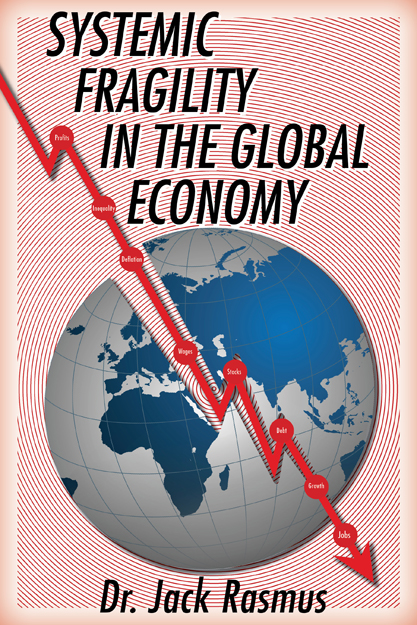
(For a more detailed analysis of how central banks are responsible for rising government debt, growing economic instability, and the next financial crisis, read Chapter 14 of Jack’s recent book, ‘Systemic Fragility in the Global Economy’. Click on the book logo on this blog for free select chapters of the book.)

How U.S. Congress and Presidential Candidates keep the cash flowing to corporations and investors.

By: Jack Rasmus

Published 1 February 2016 in Telesur English Edition

“From 2001 to 2016 US politicians have cut taxes on corporations and wealthy investors by no less than US$10 trillion. Another US$10 is coming.

Proposals for more tax cuts now pending in Congress – plus proposals supported by Trump, Cruz, other Republican presidential candidates – will add another US$10 trillion in tax cuts. And, as from 2001 to 2016, the latest proposals will once again benefit mostly US big banks, big corporations, and the wealthiest investors – i.e. the 1 percent and, even more so, the 0.1 percent and 0.01 percent.

Bill Clinton Opens the Door: 1997-1998

It is little known, but the trend toward massive investor and corporate tax cutting in recent decades began with Bill Clinton and his 1997-98 tax cut legislation. The 1997 Act cut taxes by US$400 billion. The wealthiest 20 percent households received 75 percent of the tax cuts or US$300 billion. The Clinton cuts reduced capital gains and estate taxes, cut gift taxes and the corporate alternative minimum tax, and opened up corporate tax loopholes while limiting the IRS ability to investigate wealthy tax evasion. Forty-eight million of the lowest income households got no cuts or saw their taxes actually increased. Another 48 million households got tax cuts averaging US$300. Capital gains taxes were cut by US$200 billion benefiting the wealthiest 1 percent households (1.2 million) who received an average cut of US$16,187, according to the Center for Tax Justice. A follow up tax act in 1998 further restricted the IRS from investigating tax fraud by the wealthy and corporations, while expanding capital gains tax provisions still further. The modern era of tax cutting for the wealthy and their corporations thus begins with Bill Clinton.

George W. Bush ‘The Great Benefactor’: 2001-2008

George Bush wasted no time in blowing open the door unlocked by Clinton. In a succession of annual tax cuts starting in 2001, personal income taxes under Bush were reduced by US$3.3 trillion, according to the independent research source, ‘Tax Notes.’

In 2001, as the ultra-conservative think tank, the Heritage Foundation, admitted the 2001 Bush cuts in personal income taxes mostly benefited capital incomes and the 4.7 percent wealthiest households; 95 million U.S. taxpayers received no reductions at all from Bush’s US$1.35 trillion 2001 cuts. Roughly three-fourths of the US$1.35 trillion – i.e. US$1 trillion – went to the wealthiest households, according to the National Tax Journal’s analysis. In 2001, the wealthiest 1 percent households also received another US$138 billion tax windfall in the reduction of Estate and Gift taxes.

In 2002, Bush turned to reducing corporations’ taxes. Faster business depreciation write offs (a tax cut) and more corporate tax loopholes, like ‘net operating loss’, added another US$1 trillion in tax cuts.

In 2003, it was back to more tax cuts for wealthy individuals. Cuts in capital gains and dividend taxes, from 39.5 percent to 15 percent were enacted, faster tax rate cuts at the top levels, and even more generous depreciation and business tax cuts, cut taxes for businesses by another US$400 billion and for mostly wealthy individuals by another US$800 billion.

In 2004 it was tax cuts benefiting mostly the largest U.S. multinational corporations. The 700 page Corporate Tax Reduction Act of 2004 produced, according to the Center for Tax Justice, “the largest business tax relief program in more than a decade”. Many of the dozens of offshore tax sheltering corporate tax loopholes that exist today were born in the 2004 Act, which also provided a ‘tax holiday’ that saved multinationals US$195 billion in back taxes owed, a US$80-$100 billion in export subsidy tax rebates to corporations, deduction of foreign taxes from U.S. taxes, and scores of special tax cut provisions for industries like tech, pharmaceuticals, banks, aircraft leasing, beer and wine, film and entertainment and other special interests. Estimates are the 2004 corporate reductions amounted to another US$500 billion for the decade.

Bush cuts for just his first term in office, add up to wealthiest households, investors, and businesses getting approximately US$3.8 trillion in tax cuts. No wonder U.S. tax revenues from corporations declined to only 6 percent of total government tax revenues, compared to previous averages as high as 20 percent.

With the 2008 crash, Bush and the Democratic Congress passed another US$168 billion emergency tax cuts to try to slow the recession, with little effect. It added another US$50 billion in business tax cuts, along with emergency rebates to consumers.

Obama ‘The Generous’: 2009-2015

Obama’s initial emergency stimulus bill of 2009 called for US$787 billion, about US$315 billion of which were tax cuts and at least US$200 billion in business and investor cuts. Democrats in Congress at the time proposed an additional US$120 billion in consumer household tax cuts, but Obama agreed with his business advisers and Republicans and cut it out of his 2009 stimulus proposals.

In 2010, the Bush tax cuts of 2001-03 were scheduled to expire. However, Obama supported the extension of the cuts for another two years. That resulted in US$450 billion in further tax cuts for investors and corporations.

In August 2011, the Congress cut $1 trillion in spending on education and other social programs, and scheduled another US$1 trillion for cuts starting in 2013 – half of which as for defense and half for more social programs. A ‘fiscal cliff’ crisis, as it was called, loomed for 2013 as the US economy slowed. A deal was struck at year-end 2012 between Obama, U.S. House of Representatives Republicans, and conservatives in the U.S. Senate to avoid the so-called ‘fiscal cliff’. As part of that deal, no less than US$4 trillion more in tax cuts were passed – entrenching the Bush tax cuts benefiting corporations and investors with US$3 trillion more for the next decade, and at minimum US$3 trillion forever as the Bush era cuts now became permanent.

Meanwhile, throughout the Obama era, multinational corporations continued to hoard profits offshore and not pay U.S. taxes. Un-repatriated corporate taxes due but not paid rose from US$700 billion during the Bush years to more than US$2.1 trillion by 2014. If one averages the offshore tax avoidance by U.S. multinationals over the Obama years, it averages approximately US$1 trillion a year. If U.S. multinationals had paid the required 35 percent corporate tax rate, if the numerous loopholes created since 2002 were removed, if the ‘tax inversion’ scams since 2014 were not allowed, it would have meant US$350 billion a year for the eight years, or about US$2.8 trillion, in additional taxes paid by multinationals. Or, US$2.8 trillion in what amounts to de facto tax cuts since they were allowed by Bush-Obama and Congresses over the past decade and a half.

Thus, under the Obama regime a total of roughly US$6.5 trillion has been added in tax cuts for wealthy households, investors, multinational corporations, and U.S. business in general. Summing up, that’s US$300 billion from Bill Clinton, US$3.8 trillion from Bush, and US$6.5 trillion under Obama – for a total of at minimum US$10.6 trillion!

However, that mind-boggling total is not the end of it. Candidates now running for office for president of the United States are proposing trillions more in tax giveaways to the 1 percent and their corporations.

The Republican Presidential Candidates: ‘More Is Not Enough’

All the main republican presidential candidates propose cutting wealthy and corporate taxes by well more than US$10 trillion. Here’s just a few of the main proposals of the top 3 Republican candidates:

Ted Cruz: Reduce the personal income tax from 35 percent to 10 percent. Then end the corporate income tax altogether and replace it with a 16 percent business value added tax (VAT) – most of which business would obviously then pass on to consumers to pay. Businesses could also deduct every penny they spend on investments from their taxes owed. Invest it all and pay no taxes whatsoever, in other words. The conservative Tax Foundation has estimated Cruz’s plan would amount to US$768 billion in tax cuts for corporations and the wealthy 1 percent, the latter of whom would see their take home income immediately rise by 30 percent. Other detailed provisions would push it well over US$10 trillion for the next decade.

Marco Rubio: End all taxes on capital gains, dividends, and interest. Reduce the top rate for business incomes from 39.5 percent to 25 percent. (For wage incomes reduce it only from 39.5 percent to 35 percent). The Rubio proposal would have meant the US$5 trillion paid by corporations in stock buybacks and dividends since 2010 would have been totally tax-free for wealthy investor households. So too would the more than US$1 trillion a year in total capital gains every year since 2012. In other words, just the end of capital gains would mean a trillion dollars minimum a year for every year forever. Add to that the 15 percent rate cuts for business income and high end CEO salary tax cuts.

Donald Trump: the Tax Foundation and other sources estimate Trump’s tax cut at US$12 trillion over the coming decade: US$10 trillion in personal income tax cuts and another US$1.5 trillion in corporate tax cuts. Trump reduces the personal income tax top rate from 35 percent to 25 percent and corporate income tax to 15 percent. Trump would eliminate the estate tax (another US$238 billion), the Alternative Minimum Tax that hits the wealthy, and the 3.8 percent Obamacare tax on the wealthiest.

Other ‘wannabe’ Republicans – Carson, Paul, Christy and other assort ‘goofies’ – parrot the same, and more, US$10 trillion in new tax giveaways to the wealthiest, investors and businesses across the board.

It may have taken 15 years to give the first US$10 trillion away. But it looks like it will take less than half that to give the next US$10 trillion.

Jack Rasmus is author of the just released new book, ‘Systemic Fragility in the Global Economy’, by Clarity Press, 2016. His blog is jackrasmus.com.

This content was originally published by teleSUR

Listen to Dr. Jack Rasmus’s latest Alternative Visions Radio show of 1-29-16 on topics of latest US GDP numbers and coming ‘relapse’ in US economy–plus evidence on growing problems in China, Europe, Japan, and global oil and currency markets worldwide.

go to:

http://www.alternativevisions.podbean.com

or to:

http://prn.fm/category/archives/alternative-visions/

SHOW ANNOUNCEMENT:

More indicators show growing instability in the global economy, as US economy now appears to be slowing rapidly as well. Jack disassembles US 4th quarter 2015 initial GDP numbers, showing durable goods falling at the fastest rate since 1992, as business spending and inventories and exports continue to pose a problem into 2016. Jack predicts yet another ‘economic relapse’—the fifth in as many years—on the horizon for the US for 2016. Elsewhere, global instability continues to rise: Japan announces surprise negative interest rates, pre-empting Europe’s soon announcement of another QE expansion—which will intensify global currency wars further. China capital flight reaches $1 trillion, and Jack predicts inevitable Yuan devaluation coming. Italian banks in big trouble with more than $350 billion in non-performing bank loans (Europe more than $1.5 trillion). Why economists are confused about the correlation of stock price and oil price collapse occurring now. Jack’s view of unreliability of China stats confirmed by sacking of its statistics director this week, Wan Baoan. Japan stats with resignation of Akira Amani as well. Jack reviews billionaire speculator, George Soros’, predictions at interview at Davos last week, confirming China ‘hard landing’ underway and threat of spreading deflation, which Jack predicted in his book, ‘Systemic Fragility in the Global Economy’.

The destruction of unions in the US has been going on for decades, steadily intensifying since the 1970s. But recent, and pending, U.S. Supreme Court decisions are now leading a new, intensive attack on unionization in the U.S.

The latest is the pending decision by the US Supreme Court in the case, “Friedrichs vs. California Teachers Association,” which targets teachers and other public workers and their unions. The decision immediately affects 10.7 million teachers in the US, and potentially a further 10 million state and local public workers who are, or might be, in unions.

The Friedrichs case is but the latest in a decades-long effort to deny unions in general – both public and private sector – necessary financial resources to effectively represent members in bargaining, and especially to undermine their ability to engage in political action like lobbying or support for pro-worker political candidates.

In the Friedrichs case, which has already heard by the US Supreme Court, with a decision coming down any day now, teachers unions won’t be allowed to use union dues or now even equivalent “agency fees” for union spending on what is the primary target of Friedrichs – i.e. political action, lobbying, candidate support, and political advocacy in general.

Teachers and other public sector unions rely heavily on mobilizing politically in support of their collective bargaining demands. They spend significant financial resources to try to elect government representatives, their bargaining partners, who are sympathetic to their interests in terms of wages, jobs, and benefits; or to defeat or remove those elected politicians who are not. They also spend heavily to lobby government and politicians after elections. Should the US Supreme Court rule in favor of Friedrichs, which is reportedly highly likely, it would mean teachers and public unions could no longer spend financial resources on such activities as they had been. They will have fewer financial resources with which to do so. And fewer financial resources translates into less political mobilizing, less political influence, and therefore less effective bargaining thereafter in the longer run.

The Friedrichs case therefore represents an important shift and intensification of anti-union efforts, this time targeting teachers and other public workers and their unions. But the attacks on private sector unions in the US have been going on for decades.

Destruction of Private Sector Unions

Since the 1970s, corporate efforts to destroy US unions have primarily targeted private sector workers and their unions in manufacturing, construction, and transport – i.e. industries where once 60-70 percent or more of the workforce were once organized before 1980 but where, today, the number of workers in the private sector in the U.S. that are unionized has declined to barely 6 percent.

The 6.7 percent unionization of private sector work force that remains in the US today represents roughly 10.5 million out of a total 157 million in the labor force in the US today. Had the percentage of unionized in the US remained the same today as it was in 1980, at 22 percent, instead of today’s 6 percent, private sector unions today would have a total membership of 35 million instead of the actual 10.5 million. Union labor has thus declined by an actual and potential 25 million members as a consequence of the corporate offensive since 1980.

The destruction of unions in manufacturing, construction, and other private sector industries has been the result of a multi-sided corporate attack on a number of fronts: virtually eliminating the right to strike, government-legal support for outright union-busting, establishing more and more obstacles to union organizing, eliminating the right to have union hiring halls, free trade and corporate tax incentives to move jobs offshore, targeting and removal of militant union leaders, allowing 40 million part time, temp, and contract workers to be exempt from union representation, expanding to 25 states what is called “right to work” laws in the US, which prevent unions from requiring workers they represent to join the union or pay any union dues.

Another element of anti-union strategy targeting manufacturing, construction and other private sector unions has been to impose more and more restrictions on how unions may spend their members’ dues and financial resources on political action and mobilizing. New rules in recent decades, for example, requires unions to “refund” back to a member his or her share of what the union would have spent on political action. That means less resources for unions to spend on bargaining or political action. Up to now, the member has had to request to “opt out” of the spending to get the dues rebated. But this too may change soon, if the Friedrichs case is approved and then is extended to the private sector unions.

All of this imposing of more limits on unions spending for political action is rather ironic, given that the US Supreme Court has been approving laws like Citizens United since 2010 allowing corporations unlimited resources to spend on political action. What’s clear is that corporate interests are increasingly developing ways to inhibit and reduce unions’ ability to engage in political advocacy and action—in both public and private sectors.

Public Workers Unions Now the Target

A key element in the Friedrichs case is this question of “opt out” or “opt in.” The case reportedly will decide whether to change the practice of ‘opting out’ where now the member has to request the union not spend a portion of his dues or agency fee on political action and return that portion to him, the member. Should Friedrichs be approved, the member will automatically “opt out” and the union has to request of him to “opt back in.” Should that rule accompany the Friedrichs decision, it will mean massive loss of dues equivalent funds for the teachers union in this case. That precedent will like quickly apply to all other teacher unions, in other states and at the college level as well, and thereafter to public workers in cities and states in general.

This precedent could well even expand to private sector unions as well. With the major “right to work” offensive gaining momentum, where in 25 states so far workers can decide to pay no dues or equivalent, the “opt in” responsibility placed on the union will almost certainly result in further loss of financial resources for political action.

Public sector unions have been under attack since 2009 in other ways as well. Conservative governors have been making public workers pay for state government deficits by cutting their pensions and health care and other benefits. This has occurred even as the same states continue to cut business taxes as their deficits grow. In other states, outright limits on collective bargaining have been imposed. The Friedrich’s case is but the latest development in what will likely mean even more new initiatives to undermine public workers unions and their members’ rights and benefits.

At the same time, the attacks continue to intensify against private sector unions. More free trade and offshoring is in the works, more categories of workers legally exempted from right to unionize (for example the “gig” or “sharing” economy job trend), and the growing “right to work” corporate funded movement at the state level all represent major initiatives ongoing against private sector unions.

What it all represents is a “legal web” has thus been woven around the Labor “Gulliver” in the US, a cocoon of laws that have been spun by corporate interests and their lobbyists, a silken coffin of the law that has virtually immobilized union labor in the U.S. To break through the web, workers in the US will have to soon start over, to rebuild their unions from the ground up. That will require a different form of grass roots organization and collective action.

Jack Rasmus is the author of the just published book, ‘Systemic Fragility in the Global Economy’, Clarity Press, January 2016.

What’s happening in China? Is it becoming the locus of the next financial crisis? Some well positioned capitalists are beginning to suggest so, including no less than that guru of global hedge fund and financial speculators, George Soros. The Bank of Central Banks, the Bank of International Settlements (BIS) in Geneva, is saying the same; so too are a growing list of research departments of major global banks ,like UBS and Societe General in Europe.

China today is facing a convergence of several major forces that threaten not only to drive its economy and financial system into further and faster contraction and instability, but threaten as well to destabilize the rest of the global economy, especially emerging markets.

Instability #1: Imploding Stock Markets

In early January 2016, China’s main stock markets, the Shanghai and Schenzen, fell steeply to levels that required the government to suspend trading, i.e. to shut them down. Since December 22, 2015, in just two weeks, China stock markets have contracted by more than 20 percent, in what is a third ‘leg down’ since China’s markets began first imploding last June 12, 2015.

Initially having risen by 120 percent to bubble levels in 2014-2015, China’s markets contracted -32 percent by early July. Intervention by its central bank and government thereafter briefly stabilized prices. China then devalued its currency, the Yuan, in late August and the markets fell a second time, by -42 percent. After a short recovery last fall, a third and most recent collapse of 20 percent in early January 2016 has resulted in stock values falling about -50 percent from their previous May-June 2015 highs.

After three intervention efforts requiring US$500 billion by China’s central bank and government over the past six months to stabilize the stock implosion, it has become clear that China authorities cannot prevent the markets from imploding still further. Analysts predict China’s stock index will fall to 2000 from its current 2900, and its June 2015 highs of more than 5000. That’s about a -65 percent fall, which is roughly equivalent to the collapse of U.S. stocks in 2008-09.

That kind of stock market collapse suggests China may be beginning to experience a financial crisis roughly equivalent to the U.S. financial crash of 2008-09. Stock market crashes of such dimensions are signs of either actual, or impending, near-depression conditions.

Instability #2: Currency Decline & Capital Flight

With a stock market collapse underway, wealthy Chinese investors, speculators, and China’s more than 6,000 estimated shadow banks (there were no shadow banks in 2008), are all desperately selling stock. Stock sales in Yuan are then being converted to dollars and other global currencies. The money is then sent out of China to invest abroad. Estimates of capital flight from China last year in 2015 are estimated at around US$1 trillion.

To try to stem the outflow, China authorities have been intervening in global currency markets to try to keep currency values from falling precipitously. More than US$100 billion was used to prop up the currency in December 2015 alone. But like the US$500 billion spent the past six months to intervene to stop the stock price collapse, China central bank and government attempts to prop up China’s currency have proved equally ineffective at stemming the decline in its currency, which has already devalued since last summer by 6 percent to the dollar, as pressure continues to build for still more devaluation.

Unable to prevent both its stock market implosion and further devaluations, the impression globally is growing that China is progressively losing control of growing economic instability.
The stock selling and collapse is feeding the currency devaluation and vice-versa. Investors and speculators are selling stock converting Yuan to dollars and driving down the currency’s value; in turn the declining currency is encouraging investors to sell stocks in a currency that is falling in value. In other words, a mutual downward spiral is underway.

Instability #3: Slowing Real Economy

Behind the stock-currency spiral is China’s real economy that is slowing faster than China official statistics indicate. China’s real economy, measured in GDP, is slowing far more rapidly than the government’s estimated 6.9 percent. Independent sources looking at rail and freight traffic, electricity usage, manufacturing output, and other such indicators, suggest China’s growth rate may in fact average around 5 percent. Some estimates are suggesting as low as 3 percent annual growth today. Its manufacturing sector has contracted every month throughout 2015. Export growth is negative. Industrial production and real investment growth rates are half of what they were in 2014. Prices for industrial goods are deflating and for consumer goods and services rapidly disinflating.

China’s slowing real economy means corporate profit declines and even defaults, which encourages investors to dump and sell stocks; stock and currency translates by various channels into further corporate profits decline. The problem is particularly acute among state owned and old ‘industrial’ enterprises, which have become massively indebted since 2009 and increasingly unable to secure financing even to continue production operations.

Thus these three elements—slowing real economy, stock implosion, and currency devaluation—are now feeding back upon and exacerbating each other. The downward spiral is intensifying.

Overlaid on all the three elements are the slowing global economy and slowing demand for China exports, the global currency wars intensified by recent Europe and Japan QE programs which will expand still further in 2016, and spreading recessions in emerging markets, barely growing or stagnating economies in Europe and Japan, and the concurrent collapse of global oil prices, now at US$29 a barrel and in some places, like Canada, as low as US$15.

In other words, growing fragility in the global economy outside China makes the global economy today more sensitive to growing instability within China itself, and vice-versa. China and the global economy are feeding off each other negatively as well: China destabilizing the rest of the global economy and that destabilization negatively impacting China as well.

Instability #4: Corporate Debt and Non-Performing Loans

This China-global interaction is taking place, moreover, on a tinderbox of debt in China, as well as globally. Total global debt, mostly business debt, has increased by no less than US$50 trillion since 2009. China’s total debt represents no less than half of that US$50 trillion, having risen from US$7.4 trillion in 2007 to more than US$30 trillion today. Moreover, even more ominous, about US$2.5 trillion of its US$19 trillion corporate debt represents non-performing business loans in China today.

As stock markets and currency declines, as old industrial companies slide deeper into trouble and can’t raise money capital, and as revenue from exports slows for China, it means China corporations (and local governments) will face increasing difficulty making payments on the massive debt that has accumulated since 2007. Defaults are inevitable, which in turn will make both China’s real and financial economy even more unstable.

In short, a bust in coming in China and it will spill over to the rest of the global economy with serious consequences—first for emerging markets and thereafter inevitably as well for advanced economies like the US, Europe and Japan.

China government and state banks will have to bail out the over-indebted private sector. The government has massive reserves of US$3 trillion with which to do so. But it has already spent approximately US$1 trillion dollars thus far to support stocks and its currency. How much more will it commit to bail out its falling stock market, to halt the decline of its currency and capital flight, and eventually to bail out defaulting corporations and local governments as well? And what happens to China, and the global economy, should it even balk at doing so?

The next major global financial crisis will most likely not occur in the U.S. or other advanced economies of Europe and Japan. It will originate in emerging market economies, precipitated by instability events in China. China may be able to weather the crisis, given its huge reserves. But other emerging markets, many already in recession, will find it far more difficult to do so. As China and emerging market economies enter a deeper crisis in 2016-17, the U.S, Europe and Japan, already essentially stagnating, will not prove immune as well.

Jack Rasmus is author of the just published book, ‘Systemic Fragility in the Global Economy’, available from his blog, jackrasmus.com, and website, http://www.kyklosproductions.com, as well as from Amazon.

For a half hour explanation of the basics involved in China’s growing stock, currency, real economy instability, listen to Jack Rasmus’s January 10 interview with KGO 810AM Talk Radio, covering all of northern California.

For interview go to: http://www.kyklosproductions.com/audiocds.html

SHOW ANNOUNCEMENT:

Jack Rasmus is interviewed by Northern California Talk Radio, KGO-810 AM host, Pat Thurston. Jack explains the recent renewed stock market crisis in China and what it means in 2016. He also explains the relationship between China’s currency decline, economic slowdown, and the Shanghai stock market’s recent plummet, how oil prices now will fall below $30/barrel, and what are likely responses of Emerging Markets, Japan, and Europe to the growing instability in global financial and real economies. Jack describes how his new book, Systemic Fragility in the Global Economy, predicted these developments.

SPECIAL NOTE:

Readers interested in my further analysis of the origins of the current financial instability and economic slowdown in China, beyond the ‘selections’ provided below on this blog, may read a complimentary Chapter 6 from the book, ‘China: Bubbles, Bubbles, Debt & Troubles’, for an explanation of the origins, China’s massive liquidity and debt run-up, its rotating financial asset bubbles, its turn to monetary solutions, and likely contagion effects of China’s growing instability on the rest of the global economy.

TO read the complimentary chapter 6, go to http://www.kyklosproductions.com/articles.html

For analyses of the rest of the global economy–US, Europe, Japan, Emerging Markets–and the theoretical bases for the growing global crisis, purchase the book, ‘Systemic Fragility in the Global Economy’, by clicking on the book icon on this blog and purchasing by Paypal. Or, go to Amazon.com.

Author’s Note: With all the news about China this past week, likely to continue this week and next, how did the growing crisis in China originate? What follows is an except from chapter 6 of my just published book, ‘Systemic Fragility in the Global Economy’. That chapter, dedicated to China, is entitled: “Bubbles, Bubbles, Debt and Troubles”. The following are two excerpts from Chapter 6 on China in the book.

(The book may be purchased from the icon of the book front jacket. Just click on it and pay with 10% discount using Paypal, or go to Amazon books to purchase as well).

Chapter Six: China–Bubbles, Bubbles, Debt & Troubles

The Inevitable Debt Crisis

The primary indicator of excess liquidity and financial asset investment and speculation is debt. Debt—i.e. credit extended by lenders—is the mediating element between liquidity and financial asset investing. Excess liquidity is necessary for the availability of excess credit to be loaned out as debt. Debt and its leveraging is the stuff of financial asset over-investment and financial speculation that eventually leads to financial asset bubbles, instability events, and periodic asset bubble crashes. And when those crashes are of sufficient scope and magnitude, an economy-wide—or even global-wide—financial crisis results.

In parallel with China’s exploding liquidity, its total debt has also nearly quadrupled from 2007 to mid-2015. According to a recent 2015 study by McKinsey &Company, the global business research and consulting firm, China’s total debt rose from $7.4 trillion in 2007 to $28.4 trillion through mid-2014. That total represents 282% of China’s GDP at mid-year 2014, among he highest in the world

The problem with China’s debt, however, is not just its magnitude; nor even its rate of increase. Both are impressive enough. The even greater problem is its composition, by which is meant the proportion of the debt that is private business associated debt. China national government debt is not particularly severe as countries go. But private businesses are, and especially older basic industrial companies including the many that are government enterprises.

By far the largest part of the $28.2 trillion in outstanding debt in China, as of mid-2014, was debt held by non-financial businesses. At 125% of China’s $9.4 trillion 2014 GDP, that’s about $11.9 trillion. Add another $6.2 trillion for financial institutions’ debt. That’s more than $18 of the $28 trillion, roughly two-thirds of its total debt as business-financial. Corporate debt is roughly $16 trillion in 2015 of that.

Local government debt is another problem of major dimensions in China, and should be viewed in part as wrapped up with private sector business debt. Over 10,000 local government entities in China set up ‘off balance sheet’ property investment vehicles called LGFVs, local government financing vehicles. Borrowing heavily from shadow banks, they then over-invested in local property markets. LGFV debt was approximately 18% of China GDP in 2008, or $634 billion. According to a China government survey done at the end of 2013, it rose to about $3 trillion for that year. Projections are it will rise further, to 45% of China GDP in 2015, or $4.6 trillion.

Another approximate $3.8 trillion represents household debt in China as of 2014, according to the McKinsey study, about half of which is household mortgage debt. That $3.8 trillion rose from $1.9 trillion in 2010. But the amount today may be actually higher, since the $3.8 trillion McKinsey estimate predates the bubble in China stock markets that began growing rapidly after the 2014 data by the McKinsey study. As the stock bubble grew, ‘margin debt’ lending by brokers to retail stock market investors, i.e. households who constitute 85% of China’s stock buyers, rose by as much as another $.85 trillion in just one year, from July 2014 to June 2015, according to some estimates.

Extrapolating from the mid-2014 figures, China’s total debt therefore likely will exceed $30 trillion in 2015—just about three times China’s nominal annual GDP. About $26.5 trillion is private sector debt or various kinds and related off balance sheet local government, LGFV, real estate debt. The rest is general government debt of about $4 trillion. That private sector + LGFV debt represents a $20 trillion increase in private sector debt alone since the 2008 crash—an unprecedented, historic rise in debt in only five years or so.

That debt would not have been possible without the massive liquidity injection by banks, foreign money capital in-flows, shadow bank source funding, and forms of ‘inside credit’ like margin debt, most of the latter of which is reportedly provided by shadow banks as well. And debt has consequences, especially when of that magnitude and composition. It becomes particularly important when the real economy is slowing or declining and when deflation is a factor, both in financial securities prices as well as in real goods and services prices.

China’s Triple Bubble Machine

Thus far China has faced three financial bubbles since 2013 which are in various stages of collapse and therefore financial asset deflation. The first is the local government property and infrastructure bubble. The second, the corporate junk bond and refinancing bubble involving older industrial companies and SOEs. In both cases, China’s central government has been intervening to prevent a rapid collapse of the bubbles and financial assets, trying to slow them down, prevent contagion, and extend the period of unwinding. The third bubble, in its two major stock markets, Shanghai and Schenzhen, began to form late summer 2014. In a year’s time, the stock markets surged 120%, clearly a bubble, and then began collapsing in June 2015. Since June 2015 the central government has been desperately intervening on an unprecedented scale to prevent the stock collapse from gaining momentum, just as it has been since 2013 to contain the deflating of the previous housing-local infrastructure bubbles that continue to be a problem.

The first bubble, in local real estate property, was driven by local governments, their off balance sheet financing vehicles, the 10,000 or so LGFV funds, and shadow bank financing (domestic and foreign) providing the liquidity and debt that fueled financial speculation in real estate from 2011 to 2014. Real estate prices rose to record levels in 2013. That bubble finally began to deflate in 2013-14. The collapse of the over-investing in housing and local infrastructure meant that a major stimulus to China’s real economy was thus removed after 2013, or at least significantly reduced. It has been estimated that housing constitutes 10% of China’s GDP. So it’s collapse and retreat has taken away a major underpinning to China’s real economy. In other words, the collapse of financial asset prices, and their subsequent deflation, has direct effects on a real economy GDP.

The effect of the housing bubble as it expanded also impacted the real economy. China’s central government intervened several times to slow the housing bubble before 2014 but without much effect. Each time it intervened by raising interest rates it simultaneously slowed the real economy as well as the real estate sector. As this happened, China then lowered rates again and introduced fiscal mini-stimulus packages to get the real economy back on track. This in turn restarted the real estate bubble. This see-saw policy to try to tame the shadow banks and keep the economy growing at the same time happened several times before 2014. Thereafter, China adopted a more targeted approach to attacking its shadow banks, speculators, and their local government official allies feeding the bubble in local real estate and infrastructure. By 2014 real estate prices began to moderate. However, the speculators and the profits they made from the real estate bubble then moved on—to investing and speculating in the new financial asset opportunity associated with the WMPs, the ‘asset management fund’ securities.

The WMPs fueled the continuing bubble in what other economists in the past have called ‘ponzi’ finance, providing high interest loans from ‘trust accounts’ managed by Trusts and other shadow banks to enterprises becoming increasingly fragile. A parallel development in the boom in ‘high yield’ (junk) bonds was occurring simultaneously in the US and AEs. But as China’s real economy has continued to slow, fragile enterprises are increasingly unable to repay even these high cost WMP (junk) loans. On several occasions since 2014, the China central government has had to bail them out and absorb the losses. As China’s real economy slows more rapidly in 2015-16, it is questionable whether the central government can continue to bail out ever-wider potential debt payment defaults by these enterprises. Should it not do so, the market value of the WMPs will also deflate rapidly, just as housing has.

China’s third clear financial bubble has been the acceleration in its stock markets. China’s stock bubble of 2014-15 and its current collapse has several roots. First, it is the outcome of a conscious shift in policy by China made in 2014, to redirect the massive liquidity and deb that had been destabilizing its internal financial system—i.e. in housing, local government investment, real estate, and desperation financing of failing enterprises—into the stock markets. In 2013 a major policy ‘turn’ was decided by China leadership, of which the encouragement by the central government of the stock bubble was one element.

That major policy turn was to move toward encouraging more private investment and private consumption as major drivers of the economy, and to therefore shift away from the prior heavy reliance on direct central government investment and export sales, as was the previous case. That direct investment plus exports growth strategy began to lose momentum by 2013. Future growth based on exports was about to become more difficult, as both Japan and Europe had entered double dip recessions and US growth showed no signs of accelerating. Japan introduced its QE program, designed to drive down its currency exchange rate and make it more competitive in export markets. Europe introduced its own liquidity version, a kind of ‘pre-QE’ called Long Term Refinancing Option (LTRO), with the same objective in mind. The US signaled it would raise interest rates which meant emerging markets would be severely economically impacted at some point and thus reduce their demand for China exports as well. Global trade showed signs of initially slowing. An export-driven strategy was therefore less reliable, China apparently decided. At the same time, it was also growing clear there were limits to China’s government direct investment stimulus to growth. China apparently therefore decided at an important Communist Party conference in 2013 to ‘restructure’ by shifting to more private sector driven growth. That is, to encouraging more private business investment and private consumption. Boosting the stock market was viewed therefore as the solution to enable the transition to more private investment and consumption.

Stimulating the rise of stock prices was also considered to have a double beneficial effect. It would divert money capital out of the over-heated local housing and real estate-infrastructure market, which it did. Higher stock prices would in theory also provide an important funding source for SOEs and other non-financial enterprises in trouble. If their stock price rose, it would reduce their need to borrow more debt at higher rates with more stringent terms of repayment. Debt would be exchanged for equity, reducing their financial fragility. Higher stock prices also meant, in theory at least, that enterprises in general would realize higher capital gain income, from which they could and would invest in expansion. Real asset investment would result, providing jobs and income for more workers and thus more private consumption. Rising stock prices would also have a positive ‘wealth effect’ on high end retail investors in the market, and also promote more private consumption. Higher stock prices would assist in the strategic shift to more private sector investment and consumption as the key drivers of economic growth.

It appeared a stock market boom was therefore the answer to several strategic challenges: first, the stock boom enabled plans to restructure toward more private investment and consumption; second, it addressed the need to tame the shadow banks and the bubbles they were creating by redirecting money flows into stocks; third, the new investment and consumption would get the China economy back on a faster GDP growth path—a path that was clearly slowing as the slowdown in global trade promised to negate an export driven growth strategy.

So China’s government undertook a series of measures in 2014 to rapidly expand stock values. However, the timing was inopportune. Emerging markets were already under growing pressure and slowing. Their income from commodities exports was declining. The domestic real economies of Japan and Europe economies were not recovering as planned and their demand for China exports was not rising sufficiently. Then, in June 2014, the collapse of global oil prices commenced. To boost the markets, China’s central bank, the Peoples Bank of China (PBOC) began lowering interest rates in late 2014, the first of what would be five consecutive cuts. It further injected liquidity into the markets by lowering reserve requirements of banks to get them to lend even more. In mid-November 2014 it introduce several changes to open the economy and markets further to foreign money capital. And, as a clear signal as to where the additional liquidity should flow, it introduced measures to encourage even more aggressive buying of stocks on margin. A flood of ‘retail’ investors came into the market in early 2015 as a result. The margin buying by retail investors was especially getting out of hand. Measures were introduced to slow the trend, to no avail.

After rising 120% in a year, the damn broke in China’s two major equity markets in June 2015. Stock prices crashed by 32% in just two weeks on the Shanghai exchange and by 40% on the Schenzen. Just as it had intervened to help create the stock boom, China policy makers quickly intervened again, this time to try to quell the collapse. Various measures were introduced to prevent selling of stocks, including suspension of trading at one point of nearly three-fourths of all the listed companies on the exchanges. Short selling of stocks was banned. Major shareholders (more than 5% of total shares) were banned from selling. Other measures were initiated to get buyers back into the market to buy stocks. SOEs were required to buy their stock, even if it meant raising more debt. State investment funds were ordered to buy. The PBOC provided more liquidity to brokerages to buy stock. And in another 180 degree turnaround, margin buying terms were again loosened and encouraged. In other words, a return to massive liquidity injections to try to resolve the problem that excess liquidity had helped create in the first place. That additional liquidity would translate into yet more financial debt earmarked for financial asset investment and speculation. The long run problem—too much liquidity and therefore too much leveraged debt feeding financial markets—became the short run solution. But the solution would again add to the long run problem.

China’s strategic policy shift in 2013—away from direct government investment, manufacturing and export driven growth, and monetary policy in service to that real investment and exports approach—amounts in retrospect to a strategy for recovery not unlike that failed approach adopted by the advanced economies from the beginning of the crash of 2008-09. That AE strategy relied primarily on monetary measures that accelerated liquidity in the system. Fiscal policy was token at best (or negative in Europe and Japan), assuming forms of austerity. AE central banks believed that massive money injections would flow into real asset investment as banks resumed lending to non-financial enterprises. Real investment would bring back jobs, and therefore income and consumption. Wealth effects from rising financial asset values would add to consumption. More consumption would stimulate more real investment in turn. But nothing like that happened. The liquidity flowed into financial asset investing and financial markets, boosting stocks and bonds but little else.

China differed from the AEs in the initial period of 2008-10. Fiscal policy came first, and monetary policy and liquidity was primarily accommodative. But that began to reverse as a result of a series of measures, first in 2010 and then in 2013. The liquidity and debt explosions in China thus came later, well after the AEs, and in different forms. The eventual financial asset bubbles occurred in different markets as well. But China’s experience, especially after 2013, shows the same problems with AE recovery strategies that focus on liquidity injection that ultimately lead to excessive debt leveraging that tends to flow into financial asset markets. They lead to financial asset bubbles, to the need for still more liquidity to prop up the financial asset deflation that inevitably occurs when bubbles unwind and prior debt cannot be repaid. Excess liquidity leads to debt leads to more liquidity and yet more debt. It is a vicious circle leading to financial fragility and instability.

Listen to the ALTERNATIVE VISIONS RADIO show of January 8, 2016, and host Jack Rasmus’s latest ‘take’ on China stock markets and financial instability this past week, plus the deepening economic and political crisis brewing in South America. Go to:

http://www.alternativevisions.podbean.com

or to:

http://prn.fm/category/archives/alternative-visions/

SHOW ANNOUNCEMENT:

“Jack Rasmus takes a look at this past week’s major event in the collapse of the China stock market, as well as the resurgence of Neoliberal policies in South America and the US pivot to that continent and destabilization of economies in Venezuela, Brazil and Argentine now underway. What’s behind the most recent stock decline in China? Jack explains its relationship to the slowing real economy there, and the pressure to devalue its currency, the Yuan, that is growing. Devaluation coming in China is reflected in investors attempting to take their money and run, thus the stock decline now underway. China government efforts to slow it via ‘circuit breakers’ is not working as well as before. The real economy-currency-stock nexus will continue. How this all has contagion effects on the rest of the global economy is explained. Jack then looks at the US ‘pivot’ to South America, and specifically how the US destabilizes economies by wrecking its currency. Global oil and commodity crash, slowing China, and US interest rate hikes are all having major negative effects on South American economies. In this scenario, the US is now attempting to exacerbate Venezuela’s currency collapse even further, while attacking it politically and legally. Venezuela is a model of how the US destabilizes a country’s currency and therefore economy, as a prelude to re-establishing more friendly Neoliberal governments and policies.”

For a comprehensive analysis of both China and Emerging Market economies, see chapters 3 and 6 of Jack’s just published book, ‘Systemic Fragility in the Global Economy’, Clarity Press, January 1, 2016, available from this blog (see icon) and Jack’s website (book icon front webpage), purchasable by paypal, or now available on Amazon and at bookstores.

After 9-11, the United States focused its most aggressive foreign policy on the Middle East—from Afghanistan to North Africa. But the deal recently worked out with Iran, the current back-door negotiations over Syria between US Secretary of State, Kerry, and Russia Foreign Minister, Lavrov, and the decision to subsidize, and now export, US shale oil and gas production in a direct reversal of US past policy toward Saudi Arabia—together signal a relative shift of US policy away from the Middle East.

With a Middle East consolidation phase underway, US policy has been shifting since 2013-14 to the more traditional focus that it had for decades: First, to check and contain China; second, to prevent Russia from economically integrating more deeply with Europe; and, third, to reassert more direct US influence once again, as in previous decades, over the economies and governments in Latin America.

Following his re-election in 2012, Obama announced what was called a ‘pivot’ to Asia to contain and check China’s growing economic and political influence. In 2013-14, it was the US-directed Ukraine coup—i.e. a pretext for sanctions on Russia designed to sever that country’s growing economic relations with Europe. But there is yet another US policy shift underway that is perhaps not as evident as the refocus on China or the US new ‘cold war’ offensive against Russia. It is the US pivot toward Latin America, begun in 2014, targeting in particular the key countries and economies of South America—Venezuela, Brazil, and Argentina—for economic and political destabilization as a fundamental requisite for re-introduction of Neoliberal policies in that region.

Venezuela: Case Example of Destabilization

Economic destabilization in its most recent phase has been underway in Venezuela since 2013. The collapse of world oil and commodity prices, a consequence in part of the US vs. Saudi fight that erupted in 2014 over who controls the global price of oil, has caused the Venezuela currency, the Bolivar, to collapse. The US raising its long term interest rates the past year has intensified that currency collapse. But US government and banking forces have further fanned the flames of currency collapse by encouraging speculators, operating out of Colombia and the ‘DollarToday’ website, to ‘short’ the Bolivar and depress it still further. US based media, in particular the arch-conservative CATO institute in Washington, has joined in the effort by consistently reporting exaggerated claims of currency decline, as high as 700%, to panic Venezuelans to further dump Bolivars for dollars, thus causing even more currency collapse. Meanwhile, multinational corporations in Venezuela continue to hoard more than $11 billion in dollars, causing the dollar to rise and the Bolivar to fall even more. The consequence of all these forces contributing to collapse of the currency is a growing black market for dollars and shortages of key consumer and producer goods.

But all that’s just the beginning. Currency collapse in turn means escalating cost of imports and domestic inflation, and thus falling real incomes for small businesses and workers. The black market and dollar shortage due means inability to import critical goods like medicines and food. Rising cost of imports means lack of critical materials needed to continue production, which results in falling production, plant and business closures, and rising unemployment.

Currency collapse, inflation, and recession together result in capital flight from the country, which in turn exacerbates all the above again. A vicious cycle of general economic collapse thus ensues, for which the popular government is blamed but which it has fundamentally not caused.

As this scenario in Venezuela since 2014 has worsened, the US has targeted Venezuela’s state owned oil company, Petroleos de Venezuela, with legal suits. The Obama government in March 2015 also issued executive orders freezing assets of Venezuelan government and military representatives charged with alleged ‘human rights’ abuses. The US then then recently arrested Venezuelan businessmen in the US, holding them without bail, no doubt to send a message to those who might still support the government. The US government has also indicted Venezuelan government and military officials recently with charges of alleged drug conspiracy, including National Guard generals who have supported the Maduro government. This all raises impressions of government corruption with the public, while giving second thoughts to other would-be military and government supporters to ‘think twice’ about their continuing support and perhaps to consider ‘going over’ to the opposition in exchange for a ‘deal’ to drop the legal charges. The popular impression grows that the economic crisis, the inflation, the shortages, the layoffs must all be associated with the corruption, which is associated with the government. It is all classic US destabilization strategy.

As all the above economic dislocation has occurred in Venezuela, money has flowed through countless unofficial channels to the opposition parties and their politicians, enabling them to capture earlier this month control of the national assembly. The leaders of the new assembly, according to media leaks, now have plans to reconstitute the Venezuelan Supreme Court to support their policies and to legally endorse their coming direct attack the Maduro government in 2016. It is clear the goal is to either remove Maduro and his government or to render it impossible to govern.

As Julio Borges, the next president of the national assembly, has declared publicly in recent days: if the Maduro government does not go along with the new policies of the Assembly, “it will have to be changed”. No doubt impeachment proceedings, to try to remove Maduro, will be soon on the agenda in Venezuela—just as it now is in Brazil. But for that, the Venezuelan Supreme Court must be changed, which makes it the immediate next front in the battle.

Argentina & Brazil: Harbinger of Neoliberal Things to Come

Should the new pro-US, pro-Corporate Venezuela National Assembly ever prevail over the Maduro government, the outcome economically would look much like that now unfolding with the Mauricio Macri government in Argentina. Argentina’s new Macri government has already, within days of assuming the presidency, slashed taxes for big farmers and manufacturers, lifted currency controls and devalued the peso by 30%, allowed inflation to rise overnight by 25%, provided $2 billion in dollar denominated bonds for Argentine exporters and speculators, re-opened discussions with US hedge funds as a prelude to paying them excess interest the de Kirchner government previously denied, put thousands of government workers on notice of imminent layoffs, declared the new government’s intent to stack the supreme court in order to rubber stamp its new Neoliberal programs, and took steps to reverse Argentine’s recent media law. And that’s just the beginning.

Politically, the neoliberal vision will mean an overturning of the Supreme Court, possible changes to the existing Constitution, and attempts to remove the duly-elected president from office before his term. Apart from stacking the judiciary, as in Argentina, Venezuela’s new business controlled National Assembly will likely follow their reactionary class compatriots in Brazil, and move soon to impeach Venezuela president, Maduro, and dismantle his popular government, just as they are attempting in Brazil with recently re-elected president, Rousseff.

What happens in Venezuela, Argentina, and Brazil in the weeks ahead, in 2016, is a harbinger of the intense economic and political class war in South America that is about to erupt to another higher stage in 2016.

by Jack Rasmus,
copyright 2016

Jack Rasmus is author of the just published analysis of the global economy, ‘Systemic Fragility in the Global Economy’, by Clarity Press, January 2016, available from Amazon; from http://www.ClarityPress.com/Rasmus.html; and from this blog (see book icon) and website