Feeds:
Posts
Comments

(This article was published by the author in Telesur Media English Edition, April 17, 2016)

Last August 2015, after eight months of intense negotiations with Europe’s Troika financial institutions—the IMF, European Central Bank, and European Commission—the Greek Government capitulated to the Troika’s demands imposing more austerity on Greece and its people in exchange for another $98 billion in additional loans.

The $98 billion did not represent economic assistance to Greece, to stimulate its economy, but was earmarked almost exclusively to pay back interest to the Troika, Europe banks, and Europe investors for prior loans made to Greece in 2012, 2010, and before. But while the Greek people would see little real benefit, they would have to pay the price. In exchange for the $98 billion in new credit, the August 2015 debt restructuring deal required Greece to even further cut pensions, axe more government jobs and cut wages, raise taxes, accelerate the sales of public works (ports, airports, utilities, etc.) to private investors, and to in effect turn over Greek banks to the Troika and its northern Europe banker and investor friends.

To ensure Greece would not renege on the August 2015 deal, it would now also have to submit to vetoes by Troika representatives sent to Greece to oversee virtually all policy decisions made by Greece’s democratically elected Parliament or local governments. The Troika last year thus tightened its grip on Greece both politically and economically to ensure it would receive debt payments from Greece no matter how harsh the austerity terms.

The Greek government may have thought it had a debt deal, albeit a dirty one, last August 2015; but recent developments are now beginning to reveal it was only temporary. Worse is yet to come. The Troika grip on Greece is about to tighten still further, as revelations in recent weeks show Troika plans to renege on last year’s terms and demand even more draconian austerity measures. Leading the Troika attack on Greece once again is the International Monetary Fund, the IMF, one of the Troika’s three institutional partners.

IMF Secret Plans to Impose Further Austerity on Greece

This past April 2, 2016, Wikileaks released transcripts of a secret teleconference among IMF officials that occurred on March 19. In it, leading IMF directors expressed concern that discussions between Greece and the IMF’s Troika partner, the European Commission, on terms of implementing last August’s deal were going too slowly. The Eurozone and Greek economies have been deteriorating since last August. Still more austerity would thus be needed, according to the discussions among the IMF participants in the teleconference. And to get Greece to agree, perhaps a new ‘crisis event’ would have to be provoked.

The original August 2015 deal called for Greece to introduce austerity measures that would result in a 3.5% annual GDP budget surplus obtained from spending cuts, tax hikes, and public works’ sales needed to make the debt repayments to the Troika. But the IMF’s latest forecast for 2016 is that Greece in 2016 would have a -1.5% GDP budget deficit, not a 3.5% budget surplus. And 2015, for which numbers are not yet available, was probably even worse. Getting from -1.5% or worse to 3.5% was thus virtually impossible, according to the IMF discussants on March 19, and therefore additional austerity measures were necessary.

According to the IMF, the additional austerity would have to occur in the form of ‘broadening the tax base’—a phrase typically associated with making households with lower incomes pay more taxes instead of just raising tax rates on the top income households. The IMF thus rejected taxing the rich further, and instead taxing middle and working classes more. In addition, still more pension cuts would also prove necessary, as well as other measures.

The IMF secret teleconference further revealed that the IMF was increasingly concerned that the European Commission, in the midst of discussions with Greece on the details of the implementation of the August deal with Greece, might agree prematurely to grant some kind of ‘debt relief’ to Greece. The IMF was strongly opposed to ‘up front’ debt relief. All talk of debt relief should be postponed for at least another two years, according to the IMF’s secret discussions.

The private teleconference also revealed the IMF was growing increasingly concerned that Greece’s major debt payment to the Troika due this coming July 2016 might not be paid. The default on the payment would come within weeks of a possible United Kingdom exit (Brexit) from the European Union, scheduled for a vote in the UK on June 23, 2016. If the UK exited, and Greece could not pay, it might raise renewed interest—the IMF feared—in a Greek exit (Grexit) as well as a UK ‘Brexit’. The IMF’s March 19 teleconference therefore raised the idea that further austerity should be considered and proposed on Greece and quickly, before the June 23 UK ‘Brexit’ referendum in that country.

The IMF’s April 15, Press Conference

The ‘firestorm’ over the leak of the IMF’s plans for new and more austerity for Greece, prompted public responses by Greece, as well as a clarifying press conference by the IMF’s European directors on April 15, 2016.

Greece’s prime minister, Alexis Tsipras, publicly replied, noting Greece was already undertaking “an ambitious reform of income tax and a major overhaul of the Greek pension system”—the former providing a revenue of 1% of GDP and the pension reform and even greater 1.5% by 2018. With pensioners carrying the greatest burden of the austerity terms, why should the very rich be given relief with more taxation imposed on the middle and working classes by ‘broadening’ the tax base—i.e. making it less progressive, Tsipras inquired?

Wolfgang Schaueble, hard line German finance minister, who led the forces imposing even more austerity on Greece in August 2015, responded that debt relief was “not necessary” and ruled out any debt relief whatsoever for Greece, in 2018 or at any time. Schauble added that IMF refusal to participate in the August 2015 Greek debt deal unless the terms of the deal were changed to suit the IMF (which did not sign the deal as yet), would collapse the 2015 deal altogether.

In the IMF’s press briefing of April 15, 2016 Poul Thomsen, head of the IMF’s European department, responded that the IMF could not participate in the bailout without debt relief in some form, but left the door open as to what debt relief actually meant. Thomsen repeated his proposal to “broaden the tax base” and not raise taxes further on the rich.

Behind the apparent Schauble vs. IMF disagreement is the implication that ‘debt relief’ would require some kind of what is called ‘haircut’ and reduction in interest and/or principal for those investors holding bonds issued by the Troika on Greek debt. That’s what Schauble and European bankers don’t want. The IMF thus assured that debt relief did not require ‘haircuts’.

The Meaning of the IMF’s New Attack on Greece

What the new developments reveal is that fractures are emerging within the Troika and the Euro elites in general over the Greek debt deal of last August, as Europe’s economy continues to falter. New crises have emerged in Europe, including the cost of refugee settlement and the great economic uncertainty associated with the possible UK ‘Brexit’ this June. Europe’s central bank monetary policies are also clearly failing in the face of a steadily slowing global economy.

At the same time, the IMF itself is facing additional challenges supporting an even worse economic crisis in the Ukraine, which it has also committed to bail out but which is collapsing faster than predicted. Meanwhile, on the horizon are growing stresses in emerging market economies that have accumulated $50 trillion in additional debt since 2009, which threaten to lay claims on the IMF in the not too distant future. The IMF is no doubt looking over its shoulder at even greater potential challenges than Greece.

In short, the deteriorating conditions in the global economy are beginning to converge, and the Troika, Europe, IMF are all feeling the heat as the economic temperature rises. Another debt crisis in Greece is inevitable. But it may occur at a juncture at which it appears the least of the economic problems facing the global economy.

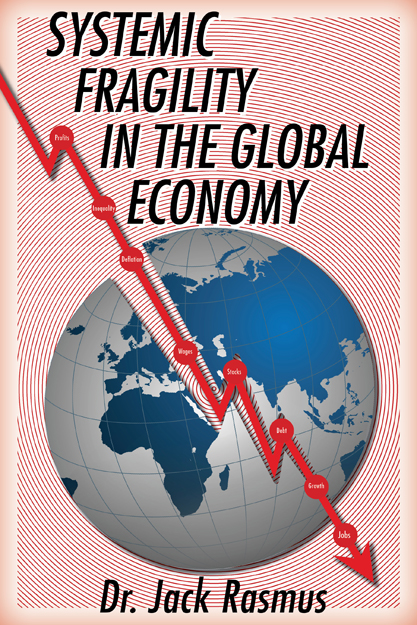
Jack Rasmus is author of the recent book, ‘Systemic Fragility in the Global Economy’, Clarity Press, January 2016, and the forthcoming, ‘Looting Greece: The Emerging New Financial Imperialism’, Clarity Press, June 2016. He blogs at jackrasmus.com.

To listen to this Alternative Visions Radio show, host Dr. Jack Rasmus, interview of Pablo Vivanco, Director of Telesur Media TV, Quito, Ecuador, on eyewitness events in South America, go to:

http://prn.fm/category/archives/alternative-visions/

Or go to:

http://alternativevisions.podbean.com/

SHOW ANNOUNCEMENT:

Jack Rasmus welcomes Pablo Vivanco, political commentator in Quito, Ecuador to provide a latest update on the right wing economic and political forces in ascendance in South America, focusing on the latest developments in Argentina, Brazil and Venezuela. As the economic crisis deepens throughout the region due to forces beyond the control of progressive governments in the region—i.e. falling oil and commodity prices, collapsing currencies, capital flight, slowing global economy—right wing forces (with assistance of US government and elite) have launched in the past year an intense attack throughout South America to reverse the tide of progressive governments that came to power since 2000. Vivanco describes the strategies and tactics, economic and political, currently being employed by the nascent Right Wing Offensive, including efforts to depose recently duly elected governments in Venezuela and Brazil and the launching of intense austerity measures, shutting down of independent media, mass layoffs, while rewarding of global bankers and investors by the new right wing government of billionaire, Mauricio Macri, in Argentina. New popular movements of resistance are described by Vivanco, as are efforts of the new right wing forces and governments to stifle independent journalists and media outlets throughout the region.

Biography: Pablo Vivanco is currently Director of the English Division of Telesur Media in Latin America, a consortium of progressive Latin American countries. A former radio host of ‘Voces Latinas’, he is a long time activist in movements for progressive change in Latin America, living and working in Quito.

For timely reports in English on daily Latin American political events, go to: http://www.telesurtv.net/english/index.html

As U.S. presidential candidate Bernie Sanders has gained momentum in the presidential primaries, the attacks on his proposed economic programs have grown proportionally.

Leading the assault have been supporters of Hillary Clinton, especially Paul Krugman, and other “stars” of the economics profession like Christine Romer, Laura Tyson, Alan Kreuger, and Austan Goolsbe — all of whom have served in past Democratic administrations and are no doubt looking to return again in some capacity in another Clinton administration. Sometimes referred to as the “gang of four,” in recent weeks all have been aggressively attacking Sanders’ economic programs and reforms. However, the target of their attacks, which began in February and continue today, is Sanders’ proposals for financing a single-payer universal health care program by means of a financial transactions tax.

The irony of the Krugman/Gang of Four attack is that Sanders’ proposals represent what were once Democratic party positions and programs — positions that have been abandoned by the party and its mouthpiece economists since the 1980s as it morphed into a wing of the neoliberal agenda.

Sanders’ critics have been especially agitated that their own economic models are being used to show that Sanders’ proposals would greatly benefit the vast majority in the U.S. But debating Krugman and his neoliberal colleagues on the grounds of their faulty economic model — a model that failed miserably under Obama to produce a sustained, real economic recovery in the U.S. — is not necessary. Their model has been broken for some time. Some straightforward historical facts and recent comparative studies are all that’s need to show that a real financial transaction tax can generate more revenue than is needed to fund a single-payer type program. Here’s how.

A Real Financial Transaction Tax

Let’s take four major financial securities: stocks, bonds, derivatives, and foreign currency purchases (forex).

A European study a few years ago involving just 11 countries, whose collective economies are about two-thirds the size of the U.S. economy, concluded that a miniscule financial tax of 0.1 percent on stocks and bonds plus a virtually negligible 0.01 percent tax on derivatives results in an annual tax revenue of US$47 billion. In an equivalent size U.S economy that would be about US$70 billion in revenue a year.

Wealthy investors’ buying of stocks and bonds is essentially no different than average folks buying food, clothing or other real ‘goods and services’. Why shouldn’t investors pay a sales tax on financial securities purchases? In the U.S., average households pay a sales tax of 5 percent to 10 percent for retail purchases of goods and many services. So why shouldn’t wealthy investors pay a similar sales tax rate for their retail financial securities’ purchases?

A 10 percent “sales tax” on stock and bond buying and a 1 percent tax on derivatives amounts to a 100x larger tax revenue take than estimated by the European study. The US$70 billion estimated based on the European study’s 0.1 percent stock-bond tax and 0.01 percent derivatives tax yields US$7 trillion in tax revenue with a 10 percent and 1 percent tax on stocks and bonds and derivatives.

Too high, Krugman and the Gang of Four would no doubt argue. Wealthy stock and bond buyers should not have to pay that much. It would stifle raising capital for companies. Okay. So let’s lower it to half, to 5 percent tax on stocks and bonds and 0.5 percent on derivatives. That reduces the US$7 trillion tax revenue to a still huge US$3.5 trillion annually.

Still too high? Okay, half it again, to a 2.5 percent tax on stocks and bonds and a 0.25 percent on derivative trades. That certainly won’t discourage stock and bond trading by the rich (not that that is an all bad idea either). The 2.5 percent and 1 percent tax still produces US$1.75 trillion a year in revenue.

But what about an additional financial tax on currency trading, like China is about to propose? Currency, or forex, trades amount to an astounding US$400 billion each day! Not all that is U.S. currency trading, of course. However, the U.S. dollar is involved in 87 percent of the trading. A 1 percent tax on U.S. currency trades conservatively yields approximately US$3 billion a day. Assuming a conservative 220 trading days in a year, US$3 billion a day produces US$660 billion in financial tax revenue from U.S. currency financial transactions in a year.

US$1.75 trillion in revenue from stock, bonds, and derivatives trades, plus another US$660 billion in forex trade tax revenue, amounts to US$2.41 trillion in total revenue raised from a financial transaction tax of 2.5 percent on stocks and bonds, 0.25 percent on derivatives, and 1 percent on U.S. dollar to currency conversions.

So how much will that US$2.41 trillion a year cover is needed to fund a single payer-Medicare for All program in the US?

Paying for Single Payer Health Care

Nearly every advanced economy in the world provides a version of single payer health care to its citizens—except the U.S. On the other hand, no country spends as much on health care as the US. The UK spends 9 percent of GDP, Japan about 10 percent, France and Germany 11 percent, for example. The U.S., in contrast, pays 17 percent plus of its GDP on health care. Given that the most recent US GDP is about US$18 trillion a year, 17 percent of US$18 trillion equals just over US$3 trillion a year.

If the U.S. spent, like other advanced economies with single payer, about 10 percent of its GDP a year on health care, it would cost US$1.8 trillion instead of US$3 trillion a year. The U.S. would save US$1.2 trillion.

Where does that current US$1.2 trillion go? Not for health services for its citizens. It goes to health insurance companies and other “middlemen,” who don’t deliver one iota of health care services. They are the “paper pushers” who skim off US$1.2 trillion a year in profits that average returns of 20 percent a year and more. They are economic parasites, or what economists refer to as “rentier capitalists” who don’t produce anything but suck profits and wages from those who do actually produce something. They then used the US$1.2 trillion a year to buy up each other, expand globally, and deliver record dividend and stock buybacks for their shareholders.

In other words, a true financial transactions tax, that is still quite reasonable at tax rates of 0.25 percent to 2.5 percent, can pay for all of a single-payer health care program in the U.S. and still have hundreds of billions left over — US$641 billion to be exact (US$2.41 minus US$1.8 trillion).

That US$641 billion residual could then be used to better fund current Medicare programs. It could eliminate the current 20 percent charge for Medicare Part B physicians services and provide totally free Part D prescription drugs for everyone over 65 years. The savings for seniors over 65 years from this, and the tens of thousands of dollars saved every year by working families who now have to pay that amount for private company health insurance, would now be freed up with a single payer system, to be spent on other real goods and services.

A financial transaction tax and single payer program would consequently have the added positive effect of creating the greatest boost in real wages and household income, and therefore consumption, in US economic history. More consumer demand would mean more real investment.

Yes, there would be less spending by the wealth speculating in stocks, bonds, derivatives, forex and other financial securities. But so what? If rich and wealthy investors don’t like that, well then let them eat cake — or some other four letter word.

Jack Rasmus is author of the just published book, “Systemic Fragility in the Global Economy,” by Clarity Press, 2016. He blogs at jackrasmus.com.

This content was originally published by teleSUR at the following address:
http://www.telesurtv.net/english/opinion/Neoliberal-Economists-Against-Bernie-Sanders-and-Common-Sense-20160331-0026.html”. If you intend to use it, please cite the source and provide a link to the original article. http://www.teleSURtv.net/english

To listen to why Mainstream economists allied with the Democratic Party are attacking Bernie Sanders’ economic program–and Jack Rasmus’s defense and explanation how a financial transactions tax would more than pay for single payer-universal health care (Medicare for All)–listen to the March 25 Alternative Visions radio show. Go to:

http://prn.fm/category/archives/alternative-visions/

or go to:

http://alternativevisions.podbean.com/

SHOW ANNOUNCEMENT:

(Note: first half hour reviews the global economy. second half hour of show describes how a financial transactions tax pays for single payer with billions left over to expand social security Medicare)

Dr. Jack Rasmus explains how his version of a Financial Transaction Tax on stocks, bonds, derivatives, and currencies could raise far more than sufficient revenues to pay for a single payer-national health care program and still leave hundreds of billions to expand social security Medicare and other programs. In the second half of the show, Rasmus shows how a single payer system would save $1.2 trillion a year out of the current health care cost of $3 trillion today. Based on a tax study done in Europe in 2013, Rasmus shows a US financial tax of 5% on stocks & bond trades, a 1% tax on derivatives sold in the US, and 1% on non-government US currency sales raises $3.89 trillion a year, or about twice the revenues needed for a comparative single payer system. Rasmus then reviews and debunks the debates by neoliberal economists like Paul Krugman, and Clinton’s ‘gang of four’ economists, who have been attacking Sanders’ proposals for a financial tax and single payer health care. In the first half of the show, reviewing recent events in the global economy Rasmus addresses the fallout from the European Central Bank’s recent decision to expand its quantitative easing and negative interest rate programs and why they will fail; the growing default risk in the US energy junk bond markets; the preliminary agreements by Russia, Saudi Arabia and others to freeze oil prices; China’s continuing desperate moves to deal with the massive bad corporate debt problem; French retreats on introducing labor market reforms in response to mass demonstrations: the doubling in average prescription drug prices in the US: and why millennials (age 25-34) in the US now earn take home pay today in 2016 less than they did in 1984.

To listen to my March 11, 2016 Alternative Visions radio show on this topic, go to:

http://prn.fm/category/archives/alternative-visions/

or to:

http://www.alternativevisions.podbean.com

SHOW ANNOUNCEMENT:

Last month the Bank of Japan (BoJ) expanded its QE program and negative interest rates (NIRP) in a desperate attempt to reboost its stock market and Yen exchange rate. This past week the European Central Bank (ECB)went a step further, as both the ECB and BoJ continue to engage in ‘dueling QEs’ that are intensifying global currency wars and slowing global trade. ECB chairman, Mario Draghi, lowered the Eurozone’s negative rate on government bonds another notch, now to -0.4%. Reportedly half of all government bonds in Europe now trade at negative rates. In addition, the ECB raised its monthly buying amount from $66 billion to $88 billion, and now will buy corporate bonds as well. The move subsidizes Euro corporations, lowering their costs of borrowing and insurance (CDS) on bonds, a move to offload the $1.5 trillion in corporate non-performing loans in Europe. Jack Rasmus explains why this won’t have any effect on the Eurozone real economy but will temporary boost stocks and currency. Jack also reviews why global oil prices have risen recently to $40 a barrel, Japan’s official return to recession after doctoring GDP numbers last 3Q2015, China’s latest ‘mini-stimulus’, the US deepening control of Ukraine’s economy, and the significance of the ‘Socialist’ government in France new attack on eliminating the 35 hr. workweek, where 90% of all jobs created in 2015 were part time and temp, and the mass protests now emerging there. Jack concludes with brief introduction to his forthcoming May 2016 book, ‘Looting Greece: The Emergence of a New Imperialism’, and his next book out October 2016 entitled, ‘Central Bankers on the Ropes’, both from Clarity Press. (see his blog, jackrasmus.com and Clarity Press for more information).

With every televised U.S. presidential debate, listeners are fed a line of bull by candidates about how great previous United States presidents were and how the country needs to return to their policies in order to “make America great again!”

All that’s needed, the Republican candidates say, is to resurrect Reagan policies and today’s U.S. problems will be solved. “Vote for me, and I’ll return to Reagan and restore U.S. greatness,” we’re told.

With the Democrats, it’s a bit more subtle but the underlying message is the same. Under Hillary’s hubby, Bill Clinton in the 1990s, the U.S. created a record number of jobs, incomes were rising, the healthcare crisis was contained, and the U.S. had achieved a “new economy” of prosperity that would only improve further in the 21st century. Under Bill, we were on the right track. George W. Bush screwed it up by reversing course. All we need then is to get back to that “Clinton track” and good times will return again.

But what are the facts? Were Clinton policies a diversion from Reagan? A continuation? Worse?

About Incomes?

During Bill Clinton’s two terms in office, 1992-2000, 45 percent of all the income growth during the period went to the wealthiest 1 percent of families in the US, according to IRS data gathered by economist, Emmanuel Saez, of the University of California, Berkeley.

The S&P 500 stock index rose 234 percent, providing the wealthiest 1 percent households most of that 45 percent gain. Bill’s big tax cut handout to the 1 percent enabled that income growth by reducing capital gains taxation in 1997 from 28 percent to 20 percent. Executives’ direct pay also rose — on average from US$4.5 million in 1992 to US$11.1 million by 2000, for a 342 percent increase. CEO pay was equal to about 90 times the pay of the averaged paid worker; by the end of his second term, CEO pay had risen to more than 300 times the average worker’s pay.

How did the average worker do over the same period? Adjusted for inflation, in 1982 real dollars, average hourly pay rose by a paltry 5.8 percent over eight years. At the bottom of the work force, the minimum wage, measured in real terms, rose by a mere 4 cents an hour to US$5.50. The 5.8 percent and 4 cents an hour were more than offset by workers’ rising contributions to continue their pensions and healthcare insurance coverages.

Tax Rip-Offs

Apart from reducing capital gains taxes for wealthy stock and bond owners, Clinton exempted the top 10 percent households from tax hikes in 1993. Thereafter, in his big tax cut act of 1997, he raised the threshold for paying any estate tax, cut gift taxes (so the rich could give more to relatives), repealed the alternative minimum tax for small businesses and reduced it for larger corporations. Meanwhile, the effective corporate tax rate — i.e. the rate at which they actually paid a percent of their profits — fell from 18 percent in 1995 to 12 percent. In his second term, 1996-2000, no fewer than 63 percent of all corporations in the U.S. paid no corporate income tax whatsoever, amounting to a US$2.5 trillion tax windfall.

Income inequality trends, topical in the U.S. and the current 2016 presidential campaign today, actually accelerated under Clinton, and even more than under Reagan.

Job Creation

OK, so the rich got significantly richer on Bill Clinton’s watch. But at least U.S. workers were able to enjoy significant job creation, according to the Clinton camp.

Hillary and Democrats like to talk a lot about the jobs created in Bill’s second term. Admittedly, jobs were created, but they were mostly in low pay service occupations. Meanwhile, higher paid manufacturing jobs were being lost in the millions as a result of Bill Clinton free trade policies alone. Clinton proved an even fiercer “free trader” than Reagan. In 1993, he rammed through Congress legislation to expand the North American Free Trade Agreement (NAFTA) to include Mexico. One million, higher paid U.S. manufacturing jobs were lost due to NAFTA on Clinton’s watch, another 880,000 lost to China due to Clinton giving that country what is called “preferred nation trading rights” (PNTR), and another 1.2 million due to the U.S.’s exploding trade deficit in general — according to research by the Economic Policy Institute in the U.S. Corroborating the Institute, the U.S. Commerce Dept. in the 1990s estimated that 13,000 jobs are lost for every US$1 billion trade deficit — and that trade deficit rose from US$118 billion in 1993 to US$436 billion by 2000 under Bill Clinton.

Another problem with jobs during Bill’s term in office was the rise in what is called ‘contingent’ jobs, which means part time, temp, contracting, and other “alternative” forms of employment that typically pay 60 percent of full time regular jobs and very few benefits. Considering just part time and temp agency jobs, such low paid, tentative employment rose from about 22 million in 1995 to 27 million by 2000. In other words, when and if jobs were created on Bill’s watch, they were often low paid contingent jobs.

Healthcare and Health Insurance

Then there’s health care. The Clintons like to brag about how Hillary’s 1995 reforms, called “managed health care” (MHC), were successful in keeping healthcare costs down. Health care spending cost increase slowed a little in the 1990s. Instead of a 400 percent increase, as during the 1980s, health spending rose by only 60 percent from 1990 to 2000. However, that slower rate of increase was likely because the percent of corporations providing health insurance declined from 63 percent to 45 percent. Obviously, with 18 percent fewer companies offering health insurance, without coverage many workers had no choice but to forego spending on health care. The U.S. Census population survey shows that 31 million citizens lacked any health insurance in 1987. By 1998, this had grown to 44 million — a total which was then “redefined” by Clinton thereafter and reduced to “only” 39 million uninsured by 1999.

Pension Plans

Retirement benefits fared no better under Clinton. True pension plans, called Defined Benefit Plans, which guarantee retirement payments, were abandoned by the tens of thousands by companies in the 1990s. They were replaced by pseudo pensions called “401k” plans, under which workers may lose every penny of their contributions. As companies dropped defined benefit for 401k plans, enrollment in 401ks rose from 18 to 42 million workers . In addition, Clinton also allowed corporations to declare “pension contribution holidays,” during which they need make no mandatory contributions to their pension funds. Another Clinton move was to allow corporations to withdraw cash from their pension funds to cover 20 percent of their, the corporations’ share of the cost of health care insurance.

The Clinton campaign’s frequent claims today that Bill’s two terms in office were days of exceptional economic good times for U.S. workers is just plain false. On several policy fronts, Bill Clinton was actually worse than Reagan — especially with regard to free trade and benefits like health care and pensions. At best, Bill Clinton’s presidency and legacy therefore represents a continuation of Reagan’s — not a shift from his predecessor.

We shouldn’t expect anything less from Hillary — i.e. her continuation of Obama’s economic policies, which have brought very little benefit to U.S. workers while providing massive income shifts even more generous to the wealthiest 1 percent and their corporations.

During Bill Clinton’s term in office, 45% of all the income gains went to the wealthiest 1%. But under Barack Obama, 97% of all income gains went to the wealthiest 1%, according to IRS data. And Hillary says she wants to continue BO’s work as well as Bill’s.

Reagan, the Bushes, the Clintons, Obama–they’re all representatives of the two wings of the Corporate Party of America–aka Republicans and Democrats. Time to end the one party system in the USA don’t you think?

Jack Rasmus is author of the recently released book, “Systemic Fragility in the Global Economy,” Clarity Press, January 2016, which is available on Amazon, in bookstores, and from the publisher, Clarity Press.

Visitors to this blog who are interested in knowing more why Dr. Rasmus has been writing that the global economy is growing increasingly fragile, unstable financially, and heading toward (and in many cases already in) a global recession, should read his three part series based on his book which has appeared in Z Magazine in its December-March issues.

The Z magazine 3-part article series is accessible at no cost at Dr. Rasmus’s website at:

http://www.kyklosproductions.com/articles.html

Part 1: Systemic Fragility in the Global Economy (China, Europe, Japan and Emerging Markets)

Part 2: Systemic Fragility in the Global Economy (Financial Shift, Debt, and the Next Crisis)

Part 3: Systemic Fragility in the Global Economy (Why Mainstream Economists Keep Getting It Wrong)

For the more in-depth analysis of what’s happening globally, the 9 fundamental driving forces behind the growing instability, a critique of ‘Hybrid Keynesians’ and ‘Retro Classicalists’ of mainstream economics, and Dr. Rasmus new conceptual framework for analysis of the global economy, see the full 490p. book, with sample chapters, by clicking on the book icon on this blog webpage and on Dr. Rasmus’s website, http://www.kyklosproductions.com. (Or go to the website from the sidebar on this blog webpage).

The following published article by Dr. Jack Rasmus in telesur summarizes the money behind the major candidates–including Rubio, Cruz, Trump, Bush and Clinton and the estimated $10 billion that will be spent on this year’s US national election.

published February 21, 2016, by telesur

“Poll after public opinion poll in the US today consistently show that US voters overwhelmingly share the opinion that big money billionaires and their corporations were increasingly dominating US elections.

As the United States election cycle began to ramp up last summer, for example, the New York Times/NBC News poll showed no less than 84 percent of U.S. voters – Democrats, Republicans, and Independents alike – shared the common view that there was simply “too much money” flooding into U.S. elections today. While 85 percent of those in the poll further indicated that either major changes or a “complete rebuild” of the U.S. election system was needed to take money out of politics.

Forget minor tweaking reforms of campaign financing. The people of the U.S. now believe the entire process is rigged in favor of rich contributors and corporations who fill to over-flowing the campaign coffers of their chosen politicians.

War for the White House 2016

A related major concern expressed by those polled was that those billionaires writing the checks for candidates were “hiding behind the curtain” as never before. The electoral system itself was becoming increasingly opaque. Seventy-five percent of those polled thus demanded full disclosure of just who was providing all the money.

The current election cycle is just now getting underway with the primary season and nominating of candidates, so total spending won’t be known for at least mid-2017 at the earliest. But there are signs appearing in numerous places that this election year will break all records for money flowing from the billionaires, their banks, and their corporations to their “hat in hand” candidates, as they regularly stumble over themselves and trek one after the other attending private meetings with the Koch Brothers, the Sheldon Adelsons, the Paul Singers, Goldman Sachs and other bankers – and all the rest of the billionaire class who write checks for tens of millions of dollars at a single sitting – to fund whichever candidate bends his knee and bows his head the most in committing to their favorite economic interest or pet political cause. And bend and bow they do.

Marco Rubio

For example, there’s the Republican presidential candidate, Marco Rubio, who led the attack on Argentina in the U.S. Congress to pressure that country’s Kirchner government to concede to the blackmail by U.S. vulture funds led by multi-billionaire, hedge fund magnate, Paul Singer. A financial supporter of the expansion of Israeli settlements in the west bank of Palestine, Singer is an ardent advocate that “Israel can do no wrong.” As Singer’s boy in the U.S. Senate, Rubio consistently takes a hard line on every Israel debate and vote, effectively representing Singer’s views and interests. Not surprisingly, for that Rubio has been repaid well. Singer is Rubio’s second biggest campaign contributor, second only to Florida real estate billionaire, Norman Braman. Multi-billionaires, both have already contributed more than US$11 million in 2015 to Rubio’s campaign. Software billionaire, Larry Ellison, the world’s fifth richest person, worth $47 billion, has also already contributed millions to Rubio. All three no doubt appreciate Rubio’s pledge to eliminate all taxes on capital gains and dividends, which would mean $1 trillion tax free to them and their billionaire friends. Rubio’s election campaign committee and his “Conservative Solutions” super PAC have accumulated more than $60 million in 2015. Bush money is reportedly moving to Rubio recently as well.

Ted Cruz

Then there’s candidate Cruz. His billionaires include ultra-right wing, hedge fund owner Robert Mercer, who contributes to restoration of the death penalty, advocates return to the gold standard, funds pro-life and anti-gay causes, and collects machine-guns for a hobby; Toby Neugebauer, the billionaire Houston investment banker; and Farris and Staci Wilks, extreme bible-thumpers, who view the U.S. from a prism of the biblical old testament, and whose family has made their billions by fracking and poisoning land in the U.S. from Texas to Montana. All have all written checks to the Cruz campaign for more than $10 million each thus far, and contribute heavily to Cruz’s super PAC, “Keeping the Promise,” and his campaign committee, together worth at latest estimate more than $100 million. Cruz repeatedly pilgrimages to their respective billionaire compounds and retreats, that is, when he’s not getting loans from the big Investment bank, Goldman Sachs, where his wife worked as a managing director, and from which Cruz has been given low interest loans.

Jeb Bush

Jeb Bush got most of his money from his personal and family investment sources, from his super PAC, “Right to Rise,” to which wealthy friends have already contributed $118 million in “outside money,” from his election committee with a pot of more than $40 million more so far, from his 50+ per year public speeches for which he is paid an average of $40,000 each, and unknown amounts from his multi-billionaire Bush dynasty family. Another big billionaire contributor, writing a $10 million check recently, was the notorious Hank Greenberg, former Chairman of the American Insurance Group that the government and U.S. taxpayer bailed out to the tune of $180 billion in the 2008 crisis.

Hillary Clinton

Hillary Clinton’s money comes from all the above sources and then some. For example, there’s hedge fund billionaire, George Soros, who contributed $8.5 million just last year. And the media billionaires, Haim and Cheryl Saban, who have directly already contributed millions; and reportedly may have contributed an estimated $10-$25 million more indirectly from their own personal foundation to the Clinton’s foundation: a favorite way the rich contribute to each other. Both Hillary and Bill have also had multi-million dollar royalty book contracts, Hillary’s latest worth $5 million. She is also the biggest recipient of contributions from professional Lobbyists among all the candidates. Her campaign committee has amassed $115 million as of January 2016 and her super PAC, “Priorities USA,” more than $40 million.

The Clintons, however, have especially farmed the speech circuit for big money ever since Bill left office. That’s how former presidents and other big-name, high visibility politicians who have performed well for the rich are “paid off” in the U.S. when they leave office. Corruption is “post-hoc” in the U.S. system, a more sophisticated arrangement than crude graft or theft while in office practiced in other countries. Bill Clinton has earned more than $100 million in speeches alone since 2001. Hillary and Bill have earned another $25 million just since her announcement to run. And then there are Hillary’s “closed door talks,” off-the record, unrecorded, Q&A sessions of an hour or so, which Hillary has held with scores of financial institutions, banks, and big companies since announcing her candidacy.

Her speeches and talks average $225,000 to $275,000, according to her “schedule A” campaign finance statement that is public record. When challenged by Sanders why she has been accepting fees of $275,000 from scores of bankers and big corporations, including a recent 3 speech $675,000 fee from Goldman Sachs, her reply was “I don’t know, that’s just what they offered”. Yeah, out of the pure generosity of their banker hearts, expecting nothing in return no doubt.

The Clintons have given more than 50 speeches each in 2014 alone, according to public records. Adding it up, it’s more than $25 million in speeches and “talks” in 2014 alone. Their 2014 income was $28 million and net worth $110 million. At least $28 million, and likely far more will eventually be reported for 2015 later this summer. Even more for 2016.

Trump and Sanders

Trump claims his net worth is more than $10 billion, and receives $3 million per show just as host of the TV show, “Celebrity Apprentice,” providing ample cash for his campaign, that is, so far. His long list of investments generate millions more in cash every year.

Sanders relies on small donors, has no super PAC or outside money, while his campaign committee reportedly has accumulated $95 million. He owns no business and his net worth is reportedly $330,000.

Estimating the Totals

A proxy of just how much money is involved this year is perhaps estimated by how much in total was spent on the 2014 midterm Congressional elections, where no presidential candidate was running. No less than $3.77 billion was spent that year. And that was what was only official reported to the Federal Election Commission for donors contributing more than $200 – excluding as well all spending on state and local government races and excluding what is called “dark” money from nonprofit organizations – called 501( c) (4) shell groups-like Karl Rove’s notorious “Crossroads GPS,” which has reportedly raised $330 million in recent years. Spending by 501s is directed at attacking a candidate’s opponents instead of contributing to the favorite candidate via PACs, super PACs, campaign committees, party committees, and the like. But it is campaign spending on behalf of candidates, nonetheless. Super-PACs and 501s are projected to spend more than a $US billion each in the current year.

Totals for 2015 from all the above sources – i.e. corporate and special interest PACs, super PACs, leadership PACs, the 30,000 Washington, D.C. lobbyists, the 501s and their “Limited Liability Company” middlemen who raise money from the super-wealthy but can legally keep their names unreported, from House and Senate and political party fund raising committees, and so on – were likely more than $5 billion, at minimum. But public records for 2015 totals won’t be released by the government until June 30, 2016

For the entire 2015-2016 election, the cumulative totals will no doubt range from $10 to $15 billion. But the actual totals will have to wait even longer, until June 30, 2017. But even then will reflect only what is officially reported, as more “dark money” flows into elections in increasingly opaque system that grows progressively “darker” as the mountains of election money provided by billionaires, corporations, and bankers grow ever higher.

Dr. Jack Rasmus is author of the recently published book about today’s unstable global economy, “Systemic Fragility in the Global Economy,” by Clarity Press, January 2016. For more on this book, click on the book icon on the front page. For free chapters, go to the author website:https://kyklosproductions.com/homewar.html

Listen to my radio show, Alternative Visions, today February 19, and my research on which billionaires are funding the campaigns of Rubio, Cruz, Bush, Trump and Clinton. Also, my assessment of the legacy of radical right Supreme Court Justice, Antonin Scalia, and the latest in global economic news.

To listen access and download the show at:

http://prn.fm/category/archives/alternative-visions/

or at:

http://www.alternativevisions.podbean.com

SHOW ANNOUNCEMENT:

In today’s show host, Jack Rasmus , focuses on who is providing the big money behind US presidential candidates—Rubio, Cruz, Bush, Clinton, and Trump. The names of the big right wing donors behind the Republicans candidates are noted, where they’ve made their billions and how much they’ve contributed. How the Clinton’s have amassed more than $110 million in assets since 2001, including more than $100million in speaking fees. Hillary’s billionaire contributors. The legal corruption of the US election system is explained, including ‘dark money’ from 501 (c) groups that hide their contributors. (see his blog, jackrasmus.com, for a more detailed analysis of ‘billionaires behind the US election’). Jack then digresses to comment on the recent death this past week of the right wing ideologue, Supreme Court justice, Antonin Scalia, whose legacy includes advancing the corruption of the US electoral system from Citizens United case to restricting voting rights, and limits on civil liberties of minorities. At the ‘top of the show’ Jack reviews the major economic developments of the past week, including actions by central banks in the Eurozone, Japan and China; prospects for a ‘deal’ on global oil prices between Russia and Saudi Arabia; and the negotiations in Brussels in progress between the UK’s prime minister, David Cameron, and the European Union on the coming June 2016 UK election to decide whether to ‘exit’ the EU or not. Jack concludes the show with a review of his late 2015 predictions of the ‘fault lines’ in the global financial system in China, Europe, Emerging Markets, and the US, which now appear to be emerging as predicted. (see his blog, jackrasmus.com, for a free chapter from his book, ‘Systemic Fragility in the Global Economy’, on why China will likely be the locus of the next financial crisis).

Although this blog typically posts shorter articles and audio files and leaves Dr. Jack Rasmus’ longer articles posted at his website, the following lengthy article is posted here as well addressing the major financial markets most likely to experience instability in the coming months–including bond, loan, equity and other markets in China, Eurozone, Emerging Markets, and the USA. (For more in depth analysis, see Dr. Rasmus’ recent book, ‘Systemic Fragility in the Global Economy’, of which the following is an excerpt:

“GLOBAL STOCK MARKETS

In the past year the stock markets in China erupted, contracting by nearly 50% in just three months, after having risen in the preceding year by 130%–truly a ‘bubble event’. That collapse, commencing in June 2015, continues despite efforts to stabilize it. Chinese bankers then injected directly $400 billion to stem the decline. Including other government and private sources, estimates are that no less than $1.3 trillion was committed to prop up stock values. So far it has produced little success, with more than $4 trillion in equity values having been wiped out in less than four months.

Another $500 billion in foreign currency reserves were committed by China to prop up the currency, the Yuan, which has declined in tandem with its stock markets. To finance its efforts to support its currency, China then began to sell its large pile of US Treasury bonds. Nevertheless, capital continues in 2015 to flee China in large volumes in the wake of the stock contraction, expectations of more currency disinflation, an initial devaluation by China of the Yuan, and a general expectation of more of the same.

Both China stocks and foreign exchange effects spilled over to other equity and currency markets throughout Asia, and as well to stock markets in the US, Europe and EMEs. In the case of the US and Europe markets, the contagion effect has not been that severe. Estimated around $150 billion, other counter-vailing forces also exist in US-Europe-Japan—i.e. potential more QE and suspension of US interest rate hikes—that have offset the initial China contagion effects. Not so, however, in the EMEs where financial assets in stocks and currencies followed the China trajectory more closely.

The stock and currency declines in China and the accelerating pace of capital flight from China will likely more than negate any future efforts by China to stimulate its real economy, already slowing noticeably. Money capital flows out of China perhaps faster than China’s central bank and state banks will try to pump it in. Should China’s stock markets decline another 10% to 20%, the financial markets in and out of China, will experience even greater contagion effects and become potentially severely unstable.

Meanwhile, European, Japan and US stock markets continue largely driven by the prospect of continuing QE, delays in US interest rate hikes, historic levels of corporate buybacks of stock, and record merger and acquisition activity—all of which provided a floor under artificially maintain stock levels. However, these forces may eventually become overwhelmed by China-EME market contractions. Contagion effects from the latter may eventually play a larger role in 2015 US-European-Japan stock financial asset deflation.

Except in the case of China, however, instability in global equity markets is not the potentially most severe source of financial instability in today’s global economy. That dubious distinction will likely reside with the bond markets. Globally stock markets represent about $40 trillion in value. Global bond markets, in contrast, equal at least two and a half times that with more than $100 trillion in assets. A bond market crash, even in one of its segments, could easily spread quickly to other bond segments and in turn other financial assets quickly as well, resulting in a crisis far worse than 2008-09.

GLOBAL BOND MARKETS

Several segments of global bond markets are prime candidates for precipitating a financial instability event of major dimensions.

One is the high yield or ‘junk’ bond market in the US and Europe. Another is the excessive corporate bond debt escalation Emerging Markets, especially that increasing growing sub-segment of EME bonds issued in dollars. Massive issuance of corporate bond debt in China and what are called ‘CoCo’ bonds in Europe should be added to the list. Sovereign bonds is another area of bond instability, especially in Latin America, Africa, and in the Eurozone southern periphery (especially Greece, Italy, Portugal-Spain) and even in that region of the Eurozone referred to as ‘Emerging East Europe’, including Ukraine. Longer term, theUS Treasury bonds market might be added to the bond instability list of prime candidates for instability, given the emerging issues of growing Treasury bond volatility and concern over liquidity should T-bond transactions accelerate in a crisis.

Hi Yield junk bonds in the US, and to a lesser extent Europe where they are growing especially fast, are perhaps the most unstable—along with EME and China corporate bonds. The junk bond segment represents bonds issued at high interest rates by the more financially strapped companies who cannot raise money through investment grade bonds or obtain bank loans. The bonds are typically short term borrowing earmarked for long term investing, a dangerous combination should bond prices begin to fall rapidly in a crisis.

Within the junk sector in the US, a large proportion of the bonds have been issued to fund expansion of the shale-gas fracking industry which is now in severe contraction. Junk defaults have doubled in the US compared with the past year, and the default rate is forecast to double in 2015, according to bank research projections. As companies default and go bankrupt in oil and energy, the instability will result in price instability transmitted to other US junk bond segments. And as the US junk bond market contracts in general, it can easily spill over to Europe and to EME markets that have a similar ‘high cost, short term’ bond composition. While Europe has previously not been a big market for issuing high yield corporate bonds in the past, the market has there has accelerated especially fast since 2008 in terms of growth, from a mere $20 billion that year to $600 billion in the past year, as the traditional bank lending has declined and weak companies desperate for financing have turned to junk bond issues.

The escalation of corporate bond debt in EMEs has been even more unprecedented. In the case of Latin American EMEs in particular, a large (and growing) proportion of that debt is also issued in US dollars. (Unlike for China, where the majority of corporate bond debt is in its local currency). The special problem this presents is, since the debt is in dollars, that debt must be repaid in dollars to investors. But if EME economies are in recession or slowing rapidly and global trade is stagnating—both of which are now the case—it means EMEs can’t earn from increasing export sales to the US or countries requiring payment in dollars, the necessary income with which to make the dollar denominated payments on their bonds as they come due.

Government bond debt in the EMEs is yet another potential severe point of instability. This is true in particular of those EMEs that have been heavily dependent on ‘servicing’ or paying their sovereign debt from income earned from oil and other commodity sales. As prices for both have deflated dangerously and as demand for their oil and commodities have collapsed simultaneously, many of the EMEs are now approaching default conditions. Latin American EMEs—Venezuela, Brazil, Argentina, Ecuador—and African EMEs like Nigeria and others in Asia have will soon experience growing instability in their sovereign bond markets.

As for European sovereign bonds, especially in the Euro periphery, their level of debt has not been significantly reduced since 2009, while in Greece, Italy, and elsewhere Eurozone government bond debt continues still to rise. Ukraine government bonds represent a special ‘black hole’ for Europe, with thus far no end in sight of financial support necessary to keep Ukraine’s bond markets, government and private, from further collapse near term.
In the case of US Treasury bonds, it may seem counter-intuitive that this traditional safest haven for bond investing is a candidate for instability, even longer term. But it is. It is not just that the US Treasury market has exploded from $4.5 to nearly $13 trillion in assets since the 2008 crisis. The problem is that structural changes in the US financial system in recent years has created increasingly volatile liquid markets for US government bonds, often marketed by high risk taking shadow bankers. A potential crisis point is reflected in the increasing use of these bonds by corporations to borrow short term in the US repurchase agreements, or Repos, in the market to fund longer term investments.

With Repos, a company puts up its government bonds as collateral to borrow cash short term from investors, often shadow bankers. Should short term investments collapse in price, liquidity for selling the bonds could prove significant insufficient, thereby driving down the price of Treasuries to excess levels and causing bond rates to rise. The Repo market (see below) is thus a serious weak point in the US financial system and US bonds. And US Treasury markets are thus subject to potential instability should the Repo market crack—as it did in 2008 in the case of Bear Stearns and Lehman Brothers investment banks, which had borrowed heavily and became dependent on repo financing. They went under when the Repo market shut down for them. The vast increase in the Treasury markets of nearly $9 trillion, much at low interest rates, will pose a related problem as the US government needs to refinance them in coming years, almost certainly at much higher rates of interest. Short period, massive escalations of multi-trillion dollars in asset values almost never end well—as China’s stock market crash shows or as the subprime housing bond market before 2007 or the tech dot.com bust of 2001 all have illustrated.

As will be noted in more detail below, corporate bond debt has exploded as well in China to unsustainable levels—just as China’s stock markets had. While not yet dollar denominated to a great extent, the rise in volumes of China corporate bond debt since 2008 are so huge that the money capital that will be needed to refinance it all in the near time raises serious questions whether China private corporate debt can ever be successfully refinanced. In 2018 alone, 5 trillion Yuan (about $800 billion) will need to be refinanced, or rolled over, according to China government banking reports; hundreds of billions of dollars more as well before and after 2018.

Given the especially large volumes involved and questionable repayment problems on the horizon—EME corporate bonds, China corporate debt, bonds associated with repo markets, government bonds in commodity-dependent EMEs, Euro periphery government bonds all reflect serious and growing ‘cracks’ in global bond markets that are expanding.

EMERGING MARKETS CORPORATE DEBT

EME corporate debt represent a problem not only of excessive issuance of corporate bond debt, both in domestic currencies as well as in dollars, but non-bond debt—i.e. corporate loans—as well. In Latin America the latter, dollar composition, is especially a problem. In some countries, like Mexico, the majority of the debt is issued in dollars. Even after subtracting China from the escalation of corporate debt from $5.5 to $18 trillion in EMEs since 2007, EME debt issued in dollars has risen by almost $2 trillion in the non-China EME sector. In China, corporate debt in general has risen from $2 trillion to about $12 trillion. So non-China EME corporate debt has nearly doubled, from $3.5 to $6 trillion while China’s has risen six-fold. The magnitudes of such corporate debt escalation cannot be end poorly.
The same risks apply with regard to making payments on this debt for EMEs, whether involving bond debt or loan debt. Loan debt is of even greater volume and thus a problem and potential source of financial instability, as repayments become more difficult as EME economies falter and slip into recessions.

CHINA FINANCIAL MARKETS

Compared to other EME financial markets, China’s financial markets are even more potentially unstable, and because of the sheer size of China’s economy and markets are even more capable of precipitating a generalized global financial crisis. China’s equity and corporate bond markets have been noted above, but there are additionally three big financial markets that are particularly unstable in China today—Local Government Financial Vehicles (LGFVs), Wealth Management Products (WMPs), and debt associated with what are called ‘Entrusted Loans’. In all three markets, China shadow banks are deeply involved in providing the credit and therefore excessively leveraged debt that makes these three especially unstable.

LGFVs represent the way in which local governments in China have financed infrastructure and commercial and residential construction spending beyond the financing provided by China government operated banks. Much of the LGFV financing has been arranged through shadow banks. Local governments have then sold real estate it obtains through forced sales from private owners to make payments on the debt. The problem is that land sales have been largely used up but the debt remains. In the process of debt escalation, real estate prices became a bubble. Now they are deflating, raising the real debt previously incurred while reducing the income source (real estate land acquisitions) for making debt payments. The LGFV debt was roughly 20% of China GDP in 2007, or $550 billion; it rose to 40% and $3.8 trillion by 2014.

It is estimated that 30% of more than $3 trillion in all ‘nonperforming’ debt in China today from all sources is non-performing LGFV debt. That means debt payments are not being made and more than $1 trillion in LGFV debt is in technical default. The government solution has been to rollover the debt at lower interest rates. Whether it can continue to do so, as more than $7 trillion in such debt must be refinanced during 2016-2018, remains to be seen. The potential contagion effects of LGFV defaults starting in 2016 may prove significant, both within China and throughout the rest of the global economy.

A second major financial asset of great potential instability is called the Wealth Asset Products or WMPs. These are also provided in significant degree through shadow banks. They represent bundled asset products sold to wealthy investors—comprised of roughly one third of stocks, one third local government debt, and one third industrial loans of small and medium businesses and state enterprises that are financially in need of private funding. The debt is opaque and held ‘off balance sheet’, not on the books of banks or other institutions. Like LGFVs, the escalation in such financial assets has been from just several hundred billion in 2007 to $2.9 trillion in 2014. Tied to stocks and local real estate, as these markets have deflated in 2015, the WMPs have no doubt lost massive valuation as well, making them highly unstable.

A third severe problem area in China financial markets involved ‘Entrusted Loans’, or ELs. These are associated with the major shadow bank sector in China called ‘Trusts’, as well as the China banking system. Entrusted loans provide a kind of ‘junk loans’ to industrial companies in particular, especially government enterprises in coal, steel, and other commodities production, that have been in severe distress as China growth has slowed and global demand for China steel, etc., has declined sharply. These loans are highly leveraged and thus subject to great volatility should financial asset deflation spread between markets in China, as stock markets implode, real estate values continue to decline, and LGFV and WMPs values fall further. Like LGFVs and WMPs, Entrusted Loans have surged from $272 billion in 2007 to nearly $3 trillion.

The three combined financial asset markets—LGFVs, WMPs, and ELs—combined represent more than $10 trillion private sector debt that is potentially highly unstable. When considered in relation to China equity and general corporate debt instability, the potential for a general financial crisis in China is not insignificant. Granted, China’s economy has great reserves in terms of foreign currency and assets available, and its government is capable of rapid response to major crises. However, the combined effects of all the above may prove overwhelming in the short term, and government responses may not be able to offset the panic by investors in the short term that could lead to a major financial contraction, followed quickly by a subsequent real economic contraction by an economy already slowing in those terms.

US FINANCIAL MARKETS

US financial markets today are not the primary locus of instability. The massive injections by the federal reserve central bank has offset the financial asset losses of most large banks and shadow banks, as well as big private investors, that occurred in 2008-09—in the process taking the losses onto its own Fed balance sheet. The private debt was not eliminated; it was only moved. Notwithstanding that, there are several financial markets in the US that are candidates for financial instability.

The junk bond market was previously noted, as was the Repo market and its strategic relationship to US Treasuries and the issue of bond liquidity. Mutual funds’ total assets have accelerated tremendously since the crisis as well, reflecting the extraordinary growth of financial wealth in the wake of the Fed liquidity injections and subsequent exploding values in US stocks and bonds. Mutual funds are also connected to the Repo situation, however. And should the Repo market experience significant liquidity problems, mutual funds will be exposed as well as bonds. The US government and Fed therefore are desperately trying to reform and shield the Repo and Mutual Funds markets from future instability, although have succeeded thus far poorly in doing so.

Other growing unstable markets include those for Leveraged Loans and Exchange Traded Funds, or ETFs. The former has surged again as banks and shadow banks have been providing highly leveraged debt to companies and investors involved in historic high merger and acquisition (M&A) activity (up 179%)—which, along with corporate stock buybacks (up 287%), has been driving much of US speculative stock gains in the past year. One shadow bank alone, Blackrock, controls more than a third, over $1 trillion, of the assets in this market. Since 2013 global M&A investing has risen to $4.6 trillion in 2015, compared to $2.2 trillion in 2009, according to the global research firm, Dealogic. These loans represent short term borrowing to finance long term investing, a classic condition for financial instability. ETFs are a new financial innovation that allow investors to bundle stocks, bonds, mutual funds, and other assets and ‘trade’ them instantaneously as if they were stocks. Because they ‘link’ market securities for stocks, bonds, etc. into one financial asset, they represent a kind of securitized asset product. And because their price can change by the minute and second, ETF asset values are highly volatile and can collapse precipitously as any of the bundled asset market securities in them collapses, as they did by 30%, for example, on August 24, 2015 in the case of Blackrock.

US defined benefit pension funds and municipal state and local bonds are also potentially unstable. Neither have fully recovered from the last crisis. Pension funds depend upon general interest rates remaining sufficiently high to ensure returns on investment to pay for retirement benefits. But a decade of central bank zero interest rates has played havoc with pension fund returns, forcing them to search desperately for more ‘yield’ (returns) by undertaking risky asset investments. Public sector pension funds are further at risk due to the still largely unrecovered financial losses experienced by many states, and especially cities, school districts, and other local government entities since the 2008 crash. Some states and many cities remain in the red financially still today from financial investment losses associated with the 2008-2009 crash. The picture remains highly uneven throughout the US for US defined benefit pension funds. Some states and cities recovering, but many are still not. Should another financial crisis erupt, municipal bond rates will no doubt rise even further, resulting in a state and local government fiscal crisis far worse than in 2008-09.
Another area of consumer finance and debt in the US is the student loan market. In recent years it has escalated from several hundred billion to more than $1.3 trillion. While not a source of major financial instability, student debt functions already as a major drag on the real economy and consumption in particular. In a strange arrangement, the federal government profits significantly from this asset, much but not all of which it legislatively has redirected away from the private banks.

EUROPEAN FINANCIAL MARKETS

Government sovereign loans and debt remains a major problem in the Eurozone in particular. The debt is unevenly distributed, making it politically explosive, moreover, where it is focused in particular in the Euro periphery. Eurozone monetary and fiscal policies continue to exacerbate the debt, causing government bond rates to remain excessively high in the affected economies and, conversely, driving bond rates in Germany and elsewhere into negative territory and thus further yet unknown consequences for instability.

One solution proposed has been the issuance of a new security called a Convertible Bond, or CoCo bond. This new bond is designed to convert from a bond to equity in the event of a financial crisis. Because it may convert, and result in almost a near total loss as is potentially the case of equities compared to bonds, the CoCo bond pays a higher interest rate to investors. It is riskier in other words. It is a kind of government analog to junk bonds. In the desperate search for yield by many investors, they have piled into the security. However, should a severe instability event erupt in Europe, CoCos could quickly lose much of their value.

The general government debt problem, which now after 8 years in Europe has not abated but actually continued, combined with Europe’s stagnant economic real growth, has resulted in a high level of non-performing debt remaining on Euro bank balance sheets. Non-performing loan and bond debt in the Eurozone is estimated by some as high as $1 trillion. As in China’s case, and increasingly for EMEs in general, companies with a high level of current non-performing corporate debt typically become companies that default in a subsequent crisis.

OTHER GLOBAL FINANCIAL MARKETS

Two remaining financial markets of general global relevance are foreign exchange currency trading (FX) and derivatives speculation.

As the data table above illustrates, FX has exploded in terms of its size since 2009, which reveals the contribution of the massive liquidity injections by central banks, a good part of which has found its way to global currency trades and speculation. The daily trading volumes have almost doubled, to $5.3 trillion in purchases of currencies daily. Much of that is done by central banks, banks, and global corporations, but a significant segment of 10% of the trading is now ‘retail’; that is, done by speculators large and small, hedge funds and even small investors who, up to recently, had been financing this trade by use of credit cards. As governments continue to inject liquidity via QE they in effect create excess liquidity that fuels currency wars and volatility. And as countries attempt to devalue their currencies to gain a temporary advantage for exports, the volatility grows further. It all draws in more shadow bankers and speculators who feed off of the volatility, making currency markets more subject to financial speculation and causing havoc to economies and economic policies.

Not least, another problem globally is the role played by derivatives—interest rate swaps, credit default swaps, and other innovative financial products that continue to proliferate and grow and, in the process, add to potential contagion effects and further asset price volatility. Sometimes reference is made to what is called the notational value of derivatives, now in excess of $700 trillion. The more important figure, however, is not the notational but the potential loss values measured in what is called the ‘gross value’ of derivatives. While not $700 trillion, gross value and potential loss represents a massive $21 trillion, up from $15 trillion in 2008. In other words, derivatives and their potentially extreme financial destabilizing effects—which were clearly revealed in the 2008-09 crisis, have not been reduced. In fact, they have grown continually. And new forms of financial speculation involving derivatives have been created as well. An example of such is the ‘swaptions’ market for credit default swaps, or CDSs. It represents betting on the movements of CDS. The latter are a kind of a ‘bet’ that financial assets will deflate significantly, in which case a ‘payoff’ for the CDS is made. But swaptions take it one step further: betting on the broad index of CDSs as a financial security itself.

Derivatives trading is growing rapidly, having reached record levels in 2014. Previously largely concentrated in the USA and UK, it has begun to grow as well in Southern Asia—in particular in Thailand, Singapore, Malaysia. Japan has begun significant volumes of derivatives trading. Europe is attempting to promote it. And China will open a trading section in Shanghai in 2015.