Feeds:
Posts
Comments

This past week the Federal Reserve and the Bank of Japan announced new policies that signal their continuing desperation with their failing central bank policies. Their answer to failing central bank policies continues to be ‘more of the same’, i.e. still more free money injections. The BoJ now promises ‘QE for ever’ pegged to the 10 year bond rate fixed at zero interest, while the Fed creates a fictitious ‘neutral federal funds rate’ as the benchmark justifying keeping free money flowing to bankers, shadow banks, and big investors. Listen to my analysis of the recent decisions by the BoJ and the Fed on my radio show this past friday, 9-23.

Go to:

http://prn.fm/alternative-visions-central-bankers-out-of-control-09-23-16/

or go to:

http://alternativevisions.podbean.com/e/alternative-visions-central-bankers-out-of-control-092316/

SHOW ANNOUNCEMENT

Today’s show examines and discusses the past week’s major decisions by the Federal Reserve and the Bank of Japan, and how they represent growing failure and desperation of central bank monetary policy globally. Bank of Japan promises to keep bond rates at zero for another ten years and to continue to inject money until inflation exceeds 2%. The Federal Reserve forecasts US growth rates through 2019 at a mere 1.9% GDP, but predicts unemployment rates will fall to 4.5% even as it raises interest rates (staring December) from 0.5% to 2.6%. Jack discusses how this contradiction makes no sense and why a US recession is on the agenda in 2017-18 that will blow all those Fed projections. Meanwhile, the Fed creates another fictitious ‘target’—by aligning nominal interest rates with an unknown ‘neutral rate’. Monetary policy is broken and central banks are desperately searching for cover.

(Watch for my coming commentary and analyses of the US elections in the run up to November voting. This coming friday, September 30, the Alternative Visions show is dedicated to analyzing the first presidential debate. Read on this blog in coming weeks my series of articles on the election from Telesur and other print publications–including ‘Hillary’s Ghosts’, ‘Taming Trump’, and assessments of the three presidential debates.)

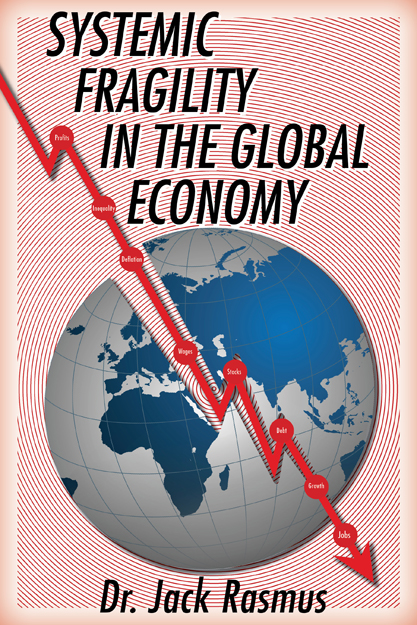
Through this blog and my website, Kyklosproductions.com, discounts of 25%-33% are available on my two published 2016 books–‘LOOTING GREECE: A NEW FINANCIAL IMPERIALISM EMERGES, Clarity Press, Sept. 2016 and ‘SYSTEMIC FRAGILITY IN THE GLOBAL ECONOMY, Clarity Press, January 2016. A discount of 25% on ‘Looting Greece’ and 33% on ‘Systemic Fragility in the Global Economy’ are now available.

Click on the book icon on the sidebar, to go to Paypal and order. ‘Looting Greece’ is $20 and $4.95 off list and Amazon price. ‘Systemic Fragility’ is $20 and $9.95 off. Table of Contents for both books follows:

1. LOOTING GREECE Table of Contents

Chapter One
THE MEANING OF THE GREEK DEBT CRISIS / 11

Syriza’s Poorly Bet Hand / 14
The Troika’s Stacked Deck / 17
Greek Debt Crises and ‘Weak Form’ Euro-Neoliberalism / 21
Generic Neoliberalism / 23
Eurozone Neoliberalism / 28
The Greek Debt Crisis and Euro Social Democracy / 34
The Emerging New Debt-based Imperialism / 36

Chapter Two
THE GERMAN ORIGINS OF GREEK DEBT / 45

The Lisbon Strategy and ‘Internal Devaluation’ / 47
Germany’s Lisbon Strategy Implementation / 49
Germany’s Bundesbank Dominates the ECB / 51
Greek Debt as Private Bank-Investor Debt / 55
The Myth of Greek Wages as Cause of Debt / 56
From Private to Government Debt / 57
The German Origins of the Greek Debt / 61

Chapter Three
PASOK AND THE DEBT CRISIS OF 2010 / 66

2009: PASOK’s Strategic Error / 66
PASOK’s Voluntary Austeriy Program / 68
Bond Vigilantes Escalate the Debt / 72
The 2010 Debt Agreement / 74
Who Was Really Bailed Out? / 75

Chapter Four
THE SECOND GREEK DEBT CRISIS OF 2012 / 79

A Brief Recapitulation / 79
Some Defining Characteristics of the 2012 Debt Crisis / 82
2011: Interim Preceding the Second Debt Crisis / 84
The 2012 Debt Crisis and the Three-Way Negotiating
Farce / 87
The ‘German Hypothesis’ / 90
The Second Debt Restructuring Deal of 2012 / 92

Chapter Five
COLLAPSE OF NEW DEMOCRACY & RISE OF SYRIZA / 103

New Democracy Pleads to Renegotiate / 104
The Bond Buyback Boondoggle of December 2012 / 107
Who Benefits? / 109
Muddling Through: 2013-2014 / 112
Syriza Comes of Age / 113
The Eurozone Stagnates Once Again / 114

Chapter Six
SYRIZA TAKES THE OFFENSIVE / 120

The Troika’s $2.8 Trillion Grexit Firewall / 121
Troika Strategy to Defeat Syriza at the Polls / 123
Syriza’s Electoral Offensive / 126

Chapter Seven
THE TROIKA COUNTER-ATTACK / 136

The Debt-Swap Proposal and Euro Tour / 139
The February 20 Interim Agreement / 146
The Lessons of Bargaining: February-March 2015 / 154

Chapter Eight
FROM CONFRONTATION TO CAPITULATION / 158

Troika Economics: 1932 Déjà vu / 161
Varoufakis Marginalized / 163
Brexit Before Grexit? / 165
The Troika’s ‘Final and Best’ Offer—June 2015 / 167
Greece’s Interim ‘Final’ Offer / 172
The Road to Referendum / 176
Referendum and Fallout / 182

Chapter Nine
SYRIZA TAMED / 188

Greece as an Emerging ‘Economic Protectorate’/ 190
Party Restructuring as a Precondition for Economic Restructuring / 191
The Third Debt Deal of August 2015 / 193
The Parliamentary Election of September 20, 2015 / 197
General Strikes and Grexit / 198
Feints, Rear-Guard Actions, & Longer-Term Agreement / 200
The IMF’s Secret Concerns in Negotiations / 202
The IMF-EC/Germany Split / 204
Debt Restructuring by Another Name? / 207
Observations on the Third Debt Agreement of 2015-18 / 209

Chapter Ten
WHY THE TROIKA PREVAILED: INTERPRETATIONS AND ANALYSES / 216

An Overview of Greek Economy 2015-2016 / 216
The Greek Debt Crisis as a Banking Crisis / 217
The Big Picture / 220
Eurozone Structure and the Greek Crisis / 223
Syriza’s Fundamental Error / 228
Syriza’s Objectives / 231
Could a Grexit Have Succeeded / 233
Syriza Strategies / 235
Troika Strategies / 241
Tactics—Troika vs. Syriza / 247
The Individual Factor in Syriza’s Defeat / 251
Organization and Public Consciousness Factors / 253
Is a Fourth Greek Debt Crisis Inevitable? / 257

Conclusion
A NEW FINANCIAL IMPERIALISM EMERGES / 264

The Many Meanings of Imperialism / 264
Colonies, Protectorates, and Dependencies / 266
Greece as an Economic Protectorate / 269
Wealth Extraction as an Imperialist Objective / 271
‘Reflective’ Theories of Imperialism / 273
Alternatives to Hilferding-Lenin / 278
Greece as a Case Example of Financial Imperialism / 284
Private Sector Interest Transfer / 287
State to State Debt and Interest Aggregation and Transfer / 289
Financial Imperialism from Privatization of Public Assets / 297
Foreign Investor Speculation on Greek Financial Asset Price Volatility / 299

2. SYSTEMIC FRAGILITY IN THE GLOBAL ECONOMY Table of Contents

INTRODUCTION
Fundamental Trends & Determinants
Key Variables and Forms of Fragility
Instability in the Real Economy
Financial Instability in the Global Economy
Outline of the Book

PART I: STAGNATION AND INSTABILITY IN THE GLOBAL ECONOMY

Chapter 1: FORECASTING REAL & FINANCIAL INSTABILITY

The Chronic Problem of Over-Optimistic Official Forecasts
2014: Transition Year for the Global Economy
Europe
Japan
China
Global Oil Deflation
EMEs
USA
The Prediction Dilemma Posed by SWANS—Gray and Black
IMF’s Global Economic Forecasts
World Bank Forecasts
OECD Forecasts
Global Central Bank Forecasts
The Inability to Forecast Financial Instability

Chapter 2: THE ‘DEAD-CAT BOUNCE’ RECOVERY

Dead Cats and Epic Recessions
Five Realities of the Post-Crash ‘Bounce’
Secular Stagnation—A New Normal?
Industrial Production and Trade Recessions Are Already Here
Redefining GDP to Overestimate Global Growth
One More Bounce?

Chapter 3: THE EMERGING MARKETS’ PERFECT STORM

What’s an EME?
External Forces Destabilizing EMEs
The China Factor
The AE Interest Rate Factor
Global Currency Wars
Global Oil Deflation
Who ‘Broke’ the EME Growth Model?
Internal Forces Causing EME Instability
EME Capital Flight
EME Currency Collapse
Domestic Inflation
Brazil: Canary in the EME Coalmine?
EME Financial Fragility & Instability

Chapter 4: JAPAN’S PERPETUAL RECESSION

Japan’s ‘Made in the USA’ Bubble and Crash
Japan’s Rolling Banking Crisis
Lessons of 1990-2005 Ignored
Japan’s Five Recessions
Japan’s Response to Recession, 2008-2012
Shirakawa’s Warning
‘Abenomics’ 1.0: Back to the Future
Abenomics 2.0: Doubling Down on Policy That Doesn’t Work
Growing Fragility in the Japanese Economy

Chapter 5: CHINA: BUBBLES, BUBBLES, DEBT AND TROUBLES

China’s Successful Fiscal Recovery Strategy: 2009-2012
AE’s Failed Monetary Recovery Strategy: 2009-2015
China’s Liquidity Explosion
The Inevitable Debt Crisis
China’s Shadow Banks
China’s Triple Bubble Machine
China’s Real Economic Slowdown: 2013-2015
China Global Contagion Effects
China & Global Systemic Fragility

Chapter 6: EUROPE’S CHRONIC STAGNATION

The Limits of Exports-Driven Recovery
German Origins of Eurozone Instability
Eurozone’s Double Dip Recession: 2011-2013
ECB Opens the Money Spigot … Just a Little
Germany’s Export Pivot to Asia
Eurozone’s 2nd Short, Shallow Recovery: 2013-2014
Eurozone’s QE Money Firehose: 2015
‘Triple Dip’ Recession on the Horizon?
Lessons the Eurozone Has Yet to Learn.

PART II: THE DEAD CAT’S 9 LIVES: KEY TRENDS OF SYSTEMIC FRAGILITY

Chapter 7: SLOWING REAL INVESTMENT
Chapter 8: DRIFT TOWARD DEFLATION
Chapter 9: RISING GLOBAL DEBT
Chapter 10: MONEY, CREDIT & EXPLODING LIQUIDITY
Chapter 11: THE SHIFT TO FINANCIAL ASSET INVESTMENT
Chapter 12: STRUCTURAL CHANGE IN FINANCIAL MARKETS
Chapter 13: STRUCTURAL CHANGE IN LABOR MARKETS
Chapter 14: MONETARY POLICY & GOVERNMENT FRAGILITY
Chapter 15: FISCAL POLICY & GOVERNMENT FRAGILITY

PART III: THE FAILED CONCEPTUAL FRAMEWORK OF CONTEMPORARY ECONOMIC ANALYSIS

CHAPTER 16: HYBRID KEYNESIANS & RETRO-CLASSICALISTS

Conceptual Limits of Classical Economics
Postscript on Marx’s Economics
The Neoclassical Detour: 1870s to 1920s
Keynes’ Original Contributions
The Limitations of Keynes
Austrian Credit Cycles
The Hybrid-Keynesians
The Retro-Classicalists

CHAPTER 17: MECHANICAL MARXIS

Critiquing the Propositions of Mechanical Marxism and Falling Rate of Profit

-Falling Rate of Profit Explains Short Run Business Cycles
-Negative Productivity, Supply Side, and Collapsing Long Run into Short Run
-Only Productive Labor in Goods Production Creates Surplus and Profits
-Only Primary Exploitation of Productive Labor Determines Changes in Profits
-Redefining Profits to Fit the Theory
-Profits Determine Real Asset Investment
-Real Investment Drives Financial Investment
-Financial Assets are ‘Fictitious’ Capital Independent of Real Investment & Cycles
-Financial Asset Prices Are Not Responsible for Economic Instability
-Banks Are Intermediaries Redistributing Profits as Credit
-Money, Credit and Debt

Summary
A Note on Marx on Finance in Vol. 3 of Capital

CHAPTER 18: THE CONTRIBUTIONS & LIMITS OF MINSKY’S ‘FINANCIAL INSTABILITY HYPOTHESIS’

Marx and Keynes Were Before Their Time
Minsky on Financial Instability
Minsky’s Contributions
The Limits of Minskyan Analysis
The Missing Dichotomy of Investment
The Burden of Kalecki’s Theory of Profits
Two- vs. Three-Price Theory
Flow vs. Income Analysis
Fragility’s Undeveloped 3rd Key Variable
Government as Solution vs. Source of Fragility
Dynamic & Systemic v. Financial Fragility
Transmission Mechanisms
Institutional Framework
Origins of Debt
Money v. Inside Credit
Business Cycles & Phases of Profits-Debt

PART IV: A THEORY OF SYSTEMIC FRAGILITY

CHAPTER 19: A THEORY OF SYSTEMIC FRAGILITY

The Historical Context
Some Queries from History
Excess Liquidity at the Root of Debt Accumulation
Money Liquidity
Inside Credit Liquidity
From Excess Liquidity to Excess Debt
Debt and the Shift to Financial Asset Investing
Financial Asset v. Real Asset
Financial Asset Investing Shift
The New ‘Spread’: Financial v. Real Investment
From Stagflation to ‘Definflation’
The Irrelevant ‘Money Causes Inflation’ Debate
Liquidity As Brake on Real Growth
Restructuring Financial and Labor Markets
Financial Market Structural Change
Labor Market Structural Change
Structural Change and Fragility
Fiscal-Monetary Policy: From Stabilizing to Destabilizing
What Can Be Done
A Brief Recapitulation of Key Trends & Systemic Fragility
Measuring the Three Forms of Systemic Fragility
Fragility Feedback Effects
Transmission Mechanisms of Systemic Fragility
Price Systems as TXM
Government Policy as TXM

APPENDIX
Preliminary Equations for a Theory of Systemic Fragility

TO listen to my Alternative Visions radio show of Sept. 9 on this topic,

Go To:

http://prn.fm/category/archives/alternative-visions/

or Go To:

http://alternativevisions.podbean.com/

SHOW ANNOUNCEMENT:

Media, press, pundits and politicians in the US today keep hyping the US economy as doing well. We hear the US economy is growing nicely, better than other economies at least. Wages are finally rising, and full employment is here. Jack bunks these and other myths about the US economy on the eve of the US election, and explains why a recession in 2017-18 is increasingly likely. Explained are why the US GDP growth rate for the first half of 2016 was really only 0.65%, thus nearly stagnant, and real income growth was even lower at 0.1%, or on net stagnant (with wage and income growth for top 10% but declining at median and below 70 million). Jack reviews household consumption growth, the only indicator, keeping the economy from recession, and predicts it is about to falter. The recent PMI data for manufacturing and services, investment, and auto sales are reviewed. The show concludes with an explanation why wage growth figures are misrepresenting and biased toward upper end and full time employment, benefitting 20 million, but wage stagnation and decline is the fact for 70 million at the median and below. US part time, temp, independent contract, unincorporated self employed, gig economy, and the underground economy now comprise close to half of the US labor force today (60-70 million), up from 33% a decade ago.

Listen to my Alternative Visions radio show of Sept. 2, where I discuss the new emerging financial imperialism as it has functioned in the case example of Greece and Greek debt crises in my just released new book, ‘Looting Greece: A New Financial Imperialism Emerges’, Clarity Press, September 2016.

Go to:

http://prn.fm/category/archives/alternative-visions/

or go to:

http://www.alternativevisions.podbean.com

SHOW SUMMARY

Sep 6th, 2016 by progressiveradionetwork

Dr. Jack Rasmus summarizes his just published book this month, ‘Looting Greece: A New Financial Imperialism Emerges’, Clarity Press, Sept. 2016, explaining how debt and credit are becoming new and even more efficient and generalized means by which the more powerful capitalist countries are beginning to extract and transfer wealth from the smaller and more vulnerable. Jack describes the various techniques and means by which financial measures are used to extract surplus. Greece is a case example of the new imperialism taking shape increasingly globally. ‘Looting Greece’ is a sequel to Dr. Rasmus’s January 2016 publication, ‘Systemic Fragility in the Global Economy’, which described how the shift to financial investing is slowing down the global economy, and how a new global finance capital elite is increasingly dominating national economies and slowing growth. In the last half of the show, Rasmus reviews the major economic events of the past week, including today’s US job numbers, recent US manufacturing data, the US central bank meeting—and why the Fed will raise interest rates for certain before year end and the impact that will have on a shift to fiscal spending in 2017 andthe US economy’s coming recession in 2017-18 as well as on emerging markets, China and US corporate profits. The show concludes with a commentary on recent IMF and BIS reports on the global economy.

FOR INFORMATION AND ORDERING OF ‘LOOTING GREECE’, the book, go to:
http://www.claritypress.com/RasmusII.html

Supporters of Bernie Sanders’ presidential election campaign launched on Wednesday what it declared to be the next phase in the progressive political movement in the United States. More than 2,600 “Watch Parties” were organized and held in houses across the country to hear Bernie speak and announce the next phase of a continuing campaign to challenge corporate America and roll back the stranglehold of money on U.S. democracy that has been deepening with every election cycle at least since the 1990s.

Reportedly, more than 200,000 across the U.S. also listened in and watched Bernie remotely as well. The event, and the new movement, has been officially called “OR,” for “Our Revolution.”

Sanders Addresses the 2,600

In his video address Sanders pledged his recently terminated presidential campaign would continue to fight at the grassroots level for changes in US politics — including election campaign finance reform, single payer national health care legislation, racial and environmental justice, worker and gender rights. Sanders declared the new movement would work to immediately elect 100 new progressive candidates at every level — from school boards and local city and state government to the U.S. Senate – and support eventually hundreds more beyond that. And not just electoral action, according to Bernie the new movement, “OR” will fight to bring justice through passing initiatives and referenda, protesting police oppression, fighting for immigrant rights, and other non-electoral political action.

The goals and objectives Sanders has declared for the new movement are admirable — and not unlike his admirable policy positions he raised and promoted during his recent campaign for the Democratic Party presidential nomination.

But noble sounding objectives alone do not a movement make. A progressive movement and politics is as much a question of strategy and organization as it is of goals and objectives. Revolutionary objectives—and the new movement, ‘Our Revolution’, claims to want to achieve revolutionary objectives—requires a revolutionary strategy and a revolutionary organization. But what the hell is that?

Well, what a revolutionary strategy and organization in U.S. 2016 may be is up for debate. But what revolutionary strategy and organization is NOT, is not so debatable. It isn’t a return to the corporate-controlled Democratic Party.

“Inside” vs. “Outside” Strategy

Sanders had made it clear from the outset of his recent campaign for the Democratic Party nomination that if he was not nominated as the Party’s presidential candidate, he would support the Democratic Party’s nominee. That nominee was clearly engineered by party elites to be Hillary Clinton. Sanders, true to his pledge, declared his public support for Hillary at the recent Democratic Party convention. From the beginning, Sanders has always been an ‘insider.’

Sanders’ running in the Democrat Party primaries and pledging to support whoever was the nominee of the Party represents what is sometimes called an ‘inside’ strategy—i.e. bring about progressive change by reform within the Democrat Party. Other progressives have repeatedly argued against “inside,” and insisted an “outside” the party strategy and movement was the only way to bring real, permanent progressive change.

This “inside-outside” debate has raged in US progressive circles for years. Recent history shows, however, that “inside” has proven repeatedly futile and a waste of time. Every time an even remote, tentative challenge to the party’s hand-picked pro-corporate nominees have occurred, they have been squashed quickly by those same party leaders. Howard Dean, Dennis Kucinich, Jesse Jackson are but the most notable examples.

Sanders’ own recent campaign is also good testimony to the futility of “inside.” In retrospect, it is now clear his candidacy was doomed from the start, given Party elites’ structure of super-delegates as a safety valve – given the same elites’ biased anti-Sanders maneuvers during the nominating process by party hack, Debbie Wasserman-Schultz, and, most recently, their control of the Democratic party convention and challenges to the Party’s platform by Sanders delegates.

Once Sanders lost the nomination, he did not abandon his “inside” strategy. His next “inside” move was to tell his supporters to go to the Democratic party convention and change the Party’s platform. That was a necessary first step, he said, to reforming the party. But “inside” failed at the convention as well—as the party elite ensured its free trade policy platform remained intact, including the recent TPP (Trans Pacific Partnership) deal, and made certain that Sanders’ supporters’ demands that the party adopt a single payer national health care position was also rejected as the party position. Not one really significant reform of the Party’s platform was achieved at the convention.

Sanders’ supporters should have learned that “change the party platform” was as futile – given party elites’ control of the convention committees (rules, credentials, etc.) – as it was to run against a “stacked deck” of super-delegates and not to fall victim to the maneuvers of the Wasserman-Schultzes who ran the Party’s primaries political sideshow.

Some of Sanders’ supporters have apparently begun to learn, as they booed Bernie’s endorsement of Hillary speech at the convention and walked out. The walkouts and others valiantly determined to carry on the fight for independent progressive politics in the wake of the convention.

They began organizing at the grass roots, city by city, building a proto-organization, determined to chart a course of true progressive politics “outside” the Democratic Party. That new progressive organization’s launch was envisioned as the OR “watch parties” held on Wednesday.

But just as the 2600 “Watch Parties” were launched, half of the staff organizing the OR resigned and walked out. The reasons they did reveal that the “inside” strategy is still very much alive and well among Sanders’ professional politico operatives now taking control of the OR.

OR Staff Resignations and Weaver-Cohen Regime

The walkout and resignations were over the appointment at the last minute, apparently by Sanders, of Jeffrey Weaver, his longtime confidant and recent nominating election campaign manager. Weaver has been particularly disliked by many of the grass roots young organizers and staffers involved in Bernie’s primaries campaigns who moved over to build the OR. Lieber had been, and remains, a strong advocate of raising money from wealthy donors whenever possible. He, and others like him in Sanders’ organization, is also a proponent of reforming the Democratic Party from “within” as the main strategic thrust of the new OR.

Weaver’s approach is also to turn the OR into what is called a 501c4 fund raising organization, that accepts billionaires’ money. The 501c4 is a legal structure in the US that prohibits direct involvement in elections. By law, it can’t even discuss, talk, or coordinate with candidates it may fund.

According to the staffers that just resigned from OR, as a 501c4 the OR could not, according to Weaver, support Tim Canova, a progressive candidate who is targeting to defeat Wasserman-Schultz, who led the anti-Sanders dirty maneuvers in the party during the recent primaries. OR as a 501c4 is a convenient legal structure that prevents OR from directly supporting progressive challengers to unseat Democrat Party candidates, in other words. And you can’t reform the Democrat party from ‘inside’ if you alienate Party elites by trying to defeat their high ranking, hand-picked Democrat candidates running for office now, can you?

Weaver’s insertion into the just forming OR, apparently by Sanders, also shows just what kind of organization the politicos at the top want the OR to be. Why hasn’t there been some kind of democratic process to determine who will lead the OR, its supporters should ask themselves? And what about the 100 or so “Board” members of the OR? How has it been “selected” and by whom? Why not elected? Or the OR’s chair, Larry Cohen, former head of the Communications Workers of America union. Who made him ‘chair’ of the Board?

It will become increasingly clear that Weaver-Cohen clearly want the ‘OR’ strategically to focus on reforming the Democratic Party from “inside.” Yes, grassroots non-electoral activity will occur. Keep the troops in the field mobilized and busy until new progressive candidates can run “inside” and reform the party once again. And how will these progressives running for future office be selected as worthy to receive OR support?

“To Be OR not to Be” – That is the Question

These are organizational questions that in turn determine what kind of strategy is adopted. The OR may be “revolutionary” in its objectives, but certainly not at this point in its strategy—and even more certainly not in terms of its organizational structure. A counter-revolutionary strategic focus attempting to reform the Democrat Party from “inside” – with appointed managers like Weaver and selected Board chairs like Cohen in a top-down organizational structure – will not constitute “Our Revolution.” It will still “be” theirs.

William Shakespeare’s famous character, Hamlet, raised his oft-quoted famous line: “to be or not to be, that is the question.” To borrow that line, what will OR “be” now that its outlines are emerging and splits already developing—i. e. an organization with laudable progressive goals but with a strategy to achieve those goals by trying to reform ‘inside’ the un-reformable, counter-revolutionary, corporate-controlled, and billionaire-financed Democratic Party? Or will it build its own independent organization “outside” the Democratic Party and challenge the latter directly instead of trying to change it “inside.”

That is the question! In short, the OR now faces its “Hamlet” moment.

Jack Rasmus is author of Systemic Fragility’ in the Global Economy, Clarity Press, January 2016, and the forthcoming, Looting Greece: An Emerging New Financial Imperialism, Clarity Press, July 2016. He hosts the New York radio show, Alternative Visions, on the Progressive Radio Network, and blogs at jackrasmus.com.

Published 22 August 2016, Telesur English Edition, as ‘Who Profited from the $440 Billion Bailout?’, by Jack Rasmus

This week marks the first anniversary of the 2015 Greek debt crisis, the third in that country’s recent history since 2010. Last Aug. 20-21, 2015, the ‘Troika’—i.e., the pan-European institutions of the European Commission (EC), the European Central Bank (ECB), plus the IMF-imposed a third debt deal on Greece. Greece was given US$98 billion in loans from the Troika. A previous 2012 Troika imposed debt deal had added nearly US$200 billion to an initial 2010 debt deal of US$140 billion.

That’s approximately US$440 billion in Troika loans over a five year period, 2010-2015. The question is: who is beneftting from the US$440 billion? It’s not Greece. If not the Greek economy and its people, then who? And have we seen the last of Greek debt crises?

One might think that US$440 billion in loans would have helped Greece recover from the global recession of 2008-09, the second European recession of 2011-13 that followed, and the Europe-wide chronic, stagnant economic growth ever since. But no, the US$440 billion in debt the Troika piled on Greece has actually impoverished Greece even further, condemning it to eight years of economic depression with no end in sight.

To pay for the US$440 billion, in three successive debt agreements the Troika has required Greece to cut government spending on social services, eliminate hundreds of thousands of government jobs, lower wages for public and private sector workers, reduce the minimum wage, cut and eliminate pensions, raise the cost of workers’ health care contributions, and pay higher sales and local property taxes. As part of austerity, the Troika has also required Greece to sell off its government owned utilities, ports, and transport systems at ‘firesale’ (i.e. below) market prices.

Europe’s Bankers Got 95 Percent of Greek Debt Payments

The US$440 billion in Troika loans—and thus Greek debt—has not been employed to benefit the Greek people, or to help the Greek economy recover from its eight years of depression; it has gone to pay the principle and interest on previous Troika debt, as that debt has been piled on prior debt in order to pay for previous debt
.
A recent 2016 released study has revealed conclusively where all the interest and principal payments on the US$440 billion debt has gone. It has gone directly to European bankers and investors, and to the Troika institutions of the EC, ECB, and IMF, who indirectly in turn recycle it back to private bankers and investors.

According to the White Paper (WP-16-02) published by the European School of Management and Technology, ESMT, this past spring 2016, entitled “Where Did the Greek Bailout Money Go?”, more than 95 percent initial Troika loans to Greece went to pay principal and interest on prior Troika loans, or to bailout Greek private banks (owned by other Euro banks or indebted to them), or to pay off European private investors and speculators. Less than 10 billion euros was actually spent in Greece.

The ESMT study further estimates the most recent, third Greek debt deal of last Aug. 2015 will result in more of the same: Of the US$98 billion loaned to Greece last year, the study projects that barely US$8 billion will find their way to Greek households.

The Cost to Greece Eight Years Later

In exchange for the 95 percent paid to the Troika and banker-investor friends, the austerity measures accompanying the Troika loans has meant the following: Greece’s unemployment rate today, in 2016, after eight years is still 24 percent. The youth jobless rate still hovers above 50 percent. Wages have fallen 24 percent for those fortunate enough to still have work. The collapse of wages is due not just to layoffs or government and private business wage cutting, both of which have occurred since 2010, but is due also to the shifting of full time to part time work. Full time jobs have collapsed 27 percent, the lowest ever, while part time jobs have risen 56 percent, to the highest ever. The poorest and most vulnerable Greek workers and households have seen their minimum wages reduced by 22 percent since 2012, on orders of the Troika. And pensions for the poorest have been reduced by approximately the same. All that to squeeze Greek workers, households and small businesses in order to repay interest on debt to the Troika, to Europe’s bankers, and private investors.

None of the debt, austerity, depression, and collapse of incomes existed before the Troika intervened in Greece starting in 2010. Greece’s debt to GDP was around 100 percent in 2007, about where it had been every year for the entire preceding decade, 1997-2007. It was no worse than any other Eurozone economy, and better than most. Greek debt rose in 2008 to 109 percent due to the global recession, accelerating to 146 percent of GDP in 2010 with the first Troika debt deal of US$140 billion. It then surged to more than 170 percent in 2011, where it has remained ever since as another US$300 billion was added in Troika loans in 2012 and 2015.

Greece’s debt since 2010 is certainly not a result of Greek government spending, which has fallen from roughly 14 billion euros to 9.5 billion in 2015, reflecting Greece’s deep austerity cuts demanded by the Troika. Nor can it be attributed to excessive wages and too many public jobs, as both these have declined by a fourth as debt has accelerated. The debt is Troika loans forced on Greece in order for Greece to pay principal and interest on previous loans forced on Greece.

And Still No Relief 2015-16

What happened a year ago, in the third Troika debt deal of Aug. 2015, was the same that happened in 2012 and 2010: US$98 bill more debt was added to Greece’s already unsustainable US$340 or so billion. In exchange, last August Greece had to implement the following even more severe austerity measures:

Generate a budget surplus of 3.5 percent of GDP from which to repay Troika debt-i.e. around US$8 billion a year. Raise sales taxes to 24 percent, plus more tax hikes on “a widening tax base” (i.e. higher taxes for lower income households). Introduce what the Troika calls “holistic pension reform”—i.e., cut pensions up to 2.5 percent of GDP, or around US$5 billion a year, and abolish minimum pensions for the lowest paid and the annual supplemental pension grants. Introduce a “wide range” of labor market reforms, including “more flexible” wage bargaining, easier mass layoffs, new limits on worker strikes, and thousands more teacher layoffs as part of “education reform”. Cut health care services and convert 52,000 more jobs to part time. And introduce what the Troika called a more “ambitious” privatization program. And this is just a short list.

And How Has Greece’s Economy Actually Performed over the Past Year?
Greek government spending since Aug. 2015 has further declined by 30 percent as of mid-year 2016, except for military spending that has risen by US$600 million. Since Aug. 2015, quarterly Greek GDP has continued to contract on a net basis. Greek debt as a percent of GDP has risen further.

There are 83,000 fewer full time jobs. (But 28,000 more part time jobs). Youth unemployment rates have risen from 48.8 to 50.3 percent. Consumer spending has dropped by almost 10 percent, as consumer confidence continues to plummet, home prices deflate, and business investment, exports, and imports all slow. In other words, the Greek economy continues to worsen despite the added US$98 billion Troika debt and the more extreme austerity measures imposed a year ago.
Is Another Fourth Greek Debt Crisis Inevitable?

The answer is “Yes.” Greece cannot generate a 3.5 percent surplus from which to pay the mountain of principal and interest on its debt. Debt repayments in 2016 to the Troika were relatively minimal in 2016. In 2017-18, however, greater debt repayments will come due as Greece’s inability to repay will no doubt worsen, when the next Europe-wide recession hits, which is likely in 2017-18 as well. The next Greek debt crisis may erupt even before, as a consequence of the current deterioration in Europe’s banking system in the wake of Brexit and the deepening problems in Italy’s and Portugal’s banking systems. Contagion elsewhere could quickly spill over to Greece, precipitating another fourth Greek banking and debt crisis.

An Emerging New Financial Imperialism?

By imposing austerity to pay for the debt the Troika since 2010 has forced the Greek government to extract income and wealth from its workers and small businesses-i.e. to exploit its own citizens on the Troika’s behalf-and then transfer that income to the Troika and Europe bankers and investors. That’s imperialism pure and simple-albeit a new kind, now arranged by State to State (Troika-Greece) financial transfers instead of exploitation company by company at the point of production. The magnitude of exploitation is greater and far more efficient.

What’s happened, and continues to happen in Greece, is the emergence of a new form of financial imperialism that smaller states and economies, planning to join larger free trade zones and ‘currency’ unions, or to tie their currencies to the dollar, the euro, or other need to avoid at all cost, less they too become ‘Greece-like’ and increasingly debt-dependent on more powerful capitalist states to which they decide to integrate economically.

Neoliberalism is constantly evolving and with it forms of imperialist exploitation as well. It starts as a free trade zone or ‘customs’ union. A single currency is then added, or comes to dominate, within the free trade customs union. A currency union eventually leads to the need for a single banking union within the region. Central bank monetary policy ends up determined by the dominant economy and state. The smaller economy loses control of its currency, banking, and monetary policies. Banking union leads, of necessity, to a form of fiscal union. Smaller member states now lose control not only of their currency and banking systems, but eventually tax and spending as well. They then become ‘economic protectorates’ of the dominant economy and State-such as Greece has now become.

For a deeper analysis of Greek debt and the emerging new financial imperialism, see Dr. Jack Rasmus, “Looting Greece: An Emerging New Financial Imperialism,” by Clarity Press, September 2016.

To listen to the part 1 overview of my forthcoming book, ‘Looting Greece: An Emerging New Financial Imperialism’, by Clarity Press, September 2016, on the Euro neoliberal and German origins of Greek debt crises 2010-2016, listen to my August 19, Alternative Visions radio show. Go to:

http://prn.fm/category/archives/alternative-visions/

or:

http://www.alternativevisions.podbean.com

(Next week’s August 26 show: ‘Greek Debt Crises, Part 2: Syriza’s strategic and tactical errors, why the Troika prevailed, and why another Greek crisis is inevitable; plus what is ‘Financial Imperialism’.)

SHOW ANNOUNCEMENT:

Dr. Rasmus discusses the first of a two part series on Alternative Visions radio, Progressive Radio Network, on the nature of Greek debt crises, and how they are the consequence of Euro neoliberalism, dominance of the Eurozone’s ‘Troika’ (European Commission, European Central Bank, IMF) by German bankers, allies and politicians, and the continuing insolvency of European private banks. Citing recent studies that show 95% of Greece’s debt payment to the Troika since 2010 have gone to European bankers, Rasmus argues the recycling of debt and interest payments represents an emerging new form of financial imperialism that is built into the Eurozone’s very structure since 1999. The deeper analysis is available in Dr. Rasmus’s new book, to be released in September, ‘Looting Greece: An Emerging New Financial Imperialism’, by Clarity Press. Rasmus discusses the origins of the 2010, 2012, 2015 (and April 2016 mini) debt crises in Greece, and concludes with the Greek Syriza party’s main strategic error. Next week, Part 2: ‘Why Syriza’s strategy (and tactics) failed and why the Troika’s prevailed’—plus more on the new financial imperialism taking form in the Eurozone periphery and its prospects globally elsewhere.

Jack Rasmus
Systemic Fragility in the Global Economy, Atlanta, GA: Clarity Press, pp 490, GBP
17.51, USD 29.95; 978-0-9860769-4-7
Reviewed by Bob Jessop, Lancaster University

Jack Rasmus studied economics at Berkeley, took his doctorate in the University ofToronto (1977), and worked for many years as a union organizer and labour contract negotiator. Then, after working as an international economist for global companies(such as Siemens) and an international strategic analyst for some Silicon Valley start-ups, he became a full-time independent economic researcher, author, journalist, radio host, playwright, poet, lyricist, and activist. He also established Kyklos Productions and Jack Rasmus Productions, which use different media, including stage plays and musicals, to explain the long run changes in the USA and its future trajectory. He is currently Federal Reserve Bank chair of the Green Party Shadow Cabinet and economic advisor to Jill Stein, the party’s presidential candidate. This background is important for understanding the theoretical novelty, persuasive power, political passion, and programmatic significance of this book.

Systemic Fragility in the Global Economy (2015) is the fourth in a series that Rasmus has produced within this broad intellectual and activist project. Each work not only provides a theoretically-informed, empirically-grounded diagnosis but also offers a wide-ranging set of policy recommendations aimed at progressive movements.

The first work was a detailed critique of the diverse upward wealth transfer mechanisms employed in the corporate-government class struggle against subaltern classes and groups in the Reagan-Bush-Clinton-Bush era (Rasmus 2006). The second, based in part on major journal articles, was Epic Recession: Prelude to Global Depression (2008).

This also provides the theoretical foundations for his analysis of systemic fragility. Its two main claims are that, first, the North Atlantic Financial Crisis (my term) is more comparable to the recessions followed by stagnation that occurred in the USA in 1907-1914 and 1929-31 than it is to normal cyclical recessions (marked by a brief contraction followed by a swift return to growth) or a classic depression; and, second, that the explanation for epic recessions can be found in the interaction of debt-default-deflation dynamics across the corporate, household, and government sectors.

This work was followed by detailed critique of the current and future policy failures of the Obama Presidency and the presentation of an alternative policy programme and reform agenda (2012). The fifth is concerned with the Greek crisis and the rise of financial imperialism (2016).

The book reviewed here extends the analysis of epic recession dynamics, with declining growth, increasing fragility, and worsening instability, to the global economy. In particular, Rasmus argues that the epic recession has been mutating as the financial crisis becomes more general and directly weakens the ‘real economy’, generates secular stagnation, and produces ricocheting contagion effects around the world economy exacerbating weaknesses in each economy and giving rise to distinct crisis symptoms in different regions. Starting in the neoliberal, finance-dominated US-UK economies in 2007-2008, in 2010-14 it affected the weak regional links in the advanced economies the Eurozone and Japan before shaking China and emerging markets. Despite their different forms of appearance (real estate, stocks, currency markets, government bonds), the underlying causes remain excessive liquidity that fuel different kinds of speculative financial bubbles and growing debt. The resulting crises cannot be tamed by fiscal or monetary means.

Indeed central bank liquidity injection and government fiscal policies exacerbate the crises. Central bank responses have boosted liquidity, which has flowed into further asset speculation rather than productive investment and is creating the basis for an even bigger economic crisis. The detailed empirical analysis is backed by a sustained critique of inter-national financial institutions, Wall Street shills and regulators, economic statistics and statisticians, and, more importantly, mainstream economics, especially neoclassical economists and hybrid Keynesians (who seek to integrate Keynesian insights into neoclassical economics), mechanical Marxists (who invoke the falling rate of profit to explain crises), and the significant but now outdated contributions of Hyman Minsky to the analysis of financial instability.

The theoretical novelty in this text compared with the author’s Epic Recession is a more systematic presentation of systemic fragility. The possibility of recession, crisis, and depression is given in the price system in general and the dynamics of financial asset prices in particular, which differ in several ways from those of real asset prices and can become fundamentally destabilizing under conditions of systemic fragility. For Rasmus, this phenomenon is rooted in nine key empirical trends: slowing real investment; deflation; an explosive growth in money, credit and liquidity; rising levels of global debt; a shift to speculative financial investing; the restructuring of financial markets to reward
capital incomes; downward pressure on wages; the failure of Central Bank monetary policies; and ineffective fiscal policies.

The case studies of the USA, Europe, Japan and China are excellent, typically contrarian, and highly teachable. Many important and provocative arguments and points are made in passing in these studies and they are strengthened by the more sustained theoretical analyses that follow. A major contribution is the analysis of the complexity of shadow banking, an ill-defined term of art in most of the literature. I have found the analysis of debt-default-deflation dynamics very helpful in my own research on crises and the elaboration here is more detailed than in Epic Recession.

Nonetheless there are also three unresolved issues that will interest readers of Capital & Class and are unlikely to be solved through Rasmus’s promised next iteration of the analysis. First, perhaps reflecting his economic training and labour activism in the USA and Canada, the critique of official dogma, orthodox economics and Keynesianism is well-developed but the presentation and critique of Marxist theories leads much to be desired, especially the critique of “mechanical Marxism”, and, compared with his biting criticisms of other theorists, his grasp of Marx’s method and arguments is disappointing. Second, relatedly, while the analysis of financial asset price formation and debt-default-deflation dynamics is innovative, the articulation of this analysis with the contradictions and crisis-tendencies in the circuits of productive capital is weak. This matters insofar as the crisis of Atlantic Fordism in the 1970s and 1980s has a strong bearing on the rise of financialization and finance-dominated accumulation in the USA and UK. And, third, the institutional mediation of crisis dynamics in the political system, the influence of neoliberalism broadly considered, and the specificities of political and ideological struggles that have shaped the rise of finance-dominated accumulation, all deserve far more attention than they receive in this text. The analysis seems at times to move uneasily between detailed empirical description of crisis symptoms and dynamics, a general middle range theory of debt, liquidity, and financial asset price formation, and a potentially class-reductionist account of the social forces behind the rise of financialized capitalism.

Paradoxically this makes this book an excellent and cathartic text for teaching and activism but leaves much unfinished business for those who want to relate this analysis to broader questions of international political economy and political strategies that look beyond the labour and green movements.

References

Rasmus J (1977) The Political Economy of Wage-Price Controls in the U.S., 1971–74. Ph.D. thesis, University of Toronto.
Rasmus J (2006) The War At Home: The Corporate Offensive from Ronald Reagan to George W. Bush. San Ramon, CA: Kyklos Productions.
Rasmus J (2010) Epic Recession: Prelude to Global Depression. London: Pluto.
Rasmus J (2012) Obama’s Economy: An Alternative Program for Economic Recovery. London: Pluto.
Rasmus J (2016) Looting Greece: a New Financial Imperialism Emerges. Atlanta, GA: Clarity Press.

Author biography
Bob Jessop is Distinguished Professor in the Department of Sociology, Lancaster University

Advanced economies are in a rut of slow growth, the new normal (El-Erian), or is it the end of normal (Galbraith 2014)? Growth was slim before the 2008 crisis and recovery after crisis has been sluggish as well, with growth around 2% in the US (2.2% in 2017, according to IMF estimates), 0.6% in the EU (2016), 0.7% in Japan (2016). An ordinary period headline is, ‘U.S. in weakest recovery since ‘49’ (Morath 2016).

Emerging economies and developing countries (EMDC) face a ‘middle-income trap’ and‘premature deindustrialization’; energy exporters see oil prices collapse from above $100 per barrel to below $50 (2014) and advanced economies are in a ‘stagnation trap’.

Explanations of the conundrum are perplexingly meager. Many accounts are merely descriptive, such as secular stagnation (Summers 2013)—noted, but why? Or, uncertainty—which is odd because policies haven’t changed for years. Or, corporate hoarding—corporations, particularly in the US, are sitting on mounds of cash, buy back their own stock, buy other companies and reshuffle, but are not investing—noted, but why? Or, a general account is that advanced economies are on a technological plateau, broadly since the 1970s (Cowen 2011,Gordon 2016). With the rise of the knowledge economy and the digital economy (along with the gig economy as in Uber, Airbnb and freelance telework), contributions of Silicon Valley (Apple, Google, etc.), innovations in pharma and military industries, also in emerging economies,innovations abound. However, as Martin Wolf (2016) notes, ‘today’s innovations are narrower in effect than those of the past’. Besides, the shift to services in postindustrial societies means a shift toward sectors (such as healthcare, education, personal care) where it is hard to raise
productivity.

If we consider policies, the picture gets worse because a) implemented year after year,they clearly don’t work, b) indications are they make things worse.

Fiscal policy is generally ruled out because of fear of deficits. The policy instrument that remains is monetary—low interest rates and quantitative easing (QE), implemented in the US, UK, EU and Japan. Other standard policies are, in the EU, austerity—which may cut deficits but obviously doesn’t generate growth (and by depressing tax revenues over time worsens deficits)—and structural reform. Besides privatization, the major component of reform is labor market flexibilization, in other words depressing wages and incomes. This has been implemented in the US since the 1970s and 80s, in the UK in the 90s, in Germany in the 00s, and is now on the scaffolds in Japan and France (and possibly Spain and Italy). The objective is to boost international competitiveness by depressing wages and benefits, which a) ceases to have effect when every country is doing the same, b) assumes the key problem is cheap supply, whereas supply is actually abundant and what is lacking is demand, c) by depressing wage incomes it further reduces domestic demand. No wonder these policies make matters worse.

Thus, explanations of slow growth fall short and policies have been counterproductive.This is where Jack Rasmus’s book comes in. It offers the most pertinent analysis of the stagnation trap I have seen. There are many steps to the analysis but it boils down to his Theory of Systemic Fragility. I review the main points of his approach, for brevity’s sake in bullet form.

o Taking finance seriously, not just as an intermediary between stations of the ‘real economy’ (as in most mainstream economics) but with feedback loops and transmission mechanisms that affect the real economy of goods directly and indirectly
.
o A three-price analysis—beyond the single price of neoclassical economics (the price of goods), the two-price theory of Keynes and Minsky (goods prices and capital assets prices), Rasmus adds financial assets and securities prices (408).

o The long-term, secular slowdown of investment in the real economy (chapter 7) and the shift to investment in financial assets (chapter 11). This has been occurring because financial asset prices rise faster than the prices of goods; their production cost is lower; their supply can be increased at will; the markets are highly liquid so entry and exit are rapid; new institutional and agent structures are available; financial securities are taxed lower than goods; in sum, they yield easier and higher profits. Financial asset investment has been on the increase for decades, has expanded rapidly since 2000 and ‘from less than $100 trillion in 2007 to more than $200 in just the past 8 years’ (212).

o In government policy there has been a shift from fiscal policy to monetary policy. ‘Central banks in the advanced economies have kept interest rates at near zero for more than five years, providing tens of trillions of dollars to traditional banks almost cost free’

Low interest rates and zero interest rate policies (ZIRP) benefit governments (it lowers their debt and interest payments) and banks (affords easy money) while they lower household income (lower return on savings and lower value of pensions), so in effect households subsidize banks (471).

o Quantitative easing (QE) policies, massive injections of money capital by the US ($4tr), UK ($1tr), EU ($1.4tr) and Japan ($1.7tr) since 2008, or ‘about $9 trillion in just five years’ (185, 262). Add China ($1-4tr) and add government bank bailouts over time and, according to Rasmus, the total global liquidity injected by states and central banks is in the order of $25 trillion (263). The injections of liquidity into the system allegedly aim to stimulate investment in the real economy (by raising stock and bond prices), which raises several problems:

a Investment in the real economy isn’t determined by liquidity but by expectations of profit.
b Funds that are invested in the goods economy leak overseas via MNCs investing in EMDC, where returns are higher (and more volatile).
c Most additional liquidity goes into financial assets, boosting commodities, stocks and real estate, and leading to price bubbles (177). ‘The sea of liquid capital awash in the global economy sloshes around from one highly liquid financial market to another, driving up asset prices as a tsunami of investor demand rushes in, taking profit as the price surge is about to ebb, leaving a field of economic destruction of the real economy in its wake’ (473).

The post-crisis attempts at bank regulation overlook the shadow banks, even though the 2007-2008 crisis originated in the shadow banks rather than the banks. (Shadow banks include hedge funds, private equity firms, investment banks, broker-dealers, pension funds, insurance companies, mortgage companies, venture capitalists, mutual funds, sovereign wealth funds, peer-to-peer lending groups, the financial departments of corporations, etc.; a typology is on 224.) The integration of commercial and shadow banks is another variable. Shadow banks control in the order of $100 trillion in liquid or near liquid investible assets (2016, p. 446).

Add up these trends and policies and they contribute to several forms of fragility, which is the culmination of Rasmus’s argument. Rasmus distinguishes fundamental, enabling and precipitating trends that contribute to fragility (457).

The explosion of excess liquidity goes back to the 1970s and has taken many forms since then. QE policies amplify this liquidity and have led to financial sector fragility, which has been passed on to government balance sheet fragility (via bank bailouts, low interest rates, and QE), which have been passed on household debt and fragility (via austerity policies). ‘Austerity tax policy amounts to a transfer of debt/income and fragility from banks and nonbanks to households and consumers, through the medium of government’ (472). This in turn leads to growing overall system fragility.

While Rasmus aims to provide a theory of system fragility, in the process his analysis gives an incisive account of the stagnation trap. Many elements aren’t new. Note work on austerity (Blyth 2013) and finance (Goetzmann 2016) and note, for instance: ‘The world has turned into Japan,’ according to the head of a Hong Kong-based hedge fund. ‘When rates are this low, returns are low. There is too much money and too few opportunities’ (Sender 2016).

However, by providing an organized and systemic focus on finance and liquidity, Rasmus makes clear that the policies that aim to remedy stagnation (low interest rates, QE, competitive devaluation, bank bailouts) and provide stability are destabilizing, act as a break on growth and aggravate the problem. According to Karl Kraus, psychoanalysis is a symptom of the disease that it claims to be the remedy of, and the same principle holds for the central bank policies of financial crisis management.

This doesn’t mean the usual arguments for stimulating growth (spend on infrastructure, green innovation, etc.) are wrong, but they look in the wrong direction. For one thing, the money isn’t there. Courtesy of central banks, the money has gone by billions and trillions to banks, shadow banks and thus to financial elites and the 1%. Surprise at corporations not investing is also beside the point when government policies at the same time are undercutting household income and consumer demand, reproducing an environment of low expectations.

Criticism of QE has been mounting, even in bank circles (‘it’s the real economy, stupid’). Yet the role of finance remains generally underestimated. Rasmus’s analysis of central bank policies overlaps with that of El-Erian (2016), but his critique of economics is more fundamental and his theory of fragility and its policy implications are more radical. A turnaround would require fundamentally different policies and, in turn, different economic analytics.

Let me note some reservations about Rasmus’s approach. One concerns the unit of analysis—the global economy. His analysis overlooks or underestimates the extent to which East Asian countries stand apart from general financial fragility. They have been less dependent on western finance than Latin America and Africa and having learned from the Asian crisis of 1997, they have built buffer funds against financial turbulence and tend to ring-fence their economies from Wall Street operations. But, of course, this remains work in progress. Second, Rasmus adds China’s stimulus spending to the liquidity injections of western central banks. However, the bulk of China’s stimulus funding has been invested in the real economy of infrastructure, productive assets and urbanization, which has led to over-investment, but which has next led to major initiatives of externalizing investment-led growth in new Silk Road projects in Asia and beyond (One Belt One Road, Maritime Silk Road, Asian Infrastructure Investment Bank, Silk Road Fund, etc.). Meanwhile, Rasmus has made a signal contribution to contemporary economics and provided a vitally important X-ray of the political economy of stagnation.

Jan Nederveen Pieterse, University of California Santa Barbara

References

Blyth, Mark 2013 Austerity: the history of a dangerous idea. New York, Oxford University Press
Cowen, Tyler 2011 The Great Stagnation. New York, Dutton
El-Erian, Mohamed A. 2016 The only game in town: central banks, instability, and avoiding the next collapse. New York, Random House
Galbraith, James K. 2012 The end of normal. New York, Simon and Schuster
Goetzmann, William N. 2016 Money changes everything. Princeton University Press
Gordon, Robert J. 2016 The rise and fall of American growth. Princeton University Press
Morath, E., U.S. in weakest recovery since ’49, Wall Street Journal 7/30-31/2016: A1-2
Rodrik, Dani 2015 Premature Deindustrialization, NBER Working Paper No. 20935, http://www.nber.org/papers/w20935.pdf
Sender, H., Short-term relief for hedge funds belies tough search for yield, Financial Times 7/12/16: 22
Summers, Lawrence, Why stagnation might prove to be the new normal, Financial Times 12/15/2
Wolf, Martin, An end to facile optimism about the future, Financial Times 7/13/2016: 9.

Japan as worst-case example of failure of central banks monetary policies. Why central banks’ policies are collapsing worldwide. To listen to my August 12, 2016 radio show at:

http://prn.fm/category/archives/alternative-visions/

or go to:

http://www.alternativevisions.podbean.com

SHOW ANNOUNCEMENT

Jack reviews the current condition of Japan’s economy, after 8 years of virtual perpetual recession despite record QE central bank injections, negative interest rates, and talk of helicopter money. The Central Bank of Japan as harbinger of global capitalist central banks policy direction and innovation. How central banks-bank of japan free money policies are not only no longer working, but are now having contrary negative effects on the global economy. Japan’s history of monetary policy first, plus austerity, since 1991 has doomed it to perpetual recessions—8 since 1991 and 5 since 2008. Japan as innovator of QE and negative rate policies. The results in creating trillions of non-performing bank loans (NPLs) and more than $13 trillion in negative bond rates since 2014 are reviewed. Growing NPLs and negative rates as indicators of failing capitalist monetary policies as investment slows, productivity declines, wages stagnate and real consumption falters worldwide. Why global economies are about to shift in 2017 to more fiscal infrastructure spending—but will do so ‘too little and too late’ to prevent recessions in 2017.