Feeds:
Posts
Comments

Jack Rasmus
Copyright 2016

Almost all national polls are irrelevant. A growing number of small college statistics departments and wannabe start up polling companies have been producing numerous, and questionable, national opinion polls on who supports Trump vs. Clinton.

Not so for the ‘FiveThirtyEight’ group, a well-established non-partisan forecasting organization that has been remarkably successfully predicting US election outcomes for several election cycles now. FiveThirtyEight has the November 8 election close to a virtual electoral college‘toss up’.

As of November 4, FiveThirtyEight forecasts Clinton with 289 electoral votes to Trump’s 247 electoral votes. In popular opinion, it has 48% of the national vote for Clinton and 45% for Trump. But forget about national popular opinion polls, whatever the source.

As the US electorate almost daily now swings widely between the two candidates with each Wikileaks revelation about Clinton and each new revelation about Trump’s finances, business, and wild statements, it is clear so far as national opinion polls are concerned that US voters in general can’t make up their minds which candidate they dislike the most. Both now register, at minimum, a 60-65% ‘dislike’ and in some estimates as high as 80% dislike for either candidate, Trump or Clinton. That makes national opinion polls highly unstable.

All that matters is the electoral college vote, not the popular vote, and the electoral vote primarily in the swing states at this point.

FiveThirtyEight estimates there is at the moment, November 4, a 289 v. 247 electoral vote division between Clinton vs. Trump. That means a switch from either camp of two, or even one state, can tip in either direction by next Tuesday, November 8.

That tipping may easily occur in any of the 8-9 swing states, based on the relative turnout of the base of each candidate in those eight or so swing states. So what are the swing states? And what’s the base of each candidate that could ‘tip’ the electoral vote of a state?

The swing states are Ohio, Florida, North Carolina, Pennsylvania, Iowa, Michigan, Wisconsin, Colorado, and maybe Nevada. Trump’s key turnout base is the non-college educated working class, mostly white. Hillary’s is the suburban, college educated, minorities, and women. Millennials (age 35 and under) are a toss up, regardless of race, sex or age and may not vote equally for either candidate.

So why may this election be so close? And could it result in another contested 2000 election, where disputed votes in just one or two states could determine the outcome? Yes, quite possibly. Here’s why:

FiveThirtyEight predictions show that Trump has voters in Iowa and Ohio, with 6 and 18 electoral votes respectively, firmly in his camp. It also predicts that Florida (29) and North Carolina (15) are close but are both leaning in his direction with momentum on his side. And contrary to media spin, Arizona (11) and Georgia (16) are not ‘in play’. They will likely go Trump.

The remaining swing states, according to FiveThirtyEight, are leaning in various degrees to Clinton. They include Pennsylvania (20), Michigan (16), Virginia (13), Wisconsin (10), Minnesota (10) and Colorado (9). That’s 78 electoral ‘swing state votes’ leaning to Hillary.

Summed up, that’s 78 leaning Clinton and 68 leaning Trump. 270 electoral votes are needed to win.

So if Trump retains Ohio and Iowa, and carries Florida and North Carolina, he needs to take two of the following three states now leaning Clinton to win: Pennsylvania, Michigan, and/or Wisconsin.

And it’s those same states that happen to be where free trade, offshoring, and working class job destruction, that has been going on from Bill Clinton to George W. Bush to Barack Obama, have taken their greatest toll. It’s the region where the non-college working class has been most devastated. It’s where Obama job creation since 2009 has been the weakest in terms of both quantity and especially quality of jobs, creating only low paid, part time, service jobs. It’s where US cities have deteriorated the most severely, along with rising crime, collapse of social services (think Detroit and Flint), and general living standards. It’s where Trump has his base.

This same white working class base was once a stronghold of the Democratic Party. But Bill Clinton and Obama, with the help of GW Bush for an intervening eight years, have destroyed its once traditional support for their party.

The Democratic Party has become the party of the upscale, suburban, and college educated. A now devastated union labor movement—a mere shadow of its once political self—cannot deliver their white working class members’ votes in those swing states any longer. Thanks again to free trade, job offshoring, and the collapse of manufacturing in those states.

The US electorate has been quietly turning upside down since 2000, and the Democratic Party elite have no one to thank for that but themselves. (Obama’s record Latino deportations may have also had the same effect for the tens of millions potential voters in that group as well. The election’s outcome will soon verify that or not as well).

Can the Democrats and Hillary win without that traditional non-college white working class base? They didn’t win in 1980, when that group turned to Reagan in the aftermath of a prior economic crisis in the 1970s.

What the preceding analysis suggests is that Trump’s ability to turnout a highly disaffected white working class base in the Pennsylvania to Wisconsin geographic ‘arc’ may prove the determining factor in the election. Whether Hillary can neutralize that turnout by counter-mobilizing suburbanites, minorities, and millennials (the least likely) in those same great lakes region ‘swing states’ is the fundamental question in this election.

Hillary’s real opponent in this election, in other words, is not Donald Trump, but the economic track record and performance of the Obama administration over the past eight years.

The election next week will likely be incredibly close, decided perhaps by a matter of a handful of electoral votes. There’s one more wildcard, however, in the swing state equation: That’s Nevada with a mere 6 electoral votes where FiveThirtyEight has that state in a virtual tie. If Clinton is to win there, she will need the overwhelming turnout and support of Latino working class voters. Will their memory of Obama deportations outweigh their indignation of Trump insults of workers of Latin American heritage there? Next week will also tell.

Whatever the electoral vote, predictions by FiveThirtyEIght are the election may prove extremely close. Trump only needs to turn two states now in Hillary’s camp and hold onto Florida, Ohio and the other states leaning his way.

But the closer the final vote, the more likely that Trump will refuse to accept it and will contest it legally should he lose. And don’t expect him to ‘cave in’ like former political elite members Gore in Florida in 2000. Or Kerry in Ohio in 2004.

And if Trump loses, watch for Hillary and the established elite of both parties (now firmly behind her) and their media go after Trump legally and economically (by attacking his business interests) to try to discourage him from contesting the results. And should Trump win, watch for him and his backers counterpunch and go after Hillary (and Bill) with charges of criminal indictments.

As the overall crisis in the US deepens, the political and economic elites are engaging increasingly in internecine political warfare. If we think the current election cycle has been incredibly dirty, decadent, and disturbing so far, we may not have seen anything yet. What follows post-election may prove even more disruptive and destabilizing.

Dr. Jack Rasmus
November 4, 2016

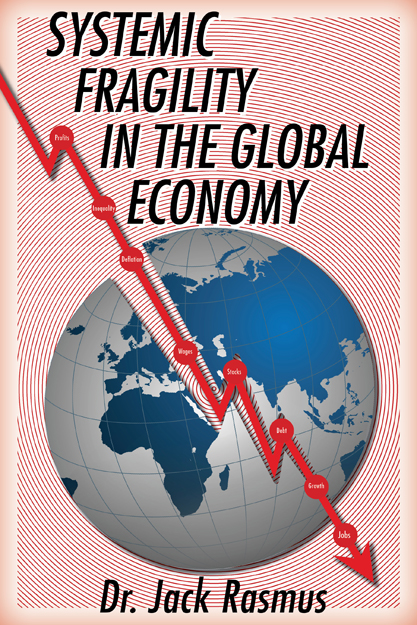
Dr. Rasmus is the author of the recently published, ‘Systemic Fragility in the Global Economy’, 2016, by Clarity Press, and ‘Looting Greece: A New Financial Imperialism Emerges’, Sept. 2016, by Clarity Press. He blog at jackrasmus.com.

Alternative Visions – Interview with Jill Stein, Green Party Presidential Candidate – 11.04.16

To listen go to:

http://prn.fm/category/archives/alternative-visions/

Or go to:

http://www.alternativevisions.podbean.com

SHOW ANNOUNCEMENT

Dr. Rasmus interviews Jill Stein, Green Party presidential candidate, discussing the real issues of the presidential election and her Party’s positions and solutions to the deepening political and economic crisis in the USA. Topics addressed include Green party proposals for tax reform. Reversing job destroying NAFTA, TPP, and free trade treaties. What to do about escalating healthcare costs and prescription drug price gouging. How to eliminate student debt and provide free public college education. Solutions to the growing retirement crisis and how to fund doubling of social security benefits and Medicare for All. Who Jill would appoint to the Supreme Court and reverse Citizens United. Her proposals for immigration reform. And Green party positions on preventing US military confrontation with Russia in Syria, East Europe and with China in the south China seas, toward which the US continues to drift. How claims of ‘lesser evilism’ to vote Democrat to oppose Trump is a dead end and why voting a third party is the only way forward.

THE FOLLOWING IS THE TRANSCRIPT OF AN INTERVIEW by MINTPRESS NEWS of Dr. Jack Rasmus on the Eurozone, Euro Debt, and Rasmus’s two latest books, LOOTING GREECE and SYSTEMIC FRAGILITY IN THE GLOBAL ECONOMY.

ATHENS — This has been another eventful year in Greece. Almost one year after it turned its back on the July 2015 referendum result which rejected further austerity, the Syriza-led government has pushed forward a program of even harsher austerity, spending cuts, and privatizations.

Following the British vote to proceed with “Brexit,” or a departure from the European Union, fears that Greece might follow suit led Greece’s lenders to demand even more austerity measures from a country already mired in an economic depression.

In this interview, Dr. Jack Rasmus, a professor of economics and politics at St. Mary’s College of California, analyzes these issues and the many challenges facing the Greek and European economies today.

The author of such books as “Looting Greece” and “Systemic Fragility in the Global Economy,” Dr. Rasmus shares his insights into the consequences of austerity for Greece and other peripheral European economies, and presents his proposed solutions for an end to the crisis and austerity.

MintPress News (MPN):

In September, Greek Prime Minister Alexis Tsipras gave his annual “state of the nation” address, where he boasted that the Greek economy has turned the corner, that unemployment is going down, that salaries will be increased, and that the country is returning to growth. Is this what Greece’s economic indicators actually show?

Protesters march to the Greek Parliament in Athens on Tuesday Nov. 6, 2012. Greece’s unions are holding their third general strike in six weeks to press dissenters in the country’s troubled coalition government not to back a major new austerity program that will doom Greeks to further hardship in a sixth year of recession. Two days of demonstrations are planned to start Tuesday, continuing until lawmakers vote late Wednesday on the bill to slash euro13.5 billion ($17.3 billion) from budget spending over two years.

Dr. Jack Rasmus (JR):

No, not quite. Greece’s debt is still the same as it was in 2011, roughly 180 percent of GDP. Unemployment has come down by only 3 to 4 percent, so instead of 27 percent, it’s about 23 to 24 percent. That’s depression-level unemployment. All the other indicators in the economy are flat or declining, so I don’t see anywhere that Greece is really “recovering,” and neither, really, is the entire eurozone economy. It’s been bouncing along the bottom.
As I said in my book “Systemic Fragility,” it’s a case of chronic stagnation. [The eurozone] might grow a little, 0.5 percent or 1 percent above GDP, mostly as a result of Germany’s growth, then it flattens out or goes below. Most of the periphery economies in Europe are stagnant or in a recession, as they have been for quite some time.

As far as raising wages, Greece cannot raise, at least in the public sector, any wages without the approval of the troika [Greece’s three major lenders: the European Commission, European Central Bank, and the International Monetary Fund]. It’s a real stretch to say that Greece is recovering. It’s kind of moving sideways, in the condition of still chronic economic depression.

MPN:

One of the perceptions that has been prevalent in global public opinion with regard to the economic crisis in Greece is that the country has been “bailed out” with billions upon billions of euros in free money. Is this really the case, and where has the so-called “bailout” money to Greece actually gone?

JR:

Countries don’t get bailed out. Governments, banks, businesses, and sometimes, though not so frequently, households get bailed out. So the question is, who got bailed out here, in the debt restructuring deals of 2010, 2012, 2015, and this past spring? The banks got bailed out several times. Foreign investors and speculators in Greek bonds and other securities clearly got bailed out in 2012. If you look at where the money has gone, there’s $400 billion in debt in Greece still, that they have to pay off, with an economy that is less than half that size, so it’s impossible.

Where has all this money gone? Recent studies by the European School of Management and Technology documenting the 2010 and 2012 bailouts indicate that 95 percent of all the loans to “bail out” the Greek government, which then bailed out the Greek banks — 95 percent of that went back to Northern Europe, mostly to the German and Northern European banks that had loaned so much money to Greece. [Bailout funds also went] to the troika, particularly the European Commission, that then distributed it to the banking system and investors in turn. The EC is the big player here, and to some extent the European Central Bank, and to a minor extent now the International Monetary Fund. So, 95 percent of all the money loaned to Greece went right back to [Europe] and less than 5 percent of that went back into the Greek economy. Greece has been subsidizing the financial system elsewhere in Europe.

MPN:

What do you believe needs to be done about the Greek debt?

JR:

You might ask what needs to be done about debt throughout the eurozone, because it’s not just Greece. Greece is perhaps the most serious case, but other places in the periphery of Europe are still heavily indebted. You cannot sustain, with austerity measures designed to pay the interest and principal on debt, a $400-plus billion debt based on an economy that’s less than $200 billion. Even the IMF has come to that conclusion and is maneuvering with the other troika members on that particular point.

Is [the debt] legitimate? Well, you have to understand the origins of this debt. It was originally private sector debt that was created as a result of the formation of the eurozone in 1999, the ECB as part of that creation, and other elements of the eurozone agreements, particularly the Lisbon Strategy that Germany adopted. Germany and other Northern European businesses and bankers pumped money and capital into the periphery, including Greece, from 2005 onward. Germany had a strong competitive advantage in exports, so a lot of the money and capital was pumped into the periphery, including Greece, in order to purchase German and other exports. So the money went in and circulated around, leaving a pile of private sector debt in Greece, Italy, and other places.

Then we had the crash of 2008-2009 and the debt could not be repaid, and the troika stepped in to [offer] the governments of Greece and other countries money in order to continue to bail out the private sector and enable the repayment of the private debt. So it starts out as private debt, because of this great imbalance in exports within the eurozone, and then that gets converted to government debt, and then the big crash of 2008-2009 adds even more debt, and then you have the recession of 2011-2013 in the eurozone and the 2012 bailout, which piled on more debt in order to pay the old debt, and then in 2015 the same thing. So the troika’s piling more debt on Greece in order for Greece to pay the previous debt, and that’s totally unsustainable. They’re going to have to expunge some of that debt.

Of course, the Germans, Wolfgang Schauble [the German finance minister] and the coalition in the north, does not want to allow that. And they don’t really want to change the eurozone, because the eurozone, while very imbalanced for the periphery, has benefited Germany significantly. [The Germans] dominate the finance ministers’ council in the EC and they dominate the ECB, and they’re just keeping the situation the way it is because it’s profitable for them.

MPN: Why must Greek banks be nationalized, in your view?

JR:

Look at the debt negotiations of 2010, 2012, and 2015. What happened was the ECB, which pretty much controls the Greek central bank — the ECB is just a council of central banks dominated by the Bundesbank [the German central bank] and its allies, so they have control — and what you saw in the negotiations is that in 2015, the ECB put the screws to the Greek economy, and Syriza collapsed and agreed each time the screws were tightened, bringing the economy to a halt. They couldn’t deal with the squeeze on the economy by the ECB. This brought the economy to a halt, squeezing it and of course not releasing loans that [the troika] had agreed to provide Greece under previous agreements. There was an economic squeeze that Syriza did not have a strategy to deal with, and eventually it capitulated.

You’ve got to nationalize, make the Greek central bank and the banking systems independent of the ECB. Gain control over your economy once again, and that is one of several key steps to prevent the squeeze every time you attempt to renegotiate the debt or restructure the debt. Without an independent, Greek, people-controlled banking system, the eurozone and the troika will squeeze and bring Greece to its knees every time. We’ve seen that three times. You’ve got to nationalize the banking system, including the central bank, or if you want to just leave the central bank as part of the ECB structure, go ahead, but create an independent central bank authority elsewhere in the Greek government.

In the U.S. during the Great Depression, the U.S. central bank had screwed up badly, and [President Franklin Delano] Roosevelt took over and had his Treasury Department take over and run the economy. Greece would have to set up a parallel central bank in its finance sector, and isolate and bypass the influence of the ECB through the Greek central bank. You would have to create a parallel currency as part of this and impose serious controls on bank withdrawals and capital flows outside the country, which Syriza did not really do, because the ECB and the troika opposed it. When you have all the capital, bank withdrawals and capital flight is another way of squeezing the country economically.

MPN:

The current government in Greece has been continuing a policy of massive privatizations of Greek public assets, with profitable airports and harbors having been privatized in the past year, in addition to the recent selloff of the Greek national railroad for a total of €45 million ($49 million). What are the short- and long-term impacts of the privatization of such public assets?

JR:

The short-term is that when you privatize them, under the aegis of the troika, if you sell below market prices, which a lot of these assets are being sold at, that’s profit on the sale for the investors who are buying up these assets. But once the assets are in private hands, where does the revenue go? Does it go back into Greece or does it go back into the pockets of the investors and the corporations and the banks outside Greece that are buying it up? Well, it goes out. It’s a form of capital flight. Money that is needed in Greece flows out of Greece.

This is a new form of financial imperialism, wealth extraction in other words, that is being structured and managed on a state-to-state basis. It’s not 19th century British imperialism where they set up a factory in India, paid them low wages, and brought the textiles back to London to re-sell at a higher price. It’s not that kind of production imperialism. This is financial imperialism imposed on Greece, and it’s a new form that’s emerging everywhere, where you indebt the country and then you force the country to engage in austerity in order to pay the principal and interest on the debt, and you extract the income from the country. Privatizations are another form of that.

You privatize public goods, you get them at fire-sale prices, and then the income flows from those assets flow back to the coffers of the private companies or the banks, outside of Greece.

The other consequence is when you privatize, they come in and they cut costs, which means they lay off people in mass numbers, they put a hold on wages, they get rid of benefits, and they do everything else to maximize their revenue.
Finally, longer term, it means that Greece has less control over its own economy if it can’t control its infrastructure and everything is owned by foreigners. Then you can’t influence it as much, and if you’re part of the eurozone, you’re legally prohibited from what you can do to make sure that these foreign-owned infrastructure companies are behaving in terms of the benefit for the public sector, for the rest of Greece.

MPN:

You have argued in your book, “Systemic Fragility in the Global Economy,” that there are nine major trends which account for the economic troubles that are seen on a global scale. What are some of these trends?

JR:

Everywhere, and particularly since 2008, we see central banks and monetary policy to be ascendant, and that means creating money, pumping it into the economy to bail out the financial systems, the financial institutions, the banks and the shadow banks, meaning speculators, hedge funds, private equity firms, asset management companies, and so forth. We’ve seen bailouts of tens of trillions of dollars since 2008. All of that liquidity injection into the economy has driven interest rates down to zero or even, in Europe and Japan and elsewhere, negative rates, and that fuels debt. With rates that cheap, corporations and businesses float new corporate bonds, and they use the money not to invest necessarily, they use it to buy back the stock and drive up the stock prices and pay out dividends, or they sit on it, they hoard it, or they send it to emerging markets. That’s a problem everywhere, and that’s the result of massive liquidity injections, which have really been escalating since the 1980s, when controls on international capital flows were eliminated everywhere.

After the 1970s, when the Bretton Woods system collapsed and central banks took over, the combination of those has led to the financialization of the global economy in the 21st century, where profits are far greater for investing and speculating in financial securities than they are in investing in real assets and real things that create real jobs and real income and real consumption. We’re becoming dependent on debt more and more. The economy is increasingly credit- and debt-driven, and that’s the result of this massive liquidity injection, and it also leads to a shift from real asset investment — investing in real things that create jobs that people need — toward financial asset investment. That means that real investment collapses over time and productivity collapses over time as well, and we see that happening everywhere.

That’s a major point that I argued about in my book, “Systemic Fragility,” this financialization of the global economy based on liquidity and debt and squeezing out. It’s diverting money and capital from real investment into financial speculation. What’s going on in Greece is a concrete expression of this, the reliance on financial means and financial manipulation. The periphery in the eurozone is at a great disadvantage to Germany and others, and they’re being manipulated financially. All the payments on interest and the debt flow back to the north. This is all flowing through the EC to the private sector, and it’s a nice constant money capital flow from interest payments and privatization and speculation on government bonds and securities and stocks in these countries as the volatility occurs.

It’s a reflection, in Greece, of what’s happening on a broader scale elsewhere in the global economy, and that’s why we haven’t seen much of a recovery in the global economy. Global trade is stagnant and real investment everywhere is drifting toward zero, productivity is negative almost everywhere, even in the U.S., and we’re seeing growth rates of barely 1 percent, 1.5 percent, at best, when it should be double that. We see these growing, non-performing bank loans, almost $2 trillion in Europe, the worst in Italy with about $400 billion. We see the same thing in Japan and in China. We’re becoming more systemically fragile financially because of this shift to financial speculation.

MintPress:

What is your outlook for the eurozone economy and the difficulties that it is currently facing?

JR:

The European banking system has never fully recovered from the 2008-2009 crash. The ECB is pumping money into the banking system in various ways, long-term refinancing options and all the bailout funds and qualitative easing and negative interest rates and so forth. They’re desperately pumping money into the banking system, but the banks aren’t really lending, at least to those businesses that would reinvest in real assets to create jobs. It’s far more profitable to make money now. Investors make more money from financial speculation than they do from investing long-term and expecting to get a return over 10 to 20 years for investment in a real company that creates real things.
We can see the strains now with the non-performing loans, in particular in Italy. Of course, we know the situation with the non-performing bank loans in Greece. Portugal is in bad shape as well in terms of non-performing loans, and now we see even institutions like [Germany’s] Deutsche Bank and others beginning to feel this strain, and the further impact on the European banking system of the “Brexit” [the departure of Great Britain from the European Union].

The problem is that the private banks are either hoarding the cash, they won’t invest in real growth, or they’re sending their money offshore to emerging markets, or they’re using it, as in the U.S., to buy back stock and pay out dividends and loaning money to companies to do just that. The global economy has changed dramatically in ways that make it much more fragile than ever before. A lot of debt has been building up everywhere: Over $50 trillion in additional debt has occurred since 2009, and when the next recession comes, how are they going to pay that debt?

When times are stable or growing, you can add debt without a great crisis emerging, but when you have a recession or a downturn that’s significant, where are you going to get the money capital to pay the principal and interest on the debt? Then you start seeing defaults and you start seeing financial asset price collapses going on, and now you’re back in 2008-2009. That’s the picture of the global economy.

MPN:

What would be the steps for Greece to follow, in your view, in order to escape the spiral of economic depression and austerity?

JR:

Syriza made it clear, when it came into power, that it was not in favor of “Grexit” [a Greek departure from the eurozone], and it has always maintained that position. An unprepared, “we’re leaving the eurozone and the euro” kind of decision would cause a collapse of values, particularly among those who have investments in some savings in Greece. To some extent, Syriza was caught between a rock and a hard place here. They couldn’t or didn’t want to advocate an exit, and at least those who had investments didn’t want it because of the potential effect on their investments. The broader Greek populace thinks, still, that to be European you have to be in the eurozone. That’s a big mistake.
I think what Greece and Syriza should have done is to create a parallel currency and to take over its banking system. In other words, make the banking system truly independent, including the Greek central bank, and if that was not possible, bypass the Greek central bank and set up a central banking function in the finance ministry, as the U.S. has done at different times. Create a parallel currency, and policies and programs to get people to convert their euros into the parallel currency. Maybe declare that henceforth all taxes to the Greek government will be paid with the parallel currency, and that means that people would then trade in their euros for the parallel currency to pay their taxes.
Then tell the troika [the EC, the ECB, and the IMF — collectively, Greece’s lenders] that we’re going to pay you in your euros, but if we run out of euros here as a result of the conversion, well, tough luck, we don’t have a way of paying you, let’s negotiate a final deal where you expunge some of it and we pay you off and we go our separate ways. Of course, you would have to create significant capital flow controls, which has always been a problem every time there’s been a crisis; the money flows out of Greece. Take the economy out of the control of the troika without a formal exit.

That could have been done, but for some reason Syriza and its finance advisers either didn’t want to do that or didn’t know how to do that.

MPN:

Arguments that have been heard against a parallel currency include the claim that the existence of two currencies would create a situation where there would be “haves” and “have nots” — between those who would hold a stronger, hard currency, compared to those holding a weaker, devalued currency. How do you respond to this?

JR:

There are policies and approaches you can take that entice and require people to convert their euros into the new currency. That would raise the demand and therefore the value, the price of the new currency. If you just had the currency and you didn’t have this forced trade-in, then of course you would have “haves” and “have nots,” the new currency would collapse, and pretty soon no one would want to use it. But, for example, saying that taxes could only be paid with the new currency, would force people who had corporations and businesses and so forth to purchase the new currency with the euro. It would undermine the value of the euro in Greece and it would raise the value of the new currency in Greece as well. That might set off a parallel elsewhere in the eurozone with other countries thinking the same thing, which would undermine the value of the euro and put the squeeze on the troika for once. Greece never put the squeeze on the troika, it was just the opposite in all of these negotiations that occurred, they never really hurt the troika in negotiations, and that’s the only way you prevail in negotiations. You’ve got to make it unpleasant for the opposition. Syriza never did that, they played along and made concession after concession.

Syriza thought that their example would strike a spark elsewhere in Europe of other social democratic forces and governments. They thought that they would get the rest of the social democracies behind them and together they would reform the eurozone. That was a fiction, a fantasy thought on the part of Alexis Tsipras and others, but that was the core of their whole strategy. European social democracy is a dying force, and that’s why you see the growth on the fringes, both to the right and the left.

Tsipras and [former Greek finance minister] Yanis Varoufakis’ problem was that they thought they could get all these elements behind them and that together they would have enough weight to force Schauble and other finance ministers to make concessions. Well, Schauble and the other ministers, the “German faction,” as I call it, within the finance ministers’ council in the EC, remained dominant. At every step along the way, whenever Syriza and its few allies tried to make a compromise where some concessions were made to them, the German faction squelched it. We saw that, for example, at the very end, when [Greece held] the referendum in July 2015. Greece held the vote, and the vote said “go back and negotiate a better deal for us,” and what did Tsipras do? He totally caved in to the Schauble faction, and then the Schauble faction said, “The offer we made last week is now off the table, you’re going to have to accept an even worse one.” So they put the screws to Syriza, and Syriza looked to its allies in the EC, and they totally caved in as well. Things just got worse and worse until you had the final [austerity] agreement on August 20, 2015.

It was a step-by-step retreat from [Syriza’s election in] January 2015, because Syriza had the wrong strategy and was not engaged in certain necessary tactics. Of course, the troika itself had a lot of cards to play. It would have been an uphill fight for Syriza. The time where they might have been able to strike some concessions from the troika was 2012, but New Democracy [the center-right party in power at the time in Greece] was totally in the pocket of the troika, so that was impossible.

[This past spring], the IMF and the troika were worried about “Brexit” and what impact that might have on renewing “Grexit.” So they put the screws to Greece again, raised the debt even more, austerity even more, and I think another round of that is coming, because the IMF wants out of the troika deal. We’ll see what happens at the IMF meeting, but they haven’t endorsed even the 2015 agreement because they know it’s unsustainable. I think the IMF is maneuvering to have the EC to buy its portion of the debt, and once that happens, the EC will demand even more austerity from Greece.

MPN:

In the event that a parallel currency is implemented and steps are taken to maintain or strengthen its value, could that be a prelude to a switch to a national, domestic currency?

JR:

Yes. At some point, one currency will become dominant. You can’t have two equal currencies like that. Another advantage of the new currency is that it will start out at less value than the euro, and that will be used as the trading currency. That will stimulate Greek exports to elsewhere, outside the eurozone.
Part of the problem is that the periphery in Europe is so dependent on exports and imports to Germany and the north, that it can’t really engage in its own independent export strategy without cutting wages. Throughout Europe, you have what’s called “internal devaluation,” when you are stuck with a currency and someone else’s central bank, the ECB and the euro. You can’t really engage in independent monetary policy to stimulate your economy and you can’t engage in lowering your currency in order to gain some advantage in exports. You’re stuck, and only the most powerful country that’s most efficient and has the lowest costs is able to take advantage of global exports, and that’s Germany. The weaker economies of the periphery will always be at a disadvantage to Germany when it comes to trying to push their exports anywhere else outside the eurozone.

That’s the lesson. The lesson is that you’ve got a 1999 agreement in which you have this quasi-central bank, the ECB, and you have [the euro], and that arrangement significantly benefits the most efficient, low-cost producer, which is Germany, at the expense of the periphery. Until you have a true central bank and fiscal union to some extent, that will pump the money into the periphery to help it grow when it doesn’t, you will always have the situation you have in Europe right now.

Compare that to the U.S., where there’s a fiscal union, so that if certain states have economic problems … the federal government can pump money into those specific locations. If you don’t have a true federal government and fiscal union, you can’t do that, and if your central bank is dominated by the largest economy — Germany — even the monetary policy has no effect. And if it’s a single currency, it’s to the advantage of the stronger economy at the disadvantage of the weaker.

The eurozone economy is structured to emphasize the growth of the strongest economies at the expense of the weaker, and that’s not going to change. It’s built into the eurozone. You cannot create a currency union and a customs union without a true banking union and fiscal union. More and more countries in the eurozone are beginning to come to that conclusion, but it was foreordained. Economists knew this from the beginning, and that’s the tragedy. Greece has tied its tail to the eurozone, dominated by Germany, and it can never get out of this situation as long as Germany dominates the institutions, which it does, because the whole arrangement is great for Germany.

MPN:

Tell us about your most recent book, “Looting Greece.”

JR:

It’s really a case study of the consequences of financialization and globalization and integration. I argue that there is this phenomenon of the smaller economies being tied into the larger economies through free trade agreements, which lead to currency unions, which lead to banking unions, and then you’ve got a situation like Greece and the euro periphery and the problems associated with that.

The book also takes a historical look at the origins of the Greek debt, that starts in 1999 with the [creation of the] eurozone, the adoption of the euro by Greece in 2002 and the consequences of that, how the debt developed, first in the private sector because of German export domination and then conversion of the private debt in 2008-2009 to the public debt, and then the collapse of 2008-2009, which added to the government debt. Then you had the 2012 agreement where the private sector was bailed out, and that added more debt, and then 2015 and so forth. All this is described in detail in the early chapters, and then most of the book is a step-by-step look at the negotiations between Syriza and the troika, from [Syriza’s January 2015 election] through the spring of 2016, and what were the strategic and tactical errors of Syriza and the strategic and tactical moves by the troika which enabled it to prevail.

At the end, [the book discusses] how this is a form of a new emerging financial and wealth extraction from smaller economies by the larger economies, because of the globalization and integration arrangement that exists, the emergence of financial extraction and financial exploitation, and how central banks are feeding that all. This will lead to my next book, which is about global central banks and the problems they’ve created as we move to another crisis, which I think is coming in the next five years.

The 3rd US presidential debate held October 19, 2016 between Donald Trump and Hillary Clinton was perhaps the most critically important of the three presidential debates—not so much for what was said, or even how it was said, but for what it portends for US policy in the post-election period regardless which candidate is elected in November.

The 3rd debate began with a reasonably rational discussion covering topics of Supreme Court appointments, 2nd amendment gun rights, abortion and then immigration—each subject revealing the deep differences in positions between the candidates. But then, as in the 1st and 2nd debates, it quickly exploded.

As the debate addressed the topic of immigration, Trump noted that Barack Obama was the biggest deporter of undocumented Latinos in US history—a fact which Clinton has consistently avoided, he charged. Trump then referred to the recent Wikileaks revelations, where Clinton declared she was in favor of ‘open borders’ throughout the western hemisphere and Trump suggested her ‘open borders’ remark referred not only to more free trade but also more cross border labor immigration as well.

The Wikileaks revelations have been a consistent hot ‘third rail’ in the US election and the debates. The revelations have served as a multi-edged sword against Clinton. By revealing her ‘open borders’ remark they contradict Clinton claims that she opposes the Trans Pacific Partnership trade treaty or free trade, while simultaneously suggesting she would accept more immigration to the US as part of a broad hemisphere free trade deal. Wikileaks further touches another Clinton political ‘raw nerve’: her emails cover-up. And they also reveal Clinton’s cynical ‘dual communications strategy’, in which she consciously says one thing to bankers and big business and another to the US public. The Wikileaks revelations are thus a kind of strategic lynchpin for the Trump campaign in the election, raising multiple issues on which Clinton is vulnerable.

It was not surprising therefore that, almost on cue when Wikileaks was first raised by Trump in the 3rd debate, Clinton angrily went on the offensive and diverted the discussion from the revelations. Her offense-defense was to redirect the debate to an attack on Wikileaks itself. From Wikileaks suggesting free trade, open immigration, email cover ups, and double talking to bankers and voters the discussion was diverted to Wikileaks as Russian hacking of senior Democrat party leaders, Wikileaks as Russian vehicle to disrupt US elections, and from there to Russian aggression in Syria, demonizing Putin as war criminal, and then demonizing Trump by association as a friend of Putin.

In redefining the Wikileaks debate, Clinton’s words and her visual countenance response revealed a deep anger. How dare any country interfere with US elections. How ironic, given the US long and consistent interference in other countries’ elections. Clinton’s comments reflected the US elite’s growing frustration with Russia’s recent military offensive and gains in Syria. Clinton’s counter-attack on Wikileaks then set up the segway to Putin as the cause of continuing war in Syria, Putin as Saddam Hussein incarnate, Putin as the source of subversion of US democracy, and, then in turn, to Trump as the buddy of Putin and therefore, by association, all the above as well.

Wikileaks was clearly the nexus point of the 3rd debate. Clinton declared Wikileaks “the most important issue tonight”, charging Trump with “willing to spout the Putin line”, declaring “you continue to get help from him” (Putin) and that “you are his favorite in this race”. Trump countered with the charge Putin has outsmarted her and Obama at every foreign policy turn and that’s why she, Clinton, is trying to attack him by a desperate attempt to associate him with Putin.

The even more disturbing quote from Clinton in the exchange, however, was her repeated call, first raised in the 2nd debate, to establish ‘no fly zones’ in Syria. When the debate moderator noted that US generals have said such zones would likely lead to war with Russia, Clinton suggested ‘no fly’ would correspond to ‘safe zones’ on the ground. But ‘no fly’ was necessary to confront Putin and Russia in Syria. “We have to up our game” there, she concluded.

The debates reveal that, if elected, Clinton and the US war faction are likely to engage in new military adventures in the middle east, in particular in Syria. Or perhaps try to counter Russia with a more assertive military challenge in the Baltics, Eastern Europe or the Ukraine as a bargaining chip with Russia in Syria. The 2nd and 3rd presidential debates indirectly reveal something is afoot in that regard, no matter what the outcome of the election in November, but especially if Clinton is elected.

The debates also reveal a new offensive is brewing, indeed already underway, to shut down Wikileaks and to further restrict free speech and civil liberties. Already, Wikileaks’ internet connection at the Ecuadoran embassy in London has been cut. Concurrently, in recent days British banks have indicated they will no longer service the accounts Russia TV in the UK. This is a ‘shot across the bow’ to Russia media as well. A similar move is likely in the US for Russia TV soon after the elections. US government and US banks have initiated similar financial disruption tactics against Latin American progressive media, as the US renewed neoliberal offensive in Latin American continues to deepen. And should Trump lose the US election, it is likely his voice too will be muffled, if not ‘silenced’, in US media.

That muffling is especially true should Trump refuse to abide by the election outcome in the US. Another Trump ‘verbal bombshell’ in the 3rd debate was his refusal to say whether he would accept the outcome of the US election if he were defeated. Before the debate, Trump also continually raised the charge the election was being ‘rigged’.

That view of media bias and election manipulation resonates with much of the US voting electorate, especially his base of at least 40% of hard core pro-Trump voters. The charge of ‘rigging’ and potential to refuse to accept the election results may prove a ‘game changer’ in US elections. It reflects the deep distrust by broad segments of the US populace of the political elites in the US and their two parties. That distrust is not going away after the election, but will take new forms of protest in 2017 and beyond.

For there is clearly a rebellion underway against the ‘political class’ in the US. That rebellion is not yet reflected in independent political organization and opposition. It is still being expressed through and within the two wings of the Corporate Party of America—Republicans and Democrats. But that may break down, should Trump lose and the US economy continue to falter in 2017. What the debates reflect is growing disenchantment with the two parties’ organizational cocoon. A ‘rebellion within’ those two wings could evolve post-November easily and quickly to a challenge ‘from without’.

Should he lose, Trump will almost certainly launch a new political party. A Trump new party initiative could also stimulate something similar on the left in the US. Bernie Sanders’ millennials are still clearly not in the Clinton corner, despite their erstwhile leader having thrown in with Clinton. The election may come down to whether, in the 8-9 swing states, Trump can turn out more non-college educated white workers than Clinton can turn out educated urban professionals, women, suburbanites, and Latino-African Americans.

Neither candidate has the millennial vote, now the largest population segment. Millennials may in the end vote for ‘none of the above’. Clinton is trailing well behind Obama for the millennials. Trump too is losing their support, at least among the better educated. Polls show only 54% of the under-35 years old group is currently at all interested in the election. And that will not soon change.

Third party candidates, Jill Stein of the Green Party and Gary Johnson of the Libertarians, are polling 22% of likely voters aged 18 to 29. According to a Harvard University survey this past summer, a third of Americans aged 18-29 support Socialism, while not even half back Capitalism. For them, the economy is the main issue and that is going to get worse in 2017 and beyond, not better, regardless who wins in November.

In summary, apart from all the personal mudslinging and the occasional, tangential references to real issues in the debates, what the 3rd—and indeed all three debates—reveal beneath the surface is in 2017 and beyond what’s in store is more military adventures, more limits on civil liberties, a growing loss of legitimacy by the US political elite and their parties among broad segments of the US population, deeper splits and more internecine conflict within the political class and each of their two parties, a growing potential for new forms of independent politics, and more instability within the US political system in general.

Jack Rasmus is the author of the just-released book, “Looting Greece: A New Financial Imperialism Emerges,” and the previous, “Systemic Fragility in the Global Economy.”, both published by Clarity Press, 2016. He blogs at jackrasmus.com.

The two most disliked candidates in modern U.S. election history did not disappoint U.S. voters’ low expectations of their performance in the second presidential debate held October 9 in St. Louis.

Both candidates spent most of their time attacking each other as either ‘morally unfit’ to be president, chronically prone to ‘bad judgement’, and habitual liars. Issues of real importance to voters were again, as in the first debate, altogether absent or, at best, were briefly and superficially addressed.

The continued mudslinging was fueled by the release of videos this past week, taken a decade or more ago, showing Trump bragging about his ability to sexually dominate women and making other generally extreme misogynist comments.

The videos set off a firestorm among the Republican elite over the week. Some began calling for Trump to drop from the race. Others talked of ‘pulling the plug’ on Republican Party financial assistance to Trump’s campaign. How Trump performed in this second debate would no doubt determine whether such talk translated into action, as the Republican camp showed signs of splitting down the middle even further and the party’s elite abandoning their candidate.

This potential ‘hard split’ among Republicans in the United States, the party elite vs. a majority of its members, is not unlike similar party developments in Europe, where the British Labour party elites have been attacking their public leader, Jeremy Corbin, for abandoning their neoliberal policy regime; or in Spain where the Socialist Party leader was recently dumped; or in France where presidential Holland will soon be. The economic recovery since 2009 that has benefited only the economic elites—in the United States 95 percent of all the net income gains since 2009 have accrued to the wealthiest 1 percent households—has been translating into a grass roots disaffection from political parties. As one of the press commentators put it after the second U.S. debate, “This election is about the American people vs. the Political Class.” But it’s not just an American phenomenon. The trend is becoming generalized across many of the advanced economies.

Trump fielded the damning video evidence of his misogynist bragging by saying it was only ‘locker room’ talk. Only words. He then went on the offensive against Hillary Clinton, saying that while his were only ‘words’, Hillary’s husband, past president Bill Clinton, engaged in actual sexual abuse and was impeached for it. The Trump camp had brought three women to the debate who were involved in Bill Clinton’s impeachment charges or were subjects of Clinton’s sexual misconduct. Trump further accused Hillary of laughing when, as a prosecuting attorney, she got her client saved from jail time in a rape case involving a 12 year old. Both candidates thus showed they would go to whatever lengths to dredge up decades old evidence to prove their opponent as ‘morally unfit’.

An interesting, related detail to the ‘morality telenovela in real time’ that has become the U.S. presidential election, is that the videos of Trump were released more or less simultaneous with the Wikileaks’ release last week showing Clinton’s plans to run her campaign with one set of proposals and promises communicated to private big banker-corporate donors, while planning to say the opposite to voters. When challenged by Trump to explain the leak and her implied ‘two-faced’ approach to U.S. voters, Hillary hid behind the example of Abraham Lincoln, saying he did the same and the practice was therefore legitimate.

This ascerbic exchange was preceded by Hillary’s reference to Russia and its president, Vladimir Putin, accusing them of hacking the Democratic Party and the U.S. election in order to aid Trump. The U.S. media in recent weeks has picked up this idea, for which there is no evidence to date, and has been promoting it widely. It is yet another dimension of the growing shift in U.S. elite toward confronting Russia. Hillary’s implicit suggestion in the debate was the Wikileaks release reflects Putin-Russian interference in the US election to aid Trump. The timing of the release of the Trump videos and the Wikileaks material raises the question whether in coming weeks voters can expect more of the same—i.e. more damaging Trump videos being released, perhaps not coincidentally, as more promised Wikileaks releases appear damning Clinton.

The second debate revealed yet another, even more ominous anti-Russia theme worth noting. In a reply to a question about what would the candidates do about Syria and Aleppo, Hillary declared the Russian air force in Syria is determined to destroy Aleppo. Russia has ‘gone all in’ in terms of ambition and aggressiveness in Syria, she added. Russia’s war crimes should therefore be investigated. Furthermore, a ‘no fly zone’ should be imposed in Syria. What she didn’t explain is if Russian planes ignored the U.S. ‘no fly zone’, would the United States try to shoot them down? And what if U.S. planes were shot down, as Russians retaliated? Clinton’s exchange revealed the U.S. ‘war hawk’ faction’s increasingly desperation concerning the Syria conflict, in which the United States has been increasingly sidelined and Russia has become more influential.

The debate moderator, Martha Radditz, then asked Trump what he would do in Syria, since Trump’s vice-presidential running mate, Pence, had just days before declared, agreeing with Clinton, “the U.S. should be prepared to strike military targets of the Assad regime”, presumably including airfields with Russian planes. Trump replied “I disagree”, and that the focus should be on dealing with ISIS. Trump’s disassociating from his VP, Hillary, and the war hawk faction created some stir and commentary in the post-debate discussion by pundits and talking heads.

Another notable exchange during the debate occurred when Trump attacked Clinton for deleting her emails after receiving a subpoena, when Secretary of State. He then dropped yet another debate bombshell by saying when he’s president he would appoint a special prosecutor to investigate Hillary’s action. When she rejected the notion as an example of Trump’s ‘imperial presidency’ view, Trump retorted it didn’t matter “because you’ll be in jail”.

Hillary clearly scored points in the debate, however, when the discussion turned, on occasion briefly, to actual policy. Trump noted costs of Obamacare had risen 68 percent, and that voters were drowning under rising costs of premiums, deductibles and copays. He advocated repeal and a total restart. Clinton, however, argued to fix it, and keep the good elements, whereas Trump would return health care to insurance and pharmaceutical companies’ price gouging and coverage denial, as in the past.

Clinton scored points in the exchange on taxes as well, noting that Trump’s plan to reduce taxes from 35 percent to 15 percent would benefit the rich twice as much as had George W. Bush’s tax cuts. She proposed no tax hikes on anyone earning less than US$250,000 a year, with taxation raised only on the wealthy.
The second presidential debate changed little in terms of voter preference, according to post debate polls.

The unfavorability ratings for both candidates were virtually unchanged: Clinton with 45 percent unfavorable rating before the debate and 44 percent after; Trump with 64 percent unfavorable both before and after. In national polls Clinton enjoyed a wide margin of support among women before the debate, which has grown further after events of the past week. This margin may prove significant in the election outcome, providing it carries over to the 8 or 9 swing states where the election will be determined by voter turnout–perhaps even before November since 30 percent vote by mail before and that voting has already begun.

In the second debate, Trump’s strategy was clearly to shore up his conservative base by returning to the extreme anti-Hillary rhetoric that got him the nomination. Themes of Clinton as ‘liar’, ‘devil’, and ‘put her in jail’, were resurrected. He may have restored his base after the events of the past week, and by performing relatively better in the second debate (a very low bar), but that may not prove sufficient to win in November. Clinton has used the events of the past week and the debate to deepen her support among women voters. However, an expected ‘knock out’ debate, where Trump was decisively defeated, did not happen.

But debates and national polls are almost irrelevant at this stage. The outcome will be determined in the eight to nine swing states. With 87 percent of voters decided and neither candidate able to ‘move the needle’ in debates, it’s about whether Trump turns out more of his base in the swings states and whether Hillary can change the minds of millennials, Latinos, and others to turn out to support her after they have felt betrayed by Obama’s second term and its failure to deliver on promises made in 2012.

In the meantime, audiences can just ‘enjoy’ (and weep) the morality telenovela that is the current U.S. presidential election.

Jack Rasmus is the author of the just-released book, “Looting Greece: A New Financial Imperialism Emerges,” and the previous, “Systemic Fragility in the Global Economy.”, both published by Clarity Press, 2016. He blogs at jackrasmus.com.

Listen to my recent 39 min. interview with Dialogos Radio worldwide, on the German-Eurozone origins of the Greek debt crisis and the deeper crisis in the Euro system itself.

Go to:

http://www.kyklosproductions.com/audiocds.html

Or go to:

SUMMARY OF INTERVIEW TOPICS:

In his interview with Greek ‘Dialogos Radio’, Dr. Rasmus explains the current state of the on-going Greek debt crisis and depression, and explains how Greece’s continuing economic and political crisis is but part of the larger crisis of the Eurozone system (as described in more detail further in his just published book, Looting Greece: A New Financial Imperialism Emerges by Clarity Press, September 2016). In the interview, Rasmus explains in detail why Greece must create a parallel currency to the Euro, reassert independent control over its central bank, and nationalize its banking system if it ever expects to recover from its on-going economic depression. Rasmus, further explains why Greece is a case example of a new emerging financial exploitation in the 21st century global economy. The interview concludes with Rasmus providing his outlook for an increasingly fragile Eurozone banking system (German-Italian in particular)

TO listen to my Alternative Visions Radio Show of October 10, 2016, on this topic,

Go to:

http://prn.fm/category/archives/alternative-visions/

Or go to:

http://www.alternativevisions.podbean.com

SHOW ANNOUNCEMENT

Dr. Rasmus explains why a Federal Reserve interest rate hike is coming very soon. Why central bank monetary policies in US, Europe and Japan have failed miserably to generate real economic growth since 2010, but were always focused on boosting stock, bond and other financial markets. Now, however, they no longer even stimulate financial assets but are increasingly causing financial instability in pension funds, insurance annuities, bank margins, retirees’ consumption, and will therefore soon be shelved. Anticipating the shift, central banks in Europe and Japan are adjusting their monetary policies in turn. The likely negative consequences of the US Fed rate shift globally are discussed. A new shift to fiscal infrastructure spending, business tax cuts, and abandonment of austerity fiscal policies are now on the agenda following the US election and in 2017 in Europe and beyond. The show concludes with analysis of the 1st presidential debate and why Trump, despite a disastrous debate performance may still win critical ‘swing states’ in November.

A week ago, on Monday, September 26, the 1st Presidential debate was held. 84 million watched the two most disliked candidates in perhaps more than a century square off and debate.

The one, Donald Trump, a self-proclaimed billionaire wheeler-dealer real estate developer backed by billionaire economic advisers and campaign contributors like sleazy Casino magnate Sheldon Adelson, hedge fund vultures Robert Mercer and John Paulson, private equity king Stephen Feinberg and at least a dozen other billionaires that constitute Trump’s current ‘economic team’; the other, Hillary Clinton, a mere multimillionaire worth a paltry $200 million (not counting her foundations valued at around $400 million), who has accumulated her wealth in just the past decade by means of her (and her husband Bill’s) close connections to investment bankers like Goldman Sachs CEO, Lloyd Blankfein, billionaire hedge fund managers like George Soros and James Simons, multinational tech company CEOs, and billionaire corporate media families like the Sabans, Katzenbergs, and Coxes.

The major economic issues raised in the debates included jobs, trade, taxes and the $20 trillion US government debt. On domestic policy, the focus was racism and gun violence. On foreign policy—Isis, Iraq, NATO, China, first use of nuclear weapons, and Russia.

Taxes and Jobs

Trump proclaimed his plan would cut taxes by $12.5 trillion. He proposed to pay for the cuts by repatriating $5 trillion of cash US corporations continue to hoard offshore. The incentive to repatriate the $5 trillion would be to reduce the corporate tax rate to 5% to 7%, instead of the current 35. But Trump conveniently ignored pointing out this repatriation trick was already played in 2005-06 under George W. Bush. US corporations had accumulated $2 trillion offshore, were given by Congress a ‘pass’ and a lower rate of 5.25% to repatriate so long as they created US investment and jobs with remainder of the repatriated funds. They brought it back, all right, but did not create jobs and instead used the excess profits they realized to buy up companies and pay out dividends to shareholders.

But Clinton carefully did not pick up this issue and use it against Trump in the debate. Why? Because Democrats in Congress are currently proposing the same tax repatriation scam as Trump and Clinton admitted she too supported ‘repatriation’ business tax cuts.

While talking in generalities about ‘taxing the wealthy’, Clinton carefully avoided mentioning that tax cuts for business under Obama have been even more generous than they were under George W. Bush. Bush tax cuts from 2001-2008 amounted to approximately $3.7 trillion—of which it is estimated 80% accrued to businesses and wealthiest households. Obama extended the Bush tax cuts for two years from 2008 to 2010, at a cost of another $450 million, then provided another $300 million in his 2009 bailout package, and then struck a deal with Congress to cut taxes another $4 trillion in January 2013 by again extending Bush’s tax cuts another decade through 2022.

And conspicuously missing in the debate was that neither candidate commented on whether they supported the further major tax cuts for corporations being planned to passage right after the November elections. That’s because both no doubt will support it when it comes up for voting in Congress soon following the election.

Both candidates avoided responding directly to the moderator’s question: ‘Would you support raising taxes or reducing taxes on the wealthy”. Instead of substance, the debate on taxes focused on whether Trump personally paid taxes and why he refuses to release his tax returns. Clinton kept pressing the subject, scoring points repeatedly as Trump fumbled the issue of his personal taxes. He finally responded to why he hasn’t paid taxes or released his tax records with “I guess that makes me smart”—a remark that will no doubt cost him significant votes.

In the debate, both candidates supported the myth that tax cuts create jobs. The only difference between them is which cuts. Trump meant corporate tax cuts. Clinton meant a mix of business and non-business. But the historical record shows clearly there is no relation between tax cuts in general, and business tax cuts, and job creation in the 21st century. US manufacturing employed 18 million workers in 2000. After nearly $10 trillion in tax cuts, it now employs 12 million. Construction employment has similarly declined. While service jobs have increased since 2000, so too have the ranks of the part time, temporary, and those employed in the underground economy. Together with these ranks of partially employed, more than 6 million more have left the labor force in the US—a net poor return in jobs for the nearly $10 trillion in tax cuts.

NAFTA, TPP and Trade

Trump’s business constituency of real estate and financial interests is less concerned with trade deals than Clinton’s. Trump is also targeting small businesses, which typically don’t export but are harmed by imports, as well as white working class in the Midwest whose incomes have been devastated by free trade deals like NAFTA. However, unlike before the debate, he didn’t declare he would discontinue the existing trade deals. He promised first to stop the further offshoring of US jobs —without explaining how he would do this—and also left unexplained how he proposed to get the millions of jobs previously offshore back to the US. Clinton too provided no details how to get the jobs back or what she would do to stop future bloodletting of US jobs offshore.

While declaring NAFTA as ‘defective’, Trump simply added “we need to renegotiate trade”—a position little different from Clinton’s that we “need to take a new look at trade”. The debate thus talked in generalities that leave the door open after the election for either to support the TPP and undertake token reforms at best regarding NAFTA. More revealing of Clinton’s true intentions perhaps was her off the cuff comment that she’d vote again for CAFTA (Central American Free Trade Agreement) if given the opportunity.

Debt and Defense Spending

Trump several times during the debates referred to the nearly $20 trillion in US national debt. But what he failed to mention is that studies show about 60% of that debt is due to tax cuts and declining US tax revenues. Another $3 trillion at least is due to US war spending since 2003. Yet in the debate Trump called for accelerated war spending, while Clinton said nothing about whether she would increase war spending or reduce it. Her silence spoke volumes on that topic, however, as did her repeated references to the need to confront Russia and China. While Trump directly indicated he would not use nuclear weapons first, Hillary avoided answering the moderator’s question, implying perhaps she would, which has been the US official position to date.

The Silly Subjects

Much of the time of the debate was also consumed by extensive discussion of such silly issues as whether Obama was born in the US, whether Hillary had the ‘stamina’ to be President or Trump the ‘temperament’, Trump’s personal bankruptcies, and whether each would accept the outcome of the vote.

The Missing Debate

More important perhaps than what was said was what was ignored and not discussed by the candidates during the debate—like the stagnating and declining incomes of tens of millions of working and middle class Americans since 2000, the simultaneous approximate 10 trillions of dollars in capital gains, dividends and interest income obtained by the wealthy 1% over the same period, the collapsing pension and retirement systems today in the US, the increasingly unaffordable rents and healthcare insurance costs, US drug companies’ price gouging and unraveling of Obamacare, the US central bank’s policy of low interest rates destabilizing the economy, the consistent violation of regulations by bankers, the new US military adventures now being prepared for Russia’s east Europe border and China’s coast, the militarization of US police forces, what to do about racism and gun violence besides meaningless calls to ‘improve community-police relations’. Nothing was said about global climate crisis by either candidate; nor about the opaque manipulations, by both candidates, of their personal foundations for political use.

The Aftermath

In the days immediately following the debate, the general consensus was that Trump’s rambling and unfocused responses to Clinton meant he had clearly performed poorly and had lost the debate. Clinton recovered in the polls, pulling even or just a few points ahead in national polling and assuming a slight lead in several of the ‘swing states’. But with 87% of voters having already decided, national poll results are largely irrelevant, and the margin of error in the polling in the swing states still remains so narrow, post-debate, that it is insignificant in most of the swing states.

How is it that Trump could have performed so poorly in the TV debate and the race still remain so close? What the past week does show is that despite Trump doing all he can to put his foot in his mouth, and help Clinton with outrageous sexist and racist statements, there still remains a large, widespread and hardened discontent with Clinton. The first debate should have clearly ‘put Trump away’, and locked in an eventual November victory for Clinton, but it hasn’t. Which candidate turns out its traditional base to vote in November in the swing states still remains the key element for who wins the election.

Given that strategic reality, it’s not surprising that Clinton in the past week has intensified efforts toward trying to convince millennials to turn out to vote for her. A Democrat Party ‘full court press’ has been launched targeting the under-35 voters, many of whom had defected to Sanders in the primaries as well as to the Libertarian candidate, Johnson, and Green Party candidate, Jill Stein.

In synch with this effort, this past week the anti-Trump mainstream corporate media has stepped up its critique and efforts to marginalize both Johnson and Stein, pressing the old theme that ‘a vote for a third party is a vote for Trump’. The past week Clinton campaign thus began mobilizing Sanders and liberal darling, Elizabeth Warren, having them tour college campuses pitching the theme to millennials to ‘get out and vote’. Simultaneously, Clinton herself has begun to prioritize themes of college tuition and child care more in her speaking engagements and in her media advertising. In the remaining weeks before the election, watch for the Clinton camp to launch new initiatives as well to shore up her weak base among white working class voters in the Midwest swing states, and among Latinos there and in Florida, Virginia-Carolinas, Colorado-New Mexico-Nevada.

The Clinton campaign has clearly not yet turned out the defections of the youth, under-30 vote, lost during the primaries. Nor has it been able to excite Hispanics and Latinos as did Obama in 2008 and 2012 with false promises of Dream Acts and Immigration justice. And the white, non-college educated working class in key Midwest states remains all but lost to Trump for good.

The continuing hard core discontent with Clinton has its roots not only in her own political record on war, trade, and her intimate ties to the banking and corporate elite, but in the poor economic legacy left by Obama policies and programs over the past eight years. Clinton presses her point the US economy has not been as bad as Trump claims, but for many constituencies—especially youth, minorities, and non-college educated white workers—it is not believable. In fact, for many it has been a disaster. But you won’t hear that truth from the mainstream corporate media or the Clinton camp.

Behind Clinton’s troubles in this election is the ‘gray eminence’ of failed Obama economic and social policies that Democrats refuse to own up to—i.e. creation of only low pay, part-time, temp and ‘gig’ service jobs with no benefits, crushing levels of student debt, escalating rents and health insurance costs under Obamacare, declining savings for tens of millions of retirees after eight years of near zero interest rates by the Federal Reserve under Obama, continuing free trade destruction and offshoring of US manufacturing, millions of homeowners still ‘under water’ on their mortgages, chronically rising household debt, perpetual wars in the middle east, intensifying racism and police violence throughout the US, record levels of immigrant deportations, etc.—in other words, the ‘legacy of Barack Obama’, which hangs like a thick political fog over the Clinton campaign threatening key constituency voter turnout while holding up support for Trump despite his best efforts to scuttle his own campaign with his mouth.

Jack Rasmus is the author of “Looting Greece” and “Systemic Fragility in the Global Economy”, by Clarity Press, 2016. He blogs at jackrasmus.com

Is another global banking crisis taking form in Europe? Listen to my analysis of the recent events surrounding Deutsche Bank in Germany this past week on my radio show, Alternative Visions.

To listen go to:

http://prn.fm/category/archives/alternative-visions/

Or go to:

http://www.alternativevisions.podbean.com

SHOW ANNOUNCEMENT

Dr. Jack Rasmus reviews recent developments in the growing instability in Germany’s largest bank, Deutsche Bank, and explains how it is a reflection of a deeper, ongoing crisis in the Euro banking system itself. Parallels of Deutsche Bank—the ‘Goldman-Sachs’ of Germany—with the 2008 crash of US Lehman Brothers investment bank are discussed, with Rasmus predicting the German central bank, Bundesbank, will eventually bail out Deutsche—unlike the US decision in 2008 to let Lehman go under. Also addressed: how Rasmus’ theoretical work published earlier this year, ‘Systemic Fragility in the Global Economy’, predicted the growing crisis in the Euro banking system, which is now expanding beyond Italy’s banks to Germany and beyond. How the Deutsche crisis is exacerbating in-fighting between the Bundesbank and the European Central Bank, the ECB, and attacks on ECB chair, Mario Draghi. The Deutsche-Euro bank crisis is a reflection of the growing awareness of the failure of the ECB and other central banks’ QE and negative rates policies—including the US Federal Reserve—to stimulate the real economy and only boost stock and other financial markets. Jack explains how the Deutsche affair is also a reflection of the failed structure of the Eurozone currency union itself. The show concludes with brief comments on Saudi Arabia/OPEC’s recent decision to cut oil supplies to raise global prices, how Japan is considering redefining its GDP in order to raise growth on paper, and on the phony debate on taxes during the recent 1st presidential debates this past week between Clinton and Trump. (For more on Jack’s analysis of the 1stpresidential debate, read his article at his blog, jackrasmus.com, or go to the PRN website articles archive after October 1).

(Read my latest published article appearing on Telesur and other blogs)

On the eve of the first presidential debate, concern is growing among Democratic candidate Hillary Clinton supporters that her previous lead in the polls is narrowing and Republican rival Donald Trump is nearly “neck and neck” in voter support in key “swing states.”

In what are two of the three ‘bellweather’ states—Ohio and Florida (the other is Pennsylvania)—Trump appears ahead going into the first televised debate on Sept. 26. As of last week’s mid-September polling, he leads in Florida by 43.7 percent to 42.8 percent for Clinton. Other polls show him with a similar modest lead in Ohio. Should Trump win Florida and Ohio, it is highly likely he’d get the 270 electoral college votes necessary to win; and should he take Pennsylvania as well, it’s virtually assured he would.

U.S. presidential elections are not determined by the popular vote. They never have been. In the archaic and basically undemocratic U.S. electoral system—dominated by the highly conservative institution called the electoral college—all that matters this year is who wins the electoral college votes in the 8 or 9 “swing states.”

The remaining states are safely in either the Clinton or the Trump camp. The swing states, sometimes called the “battleground” states, are: Ohio, Florida, Pennsylvania, Michigan, Iowa, Wisconsin, Virginia, Colorado, and maybe North Carolina this year. The largest in terms of potential electoral college votes are Florida and Ohio. Pennsylvania is also significant. Whoever wins Florida, Ohio and Pennsylvania—the bellwether states—will almost assuredly carry the other five as well; and whoever wins most of the swing states, wins the election.

Clinton may have problems mobilizing the very voter constituencies that made the big difference in giving Obama one more chance in 2012.

Trump’s key constituencies are middle-aged and older whites in general, high school or less-educated white workers, religious conservatives, wealthy business types and investors, and the Tea party, radical and religious right. The Democrats’ constituencies are African Americans, Hispanics, immigrants, the college-educated, urban women, trade unions in public employment and what’s left of the industrial working class, students and millennial youth under 30. This is the “Obama Coalition” created in 2008, that was barely held together in 2012, and is now in the process of fragmenting in 2016. The consequences of that break up may be determine the coming election.

The Ghost of Free Trade

The first ghost haunting Clinton is her historic, long-term advocacy of free trade deals from NAFTA to the current Trans-Pacific Partnership. Clinton has said she does not agree with the TPP, but only in its present form. She promises to “take a look” at it if elected. But that’s waffling that won’t fool union and white working class voters in the Ohio-Pennsylvania-Michigan-Wisconsin swing states that have seen their good jobs offshored and sent to other countries as a direct result of free trade deals from Bill Clinton’s NAFTA to Barack Obama’s TPP.

Nor will this former Democrat constituency forget how Obama in 2008 pledged, similar to Hillary, to take a look at changing NAFTA, but then went on to become the biggest advocate of free trade ever—cutting deals with Panama, Colombia, bilaterally with other countries and is now pushing hard for TPP and a similar deal with Europe.

Union workers in the Great Lakes area of Ohio-Pennsylvania-Michigan played a major role in carrying those swing states for Obama in 2012. The majority have likely already gone over to Trump, who’s position on free trade deals is more directly opposed than Hillary’s carefully worded ambivalence. If they turn out to vote, it will be for Trump.

The War Hawk Ghost

Another ghost haunting Clinton is her repeated and consistent war-hawk positions assumed while in the senate and then as secretary of state. Hillary voted for the wars in Iraq and Afghanistan, was at the center of initiating war in Libya, and favored more direct U.S. military action in Syria.

As secretary of state, she also allowed—unchecked—her neocon-ridden state department, led by Undersecretary Virginia Nuland, to actively help provoke a coup in the Ukraine in 2014. No matter how hard she tries at the eleventh hour, Clinton cannot shed the war-hawk image she nurtured for more than a decade. This will cost her votes with millennials, who already deserted her for Sanders for her pro-war history.

The Ghost of Abandoned Millennials

College educated millennial youth are also abandoning Clinton as a result of the Obama administration’s failure to do something about their more than $1.2 trillion college debt and the long-term underemployed in part-time and temporary jobs with no benefits and little prospects for the future. The Obama administration may brag of the jobs it has created since the last recession, but most millennials languish in low pay, no benefit service employment, with more than a third living at home with parents and unable to start families or independent lives.

They may not like Trump but their resentment will likely translate into not voting for Clinton. Attempts to lure millennials back with promises of free college tuition are too late for those already indebted; and a few weeks of paid maternity leave for new parents appears as a token alternative for more generous childcare tax cuts proposed by Trump.

The Ghost of the Hispanic Vote

The constituencies of union labor, youth, and people of color were the voters that gave Obama his second chance in 2012 and returned him to the White House. He rewarded trade unions with the TPP and millennials with debt and underemployment.

Obama carried key swing states like Florida, Virginia, Colorado, Iowa and others largely as a result of the Hispanic vote as well. He promised them, in exchange for their vote in 2012, immigration reform, the Dream Act, and direct executive action. What they got was the largest mass deportations in modern U.S. history and broken families. Trump may insult Mexican-American voters with stupid off-the-cuff remarks and silly promises to build walls. But the deportations have had a far more devastating effect on Latino families and voters in key states in the Midwest, southwest and Florida.

Florida is a must-win swing state. Whoever loses Florida would have to win virtually all the remaining swing states. Obama carried more than two-thirds of the Latino vote in Florida in 2012. Clinton has barely 50 percent support of that constituency today. In addition, a majority of the Florida youth vote now favor Trump, not her. The ghost of past mistreated Latinos under Obama thus hangs heavy over Clinton in the present in that state—just as free trade and job loss do in the other key swing states of Ohio and Pennsylvania. Losing the three means virtual defeat.

These ghosts hang heavy over the Clinton campaign in the swing states. Trump will have trouble with establishment Republicans and some Tea party types will certainly go to the Libertarian candidate, Gary Johnson. But Clinton may have even bigger problems with mobilizing white union workers, youth, and Hispanics—the very voter constituencies that made the big difference in giving Obama one more chance in 2012.

How the two candidates perform in the upcoming presidential debates will also weigh heavily on the election outcome. Can Clinton offset her voter turnout disadvantage by clearly prevailing in the upcoming debates? The election may be scheduled for November, but it may be all but over by October if she clearly doesn’t.

Jack Rasmus is the author of the just-released book, “Looting Greece: A New Financial Imperialism Emerges,” and the previous, “Systemic Fragility in the Global Economy.” He blogs at jackrasmus.com.