Feeds:
Posts
Comments

Listen to my friday, October 6, 2017 Alternative Visions radio show on the Progressive Radio Network, during which I dissect the latest US jobs numbers and, in the second half of the show, identify emerging financial bubbles in the global economy. (Listen to the coming friday, October 13, show, when I continue the discussion of global financial instability, and specifically discuss the recent Deutschebank and BIS reports warning of global financial bubbles and debt about to get worse.

TO LISTEN, Go to:

http://prn.fm/alternative-visions-us-job-numbers-global-financial-bubbles-10-06-17/

Or Go to:

http://alternativevisions.podbean.com

SHOW ANNOUNCEMENT:

Dr. Rasmus in the first half of the show discusses today’s Labor Dept. job numbers, explaining how the total jobless today is not 6.8 million but closer to 15 million, and not counting the 8 million equivalent decline due to falling labor force participation. Rasmus debunks academic explanations like ‘It’s the opioid crisis’ (Princeton) or that it is due to workers staying home playing video games (Univ. of Chicago), or even due to the ageing population and early retirements. Other real causes are offered. In the second half of the show, Dr. Rasmus addresses growing financial asset bubbles in the US and worldwide—including US stock markets, US and Europe junk bonds, Leveraged Loans, Exchange Trade Funds, Europe Non Performing Loans, Bitcoin and crypto-currencies, China entrusted loans junk debt, NPLs, Emerging markets dollarized debt and hidden forex exchange derivatives recently warned by the Bank of International Settlements in Geneva. (Next Week: the Deutsche Bank Study just released on growing financial fragility in the global economy).

A reader of my just posted ‘The Trump-Goldman Sachs Tax Cuts for the Rich’, recently asked me some questions about Trump that I’m sure are on the minds of many. Certainly US Secretary of State Tillerson, a quote from which was ‘leaked’ today by the mainstream press which apparently Tillerson is not refuting.

Since Trump assumed office I have been arguing he is not a president in the normal sense. He is something of a figurehead that is allowed to perform certain acts, sign bills, welcome his wealthy friends to tours of the White House, go before cameras to promote himself, and spend weekends at his resort in Florida in the interim. (see my piece of ‘Taming Trump’ last November on this blog).

US economic policy is being run by the bankers in his administration, and the foreign policy by the generals and the CIA-NSA guys. (who are buddy-buddy with Exxon CEO Tillerson in the State Dept.

The reader of this blog noted above, had this to say to my recent posted Trump Tax article and what it signifies politically. My reply to him then follows, for what it’s worth, expressing my current opinion of the Trump experience, written from a class analysis perspective. I thought our exchange would be worth a read.

READER:

“Great article.
So the trump tax cuts might keep the bubble inflated a few more years with M&A and stock buybacks.

Do you think the deficit hawks will shut up and allow this to happen?
Or do you think it will get blocked like the repeal of obamacare?
I expect a coalition of some Dems, anti-wall street tea party, and deficit hawks will stop this.
Trump is becoming so toxic, I don’t see him lasting another year.
At some point he will be told to quit – or else.
And the tax cut effort will morph into attempts to save the economy as the debt bubble pops.”

MY REPLY:

“It’s already having the effect on stock markets in the US.

Yes, the deficit hawks have shut up. (But they’ll complain about bailing out Puerto Rico, while opening the spigot for Republican Texas and Florida). Trump will get a partial wall for Mexican border, in exchange for a watered down DACA deal with Shumer-Pelosi.

The big corporate tax cuts will definitely go through; maybe a reduced ‘income passthrough’ for the non-corporate business folks; and the personal income tax cuts will be reduced. To pay for it, the state and local government tax deduction for the middle class will likely go (affects more the west coast and east coast Democrat states), in order to fund some reduction in tax rates for the rich. Maybe five brackets instead of three and with some rate cuts for the $91K and above crowd of a couple percent.

The repatriation tax boondoggle for multinational corporations will pass and the ‘territorial’ tax ended. Also likely the inheritance tax. Some weak AMT will remain possibly.

Will Trump be forced out? Not until the tax cuts for the rich are passed, NAFTA tinkering concluded so its only token, and they take another shot at cutting ACA taxes on the rich and business next year. Or, if he really screws up with North Korea negotiations (which he will eventually do if he continues sticking his foot in his mouth).

In the meantime, the bankers are running domestic economic policy and the generals the foreign policy. Tillerson calling Trump a ‘moron’ and letting that leak, was a warning to Trump from the elite to stay out of negotiations with Korea. The fact that Mattis and McMaster backed up Tillerson in front of Congress, not Trump, was significant. This guy Trump is not really president, but a figurehead the elite are tolerating (so far). They let him tweet off to his content, clean up his mess periodically, and chastise him to ‘behave’, like the spoiled little child he is.

On the other hand, he’s circling the wagons with his grass roots radical conservative base, turns Bannon lose to go organize and if necessary mobilize them, and he keeps agitating that base as a warning of his own to the Republican and Dem. Elites.

As I see it, there’s a struggle in progress between factions of the capitalist class as to whose going to run the government and political institutions. It’s still a kind of coexistence and joint rule, but it’s getting uneasy. They’re united on certain issues, like taxes, but at odds on others like foreign policy and even some domestic policy that might ‘stir populism’ if taken too far too fast.

Anyway, that’s my analysis of the situation at present.

Jack Rasmus”

The following will shortly appear in various blogs and print publications. My detailed analysis of the Trump tax plan announced this past week.
Dr. Jack Rasmus
Copyright 2017

“This past week Trump introduced his long awaited Tax Cut, estimated between $2.0 to $2.4 trillion. Like so many other distortions of the truth, Trump claimed his plan would benefit the middle class, not the rich—the latest in a long litany of lies by this president.

Contradicting Trump, the independent Tax Policy Center has estimated in just the first year half of the $2 trillion plus Trump cuts will go to the wealthiest 1% households that annually earn more than $730,000. That’s an immediate income windfall to the wealthiest 1% households of 8.5%, according to the Tax Policy Center. But that’s only in the first of ten years the cuts will be in effect. It gets worse over time.

According to the Tax Policy Center, “Taxpayers in the top one percent (incomes above $730,000), would receive about 50 percent of the total tax benefit [in 2018]”. However, “By 2027, the top one percent would get 80 percent of the plan’s tax cuts while the share for middle-income households would drop to about five percent.” By the last year of the cuts, 2027, on average the wealthiest 1% household would realize $207,000, and the even wealthier 0.1% would realize an income gain of $1,022,000.

When confronted with these facts on national TV this past Sunday, Trump’s Treasury Secretary, Steve Mnuchin, quickly backtracked and admitted he could not guarantee every middle class family would see a tax cut. Right. That’s because 15-17 million (12%) of US taxpaying households in the US will face a tax hike in the first year of the cuts. In the tenth and last year, “one in four middle class families would end up with higher taxes”.

The US Economic ‘Troika’

The Trump Plan is actually the product of the former Goldman-Sachs investment bankers who have been in charge of Trump’s economic policy since he came into office. Steve Mnuchin, the Treasury Secretary, and Gary Cohn, director of Trump’s economic council, are the two authors of the Trump tax cuts. They put it together. They are also both former top executives of the global shadow bank called Goldman Sachs. Together with the other key office determining US economic policy, the US central bank, held by yet another ex-Goldman Sachs senior exec, Bill Dudley, president of the New York Federal Reserve bank, the Goldman-Sachs trio of Mnuchin-Cohn-Dudley constitute what might be called the ‘US Troika’ for domestic economic policy.
The Trump tax proposal is therefore really a big bankers tax plan—authored by bankers, in the interest of bankers and financial investors (like Trump himself), and overwhelmingly favoring the wealthiest 1%.

Given that economic policy under Trump is being driven by bankers, it’s not surprising that the CEO of the biggest US banks, Morgan Stanley, admitted just a few months ago that a reduction of the corporate nominal income tax rate from the current 35% nominal rate to a new nominal rate of 20% will provide the bank an immediate windfall gain of 15%-20% in earnings. And that’s just the nominal corporate rate cut proposed by Trump. With loopholes, it’s no doubt more.

The Trump-Troika’s Triple Tax-Cut Trifecta for the 1%

The Trump Troika has indicated it hopes to package up and deliver the trillions of $ to their 1% friends by Christmas 2017. Their gift will consist of three major tax cuts for the rich and their businesses. A Trump-Troika Tax Cut ‘Trifecta’ of $ trillions.

1.The Corporate Tax Cuts

The first of the three main elements is a big cut in the corporate income tax nominal rate, from current 35% to 20%. In addition, there’s the elimination of what is called the ‘territorial tax’ system, which is just a fancy phrase for ending the fiction of the foreign profits tax. Currently, US multinational corporations hoard a minimum of $2.6 trillion of profits offshore and refuse to pay US taxes on those profits. In other words, Congress and presidents for decades have refused to enforce the foreign profits tax. Now that fiction will be ended by officially eliminating taxes on their profits. They’ll only pay taxes on US profits, which will create an even greater incentive for them to shift operations and profits to their offshore subsidiaries. But there’s more for the big corporations.

The Trump plan also simultaneously proposes what it calls a ‘repatriation tax cut’. If the big tech, pharma, banks, and energy companies bring back some of their reported $2.6 trillion (an official number which is actually more than that), Congress will require they pay only a 10% tax rate—not the current 35% rate or even Trump’s proposed 20%–on that repatriated profits. No doubt the repatriation will be tied to some kind of agreement to invest the money in the US economy. That’s how they’ll sell it to the American public. But that shell game was played before, in 2004-05, under George W. Bush. The same ‘repatriation’ deal was then legislated, to return the $700 billion then stuffed away in corporate offshore subsidiaries. About half the $700 billion was brought back, but US corporations did not invest it in jobs in the US as they were supposed to. They used the repatriated profits to buy up their competitors (mergers and acquisitions), to pay out dividends to stockholders, and to buy back their stock to drive equity prices and the stock market to new heights in 2005-07. The current Trump ‘territorial tax repeal/repatriation’ boondoggle will turn out just the same as it did in 2005.

2. Non-Incorporate Business Tax Cuts

The second big business class tax windfall in the Trump-Goldman Sachs tax giveaway for the rich is the proposal to reduce the top nominal tax rate for non-corporate businesses, like proprietorships and partnerships, whose business income (aka profits) is treated like personal income. This is called the ‘pass through business income’ provision.
That’s a Trump tax cut for unincorporated businesses—like doctors, law firms, real estate investment partnerships, etc. 40% of non-corporate income is currently taxed at 39.6% (the top personal income tax rate). Trump proposes to reduce that nominal rate to 25%. So non-incorporate businesses too will get an immediately 14.6% cut, nearly matching the 15% rate cut for corporate businesses.

In the case of both corporate and non-corporate companies we’re talking about ‘nominal’ tax rate cuts of 14.6% and 15%. The ‘effective’ tax rate is what they actually pay in taxes—i.e. after loopholes, after their high paid tax lawyers take a whack at their tax bill, after they cleverly divert their income to their offshore subsidiaries and refuse to pay the foreign profits tax, and after they stuff away whatever they can in offshore tax havens in the Cayman Islands, Switzerland, and a dozen other island nations worldwide.

For example, Apple Corporation alone is hoarding $260 billion in cash at present—95% of which it keeps offshore to avoid paying Uncle Sam taxes. Big multinational companies like Apple, i.e. virtually all the big tech companies, big Pharma corporations, banks and oil companies, pay no more than 12-13% effective tax rates today—not the 35% nominal rate.

Tech, big Pharma, banks and oil companies are the big violators of offshore cash hoarding/tax avoidance schemes. Microsoft’s effective global tax rate last year was only 12%. IBM’s even less, at 10%. The giant drug company, Pfizer paid 18% and the oil company, Chevron 14%. One of the largest US companies in the world, General Electric, paid only 1%. When their nominal rate is reduced to 20% under the Trump plan, they’ll pay even less, likely in the single digits, if that.

Corporations and non-corporate businesses are the institutional conduit for passing income to their capitalist owners and managers. The Trump corporate and business taxes means companies immediately get to keep at least 15% more of their income for themselves—and more in ‘effective’ rate terms. That means they get to distribute to their executives and big stockholders and partners even more than they have in recent years. And in recent years that has been no small sum. For example, just corporate dividend payouts and stock buybacks have totaled more than $1 trillion on average for six years since 2010! A total of more than $6 trillion.

But all that’s only the business tax cut side of the Trump plan. There’s a third major tax cut component of the Trump plan—i.e. major cuts in the Personal Income Tax that accrue overwhelmingly to the richest 1% households.

3. Personal Income Tax Cuts for the 1%

There are multiple measures in the Trump-Troika proposal that benefits the 1% in the form of personal income tax reductions. Corporations and businesses get to keep more income from the business tax cuts, to pass on to their shareholders, investors, and senior managers. The latter then get to keep more of what’s passed through and distributed to them as a result of the personal income tax cuts.

The first personal tax cut boondoggle for the 1% wealthiest households is the Trump proposal to reduce the ‘tax income brackets’ from seven to three. The new brackets would be 35%, 25%, and 12%.

Whenever brackets are reduced, the wealthiest always benefit. The current top bracket, affecting households with a minimum of $418,000 annual income, would be reduced from the current 39.6% to 35%. In the next bracket, those with incomes of 191,000 to 418,000 would see their tax rate (nominal again) cut from 28% to 25%. However, the 25% third bracket would apply to annual incomes as low as $38,000. That’s the middle and working class. So households with $38,000 annual incomes would pay the same rate as those with more than $400,000. Tax cuts for the middle class, did Trump say? Only tax rate reductions beginning with those with $191,000 incomes and the real cuts for those over $418,000!

But the cuts in the nominal tax rate for the top 1% to 5% households are only part of the personal income tax windfall for the rich under the Trump plan. The really big tax cuts for the 1% come in the form of the repeal of the Inheritance Tax and the Alternative Minimum Tax, as well as Trump’s allowing the ‘carried interest’ tax loophole for financial speculators like hedge fund managers and private equity CEOs to continue.

The current Inheritance Tax applies only to those with estates of $11 million or more, about 0.2 of all the taxpaying households. So its repeal is clearly a windfall for the super rich. The Alternative Minimum Tax is designed to ensure the super rich pay something, after they manipulate the tax loopholes, shelter their income offshore in tax havens, or simply engage in tax fraud by various other means. Now that’s gone as well under the Trump plan. ‘Carried interest’, a loophole, allows big finance speculators, like hedge fund managers, to avoid paying the corporate tax rate altogether, and pay a maximum of 20% on their hundreds of millions and sometimes billions of dollars of income every year.

Who Pays?

As previously noted, folks with $91,000 a year annual income get no tax rate cuts. They still will pay the 25%. And since that is what’s called ‘earned’ (wage and salary) income, they don’t get the loopholes to manipulate, like those with ‘capital incomes’ (dividends, capital gains, rents, interest, etc.). What they get is called deductions. But under the Trump plan, the deductions for state and local taxes, for state sales taxes, and apparently for excess medical costs will all disappear. The cost of that to middle and working class households is estimated at $1 trillion over the decade.

Trump claims the standard deduction will be doubled, and that will benefit the middle class. But estimates reveal that a middle class family with two kids will see their standard deduction reduced from $28,900 to $24,000. But I guess that’s just ‘Trump math’.

The general US taxpayer will also pay for the trillions of dollars that will be redistributed to the 1% and their companies. It’s estimated the federal government deficit will increase by $2.4 trillion over the decade as a result of the Trump plan. Republicans in Congress have railed over the deficits and federal debt, now at $20 trillion, for years. But they are conspicuously quiet now about adding $2.4 trillion more—so long as it the result of tax giveaways to themselves, their 1% friends, and their rich corporate election campaign contributors.

And both wings of the Corporate Party of America—aka Republicans and Democrats—never mention the economic fact that since 2001, 60% of US federal government deficits, and therefore the US debt of $20 trillion, are attributable to tax cuts by George W. Bush and Barack Obama: more than $3.5 trillion under Bush and more than $7 trillion under Obama. (The remaining $10 trillion of the US debt due to war and defense spending, price gouging by the medical industry and big pharma driving up government costs for Medicare, Medicaid, and other government insurance, bailouts of the big banks in 2008-09, and interest payments on the debt).

The 35-Year Neoliberal Tax Offensive

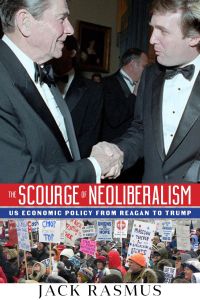
Tax cutting for business classes and the 1% has always been a fundamental element of Neoliberal economic policy ever since the Reagan years (and actually late Jimmy Carter period). Major tax cut legislation occurred in 1981, 1986, and 1997-98 under Clinton. George W. Bush then cut taxes by $3.4 trillion in 2001-04, 80% of which went to the wealthiest households and businesses. He cut taxes another $180 billion in 2008. Obama cut another $300 billion in his 2009 so-called recovery program. When that faltered, it was another $800 billion at year end 2010. He then extended the Bush tax cuts that were scheduled to expire in 2011 two more years. That costs $450 billion each year. And in 2013, cutting a deal with Republicans called the ‘fiscal cliff’ settlement, he extended the Bush tax cuts of the prior decade for another ten years. That cost a further $5 trillion. Now Trump wants even more. He promised $5 trillion in tax cuts during his election campaign. So the current proposal is only half of what he has in mind perhaps.

Neoliberal tax cutting in the US has also been characterized by the ‘tax cut shell game’. The shell game is played several ways.

In the course of major tax cut legislation, the elites and their lobbyists alternate their focus on cutting rates and on correcting tax loopholes. They raise rates but expand loopholes. When the public becomes aware of the outrageous loopholes, they then eliminate some loopholes but simultaneously reduce the tax rates on the rich. When the public complains of too low tax rates for the rich, they raise the rates but quietly expand the loopholes. They play this shell game so the outcome is always a net gain for corporations and the rich.

Since Reagan and the advent of neoliberal tax policy, the corporate income tax share of total US government revenues has fallen from more than 20% to single digits well below 10%. Conversely, the payroll tax has doubled from 22% to more than 40%. A similar shift within the personal income tax, steadily around 40% of government revenues, has also occurred. The wealthy pay less a share of the total and the middle class pays more. Along the way, token concessions to the very low end of working poor are introduced, to give the appearance of fairness. But the middle class, the $38 to $91,000 nearly 100 million taxpaying households foot the bill for both the 1% and the bottom. This pattern was set in motion under Reagan. His proposed $752 billion in tax cuts in 1981-82 were adjusted in 1986, but the net outcome was more for the rich and their corporations. That pattern has continued under Clinton, Bush, Obama and now proposed under Trump.

To cover the shell game, an overlay of ideology covers up what’s going on. There’s the false argument that ‘tax cuts create jobs’, for which there’s no empirical evidence. There’s the claim US multinational corporations pay a double tax compared to their competitors, when in fact they effectively pay less. There’s the lie that if corporate taxes are cut they will automatically invest the savings, when in fact what they do is invest offshore, divert the savings to stock and bond and other financial markets, boost their dividend and stock buybacks, or stuff the savings in their offshore subsidiaries to avoid paying taxes.

All these neoliberal false claims, arguments, and outright lies continue today to justify the Trump-Goldman Sachs tax plan—which is just the latest iteration of neoliberal tax policy and tax offensive in the US. The consequences of the Trump plan, if it is passed, will be the same as the previous tax giveaways to the 1% and their companies: it will redistribute income massively from the middle and working classes to the rich. Income inequality will continue to worsen dramatically. US multinational corporations will begin again to divert profits, and investment, offshore; profits brought back untaxed will result in mergers and acquisitions, dividend payouts, and financial markets investment. No real jobs will be created in the US. The wealthy will continue to pump their savings into financial asset markets, causing further bubbles in stocks, exchange traded funds, bonds, derivatives and the like. The US economy will continue to slow and become more unstable financially. And there will be another financial crash and great recession—or worse. Only this time, the vast majority of US households—i.e. the middle and working classes—will be even worse off and more unable to weather the next economic storm.

Nothing will change so long as the Corporate Party of America is allowed to continue its neoliberal tax giveaways, its tax cutting ‘shell games’, and is allowed to continue to foment its ideological cover up.”

Dr. Jack Rasmus, October 2, 2017

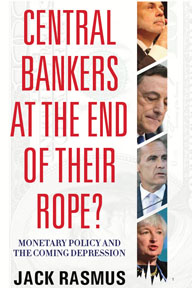
Dr. Rasmus is author of the just published book, ‘Central Bankers at the End of Their Ropes?: Monetary Policy and the Coming Depression’, Clarity Press, August 2017, and the previously published ‘Looting Greece: A New Financial Imperialism Emerges’, October 2016, and ‘Systemic Fragility in the Global Economy’, January 2016, also by Clarity press. More information is available at Claritypress.com/RasmusIII. For more analyses on the Trump and neoliberal taxation, listen to Dr. Rasmus’s, September 29, 2017 radio show, Alternative Visions, on the Progressive Radio Network at http://alternativevisions.podbean.com. He blogs at jackrasmus.com and his website is http://kyklosproductions.com.

My analysis of Trump’s recently announced proposed tax cuts, as latest iteration of Neoliberal tax cut policy since 1981. How it will continue to redistribute income from wage earner households ($38,000-$91,000), to corporations, non-corporate businesses, investors, and 1% wealthiest households. How the neoliberal ‘tax cut shell game’ is played from Reagan to Trump.

To Listen to the radio show podcast GO TO:

http://prn.fm/?s=Alternative+Visions

Or GO TO:

http://alternativevisions.podbean.com/

SHOW ANNOUNCEMENT

Dr. Rasmus dissects the Trump tax proposal of this past week, crafted by Goldman Sachs investment bankers, Steve Mnuchin (Treasury Secretary) and Gary Cohn (head of economic council). Rasmus explains how it is the latest in a long line of neoliberal tax proposals since 1981, which are designed to shift income to businesses, investors and wealthy households at the expense of wage earners. Once again wealthy investors, households, corporations and non-corporate businesses all gain at the expense of wage earners with annual incomes of $38 to $91,000. Rasmus explains how tax cuts are a foundation of neoliberal policy–along with defense-war spending hikes, social program cuts, and the ‘twin deficits’ solution to financing government debt. Tax cutting from Reagan to Obama to Trump are summarized. The major elements of corporate and non-corporate business income that will benefit from the Trump plan are summarized, including benefits that will accrue to the wealthiest households and businesses as a result of the elimination of estate and AMT taxes, retention of carried interest and preferential capital gains, new cuts in top end corporate and personal nominal tax rates, Trump’s proposal to end the territorial taxation, to allow multinational corps to repatriation $2.6 trillion at special rates, big cuts in business income pass through, etc . (Next week: Financial Asset Bubbles Again Growing—What Could Happen).

September 17, 2017

By Jack Rasmus

(In this article, just published in the World Financial Review (London), Dr. Jack Rasmus comprehensively elaborates on the failures of global central banks’ nine-year experiment since 2008, their inevitable transformation, and ultimately, their survival beyond the mid-21st century. The article is based upon research and conclusions in Dr. Rasmus’s just published latest book, ‘Central Bankers at the End of Their Ropes: Monetary Policy and the Coming Depression’, Clarity Press, August 2017, which is now publicly available in bookstores, on Amazon, and from this blog.)

“After nearly nine years of a radical experiment injecting tens of trillions of dollars and dollar equivalent currency into their economies, the major central banks of the advanced economies – the Federal Reserve (Fed), Bank of England (BoE), European Central Bank (ECB), Bank of Japan (BoJ), and the People’s Bank of China (PBOC) – appear headed toward reversing the policy of massive liquidity injection they launched in 2008.

Led by the US central bank, the Federal Reserve, central bankers have begun, or are about to begin, reducing their bloated balance sheets and raising benchmark interest rates. A fundamental shift in the global availability of credit is thus on the horizon. Whether the central banks can succeed in raising rates and reducing balance sheets without precipitating a major credit crunch – or even another historic credit crash as in 2008 that sends the global economy into another recession tailspin – is the prime question for the global economy in 2018 and beyond.1

Fundamental forces in recent decades associated with globalisation, rapidly changing financial structures worldwide, and accelerating technological change significantly reduced central banks’ ability to generate real investment and productivity gains – and therefore economic growth – after nine years of near zero and negative benchmark rates. The same changes and conditions may threaten a quicker than anticipated negative impact on investment and growth should rates rise much in the near term. In the increasingly globalised, financialised, and rapid technological change world of the 21st century, central bank interest rate policies are becoming less effective – and with that central banks policies less relevant.

The $25 Trillion Radical Experiment

For the past nine years the major central banks have embarked on an unprecedented experiment, injecting tens of trillions of dollars of liquidity into their banking systems and economies – by means of programmes of quantitative easing (QE), zero interest rates (ZIRP) and even negative rates (NIRP), among other more traditional means. The consequence has been the ballooning of their own balance sheets.

Officially, the balance sheets of the five major central banks today total conservatively $20 trillion. The Fed’s contribution is $4.5 trillion. The ECB’s just short of $4.9 trillion, but still rising as it continues its quantitative easing, QE, programme purchasing both government and private bonds. The BoJ’s is more than $5 trillion, while it too continues even more aggressively buying not only government and corporate bonds but private equities and other non-bond securities as well. The BoE’s total is heading toward $1 trillion, as it re-introduced another QE programme in the wake of the Brexit vote in June 2016. And the PBOC’s is estimated somewhere between $5 and $7 trillion – the result of liquidity injections supporting its state policy banks and entrusted loans to industries and local government construction projects.

Add in important “tier 2” central banks – like the Swiss National Bank, the Bank of Sweden, and central banks of India, Brazil, Russia and others – that in recent years have also significantly increased their balance sheets, global balance sheet totals easily exceed the $20 trillion of the five majors.

This historically unprecedented $25 trillion global liquidity injection by central banks worldwide has occurred within the context of a simultaneous general retreat from fiscal policy as well – at least in the form of government direct investment and spending.

The $20 trillion itself is actually an under-estimation of cumulative liquidity injections that have occurred since 2008. Although the Fed officially ended its QE3 programme at the end of 2013 when its total reached $4.5 trillion, it continued re-buying securities thereafter as some of its earlier bond purchases matured and “rolled off”. The repurchases kept its balance sheet level at $4.5 trillion. Bloomberg Research has estimated the Fed has purchased 2008 more than $7 trillion since 2008 when its repurchases are considered. Similar reinvestments by the other four major central banks would likely add even more “cumulative trillions” of liquidity injections since 2008 to their official $20 trillion balance sheet totals. The actual liquidity injected is therefore likely closer to $25 trillion.

Some argue the reinvestments shouldn’t be counted, since the maturing of bonds represent liquidity removed from the general economy. But that view disregards any money multiplier effects on private debt and debt leveraging. Even after maturing, the bonds leave a residue of debt-generation in the economy regardless whether the bonds are repaid. The liquidity might be removed from the economy, but its multiple of residue of debt and leverage remain.

This historically unprecedented $25 trillion global liquidity injection by central banks worldwide has occurred within the context of a simultaneous general retreat from fiscal policy as well – at least in the form of government direct investment and spending. With the exception of China perhaps, it has meant almost total reliance in the advanced economies on central bank monetary policy. Since 2008 central bank monetary policy of massive liquidity injection, generating super-low (and even negative) interest rates, has been the “only game in town”, as others have aptly described.2 Talk of renewed government investment and spending in the form of infrastructure investment has to date been only talk. Elites and policy makers in 2008 chose central bank monetary policy as the primary, and even sole, engine of economic recovery. And it has proven an engine running on low octane fuel, and now running out of gas.

Has the Nine-Year Experiment Failed?

In retrospect, monetary policy has not been very effective – whether considered in terms of generating real economic growth, achieving targets of price stability and employment, or even in terms of ensuring central banks’ primary functions of lender of last resort, money supply management, and banking system supervision.

If measured in terms of central banks’ primary functions, avowed targets, and monetary tools’ effectiveness, the past nine years of “monetary policy first and foremost” (with fiscal spending frozen or contracting) may reasonably be argued to have failed. The $20 trillion central bank monetary experiment was supposed to bail out the banks, generate employment, raise goods and services prices to at least 2% annually, restore financial stability, and return economic growth in GDP terms to pre-2008 crisis averages. But it has done none of the above – despite the $20-$25 trillion massive liquidity injections.

That in turn raises the question: should anyone believe central banks’ pending policy shift – i.e. to sell off and reduce their balance sheets and raise interest rates – will prove any more successful?

Both mainstream and business media generally concur that central banks policies since 2008 saved the global economy from another 1930s-like global depression. But an assessment of central banks’ performance in terms of their primary functions, in achieving their publicly declared targets and objectives, and in the effectiveness of their monetary policy tools suggest the track record of central banks has been far less than successful.

Should anyone believe central banks’ pending policy shift – i.e. to sell off and reduce their balance sheets and raise interest rates – will prove any more successful?

Lender of Last Resort Function. Clearly some of the biggest commercial banks were rescued after 2008. The bailout was enabled by means of a combination of programmes: i.e. central banks providing virtually zero interest loans and loan guarantees to banks, directly buying bad assets like subprimes from banks and private investors at above market rates, forcing bank consolidations, suspending normal accounting rules, establishing government run so-called “bad banks” to offload bad debt, and by temporary bank nationalisations. But the global banking system today is still over-loaded with a mountain of non-performing bank loans (NPLs) and other forms of private debt and remains therefore still quite fragile. Lender of last resort appears to have been successful in rescuing some large banks, but much of the rest of the banking system has been left mired in a swamp of bad debt.

Official data show NPLs in Europe and Japan officially at levels of $1-$2 trillion each. But much of it is concentrated dangerously in certain periphery economies and industries, which makes their NPLs potentially even more unstable. China’s NPLs are estimated around $6 trillion. NPLs in India are certainly hundreds of billions of dollars and perhaps even more, and are almost certainly officially underestimated. Then there’s Russia, Brazil, South Africa and other oil and commodity producing countries, the NPLs of which – like India’s – have been accelerating particularly rapidly since 2014 as a percent of GDP, according to the World Bank. Moreover, all that’s just official data, which grossly underestimates true totals of bad debt still on banks’ balance sheets, since many NPLs are conveniently reclassified by governments as “unrecognised stressed loans” or “restructured loans” in order to make the magnitude of the problem appear less serious.

In other words, the $25 trillion central bank liquidity experiment has left the global economy with $10 to $15 trillion in global NPLs. And that’s hardly an effective “lender of last resort” performance, notwithstanding the bailout of the highly visible big banks like Citigroup, Bank of America, Lloyds, RBS, and others. What remains is a massive bad bank loan debt global overhang of at least $10 trillion. And when high risk private debt in the form of corporate junk bonds, equity market margin debt, household and local government debt are considered as well, “non-performing” debt totals likely exceed $15 trillion worldwide at minimum. A truly effective lender of last resort function would have cleaned up at least some of this bad debt, but it hasn’t. Beneath the appearance of a successful post-2008 lender of last resort function lies massive evidence of central banks failure in their performance of this function.

The global economy thus remains highly fragile, despite the $25 trillion liquidity injections by central banks since 2008.3 The global banking system is permeated with “dry rot” in many locations. If financial stability is an avowed objective of central bank policy, the magnitude of global NPLs and other forms of non-performing private debt is ample testimony that central banks have failed the past nine years to restore stability of the financial system. Central banks have failed to implement pre-emptive lender of last resort programmes and have been content to respond in reactionary fashion as lender of last resort after crises have erupted.

Money Supply Management Function. The great liquidity experiment is not just a phenomenon of the post-2008 period. It has been underway for decades, beginning with the collapse of the Bretton Woods international monetary system in the 1970s which gave central banks, especially the Fed, the task of stabilising global currency exchange rates, ensuring price stability, and facilitating global trade. Neoliberal economic policies, first in the UK and USA then later elsewhere, further encouraged and justified central bank excess liquidity policies since the 1980s. The removal of restrictions on global money capital flows in the late 1980s helped precipitate financial instability events globally in the 1990s that further encouraged central bank excesses. So did technological change in the 1990s that linked and integrated financial markets and accelerated cross-country money velocities that made banking and financial systems increasingly prone to contagion effects. As financial asset markets’ bailouts grew in frequency and magnitude after 1990 in response to multiple sovereign debt crises, Asian currency instability, bursting tech bubbles, and subprime housing and derivatives credit booms, central banks provided ever more liquidity to the system. At the same time changing global financial structures gave rise to forms of non-money “inside” credit and technology increasingly spawned forms of digital money – over both of which central banks have had little influence as well. The 2008-09 global crash thus only accelerated these developments and trends already underway for decades.

Financialisation, technological change and globalisation thus have all served to reduce central banks’ ability to carry out their money supply function as well. Moreover, central banks themselves have exacerbated the trends and loss of control by embracing policies like QE, ZIRP, and NIRP which, in effect, have thrown more and more liquidity at crises – i.e. crises that were fundamentally created by excess liquidity, runaway debt, and leveraging in the first place. The solution to the last crisis – i.e. liquidity – would become the enabling cause of the next.

Banking Supervision Function. Central banks have been no more successful in performing their third major function of banking supervision. If banks were properly supervised the current volume of NPLs would not have been allowed to grow to excessive levels. Central banks would intervene and check financial asset price bubbles before they build and burst, threatening the entire credit system and collapsing the real economy. Limited initial efforts to expand bank supervision role of central banks following the 2008 crash – such as Dodd-Frank legislation in the US and the Financial Stability Authority in the UK – have been checked and are being dismantled step by step. In Japan, bureaucratic forces have effectively stymied more bank supervision for decades and little more was done after 2008. In Europe, supervision remains largely still with national central banks. Efforts to coordinate bank supervision across central banks with the Basel II and III agreements are moribund. And nowhere have effective regulatory measures been implemented to address the huge shadow banking system, rapidly expanding online banking, or the growing role of global multinational corporations’ financial departments, which have been transforming them into de facto private banks as well.

Even ardent central banker, Stanley Fischer, vice-chair of the Federal Reserve and head of its financial stability committee, has recently declared that efforts in the US to roll back even the limited measures of Dodd-Frank to expand Fed bank supervision as “very, very dangerous”.4

Never totally responsible for bank supervision – and only one institution among several tasked with supervising the private banks – central banks have never been very successful performing bank supervision. And now that function is again weakening across many locations of the global economy.

The Failure to Achieve 2% Price Stability. Failing functions of lender of last resort, money supply and credit control, and banking supervision are not the only indications of central banks’ failure in recent decades, and especially since 2008. No less indicative of failure has been central banks’ inability to achieve their own publicly declared targets.

Failure to achieve their 2% price stability target has been particularly evident. Since 2008 the economies of Europe and Japan in particular have repeatedly flirted with deflation in goods and services prices. When not actually deflating, prices have either stagnated or barely rose above zero. Even the US economy, which analysts herald as performing more robustly than the others, the Fed’s preferred Personal Consumption Expenditures, or PCE, price index has consistently failed the 2% threshold. And over the longer term has steadily drifted toward 1% annual rate or less. And in recent months it has been near zero. China’s prices have performed better, but that has been mostly due to periodic booms in its housing sector and its several fiscal stimulus programmes that have accompanied its central bank’s liquidity injections policy since 2011. Despite the $25 trillion, central banks have clearly failed to achieve anything near their declared 2% price targets.

Unemployment and GDP Growth. While the ECB, BoE, and BoJ limit their targeting to a 2% price stability rule (the PBOC to 3.5%), the US Fed officially maintains that employment and economic growth are also official targets of central bank monetary policy.

But it has been mostly lip-service. Since 2015 the Fed has touted the fact of the US economy’s unemployment rate has fallen to only 4.5%. But 4.5% is not the true US unemployment rate. It is the government’s official U-3 rate, which estimates only full time permanent employment. At least an equivalent percentage of the US labour force remains unemployed in the US economy when part time, temp, and contract work – i.e. underemployment – is considered. That’s the U-6 unemployment rate which the Fed conveniently ignores. The true numbers of jobless are even higher than the U-6, when workers who never entered or drop out of the labour force are considered, or when the millions more who chose permanent disability status in lieu of unemployment are added; or when the poorly estimated growing underground economy and undocumented immigrant labour force are considered. The true US unemployment rate remains over 10%, as it does as well in Europe.

If central banks’ $25 trillion liquidity injection are measured against restoring economic growth rates, the picture fares no better. Despite the Fed’s QE, ZIRP, and related programmes, the US economy has grown since 2008 at an annual rate, in GDP terms, averaging only 60% of its pre-crisis economic average. On three separate occasions since 2010 the US economy collapsed to near zero growth for one quarter. Europe’s GDP performance has been even worse, experiencing a serious double dip recession in 2011-13, and chronic growth rates well below 1% for most of the period that followed. And Japan’s growth has been even worse than Europe’s, experiencing no less than four recessions since 2008. Only China has performed better, but most likely due once again to its significant fiscal stimulus programme of 2008-09 and additional mini-fiscal stimulus thereafter and not due to monetary policy. In 2012 every dollar of liquidity provided by the PBOC generated an equivalent dollar of real GDP growth; today, that ratio is four dollars necessary to generate one dollar of real growth.

Monetary Policy Tools’ Effectiveness. With the 2008-09 global crash, it became almost immediately evident that central banks’ traditional monetary tools, like open market operations bond buying and reserve requirement adjustments, were seriously deficient for both bailing out banks and assisting economic recovery. New, more radical policy tools were introduced – specifically QE, ZIRP and then NIRP. How effective have the new tools been, one might ask?

While they reflated part of the banking system no doubt, the negative costs of the QE-ZIRP-NIRP have risen steadily since 2008. Much of the QE driven liquidity – especially direct buying of investors’ subprimes by the Fed and ECB-BOJ purchases of corporate bonds and equities – have been misdirected into financial asset markets rather than real investment, redistributed to shareholders, diverted offshore, or remain hoarded on corporate balance sheets. Both real productivity and real goods and services prices have stagnated, while financial asset prices have bubbled – especially in equities, high yield corporate bonds, and derivatives like exchange traded funds (ETFs). The nine years of near zero interest rates have devastated fixed income households’ savings. Retirees’ incomes in particular have stagnated and declined, while capital gains incomes of investors and speculators have accelerated. That does not portend well for sustained household consumption.

Central banks’ chronic low rates have been fueling a new “debt bomb” worldwide, not just in the advanced economies but increasingly in emerging markets as well.

The long term QE-ZIRP has also been distorting various markets. Pension funds and insurance annuities have not recovered due to the chronic low rates of return, and are poorly positioned now for the next recession and crisis. Low rates have encouraged excessive corporate bond debt issuance, which has not flowed into real investment and productivity or wage incomes. In the US alone, corporate debt has exceeded $6 trillion in the past six years. Central banks’ chronic low rates have been fueling a new “debt bomb” worldwide, not just in the advanced economies but increasingly in emerging markets as well. Not least, the low rate regime for nearly a decade has seriously neutralised interest rates as a potential central bank tool on hand when the next recession occurs within the next few years.

As the world’s primary central bank, the Fed has been desperate to raise rates in order to restore a policy tool cushion before the next crisis. Central banks in Europe and Japan are waiting to follow suit, to raise their rates and sell off their balance sheets, but will not do so until the Fed does more convincingly in the coming months. Due to new forces dominant in the 21st century, however, the Fed and other central banks may not be able to raise rates much higher (or significantly reduce balance sheets that will have the similar effect on rate hikes).

It is this writer’s view that the Fed will not be able to raise its benchmark federal funds rate above 2%, or push the longer term 10 year Treasury bond yield (rate) above 3%, without precipitating another major credit crisis. And if the Fed cannot, the other central banks will not as well. Monetary policy may be already neutralised for the next recession and crisis.

Central Banking’s Inevitable Transformation

Whether based on assessment of central banks’ primary functions, central bank targets, or effectiveness of new monetary tools, it is reasonable to argue that central banks have not been performing very well in recent decades, and especially not well in the post-2008 period. As the Fed and other central banks now consider reversing and reducing the consequence of post-2008 policies by trying to sell of balance sheets and raise rates, that major policy shift will most likely prove no more successful than policies pursued 2008-2017 and perhaps even less so.

Central banks have clearly not evolved apace with the rapid changes in globalisation, financial structures, and technology. The private banking and global financial system is changing far more rapidly than central banks have been able to adjust. Being essentially national institutions, they cannot adapt fast enough to the globalisation and economic and financial integration trends that are accelerating. Manipulation of national interest rates by central banks are thus becoming increasingly ineffective. Expanding, highly liquid and integrated global financial markets, proliferating new financial securities, new forms of digital money and inside credit beyond their influence, virtually unregulated (and perhaps unregulatable) global shadow banking institutions that now control more assets than commercial banks, fast-trading, dark pool investing, and coming artificial intelligence driven passive investing – all represent significant challenges to central banks’ functions, targets, and tools effectiveness. Their response has been simply to thrown more money and ever more liquidity at crises as they multiply and magnify. And in the process they lay the groundwork for still more speculative debt and leverage, more financial asset bubbles, and more subsequent financial instability to follow.

The problem is not only technological or economic. Accompanying the changes has been the rise of a new global finance capital elite – i.e. the human agency driving changes both economically and ensuring those changes are enabled politically.

Moreover, the problem is not only technological or economic. Accompanying the changes has been the rise of a new global finance capital elite – i.e. the human agency driving changes both economically and ensuring those changes are enabled politically. A couple hundred thousand super-wealthy individuals and investors who are transforming not only the global banking-financial system but who are steadily deepening their influence within the state and governments of the advanced economies as well their economies. They have been bending traditional government institutions – legislatures, executive agencies, and even courts – to their collective will. Central banks are being influenced and affected no less so.

US economic policy today is largely determined by members of this financial elite. Despite this elite’s central role in causing and precipitating the last financial crash, none have gone to jail and their representatives now sit firmly in control of US levers of economic policy. The US Treasury, the New York Fed, and the National Economic Council are run by former Goldman Sachers Steve Mnuchin, Bill Dudley, and Gary Cohn. It is almost certain Cohn will replace current Fed chair Janet Yellen when her term expires next February, thus further solidifying that control. President Trump is himself a billionaire real estate speculator and member of this new finance elite, as are most of the private advisors with whom he communicates regularly and who have a swinging door access to the White House.

The various economic developments, global system restructuring, technological changes and political system entrenchment of the new elite thus render it highly likely that central banks will perform even more poorly in the decades to come – whether that performance is measured in terms of functions, targets, tools, or ensuring financial stability. That failure will drive necessary basic changes in central banking in the coming decades. Central banks will have to undergo major structural change, develop new targets and tools, and become more directly accountable to the public interest than ever before if they are to survive by mid-century. There will always be central banking in some form. But central banks as we now know them will certainly no longer exist.”

About the Author

Dr. Jack Rasmus is author of the just published book, “Central Bankers at the End of Their Ropes? Monetary Policy and the Next Depression”, Clarity Press, July 2017, and the previously published “Systemic Fragility in the Global Economy”, also by Clarity Press, January 2016. For more information: http://ClarityPress.com/RasmusIII.html. He teaches economics at St. Marys College in Moraga, California, and hosts the radio show, Alternative Visions, on the Progressive Radio Network. He blogs at jackrasmus.com and his twitter handle is @drjackrasmus.

References

1. This is one of several main themes addressed by the author in the just published book: Jack Rasmus, “Central Bankers at the End of Their Rope?: Monetary Policy and the Coming Depression”, Clarity Press, July 2017
2. See Mohammed El-Erian, “The Only Game in Town: Central Banks, Instability, and Avoiding the Next Collapse”, Random House, 2016.
3. For an assessment of the “system-wide” fragility as of 2015, see Jack Rasmus, “Systemic Fragility in the Global Economy”, Clarity Press, January 2016.
4. Financial Times, August 19, 2017, p.R3.

This past week the US central bank, the Federal Reserve, announced it would begin selling off its $4.5 trillion debt that it accumulated since 2008 by buying up investors’ toxic mortgage and T-bonds at above market rates.

The Fed has continually argued ever since 2008 this was necessary in order to ‘bail out the banks’. But the banks were bailed by 2010, and the free money from the Fed continued another six years. The Fed $4.5 trillion bond buying spree then drove down interest rates at which banks could borrow from the Fed to historic lows of 0.1%-0.25%, in effect further subsidizing the banks for 8 more years. What was originally a bank bailout in 2008-09 thus became a more or less permanent ‘banking system subsidization’ program by the Fed, which has resulted in banks becoming addicted to the virtual free money. The Fed’s just announced start of selling its debt–which will have the effect of raising interest rates–is a mere token effort and won’t succeed in any serious reduction of its debt.

As I predict, and explain in my recent book, ‘Central Bankers at the End of Their Ropes’, Clarity Press, August 2017, the Fed now cannot raise rates beyond 2% (now at 1.25%) much without precipitating another financial crisis, or without collapsing currencies and economies in emerging markets, or without causing US multinationals offshore a major profits contraction, or without seriously undermining US exports and thus an already fragile US economy that already shows signs of slowing in 2018.

Thus the recent Fed announcement of sell off of its $4.5 trillion debt is a ‘token’ and a ‘fiction’. The Fed will be stuck with more than $4 trillion in debt by 2019, and will soon have to add even more to it when the next recession occurs circa 2019-20 or perhaps even sooner.

The Fed itself knows this. That’s why the announcement was a token $10 billion sell off per month, and marginally more thereafter. Before it reaches $.5 trillion in sales, and the 2% ceiling interest rate, it will have to stop, or even reverse its balance sheet selling. That means when the next recession or financial crisis occurs, the Fed will open the money spigot again and add still more to its debt–and now on top of the $4 trillion or so debt that will still remain. The US central bank is doomed to go ever deeper in debt in order to continue its program of private banking system ‘subsidization’, which has become a major characteristic of 21st century capitalism and banking. The private sector is becoming more and more dependent on the capitalist state and its central banks to prop up and support its long run faltering investment and profit trends. What was once termed a bank bailout function (called ‘lender of last resort’) has become a banking system ‘subsidization’ function.

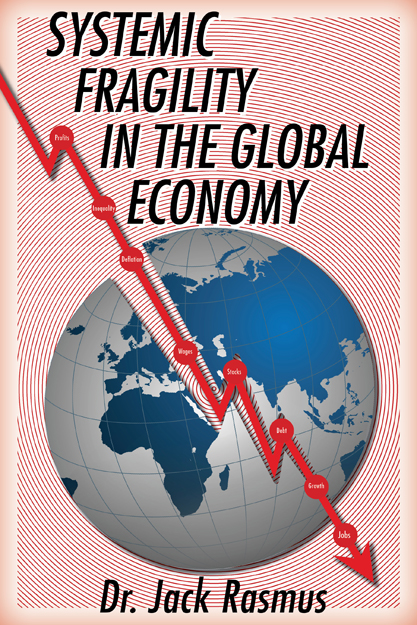
This new role of the central bank in the 21st century has also contributed greatly to the growing financialization of global capitalism, as the central bank free money flows not into real investment to produce infrastructure and real goods but rather is increasingly diverted to financial asset markets creating bubbles in stocks, bonds, derivatives, foreign exchange, and property prices–an argument, with evidence, I provided in detail in my 2016 book, ‘Systemic Fragility in the Global Economy’, Clarity Press, January 2016′.

What follows are a couple of excerpts from my ‘Central Bankers at the End of Their Ropes’ book, specifically the chapter 14 on the Yellen Fed, that discusses how the Federal Reserve under Yellen–and before that under Bernanke and Greenspan as well–have evolved into the ‘subsidization’ function as a consequence of its decades-long free money injections into the banks have led to accelerating ‘financialization’ of the global capitalist system, and in turn more frequent and severe financial bubbles, crashes, and consequent recessions.

EXCERPTS from ‘CENTRAL BANKERS AT THE END OF THEIR ROPES’:

1. On Banking System Subsidization by the Fed

“Central bank financial subsidization policy raises the question as to whether the primary function of the central bank in the 21st century is more than just lender of last resort, or money supply management, or bank supervision, as has been the case in the past before 2008. Certainly those primary functions continue. But a new primary function has demonstrably been added: the subsidization of finance capital rates of return and profitability—regardless of whether the financial system itself is in need of bailout or not. Globalization has intensified inter-capitalist competition and that competition compresses prices and profits. So the State, in the form of the institution of the central bank, now plays an even more direct role in ensuring prices for financial assets are not depressed (or prevented from rising) by inter-capitalist global competition; and that global competition is more than offset by central banks becoming a primary source of demand for private sector financial assets. Excess liquidity drives demand for assets, which drives the price of assets and in turn subsidizes price-determined profitability of financial institutions in particular but also of non-financial corporations that take on the characteristics of financial institutions increasingly over time as well.

“Long after banks were provided sufficient liquidity, and those in technical default (Citigroup, Bank of America, etc.) were made solvent once again, the Yellen Fed has continued the Bernanke policy of massive and steady liquidity injection. Whether the tools are QE or open market operations, modern central bank monetary policy is now about providing virtually free money (i.e. near zero and below rates). Targets are mere justifications providing an appearance of policy while the provision of money and liquidity is its essence. Tools are just means to the end. And while the ‘ends’ still include the traditional primary functions of money supply and liquidity provision, lender of last resort and banking system supervision—there may now be a new function: financial system subsidization.

“The ideological justification of QE, ZIRP and free money for banks and investors has been that the financial asset markets need subsidization (they don’t use that term however) in order to escalate their values in order, in turn, to allow some of the vast increase in capital incomes to ‘trickle down’ to perhaps boost real investment and economic growth as a consequence. They suggest there may be a kind of ‘leakage’ from the financial markets that may still get into creating real things that require hiring real people, that produce real incomes for consumption and therefore real (GDP) economic growth. But this purported financial trickle down hardly qualifies as a ‘trickle’; it’s more like a ‘drip drip’. It’s not coincidental that the ‘drip’ results in slowing real investment and therefore productivity and in turn wage growth. This negative counter-effect to central bank monetary policy boosting financial investment and financial markets now more than offsets the financial trickle-drip of monetary policy. The net effect is the long term stagnation of the real economy.

“The Fed’s function of money supply management may be performing well for financial markets but increasingly less so for the rest of the real economy. That was true under Bernanke, and that truth has continued under Yellen’s Fed as well. Central bank performance of the money supply function is in decline. The Fed is losing control of the money supply and credit—not just as a result of accelerating changes in global financialization, technology, or proliferation of new forms of credit creation beyond its influence. It is losing control also by choice, as it continually pumps more and more liquidity into the global system that causes that loss of control.”

………………………………………………………..

2. The Fed’s $4.5 Trillion Balance Sheet Sell-Off

“From 2008 through May 2017, QE and other Fed liquidity programs raised the Fed’s balance sheet from $800 or so billion to $4.5 trillion. The QE programs ended in October 2014. Since then payments on bonds to the Fed could have reduced the Fed’s balance sheet. However, the Fed simply reinvested those payments again and kept the balance sheet at the $4.5 trillion level. In other words, it kept re-injecting the liquidity back into the economy—in yet another form indicating its commitment to keep providing excess liquidity to bankers and investors.

“Throughout the Yellen Fed discussions and debates have continued about whether the Fed should truly ‘sell off’ its $4.5 trillion and stop re-injecting. That would mean taking $4.5 trillion out of the economy instead of putting it in. It would sharply reduce the money supply and liquidity. It has a great potential to have a major effect raising interest rates across the board, with all the consequent repercussions—a surge in the US dollar, reducing US exports competitiveness and GDP; provoking a ‘tantrum’ in EMEs far more intense than in 2013, with EME currency collapse, capital flight, and recessions precipitated in many of their economies. It would almost certainly also cause global commodity prices to further decline, especially oil, and slow global trade even more.

“Finally, no one knows for sure how sensitive the US economy may be, in the post-2008 world, to rapid or large hikes in interest rates. Over the past 8-plus years, the US economy has become addicted to low rates, dependent on having continual and greater injections. Weaning it off the addiction all at once, by a sharp rise in rates due to a sell-off of the Fed’s $4.5 trillion, may precipitate a major instability event. The US economy may, on the other hand, have become interest-rate insensitive to further continuation of zero rates, or even forays into negative rates(as in Europe and Japan) as a result of the 8 year long exposure to ZIRP.. In contrast, that same addiction may mean the economy is now also highly interest rate sensitive to hikes in interest rates. As economists like to express it, it may have become interest-rate inelastic to reductions in rates but interest-rate highly elastic to hikes in rates. But it is not likely that Fed policymakers, or mainstream economists, are thinking this way. Their ‘models’ suggest it doesn’t matter if the rates are lowered or raised, the elasticities are the same going up or going down. But little is the same in the post-2008 economy.

“Notwithstanding all the possible negative economic consequences of disposing of the $4.5 trillion, this past spring 2017 the Fed reached an internal consensus of to begin doing so. That consensus maintained that an extremely slow and pre-announced reduction of the balance sheet would not disrupt rates significantly. But as others have noted, “such an assessment is complacent and dangerously incomplete”. Selling off the $4.5 trillion would mean lost interest payments to the US Treasury amounting to more than $1 trillion, according to Treasury estimates. That’s $1 trillion less for US spending, with all it implies for US fiscal policy in general as the Trump administration cuts taxes by $trillions more and raises defense spending. In other words, sell-off may result in a further long-term slowing of US GDP and the real economy.

A couple early endorsements for my just published book, ‘Central Bankers at the End of Their Ropes’, Clarity Press, August 2017, now available on Amazon, in bookstores, from the publisher, and via paypal from this website plus a Special Notice.

SPECIAL NOTICE: The European Financial Review (London) and the World Financial Review (London) journals are seeking reviewers of the ‘Central Bankers at the End of Their Ropes’ book for their next issues. If any reader is interested, see Dr. Jack Rasmus at drjackrasmus@gmail.com who will arrange a complimentary copy of the book from Clarity Press and put them in touch with the journals)

ENDORSEMENTS:

1. “The financialization of the US economy has been well documented
with finance capital now far surpassing manufacturing as a percentage
of GDP. Rasmus documents the ties of the Federal Reserve to Wall
Street and demands democratization of central banking with a series of
common sense solutions. A great book. I learned a lot from it.”

—Larry Cohen, Board chair, Our Revolution
Past President, Communications Workers of America

(This endorsement is posted on the Clarity Press website at Claritypress.com/RasmusIII.html)

2. “Central Banks On the Ropes? By Jack Rasmus is a tour de force of both the history of central banks and how they have degraded into weapons of mass financial destruction in the service of the 1%. Historically central banks have always been in the service of elites; first, to provide loans to Princes, Kings, and Emperors for their endless wars; more recently as the lender of last resort to financial institutions who are too big to fail and too big to jail. It is the latter function which has brought us to the financial abyss, an ocean of debt of over $20 trillion, broadcast world wide to the 1% who have used the electronically printed money as fast as they receive it for gambling in financial assets, off shoring jobs, buying stocks and bonds, and generated rivers of dividends to themselves. It is part of Jack Rasmus’s major achievement that he unravels the layers and layers of deceit by the central banks and the all too trusting media to show that the publicly announced goals of lender of last resort, maintaining inflation and money supply goals, are empty ideology. Which is why central banks are “on the ropes” and we face the financial abyss: the central banks cannot stop the flow of billions of electronically printed cash or raise interest rates significantly without plunging the markets into financial crisis. But it is the rivers of cash distributed world wide that has prompted bubble after financial bubble and will lead inevitably to the next crash.”

-David Baker, Amazon reviewer

(This endorsement is posted on the Amazon.com bookpage for the book, located at https://www.amazon.com/s/ref=nb_sb_noss?url=search-alias%3Daps&field-keywords=jack+rasmus+in+books)

How Economic Ideology often parades as economic fact and science is the topic of my last friday, Sept. 15, 2017 ‘Alternative Visions’ radio show. How mainstream economist, Holtz-Eakin, continues the false argument that business tax cuts create jobs; how NY Times columnist, David Brooks, repeats the 19th century mainstream economics notion that one’s income is the result of one’s productivity contribution (or lack thereof) and thus Income Inequality trends are the fault of the victims, not the wealthy investors, their corporations, and 1% households that have been accruing 95% of all income gains since 2008 for themselves. As manipulated data in support of the latter, the US Commerce Dept’s Census Bureau last week reports median family incomes have been rising 2015-16, reversing prior trends. Why this is based on select data and ignores mountains of contradictory facts, listen to the radio show below.

To Listen to the show, GO TO:

http://prn.fm/?s=Alternative+Visions

Or GO TO: http://www.alternativevisions.podbean.com

SHOW ANNOUNCEMENT

Dr. Jack Rasmus explains the notion of ideology in mainstream economics and how it works to create false arguments like ‘business tax cuts create jobs’, ‘free trade lifts all boats’, ‘markets are efficient’, ‘inflation is always caused by too much money chasing too few goods’, recessions are caused by external shocks to a stable (equilibrium) economic system, interest rates determine investment, a global savings glut caused the housing bust and crisis of 2008, ‘central banks are independent of the banks’, and one’s ‘income is determined by one’s productivity’. Rasmus defines ideology as ‘purposeful falsification of original ideas’ on behalf of the interests of those who benefit from the falsification, and describes language manipulation techniques of how this is done, like inversion of propositions, reversal of cause-effect, converting correlations to causation, inserting contradictory elements, deleting original elements of the idea, etc. The latest version of tax cuts create jobs, by economist Douglas Holtz-Eakin is explain, as is the US Dept. of Commerce’s recent report on incomes and poverty results and its interpretation by NY Times columnist, David Brooks.

(Check out Dr. Rasmus’s website, http://www.kyklosproductions.com, later today for re-posting of his prior essay, ‘Applications of Ideology in Economic Policy’, for a print publication of how the ideology of ‘tax cuts create jobs’ that has emerged under US Neoliberalism since the 1980s functions in terms of the various language manipulation techniques Rasmus discusses on the radio show above).

This past August marked the second anniversary of the Greek debt crisis and the third major piling on of debt on Greece in August 2015 by the Eurozone ‘Troika’ of European Commission, European Central Bank, and the IMF. That 2015 third debt deal added $86 billion to the previous $230 billion imposed on Greece—all to be paid by various austerity measures squeezing Greek workers, taxpayers, retirees, and small businesses demanded by the Troika and their northern Euro bankers sitting behind it.

Studies by German academic institutions showed that more than 95% of the debt repayments by Greece to the Troika have ended up in Euro bankers’ hands.

But the third debt deal of August 2015, which extends another year to August 2018, was not the end. Every time a major multi-billion dollar interest payment from Greece was due to the Troika and their bankers, still more austerity was piled on the $83 billion August 2015 deal. The Troika forced Greece to introduce even more austerity in the summer of 2016, and again still more this past summer 2017, to pay for the deal.

Last month, August 2017, Syriza and its ‘rump’ leadership—-most of its militant elements were purged by Syriza’s leader, Alex Tsipras, following the August 2015 debt deal—-hailed as some kind of significant achievement that the private banks and markets were now willing to directly lend money to Greece once again. Instead of borrowing still more from the Troika—-i.e. the bankers representatives—-Greece now was able once again to borrow and owe still more to the private bankers instead. In other words, to pile on more private debt instead of Troika debt. To impose even more austerity in order to directly pay bankers, instead of indirectly pay their Troika friends. What an achievement!

Greece’s 2012 second debt deal borrowed $154 billion from the Troika, which Greece then had to pay, according to the debt terms, to the private bankers, hedge funds and speculators’ which had accumulated over preceding years and the first debt crisis of 2010. So the Troika simply fronted for the bankers and speculators in the 2nd and 3rd debt deals. Greece paid the Troika and it paid the bankers. But now, as of 2017, Syriza and Greece can indebt themselves once again directly to the bankers by borrowing from them in public markets. As the French say, everything changes but nothing changes!

What the Greek debt deals of 2010-2015, and the never-ending austerity, show is that supra-state institutions like the Troika function as debt collectors for the bankers and shadow bankers when the latter cannot successfully collect their debt payments on their own. This is the essence of the new, 21st century form of financial imperialism. New, emerging Supra-State institutions prefer weaker national governments to indebt themselves directly to the banks and squeeze their own populace with Austerity whenever they can to make the payments. The Supra-State may not be involved. But it will step in if necessary to play debt collector if and when popular governments get control of their governments and balk at onerous debt repayments. And in free trade currency zones and banking unions, like the Eurozone, that Supra-State role is becoming increasingly institutionalized and regularized. And as it does, forms of democracy in the associated weaker nation states become increasingly atrophied and eventually disappear.

Syriza came to power in January 2015 as one of those popularly elected governments intent on adjusting the terms of debt repayment. But after a tragic, comedy of errors negotiation effort, capitulated totally to the Troika’s negotiators after only seven months.

The capitulation by Syriza’s leader, Alex Tsipras, in July 2015 was doubly tragic in that he had just put to a vote to the Greek people a week beforehand whether to reject the Troika’s deal and its deeper austerity demands. And the Greek popular vote called for a rejection of the Troika’s terms and demands. But Tsipras and Syriza rejected their own supporters, not the Troika, and capitulated totally to the Troika’s terms.

The August 2015 3rd debt deal quickly thereafter signed by Syriza-Tsipras was so onerous—-and the Tsipras-Syriza treachery so odious—-that it left opposition and popular resistance temporarily immobilized. That of course was the Troika’s strategic objective. Together with Tsipras they then pushed through their $83 billion deal, while Tsipras simultaneously purged his own Syriza party to rid it of elements refusing to accept the deal. Polls showed at that time, in August-September 2015, that 70% of the Greek people opposed the deal and considered it even worse than the former two debt agreements of 2010 and 2012. Other polls showed 79% rejected Tsipras himself.

To remain in power, Tsipras immediately called new Parliamentary elections, blocking with the pro-Troika parties and against former Syriza dissidents, in order to push through the Troika’s $83 billion deal. This week, September 20, 2017 also marks the two year anniversary of that purge and election that solidified Troika and Euro banker control over the Syriza party—-a party that once dared to challenge it and the Eurozone’s neoliberal Supra-State regime.

The meteoric rise, capitulation, collapse, and aftermath ‘right-shift’ of Syriza raises fundamental questions and lessons still today. It raises questions about strategies of governments that make a social-democratic turn in response to popular uprisings, and then attempt to confront more powerful neoliberal capitalist regimes that retain control of their currencies, their banking systems, and their budgets–such as in the case of Greece. Even in the advanced capitalist economies, the message is smaller states beware of the integration within the larger capitalist states and economies–whether by free trade, central banking integration, budget consolidations, or common currencies. Democracy will soon become the victim in turn.

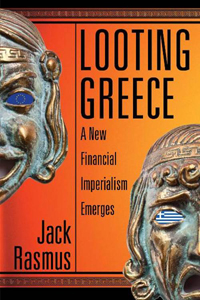
The following is an excerpt from the concluding chapter of this writer’s October 2016 book, ‘Looting Greece: A New Financial Imperialism Emerges’, Clarity Press, which questioned strategies that attempted to resurrect 20th century forms of social-democracy in the 21st century world of supra-State neoliberal regimes. It summarizes Syriza’s ‘fundamental error’—a naïve belief that elements of European social democracy would rally around it and together they—i.e. resurgent social democracy and Syriza Greece—would successfully outmaneuver the German-banker-Troika dominated Euro neoliberal regime that solidified its power with the 1999 Euro currency reforms.

Syriza and Tsipras continue to employ the same error, it appears, hoping to be rescued by other Euro regime leaders instead of relying on the Greek people. Tsipras-Syriza recently invited the new banker-president of France, Emmanuel Macron, who this past month visited Athens. Their meeting suggests Tsipras and the rump Syriza still don’t understand why they were so thoroughly defeated by the Troika in 2015, and have been consistently pushed even further into austerity and retreat over the past two years.

But perhaps it no longer matters. Polls show Tsipras and the rump Syriza trailing their political opponents by more than two to one in elections set to occur in 2018.

EXCERPT from ‘Looting Greece’, Chapter 10, ‘Why the Troika Prevailed’.

Syriza’s Fundamental Error

To have succeeded in negotiations with the Troika, Syriza would have had to achieve one or more of the following— expand the space for fiscal spending on its domestic economy, end the dominance and control of the ECB by the German coalition, restore Greece’s central bank independence from the ECB, or end the control of its own Greek private banking system from northern Europe core banks. None of these objectives could have been achieved by Syriza alone. Syriza’s grand error, however, was to think that it could rally the remnants of European social democracy to its side and support and together have achieved these goals—especially the expanding of space for domestic fiscal investment. It was Syriza’s fundamental strategic miscalculation to think it could rally this support and thereby create an effective counter to the German coalition’s dominant influence within the Troika.

Syriza went into the fight with the Troika with a Greek central bank that was the appendage, even agent, of the ECB in Greece, and with a private banking system in Greece that was primarily an extension of Euro banks outside Greece. Syriza struggled to create some space for fiscal stimulus within the Troika imposed debt deal, but it was thoroughly rebuffed by the Troika in that effort. It sought to launch a new policy throughout the Eurozone targeting fiscal investment, from which it might benefit as well. But just as the ECB was thwarted by German-core northern Euro alliance countries, the German coalition also successfully prevented efforts to promote fiscal stimulus by the EC as well. The Troika-German coalition had been, and continues to be, successful in preventing even much stronger members states in France and Italy from exceeding Eurozone fiscal stimulus rules. The dominant Troika German faction was not about to let Greece prevail and restore fiscal stimulus, therefore, when France and Italy were not. Greece was not only blocked from launching a Euro-wide fiscal investment spending policy; it was forced to introduce ‘reverse fiscal spending’ in the form of austerity.

Syriza’s insistence on remaining in the Euro system meant Grexit was never an option. That in turn meant Greece would not have an independent central bank providing liquidity when needed to its banking system. With ECB control over the currency and therefore liquidity, the ECB could reduce or turn on or off the money flow to Greece’s central bank and thus its entire private banking system at will—which it did repeatedly at key moments during the 2015 debt crisis to influence negotiations.

As one member of the Syriza party’s central committee reflected on the weeks leading up to the July 5 capitulation, “The European Central Bank had already begun to carry out its threats, closing down the country’s banking system”.

The ECB had actually begun turning the economic screws on Syriza well before the final weeks preceding the referendum: It refused to release interest on Greek bonds it owed under the old debt agreement to Greece from the outset of negotiations. It refused to accept Greek government bonds as collateral necessary for Greek central bank support of Greece’s private banks. It doled out Emergency Lending Assistance, ELA, funds in amounts just enough to keep Greek banks from imploding from March to June and constantly threatened to withhold those same ELA funds when Troika negotiators periodically demanded more austerity concessions from Greece. And it pressured Greece not to impose meaningful controls on bank withdrawals and capital flight during negotiations, even as those withdrawals and money flowing out of the country was creating a slow motion train wreck of the banking system itself. The ECB, in other words, was engineering a staged collapse of Greece’s banking system, and yet Syriza refused to implement any possible policy or strategy for preventing or impeding it.

For a more detailed analysis of the respective strategies and tactics of Syriza and the Troika in 2015 and after, and the role played by individual leaders and organizations, see the concluding chapter of Jack Rasmus, ‘Looting Greece: A New Financial Imperialism Emerges’, Clarity Press, October 2016, pp. 231-57. Dr. Rasmus is also author of the recently published, ‘Central Bankers at the End of Their Ropes?: Monetary Policy and the Coming Depression’, Clarity Press, August 2017.

The following is a review of Dr. Jack Rasmus, ‘Central Bankers at the End of Their Ropes?: Monetary Policy and the Coming Depression’, Clarity Press, August 2017, by David Baker, which will appear in the October 1, issue of Z Magazine.

“Jack Rasmus has written a series of important books about the global economy; the critical question is, important or not, why would the general reader make the effort required to read any of them? The best answer comes from Noam Chomsky who tells us that we face two existential threats, nuclear holocaust and the environmental collapse called climate change. Those threats to tens of millions of people worldwide can only be mitigated by bringing back real democracy from the shadow of the empty political theater which we currently endure; but to bring back real democracy, we need to understand what destroyed it and what destroyed it is the collection of economic engines called neoliberalism. The most reliable guide to understanding neoliberalism is Jack Rasmus; his book, Central Bankers on the Ropes, examines the fundamental role of central banks in our new, savage global economy.

The word savage would puzzle Volker, Greenspan, Bernake, Yellen et al but it accurately describes neoliberalism’s impact on the world; the lower 90% are collateral damage in the service of the 1%. But the central banks have always served rulings elites; kings and princes historically have financed their endless wars with the help of the institutional ancestors of central banks; in more modern times, central banks provide trillions of dollars in cash, in various forms, to the financial industry which in turn have been used to prop up the stock and bond markets world wide; offshore jobs, gamble in financial instruments, and pour out dividends. The central banks are in effect a conduit straight to the one percent; as fast as legal tender is electronically printed, it ends up hoarded in their accounts, where it stays.

Jack Rasmus is excellent at peeling away the layers of economic deceit to demonstrate that the rivers of cash pouring out of the central banks does not bring prosperity to the lower 90%; the idea that prosperity is even trickling down is empty ideology. The way in which he peels away the layers of deceit is by examining each of the central banks, in turn, The Fed, The Bank of Japan, the EU Central Bank, and the Central Bank of China, and determines which if any is actually achieving their publicly announced goals. These goals include inflation at 2%; interest rate stabilization; money supply stabilization; bailing out major financial institutions during economic downturns, and increasing GDP.

With the exception of China, each central bank has failed in all of their stated goals. Since their publicly stated goals are not being achieved, we have to examine their actual outcomes to determine what their real goals are and ultimately after peeling away all the layers of deception, their real goal to help the one per cent, by propping up stocks and bonds, providing capital to offshore jobs as well as gamble in financial assets.

The case of China is of particular importance because prior to the 2008 collapse, China pulled out of economic downturns relatively quickly and easily and did achieve its announced goal of significant increases in GDP. What happened after 2008, is that China changed its mix of monetary and fiscal policy, conventional banking, and strict restrictions on capital flows. But because China wanted its currency used as a major trading currency, it was pushed by the rest of the world banking community to open up its economy to capital flows and allow non conventional banking, i.e. shadow banking to operate within in its borders. This was a huge mistake; once China made this shift in policy, it could no longer pull itself out of downturns easily and it is finding it harder and harder to maintain its GDP goals. It has fallen into the chronic subsidization trap of financial institutions.

It is this paradigm shift, the chronic subsidization of financial institutions by central banks world wide that is the key finding; it is why central bankers are “on the ropes.” Historically, one of the major roles of central banks has been to bail out large financial institutions when they fail. Which is exactly what the Fed and others did during the 2008-2009 collapse. But by 2010, the financial institutions were stabilized but the trillions of liquidity injections, quantitative easing and low or no interest loans, continued. Why? Because the banking industry and the one per cent were making so much money from what became chronic subsidization, a subsidization that continues to this day. And here is the problem. The central banks know that a serious downturn is coming; if they continue to generate trillions of dollars in world wide debt through the extension of credit then the inevitable collapse becomes greater; but if they stop, they also risk a huge collapse since the rise in financial assets worldwide has nothing to do with the real economy but is propped up by the central banks.

Rasmus also documents another element of the central banks dilemma; they can’t raise interest rates. The central banks want to raise interest rates, for many reasons but one important reason is because it allows them to lower rates when the inevitable financial bust comes. If they can’t raise rates now, they can’t lower them when the bust comes; likewise, if they can’t stop the cash distributions now, they have nothing left in their monetary weapons to use when the crash comes. Over and over again, throughout history, it was the raising of interest rates by central banks that plunged the world into either recession or depression. So we are truly looking at the abyss since the coming collapse will be more violent, due to the rising oceans of debt [over $20 trillion] and the central banks have no monetary weapons left, either cash or lowering interest rates.

Which brings me to the heart of the debate, what in the austere language of economics is called Fiscal Policy versus Monetary Policy. Progressive fiscal policy is what finally dragged the US out of the Great Depression; it is what Ronald Regan sneered at as “Tax and Spend”. For a progressive, you tax based upon ability and spend based upon need; and, during the 1950’s and 1960’s, the progressive tax and spend policies produced prosperity for all. If you think about it, taxes are the only way to generate capital without falling into the credit/debt trap. Not so with monetary policy.

Monetary policy is economic policy driven by the central banks who in turn serve the one percent. There are many tools that can be used in Monetary Policy, the most well known of which are electronically printing low or interest free loans as well as direct buys of stocks and bonds and raising and lowering interest rates. What Jack Rasmus provides is the insight that the one percent are not willing to wait for prosperity to “trickle up” from the lower 90%; they want instant cash now, as fast as the Fed can electronically print it. Even if it brings down the entire world economy. The lower 90% can wait, apparently forever.

Once again, China did provide an interesting contrast prior to 2008; it had a true fiscal policy, not the fiscal austerity that monetary policy demands. China made and continues to make enormous expenditures on infrastructure, on a scale close to the fiscal policies of the US during WWII. In sharp contrast, none of the other central banks or economies examined engage in this kind of fiscal policy; the case of the EU is quite extreme; they are prohibited by their enabling legislation from engaging in any fiscal policy other than fiscal austerity.

Extraordinary dangers require extraordinary measures. Jack Rasmus concludes with a proposed US constitutional amendment that would place The Fed under strict democratic controls such as nationalizing all banking, prohibiting shadow banking and casino capitalism, placing strict controls on capital flows, and making the explicit goal of The Fed the raising of household disposable incomes. There is a body of scholarly work that demonstrates that the US Constitution was designed to protect investor rights [see e.g. An Economic Interpretation of the US Constitution] so why not amend it and finally give the people control over their economy? One criticism of this proposal is that it really doesn’t go far enough; doesn’t global capitalism require global controls? Thomas Piketty in his groundbreaking work, Capital, proposes just that.

David Baker