Feeds:
Posts
Comments

Today the US stock market plummeted another 1,000 points. As this writer forewarned after last monday’s 1175 pt. fall, the recovery would be a classic ‘dead cat bounce’. Well, the cat bounced the past two days–just not very high or for very long. And now it’s flopped again. The Question: will it roll over on its back, legs up? Or get up and run around a little more, before flopping again? Make no mistake, the cat is tired and can no longer jump. It may not even be able to get back up on its feet.

Investors’ psychology will now have changed. Now it’s clear, the financial markets’ last weekend collapse was not a ‘one off’ event. This realization will have a big effect going forward. It’s all a different level now. And all the talk by pundits this week trying to pump the market back up, i.e. go ‘buy on the dip’, now look quite stupid and self-serving. Should investors now ‘buy on every dip’ as each dip goes down further and further? It’s a 10% correction in less than a week, well on the way to 20% (and who knows how much more).

In the intervening days since last weekend, reports also began to emerge (somewhat) that the markets were responding to problems with the new derivatives–i.e. Exchange Traded Funds/Products (ETF-Ps)–that were being dumped automatically by what are called ‘quant sellers’ (aka professional investors) in big volumes. This automated selling was responsible for the big movements in price. But all this was quickly hushed up in the mainstream business media.

Last Monday’s collapse was also followed by China currency (Yuan) beginning to fall precipitously. Clearly, China investors are dumping Yuan, buying foreign currencies, and trying to get out in anticipation of more financial instability in China. Capital flight from China is ‘on again’. This could lead to competitive currency devaluations throughout Asia economies. (Shades of 1998’s Currency Crisis!).

And what about other Emerging Market economies? They are extremely fragile and capital flight will almost certain emerge there again, once the US Fed raises rates in March, as it has promised to do. (The Fed also promised to raise rates three more times this year. As I have predicted, however, if the stock markets keep falling, that will not happen, as it will almost certain result in a global credit crunch.) For eight years the Fed has propped up the stock markets with free money; it won’t abandon that fundamental policy at this point. It only backed off temporarily because of fiscal-tax cuts in the trillions taking up its (Fed’s) prior role of subsidizing capital incomes.

And what about Europe (and the even weaker UK) with its $2 trillion in non-performing bank loans? Watch out Italy.

And then there’s the junk bond markets in the US, where some estimates are that nearly a fifth of junk bond borrowing companies are ‘zombies’. They’ve been put on life support by borrowing to repay interest and principal on past debt, laying ever more debt on debt. At some point defaults will appear as the free money from the Fed lowers the liquidity level and the rocks appear in the junk bond market.

The downward momentum in US stock prices will also be fueled in the next stage by the massive buildup in margin buying of US stocks that has been occurring since 2014, and the even more rapid rise in margin buying since Trump took office. Debt balances on margin accounts has risen from an annual average of less than $10 billion a year from 2009 to 2013, to $200 to $300 billion a year the last four years. That’s the greatest margin buying bubble since 1980. Margin buyers will prove desperate stock sellers, driving stock prices even lower in coming weeks, entering yet another new phase.

Listen to my weekly radio show tomorrow, friday, February 9, 2pm eastern time, on the Progressive Radio Network in NY, when I’ll be discussing these events (and tomorrow’s) further. Go online to: http://prn.fm/?s=Alternative+Visions
Or listen to the podcast posted at the same location after).

by Dr. Jack Rasmus
Copyright 2018

“Today, February 5, 2018 the main US stock market, the DOW, fell another 1,175 points, the largest drop in its history. That followed a major decline of 665 points the preceding Friday. The total two day decline amounts to 7.5%. The other major US stock markets, the Nasdaq and S&P 500 also registered significant declines of similar percentages. Markets in Japan and Europe followed suit over the weekend in response to Friday’s US drop; and are expected to fall comparably to the US when they open for Tuesday, February 6. What’s going on? More important still, what will go on—in the next few days and in the weeks to come?

The business press and media trotted out all the experts today. The ‘spin’ and message was “don’t panic” folks. This is to be expected, they say, given the bubble price run-up through 2017, and especially since last November 2017, after which the bubble accelerated still faster. In the month of January alone, the DOW rose nearly 7%. That’s considered a good ‘year’s gain’ in ordinary times. Yet mainstream economists say it hasn’t been a bubble, while they give no definition of what a bubble exactly is—because they don’t know. But certainly a DOW run-up from around 16,000 lows in 2016 to more than 26,000 in little more than a year constitutes as a bubble.

But the media talking heads parading in front of cameras today sing the same song, “don’t panic”. It comes in various keys: “It’s a welcome pullback”, a “constructive sell off”, an “opportunity to buy on the dip” and other such nonsense. But when asked why now the collapse, they have nothing to add.

What it represents, however, is professional institutional investors decided to ‘take their money and run’, leaving the small investors to take the losses. And more are coming. The professionals realize that the central bank, the Fed, is going to raise interest rates 3-4 times this year. That has already begun to send the bond markets into a tailspin. And now stocks are following suit. The stock markets have risen to bubble territory for several reasons:

One is the 9 year massive injection of free money by the Fed and other central banks. More than necessary to invest in real production, so it flows into financial markets in the US and worldwide. Corporate profits since 2010 have nearly tripled, and capital gains taxes have been steadily reduced by trillions of dollars since 2010 as well. Corporations have kept a steady flow of money capital to their shareholders with 7 years of stock buybacks and dividend payouts—averaging a trillion dollars a year for seven years! Profits, dividends, buybacks, capital gains tax cuts resulted in trillions flowing into financial markets. Add to that record levels of margin buying of stocks by small investors (always a sign of bubbles) and that’s the source of the record price appreciation of stock markets. And, of course, let’s not forget the Trump business-investortax cuts of more than $4 trillion (not $1.5) that are coming on top of it all—that will subsidize profits with an immediate 10%-31% profits boost, on top of the record profits that US corporations had already attained. Massive money capital injections surging into stock and other financial markets. That’s why the bubble.

But what of the bust? Why now—not before or later? It’s because of changes in the markets themselves: the advent of what’s called ‘momentum trading’ by big institutions like quant hedge funds and others; by the shift to passive investing and what’s called index funds; by derivatives like ETFs driving stock prices as well. All the above result in rising prices sucking in more money capital just because prices are rising….which results in still more prices rising.

Until of course the central bank convinces them that the ‘punchbowl of free money’ is being drained. Then the professionals take their money and run, leaving the ‘herd’ of small investors holding the empty bag.
What’s most interesting is that the Fed’s interest rates haven’t even reached 2% and the system has cracked. In 2007, Fed rates had to exceed 5% before the credit crash was set in slow motion. But this writer predicted that would be the case, i.e. that the Fed rates could not rise above 2-2.25% (and the 10 year Treasury bond much above 3%) without precipitating another credit crisis.

But the stock crash of February 2 and 5 is not the beginning nor the end of what’s coming. There may be a further decline in coming days but it will stabilize. There will be a recovery or sorts. But it will be a ‘dead cat bounce’, as is always the case in such events. Some weeks, or even months later, the real contraction will begin. And that will be the real one.

To recall events of 2008, it was the collapse of Countrywide Mortgage and Bear Stearns investment bank in early 2008 that were the warning signs. Recovery temporarily followed, until Fannie Mae and then Lehman Brothers set the real forces in motion. The precipitating events may not even originate in the US but outside. Japan and Emerging Market economy stock markets are especially vulnerable. But financial markets are global and tightly integrated in today’s capitalist system. Contagion is built into the system globally. And investors move their money around worldwide in an instant. They will eventually pull back, wait and see, and the markets temporarily restabilize. Is it an opportunity to scoop up the losses of the smaller herd investors that will have lost trillions this week? That’s what the professional investors, the big institutional investors, the hedge funds, private equity, the big capitalists will now be asking themselves. Or is it the real contraction that will drive the markets down at least 20% in coming days and weeks? They will also ask themselves will the Fed hold to its plan to continue to raise rates? If it does, the they’ll decide the great stock bull run of 2010-18 and its bubble is over and they’ll move to the sidelines for the foreseeable future, not temporarily. They’ll take their trillions of dollars and run. And when they do, the real contraction will begin….and the road to the next recession.

In the meantime, watch the dead cat as it bounces. How high. And when it lands will it flop over dead or get up and run again?”

Jack Rasmus

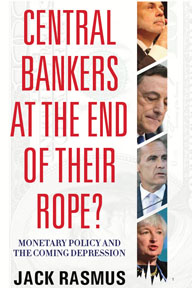
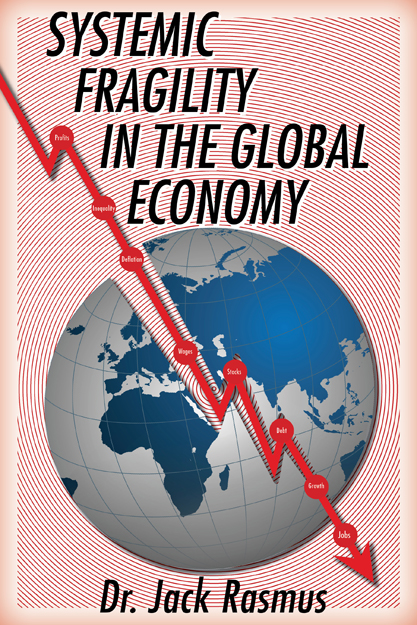
Dr. Rasmus is author of the 2017 book, ‘Central Bankers at the End of Their Ropes: Monetary Policy and the Coming Depression’, Clarity Press, August 2017, and Systemic Fragility in the Global Economy, Clarity Press, 2016

As I predicted, the Dow US stocks bubble collapse begins today. Correction at least 20% coming. One result: there’ll be no more Fed rate hikes after March. Money will flow massively into US bonds and gold as safe havens. This is a repeat of the dotcom bust in 2000, except not limited to the Nasdaq tech market, more broad across S&P 500, Europe Stoxx 600 and Japan Nikkei as well.

The Janet Yellen era at the US central bank ended this past week. What was her performance as chair? Did the Fed attain any of its announced targets? Why did she continue to inject billions in virtually free money into the banking system, and keep interest rates near zero, after banks had fully recovered? Read my 13k word complimentary chapter 10 (‘Yellen’s Bank: From Taper Tantrums to Trump Trade’) of my latest published book, “Central Bankers at the End of Their Ropes“, Clarity Press, August 2017)

To read, GO TO my website: http://kyklosproductions.com/articles.html

Should the Fed continue with rate hikes in 2018, & equity markets correct by 20%, money will flow back into Treasuries & long term bond yields will fall. And as short term rates rise, the yield curve will invert. That’s recession in 2019 (or even by 4Q2018).

Read my book, ‘Central Bankers at the End of Their Ropes’, Clarity Press, August 2017, where I predict that the Fed benchmark rate cannot rise above 2-2.25% without inverting the yield curve & precipitating a credit crunch (access from my blog,
Feb 1

US Treasury bond markets began to implode today. Is the stock market far behind? Having experienced events that led up to the dotcom bust that began in early spring 2000, the similarities are great. The difference: the bond markets are far larger and more strategic than equities
Jan 31

The Fed today decided unanimously NOT to raise rates, after indicating 2017 it would 4 times in 2018. What does the Fed know about the US economy it’s not telling us? If the scenario 2018 was 3-4% GDP growth, as politicians tell us, the Fed would have raised rates. But it didn’t
Jan 31

What the US stock markets declining sharply today? Money being pulled out and reinvested in Europe stocks where markets haven’t accelerated to bubble level yet, as in US. Dumping dollars for Euros causing US dollar weakness, despite Federal Reserve rate hikes. A new Fed dilemma
Jan 22

For a 40 minute in depth explanation of the Bitcoin bubble, bust, and what may be next, listen to my ‘Alternative Vision’ radio show at:
Jan 18

For my further commentary on the Bitcoin/Altcoin price collapse this past week, read my blog entry today, ‘Why Bitcoin’s Fallen by Half’, at
Jan 17

Why bitcoin’s (& altcoins) crashing: Demand falling due to prospects of govt regulation & taxation, slow takeoff futures trading, China et. al. ban, money flows to gold. As supply rises due to substitutes, central banks considering own digital currencies, big investors’ dumping.
Jan 12

Bloomberg News story yesterday, that China will stop buying US T-Bonds, was ‘fake news’ (i.e.China’s comment). Why then this story? Is someone trying to manipulate markets in the US? Or is it an unofficial ‘shot across the bow’ by China warning US against starting a trade war?
Jan 9

Listen to my 11 minute interview with ‘Loud and Clear’ radio on the current stock market bubble, and my estimations of when, and by how much, it is likely to correct, as well as the consequences for the real economy in 2019-20.
Jan 5

What’s driving the US stock bubble? Trump’s tax cuts creating 10-30% profits windfall; $1 trillion a year for 6 years of stock buybacks and dividends; low US $ and foreign demand; structural changes in stock markets (ETFs, index and passive investing). 20-30% correction coming.

By
Jack Rasmus
copyright 2018

“Presidents’ State of the Union speeches used to report on accomplishments of the past year and proposals for new programs and policy changes for the next. Just as the country we once knew, those days are long gone.

In the 21st century the format is mostly theatrical: The president offers a short sentence about how wonderful America is, cuts his sentence short, and waits for applause. The Congress rises and claps longer than the spoken sentence that brought them to their feet. This goes on every 15 seconds. Sometimes less. Up and down, up and down. Turn off the volume, and it’s similar to canned laughter in a TV situation comedy—with the visual effect of bouncing butts replacing the canned laughter. Except it’s all more tragic than it is comedic.

A stranger viewing for the first time must conclude that something anatomically must be wrong with their backsides. Up-down, up-down. But when the incessant pattern of ‘short phrase, rise and clap too long, sit down’ threatens to become too repetitive, a new theatrical effect is introduced. Now it’s the president introducing staged character actors in the gallery above the floor, each introduction providing an appeal to the tv audience’s emotions. In the Trump speech tonight, there were no fewer than twelve such ‘gallery scenes’ to break up the mesmerizing stop-rise-clap-sit down nonsense.

First there was ‘Ashley the helicopter lady’, then ‘Dolberg the firefighter’, Congressman Scalise, whose only claim to fame was he got himself shot (definitely not on the level of the other ‘heroes’), followed. And how about the 12 year old ‘Preston the flag boy’, with whom Trump said he had a great conversation before the speech. (I’m sure it was of comparable intellect).
But clever by far was the next gallery event, the four parents whose kids were killed by MS13 gang members in Long Island, NY. All four were black, apparently to blunt the racist appeal by Trump injected into the scene, suggesting that all immigrants were gang members who came here as a result of ‘chained migration’ family policy. I guess MS13 gangsters never killed whites.
Not surprisingly, the next gallery scene was the ICE agent, a guy named Martinez who heroically smashed the MS13 gangsters. Of course, he too was Hispanic.

Both theatrical scenes dealing with ‘immigrant gangsters arriving by chained migration’ provided Trump a nice segway into describing his ‘4 pillars’ immigration bill, the only policy proposal he actually spelled out in his nearly hour and a half speech.

For a pathway to citizenship that would take 12 years for ‘Dreamer’ kids, Trump would have his $30 billion plus border wall, a new immigration policy based on ‘merit’ (welcome Norwegians), as well as an end to family ‘chained migration policy’ (which somehow would also protect the nuclear family, according to Trump). The message: white folks’ nuclear families good; immigrant folks’ (especially Latino) extended families bad, was the suggested logic. What it all added up to? If Democrats agreed to his pillars 2-4 right now, maybe there would be citizenship for Dreamers sometime by 2030! What a deal. But who knows, maybe the Democrats will take it, given that they retreated from their prior ‘line in the sand’ of pass DACA and dreamers or they’ll shut down the government.

The next theater event was no less interesting than the immigration scenes in the Trump play that was the presidential State of the Union address last night. In typical Trumpian worship of the police and military, Trump (the draft dodger) introduced an Albuquerque policeman in the gallery who had talked a pregnant woman on drugs from committing suicide. Seems the woman was desperate about bringing a kid into the world she’d be unable to afford to raise. The solution by the policeman was to offer to adopt her baby if she didn’t kill herself. It worked. The kid and mother were saved, and the policeman adopted the child. The policeman’s wife accompanied him in the gallery—with an infant in her arms of course. Not sure whose it was but no matter. Now that was double theater, a scene within a scene. Shakespeare would have been proud.

That impressive bit of theater, perhaps the high point of all the ‘gallery effects’ of the evening, was the intro to Trump’s solution to the Opioid crisis in America, where 60,000 a year now die from overdoses. In his speech, Trump’s solution to the opioid crisis was ‘let’s get tougher on drug dealers’. He failed to mention, of course, that the drug dealers in question most responsible for launching the opioid crisis were the prescription drug companies themselves who pushed their products like Fetanyl and Percoset on doctors a decade ago, telling them the drugs weren’t addictive.

As for the even larger prescription drug problem in American—i.e. the runaway cost of drugs that is killing unknown thousands of Americans who can’t afford them because of price gouging—Trump merely said “prices will come down substantially…just watch!” That solution echoed his press conference of several weeks ago when he publicly addressed the opioid crisis…but offered no solution specifics how. Watching Trump solve the opioid crisis will be slower than watching grass grow…in winter!

Trump’s speech was not all theater. Much of it was factual—except the facts were mostly misrepresentations and outright lies.

Like unemployment is at a record low. But not when part time, temp, contract and gig work is added to full time. More than 13 million are still officially jobless. The rate is still close to 10%. And that doesn’t count the 5-10 million workers who have dropped out of the labor force altogether since 2008, leading to record lows in labor force participate rates and employment to population ratios. That rate and ratio hasn’t changed under Trump.

Another lie was that wages are finally starting to rise. Whose wages? If you want to count average wages and salaries of the 30 million managers, supervisors, and self-employed, maybe so. But according to US Labor department data, real average hourly earnings for all non-farm workers in the US in 2017 rose by a whopping 4 cents!

Trump cited again his Treasury Secretary, Mnuchin’s, ridiculous figure that the average family income household would realize $4,000 a year in tax cuts. But no economist I know believes that absurd claim.

Perhaps the biggest facts manipulation occurred with Trump’s references to his recent tax cuts. He cited a list of so-called middle class tax cuts, leaving out wealthy individual tax cuts measures. Typical was his claim of doubling the standard deduction, worth $800 billion in tax cuts for the working poor below $24k a year in income. But he failed to mention the additional $2.1 trillion hikes on the middle class. (Or the $2 trillion in corresponding cuts for wealthiest households.) Independent studies show the middle class may get some tax cuts initially, but those end by the seventh year, and then rise rapidly thereafter by year ten. In contrast, the corporate, business, and wealthy household cuts keep going—beyond the tenth year.

What Trump conveniently left out in his speech regarding taxes also qualifies as lie by omission. He noted the corporate tax rate was reduced from 35% to 21% and the non-corporate business income deductions were increased by 20%. That was $1.5 trillion and $310 billion, respectively. Or that the Obamacare mandate repeal saved businesses another $300 billion. And multinational corporations would reap the lion’s share of $1 trillion in tax cuts, at minimum. And all that still doesn’t account for accelerated depreciation under the Act. Or abolition of the corporate Alternative Minimum Tax. Or continuation of the infamous corporate loopholes, like carried interest, corporate offshore ‘inversions’, or gimmicks that corporate tax lawyers joke about—like the ‘dutch sandwich’ and ‘double Irish’.

Then there were the Trump jokes. I don’t mean anything actually funny. Nonsense statements like “beautiful clean coal” (the oxymoron statement of the year). Or that US companies offshore are “roaring coming back to where the action is”. And car companies are bringing jobs back (while laying off in thousands). “Americans (white) are dreamers too”. Or the phony infrastructure program that’s coming, where companies will be subsidized by the federal government in ‘public-private partnership’ deals. And his unexplained reference to ‘prison reform’ (really?). Perfunctory references to trade, job training, another non-starter.

Hidden between the lines were other serious references, however. Like his ominous threat to “remove government employees” who ‘fail the American people’ or ‘undermine American trust’, which sounded like a warning from Trump to the bureaucracy not to cross him or else. Or his slap at National Football League players for not saluting the flag. Or plans to expand Guantanamo and the US nuclear arsenal. Or reaffirmation of the definition of ‘enemy combatants’ (which may include US citizens). Trump re-established the fact of his threat to civil liberties.
On the foreign policy front it was mostly threats as well, new and old: To withhold UN funding. Renewed support for new sanctions against Cuba and Venezuela. But North Korea was left for last. Here the return to theater was among the most dramatic. The last ‘gallery scene’ involved a legless defector from North Korea, Seong Ho, brought all the way from So. Korea just for the speech. This was theater with props; applause was sustained as Mr. Ho raised and shook his crutches above his head after Trump’s introduction.

Trump then rode the emotional wave to conclusion with his closing theme that the American people themselves are what’s great about America. Too bad he doesn’t mean all Americans.

So far as Trump speeches go, it was a ‘safe speech’, a teleprompter speech. But typically Trump. Lots of false facts. Emphasis on dividing the country. Long on Theater and emotional appeals to ‘enemies within and without’. And short on policy specifics. But after all, apart from tax cuts and deregulation for corporations and the rich, and a failed Obamacare repeal, not much was achieved in 2017 for him to talk about. And so far as new ideas for 2018 are concerned, there’s ‘no there there’ as well. ”

Jack Rasmus is author of the just published book, ‘Central Bankers at the End of Their Ropes: Monetary Policy and the Coming Depression’, Clarity Press, August 2017

What’s sometime referred to as ‘shadow bankers’ have been running the economy and drafting US domestic economic policy since Trump took office. ‘Shadow’ banks include such financial institutions as investment banks, private equity firms, hedge funds, insurance companies, finance companies, asset management companies, etc. They are outside the traditional commercial banking system (e.g. Chase, Bank of America, Wells, etc.) and virtually unregulated. Shadow banks globally now also control more investible liquid assets than do the world’s commercial banks.

It was the shadow banks–investment banks like Lehman, Bear Stearns, insurance giant AIG, GE and GMAC credit and others that precipitated the 2008 financial crisis that then froze up the entire credit system and led to the 2008-09 collapse of the real, non-financial economy. None of the CEOs of the shadow bank system went to jail for their roles in the collapse. And now they are back–not only reaping record profits and asserting even greater influence over the US and global economy; but have penetrated the political institutions of control in the US and other advanced economies even more than they did pre-2008.

Shadow Bankers On the Inside

In the US, shadow bankers from Goldman Sachs, the giant investment bank, took over the drafting of US economic policy when Trump took office. (Trump himself, a commercial property speculator, is part of this shadow banker segment of the US capitalist elite). Running the US Treasury is ex-Goldman Sacher, Steve Mnuchin. On the ‘inside’ of the Trump administration is Gary Cohn, chair of Trump’s key advisory, Economic Council. Together the two, Mnuchin-Cohn, were the original drafters (which was done in secret) of the recent Trump Tax cuts that will yield a $5 trillion windfall for US businesses and wealthy investors, especially multinationals. (More on this in my forthcoming article, to be posted here subsequently).

Mnuchin is also leading the charge for the Trump deregulation offensive, especially financial deregulation. Mnuchin recently took the offensive as well with public statements indicating it was US policy that US dollar should remain at record low levels. Why? To ensure US multinational corporations’ offshore profits are maximized when they convert their profits in local currencies back to the dollar, before they repatriate those profits back to the US at the new lower Trump tax rates (12% instead of 35% repatriation tax rate) and, even more lucratively, when they pay no taxes on offshore profits virtually at all starting 2019. The Mnuchin announcement caused quite a stir among European and other capitalist central bank and Treasury heads in Europe, who were angered because the statement reflected a rejection of prior ‘understandings’.

Goldman Sachs and the shadow banker crowd’s economic influence extends beyond the US Treasury and Economic Council. The New York Federal Reserve’s district president, Dudley, is also a former Goldman Sachs employee. He announced he’ll be resigning this year. The New York Fed is the key district of the Fed responsible for US Treasury securities buying and selling and other trading with global central banks outside the US. Watch for another Goldman Sachser to replace him, or some other former high level senior exec from private equity or hedge fund industry.(For my analysis of the rising global shadow banking sector and its destabilizing role, check out my 2016 book, ‘Systemic Fragility in the Global Economy‘, Clarity Press, and specifically chapter 12, ‘Structural Change in Global Financial Markets’).

Shadow Bankers Will Run the Fed

Trump and fellow shadow bankers are about to further solidify their control of US economic policy at the Fed as well. The Fed’s chair will soon be Jerome Powell, who comes from the private equity sector of the shadow banking industry.. But several additional Fed governor positions have been vacant for some time, as is the vice-chair of the Fed. Watch for appointees from the shadow banks here as well after Powell takes the helm.
Fed governors are officially supposed to serve 14 year terms. (They, along with Fed district presidents constitute the important FOMC, Federal Open Market Committee, that make day to day decisions at the Fed on matters of short term interest rate changes and such). But the Fed governors in recent decades never remain the 14 years. In fact, recently they remain around 3-4 years, if that. They leave early to take senior positions in the banking and shadow banking world. It’s a ‘revolving door’ problem.

Bankers get appointed to Fed governor and Fed district president positions, make decisions beneficial to their former banker buddies, and then leave early to return to their banker roots, with highly remunerative positions once again (often ‘do-nothing’ sinecures). As former governors they also go on the speech circuit, speaking at banker and business conferences, for which they’re paid handsomely, in the tens of thousands of dollars for a 20 minute speech. (Former Fed chairpersons, like Ben Bernanke and soon Janet Yellen get even more generous handouts, paid in the several hundreds of thousands of dollars a speech. They also get nice book contracts as they leave, with prepayments in the millions of dollars upfront, with guaranteed book purchases by corporations, and the best promotional efforts by publishers).

Trump’s appointment, and recent approval by the US House and Senate, of Jerome Powell to head the Fed is only the beginning. The vice-chair and several open Fed governor positions will enable Trump and Mnuchin to stack the deck at the Fed with their appointees. That will solidify Trump’s, and the shadow banker community’s, control of the Fed and ensure its policy direction will reflect Trump’s economic objectives of boosting business incomes, especially multinational corporations.

Central Bank Independence–But from Whom?

Mainstream economists write incessantly about the need to ensure ‘central bank independence’ (for the Fed) from elected government representatives. But they miss the more fundamental fact that it is the bankers themselves (especially now shadow bankers) that ultimately control the Fed. While mainstream economists talk about independence from government representatives, they ignore the deeper control (often through those representatives) of the Fed, and all central banks, by the bankers themselves.

Are Mnuchin, Cohn, Dudley and others really government ‘representatives’? Or are they shadow bankers first and foremos, who have managed to capture key positions in the government apparatus? Do the ‘revolving door’ former Fed governors act independently? Or do they decide with a keen eye on a lucrative offer from the private banks after a few years in office during which they ‘prove’ their value to the bankers? Do the Fed chairs and vice-chairs make decisions solely in the public interest at all times? Or are they perhaps too aware of the opportunity to become quick multimillionaires themselves once they leave office, recompensed nicely in various ways once they leave? And why is it that at the 12 Fed districts, the district president selection committee of 9 district board directors are almost always ‘stacked’ by 5-6 former regional bankers or banker business friendly former CEOs?

In my just published book, ‘Central Bankers at the End of Their Ropes’, Clarity Press, August 2017, I examine this ‘myth of central bank independence’ in detail, and show how central banks, including the Fed, from their very origins have always been dependent (not independent) on the private banks rather than from elected government representatives. Central banks emerged from the private banks and have always been an appendage of sorts of that private banking system. This fact is supported today more than ever by the fact that Fed and central banks’ policy since 2000, and especially since 2008, has been to ensure the subsidization of financial institutions’ profitability. It’s no longer just serving as ‘lender of last resort’ to bail out the private banks periodically when they get in trouble (which chronically occurs). Now it is permanent subsidization of the private banking system.

A Constitutional Amendment to Democratize the Fed

In the book I also propose in the addendum a constitutional amendment and enabling legislation that will sever the relationship of the central bank, the Fed, from the banking industry (and its government representatives) for good. (see the reviews and information re. the book,’Central Bankers at the End of Their Ropes‘ on my blog, jackrasmus.com, on my website, kyklosproductions.com, and at Amazon books. See the book’s addendum for the amendment and enabling legislation).

The trend in banker control of the Fed–and thus US economic policy–is about to deepen as Trump fills the open governor, chair, and vice-chair positions at the Fed in coming months. This will begin immediately after Jerome Powell assumes the chair position from Janet Yellen in early February 2018.

Economic Consequences of a Trump Fed

The shadow bankers, who gave us the last financial crash in 2007-09, will then be in total control–at the Treasury, in the White House, at the New York Fed, and in a majority of the Fed governorships. They will support Treasury Secretary Mnuchin’s policies–keep US rates at levels to ensure that the US dollar’s exchange rate is low versus other key world currencies. That will ensure that US multinational corporations’ profits offshore are not threatened, as they bring back those profits in 2018 at lower tax rates, and then can bring back profits thereafter paying little, if any, taxes on offshore profits at for the next nine years.

The next financial crisis and crash is coming. It is not more than two years away, and could come sooner. The Fed will be totally unprepared and unable to lower interest rates much in response. It will then re-introduce its massive free money injections into the banking system, as it did with ‘QE’ for seven years starting with 2009. The Fed and other central banks provided ‘free money’ in the amount of at least $25 trillion to bail out the private banks over the last 9 years. How much more will they give them next time? Will it be enough again to stabilize the US and world financial system? And will the Fed and US government then legitimize and legalize the private banks’ taking the savings of average depositors and converting those savings to worthless bank stocks? UK and US government preparations are already underway for that last draconian measure. For even today, when one deposits one’s money in a bank, that money legally becomes ‘owned’ by the bank.

Trump’s imminent appointments of Fed vice-chair and governors may prove historically to be the first step in the total capture of the US central bank by the shadow banker element in the US economy–by the Goldman Sachsers, the private equity firms, the hedge fund vulture capitalists, and the commercial real estate speculator that is Trump himself.

We now have government by the bankers unlike ever before in the US. And their policies will inevitably lead to another financial crisis. Only this next time, the rest of US will be even less prepared and able to endure–given the decade of stagnant wages, new record in household debt, collapsing savings rates, greater reliance on part time/temp/gig employment, decline of pensions, loss of social benefits and safety net, higher cost of healthcare, and all the rest of the economic decline that is afflicting more than 100 million households in the US today.

Meanwhile, Trump went to Davos, Switzerland, this week to party with the rest of the World Economic Forum’s multimillionaire-billionaire class. They will celebrate and pat themselves on the back about how well they’ve done for themselves in 2017: record profits, record stock markets’ price appreciation, record dividend payouts to wealthy shareholders, new tax laws that mean they can now keep even more of those profits and capital gains, continuing austerity for the rest of us, further destruction of unions (called ‘labor market reform’), decline and co-optation of remaining social democratic parties, etc. At Davos, Trump will bask his ego and give an ‘American First’ speech, largely for public consumption to his base in the US. But ‘America First’ means Trump, and his more aggressive wing of US capital, are signaling they plan to squeeze the rest of the world’s capitalists for a US larger share of the total pie (that is growing slower and slower). So they’ll have to take even more out of their workers with austerity, wage compression, social benefits reduction, and even more ‘labor market reform’, to keep up competitively with Trump’s USA.

The Davos crowd may think they are sitting on their mountain in Switzerland, but they are really sitting on a powder keg of accelerating inequality, growing economic populism and anti-globalism, and escalating global debt amidst slowing trade, investment, productivity and wages. The Trump answer is for the US elite to protect and expand its share of the global capitalist pie (which is growing more slowly) at the expense of its global capitalist competitors as well as its own middle class. Meanwhile, mainstream economists, asleep on the bridge of the Titanic, declare ‘steam on’, all is well and getting better.

Jack Rasmus
copyright 2018
Dr. Jack Rasmus is author of the recently published, ‘Central Bankers at the End of Their Ropes: Monetary Policy and the Coming Depression‘, August 2017, and ‘Systemic Fragility in the Global Economy‘, 2016, both by Clarity Press.

.

Today the Republican and Democrats in Congress agreed to end the so-called ‘shutdown’ of the US government over the weekend. Not much really ‘shut down’. Government workers were not at work over the weekend. There were no plans to stop funding the military. Or halt social security checks. Or anything else that was economically meaningful. Using the word, ‘partial’, in relation to shutdown was probably also an overstatement. So what was involved? And what was agreed today?

Republicans wanted to eliminate left over taxes on the rich and business, that they were not able to achieve with their failure to repeal the Affordable Care Act (Obamacare) last year. The ACA required $692 billion in taxes on businesses and investors. Republicans and Trump have been chipping away at the ACA ever since their failure to get a full repeal. The shutdown deal marks yet another milestone in the destruction of the health care act. In the agreement Republicans reportedly got to eliminate more of the tax funding base for the ACA, another cut of the $692 billion. (The ACA destruction will result in even more accelerating insurance premiums and even more enrolled dropping from the program).

To make sure they got their business tax cuts, Ryan and McConnell held the SCHIP program hostage. SCHIP is the insurance program for 9 million children whose parents otherwise can’t afford to buy them health coverage. The Democrats got the continuation of SCHIP for another six years. In other words, they ‘got’ what they ‘already had’, while the Republicans got something new–i.e. more tax cuts.

So what about DACA–the 800,000 ‘dreamer’ kids? Wasn’t the Democrats’ refusal to pass the spending bill to fund the government based upon getting the DACA issued resolved? Yes. But the Democratic party leadership dropped that demand in today’s agreement, and instead agreed to refund SCHIP in exchange for three more weeks of government funding, and the further ACA tax cuts. In other words, they got what they had and gave up on DACA. They say DACA is not dead, that they’ll return to it three weeks from now.

But in three weeks from now the Republicans will find another program they will hold hostage, and demand the Democrats fund the government further in exchange for keeping another program going–while the DACA demand will be left hanging once again.

What this all points to is the Democratic Party is continually being outmaneuvered by the Republicans. It’s a sad story that has been the case ever since 2008. Democrat party leaders are proving themselves not only strategically myopic since the 2016 election, but tactically inept as well.

What the recent ‘negotiations’ around the DACA-for-funding the border Wall trade off also reveal is the Republicans keep adding demands to the negotiations, keeping Democrats off balance and unable to hold firm to their initial principled demands.

Also revealing is that Trump was a non-entity in the entire negotiations process. He holds PR press conferences for the TV audience, making it look as if he’s in charge, and will play a positive role in getting the two parties to agree on DACA in exchange for his Wall funding. But he’s not in charge. Whoever gets to him last, he agrees with. Shumer goes down to the White House and thinks he has a deal. But the right wing and corporations walk in the swinging door and Trump changes his position before Shumer can even get back to his office on the hill.

Democrat party second in command in the Senate, Dick Durbin, went on TV to try to pick up the pieces. He asked the DACA kids ‘don’t give up hope’. We’ll deliver next time. But now that the Democrats caved in on their DACA demand, who will believe they’ll prove tougher the next time around three weeks from now? The Republicans will hold out even more confidently, knowing the Democrats will cave again. By giving up on DACA the Democratic party leadership ensures it will be even more difficult next time.

To use a metaphor, it’s like a union declaring its intent to go on strike for a non-negotiable demand, and when the deadline comes telling its union members they’ve changed their mind,they’ve given up the demand, and no one should go on strike…for now. The union leaders then declare publicly they’ll strike ‘next time’ three weeks later. Who among their rank and file are going to believe them? Nor will the Republicans (i.e. the management negotiators per our metaphor). And certainly not the workers (DACA kids). Drawing a line in the sand and then backing up and drawing another accomplishes nothing but demoralization.

For my commentary on yesterday’s OXFAM annual report on the continuing growth of wealth inequality globally, benefiting the wealthiest 1% investor class, listen to my 1 minute YOuTube interview. GO TO:

For a further discussion of the causes of the Bitcoin/Crypto 2017 Bubble and 2018 Bust, listen to my Alternative Visions radio show:

Go to:

http://prn.fm/alternative-visions-behind-bitcoin-bubble-bust-apples-105-billion-trump-tax-cut-1192018/

Or go to:

https://alternativevisions.podbean.com

SHOW ANNOUNCEMENT:

Dr. Rasmus explains the forces behind the 2017 escalating Bitcoin bubble and their reversal in 2018 in recent weeks, leading to the collapse of Bitcoin prices. Both demand and supply forces driving, then collapsing, bitcoin are explained, and projections for 2018 offered where Bitcoin and other Altcoins may be headed. Crypto currencies as classic financial asset speculative plays are explained, in context of 21st century Capitalism’s continuing securing shift to financial asset investing. Rasmus then estimates the true tax cuts for US businesses from the Trump tax act ($4 trillion not $1.5 trillion), and estimates that US multinational corporations will reap at least half of that $4T. The case example of Apple Corp’s tax cuts are estimated—from the repatriation one time tax savings in 2018 and thereafter for the next five years, after Apple’s announcement of bringing back $38 billion (over the next five years) of its $270 billion offshore untaxed thus far profits hoard. Rasmus explains only part of the $38 billion will result in wage and real investment, with most going to stock buybacks, dividends, and mergers and acquisitions. (Next week: ‘What’s Happening in China?’)