Feeds:
Posts
Comments

Trump yesterday announced the USA-Canada trade agreement, less than a week after the USA-Mexico changes to NAFTA. Like Mexico, the Canada deal is minor changes to auto quotas that will have no impact on Canada’s current 2 million auto exports to the US. No changes in the trade dispute mechanism Trump previously declared was non-negotiable. Only a 3.5% increase in US dairy farmers sales into Canada. No changes to steel tariffs, etc. Hardly a ‘I’ll tear up NAFTA if elected’ Trump campaign promise. The big change: cross out the word NAFTA and replace it with ‘USMCA’.

The Canada-USA deal replicates the agreement last week with Mexico. Again no change to steel imports. A ‘side letter’ with Mexico freezing US tariffs, as is, for the term of the new deal, in exchange for Mexico raising auto workers wages to $16/hr.–sometime in the future (and on only 40% of auto workers)–and token increase in north american content from 62.5% to 75%.

NAFTA changes reflect Trump’s phony trade war with US trading allies. USMCA a repeat of USA-So. Korea softball deal of several months ago (signed last week). Trump suspended threats on Europe tariffs and lifted them on Brazil and others as well. So where’s the ‘Trade War’? It’s with China and is coming.

Meanwhile, Trump gets to engage in typical bombast, hyperbole, misrepresentation and lies to his domestic political base about how he’s making trading allies ‘cave in’ to his demands. Only that’s what is not happening at all.

For more of my commentary, listen to the ‘Critical Hour’ radio show (first 18 minutes) of October 2, 2018,

GO TO:

https://sputniknews.com/radio_the_critical_hour/201810021068504114-usmca-nafta-kavanaugh/

Trump’s ‘trade war’ with allies, including Mexico-Canada, was and remains a phony trade war. A war of words for the purpose of consumption of Trump’s domestic political base before the November midterm elections. Trump has been playing his ‘economic nationalism’ card that helped win him his election once again. A US-Mexico deal last Friday, and the US-Canada deal announced today, confirm little that’s different in the NAFTA free trade agreement. Trump will exaggerate and lie about both to his domestic political base, but the terms of both the Mexican and Canadian trade deals will show hardly any change.

US-Mexico Trade Details Before Final Document

As with So. Korea, an early look at the Mexico-US deal late last week showed token changes on autos and steel. No tariffs, just phony quotas on car imports to US. (Trump has recently also quietly exempted other big steel importers to the US (Brazil, etc. from the 25% tariffs he announced last March). Mexico deal details will show few if any tariffs, some quotas well above current actual levels so they have no effect, and the US-Trump backing off the threat to change how disputes are resolved over trade issues. Trump essentially agreeing to the Mexico (and Canada) positions that no changes should be made to the past process.

Mexico has apparently not agreed to slow imports of autos and steel to the US. Just to raise North American auto parts content to 75% from 62.5%, and to raise Mexican auto workers wages to $16/hr. (but only on 40% of Mexican auto workers)!

Mexico is also bragging of a ‘side deal’ with US also just signed, outside NAFTA, in which current tariffs get locked in for years to come.

In other words, the US-Mexico agreement is A PHONY TRADE DEAL–just like So. Korea! (Canada will now fall into the same deal. All the talk about separate agreements for Mexico and Canada has collapsed. It has always been just a smokescreen by Trump).

Canada-US Deal Early Look

Late in the day news for Sunday, Sept. 30, is that US and Canada just agreed to a trade deal, with Canada remaining with Mexico in NAFTA. No change in the NAFTA dispute settlement mechanism.Canada agrees to let US diary farmers access a whopping 3.5% of its market (offset by Canadian price subsidies to them for the 3.5%).
On Autos, Canada agrees to not export more than 2.6 million cars to the US. But Canada only importing 2 million now, so it raise imports another 600,000. Moreover, the 2.6m quota takes effect only if US imposes 25% auto tariffs on Canada and globally as well in the future–which it will never do.So no tariffs on autos or steel from Canada. ANd the auto quotas are fictitious.

According to Reuters news service, “The quota (2.6m) would allow for significant growth in tariff-free automotive exports from Canada above current production levels of about 2 million units”. And apparently no change in Canada steel and aluminum imports to the US: “the deal failed to resolve US tariffs on Canada’s steel and aluminum exports, the Canadian Sources said”. What that means is that Canada keeps importing steel and aluminum to US as before.

Deals show that Trump is desperate to sign something before the November elections, as a show of his ‘economic nationalism’ and ‘America First’ themes. So now So. Korea, Mexico and Canada have agreed to softball deals with the US to changes in their free trade agreements with the US. (Meanwhile Trump backs off threats to Europe and quietly exempts other economies like Brazil from his previously announced steel and aluminum tariffs last March).

Canada and Mexico stock markets surging on the news, and the currencies are rising in the wake of the news of deals reached on trade with both by Trump.

For my 10 minute interview on US-Mexico deal, listen to my Loud & Clear Radio interview last friday, Sept. 28. Go To:

https://www.spreaker.com/user/radiosputnik/u-s-mexico-trade-agreement-to-be-release

Check out this blog again in the next 24-48 hours for more details on the Canada-US deal.
And compare the details for both against Trump’s 2016 election ‘bombast and bullshit’ about ‘tearing up the NAFTA trade agreement if elected’. And bringing jobs from Mexico and Canada back to the US.
Dr. Jack Rasmus

Sept. 30, 2018, 11:30pm

This past week Donald Trump appeared before the United Nations Assembly in New York. In typical Trump style, he immediately launched into bragging about his accomplishments. Like most of his recent public appearances, it was a campaign speech directed to his political base. He proclaimed to the Assembly he had achieved more in his first two years than had any other president in a like period. The claim elicited laughs from the audience, which Trump would brush off later in a press conference saying ‘We were laughing together, they weren’t laughing at me”. Sure, Donald. That’s what happened!

In the course of his over-the-top, self-congratulatory announcement he said the US economy had grown faster in his first two years at the presidential helm than in any administration before during a like period, he had reduced unemployment to the lowest rate ever in the US, and his policies have produced record wage gains for American workers. The reality, however, is none of the above are true.

What’s somewhat ironic is that Trump’s lies and misrepresentations about the performance of the US economy are buttressed in part by official US statistics. He didn’t have to lie outright. It is often forgotten that statistics are not actual data. They are not numbers and facts that are actually observed, collected and reported in their original form. Statistics are ‘operations’ on and manipulation of the actual data, i.e. the real numbers. Statistics are created numbers. The operations and manipulations are often justified by arguing they improve the data, reveal it more accurately. Sometime this is so. But too often the manipulations are designed to boost the raw data to show the economy is doing better than it actually is (i.e. GDP and growth is better than it really is); or reduce the numbers to show the same effect (i.e. inflation is not as high as it really is); or that wages are rising for everyone when in fact they may not be for most.

In Trump’s UN speech, we therefore find an ironic congruence of typical Trump imagined facts that don’t actually exist and official government statistics that are not lies per se but are nonetheless distortions and misrepresentations created by the many complex, often convoluted operations and manipulations performed on the actual facts.

Who’s lying? There are different ways to lie. Trump does it crudely and blatantly. Official stats often do it cleverly and opaquely. The debunking of Trump claims before the UN about US GDP, US unemployment, and US wages in what follows shows how the crude and the clever often coincide.

Trump’s ‘US GDP Is Growing at Record Rate’ Claim

Let’s take US economic growth or GDP (Gross Domestic Product). Trump claims the last quarter’s GDP growth of 4.2% was the best ever. Apart from the fact that the US economy has grown quarterly faster many times before, the 4.2% is a misrepresentation—even if it’s the official US figure. Here’s why:

GDP is defined as the total goods and services produced in a given year that is sold in that year. So prices are associated with the output of actual goods and services produced. But real growth of the economy should not include prices. Therefore prices are adjusted out from what’s called the ‘nominal GDP’ number. Nominal GDP last quarter was 5.4%. Trump’s ‘real GDP’ number of 4.2% means inflation was 1.2% for the period, according to the ‘GDP Deflator’ price index that’s used to adjust GDP for inflation.

But does anyone really believe inflation was only 1.2%? No one that was paying for double digit hikes in insurance premiums and copays during the quarter, or a dollar plus more for a gallon of gasoline to get to work, or who has had to pay rent hikes by their landlord of 20% or more, or is paying higher local property taxes and fees, or has opened their utility bill envelopes lately. What wage earning household believes inflation is running at only 1.2%? And if inflation is higher than that, then the adjustment for inflation to the 5.4% nominal GDP results in a ‘real GDP’ of far less than Trump’s official 4.2%.

So why is inflation so underestimated, resulting in real GDP being over-estimated at 4.2%?

One reason actual inflation is much higher is that government statisticians arbitrarily assume that consumers are buying more online where goods are cheaper, even though the government itself has said its procedure for estimating online sales is a ‘work in progress’ and at best a guesstimate.

Another reason inflation is underestimated at 1.2% is government bureaucrats at the Commerce Dept. (responsible for estimating GDP) assume that the quality of goods sold today is better than in the past. So they reduce the actual price that households really pay for the product in the marketplace and assign a lower, fictional price when they calculate the 1.2% GDP Deflator.

Or they assume that rents aren’t really rising as fast as they are in fact, because their models definition of rent includes homeowners with mortgages supposedly paying a ‘rent’ to themselves as well. That’s called ‘imputed rents’. Of course it’s nonsense. Homeowners don’t pay themselves rents. But when you assume they do, it means 100 million homeowners pay rents to themselves that barely changes year to year, while true renters keep paying 20% or more. When rents are then ‘averaged out’ for both homeowners and real renters, the actual rent inflation comes out much lower as a contribution to total GDP inflation. There are dozens of other techniques by which the ‘GDP Deflator price index’ is manipulated to come up with only 1.2% inflation—and thus overstate real GDP to 4.2%.

The US has other inflation indexes it could use to adjust for real GDP more accurately, but it doesn’t use them. It prefers the ‘lowball’ GDP Deflator price index. The Consumer Price Index, CPI, is closer to the actual inflation, at 2.7%. If the CPI were used to adjust nominal GDP, the 4.2% real GDP would be only 2.7%. The US Central Bank, the Fed, uses yet another index called the Personal Consumption Expenditure or PCE. That’s at 2.2%, also much higher than 1.2%. If the PCE was used real GDP would be 3.2% not 4.2%. So the most conservative and lowest inflation indicator is used to estimate real GDP. And that’s how Trump gets his phony 4.2% real GDP—i.e. his ‘greatest in history’ US growth number.

But even the CPI, at 2.7%, underestimates inflation. It uses what’s called the ‘chained index’ method for calculating annual inflation rates. That simply takes the actual current year CP inflation and averages, or ‘smooths’, it out with the preceding years of inflation. The resulting ‘averaging of averages’ is a lower than actual annual rate of inflation.

There are other problems with GDP that further reduce the 4.2% assumed real growth rate. Periodically the government changes its definition of what makes up the GDP. The re-definitioning often results in a higher GDP than previous. It’s not a real growth increase, just growth by definition. This redefining GDP is going on globally as well. In Europe for example they now include drug smuggling and services from brothels as contributing to GDP. Of course, to estimate these ‘services’ contributions to total GDP one needs to get a price. Drug peddlers don’t tell the government what they’re selling their heroin or cocaine for. And it’s doubtful that government statisticians stand outside the brothels or interview street walkers to determine the price they charged their ‘johns’. So government statisticians simply make up the numbers and plug them into their GDP calculations. One of the most egregious examples of GDP growth by definition occurred in recent years in India. By redefining GDP it doubled its value overnight. The US engaged in its own form of GDP redefinition a few years back as well, when the economy recovery just couldn’t get off the ground and stagnated in late 2012.

Back in 2013 US GDP was arbitrarily redefined to include categories that had never been included—like the estimation of the value of company logos, trademarks, and intellectual property that never gets sold. What was for decades considered a business cost and not an investment—i.e. research and development—was now added to GDP figures. This change to GDP raised it by $500 billion annually starting in 2013. It’s no doubt higher today. That’s about 0.2% to 0.3% artificial boost to GDP just by redefining it. The point is no one knows the price of new categories like logos, trademarks, and the like. Government bureaucrats simply make them up (like they do ‘imputed rents’) and add them to the GDP totals.

What this all means is that Trump’s boast of his record 4.2% GDP is not really 4.2%, but something far lower, probably around 2%. That’s only a few tenths of one percent higher than under Obama, when GDP averaged around 1.7%-1.8% annually.

Trump’s bragging of historic growth misses another really important problem with GDP: It avoids the question of who benefits from the 4.2% (or 2% in fact). Who gets the income generated from the 4.2%, or 2.7%, or 2%, or whatever. The flip side of the 4.2% GDP is what is called National Income. National Income is what the GDP creates for businesses, investors, wage earners, etc. who make the goods and services that create the National Income. But to whom is the 4.2% national income equivalent of GDP really benefitting? Is it the roughly 130 million wage earners? Or is it the owners of capital, their shareholders and managers, the self-employed? How much do those who make the goods and services—i.e. wage earners—get of the National Income? And is the share of total National Income they are getting distributed more or less equally among the 130 million, or is it skewed to the high end of the wage and salary structure, i.e. the top 10% of wage and salary earners—i.e. the business professionals, tech sector engineers, high paid health professionals, etc.?

Trump’s ‘Wages Are Rising Fast’ Claim

Trump brags that wages are rising at 2.9% a year now. However, that 2.9% is for full time permanent employed workers only. (Read the fine print in the Labor dept. definitions). Excluded are the roughly 50 million part time, temp, on call, under-employed and unemployed. And the wages are rising nicely claim may include extra hours worked—i.e. more overtime for the full time employed and extra part time jobs and gig jobs for the part time and temp employed. Workers’ earnings may thus rise due to more hours worked, not actual wage rate increases. Independent reports show, moreover, that employers are giving raises mostly in lump sum and bonus payments instead of wage rate per hour hikes. That way they can discontinue paying the lump sums and bonuses more easily in the future.

Apart from applying only to full time permanent employed, the 2.9% is a distortion for tens of millions of workers as well because it is an average. It represents those at the top of wages and salary—the best off 10% of tech, healthcare, and select other occupations getting most of the 2.9%. They may be getting 4% and more. Those in the less preferred occupations get far less than 2.9%, or nothing at all in wage hikes. The average is 2.9%. So at least 100 million wage earners are getting far less than 2.9%–which then needs adjusting for a much higher than reported inflation rate. The result is a real wage gain for 100 million or more that is negative, not 2.9%. But Trump doesn’t bother to explain that. The devil is in the details, as they say.

Here’s another problem with the official government wage data reported in the GDP-National Income numbers you probably never heard of. It reduces the share of wages in National Income even more than is reported officially. According to GDP rules, 65% of the profits of unincorporated businesses (i.e. sole proprietorships, partnerships, S-corps, etc.) are considered wages in the National Income data. That’s right. Business Income—aka profits of non-corporate business—is considered ‘wages’ and added to the totals for wages in the GDP-National Income calculations.

The biggest misrepresentation of wage gains, however, is due to the underestimating of true inflation. What matters is ‘real wages’, what wages can actually buy. Trump’s 2.9% wage increase is not adjusted for inflation. It’s not ‘real’. If CPI inflation is 2.7% and nominal wages are rising at 2.9%, then real wages are actually stagnant at best at 0.2%. And if inflation for the more than 100 million primarily wage earning households is really around 3.5%–given recent hikes in oil and gas prices, rents, healthcare costs, utilities costs, local taxes and fees, etc.—then real wages for the 100 million or so are actually falling by 0.6% or more. Just as they have been falling every year since 2009.

Trump’s ‘Unemployment is at an Historic Low 3.9%’ Claim

Like the numbers for GDP, inflation, and wages there are problems associated as well with Trump’s jobs data claim in his UN Speech. The 3.9% unemployment rate Trump declared as ‘the lowest it’s ever been’ refers to the unemployment rate for only former full time permanently employed workers. (The lowest ever rate was 1.9% in 1944, by the way). The 3.9% excludes the 50 million part time, temps, on call, i.e. what’s called the underemployed. If the underemployed are included the unemployment rate rises to about 8%–in other words more than double the 3.9% for full time permanent workers only.

But both the 3.9% and 8% are still underestimates of the true unemployment in the US at present. In the US, someone is considered unemployed only if they are ‘out of work and looked for work in the preceding 4 weeks’. Otherwise, they’re considered part of what’s called the ‘missing labor force’ and not counted in the 3.9% (or 8%). (Note that being unemployed in the US also has nothing at all to do with whether or not you’re getting unemployment benefits).

Another problem with the 3.9% is that it is based in large part on gross and arbitrary assumptions by government statisticians as to the number of new jobs that were created due to ‘new businesses being formed’. The government assumes hundreds of thousands of net new businesses are created every month, each with a number of employees. But the government just makes an assumption of how many businesses and number of employees. It then adds these assumed numbers to the actual numbers of unemployed counted for a recent month. Worse still, this assumed number of new jobs is based on businesses and jobs created nine months prior to the present. For example, assumed new business formations and jobs back in January 2018 are then plugged into current September 2018 job numbers. That boosts the number of jobs in September, to get the lower, 3.9% unemployment rate. And we’re talking about tens and sometimes hundreds of thousands of net jobs from nine months ago being added to current unemployed totals in the present. In short, boosting job numbers (and thus reducing unemployment to 3.9%) from ‘New Business Formation’ assumptions nine months prior is a way of padding the numbers.

Another set of problems in estimating the 3.9% occurs due to how the Labor Dept.’s household surveys are conducted to provide the 3.9% unemployment rate. The government surveys 60,000 households a month by telephone. But not everyone has a telephone or responds to a government call to participate in the survey. Typically refusing to participate in such government surveys are inner city youth, workers ‘working off the books’ and receiving cash instead of wages, most of the 10 million undocumented workers in the US, itinerant workers without cellphones, and others. In other words, how the government surveys to get its estimated 3.9% unemployment rate is not sufficiently accurate either.

There’s an even greater gap in government estimations of unemployment. There’s still millions more who are not counted at all. Millions of workers in recent years have dropped out of the labor force altogether. Remember, if you’re not working or looking actively for work you’re not even in the labor force. Your ‘joblessness’ is therefore not even considered in calculating the unemployment rate. You may be jobless but you’re not unemployed, given the oxymoron US definition of unemployed. And the number of those who have dropped out of the labor force altogether, and thus not considered in calculating the unemployment rate, in the past decade number in the millions!

There’s what’s called the ‘Labor Force Participation Rate’ (LFPR). It is the percentage of the working age population that is employed or else unemployed and actively looking for work. That’s about 58% of the potential working age workforce in the US at present. But before the 2008 crash the percentage or LFPR was 63%. So 5% of the labor force has somehow ‘disappeared’ during the last decade. They’re not factored in the unemployment rate calculations. They may be without jobs, but they’re not considered unemployed. That 5% decline in the LFPR represents 5% of the total civilian labor force, which is about 165 million. So 5% of 165 million is a massive number of another 8.25 million. Having dropped out of the labor force, it is safe to assume most are unemployed or only temporarily or partially employed. About a million of them were able to arrange permanent social security disability benefits.

Mainstream and government economists try to explain away this massive drop out of the labor force by saying it reflects a growing number of retiring baby boomers. But that’s questionable, since the fastest growing numbers of people entering the labor force today (not dropping out) are workers older than 65 and 70, who are returning to work because they cannot afford to retire on the paltry benefits, 401k pensions, and IRAs they have, or the minimal savings they were able to accumulate since the 2008 crash.

To sum up: If to the ranks to the roughly 6.5 million full time permanent unemployed (the 3.9%) are added the 4% or so underemployed and discouraged, there are officially about 8% of the 165 million that are unemployed. That rate is double Trump’s claim of only 3.9%. But add a further 2%–i.e. the ‘hidden’ unemployed not counted in the underground economy, plus the mis-estimation of unemployment due to government survey methods, plus the million or so who have gone on social security disability, plus the 8 million more who have dropped out of the labor force altogether—and the true unemployment rate is somewhere between 15% and 18%, not 3.9%. But you won’t hear that from Trump, or for that matter from government bureaucrats that create the low ball number, or from the media and press that favorably promote the lowest possible number.

Trump’s ‘Stock Markets are at Record Highs’ Claim

In this case Trump is also lying. He claims that he is totally responsible for the current record highs in the Dow, S&P 500, and Nasdaq stock markets in the USA. Record levels in all the three major stock markets are of course fact. That is not the locus of Trump’s lying. The lie is he claims his economic policies, especially tax cuts and military spending and business deregulation are the direct cause of the record stock market levels. While it is true that Trump’s investor-business tax cuts have contributed in 2018 to boosting stocks. The cuts have reduced US budget revenues by more than $300 billion in just the first half of 2018. The tax cuts have thus far provided an artificial windfall to corporate profits of at least 20%, according to numerous studies. Other studies show that 49% of the tax-profits windfall has gone into corporations buying back their stock and paying more dividends to shareholders. Estimates by Goldman Sachs bank research and other sources are that $1.3 trillion will be spent by corporations on buybacks and dividends. That is a major factor why stocks just keep rising this year regardless of concern about trade wars, emerging markets’ currency collapse, Fed raising rates, the spread and deepening of recessions in key global economies, etc. Trump’s lie, however, is his taking credit for the entire stock bubble, when in fact a wall of money has been handed to investors and corporations ever since 2009 by continuous tax cutting under Obama, free low interest money provided by the Federal Reserve for six years, and other forms of subsidization or business by the US government, which is now the hallmark of 21st century capitalism in America.

Trump’s tax cuts and spending may be boosting stock buybacks and dividends—that in turn keep driving stock prices ever higher. But this policy has been going on since 2010. Every year since 2010, buybacks and dividend payouts have on average exceeded $1 trillion a year. Corporate profits have almost tripled. The Fed kept interest rates so low for so long that corporations, like Apple, borrowed billions by issuing new corporate bonds, with which to buy back its stock, increase its dividends, and invest massive sums directly itself in the stock market—even as it hoarded 97% of its $252 billion in cash offshore.

Trump thus lies when he takes full credit for the stock market at record highs. Obama and George W. Bush before him actually are even more responsible than he is.

Jack Rasmus
September 28, 2018

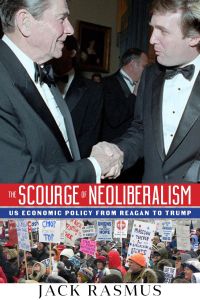
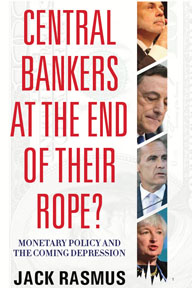
Jack is author of the book, ‘Central Bankers at the End of Their Ropes: Monetary Policy and the Coming Depression’, Clarity Press, August 2017, and the forthcoming book, ‘The Scourge of Neoliberalism: US policy from Reagan to Trump’, 2019, also by Clarity Press. He blogs at jackrasmus.com, hosts the weekly radio show, Alternative Visions, on the Progressive Radio network, and tweets at @drjackrasmus.

by Dr. Jack Rasmus

The business and mainstream press this month, September 2018, has been publishing numerous accounts of the 2008 financial crash on its tenth anniversary. This month attention has been focused on the Lehman Brothers investment bank crash that accelerated the general financial system implosion in the US, and worldwide, ten years ago. Next month, October, we’ll no doubt hear more about the crash as it spread to the giant insurance company, AIG, and beyond that to other brokerages (Merrill Lynch), mid-sized banks (Washington Mutual), to the finance arms of the auto companies (GMAC) and big conglomerates (GE Credit), to the ‘too big to fail’ banks like Bank of America and Citigroup and beyond. These ‘reports’ are typically narrative in nature, however, and provide little in the way of deeper historical and theoretical analysis.

Parallels & Comparisons 1929 & 2008

It is often said that the initial months of the 2008-09 crash set the US economy on a trajectory of collapse eerily similar to that of 1929-30. Job losses were occurring at a rate of 1 million a month on average from October 2008 through March 2009. One might therefore think that mainstream economists would look closely at the two time periods—i.e. 1929-30 and 2008-09—to determine with patterns or similar causes were occurring. Or to a deep analysis of the periods immediately preceding 1929 and 2008 to see what similarities prevailed. But they haven’t.

What we got post-2009 from the economic establishment was a declaration simply that the 2008-09 crash was a ‘great recession’, and not a ‘normal’ recession as had been occurring from 1947 to 2007 in the US. But they provide no clarification quantitatively or qualitatively as to what distinguished a ‘great’ from ‘normal’ recession. Paul Krugman coined the term, ‘great’, but then failed to explain how great was different than normal. It was somehow just worse than a normal recession and not as bad as a bona fide depression. But that’s just economic analysis by adverbs.

It would be important to provide a better, more detailed explanation of 1929 vs. 2008, since the 1929-30 crash eventually led to a bona fide great depression as the US economy continued to descend further and deeper from October 1929 through the summer of 1933, driven by a series of four banking crashes from late 1930 through spring 1933 after the initial stock market crash of October 1929. In contrast, the 2008-09 financial crash leveled off after mid-2009.

Another similarity between 1929 and 2008 was the US economy stagnated 1933-34—neither robustly recovering nor collapsing further—and the US economy stagnated as well 2009-12. Upon assuming office in March 1933 President Roosevelt introduced a pro-business recovery program, 1933-34, focused on raising business prices, plus initiated a massive bank bailout. That bailout stopped further financial collapse but didn’t generate much real economic recovery. Similarly, Obama bailed out the banks (actually the Federal Reserve did) in 2009 but his recovery program of 2009-10, much like Roosevelt’s 1933-34, didn’t generate real economic recovery much as well.

After the failed business-focused recoveries, the differences between Roosevelt and Obama begin to show. Roosevelt during the 1934 midterm elections shifted policies to promising, then introducing, the New Deal programs. The economy thereafter sharply recovered 1935-37. In contrast, Obama stayed the course and doubled down on his business focused recovery program in 2010. He provided $800 billion more business tax cuts, paid for by $1 trillion in austerity programs for the rest of us in August 2011.

Not surprising, unlike Roosevelt’s ‘New Deal’, which boosted the economy significantly starting in 1935 after the midterms, Obama’s ‘Phony Deal’ recovery of 2009-11 resulted in the US real economy continuing to stagnate after 2009.

The historical comparisons suggest that both the great depression of 1929-33 (a phase of continuous collapse) and the so-called ‘great’ recession of 2008-09 share interesting similarities. Both the initial period of the 1930s depression—October 1929 through fall of 1930—and the roughly nine month period of October September 2008 through May 2009 appear very similar: A financial crash led in both cases to a dramatic follow on collapse of the real economy and employment.

But the 1929 event continues on, deepening for another four years, while the latter post 2009 event levels off in terms of economic decline. Thereafter, similar pro-business subsidy policies (1933-34) and (2009-11) lead to a similar period of stagnation. Obama continues the pro-business policies and stagnation, while Roosevelt breaks from the business policies and focuses on the New Deal to restore jobs, wages, and family incomes and recovery accelerates. Unlike Roosevelt who stimulates fiscal spending targeting household incomes, Obama focuses on further business tax cutting—i.e. another $1.7 trillion ($800 billion December 2010 plus another $900 billion in extending George W. Bush’s tax cuts for another two years—thereafter cutting social programs by $1 trillion in August 2011 to pay for the business tax cuts of 2010-11.

The policy comparisons associated with the recovery and non-recovery are clearly determinative of the comparative outcomes of 1935-37 and 2010-11, as are the comparisons of the business-focused strategies 1933-34 and 2009-10 that resulted in stagnant recoveries. But the political outcomes of the policy differences are especially divergent and interesting.

No less interesting are the political consequences for the Democratic Party. Roosevelt’s 1934 campaigning on the promise of a New Deal resulted in the Democrats sweeping Congress further than they did even in 1932. They gained seats in 1934 so that by 1935 they could push through the New Deal that Roosevelt proposed despite Republican opposition. In contrast, Obama retained, and even deepened, his pro-business programs before the 2010 midterms which resulted in the Democrats experiencing a massive loss in Congress in the 2010 midterm elections. Thereafter, the Democrats were stymied by a Republican House and Senate that blocked everything. Obama nonetheless kept reaching out and asking for a compromise with Republicans, but the Republican dog bit his hand with every overture.

Obama pleaded with American voters for one more chance in 2012 and they gave it to him. The outcome was more of the same of naïve requests for compromise, rejection, and a continued stagnation of the US economy. Republicans meanwhile also deepened their control of state and local level governorships, legislatures, and local judiciary throughout the Obama period.

The final consequence of all this was Trump in 2016 as the Obama Democrats promised more of the same in the 2016 presidential election. We know what happened after that.

Consequences for US Midterm 2018 Elections

As yet another midterm election approaches, November 2018, we are once again inundated with mainstream media projections of a ‘blue (Democrat) wave’ coming. But they are today the same pollsters of that same media that were proclaiming in October 2016 that Trump had only a 15% chance of winning the 2016 election. What’s changed that we should believe the pollsters, the media, and the Democrats this time around again that Democrats have the big lead?

Granted, there have been a few notable progressive victories in solid, highly urban constituencies But this does not necessarily ensure their optimistic projections. A likely greater voter turnout in these urban Congressional districts must be weighed against the continued Republican-Trump efforts to deny millions of their voting rights, the continued gerrymandered reality of Republican-led governorships and legislatures, and the massive money machine of ultra-right wing billionaires like the Koch brothers, the Mercers, the Adelmans and other radical right billionaire families behind Trump that is now cranking up to provide a wall of money for Trump sycophants running for office. And let’s not forget those millions of phony religious-moral Americans who support Trump regardless of his misogyny, racism, attacks on the press and immigrants, or his obvious disregard for the even limited democratic institutions and precedents that barely still prevail today in the US. Like Germans who loved Hitler, but not necessarily the Nazi philosophy, they will follow him over any cliff.

Will Millenials now turn out to vote in 2018 when they didn’t in 2016? What have Democrats promised to them this time that they will believe? Why should they think Democrats are any different now? Will Latinos and Hispanics turn out this time, when the Democrats promised last February a ‘line in the sand’ for a Dreamers bill or no approval of the US debt ceiling extension—and then caved in once again? Women and professionals (independents) tired of Trump’s antics and misogyny may come back to vote for the Dems. Maybe some union workers in the Midwest this time, who abandoned Hillary in 2016, as well. But will that be enough?

What will the public think and feel should Trump and his now converted radical Republican party maintain control of the House and Senate for another two years? They’ve been told of the coming ‘blue wave’. But what if that wave dissipates on the reactionary shore that has been deepening in America now for decades? What will the anti-Trump camp do? Say ‘Ok, let’s try again in 2020’? And go away further demoralized?

The opposite outcome in November—a defeat for Trump in the House—will have a similar ‘shock’ to public consciousness, only this time on the right. What will the far right do should it appear that the Dems win the House and announce Trump impeachment proceedings? Trump’s 30% of the electorate are beholden to him only—and not to the remaining, limited democratic institutions of America. He can do no wrong, even if it means dismantling the vestiges of democracy in America.

Should Trump lose the House and face the threat of impeachment, or even an indictment by special prosecutor Mueller, the radical right will mobilize at the grass roots. Bannon at his ilk, fueled by the money of the Mercers et. al., may well shift to popular right wing mass protests and demonstrations. They will want to ‘warn’ the Dems and others to proceed with caution toward impeachment or face the advent of a proto-civil war in the country. A threat of such, if not actual.

The linking of Trump, his wealthy backers, and releasing grass roots Trump supporters into a real street movement will mean yet another step toward a US fascist-like phenomenon. We are not there yet. Trump is not a fascist. To throw around the charge, as a part of the progressive left does, is like crying ‘wolf’ before it actually appears’. If and when it does appear, what should the real wolf then be called?

If Trump is not a fascist he clearly has proclivities toward tyranny and dictatorship: he obviously considers himself above the law (definition of Tyrant), as he has already declared he would pardon himself if indicted. And he clearly identifies with, and is fond of other, authoritarian strong men like Kim, Duterte, and others who rule by dictate. A crisis period Trump administration might be expected to ‘rule by executive order’, with the permission of Congress perhaps. But he is not yet a fascist (as so many progressives mistakenly declare). For that he needs a movement in the streets. Bannon, the Mercers and friends may yet give him that should he be actually impeached.

That street movement may be sufficient to scare the timid liberals and Democrats in Congress from proceeding with impeachment in all but talk should they win the House in November. The leadership of the Democrats will likely back off, once again, should Trump-Bannon turn to the streets. Therefore Democrats, should they win the House, will be all talk and no action. We’ll hear instead the real message, the real strategy: “complete the anti-Trump change by electing a Democrat president in 2020.” Once again, as Trump and the right leverage grass roots movements, the Dems try to funnel all discontent into their re-elections. Trump spends most of his time at rallies in the field. Obama sat on his butt in the White House and was rarely seen or heard.

But hasn’t that been the problem of the last several decades? Republicans link up with the Teaparty, go for the juggler, release the political demons in America always simmering below the surface, mobilize right wing money bags, pervert what remains of democratic institutions, block and thwart all progressive legislation, and ‘kick ass and take names’ of the Democrats—who respond timidly, try to play by the old rules, mouth bipartisanship ad infinitum, and continually retreat in the face of the right wing onslaught

With more than 100 of its Democrat National Committee, DNC, composed of business CEOs and business lobbyists, there’s little chance the Democratic Party will really directly confront Trump and his minions. Should the Democrats even win the House in November, it will be mostly talk of impeachment and token moves for the media, while re-directing discontent to electing still more Dems in 2020 as the real strategy. Meanwhile, Trump and the radical right will continue to mobilize in defense—legislatively, financially, and at the grass roots in increasingly confrontational ways.

To sum up: 1929 gave us Roosevelt and the ‘New Deal’. 2008 gave us Obama and a ‘Phony Deal’. The 2018 midterm elections and the next financial crisis, which is no more than 2-3 years away, may give us Trump’s ‘Final Deal’.

Whether Trump survives November, and his now transformed in-his- image Republican party continues to shield him and allow him to deepen his radical policies, or whether the Democrats take the House and commence talking impeachment proceedings—the result in either case will be a shattering of public consciousness from its prevailing mode once again, as occurred in November 2016. Either way, the next two years will undoubtedly prove more politically unsettling and economically destabilizing than the last.

The Next Crisis

The next financial crisis—and subsequent severe contraction of the real economy once again—is inevitable. And it is closer than many think, mesmerized by all the talk of a robust US economy that is benefiting the top 10% and not the rest. Why so soon?

The answer to that question will not be provided by mainstream economics. They are too busy heralding the current US economic expansion—which is being grossly over-estimated by GDP and other data and which fails to capture the fundamental forces underlying the US and global economy today, a global economy that is growing more fragile and thus prone to another major financial instability event.

The forces which led to the 2008 banking crash were associated with property bubbles (US and global) and the derivatives markets which allowed the bubbles to expand to unsustainable levels, derivatives which then propagated and accelerated the contagion across financial markets in general once the property bubbles began to collapse.

The 2008 crash was thus not simply a subprime housing crisis, as most economists declare. It was just as much, perhaps more so, a derivatives financial asset (MBS, CMBs, CDOs, CDSs, etc.) crisis.

More fundamentally than the appearance of a collapse in prices of subprime mortgages, and even derivatives thereafter, 2008 was a crisis of excess credit and debt that enabled the boom in subprimes and derivatives to escalate to bubble proportions.

But subprimes and derivatives were still the appearance, the symptoms of the crisis. Even more fundamentally causative, the 2008 crash had its most basic origins in the massive liquidity injections by the central banks, led by the US Fed, that has occurred from the mid-1980s to the present. The massive liquidity provided the cheap credit that fueled the excess debt that flowed into subprimes and derivatives by 2008. (And before than into tech stocks in 1998-2000, and before that into Asian currencies (1996-97), and into Japanese banks and financial markets and US junk bonds and savings & loans in the 1980s, and so forth).

Excessive debt accumulation is not the sole cause of financial crises, however. It is an enabling precondition. Enabling the debt in the first place is the excess liquidity and credit. That liquidity-credit-debt buildup is what occurred in the 1920s decade leading up to the October 1929 stock crash. It’s what occurred in the decades preceding 2008, especially accelerating after the escalation of financial derivatives in the 1990s.

Excessive debt creates the preconditions for the crisis, but the collapse of financial asset prices is what precipitates the crisis, as the excessive debt built up cannot be repaid (i.e. principal and interest payments ‘serviced). So if liquidity provides the debt fuel for the crisis, what sets off the conflagration is the collapse of prices that lights the flame.

The collapse of stock prices in October 1929 precipitated the subsequent four banking crashes of 1930-33. The collapse of property prices (residential subprime and also commercial) in 2006-07 precipitated the collapse of investment banks in 2008, thereafter quickly spilling over to other financial institutions (brokerages, insurance companies, mutual funds, auto finance companies, etc.) after the collapse of Lehman Brothers investment bank in September 2008.

Today in 2018 we have had a continued debt acceleration since 2008. As estimated by the Bank of International Settlements (BIS) in Geneva, Switzerland, total US debt has risen from roughly $50 trillion in 2008 to $70 trillion at end of 2017. The majority of this is business debt, and especially non-financial business debt. That’s different from 2008 when it was centered on mortgage debt. It is also potentially more dangerous.

The US government since 2008 has also increased its federal debt by trillions, as it continued to borrow from investors worldwide in order to ‘finance’ and cut business-investor taxes and continue escalation of war spending since 2008. US household debt also rose further after 2008, as the lack of real wage and income growth over the post-2008 decade has resulted in $1.5 trillion student debt, $1 trillion plus in auto and in credit card debt, and $7-$8 trillion more in mortgage debt. Globally, according to the BIS, non-financial business debt has also been the major element responsible for accelerating global debt levels—especially borrowing in dollars from US banks and investors (i.e. dollarized debt) by emerging market economies, as well as business debt in China issued to maintain state owned enterprises and to finance local building construction.

So the debt driver has continued unabated as a problem since 2008, and has even accelerated. Financial asset bubbles have appeared worldwide as a result—not least of which is the current bubble in US stocks. This time it’s not real estate mortgages. It’s non-financial business and corporate debt that is the likely locus of the next crisis, whether in the US or globally or both.

Since 2008 US and global debt bubbles have been fueled once again—as in the 1920s and after 1985 by the excess liquidity provided by the US central bank, and other advanced economy central banks. The central bank, the Fed, alone has subsidized US banks and investors to the tune of $6 trillion from 2009 to 2016, as a consequence of its QE and near zero interest rate policies.

Since 2008, excessive and sustained low interest rates for investors and business have resulted in at least $1 trillion a year in corporate debt buildup, as corporate bond issues have accelerated due to ultra cheap Fed money. The easy money has allowed countless ‘junk’ grade US companies to survive the past decade, as they piled debt on debt to service old debt. Cheap money has also fueled corporate stock buybacks and dividend payouts to investors, which have been re-funneled back into stock prices and bubbles. So has the doubling and tripling of corporate profits from 2008 to 2017 enabled record buybacks and dividend distributions to shareholders.

Most recently, in 2017-18 the subsidization locus has shifted to Trump tax cuts that have artificially boosted US profits by a further 20% and more. As data has begun showing in 2018, most of that is now being re-plowed back into stock buybacks and dividend payouts—this year totaling more than $1.4 trillion, after six years of already $1 trillion a year in buybacks and payouts. That’s more than $7 trillion in distribution by corporate America in buybacks and dividends to its wealthy shareholders.

Where’s the mountain of money provided investors all gone? Certainly not in raising wages for workers. Certainly not in paying more taxes to government. It’s been diverted into financial markets in the US and globally—stocks, bonds, derivatives, currency, property, etc.—into mergers & acquisitions in the US, or just hoarded on balance sheets in anticipation of the next crisis approaching. Or sent into emerging markets (financial markets, mergers & acquisitions, joint ventures, expanding production, etc.) when they were booming 2010-2016.

So where will the financial asset prices start collapsing in the many bubbles that have been created globally and in the US so far—and thus precipitating once again the next financial crisis? The BIS has been warning to watch US corporate junk bonds and leveraged loan markets. Watch out for the new derivatives replacing the old ‘subprimes’ and CDSs—i.e. the Exchange Traded Funds, ETFs, passive index funds, dark pools, etc. Watch also the US stock markets responding to US political events, to a real trade war with China perhaps in 2019, a continuing collapse of emerging market economies and currencies, to a crisis in repayment of non-performing bank loans in Italy, India and elsewhere, or a tanking of the British economy in the wake of a ‘hard’ Brexit next spring, or Asian economies contracting in response to China slowing or its currency devaluing, or to any yet unseen development. Collapsing prices in any of the above may be the origin of the next financial asset contraction that will spread by contagion of derivatives across global markets. And the even larger debt magnitudes built up since 2008 may make the eventual price deflation even more rapid and deeper. And the new derivatives may accelerate the contagion across markets even faster.

The financial kindling is there. All it now takes is a spark to set it off. The next financial crisis is coming. The last decade, 2008-18, is eerily similar to the periods 1921-1929 and 1996-2007.

Only now it will come with the US challenging foreign competitors and former allies alike as it tries to retain its share of slowing global trade; with a US economy having devastated households economically for a decade; with a massive US federal debt now $21 trillion and going to $33 trillion due to Trump tax cuts; with a US crisis in retirement income, healthcare access and costs, and a crumbling education system; with an economy having created only low pay and mostly contingent service jobs; with a virtually destroyed union movement; with a big Pharma initiated opioid crisis killing more Americans per year than lost during the entire 9 year Vietnam war; with a culture allowing 40,000 of its citizens a year killed by guns and doing nothing; with an internal transformation and retreat of the two established political parties; and with a Trump and right wing radical movement ascendant and poised to move to the streets to defend itself.

Jack Rasmus
September 24, 2018

Dr. Rasmus is author of the forthcoming book ‘The Scourge of Neoliberalism: US Policy from Reagan to Trump’, Clarity Press, 2019. He blogs at jackrasmus.com and his twitter handle is @drjackrasmus. (For a more detailed analysis of the similarities and differences between 1929 and 2008, and how Roosevelt and Obama treated the crisis differently, read the except from Dr. Rasmus’s 2010 book, ‘Epic Recession: Prelude to Global Depression’, Plutobooks, now posted on his website, http://kyklosproductions.com).

.

For my analysis of last week’s Trump announcement of $200 billion more in tariffs on China imports to US–and China’s response of $60 billion more on US imports–listen to my friday, September 21, Alternative Visions radio show. Are the latest moves by US-China the real advent of trade war, or still mostly about Trump’s tough talk before US midterm elections in November?

To Listen Go To:

http://prn.fm/alternative-visions-china-us-trade-war-two-steps-forward-one-step-back/

Or Go To:

http://alternativevisions.podbean.com

SHOW ANNOUNCEMENT

Dr. Rasmus analyzes in depth the past week’s further trade tariffs announced by Trump against China ($200b) and China’s response in kind ($60b). Big retreats in both cases in terms of tariff rates and composition (tariff exemptions) show that real trade war not yet begun but getting closer. US investors and stock markets agree, and surge. Trump objective in latest moves: bring China back to bargaining table before US elections. Trump reduces tariff rate, from prior 25% to 10%; China also reduces, from 25% to 10% and 5%. Plus both sides exempt key products: US cuts 300 from prior list, including Apple, tech and car industries; China exempts or reduces rate on US agriculture and consumer goods (toys) for upcoming holidays. Some interesting facts re. China imports to US: 90% of $529 billion from US and foreign corporations’ and foreign-Chinese joint ventures producing in China and importing to US. (Apple and mobile phones = $40billion of the $529b. All US tech corps= $90 billion. US car makers and minerals tens of billions more). Updates on Turkey, Argentina and other emerging markets, and financial markets that are growing more fragile. Global weak spots: Emerging markets, Italy, China stocks, and, in 2019 the UK if ‘hard Brexit’, now appearing more likely. Rasmus describes the ‘wall of money’ now driving US stock markets to historical highs, including $1.5 trillion in 2018 stock buybacks and dividend payouts.

This past weekend, September 15-16, marked the 10th anniversary of the Lehman Brothers Investment bank collapse and the subsequent generalized financial system crash that followed. Business and mainstream media flooded the airwaves and print publications with recounts and assessments of the events of ten years past. Most promoted the theme about how the Federal Reserve central bank and the US Treasury rescued us all from another 1930s-like depression. The corollary message is that ‘IT’ can’t happen today because of the various reforms instituted in the wake of the crash that now prevent the repeat of something similar like 2008.

Buried in the reviews of 2008 events is the sticky question of whether the investment bank, Lehman Brothers, should have been allowed to fail—as the US Treasury Secretary, Hank Paulson, and the chair of the Federal Reserve, Ben Bernanke, decided to allow. The collapse of Lehman precipitated a chain of events and subsequent failures that resulted in a virtual freeze up of the entire US (and much of the rest of the global) financial system. Credit not only contracted—it essentially disappeared altogether for a period of time. The almost total absence of available credit spilled over to the rest of the non-financial economy. Businesses laid off workers at the rate of 1 million a month for the next six months—a trajectory almost exactly that of 1929-1930. By March 2009, even mainstream economists like Paul Krugman were declaring we had entered another ‘great depression’.

Ever since 2008 a debate has simmered whether Paulson-Bernanke should have allowed Lehman Brothers to go under, thus precipitating a chain reaction of derivatives claims that reverberated throughout the US banking system and beyond. The giant insurance company, AIG, a major issuer of derivatives contracts, quickly required bailout after Lehman’s collapse. Brokerages like Merrill Lynch were bailed as well. The big banks—Bank of America and Citigroup—were technically bankrupt by late 2008 and could have been dismantled were it not for $300 billion in debt payment guarantees by the US government. The financial arms of the auto companies, especially General Motors’ GMAC, which had invested heavily in subprime mortgages, dragged down their operating companies until bailed out by another $180 billion government infusion. Mid-tier banks were provided more than $100 billion. And the Federal Reserve set up special ‘facilities’—aka auctions—for various sectors of the financial system and provided emergency funds based on whatever interest they, the mutual funds, investment banks, and others said they wanted to pay. The borrowers, in other words, set their own interest rates. Those rates were quickly driven down by the Fed, to an historic low of 0.10% and kept there for another 7 years. The Fed then paid 0.25% to whoever borrowed from it and left the borrowed funds with it—i.e. a free subsidy of 0.15% for doing nothing. The Democratic Congress did its part as well, allowing banks to suspend normal ‘mark to market’ accounting practices and thus lie about how bad their balance sheets actually were. The Fed then conducted phony ‘stress tests’ of the banks to help them cover up their insolvent condition so that investors might then again start buying bank stocks that had collapsed. Thereafter, over the next seven years, through 2016, by means of its quantitative easing QE program, the Fed bought up bad assets from the banks, shadow banks, and individual investors totaling more than $6 trillion (often at above market prices for those securities).

On the fiscal policy side of bailout, the Obama administration provided a mere $25 billion to help bail out the 14 million homeowners that would eventually face foreclosures during the crash and ‘recovery’ period. In contrast, however, it provided $1 trillion in business-investor tax cuts in 2009 and 2010 ($200 billion in the 2009 Recovery Program, supplemented by another $800 billion at the close of 2010). Obama would then extend the Bush tax cuts of 2001-04 for another two years, 2010-2012, at a cost of $450 billion a year. And to top it off, in January 2013 Obama agreed to extend the Bush tax cuts for another decade at a cost to the Treasury of yet another $5 Trillion in what was called the ‘fiscal cliff’ deal with the now Republican Congress.

This unprecedented, massive bailout of bankers, corporations, and owners of capital incomes was arguably set in motion or accelerated by Paulson and Bernanke, by allowing the collapse of Lehman Brothers—one of the two milestone events of the 2008 crisis. The other milesdtone, occurring in March 2008, was the bailout by Bernanke’s Fed of the Bear Stearns investment bank.

The Sticky Debate: Why Bear But Not Lehman?

The debate about why Bear Stearns was bailed, and Lehman not, has never quite gone away since the events of 2008. Nor has the contending arguments whether Lehman should have been allowed to fail. Autobiographies published by Paulson, Bernanke, and Tim Geithner (head of the key New York Fed district charged with big bank regulation)—i.e. all the key decision makers re. Lehman at the time—all insist that Lehman should not have been bailed, or that they just did not see the consequences. In other words, it was either the ‘right decision’ or a simple mistake. But there is another argument that has been more or less suppressed in the press and media: that Lehman was allowed to fail in order for Goldman Sachs investment bank to benefit by reaping tens of billions of dollars on derivative contracts from the insurance giant, AIG. When AIG then went under, Paulson moved quickly to bail AIG out (unlike Lehman a week earlier), at a cost to the Treasury of $180 billion at the time. Similarly, in the case of Bear Stearns the preceding March 2008, it too was bailed out, by the Fed which provided a $29 billion loan to JP Morgan Chase to absorb Bear Stearns’ assets at pennies on the dollar.

Goldman thus benefited greatly from Lehman’s collapse while Chase similarly did from Bear Stearns’ rescue. And the government—the US Treasury and Federal Reserve—was complicit in arranging the bailout of the one and the collapse of the other. The apparent anomaly of why Bear was bailed and Lehman allowed to go under is thus explainable by the US government’s role allowing even bigger and more influential banks—JP Morgan Chase and Goldman Sachs—to gobble up their competitors (Bear and Lehman) on the cheap. In the one, Chase benefited from the bailout; in the other, Goldman benefited from the collapse.

This suggests the unifying element of the apparent different treatments of Bear v. Lehman was the US government—Treasury and Fed—unofficial policy at the time of trying to resolve the crisis by making even bigger banks more financially solvent, and thus able to withstand the crisis, at the expense of the smaller.

This policy of saving the big bankers at the expense of the smaller was disastrous, however. In the case of Bear Stearns, it gave a signal to speculators they could attack and drive down the stock prices of other financial institutions and the Fed-Treasury would do nothing. And that’s exactly what happened after March 2008, as the vultures descending on Fannie Mae and Freddie Mac, the GSEs, that Paulson’s Treasury then bailed out at a cost of $300 billion; then attacked smaller banks like Washington Mutual, causing it too to fail; then moved on to brokerages like Merrill Lynch; and then Lehman. If the speculators and short-sellers of these bank and financial institutions’ stocks were prevented from doing what they did by Paulson and the Treasury, or Congressional action, there would have been no Lehman to allow to collapse—or Washington Mutual, or AIG, or GMAC or Bank of America or Citigroup, or the $6 trillion Fed bailout that followed, 2009-16.

Few progressive economists bother to investigate all this, allowing their commentary to fall into the ‘safe zone’ trap of discussion themes set by the business and official mainstream press. Like the mainstream press, they have tended to focus on whether the Lehman collapse was ‘necessary’—and not on ‘who benefited’, why, and the role of the US government (Treasury and Fed).

One exception to this is the recently released book by Laurence Ball, definitely not a progressive or ‘left’ economist. His ‘The Fed and the Lehman Brothers’ book (Cambridge University Press, 2018) dives into this question of the contributing role of the Treasury and the Federal Reserve in engineering the failure of Lehman Brothers (if not the similar event of Bear Stearns). It’s an essential read. Yours truly also raised the issue back in 2010 in my own book, ‘Epic Recession: Prelude to Global Depression’, (Pluto books, London, 2010).

The Fed’s Bear Stearns Bailout: JP Morgan Chase’s Multibillion Dollar Windfall

In the book I argue that Bear Stearns—the first ‘bookend’ to the crisis—set in motion a chain reaction of liquidity and insolvency events throughout the ‘shadow banking’ sector starting in early 2008 that culminated in the Lehman crash in September. Lehman’s implosion then exacerbated and deepened the liquidity-insolvency problems throughout virtually the entire financial system, as contagion spread as the ‘transmission mechanisms’ of the crisis—i.e. accelerating general asset price deflation and derivatives liability claims between banks and financial institutions—infected one credit sector after another, including international. With Lehman, what had started as a subprime mortgage problem in 2007, had now become a generalized credit problem connected by the cancerous thread of derivatives linking banks and financial institutions globally. 2008 was a derivatives crisis not a mortgage crisis.

Bear Stearns’ collapse was caused in large part by the giant commercial bank, J.P. Morgan Chase—which eventually became the big beneficiary of Bear Stearns’ insolvency. JP Morgan Chase’s eventual takeover of Bear Stearns in April 2008 was arranged with the direct assistance of Ben Bernanke’s Federal Reserve, the US central bank. Bernanke arranged a low interest loan of $29 billion to Chase with which it ‘bought’ up Bear Stearns’ assets. Chase thus did not commit any of its own capital. Chase acquired Bear assets for pennies on the dollar. Bear Stearns’ New York Manhattan building and properties alone were worth more than $100 billion. Its remaining financial assets and accounts billions of dollars more. Its customer base was worth untold further billions to Chase.

US Treasury’s Lehman Brothers Decision: Goldman Sachs Gets $69 Billion

Similarly, the Lehman collapse was engineered with the help of the US government—specifically the direct assistance of the US Treasury. In the Lehman case the direct beneficiary of the Lehman collapse was the Goldman Sachs investment bank, a main competitor of Lehman.

The Fed did not offer to bail out Lehman, unlike Bear Stearns. Bernanke’s weak excuse was it did not have the authority to do so. Or the liquidity, since it, the Fed, had expended most of its balance sheet assets in preceding months in bailing out Bear and others. The latter argument is specious. The Treasury could have easily provided the Fed the liquidity to bail out Lehman. But as Laurence Ball, in his ‘The Fed and Lehman Brothers’ summarizes in his four year study of the Lehman case: “the Fed could have rescued Lehman but officials chose not to because of political pressures”. What officials? What political pressures?

The officials and pressures suggests Treasury Secretary, Henry Paulson, who just two years prior was the CEO of Goldman Sachs. By allowing Lehman to go under, Paulson ensured that his former employer, Goldman Sachs (whose stock he personally still held when leaving Goldman in 2006), would be able to collect on the billions of dollars in Credit Default Swaps (CDS) it bought from AIG. CDS’s are ‘bets’ that an institution will fail. If it fails, the issuer of the CDS bets has to pay off the buyer of the CDS. AIG had issued a massive number of CDS that Lehman would fail. It would have to pay Goldman if Lehman failed tens of billions of dollars. When Lehman was allowed to fail (by Paulson), Goldman collected. Because AIG had over-issued CDS on Lehman that it did not have the resources to pay—AIG became insolvent as well.

By bailing out AIG to the tune of $180, AIG was able to pay Goldman and others on their CDS bets that Lehman would fail. In short, Lehman was allowed to fail (by Paulson’s decision), so AIG could provide a tens of billions of dollars windfall to Goldman Sachs, Paulson’s former employer, and Paulson approves the AIG bailout so it could pay Goldman. If this isn’t a ‘smoking gun’ then what is?

Of course, no one was about to investigate Paulson’s role (and Bernanke’s willingness to go along and not bail out Lehman as well) in all this despite the prima facie evidence. After all, none of the actual bankers responsible for the 2008 crisis in general were ever indicted or went to jail. So why would the US government’s Treasury Secretary, big banker, CEO of Goldman be charged with anything?

It is important to understand that the US government played a central role in assisting the two larger banks—Chase and Goldman—to gobble up their smaller capitalist competitors, Bear Stearns and Lehman Brothers. And that this assistance occurred after both Chase and Goldman played a key role causing the collapse of Bear and Lehman.

Bear’s rescue directly benefited JP Morgan Chase in the tens of billions; Lehman’s collapse benefited Goldman Sachs in the tens of billions as well. Capitalist bankers devour each other, but US politicians play their part as well. That’s how the system works.

This role of government and politicians in the 2008 banking crash is often treated shallowly, or altogether ignored, by mainstream economic and business reviewers of the 2008 crash—Ball’s book somewhat to the contrary.

This week marks the 10th anniversary of the 2008 crash. Most say that ‘It’ could never happen again. Banks are better regulated. They have significant capital buffers to offset losses should another collapse of their asset prices occur. We have the ‘Volcker Rule’. The subprime mortgage housing problem is no longer. Housing finance reforms are in place. And so forth. But don’t bet on it. And don’t bet that in the next crisis coming that government and politicians won’t be deeply involved in assisting their bigger banker friends making money off the crisis.

For capitalist banks are cannibals. They eat their own. Never was this more obvious than during the 2008 financial crisis. And our government and politicians are there to ensure that they are well fed.

(Readers interested in my analysis of the Bear-Lehman ‘bookend events’ to the 2008 crisis are welcomed to read the excerpts on the events of March to September 2008 on my website which is accessible at http://www.kyklosproductions.com/articles.html).

Readers further interested in the topic, and current events in emerging markets compared, are welcome to access the podcast of my September 7, 2018 Alternative Visions radio show presentation at:

Go To

http://prn.fm/alternative-visions-lehman-brothers-2008-crash-emerging-markets-2018-crises-compared/

Or Go To:

http://www.alternativevisions.podcast.com

Dr. Jack Rasmus
September 16, 2018

#chinatradewar: Trump $200b more tariffs on China coming next week=true start of tradewar. Mnuchin-Banker faction on US trade team loses out to anti-China Navarro-Bolton advisors to Trump. Watch US inflation to surge as businesses pass on prices. China’s next move? Stay tuned.
Sept 13

#chinatradewar:
Trump announces he’s invited China back to discuss trade. Why? Pressure from US business interests? From Mnuchin-banker faction US trade delegation? Yes. But don’t be surprised if Trump announces ‘deals’ with Mexico, Canada, and China a week before the midterm US elections
Sept 12

#USrecession: Next recession coming, late 2019 or 2020 sure. Policy options poor: Monetary stimulus poor as Fed rates will peak at no more than 2.5%-3% (vs. 5.25% in 2008) + more tax cuts & spending unlikely given Trump’s already $1 trillion annual US budget deficits through 2028
Sept 7

#chinatradewar: US-China on cusp of trade war–but not yet. Trump declared last week he’d raise $200b more tariffs on China this week…but then put it off. As cover, more Trump bullshit bombast this week about additional $267b ($467total) in tariffs. It’s all about Nov elections folks
Sept 6

#Amazon & AI: Read my just published piece, ‘Amazon the Job Killer: Yesterday, Today & (AI) Tomorrow’ at my blog http://jackrasmus.com . Focuses on Amazon development in ‘bots, drones, and Alexa-AI for enterprise segment. Review of recent McKinsey AI study impacts on jobs as well
Sept 4

#Wages in America: The ‘spin’ that wages are rising is nonsense. Real wages adjusted for inflation are negative. Real CPI=3.5%. Nominal wages for 133 million only 1.5%. Real wages thus -2.0%. For my analysis, read my blog piece at
Sept 3

#Argentina Peso: -16% in one day & -50% in 2018. Inflation 31%. GDP -5.8% and falling. Central bank rates up 60%. Economy heavy dollarized debt. Macri govt to raise taxes on exports=fewer dollars to pay debt. IMF lends $50b. Not enough. If deeper crisis this week=global contagion
Aug 28

#NAFTA: Trump will now boast big gains in Mexico-US deal. But won’t say auto content change in deal affects only 3 car models!! (per Bloomberg news today). Phony trade war all about US elections & Trump hype to domestic political base. Watch more tough talk re. China next for same
Aug 27

#NAFTA: As I have predicted, US-Mexico deal today. Canada next. Add prior softball deal with S. Korea + Trump suspends trade dispute with EU until after Brexit. Trump phony trade war with allies (see my blog entries, http://jackrasmus.com ) now clear. Trade war with China is real
Aug 24

#Yieldcurve: Yield curve today for 2 yr. & 10 yr. Treasuries flattened to .22 basis points. Another rate hike could invert it. The curve has predicted 17 recessions, best of any indicator. My prediction again: Fed rate at 2.50% (from 2% now)=recession. Fed’s Bullard agrees.
Aug 20

#ChinaCurrency: Trump says China & Europe are manipulating currencies. But China’s central bank is intervening in markets to keep Yuan up not down. Rising $US is the cause of falling Yuan and Euro. And Trump deficits are causing US interest rates & the dollar to rise. Look in the mirror, Donald
Aug 10

#Turkey: My predicted emerging markets crisis just ratcheted up. Turkey Lira collapsing (-40%). Contagion effects?: Italian-EU banks. Weak EME currencies (Argentina, Brazil,etc). May push Yuan out of band. Global currency speculators running amuck. Big ‘risk off’ shift coming
Aug 2

#trumptradewar: Trump thinks China is Mexico & EU. Thinks he can threaten and bring them to negot. table. Threatens 25% more tariffs. China stonewalling. No negot. likely before US Nov. elections. For my latest update analysis of Trump trade read at my blog
Jul 31

#taxcuts: Trump Jan. tax cuts gave $5 trillion to business-investors (offset by $2 trillion hike on the rest of us). More tax cuts 2.0 coming before November: Congress cutting $1.5t more; piecemeal repeal of ACA taxes underway; and now Mnuchin Treasury rule changes to cut $100B.
Jul 26

#TrumptradeWar: Listen to my 12min. interview with Loud & Clear radio, Washington DC, on July 25, on Trump’s latest tariffs threats to Europe, Mexico, and China and how an intensifying tariff war could precipitate a full blown currency war. Go to my blog,
Jul 23

#Centralbanks:
Bank of Japan selloff of US Treasuries today behind US bond yields sharp rise. Will Bank of China follow? Trump deficits+Trump trade war coming home to roost. Are central banks ganging up on Trump? Warning him to halt trade war? US recession 2019 will sink Trump.
Jul 23

#Yieldcurve: One of my most important 2018 predictions: the US yield curve (2y v. 10y. Treasuries) will ‘invert’ by year end of January 2019, as Fed raises rates two more times in 2018 (Fed funds rate at 2.5%) while 10y. T-bond falls to 2.5% or less. Trump Recession 2019 coming.

#Trump v.Fed: Trump dislikes Powell-US Fed raising rates. Ironic. Fed rates rising to finance Trump’s $trillion annual deficits and $12t more US debt by 2028, caused by Trump tax cuts. Trump creates deficits, then complains when Fed must pay for them by raising rates
Jul 20

#Autotariffs: Trump’s threat to raise tariffs on autos is mostly hyperbole, for his US political base before US November elections. (Ditto his latest threat of another $500b China tariffs). Listen to my 12minute radio interview today on what’s behind it at

#Trumptradewar: My predictions re. Trump’s trade war: deal with NAFTA by end of this year. With China in 2019. EU after UK Brexit concluded. It’s mostly Trump election year tactical vote turnout from his base. Media hyping it all. Trump loving the hype–makes him look good to base
Jul 19

#Trumptradewar: Still mostly media hype, with Trump playing to his base. Trump actual tariffs $72b or 2.3% of all imports to US. Responses also 2.3%: EU actual counter tariffs $5b. Mexico $3b. Canada $12.8b. China $37b (same as Trump’s tariffs to date on China imports to US).
Jul 19

#Autotariffs: Trump threats to impose tariffs on EU auto imports a tactical move before meeting. No deal with EU until after Brexit. More Trump election year hype. No trade war…yet. Of $3.06 trillion US imports, only $72b Trump actual tariffs to date, or 2.3% of all US imports
Jul 12

#Trumptradewar: Trump trade war mostly economic theater, driven by US midterm elections. $36b tariffs on China only 5.7% of $635 billion total US-China trade. Trump trade bombast & tariffs for his political base. China will make big concessions on market access & exports. Deal coming.
Jul 12

#taxcuts: Trump claimed his tax cuts would result in US investment surge. Fact 3:US Capital spending (CAPEX) rose 18% 1Q18. Forecast to slow to 10% 3Q18 & 1.7% 4Q18. Small businesses to decline to -11.7% 4Q18. Tax cuts being hoarded. Economic effect already fading.
Jul 12

#taxcuts: Trump tax cuts claimed US multinational corps would bring back offshore profits and invest in US. Fact 2: Money instead going to stock buybacks, dividends, and M&A. S&P 500 buybacks 2Q2018 at record $436b level, up from 1Q18 $242b.
Jul 12

#taxcuts: Trump $5t tax cuts for business & investors promised to stimulate economy and thus yield more tax revenue (per supply side economic theory). Fact: Fed data show 2018 govt tax receipts running 34% below 2017 average

A higher ed colleague of mine recently responded to my ‘Amazon the Job Killer’ piece (see post below) which described, in part, how the coming Artificial Intelligence tech revolution will destroy jobs at a rate and magnitude unforeseen before in US history, educational services included.

The colleague had previously shared a graphic with the faculty which highlighted the admirable slogans: “Education is not a product. Students are not customers. Professors are not tools. The university is not a Factory!”

As a higher ed teacher, this colleague was especially concerned about my analysis of how AI would impact the dominant higher ed college model that has prevailed since 1945–i.e. the four year college experience, now on its last legs propped up increasingly by an unsustainable $1.5 trillion subsidization in the form of student loans, an ‘end of cycle’ solution that cannot continue beyond more than another decade. Certainly teachers would fight back, the colleague argued, as recent teacher strikes in some parts of the US have shown.

But my colleague’s four slogans are more a lament than a call to resistance, since all the four have already become a reality to a significant degree: Higher ed especially has become a product, students obviously are customers, professors are increasingly just tools–soon to be replaced by more efficient, more productive, and more profitable tech tools; and the university is an education factory, maintained by multi-trillion dollar subsidies from the central government that will unravel with the next major recession and economic crisis.

It is a business model that will, like other business models, soon be displaced by a more profitable model based on AI and related technologies. Higher college ed as we know it will largely disappear with the coming diffusion of AI tech throughout the US system. The ‘model’ off 4 year college will soon decline rapidly, I argued.

As a further elaboration on this theme, here’s my verbatim reply to my well meaning colleague, who’s desire for a higher ed college model outside capitalist economy I share, but which I do not believe will happen. Nor do I think that the two main political parties, Republicans and Democrats, will do much, if anything, about the new tech-driven education business model displacing the current 4 year model. They will not prevent or slow the radical transformation of education in the US but will pass legislation to accelerate it.

Here’s My Colleague’s Original Comments:

“well yes, this is a (technology) train that has left the station, but I can’t see the elite institutions succumbing. Small liberal arts institutions are digging their own grave and it is troubling, to say the least, to see so many cooperating in their own demise.”

My Subsequent Reply:

In ten years, K-12 teachers will be machine operator monitors, with lesson plans from software textbooks developed by bureaucrats and delivered to all students everywhere, on handheld devices and from in class monitors. (And eventually removed from brick & mortar classrooms altogether).

In the process, the same ‘cost saving’ K-12 model will quickly migrate to community colleges (already begun) and then to 4 year institutions (ditto, being planned and piloted). The higher education system you see today will be gone by 2035. No more ‘brick & mortar’ institutions. We are living in the twilight of the demise of higher education (and K-12 lower) as we know it. Artificial intelligence will make it all redundant. And the alternative that replaces it far more profitable. Nothing escapes the capitalist dynamic to cut costs and raise profit margins. Education services is no exception.

Yes, teachers will fightback on a local to local basis. But the AFT and NEA and others will continue to defer to the Democratic Party, which will prevent a more national teacher and public employee response to the crisis of jobs and wages for public workers of all kinds. Capitalists have all but destroyed the private sector unions. As I predicted several years ago the target was now the public unions. Next attack will be not only to legalize the open shop, as has been done. But to take away any dues checkoff and collection.

As for elite higher ed, agreed, some will continue the legacy brick and mortar education model (Harvards, Yales, etc.). Or, to put it another way, an ‘extended youth 4 year resort model’ for the well to do who can afford it and take a liberal arts approach to education. But college for the rest will become a glorified STEM training experience or nothing, delivered as I described. In the interim, hundreds of smaller liberal arts institutions will simply disappear.

Capitalism is increasingly unable to deliver, except for below quality jobs and income for most, when compared to what it had in the past. The next global recession, coming in late 2019 or early 2020 for sure, will occur with a Fed and monetary policy left with few response options (rates will have risen only to 3% at most, compared to 5.25% in 2007, and rate cuts will have little effect). And fiscal policy (more tax cuts and government spending) will be confronted with Trump $1 trillion annual deficits for at least another decade and $31 trillion national debt by 2028. So few options for stimulus policy there as well.

Watch for really draconian policy alternatives when the crisis hits, like freezing your savings or forcing you to convert savings to buy your bank’s worthless stock as a bailout). On the fiscal side, watch as they steal social security’s remaining $2.9 trillion Trust Fund’s surplus, and try to turn over medicare to the insurance companies. Private defined benefit pensions in the public sector will be dumped on the government’s PBGC (Pension Benefit Guaranty Corporation) or on a new PBGC like government agency for the public sector, that will, like the private sector PBGC, pay half of what the benefit would have been.

The central political problem to stopping all this is the organization question. There’s no organizational alternative on the horizon for those wanting to challenge these conditions. The quality of the two mainstream parties shows they are in decline, and an alternative has not yet risen. Republicans are becoming Trump’s (and the ultra right) party; Democrats are refusing to allow Sanders and progressives to reform it. (Did you know that more than 100 members of the DNC are corporate heads and lobbyists?). Do you really think they’ll ever turn to economic issues and the working class again? Never, apart from just ‘talking the talk’. That’s why identity politics is their solution and marketing pitch.(My definition of Identity Politics: ‘Self-Divide and Self-Conquer’). Except for the west coast and northeast, the DP has lost influence across the board in state and local politics. In 80% of the states now they’re defunct. They’re a 20% party. Just a national parliamentary (congress) vote seeking party. Sanders’ (and the Our Revolution crowd) quixotic ‘inside-outside’ strategy to reform it is a joke.

Sorry to be so pessimistic. But I’m a devout materialist and refuse to pretty up the scenario. To sum up: AI will devastate conditions further for all but the few, and it will come faster than most think because it makes capital more profitable in a period when US capital is being increasingly challenged by foreign competitors.

Trump is a response to that. What he represents is a policy offensive designed to restore and ensure US global economic hegemony for another decade. He represents a new, more virile, aggressive and violent form of Neoliberalism, that requires a de-democratization domestically, an even more manipulable domestic workforce, and emerging US economic warfare globally against both challengers and allies alike.

By Dr. Jack Rasmus
Copyright 2018

“Prominent in the news this past week was the report that Amazon and its CEO, Jeff Bezos, reached record levels of market valuation and wealth. Amazon is now worth more than $1 trillion and Bezos’s personal wealth stands at $165 billion. This of course is largely due to the stock price appreciation of the company, as investors in the US and worldwide pile into purchasing Amazon stock and thereby drive up its stock price, its market valuation and, in turn, Bezos’s share of that in terms of his own net worth.

Why so much investment money is surging into Amazon—and other tech company stocks like Google, Apple, and others—is a story in itself but left here for another analysis. Briefly, it has to do with the investor class’s accelerating capital gains from the $1 trillion a year distribution to them from Corporate America’s stock buybacks and dividend payouts. A trillion dollars a year, every year (2011 to 2017) for the past six years in buybacks and dividends by S&P 500 corporations alone. This year, 2018, buybacks and dividend payouts will set a record of more than $1.3 trillion in such distribution to investor-shareholders, pumped up by Trump tax cuts of more than $300 billion in 2018 that are doubling profits of S&P 500 companies.

According to a recent report by Zion Research, for the S&P 500 no less than 49% of their 2018 record profits has been due to the Trump tax cuts—a massive direct subsidy to corporate America without historical precedent in the US. For some sectors, like the telephone companies, 152% of their 2018 profits have been due to the Trump tax cuts. The massive tax-driven profits are then redistributed to their shareholder-investors via stock buybacks and dividends well exceeding $1 trillion annually. The stockholder-shareholders then plow back the much of the $1 trillion back into the stock market, driving up stock prices further that are already rising due to the record profits and buybacks. A good part of the ‘plowback’ into stocks has been going into the tech sector. The Apples, Googles, and of course Amazon especially—which leads to the company’s $1 trillion current market valuation and Jeff Bezos’s $165 billion personal net worth.
But to justify this obscene income subsidization of Corporate America by the US government—Trump and Congress—the political ‘spin’ is that it is creating jobs and wages are rising. But while wages are rising for a slice of workers in tech, healthcare, other high end professions, and salaries of managers, they are stagnant and falling for at least 133 million of the 165 million US labor force. (for more detailed analysis see my recent piece posted below, ‘The Myth of Rising Wages’ at my blog, jackrasmus.com).

The other ‘spin’—that jobs are being created— is one that Amazon in particular has been promoting, as has most of the tech sector. But how true is that? What’s Amazon’s track record on jobs? And not just in 2018, but in recent years and, most importantly, in the decade to come? How many jobs has Amazon created? How many has it destroyed in other companies? What’s been Amazon’s ‘net’ job effect?

Competitors’ Job Destruction

It’s no secret that Amazon’s business model has destroyed tens of thousands, perhaps hundreds of thousands, of jobs of US workers in industries like bookstores (independent and chains like Borders Inc.). Its business model then expanded beyond book selling to general retail and resulted in destruction of local electronic, toy stores, and other mom & pop retail. In recent years this effect has begun to expand to what are called ‘big box’ retail stores like Sears, JC Penny, and others. Severely weakened by Amazon competition, they have begun closing stores and thus eliminating thousands of jobs. Sears and others will likely not survive the next recession coming soon, and go out of business altogether. While not totally due to Amazon competition, there’s little doubt that Amazon’s effect has been the ‘straw that broke the camel’s back’, as they say.

Amazon’s business model has not only contributed to job destruction directly by forcing companies to go out of business. It does so indirectly as well. A good example is WalMart and Macys. They have been rapidly transitioning to Amazon’s model and emulating it by establishing their own online e-commerce sales. As they have begun to do so, they have also been shutting down hundreds of their brick and mortar stores in malls throughout the US. With those closures go tens of thousands of jobs. That’s indirect job destruction.

That process of forcing competitors to shift to e-commerce and close stores is soon to be replicated as well in the grocery store industry. Regional grocery store chains are rushing to establish on line food sales and delivery. And once they do, good-bye to many of the tens of thousands of jobs in your local grocery stores (checkers, stockers, buyers)—as more reduce the items in them that are easily sold online as well as shut down many of their brick and mortar stores
.
But what about jobs at Amazon itself? The spin is that Amazon is creating new jobs, replacing jobs being lost at its retail competitors, both large and small. One hears of plans by Amazon to set up new warehouse outlets in the US (and abroad as well), in the process creating thousands of new jobs. Cities across the US currently are intensely competing with each other in bidding for the new Amazon warehouse operations. They’re offering massive subsidies and tax cuts to Amazon to entice it to choose them as the company’s new warehouse locations. So doesn’t that mean new jobs replacing the old retail disappearing due to Amazon? Yes, but only in the very short term. In a soon-to-follow subsequent phase of operations, those jobs will disappear rapidly.

Amazon’s Job Destruction: Warehouse Automation

What Amazon doesn’t like to talk about is that it is currently running internal pilot projects in its existing warehouses that plan to eliminate thousands of jobs by using robots to order, shelve and retrieve stock, and deliver ordered goods. Unlike real workers, the ‘bots’ will work 24/7, never take lunch breaks or get sick and, just as important, never seek to form a union and push for higher wages and benefits. That is the future of jobs within Amazon. The jobs created today will soon go away. Within five to ten years, Amazon will be fully automated. The jobs will go away, but the tax concessions and subsidies from local governments will remain. Amazon costs will continue to decline dramatically, and with it so too its profitability rise. That’s why, moreover, the investor class also continues to plow money into Amazon stock purchases, driving the company’s market valuation ever higher—and with it Jeff Bezos’s personal wealth!

But the accelerated shift to new technology within its warehouse operations is not the only way Amazon and Bezos are driving job destruction. Amazon is not simply a warehouse company. It is not just a retail company. It is a tech company. And that’s how Amazon will destroy most of the jobs over the next decade.

Drone Technology & Delivery Jobs Destruction

Amazon is a leading edge developer of drone technology. Its plan by the end of the next decade is to deliver most of its packaged products by means of drones. That will force major package delivery companies like UPS, Fedex, and the US Post Office to shift to drone delivery as well. That means fewer truck drivers.

There are a million truck drivers in the US today. Most are local delivery workers, not the over the road 18-wheeler drivers. Their jobs are slated to disappear by the hundreds of thousands, as Amazon (and Google and others) perfect the drone delivery technology that will take deep hold in the next decade.

Alexa, Artificial Intelligence (AI) & 31 Million Jobs Destroyed

But automation of his warehouse operations and drone delivery technology negative impact on jobs will pale against what’s coming with Artificial Intelligence (AI) technology, of which Amazon is also a major innovator and driver. So briefly what’s AI? Rudimentary AI is embodied in Amazon’s ‘Alexa’ intelligent ‘bot (home “butler”, as some call it). Alexa is the hardware device, but it’s the software intelligence within it that is the AI. Currently Alexa (and Google and Apple’s similar products) respond to simple voice commands from users. Simple tasks like ‘order this’ (from Amazon of course), ‘turn off the lights’, ‘change the thermostat’ temperature in the house, etc. But Alexa is going to get more intelligent, much more intelligent. It will ‘learn’ to anticipate user commands of its users before they are even made. It will teach itself.

In a most basic sense, AI is nothing more than software (embedded in a hardware device) that employs techniques of advanced statistical data gathering and processing, based upon which it makes decisions. And the more requests by users, the more data gathered, the more processed, and the more decisions made—the more intelligent it becomes; the software ‘learns’ by means of AI techniques called ‘natural language processing’ and ‘deep learning’.

Over time the decision making becomes more accurate than if made by a human agent. This does not mean more accurate in the case of all decisions—i.e. for complex, creative tasks and decisions. That will still remain the realm of human decision making—albeit only for that minority of highly educated or trained workers capable of making such decisions. The simple decisions, tasks, etc. made by the vast majority of workers will be increasingly assumed by future Alexa-like software driven devices. And that’s where massive job destruction will occur, and sooner than most anticipate. In fact, the major impact will begin around 2020 and will accelerate throughout that decade.

The devastation of AI on jobs and occupations will be clear by 2030, as no fewer than 50% of all companies will implement some degree of AI by 2030, according to McKinsey.

AI will create jobs at the ‘high end’ that require advanced education skills—i.e. what’s called ‘analytics’ of all kinds. But it will destroy many-fold more jobs and occupations where simpler decision making is involved—especially in retail, hospitality, basic services of all kinds, and will of course also accelerate further current job destruction already underway in manufacturing.

These are the job areas that have been already seriously impacted by what’s called ‘contingent’ job creation—i.e. part time, temp, on call, gig and other work. Contingent jobs number in the tens of millions in the US already, and similar tens of millions in Europe, Japan, Asia. But these already devastated job occupations—with lower wages and few benefits—will be totally eliminated as well by the millions as a consequence of the impact of AI in the next decade.

For example: nearly all customer service rep jobs will be replaced by even more intelligent AI-Alexa devices. This is already happening on a rudimentary level. First and second tier call center inquiries and service inquiries have already been replaced. But as AI advances, even higher level inquiries, that only trained technicians now handle, will be replaced as well. In-home ‘virtual assistant’ roles now performed by devices like Alexa will proliferate throughout businesses and the economy over the next decade. Occupations like receptionists, ticket sellers, movie kiosk and concessions workers, phone sales reps, in store retail sales assistants, tellers of all kinds, food ordering and food preparation, and so on are prime job occupations destined for displacement. AI will have a major impact as well on scores of maintenance and repair job occupations. AI will enable hardware devices of all kinds to self-maintain and even self-repair. The auto industry will be heavily impacted by intelligent, self-maintenance and repair capabilities in new cars and trucks that will eliminate tens of thousands of auto mechanic jobs. Intelligent tires will learn to self-inflation and repair, cars to re-align themselves, and filters self-clean. Local banking and insurance services, residential real estate, accounting occupations, marketing, and what are called business ‘back office’ functions will all be job-impacted by Alexa-like devices that expand from their current role as ‘home butlers’, become more advanced, up-graded, and penetrate business operations on a wide scale. AI will also have a profound impact on educational services: K-12 and community college teachers will be de-professionalized and increasingly become in-classroom monitors of tech equipment, software and hardware based, that will deliver the standardized classroom instruction for many of the courses taught. Online higher education instruction will increasingly become the norm as well. Wages and compensation of teachers and professors will stagnate and decline accordingly.

Amazon has plans to lead the tech industry with its Alexa product. Alexa as a residential ‘bot butler’ is just the beginning. New, faster learning, self-teaching, more powerful, high end Alexa-like devices will target business enterprises over the coming decade. They will serve as technology Trojan horses that will wipe out entire business functions and, in the process, countless job occupations as well.
How many jobs will be destroyed? And what are the economic consequences?

The McKinsey Consultants Group 2018 Study

A glimpse into the job destruction future was provided early this September by an in-depth study by the well-known McKinsey Consultancy Group. The study estimated that 60% of the current job occupations in the US will be impacted by AI by 2030. And one third, 33%, of that 60% will experience a reduction in jobs and/or hours worked. (see p. 21 of that study).

There are approximately 165 million in the US workforce today. Assuming the long term trend of 1-1.5 million growth annually in that workforce over the next 12 years—the historical average—that means on average a175 million US work force over the next decade. Assuming McKinsey’s 60% impact, and 33% of that 60% experiencing reduced employment, the result is roughly 31 million jobs will be lost, or have hours significantly reduced, due to the effects of AI over the next decade.

According to the McKinsey study, the ‘cost’ to workers will be $7 trillion. AI will reduce corporate costs by 50% where introduced, thereby boosting ‘profits’ to business from introducing job-killing AI by $13 trillion. In other words, AI will dramatically accelerate the already devastating income inequality trends in the USA. Having declined already from 64% to 56% of total national income, Labor Share will thus decline even more sharply by 2030.

Unless there is a massive government financed program of technical job retraining, a basic restructuring of the US educational system, and some sort of guaranteed annual income for those workers too old or unable to make the rapid changeover to an AI driven economy, there will be a significant negative impact to household consumption and therefore the economy in general. This will require a major restructuring of the current tax system that reverses the $15 trillion in tax cuts for corporations and investors that has been implemented since 2001.

Given the current political leadership in America at present, however, it is highly unlike the tax changes and funding shift will be implemented. Republican Congresses and presidents will argue that GDP is growing despite the job destruction, AI created jobs will be over-estimated and jobs destroyed under-estimated, and income inequality will be blamed on workers displaced not re-educating themselves and becoming more productive (and useful to tech driven economic growth). Policies will continue to provide credit and debt to households as a substitute to actual wage growth. Guaranteed annual income supplements will be called ‘socialism’, while actual subsidization of capital incomes by the government via tax cuts and cheap money—i.e. actual ‘socialism for investors and business—continue by another name. Democrats during worst times will be given a shot at the changes but will deliver too little-too late in token adjustments, thus laying the ground work for a return of Republican-Corporate solutions that claim will resolve the problem while actually making it worse.

In other words, the policy process that has characterized the last three and a half decades will likely continue into the next. AI in net terms will make the rich much richer, provide job and attractive wage opportunities for perhaps the top 10% of the US work force, leave maybe another third continuing to thread economic water, while thrusting the bottom 50% of workers in America into a still more desperate economic condition than they already experience.

Over the 2020 to 2030 decade, Amazon the tech company will be at the leading edge of AI development and its devastating negative impact on the majority of jobs and wages. Simultaneously, in the shorter run, Amazon the warehouse company will start eliminating its jobs by the thousands as it automates its warehouse operations; and Amazon the retail giant will continue to directly, and indirectly, destroy retail jobs as its competitors—small and large alike—attempt to adjust to Amazon’s job destruction machine.

Dr. Jack Rasmus
September 6, 2018

Dr. Rasmus is author of the recently published book, “Central Bankers at the End of Their Ropes: Monetary Policy and the Coming Depression”, Clarity Press, August 2017, and the forthcoming companion critique of US fiscal-trade-industrial policy, “The Scourge of Neoliberalism: Economic Policy from Reagan to Trump”, also by Clarity Press. He blogs at jackrasmus.com and his twitter handle is @drjackrasmus.

This Labor Day 2018 marks yet another year of declining living standards for American workers. If one were to believe the media and press, rising wages belie that statement. The Wall St. Journal, August 1, 2018 trumpeted ‘US Workers Get Biggest Pay Raise in Nearly Ten Years’.

But here’s why that media spin is a misrepresentation of reality.

Labor’s Falling Income Share

If wages were rising, why is it that labor’s share of total national income has continued to fall for nearly 20 years, including this past year? At about 64% of total national income in 2000, it has steadily plummeted to around 56% of today’s roughly $16 trillion national income. That decline has not just been a result of the 2008-09 great recession; half of it occurred between 2000 and 2008. So it is a long term secular trend, rooted in today’s 21st century US capitalist system and not a recent phenomenon.

A drop of 8% in income share for Labor might not seem much in simple percent terms. But 8% of $16 trillion is just short of $1.5 trillion a year. In other words, workers have come up short $1.5 trillion in 2017-18; if their share had remained at 64% they would have $1.5 trillion more in their pockets today than they actually have. That $1.5 trillion of Labor Share decline represents a loss, at minimum, of $8,000 a year or more per worker. But the $1.5 is also an underestimation.

‘Labor’s Share’ as defined by the government (Labor Dept. and Congressional Budget Office) includes the salaries of managers and senior executives, year-end bonuses of bankers, lump sum payments to executives, and other forms of non-wage income. True wages income—i.e. of non-management, non-supervisory worker—is a subset of this expanded official definition of Labor’s Share. But if executives, managers and bankers’ forms of salary and pay categories of Labor’s Share have been rising rapidly—which they have—in net terms then true wage incomes have fallen even more than the $1.5 trillion. Take out the executives’ and managers’ share of the Labor Share of national income, and the lost per year per worker likely exceeds $10,000.

But that’s not all. Even when considering true wage incomes of non-management, non-supervisory workers (about 82% of the total labor force), wage gains that have occurred have been skewed strongly to the top 10% of the remaining working class households—i.e. professionals in tech, health care and finance, those with advanced college degrees, etc. By averaging in the wage gains of the top 10% of the working class with the rest, the wage gains of the 10% offset the wage stagnation of the rest. The true negative wage stagnation and decline for the ‘bottom’ 90% wage earners is thus even greater. That’s about 133 million of the 162 million labor force. In other words, the wage incomes of the 133 million have lost even more than the $1.5 trillion of Labor’s Share decline, when excluding the net wage gains of the top 10% of the working class. That means the 133 million have lost even more than $10,000 a year per worker.

Weekly Earnings v. Wages

Actual wages of the 133 million have therefore fared worse than the Labor Share decline suggests—and even after adjusting for executives-managers and for the top 10% tier (professionals, higher educated, etc.) of the working class. Wages are far less than Labor’s Share data.

Nor are wages the same as ‘workers weekly earnings’, which the media often refers to as wages in order to overstate wage gains. Official government sources indicate weekly earnings have been rising at 2.7% annual rate. But weekly earnings are volatile and upswing widely with the business cycle, reflecting hours worked and second jobs. And business cycle upswings since 2001 have been short and shallow. Nevertheless, the press and media often, and purposely, confuse wages with weekly earnings (or with household personal income) in order to make it appear that gains for America’s working class are greater than they are in fact. US Labor Dept. data as of mid-year estimated wage gains at 2.5% over the preceding 17 months to July 2018, according to the Wall St. Journal, and therefore less than the 2.7% figure for weekly earnings.

Wages: The Real Numbers

Even when properly considering just wages for non-management and non-supervisory workers, official government stats still distort to the upside the true picture with regard wages as well. This upside overestimation is due largely to five causes:

• 1) reporting wages for full time employed workers only;
• 2) reporting nominal wages instead of real wages;
• 3) ignoring the claims on future wage payments due to rising worker household debt in the present and therefore future interest payments;
• 4) not considering the decline in ‘deferred wages’ which are represented in pension and retirement benefit payments decline;
• 5) disregarding declines in ‘social wages’ represented in falling real social security benefits payments;

1) While official government data report that wages are now rising at a 2.5% annual rate, what that stat fails to mention is that the 2.5% is for full time permanent workers only. It thus leaves out the lower, if any, wage increases for the current 40-50 million workers who are not full time and are employed in what is sometimes called ‘contingent’ or ‘precarious’ work.

Their lower wage gains would reduce the 2.5% for the total wage earning labor force to less than 2.5%. A similar adjustment should be made for the 8 million or full time workers who have become unemployed and whose “wages”, in the form of unemployment benefits and food stamps, are certainly not rising or being cut. Add the millions more of undocumented workers, and still millions more youth and others working in the ‘underground’ economy (estimated now at 12% of US GDP)—neither of whom whose wages are estimated accurately by official government wage stats—and the wage gains are still further reduced from the official 2.5%. When adjustments are made to include these latter categories of wage earners, and consider contingent workers’ wages, it is this writer’s estimate that the true net rise in nominal wages the past year is no more than 1.7% to 2.0% overall and closer to 1% for the 133 million and the ‘bottom’ 90% of the wage earning labor force.

To sum up thus far, when excluding salaries of executives and managers, exempting the top 10% of the wage earning labor force, adding in the wage-less unemployed, and correcting for undocumented and underground economy labor force—the net result for even nominal wages is far less than the official 2.5%.

Nominal wage gains for 133 million are thus no more than 1.5%; that is, or one percent less than the official 2.5%.

2) The 2.5% official wage gain stat reported by the government is what’s called the nominal wage, not the real wage. The real wage—or what workers have actually to spend—is the nominal wage adjusted for the rate of inflation. So what has been the inflation rate? And how accurate is it?

There are various price indices against which wage gains may be adjusted: the consumer price index (CPI), the personal consumption expenditures index (PCE), GDP deflator index, and others. However, most often reported by the media is the CPI. The CPI at mid-year had officially risen 2.9% over the previous year. So if one applied the CPI to the official hourly wage gain of 2.5%, it would mean that workers’ real wages declined by- 0.4% over the past year. (Or fell by -1.4% if the above adjustments to the nominal wage are considered).

But both the -0.4% and -1.4% are also underestimations. Here’s why: The CPI purposely underestimates the true rate of inflation. (And the higher the rate of inflation, the lower the real wage). First, it smooths out year to year inflation by averaging annual inflation rates by means of what is called ‘chained indexing’. Furthermore, the CPI does not look at all prices, but at a ‘basket’ of the most likely purchases of goods and services by households. It then assigns ‘weights’ to the items in this basket. For working class households, the weights should be greater for housing, healthcare, education, insurance and other basics but they’re not. The weights therefore do not reflect the true impact of inflation on reducing real wages. There’s another problem. The Labor Dept. arbitrarily assumes increases in quality of a particular good or service in the basket reduces the price for that product. The price for the product in the CPI is often far lower than what a household actually pays for it in the market place. For example, a student may pay $800 for a computer laptop for back to school use, but the Labor Dept. reports it in the CPI as only $500 since it assumes the quality of that laptop is greater than an $800 laptop three years ago. But this is a distortion of the actual price paid in the market by the working class household. Inflation is under-estimated. Another problem in the CPI is the government’s bias toward underestimating prices for online ecommerce goods purchases by households.

These arbitrary assumptions baked into the CPI serve to reduce the actual rate of CPI inflation. And if the CPI is underestimated, the real wage gain is estimated higher than it actually is. The true inflation rate is therefore undoubtedly well above the official 2.9% and real wages consequently even lower than officially reported.

While mainstream economists typically argue households don’t really know how much inflation is really rising, the truth is they know far better than the economists who rely on faulty, arbitrary government statistical estimations of consumer inflation. Ask any median working class worker if their household costs have been increasing by only 2.9% the past year—when rent costs are escalating rapidly (often at double digit rates), health insurance premiums and doctor-hospital deductible and copay costs rising 20%-50%, auto insurance, gasoline costs per gallon up sharply over the past year, education & utility and transport costs, etc. And in the last six months, prices have begun to rise even more broadly, as a large array of goods prices are being hiked by US businesses in anticipation of Trump’s tariff wars starting to bite.

With official CPI inflation at 2.9% and official nominal wages at 2.5%, the government real wage adjustment is only -0.4%. But if the real CPI were around 3.5%, and nominal wages still assumed at the official 2.5%, then the real wage gain would be only 1.5%.

But that 1.5% real wage still does not factor in the corrections to the nominal wage noted in 1) above—i.e. for excluding executive-managers’ salaries as wages, for including contingent part time and temp workers’ wages, including the lost wages of the unemployed, and correcting for the undocumented and underground economy labor force, etc. Those adjustments reduced the nominal wage from 2.5% to 1.5%.

When these downward adjustments are made to the official 2.5% nominal wage (reducing it to 1.5%), combined with an upward adjustment of the CPI inflation rate to 3.5% (from 2.9%), what results is a real wage decline of -2.0% for the 133 million wage earners in the labor force.

The media and the press consistently report that real wages have stagnated this past year. The nominal wage gains have been roughly equal to the rate of inflation. But by properly estimating nominal wages (with the adjustments) and properly estimating a somewhat higher CPI rate, real wages have not been stagnating but have continued to decline—at least for the 133 million.

But the ‘wage story’ is still not complete, even when properly defining and adjusting for nominal wages, inflation, and real wages. Neither the media or government give any consideration in their calculations of wage changes to deferred wages or social wages or to the impact of interest and debt on future wages.

3) Future Wages represent a category never considered by official government statistics. What’s ‘future wages’? They represent nominal and real wages adjusted downward to reflect the cost of credit, and thus interest payments on debt, incurred in the present but due to impact wages in the future as the interest on debt is repaid. It is no secret that US working class households are increasingly in debt since 2000, as they take on credit in order to finance household consumption as their real wages and incomes have steadily stagnated or declined. Credit, and therefore debt, has been a primary way they have tried to maintain their standard of living the past two decades. (Before that it was adding more hours of work to the family income by having spouses enter the workforce. But this leveled off by 1999). Adding second and third jobs has been another way to add wage income to the household, as wages for primary worker in the household have declined.

But interest on debt is a claim on wages to be paid in the future. It is spending future wage income in the present. And US capital is more than glad to finance household consumption by extending more and more credit and debt to households in lieu of paying more wages. Another method by which wage decline has been ‘offset’ is to provide cheap imports of basic goods like clothing, household items, even some food categories. But the cheap imports come at the cost of lost high paying manufacturing jobs. So lack of wage gains is in part offset by cheap imports and a massive increase in available credit to households. US household debt is now at historic levels, higher than in 2007. More than $13 trillion in debt, including $1.5 trillion in student debt, more than $1 trillion in credit cards, $1.2 trillion in auto debt, and the rest in mortgage debt. The average household credit card debt interest payments alone are estimated at no less than $1,300 per year. Debt costs, moreover, are rising rapidly as the US central bank continues to steadily hikes its rates.

The debt-interest to wage change relationship has become a vicious cycle, moreover. Employers give little in the way of wage hikes and households resort to more credit-debt and in turn demand less wage increases. This cycle appears in some areas to be breaking down, however, as teachers, minimum wage service workers, and others agitate for higher wages. But the overall problem will likely continue, as the vehicle for achieving wage gains in good economic times—i.e. Unions—decline further and no longer play their historic role. Knowing this, and burying households in credit card offers and other credit, businesses refuse to grant wage hikes except in isolated cases.

4) and 5): Another area that should be considered ‘wage’ but is not by government agencies reporting on wage changes is pensions and social security benefits. These too are in effect ‘wages’. Pensions are deferred wage payments. Workers forego actual wage increases in order to have employers provide contributions, in lieu of actual wages, into their pension plans. Upon retirement, they are then paid these ‘deferred wages’ from their pension plans.

But true pension plans, called defined benefit pensions, have been steadily destroyed—with the assistance of the government run by both Republican and Democrat parties—by employers since the 1980s. The destruction has accelerated since 2001 and continues in its final stages. Defined benefit pensions have been progressively replaced with privatized, ‘401k’ and ‘IRA’ plans—reducing employer costs and liabilities dramatically. 401k plan substitutes have proven a disaster and grossly insufficient for providing ‘deferred wages’ for retirees. Workers within 10 years of retirement on average have barely $50k in 401ks with which to retire on. The average 401k balance for all households is less than $18k. Not surprising, the fastest segment of US labor force growth is workers over age 67 having to re-enter the work force in order to survive. And retiree bankruptcy filing rates are at record levels and rising rapidly. Before 2000, only 2.1% of the over 65 age group filed for bankruptcy; today the rate is 12.2%, a more than fivefold increase even as their population share has risen by only 2.3%. Median household indebtedness for retirees is now $101,000.

Much of the rising debt for retirees is due to the collapse of the ‘wage’ in the form of monthly pension benefit payments, as defined benefit plans have been destroyed by employers and government in collusion and replaced by lower benefit 401k privatized pensions. Bankruptcies, rise of part time contingent work by retirees, and senior citizen poverty rate escalation have been the consequences. None of this deferred wage decline has been accounted for in the general wage statistics by US government agencies, however.

A similar retirement household wage decline is associated with monthly social security benefit payments—i.e. what might be called a ‘social wage’ similar to private pension deferred wage. It is ‘financed’ by employer (and worker) payroll tax payments into the social security trust fund from which monthly money benefits upon retirement are paid. Also deferred, like private pension benefit payments, the social wage represents employer payroll tax contributions to social security that are made in lieu of direct wages that might be paid to workers were there no payroll tax. The payroll tax represents workers’ deductions from wages they do not otherwise receive and instead have redirected to the social security trust fund. Both employer and worker wages are thus deferred and deposited to the trust fund, to be paid out in the future in wages in the form of social security benefit payments. Social security benefits are thus a form of ‘social wage’. And to the extent social security benefits are reduced, the social (deferred) wage is reduced. The wage reduction has been implemented by the government raising the retirement age to 67 at which to receive social security retirement benefits. Suspending or failing to enact cost of living adjustments to monthly payments. Cuts to SSDI benefits, i.e. social security disability insurance. All represent de facto cuts to the social wage. Rising annual deductibles and copays for Medicare are another form of social wage cut. And Trump plans to reduce Medicare further in his latest budget which represents yet another pending social wage cut.

Like defined benefit pension deferred wage reductions and reductions in the social wage in the form of social security payments represent appropriate wage categories that affect 50 million retired workers in the US today–i.e. forms of wages that US government agencies responsible for estimating wage changes do not include in their calculations of wage changes.

Summary Comments

Contrary to media ‘spin’, business press misrepresentations, and US government agencies’ ‘statistical legerdemain’, real wages for the vast majority of the US labor force—especially the 133 million core US working class— are not even close to rising in the US under Trump. Nor did they under Obama, Bush, or Clinton. Since 1980 and the advent of neoliberal capitalist restructuring of the US and global economy, a key element of neoliberal policies has been to compress wages—for all but the roughly 10% that US Capital considers essential to its further expansion and for, of course, the salaries of executives and managers. The rest of the US workforce has undergone constant wage stagnation and decline over the long term. The pace has accelerated or abated at different times, but the long term direction of decline and stagnation has not.

When wage change is not limited to considering only permanent, full time employees or averaged out, when conveniently excluded categories of workers are considered, when wages are adjusted for true inflation rates, when interest and debt effects are accounted for, and when ‘deferred’ and ‘social’ wage payments are factored into wage totals in general—it is overwhelmingly the case that US wages have been declining for some time and that decline continues in 2018 despite the media-government spin that wages are rising in America.

Dr. Jack Rasmus
September 3, 2018

Dr. Rasmus is author of the most recently published book, ‘Central Bankers at the End of Their Ropes: Monetary Policy and the Coming Depression’, Clarity Press, August 2017, and the forthcoming ‘The Scourge of Neoliberalism: Economic Policy from Reagan to Trump’, Clarity Press, 2019. He blogs at jackrasmus.com and his twitter handle is @drjackrasmus.