Feeds:
Posts
Comments

The recently passed G20 meeting in Osaka, Japan witnessed the return to ‘happy talk’ by Trump, promising the US and China would again get together and continue negotiating on trade. The Osaka G20 sounds almost a repeat of the December 2018 G20 in Buenos Aires. The outcome post-Buenos Aires, however, was a blow up of US-China negotiations this past May 2019. Following Osaka this past June, once again Trump promises a return to negotiations and a deal. Will the ‘post-Osaka’ events be a repeat of post-Buenos Aires? Both negotiating teams reportedly will meet again. But it appears China won’t be playing the same game. Read my analysis of events and why there’ll be no agreement in 2019, and only possibly in 2020.

The following is an excerpt of a longer article recently published in the World Financial Review. (For the full article, go to my website at: http://www.kyklosproductions.com/posts/index.php?p=391

…………………………

G20 Buenos Aires Meeting and After

Immediately after the November 2018 elections, Trump renewed efforts to meet with Xi. They did so at the end of 2018 at the G20 in Buenos Aires. Lots of fanfare and typical Trump hyberbole followed: President Xi was such a good buddy. A great deal was in the works and would soon be announced. In the interim, Trump suspended raising tariffs to 25% on existing $200 billion of China imports as negotiations resumed February 2019. Lots of happy talk about all the progress being made at the G20, as the US stock markets recovered nicely in the first quarter of 2019.

But negotiations broke down once again, a second time, in May 2019 (as they had a year previous in May 2018). The official US line fed to the media was that the Chinese had reneged at the last minute, and added new demands and proposals—when in fact it was the US that introduced last minute demands it knew the Chinese could not accept, in the week before the China delegation was to come to Washington to finalize the deal.

This time the Lighthizer-Navarro-Bolton team not only demanded stronger limits on tech transfer from US corporations in China. Now the demand was China would have to sever all its companies’ relations with US tech companies in the US —and not just Huawei. A new US offensive was launched to intimidate US researchers doing joint tech research work with Chinese counterparts in US universities to end their joint cooperation; US tech companies in China were quietly told to start planning to move their supply chains out of China in the medium to long run; and the Chinese were told the US would not stop its proceedings against Huawei; moreover, it would escalate its pressure on US allies to sever 5G investment plans with Huawei as well. And that was not all. As the China delegation made final plans to come to Washington, the US team signaled publicly that the US would retain tariffs even if there were a deal. The excuse was the US needed to retain tariffs as a threat if China didn’t fully implement its concessions to the US. And then there was the especially insulting demand by the US: China would have to share even its independent technology development in 5G, cyber, and AI with the US as part of a deal.

The China delegation came over anyway, but obviously no deal was concluded. Perhaps it was to verify whether Trump really agreed with these onerous terms thrown up at the last minute by the Lighthizer-Bolton neocons. They left empty-handed. Apparently it was true.

How Trump and the US Now Negotiates

The Trump approach was predictable. This is how he did business before becoming President. And it is how he now runs the US government: Make public declarations about what a great person his negotiating partner is. Make public statements how a trade deal is imminent. Then at the last minute throw up unacceptable demands, threats, and intimidating statements. Allow negotiations to break off. When the other side does so, blame them for failing to make a deal. Then wait and see if the other side makes concessions and signals it wants to return to the bargaining table. When they do, privately or publicly, return to negotiations with more demands for concessions. If necessary, play this same game over again.

China and Xi were burned once by these maneuvers back in May 2018. Now they met again at the recent G20 in Japan and the negotiations will once again resume. Trump adviser Larry Kudlow has noted ‘phone calls’ are occurring back and forth between the US and China negotiating teams. But there’s no indication of any meetings in the works between Trump and Xi. Nor will there likely be soon. It is not likely the Chinese will be burned again. In fact, they have publicly declared no deal unless Trump at minimum withdraws his May 2019 trade team threat to retain tariffs whether a deal is reached or not. That’s likely a ‘non-starter’ until Trump takes it off the table. Positions may be hardening, not softening.

In the interim, as during the days following Buenos Aires, following the most recent Osaka G20, Trump is again repeating platitudes and praise for Xi. He’s publicly announced that China has made great concessions to buy record levels of US farm goods. But China had conceded that and put it on the bargaining table almost a year ago! It had promised to buy $1 trillion more in US goods over the next five years. So Trump’s just repeating what has already been agreed to some time ago. Nevertheless, for Trump ‘spin is in’ once again post-Osaka.

That should hold US business and farm criticisms at bay for several more months—along with the $20 billion more in farm subsidies announced by Trump—likely paid for by cuts to US food stamps, housing subsidies, education funding, etc. Should another, third round of farm subsidies follow in 2020 if no trade deal is concluded, total direct Trump farm subsidies will exceed $50 billion.
What’s Next: More Déjà vu? Or a Deal?

It should be clear that as of July 2019 there’s no imminent China-US trade deal. Trump is just buying time. No additional tariffs—i.e. $325 billion on remaining China imports—will likely be imposed in the interim. A hiatus has occurred at least for the remainder of 2019. US business pressure and growing criticism of Trump’s trade policy, and growing farm sector discontent, will prevent Trump from raising more tariffs—at least for now.

But US pressure to drive China tech companies out of the US economy and, if possible, from the economies of US allies in Europe and elsewhere, will no doubt continue. So too will continue US pressure to isolate China company and University researchers in the US and force them to leave. And longer term, the US will continue to press US corporations to relocate their supply chains from China to elsewhere in Asia (Vietnam? South Korea?) or even Mexico.

Trade Deal in 2019?

When will a China-US trade deal then be concluded? Not likely this year. Trump probably now wants to wait until closer to the 2020 election. And the neocons still have his ear and are still driving US trade policy (indeed, US foreign policy on a number of fronts as well). And they don’t want a deal…ever! Unless of course China agrees to capitulate on the central issue of nextgeneration technology development.

For the remainder of 2019, US policy will be to squeeze China tech corporations, to make operations so uncomfortable for them they will have to leave the US, as well as US allied economies. Trump will continue to collect tariffs from China imports, which he sees as a plus, while increasing his public threats that China not to allow its currency, the Yuan-Reminbi, to devalue which would negate the hikes in US tariffs. Meanwhile, domestically Trump policy ‘spin’ will try to publicly make it appear (to Trump’s farm base and US business in general) that the US and China are working in good faith toward an agreement.

Longer term, into 2020, if the US neocons retain control of negotiations and Trump’s ear, they will continue to insist the US retain tariffs, insist on China capitulating on the tech issue, and continue to go after China tech companies in the US and worldwide. That means there will be no agreement even in 2020.

The IMF released yet another report predicting the global economic slowdown in progress. Latest is regional Middle East-N. Africa-Iran-Afghan-Pakistan economic growth forecast by IMF slowing now to 1% (Oxford Economics’ forecast even lower at 0.6% currently). Meanwhile, Europe/UK/Germany heading for recession, at less than 1% and falling. Hard Brexit now coming with UK Johnson as PM, Europe to slow faster and enter recession in next 6 months. In addition, Japan slowing to 1%. US 2H19 GDP to decline below 2%. China real GDP likely at no more than 4% and slowing. While sanctions are certainly depressing the Iranian economy, global recession in manufacturing now in progress, and falling global demand for oil, are likely even a greater factor.

Watch my video Youtube commentary on latest IMF forecast.

Listen to my 27 minute radio interview explaining how the primary function of both central bank (Fed) monetary, and government tax cut (fiscal) policy in the USA today in the 21st century is more about subsidizing capital incomes than stimulating investment in real goods & services to create decent paying jobs. Why low rates and tax cuts produce big savings to corporations that are then redirected to financial markets (stocks, bonds, derivatives, etc.) to offshore emerging markets, or to corporate mergers & acquisitions. The result is growing income inequality in US as the rich get richer from financial asset bubbles and foreign investing, as interest rate cuts and tax cuts for corporations-investors-1% wealthiest households has resulted in corporations redistributing $1 trillion a year since 2011 to shareholders in stock buybacks and dividend payouts. ($1.3T in 2018; $1.5T 2019 projected). Check out the last 7 minutes of the interview for my explanation why monthly US job figures reflect mostly hiring of part time and temp second and third low paid service jobs (now totaling 49 million per bankrate.com and payscale.com surveys), as US workers work more jobs to make up for lack of wage gains on their primary employment.

    To Listen GO TO:

https://www.spreaker.com/user/radiosputnik/false-profits-a-weekly-look-at-wall-stre_62

A reader of this blog recently noted the magnitude of the debt problem in China and argued it will be the locus of the next debt-financial crisis–not Europe. Making good points in support of his view, my reply follows arguing it is not the magnitude of the debt load that is, by itself, key. True, the quantity of debt–and the quality of that debt–are important. But the ability to ‘service’ that debt (paying interest and principal when due) is just as critical. And that ability to ‘service’ in turn depends on the assured cash/near cash assets available, which depends on maintaining price levels and sales levels (i.e. revenue) and returns on near cash assets in order to make the payments. The various terms and conditions associated with the servicing may also be critical (i.e. can the borrower roll over the debt, what’s the interest rate and term structure of rates, can it legally suspend payments, are the covenants that relieve payments generous or not, etc.

Here’s the reader’s notable comments and my reply:

The Reader’s Comments on China debt:

I came across some of your writings and been reading for a few hours… I am curious to know why you seem to be thinking the financial crisis isn’t coming from collateral shortage in Eurodollar Markets ? Since baoshang 30 % haircuts, AA bonds no longer accepted, AAA 2 to 1 value only sovereign bonds accepted at face value in china repo. Eurodollar markets seem to want Sovereign Bonds and stopped accepting HY Bonds, Gold furious bid indicates Collateral problems, Gold collateral of last resort in money markets.

European banks are the starting crisis point, due to Trillions in USD loans to EM’s and china china has 3.5-4 Trillion US bond issuance, on paper borrowing 100 Bil USD + a Quarter… Then add 250 Trillion + of derivatives between Big 9 of New York and EU, the biggest financial collapse the world will ever see. China is the catalyst by far right now, they make Wall St look noble. Their 10 year isn’t being bid much which indicates serious cash flow problems in their banks, while every other sovereign bond in the world is being full blown bought, money dealers and banks running towards liquid and accepted collateral, credit cycle is done… Baoshang sealed it, no way European banks are making it out, Chinese collateral is bunk, not worth much and big haircuts, PBOC isn’t gonna cover much on foreign debt… Hengfeng bank failing now, 16 more to go.

I think you are hell bent on America and the ” Establishment ” but give credit where it’s due… China was the biggest cause to Inflation in this cycle, they will be the biggest cause to deflation, gravity Jack… What goes up, always comes down

Please let me know your thought process behind China not being the catalyst given they accumulated close to 80 % of world’s debt in this cycle ( Corporate, Local Gov, Household and Central Gov )… Price Per Income is 45-50 in Tier 1’s, their income to mortgage average in the country is 330 %, it doesn’t make sense the amount of leverage, everybody is indebted to their eyeballs with over 100 Trillion Yuan in shadow banking loans to consumer, their Consumption GDP is the lowest in the world in net terms, highest investment GDP in the world… I don’t get how you think they are even growing at 4 %, with debt servicing they are negative growth, M1 growth is horrendous in China

My Reply:

Indeed, China debt is extremely high, in all sectors, government, household, etc. But debt magnitudes are not the entire picture when it comes to an asset crash. Servicing of the debt is key, and in turn price levels and revenue from sales of output which generate the income with which to service the debt. When debt servicing reaches a point where income is insufficient and then defaults occur, that’s the threshold to watch. China has shown its willingness, and has the resources, to absorb defaults. Also, it can respond quickly before the expectations of creditors deteriorate too far, and they precipitate a general asset price collapse that begins to snowball. The US, EU, Japan-S.Korea can’t respond as quickly as China might. Also, China is still growing, although far more slowly than reported. That growth generates income for debt servicing. In contrast, Europe is not growing at all, hasn’t really since 2009, and has never really recovered from the 2008-09 and 2011-13 crises. Its bank lending is still mostly flat. Money capital keeps flowing offshore. Central banks’ QE has not gone into real investment in Europe but has been diverted elsewhere. Negative rates have not proven effective in stimulating bank lending in Europe. Non-performing loans totals are very large. QE has failed miserably and it will again when they try it again soon. In contrast, China can turn to boosting government investment quickly in lieu of revenue from exports now slowing because of the global trade slowdown and US trade war. Europe cannot or will not seek to offset its exports slowdown with government direct investment as an alternative. Its bankers driving policy and the Euro system have structured austerity systemically. It’s therefore far more dependent on export revenue but the global slowing of manufacturing and exports means less ‘income’ from revenue with which to service debt.

In short, my point is that magnitude of debt is not the only determining variable of financial fragility and instability and eventual financial crashes. Excessive debt levels and leverage are necessary conditions for a crisis, but the quality of that debt, the ability to service it, the means and willingness of government to avoid or cut short defaults preventing contagion, etc., are all important.

Read my equation in the appendix of the Systemic Fragility in the Global Economy book written in 2016. It considers the role of debt in relation to ability to service the debt and the numerous terms and conditions and covenants that may be associated with debt servicing.

I’m currently developing these equations further, using neural network data analysis to determine the actual multiple causal relations between government, household, corporate, bank debt as well as, within each of these sectors of the economy (government, household, business), the degree of causality between debt levels, quality of debt, income available to service the debt, and terms and conditions of debt financing.

But you’re right, the situation in China is worse than it appears. But so is Europe even worse. China debt may be higher in absolute terms, but Europe’s debt servicing ability, after eight years of double dip recession and near stagnant growth (what I call an ‘epic’ recession that still continues), is weaker than China’s ability to ensure debt servicing and thus avoid defaults contagion that sets off a general financial asset price crash. And let’s not forget EMEs like Argentina, Turkey, Pakistan, as well as India which has a very serious problem with its shadow banks. Their debt servicing ability may be even weaker than Europe’s.

I think the crisis will involve feedback effects between Asia (China, India, Japan) and Europe and EMEs. Where it first erupts is important. I’m leaning toward Europe as the initial focal point, although I could be wrong.

Europe’s biggest investment bank, Deutschebank, is in big trouble. This Sunday it will announce a major restructuring. It’s also a harbinger of a bigger problem with European banks in general, which are loaded with trillions of euros in non-performing bank loans they haven’t been able to shed since the crisis of 2008-10 (and subsequent Eurozone double dip recession of 2011-13).

Deutsche, the biggest, is among the worst shape, much like the largest Italian banks. Deutsche soon will announce this Sunday, according to reports, a 20,000 cut in jobs, as well as asset sales of entire divisions, as it pulls out of the US and other economies and consolidates back to Germany. (It formerly tried to challenge US investment bank giants, Goldman Sachs and Morgan Stanley, by acquiring the large US bank, Bankers Trust, several years ago but has now clearly lost out in that competition and is trying merely to survive.)

But even before the next financial crisis hits Europe, which is coming soon, Deutsche is already in the process of being ‘bailed out’. One means of bail out is forcing a merger with another large bank. That was recently attempted by the German government, with German Commerz bank, but the effort failed. Another bailout measure is to get the bank in trouble to raise capital by selling off its best assets. Now firesales of its better assets are underway. Another approach is to set up what’s called a ‘bad bank’ in which to dump its non-performing assets. That’s going on with Italian banks. But those solutions may not be enough should the bank’s stock price collapse further even more rapidly. At only $7 a share now, speculators could soon jump in and drive it to near zero, as what happened in the month preceding Lehman’s collapse.

Like Lehman in 2008, another major problem with Deutsche is the composition of its risky asset portfolio of derivatives contracts undertaken in recent years and the potential for it to precipitate a global ‘contagion effect’ should its financial condition worsen rapidly.

Deutsche currently holds $45 trillion in derivative trades with other institutions. And some sources and analysts are beginning to compare it with the Lehman Brothers investment bank collapse in 2008 in the US. Like Lehman, the derivatives connection is the historic channel through which contagion and asset value collapse is transmitted across other financial institutions, leading in turn to a general credit freeze across multiple financial markets in Europe. The giant US insurance company/shadow bank, AIG, over-issued and held trillions of Lehman derivatives which it could not pay when Lehman collapsed. Deutsche may thus represent a kind of Lehman-AIG in a single institution.

Whether the European Central Bank, ECB, could successfully bail out Deutsche in the event of a crash is another related question. Unlike in 2008, the ECB is no longer in as strong a position to do so. Its policies since 2015, of QE and driving down government interest rates to negative levels, may mean a Deutsche bailout could intensify a European crisis. An ECB bailout might inject even more liquidity into the European banking system, driving interest rates significantly further into negative territory. Negative interest rates already range from 64% to 69% of all government bonds in Europe.

A recent reader of this blog raised a series of questions about Deutsche as a repeat of Lehman and asked my response. The following are his questions, and my replies:

Reader’s Question:

The largest bank in Germany is Deutsche Bank,and it is also the largest bank in the EU. Its stock has been plummeting. It laid off 20,000 employees, and I noticed that its PE ratio is 600 to 1, which means it is earning about 10 cents per share. It seems like it is getting close to being a zombie bank. The bank, however, has 45 trillion dollars in derivatives, and these appear to be heavily interconnected to U.S. banks. Can a bank be too big to fail and too big to save? If it goes under, is there a chance of contagion? Can a bank collapse and yet leave its $45 trillion in derivatives unaffected? On a scale of 1 to 10, what are the chances of a Lehman collapse and global contagion with Deutsche Bank in your view

My Reply:

The percentage potential for collapse is probably around 7 out of 10 should the next recession hit Europe. It also depends of course on which institutions are counter parties to the $45 trillion. That’s unfortunately not knowable because of the opacity of derivatives contracts (except for rate swaps). And it also depends on how financially fragile other institutions are, apart from the Deutsche-derivatives connection. My view is that European banks and financial institutions are quite fragile–given the trillions in non performing loans, negative rates, etc. Along with certain emerging market economies’ sovereign debt (and dollarized corporate debt) loads (Argentina, Turkey, etc.), India’s shadow banks leverage and NPLs, and China’s debt, Europe banks may prove the next locus of the global financial crisis on the agenda. That more general financial fragility (and thus instability) would certainly raise the probability of Deutschebank repeating the role of Lehman in the next crisis. In short, you can’t evaluate Deutschebank just in relation to its (and its counterparties) derivatives exposure. Contagion will not occur just within a certain subset of the banking system; it will soon spread via expectations to other sectors of the credit system (as it did in 2008), and that will quickly feedback negatively on the Deutschebank-partners derivatives exposure condition.

IN an important development challenging the dominance of the US Dollar globally, and the associated US-dominated ‘SWIFT’ currency exchange payments system, Europe launched its alternative to SWIFT, called INSTEX, to get around US sanctions on Euro-Iran trade.

    Watch my video 5 minute interview on the development.

GO TO:

https://www.youtube.com/watch?v=m-q2uS66iTE

Watch my recent video interview with RT International on whether current China-Russia efforts to trade using their own currencies, in lieu of the dollar, will soon mean a displacing of the US dollar as the global trading and reserve currency.

Go TO: https://www.youtube.com/watch?v=dtDjqL8Q1kg&feature=youtu.be

Capitalist ideology apparatuses (i.e. talk shows, cable news, think tanks, business press editorialists, etc.) have been gearing up in recent months, targeting new progressive ideas that have begun to emerge: medicare for all, modern money theory, green new deal, Socialism, etc. Ideology defined here refers to purposeful manipulation and distortion of ideas in defense of the economic interests of dominate elites and classes.

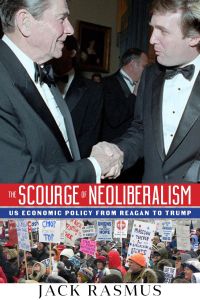
This ideological manipulation, which aims at misrepresentation and distortion of original ideas, is based on various techniques of language transformation. One such technique is to delete reference to essential propositions that are part of the original idea; to add contradictory propositions to further distort the original idea; to invert the logic and relationships of elements in the idea; to reverse the causal relationships between the elements; to substitute correlations for causation, etc. (For more detail on the methodology see my various blog pieces at jackrasmus.com on how ideology works in economics, as well as my forthcoming book, ‘The Scourge of Neoliberalism’, Clarity Press, September 2019).

Ideological manipulation is not new. A number of such notions lie at the heart of Neoliberalism. Among Neoliberalism’s most notable examples are nonsense like ‘free trade benefits all’, ‘business tax cuts create jobs’, ‘inflation is always due to too much money chasing too few goods’, ‘markets are always efficient’ (and the corollary, government is always inefficient); ‘productivity determines wage gains’, ‘central banks are independent’; ‘recessions are caused only by ‘external’ shocks to an otherwise stable system’; ‘the crash of 2008-09 was due to a ‘global savings glut’, and so on. It can be shown that none of these notions are supported by the facts

Attacks by the ideological apparatuses on ideas of Medicare for All, green new deal, socialism, and Modern Money Theory, are the new ideological offensives, now being added to the old.

Wall St. types are now leading the charge. One of the main champions of distortion from among their ranks is David Rubenstein, a host of many well known (among investors and watchers of Bloomberg news TV) interviews of famous US capitalists, and who is also a co-founder of the Carlyl Group, one of the biggest Private Equity firms (and thus shadow banks) in the world. (The Bush family has been a big investor in Carlyl). Rubinstein has been giving interviews all over on the media and attending elite conferences, attacking MMT, green new deal, medicare for all, etc. He always ends up as well with the further attack on social security retirement, mouthing the typical garbage that it’s going broke in a couple of years and therefore benefits must be cut, especially raising the retirement age (to as high as 80).

Rubenstein was joined this past week by another of his shadow banker buddies, Paul Singer of the big hedge fund Elliott Management. Together they were interviewed by Bloomberg hosts at the Aspen Conference, a gathering of the US economic elite. Bloomberg hosts fed them loaded questions about Medicare for all, social security retirement, MMT and all the rest.

The essence of Rubenstein-Singer’s attack on Medicare for All, is to grossly distort its cost, while arguing 180 million Americans love their private, employer provided health insurance. In distorting the costs they echoes the same themes being peddled around the media now by lesser hired, and well paid ideologists, in the business media, think tanks, cable shows, etc.

The gist of the attack on Medicare for All is they conveniently ignore the facts that 162 million US workers (the size of the US labor force today ) pay only a tax of 1.45% on payroll while working, and the nearly 60 million over age 65 pay only a $135 annual deductible when retired when they collect Medicare.

Compare that ‘cost’ to those households still on private health insurance. According to Kaiser Foundation’s latest report this past week, the cost of premiums for private health insurance have risen from $5000 a year in 2001 to $20,000 a year 2016 (no doubt higher now under Trump). That $20k is $1,666 a month. And that’s not counting the tens of millions who can’t afford that and who have had to opt for the barely affordable private insurance, now paying $2k to $5k annual deductibles, thousands of dollars more in co-pays, and even so facing hundreds of health procedures not even covered. And then there’s the tens of millions who can’t afford anything–even Obamacare since their states won’t participate or, if they do, the premiums have escalated beyond affordability.

That’s a comparison of Medicare, with a cost of just low hundreds of dollars a year, compared to private health insurance costing $20k a year on average and more, and sometimes far more. But you’ll never hear that comparison or facts from Rubinstein-Elliott or the other of their ilk. That’s because they simple ‘delete’ reference to such facts when they talk about and attack Medicare for All. But that’s how ideology works. Delete the facts, insert false facts, invert the logic, reverse causation, argue correlation is causation, etc. It’s all about ‘language games’ to distort the truth, so they can attack and propose their solutions that benefit them and not the rest.

Then there’s Rubinstein-Singer’s further ideological argument that 180 million want to keep their private health insurance coverage instead of being forced onto Medicare. Well, if the rich want to pay for private coverage on top of the minimal healthcare tax, they can certainly do so in the proposals for Medicare for All on the table right now. But it’s not likely that the more than 100 million US households now being gouged by private health insurance will want to keep those token plans and not want to go to Medicare. If they were so happy with their current health insurance, why do 74% of voters now say they are dissatisfied with the current health insurance system?

And there’s the growing ideological assault on anything that has to do with making the rich pay taxes or having government spend on programs that benefit the rest of us, not just corporations and investors.

What used to be accepted social programs in the 50s, 60s and 70s, designed to provide income for the middle class and working class (really the same folks), is now painted with the broad brush of ‘socialism’. Invest in alternative energy, that’s socialism. Provide relief to the tens of millions of students in debt to the tune of $1.5 trillion, that’s socialism too. Medicare? That’s really socialism. No tuition at public colleges…socialism. (But let government gouge students with 6.8% interest rates on student debt, while letting banks borrow at 0.25%, that’s ok. That’s not socialism). Stop writing government checks ($79 billion last year) to corporations with big profits, that’s socialism for the capitalists but that kind of socialism is ok). What were in past decades ‘normal’ social programs and spending are now being conveniently labeled ‘socialist’. But let them continue with that ideological theme, I say. It’s convincing two-thirds of millenials, now the biggest population group, that they prefer ‘socialism’ to the present capitalism, according to recent polls. (Of course, ‘socialism’ to them so far means ‘anything but the above’, but that’s a good place to start).

Then there’s the more sophisticated ideological attack on the emerging idea of Modern Money Theory, or MMT. Rubinstein-Singer are really against that as well. MMT in one of its propositions (elements of meaning of an idea) calls for fiscal-social spending by the central bank, the Fed, creating money and using it to fund infrastructure spending and social programs that would benefit the rest of us. It’s interesting to watch Rubinstein & Co. attack that. They say, ‘Oh, it would mean excess money and inflation, create too much debt at the central bank, it would mean a rising national debt further out of control, and so on.

But wait a minute. That’s just what the Fed did since 2009 with its ‘quantitative easing’ QE program that bailed out the banks with trillion dollar cash injections, followed by zero borrowing rates for bankers like Rubinstein and Singer for 7 more years. One didn’t hear Rubinstein-Elliott and friends complain about that QMT, ‘QE Money Theory’, because it directly benefited them. Their shadow banks–private equity firms, hedge funds, etc.–got to borrow at 0.15% for years after they were even bailed out (by 2010). They got free money from the Fed until 2016, and then the cost of borrowing went up a miniscule couple of percentages (still way below the 6.8% that students had to keep borrowing at). They loved QE and never complained about debt, inflation in stocks and bond prices, or the massive income and wealth they accumulated personally because of QE.

QE was just MMT turned on its head. Now the theorists of MMT are just trying to turn the tables on the Rubinsteins, Elliotts, et. al., by saying let’s do QE for the rest of us now. But no, in their view, the rest of us have to continue to settle for austerity in government spending–i.e. cuts in food stamps, education, transport services, medicaid, etc. We have to pay higher taxes to finance Trump’s $4 trillion tax cuts for corporations, investors and the wealthy 1% households and for Trump’s annual $100 billion a year hikes in war spending.

QE, low rates, and tax cuts are for them; 6.8% for students and tax hikes are for us. And don’t dare ask for Medicare for All, green new deals, free tuition, student debt relief, etc. It’s too costly. It won’t work. It will wreck the system, according to Rubinstein-Singer.

But the policies of the Rubinsteins, Singers, and the Goldman-Sachers and Trump now running government policy—i.e. shadow bankers all–have cost too much. Haven’t worked. And have already ‘wrecked the system’.

What they want is to continue the annual $trillion dollar plus distribution of income to their class via stock buybacks and dividend payouts ($1.3 trillion in 2018 and projected $1.4 trillion this year). Tax cuts and cheap money (QMT/QE) have enabled that historic income redistribution via stock, bond, and other capital gains markets.

Medicare for All and expanding social security retirement by raising the ‘cap’ on social security plus taxing capital incomes; bailing out students with a financial transaction tax, funding a green new deal by reversing 40 years of tax cutting for the rich and their corporations–all will mean taking back some of their $1.3 trillion firehose of income redistribution since 2008. Rubinstein & friends know that. And they don’t want that.

So Rubinstein and his buddies are now touring the country attacking proposals that would do that, and socialism in general, by distorting, misrepresenting, and outright lying about what these programs mean. Using the various techniques of playing with language to change the original meanings. To arm their class with the ‘talking points’ to carry on the attack locally as well. To establish the ‘messages’ for their media to carry via various channels daily thereafter. To get naive economist-apologists to parrot and legitimize the economic ideology as economic science in their journal articles.

The fundamental message of their ideological offensive is: Socialism for the rich: good; socialism for the rest of us: bad. Tax cuts for the rich and their corporations: good; tax cuts for the rest: bad. Subsidy checks to profitable corporations: good; subsidizing of health care or education: bad. Free money from the Fed (QE) for them: good; free money from the Fed (MMT) for us: bad.

But that’s always been how ideology in economic policy works. Only the targeted themes have changed today. The methodology of language manipulation is the same. So too are the direct beneficiaries. Just pour the new wine into the old bottles and ‘waterboard’ it, if necessary, down our throats through repetitive messaging from the institutions that deliver the ideological messaging.

Dr. Jack Rasmus is author of the forthcoming book, ‘The Scourge of Neoliberalism: US Economic Policy from Reagan to Trump’, Clarity Press, September 2019. He blogs at jackrasmus.com, and hosts the weekly radio show, Alternative Visions, on the Progressive Radio Network. His twitter handle is @drjackrasmus.

.

(The following is the last part 6 of an Interview with the American Herald Tribune reporter, Mohsen Abdelmoumen, on my views of contemporary capitalist crises today).

Mohsen Abdelmoumen:

Why in your opinion does capitalism generate crises?

Jack Rasmus:

Part of the reason is the failure of economic theory today to understand how global capitalism has been restructuring itself in recent decades. This restructuring has rendered much of traditional economic theory irrelevant, in so far as understanding and predicting the current trajectory of the global capitalist economy.

My view is not the typical mainstream (e.g. bourgeois) economics analysis of what causes (i.e. ‘cause’ here means distinguishing between what enables, or precipitates, or fundamentally drives) a crisis. There are different ‘forms’ of causation which mainstream economists do not distinguish between, but which I think are necessary. I would not characterize my view as a Keynesian, Schumpeter, Fisher, or even an Austrian (Von Mises-Hayek) economist view.None of these mainstream approaches to economic crisis analysis understand finance capital or how it determines, and is determined by, real (non-financial) capital. They don’t understand how financial and labor markets have both changed fundamentally since the 1980s.Their conceptual framework is deficient for explaining 21st century capitalism and its crises.Nor is my view what might be called a traditional Marxist approach. It too does not understand finance capital.It too tries to employ an even older conceptual framework, from the 19th century classical economics, to explain 21st century capital and crises.

    Mainstream economics

focuses only on short term business cycles and fiscal-monetary policy measures as solutions. But short term business cycle fluctuations aren’t really ‘crises’. A crisis suggests a fundamental crux or crossroad has been reached requiring basic changes in the system. Mainstream economics doesn’t even raise this as a subject of inquiry. Reality is just a sequence of short term events patched together. Or it attempts to apply business cycle analysis, and associated fiscal-monetary policy solutions, to what is a more fundamental, longer term, chronic instability condition. Consequently it fails both at predicting crises turning points and/or posing effective solutions to them. The two main trends in mainstream economics—what I call Hybrid Keynesians (which is not really Keynes) and Monetarists along with their numerous theoretical offshoots in recent decades—are both incapable of explaining longer term crises endemic in capitalism that have required the periodic restructuring of the capitalist system itself over the last century. That is, in 1908-17, 1944-53, and 1979-88.

    Marxist economists

have fared little better understanding or predicting 21st century capitalism. This is especially true of anglo-american Marxist economists, although the European and others outside Europe have been more open-minded. Marxist economists do consider the problem of longer term crises trends but attempt to explain it based on the conceptual economics framework of 18th-19th century classical economics, which is insufficient for analysis of 21st century capital. They assume industrial capital is dominant over finance capital, that only workers who produce real goods explains exploitation, and that finance capital and financial asset markets are ‘fictitious’. Hobson-Lenin-Hilferding and others attempted to better understand and integrate the relationship between industrial and finance capital at the turn of the 20th century. This led to an analysis of what’s sometimes called ‘Monopoly Capital’, a school of which still exists today. But subsequent capitalist restructurings of 1944-53 and 1979-1988 in particular have rendered such a view and analysis inaccurate.A century later, today in the early 21st, the relationships between finance capital and industrial capital have significantly changed from how Marx saw them in the 19th century, as well as how Hobson-Hilferding-Lenin envisioned them in the early 20th. In other words, contemporary Marxist economists don’t understand modern finance capital any better than do contemporary mainstream economists. Moreover, they still insist on employing classical economics concepts like the falling rate of profit, productive v. unproductive labor, and try to explain 21st century money and banking based on 19th century financial structures.Nor do they pay much attention to the new forms of labor exploitation today or explain why the unions and social democratic political parties have declined so dramatically in the 21st century.

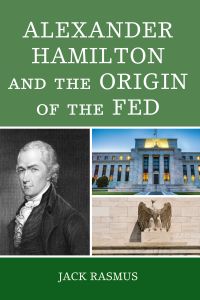
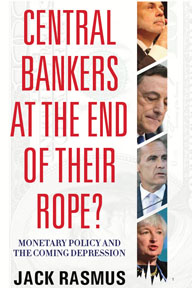
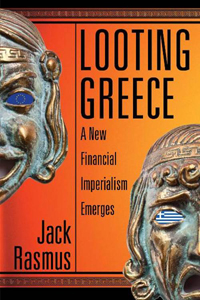
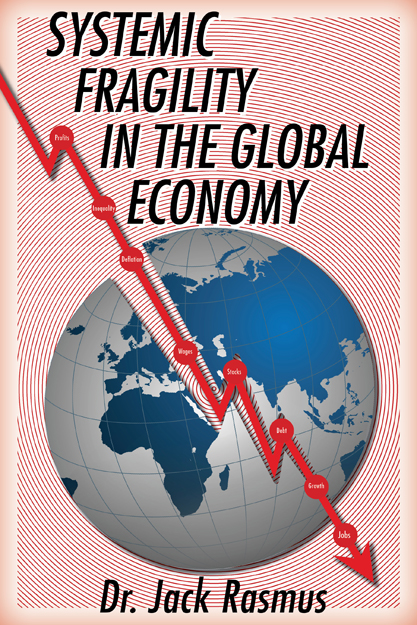
My critique of all these mainstream (bourgeois) and Marxist economic ‘schools of analysis’, and their numerous spinoffs and offshoots, is contained in Part 3 of my 2016 ‘Systemic Fragility in the Global Economy’ book. That book also advances the analysis I originally began to develop in the 2010 book, ‘Epic Recession: Prelude to Global Depression’. My books published thereafter, 2017-2019, subsequent to ‘Systemic Fragility’, expand upon the key themes introduced in ‘Systemic Fragility’. Looting Greece: A New Financial Imperialism Emerges, August 2016, expands upon analysis in chapters 11, 12 in ‘Systemic Fragility’, addressing financial restructuring of late 20th century capitalism. Central Bankers at the End of Their Ropes (August 2017)expands on ‘Systemic Fragility’, chapter 14, on monetary contributions and solutions to crises.So does ‘Alexander Hamilton and the Origins of the Fed’ (March 2019), which is a prequel to ‘Central Bankers’ as a 18th-19th century historical analysis of US banking.And my forthcoming, September 2019, The Scourge of Neoliberalism book,will expand on Chapter 15 in ‘Systemic Fragility’ addressing fiscal policy, deficits and debt.

So all my work is an attempt at a more integrated analysis of 21st century capitalist economy, its contradictions, its increasing financial—and thus general economic—instability, the profound changing relations between finance and industrial capital, its fundamental changes in production processes and both product and labor markets, the increasing failure of traditional fiscal-monetary policies to stabilize the system, and the growing likelihood of a crisis coming within the next five years, or even earlier, that could prove far more intractable and deeper than even that of the 1920s-1930s.

The Three Restructurings of US & Global Capitalism, 1909-2019

Thus far, American capital, the dominant and hegemonic form of global capital over the last century, has restructured itself successful on three occasions: the first in the period just prior to world war I (1909 -1918) and during that war, as US capital ascended in the 1920s as a global player more or less equal to British capital. British capital in this period was eclipsed as hegemonic and had to share hegemony with American capital. In the wake of the second world war British capital was displaced by American as hegemonic, starting 1944 with the Bretton Woods international monetary system created by US capitalists, for US capital, in the interests of US capital.That second restructuring (1944-1953) began to break down in the early 1970s as global capitalist stagnation set in once again. That 1970s decade witnessed a general crisis of global capitalism, especially in the US and throughout the British empire (or what was left of it). But elsewhere among advanced capitalist economies in Europe and Japan as well.

A third restructuring was launched in the late 1970s by Thatcher and Reagan.This is sometimes called ‘Neoliberalism’ (a term I don’t like but use since it is generally accepted but is somewhat ideological). The third, Neoliberal restructuring re-stabilize US and global capital and expanded US capital, from roughly 1979 to 2008. It underwent a crisis with the Great Financial-Economic crash of 2008-09 in the US, and subsequent European and Japan multiple recessions and general stagnation that followed 2010 in the ‘advanced capitalist economic periphery’ of Europe-Japan which is now the weak link of global capitalism. Trump’s regime should be understood as an attempt to restore and resurrect neoliberalism—as both a restructuring and a new policy mix—albeit in a more violent, aggressive and nasty form of neoliberalism (2.0? perhaps).

I do not believe Trump will be successful in the longer term with this restoration. He’s had definite success with tax restructuring favoring capital, but is still contending with restoring monetary system to neoliberal principles (i.e. free money/low rates/low dollar value),and is in the midst of a major conflict and resistance to restore US hegemony in international trade and money affairs, in particular from China. Should Trump fail in restoring a harsher, more aggressive Neoliberalism 2.0, it will almost certainly mean a ‘fourth’ major capitalist restructuring will follow in the 2020s. That fourth restructuring will be even more exploitive and oppressive than Neoliberalism, especially for working classes as well as for US capitalist competitors in the advanced capitalist economic periphery and emerging market economies.

My Basic Thesis On Capitalist Crises

Is that capitalism experiences periodic crises every few decades (not ‘business cycles’ that may occur in between the crises but are not crises per se) and it must, and does, restructure itself periodically in order to survive.It creates multiple imbalances within itself whenever its shorter term fiscal-monetary policy solutions no longer are able to re-stabilize a system that grows increasingly unstable over time—i.e. a system which inherently and endogenously tends toward crisis periodically. Each restructuring, however, proves to have limits. Its effect at resurrecting capitalism inevitably dissipates over time, typically 2-3 decades.As a consequence of periodic restructurings, stability and growth is restored for a couple decades, but the fundamental contradictions that lead to renewed crisis arise and intensify once again during the periods of apparent growth and stability. Thus even basic economic restructurings as solution are temporary. Think of fiscal-monetary policy as solutions for only the very short term in the case of business cycles that are due to policy errors or other non-financial forces that cause ‘normal’ recessions. Think of periodic restructurings as producing solutions for the medium term (2-3 decades). But the capitalist system’s longer term crisis is that even periodic restructurings don’t prevent the inevitable crises from reappearing.

In a recent radio interview I commented on Congress’s recent proposal to spend $983 billion, $733 billion of which will go to the Pentagon. However, that $733 billion (of Trump’s requested $750B) does not represent total US military spending. Listen to my explanation how total annual US military expenditures are really around $1 Trillion, and maybe more. And how the Democrat Party leaders keep striking a losing deal with Trump: giving him more and more war spending in exchange for just continuing spending on social programs. Why the $1 trillion + military spending every year is ballooning the total US budget deficit, and national debt, by more than $1 trillion a year for as far as the eye can see.

To Listen, Go To:

Critical_Hour_263_Seg2.mp3