Feeds:
Posts
Comments

IN an important development challenging the dominance of the US Dollar globally, and the associated US-dominated ‘SWIFT’ currency exchange payments system, Europe launched its alternative to SWIFT, called INSTEX, to get around US sanctions on Euro-Iran trade.

    Watch my video 5 minute interview on the development.

GO TO:

https://www.youtube.com/watch?v=m-q2uS66iTE

Watch my recent video interview with RT International on whether current China-Russia efforts to trade using their own currencies, in lieu of the dollar, will soon mean a displacing of the US dollar as the global trading and reserve currency.

Go TO: https://www.youtube.com/watch?v=dtDjqL8Q1kg&feature=youtu.be

Capitalist ideology apparatuses (i.e. talk shows, cable news, think tanks, business press editorialists, etc.) have been gearing up in recent months, targeting new progressive ideas that have begun to emerge: medicare for all, modern money theory, green new deal, Socialism, etc. Ideology defined here refers to purposeful manipulation and distortion of ideas in defense of the economic interests of dominate elites and classes.

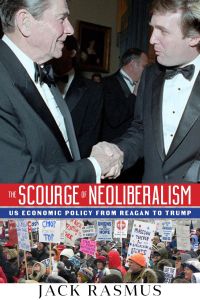
This ideological manipulation, which aims at misrepresentation and distortion of original ideas, is based on various techniques of language transformation. One such technique is to delete reference to essential propositions that are part of the original idea; to add contradictory propositions to further distort the original idea; to invert the logic and relationships of elements in the idea; to reverse the causal relationships between the elements; to substitute correlations for causation, etc. (For more detail on the methodology see my various blog pieces at jackrasmus.com on how ideology works in economics, as well as my forthcoming book, ‘The Scourge of Neoliberalism’, Clarity Press, September 2019).

Ideological manipulation is not new. A number of such notions lie at the heart of Neoliberalism. Among Neoliberalism’s most notable examples are nonsense like ‘free trade benefits all’, ‘business tax cuts create jobs’, ‘inflation is always due to too much money chasing too few goods’, ‘markets are always efficient’ (and the corollary, government is always inefficient); ‘productivity determines wage gains’, ‘central banks are independent’; ‘recessions are caused only by ‘external’ shocks to an otherwise stable system’; ‘the crash of 2008-09 was due to a ‘global savings glut’, and so on. It can be shown that none of these notions are supported by the facts

Attacks by the ideological apparatuses on ideas of Medicare for All, green new deal, socialism, and Modern Money Theory, are the new ideological offensives, now being added to the old.

Wall St. types are now leading the charge. One of the main champions of distortion from among their ranks is David Rubenstein, a host of many well known (among investors and watchers of Bloomberg news TV) interviews of famous US capitalists, and who is also a co-founder of the Carlyl Group, one of the biggest Private Equity firms (and thus shadow banks) in the world. (The Bush family has been a big investor in Carlyl). Rubinstein has been giving interviews all over on the media and attending elite conferences, attacking MMT, green new deal, medicare for all, etc. He always ends up as well with the further attack on social security retirement, mouthing the typical garbage that it’s going broke in a couple of years and therefore benefits must be cut, especially raising the retirement age (to as high as 80).

Rubenstein was joined this past week by another of his shadow banker buddies, Paul Singer of the big hedge fund Elliott Management. Together they were interviewed by Bloomberg hosts at the Aspen Conference, a gathering of the US economic elite. Bloomberg hosts fed them loaded questions about Medicare for all, social security retirement, MMT and all the rest.

The essence of Rubenstein-Singer’s attack on Medicare for All, is to grossly distort its cost, while arguing 180 million Americans love their private, employer provided health insurance. In distorting the costs they echoes the same themes being peddled around the media now by lesser hired, and well paid ideologists, in the business media, think tanks, cable shows, etc.

The gist of the attack on Medicare for All is they conveniently ignore the facts that 162 million US workers (the size of the US labor force today ) pay only a tax of 1.45% on payroll while working, and the nearly 60 million over age 65 pay only a $135 annual deductible when retired when they collect Medicare.

Compare that ‘cost’ to those households still on private health insurance. According to Kaiser Foundation’s latest report this past week, the cost of premiums for private health insurance have risen from $5000 a year in 2001 to $20,000 a year 2016 (no doubt higher now under Trump). That $20k is $1,666 a month. And that’s not counting the tens of millions who can’t afford that and who have had to opt for the barely affordable private insurance, now paying $2k to $5k annual deductibles, thousands of dollars more in co-pays, and even so facing hundreds of health procedures not even covered. And then there’s the tens of millions who can’t afford anything–even Obamacare since their states won’t participate or, if they do, the premiums have escalated beyond affordability.

That’s a comparison of Medicare, with a cost of just low hundreds of dollars a year, compared to private health insurance costing $20k a year on average and more, and sometimes far more. But you’ll never hear that comparison or facts from Rubinstein-Elliott or the other of their ilk. That’s because they simple ‘delete’ reference to such facts when they talk about and attack Medicare for All. But that’s how ideology works. Delete the facts, insert false facts, invert the logic, reverse causation, argue correlation is causation, etc. It’s all about ‘language games’ to distort the truth, so they can attack and propose their solutions that benefit them and not the rest.

Then there’s Rubinstein-Singer’s further ideological argument that 180 million want to keep their private health insurance coverage instead of being forced onto Medicare. Well, if the rich want to pay for private coverage on top of the minimal healthcare tax, they can certainly do so in the proposals for Medicare for All on the table right now. But it’s not likely that the more than 100 million US households now being gouged by private health insurance will want to keep those token plans and not want to go to Medicare. If they were so happy with their current health insurance, why do 74% of voters now say they are dissatisfied with the current health insurance system?

And there’s the growing ideological assault on anything that has to do with making the rich pay taxes or having government spend on programs that benefit the rest of us, not just corporations and investors.

What used to be accepted social programs in the 50s, 60s and 70s, designed to provide income for the middle class and working class (really the same folks), is now painted with the broad brush of ‘socialism’. Invest in alternative energy, that’s socialism. Provide relief to the tens of millions of students in debt to the tune of $1.5 trillion, that’s socialism too. Medicare? That’s really socialism. No tuition at public colleges…socialism. (But let government gouge students with 6.8% interest rates on student debt, while letting banks borrow at 0.25%, that’s ok. That’s not socialism). Stop writing government checks ($79 billion last year) to corporations with big profits, that’s socialism for the capitalists but that kind of socialism is ok). What were in past decades ‘normal’ social programs and spending are now being conveniently labeled ‘socialist’. But let them continue with that ideological theme, I say. It’s convincing two-thirds of millenials, now the biggest population group, that they prefer ‘socialism’ to the present capitalism, according to recent polls. (Of course, ‘socialism’ to them so far means ‘anything but the above’, but that’s a good place to start).

Then there’s the more sophisticated ideological attack on the emerging idea of Modern Money Theory, or MMT. Rubinstein-Singer are really against that as well. MMT in one of its propositions (elements of meaning of an idea) calls for fiscal-social spending by the central bank, the Fed, creating money and using it to fund infrastructure spending and social programs that would benefit the rest of us. It’s interesting to watch Rubinstein & Co. attack that. They say, ‘Oh, it would mean excess money and inflation, create too much debt at the central bank, it would mean a rising national debt further out of control, and so on.

But wait a minute. That’s just what the Fed did since 2009 with its ‘quantitative easing’ QE program that bailed out the banks with trillion dollar cash injections, followed by zero borrowing rates for bankers like Rubinstein and Singer for 7 more years. One didn’t hear Rubinstein-Elliott and friends complain about that QMT, ‘QE Money Theory’, because it directly benefited them. Their shadow banks–private equity firms, hedge funds, etc.–got to borrow at 0.15% for years after they were even bailed out (by 2010). They got free money from the Fed until 2016, and then the cost of borrowing went up a miniscule couple of percentages (still way below the 6.8% that students had to keep borrowing at). They loved QE and never complained about debt, inflation in stocks and bond prices, or the massive income and wealth they accumulated personally because of QE.

QE was just MMT turned on its head. Now the theorists of MMT are just trying to turn the tables on the Rubinsteins, Elliotts, et. al., by saying let’s do QE for the rest of us now. But no, in their view, the rest of us have to continue to settle for austerity in government spending–i.e. cuts in food stamps, education, transport services, medicaid, etc. We have to pay higher taxes to finance Trump’s $4 trillion tax cuts for corporations, investors and the wealthy 1% households and for Trump’s annual $100 billion a year hikes in war spending.

QE, low rates, and tax cuts are for them; 6.8% for students and tax hikes are for us. And don’t dare ask for Medicare for All, green new deals, free tuition, student debt relief, etc. It’s too costly. It won’t work. It will wreck the system, according to Rubinstein-Singer.

But the policies of the Rubinsteins, Singers, and the Goldman-Sachers and Trump now running government policy—i.e. shadow bankers all–have cost too much. Haven’t worked. And have already ‘wrecked the system’.

What they want is to continue the annual $trillion dollar plus distribution of income to their class via stock buybacks and dividend payouts ($1.3 trillion in 2018 and projected $1.4 trillion this year). Tax cuts and cheap money (QMT/QE) have enabled that historic income redistribution via stock, bond, and other capital gains markets.

Medicare for All and expanding social security retirement by raising the ‘cap’ on social security plus taxing capital incomes; bailing out students with a financial transaction tax, funding a green new deal by reversing 40 years of tax cutting for the rich and their corporations–all will mean taking back some of their $1.3 trillion firehose of income redistribution since 2008. Rubinstein & friends know that. And they don’t want that.

So Rubinstein and his buddies are now touring the country attacking proposals that would do that, and socialism in general, by distorting, misrepresenting, and outright lying about what these programs mean. Using the various techniques of playing with language to change the original meanings. To arm their class with the ‘talking points’ to carry on the attack locally as well. To establish the ‘messages’ for their media to carry via various channels daily thereafter. To get naive economist-apologists to parrot and legitimize the economic ideology as economic science in their journal articles.

The fundamental message of their ideological offensive is: Socialism for the rich: good; socialism for the rest of us: bad. Tax cuts for the rich and their corporations: good; tax cuts for the rest: bad. Subsidy checks to profitable corporations: good; subsidizing of health care or education: bad. Free money from the Fed (QE) for them: good; free money from the Fed (MMT) for us: bad.

But that’s always been how ideology in economic policy works. Only the targeted themes have changed today. The methodology of language manipulation is the same. So too are the direct beneficiaries. Just pour the new wine into the old bottles and ‘waterboard’ it, if necessary, down our throats through repetitive messaging from the institutions that deliver the ideological messaging.

Dr. Jack Rasmus is author of the forthcoming book, ‘The Scourge of Neoliberalism: US Economic Policy from Reagan to Trump’, Clarity Press, September 2019. He blogs at jackrasmus.com, and hosts the weekly radio show, Alternative Visions, on the Progressive Radio Network. His twitter handle is @drjackrasmus.

.

(The following is the last part 6 of an Interview with the American Herald Tribune reporter, Mohsen Abdelmoumen, on my views of contemporary capitalist crises today).

Mohsen Abdelmoumen:

Why in your opinion does capitalism generate crises?

Jack Rasmus:

Part of the reason is the failure of economic theory today to understand how global capitalism has been restructuring itself in recent decades. This restructuring has rendered much of traditional economic theory irrelevant, in so far as understanding and predicting the current trajectory of the global capitalist economy.

My view is not the typical mainstream (e.g. bourgeois) economics analysis of what causes (i.e. ‘cause’ here means distinguishing between what enables, or precipitates, or fundamentally drives) a crisis. There are different ‘forms’ of causation which mainstream economists do not distinguish between, but which I think are necessary. I would not characterize my view as a Keynesian, Schumpeter, Fisher, or even an Austrian (Von Mises-Hayek) economist view.None of these mainstream approaches to economic crisis analysis understand finance capital or how it determines, and is determined by, real (non-financial) capital. They don’t understand how financial and labor markets have both changed fundamentally since the 1980s.Their conceptual framework is deficient for explaining 21st century capitalism and its crises.Nor is my view what might be called a traditional Marxist approach. It too does not understand finance capital.It too tries to employ an even older conceptual framework, from the 19th century classical economics, to explain 21st century capital and crises.

    Mainstream economics

focuses only on short term business cycles and fiscal-monetary policy measures as solutions. But short term business cycle fluctuations aren’t really ‘crises’. A crisis suggests a fundamental crux or crossroad has been reached requiring basic changes in the system. Mainstream economics doesn’t even raise this as a subject of inquiry. Reality is just a sequence of short term events patched together. Or it attempts to apply business cycle analysis, and associated fiscal-monetary policy solutions, to what is a more fundamental, longer term, chronic instability condition. Consequently it fails both at predicting crises turning points and/or posing effective solutions to them. The two main trends in mainstream economics—what I call Hybrid Keynesians (which is not really Keynes) and Monetarists along with their numerous theoretical offshoots in recent decades—are both incapable of explaining longer term crises endemic in capitalism that have required the periodic restructuring of the capitalist system itself over the last century. That is, in 1908-17, 1944-53, and 1979-88.

    Marxist economists

have fared little better understanding or predicting 21st century capitalism. This is especially true of anglo-american Marxist economists, although the European and others outside Europe have been more open-minded. Marxist economists do consider the problem of longer term crises trends but attempt to explain it based on the conceptual economics framework of 18th-19th century classical economics, which is insufficient for analysis of 21st century capital. They assume industrial capital is dominant over finance capital, that only workers who produce real goods explains exploitation, and that finance capital and financial asset markets are ‘fictitious’. Hobson-Lenin-Hilferding and others attempted to better understand and integrate the relationship between industrial and finance capital at the turn of the 20th century. This led to an analysis of what’s sometimes called ‘Monopoly Capital’, a school of which still exists today. But subsequent capitalist restructurings of 1944-53 and 1979-1988 in particular have rendered such a view and analysis inaccurate.A century later, today in the early 21st, the relationships between finance capital and industrial capital have significantly changed from how Marx saw them in the 19th century, as well as how Hobson-Hilferding-Lenin envisioned them in the early 20th. In other words, contemporary Marxist economists don’t understand modern finance capital any better than do contemporary mainstream economists. Moreover, they still insist on employing classical economics concepts like the falling rate of profit, productive v. unproductive labor, and try to explain 21st century money and banking based on 19th century financial structures.Nor do they pay much attention to the new forms of labor exploitation today or explain why the unions and social democratic political parties have declined so dramatically in the 21st century.

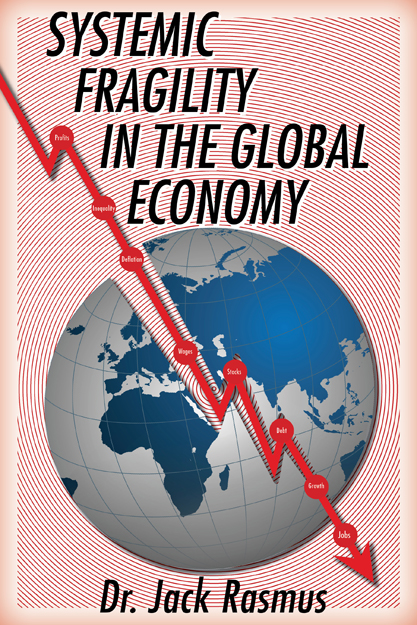
My critique of all these mainstream (bourgeois) and Marxist economic ‘schools of analysis’, and their numerous spinoffs and offshoots, is contained in Part 3 of my 2016 ‘Systemic Fragility in the Global Economy’ book. That book also advances the analysis I originally began to develop in the 2010 book, ‘Epic Recession: Prelude to Global Depression’. My books published thereafter, 2017-2019, subsequent to ‘Systemic Fragility’, expand upon the key themes introduced in ‘Systemic Fragility’. Looting Greece: A New Financial Imperialism Emerges, August 2016, expands upon analysis in chapters 11, 12 in ‘Systemic Fragility’, addressing financial restructuring of late 20th century capitalism. Central Bankers at the End of Their Ropes (August 2017)expands on ‘Systemic Fragility’, chapter 14, on monetary contributions and solutions to crises.So does ‘Alexander Hamilton and the Origins of the Fed’ (March 2019), which is a prequel to ‘Central Bankers’ as a 18th-19th century historical analysis of US banking.And my forthcoming, September 2019, The Scourge of Neoliberalism book,will expand on Chapter 15 in ‘Systemic Fragility’ addressing fiscal policy, deficits and debt.

So all my work is an attempt at a more integrated analysis of 21st century capitalist economy, its contradictions, its increasing financial—and thus general economic—instability, the profound changing relations between finance and industrial capital, its fundamental changes in production processes and both product and labor markets, the increasing failure of traditional fiscal-monetary policies to stabilize the system, and the growing likelihood of a crisis coming within the next five years, or even earlier, that could prove far more intractable and deeper than even that of the 1920s-1930s.

The Three Restructurings of US & Global Capitalism, 1909-2019

Thus far, American capital, the dominant and hegemonic form of global capital over the last century, has restructured itself successful on three occasions: the first in the period just prior to world war I (1909 -1918) and during that war, as US capital ascended in the 1920s as a global player more or less equal to British capital. British capital in this period was eclipsed as hegemonic and had to share hegemony with American capital. In the wake of the second world war British capital was displaced by American as hegemonic, starting 1944 with the Bretton Woods international monetary system created by US capitalists, for US capital, in the interests of US capital.That second restructuring (1944-1953) began to break down in the early 1970s as global capitalist stagnation set in once again. That 1970s decade witnessed a general crisis of global capitalism, especially in the US and throughout the British empire (or what was left of it). But elsewhere among advanced capitalist economies in Europe and Japan as well.

A third restructuring was launched in the late 1970s by Thatcher and Reagan.This is sometimes called ‘Neoliberalism’ (a term I don’t like but use since it is generally accepted but is somewhat ideological). The third, Neoliberal restructuring re-stabilize US and global capital and expanded US capital, from roughly 1979 to 2008. It underwent a crisis with the Great Financial-Economic crash of 2008-09 in the US, and subsequent European and Japan multiple recessions and general stagnation that followed 2010 in the ‘advanced capitalist economic periphery’ of Europe-Japan which is now the weak link of global capitalism. Trump’s regime should be understood as an attempt to restore and resurrect neoliberalism—as both a restructuring and a new policy mix—albeit in a more violent, aggressive and nasty form of neoliberalism (2.0? perhaps).

I do not believe Trump will be successful in the longer term with this restoration. He’s had definite success with tax restructuring favoring capital, but is still contending with restoring monetary system to neoliberal principles (i.e. free money/low rates/low dollar value),and is in the midst of a major conflict and resistance to restore US hegemony in international trade and money affairs, in particular from China. Should Trump fail in restoring a harsher, more aggressive Neoliberalism 2.0, it will almost certainly mean a ‘fourth’ major capitalist restructuring will follow in the 2020s. That fourth restructuring will be even more exploitive and oppressive than Neoliberalism, especially for working classes as well as for US capitalist competitors in the advanced capitalist economic periphery and emerging market economies.

My Basic Thesis On Capitalist Crises

Is that capitalism experiences periodic crises every few decades (not ‘business cycles’ that may occur in between the crises but are not crises per se) and it must, and does, restructure itself periodically in order to survive.It creates multiple imbalances within itself whenever its shorter term fiscal-monetary policy solutions no longer are able to re-stabilize a system that grows increasingly unstable over time—i.e. a system which inherently and endogenously tends toward crisis periodically. Each restructuring, however, proves to have limits. Its effect at resurrecting capitalism inevitably dissipates over time, typically 2-3 decades.As a consequence of periodic restructurings, stability and growth is restored for a couple decades, but the fundamental contradictions that lead to renewed crisis arise and intensify once again during the periods of apparent growth and stability. Thus even basic economic restructurings as solution are temporary. Think of fiscal-monetary policy as solutions for only the very short term in the case of business cycles that are due to policy errors or other non-financial forces that cause ‘normal’ recessions. Think of periodic restructurings as producing solutions for the medium term (2-3 decades). But the capitalist system’s longer term crisis is that even periodic restructurings don’t prevent the inevitable crises from reappearing.

In a recent radio interview I commented on Congress’s recent proposal to spend $983 billion, $733 billion of which will go to the Pentagon. However, that $733 billion (of Trump’s requested $750B) does not represent total US military spending. Listen to my explanation how total annual US military expenditures are really around $1 Trillion, and maybe more. And how the Democrat Party leaders keep striking a losing deal with Trump: giving him more and more war spending in exchange for just continuing spending on social programs. Why the $1 trillion + military spending every year is ballooning the total US budget deficit, and national debt, by more than $1 trillion a year for as far as the eye can see.

To Listen, Go To:

Critical_Hour_263_Seg2.mp3

The following is the latest post of my interview with Mohsen Abdelmoumum of the American Herald Tribune. Here brief comment on how US financial imperialism works in Venezuela, just as German-Northern Europe financial imperialism works in the southern Europe periphery of the Eurozone (e.g. Greece, Italy, etc.)

Mohsen Abdelmoumen:

Your article Financial Imperialism: The case of Venezuela dated last March caught my attention, as all your work that I advise our readership to read. You wrote: “Venezuela today is a classic case how US imperialism in the 21st century employs financial measures to crush a state and country that dares to break away from the US global economic empire and pursue an independent course outside the US empire’s web of entangling economic and financial relations.” In your opinion, how can Venezuela resist the US-led imperialist war against it?

Jack Rasmus:

It’s important to understand how in 21st century capitalism, where the US is clearly the hegemonic power, how the US expands, maintains, and intervenes to maintain its economic empire. If 21st century global capitalism is increasingly a financial capitalism, and depends increasingly more on financial means to expand, then its imperialism is more financial than ever before.

Unfortunately, the ‘left’ and progressives, even Marxists, are looking in the rear view mirror at imperialism.They still see it in the prism of 19th century, or early 20th century, in its forms. One of my projects is to analyze and explain how financial measures are used by US to maintain its economic empire. It is quite different from classical British imperialism, which collapsed fully after world war II and was replaced by the American empire.

In my article, ‘Financial Imperialism: The Case of Venezuela’ I explained how some of these financial measures work, and continue to work, to destabilize Venezuela’s economy and set it up for violent political change, either from within or without via invasion of some kind that is organized and managed by the US.

My 2016 book, ‘Looting Greece: A New Financial Imperialism Emerges’, looked at how it works in the Eurozone as well, with Greece a microcosm case example that has implications elsewhere. Financial Imperialism works as well within the advanced capitalist economies, where the periphery (like southern Europe) is financially exploited by the northern Europe bankers and their political elites in the European Central Bank, European Commission, etc. Trade zones and currency unions (like the Eurozone) function in this way.

What can Venezuela do to resist the US-led imperialist war against it is your question. First, it is essential for Venezuela to organize, mobilize and arm its base of popular support. This I think it has been doing. But I’m not sure it has a strategy how to use that mobilized base against its opponents, internal and external. It’s been mostly a defensive action, not going on the offensive. But I may be wrong there, since I have no way of knowing what it may be doing internally in that regard.

Second, the Maduro regime must retain support of the Venezuelan military.So far it appears it is succeeding in that regard. The recent attempted uprising by the US-puppet, Gaido, failed miserably in its attempt to co-opt and ‘turn’ the military against the government.

Third, its important that popular forces find a way to throw out Bolsonaro in Brazil and Macri in Argentina.Those two US-assisted governments would probably send the military forces should a military invasion occur in Venezuela. The US will use the OAS (note: Organization of American States)and their militaries as proxies. But if they’re out of the picture or preoccupied with serious problems at home, its unlikely they could be used.The people of Brazil and Argentina can thus play a role here as well. State allies of Venezuela could help significantly as well by trade and loans to help Venezuela. And by purchasing its oil and restoring its refinery production to offset US sabotage and sanctions. Notably here are China, Russia, Cuba and other South American countries not already the clients of Washington like Brazil, Argentina, and perhaps now Ecuador.

Finally, within the US progressive forces can work more aggressively and coordinate better their efforts to reveal to American people what’s really going on in Venezuela, how the US neocons are intensifying the attack in preparation for invasion, what’s really behind the problems in the country’s economy, etc. There needs to be something similar to the Latin American defense movement that arose in the 1970s after the Chilean coup engineered by the US and the defense of central American progressive forces in the 1980s.

Another ‘target’ of intensifying US financial imperialism is, of course, Iran. Here you can see the strategy and program how it is implemented from the beginning.

Facebook’s announcement yesterday of its plan to enter Cryptocurrency market with its Libra digital token marks its entry into a new product line of financial transactions. The announcement represents an expansion of the shadow banking system, as more and more tech companies enter financial services (Amazon has also become a financial lender). Will you buy your next house from Facebook? Why would Facebook, facing regulatory scrutiny already, enter yet another business that is increasingly coming under central bank regulatory investigation (e.g. all crypto currencies, including Bitcoin)? What’s Facebook’s longer range plan to become a financial services company? Will hackers (of Facebook) now get into your personal transactions and borrowing history? Why setting up a separate subsidiary or locating the development in Switzerland (notorious for opaque finance), will not prevent hackers from accessing your personal transactions or borrowing history! What’s Facebook’s competition in the crypto market (try Tencent in China and Telegram)? Crypto currencies as digital money and threat to central bank money supply control–already in decline and effectiveness, as I’ve argued at length in ‘Central Bankers at the End of Their Ropes’ book.

For my comments on this, check out my recent TV interview.

GO TO Toutube at:

The following is an excerpt from the interview by the American Herald Tribune and reporter, Mohsen Abdelmoumen, with Dr. Jack Rasmus. The subject focus is the decline of organized labor in the US and advanced capitalist economies under Neoliberal offensives since the 1970s, and what might be done to begin a resurrection of a unionized working class.

Mohsen Abdelmoumen:

You have worked on trade union issues and you have been a trade unionist yourself. In the face of the fierce neoliberal offensive, do we not have a vital need for a very strong trade union movement to defend the working class?

Jack Rasmus:

Absolutely. One of the great tragedies in recent decades is the destruction and co-optation of what’s left of that trade union movement. The destruction was planned in the 1970s and the implementation of a strategy of union destruction began in earnest under Reagan and has not ceased ever since. One of the greatest and most successful union strike waves in the US occurred in 1969-71 (second in scope only to 1946). Workers won wage and benefit gains of 25% in the first year of contracts at that time (1970-71). First construction trades, then teamsters, then auto and steel, then port dockworkers. Employers could not stop them. They were too well organized and remembered how still to fight from the traditions left over from the 30s and 40s. That’s when a plan was developed first to destroy the building trades. That was implemented back in the late 1970s, even before Reagan. Under Reagan the attack was directed at manufacturing and transport unions. At its core was the offshoring of their jobs and the deregulation of their industries to intensify competition to drive down wages. The beginning of the ‘contingent’ labor transformation began in the 1980s as well, then accelerated. Free trade wiped out more jobs, especially under Clinton in the 1990s. Pensions were destroyed in the private sector in the 80s and 90s. Minimum wages were allowed to lag. Healthcare costs were privatized and shifted to workers. Some workers fought back, a rear-guard action.

But the explanation for the demise of unionization in America in the private sector cannot be understood as solely the result of capitalist offensives. That was important. But so was the lack of leadership by unions at the top. They thought it would temporary, under Reagan, and they could recoup losses thereafter in membership, wages, and benefits. But it was not temporary. It continued under Democrats in the 1990s. The problem was that unions, as they weakened, turned to the Democratic Party to save them. It didn’t. As they got weaker they pleaded with Democrats even more, but the latter simply took their support for granted and did little in return. The Democrat party insisted the Unions not embarrass them by strikes, especially under Clinton. The leadership abided by the party’s request. And got weaker still, losing more members. Then came NAFTA, China, and H1-B visas giving hundreds of thousands of jobs to skilled labor coming to the US. Millions of jobs were lost after 1997 to trade. Then came tax cuts for business that subsidized the replacement of labor by capital and machinery. That devastated at least as many jobs as free trade deals. Then came the collapse of housing markets and permanent loss of millions of construction jobs. Filling the gap of jobs were more low paid service employment and more contingent part time, temp work, at lower pay and no benefits. All the while the leaders of unions pleaded with Democrats to help them. Obama promised reforms to help unions organize new members in 2008, then buried the promise once elected and having received union members’ contributions in the millions for his campaign.

The problem of declining unions is a problem of capitalist restructuring and change, of capitalist offensives to de-unionize and weaken collective bargaining. But it’s also a consequence of wrong union strategies, especially becoming more dependent on Democratic party leaders who abandoned unions once they took their campaign contributions. If unions are to resurrect themselves, and I believe they will, it will have to be an independent union movement, not depending on either wings of the corporate party of America—aka the Democrats and the Republican wings of this single, essentially capitalist party. It will probably have to assume a new kind of organizational form as well. Not organized along lines of ‘smokestacks’, for this or that industry, and not placing contracts as its key objective but forming alliances and new organizations that include allies outside of work and pursuing political-legislative objectives as equally important strategies.

Having personally lived and worked in unions when they were at their peak, and then experienced and witnessed the decline, from within and from afar, it is clear union labor will have to undergo a major organizational and strategic restructuring of its own if it is to become a force it once was. But this is not the first time historically it has undergone such a transformation and arose to resume its critical economic and political role. I’m convinced it will do it again. But only if that resurrection attempt is done independently and it breaks as an appendage of either of the wings of the corporate party of America.

For my recent interview with ‘Loud & Clear’ radio this past week on the revolt of New York renters against manipulation of rent controls by landlords, and the mobilizations going on to restore rent controls,

GO TO:

https://www.spreaker.com/user/radiosputnik/new-york-law-aims-to-tackle-affordable-h

The following is the third excerpt from my recent interview with The American Herald Tribune. The subject is the growing influence and power of Neocons in US government, and the nature of the Trump regime and the constitutional and economic crisis to which it is inevitably leading.

Mohsen Abdelmoumen:

How to explain why the influence of neocons in the US continues despite changes in presidents and administrations?

Jack Rasmus:

The neocons represent a particular right wing radical social and political base in America that has existed for some time. In fact, it’s always been there, going back at least to McCarthyism in the early 1950s, and even before. This is a radical ideological right, even pro- or proto-fascism base in the US. It was checked by the great depression and world war II temporarily but quickly arose again in the late 1940s with the advent of the cold war and China’s successful war for independence. It formed around Barry Goldwater in the 1960s. It arose again in the 1970s with Nixon.When Nixon was thrown out, it reorganized and set forth a plan to take over the American government and political institutions.It even developed position papers and internal proposals how this takeover might be achieved. Ideologues like Dick Cheney, Donald Rumsfeld, and others assumed positions of power in the Reagan administration. Their movement took over the US House of Representatives in 1994 and vowed to create a dysfunctional government that would be blamed for gridlock and give their more radical proposals a hearing as to how to break the gridlock and govern again in their interests. We saw them reassert their influence when Cheney was made vice president in 2000. He was actually a co-president, and perhaps more, as George W. Bush, was the publicized president but really a playboy figurehead. Cheney and his radical right ran foreign policy, giving us Iraq and setting the entire Middle East afire in its wake.This radical right is also behind the decline of democratic and civil rights since 2000, using the 9-11 events as excuse to push their anti-democratic agenda. The Koch brothers, the Adelman and Mercer families, and scores of others are the moneybags in their ranks.They funded the teaparty movement that has since entered the Republican party, terrorized the party’s moderates and driven them out of office and the party itself. Without them, their money, their grass roots organizations, their control now of scores of states’ legislatures, their stacking of judgeships across the country, the Trump phenomenon would not have been possible in 2016. Ideologues like Steve Bannon, John Bolton, Navarro, Abrams, Miller and others are now running the Trump administration and its domestic (immigration) and foreign (trade fights, Israel, No. Korea, Venezuela, Iran) policies.

The point is they’ve always been there, a current in US politics below the radar, but since 1994 aggressively asserting itself and penetrating US institutions with increasing success—aided by media like Fox News and their analogues in radio and on the internet.

Mohsen Abdelmoumen:

Trump made promises of employment during his election campaign and was elected on the slogan “America first” by the disadvantaged classes, especially in rural areas. Isn’t Donald Trump the president of the rich in the United States? What is your assessment of Trump’s governance?

Jack Rasmus:

That assessment must first distinguish between governance in the interest of whom? It’s been a disaster for working-class America. All Trump’s promises of bringing jobs back is just a manipulation of concerns by workers of massive job losses and wage stagnation due to offshoring of US jobs and free trade. While Trump talks of bringing jobs back, he opens the floodgates to skilled foreign engineers and workers taking more jobs based on H1-B and L-1 visas, covered up by cuts to unskilled workers entering from Central America.

Trump is a free trader, just a bilateral free trader not a multilateral one. Trump’s trade offensive is about the US reasserting its hegemony in global markets and trade for another decade as the global economy weakens. It’s a phony trade war against US allies. Just look at the deals made with South Korea, the exemptions given for steel and aluminum tariffs, the go slow and go soft with Japan and Europe. Contrast that with the increasingly aggressive attack on China trade relations—which is really about the US trying to stop next generation technology development by China in AI, cyber security, and 5G wireless. These are technologies that are also the military technologies of the 2020s. The neocons and military industrial complex in the US, along with the Pentagon and key pro-military chairpersons in Congress, want to stop China’s tech development. It’s really a two country race in tech now, with almost all the patents roughly equally issued by China and the US and everyone else way behind. So the trade war has delivered nothing for the working classes except rising prices now, and even for farmers who are the losers (but they’re given direct subsidies to offset their losses, unlike working families that have to bear the brunt of the tariff effects).

Look at the tax legislation of 2018 and the deregulation actions of 2017 by Trump. Who benefited. Business got big cost cuts. The rest of us got higher taxes to offset the $4 trillion actual Trump tax cuts for business and investors and wealthy households.US multinational corps got $2 trillion of that $4 trillion. And households will have to pay $1.5 trillion in more taxes, starting this year and accelerating by 2025. In deregulation, we get the collapse of Obamacare and accelerating premiums, while the bankers got financial regulations of 2008-10 repealed. As far as political ‘governance’ is concerned, what we’ve seen under Trump is widespread voter suppression, gerrymandering by his ‘red states’ to help him get re-elected next time, the approval of two conservative judges to the US Supreme court engineered by Trump’s puppy, McConnell, in the Senate. Then there’s the now emerging attacks on immigrants, including jailing their kids, and the attacks on womens’ rights that was once considered unimaginable.

Politically Trump has been engineering a bona fide constitutional crisis. He’s appeared to have gotten away with the Mueller investigation which should have led to his impeachment but hasn’t. He continually undermines US political institutions verbally. He clearly is moving toward bypassing Congress and governing directly by ‘national emergency’ declarations, refusing to allow executive branch employees to testify to Congress despite subpoenas, ordering the launching of a new McCarthyism by ordering his Justice dept. to start investigating opponents, etc.—i.e. all of which were the basis of Nixon’s impeachment.

In short, Trump’s governance has been a disaster for working-class America, immigrants of color, small farmers and even manufacturing companies, but a boon to far right and white nationalists whom he publicly supports. It’s been especially beneficial to wealthy households, businesses and investors, moreover. And maybe that’s the most important reason why the capitalists still tolerate him and let him remain in office. If they really wanted to impeach and remove him from office they could find a way. But he’s delivering for them financially and economically. He’s ‘good for business’, in other words. But so was Hitler.