Feeds:
Posts
Comments

COMMENTARY: WITH THE FIRST PHASE OF ‘FISCAL CLIFF’ BARGAINING HAVING ENDED WITH THE IMPLOSION OF HOUSE SPEAKER, BOEHNER’S, SO-CALLED ‘PLAN B’, THE NEXT IS ABOUT TO BEGIN ON THE THREE-STAGE APPROACH TO FISCAL CLIFF THAT I HAD PREDICTED WOULD OCCUR LAST NOVEMBER 20. THE FOLLOWING IS AN APPRAISAL OF WHY BOEHN’ERS PLAN B BLEW UP IN HIS FACE.

Yours truly having negotiated scores of contracts in various venues over the years, it is easy to recognize that House Speaker, John Boehner, really bungled as a bargainer in his recent failed attempt to push his ‘Plan B’ in the fiscal cliff negotiations a few days ago.

As Washington Post political commentator, Charlie Cook, observed in the aftermath of the collapse of Plan B, in Washington DC, it appears “the art of negotiation has been lost…these people don’t know how to negotiate”. How true.
There are at least three major axioms of negotiation that Boehner violated in his recent attempt to push Plan B and leave Obama on the defensive over the Xmas holidays.

First axiom: Never tackle the toughest or biggest (i.e. costliest) issue first in negotiations. Settle the smaller issues first and leave the big item to last; then settle the big stuff by horse-trading the most important thing you want for the most important thing your opponent wants. Boehner did the opposite. He addressed the big tax hike issue—the Bush tax cut for the top 2% from the outset. In Plan B, he in effect asked his base to agree to a tax hike in mid-stream of negotiations and when doing so would not have concluded the negotiations.

Second axiom: Never negotiate in one direction. Boehner focused on Obama and not on his base. Bargaining is always dual in nature. There’s your opponent and there’s your own supporters. Boehner lost sight of his base. From what is now leaking out in the press, it appears he somewhat desperately pushed forward with his Plan B even though he didn’t have the votes among other House Republican leaders or his base. Never call for a vote guessing on the outcome. Call for a vote you either want to fail or know will pass. Never ‘test’ your base with a vote the outcome of which you are uncertain. That’s an approach that will often lead to an ‘egg pie in the face’, and a significant loss of negotiating authority with your own base thereafter, making it even more difficult subsequently to get an agreement. If there’s a cliff here, it’s not fiscal, but the one Boehner leaped off of with his push for Plan B.

Third axiom: Never tell your bargaining committee you’re going to do what you want regardless of what they want. Never take a stand 180 degrees opposite to them. Never tell your ‘chief steward’ and bargaining committee you’re going to make an offer whether they like it or not. Who’s Boehner’s ‘bargaining committee’? For certain it includes House budget chairman, Paul Ryan, and House Ways and Means chair, David Camp. According to the Wall St. Journal lead page one story today, December 22, Boehner decided to go ahead and offer Plan B without them signing on to it. No doubt those two simply went back to the Republican base and organized a revolt against Boehner before he could even offer Plan B.
Another faux-pas by Boehner was to try to desperately put Obama on the defensive over the holidays with Plan B so he, Boehner, could look tough for his upcoming election in the house on January 3. Lesson: never play chicken in bargaining on the eve of your own election. Boehner should have delayed the negotiations big trade-offs until February, agreeing to minor stuff along the way just to keep up the appearance progress was being made. A February closure to the negotiations would have given him more bargaining leverage, with the federal government due to run out of money in March.

No wonder Boehner, after his bungled bargaining, has passed the task on to McConnell in the Senate and to the Obama team. He’s finished as a negotiator, showing his opponents he can’t get a deal and simultaneously losing all authority with his own bargaining committee and his base. His plan may have been ‘B’, but his bargaining skills grade is a generous D-.

Jack Rasmus

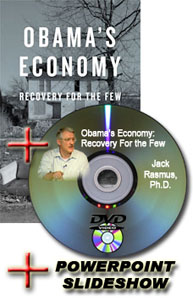
Jack is the author of the book, “Obama’s Economy: Recovery for the Few”, Pluto Press, 2012; host of the weekly radio show, ‘Alternative Visions’, on the progressive radio network, PRN.FM. His website is http://www.kyklosproductions.com, his blog, jackrasmus.com, and twitter handle, #drjackrasmus.

MY ANALYSIS OF THURSDAY’S US HOUSE (Boehner’s Boys) NO VOTE ON ‘PLAN B’–AS WELL AS AN ECONOMIC EXPLANATION WHY THE ‘FISCAL CLIFF’, SHOULD IT EVEN HAPPEN, IS JUST AN ECONOMIC ‘SPEED BUMP’, THE IMPACT OF WHICH IS GROSSLY OVERESTIMATED

Today, December 20, 2012 the US House of Representatives—aka ‘Boehner’s Boy’s—decided to not vote on the House Speaker’s ‘Plan B’ to continue all the Bush tax cuts except for token reductions on the millionaires and billionaires. The move is being hyped by the press as bringing the US economy to the edge of the so-called Fiscal Cliff. Should the Teaparty radicals who have been running the U.S. House since 2010 continue with their once-again brinkmanship through January 1, 2013, the US economy will descend over the cliff into recession once again. According to the Congressional Budget Office, the result will be an immediate 4% decline in GDP. However, this view is wrong for two reasons:

First, the House refusal to vote Plan B today, December 20, does not represent a breakdown of negotiations. It is just a tactical move designed to pass the hot potato to Obama and the Senate while they, Boehner’s Boys, break for the Xmas holiday. Why vote on Plan B now when they can do so later, after Xmas, and before the January 1 (non) deadline date? The Teapublicans need to look tough during negotiations, and appear as if they were forced into an agreement at the last moment; and this is not the last moment. Nor is January 1.

But it is increasingly clear that Corporate CEOs and public opinion is not willing to go along with a repeat of Teapublican tactics of 2011. As this writer has noted previously, CEOs want an agreement, with top income tax rates and/or revenue raised, in order to later get the big corporate tax cut Obama has promised them, reducing the top corporate tax rate from 35% to 28% later this year. They can’t get it without an agreement on the ‘fiscal cliff’, and that includes tax hikes on the personal income tax. Similarly, public opinion is overwhelmingly identifying the House Republicans as the main problem preventing a settlement. So the Boehner-Teapublican tactic to postpone a Plan B vote is likely to backfire.

Watch for a major decline in the US stock market on Friday, December 21, perhaps as much as 500 points at the market opening, with global markets to follow similarly. Watch for Corporate CEOs to up the pressure in coming week as well. The Capitalists will be sending the House ideologues a message, and Boehner will eventually bring them to heel. What postponing Plan B represents is the House radicals are refusing to appear as if they are willing to negotiate a deal; they prefer to be ‘forced’ into having to accept one. They must have a crisis before they can agree to anything.

But the economic side of the fiscal cliff is also not what it seems. Should no agreement be reached by January 1—or anytime after for that matter—there will be no economic Armageddon. There will be no renewed recession in the first quarter of 2013—at least due to the fiscal cliff. The ‘fiscal cliff’ is no cliff at all, and in reality better described as an economic speed bump derived from the Bush tax cuts. Here’s why:

The Congressional Budget Office (CBO) in its recent November 2012 report on the economic consequences if the tax cuts are allowed to expire, and spending cuts go into effect, on January 1, 2013 estimates that $503 billion will be taken out of the economy starting January 1. Another $682 billion will follow in 2014. Of the $503 billion, about $420 billion represents the expiration of tax cuts—about $80 billion in the payroll tax increase and the rest representing Bush tax cuts. Of the $85 billion or so in spending cuts, a mere $24 billion is defense spending. The rest is social program spending.

The $85 billion in spending cuts won’t hit the economy all at once in the first three months. So let’s say $25 billion will in the first quarter? The US gross domestic product, GDP, in 2013 will exceed $16.5 trillion next year easily. Conservatively estimating $4 trillion GDP in the first quarter, the spending cuts will mean a 0.6 of 1% decline in GDP. Hardly a recession due to the spending cuts.

OK. That still leaves $420 billion in tax increases that will take effect, about $80 billion in payroll hikes and the rest Bush tax cuts expiring. But as nearly all economists will admit, taxes have less an effect on the economy and GDP than spending does. In terms of an attempt to stimulate GDP, a $100 billion in tax cuts has less impact than does a $100 billion in spending increase. The opposite is also true: a $100 billion tax hike will slow the economy less than a $100 billion spending cut. It’s what economists call the ‘multiplier effect’.

Since 2008 the ‘multiplier effect’ has had significantly less impact on stimulating the economy, whether tax or spending multiplier. This has been due to the deep and rapid contraction of the economy in 2008-09, the historic weak recovery ever since, the massive unemployment, the record remaining debt overhang levels, and stagnant disposable income growth for more than 100 million households. Tax multipliers have been especially weak. Some estimates are that in recent years a tax cut of $1 has generated only a spending of that tax cut amounting to 35 cents. The multipliers are thus a fraction, not even a true multiple.

What that means in turn is raising taxes will have an equivalent weak, fractional impact on slowing the economy in 2013 just as cutting taxes has had very little effect on stimulating the economy from 2008 to 2012. The tax cuts of 2008-12, and especially the tax cuts for businesses and investors, have been mostly ‘hoarded’ and not invested. That’s why Corporate America still sits on $2 trillion in cash today and is not investing it. Business investment has been declining for months throughout 2012. Instead, corporations and investors have been, and now are increasingly, using the Bush and other tax cuts to buyback stock, pay special dividends to shareholders, invest offshore or in financial securities, etc. Stock buyback volumes this year alone will set a record of more than $400 billion in the US.

The tax cuts since 2008 did not produce much in the way of investment or jobs in the US; so ending them will not likely have all that much impact on the downside as well. If $340 billion of the $420 billion in tax hikes take effect after January 1, 2013, and if the .35 multiplier continues today, then we’re talking about $110 billion hit to the economy in the tax hikes. Over four quarters, remember. So that means about $30 billion taken out of the economy in the first quarter—or about roughly the same impact as the above $25 billion spending cut in the first quarter 2013.

That leaves only the $85 billion or so reduction from the payroll tax returning to its prior 6.2%. That impact is on the working-middle classes, who have not been ‘hoarding’ their tax cuts to the extent corporations and investors have. So one can assume the ‘multiplier’ is higher than .35 cents on the dollar. But it’s still a tax multiplier and not a spending multiplier, so it is not as if spending were cut one dollar. Generously, one can assume the payroll tax multiplier is $1 dollar for every $1 dollar tax hike. For the first three months of 2013, the impact will therefore be a $21 billion negative hit to GDP in the first quarter.

What this all means is that the true negative impact on the US economy during the first quarter from a ‘fiscal cliff’ taking effect, is no more than $75 billion on an economy that will be more than $4 trillion! A more accurate consideration of multiplier effects means the total impact on GDP is about a third of what the CBO has estimated for the first quarter of 2013. Moreover, once a deal is reached by March 27, 2013 at latest in the ‘fiscal cliff’ negotiations, most of that could be restored retroactively. What might be lost in the first quarter would mostly be restored in the second.

Even discounting an eventual deal and restoration of income to GDP in the first quarter, a $75 billion negative impact on GDP from going over a ‘fiscal cliff’ is negligible. There is no such thing as the ‘fiscal cliff’, in other words. There is a ‘Tax Cut Speed Bump’ at most.

It is far more likely that whatever deal is eventually negotiated between Obama and the House of Representatives’ ‘Boehner Boys’ will have a far more negative impact on the economy than the fiscal cliff of mostly Bush tax cuts expiration could ever have.

Not to mention the even more fundamental forces that constitute a drag on the US economy itself, from the rapid slowing of global manufacturing, trade and exports now continuing, to the refusal by big corporations to invest in the US, to the US banks refusing to lend to small businesses, to the steady decline in household consumption income for the 100 million households that constitute the middle and working class, to the growing likelihood of banking crises in Europe, growing problems in Japan’s economy, and so forth. The latter are the real threat to the US economy, not the fiscal cliff. What’s coming as a solution to the ‘fiscal cliff’, or what is best described as ‘Austerity American Style’ in 2013, is also (ironically) more a threat to the economy than the fiscal cliff. That is, the solution will prove decidedly worse than the problem itself.

In conclusion, there is no ‘fiscal cliff’ in reality—just a third derivative negative bump to the US economy in the worst case scenario.

So why all the media and political hype about the fiscal cliff? That’s how you get everyone to buy ‘Austerity American Style’ and convince them—as bad as it is—Austerity is better than the fiscal cliff that might have happened. That’s the only way they can cut social security, medicare, Medicaid, education, and all the rest $4 for every $1 they hike taxes on the wealthy and their corporations. That’s the only way they can clear the deck for historic cuts in corporate income taxes and a total pro-business revision of the entire tax code that is planned for later in 2013.

So politically there will eventually be no ‘fiscal cliff’. A deal will happen, after all the tough posturing is concluded. Economically there really is no ‘cliff’ just an economic speed bump, even should we go over it. But we won’t do that either. So watch the game play out, and then hold onto your wallets middle class and working class America.

Jack Rasmus
copyright December 2012

Jack is the author of the book, “Obama’s Economy: Recovery for the Few”, April 2012, and host of the weekly radio show, ‘Alternative Visions’, on the progressive radio network (PRN.FM). His blog is jackrasmus.com, website: http://www.kyklosproductions.com, and twitter handle #drjackrasmus where daily updates on the fiscal cliff negotiations are available.

FOLLOWING IS MY LATEST UPDATE AND ANALYSIS ON THE FISCAL CLIFF NEGOTIATIONS IN WASHINGTON. MOST RECENT EVENTS CONFIRM ONCE AGAIN MY PREDICTION OF NOVEMBER 20 (‘FISCAL CLIFF’-WHY A DEAL WILL HAPPEN THIS TIME’). OBAMA-BOEHNER ARE IN AGREEMENT ON TAXES, JUST GOING THROUGH THE PUBLIC MOTIONS TRYING TO LOOK TOUGH FOR THEIR AUDIENCES. ONCE TAX ISSUE IS RESOLVED, WATCH FOR BIG CUTS IN SOCIAL PROGRAMS TO SEAL THE DEAL. (Follow me daily on twitter for my updates, #drjackrasmus)

‘Fiscal Cliff–A Well Orchestrated Dance’ by Jack Rasmus, December 18, 2012

As the Democrats and Republicans continued their political theater this past week, coming closer step by step to an agreement on the so-called Fiscal Cliff (aka ‘Austerity American Style’), it has become increasingly clear that the key to a final agreement is how much and how to raise taxes. Given the offers and latest positions of Obama-Boehner in recent days, both are one, possibly two, steps at most away from a final agreement in principle on the tax issue. And once the tax side of the fiscal cliff debate is resolved, the spending cuts issue will quickly fall into place.

Since November 2010 and the publication of the Simpson-Bowles report, both sides have been always in agreement on the target of $4 trillion in deficit cuts. That number was confirmed in Obama’s budgets of the past two years, in Paul Ryan’s House budget proposals, in the aborted ‘grand bargain’ in the summer of 2011 between Boehner and Obama, and is the target once again, in the abrupt return to deficit cutting after the hiatus from deficit cutting during the 2012 election year. The contention has always been, given the $4 trillion target,  over how much tax increases vs. how much spending cuts; and,within the tax side of the equation, how much will the wealthiest 2% pay vs. how much the middle class will have to pay in a ‘broadened tax base’; while on the spending side, how much to cut military spending vs. how much to cut social programs, and social security-medicare-medicaid, in particular.

In a well orchestrated political dance, yesterday, Monday, December 17, Obama took the lead in the fiscal waltz and agreed to reduce the tax revenue mix a second time. After an initial offer of $1.6 trillion in tax revenue generation (tax hikes) two weeks ago, he reduced it to $1.4 trillion last week, and again, most recently, to $1.2 trillion. Boehner raised his offers for tax revenue, from an initial $800 billion to $1 trillion. A compromise at $1.1 trillion is just about what Simpson-Bowles recommended two years ago.

Boehner has also agreed in principle to some kind of increase in the top tax rate, while Obama has signaled he’s willing to give up on his $250,000 threshold, suggesting a $400,000, but indicating even this was not his last offer. Boehner offered $1 million. It’s not unlikely they’ll settle at around $600,000, which is approximately the average annual income of the wealthiest 1% households in the US.

So the parties, Boehner and Obama, are virtually agreed on the tax question. The only issue is how much tax revenue will be realized from tax rate increases vs. tax bracket manipulation. With just one or two offers from an understanding on the tax issue, the parties are already moving on to determining how much spending cuts will accompany the revenue hikes. If the final deficit reduction target is $4-$4.4 trillion over the coming decade, that means another roughly $3 trillion in spending cuts and/or tax hikes on the middle class will be necessary.

Evidence that Obama and the Democrats are about to make a significant offer in spending cuts is indicated by Obama’s meeting yesterday with Democratic House leader, Nancy Pelosi. They’re getting ready to up the ante in cuts in social programs in the next move or two. Since last week the parties’ respective positions, Republican and Democrat, spending cuts was an offer of $340 billion in Medicare-Medicaid cuts by Obama and a $600 billion proposal by Boehner. Watch for around $500 billion in Medicare spending reduction in a final deal—although not in the form of benefits cuts but in hikes in Part B and Part D deductibles and copays by retirees. So that’s a total of about $1.5 trillion in revenue from the wealthiest 1% plus Medicare over the coming decade.

Forget about the $500 billion in defense cuts called for in the sequestration deal of August 2011. That’s no longer an issue, and never was. If readers had listened close to Obama in the second presidential debate, when asked by the moderator what was his position on that issue, he briefly answered ‘that was Congress’ proposal, not mine’. The Congressional Budget Office estimates that even in the sequestration deal, only $24 billion in 2013 is scheduled in defense cuts. Look therefore for about half, or no more than $200 billion over ten years in military spending cuts. That will come from withdrawal from Afghanistan and Iraq and Army personnel downsizing. Military equipment expenditures will likely actually rise, however, after 2014 as the US military redeploys to the western pacific and Navy-Air Force spending takes precedence over Army expenditures. Defense equipment companies know the deal for them is already cut. They reportedly even have no ‘Plan B’, according to the Wall St. Journal, in the event that military spending is reduced per the sequestration agreement, which is now virtually out of the question. Unlike the reduction of the cuts in military spending by half in a Fiscal Cliff agreement, don’t expect the other $500 billion in the 2011 sequestered cuts social programs to be similarly reduced by half.

Adding up the likely amounts in a final Fiscal Cliff deal, there’s the $1 trillion in tax revenue generation, the $500 billion Medicare spending cuts, about $250 billion estimate in military spending reduction (mostly by attrition), and the roughly $500 billion in Education and other cuts scheduled since August 2011. The leaves $1.5-$2 trillion more in tax hikes and spending cuts to achieve the $4 trillion target.

That remaining amount will likely come from a ‘broadening the tax base’—i.e. the code word for cutting tax deductions, credits, exemptions, etc., now enjoyed by the middle class. That means those with annual family incomes ranging from $118,000 to the $400,000 recently offered by Obama. Expect limits on their mortgage deductions, state-local tax deductions, charitable and medical insurance deductions, education credits, etc. over the coming decade. If around $50 billion a year, ‘broadening the tax base’ will produce another $500 billion over the coming decade. Elimination of the 2% payroll tax cut will mean another $900 billion to a $1 trillion over the coming decade.

We’re now at a total of about $3.75 trillion in deficit reduction, and just a step away from the $4 trillion target. Apart from savings from interest on the federal debt as a result of the deficit reduction, and assumed tax revenue from economic recovery (which may not happen), the rest could easily come from social security, in the form of reducing the cost of living formula adjustments, raising the retirement age toward the end of the ten years, and reducing social security disability eligibility—all of which are proposals of the Republicans. If House Democrats won’t agree to the social security cuts, then additional cuts in Medicaid at about $10-20 billion a year closes much of the remaining $250 billion gap. And there’s the $4 trillion.

What we’re witnessing this past week, and the week to come, are the chief negotiators (Obama and Boehner) going through the motions publicly to appear as if they’re driving a hard bargain, in order to placate their respective bases in Congress. However, the deal is already done in principle. The dance is for the audience.

Four weeks ago, immediately following the November 6 elections, this writer publicly predicted a deal would happen. That was because major corporate CEOs were now aligning strongly behind Obama. Their joint pressure, it was predicted, would result in splitting the Republican ranks, with the Republican Senate and major corporate campaign donors putting pressure on the House radicals. All that was needed was a switch in 25 votes in the House to seal a deal. A threat of withholding future corporate campaign donations would likely sufficient to buy 25 votes in the House on the Republican side, it was argued. Obama has been meeting the past two weeks with groups of Corporate CEOs at minimum twice and three times a week. Key CEOs have been playing lobbying middlemen between the White House and the Congress—and especially the House of Representatives—now for several weeks. This Corporate CEO factor and direct involvement is a new element in the equation absent in 2011 deficit debates and reductions.

So why are Corporate CEOs so aligned with Obama this time around? Because a deficit reduction deal is a prerequisite for what they really want—a cut in the corporate tax rate, understandings on non-enforcement of the foreign profits tax, and further incentives—all of which Obama (and Romney) promised in the recent elections. Obama is on record during the elections, and well before, in favor of cutting the top corporate tax rate from 35% to 28%–i.e. where it was during the Reagan period. The idea, in other words, is to raise the rate on the personal income tax a couple percent, and later cut the corporate rate by 7% in the summer 2013 as part of a major revision of the tax code.

But major corporate tax cuts cannot happen in the current negotiations. It would look as if medicare-social security were being cut, and middle class taxes raised, in order to fund big corporate tax cuts. Moreover, cutting the corporate tax rate to 28% cannot be part of the current negotiations and still get the $4 trillion in total deficit reduction. So the corporate tax cuts will come in a subsequent phase later in 2013. And when that second phase happens, one can expect another round of cuts in Medicare and Social Security as part of that subsequent deal as well.

Whether taking place in phase one, between now and March 27, or in a subsequent phase two, in the coming Fiscal Cliff deal both the revenue hikes and spending cuts will be mostly ‘backloaded’. They will not take full effect in 2013 or even equally across the decade. Most will begin to have their greatest impact in 2014 or even in 2015 and beyond.
In terms of time lines, January 1 is not the real deadline date despite all the press hype. Cuts and tax hikes can occur after and made retroactive to January 1, 2013. The real deadline, if any, is March 27, 2013. That’s when the federal government runs out of money. A deal could be reached in key principles, if not in detail, before January 1 and more formally concluded after January 1. However, it will then be followed by a second phase deal later in 2013 in the form of a major tax code revision, which will include further spending cuts.

So sit back and watch Boehner and Obama stumble around the dance floor for another week. Most of the main elements of an agreement are already in place. Negotiations between Boehner and Obama are not the real problem. Not even Congress. The Senate has already agreed and is waiting in the wings to sign off on a deal quickly. Even Senate radicals like Coburn and Corker are fully on board.

Getting the Teapublicans in the House to buy entitlement cuts in exchange for token tax hikes on the wealthy, and getting Pelosi to corral liberal Democrats in the House to agree to Medicare-Medicaid-Social Security cuts are the real remaining negotiations.

The glue is CEOs promising some big election contributions in 2014—or the withdrawal of the same—or the withdrawal of the same. And it probably won’t take much to buy the necessary votes—from either side of the aisle in the House.
Jack Rasmus, December 17, 2012

Jack is the author of book “Obama’s Economy: Recovery for the Few”, 2012, and host of the weekly radio show, ‘Alternative Visions’, on the progressive radio network, PRN.FM. His website is http://www.kyklosproductions.com, his blog, jackrasmus.com, and twitter handle #drjackrasmus.

For my latest update on the Fiscal Cliff negotiations between Obama and Congress, go to my December 5 radio show, ‘Alternative Visions’, on the Progressive Radio Network, at the following url: http://prn.fm/2012/12/05/alternative-visions-income-inequality-america-120512/#axzz2ED5isoYj.

For an hour long in-depth discussion of the Fiscal Cliff and its origins back to 2010, listen to my radio show of the preceding week, November 28, at: http://prn.fm/2012/11/28/alternative-visions-fiscal-cliff-hold-wallet-mr-middle-class-112812/#axzz2ED5isoYj

For a print version of the background to the Fiscal Cliff, see my Chapter 7, “From Deficit Cutting to Double Dip Recession’, of my 2012 book, “OBAMA’s ECONOMY: RECOVERY FOR THE FEW’, which is posted for free on my website, http://www.kyklosproductions/articles.html

And for one-liner daily commentary, check out my twitter account at #drjackrasmus

More to Come on the Fiscal Cliff and my predictions re. the outcome. A Deal is in the works and will happen, as predicted on this blog several weeks ago. Events of the past week are moving toward confirming that, and related, predictions re. the likely content of the deal. Check this blog again on sunday evening for the latest assessment.

Dr. Jack Rasmus

Readers of this blog are invited to tune into my coming Wednesday, November 22,, radio show, ‘Alternative Visions’, to listen to an important discussion between myself, Dr. Jack Rasmus, host of the weekly show, and my guests, long time union officers and now grass roots labor-community activists in the national ‘Emergency Labor Network’ organization, Jerry Gordon of the UFCW, and Dennis Serrette of the CWA. The topic of discussion will be ‘What Next for American Unions and Labor’.

The show may be listened to live (and archived) on wednesdays, 2pm, New York time, online at PRN.FM (Progressive Radio Network). It may also be accessed from my blog page, jackrasmus.com, and website, http://www..kyklosproductions.com.

ANNOUNCEMENT:

“With wages of US workers falling for more than a decade now, chronic long term problems of job creation in the US, attacks on public workers and unions intensifying, and union membership continuing to decline—‘What’s Next for American Labor” is the topic of today’s November 22, 2012 ‘Alternative Visions’ radio show. Dr. Jack Rasmus welcomes special guests—long time union officers and activists, Jerry Gordon (UFCW) and Dennis Serrette (CWA), to discuss what should be the future direction of American labor and unions after having spent $400 million to elect politicians in each of the last two national election cycles, 2008 and 2012, and thus far having little to show for it.

“Jerry Gordon, is a long time activist in the antiwar, labor, and civil rights movements, and has been an International Representative for the United Food and Commercial Workers, UFCW, for 25 years. He is currently the national secretary of the recently formed Emergency Labor Network, ELN, a grass roots organization of union and community leaders and activists dedicated to moving American labor and unions in a more progressive direction.

“Dennis Serrete is a 49 year veteran of the US union movement, a former National Director, now retired, of the Communications Workers of America, CWA, a past president and vice president of CWA locals 2108 and 1101 in New York, a founder of the Coalition of Black Trade Unions, CBTU, in 1972 and also a member of the Emergency Labor Network, ELN, today.”

While both candidates in the recent election period were busy telling voters about their fictional economic programs, the real economic program that would emerge post-election was being formulated and debated by the elites of both parties and their corporate benefactors. Behind the scenes for months before the election, heads and CEOs of multinational and other large corporations were developing their recommendations. As the election day approached, their voice became louder and then was carried across the media in the week following the national election. Wall St. Journal, New York Times, Barron’s, and all the other pro-corporate media outlets gave preferred coverage, as the real policymakers took increasing control of the policy agenda post election.

Two years ago almost to this date the Obama-appointed Simpson-Bowles Commission released its report calling for $4 trillion in deficit cuts. The midterm 2010 elections disrupted and delayed their implementation, as the right wing injected its ‘all or nothing’ proposals into the national political equation. The next year would bring incremental deficit cutting, culminating in the August 2011 ‘debt ceiling debacle’ deal, for which the House radicals got $2.2 trillion in all spending cuts and Obama and Democrats gave up all their primary proposals in exchange for merely an agreement of no more debt ceiling brinksmanship until after the 2012 elections. As part of the August debt ceiling deal, the notorious ‘Supercommittee’ was established and mandated to deliver its version of an additional $1.5 trillion of deficit cutting by year end 2011. All that was a year ago, November 2011. But like the ‘get me re-elected first’ politicians they are, the Supercommittee House and Senate politicians of both parties agreed to ‘kick the can down the road’ one more year. The US economy moved sideways in terms of recovery for yet another year, 2011-12. Then the recent national election. The election period fantasy economic proposals of both candidates. And now the re-emergence of the real economic program the media calls the ‘Fiscal Cliff’.

Prediction #1:
Unlike in November 2010 and again in November 2011, this time a deal will be concluded over the next 90 days between the Obama administration and the Republican dominated US House, teapublicans and all.

So why this time? The fundamental reason is that Corporate America has aligned itself firmly behind the Obama administration on the matter of the deficit. Together they will force the necessary votes from the US House to close a deal. But the even more fundamental question remains. Why are Corporate CEOs firmly on board this time, and on the side of Obama? As this writer wrote when the Supercommittee kicked the can down the road a year ago, “it’s the tax cuts, stupid”. Corporate CEOs are blocking with Obama because an integral part of the coming ‘fiscal cliff’ deal will include more major tax cuts for big corporations.
For some time now, Obama has been making it clear that he proposes to cut the top corporate tax rate from current 35% to 28%. His position on that issue was virtually the same as Romney’s during the election campaign. Obama’s positions on more largesse for corporate America also include major changes in the foreign profits tax. The media has not emphasized these long standing Obama positions, however, preferring to talk about token tax loophole closings like the oil company tax and use of jet aircraft. But that’s all diversion from the real issue of further big corporate tax cuts coming, especially for the Fortune 500 largest businesses and multinational corporations.

It should be noted that these further corporate tax breaks will come despite corporations now paying the lowest effective tax rates in more than a quarter century. Corporate taxes as a percent of corporate profits in the past two years have averaged about 12.4% of profits. That compares to the annual average of corporate taxes as a percent of profits from 1989 to 2007 of 24.7%. Moreover, large corporations are also currently sitting on more than $2.5 trillion in cash and multinationals more than $1 trillion. With all that excess cash, and record low taxation as a percent of profits, how are still more corporate tax cuts justified? They aren’t, but they will be part of the coming deal—and that’s the fundamental reason why Corporate America is blocking with Obama and they together will wring a deal from the now chastised US House radicals.
The following are additional predictions concerning the coming fiscal cliff deal—i.e. a term that will soon become clear really means ‘Austerity American Style’:

Prediction #2:
The coming deal will include deeper cuts in Medicare, Medicaid, Social Security, Education, Vets benefits, postal services, and social safety net programs like unemployment insurance and food stamps than have been publicly indicated so far.

In the summer of 2011, as Obama attempted to cut a ‘grand bargain’ with House leader Boehner, he offered to cut $700 billion in each, Medicare-Medicaid, and several hundred billion more in social security and other programs. When the deal fell through in July 2011, reference to the proposed cuts was quickly dropped by the press. On the Meet the Press NBC TV show this past November 2012, Washington Post editor Bob Woodward announced he had obtained a memo with the original offer by Obama to Boehner to make such cuts. Woodward was wrong in one aspect, though. It was no secret, even in 2011. Elements of the deal were revealed at the time in July 2011 piecemeal in the press, and were summarized in this writer’s April 2012 published book, “Obama’s Economy”, chapter 7, for those interested.

What form specifically then will the social spending cuts take in the coming ‘deal’? Medicare benefits won’t be reduced, but the out of pocket cost for parts B (doctor services) and D (drugs) will rise significantly. Obama will agree to partially let the states decide on Medicaid spending. Social security benefits will be cut by reducing the cost of living formula, raising the retirement age in steps to 69, and by slashing social security disability eligibility and thus benefit payments.

Prediction #3:
The Tax Base will be ‘broadened’. That coded phrase means cuts in provisions like the mortgage deduction and other exemptions and itemized deductions. The payroll tax cut will almost certainly be phased out. In short, the middle class will thus clearly pay more. The top personal income tax rate will be raised to 39.6% but so too will the threshold, from Obama’s pledge of $250k to $500,000 or even $1 million. Other personal income tax provisions on upper income groups will also be raised, but slowly in steps over decades to come.

Prediction #4:
Defense spending cuts indicated by the sequestered agreement of August 2011—some $500 billion scheduled to take effect starting January 2013—will be suspended. If readers listened closely to Obama during the debates, he clearly indicated the $500 billion in defense cuts was ‘Congress’s proposal, not mine’. So defense spending reduction will be less than half that previously projected, mostly realized by troop pullouts from Afghanistan, veterans benefits cuts, and attrition of old equipment purchase programs.

Prediction #5:
The ‘mix’ of spending cuts to tax hikes will be no less than 6 to 1—i.e. for every dollar in tax hikes there’ll be $6 in spending cuts. Once again, history is the best indication of the parties’ future positions. In June 2011, Vice-President Biden had offered Boehner a ‘mix’ of 87% in spending cuts and a token 13% in tax loophole closings. Obama reportedly offered Boehner the same. Simpson-Bowles called for 4 to 1. The end result will be somewhere between.

Prediction #6:
The deficit cuts will be largely ‘backloaded’, taking effect in 2014 or even starting 2015 and growing in magnitude annually thereafter. Politicians will thus avoid equal annual cuts out of fear the US economy remains fragile and chance of recession in 2013 remains a distinct possibility. The US economy has been growing at a 1.7% annual rate, slightly higher in the 3rd quarter of 2012, and will grow slightly less than the third in the current fourth quarter. Whatever the final ‘deal’ on the fiscal cliff, it will not be a stimulus program in any sense but an austerity program. At first ‘austerity-lite’, then an even more austere in out years. The only question is how austere, and how much austerity ‘up front’ as opposed to back loaded. The ‘loading’, will be in out years.

Prediction #7:
There are three scenarios: A partial deal before year end 2012 to accommodate the need to raise the debt ceiling limits again before year end, followed by another bigger deal within 90 days. It is possible a one-two year deal for 2013-14 will occur by February, followed by a bigger deal focusing on major changes in the US tax code in exchange for bigger cuts in social security, Medicare, Medicaid long term over the next two decades. Alternatively, scenarios 2 and 3 may be combined.

Whatever the case, a final deal will be concluded within 90 days. It will be marked by big corporate tax cuts, higher personal income taxes including middle class taxes, the end of the 2% payroll tax cut, bigger cuts than announced for Medicare-Medicaid-Social Security-Vets-Unemployment and Food Stamp benefits, and so on. The mix will be weighted heavily toward spending cuts, except for Defense spending, and most of the impact will be backloaded beyond 2013.

Whether front or backloaded, however, the impact on the US economy will not prove positive, at a time during which the economy will show further signs of weakening in 2013, and as the global economy continues to slow and the recessions in Europe, Japan, and elsewhere continue to deepen.

Jack Rasmus

Jack is the author of ‘Obama’s Economy: Recovery for the Few’, April 2012. He hosts the radio show, ‘Alternative Visions’, at PRN.FM. His blog is jackrasmus.com. Website: http://www.kyklosproductions.com, and twitters at #drjackrasmus.

Join in to hear host Dr. Jack Rasmus today, November 14, at 2pm (eastern) time on his radio show, Alternative Visions, to discuss with union guests the possibilities of independent labor political action. The discussion will be archived on prn.fm/shows/alternative-visions/

“Dr. Jack Rasmus discusses long time AFL-CIO union activists, Alan Benjamin and Donna Dewitt, the potential for independent labor political action in 2013 and beyond. Now that the November elections are over, voters will be surprised, Dr. Rasmus predicts, how harshly the new economic program called the ‘fiscal cliff’ will result in deep cuts in programs like Medicare, Social Security, Education and middle class tax hikes—while big corporations will be given even more tax cuts and subsidies. Is this the time to begin independent political action, led by union and community activists? Is it the time to consider building a third party? Jack will discuss those questions with Benjamin and Dewitt.

Donna Dewitt is the just recently retired, former president of the South Carolina state AFL-CIO federation of labor. Donna has been involved in South Carolina union and labor politics for 45 years. An activist in her union, the CWA local 3719, for thirty years, she then served as a member of the board of the South Carolina AFL-CIO, subsequently thereafter elected as the first woman to head the state’s AFL-CIO in 1996.

Alan Benjamin is a member of the Executive Board of the San Francisco Labor Council, AFL-CIO, a member and delegate from OPEIU Local 3. He’s a member of the National Steering Committee of US Labor Against the War, the International Coordinating Committee of the International Liaison Committee of Workers and Peoples, and a past organizer for Labor Party Advocates and the Labor Party in the US, as well as editor of ‘The Organizer’ labor newspaper. Both Ms. Dewitt and Mr. Benjamin are members of the recently organized, ‘Emergency Labor Network’ of grass roots local union leaders in the U.S.”

On the surface, it appears why Obama won a second term is that he carried nearly all the ‘swing states’. But the deeper question is why did he carry those swing states? The consensus of press and pundits in the days immediately following the election is Obama carried the minority, youth (18-29), and to a lesser extent the women vote. But that still doesn’t answer the even more fundamental question why he carried these groups in those swing states? And Press and pundits stop at that point.

As the voting began on Nov. 6, I predicted Obama would win the electoral vote, in a range 280-291 to 248-257. (see my blog, jackrasmus.com, entry of early morning Nov. 6). That range of electoral votes was predicated on the assumptions that Obama-Romney would split Ohio and Florida, leaving the remaining key states being Virginia and Colorado. Obama needed to win one, I argued, and Romney both of these two states as well as several of the smaller states of New Hampshire and Iowa. As it turned out, Obama won both Virginia and Colorado, as well as all three of the smaller states. That put his total at 303 in fact,–i.e. just above the 291 high end range that I estimated he’d get had he lost Virginia and a couple of the smaller states. All the other states’ electoral votes turned out, however, much as I had predicted (Florida still pending). So it was a moderately close prediction.

So why did Obama win the swing states? Why did he carry the minority and youth vote so convincingly? And what can those groups, who clearly put him in office for a second term, expect in return with regard to policies and programs the next four years?

To begin, the Hispanic vote clearly made the overwhelming difference in Colorado, Nevada, and, together with the black vote, in Virginia (in retrospect it probably played an important role as well in Iowa). But describing it as ‘Hispanic’, African-American, and even the youth vote, leaves out a more fundamental dimension: this was a ‘working class vote’ even though the press refuses to define it as such. That point is important, given that throughout the election campaign the past two years Obama’s team of advisers and he himself repeatedly indicated the key voting bloc that would make the difference in the election was the ‘independent voter’ and the ‘middle class’, especially the upper income urban professionals.
The minority groups that made the big difference in the swing states of Virginia, Colorado, Nevada and Iowa—especially Hispanics—represent the major force that put Obama in the White House for a second term. They are not the much heralded ‘middle class’ households making $100,000 a year incomes that the Obama team said was their primary target during the election campaign. Nor are they the ‘independent urban professionals’, who almost all earn more than $100,000, that Obama’s advisers kept saying was the key to winning the White House the past two years.

71% of Hispanics voted for Obama and turned out in even greater numbers than in 2008. That bloc is solid working class, the vast majority of whom earn less than $50,000 a year. The same can be said for African-American voters who probably made the difference in Virginia, turning out big in the southeastern part of that state.

In start contrast, the ‘independents’ and ‘urban professionals’ earning $50-$100k a year stayed home or reduced their vote for Obama. Their Obama vote fell from 52% in 2008 to 45% in 2012. Some post-election polls estimate only 24% of this group bothered to vote. So it wasn’t the independents or middle class, it was the minority working class that had the biggest impact on Obama’s re-election.

The key point that it was workers who put Obama back in office also applies the equally important swing state of Ohio and the neighboring key states of Michigan and Wisconsin. In Ohio-Michigan-Wisconsin union workers made the difference in carrying those important states. Union labor certainly gave Obama Ohio, and just as probably prevented Michigan-Wisconsin from going Republican. In these states union workers are overwhelmingly manufacturing, construction, industrial and public employees and not ‘independents’ or ‘urban professionals’. Outside the Ohio to Wisconsin ‘arc’, however, union households’ vote for Obama fell somewhat, as the same households vote for Obama increased significantly in those Midwest swing states.

Yet what is heard repeatedly by the press and media pundits is that the ‘working class’ vote in general has gone Republican. That’s only true if one believes that the millions of Hispanics, blacks, and the majority of the 18-29 working class youth, who made the key difference in several of the key states, are somehow not in fact ‘working class’. Or that those voters in the key arc of Ohio-Michigan-Wisconsin, a majority of which were ‘white’ by the way, were also not working class.

So it was minority workers, young workers, and union workers in the northwest that carried the swing states that put Obama in office—and not the upper middle class, independents, and professionals. So why did they do it? And what can they expect in return from Obama during his second term?

First, despite deporting more undocumented workers than George Bush, Obama did an about face before the election and endorsed the ‘Dream Act’ for immigrant (hispanic) youth. In contrast, Romney talked about how they should ‘self-deport’ themselves to solve the so-called immigration problem. The student segment of the youth vote was captured by Obama by his shift to hold the line on the cost of student debt and Obamacare provisions to continue health insurance coverage. Romney’s position was students should borrow more from their parents and repeal all of Obamacare. And the Great Lakes region union vote no doubt was influenced by the bailout of the auto industry and the Obama teams’ successful spinning of the event, even though only 157,000 or the 340,000 lost auto jobs have been recovered and much of the latter at two-tier, low paid $14/hr. jobs. Romney argued the auto companies and jobs should ‘go bankrupt’ (and let the private equity vultures like his ‘Bain Capital’ pick their economic bones, no doubt).

So some minimalist concessions to their direct interests were made prior to the election. Nothing like the $13 trillion bail out of the banks, of course. But nevertheless something. In contrast, Romney made it clear to them their future would be ‘far less than something’.

Post-election November 2012, the biggest question remains: will Obama deliver for these working class groups that put him in office a second time? Or will it be ‘concession time’ again, with those who put him in office a second time asked to pay the lion’s share of deficit cutting?

With the election over, the real economic program for the next four years is about to be revealed. It’s concealed behind the fascade called ‘fiscal cliff’. The economic promises of both candidates during the election was only talk, both candidates telling their constituencies what they thought they wanted to hear. Now the real thing—the real economic program—is about to appear. Will ‘fiscal cliff’ mean those who put him in office pay the biggest price, while the wealthy, corporations, defense companies, bankers, stock and bond traders, and all the rest of such get yet another mostly ‘free ride’, as has been the case the past four years? With only three days since the election, Obama has publicly invited House Speaker, Boehner, to restart negotiations on the so-called ‘grand bargain’ that was postponed in the summer of 2011. Signaling willingness to once again engage in major concessions, Obama publicly declared he was not wedded to his prior stated economic program or objectives. Stay tuned for the next few weeks, as the political fog called US national elections slowly burns off and the true outlines of real economic program being cooked behind the scenes the past several weeks by the powerful economic and political elites of both parties becomes increasingly clear.

Jack Rasmus, November 9, 2012
Jack is the author of the recent book, ‘Obama’s Economy: Recovery for the Few’, 2012, and host of the radio show, ‘Alternative Visions’ on the progressive radio network, PRN.FM. His blog is jackrasmus.com, website http://www.kyklosproductions.com, and his twitter account, #drjackrasmus.

This morning the polls opened for the election. Before exit polls start their estimation, I offer the following prediction this morning, Nov. 6, for the eventual election results as follows:

Obama: 281-290 electoral votes
Romney: 248-257 electoral votes

Should Obama win, don’t expect anything different for the US economy, besides more ‘stop-go’ recovery at best and a growing liklihood of a double dip in 2013, given industrial production and real income (and thus consumption) again beginning to weaken, and government spending virtually certain to join the relapse again in the first quarter of next year.
While at it, I will predict yet another ‘jobs relapse’ in the first quarter of next year, and more ‘bumping along the bottom’ for construction spending (except for apartment building).

Watch for my year-end assessment of last year’s (Jan. 2012) predictions for the US and global economy (much of which has turned out to be accurate), and predictions for the coming 2013-14 period. The article will appear in Z magazine’s Jan. issue, and will be posted on my website, http://www.kyklosproductions.com, as well as discussed on my radio show, Alternative Visions, on the progressive radio network in coming weeks (PRN.FM).

With the election about over, the ‘real economic program’ of the two wings of the single party system in the US will be revealed. It’s called the ‘Fiscal Cliff’, and it will contradict most of what the two presidential candidates have been feeding the public to date. More on this as well in coming weeks.

Dr. Jack Rasmus

With less than a week to go to the November national elections, popular polls show Obama and Romney are either in a dead heat tie or Romney slightly ahead in the popular vote. What counts, of course, is not the popular vote but the archaic US system of electoral college votes—a legacy of one of the most undemocratic procedures borne from the US Constitution.

Much focus by the press in recent days has been on the so-called ‘swing states’ which will decide the election outcome. Apart from the swing states with their potential electoral votes, our this writer’s estimate is that Romney has 204 electoral votes firmly in hand while Obama has 224. Romney’s total includes states like Arizona (10) and Montana (3) that some pollsters erroneously indicate as swing but will go, as they always have, to the Republican candidate. Obama’s total includes Pennsylvania (21), Michigan (17), Minnesota (10) and Oregon (7), all leaning comfortably toward Obama.
That leaves the true swing states with electoral votes as follows:

Virginia 13, Colorado 10, Ohio 18, Florida 29, North Carolina 15, Wisconsin 10, Iowa 6, Nevada 6, and New Hampshire 4.
Pundits have identified Ohio and Florida as the key swing states. Whoever wins the two, easily wins the election. But Ohio and Florida are not the key. That’s because it appears increasingly that Romney and Obama will split these two largest states. Obama is ahead in Ohio, giving him 18 more votes and Romney in Florida, giving him 29 more.
The tally then is Obama with 242 and Romney with 233.

Of the remaining swing states, this writer predicts Nevada (6), Iowa (4) and even Wisconsin (10) will go to Obama—the latter the home state of Republican VP Ryan. That gives Obama another 20 electoral votes, for a total of 262. 270 are needed to win. Should Romney prevail in North Carolina (15) and New Hampshire (4),where he is ahead, he would have 252 total electoral votes.

That leaves Virginia (13) and Colorado (9) as the remaining key states. And they are in a statistical dead heat toss up. Both states polling show 47.8% popular support for both candidates in both states.

Obama has to win at least one of the two, Colorado or Virginia. Romney has to win both. That means a slight advantage to Obama, but with a dead heat in both and momentum in the final week going to Romney, Obama could easily lose both states.

The coming election promises to be the tightest not only in terms of popular vote but also electoral votes, with margins of less than 20 and even as little as 10 between the two candidates. This writer has noted since 2011 that the outcome will depend upon whether Obama can turn out the vote for those who supported him in 2008 but who have become deeply discouraged and disappointed in his pro-corporate policies and constant concessions to business and Republicans since the summer of 2010. If these erstwhile supporters vote with their backsides and stay home, Obama will lose. That raises the ironically strange outcome of the US electing a financial speculator-banker, Romney, four years after the same crowd of banker-speculators brought us the banking crash of 2007-08 and the chronic no-recovery economy (for us, not them) of the past four years. The choice for the US electorate in this strange national election year has been to vote either for a set of policies that have not brought general economic recovery (Obama) and that will likely not do so for another four years, or to vote for a set of policies (Romney) that will make conditions still worse and return the US to yet another reshuffled version of Bushonomics-Reaganomics that has contributed much to the current continuing economic crisis.

It’s all the more strange, given that a national Gallup poll recently showed that 61% of independents are in favor of another political party, neither Democrat or Republican, and even 60% of liberals and conservatives say the same.
What the current election debates and the past decade together have shown is that there isn’t a two party system in America. There’s a one-party system with two wings. Time to create a true alternative, is it not?

Dr. Jack Rasmus
October 31, 2012
Jack is the author of the 2012 book, ‘Obama’s Economy: Recovery for the Few’, and host of the radio show, ‘Alternative Visions’, on the Progressive Radio Network, PRN.FM. He blogs at jackrasmus.com and can be followed on twitter at #drjackrasmus. His website is http://www.kyklosproductions.com.