The just issued today Congressional Budget Office Report on income inequality for 129m households in USA in 2018–first year of Trump’s $4T 10 yr. tax cuts–were as follows:
*The richest 0.01% households’ (13k of 129m total US households) average income in 2018 was $44.5m. The richest 0.1% was $5.8m. The remaining richest 0.89% of the richest 1% households was $1.1m.
* Average after tax income for richest 1% households rose 268% since 1979 (almost 7%/yr.). In contrast, for middle classes income rose 53% (just over 1%/yr.) And that’s 1% for the middle income groups on a much smaller total income base than 7% for the richest 1% households on much higher total income base
Archive for 2021
Latest Income Inequality Stats from CBO
Posted in Uncategorized on August 4, 2021| 1 Comment »
2 Interviews: Senate Infrastructure ‘Deal’ & Rent Evictions Moratorium
Posted in Uncategorized on August 4, 2021| Leave a Comment »
Listen to my latest 2 radio interviews of this past week on the interim deal reached in the Senate on Infrastructure bill negotiations; and the recent Supreme Court ordered rent evictions moratorium suspension and Biden’s temporary reinstatement.
https://drive.google.com/file/d/1KjCe_MnWoILqvqA8_3jzW0fD2DpHP9Gr/view
https://www.spreaker.com/user/radiosputnik/us-eviction-ban-expires
Evictions & the US Supreme Court
Posted in Uncategorized on August 4, 2021| 1 Comment »
I was recently asked my view on the expiration of rent moratorium on July 31 and, specifically, the role of the US Supreme Court in the matter. The inquirer wanted to know if the expiration, ordered by the Supreme Court, will precipitate a constitutional crisis, as the Biden administration has extended the moratorium another two months until October 3 nonetheless, despite the Court’s declaration the Executive Order establishing the initial moratorium until July 31 had to be ended on that date. What follows is my initial viewpoint on the evictions scandal set forth in my reply to the inquirer. A further, more comprehensive analysis in a written article, to be posted on this blog, will follow.
INQUIRY:
We’re discussing the announcement by the US Centers for Disease Control and Prevention that it was renewing the ban on evictions that expired on July 31, setting the stage for a constitutional showdown after the US Supreme Court ruled earlier this year that the public health agency didn’t have the authority to issue such a ban. After days of protests outside the US Capitol and appeals by federal lawmakers, US President Joe Biden has bowed to popular pressure and directed the CDC to extend the federal eviction moratorium until October 3. The move will protect perhaps 90% of American renters as more than 11 million people remain behind on their rent payments, according to CNBC. To what extent does the CDC have the right to bypass the Supreme Court decisions, and what’s next for the people who are on the eviction list, after the moratorium expires or is deemed unconstitutional and annulled?
MY REPLY:
I doubt very much this will get to the Supreme Court again by October 3. That’s why, I believe, Biden only extended it a couple months—not until the end of the year. Were it the latter, then SCOTUS might have reviewed it again. In short, I don’t see a constitutional crisis occurring as a result. Of course, there will be numerous lower court actions pushed by Republicans. But no action by the Court for the token two month extension. It won’t want to provide fodder to the commission now authorized to review the Court itself; and growing calls for reducing their terms from life to 14 years, or expanding its numbers. The Court won’t want a direct conflict with Congress or the Executive.
As for the evictions themselves, the 11m is an understatement. As I understand, that’s the potential number for renters whose housing is someway supported by federal financing or other support. There are actually 48m or so rental units in the US, and I’ve heard actual renters about 80 million. Evictions have been going on for millions since the beginning of this year, especially in states (mostly ‘red’) controlled by Republican legislatures and governors who have been engaging in a quiet ‘austerity’ campaign, cutting back rent support for non-federal rental units, pandemic unemployment assistance, small business loans, etc.
As for rental payments in arrears, there are those in forbearance and those not but behind in rent payments more than 60-90 days. The actual numbers are not accurately reported by the press. It depends whether you include forbearance, in arrears 60 days, or 90 days, or more, and if you include federal supported rental units or all rental units. Earlier this year I saw figures that the total back rent owed was $75 billion. Biden’s American Rescue Plan authorized $52B I think. But only $3B has been distributed. All we get from the mainstream press is that it’s due to bureaucracy. That’s too simplistic.
As I’ve been informing my radio show listeners and my blog audience, the $40B or so unspent on rent assistance to date compares to the Federal Reserve’s continuing $120B/mo essentially ‘free money’ being distributed to banks, businesses and investors at negative (real ) interest rates. No one, including SCOTUS, is concerned about that are they? The Fed will continue doing so until at least a year more, probably after that as well. We can make the same point with the $53B in unemployment benefits assistance authorized in the American Rescue Plan that will now be diverted to pay for the Infrastructure bill, along with other diversions and smoke and mirrors financing of Infrastructure in order to avoid restoring a few of Trump’s tax cuts!
The real Constitutional issue is SCOTUS itself. Nowhere in the Constitution is the right given to the court to declare Executive Orders or Laws unconstitutional. But Congress has allowed it to continue. We see a series of decisions in recent decades where the Court it slashing away at what’s left of democracy in America: the evictions case is just the latest. Not long before, there’s the support for voter suppression by further gutting the Voting Rights Act; there’s decisions endorsing further gerrymandering; there’s Citizens United and its further similar decisions; and of course there was the ‘selection’ of George Bush Jr. in 2000. Some refer to the Imperial Presidency. The Imperial SCOTUS is just as much a problem. SCOTUS itself is the constitutional issue. But of course mainstream media won’t go there.
It’s unfortunate the evictions are occurring (notwithstanding the 60 day moratorium extension on some rental units), just as unemployment benefit assistance has been cut (in some states early), as the small business loan programs have ended, and as inflation is growing. Republicans and the corporate wing of the Democrats are betting that the economy, now opening up again (as it did last summer) will be sufficient to generate a sustained recovery this time with the aid of the vaccination campaign. However, the economy growth is slowing, and I’m betting it will relapse again by end of year. We have a ‘rebound’ going on, but not yet a sustained recovery. And we have a premature shadow austerity policy shift emerging as it slows. The American Rescue Plan stimulus is fading. The Infrastructure bill is too small and won’t take effect until well into 2022. And the $3.5T Family plan will never see a budget resolution vote to get it passed. It’s already DOA. And Delta Covid is taking off, in the US and globally. These drags on the recovery may well negate the effects of the reopening eventually. We could have another repeat of the rebound of summer 2020 relapsing by year end once again. Although probably not as strong a relapse this year as in 2020, since there won’t be any closure of business this time.
Dr. Jack Rasmus
August 4, 2021
Economic Update: US 2nd Qtr GDP first look, Fed Meeting & Infrastructure Negotiation Follies
Posted in Uncategorized on July 30, 2021| 1 Comment »
For my update on key economic events of this past week–i.e. US GDP report, Fed meeting & Powell’s press conference & status of latest infrastructure negotiations–listen to my Alternative Visions radio show today.
Go to:
SHOW ANNOUNCEMENT:
Dr. Rasmus discusses 3 key events of the past week and how they’re related: (1) What does the preliminary report on 2nd Quarter 2021 US GDP really indicate? Is it a ‘V’ or just the first half of a ‘W’ given economic indicators showing a slowing of US recovery in the second half 2021. (2) the Federal Reserve meeting showed chair Powell is intent on continuing pumping in $120B of free money to the banks and investors every month for at least another year. Plus keep a second $1T spigot is now permanently open in the Repo Market for stock speculators as well. Why then are banks and investors continuing to get all the free money, while politicians keep cutting the promised fiscal stimulus for working and middle class households and the poor? Why Sanders’ $3.5T Family Bill Dead on Arrival! (3) Rasmus next addresses the phony Infrastructure deal and the Dems latest concessions to McConnell & Republicans in the name of ‘bipartisanship’. .
Marx’s Economics vs. Marxist Economics, Part 3
Posted in Uncategorized on July 27, 2021| Leave a Comment »
My third and final radio show commentary on Marx’s economics vs. contemporary Marxist (and mainstream) economists’ distortion of his views. Discussion focuses on the two historic distortions: the falling rate of profit thesis (contemporary Marxist economists) and the transformation problem thesis (mainstream).
TO LISTEN GO TO:
SHOW ANNOUNCEMENT
In this final 3rd show discussion the differences between what Marx said and what economists today erroneously say he said, Dr. Rasmus addresses two historic issues in Marx’s analysis of capitalism. First is the idea, held by many contemporary economists who consider themselves Marxists, that under capitalism the rate of profit tends to decline over time, leading to ‘crises’ in the form of severe business cycle contractions (recessions, depressions, etc.). Rasmus shows this is incorrect, that Marx’s ‘Falling Rate of Profit’ tendency is a ‘in the long run’ supply side argument about the breakdown of capitalism and not an explanation of short run business cycle ‘crises’ like economic depressions. Rasmus debunks the assumptions in the Falling Rate of Profit tendency argument and explains how 21st century capitalist instability cannot be explained by a singular focus on profits. The second issue addressed is by contemporary mainstream economics critics of Marx, who hold that Marx failed to explain how values get transformed into prices in the real world and therefore Marx’s explanation of how exploitation of labor drives capitalist profits is never proven and thus Marx’s entire body of analysis should be rejected. Again, a single variable (price) is basis for rejection of everything else Marx said, just as a single variable (profit) explains everything he said. Rasmus concludes with commentary why both contemporary Marxists and Mainstreamers fail to understand the financialization of capitalism today as a key source of crises, short run and long.
On the State of the US Economy–2 Radio Interviews
Posted in Uncategorized on July 19, 2021| Leave a Comment »
Listen to my interviews of last week on the state of the US economy, status of infrastructure negotiations, inflation, spending, etc. Will the US economy experience a repeat of last year (2020) growth trajectory–i.e. surge in 3rd Quarter followed by relapse in 4th–as Republican (+ blue dog Dems) coalition halts further fiscal stimulus, bets on reopening of US economy as sufficient, which then proves insufficient for sustained recovery in 4th quarter 2021? Or will Dems & Biden drop bipartisan bullshit and push budget reconcilation? Bet on the former. Biden has already agreed to McConnell position on Infrastructure by dropping all efforts to raise taxes (and abandoning this past weekend his proposal to have IRS recoup $700B in tax avoidance & fraud) to pay for infrastructure. Biden & Dems have now in effect capitulated on infrastructure bill, accepting McConnell’s on spending and taxing. Dems will now turn to hyping their $3.5T new spending proposals (made up of cuts to original infrastructure + family support bill) knowing it too will never pass. Biden won’t use budget reconciliation for either infrastructure or $3.5T. And won’t abandon filibuster (opposed by Manchin-Senema). In short, fiscal stimulus is over for 2021-22. Covid Relief Act (American Rescue Plan) of last March) will dissipate after 3rd quarter (just as Care’s Act in March 2020 did). Economy will slow again in 4th quarter 2021, as it did last year 2020.
TO LISTEN GO TO:
Or GO TO:
https://drive.google.com/file/d/1migo5rUOKTSiiVbDjU7719ClrzxbN7tf/view
Marx’s Economics vs. Marxist Economics: Part 2
Posted in Uncategorized on July 16, 2021| 1 Comment »
Dr. Rasmus continues part 2 of the 3 part series explaining how ‘Marx’s Economics’ is not the same as ‘Marxist Economics’, as well as explain what Marx said is quite different from what mainstream economists claim he said. Why Marx’s Economics should be understood as both a continuation and a critique of classical economics that preceded him. Like Keynes later (see prior shows), Marx adopts much of the classical economics conceptual framework, adapts and changes key concepts and propositions of classical economics, but introduces totally new concepts and analysis that fundamentally critiques classical economics as well. But in the final analysis, like classical economists Smith, Ricardo and others, Marx’s analysis is a long run, supply side (production), explanation of how the capitalist economy changes and evolves, and eventually experiences a stagnation and breakdown, driven by an intensification of exploitation of labor. Rasmus explains why intensifying exploitation does not necessarily mean ‘impoverisation’ of labor and why workers’ standard of living under capitalism may rise while their exploitation grows even faster (and thus capitalists grow wealthier and income inequality expands).
TO LISTEN GO TO:
SHOW ANNOUNCEMENT
Dr. Rasmus continues the clarification of what Marx really said vs. what contemporary economists (Marxist & Mainstream anti-Marxist) claim as Marx’s economics. Dr. Rasmus explains the 10 conceptual innovations Marx makes on the framework of classical economists before him (Smith, Ricardo, et. al.) to develop his theory of capitalist exploitation that drives the system to a breakdown crisis in the long run. After recapitulating the origins of Marx’s economic analysis and concept innovations on classical economics, begun last week, Dr. Rasmus discusses in Part 2 today the ‘heart’ of volume I of Capital: Marx’s conceptual innovations of Absolute and Relative Surplus Value, which explain how labor is exploited in production, creating a surplus that capitalists appropriate for themselves. Dr. Rasmus provides examples of how both forms of exploitation exist today in 21st century and are in fact increasing, leading to more exploitation of labor, not less. Plus, how ‘secondary’ forms of exploitation are also becoming more widespread. (Next week: Part 3 on the arguments against Marx by mainstream economists and the weak analyses by those calling themselves contemporary ‘Marxist Economists’)
Marx’s Economics vs. Contemporary Marxist Economics: Part 1
Posted in Uncategorized on July 13, 2021| 1 Comment »
Listen to my Alternative Visions radio show of July 8, 2021 for the first of a three part series on what Marx really said, as opposed to what contemporary economists (marxists & non-marxist) claim he said. (This series follows the preceding three weeks of shows which explained how Keynes’ economics were not ‘Keynesian’ economics)
To listen to the Part 1 of Marx’s economics, GO TO:
SHOW ANNOUNCEMENT
Dr. Rasmus continues his analysis of three great economists (Keynes, Marx, Smith) in today’s first of 3 part series on ‘Marx’s Economics’. What are the origins of Marx’s economic thought? How it critiqued classical economics before him, while borrowing and adapting concepts from the classicals. What were the original contributions of Marx’s economics, conceptually and otherwise. Why Marx is about long run, supply side evolution of capitalist economy and the possibility of eventual breakdown of the system (and not about explaining recessions or depressions). Marx’s great innovations in quantifying the labor theory of value and explaining how and why capitalism evolves fundamentally by means of exploitation of labor. (Next week: contemporary examples why exploitation of labor is intensifying in both absolute and relative terms in the USA over at least the last 40 years. What Marx could not see in the evolution of capitalism in the 21st century).
US Economy: Recovery or Summer 2021 Rebound 2.0?-Two Interviews
Posted in Uncategorized on July 10, 2021| 2 Comments »
Listen to my latest, early July 2021 radio interviews (15-30 min. ea.) on state of the US economy, whether sustained recovery is underway or not, and latest developments re. inflation, jobs, infrastructure negotiations, growing wealth inequality, Fed policy, etc.
TO LISTEN GO TO:
https://drive.google.com/file/d/1cgqHUp8IvMUOdVNYOaxaVCqEv4yvWDAP/view
https://www.spreaker.com/user/8544886/price-hikes-and-inequality-in-the-new-gi
Part 3: Keynes’ Economics vs. Keynesian Economics-Finance Capitalism
Posted in Uncategorized on July 3, 2021| 2 Comments »
Listen to Alternative Visions show of July 2, 2021, which concludes a 3 part commentary on why Keynes’ economics is not Keynesian and why mainstream economists have purged much of Keynes’ original ideas to make them ‘fit’ with their more conservative (pre-Keynes economic) analyses of capitalist economy. ‘Keynesian’ economics as a bastardized, hybrid of ‘safe’ Keynes and pre-Keynes economic analysis vs. Keynes’ economics as a more fundamental critique of capitalist economic analysis. (Next week listen to the show for the start of a 3-part similar analysis of Marx’s economics and why Marx failed to fully break from his bourgeois classical economics (Smith, Ricardo, et. al.) predecessors’.
To Listen to the show GO TO:
https://alternativevisions.podbean.com/e/alternative-visions-part-3-keynes-economics-vs-keynesian/
Show Announcement
Dr. Rasmus concludes the 3-part overview of why Keynes’ economics is not ‘Keynesian’, focusing on the sometime radical conclusions and analysis of Keynes that is conveniently ignored by mainstream economics. Recapping the two prior shows explanation, Rasmus addresses Keynes’ views on financial asset markets, financial instability, and the rise and growing influence of professional speculators on the stability of the capitalist system. Why financial markets are often key to capitalist instability, contrary to mainstream economists and ‘Keynesians’ who largely ignore its role. (The show concludes with a brief commentary on the recent US Supreme Court decision further again gutting US voting rights and Democracy, giving a new green light of support to expanding voter suppression in the pro-Trump legislators in the red states. Check out Rasmus’ posting of how Neoliberalism is driving Democracy decline, in last chapter of his 2020 book, ‘The Scourge of Neoliberalism’, posted on http://jackrasmus.com blog later today, July 2.)
Dr. Rasmus on Twitter
Jack’s Weekly Radio Show, ALTERNATIVE VISIONS
NEW BOOK
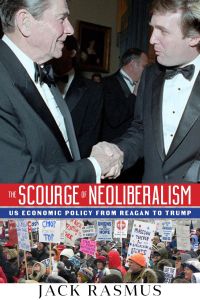
While the capitalist system has undergone numerous restructurings throughout its history, capitalist elites purpose in restructuring has remained the same: to restore and/or extend their hegemony. The current restructuring, operative since 1978, is called Neoliberalism. The book examines Neoliberalism as both an Idea and an historical practice composed of a particular mix of fiscal-monetary-trade-industrial policies that began with the latest US capitalist restructuring in the late 1970s, continuing to evolve to this day. The book further explains the deeper material forces giving rise to - as well as now undermining - the Neoliberal policy regime, with special focus given to the crisis of Neoliberalism in the wake of the 2008-09 global crash, Obama's failure to resurrect it, and Trump's current doomed effort to restore it in a new, more aggressive form. Evidence why Neoliberalism is destroying US Democracy concludes the book's analysis.
NEW BOOK
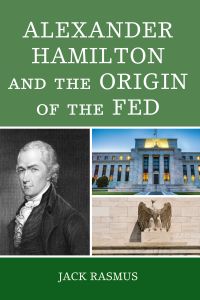
Describes how US federal governments, often in cooperation with the largest US private banks, introduced and expanded central banking functions from 1781 through the creation of the Federal Reserve Act of 1913. Based on an analysis of the evolution of the US banking system - from pre-1781, through the 1787 US Constitutional Convention, Congressional debates on Hamilton's reports to Congress, the rise and fall of the 1st and 2nd Banks of the United States, and through the long period of the National Banking System form 1862-1913, the book shows how central banking in the US evolved out of the private banking system, and how following the financial crash of 1907 big New York banks pushed through Congress the Federal Reserve Act of 1913, creating a central bank which they then managed for their interests.
BOOK
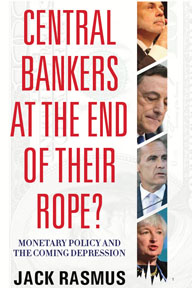
(Click on image) CENTRAL BANKERS is a comprehensive critique of central banks’ policies in the 21st century, explaining why the massive injections of free money to the banking system since the 1970s enabled the creation of excess corporate debt that has led to financial bubbles and repeated crises. The book addresses the growing contradictions of central banking, why they are failing in their functions, targets and tools, and proposes a radical democratization and restructuring to transform them to serve the public interest and not the private banks.
Book:
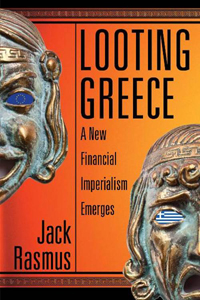
(Click on image) LOOTING GREECE, A New Financial Imperialism Emerges. This book - Reveals clearly who calls the shots in the Eurozone—the hardliners, not the remnants and political residue of what was once European social democracy, - Follows the negotiations in their excruciating detail as the Troika tightens the screws from 2009 to the present, - Shows how Europe’s financial elite enriches itself on Greek debt, privatizations and financial manipulations, turning Greece into an Economic Protectorate.
Book:
(Click on image): This book offers a new approach to explaining why mainstream economic analyses have repeatedly failed and why fiscal and monetary policies have been incapable of producing a sustained recovery. It explains why the global economy is slowing long term and becoming more unstable, why policies to date have largely failed the trend, and why the next crisis may therefore prove even worse than that of 2008-09.
Book plus DVD and Powerpoint slideshow
(Click on image) Obama's Economy: Recovery for the Few, explains how the weakest and most lopsided economic recovery since 1947 has been the direct outcome of failed economic policies of the Obama administration and US Federal Reserve bank since February 2009. Includes a detailed 'alternative program' in the final chapter. Includes the book, a video DVD presentation, and 66-slide PPT slideshow.
Book

(Click on image) Obama's Economy: Recovery for the Few, explains how the weakest and most lopsided economic recovery since 1947 has been the direct outcome of failed economic policies of the Obama administration and US Federal Reserve bank since February 2009. Includes a detailed 'alternative program' in the final chapter.
Book

(Click on image) A theoretical analysis, with historical case examples, of origins, causes and future evolution of the recent--and continuing--economic crisis in the U.S. and global economy. Includes predictions in 2009 of the inevitable failure of Obama policies and more serious crisis to come, 2013-15.
Book

(Click on image) Seven specific reasons why economic recovery under Obama since 2009 has failed for all but the wealthiest few and largest corporations. The book spells out eight specific areas as an Alternative Economic Recovery Program.
Book

(Click on image) The War At Home: The Corporate Offensive From Ronald Reagan to George W. Bush, is a 534 page, extensively researched, nonfiction book that describes the evolution of corporate-government policies from 1980 to 2005 that have shifted more than a $1 trillion dollars a year, every year, from 90 million American middle and working class households to the wealthiest 10% and corporations.
Search
-
Join 459 other subscribers
Jack Rasmus Site: KYKLOS PRODUCTIONS
 Dr. Jack Rasmus @drjackrasmus
 Jack Rasmus