Feeds:
Posts
Comments

Posts Tagged ‘US economy’

This past week was punctuated by a perfect storm of negative US economic reports and events. Together they mean the door to recession in the US has now opened—quite contrary to all of Trump’s hype that the US economy is doing great.

The reports in question are the July jobs report lasts Friday and the advanced (preliminary) US GDP report for the 2nd quarter (April-June) released a few days before. The events associated with these reports were (1)Trump’s announcement imposing widespread tariff hikes ranging from 15% to 41% on more than 40 countries, with even higher tariffs previously announced on China, Russia, Mexico, Canada as well as ‘across the board’ global tariffs steel, aluminum, copper and other commodities; (2) and The Federal Reserve bank’s decision to keep US interest rates at current levels for at least another six weeks.

If last week’s 2nd quarter GDP data unlocked the door to recession, then last Friday’s Jobs data kicked it wide open. And Trump’s tariffs coming behind threaten to blow it off its hinges.

The Jobs Data Tsunami

It’s generally acknowledged that jobs are a lagging indicator of the condition of the US economy. If so, the July Jobs report shows that there’s no more lag. Jobs have caught up and Friday’s August 1, 2025 report shows Labor Market conditions in the US economy are now flashing red.

According to the US Labor Department’s Establishment Survey (CES) only 73,000 net new jobs were created in July. Moreover, this number is likely to be downward revised, since the July jobs report also revised its previous May and June reports downward big time: for May, the jobs created were reduced from an initially reported 144,000 jobs created that month to only 19,000 in fact: for June, the revision was from 147,000 to 14,000. So when July is similarly revised, it’s highly likely the 73,000 will be reduced dramatically as well. This will mean the total jobs created over the past three months will be barely 50,000!

It’s generally acknowledged the economy has 125,000 new workers entering the labor force and economy every month. The economy must therefore create that many jobs every month just to absorb new entrants, mostly youths seeking jobs for the first time. Only 50,000 created means more than 300,000 are entering the ranks of the unemployed not gainful employment.

The US Labor Department has a second jobs survey to the CES, which covers mostly large companies. The second survey is called the Current Population Survey or CPS. It covers more small and medium sized businesses as well as unemployment levels the CES does not report. The CPS report on Friday showed that new entrants’ unemployment rise by 275,000 in July.

The plight of new workers seeking employment is not the only negative indicator of a rapidly deteriorating US labor market this summer. Here’s some other telling job indicators:

  • The general level of employment in July fell by -260,000. It would have been an even greater decline had the level of part time employment not also risen by 433,000 as well. No doubt many companies converted their full time employed workers to part time in lieu of laying them off. Conversion of full time to part time typically occurs with the onset of early stages of recession.
  • Beyond just July, the CPS revealed that since May 1 the Employment level for the US economy in general declined by -863,000.
  • The unemployment rate, also indicated by the CPS only, remains at approximately 8% for the entire US labor force of 170 million—not the ‘official unemployment rate of 4.2% one consistently reported by the mainstream media and hyped by politicians. The 8% includes the 50 million plus part time, temp, discouraged, independent contractor, gig and similar job categories that the ‘official’ 4.2% excludes.
  • The 8% means there’s roughly 14 million US workers unemployed or underemployed. Of that 14 million, those unemployed long term (more than 27 weeks) has risen sharply as well over the summer. In July alone their numbers rose by 179,000.

Multiple statistics show the band-aid has been ripped off the obfuscation of the real condition of the labor market that has prevailed for at least this past year, exposing the long festering wound beneath.

The labor market has been weak for some time, as this writer has been reporting repeatedly over the past year. One needed only to look behind the mainstream media’s cherry picked reporting of the most favorable numbers in the two jobs reports, ignoring other data in the same reports that were growing consistently weaker.

What’s different the past three months, and in the July report in particular, is that the real rot in the jobs market could no longer be covered up by selective media reporting or by politicians’ hype.

Trump’s response to the recent jobs data has been to shoot the messenger, as he quickly announced his firing of the Labor Department’s statistics chief. But there’s no politically ‘cooked numbers’ to make him look bad here, as Trump claims. It’s just that the facts have now deteriorated to such an extent that even efforts to pave over the pot holes with marginal under-reporting and selective media reporting can no longer cover up the true condition of the deteriorating jobs ‘road-bed’.

The US GDP April-June Report

The second report indicating the US economy now balances on the precipice of recession is the advance (preliminary) US GDP report for the 2nd Quarter 2025. Here’s just three reasons why the announced 3% growth rate is not actually 3%.

First, readers should understand the US, virtually alone among advanced economies, puffs up its quarterly GDP numbers by multiplying the quarter change from the previous quarter by annualizing it. That is, 3% for the 2nd quarter is actually 4 times roughly what the economy actually grew from the previous 1st quarter.  3% sounds a lot better than 0.75% if one is publicly hyping the growth rate in the media.

However, even the 3%(0.75%) is grossly over-estimated for several reasons. Here’s just two of many: First, real GDP is artificially boosted by under-estimating the real rate of inflation. This occurs every report. Second, in the case of the 2nd quarter GDP report, the 3% is grossly over-estimated by temporary effects due to Trump’s current tariffs policies now rolling out which has dramatically distorted the contribution to GDP from what is called ‘net exports’—i.e. the difference and gap between imports into the US and US exports to the rest of the world.  For decades, imports have significantly exceeded exports. The result is that ‘net exports’, as the gap is called, has been a consistent subtraction from GDP from other categories like consumer spending, business investment, and government spending.

Let’s look at the under-reporting of real GDP due to low-balling inflation, and then the volatile impact of Trump’s tariffs on GDP for the entire first half of 2025.

(How Under-Estimating Inflation Over-Estimates GDP)

When the government reports GDP it’s for what’s called ‘real’ GDP. Real means adjusted for inflation (unadjusted is called ‘nominal’ GDP). The media reports the ‘real’. For the 2nd quarter that was the 3%. The problem is the inflation adjustment used greatly understates actual inflation. And the more it underestimates actual inflation, the more in turn real GDP is over-estimated.

The price index used to estimate real GDP is called the PCE. For the 2nd quarter the PCE was 2.1%. In the first quarter it was higher, at 3.7%. So simply by reducing PCE from 3.7% to 2.1%, all things equal the real GDP of 3% was boosted by a 1.6% lower PCE in the 2nd quarter.  If PCE in the 2nd quarter was 3.7% as in the 1st quarter, then 2nd quarter real GDP would be 1.4% instead of the reported 3%.

Ok. Some will argue perhaps inflation did abate significantly in the 2nd quarter compared to the first. Perhaps inflation was indeed 40%+ less in the 2nd compared to the 1st. But whichever the quarter PCE grossly underestimates actual inflation for dozens of reasons due to faulty assumptions and questionable methodologies used by the government to get PCE. Don’t think the government actually goes out and surveys price changes by businesses to get the PCE, like it does the other price index called the Consumer Price Index. It doesn’t. PCE is determined totally by estimating prices from other sources than the actual prices charged by businesses.

For example, let’s take insurance costs for home, auto, etc. which have been surging the past year. Insurance prices aren’t surveyed. They are extrapolated from insurance company profits. If the big insurance companies hide their profits in order to pay less taxes—which they do—then insurance inflation is grossly underestimated. But that’s what happens with PCE. How about rent inflation. Rents in the PCE index are calculated from reported new rental contracts from a subset of big apartment owners. Landlord price hikes for renters with existing contracts do not report price hikes within the term of the rental contract. There are dozens such examples that result in PCE underestimating actual inflation. Nonethless, PCE is used to low ball actual inflation in order in turn to over-estimate reported ‘real’ GDP. In short, 3% GDP in 2nd quarter is not actual GDP because PCE inflation is not actual inflation.

There are many other ways GDP in general is always over-estimated, apart from the faulty inflation adjustment. There are issues with seasonality adjustment methodologies. There are issues with how GDP is periodically re-defined in order to make it look larger. The latest such example was in 2013 when the government included as business investment items like business logos, trademarks, R&D expenses, IP and other similarly un-estimable values. The government simply accepts whatever businesses tell it are the increase in value (and thus price) of these ephemeral items, and then adds them to GDP.  When first introduced more than a decade ago, this boosted real GDP from business investment by more than $500 billion a year. Thus real business investment and its contribution to GDP is, and has been, less than reported every year.

Trump Tariffs & Volatile Net Exports

The even bigger reason why the 2nd quarter GDP growth of 3% is misrepresented has to do with Trump’s recent tariffs and trade policies. Briefly stated: nearly all of the 2nd quarter 3% GDP growth was due to the collapse of imports to the US economy in the quarter in response to Trump’s tariffs.

In the 1st quarter 2025, companies increased their imports excessively in anticipation of Trump’s coming tariffs. That artificially exacerbated the gap between exports from the US and imports to the US. A big negative number resulted, as imports exceeded exports by a wide margin. Imports thus subtracted from overall GDP calculation in the 1st quarter, overwhelming the effect on GDP from government spending, consumption, and business investment. GDP thus contracted by -0.5% in the first quarter. Virtually all due to the effect of import surge.

This flipped in the 2nd quarter. Imports that formerly surged in the 1st quarter collapsed in the 2nd. The difference between imports and exports now added to GDP. How much? Around 5% or 2% more than the actual 3% GDP. So what subtracted from the 5% to get the 3%? Business investment contracted, government spending flattened to virtually zero and consumption slowed. That knocked 2% off the 5% from imports-exports to get to the 3%.

Considering both quarters, it’s clear tariff policy and its impact on exports and imports, especially the latter, is distorting the numbers for GDP in the first half of the year 2025.

But beneath this what’s happening is business investment, a more permanent and less volatile factor in GDP determination, is steadily falling. In part due to tariff and trade volatility but also due to more fundamental forces and developments within the US economy. The same can be said for consumer spending, now steadily slowing even if still growing. In addition, Trump fiscal policies—spending cuts for social programs, government employment, and department dismantling are also building pressure toward less government GDP contribution.

US Economy Next 6-12 Months

The US economy is now at the precipice of recession and will likely deteriorate further over the next 6 to 12 months, and especially so in 2026. Here’s why:

Trump’s ‘big beautiful bill’ Act just passed by the Congress will have a net negative impact on GDP, and will not boost US economic growth as Trump claims.

Most of the at least $3 trillion in corporate and individual (and estate) tax cuts are just a continuation of previous 2018 cuts. The effect of the 2025 bill is just to make them permanent. That’s not net new fiscal stimulus from tax cutting. Meanwhile, the so-called working class $500 billion tax cuts in the bill—for tips, overtime pay, social security, interest on new cars, etc.—have been dramatically reduced and made temporary.

In contrast, the program and employment spending cuts in the bill—for Medicaid, ACA subsidies, education, layoffs of federal workers, and so on—amount to at least $1.5 trillion and take effect immediately. They will significantly reduce current consumer spending this year and next. Furthermore, Trump’s cuts in spending and layoffs will soon begin to spill over to state and local government spending cuts and layoffs, as the states will have to make up for reduced Federal government support and find ways to continue education, health and other spending from their own budgets. They too will have to begin layoffs and cuts to programs, both of which will exacerbate consumer spending in their states.

Add to all this what economists call the ‘multiplier effects’. Tax cut multiplier effects are less than spending cuts multiplier effects. Tax cuts don’t immediately result in more investment by businesses or wealthy investors. They lag. Moreover, the more the cuts accrue to the more wealthy and corporations, the less is actually spent of the total cuts. Some of the cuts are just hoarded. Some are distributed to shareholders as stock buybacks and dividend payouts. Some are invested in financial asset markets, none of which add to GDP. And some are redirected to offshore investment which also contributes nothing to US GDP. So tax multiplier positive effects are relatively low, and increasingly so in the 21st century as the US economy has globalized and financialized.

In contrast, the multiplier negative effects from spending on programs and jobs are immediate and much higher. This is especially more so, to the extent the spending cuts negatively impact incomes of middle to low income levels, which the Trump spending cuts clearly target. In other words, the composition of the Trump tax and spending cuts are net negative and exacerbate the negative multiplier effects of the combined tax and spending cuts as well.

In summary, over the next year US GDP is likely to weaken due to less consumer spending—as state and local government layoffs rise and Trump spending cuts take effect as well as due to less immediate and historically low impacts of tax cuts on the real economy—while the short term positive effect on Imports-Exports on 2nd quarter GDP dissipates.

The recent Jobs and GDP reports reveal the door to near term recession has opened. Trump tariff, tax and spending policies will likely kick it wide open as they take effect.

Jack Rasmus

Read Full Post »

by Jack Rasmus

Last week the US Congress passed the Trump Tax Cuts. The mainstream media and economists have been mostly reporting the details of the cuts — i.e. which taxes got cut in the 2025 Act, how much accrued to businesses and wealthy as opposed to the rest of us, what’s the impact on GDP and maybe even government deficits and debt. 

All interesting facts. But not the most important. They purposely ignore the cuts in historical perspective and the bigger picture they represent.

That bigger picture is the looming fiscal crisis driven by the growing convergence of runaway tax cutting since 2001, chronic escalating defense and war spending, more frequent deeper crashes of the economy with slower economic growth between, and now since 2022 accelerating trillion dollar annual interest costs on the US national debt.

The US national debt is on track to reach $38 trillion by year end 2025. Interest payments to bondholders are already exceeding $1 trillion a year. The Congressional Budget Office, research arm of the US Congress, estimates the national debt will reach $56 trillion by 2034 with interest payments of $1.7 trillion — and all that before Trump just passed $5 trillion tax cuts.

Moreover, the US elite today show no sign of addressing the coming fiscal crash. It continues to:

  • cut taxes by trillions on corporations, investors and wealthiest 1% households
  • raise spending on the Pentagon, wars and other ‘defense’
  • allow health insurance and big Pharma to gouge the US Treasury
  • pay holders of US securities—foreign and US—trillions of dollars more every year

Multiple studies show that historically 60% of the US budget deficits and thus national debt are due to insufficient tax revenues — from chronic tax cutting, slow economic growth, legal avoidance and fraud. Here’s some interesting facts about cumulative tax cuts by both political parties together since 2001.

Cumulative Tax Cutting 2001-2025

George W. Bush’s tax cuts in 2001-03 amounted to $3.8 trillion over the decade 2001-10. Estimates are roughly 80% accrued to corporations, businesses, and wealthy individuals by focusing overwhelmingly on individual income tax rates, corporate capital gains and dividends, and the estate tax affecting the wealthiest 1% or less households. Bush then cut taxes in the spring of 2008 by another $180 billion as the economy began to slide into recession and the great crash of 2008-09.

When Obama took over in 2009 his American Rescue Plan stimulus for the economy passed that March provided for another $325 billion in tax cuts. His entire stimulus plan was $787 billion, another $280 billion of the remaining $487 billion went to the states which then hoarded most of it. 

So less than $200 billion went to stimulate consumption which immediately proved too little to reboot the US economy. He had to add another $25 billion for ‘cash for auto clunkers’ and another $25B for ‘first time home buyers’ later that year. Most of the latter, moreover, didn’t go to home buyers but to mortgage lenders as incentive to approve more mortgages.

When Bush’s tax cuts came up for renewal in 2010, Obama extended them for another two years through 2012. That amounted to another $803 billion in tax cuts, again mostly to wealthy and corporations.

In August 2011, in an agreement with the Republican Congress, Obama cut social program spending by $1.5 trillion in a new ‘austerity’ plan. $1 trillion was cut in just education and other social programs; $.5 trillion was supposed to be cut for defense spending but was kicked down the road and never applied. 

Austerity social program cuts always follow crisis bailouts. They did in 2011 after the 2009-10 bailouts. They’re occurring again today in 2025 after the 2020-21 Covid bailouts — more on which shortly.

The 2012 Obama tax cuts made the Bush tax cuts permanent. They cost another $5 trillion. They were supposed to avoid what the media, lobbyists, and propagandists called the pending ‘fiscal cliff’. They were supposed to boost the economy. 

They didn’t. US economic growth in GDP terms for the rest of the Obama term averaged only 60% of what was historically average during recovery periods from the earlier 10 US recessions since 1948.

Obama thus cut taxes on wealthy and corporations more than Bush did. To restate: Bush cut by $4 trillion ($3.8 trillion + $180 billion). Obama cut by $325 billion (’09) + $803 billion (’10-11) then by $5 trillion (2012). That’s $4 trillion (Bush) and $6.1 trillion (Obama). Then came Trump’s $4.5 trillion in 2018.

Trump promised during the 2016 election to cut taxes by $5 trillion. And he roughly did. The 2018 tax cut over the next decade cost $4.5 trillion.

His administration, with the media and professional economist class in tow, estimated the $4.5 trillion at only $1.9 trillion. Trump’s Treasury Secretary at the time, Steve Mnuchin, even publicly declared the Trump tax cuts would ‘pay for themselves’. 

By that he meant the tax cuts would boost US GDP and the economy so much that economic growth would result in a rise in so much more tax revenues over the decade that would offset the $1.9T. To quote Mnuchin at the time: “we believe the tax cuts will pay for themselves over a 10 year period of time.”

Proof that the Trump 2018 tax cuts were $4.5T — not $1.9T — was reflected in the Trump administration’s budget forecast and a US federal deficit reduction of $4.6 trillion over the decade 2018-28. An even more convincing later piece of evidence was the US Congressional Budget Office, the research arm of Congress, that estimated in 2025 that the cost of the 2018 tax cuts were at least $4 trillion total!

For several years in debates with professional mainstream economists like Robert Reich and Paul Krugman this writer kept showing the Trump tax cuts weren’t $1.9 trillion but actually $4.5 trillion. Here’s how.

First, the $1.9 trillion official estimate was based on the assumption that the US economy would grow over the next ten years, 2018-28, by 3%-3.5% annually. A forecast that proved grossly inaccurate in fact.

After a modest growth in 2018-19, the US economy crashed in 2020 as the government ordered a partial economic shutdown in response to Covid. The economy haltingly reopened and recovered in stages in 2021. Thereafter it grew only moderately from 2022-24.

That modest three year GDP recovery followed the massive $10.7 trillion fiscal and monetary stimulus by Congress and the Federal Reserve during the years 2020-22: $6.7 trillion in fiscal stimulus and another $4 trillion in monetary stimulus by the Federal Reserve Bank. In other words, a mountain of stimulus brought forth a molehill of GDP.

Second, the 2018 tax cut estimate grossly under-estimated and failed to account for the magnitude of tax cuts that accrued to US multinational corporations offshore.

The largest 108 US Fortune 500 corporations with offshore subsidiaries had accumulated $2.7 trillion in their corporate offshore accounts they weren’t returning to the US in order to avoid paying the then 35% corporate tax rate. Estimates of un-repatriated hoarded profits from the offshore operations of US multinationals were as high as $4 to $5 trillion. 

Trump’s 2018 tax cuts allowed them to bring back those profits and pay only 10%. That’s a 25% tax saving on at least $4 trillion. 

The US Commerce Dept. estimated in 2020 US multinationals brought back only $750 billion in 2018 and another $250 billion in 2019. They thus paid 10% or $100 billion instead of 35% or $350 billion. They pocketed the other $900 billion of the $1 trillion repatriated. No government records were kept after 2019 unfortunately.

What did they do with the $900 billion they did repatriate? As the Wall St. Journal reported on January 28, 2020: “Much of what firms retrieved went to buybacks”. After averaging about $125 billion per quarter in 2017, S&P 500 stock buybacks surged to $200 billion per quarter in 2018 and 2019.

And what happened to the other roughly $3-$4 trillion plus US corporations never repatriated? They hoarded the remaining $3 to $4 trillion profits in their offshore subsidiaries to avoid taxes. Another loophole allowed them to convert their cash profits from overseas operations into short term financial securities held offshore, on which they didn’t have to pay any profits.

And there was another way they avoided taxes: they manipulated their internal pricing — i.e. what US located operations charged or paid their foreign subsidiaries. They paid their foreign subsidiaries higher prices for components or final products, thereby shifting profits offshore where they were booked at lower tax rates, which also raised costs in the US and thus lower profits taxed at the higher rate.

The 2018 Trump tax act also raised the amount US multinational corps paid to foreign countries that they could then deduct from their US taxes owed.

The point is these offshore rules and loopholes that grossly reduced the total tax cuts by at least $2 trillion over ten years, 2018-28, that were grossly under-estimated or were not accounted for in the 2018 Trump official $1.9 trillion tax cut cost estimates.

In summary, phony assumptions about a decade of future GDP growth, reduced taxation on repatriated profits, and loopholes reducing taxes due on their offshore subsidiary operations all meant US multinational corporations’ tax cuts were far greater than reported. These assumptions and loopholes meant the 2018 cuts were $4.5 trillion not the ‘official’ $1.9 trillion.

Thus total tax cuts for 2001-19 were $14.6 trillion.

Thereafter followed the 2020 Covid fiscal stimulus package during Trump’s last year in office, 2020. Taxes were cut another $950 billion as part of the ‘CARES Act’ fiscal stimulus passed by Congress March 2020 and another $260 billion in tax cutting in the emergency ‘Consolidated Appropriations Act’ passed that December as the US economy faltered again.

That $1.2 trillion in 2020 tax cuts was followed in 2021 by Biden’s subsequent ‘AMERICAN RELIEF PLAN’ fiscal stimulus which cut taxes by a further $640 billion.

In 2022 Biden thereafter shifted some of the unspent relief for social programs in his American Relief Plan and redirected the funds to a new round of three business investment stimulus programs costing $1.7 trillion: 

  1. the Infrastructure Act
  2. the Chips & Modernization Act
  3. the misnamed Inflation Reduction Act which was mostly tax cuts and subsidies to energy companies, alternative and fossil fuel

Those three 2022 business investment Acts together cut taxes by another roughly $500 billion.

Adding all the tax cuts from 2001 thru 2024, both parties — two Republican and two Democrat administrations — together cut taxes by almost $17 trillion!

No one should therefore be surprised that Trump 2025 is cutting taxes again by another $5 trillion — and once more mostly for business, investors and wealthiest households. A massive tax cutting has been going on for a quarter century since 2001. (One can argue the trend extends even further back, to Reagan’s 1981 and 1986 tax cuts and Clinton’s 1997-98 cuts).

It’s all part of the long term Neoliberal era (1979-present) fiscal policy: 

  • cut taxes on the rich and their corporations
  • offset the cost of the tax cuts in part with social spending program cuts
  • increase spending on defense and wars
  • ignore the effects of all that on budget deficits and national debt that result in rising interest payments to US bondholders to $1 trillion dollars per year

Long term historical studies show conclusively that tax cuts, and reduced tax revenues from slow economic growth, fraud, legal avoidance, are responsible for 60% of budget deficits.

The other major forces driving US budget deficits and national debt since 2001 are: 

  • the $9 trillion spent on foreign wars in the first quarter of the 21stcentury
  • the two big bailouts of 2008-09 ($787 billion +), 2020 ($3.1 billion) and 2021 ($1.9 billion);
  • the chronic price gouging by health and insurance corporations escalating the costs of government health support programs (Medicare, Medicaid, Schip, ACA)
  • rising interest payments on the national debt to investors (US and foreign) purchasing US Treasury securities

So loss of tax revenue from 25 years of tax cuts and slower long term economic growth ($17 trillion), the $9 trillion thrown away in forever wars since 2001, the bailout costs ($5.8 trillion), and healthcare price gouging ($0.5 trillion?) together explain most of the current $36.2 trillion US national debt.

In short, a fiscal train wreck has been running down the tracks for at least the past 25 years and Trump’s $5 trillion ‘Big Beautiful Bill’ (BBB) — along with trillions more for defense and wars — are shifting that train into another higher gear.

Trump, Budget Deficits and National Debt

US budget deficits have been averaging $2 trillion annually and rising since 2016. They are projected to rise another $2 trillion in 2025 even before Trump’s tax cuts take effect this year.

The national debt is just the accumulation of annual budget deficits. In 2000 the US national debt was $5.6 trillion. After eight more years it nearly doubled to $10.7 trillion. It then did double under Obama to $20 trillion by end of 2016. Trump added $7.8 trillion in the four years of his first term and Biden added another $8.5 trillion in just four years more. By the end of his Biden’s term in December 2024 the national debt had risen to $36.2 trillion.

By the way, as that rises to $38 trillion by year end 2025 and $56 trillion by 2034, it does not include the Federal Reserve Bank’s balance sheet debt (now $8 trillion) or state and local governments’ debt load of several trillions$ more.

Future Consequences

It’s ironic Trump has chosen to call his tax cuts and defense spending hikes proposal the Big Beautiful Bill — or BBB as Congress refers to it. For in the world of business finance, BBB refers to the worst run corporations that are overloaded with high risk debt (triple B grade). Triple B rating makes them the most financially fragile and at greatest risk of default and bankruptcy.

While it’s not likely the USA federal government can ever go bankrupt or even default on its annual payments of $1 to $1.7 trillion to bondholders of the national debt. All it needs do is ‘print’ more money, either by adding accounts to the Federal Reserve electronically — or perhaps in the near future by creating digital currency. 

But while that may not mean bankruptcy, it could very well mean a collapse of the value of the US dollar globally. That in turn could result in the abandonment of the dollar as the global reserve and trading currency. And that in a collapse of the recycling of US dollars back to the USA by foreign holders of excess dollars. In such case, the US annual budget can’t be financed, requiring then massive spending cuts and tax hikes. In other words, the end of the US global empire.

Trump’s tax cuts and spending bill is just another iteration of Neoliberal fiscal policy, this time on steroids. But Neoliberal fiscal policy is broken. That is, it does not produce the same stimulus to the real economy, real investment, and GDP growth that it had in decades past. Increasing magnitudes of fiscal stimulus is required in order to generate the same, or even smaller, real GDP growth.

What fiscal policy does result in increasingly is a stimulus to financial asset markets, in US and globally, and thus a continued rise in stocks, bonds, forex, derivatives and other financial instruments’ price. Or the tax cuts are redirected by multinational corporations that receive them to offshore investment and operations. 

In other words, to subsidize the expansion of US capital expansion offshore. Both the financialization and globalization of investment are characteristic of trends in the 21st century capitalist economy. A similar effect applies to US monetary policy: more and more of the Federal Reserve’s injection of money into the economy gets diverted to financial markets and to offshore.

Perhaps the best evidence of this is the $10.7 trillion in fiscal and monetary stimulus by Congress and the Federal Reserve injected in 2020-22. It should have produced a massive GDP growth expansion in 2022-24. It produced a mere historical average of barely 2%.

All of the media, economists, and government officials’ about the Trump tax cuts and BBB Act stimulating the real economy — i.e. wages, jobs, investment, etc. — is just economic hype. The 2018 tax cuts didn’t. Nor did Obama’s and Bush’s before that. Trump’s current BBB Act won’t do any different.

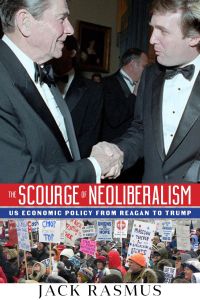
Fiscal and monetary policy in the late Neoliberal era — in the 21st century American capitalism and global economic empire — are failing. Nevertheless, America’s elite are doubling down on their tax cutting for the rich and their wars of defense of Empire.Jack Rasmus is author of the recently published book, ‘The Scourge of Neoliberalism: US Economic Policy from Reagan to Trump’, Clarity Press, 2020. He publishes at Predicting the Global Economic Crisis

Read Full Post »

There is an emerging debate whether the US Empire is about to collapse or in decline (or neither). In my forthcoming book, ‘Twilight of American Imperialism’, forthcoming this fall this debate is discussed as part of the book’s history and evolution of the American Empire from 1768 to the present. The main focus of the book is the contemporary period since 2008 and especially since 2020 and its analysis that, while the Empire is not about to collapse, it is clearly in a state of decline and a decline that’s accelerating. Special attention is given to the current Trump regime and a discussion of the question whether Trump policies can stop or even slow the decline. The following is the draft Introduction to the book where the main themes are outlined and briefly discussed. Here’s the Intro

  INTRODUCTORY CHAPTER

Twilight of American Imperialism:

By Jack Rasmus

Copyright 2024

Mid way through the third decade of the 21st century it is becoming increasingly clear the American empire has been growing steadily weaker across various dimensions—political, economic, cultural and even technological. Some say it has entered a period of decline. A few—prone perhaps to substitute wishful thinking for hard analysis—even go so far as to predict its imminent collapse.

Those advocating imminent collapse point to the USA’s military defeat and pullout of Afghanistan in 2021; the increasing likelihood of US exit from its proxy war against Russia in Ukraine after three years and $350 billion dollars cost; the growing economic and geopolitical influence of China and its deepening alliance with Russia; advances in military technologies & weaponry by Russia and China that the US appears to lack (hypersonic missiles, mass drones, certain naval assets, etc.); the expansion of the BRICS in the global south; the drift of a growing list of countries from the use of the US dollar in trade and as a reserve currency and from use of the US’s SWIFT international payments system; and so on.

While certainly weaker, and arguably in decline, the American empire is nowhere near imminent collapse.  Its currency, the dollar, is still the majority currency in use in global goods transactions and money capital flow settlements. So too still is its SWIFT international payments system that runs through the large US commercial banks. Its central bank, the Federal Reserve, still functions as the ‘central bank of central banks’ with which most countries’ central banks move mostly in tandem. Since 1980, via massive money capital flows and FDI (foreign direct investment), US company presence and production has expanded throughout the world. The USA still provides the majority funding and controls voting in strategic economic institutions like the IMF and World Bank, even as China’s ‘Belt and Road’ initiative is mounting a major challenge to the latter. The USA still has the largest and most comprehensive global agreements on free trade. It maintains a leading role in the development of next generation technologies like Artificial Intelligence that constitute the future of new product lines even though China is nearly equal.  Militarily, the US spends more on weapons and defense than all other countries combined, maintains more than 800 bases worldwide, has more bilateral military alliances than any other country, and maintains the largest naval force with a dozen of aircraft super-carriers and scores of nuclear submarines, each of which carry hundreds of Trident II nuclear missile warheads and are essentially undetectable. It provides the majority of funding for NATO and economically props up the European economy in divers ways. Its CIA and NGOs have engineered scores of regime changes in recent decades in smaller countries throughout the world that have dared to act independently of its imperial interests. It dominates the G7 ‘core’ US empire countries’ and exercises significant political influence over the foreign policies of countries like Japan, South Korea, Pacific Islands and in Europe and wherever it maintains large US military forces and bases.

In support of their view of imminent collapse, its advocates further point as confirming evidence to the Trump administration’s recent radical changes in its US military commitments in Ukraine; its shutting off of funding to US NGOs like USAID; the administration’s increasing feud and distancing of relations with European NATO members; its attempt to radically transform trade relations, propose deep cuts to fiscal spending programs; the administration’s aggressive reordering of US immigration and other legal relations;  and Trump’s emerging conflict with US central bank chair, Powell, over interest rates. But simply citing policy differences one may deeply disagree with does not constitute causal evidence of how such policies lead inevitably to Empire decline, let alone collapse.  

Challenging this often politically biased—and to some extent US mainstream media propaganda—view, in this book it will be argued that what appears as chaotic radical shifts in policy and political initiatives by the Trump administration should be more appropriately understood as an effort by the US elite (at least the segment of it supporting Trump) to restructure US domestic and global economic and political relations in order to consolidate and continue to fund its Empire in an era of growing challenges to Empire and its rising costs—especially given the USA domestic economy’s increasing failure to grow sufficiently to cover those rising costs.

The imminent collapse of Empire viewpoint also assumes Trump policies in his second term will fail and that failure will itself accelerate imminent collapse.  This view is backed by little evidence to date as well, however.

Trump policies and initiatives are better understood as the opposite: i.e. an attempt to slow and even halt the decline of Empire. Alternatively viewed, Trump’s policies and initiatives are about trying to check and reverse American’s emerging imperial decline. Whether they will succeed in that regard, however, remains to be seen. The odds are likely against it, but who knows for certain.

A central theme of the book is that the American Empire is approaching a period in which it needs to restructure its imperial relations, practices and institutions. It cannot afford the cost of the Empire as currently structured.

US elite policies and practices thus far in the 21st century have not succeeded in expanding or even maintaining the Empire. An Imperial ‘Rubicon’ may have been crossed in 2008. And if not in 2008, certainly circa 2020-22 after the double shock events of the Covid economic shutdown that was quickly followed by the Empire’s geopolitical defeat in its Ukraine proxy war and the economic fallout from that latter event.

Collectively US elite policies and strategic decisions the last quarter century have been undermining—not advancing—the Empire, it will be further argued. Thus a fundamental restructuring is needed if the American Empire is to approximating its prior hegemonic role or exert anything even approaching the influence it once had during its peak from 1945 to 2007.  

If the thesis is correct that a restructuring—not a collapse—of empire is imminent, the current will prove the fourth such restructuring during the past century undergone by the American Empire. Each restructuring of economic and political relations served to advance and/or maintain the Empire. The most recent three restructurings of the Empire occurred 1913-1919, 1944-1953, and 1980-1986.

A Brief History of American Imperial Restructurings

Chapter one of this book will review and critique the major theories of Imperialism. It will argue that most of these describe 19th and 20th century Euro-centric empires and fail to appropriately describe the American way of Empire.  The American imperial experience differs in certain key aspects, which is described in chapter two and subsequent chapters.

Chapter two of this book describes the evolution of the American Empire as it broke out of and emerged from its parent British Empire in the mid to late 18th century. It retained some of the characteristics of the British at the time, but its essential drive in its early history was twofold: clear away the competing European empires on the north American continent—the Spanish in the far south, the remaining British on its undefined periphery border to the north, the last vestiges of the French in the Mississippi-Missouri valleys and later, toward the mid-19th century, the Mexican in the southwest and far west.

The second thrust of America’s continental imperial expansion in the 18th-19th centuries was to displace, destroy or otherwise move native American tribes off the Land by physically destroying them in wars or by disease, pushing and resettling them ever further west, or encapsulating and isolating them in small enclaves called reservations. 

In either case—whether eliminating European competitors or native American tribes—the main objective of the early American Empire has always been Land. Not just land for purposes of farming but also for minerals, animal harvesting for the market, precious metals, lumber, grazing, and water resource control.  It followed that central to the nature of early American imperial continental expansion was land speculation and profits from land as a market commodity.  With each wave of westward emigration from the east coast colonies and initial states came waves of land speculation often even preceding land settlement. In its earliest forms, therefore, American imperialism was not just ‘land grabbing’ but land for purposes of financial and capitalist appropriation and exploitation.

This land acquisition financial imperialism was unlike its British parent. Britain’s empire considered its north American colonies as a source of natural resource extraction, using native americans as the ‘producers’ who provided the animal furs and products to it for resell back in England; or, the colonies’ producing lumber and farm products for shipment as well. British policy was to prohibit the acquisition of lands west of the colonies by the colonialists. It was a major source of contention and one of several issues that provoked the US war of independence with Britain in 1775-83. As details in chapter two will show, the newly independent USA’s 1787 Constitution represents an imperial restructuring, the first, for America.

Concurrent with America’s continental Empire building in its countless wars with native americans, from 1776 until the closing of the ‘frontier’ circa 1890s, was its war with Mexico in the 1840s which was concocted on the flimsiest excuses in order to conclude the final seizure of land on the continent in the southwest and far west. (Not counting the 1867 purchase of Alaska from the Russian Tzars).  Once the continent was secured for Empire, only then did the Empire turn its gaze offshore in 1898. During that long interim from 1775 to 1890s the initial restructuring of 1787 served to enable and maintain imperial expansion westward across the continent.

That initial restructure worked for continental expansion, but would not for offshore global expansion, the first of which was attempted by the Empire in 1898 in a war with Spain. The land grabbing was for the Caribbean island of Cuba and lesser islands and for Spain’s huge colony in the far west Pacific Ocean, the Philippines. The conquest of Spain occurred fairly quickly but the pacification of the inhabitants of the Philippines dragged on for years, until at least 1902, and was very costly. The US Empire realized it needed greater resources and a larger Army and Navy to play the new role of Imperialist beyond a north American continent scale.

In the empire’s first offshore imperial expansion in the 1898-1902 Spanish-American war, the costs of war were financed by taxing the property of wealthy Americans. This did not work well and generated much political opposition among wealthy interests who were taxed. Without a central bank, monetary policy and bond financing to pay for the war was difficult as well. The US Treasury was not able to provide the bond financing for war expenditures. The US economy had just recovered from the great depression of 1892-98. In short, the tax base built mostly on tariffs was insufficient for covering the costs of global empire expansion. 1898 was a lesson for the need of restructuring fiscal policy rather than an experience in one

Not so World War I. As the US prepared to play a role in World War I, it restructured its fiscal and monetary policies in order to fund and afford the costs of imperial expansion: It created a central bank, the Federal Reserve, in 1913 to raise bond debt and it passed for the first time a corporate and an individual income tax and introduced inheritance taxation. These fiscal and monetary measures became the source by which the US paid for the build up of a world class military and funded its involvement in that war. A combination of direct taxation and sales of bond issues—the latter of which was extended to sales to the general public—became the primary source of war finance for the new imperial initiative in World War I.

During and after the war the USA assumed a role among European empires as a co-player in imperial advancement on the world stage. That meant its ‘external’ policy—i.e. trade relations, lending of money capital, importance of its currency the dollar—all became new areas of policy and part of the restructuring of both US domestic relations and external relations. Industrial policy was introduced as part of the restructuring as well during the war. US elites mobilized war production and created new institutional arrangements with labor and unions as part of the World War I restructuring as well. World War I thus introduced the specific arrangement of fiscal, monetary, industrial and external policies necessary for the American Empire to assume a major role on the global stage in competition with the major European empires.

Since World War I the US financed its imperial expansion out of a combination of taxation of domestic wealth holders, domestic production, and debt (bond) financing. 

In World War II the empire applied a similar war financing arrangement of fiscal tax policy and bond issuance policy by the central bank. But now on an even greater scale. It raised record bond sales during the war, now from the general public as well as from wealthy investors.  It also expanded and broadened its tax base. In a series of annual revenue acts by Congress starting in 1942, a top tax rate of 90% was imposed on the super wealthy and for the first time the tax system was ‘broadened’ to cover taxation of working class wage incomes. Also new was payroll deduction of income taxes. Both the working class taxation and payroll deduction were written in the revenue bills so to expire at wars end. Neither were. Both thus helped fund the American empire’s continued military expansion post 1945 and especially increased after 1950 and the Korean war.

The Vietnam war of the 1960s-73 was similarly financed by a special surtax of incomes and bond debt sales by the central bank.  However, those policies now contributed to the economic problems in the US domestic economy and global economic hegemony weakening thereafter in the 1970s.  The answer was to restore the empire’s financial base by measures commencing in the early 1980s that have come to be known as Neoliberalism.  Neoliberal policies enabled the Empire to expand geographically offshore (aka globalization) and to financialize in parallel. 

As a concept, Neoliberalism should thus be best understood as a term that somewhat obfuscates what is actually a set of policies (fiscal, monetary, industrial, external) serving to restructure American imperialism starting in the 1980s. That policy mix and 1980s neoliberal restructuring—the 3rd such since World War I—continued more or less unchecked until late in the first decade of the 21st century.

The expansion of the American Empire in the current neoliberal era reached an apex—economically, geopolitically, and technologically—roughly around 2005-07.  About the same time US elites shifted their methods of war financing and methods for funding empire expansion. That is, just as the costs of expanding and maintaining the Empire began to escalate.

The Apogee of Empire: 2005-07

History will show the first decade of the 21st century was the high mark of the American Empire, especially the years mid-decade of 2005-07. It was the apogee of the Empire’s political-military power as well as global economic.  Ironically, it was also the period during which changes and forces began to coalesce that set in motion the subsequent period of the Empire’s initial phase of decline, 2008-2020.

In 1999 US elites moved to absorb into NATO the east European nations once part of the USSR Warsaw pact.  Poland, Czech Republic and Hungary joined. The big NATO move east, however, was in 2004 when Bulgaria, Romania, Slovakia, Estonia, Latvia, Lithuania and Slovenia all joined. Following that, in 2008 at a conference in Bucharest, NATO led by US elites’ announced Georgia and Ukraine would become NATO members as well. Thus was set in motion events that eventually erupted into the Russia-Ukraine/NATO war in 2022—a defining event in the decline of the American empire which may represent the most recent, second phase of decline.  In parallel, however, US-CIA-NGO ‘color’ revolutions and regime changes were being engineered, including the early attempt at such in the Ukraine.

Another geopolitical event as marker for America’s imperial apogee was the Iraq war in 2003, a year just before the big NATO expansion.  The Iraq war represents what appears to be the USA’s last successful direct military action.  Neither China nor Russia were sufficiently strong enough to prevent the war. Russia was just emerging from its great depression of the 1990s decade and in a debilitated military condition except perhaps for its nuclear forces.  China was dependent on western capital, US in particular, needed to jump start its economy after a weak 1990s performance and to begin its role as the world’s major manufacturing exporter. The rest of the global South countries were still heavily dependent on the US dollar, IMF-World Bank, US corporate direct FDI, and soliciting US free trade deals. The NAFTA north American free trade agreement was expanded, a number of bilateral free trade deals between the US and countries were signed, and a proposed North-South America free trade agreement was proposed. The Federal Reserve and its chair at the time, Alan Greenspan, seemed to be able to magically manage the economy. The news media referred to him as the ‘Maestro’ of the Fed.

Domestically, profits were accelerating and wage levels rising in the wake of the late 1990s tech boom. Jobs were plentiful at mid-decade. GDP economic growth was slightly above long run historic averages, except for the 2001 recession—the first in ten years—which proved relatively shallow and short lived in 2001. The Housing market was booming. In terms of technology, the internet and wireless access was penetrating an ever greater percent of the US population. The country appeared unified as never since decades before, in the wake of the 9-11 terrorist attacks. However, beneath the surface major forces were developing that would result in major economic, foreign policy and domestic US political eruptions at the decade’s close and beyond.

Economically, the Greenspan and Fed policy of flood the economy with virtually free money since 1986 continued into the 21st century. That helped fuel the tech boom of the late 1990s which overheated by 2001 and bust. Financial deregulation policies of the late 1990s and during the 2000s were laying an economic time bomb that would explode by decade’s end. Greenspan cut a deal with then President George Bush to be reappointed chair of the Fed in exchange for continuing to flood the economy with money and keep interest rates artificially low as the Iraq war was launched and Bush’s 2004 election approached.  Fed monetary policy was artificially extending the business cycle into the new decade, overheating the housing market and, together with derivatives financial instruments and financial deregulation, creating the foundation for an historic financial crash later in the decade. Fed monetary policy was providing the fuel for financing US corporate offshore expansion and financial speculation that together were driving what was called ‘globalization’ and ‘financialization’ at the time.

The fundamentals for fiscal policy crises were also originating in the 2000s: In the wake of the 9-11 attacks, war and defense spending accelerated sharply throughout the decade. This coincided with the other side of the coin of fiscal instability—the start of the massive tax cutting in the midst of rising war spending. In 2001-04 taxes were cut $3.8 trillion for the 2001-10 decade, 80% of which accrued to corporations and wealthiest households.  Not surprisingly, the first decade of the century witnessed the beginning of what would prove a long term chronic escalation of budget deficits and the US national debt.  The national debt rose from $5.6 trillion in 2000 to almost double and $10 trillion by 2008.

In other words, the new fiscal policies of escalating war and defense spending amidst massive tax cutting began blowing a hole in the government budgets and creating ever growing budget deficits and in turn the national debt.  In parallel, monetary policy of artificially low interest rates (at least until late 2006) put government bond sales in the service of subsidizing corporate offshoring and financial markets. This dual fiscal-monetary policy mix would erupt later into growing contradictions and crises in both fiscal and monetary policies in subsequent decades. But the pattern was set in the 2000s.

What these policies represent at another level is a general retreat by US elites from historic strategies for financing war and Empire. In the 21st century for the first time in US economic history the US elite began funding its wars and empire not by taxation or by bond financing of its citizenry, as it had in its imperial expansion throughout the 20th century. Now in the 21st war financing was largely out of direct legislation appropriations by Congress.  In fact, as its ‘wars on terrorism’ erupted in 2001-03 and continued another 20 years, as it expanded its military bases worldwide after 2001, expanded its surface naval, missile, aircraft and submarine forces and Pentagon weapons spending in general, expanded the CIA, special forces, NGO funding, and began funding proxy wars—the US elites have notably done so while simultaneously massively cutting taxes instead of raising them!

The seeds of crisis in ‘external’ policy (trade, capital flows, currency) were also sown in the first decade period.  Free trade deals were expanding, thus encouraging more offshoring by corporations and in turn demand by those corporations for low Fed interest rates with which to finance the offshore expansion. The US trade deficit consequently worsened in parallel with the budget deficit, as the trade deficit meant a rising net outflow of US dollars from the US economy to globally elsewhere.  The ‘external’ problem would grow unstable in later years, but for now the excess dollar outflow was recycled back to the US economy in the form of foreign purchases of US Treasury bonds and securities. Heavy buyers of Treasuries were Japan, Europe and the new trading partner China.  For now the trade deficit was enabling the financing of the rising budget deficit, which in turn was growing as a result of escalating war and defense spending amidst historic tax cutting.

A triad of fiscal-monetary and trade/dollar recycling policies were still mutually supporting each other in the first decade. However, should any one of the three fail to perform in the future—as they would—the consequence would prove to be growing instability in both the real and financial sectors of the US economy.

Problems and instability with the political system were intensifying as well during that seminal first decade. At the start of the decade the key marker of beginning political decline was the intercession of the US Supreme Court to decide who was the winner in the contested election of 2000 between George W. Bush and Al Gore. Problems with ballot counting in the state of Florida led not to a recounting of the ballots, as required by election laws but instead resulted in the Supreme Court intervening—with no Constitutional precedent—to stop the recounting and give the election to Bush. That decision set in motion a string of further decisions by the court, and other government institutions, limiting voters rights in elections. It was accompanied in 2001-02 with the passage of the infamous Patriot Act that authorized deep spying and surveillance of American citizens and thus a severe restricting of US Constitution 1st amendment and 4th amendment civil liberties and rights. Campaign finance reform efforts also died during the first decade, crowned by the Supreme Court decade’s end Citizens United decision ruling that corporations were persons with the same free speech rights as citizens and  they exercised free speech by contributing money in elections to their favored candidates. Between these ‘anti-democracy’ book ends of the decade were various court decisions ‘gerrymandering’ Congress so that both parties, Democrats and Republicans, locked themselves into near majorities despite elections. A separate chapter of the book will address the various dimensions of democracy decline after 2000 as a reflection of growing decline of Empire.

US social-cultural decline emerging in parallel with the apogee of America’s imperial hegemony also began circa the mid-first decade. To cite just a few indicators: US deaths by drug overdose rose from 17,000 in 2000 to 36,000 by 2007. Suicides rose from 33,000 to 38,000, 60% of which were by guns. Homicides by guns totaling more than 10,000 that latter year as well. By 2023 drug overdose, suicides and homicides would rise to 87,000, 49,000 and 19,000 respectively. Socio-cultural decline has many indicators, addressed in more detail in later chapters in the book. This will include an important, albeit difficult to quantify, impact of social media on country’s general mental health, especially of youth, and its consequences for undermining of the political system itself.  The 2000s marked the beginning of important changes in technology impacting both mental health and political instability: In 2003 social media giants like Facebook appeared—and their negative impact on society and democracy accelerated  after the introduction of Apple’s Iphone in 2007.

Thus in summary, History will likely show—and this book will argue and attempt to explain—the American empire reached a peak in terms of global economic hegemony and an apex in geopolitical and military power around the middle of the first decade of the current century.  Subsequent to 2005-07, the Empire in all its key dimensions—economic, political, social, technological, and even cultural—has been in decline. Moreover, that rate of decline has not been stable or linear but has accelerated after certain crisis events which include the 2008-09 economic crash, the Covid crisis of 2020 and, most recently, the imminent loss of the US/NATO proxy war in Ukraine.

The Increasingly Unaffordable Empire

The creation and maintenance of empire is an expensive undertaking. At the foundation of all is their economic base. The costs of pursuing and/or defending empire are significant. The home country must produce or otherwise acquire significant economic resources with which to finance empire.  This has been true not only in the modern era of empires in the last five hundred years or so during capitalist economy, but even before that.

Empires rise over the course of decades or even centuries. And they weaken and decline over extended periods of time. An appearance of collapse is just the final act. Empires never collapse due to lost wars but due to internal forces. Lost wars are more a symptom and reflection of those internal forces driving decline, than a cause of them. That has been true from the Roman Empire to the more recent British.

All empires lose wars along the way as they expand, as well as from time to time during their period of subsequent sustained ascendance. The Roman lost many wars along the trajectory of its expansion as well as during its centuries-long period of sustained ascendance. Rome’s expansion was financed initially by plunder or its opponents’ wealth, including its ‘investments’ in human capital in the form of mass slavery. Its occupation of foreign lands then added to wealth and surplus extraction in the form of taxing of agricultural production, in particular grains. Its decline began when it stopped expanding by conquest and acquisition of plunder and slaves and then subsequently also lost the grain agricultural production regions that produced the economic surplus with which it financed its armies—first in Egypt when the empire split into east and west in the fourth century and then in North Africa, Sicily and Spain after Germanic invasions in the 5th cut off the surplus. Rome’s armies atrophied and with it its ability to defend its former acquisitions.

Fast forward to the 19th century British empire. It too expanded by means of acquisition of surplus wealth from the countries it conquered. The surplus upon which its empire depended and expanded was not primarily slavery or agricultural. The British extracted wealth from its colonies by means of natural resource plunder and cheap production of goods by the native population (wage slavery as some might call it).  Its colonial administrations organized local mining and goods production, as well as agricultural production, and subsequently shipped the goods back to Britain for resale at profit in the home country and for trade to other countries. Thus trade and the market were the sources of surplus wealth extraction with which it financed its Navy and armies to further expand and defend its acquisitions and empire in general.

This system of empire worked well into the 20th century, even as it broke down elsewhere at times in its imperial advance. One such example of was the empire’s loss of the war with its North American colonies in the late 18th century. Until the 1780s its ‘American colonies’ functioned to extract wealth by means of agricultural and resource production by colonists as well as trade with native American tribes for furs. Britain controlled the banking and shipping of all goods to and from north America. The colonists were not allowed to develop their own banking system, own currency, or even their own shipping. They could not trade with any other countries (especially Caribbean or French goods) but only with Britain which controlled and set the terms of trade. This monopoly control by London was the source of much of the colonists’ original revolt. It was surplus extraction by means of the monopolization of trade and the dominance of market control.

The decline of the British empire began in earnest when it could no longer control the terms of trade with its former colonies and extract sufficient surplus in order to finance a military force necessary to fight a world war. The costs of empire in the 20th century exceeded its extraction of surplus needed to fund that empire. It ended up borrowing from the rising American empire in the 1920s and after 1945 it was essentially broke financially. It effectively auctioned off its control of key resources in the middle east and elsewhere to America during and after the second world war and then had to abandon India and its other colonies after 1945 as well.

As inheritor of the British empire, the trajectory of the American in the latter 20th century has been similar but in key ways different as well. Surplus extraction has been by trade but also by dominance of money capital flows—i.e. finance. Financial imperialism has played a greater role than in the former, mostly industrial British empire.

After America quickly assumed the role of global hegemon after World War II, and solidified that role by fundamentally restructuring its economy and political system between 1944-53, the American empire ruled more or less unchallenged over the vast majority of the globe for the remainder of the 20th century. Funds for financial imperial expansion were plentiful, both from high rates of economic growth, a solid tax revenue base, trade surplus that brought wealth into the USA from around the world dependent at the time on US exports, as well as from financial exploitation.  New institutions of empire were created, like the IMF, World Bank, SWIFT payments system, etc. that did not exist similarly under the British empire.  The comparison of empires is based, however, not just on institutional differences but on the practices of how imperialism is employed. Chapter three of the book considers the new institutions of the American empire and how well they functioned in maintaining empire—and then increasingly didn’t or did less so over time.

American imperialism was more efficient than the British in extracting wealth from its areas of dependency and control. Competition to the extent it existed was largely marginalized in the 1980s. There were no economic challengers to USA hegemony thereafter for a quarter century.  Europe and Japan were rendered deeply dependent on the US both economically and politically after the 1980s. The Soviet Union remained economically isolated within the USSR and east Europe and walled off from the rest of the global economy and then imploded by the end of the decade. China was even more isolated and economically backward throughout that period and well into the 1990s.

The US imperial system entered an economic crisis in the 1970s decade but that was contained and subsequently overcome.  Challenged both at home by labor, social movements and growing popular resistance in the early 1970s—as well as from abroad economically by the expanding economies of Japan and Europe and by inroads on its periphery by the USSR—the American empire experienced its first real postwar crisis in the 1970s as the US economy was wracked by the worst inflation and recession since the 1930s, business investment collapsed, the breakdown of the gold-dollar standard created in 1944, and Japan and Europe began challenging its dominance in world trade during the decade.

Its loss in Viet Nam in 1974 did not lead to the empire’s collapse, however; nor did the loss in Vietnam even mark the beginning of imperial decline. Losses of particular wars are not indicators of imperial decline necessarily.  After the end of the Vietnam conflict in 1974 the empire went on to expand even further in the 1980s for another quarter century, as it underwent a second major economic and political—that is neoliberal—restructuring over the next quarter century 1980-2005.

US global hegemony thus was restored after the 1970s crisis by the restructuring of the economy and the political system during the neoliberal era, 1980-2005. Both US domestic and global political and economic relations were successfully rearranged. Neoliberal policies thereafter unleashed a major historic wave of US capital expansion abroad assisted by the financializing of the global economy with the US as dominant force. A geopolitical expansion starting in the 1990s accompanied the economic set in motion in the 1980s.

In summary : the loss of war in Vietnam amidst the general weakening of the US imperial system in the 1970s did not usher in a collapse of empire. Neither did the significant domestic US political instability and economic stagnation of the decade. Nor the challenges from capitalist and non-capitalist competitors globally. The empire was restructured and restored.

That ‘Neoliberal’ restoration of Empire began to fracture and break down in the 21st century, however as it reached its ‘apogee’ as discussed previously.

As in the case of prior Empires, the American’s ability to finance the growing costs of Empire in the 21st century—based on an economy increasingly unable to generate a surplus sufficient to fund those rising costs (for a host of reasons addressed in the book)—ushered in an extended period in the 21st century of growing contradictions within and challenges from without to America’s imperial hegemony. This included contradictions within the policies that enabled surplus wealth extraction, contradictions within the policies that produced wealth within the economy, as well as contradictions between the economy and the empire’s political institutions.

Phase One Decline: The Long 2008-2020 Decade

In the book the idea of contradictions is central to the analysis of the decline of the American empire in the 21st century following its 2005-07 peak. Contradictions in this case defined as the functioning of one set of policies, institutions or practices causing the decline in the effectiveness of other policies, institutions or practices; or the effort to prevent the decline in the effectiveness of one set of policies, institutions or practices exacerbating the effectiveness of another set; or how decline in either set results in a feedback effect causing the other to become even less effective.

As another chapter will argue as a case, efforts to resolve contradictions within fiscal policies (taxes, spending, deficits, etc.) result in an intensification of contradictions within monetary policies(interest rates and investment)—and vice versa.  Or how growing problems in external policies (trade, money flows, currency stability) in turn exacerbate fiscal policy contradictions. Or how geopolitical change and challenge to empire exacerbate external economic policies. Decline in empire begins when the economic base contradictions multiply to the point that attempts at resolving one results in deterioration of others.  Crisis occurs when the contradictions multiply to the point that the Empire cannot be maintained without a major restructuring in economic and political relations, domestic and foreign.

An example is the fiscal and monetary contradictions of Empire that began to grow throughout the first decade of the 21st century thereafter erupting toward the close in the general crisis of 2008 that came to be known as the financial crash and great recession.

In the wake of the September 11, 2001 attacks on the USA, the direct and indirect costs of  empire began to accelerate.  The war on terrorism, as it was called, resulted in significant rise in defense and war spending. That was shortly thereafter in 2003 escalated by the unrelated war on Iraq and subsequent continued war with forces of resistance in Iraq and Afghanistan. The US elite declared war unofficially on what it called the ‘axis of evil’, which meant targeting Libya, Syria and North Korea as well as its long term opponent, Iran.  The Empire would eventually spend $9 trillion on its various wars in the middle east alone—not counting a surge in strategic weapons buildup for aircraft carriers, nuclear submarines, satellites, new versions of tanks, planes and other combat equipment and general Pentagon salary escalation.

Simultaneous with this defense-based fiscal spending, US elites decided the Empire could embark on massive tax cutting for mostly business interests. In the first decade $3.8 trillion in tax cuts were enacted by 2004, followed by at least another $180 billion in 2008 and $300 billion in 2009 as the great recession occurred those last years of the decade.  Another $4 trillion in monetary injections by the US central bank, the Federal Reserve, accompanied the roughly $850 billion of the Obama administration’s fiscal stimulus of 2009-10. Weak economic recovery after 2009 would result in another $800 billion in tax cuts for 2010-12 followed by a further additional $5 trillion starting in 2013.  Weak real economic growth from 2010 to 2015 further reduced tax revenues, as Pentagon and defense spending continued at excessive levels addressing continued warfare in Iraq, Afghanistan, Libya and elsewhere.

The consequence of the progressive surge in war and defense spending from 2001 on—amidst the massive tax cutting underway in parallel, was a record surge in US annual budget deficits and rise in the national debt during the first decade. That plus the cost of social bailouts from the 2008-10 crash amounted to a rise in the national debt from $5.6 trillion in 2000 to $10 trillion in 2008. Subsequent tax cutting in 2009-10, slow economic recovery from the great recession crash, $5 trillion in further tax cuts 2013-23 and continued war/defense spending resulted in rising annual budget deficits and $19.5 trillion national debt by 2016. The Covid economic crash added another $3.1 trillion in bailouts in 2020 as tax revenues collapsed due to the Covid shutdown of much of the US economy. The deficit in 2020 alone was more than $3 trillion and the national debt went to $27 trillion by the end of that year.

Meanwhile monetary policy in the form of the US central bank, the Federal Reserve, was developing its own set of internal contradictions as well.  Instead of introducing a policy of selling government bonds to finance the war and defense spending surge, the central bank policy focused on injecting money into the economy to keep interest rates near zero. That fueled financial market speculation and instability. Policies of financial deregulation since 1999 and the excess speculation led eventually to the financial crash of 2007-09. That exacerbated the fiscal crisis by reducing tax revenues and increasing bailout costs. Monetary policy contradictions were exacerbating fiscal policy contradictions, in other words.

The feedback effect between fiscal and monetary policy also intensified.  To cover the rising budget deficits, the Fed sold more Treasuries. More money injected into the economy led in turn to more financial asset market speculation instead of real investment, as result of the growing financialization of the US and Empire economy since the 1980s and especially after deregulation of finance after 1999. Contradictions in fiscal and monetary policies were feeding off each other. Simultaneously both were becoming increasingly ineffective in stimulating real economic growth, as evidenced by the chronic slow recovery of the real economy (at roughly 2/3s normal growth) throughout the second decade of the 21st century even before the Covid crash of 2020-21.

In separate chapters the book will address the contradictions in both fiscal and monetary policy in more detail, and the role both play in the growing inability of the Empire to fund its rising costs since 2001.

Also considered in subsequent chapters how both fiscal and monetary contradictions are interacting negatively with contradictions in external policy as well (trade, money flows, the US dollar as global currency, etc.) that have been intensifying over the past decade.  

What this brief preceding and partial overview of contradictions represents is that the US elite in 2001 embarked upon a set of policies to fund rising commitments and costs of maintaining the American empire that have thus far proved a dismal failure.  The rising costs of defense amidst historic tax cutting and required social bailouts in 2008 and 2020 have resulted only in escalating annual budget deficits and accelerating national debt.

Subsequent to the $3.1 trillion cost of bailout in 2020, another $3.7 trillion was introduced in fiscal stimulus. Plus another $4 trillion in monetary stimulus by the Federal Reserve. Since 2020 that amounts to a total fiscal-monetary stimulus of more than $10 trillion. The response of the real economy in terms of growth has been even more anemic than during the recovery from the 2008-09 crash when $1 trillion fiscal and $4 trillion Fed stimulus produced a below average GDP growth until 2016. Since the $3.6 trillion fiscal and second $4 trillion Fed monetary stimulus in 2020-21, the US economy has grown barely equal to its long term historic average of 2-2.5% GDP. That’s worth repeating: $10 trillion stimulus produced barely 2% growth in the subsequent three years 2022-24!

Meanwhile, since 2020 the costs of Empire have continued to accelerate—as the US empire engaged in a costly and winless war in Ukraine, continued funding European NATO economies, addressed wars in Israel and Yemen, and prepared militarily for eventual conflict with China in the Pacific.  In short, the Empire’s home economy is increasingly incapable of producing the surplus necessary to fund the rising costs of Empire.  It continues to allow deficits and debt to accelerate, now by  2024-25 at levels of nearly $2 trillion annually and $36 trillion, respectively. As a result of Fed interest rate hikes since 2022, the interest on the $36 trillion national debt in 2024 has exceeded $1 trillion for 2024 and rising. According to the research arm of Congress, the Congressional Budget Office, the national debt by 2024 will amount to $56 trillion and interest payments to $1.7 trillion annually.

The Empire can no longer afford to continue the $17 trillion in tax cuts it has implemented since 2001 and the $9 trillion it has spent on foreign wars—while paying more than $1 trillion a year to holders of US Treasuries, $1.3 trillion annually for Defense, and prepare for another financial-economic crash and recession bailout should it inevitably occur!

Like the Roman and British empires before, the American empire is facing a crisis in the continued funding of its Empire.  Contradictions in policy and their growing ineffectiveness are no longer able to generate the necessary domestic economic growth and surplus from which to finance the growing costs of empire.

It no longer has the economic base to fund three wars—in Europe (which includes the costs of NATO and Ukraine war), in the middle east (funding Israel, US naval assets in war with Yemen, preparing for possible war with Iran), and in Asia (prepare for conflict with China over Taiwan or South China sea). The American Empire can no longer afford to maintain 800 bases worldwide, retain a top heavy senior officer military (45 four star generals & below), pay for a bloated CIA-NGO regime change apparatus and government war bureaucracy, and develop next generation weapons in areas it is behind like hypersonic missiles, drones, air defense, nextgen naval assets and other ‘blackbox’ secret projects. And it cannot do this while it maintains and expands tax cuts, pays bondholders $1 trillion a year, and if it experiences another great financial and economic crisis that appears to occur every decade now. And especially it cannot if the US economy continues to grow at barely 2% per year. Or if the emerging challenge by the BRICS and global south result in a decline in the role of the lynchpin institution of the US global empire, the US dollar, as the dominant global trading and reserve currency.

Trump 2.0 and the 4th Restructuring

The US mainstream media which is largely aligned with the Democrat party and those interests called, for lack of a better term, ‘globalists’, continue to aggressively push the message that Trump’s policies introduced in 2025 are chaotic, misdirected, reckless and doomed to failure at a cost of economic crisis and collapse of the former USA ‘rules based order’ which characterized policies in the Neoliberal era up to and through the recent Biden administration.

In the analysis of this book in its concluding chapters, Trump 2.0 policies and programs are best described, however, as a stumbling toward a new restructuring—a new set policies and a new re-arranging of US and global economic and political relations.  Within that restructuring lies a shift to new sources and methods with which to fund the American Empire.

A major thrust of Trump policies is to shift defense and foreign spending from areas of little return for the cost and from areas no longer strategic for US imperial interests. Europe and NATO are no longer considered as strategic enough to justify the level of current NATO spending, which includes the US proxy war in Ukraine. Nor is the billions spent on agencies like USAID, national endowment for Democracy, and other NGO funding.  A review of excess and unnecessary expenditure in the Departments of Defense, State and CIA is also underway.  Bloated staffing accumulated over the past forty years of expanding Empire commitments is also under review. The USA had four 4-Star generals at the close of world war II; it reportedly now has forty-five and who knows how many three and two stars. Many will go into retirement. Other staffing will no doubt be cut as well.

The DOGE initiatives should be viewed in the same light. Congress has identified a potential 1.7 million cut in federal employment. Likely at least 1 million will occur. Most will occur via quits, probationary (< 2 yr service) employees, and those in federal government support for Education—the costs and employment of which will be turned over to the states to manage.

Trump tariff policies should be viewed in light of this general federal government cost cutting. The primary function of Trump tariff policy is to raise revenues, while using the threat of tariffs to extract political concessions from governments in areas like immigration and so on. Long term tariffs are designed, in Trump policy, to incent US and foreign corporations to relocate to the US economy and invest more in the US.  Tariff policy too is designed to raise funds for new defense area spending in tandem with foreign policy savings from reducing unnecessary empire spending cuts.

The American Empire is in the process of consolidating to focus more on the western hemisphere and the Pacific, rearranging strategic priorities, preparing to engage the BRICS, China and Russia economically and otherwise, and securing sources of funding for next generation military and defense technologies and weaponry in areas in which it is currently behind China and Russia.  That is what the withdrawal from Ukraine, NATO, the tariffs and other apparent shifts are about.

Whether Trump succeeds in this restructuring remains to be seen. Trump 2.0 is for certain a restructuring of external relations—economic, military and political. It may amount to a more general restructuring of the US economy and domestic political relations as well. Whether the changes will result in an abandonment of the Neoliberal policy mix introduced by the Reagan administration in 1980 and its replacement with something fundamentally different also depends on changes yet to unfold. 

To summarize on this concluding point: the American empire as structured today, at the end of the first quarter of the 21st century, is increasingly unaffordable!  Changes in the US and global economy over the course of the neoliberal policy regime (1980-2025) has, in addition, made the US economy financially ‘fragile’ and potentially unstable, while simultaneously slowing its ability to grow in real terms at a reasonable rate required to fund the growing costs of Empire as recently structured.   While neoliberal policies enabled the expansion of empire for a quarter century, those same policies—fiscal, monetary, industrial and external (trade, currency, capital flows)—have developed contradictions that can no longer simultaneously enable the funding or maintaining of the rising costs of Empire. Nor can they continue to function to stabilize effectively the US domestic economy or its economic relations globally. Trump 2.0 policies should be viewed in this context, as its administration stumbles toward trying to confront the reality of an Empire in decline and to reorder it in order to ensure its continued existence.

The following is an initial summary of chapter content of the book, Twilight of American Imperialism.

Chapter Content

Chapter One includes a review of some of the key literature on Imperialism.  How have non-Marxist (bourgeois) economists (Schumpeter, Weber, Hobson, Fielding, Hardt) explained Imperialism? How have classic Marxist economists (Marx, Lenin, Hilferding, Luxemburg) explained it? How about more contemporary writers (Sweezy, Harvey, Hudson, Foster, Smith, Wallerstein)? What have they missed in understanding the nature of Imperialism in general, and American Imperialism in particular? Apart from the theorists, what was pre-capitalist era imperialism like? What were its key elements: conquest & plunder, land grabbing, resource theft, colonial managed exploitation, primitive, slave based, non-slave forced labor, merchant trade? How has capitalist era Imperialism differed from pre-capitalist? How has it evolved and changed over time, from capitalist colonialism, post-colonial industrial, unequal trade Imperialism, financial imperialism? A working definition of Imperialism across its genus and various species is offered as a basis for analysis and comparison. 

Chapter Two discusses the evolution of American imperialism itself— from its early traditional land-grabbing expansion across the North American continent from 1768 to 1890, its initial offshore colonialization in 1898-1902 that followed, its emergence on the global scale in the wake of World War I alongside British Imperialism, followed by its global ascendance and consolidation after 1944 largely displacing European and Japanese imperialisms. Described as well is how the Empire dealt with the challenges to Empire in the 1970s decade, thereafter restored American global hegemony in the 1980s with Neoliberal policies, ruled unchallenged and expanded after the fall of the Soviet Union in 1991, reaching its apex in the first decade of the 21st century.

In Chapter Three the key institutions of American economic and political imperialism in its era of ascendance post-World War II are identified, from those initially created at Bretton Woods in 1944 to the institutional forms that appeared in response to the crisis of Empire in the decade of the 1970s, and the further institutions that arose in the 21st century.

Chapter Four provides a detailed review of the chronic mal-performance of the US economy in the 21st century. While American global hegemony reached its apex in the first decade of the 21st century, underlying contradictions in the Empire’s economic base were maturing in parallel since the 1980s. How those contradictions—rooted in the material triad of globalization, financialization, and accelerating technological change—contributed to the chronic mal-performance of the US economy after 2000 is the subject of the chapter.

Chapters Five and Six then review the associated, growing contradictions to US monetary and fiscal policies which the US economy has historically relied upon to stabilize the US economy and thereby facilitate the Empire’s expansion after 1980. The chapters address how and why fiscal and monetary policies, respectively, entered a period of growing contradiction after the great financial crash and recession of 2008-09.

Chapters Seven and Eight describe how US global economic and political hegemony has been fading since 2008-09, and especially since 2020-24. Discussed here are material forces and institutions such as the US dollar as global trade and reserve currency, the US managed SWIFT payments systems, the US global twin deficits dollar recycling system, free trade agreements and the World Bank as institutions promoting US foreign investment, America’s growing resort to trade wars and reliance on sanctions, the impact of new technologies on the balance of military power, the IMF and US Federal Reserve bank ensuring stable currencies in a post-gold world, US wars of empire and military strategy the past quarter century, declining US influence in global institutions like the WTO, United Nations, G20 as well as its ability to wield soft power influence in general.

Chapters Nine and Ten turn to US Empire’s domestic conditions and a description of how domestic political and social conditions are also indicators of current American Imperial decline: These include splits in the ruling elite, decline and loss of legitimacy of democracy and internal political institutions, political party decadence, political corruption, fading influence of mainstream media, civil liberties’ crisis, etc. as considered as indicators of internal political decline are reviewed in chapter 9. To which are added a discussion of indicators of US social decline in chapter 10.

Chapter Eleven visits the evolving ideology of Empire. A definition of Ideology is offered, followed by a discussion of the key ideas that have been serving to justify Empire—from ‘Human Rights’ and ‘American Exceptionialism’ of prior decades to the more contemporary ‘Axes of Evil’ and ‘Rules  Based International Order’.

The final Chapter 12 summarizes the material forces behind the fading of US global hegemony and Empire in the 21st century: How proliferating US wars in the 21st century have contributed; the chronic long term slowing of the US real economy; the increasingly ineffective fiscal, monetary, and external US economic policies; US neocons’ disastrous dominance of US foreign policy, the US elites’ wanton dissipation of critical US resources; declining legitimacy of US domestic political institutions and democratic practices; the declining standard of living and quality of life in America; growing rejection of the Ideology of Empire by broad sectors of US society; the weakening global institutions and tools ($dollar, SWIFT, IMF, World Bank, WTO, G20, etc) of Empire; and the rise, expansion and successes of China-Russia-BRICS and general challenge to Empire by the global South. All the preceding forces have been converging and thereby contributing to the undermining and fading of American imperial hegemony. The final chapter concludes with an appraisal of Trump’s 2025 policies as an attempt to re-stabilize the American empire despite forces driving its decline.

Ten Theses on Imperialism

Throughout the 12 chapters of the book major themes about Imperialism in general—and American Imperialism in particular—are raised and discussed. In brief, these include:

1. Imperialism is fundamentally about extracting the wealth of a country, region or nation group by another—the methods and means of which may vary as well as evolve over time;

2. Imperialisms evolve in both form and content, and in parallel with the evolution of the dominant economic system and that system’s materialist base;

3. All Imperialisms rest on a particular material and institutional structure and may expand and weaken, revive, weaken again, expand again, etc. before a conclusive decline and end;

4. American Imperialism has evolved in stages from the mid-18th century to the early 21st century—from early land-grabbing settler, slave form, offshore colonial, and industrial-unequal exchange trade forms to its current highly financialized and technology-dependent form;

5. American Imperialism peaked Economically, Politically and Militarily in the first decade of the 21st century;

6. Contradictions within American Imperialism have been growing since the 1980s, deepened after its 2007 apogee with the 2008-09 financial and real economic crash, and have accelerated in decline in the current 2020-25 period;

7. In the latest phase of its decline, 2022-25, the American Empire has begun a process of contraction, consolidating its core Economic-Political-Military allies (G7/8) while simultaneously responding more aggressively (economically and militarily) to its challengers;

8. The American Empire’s Technology Advantage Gap, that in former decades ensured American military hegemony, has eroded sharply in the last decade and will continue to narrow;

9. The Rise and expansion of the BRICS and allied global South presents an existential challenge and threat to American global hegemony and Imperialism;

10. Trump policies beginning 2025 represent an attempt to restructure US global economic relations, shift strategic priorities and restore funding necessary for stabilizing the decline of Empire.

Dr. Jack Rasmus

Copyright 2025

Read Full Post »

Top of FormURPE Newsletter Vol. 50 No. 4 December 2024

January 6, 2025

URPE Newsletter

Vol. 50 No. 4

December 2024 

Labor Exploitation in the Era of the Neoliberal Policy Regime

Essay by Jack Rasmus

Capitalism is a dynamic and constantly evolving global system. Its economic and political relations were restructured coming out of World War II (1944-48) as US Capital assumed dominance among its capitalist peers and consolidated its hegemony—both domestically and globally.

Those post-World War II restructured relations prevailed with minimal change for several decades, until beginning to break down in the 1970s. The answer of US Capital to the breakdown and challenges—domestic and global— to its hegemony in the 1970s was once again to begin to restructure capitalist economic and social relations in the final years of the 1970s and early 1980s and continuing the process thereafter. That most recent restructuring has been called ‘Neoliberalism’ by economists and social critics.

The direct consequence of Neoliberal restructuring was the further expansion of US capital geographically—sometimes referred to as ‘Globalization’—as well as the deepening of the role of finance capital within the system—sometimes called ‘Financialization’.

While much has been written of these two consequences, less has been paid to another even more fundamental consequence of Neoliberal restructuring: the intensification of labor exploitation in both Absolute and Relative value terms that has occurred from the 1980s to the present.

Concurrent with the beginning of neoliberal restructuring the early 1980s, traditional methods of primary exploitation in production relations intensified throughout many key US industries. Much of the impetus behind the further intensification of exploitation in production relations—i.e. primary exploitation–has been the US capitalist state undertaking a more direct role during the neoliberal period assisting Capital’s exploitation of the work force. This more direct State assistance has occurred as a result of new legislation promoting capital investment and mobility, new government administrative rulings disadvantaging unions and workers, trade treaties favoring Capital at the expense of Labor, assisting the rise and spread of new technologies displacing labor, promoting new business models that intensify exploitation, and enabling a host of labor market changes that have resulted in a further rise in exploitation.

This neoliberal period trend toward a deeper cooperation between State and Capital resulting in a further rise in exploitation has not been limited to primary forms of exploitation in direct production relations between Capital and Labor. It has taken the form of an increase in forms of what might be called secondary exploitation as well—where the term secondary exploitation has been defined as exploitation in exchange relations as defined by Marx defined in Vol. 3 of Capital.1

At first the idea of secondary exploitation involving exchange relations may seem a contradiction in terms, given Marx’s traditional model of exploitation of labor in production. But it isn’t. Whereas Marx in Vol. 1 of Capital described how exploitation occurred in the production process associated with Absolute and Relative Surplus Value, in Vol. 3 later he explained how the share of value paid to the worker in the form of wages (or what he called labor power) was being clawed back by Capitalists after the wages were paid. Both primary and secondary exploitation thus together accounted for a rise in total exploitation.  In practice in the neoliberal era both forms of exploitation—primary and secondary—have been intensifying and expanding as the Capitalist state has assumed a greater role in assisting both.

Value-Price Relationships—Short vs Long Run

While Marx’s categories of Absolute and Relative Surplus measure labor exploitation in terms of value produced by labor in production instead of market price, it is possible nonetheless to estimate exploitation in market price terms (i.e. exchange relations) with certain assumptions.

Marx assumed, like classical economists Adam Smith and others before him, that value constitutes a core proportion of market price, around which further market forces determine the observed price in the market. Market price thus contains a core of value equal to a percentage of the market price. The percentage may be either positive or negative. That is, the market price typically exceeds the value within it. It may be less on occasion but not for long. The more typical case is market price selling for more than the value-price segment within it.

In the short run observed market prices fluctuate around their value core. In the long run, however, value will equal market price as Marx himself assumed. This idea of a core of value within the observed selling price is an idea that was held by other classical economists during and before Marx’s time. While Marx in some ways radically transformed classical economics by introduce exploitation as the driving force of Capitalism, he still largely developed his ideas within the classical economics conceptual framework.

Like many of his classical economics predecessors, much of Marx’s conceptual framework and analysis of exploitation depends upon assumptions that occur only in the long run. Thus, in the long run the core of value within market price will average out such that value and price were one and the same. In the short run the two diverged. Exploitation of labor of course occurred in the short run of everyday production relations, where Capitalists acted to extend the work day and kept the extra value produced by the worker while keep the value and wage paid the worker constant. Or where Capitalists, given a fixed work day, intensified the output of the worker by introducing machinery, technology, etc. but also paying the work no more in wages.

The question hen follows whether nearly a half century of neoliberal policy in the USA is sufficient to define the ‘long run’? This article will assume so. That means concepts that include elements of both value and price—i.e. like wages, profits, and interest—will assume that value equals price.

Thus, if profits rise while wages do not then it is assumed exploitation has increased. Or if profits and interest remain stable but wages fall, it is similar assumed exploitation increases. Exploitation may even increase if wages rise but profits and interest rise at an even greater rate. Put another way, if one is to discuss exploitation of labor based on wages paid in production—or clawed back in exchange—then the assumption that value is equivalent to price applies and one can analyze exploitation by employing Marx’s exploitation concepts of Absolute or Relative surplus value and by adding to that his later discussion of exploitation using his idea of secondary exploitation—i.e. capitalists taking back wages previously paid to workers.

Non-Marxist Estimates of Capital-Labor Shares as Proxies for Exploitation

If one assumes the equivalency of value to price in the aggregate across all industries it is possible to estimate the change in the rate of exploitation over time that has occurred during the Neoliberal era by comparing the relative trends between wages and profits.

Several sets of capitalist government statistics approximate the relative trends in profits vs. wages over time.  One set is called Relative Income Shares. While Capital incomes are composed of more than just reported profits, the latter are the largest component of capital income.2 Similarly, Labor incomes are composed of more than wages but wages are by far the greatest element of Labor’s relative share of income.

A second set of statistics that one may assume estimates the aggregate trends and relations between profits and wages at the level of market price is the data and statistical analyses of economist Emmanuel Saez who since 1998 has been estimating the relative shift in incomes to the highest 1% (and 0.1” and 0.01%) households vs. the ‘bottom’ 99%-90% households. While not perfectly congruent, the wealthiest 1% households may be assumed to represent the income of owners of Capital while the bottom 90% mostly the income of Labor. The class lines obviously blur when one estimates higher than the 90%, or 95% or more, or even in cases below the 90%. However, 90% is probably a workable compromise.

Yet a third statistical source that one may assume reflects the relative shift from wage incomes to profit incomes is the gains from productivity accruing unequally to Capital over the past half century. Productivity generates incomes and thus can be assumed also to represent a proxy variable for shift in income shares.

In all three aggregate examples, whether in nominal or inflation adjusted terms capital incomes have been rising the past half century at a faster rate than have wage incomes. Moreover, that rate appears to have been accelerating in most recent decades as well.

In short, relative income trends between Capital and Labor may serve as high aggregate level reflection of relative shifts between Profits and Wages over time. Concepts of profits and wage contain both value and market price elements. However, if one assumes the long run and that value and price are congruent then it is possible to assume value has been shifting to Capital from Labor and exploitation therefore rising.

However, none of these proxy measures for the aggregate shift tell us anything about the mechanisms or legislative means by which the shift—and exploitation of labor by capital—has occurred.  An early look at the mechanisms was one of Marx’s great contributions in Vol. 1 of Capital. This was his conceptual innovation to classical economics analysis, in the form of the concepts of Absolute and Relative Surplus Value. More specifically: Absolute Surplus Value in the form of the lengthening of the work day; Relative Surplus Value in the form intensification of worker output given a fixed work time per day, due largely by means of either business organization of production, motivation to produce more, and introduction of machinery and technology that raises productivity. Productivity meaning simply producing more output per worker.

The point is during the neoliberal policy regime era that began in the late 1970s and early 1980s, both the work day and productivity has risen steadily. Real wages and take-home disposable income of workers have not.  That has been one of the defining characteristics of Neoliberalism’s transformation of capitalist labor markets. It has meant both Primary Exploitation in Production—via lengthening of the work day (Absolute) and intensifying work (Relative)—as well as Secondary Exploitation in Exchange relations have been rising throughout the neoliberal period.

In addition, restructuring of labor markets be creating new business models like ‘gig work’ has also increased exploitation. It has lowered capitalist cost of goods by shifting that cost to the worker who now provides, for example, the use of his auto instead of the capitalist leasing taxis; or the hotel or office building service company having cleaning workers provide their own cleaning materials; or the apartment construction company having homeowners rent out their own homes. The gig models are many but, in all cases, the constant capital (to use Marx’s term) is not provided by the capitalist.  The introduction of the gig business model has also raised exploitation, albeit not in traditional forms of primary exploitation (lengthening work day or intensifying production). It might be considered a form of secondary exploitation.

What follows is a discussion of how during the neoliberal era both Absolute and Relative methods of primary exploitation have expanded. And so have the ways in which Secondary Exploitation has raised what might be called ‘Total Exploitation’ (primary & secondary).

Neoliberalism thus represents a period of capital-labor relations characterized by super-exploitation. And that super exploitation has been growing at an increasing rate in most recent decades after 2000.

Moreover, it is about to accelerate even faster with the dissemination of Artificial Intelligence technology solutions this decade and beyond. How AI will intensify exploitation of labor will be left, however, for a subsequent essay.

How Neoliberalism Raised Absolute & Relative Exploitation Since 1979

Capitalism’s Neoliberal era has witnessed a significant intensification and expansion of total exploitation compared to the pre-Neoliberal era.3 Under Neoliberal Capitalism both the workday (Absolute Surplus Value extraction) has been extended while, at the same time, the productivity of labor has greatly increased (Relative Surplus Value extraction) in terms of both the intensity and the mass of relative surplus value extracted.

Additionally, the capitalist state has enabled the growth of Secondary Exploitation in the following forms: a growing magnitude of Wage Theft (i.e. capitalist reclaiming of wages due or after paid); proliferation of forms of Household Debt Interest imposed on working class households (i.e. interest as a claim on future wages to be earned); a reclaiming of Deferred Wages to be paid upon retirement but reduced (State legislation replacing defined benefit pension plans with 401k individual pension plans); and the Capitalist State enabling of a rising share of total Inflation due to monopolistic Corporate Price Gouging (a rentier reclamation of wages paid in exchange). These forms of secondary exploitation are a short list of the most typical in terms of the volume of wage incomes clawed back after payment.

Neoliberal Era Absolute Value Exploitation

It is an important element of capitalist ideology to argue both the workday has been reduced during 20th century capitalism. (Ideology here is used in the Marxist sense of “a conscious and intended misrepresentation of reality and truth by various class apparatuses in the interest of that class). The reduction of the work day may have been true during the early and mid-20th century as Capital made concessions to Labor during the Great Depression of the 1930s and during the Second World War when it needed Labor’s cooperation. Fair Labor Standards legislation was passed in 1938 that required overtime time pay and minimum wages paid, both of which levied penalties on capitalists’ efforts to extend the work day.

Legislation allowing unionization after 1936 had the same effect, as even greater penalties were imposed by union contracts on overtime work and shift work and as disincentives to capitalist efforts to extend the work day.

During World War II capitalists seeking extra hours from their workforce were able to expand production not by extending the work day but by hiring millions of women workers—especially in war goods production— in lieu of imposing a longer mandatory work day. During the initial years of the war workers did voluntarily choose to work more hours to restore lost income from the depression years. But it was their choice. And as the war years continued, voluntary overtime slowed and then mostly phased out as the war ended.

In the immediate post-war period, the work day was further reduced by unions by negotiating contracts that required annual time off for vacations, holidays, paid sick leave, and other paid leave. By the end of the 1960s a typical vacation leave for an average union worker was three weeks paid vacation after five years of work. Holidays paid were typically 10 a year. Paid sick leave typically 6-12 days per year.  For perhaps a third of the work force at the peak of unionization at the end of the 1950s, the work day was thus reduced still further by negotiated paid time off in union contracts—along with strict prohibition of mandatory overtime work (and money disincentives to Capitalists in overtime and shift work when voluntary).

In short, it is true the work day was reduced during the first two thirds of the 20th century—by strong unions, union contract terms, and to some extent from government disincentives to extend the work day as a result of the passage of wages and hours legislation. But that trend and scenario toward a shorter work day was halted and rolled back starting in the late 1970s and the neoliberal era. The length of the Work Day has risen—not continued to decline—for full time workers under the Neoliberal Economic Regime.

Mandatory overtime—under threat of being fired—became a constant problem for workers in manufacturing. Unions began a long period of decline and decimation as a result of government and capitalist policies beginning in the 1970s, accelerating in the 1980s, and continuing thereafter. Union membership declined from a peak of 30%-35% of the workforce steadily every year to less than 10% by 2024. Major manufacturing industry unions—like auto, steel, meatpacking, trucking, communications, construction, mining in the early 1970s had 70% to 80% of their industry’s total workforce organized in unions.

But as Neoliberalism deepened under Reagan, offshoring of jobs, deindustrialization, deregulation of entire industries (transport, communications, etc.), and direct offensive by company hired anti-union law firms steadily decimated unions throughout the decade and after. As unions weakened, prohibitions in union contracts against mandatory overtime and shift work were weakened or removed. Union contracts providing penalties (i.e. time and half, double time, triple time pay) against employers extending the work day began to decline or disappear. Unions as the great bulwark against a longer work day weakened considerably from 1980 on during the Neoliberal era.

Simultaneously, after the 1980s legislative disincentives to businesses under the Fair Labor Standards Act (FLSA) extending overtime work weakened as well. Federal court decisions consistently ruled it was management’s right to order whatever mandatory overtime it wanted, subject now only to a more narrowly defined FLSA. The failure of both government and union contracts to discourage or prevent the extension of the work day worsened after the 1980s.

Eventually, millions of workers formerly eligible for overtime pay were further exempted from overtime pay penalties. By 2005 Capital had a virtual free hand to extend the workday—which it often did since it was less costly to have workers work many hours of mandatory overtime instead of hiring more workers.

But this was only the beginning of the Neoliberal trend toward expanding the work day and thereby extracting more value from Labor via Absolute exploitation.

In the 1980s involuntary part time employment also began to expand, as did temporary employment in the 1990s. Like mandatory overtime, now weakened unions were unable to withstand the Capitalist-Court offensive to expand part time and temp work.  The growth of part time and temp work coincided with the beginning in the 1980s of a massive offshoring of production work from the US and the corresponding rise of low paid service work jobs.  As formerly full-time jobs in manufacturing disappeared offshore, the gap was filled by the growth of low-paid, few benefits, service industry jobs providing fewer hours work per week. Caught in the de-industrialization of America’s economy that accelerated from the early 1980s on, workers had to seek two and sometimes three low paid service jobs in order to maintain living standards. That shift to what has been termed part time/temp ‘contingent labor jobs’ in effect meant an expansion of the work day once again for tens of millions of US workers in the US labor force.4 More part time work has meant actually longer work day for millions as they had to add second and third jobs to make ends meet.

By the early 21st century as many as 50 million workers in the US worked part time, temp, and similar forms of work that required working at two or more jobs—i.e. an extension of their work day and work week.

This contingent labor trend would subsequently accelerate further after 2000 with the arrival of ‘gig’ work in the millions as well, which further extended the work day for full time Uber, Lyft and other gig transport workers. For the vast majority of Uber and Lyft drivers, their gig work is in addition to their noon-gig primary jobs. A similar development was the shift from employer provided traditional jobs to self-employed, unincorporated, independent contractor jobs that millions of workers have had to turn to. Unincorporated, self-employed, contract workers typically work a 7-day workweek and there are more than 10 million of them now in the US labor force.

If one includes commuting time as part of the work day, during the Neoliberal regime era it too has expanded the work day during the recent Neoliberal decades. For example, it is typical for workers today to commute 1 to 2 hours each way, each day, just to get to their workplace.5

Reduction of paid leave hours—that in former times reduced the work day on an annual basis—has been reversed since 1980 for tens of millions: paid vacation, holidays, sick leave have all been cut for millions of US workers since 1980.  This has been partly due to the decline of paid leave time in union contracts as union concession bargaining became widespread after 1980. But the trend toward less paid time off has also been exacerbated by the growth of part time, temp, and contingent service sector jobs. Part time workers don’t get paid vacations, perhaps get only 4 of 5 paid main national holidays, if any, and of course rarely receive any paid sick leave. Paid leave reduces the work day, as it did from the 1930s to 1970s. But the rollback of paid leave has reversed its former contribution to a reduction of the work day and week to a fraction of what it was.

Changing culture in America has also contributed to a rise in the work day. As the number of business professional industry workers has risen as a percent of the labor force, hours workers by professionals have risen as well.  In the tech industry, software and other engineers are expected to work long hours past 5pm, especially when a project is in full swing.

It’s not by accident that Silicon Valley, California companies like Apple provide in-house subsidized cafeteria facilities for their employees. Don’t leave the workplace to go home to eat. Stay and continue on the project with your work team into the evening. Some even have facilities where employees can take a quick nap. And free company on-site athletic or entertainment facilities. And all manner of fast food to keep awake.

It is generally understood that many creative workers, and not just those at Apple or in tech, are expected to work evenings and weekends on projects. Legal paraprofessionals for example.

And of course they are classified by their companies as ‘salaried’, so the long hours do not make them eligible for overtime pay. Since 2000 the capitalist state has allowed businesses to re-classify millions of formerly wage workers (eligible for overtime per the FLSA law), pay them salary instead and make them work longer hours.

And there is more. There are around 15 million K-12 teachers in the USA and virtually none work a normal workday. They are required to assume the tasks of counselors to students, after school tutors, assume former administrators’ duties, and spend hours after school day ends mediating with students’ parents, or learning numerous new required software programs required by administrators, and study without pay to take and pass credential programs as a condition of employment; and, of course, there’s the never-ending evening grading. Like tech professional workers, their workday has steadily expanded in recent decades as well.

Another work day expansion example is the growing practice in companies to hire college students and recent grads on unpaid internships. In such cases students work hours for no pay whatsoever.  In a growing list of industries, the practice is becoming a norm.

Not so widespread as the 100% exploitation rate of interns who work all day often with little or no pay, but nonetheless significant with regard to unpaid hours nonetheless, is the practice in the tech sector of requiring new job applicants to produce sample work identified by the company as a condition of being considered for eventual hire.

There’s also the major new cultural development in the ‘work from home’ trend that has been accelerated by the Covid19 health crisis. Millions have begun working remotely. Their hours of work are often not a typical 9 to 5 shift. Working remotely from home has meant longer hours and increasingly undefined work shifts for millions. Team members may be dispersed across time zones and even continents. Meetings therefore occur all hours of the day. Tens of millions were assigned to work remotely under Covid. Many of them will continue doing so. Their longer work days add to the total of expanded work hours for the working-class labor force in general.

The work day should not be understood as just a ‘day’ and its hours for an individual worker. If the normal and average was 8 hours for a given individual worker, and now he/she is working 9 hours, that extra hour should be multiplied by all such workers working a similar expanded work day. And their total expanded hours multiplied by the roughly 275 (23/mo x 12) actual work days in a year. In other words, a measure of a rising work day should be aggregated on an annual basis for the entire employed labor force. When that is done—aggregating hours by worker, by day, by year and adjusted for declining days off with pay—a picture of a rising average work day appears.

When considering the work day in this aggregate manner, yet another key trend adds to the extended work day. That trend is the growing number of previously retired workers re-entering the labor force and employment. The fastest growing segments of the US labor force are workers having to return to work after having retired. The 66–70-year-old segment is returning at a faster rate than all age groups younger; and the 71–75-year-old segment faster than the 66-70. Their total hours of work add to the 16- to 65-year-old major age groups of the labor force. When averaged out for both 65 and under and 66 and older, the work day is expanded yet further.

Capitalist government statistics do not include the estimation of the average work day on a social aggregate level. There is no aggregate social average estimation of the work day. The statistics on remote work hours are currently grossly underestimated. The average weekly hours data by the US Labor Department is a statistic for full time workers only, thus missing the 50+ million or so part time, temp and gig work hours.  Studies estimating the fast-growing category of gig work are limited to those working gig as their first job only, thus leaving out the many who do gig work as a second and third job. Overtime hours for contingent workers is not calculated in government stats either; only for full time. Nor is the extended hours worked by the tens of millions on salary pay estimated. In short, official statistical estimates on the length of the work day or work week are simply not reflective of the entire labor force at large.

Nevertheless, governments and media continue to report the fiction that the work day reduced in the earlier 20th century has not changed in recent decades under the Neoliberal regime era when, in fact, on an social aggregate class basis the work day has been rising at least since the late 1970s and with it the rate of exploitation in an Absolute Surplus Value sense.

Neoliberal Era Relative Value Exploitation

Rising productivity is a key marker for growing exploitation of Labor. If real wages have not risen since the late 1970s but productivity has—and has risen at an even faster rate in recent decades—then the value reflected in business revenues and profits of the increased output from that productivity has accrued almost totally to Capital.

Simply defined, productivity occurs when the output of goods or services rises when the total hours worked remains constant; or when the output remains unchanged after a reduction of hours worked. Or when both conditions combined exist—i.e. number of workers and hours worked are reduced but total output nevertheless rises.

In the early centuries of Capitalist production, productivity rose mostly by means of reorganizing work more efficiently—usually by adding specialization and more division of labor to the production process.  For example, in an 18th century wagon shop with six workers employed, each could do all the tasks required for making one wagon per week, for a total of six wagons output by the work force of six workers.  But by specializing tasks—i.e. one worker making wheels which he does best, another making the wagon body fastest, another the yoke for the horses, etc.—the wagon shop produces 7 wagons in the week instead of 6. The one extra wagon represents a rise in productivity of 1/6th or roughly 16% just by reorganizing the work flow. If the workers aren’t paid any more for their now specialized, even more skilled labor, then the capitalist has increased his surplus value. Productivity means more output. But if workers’ wages do not proportionately rise that means more Surplus Value for the capitalist to use Marx’s value terms.  But since we are assuming value is equivalent to price in the long run, it means Surplus Value in the form of Profit rises while wages do not.

Marx recognized by the mid-19th century machinery had become the most powerful means driving productivity. But Productivity is a double-edged sword.  Machinery intensifies labor and increases its input of value into the product. Imposing the ‘strictest discipline’on the worker, the worker now works more at the pace of the machine, rather than vice-versa as in the case of hand tools used by the worker in earlier centuries.

Machinery increases the volume of output of goods while it simultaneously reduces the number of workers (and thus total hours of work) needed to produce that greater volume of output of goods. Machinery thus raises productivity and raises value. But if workers do not get a share of that greater total value from productivity in the form of higher wages, then the capitalist in effect accrues for himself virtually all the relative surplus value (i.e. profits in market terms) from the increase in productivity from machinery.

In other words, the key ‘marker’ for rising productivity enabled by machinery is the associated decline of jobs and especially hours of work.  Changes other than the introduction of machinery may add to the rise in productivity—i.e. changes in the form of business organization, more intense capitalist ‘motivation’ programs targeting workers, more training of the workforce to raise skills that add to productivity, economies of scale, etc.  But it is the introduction of machinery that is primary and the biggest contributor to productivity.

Productivity data for the US economy in the Neoliberal era’s last four decades shows that is precisely what happened: Where productivity surged, jobs and hours worked were reduced while workers’ compensation (wages and benefits) stagnated or declined. This pattern was especially apparent in manufacturing sector in the last two decades, from 2000 to 2019—a development that not surprising followed the big surge in New Technology and the ‘Dot.com’ boom of 1995-2000.6

Technology in the neoliberal period is what has accelerated the productivity of machinery. One should think of ‘machinery’ as not just a physical device like a lathe or drill press or even robotic welding machines that are common now on auto assembly lines. Today is it technology in the form of software code that is central to the definition of ‘machine’.

Productivity in the US economy during the Neoliberal regime from 1979 to 2016 rose roughly 75%, about the same rate as during the previous 30 years starting in 1948 when records were first kept.7 However, over the same period from 1979 to 2016 workers’ compensation (wages and benefits) for all production and non-supervisory workers—who have comprised on average over the Neoliberal period roughly 80% of the US labor force—rose a mere 17.5%, according to the Economic Policy Institute’s (EPI) analysis of government data.8 Since benefits’ share of total compensation is typically around one-fourth, the estimated strictly wage part of that 17.5% was around 13%.9

So, wages have risen only about one-sixth of the productivity increase.  But perhaps only half of that total 13% real hourly wage increase went to the top 5% of the production & nonsupervisory worker group, according to EPI10 (Economic Policy Institute, February 2020). That means for the median wage production worker, the share of productivity gain was likely 10% or less. The median wage and below production worker consequently received a very small share in wages from productivity over the forty years since 1979. It virtually all accrued to Capital.

In Marx’s analysis, the rise in productivity—i.e. producing more with fewer hours worked by labor in production—is represented in his innovative concept he called the ‘Organic Composition of Capital’ (OCC). It is the ratio of constant capital (physical machinery, technology expanded today) to variable capital (labor input, resources consumed in production, etc.). Productivity rises when constant capital displaces the number and hours worked by labor. Productivity is thus the representative proxy for the increase in Relative Value exploitation.

According to the US Labor Department, there were 106 million production & nonsupervisory workers at year end 2019—out of the approximately 150 million total nonfarm labor force at that time. Had they entered the labor force around 1982-84, they would have experienced no real wage increase over the four decades.11

In the goods producing sector of the US economy—manufacturing in particular—the reduction in employment and total hours of work has been particularly severe.  In just the two decades from 2000 to 2019 the US share of global goods production has remained stable at around 25%, but employment in manufacturing of goods has fallen from approximately 18.3 million to around 12.7 million or about 33% or one third.

If manufacturing employment since 2000 had grown apace with the growth of the general labor force, from 110 to 150 million, over the two decades, the total employment since 2000 in US manufacturing should have risen to 24 million (18.3m in 2000 + another 5.7m).  In other words, the actual manufacturing jobs at 12.7m by 2019 it might be argued declined by almost half, or 12 million, from what it should have been over that twenty-year period.

Of the 6 million jobs lost in manufacturing, at least half was due to manufacturing sector production workers displaced by machinery, most of which was enabled by technological enhancement of ‘machinery’ in the 1990s and after.12 If output of goods did not fall in US manufacturing during the period 2000-2019, which is the case, then all the gains of productivity over the period can be assumed to have accrued to Capital.

The US share of total world manufacturing output around 2000 was approximately 25%. Twenty years later it was still 25%, but that’s 25% of an even greater total world manufacturing output. And that greater absolute output of the 25% share in the US was produced by 6 million (i.e. 1/3 fewer) US workers in manufacturing.

The reduction of approximately 6 million manufacturing jobs amounts to 12.4 billion fewer hours worked per year in the US during those decades. One third fewer workers are left to produce the same 25% output.13 Multiply that 12.4 billion fewer hours worked per year by 20 years, and multiply that total in turn by an estimated average hourly wage of $20/hour and one gets a massive cost saving for Capitalists in US manufacturing brought about by displacing 6 million workers with new technology enhanced machinery and other related methods of organization of work, upgraded worker skills changes, etc.

Costs are reduced in production (more workers laid off) while more units of output are also produced and sold with the smaller work force—i.e. productivity rises. Both the wage cost cutting and the additional output increase profits. And that occurs with no real wage increases and the total ‘wage bill’ reduced by as much as one-third due to the layoffs.

In addition to the market value of the output and the cost savings to Capital from producing it with 6 million fewer workers, Capitalists were able to recoup even more wage and benefit costs from the 12.7m workers that still remained employed in manufacturing between 2000 and 2019.

Introduced on a wide scale starting in the early 1980s and continuing throughout the neoliberal period, union concession bargaining intensified. Workers who still had jobs in manufacturing, (especially auto, steel, and throughout basic manufacturing) agreed in contract renewals to cut wages and benefits previously negotiated. They ‘conceded’ in other words to management demands in bargaining to give back wages in order to maintain their jobs. Job security became more important than wages during the neoliberal era (until just recently) as capitalists offshored jobs in the millions and/or laid off millions due to displacing workers with new technology. And concessions were not just agreeing to wage cuts. In the course of concession bargaining, companies also shifted costs of health insurance premiums to workers and reduced pension benefit costs, sometime even dumping their pension plans altogether. In other words, wage and benefit cutting has been deep and rampant throughout manufacturing during the post-2000 period, perhaps even more intensely than during the initial two decades of the neoliberal period, 1980-2000.

Under the Neoliberal policy regime since 1979 the dual trend of rising productivity and its virtual total capture by Capital, accompanied by falling real wages, by nominal wage cuts in bargaining, and by benefit costs cut for the 12 million workers still with jobs. And total wage and benefit reduction to zero for the 6 million workers who lost their jobs. Fewer jobs, reduced wages and benefits, greater volume of output in the US 25% share—translated into rising productivity that wasn’t shared with the labor force.

The profits that that productivity and cost reductions produced—with no corresponding increase in wage income for workers as a group–translates into an increase in labor exploitation to an unprecedented degree.

Expanding Capitals Share of Value Via Secondary Exploitation

Absolute and Relative forms of raising exploitation occurs in the act of production. Lengthening the work day and work week without raising hourly or weekly real wages means Capital accrues to itself the value of the increased output of goods and services created by workers working longer.  The rise in productivity, the gains of which are not shared with Labor, also translates into more value produced, sold, and realized by Capital while the real wage is kept constant or falls.

But what if Capital’s total share of value has been growing over the first four decades of the neoliberal era not only by lengthening the work day and/or by productivity gains not shared with the same? What if Capital may also increase its share of total value by reclaiming (clawing back) part of part of the value created in production that was initially paid out in wages?

The forms by which Capital has done this increasingly over the course of the Neoliberal period is what Marx called Secondary Exploitation (SE). Value may be created in production, according to Marx. But a share of that total value created is paid out in wages to workers. SE represents Capital taking back by manipulating exchange relations, with the help of the Capitalist state, some of that value paid in the form of wages.

Secondary Exploitation (SE) is not a question of value being created in exchange relations. It’s about capitalists reclaiming part of what they paid initially in wages. It’s about how capitalists maximize Total Exploitation by manipulating exchange relations as well as production relations.

The lack of attention to the analysis of exchange relations in general may in part also be due to Marx’s own relatively light treatment of analysis of exchange relations in Vol. 1 of Capital.  Marx had planned several volumes of Capital but only published one, where the focus was on Capital and value in an abstract and general sense. Marx had planned in subsequent volumes to proceed from the general to the particular, i.e. from value to price and exchange. Capitalist prices—i.e. exchange relations— were left unfinished and unpublished in the form of his notes and commentaries in Vols. 2 and 3 of Capital. (Marx vol 2, 339-50; vol 3, 609-10).

Marx had thus not worked out all the details to his satisfaction on how to explain the relationships between Value and Price; that is, explain empirically beyond general theoretical statements.  Classical economists before Marx believed that market prices fluctuated according to market supply and demand and other forces, but also around a core of value determined by labor content. This core they called ‘natural price’.  Marx’s view was similar. Marx’s value is similar to classicalists’ concept of ‘core natural price’. In the sphere of exchange other forces determined market price as well, but those market forces (supply and demand) represented price that fluctuated around a value price core.14 In the long run the core and market converged.

Marx discuses Secondary Exploitation (SE) in Vol 3 of Capital as rooted in exchange when he discusses the exploitation of workers as consumers in home mortgage lending by interest bearing capitalists (aka bank capital). Credit in home lending leads to a “great swindle”, as he put it. The capitalist credit system is a means by which wages are reclaimed by bank capitalists in excess of any normal valuation of housing. As Marx said: “This is secondary exploitation which runs parallel to the primary exploitation taking place in the production process itself.”15

The key operative term here is ‘parallel’ in the course of discussing Interest, which is just a price as well—i.e. the market price for money.  Reclaiming wages by means of charging usury level interest is a form of exploitation in exchange relations.  Regardless where it first originated, value exists both in the sphere of exchange, in the money form, even if “unassisted by the process of production (…) It is the capacity of money, or of a commodity, to expand its own value independently of reproduction.”16

Thus, the potential exists, per Marx, for capitalists to create ways to reclaim value via manipulating exchange relations not just production relations. That is, by reclaiming part of value embedded in market prices (in this case wage which is the price of labor) after having previously paid workers wages in production.

Secondary Exploitation is therefore about ways capitalists ‘claw back’ wages previously paid and in doing so add further to the capitalists’ share of surplus value produced by workers in production. There are at least five major forms by which SE has been growing during the Neoliberal Era and expanding Capital’s share of total exploitation.

Forms of Secondary Exploitation in Exchange

The first is what is called Wage Theft. A second way capitalists reclaim wages is by issuing working class households Credit with which to purchase goods for which interest is paid out of future wages. A third is via generating Monopolistic Price Gouging. A fourth way is when workers pay into retirement benefit systems out of their wage incomes but never get to receive the full retirement benefits equivalent to what they paid into the systems. Monthly retirement benefits might be considered as Deferred or Social wages. Here the capitalist state via legislation and administrative rules has played a key role in enabling the reduction in and even suspension of retirement benefit Deferred wage payments. The fifth also involves the capitalist State, which raises Taxes on gross wages paid by workers to the government and then redistributes it back to capitalists in the form of direct subsidies to corporations and/or via tax cut legislation on corporations, businesses, and capitalist investors.

Marx raised the idea of SE by noting how the capitalist Credit System, through charging excess interest, clawed back a big part of wages originally paid.  Interest payments on working class debt were a claim in the present by capitalists on wages to be paid for labor power in the future.  The amount ‘reclaimed’ is not insignificant. Household debt in the USA today—which is mostly working-class debt in the form of mortgages, medical debt, student debt, credit card debt, and installment debt—as of mid-year 2021 totaled $15.4 trillion. That’s up by 50%, from $10.1 trillion as recently as 2013.17

As of 2024 that’s now more than $17 trillion. According to the business research source, Trading Economics, US working class households are among the most indebted in the world. A median family income household, for example, has a ratio of debt to income of 54% in 2024.

In his reference to interest bearing capital reclaiming future wages through interest, Marx also noted a similar swindle goes on in retail.  This suggests SE works via market prices and inflation in general, not just via the market price of money—i.e. interest rates.

Decades ago, the American Marxist, Paul Sweezy, raised the argument that monopoly pricing amounted to ‘profits by deduction’—i.e. another way of saying surplus value and profits were expanded by means of monopoly pricing by capitalists. In other words, monopoly pricing enabled capitalists to reclaim some portion of wages paid by raising prices higher than a normal market would have.  Capitalists reclaiming some part of wages paid thereby added further to their original level of surplus value/profits extracted from workers in the production process.18

But both Marx and Sweezy only saw the tip of the iceberg that would become the scope and the eventual magnitude of Secondary Exploitation during the Neoliberal period, especially by the third decade of the 21st century.

Not only by manipulating prices do capitalists reclaim wages via the capitalist credit system or by monopoly pricing. To credit and monopoly inflation are added additional methods of Secondary Exploitation such as Wage theft and, with the aid of the Capitalist state, legislating a massive Tax Shift from capitalists to the working class.

The primary methods of wage theft employed by capitalists have been well documented by others. The methods have included capitalists not paying the required minimum wage; not paying overtime wage rates as provided in Federal and state laws; not paying workers for the actual hours they work; paying them by the day or job instead of by the hour; making workers pay their managers for a job; supervisors stealing workers’ cash tips; making illegal deductions from workers’ paychecks; deducting their pay for breaks they didn’t take or for damages to company goods; supervisors arranging pay ‘kickbacks’ for themselves from workers’ pay; firing workers and not paying them for their last day worked; failing to give proper 60 day notice of a plant closing and then not paying workers as required by law; denying workers access to guaranteed benefits like workers compensation when injured; refusing to make contributions to pension and health plans on behalf of workers and then pocketing the savings; and, not least, general payroll fraud.19

Many of these examples of Wage Theft were estimated quantitatively in this writer’s 2005 book, The War at Home: US Corporate Offensive from Reagan to George W. Bush. The totals for the failure to pay overtime wages alone amounted to $38.2 billion in 2004 plus another $22.8 billion for failing to pay legally required minimum wages.20 And that’s just for one year. The total has risen thereafter every year.

Payroll fraud is another widespread form of wage theft in America. It occurs when companies fail to make required by law payments to government programs like Medicare and social security, to unemployment benefits funds, to workers compensation insurance, or to government payroll or income taxes.

A favorite method of fraud in wage theft occurs when capitalists try to avoid making such payments to provide benefits (unemployment, disability, etc.). They arbitrarily declare their workers are ‘independent contractors; that is, they’re businesses not workers. So, they don’t have to pay into government funds for unemployment, disability, and the like. These funds pay ‘wages’ when workers are laid off or disabled. There are now 10 million workers in America classified as independent unincorporated contractors, most improperly so classified. Falsely classifying workers this way has other benefits for companies besides avoiding paying wages in various forms: independent contract workers can’t form unions by law, they aren’t covered by various job safety, no discrimination, and other protective legislation, and they can be worked hours without limit at no overtime pay rate. No fewer than 82% of the 100,000 truck drivers delivering goods to and from US ports, for example, have been legally re-classified as independent contractors. In other words, government administrative rules make it easier for businesses to ‘game’ the system and avoid making wage contributions to safety net funds.

The occupations most heavily affected by the many forms of wage theft Secondary Exploitation are often the lowest paid:  non-union truck drivers, construction workers (especially undocumented immigrant day laborers) paid by the day job instead of by hour or paid in cash ‘off the books’ (or not paid at all). Restaurant workers often have their tips income paid into a company ‘pot’ after which they often fail to receive their actual tips earned. Even legal minimum wage laws administered by the state allow businesses to pay restaurant workers a sub-minimum wage of only $2.13 dollars an hour.21

Janitorial workers, installer independent contractors of various occupations, agricultural workers, poultry workers without unions doing ‘sweatshop’ slaughterhouse work, entry level retail sales workers, landscape and home repair workers, freelance workers of all kinds, and, in general, immigrant workers in all occupations—of which there are approximately 10 million in the USA—are the frequent targets of employer wage theft.

Another surprising and growing category of young workers whose wages are not even paid anything are young interns at tech companies, who work over summers for no pay at all. Or else are ‘hired’ by employers to work a probation period of 3-6 months, then let go, and replaced with another batch of young, often college graduates, desperately trying to find a place to start a work career and work for nothing. A variant of this is the widespread practice in the tech industry when hiring skilled workers. The company requires them, as part of the interview process, to produce work assigned by the company. The company keeps the work and doesn’t hire the worker. This has become a kind of ‘in-house’ subcontracting. Workers spend hours preparing the assignment and aren’t paid for their labor at all.

In addition to forms of wage theft, credit exploitation, and monopoly pricing as methods of wage reclamation, Secondary Exploitation also occurs with regard to what might be called deferred wage theft.

In the case of deferred wages, the capitalist State colludes with capitalists to enable them to claw back in part, or sometimes in whole, their prior contributions to workers’ pension and retirement funds. Benefit contributions are a form of deferred wages. Companies make payments into the funds, in lieu of providing an equivalent additional wage payment. Wage increases are typically reduced by the increase cost and contributions to pensions and healthcare funds by workers, especially if they’re non-union employers. So, benefit payments are just wages by another name. Pension plan contributions are wages deferred until retirement, in other words.

Capitalists ‘reclaim’ deferred wages by dumping their pension plans on the US government agency, the Pension Benefit Guarantee Corporations (PBGC). The PBGC then takes over the pension fund. The company no longer has to make contributions to it. The PBGC then pays out pension benefits to workers at only 55 cents on the dollar on average. Big abusers since 2000 include airline, steel, and other large companies. Capitalists often feign bankruptcy as the excuse to offload their funds on the PBGC. Their stock prices then rise sharply and their management gets nice bonuses.  Capitalists give the PBGC the equivalent of 55 cents which the PBGC pays out in pension benefits; capitalists in effect ‘take back’ 45 cents on the dollar.

Another more brazen way in which workers’ deferred wages in the form of pension benefits is stolen 100% is via corporate raiders—usually Private Equity firms—taking over a company just to get at the cash in its pension fund. This practice was rampant in the 1980s. They even made movies about it (Wall Street) during the decade.

It works like this: the corporate raiders (i.e. finance capitalists) borrow from banks or rich speculator-partners and buy up the company in question’s stock, take over its Board of Directors and management. They then distribute the pension fund cash reserves back to partners and shareholders from whom they originally borrowed money in order to buy up the company. Once they’ve raided the pension fund and the company’s best assets, they sell off or abandon what’s left.

Workers’ deferred wages embedded in the pension fund, to be paid out upon retirement, are lost completely in this example. Workers don’t even get the 55 cents portion of their contributions back. Their deferred wage is in effect re-distributed among the finance capitalist raiders.

Yet another form of Secondary Exploitation is associated with what might be called ‘Social Wages’ theft. Similar in ways to private pensions, capitalist retirement payments to workers also take the form of legally required payroll tax contributions into the US social security system. Those contributions might be considered ‘social wages’, another form of deferred wages. Workers pay into the social security retirement system throughout their work lives via a payroll tax of 6.2% of their gross wages on earnings up to $174,000 a year of their annual income. Companies also pay 6.2% into the social security retirement trust fund. Managers, highly skilled workers, and others who earn more than $174,000 a year stop having to pay once their wage income level hits $174000. Capitalists who earn income from stocks or sources other than salary or wage, don’t pay anything at all into the social security fund.

Secondary Exploitation occurs with regard to the social wage/retirement benefit in several ways: first, in recent years, eligibility to receive social security benefits has tightened so that many disabled workers don’t receive it at all; second, the age limit for eligibility for benefits has risen, which means workers pay into it longer and, retire later, so receive benefits over a shorter period.  All this is made possible by capitalist politicians in Congress who legislate the reductions in benefits.22 By reducing the benefits (deferred wages due) for workers upon retirement, politicians avoid having to make the higher income groups pay more—i.e. raise the $174,000 ‘cap’; or make wealthy owners of capital also pay the 6.2% on all their non-wage capital earnings.  During the Trump administration companies were also allowed to suspend their 6.2% payroll tax contribution for months even though workers had to continue paying their 6.2%.

Perhaps the most massive form of capitalist State assistance to Secondary Exploitation is the increasingly ‘inverted’ federal tax system itself.  Since the advent of Neoliberalism, the total tax burden has shifted from capitalists, their corporations, businesses, and investors to working class families.

In the post-World War II era the payroll tax has more than doubled as a share of total federal tax revenues, to around 45% by 2020. During the same period, the share of taxes paid by corporations has fallen from more than 20% to less than 10%. The federal individual income tax as a percent of total federal government revenues has remained around 40-45%. However, within that 40-45%, another shift in the burden has been occurring—from capital incomes to earned wage incomes.

If one thinks of tax revenues as the ‘price of government’ services, then the shift in taxation represents a massive social level wage reclamation by Capital—through the medium of the capitalist State-of that share of taxes deducted from their wages. The capitalist State serves as the conduit through which taxes are raised on the working class in general, and then redistributed to Capital in the form of tax cuts.

A recent most egregious example has been the Trump administration’s 2018 tax cut, almost all of which accrued to wealthy households, non-corporate businesses, and corporations in the amount of $4.5 trillion over ten years, 2018-28. The lion’s share of that tax redistribution to Capital went to US multinational corporations, whose corporate tax rate was cut from 35% to 10.5% among other measures. Corporate and non-corporate US domestic businesses’ tax rate was reduced from 35% to 21%.23

In 2025 many of the Trump tax provisions are up for renewal and those who have been the primary beneficiaries are proposing to make them permanent. It’s been estimated by the Congressional Budget Office this will cost the US Treasury another $5 trillion over the next decade.

Not just Trump, but every president since 2001 the US capitalist State has been engaged in a massive tax cutting program mostly benefiting capital incomes. The total tax cuts have amounted to at least $17 trillion since 2001: Starting with George W. Bush’s 2001-03 tax cuts which cut taxes $3.8 trillion (80% of which accrued to Capital incomes), through Obama’s 2009 tax cuts and his extension of Bush’s cuts in 2008 for another two years and again for another 10 years in 2013 (all of which cost another $6 trillion), through Trump’s massive 2017 tax cuts that cost $4.5 trillion, and Biden’s 2021-22 tax legislation that added another $2 trillion at minimum—the US Capitalist state has reduced taxes by at least $17 trillion!

In other words, the capitalist State has functioned increasing as a ‘tax clearing house’ redistributing the price of government (taxes) by reducing the burden on corporations and investors while raising the relative share of taxation onto the US working class via the payroll tax and other individual income tax changes.

This is a de facto redistribution of wages earned—from which taxes are paid—from Labor to Capital. It’s a de facto form of Secondary Exploitation mediated through the capitalist state during the Neoliberal era by which wages are increasing reduced by raising taxation and then given back to Capital by reducing its relative tax burden.

The tax shift has been possibly the greatest factor in growing income and wealth inequality in the USA which has reached chronic and historic levels. The capitalist corporation has served as the main conduit for a massive redistribution of income between classes in the US under the Neoliberal period, now accelerating even faster.

Reduction in corporate tax rates (and expanding loopholes as well) have allowed US corporations to distribute since 2010 more than $15 trillion to their shareholders in just stock buybacks and dividend payouts. Under Trump the distributions exceeded $1.2 trillion every year, 2017-19.24 In 2021 under Biden the combined distributions hit a record $1.5 trillion, with more than $900 billion in stock buybacks and another $500-$600 billion in corporate dividend payouts to shareholders. And has continued to well exceed $1-1.5 trillion every year after.

The trend toward the increasing of Secondary Exploitation has been occurring in parallel with the simultaneous rise in Primary Exploitation as well. Both the work day has lengthened as has relative exploitation as technology has driven productivity gains, accelerating profits that haven’t been shared with Labor since at least the advent of the neoliberal era in the late 1970s. The combined result of primary and secondary exploitation has been that Total Exploitation has continually risen throughout the Neoliberal era. In addition, the rise in the hours of work has reduced the number of hours available for household production and services, further squeezing workers.25

These three forms of exploitation derived from Marx’s model—i.e. Absolute, Relative and Secondary are not the final story. While signs are that all three are continuing to intensify, more forces promising to drive exploitation of labor are emerging.  Capitalist business will continue to evolve new business models that shift the cost of elements of constant capital onto to workers—as evident with the gig business model. The ‘social media’ business model is another example of something similar. Social Media companies like Facebook, Google and others have in effect shifted the cost of goods in production onto the consumer. They effectively steal the data from consumer-users which they then resell in their products back to consumers. Their ‘cost of production’ is thus greatly reduced and revenues and profits thereby increased. No doubt more innovative capitalist business models will appear.

But Artificial Intelligence revolution may accelerate the rate of exploitation of Labor to an even greater degree. Forecasts by Goldman Sachs research two years ago was AI will eliminate 300 million jobs within the next decade. That means even faster acceleration of productivity and therefore capitalist profits as massive layoffs occur as AI is implemented in processes of production. AI will prove a double-edged exploitation sword as well. It will result in Secondary Exploitation of workers as consumers in exchange relations. But AI as a driver of even greater exploitation is another story for another analysis.

________________________

1 Marx, Capital vol. 3, p. 609. Many contemporary American-Anglo Marxists argue that exploitation of Labor only takes place only in production and during the use of ‘productive labor’ by capitalists.  But as early as the Grundrisse, Marx emphasized the dialectical relationship between production and exchange and between both forms of their respective relations. Therefore, value can be reclaimed, or ‘clawed back’, secondarily from exchange relations as well, “which runs parallel to the primary exploitation taking place in the production process itself.”

2 The others being rent and interest incomes, as well as what’s called business income in the US NIPA which are really profits for non-corporate businesses.

3 For this writer’s analysis of Neoliberal economic policy, the restructuring of late Capitalism under Neoliberalism, and its function restoring American hegemony over its domestic working class, as well as over US capitalist competitors, see Jack Rasmus, The Scourge of Neoliberalism: US Economic Policy from Reagan to Trump, Clarity Press, 2020.

4 US multinational corporations that offshored US union manufacturing jobs directly added to the work day in yet another way: workers they employed in their offshored operations typically worked ten- and twelve-hour work days and 6 days a week. Capitalists thus raised the average work day in the US indirectly as well as directly offshore.

5 This trend abated somewhat in the Covid-post Covid period in certain industries like Tech and professional business jobs. However, data is still unclear whether these professionals end up working more evenings and weekends.

6 The Tech surge associated with Internet & networking led to over-investment and the ‘Dot.com’ bust and recession of 2001 that began in the tech sector but soon spilled over to manufacturing and then, lastly, the services sector.

7 https://voxeu.org/article/link-between-us-pay-and-productivity

8 https://www.epi.org/productivity-pay-gap/, Economic Policy Institute, August 2021.

9 Wages are adjusted for inflation and seasonality in the Economic Policy Institute analysis.

10 https://www.epi.org/publication/swa-wages-2019/, Figure C, Change in Real Hourly Wages by Percentiles, State of Working America Wages, Economic Policy Institute, February 2020.

11 US Dept. of Labor, Bureau of Labor Statistics, Employment Situation Report, Table B-1, January 2020,

12 It is probably accurate to assume, as Economic Policy Institute economists do, that a good part of the manufacturing jobs lost since 2000 were also lost as a consequence of free trade agreements negotiated by the US. Most trade-related job losses were due to the NAFTA (US-Mexico-Canada) trade deal, plus another group of lost jobs due to US corporations’ offshoring of jobs to China and Asia in the first decade of the 21st century.

13 Assuming all jobs were full time, which means on average 2080 hours worked per year. Of course, not all hours were immediately reduced by 12.4B in the first year, 2000, but undoubtedly ramped up over time.

14 In Vol. 1 Marx assumes, for reasons of exposition, that value (core price) and (market) price are equal in the long run. In the long run, therefore, wage equaled Socially Necessary Labor Time equaled Labor Power equaled Wage. All in the long run of course which is what Vol. 1 is all about.

15 Marx, Capital, Vol. 3, International Publishers, 1967p. 609.

16 Marx, Capital, Vol. 3, p. 392.

17 New York Federal Reserve Bank, ‘Household Debt & Credit Report’, Q32021, November 2021. The deb ranges from $10.67 for mortgages at an interest rate ranging from 3% to 10% at one end to nearly $1T in credit card debt averaging 16%. 54% of all US households have credit card debt averaging $5,500 per person, for which they’ll pay more than $6000 in interest. That more than 100% interest charge is Marx’s ‘great swindle’ reference. That $6,000 amounts to a claim on future wages in the form of interest payments.

18 Paul Sweezy, ‘Some Problems in the Theory of Capital Accumulation’, Monthly Review, May 1974, pp 38-55. As Sweezy recognized, industry characteristics influence the degree of exploitation; in the case of monopoly the greater the industry concentration, the capital-labor ratio the quality and productivity of the fixed capital stock, etc., the greater the magnitude and intensity of exploitation on average.

19 Kim Bobo, Wage Theft in America, The New Press, 2011.

20 Jack Rasmus, The War at Home: The Corporate Offensive from Ronald Reagan to George W. Bush, Kyklos Productions, 2006, pp. 169 & 164.

21 17% of minimum wage workers in the USA are currently ‘sub-minimum’ restaurant workers, especially waitpersons and women as single head of household. In America, sub-minimum (less than $7.25) wages can be paid not only to tipped restaurant workers, but to disabled workers, and teenagers. Employers simply mis-classify many workers as such in order to pay them below the federal minimum.

22 In the latest development in 2020, their proposals were to raise the minimum wage to start receiving benefits from current 67 to as high as 70 or 72.

23 This writer has estimated that the capitalist State since 2000 has cut taxes by at least $15 trillion, at least 80% of which has accrued to corporations, investors, and wealthiest households. For the calculations see Dr. Jack Rasmus, “The Trump $4.6 Trillion Tax Cut—Who Pays?”, Counterpunch, November 13, 2017, which includes the estimated $4.6 trillion pending in Trump tax cuts starting 2018.

24 For the cumulative more than $12 trillion in buybacks and dividends since 2009, see S&P Dow Jones Indices, Quarterly S&P 500 totals ($bn) chart, published in Financial Times, July 16, 2019, p. 11 and online, August 1, 2020

25 Yet another way in which to envision secondary exploitation – albeit difficult to quantify given the absence of a direct market price – is unpaid household production and services labor.  In many cases, unpaid household labor may be assumed to enable the realization (sale) of value for goods produced by other direct labor in production for the market.  Child care services are but one prime example. The prevailing average price for market provided child care services might be assumed to represent the price for unpaid family provided household child care services. A methodology would then be necessary to estimate how much of that average price is ‘clawed back’ to capitalists who do not pay for child care benefits for their directly employed labor.

Dr. Jack Rasmus is the author of The Scourge of Neoliberalism: US Economic Policy from Reagan to Trump, Clarity Press, 2020; The Viral Economy & Its Aftermath, Lexington Books, 2023; and other books. He has also written several stage plays. He hosts the weekly radio show, Alternative Visions, out of New York on the Progressive Radio Network and teaches economics at St. Marys College in Moraga, CA. He was formerly a corporate economist/market analyst and, before that, was a local union president and organizer.  He may be contacted at: rasmus@kyklos.com. Copyright 2024, Jack Rasmus.

Read Full Post »

A first look at US third quarter 2013 GDP and October Jobs Reports gives the impression that the US economy is mending and might soon begin to recover. But a closer inspection shows that the reports indicate an economy still mired in a ‘stop-go’ trajectory at best and a jobs market able to produce low pay, often contingent service jobs. Moreover, trends within the reports suggest even the already tepid results in the reports will likely wane, once again, in the coming quarter and months. Here’s why.

US 3rd Quarter GDP Report

The official, preliminary GDP numbers for July-September indicate a 2.8% US growth rate. The truth is always in the details, however. And a closer look at the composition and trends within GDP are nowhere near so rosy.

First and most important, no less than 0.71 of that 2.8% is due to what is called inventory accumulation by nonfarm businesses, which rose more than twice as fast as the 0.30 in the second quarter 2013 following a mere 0.06% in the first quarter. In other words, businesses have been accelerating their stocking up of goods in anticipation of a subsequent rise in consumer household spending in the U.S. However, as indicated below, that spending is decelerating rapidly—not rising—and along several fronts.

It would not be the first time in the past few years that businesses falsely anticipated the take off of consumer spending and ramped up prematurely, only to have to contract just as dramatically when spending did not materialize.

In early 2012 a similar scenario occurred. Business inventory accumulation surged, adding significantly to GDP, then collapsed. After gains in inventory spending contributing 0.91 to GDP in the 3rd quarter 2012, last year, the same inventory spending collapsed in the final quarter of 2012, subtracting a full -2.09 from GDP. Fourth quarter 2012 US GDP in turn collapsed to a mere 0.1% growth rate. Thereafter, businesses began once again this past spring in building inventories in anticipation, yet again, a surge in consumer spending to occur this current 4th quarter 2013—once again a ‘surge’ that does not appear will take place.

Another problem with the recent 2.8% GDP 3rd quarter 2013 number is that it reflects a major redefinition of what constitutes GDP that was introduced this past July 2013 by the Bureau of Economic Analysis, the US agency responsible for GDP reporting. In that change and redefinition, the BEA added for the first time business Research & Development costs to the business investment contribution to GDP. In other words, ‘costs’ not ‘output’, as previously has always been the case, now contribute to GDP. This was clearly one way to artificially raise what has been a declining trend in US business investment in the US for the past decade. Applying the redefinition retroactively, this GDP redefinition added no less than $550 billion to 2012 GDP last year. And for the most recent quarter, it added further to US GDP’s 2.8% rate. R&D contribution to US GDP is currently running at more than $280 billion for the year. That ‘redefinition and cost’ compares to an estimate of $292 billion for all software contribution to US GDP this year; and more than the investment contribution for all transport equipment or all industrial equipment to US GDP this year. It is not an insignificant sum, in other words. But it is ‘adding’ artificially to the 2.8% US GDP recent numbers.

Eliminate the excessive .71 contribution of inventories that will almost certainly contract this fourth quarter, and the artificial addition to GDP from R&D ‘costs’, the actual longer term trend in GDP in the 3rd quarter is about 1.8%–not 2.8%. That’s about the longer term average of US GDP growth annually for the past two years. In other words, the economy is growing no faster than it has in the past, a rate that is about half what it should be at this point nearly five years after the end of the recession in 2009.

But the 3rd Quarter GDP numbers are notable as well for other weak trends within the general number. First, it appears that spending on services has nearly come to a halt. After contributing 0.69 and 0.53 to GDP rates in the first and second quarters of 2013, respectively, services spending collapsed to only 0.05% in the 3rd quarter. Other warning signs of questionable consumer spending going forward are also now beginning to appear as well. Consumer confidence has plunged. The largest segment of consumer spending, retail sales, fell 0.1% in September, following one of the worst ‘back to school’ shopping seasons that “ended on a sour note, raising concerns about the holidays”, according to the Wall St. Journal. Imminent cuts of billions of dollars in food stamps recently approved by Congress will take a further toll on consumer spending essentials in the near future, as will the 6-day shorter holiday shopping season for this year. Both wholesale and consumer prices continue to decelerate to 1% or less, also an indicator of soft sales and demand by consumers. In short, it is not likely consumer spending will rebound significantly this fourth quarter, prompting in turn the sharp reduction in business inventory spending noted above.

Added to this will be a continued decline in government spending at the federal level, as the sequestered spending cuts take an even deeper ‘bite’ out of the US economy. Both Defense and Non-defense spending has been reducing GDP every quarter since the beginning of 2013. This will not only continue, but will now accelerate in the 2013-14 fiscal budget year.

Finally, on the manufacturing and construction side of the economy, which represents about 20% of total GDP, recent growth in new residential housing construction will likely decline. The recent US ‘housing recovery’ is now over, with rising interest rates and prices. US homebuilders are beginning to recognize this and are now reducing their output, and thus future contribution to GDP from this sector.

The contribution of manufacturing and exports to US GDP growth longer term is also fading. In the 3rd quarter, net exports added to GDP despite slowing exports because imports declined faster than exports. What was a US brief export sales advantage for a while in 2013 is in decline, as the Eurozone economy takes action to lower its exchange rate and thus boost their exports and as China quickly moves back to an ‘export-driven’ GDP in recent months after having tested the waters, and retreated, from a shift to more internal consumption driven growth. The imminent shift by the US federal reserve bank toward a ‘taper’ monetary policy in coming months will also result in higher US interest rates (further slowing housing and auto sales) and a related rising dollar (further slowing export sales).

The recent 2.8% US GDP for the third quarter is therefore a ‘false positive’ in terms of where the US economy, and economic growth, may be headed this coming 4th quarter and longer term.

US October Jobs Report

Last month’s Jobs report is a reflection of US third quarter GDP. The reported increase of 204,000 jobs in October at first glance appears a positive development. At least that number is needed to start reducing the unemployment rate. However, that rate actually rose last month. The reason is a whopping 700,000 more workers left the labor force. That huge number leaving the labor force is a strong indicator of severe weakness in the US labor markets, not strength. It means hundreds of thousands more in just one month have given up finding work because they can’t.

The composition of the hiring is also disturbing. 44,000 new hires in the retail sector. 53,000 in leisure & hospitality. And 52,000 in business services. The first two are typically overwhelmingly part time employment, as is a good part of the third as well. No doubt concerned with the weak August-September retail sales results, retail has begun hiring part timers even earlier than in previous years. Leisure and hospitality (restaurants, hotels, etc.) have also continued to hire, again typically part time. The hiring of part time, or ‘contingent’, labor is a major trend of this past year—when in the first half of 2013 more than 600,000 of the 900,000 newly hired were in fact ‘contingent’ (part time and temp jobs). That means low paid and service jobs, without benefits as a rule. That also means slow to stagnant income growth from job creation—the most important source of disposable income growth necessary for sustained consumer spending.

While wage increases for the past year are reported as 1.8%, it is important to note that this rate is for full time workers only. It does not reflect the lower pay received by part time workers, which have been the bulk of jobs created over the past year. When adjusted, wages are stagnant at best or falling for production and supervisory workers as a whole, full and part time and temp. It is not surprising, therefore, that median family (aka working class) disposable incomes continue to fall this year, as they have in four preceding consecutive years. That is not a foundation for future consumption increases. To date, consumption spending has risen even tepidly due to the growing use of consumer credit—cards, student loans, and auto and mortgage refinancing loans. Recently, credit card usage has slowed, however. Consumer spending has also been boosted by the wealthiest 10% households, who spend largely on performance of stock and bond markets that have been surging to record levels. Stocks and credit cards are not a basis for true household spending recovery; jobs and real income growth are the key but neither appear will contribute much in coming months.

Finally, contingent job growth—and especially in retail and hospitality both highly dependent on holiday spending—can ‘disappear’ quickly from the economy, and may in fact do so by December should consumer spending come in well below expectations. Meanwhile, the federal government continues to reduce spending and shed jobs, and may even do so at a faster rate early next year should the ‘sequester’ spending cuts not be reversed and Congress take an even deeper bite out of social security and medicare spending in 2014.

To summarize, the 2.8% GDP for the 3rd quarter, and the October 2013 jobs report, are nothing to get excited about. They represent temporary adjustments to an otherwise stagnant at best US economy performance and a jobs creation record barely absorbing new entrants into the labor force and doing so at a sub-standard pay rate.

Jack Rasmus
November 11,2 013

Jack is the author of the 2012 book, ‘Obama’s Economy: Recovery for the Few’, Pluto Press, and host of the weekly radio show, ‘Alternative Visions’ on the Progressive Radio Network. His website is http://www.kyklosproductions.com, his blog jackrasmus.com, and his twitter handle, @drjackrasmus.

Read Full Post »

On October 9, 2013, President Obama announced his nomination of Janet Yellen, current vice-chair of the Federal Reserve, as the new Fed chair, to replace Ben Bernanke expected to retire at year’s end.

Obama’s appointment, subject to Senate confirmation that is likely, comes after a general consensus in recent weeks that Yellen would be the President’s choice. That followed weeks of heated public debate and maneuvering, identifying Yellen as the favorite of liberals in and out of Congress, and Larry Summers the prefered choice of Obama administration staffers and insiders. Summers withdrew his candidacy several weeks ago, however, under pressure from conservative elements, who viewed his role as former Obama adviser, as too liberal on fiscal spending in Obama’s administration, and liberal elements, who viewed his role as former Clinton administration Secretary of the Treasury as too accommodating to bankers and financial deregulation.

It has been interesting to watch how liberals, within and without the Obama administration in recent weeks organized aggressively on behalf of Yellen. Yellen was the ‘Fed Dove’, willing to continue Ben Bernanke’s generous free money policies of QE (quantitative easing) and near zero interest rates. In contrast, Summers was the monetary ‘hawk’ that would likely accelerate a withdrawal from QE faster. Of course, both profiles were mostly spin.

Noted liberal economists, like Paul Krugman of the New York Times, fell completely into the Yellen camp, praising her policies and more liberal credentials. Even progressives of the moderate persuasion fell for the ‘Yellen as Fed Dove’ fiction. But a closer inspection would have revealed that neither Summers nor Yellen would have departed much, if at all, from current chair Bernanke’s policies.

Those policies, in the form of QE and ‘zero bound interest rates’, since 2009 have had little if any impact or effect on the real economy—and therefore on housing recovery, jobs, or middle class incomes.

In the course of four years of both QE and zero rates, the Federal Reserve has pumped more than $13 trillion in liquidity (money) into the US and global banking system (and shadow banking system) to bailout the banks. In terms of QE alone, this occurred in at least three versions—QE1, QE2, and now currently QE3—which together will have provided by year end 2013 (along with QE 2.5—called ‘operation twist’), nearly $4 trillion of liquidity injections to bankers as well as individual wealthy investors seeking to dump their collapse subprime mortgage bonds on the Federal Reserve.

QE and the $13 trillion resulted in record booms in the stock and bond markets in the US and globally. Much of that likely flowed out of the US into the global economy, serving to stimulate real growth in emerging markets and generating financial asset speculative bubbles around the world. There is in fact a very high correlation between the announcement, introduction, and conclusion of QE programs and stock-bond, derivative, and other financial asset booms and declines since 2009. Conversely, there is virtually no such connection between housing, jobs, and other real sectors of the US economy.
Bernanke Fed monetary policies have thus boosted financial capital gains and in turn the incomes of the wealthiest in the US and globally, as real disposable income for US households has consistently declined for four consecutive years.

As recent data on income distribution from studies of economists at the University of California have shown this past summer: The wealthiest US 1% households have accrued for themselves no less than 95% of all the income gains in the US since 2009.

Yellen has been perhaps the strongest supporter of out-going Fed Chair, Ben Bernanke’s policies of QE and zero bound rates, which have directly resulted in this lopsided income inequality. So why were liberals so impressed with her as the preferred choice for next Fed chair? It certainly wasn’t for her policies. Or was it?

Perhaps some still labor under the false notion that, in the world of 21st century global finance capitalism, low interest rates create jobs. But that academic economics fiction no longer has evidence in reality. It belongs in the same trash bin with other fictions, like business tax cuts create jobs. Or that more free trade agreements , like the pending Trans-Pacific Partnership, pushed by the Obama administration and liberals, will create jobs. Here again, the empirical track record shows that neither have, or will, create jobs. Liberals nonetheless adhere to these false notions, in essence believing in the various forms of ‘trickle down’ economics. Regardless, Yellen was given the ‘dove’ tag, and therefore the liberal endorsement.

Yellen as Fed Chair will continue policies no different in content than has Ben Bernanke. Yellen will continue to pump QE into bankers and investors, stocks and bond markets, global speculators and offshore investors, as had Bernanke. If she really were liberal, she’d take the $1 trillion given them in just the past year of QE3 liquidity injections and use it to fund a government direct job creation program. That would create 20 million $50k a year jobs, and jump start the economic recovery overnight.

But the Bernanke-Yellen policy of giving that $1 trillion (and $12 trillion more) to bankers and investors will instead continue to prop up the stock, bond and other speculative financial markets. Just as Bernanke ‘chickened out’ this past summer when he rapidly backed off suggesting the $85 billion a month QE3 injections might be reduced by modest $5 billion, so too will Yellen.

There will be no fundamental change, in other words, from a Bernanke Fed to a Yellen Fed. The US Federal Reserve under its current structure and leadership is an institution serving bankers and wealthy investors. Before the Fed can ever begin serving the rest of the economy, the country and its citizens, it will have to be radically restructured.

The Federal Reserve will have to be democratized and become an institution that functions as a ‘public banking entity’, not a private banking conduit. It will then provide low money cost loans to households, small businesses, students, and workers—instead of wealthy investors, bankers, and speculators.

Instead of issuing QE for the 1%, the Fed could issue QE designed to create jobs, raise incomes, and generate a sustained economic recovery for all. But that won’t happen under a Yellen Fed. The false ‘hawk/dove’ options for leadership in the Fed Reserve reflects the U.S. political system – a dual one-party system with corporate interest at its heart. It will take a new, grassroots movement calling for real choice, and real democracy to fix our government, and institutions like the Federal Reserve.

~ Jack Rasmus serves as the Chairman of the Federal Reserve System in the Economy Branch of the Green Shadow Cabinet of the United States

Read Full Post »

The economic ignorance of the Teapublican faction of the Republican party in the US House and Senate is perhaps exceeded only by the similar ignorance of its economic advisers.

Appearing in the public press in recent days is the latest ‘brilliant’ Teapublican view that a default by the US government on paying interest on its debt would not have a negative impact on the US or global economy.

Both the US and global economies are already slowing noticeably, with the Federal Reserve in the US continuing to downgrade and lower its estimates of future US growth, and the IMF doing the same for growth rates in China and the rest of the world. The Teapublicans claim a US debt default would not impact these already negative trends.

While it is true that the US government will not completely run out of money with which to pay its debts on October 17, 2013, as Treasury Secretary, Jack Lew, has publicly stated, it is equally true that it will definitely do so sometime between October 24 and early November. Thereafter, some funds will continue to come into the government, but not nearly enough to pay all its bills. That will force the Obama administration to choose between what it will pay: either bondholders who own US debt or grandma and grandpa on social security. Teapublicans no doubt want to force Obama to make that ‘Hobsons’ Choice’ (i.e. damned if you do and damned if you don’t). Teapublicans will argue he should pay the bondholders first, and forego paying social security. It’s their way to start cutting social security before they even negotiate an official reduction in it with Obama.

To quote one Teapartyer’s statement today, Republican Representative, Joe Barton, of Texas: “We have more than enough cash flow to pay interest on the public debt, so there is no way we’re gong to default on the public debt unless the president of the United States intentionally does so”.

Such statements by lesser known Teapublicans were followed up today in the business press with an article by Teapublican notable, Paul Ryan. Ryan made it clear that the focus of the debt ceiling discussion was to provoke further concessions by Obama on Social Security-Medicare cuts. US House radicals thus are attempting to put Obama in a negotiating box: either he agree to cut Obamacare or to cut Social Security-Medicare.
What the Teapublican faction in all their economic ignorance don’t understand, however, is that the psychological effects of a default—or even a near default—on the US and global economy will prove significant. One does not have to wait for a complete default for that to happen.

What then are some of the possible impacts?

First is the prospect of rising interest rates. Interest rates have already begun to rise, starting on a base that has already risen since the US Federal Reserve’s bungled attempt to signal over the past summer its intent to begin reducing (tapering) its Quantitative Easing (QE) $85 billion a month liquidity injections. That Fed ‘faux pas’ has already driven up long term rates by more than 1%, thereby causing an abrupt halt to a very timid US housing recovery earlier this year. In the past month banks and mortgage servicing companies have already announced thousands of layoffs in their mortgage departments, signaling the virtual end of that housing recovery. Further interest rate hikes, short and long term, on top of the Fed’s recent bungling—which will now certainly occur as the default approaches—will all but ensure the end of any housing recovery in the US.

Short term rate increases will most likely accelerate further throughout the month of October. That includes, in particular, Treasury bill rates which will in turn impact other rates. ‘Other rates’ include the critically important ‘Repo Market’ rates. Destabilizing the repo market is a dangerous game. It is likely the locus for the next financial crash, the analog to the subprime market that was the center of the last financial crash. Teapublicans are thus playing a dangerous game, one that may well in a worst case scenario precipitate another financial instability event on the scale of 2008.

Rising interest rates also mean the end of the latest stock price and junk bond booms. In itself, that doesn’t affect average folks much. But the psychological impact of a rapid decline in asset prices can, and does, spill over to consumer and business spending. That leads to layoffs, in a US job market that is, at best, producing only part time, temp, and low paid jobs as it is.

Rising rates and an even weaker job market in November-December will translate into slowing consumption, which is already showing signs of weakness in August-September. Retail sales in general will weaken still further as a consequence of the debt ceiling default, as will an already ‘long in the tooth’ auto sales cycle.

The negative impact of debt default on consumption is already becoming evident in recent weeks. A Gallup Poll in recent days showed consumer confidence dropping precipitously. While some argue confidence surveys are typically volatile and unreliable as indicators of consumer spending, that is not as true for abrupt and significant movements in confidence indicators. That may now be happening, as the public begins to focus on the dual crises events.

The recent Gallup poll in question fell to -35 from a prior -15. This compares to -56 during the August 2011 worst period of that prior debt ceiling debacle. During the worst period of October 2008 the index was -66. Already falling significantly early in the current crisis, one can estimate where the -35 current poll will be by October 17-24 should the crisis not be resolved by then. We will almost certainly be in the August 2011 territory, when the third quarter US GDP nearly went negative (and did so if the GDP deflator was substituted with the CPI index for that quarter).

Globally, the approaching debt ceiling crisis has already provoked widespread public responses by foreign governments, warning a potential default by the US would have dire consequences for US debt holdings and future purchases. China, Japan, and the IMF have all raised warnings in recent days. If default occurs, then US bond rates will rise even further and faster than at present, raising a real question whether they will continue to purchase US Treasury debt when the price of their holdings are declining significantly in the wake of a default.

There are also important implications of a default (or even near default) for the Eurozone’s own current economic recovery and its still very fragile banking system.

Yet another negative impact globally will be a decline in Euro exports. A default situation would result in the US currency losing value, causing a further rise in the already fast appreciating Euro currency. That trend would challenge German and Euro export growth and therefore that region’s tepid 0.3% last quarter’s recovery.

Another problem potentially to grow worse is the Euro banking system. The Eurozone’s version of QE-the LTRO liquidity injection policy of the past year amounting to more than $1.5 trillion-will soon need another LTRO II injection by the European Central Bank in a matter of months. In addition, more than $1 trillion of the LTRO I will need to be refinanced soon. Nearly all the major banks in Italy, for example, have yet to repay anything of their share of the LTRO $1.5 trillion and will need further liquidity in coming months. Rising interest rates from a debt default in the US will spill over to Europe, thus raising the costs of LTRO II, as well as the financing of much of LTRO I. That will cause further fragility in the Euro banking system and economic recovery there, especially for the highly fragile Italian banks.

For Japan, its recent export gains would also slow, at a time when it has decided to raise taxes while suspending structural economic reforms.
Currency volatility in emerging markets would also intensify from a debt default in the US, likely causing a retreat once again in real growth in those markets, just a few months after their recent ‘stop-go’ provoked by US Fed QE policy uncertainties this past summer.

Throughout the past 18 months, this writer has forewarned that a fragile US economic and global recovery-not nearly as robust as some maintain-is susceptible to a ‘double dip’ recession in 2013-14 should one or more of the following negative ‘tail events’ occur: first, a renewed banking crisis in the Eurozone or elsewhere; second, significant further deficit cutting in the US; and thirdly a continued drift upward in US long term interest rates as a consequence of QE tapering or other events. While it appears the Euro banking crisis has temporarily stabilized—except for Italian banks perhaps—the deficit cutting and interest rate trajectory in the US are very real and serious trends that may yet precipitate a descent into a double dip condition in the US economy.

And if the Teapublican faction in the US House of Representatives managers to prevent a resolution of the debt ceiling issue into the latter part of October, then the economic consequences for both the US and global economies will be severe, and may even prove sufficient to precipitate a double dip recession in the US.

Read Full Post »

Transcript of Radio Interview: October 4, 2013

How Will the US Government Shutdown Impact Markets?

As the government shutdown, the stock market largely shrugged. Yesterday the Dow Jones actually rose 62 points suggesting investors don’t see the current shutdown as a long-term problem. Here with more analysis is Jack Rasmus. He’s a Political economist as well as the author of “Obama’s Economy: Recovery for the Few”

Rob Sachs, Host of Russia Radio American Edition:

‘This shutdown occurs and the stock market actually gains a little bit. It doesn’t seem to be congruent with the thoughts of what stock market would do. Why did they gain?’

Dr. Jack Rasmus:

The stock markets are more concerned with what is happening with the Fed taper of its QE and on September 17th the Fed made it very clear it was going to continue pumping 85 billion a month into the economy. That is their first and foremost major concern. Second, the markets are concerned about real data on economies in the US, Chinese, Eurozone economies, jobs, retail, sales; and what is happening with banks in Eurozone, Italy, China, manufacturing exports, emerging markets etc. Third in line of concern at the moment, I would say would be the debt ceiling situation . But that is still several weeks off, plenty of time to deal with that.

In contrast, the government shutdown really doesn’t affect markets that much, which is not surprising. The last time we had a government shutdown in 1995-1996, stocks and bond markets were totally unaffected by it and were hardly impact at all by the crisis. So it is not strange that we see the same development going on here today.

Now the real risk is if the shutdown continues for whatever reasons, which I don’t think it will, for another 2-3 weeks, and then it converges with the debt ceiling deadline. That deadline for the debt ceiling is probably closer to the end of October than the October 17th date, the Obama administration is now saying. Then you have a different scenario in terms of impact on financial markets and the US economy.

Rob Sachs:

‘We came to that before when we had this debt ceiling debate and people were saying this would be Armageddon, it is outrageous – the idea that the US would not pay its debts. But what was the role of Wall Street before in preventing that from happening? What can Wall Street do now to urge congressmen and those on Capitol Hill to come to some type of agreement?’

Dr. Jack Rasmus:

I am sure Wall St. and its lobbyists are putting increasing pressure already on politicians to come to some kind of agreement. Last time we had a debt ceiling confrontation, in August 2011, they waited till the last minute and didn’t leave themselves enough time to really lobby. But now I am sure there is a lot of intense lobbying going on at this particular stage before the October 24th or so ceiling deadline, when the government may not make an interest payment on its debt, which creates a default. That’s when a technical default happens.

I think an indicator of how things may be going as we approach that deadline will be what starts to happen with short-term interest rates. If you see the bank-to-bank federal funds rate, short term Treasury bills, or especially the bank repo market began to rise, then those rising rates will have an impact on stocks and bonds. That’s what investors are concerned about. That’s what will cost them money—not the government shutdown that impacts mostly workers and households. But I don’t see that happening at this stage. Not yet.

Rob Sachs:

‘When you look though at what is at stake, a lot of people say the shutdown is not so much a big deal but what really gets people nervous when we talk about inaction on Capitol Hill? Is it something more than just not getting a legislation passed?’

Dr. Jack Rasmus:

What makes the markets (i.e. banks and investors) nervous is they can’t necessarily count on getting paid their interest at the time it comes due should a default occur. If you don’t get paid for your investments, then you are not going to make investments. When interest rates rise in anticipation of, or a result of, a default by the government, that reduces the demand for government bonds that spills over and so forth and causes problems with rising interest rates in general. It is the translation of all this into rising rates that is important in terms of impact.

That is the key and we already see that the US economy is becoming increasingly sensitive to increases in rates, bond rates and so forth. We saw that over this past summer with the Fed trying to taper its QE buying, and how long-term interest rates immediately shut up over 1% and caused serious problems in the US and global economy. With emerging markets capital flight and so forth and the slowing of the housing market in the US. So, the global system is extremely sensitive right now to interest rate hikes after 5 years of QE. Not just long-term rates but as we will see with the debt ceiling issue, also with short-term rates if it comes to a crisis. It could all have a significant impact and more quickly than people think right now.

Rob Sachs:

‘Your book “Obama’s Economy: Recovery for the Few” talks about a lot of the benefits that we’ve seen have not been spread out and when we think about this economic recovery we’ve had, it has really not been felt in the middle class. Is that something where if we default, it is going to be impact on the middle class the most, or is this something where the stock market, these kinds of things are for investors to worry about and those who are throwing around tens of millions of dollars each day?’

Dr. Jack Rasmus:

It will primarily affect stock and bond markets and the investor class in a very short term that has a little effect on the real economy and real folks. But what could happened over time is that when investors pull back, then you have business investment pulling back, which is not that great in the US right now anyway. That starts to affect jobs, which are not really rising much at the moment, and incomes for the middle class and so forth, which are already falling in the US. For most US household we already have real disposable income declining at 1 and 1.5% per year for the last 4 years. And as recent data shows, the wealthiest 1% have accrued 95% of all the additional income gains since 2009. So, we are already growing increasingly income lopsided and consumers have a hard time spending, as we are now seeing with retail sales struggling in the US. So, this debt ceiling thing can have a important psychological impact. It can have a psychological impact on consumers and consumer spending and on businesses and business spending, and that is how it will mostly transmit into the real economy. The psychological impact is really important.

Read Full Post »

RADIO SHOW RECORDING

Alternative Visions – The US Fiscal-Monetary Crisis Intensifies – 10/02/13

Oct 2nd, 2013 by progressiveradionetwork

Dr. Jack Rasmus provides his analysis on the current government shutdown and the repeat of the debt ceiling crisis coming by mid-October and their possible negative impacts on the economy. Rasmus then considers the ‘other policy crisis’–i.e. the US Federal Reserve’s QE and zero interest rate monetary policies. He explains why US monetary policy has also entered a crisis stage in recent months–i.e. proving increasingly ineffective at stimulating the real economy while simultaneously generating financial bubbles. QE and austerity policies elsewhere in the world are discussed, with similar counterproductive effects on the real economy. Rasmus concludes the US and global economy is now entering a period of growing ineffectiveness of traditional fiscal-monetary policies generating a sustained economic recovery, at a time during which the US and global economies continue to slow or stagnate long term.

LISTEN TO THE FULL 56MIN. SHOW ON THE ‘ALTERNATIVE VISIONS’ WEBSITE AT:

http://prn.fm/category/archives/alternative-visions/

OR ALSO AT:

http://alternativevisions.podbean.com/

Read Full Post »

This past week the US central bank, the Federal Reserve (Fed), opted not to change its current 3rd Quantitative Easing (QE) policy providing $85 billion a month in bond purchases from bankers and investors. The Fed’s QE3 policy has been in effect for about a year, injecting in excess of $1 trillion in subsidized money into the US and global economy. Since QEs began in 2009, the total injection will have exceeded $4 trillion by the end of this year.

Consensus was strong in recent weeks that the Fed would at least slightly reduce that $85 billion, by a token $5-$10 billion a month. That would have provided a mild, second signal it would begin reducing its $85 billion a month money injection.

Last May-June 2013, the Fed’s chairman, Ben Bernanke, initially signaled to the markets the Fed might soon start ‘reducing QE. That set off what has been called the ‘taper tantrum’ by investors. Almost immediately in response to the Fed’s suggestion, rates on bonds in the US began to escalate, including mortgage rates, corporate bond rates and US Treasury bonds—all of which surged by more than a full 1% in a matter of weeks.

The outcome of the rapid rate rise was the tepid US housing market recovery almost stalled, stock and bond prices began to tank, and investment into ‘emerging markets’—where much of the total $4 trillion in QEs since 2009 has gone—began to reverse and flow back from abroad to the US and Europe. Emerging markets’ currencies in turn began to decline, the global currency war ratcheted up another notch, and capital flight from those economies to the west accelerated.

Faced with the ‘taper tantrum’ by global high net worth investors and their institutions—aka ‘the markets’—the Fed and Bernanke quickly changed their tune by early July, reassuring investors and speculators that s significant retraction of QE3’s $85 billion wasn’t really their intention. The ‘markets’ quickly sighed with relief and stock, bond, property, and other financial asset prices rose again.

As part of its so-called ‘forward guidance’ policy—notifying markets of its future intentions—the Fed in August took another shot, this time more cautiously, at trying to extricate itself once again from its massive, five year, $4 trillion QE program.

The extrication has become increasingly necessary, since QEs—together with the Fed’s accompanying policy of ‘zero bound’ interest rates—have been force-feeding financial asset bubbles globally—threatening to destabilize the global money system. Simultaneously, it has become no less clear that these dual Fed policies have become increasingly ‘inefficient’—that is, while feeding financial speculation and asset bubbles they have not resulted in much real investment in goods and services.

As more and more reports and articles have begun to show, as QE continues to grow and financial asset market prices rise, the growth of real investment in goods and services continue to slow. According to one report, only 15% of financial flows since 2009 are now going into real investment in goods and services, according to a recent article in the global news daily, the Financial Times, this past September 20.

However, the Fed’s second ‘forward guidance’ second suggestion to taper in August led to still more capital flight and currency declines in emerging markets. At the same time, by late summer in the US, a number of economic indicators began to show that the US economic recovery is not as strong as the press hype has been suggesting. Even the Fed itself has been lowering its own forecast for the US economy, from 2.5% earlier in 2013 down, most recently, to 2% GDP growth. (That downward revised forecast was not the first. In fact, the Fed has consistently reduced its US economic forecasts for the past three years, from an originally predicted 4.3% annual GDP growth).
Given the obvious concern with Fed monetary policies’ growing ‘inefficiency’ stimulating the real economy and the growing effects of QE and zero rates feeding financial speculation and bubbles, the Fed last week on September 16, shook markets and investors by deciding not to ‘taper’ at all for the moment, suspending its August implied ‘token taper’ of $5 or $10 billion a month.

To recap these Fed events over the summer: in a matter of just a few months the Fed has shifted from responding to the ‘Taper Tantrum’ to the ‘Token Taper’ retreat. This has left its policy of ‘forward guidance’—i.e. signaling its intentions to the markets—in a shambles. In recent days, several Fed board governors have returned to suggesting a third time that a reduction of the $85 billion will occur before year end, and perhaps even start in October—i.e. what might be called a ‘Taper Tomorrow’.

What all this policy shifting signifies is, in the last several months, Fed monetary policy is perhaps beginning to unwind in more ways than one.
On the other hand, the Fed’s retreat from the ‘Tantrum’ and the ‘Token’ has left speculators, investors and banksters quite happy. The stock and bond markets surged in September once again, emerging market currencies recovered a little, and other financial markets moved once more to the upside—illustrating the tight positive correlation that has evident for four years now between financial asset inflation and Fed QE policies (and the equal lack of any correlation between QEs and the real economy).

To employ a metaphor, as a consequence of its ‘on-off’ QE policy the Fed is beginning to appear like the drunk driver stopped by police after appearing to ‘weave back and forth’ on the highway. It is being asked to hold its finger to its nose and walk a straight line, to give evidence if it is indeed drunk or not. And it’s not succeeding. Instead, its stumbling to either side of the line.

What the Fed’s ‘stop-go’, on and off, QE policy signifies in a broader sense is threefold:

First, that investors and banksters have become addicted to the QE, low interest and free money policies of the Fed that have been in effect the past five years. (see this writer’s March 7, 2012 article and prediction, ‘Are Capitalists Becoming Addicted to Free Money’, on his blog at jackrasmus.com). The mere suggestion of a QE retraction, even when token, results in financial asset price declines and rising interest rates. Banksters-investors simply want the free subsidies to continue and they expect that to happen. A ‘cold-turkey’ withdrawal of liquidity sends them into ‘financial fits’.

Moreover, each time the Fed retreats on its signal to taper, it makes the next attempt even more difficult as investors anticipate and become even more predisposed to quickly respond to counter any Fed suggested move. As the Fed repeatedly retreats, the financial bubbles continue, emerging markets’ problems of currency volatility and capital flight grow, China’s real estate market becomes more fragile as hot money inflows return from the west to Chinese ‘shadow’ banks, and US monetary policy becomes even less ‘efficient’ stimulating the real US economy.

Secondly, Fed recent stop-go policies suggest the real economy has become super-sensitive to interest rate hikes—just as it has become ‘super-Insensitive’ to interest rate reductions over the past five years. (In economists’ parlance, this is expressed as the economy having become ‘increasingly inelastic’ to interest rate declines—i.e. falling rates generating little real growth—while conversely becoming ‘increasingly elastic’—rising rates quickly slowing real growth—to interest rate hikes).

QE is showing the real economy is responding less and less positively to money supply injections and interest rate declines, while more and more negatively to money supply reductions and interest rate hikes. Furthermore, the Fed’s key policy of ‘forward guidance’—i.e. telling the markets what it plans to do in order to avoid severe volatility response by investors—is now unraveling as well. No one really knows what the Fed is going to do now, how it plans to do it, and when and at what rate it plans to begin doing it. In short, the Fed is losing control of the monetary tools by which it has been stabilizing the banking and financial system the past five years.

Thirdly, it all means it will be even more difficult for the Fed to ‘taper tomorrow’, which is apparently its latest message being delivered by select Fed governors. Emerging markets may react even more volatilely to the next taper iteration by the Fed, producing even more currency volatility, capital flight, and economic slowdown. More hot money will flow into China’s increasingly fragile local property markets via its growing ‘shadow’ bank network there. Financial asset bubbles, having returned in the interim, will pose an even greater risk of too rapid asset price contraction at some later date.

Apart from problems of feeding financial speculation, asset prices, and continuing financial bubbles, the US and global real economy will now become even more ‘super-sensitive’ to QE withdrawal and resulting interest rate hikes.

Dr. Jack Rasmus
September 20, 2013

Read Full Post »

Older Posts »