February 18, 2026
Dr. Jack Rasmus, copyright 2026
During the past fourteen months since Trump took office, financial asset market bubbles accelerated to record levels in 2025—i.e. S&P 500 and Nasdaq stock markets, bitcoin cryptocurrency market, and gold and silver markets. In early February 2026 these markets abruptly contracted, briefly recovered some, but then resumed decline once again.
The key question debated today in corner offices, board rooms and hallways of finance capitalist institutions is whether the financial bubbles can continue growing much longer. If not, what’s next?
After the abrupt and steep corrections will financial asset prices recover or are the February 2026 contractions a harbinger of more, and perhaps even larger, financial asset price declines to come?
In other words, is another financial crash on the horizon in 2026? Or perhaps early 2027 at the latest?
An important, related question is: how is the current multiple bubbles scenario different from those that preceded it—i.e. the residential housing + derivatives crash of 2007-09? The dotcom bust of 2000? The Asian currency crisis of 1998? The Savings & Loan collapse of 1990? The junk bond and stock market crash of 1987? Not to mention the more recent Repo Treasury market crisis of 2019 that required $1 trillion bailout by the Federal Reserve. Or the US regional banking crisis of 2023 that cost another $1 trillion!
In answer to that query, one key difference between the current situation and its historical predecessors is prior financial busts involved single financial market implosions. Today the three financial asset market bubbles—stock markets, crypto markets, and metals markets—are becoming volatile and unstable at the same time. That’s never happened before. The consequences of a triple bubble bust today are therefore potentially greater than ever before.
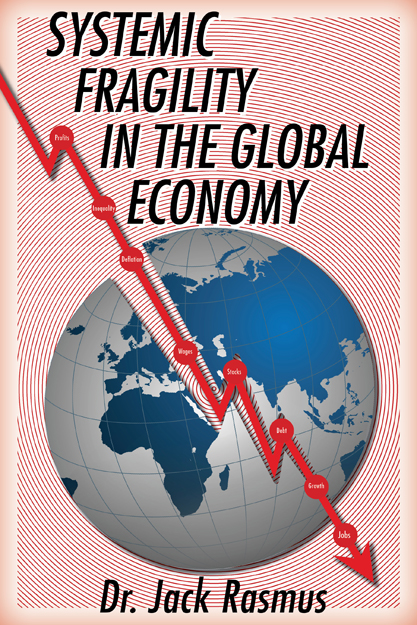
Price bubbles typically take two to three years to peak. As the data table below indicates, the US is now in the third year for all three and the February 2026 recent contractions should be a red flag. Asset price fragility is peaking—i.e. where ‘fragility’ is an indicator of the tendency for a major financial crash—a concept this writer defined quantitatively and measured in a previous publication, System Fragility in the Global Economy, Clarity Press, 2015.
All three financial markets are now increasingly fragile, as indicated by their growing volatility and ‘churn’ as they reached peak expansion in late 2025—with the sole exception of gold which will likely drive still higher due to separate geopolitical forces.
Asset price bubbles typically bust and deflate much faster than they accelerate. Often in just weeks and sometimes just days once they turn down. Asset markets are also what economists call ‘substitutable’—i.e. the same investors invest across all three. And when they deflate, the same investors end up dumping them in tandem—either for psychological reasons, the need to cover prior margin buying, or demands by their lenders. That’s called contagion, signs of which are also now also beginning to appear in the stock and crypto markets.
Moreover, should such a general asset deflation occur across all three financial markets in 2026, or early 2027, the price deflation across the three bubbles will be exacerbated by a fourth asset price deflation already well underway—i.e. the price of the US dollar which has already devalued (‘deflated) nearly 10% in 2025. Should the other bubbles bust continue to deflate, the dollar will almost certainly devalue even further in turn—raising the further question how might a further 10% devaluation of the US dollar in 2026 feed back upon the other asset markets? Or, for that matter, on the US real economy?
No one knows the consequences for the US and global economies should such a historically unique multiple financial asset price contraction occur in the midst of a 20% decline of the value of the US dollar by year end 2026! It’s never happened before.
Nor does anyone know the consequences in turn for US Treasuries sales now facing growing headwinds—and thus the US ability to continue funding its chronic $1.8 trillion annual budget deficits.
The history of past finance asset bubble deflations show the crash of even one financial market—whether housing & derivatives in 2007-08, global currencies (1998), junk bonds & stocks (1987), savings & loans (1990), etc.— is often enough to precipitate recessions in the real economy of varying degrees and duration.
What happens to the US real (non-financial markets) economy, now already barely growing at around 1.5% in real GDP terms when properly estimated and more accurately adjusted for actual inflation? A financial crash involving multiple finance markets, may make the 2007-09 so-called ‘great recession’ appear a relatively mild event.
What’s also different today is that the US real economy is far weaker than it was during previous financial instability events: Back in 2007-09 the US economy was not experiencing a US dollar devaluation of 10% or more; the US federal national debt was $10 trillion not approaching $39 trillion today; interest payments on the US national debt were $379 billion in 2008 not $1.2 trillion in 2025; foreign holders of US debt held $2.9 trillion of US Treasuries not $9.1 trillion; the annual US budget deficit in 2008 was $455 billion instead of $1.78 trillion today; total US defense and war spending (not just Pentagon) was roughly half that of 2025’s $2.1 trillion a year—the latter poised to rise by another $400 billion next fiscal year, according to Trump.
US household debt was $12.6 trillion in 2008; today it’s at record levels of $18.8 trillion with delinquencies and defaults now rising sharply for credit cards, auto and student loans, while Corporate debt is also now at a record $10.5 trillion. Real wages for US households in 2025 remain stagnant or declining now after four decades for the bottom 80% of the US work force, while net new job growth in 2025 averaged a record low of only 15,000 a month (181,000 for all of 2025). Nominal weekly earnings for the more than 100 million US production and non-supervisory workers have risen only 9.1% since 2020, while inflation per the US CPI index has risen more than 24%. Official government data shows 67% of US households now live paycheck to paycheck.
If the financial market bubbles and the chronic devaluing dollar represent the kindling beneath the US real economy, then US households’ precarious economic condition today represents the dry tinder waiting to set off an economic conflagration the next 18 months should the financial bubbles implode driving the US economy into recession once again.
Financial Asset Market Fragility 2023-25
Here’s how much the three concurrent financial bubbles have accelerated in recent years:
% Change/Yr
| 2023 | 2024 | 2025 | |
| S&P500 | 26.3% | 25.0% | 17.8% |
| Nasdaq | 43.4% | 29.5% | 20.3% |
| Dow | 16.8% | 12.8% | 13.0% |
| Bitcoin | 155% | 121% | 5.0% |
| Gold | 13.1% | 27.3% | 64.7% |
| Silver | -1.2% | 22.3% | 170% |
| $US Dollar | -2.7% | 6.8% | -9.2% |
What’s Happening February 2026
In early 2025 the asset bubbles hit a wall. Some recovered relatively quickly, like gold prices. But US Stock markets and prices have struggled to regain their lost momentum. Bitcoin and crypto currency prices have fared even worse.
| 2025 | Feb. 15, 2026 | Loss/Gain 2026 (6 wks) | |
| S&P500 | $6,845 | $6,881 | +$36 |
| Nasdaq | $23,241 | $20,367 | -$2,874 |
| Dow | $48,063 | $49,500 | +$1,437 |
| Bitcoin (per coin) | $88,430 | $68,867 | -$19,563 |
| Gold (per ounce) | $4,322 | $5,044 | +$712 |
| Silver (per ounce) | $77.92 | $78.91 | +$0.99 |
| $US Dollar (index) | -9.2% | -1.2% | -10.4% |
What the data show thus far for 2026 is that, except for gold, after accelerating for three years asset markets hit a wall in 2026 starting the last week in January and into the first weeks of February 2026. Tech stocks in particular underwent a significant contraction reflected in both the S&P 500 and Nasdaq stock markets. Bitcoin fared worse: On one day alone it crashed 14% after having declined from a high of $126,000 per coin in October 2025 to $68,867 in mid-February 2026, almost by 50%. After a torrid 170% surge in 2025, silver prices have now flattened out. Gold prices took a major dip at the end of January along with the rest, falling 15% on January 30 alone, the largest one day loss in its history but clawed back some of that loss by mid-February.
During the first week of February the contagion mostly occurred across and between financial asset markets. The sell offs abated some by the end of the first week as ‘dip buying’ set in. Big finance investors were not yet moving to the sidelines for an extended period. Some are still buying on the dip. However, that may not last. The dip buying is proving tepid—especially in the case of the S&P500, Nasdaq, and Bitcoin markets. Therefore the multi-market price deflation is so far a harbinger of things to come and not yet the ‘big event’.
Some investors have not stepped back in to re-buy Tech stocks—which is itself significant and telling—but moved over to invest in the non-Tech Dow Industrials which has experienced a temporary surge in the wake of the tech stock-crypto collapse. Other investors have rotated their profits into the gold market where fundamentals due to geopolitical and geo-economic causes promise to continue an escalation of metals prices.
So why have gold prices recovered, while other stock markets thus far have not? The simple explanation is the gold bubble is being driven by global causes as well while the US stock markets’ bubbles are driven by the hype and price speculation in the artificial intelligence AI investment boom; and Bitcoin and cryptos by regulatory changes, crypto ETFs, and by support from Trump and the Trump family crypto grift.
Gold prices continue to rise due to escalation in buying by foreign country central banks, private banks, and offshore investors. China, India, the BRICS and other global south economies have led the way. Their gold buying represents a shift from using the US dollar as their primary reserve currency, and from using dollars for transactions in oil and other commodities. Deeper still, the shift from dollars is driven by US policies employing sanctions, tariffs, and embargoes as tools of US imperial policy. The decline in the demand for dollars is occurring as well for separate set of reasons by the other historically big purchasers of dollars, Japan and Europe. They too are shifting to gold and away from dollars to purchase US Treasury securities.
As former global buyers of dollars shift to gold, the decline in the demand for dollars has resulted in the devaluing the US dollar. That in turn pushes up the demand for gold and thus its price. Thus, multiple international forces, economic and political, are driving the price of gold—unlike the price bubbles in US stock markets that are being driven largely by AI investment hype and speculation and political factors driving bitcoin and cryptos.
How much and how fast the multiple financial market bubbles contract in coming months will determine whether a ‘financial crash’ takes place the next 12-18 months. But February 2026 market events suggest that is the new trajectory in 2026, a basic departure from the sustained bubble trajectory of 2023-25. Geopolitical events will continue to drive gold prices. Domestic political events crypto prices. And investor herd psychology and hype associated with the investment boom in Artificial Intelligence in the US will largely determine what further happens in the S&P 500 and Nasdaq stock markets. However, recent developments in AI do not portend well for the US stocks markets’ recovery. Here’s why:
Artificial Intelligence Investment: Boom or Bust?
One must understand what’s going on in the Artificial Intelligence investment boom to understand whether S&P 500 and Nasdaq stock markets will continue to weaken and deflate. Some of the AI investment boom is real, but much of it is hype that will never be realized for most businesses beyond the Big 7 tech companies driving it.
As is often the case, financial bubbles are built upon developments in the real economy. When those real developments do not pan out, market asset prices bubbles based upon them implode in turn. Almost all the accelerating rise in SP500 and Nasdaq stock markets price appreciation in 2025 has been driven by the stocks of the big & Tech corporations and their stock price appreciation has been driven by their hype, announcements and plans with regard to AI.
As others have also pointed out, AI investment is also propping up the US real economy not just the financial markets. In the first half of 2025 AI investment accounted for 85% of all the gain in the US real GDP! Should the AI investment boom not deliver on the hype it has promised for the real economy, the AI driven tech stocks underpinning the stock markets will deflate further and faster.
Almost all of the US GDP growth in 2025 has been due to 1) the AI investment boom up to now focused in chips, data centers and software apps investment by the big 7 Tech corps, along with 2) technical changes in the reduction of US imports as result of Trump tariff policies. Take away these two factors and, as the saying goes, “there’s no there there” in US GDP growth last year. The US real economy would be close to stagnant in 2025. And US GDP would be contracting—i.e. in recession—if it were properly adjusted for inflation, which it isn’t by using the PCE index that low balls inflation and thus puffs up real GDP.
In short, take away the AI boom, the tariffs driven decline in US imports, and properly adjust prices, and US GDP would be negative.
We’re told by the big Tech corporations and politicians alike that the investment boom in Artificial Intelligence will ensure the stock markets continue to rise and the real US economy will experience a new era of solid real economic growth. Big Tech and US business in general are ‘rolling the economic dice’ on massive investments in AI as the magic solution that will soon turn everything around before the next financial crash. The big 7 Tech companies—Google, Amazon, Meta, Microsoft, Nvidia, Apple and Broadcom (8 if one counts Tesla)—this past winter 2025-26 together announced $700 billion new spending in AI for 2026 alone, after having invested $450 billion in 2025.
But is AI the solution to the growing financial fragility—or a major cause of it? Will AI generate real economic benefits for all—or just produce more concentration of wealth for the Big Tech capitalists and billionaires?
Here’s the problem why AI will mostly produce profits for Big Tech and not for general business, will not generate sustained economic growth in general, and will result in more fragility and stock market price instability:
Surveys show that 70% of non-big 7 tech companies don’t see how they can make money from introducing AI. The costs of implementing AI in their companies are significant. It’s not just about using a Chat-GPT app. That’s AI peanuts. To introduce AI in order to significantly reduce costs, boost productivity, and realize significant profit gains, non-tech companies will have to re-engineer their companies’ basic data architecture. That’s expensive. They’ll have to employ professional consulting services to do so. And guess who’ll offer those businesses services? The big 7 tech corps. The non-tech businesses will also have to integrate their IT with cloud computing services. Guess who offers that? Again, the big Techs, especially Alphabet-Google, Amazon, Microsoft and soon even Meta. The big chip companies like Nvidia, Broadcom and others will feed them all the expensive chips they want. In other words, the AI investment boom will largely benefit the big 7 financially. They’ll make the profits. The rest of general business caught up in the AI hype will pay for it all and realize few if any profit gains. When that becomes apparent, general business demand for AI products will decline—and with it the price of the offerings by the Big 7 tech giants. And then the AI stock bubble will begin unwinding in turn. It’s all not unlike what happened with artificially stimulated US residential housing markets in 2003-2007. When the real investment in housing collapsed in 2007, the stock values followed. And the companies that borrowed to play couldn’t pay off their lenders, who in turn recorded losses, and we know the rest of the trajectory.
The current AI boom is therefore something like the dotcom internet bubble’s over-investment 1998-2000, overlaid with elements of the residential housing boom and bubble that followed 2003-07.
AI hype is already beginning to impact other sectors and companies, now showing up in their stock valuations as well. The AI investment boom risks not only millions of US job losses and wage compression for millions more workers, but also risks destroying thousands of other companies’ business models and bottom lines. AI will prove a destructive economic force like no other to date.
The US business media is beginning to acknowledge the AI investment boom is destroying the valuations and future returns for other industries and companies: the traditional software companies are especially vulnerable. Other industries like finance, insurance, legal services and even trucking are now recognized as existentially threatened by AI. Their stock prices are already taking a hit.
As a recent Wall St. Journal article (February 14, 2026, p. B10) entitled ‘AI Jitters Fuel Worst Week for Stocks Since November’, forewarned of “the long term disruptive potential of AI” on a wide array of business sectors and “that entire industries are going to be worth much less money than they are today”.
After a brief recovery earlier in last week, all the stock markets retreated even further on Thursday and Friday, February 12-13. The Nasdaq declined for a fifth consecutive week, it’s worst slide since May 2022. The S&P 500 experienced its worst weekly loss last week since November 2025 while the Dow Industrial average rose only 49 points or 0.01%. In other words, there’s no sign of a major stock market bounce back yet.
AI contagion fears may now be spreading in the S&P 500 and Nasdaq stock markets, i.e. from the Big 7 tech companies stocks to other sectors. The decline in the financial asset bubbles may therefore have only just begun. Even given some recovery, more churn and contractions in 2026 are almost certain to occur.
The era of unrelenting asset price surges and bubbles that defined 2023-25 is likely over. A period of financial asset volatility and decline has likely now begun.
Will one or more of the recent asset bubbles break in 2026? Drag down the other bubbles in turn? Cause a further decline in the value of the US dollar? Will the weakness in the US real economy now become more increasingly apparent as well? Government shutdowns allowed politicians since October to plug in arbitrary data for the weeks of missed government surveys on inflation, jobs and GDP. They call this ‘imputed’ data. It’s actually just ‘made up’ data. A real view of the US economy will not be available until end of March 2026.
In the meantime, pending political events in the form of more Trump wars abroad, and Trump threats and actions to undermine US elections in November, will negatively impact investor-consumer confidence in 2026 and feedback on the already increasingly fragile stocks-crypto-US dollar and metals financial markets.
Should any one of the referenced financial asset markets break out of the pack and deflate rapidly, then contagion and a more general asset price collapse becomes imminent—with consequences for the real economy even greater than that which occurred in 2007-09.
 Dr. Jack Rasmus @drjackrasmus





 Jack Rasmus