Feeds:
Posts
Comments

On October 9, 2013, President Obama announced his nomination of Janet Yellen, current vice-chair of the Federal Reserve, as the new Fed chair, to replace Ben Bernanke expected to retire at year’s end.

Obama’s appointment, subject to Senate confirmation that is likely, comes after a general consensus in recent weeks that Yellen would be the President’s choice. That followed weeks of heated public debate and maneuvering, identifying Yellen as the favorite of liberals in and out of Congress, and Larry Summers the prefered choice of Obama administration staffers and insiders. Summers withdrew his candidacy several weeks ago, however, under pressure from conservative elements, who viewed his role as former Obama adviser, as too liberal on fiscal spending in Obama’s administration, and liberal elements, who viewed his role as former Clinton administration Secretary of the Treasury as too accommodating to bankers and financial deregulation.

It has been interesting to watch how liberals, within and without the Obama administration in recent weeks organized aggressively on behalf of Yellen. Yellen was the ‘Fed Dove’, willing to continue Ben Bernanke’s generous free money policies of QE (quantitative easing) and near zero interest rates. In contrast, Summers was the monetary ‘hawk’ that would likely accelerate a withdrawal from QE faster. Of course, both profiles were mostly spin.

Noted liberal economists, like Paul Krugman of the New York Times, fell completely into the Yellen camp, praising her policies and more liberal credentials. Even progressives of the moderate persuasion fell for the ‘Yellen as Fed Dove’ fiction. But a closer inspection would have revealed that neither Summers nor Yellen would have departed much, if at all, from current chair Bernanke’s policies.

Those policies, in the form of QE and ‘zero bound interest rates’, since 2009 have had little if any impact or effect on the real economy—and therefore on housing recovery, jobs, or middle class incomes.

In the course of four years of both QE and zero rates, the Federal Reserve has pumped more than $13 trillion in liquidity (money) into the US and global banking system (and shadow banking system) to bailout the banks. In terms of QE alone, this occurred in at least three versions—QE1, QE2, and now currently QE3—which together will have provided by year end 2013 (along with QE 2.5—called ‘operation twist’), nearly $4 trillion of liquidity injections to bankers as well as individual wealthy investors seeking to dump their collapse subprime mortgage bonds on the Federal Reserve.

QE and the $13 trillion resulted in record booms in the stock and bond markets in the US and globally. Much of that likely flowed out of the US into the global economy, serving to stimulate real growth in emerging markets and generating financial asset speculative bubbles around the world. There is in fact a very high correlation between the announcement, introduction, and conclusion of QE programs and stock-bond, derivative, and other financial asset booms and declines since 2009. Conversely, there is virtually no such connection between housing, jobs, and other real sectors of the US economy.
Bernanke Fed monetary policies have thus boosted financial capital gains and in turn the incomes of the wealthiest in the US and globally, as real disposable income for US households has consistently declined for four consecutive years.

As recent data on income distribution from studies of economists at the University of California have shown this past summer: The wealthiest US 1% households have accrued for themselves no less than 95% of all the income gains in the US since 2009.

Yellen has been perhaps the strongest supporter of out-going Fed Chair, Ben Bernanke’s policies of QE and zero bound rates, which have directly resulted in this lopsided income inequality. So why were liberals so impressed with her as the preferred choice for next Fed chair? It certainly wasn’t for her policies. Or was it?

Perhaps some still labor under the false notion that, in the world of 21st century global finance capitalism, low interest rates create jobs. But that academic economics fiction no longer has evidence in reality. It belongs in the same trash bin with other fictions, like business tax cuts create jobs. Or that more free trade agreements , like the pending Trans-Pacific Partnership, pushed by the Obama administration and liberals, will create jobs. Here again, the empirical track record shows that neither have, or will, create jobs. Liberals nonetheless adhere to these false notions, in essence believing in the various forms of ‘trickle down’ economics. Regardless, Yellen was given the ‘dove’ tag, and therefore the liberal endorsement.

Yellen as Fed Chair will continue policies no different in content than has Ben Bernanke. Yellen will continue to pump QE into bankers and investors, stocks and bond markets, global speculators and offshore investors, as had Bernanke. If she really were liberal, she’d take the $1 trillion given them in just the past year of QE3 liquidity injections and use it to fund a government direct job creation program. That would create 20 million $50k a year jobs, and jump start the economic recovery overnight.

But the Bernanke-Yellen policy of giving that $1 trillion (and $12 trillion more) to bankers and investors will instead continue to prop up the stock, bond and other speculative financial markets. Just as Bernanke ‘chickened out’ this past summer when he rapidly backed off suggesting the $85 billion a month QE3 injections might be reduced by modest $5 billion, so too will Yellen.

There will be no fundamental change, in other words, from a Bernanke Fed to a Yellen Fed. The US Federal Reserve under its current structure and leadership is an institution serving bankers and wealthy investors. Before the Fed can ever begin serving the rest of the economy, the country and its citizens, it will have to be radically restructured.

The Federal Reserve will have to be democratized and become an institution that functions as a ‘public banking entity’, not a private banking conduit. It will then provide low money cost loans to households, small businesses, students, and workers—instead of wealthy investors, bankers, and speculators.

Instead of issuing QE for the 1%, the Fed could issue QE designed to create jobs, raise incomes, and generate a sustained economic recovery for all. But that won’t happen under a Yellen Fed. The false ‘hawk/dove’ options for leadership in the Fed Reserve reflects the U.S. political system – a dual one-party system with corporate interest at its heart. It will take a new, grassroots movement calling for real choice, and real democracy to fix our government, and institutions like the Federal Reserve.

~ Jack Rasmus serves as the Chairman of the Federal Reserve System in the Economy Branch of the Green Shadow Cabinet of the United States

The economic ignorance of the Teapublican faction of the Republican party in the US House and Senate is perhaps exceeded only by the similar ignorance of its economic advisers.

Appearing in the public press in recent days is the latest ‘brilliant’ Teapublican view that a default by the US government on paying interest on its debt would not have a negative impact on the US or global economy.

Both the US and global economies are already slowing noticeably, with the Federal Reserve in the US continuing to downgrade and lower its estimates of future US growth, and the IMF doing the same for growth rates in China and the rest of the world. The Teapublicans claim a US debt default would not impact these already negative trends.

While it is true that the US government will not completely run out of money with which to pay its debts on October 17, 2013, as Treasury Secretary, Jack Lew, has publicly stated, it is equally true that it will definitely do so sometime between October 24 and early November. Thereafter, some funds will continue to come into the government, but not nearly enough to pay all its bills. That will force the Obama administration to choose between what it will pay: either bondholders who own US debt or grandma and grandpa on social security. Teapublicans no doubt want to force Obama to make that ‘Hobsons’ Choice’ (i.e. damned if you do and damned if you don’t). Teapublicans will argue he should pay the bondholders first, and forego paying social security. It’s their way to start cutting social security before they even negotiate an official reduction in it with Obama.

To quote one Teapartyer’s statement today, Republican Representative, Joe Barton, of Texas: “We have more than enough cash flow to pay interest on the public debt, so there is no way we’re gong to default on the public debt unless the president of the United States intentionally does so”.

Such statements by lesser known Teapublicans were followed up today in the business press with an article by Teapublican notable, Paul Ryan. Ryan made it clear that the focus of the debt ceiling discussion was to provoke further concessions by Obama on Social Security-Medicare cuts. US House radicals thus are attempting to put Obama in a negotiating box: either he agree to cut Obamacare or to cut Social Security-Medicare.
What the Teapublican faction in all their economic ignorance don’t understand, however, is that the psychological effects of a default—or even a near default—on the US and global economy will prove significant. One does not have to wait for a complete default for that to happen.

What then are some of the possible impacts?

First is the prospect of rising interest rates. Interest rates have already begun to rise, starting on a base that has already risen since the US Federal Reserve’s bungled attempt to signal over the past summer its intent to begin reducing (tapering) its Quantitative Easing (QE) $85 billion a month liquidity injections. That Fed ‘faux pas’ has already driven up long term rates by more than 1%, thereby causing an abrupt halt to a very timid US housing recovery earlier this year. In the past month banks and mortgage servicing companies have already announced thousands of layoffs in their mortgage departments, signaling the virtual end of that housing recovery. Further interest rate hikes, short and long term, on top of the Fed’s recent bungling—which will now certainly occur as the default approaches—will all but ensure the end of any housing recovery in the US.

Short term rate increases will most likely accelerate further throughout the month of October. That includes, in particular, Treasury bill rates which will in turn impact other rates. ‘Other rates’ include the critically important ‘Repo Market’ rates. Destabilizing the repo market is a dangerous game. It is likely the locus for the next financial crash, the analog to the subprime market that was the center of the last financial crash. Teapublicans are thus playing a dangerous game, one that may well in a worst case scenario precipitate another financial instability event on the scale of 2008.

Rising interest rates also mean the end of the latest stock price and junk bond booms. In itself, that doesn’t affect average folks much. But the psychological impact of a rapid decline in asset prices can, and does, spill over to consumer and business spending. That leads to layoffs, in a US job market that is, at best, producing only part time, temp, and low paid jobs as it is.

Rising rates and an even weaker job market in November-December will translate into slowing consumption, which is already showing signs of weakness in August-September. Retail sales in general will weaken still further as a consequence of the debt ceiling default, as will an already ‘long in the tooth’ auto sales cycle.

The negative impact of debt default on consumption is already becoming evident in recent weeks. A Gallup Poll in recent days showed consumer confidence dropping precipitously. While some argue confidence surveys are typically volatile and unreliable as indicators of consumer spending, that is not as true for abrupt and significant movements in confidence indicators. That may now be happening, as the public begins to focus on the dual crises events.

The recent Gallup poll in question fell to -35 from a prior -15. This compares to -56 during the August 2011 worst period of that prior debt ceiling debacle. During the worst period of October 2008 the index was -66. Already falling significantly early in the current crisis, one can estimate where the -35 current poll will be by October 17-24 should the crisis not be resolved by then. We will almost certainly be in the August 2011 territory, when the third quarter US GDP nearly went negative (and did so if the GDP deflator was substituted with the CPI index for that quarter).

Globally, the approaching debt ceiling crisis has already provoked widespread public responses by foreign governments, warning a potential default by the US would have dire consequences for US debt holdings and future purchases. China, Japan, and the IMF have all raised warnings in recent days. If default occurs, then US bond rates will rise even further and faster than at present, raising a real question whether they will continue to purchase US Treasury debt when the price of their holdings are declining significantly in the wake of a default.

There are also important implications of a default (or even near default) for the Eurozone’s own current economic recovery and its still very fragile banking system.

Yet another negative impact globally will be a decline in Euro exports. A default situation would result in the US currency losing value, causing a further rise in the already fast appreciating Euro currency. That trend would challenge German and Euro export growth and therefore that region’s tepid 0.3% last quarter’s recovery.

Another problem potentially to grow worse is the Euro banking system. The Eurozone’s version of QE-the LTRO liquidity injection policy of the past year amounting to more than $1.5 trillion-will soon need another LTRO II injection by the European Central Bank in a matter of months. In addition, more than $1 trillion of the LTRO I will need to be refinanced soon. Nearly all the major banks in Italy, for example, have yet to repay anything of their share of the LTRO $1.5 trillion and will need further liquidity in coming months. Rising interest rates from a debt default in the US will spill over to Europe, thus raising the costs of LTRO II, as well as the financing of much of LTRO I. That will cause further fragility in the Euro banking system and economic recovery there, especially for the highly fragile Italian banks.

For Japan, its recent export gains would also slow, at a time when it has decided to raise taxes while suspending structural economic reforms.
Currency volatility in emerging markets would also intensify from a debt default in the US, likely causing a retreat once again in real growth in those markets, just a few months after their recent ‘stop-go’ provoked by US Fed QE policy uncertainties this past summer.

Throughout the past 18 months, this writer has forewarned that a fragile US economic and global recovery-not nearly as robust as some maintain-is susceptible to a ‘double dip’ recession in 2013-14 should one or more of the following negative ‘tail events’ occur: first, a renewed banking crisis in the Eurozone or elsewhere; second, significant further deficit cutting in the US; and thirdly a continued drift upward in US long term interest rates as a consequence of QE tapering or other events. While it appears the Euro banking crisis has temporarily stabilized—except for Italian banks perhaps—the deficit cutting and interest rate trajectory in the US are very real and serious trends that may yet precipitate a descent into a double dip condition in the US economy.

And if the Teapublican faction in the US House of Representatives managers to prevent a resolution of the debt ceiling issue into the latter part of October, then the economic consequences for both the US and global economies will be severe, and may even prove sufficient to precipitate a double dip recession in the US.

Transcript of Radio Interview: October 4, 2013

How Will the US Government Shutdown Impact Markets?

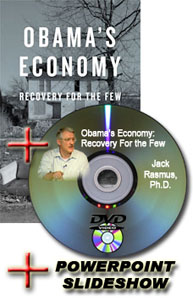
As the government shutdown, the stock market largely shrugged. Yesterday the Dow Jones actually rose 62 points suggesting investors don’t see the current shutdown as a long-term problem. Here with more analysis is Jack Rasmus. He’s a Political economist as well as the author of “Obama’s Economy: Recovery for the Few”

Rob Sachs, Host of Russia Radio American Edition:

‘This shutdown occurs and the stock market actually gains a little bit. It doesn’t seem to be congruent with the thoughts of what stock market would do. Why did they gain?’

Dr. Jack Rasmus:

The stock markets are more concerned with what is happening with the Fed taper of its QE and on September 17th the Fed made it very clear it was going to continue pumping 85 billion a month into the economy. That is their first and foremost major concern. Second, the markets are concerned about real data on economies in the US, Chinese, Eurozone economies, jobs, retail, sales; and what is happening with banks in Eurozone, Italy, China, manufacturing exports, emerging markets etc. Third in line of concern at the moment, I would say would be the debt ceiling situation . But that is still several weeks off, plenty of time to deal with that.

In contrast, the government shutdown really doesn’t affect markets that much, which is not surprising. The last time we had a government shutdown in 1995-1996, stocks and bond markets were totally unaffected by it and were hardly impact at all by the crisis. So it is not strange that we see the same development going on here today.

Now the real risk is if the shutdown continues for whatever reasons, which I don’t think it will, for another 2-3 weeks, and then it converges with the debt ceiling deadline. That deadline for the debt ceiling is probably closer to the end of October than the October 17th date, the Obama administration is now saying. Then you have a different scenario in terms of impact on financial markets and the US economy.

Rob Sachs:

‘We came to that before when we had this debt ceiling debate and people were saying this would be Armageddon, it is outrageous – the idea that the US would not pay its debts. But what was the role of Wall Street before in preventing that from happening? What can Wall Street do now to urge congressmen and those on Capitol Hill to come to some type of agreement?’

Dr. Jack Rasmus:

I am sure Wall St. and its lobbyists are putting increasing pressure already on politicians to come to some kind of agreement. Last time we had a debt ceiling confrontation, in August 2011, they waited till the last minute and didn’t leave themselves enough time to really lobby. But now I am sure there is a lot of intense lobbying going on at this particular stage before the October 24th or so ceiling deadline, when the government may not make an interest payment on its debt, which creates a default. That’s when a technical default happens.

I think an indicator of how things may be going as we approach that deadline will be what starts to happen with short-term interest rates. If you see the bank-to-bank federal funds rate, short term Treasury bills, or especially the bank repo market began to rise, then those rising rates will have an impact on stocks and bonds. That’s what investors are concerned about. That’s what will cost them money—not the government shutdown that impacts mostly workers and households. But I don’t see that happening at this stage. Not yet.

Rob Sachs:

‘When you look though at what is at stake, a lot of people say the shutdown is not so much a big deal but what really gets people nervous when we talk about inaction on Capitol Hill? Is it something more than just not getting a legislation passed?’

Dr. Jack Rasmus:

What makes the markets (i.e. banks and investors) nervous is they can’t necessarily count on getting paid their interest at the time it comes due should a default occur. If you don’t get paid for your investments, then you are not going to make investments. When interest rates rise in anticipation of, or a result of, a default by the government, that reduces the demand for government bonds that spills over and so forth and causes problems with rising interest rates in general. It is the translation of all this into rising rates that is important in terms of impact.

That is the key and we already see that the US economy is becoming increasingly sensitive to increases in rates, bond rates and so forth. We saw that over this past summer with the Fed trying to taper its QE buying, and how long-term interest rates immediately shut up over 1% and caused serious problems in the US and global economy. With emerging markets capital flight and so forth and the slowing of the housing market in the US. So, the global system is extremely sensitive right now to interest rate hikes after 5 years of QE. Not just long-term rates but as we will see with the debt ceiling issue, also with short-term rates if it comes to a crisis. It could all have a significant impact and more quickly than people think right now.

Rob Sachs:

‘Your book “Obama’s Economy: Recovery for the Few” talks about a lot of the benefits that we’ve seen have not been spread out and when we think about this economic recovery we’ve had, it has really not been felt in the middle class. Is that something where if we default, it is going to be impact on the middle class the most, or is this something where the stock market, these kinds of things are for investors to worry about and those who are throwing around tens of millions of dollars each day?’

Dr. Jack Rasmus:

It will primarily affect stock and bond markets and the investor class in a very short term that has a little effect on the real economy and real folks. But what could happened over time is that when investors pull back, then you have business investment pulling back, which is not that great in the US right now anyway. That starts to affect jobs, which are not really rising much at the moment, and incomes for the middle class and so forth, which are already falling in the US. For most US household we already have real disposable income declining at 1 and 1.5% per year for the last 4 years. And as recent data shows, the wealthiest 1% have accrued 95% of all the additional income gains since 2009. So, we are already growing increasingly income lopsided and consumers have a hard time spending, as we are now seeing with retail sales struggling in the US. So, this debt ceiling thing can have a important psychological impact. It can have a psychological impact on consumers and consumer spending and on businesses and business spending, and that is how it will mostly transmit into the real economy. The psychological impact is really important.

RADIO SHOW RECORDING

Alternative Visions – The US Fiscal-Monetary Crisis Intensifies – 10/02/13

Oct 2nd, 2013 by progressiveradionetwork

Dr. Jack Rasmus provides his analysis on the current government shutdown and the repeat of the debt ceiling crisis coming by mid-October and their possible negative impacts on the economy. Rasmus then considers the ‘other policy crisis’–i.e. the US Federal Reserve’s QE and zero interest rate monetary policies. He explains why US monetary policy has also entered a crisis stage in recent months–i.e. proving increasingly ineffective at stimulating the real economy while simultaneously generating financial bubbles. QE and austerity policies elsewhere in the world are discussed, with similar counterproductive effects on the real economy. Rasmus concludes the US and global economy is now entering a period of growing ineffectiveness of traditional fiscal-monetary policies generating a sustained economic recovery, at a time during which the US and global economies continue to slow or stagnate long term.

LISTEN TO THE FULL 56MIN. SHOW ON THE ‘ALTERNATIVE VISIONS’ WEBSITE AT:

http://prn.fm/category/archives/alternative-visions/

OR ALSO AT:

http://alternativevisions.podbean.com/

Listen to the two latest ‘Alternative Visions’ radio shows, hosted by Dr. Jack Rasmus, on the Progressive Radio Network. The first show, airing September 18, interviews guests Steve Early and Carl Finamore who attended the recent AFLCIO convention in LA . The show focuses on the topic of Union-Community Alliances and the AFLCIO’s recent discussion on creating new forms of partnerships between unions and community groups. The second show, that airs September 25, interviews immigrant rights and labor activist, Alan Benjamin, on new realignments of immigration rights groups in progress given the collapse of the Immigrant Rights bill in Congress and Obama’s refusal to take executive action on behalf of immigrant rights.

Both shows and interviews are available for download on the progressive radio network, accessible at http://prn.fm/category/archives/alternative-visions/. The shows are also archived and available at alternativevisions.podbean.com.

1. September 18 show: ‘The AFLCIO Convention & New Union-Community Alliances

Show Description: ‘Dr. Jack Rasmus welcomes two long-time union officers, Steve Early of the CWA and Carl Finamore of the Machinists, who attended the recent AFLCIO convention where delegates recently discussed and voted on whether to bring community groups (NAACP, La Raza, Sierra Club, etc.) into the union federation as a new kind of membership. Both Steve and Carl have more than 30 years each of experience in the US labor movement, which they bring to the discussion. Jack introduces the show and discussion with an explanation of the dimensions of the deep decline in union labor in the USA, its failing organizing and bargaining strategies at the company level and the political level with its alliance with the Democratic Party, as well as the consequences of both. Steve and Carl discuss the resolution and scope of the decision at the AFLCIO convention to forge a deeper partnership with community organizations. How can union labor stop and reverse its slide? Jack and guests debate whether some kind of new grass roots organizational structure uniting labor and community organizations must occur if union labor in the US is to survive and grow.

Guest bios: Steve Early is a retired, long time staff representative for the Communications Workers of America and an author of several recent books on the US union movement today, including ‘Embedded With Organized Labor’ and ‘The Civil Wars in US Labor’. Carl Finamore is a former president of Local 1781 of the machinists union representing workers in the airlines industry and a frequent writer to various magazines and blogs on labor and other issues. Check out both their recent articles on the widely read blog, Counterpunch.org, on the recent AFLCIO convention and other labor topics.’

2. September 24/25 show: Immigrants Rights Movement at Historical Juncture

Show Description: Dr. Jack Rasmus invites long-time immigrant rights and union activist, Alan Benjamin, to discuss current and possible realignments in immigrant rights groups’ strategies in the wake of the collapsed Obama legislative proposals in Congress. Benjamin explains in detail the onerous provisions of the recent immigrant rights bill that is now dead on arrival, the new emerging demands of immigrant rights groups’ as 400,000 a year deportations continue under the current administration. Jack and Alan discuss the just formed ‘United Front for Justice & Dignity’ this September 7 of 100 founding members from 40 different groups, and the AFL-CIO convention’s recent internal debates over resolution #4 vs. resolution #23. New directions in grass roots organizing and new demands by immigrant rights groups for Obama to enact immigration reform by executive order are considered. The demands of the recently formed ‘United Front for Justice & Dignity’ above can be viewed at http://www.todopoderalpueblo.org.

Guest bio: Alan Benjamin is a delegate to the San Francisco AFLCIO central labor council, a long time union member, and a leading activist with several groups advocating rights and citizenship for 11 million undocumented workers in the US.

Access both shows for download at:

http://prn.fm/category/archives/alternative-visions/.

or at:

http://www.alternativevisions.podbean.com.

This past week the US central bank, the Federal Reserve (Fed), opted not to change its current 3rd Quantitative Easing (QE) policy providing $85 billion a month in bond purchases from bankers and investors. The Fed’s QE3 policy has been in effect for about a year, injecting in excess of $1 trillion in subsidized money into the US and global economy. Since QEs began in 2009, the total injection will have exceeded $4 trillion by the end of this year.

Consensus was strong in recent weeks that the Fed would at least slightly reduce that $85 billion, by a token $5-$10 billion a month. That would have provided a mild, second signal it would begin reducing its $85 billion a month money injection.

Last May-June 2013, the Fed’s chairman, Ben Bernanke, initially signaled to the markets the Fed might soon start ‘reducing QE. That set off what has been called the ‘taper tantrum’ by investors. Almost immediately in response to the Fed’s suggestion, rates on bonds in the US began to escalate, including mortgage rates, corporate bond rates and US Treasury bonds—all of which surged by more than a full 1% in a matter of weeks.

The outcome of the rapid rate rise was the tepid US housing market recovery almost stalled, stock and bond prices began to tank, and investment into ‘emerging markets’—where much of the total $4 trillion in QEs since 2009 has gone—began to reverse and flow back from abroad to the US and Europe. Emerging markets’ currencies in turn began to decline, the global currency war ratcheted up another notch, and capital flight from those economies to the west accelerated.

Faced with the ‘taper tantrum’ by global high net worth investors and their institutions—aka ‘the markets’—the Fed and Bernanke quickly changed their tune by early July, reassuring investors and speculators that s significant retraction of QE3’s $85 billion wasn’t really their intention. The ‘markets’ quickly sighed with relief and stock, bond, property, and other financial asset prices rose again.

As part of its so-called ‘forward guidance’ policy—notifying markets of its future intentions—the Fed in August took another shot, this time more cautiously, at trying to extricate itself once again from its massive, five year, $4 trillion QE program.

The extrication has become increasingly necessary, since QEs—together with the Fed’s accompanying policy of ‘zero bound’ interest rates—have been force-feeding financial asset bubbles globally—threatening to destabilize the global money system. Simultaneously, it has become no less clear that these dual Fed policies have become increasingly ‘inefficient’—that is, while feeding financial speculation and asset bubbles they have not resulted in much real investment in goods and services.

As more and more reports and articles have begun to show, as QE continues to grow and financial asset market prices rise, the growth of real investment in goods and services continue to slow. According to one report, only 15% of financial flows since 2009 are now going into real investment in goods and services, according to a recent article in the global news daily, the Financial Times, this past September 20.

However, the Fed’s second ‘forward guidance’ second suggestion to taper in August led to still more capital flight and currency declines in emerging markets. At the same time, by late summer in the US, a number of economic indicators began to show that the US economic recovery is not as strong as the press hype has been suggesting. Even the Fed itself has been lowering its own forecast for the US economy, from 2.5% earlier in 2013 down, most recently, to 2% GDP growth. (That downward revised forecast was not the first. In fact, the Fed has consistently reduced its US economic forecasts for the past three years, from an originally predicted 4.3% annual GDP growth).
Given the obvious concern with Fed monetary policies’ growing ‘inefficiency’ stimulating the real economy and the growing effects of QE and zero rates feeding financial speculation and bubbles, the Fed last week on September 16, shook markets and investors by deciding not to ‘taper’ at all for the moment, suspending its August implied ‘token taper’ of $5 or $10 billion a month.

To recap these Fed events over the summer: in a matter of just a few months the Fed has shifted from responding to the ‘Taper Tantrum’ to the ‘Token Taper’ retreat. This has left its policy of ‘forward guidance’—i.e. signaling its intentions to the markets—in a shambles. In recent days, several Fed board governors have returned to suggesting a third time that a reduction of the $85 billion will occur before year end, and perhaps even start in October—i.e. what might be called a ‘Taper Tomorrow’.

What all this policy shifting signifies is, in the last several months, Fed monetary policy is perhaps beginning to unwind in more ways than one.
On the other hand, the Fed’s retreat from the ‘Tantrum’ and the ‘Token’ has left speculators, investors and banksters quite happy. The stock and bond markets surged in September once again, emerging market currencies recovered a little, and other financial markets moved once more to the upside—illustrating the tight positive correlation that has evident for four years now between financial asset inflation and Fed QE policies (and the equal lack of any correlation between QEs and the real economy).

To employ a metaphor, as a consequence of its ‘on-off’ QE policy the Fed is beginning to appear like the drunk driver stopped by police after appearing to ‘weave back and forth’ on the highway. It is being asked to hold its finger to its nose and walk a straight line, to give evidence if it is indeed drunk or not. And it’s not succeeding. Instead, its stumbling to either side of the line.

What the Fed’s ‘stop-go’, on and off, QE policy signifies in a broader sense is threefold:

First, that investors and banksters have become addicted to the QE, low interest and free money policies of the Fed that have been in effect the past five years. (see this writer’s March 7, 2012 article and prediction, ‘Are Capitalists Becoming Addicted to Free Money’, on his blog at jackrasmus.com). The mere suggestion of a QE retraction, even when token, results in financial asset price declines and rising interest rates. Banksters-investors simply want the free subsidies to continue and they expect that to happen. A ‘cold-turkey’ withdrawal of liquidity sends them into ‘financial fits’.

Moreover, each time the Fed retreats on its signal to taper, it makes the next attempt even more difficult as investors anticipate and become even more predisposed to quickly respond to counter any Fed suggested move. As the Fed repeatedly retreats, the financial bubbles continue, emerging markets’ problems of currency volatility and capital flight grow, China’s real estate market becomes more fragile as hot money inflows return from the west to Chinese ‘shadow’ banks, and US monetary policy becomes even less ‘efficient’ stimulating the real US economy.

Secondly, Fed recent stop-go policies suggest the real economy has become super-sensitive to interest rate hikes—just as it has become ‘super-Insensitive’ to interest rate reductions over the past five years. (In economists’ parlance, this is expressed as the economy having become ‘increasingly inelastic’ to interest rate declines—i.e. falling rates generating little real growth—while conversely becoming ‘increasingly elastic’—rising rates quickly slowing real growth—to interest rate hikes).

QE is showing the real economy is responding less and less positively to money supply injections and interest rate declines, while more and more negatively to money supply reductions and interest rate hikes. Furthermore, the Fed’s key policy of ‘forward guidance’—i.e. telling the markets what it plans to do in order to avoid severe volatility response by investors—is now unraveling as well. No one really knows what the Fed is going to do now, how it plans to do it, and when and at what rate it plans to begin doing it. In short, the Fed is losing control of the monetary tools by which it has been stabilizing the banking and financial system the past five years.

Thirdly, it all means it will be even more difficult for the Fed to ‘taper tomorrow’, which is apparently its latest message being delivered by select Fed governors. Emerging markets may react even more volatilely to the next taper iteration by the Fed, producing even more currency volatility, capital flight, and economic slowdown. More hot money will flow into China’s increasingly fragile local property markets via its growing ‘shadow’ bank network there. Financial asset bubbles, having returned in the interim, will pose an even greater risk of too rapid asset price contraction at some later date.

Apart from problems of feeding financial speculation, asset prices, and continuing financial bubbles, the US and global real economy will now become even more ‘super-sensitive’ to QE withdrawal and resulting interest rate hikes.

Dr. Jack Rasmus
September 20, 2013

Will American Unions forge new unity with progressive community groups? Will it welcome community groups into the AFL-CIO as members?

Listen to Jack Rasmus’s September 18 radio show, Alternative Visions, for a discussion with AFL-CIO convention attendees, long-time union officers, Steve Early and Carl Finamore, on this topic.

Dr. Jack Rasmus welcomes Steve Early of the CWA and Carl Finamore of the Machinists, who attended the recent AFLCIO convention where delegates recently discussed and voted on whether to bring community groups (NAACP, La Raza, Sierra Club, etc.) into the union federation as a new kind of membership.

Both Steve and Carl have more than 30 years each of experience in the US labor movement, which they bring to the discussion.

Jack introduces the show and discussion with an explanation of the dimensions of the deep decline in union labor in the USA, its failing organizing and bargaining strategies at the company level and the political level with its alliance with the Democratic Party, as well as the consequences of both. Steve and Carl discuss the resolution and scope of the decision at the AFLCIO convention to forge a deeper partnership with community organizations. How can union labor stop and reverse its slide? Jack and guests debate whether some kind of new grass roots organizational structure uniting labor and community organizations must occur if union labor in the US is to survive and grow.

Url for the radio show is: http://prn.fm/2013/09/alternative-visions-091813/

Over the past five years the US central bank, the Federal Reserve (Fed), has printed nearly $4 trillion in liquidity (money) which it has provided to banks and professional investors. This is called ‘Quantitative Easing’ (QE). QE means the Fed essentially prints money and buys bonds—mostly toxic subprime mortgages to date—from institutional investors (i.e. banks, shadow banks, foreign banks, other investors). In addition to printing nearly $4 trillion with which to buy bonds from banks and investors, since 2008 the Fed has also conducted various ‘special auctions’, by which it has loaned additional trillions of dollars at little or no interest to banks. Still more trillions were loaned were loaned by the Fed by means of policies that resulted in near zero interest rates (between 0.1%-0.25%) at which banks could borrow money.

The Fed’s QE purchases represent a massive direct subsidization of banks and investors, since the Fed’s bond purchases were almost certainly bought in most cases at prices well above the collapsed value of the bonds—most of which were mortgage bonds including toxic subprime mortgages. But we’ll never know the exact price the Fed paid bankers and investors for the bonds, since the Fed doesn’t provide specific reports on individual deals and purchases; not even to Congress. Only the aggregate data is reported.

The total of QE, special auctions, and near zero interest rates made available to bankers and investors since 2008 comes to at least $10 to $15 trillion. Some estimates range as high as $20 trillion. The number rises still higher when similar QE and free money measures by foreign central banks is taken into account; specifically, by other major central banks like the Bank of England, Bank of Japan, and the European Central Bank (ECB).

Justifying QE1: Economic Recovery

The Fed originally argued in 2009 that this massive, free money injection and bank subsidization was necessary to stimulate the US economy and generate a sustained full recovery as quickly as possible. But even if the Fed and its policies were responsible for all the economic growth since 2009, an impossible assumption that ignores all other contributions to growth, that contribution would still amount to only 8.2% GDP growth over the past five years—which is about only half the GDP growth after five years that occurred in prior recession recoveries since the 1970s.

The Fed’s QE policies these past five years have come in four doses. There was the initial QE1 in 2009, amounting to $1.75 trillion in bond purchases. The US economy then stalled out in the summer of 2010. Then came the $600 billion QE2 in the fall of 2010. The economy stalled a second time in 2011, leading to what was called ‘Operation Twist’ (QE 2.5?) that provided another $400 billion in mortgage bond purchases. When that petered out, it was followed by QE3 last September 2012. Unlike its predecessors, QE3 has had no limit. It calls for Fed purchases of $85 billion a month for ‘as long as necessary’. So QE3 has now amounted to about another $1 trillion, and continues to rise by $85 billion every month.

While there is talk that the Fed may start to ‘taper’ (reduce) its $85 billion a month, don’t expect much of a change. Maybe $10 billion a month or so reduction. QE will therefore continue for some time. That’s because, as this writer has argued elsewhere, bankers and big investors are now ‘addicted to the free money’ regime that characterizes 21st century finance capital globally today.

Just the mention of a possible ending of QE by the Fed this past June sent bankers-investors globally into financial fits and paroxysms last June. Stocks, bonds and other financial assets fell into a major tailspin in a matter of weeks. The Fed quickly denied it had any such intention of ending QE. The markets quickly recovered and went on their merry financial bubble way once again. That event of possibly reducing QE, and financial markets’ extreme reaction, this past summer has been called the ‘taper tantrum’. What’s coming in the next few weeks, however, is at most a ‘taper tweak’.

Justifying QE2: Restoring Price Stability

The Fed initially launched QE1 in early 2009, claiming it would stimulate the economy and generate a recovery. But no such thing happened. In the summer of 2010 the economy weakened again. The Fed thereafter switched its excuse. It next argued in 2010 a second QE was necessary, this time to head off the growing trend in the economy toward deflation (price declines) at the time.

Deflation is a very dangerous thing. As long as prices continue to fall, businesses will hold off investing and consumer households from buying. For businesses, deflation creates uncertainty whether they can sell their goods at a price high enough in the future to cover their production costs in the present. For households, deflation results in consumers ‘waiting for prices to bottom out’ before actually purchasing again. The recent housing market in the US is a good example. Home prices continued to fall for four years, about 40% on average. During the period of home price declines the housing market did not recover, despite the 30%-40% price drops. It wasn’t until late 2012, as home prices began to rise, that home buying recovered a little and home prices began rising a little, by about 12-15%. Thus deflation means both business investment and household consumption ‘freeze up’. That means no recovery. The Fed therefore argued another round of QE was needed to halt deflation and get prices rising again, so that investment, consumption, and recovery could follow.

But the Fed’s claim that QE 2 was needed to prevent deflation and raise prices (to a Fed target of 2.5%), as a way to encourage investment and consumer spending, didn’t materialize either. Between 2010-2011, the period during which QE2 was in effect, consumer and wholesale prices for goods and services continued to slowly drift lower, flirting dangerously with deflation. While QE policies may—and often do—result in price bubbles for financial assets (stocks, bonds, etc.), they have little effect in terms of inflating prices for normal goods and services.

So the Fed’s QE1 did not generate a sustained recovery for the US economy (which has been bouncing along the bottom now for four years since the ‘end’ of the recession in June 2009). And its QE2 did not result in getting prices to rise to the Fed’s minimal target of 2.5%. The primary goals of QE in its first and second iteration therefore failed.

Justifying QE3: Reducing Unemployment & Creating Jobs

Enter QE3, and the Fed’s third justification for introducing yet another third round of QE3 in the fall of 2012. The new excuse was that another QE was necessary in order to reduce unemployment rates and get a job recovery underway. In September 2012 the Fed announced it would launch another QE, printing and injecting $85 billion a month into the economy, until such time as the ‘U-3’ unemployment rate fell—from the 8.1% level in September 2012 to a 6.5% target level. The U-3 rate has come down over the past year to 7.3%. Meanwhile, the more accurate U-6 unemployment rate still remains around 14% and more than 20 million continue unemployed.

But the Fed’s QE3 has not really been responsible for reducing even the unemployment rate from 8.1% to 7.3%. That reduction has been the result of millions of unemployed leaving the labor force altogether over the past year, and from jobs ‘churning’ from declined in full time jobs to increases in part time and temporary jobs.

Over the past year, 2012-2013, it is true that the US economy has created 2.3 million jobs. But this has been largely part time and temp jobs, with low pay and essentially no benefits.

‘Jobs Churn’: The US Jobs Market Today

The main characteristic of the US job market today is perhaps best described as a ‘job churn’. While the US is not losing jobs, it is not creating them very well—at least not decent paying jobs.

The US is ‘churning out’ full time jobs and replacing them with ‘contingent jobs’. Since January 2013 through July 2013, just under a million jobs were created; but no fewer than 650,000 of these were part time and temp jobs. Meanwhile, 250,000 full time jobs disappeared over the same period. This ‘job churn’ has other dimensions as well.

In addition to replace full time with part time-temp jobs, it is providing jobs for millions of new entrants (at mostly part time-temp status) as millions more leave the labor force altogether.

It is substituting high paid jobs for low paid. As a recent study showed, 60% of the jobs lost since 2008 have been ‘high paid’ (more than $18/hr. on average), while 58% of the jobs created since 2008 have been ‘low paid’ (less than $12 an hour).

Not only substituting new entrants to the labor force for those leaving the labor force; not only full time for part-time/temp jobs; not only high paid for low paid. The economy is churning out union jobs and replacing them with non-union jobs as well.

It is a sad but remarkable fact that while the economy added a couple million jobs since 2012, US unions experienced an unprecedented decline of 500,000 jobs in 2012 alone. That loss amidst job creation has never before occurred for organized labor. At that rate, its meager 6% or so unionization rate in the private sector today will fall to 3% or less by the end of the current decade—i.e. the lowest ever, signifying the virtual disappearance of organized labor in the private sector in America for all practical purposes.

QE as 21st Century ‘Trickle Down’

Notwithstanding the foregoing facts, if one still insists on maintaining that the Fed’s QE3 has reduced unemployment, it is clear that QE to date is an incredibly inefficient, costly, and wasteful way to create jobs.

For example, let’s assume QE3 and Fed monetary policy is responsible for half of all the 2.3 million jobs created over the past year—a generous assumption. But let’s assume it nonetheless. That’s 1,150,000 of the roughly 2.3 million jobs created over the past 12 months. Let’s further assume that about 400,000 of that 1,150,000 represents part time-temp jobs. Next, if two part time jobs roughly equals one full time job, that’s 200,000 full time equivalent jobs created by QE and the Fed the past 12 months. Add that 200,000 to the remaining 715,000 full time jobs assumed created by QE3 over the past year, adds up to a total of 915,000 full time jobs created by QE/Fed over the past year. Let’s round it all up, to an even 1 million jobs created by QE3.

Now let’s take the $1 trillion cost of QE3 over the past year. Divide the $1 trillion by 1 million jobs and the result is a cost of $1 million per job created. That’s an absurdly inefficient and wasteful job creation program!

So who has really benefited from the Fed’s $1 trillion QE job creation program?

Taking the calculations one further step, the average wage of the 1 million jobs is reasonably no more than $15/hr—given the composition of 400,000 part time-temp, low paid jobs in the total. That $15/hr. is about $30,000 a year. The ‘benefits cost’ load is no more than 10% of the base pay, since many of the jobs are part time-temp with essentially no benefits. That’s another $3,000. That’s $33,000. That leaves $967,000 of QE3’s Fed printed money going into the pockets of someone else other than the worker who got the QE created job!

The ‘someone else’ in this case include the bankers and investors to whom the $1 trillion was provided in the first place. The bankers and investors then mostly loaned out the QE mostly to other speculators, who in turn likely invested it in the stock, bond and derivatives markets—thereby driving up the financial asset prices for these securities which, when sold, realize super-capital income gains. Given the absurdly low capital gains tax rates that exist, the bankers-investors get to keep 85% or more of their profits (realized income). Alternatively, they might not loan out the $967,000 billion from the Fed QE windfall to other financial market speculators, but loan it to offshore emerging markets, like China. In either case, the $967,000O doesn’t create any jobs in the US since it doesn’t result in investment in the US. Or, thirdly, they might just hoard the cash; or send it to their offshore tax havens in order even to avoid paying the nominal capital gains tax; or, if they’re a public corporation, as most banks are, use it to buy back their bank stock, payout more dividends to shareholders, or use it to purchase their competitors (mergers & acquisitions). None of that creates jobs either.

The net outcome of QE is the escalating incomes of bankers, investors, wealthy shareholders and high net worth individual households. That means even more income inequality in the US.

It is not coincidental that during the period of QE1-QE3 in the US, income inequality has accelerated at an even faster pace than in the past. As the most recent data on income inequality trends, released by Professor Emmanual Saez of the University of California earlier this month as part of his on-going study of income inequality trends, shows: the wealthiest 1% households accrued 95% of all the income gains in the US economy between 2009-2012.
QEs mean bankers and investors get $967,000 and the worker gets $33,000. That’s the essence of the Fed’s current QE3 job creation/unemployment rate reduction claims!

If one were to assume this ratio represents ‘trickle down’ economics in practice today, it would mean that for every one dollar in income for the worker, the capitalist-investor-banker is now getting 29.3. Of course, that 29.3 invested in financial securities generates even more income over time. The ‘trickle down’ ratio rises further and is virtually unlimited to the upside for the wealthy investors who benefit enormously from the free money QE policies of the Fed—while workers struggle to make ends meet working increasingly part time and temp jobs with low pay and no benefits.

A ‘QE for Jobs’ Program Alternative

It doesn’t take much imagination to envision a better, more efficient, less wasteful way to create jobs. If the Obama administration had a 21st century Works Progress Administration direct job creation program, it could have the Fed print the $1 trillion QE3 and create 20 million jobs at a fully loaded full time $50,000 a year. That would instantly wipe out every U-6 jobless person in the US. That’s 20 million jobs at $50k vs. the Fed’s current ‘unemployment reduction program’ of 1 million jobs at $33k.

Why should the Fed print money and subsidize the incomes of super-wealthy investors and their banks? Why shouldn’t the Fed use its printing press to instantly finance the creation of 20 million jobs directly by the US government? That’s a jobs program that would add nothing to the US deficit and debt, just as the Fed’s QE programs have added nothing to the US deficit and debt.

Those who argue to do so would result in a major inflation are simply ignoring the facts. Nearly $4 trillion in QEs to date have had no effect on inflation in goods and services. They have only inflated financial securities prices. Inflation in real goods and services continues to drift lower, flirting with bona fide deflation. If the Fed wants the get goods and services inflation to rise to 2.5%, a QE for Jobs program noted above would likely do it.

Others might argue that a $1 trillion ‘QE for Jobs’ program would mean the Fed would have to print $1 trillion every year to keep paying for the jobs in subsequent years. But that’s nonsense. It doesn’t take much imagination to understand that $1 trillion in jobs-related income in the hands of 20 million workers would result in a major boost to consumption. That in turn would result in businesses finally investing in the US and creating jobs to match the consumption demand. As real investment rose, the Fed ‘QE for Jobs’ might actually be scaled back in magnitude.

A ‘QE for Jobs’ program would also represent the greatest reduction in income inequality overnight in US history. It would also mean an annual first year boost to consumption of at least $500 billion. Considering possible ‘multiplier effects’, that would mean a boost to US GDP of more than $1 trillion. That would in turn easily push the US economic recovery to an annual GDP growth rate of more than 7% to 8%–and result in the fastest (not currently slowest) economic recovery on record for the US.

Jack Rasmus
September 15, 2013

I WOULD LIKE TO EXTEND ONCE AGAIN AN INVITATION TO READERS OF THIS BLOG TO JOIN ME ON TWITTER AT: @drjackrasmus.

THIS BLOG PROVIDES INTERMEDIATE ANALYSES. MY TWITTER ACCOUNT OFFERS BREAKING NEWS AND COMMENTARY.

A sample of my recent ‘tweets’ on the economy over the past three weeks, August 20 to Sept. 7,are as follows:

• Dr. Jack Rasmus ‏@drjackrasmus 1m

Is Eurozone Econ Recovery underway? Don’t bet on it. Today’s Industrial Production rept. shows -1.5% decline for July vs. forecast of+ 0.1%

• Dr. Jack Rasmus ‏@drjackrasmus 3h

Latest IRS data study shows Top 1% accrued 95% of all income gains, 2009-2012. Remaining 99% declined 0.4%. Median and below, big declines.

• Dr. Jack Rasmus ‏@drjackrasmus 6 Sep

Read my piece tomorrow (9-7) on the Znet blog: “Larry Summers-Next Fed Chairman?” And why there’ll be no ‘Summers Effect’ as Fed chair.

• Dr. Jack Rasmus ‏@drjackrasmus 6 Sep

Obama should have been a union rep. Then he’d know “never take a strike vote unless you know they’ll vote yes” (Syria=big egg on his face)

• Dr. Jack Rasmus ‏@drjackrasmus 6 Sep

Check out my blog piece, ‘Federal Reserve Policy-Past Failures and Future ‘Tail Risks’, at http://jackrasmus.com .

• Dr. Jack Rasmus ‏@drjackrasmus 6 Sep

Will Fed now back off from QE 9-18? No. A very slow, token reduction in the $85B/mo. money injection-watch for $75B or a reverse repo deal.

• Dr. Jack Rasmus ‏@drjackrasmus 6 Sep

Another stagnant US jobs report + only 100,000 jobs in July. US barely creating (low pay) jobs for new entrants. And as jobs ‘churn’, wages burn

• Dr. Jack Rasmus ‏@drjackrasmus 5 Sep

Frontpage mainstream press (NY Times, Journal, CNN) articles today featuring Larry Summers. Is Summers’ Fed Chair announcement imminent?

• Dr. Jack Rasmus ‏@drjackrasmus 4 Sep

Money flooding out of Asia, Brazil, Turkey,etc. back to US, EU. Export gains US/EU at expense of Emerging Mkts. No net gain for world econ.

• Dr. Jack Rasmus ‏@drjackrasmus 4 Sep

G20 meets in St. Petersburg Thurs. #1 issue? Not Syria. But emerging markets crisis: capital flight, currency freefall, commodity deflation

• Dr. Jack Rasmus ‏@drjackrasmus 30 Aug

Will the Fed ‘taper’ after 9-17? Will Summers get appointed next Fed chair? Will Obama send missiles into Syria? Do bears live in the woods?

• Dr. Jack Rasmus ‏@drjackrasmus 30 Aug

US consumer spending last month=0.0%, adjusted for inflation (Consumption=70% US economy). Banks lower 3Q13 GDP estimates to 1.5%. Recovery?

• Dr. Jack Rasmus ‏@drjackrasmus 30 Aug

Why did Obama & Repubs agree Jan. 1 to extend $4 trillion of the $4.6T Bush tax cuts?So corps could give $821 bil. to stockholders this year

• Dr. Jack Rasmus ‏@drjackrasmus 29 Aug

India economy ’emerging’ as weakest of emerging markets. Watch for 2% GDP or less in 2014. Currency (Rupee) to fall to record lows

• Dr. Jack Rasmus ‏@drjackrasmus 29 Aug

Emerging mkts quadruple crisis: rising US rates, capital flight to safe havens in west, commodities deflation, and soon to rise oil prices.

• Dr. Jack Rasmus ‏@drjackrasmus 29 Aug

Re. growing assault on democratic rights in the USA, see my blog http://jackrasmus.com article ‘North Carolina’s ‘Moral Mondays’ movement’

• Dr. Jack Rasmus ‏@drjackrasmus 27 Aug

Watch for coming ‘tail events’ causing market declines: Fed taper, debt ceiling fight, & emerging mkts capital flight–converging late Sept

• Dr. Jack Rasmus ‏@drjackrasmus 26 Aug

So bus.spending biggest fall since 2008, consumer-retail sales flattening, and home sales in freefall. OK, so where’s the recovery (again)?

• Dr. Jack Rasmus ‏@drjackrasmus 26 Aug

Data today show bus.investment fell in July almost twice as fast as consensus. Durable goods orders and shipments largest since 2008.

• Dr. Jack Rasmus ‏@drjackrasmus 23 Aug

consumer spending decelerating & flatlining-as predicted in my ‘The Stop-Go US economy’, see my blog, http://jackrasmus.com , article

• Dr. Jack Rasmus ‏@drjackrasmus 23 Aug

New home sales July freefall. My prediction rising rates (due to taper talk) will stop H-recovery sooner rather than later, now coming true

• Dr. Jack Rasmus ‏@drjackrasmus 20 Aug

The global economy, including USA, is slowly slipping into a stagnant growth scenario. The process is slow, long-term, erratic, but steady.

• Dr. Jack Rasmus ‏@drjackrasmus 20 Aug

Has the Eurozone/UK ‘recovered’? No, just following the trajectory of Epic Recession: short shallow recoveries followed by repeated relapses

• Dr. Jack Rasmus ‏@drjackrasmus 20 Aug

The locus of global economic instability is now shifting from Europe to Asia, esp. India, as China slows & Japan’s boom proves short-lived.

When mainstream press outlets, like the New York Times, Wall St. Journal, CNN money and others, issue front page articles on a topic related to the government more or less simultaneously, it usually means they have received confidential, not-yet-for-publication notice from the government of decisions made but temporarily embargoed. So it was on September 5, 2013, that all the above noted media sources printed lead stories on Larry Summers’ candidacy for the chair of the Federal Reserve Bank. The stories have continued to appear, with the New York Times editorial page on September 6, 2013 going so far as to say “Mr. Obama is expected to announce his nominee soon…”

Is an announcement of Summers’ appointment to replace current Fed chairman, Ben Bernanke, therefore imminent?

This writer has been predicting for weeks that Summers was the heavy ‘odds on favorite’ for appointment by President Obama to replace Bernanke for several reasons.

Is A Summers’ Appointment Imminent?

Summers’ appointment may come more quickly than some think. Again, the surge of front page press articles and talking heads electronic commentary in recent days suggests it may be imminent. While current Fed Chairman, Bernanke, doesn’t officially leave until next January 2014, Obama needs to ensure there is time for the new Fed Chair’s Senate confirmation.

Then there’s the need for Obama to get his full economic team on board before the coming fight over the debt ceiling with House Republicans begins in earnest again in October 2013. Emerging Markets economies are pressing hard for a quick decision on the Fed chair to reduce the uncertainty concerning the Fed’s reported plans to ‘taper’ its $85 billion a month free money injections into the global banking system. That pending decision, and the delay, has been causing severe economic stress among many economies, like India, Indonesia, Turkey, Brazil and others. International developments perhaps slowing the decision process include Syria. But there’s little reason to assume even that will significantly delay, and may even accelerate, Obama’s decision on a Fed Chair nominee—including Summers.

The likelihood that that nominee will be Summers is further supported by the widespread and deep endorsement for Summers by Obama’s ‘old boy’ network. It has been reported, for example, that current Treasury Secretary, Jack Lew, former advisor, Obama former chief of staff, David Axelrod, Rahm Emmanuel, and McDonough, Obama’s current chief of staff, all have expressed to Obama that Summers is their preferred choice for Fed Chair.
Finally, and perhaps most importantly, it should be remembered that no one gets appointed to Fed chair, or the key New York Fed district governor, without a green light pre-approval from bankers, finance, and institutional investors. And Larry has been their ‘boy’ for decades. He has consistently proposed programs, taken positions, made recommendations, and always acted in their interests, even when doing so has meant an about face in policies and recommendations he’s made. For that, he’s been nicely rewarded over the years in terms of career advancement and income.

Summers’ Public ‘Service’ Record

An academic economist in name only, Summers started out his government career early in the Reagan administration, his early academic work arguing strongly in favor of corporate tax cuts and opposition to improving unemployment insurance benefits endearing him to the pro-business, free market Reaganites. After his Reagan years, he assumed the top role in the World Bank—a very nice preparatory appointment preparing him for even bigger things to come. He then joined the Clinton administration in the early 1990s as assistant secretary of the Treasury, serving as hatchet man for then secretary of the Treasury, Robert Rubin, a top dog at Citibank loaned to government in the early Clinton years to ensure that Clinton cut welfare and government spending and to ensure long term bond rates were reduced. The lowering of bond rates contributed much to the subsequent speculation in Asian financial markets later in the Clinton administration that resulted in the ‘Asian Meltdown’ financial crisis of the late 1990s. Larry rode shotgun for the banks in that event, making sure the US government and Federal Reserve bailed the US banks—Citibank and friends—who speculated heavily in Asian currencies and loans and then were covered for their losses by the US Treasury and Fed when the bust came.

Promoted to Treasury Secretary at the close of the Clinton years, Larry then played a central role, on behalf of the bankers again, to ensure the repeal of what was left of the Glass-Stegall Act in the late 1990s. He was also centrally instrumental in the passage of the Gramm-Bliley and Commodity Futures Trading Acts, two pieces of legislation that deregulated derivatives and other financial instruments, set the stage for the subprime mortgage bust in 2006-07, while also setting in motion repeated spikes in commodity prices (including oil) for the next decade that decimated household incomes.

Leaving the Clinton team with the advent of the Bush II administration in 2001, Larry then went out to make a lot of money, to cash in on his ‘good service’ to the banksters. He joined the big Hedge Fund (shadow banking) firm, D.E. Shaw, and also served as director on, and consultant to, other funds and financial institutions. He made speeches to business groups and conferences, for which he was compensated nicely. That’s how politicians are amply rewarded in corporate dominated government America.

He continued these lucrative appointments while serving unremarkably as president of Harvard University; that is until the liberal professors ganged up on him—not for anything he had done before for the banksters or for holding positions on boards of companies as he served as University president—but for being insensitive to womens’ issues. But that was no big deal. Harvard was just a ‘holding pen’ for him in between government jobs anyway.

With Obama’s election in 2008, Summers was immediately brought on board again. Speculation arose that he expected either the Treasury Secretary or Federal Reserve Chair position appointments. But in the midst of the worst period of the financial meltdown of 2008-09, he was asked by Obama, and accepted, the role of Obama’s number one economic advisor—taking precedence over the Chair of the Council of Economic Advisers, Christina Romer, whose position typically has played that role.

In this role as chief adviser to Obama, Summers was reportedly the key architect of Obama’s first Economic Recovery Program, a package of $787 billion fiscal measures, tax cuts and government spending. This fiscal stimulus was heavily overweighted on business tax cuts and subsidy payments to the states for one year—with no programs of any note to save the millions of homeowners being foreclosed at the time or to ensure jobs were created in exchange for the tax cuts and subsidies (which weren’t). The emphasis on business tax cuts showed Summers’ views on that topic had not changed much since his Reagan years.

In a New Yorker magazine article last year, it was reported how in early 2009 Summers argued in the Obama administration strongly for a minimalist stimulus program—no more than $800 billion—again composed mostly of business and investor tax cuts—as well as for a bail out of the banks that involved the Federal Reserve essentially writing a ‘blank check’ for the banks. He argued banks had to be bailed out first, at whatever the cost. But the rest of the economy could not spend more than $800 billion in fiscal stimulus, he further recommended to Obama. While others in the Obama administration—like CEA chair Romer—advocated inside the administration for more than a $1 trillion in fiscal stimulus, Summers insisted on the lowest ball stimulus. Even Congress initially proposed more than $900 billion. But the consumer tax cuts were largely stripped out from the Congress proposal in the final $787 billion package that Summers recommended, and President Obama chose to approve. (For a more detailed analysis of these details, see this writer’s 2012 book, ‘Obama’s Economy: Recovery for the Few’, Pluto press).

The barely 5% of GDP stimulus of $787 billion soon dissipated after a year, the economy relapsed in the summer of 2010, housing foreclosures spiked, job losses reappeared, the states ran out of their subsidies, and the US economy ‘bounced along the bottom’—and has continued to do so for the past four years.

Meanwhile, bankers and investors feasted on the more than $10 trillion in free money generously doled out by the Federal Reserve—in the form of five years of nearly zero interest rates and three editions of ‘quantitative easing’ (QE) Fed direct purchases of bad subprime mortgage and other bonds from investors, most likely bought at above prevailing market values for those securities. But the public will never know the exact price the Fed paid for the junk via QE, since the Fed refuses to reveal details even to Congress.

During his two years, 2009-10, in the Obama administration, Summers also played a key role in the housing non-recovery. The pittance that the Obama administration earmarked for homeowners’ bailout, less than $50 billion, in the form of his busted HAMP program, mostly went to banks as subsidy payments to bribe banks to lower mortgage interest rates. Of course the banks took the bribes, but preferred to offer the lower rates to new home buyers, instead of refinancing for existing homeowners. You can charge fees on the former and make still more money, while homeowners in foreclosure can be better ‘milked’ by letting them foreclose and collecting credit default swap bets previously place on them. More than 15 million foreclosures were the result.

Summers: Chameleon Economist of Corporate America

Summers was somewhere involved in all these policy fiascos—-from the original $787 billion, business tax cut heavy stimulus, to the generous bankster bailouts, to failing to prevent the homeowner foreclosures (while subsidizing mortgage lenders).

The point of this Summers’ policy history review is to show that Larry Summers has always done what the banksters have wanted—and he’ll do that again when appointed as Federal Reserve chair.

Therefore, contrary to what some pundits have been saying, there will be no ‘Summers Effect’ if he is appointed. Summers’ appointment will not spook the markets. Most assume it will happen. There will be no major departure under Summers from existing Fed policy under Bernanke.

There is no contradiction between what Summers as Treasury Secretary did for the banksters in the late 1990s in pushing financial deregulation and what Summers (or any future Fed chair) will do with QE and zero bound interest rates. Both result in rentier (i.e. super) profits for financial capitalists. In the former case, deregulation released banksters to achieve super profits by means of extraordinary asset price inflation; in the QE case, to achieve super profits by reducing interest costs to virtually zero, and by the Fed printing money, QE, to buy back bad subprimes at more than their busted market value (taking the ‘bad debt’ from private speculators onto its own Fed balance sheet.

Larry did their bidding back then, and if (when?) appointed, he’ll do it again. He’s always done it. And for that he’s been nicely rewarded over the years. In his latest personal financial records he admits a net worth of as much as $24 million. He didn’t accrue all that from his salary for service in government over the years, but from his connections to hedge funds and other corporate buddies.

Dr. Jack Rasmus, copyright
September 2013