Access the following url to watch my video presentation on Russian TV, commenting on the 100th anniversary of the Fed and its primary historical role and function of providing bank bailouts, and why talk about the Fed as a source of real economic recovery is a myth.
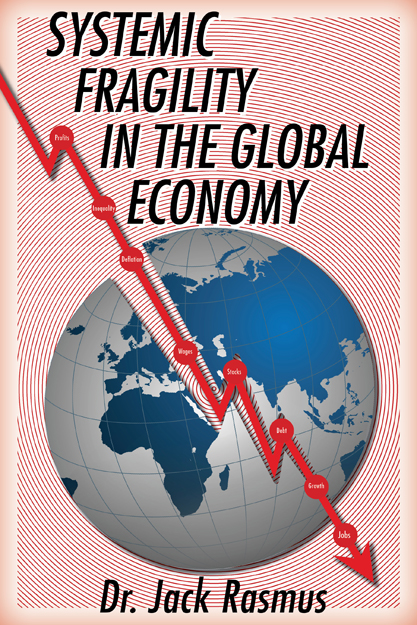
As the global economy appears to be slowing once again, reader interest in my 2010 book, ‘Epic Recession: Prelude to Global Depression’, has been growing. One of the most comprehensive and accurate interviews of the book was recently written this past summer, published in the Heterodox Economics Newsletter, by Dr. Ying Tang, of Denison University. This book is my initial theoretical explanation of the origins, and continuation, of the global economic crisis (which will be followed up in 2015 by my future book, ‘Transitions to Global Depression’.) Readers interested in the my 2010 ‘Epic Recession’book may find the following review by Dr. Tang of interest. (The book may be ordered online at Amazon and elsewhere, as well as from the author’s blog and website. For my abbreviated summary of the theses of the book, read my article and blog entry, ’20 Propositions’, posted earlier this year).
“Heterodox Economics Newsletter
EPIC RECESSION: PRECLUDE TO GLOBAL DEPRESSION, by Jack Rasmus, New York, NY: Pluto Press, 2010. 340 pages; ISBN 978-0-7453-2999-7.
Reviewed by Yiqing Tang, Denison University
In Epic Recession, Jack Rasmus introduces the term “Epic Recession” to analyze various economic crises, including the Great Recession that started in 2007. The author’s analysis is based on a presentation of a debt-deflation-default relationship in Epic Recessions in the context of financial and consumption fragility. Rasmus concludes the book by pointing out the flaws in the stimulus policy that the Obama administration employed, and provides alternative methods to promote economic recovery. The book is organized in three main parts. Part I introduces the analytical framework that Rasmus uses to identify the quantitative and qualitative characteristics of Epic Recessions and their dynamic impact on the economy. Part II is a historical analysis of Epic Recessions in which Rasmus takes a closer look into U.S. Depressions of the 19rh century and identifies two types of Epic Recessions: “Type I” (1907-14) and “Type IT (1929-31). In Part III, Rasmus critically assesses the Bush-Obama policies in the wake of the 2007-2010 Epic Recession and provides an alternative route towards economic recovery. Incidentally, the book’s analysis stops in 2010, but its main argument is still valid in 2013.
According to Rasmus, unlike normal recessions, which are usually caused by temporary supply and demand shocks (p. 9), Epic Recessions are “precipitated by financial instability and crisis” (p. 24). Quantitatively, Epic Recessions usually fall in certain ranges of several economic indicators that the book specifically identifies, such as GDP and unemployment.
Qualitatively, the formation of Epic Recessions is accompanied by close interaction among three factors: debt, deflation, and default, which create fragilities both in the financial and consumer markets. The author particularly argues that global liquidity explosion and speculative investing are great contributors to financial fragility, and to a certain extent, to consumption fragility as well.
Rasmus then analyzes several major economic crises in U.S. history. He divides Epic Recessions into two types. “Type I” Epic Recessions are financial crises followed by contraction of the real economy and long-term economic stagnation (p. 145). Here, monetary policy plays a huge role in stabilizing the economy and preventing future deterioration. The 1907-1914 recession is an example of “Type I” Epic Recession. “Type II” Epic Recessions are more severe. In these recessions, monetary policy can only temporarily stabilize the economy. Debt-deflation and default, together with financial and consumption fragilities, act upon each other, causing the real economy to constantly decline. The Great Depression is an example of “Type II” Epic Recessions. In both types, monetary policy can at most serve to stabilize rather than tackle the fundamental problems of the economy.
The Great Recession that started in 2007 is, according to Rasmus, an Epic Recession in which real assets did not absorb the explosion in global liquidity, which drove excessive speculation. Debt and leverage rose significantly, eventually leading to the financial crisis (p. 219). It is still not clear which type this crisis will become; the result depends on the policies the federal government implements. Furthermore, in Rasmus’ opinion, the Obama administration’s policy of injecting liquidity into the market only serves to offset the crisis temporarily, yet does not cure the fundamental problems of the current financial system. As a result, Rasmus offers an alternative program for economic recovery. He proposes govenunental programs that promote long-term structural economic change in order to achieve the recovery. These programs address issues such as job creation, income inequality, and regulations of financial institutions.
The book thoroughly explains the causes of the current economic crisis through the theory of the debt-deflation-default relationship. This theory draws heavily on the works of John Maynard Keynes, Irving Fischer, and Hyman Minsky (p. 16). Rasmus argues that his work “fills the gaps” left in the works of these authors, including: (1) a focus on total debt (consumer and public) rather than just business debt; (2) an analysis of deflation based on a three price system: asset, product, <7??r/wage; and (3) a focus on debt and deflation affect defaults.
The last chapter of the book is a 28-point economic recovery program addressing a wide variety of economic issues including the foreclosure crisis, job creation and retention, taxing offshore profits, and regulating banking and other speculative activities. Taking a Keynesian approach to economic recovery, Rasmus puts a lot of faith in the federal government's capacity to carry out such programs. The author does not give too much thought to the influence of special interest groups on public policy. Given the close relationship between big financial institutions such as Goldman Sachs and the government, aggressive regulations on financial institutions are more likely to be implemented.
Overall, the book provides an excellent assessment of the causes of the 2007 economic crisis and provides a solid historical and analytical framework for understanding Epic Recessions. The book is a great resource for undergraduate students and readers with basic economic knowledge. Heterodox economists working in the economic traditions of Keynes, Fisher, and Minsky will find this book engaging and thought-provoking.
Posted in Uncategorized | 1 Comment »
This past week the US House of Representatives voted 332 to 94 in favor of changes to the federal budget for 2014. The House vote in effect adopted the proposals of the ‘Joint Congressional Committee’, chaired by Teaparty House leader, Paul Ryan, and Senate Democrat, Patty Murray, set up in October as part of the interim agreement between the two parties to end the more than two week shutdown of the federal government that month.
The October interim agreement called for the Ryan-Murray committee to provide budget change proposals by December 2013 for a Congressional vote by December 13, 2013. Last week 169 Republicans and 163 Democrats in the House voted for the Ryan-Murray proposed changes to the 2014 budget; 62 Republicans voted no, as did 32 Democrats. The measure now goes to the Senate for what will likely be a formal vote of adoption, and then in January to a Congressional Appropriations committee in time for meeting the mid-January 2014 deadline date agreed to last October for changes to the federal budget.
The Official ‘Spin’
The deal agreed to this past week by both wings of the single Party of Corporate America (POCA)—aka Democrats and Republicans—has been hailed as a pragmatic, albeit ‘narrow’ agreement that shows the two wings can once again agree on fiscal changes and deficit cut matters, thus ending an era of dysfunction that has characterized US government since 2010. The narrow budget deal, amounting to only $85 billion over the next two fiscal years, 2014-2015, is also being defined as the end of efforts to reach a ‘grand bargain’ on taxes and deficit cutting, as well as the end of the Republican wing Teaparty faction’s ability to disrupt government to promote its own interests and Teaparty candidates in Republican primaries. However, none of these arguments ‘spinning’ the budget deal are accurate.
The dysfunctionality may have ended for the interests of corporations, investors, and wealthy Americans, i.e. the 1%, but it hasn’t for the remainder of households, as the details of the recent deal below clearly illustrate. Last week’s Ryan-Murray deal clearly promotes the interests of defense corporations, the Pentagon, and the wealthy—at the direct expense of millions of US government workers, millions more unemployed, veterans, retirees, and tens of millions of Americans on food stamps.
The deal furthermore represents not the reversal of ‘austerity’, as is claimed, but rather a clever restructuring and continuing of austerity in new forms. It reflects a ‘grand bargain’, but a bargain achieved in stages, piecemeal, rather than in an ‘all in’ form that might generate more severe and resentful public political reaction.
Not least, the deal just concluded represents not the ‘taming’ of the Teaparty faction in the Republican wing, but instead the realization by the rest of the two traditional wings of POCA that, in the 2014 midterm Congressional election year about to begin, they had better go slower on austerity in 2014—as they had previously during the 2012 national elections year. The deal is thus a ‘politicians deal’, and neither a fiscal stimulus nor a deficit cutting exercise.
Restoring the Sequester Defense Cuts
In 2011 House Republicans and the Obama Administration agreed to cut $1 trillion in discretionary social spending programs, mostly education, plus another $1.2 trillion of discretionary cuts deferred until 2013 called the ‘sequester’, about half of which represented defense spending cuts.
The 2012 election year that followed was a hiatus in terms of austerity and new deficit cutting. However, once the November 2012 elections were over, both wings of the POCA immediately proceeded to the ‘fiscal cliff’ deal of January 2, 2013, which raised taxes on wage earners while allowing $4 trillion in Bush tax cuts to continue for another decade. However, the fiscal cliff deal of January 2013 conveniently left the matter of the ‘sequester’ spending cuts for a later date, including the $600 billion in defense cuts. That segmenting of tax issues from spending issues, and especially defense spending, was necessary to enable the full passage of the $4 trillion in tax cuts for the rich. A more complicated deal, including spending reductions, would have risked the passage of the tax cuts.
Beginning March 1, 2013, the $1.2 trillion ‘sequester’ spending cuts were allowed in 2013 to take full effect for non-defense spending, while defense spending cuts called for in the sequester were shielded and offset in various ways by the Obama administration, with the concurrence of Congress, during 2013. Pentagon spending this past year continued at the $518 billion level (not counting another $100 billion or so for ‘overseas contingency operations’—i.e. direct war spending). That both the House Republicans and Senate controlled Democrats had every intention throughout the past year to restore the Defense spending cuts called for in the sequester, was evident in the House Budget and Senate budget proposals, both of which called for increasing Pentagon spending to $552 billion in 2014, according to a New York Times front page article of December 11, 2013.
The just concluded Ryan-Murray budget deal is also primarily about addressing (and reversing) those defense spending cuts and continuing to shield defense from current and future spending reductions. Were the sequester defense spending cuts allowed to go into effect in 2014, Pentagon spending would have declined from current $518 billion in 2013 to $498 billion in 2014. The Ryan-Murray budget deal sets Pentagon spending for the coming year at $520.5 billion.
As the Washington Post indicated in a lead article on December 12, with the recent budget deal the US House has temporarily retreated from deficit cutting “in favor of Republican concerns about the Pentagon budget”, with the Wall St. Journal adding on December 13 that the budget deal is “nearly erasing the impact of sequestration on the military”.
That the budget deal is primarily about restoring defense cuts was further evident in that the same day the budget deal was passed by the House, it immediately voted to pass the National Defense Authorization Act, NDAA, thus locking in the restoration of Pentagon spending in 2014 at a level above 2013.
Domestic Non-Defense Spending: Smoke & Mirrors
While the proposed sequester defense cuts have been essentially restored for 2014-15, and effectively removed from further deficit spending cuts in the future (as had tax hikes on the rich with last year’s fiscal cliff deal), the cuts to discretionary non-military spending programs have not fared as well.
The budget deal calls for restoring $63 billion in total scheduled sequester cuts for the two years, 2014-15. Non-defense program spending restoration is reportedly $31 billion of that. It thus appears that a $31 billion increase in non-defense spending is part of the deal. But domestic spending the past two years, 2011-2013, has declined from a total of $514 billion to $469 billion, or $45 billion. The budget deal raises that to $492 billion. That’s $23 billion, not the reported $31 billion.
Moreover, the $31 billion restoration is predicated on the continuation in the budget of the reductions in payments to Medicare doctors and health providers. If the reductions in payments are rescinded, as they have been every consecutive year thus far for more than a decade, then the $31 billion non-defense spending restoration might very well also be taken away or significantly reduced. $31 billion may not in fact, in other words, actually occur.
Apart from the possible $31 billion reduction, what Congress and Obama appear to restore in in the $31 billion discretionary social spending on the one hand, they are taking away—plus more—with the other. This will occur two ways: first by raising $26 billion in fees (i.e. de facto taxes) on consumers and by taking money from federal workers and veterans pensions; second, by taking $25 billion from the unemployed. So the net effect is a reduction of -$20 billion, not a restoration of $31 billion.
The budget deal directly includes increasing ‘fees’ by $26 billion. $6 billion of that comes in the form of raising federal employees’ pension contributions and another $6 billion by cutting military cost of living increases for military pensions. Another $12.6 billion comes from raising government taxes on airline travel. Thus retirees, government workers, and middle class households will pay $26 billion more as part of the budget deal. But that’s not all.
The budget deal cleverly does not include the $25 billion in cuts to unemployment benefits in its calculation of spending $31 billion more in domestic spending. When deducted from the $31 billion, it’s only a net $6 billion in domestic spending. And when the $26 billion in fees (taxes) are added in, that’s a total of -$20 billion in domestic spending.
Another way of looking at it is that $25 billion in cuts to unemployment benefits is that the amount is just about the same amount of restored defense spending cuts. The unemployed are effectively paying for the defense corporations’ continuation of defense contracts at prior levels.
More than 1.3 million workers will immediately lose their unemployment benefits on December 28, 2013. Another 1.9 million who were projected to continue benefits in 2014 will also now lose them. Emergency benefits that up to now included extended benefits from 40-73 weeks, will now revert back to only 26 weeks. This occurs at a time when 4.1 million workers are considered long term unemployed, jobless for more than 26 weeks. Knocking millions off of benefits will likely result in 2014 in even more millions of workers leaving the labor force, which will technically also reduce the unemployment rate. That’s one way to manipulate statistics to formally reduce unemployment, but it’s not a true reduction of unemployment by actual jobs creation, the latter of which is increasingly a problem of the US economy for more than a decade now.
The budget deal conveniently disregards in its calculations the refusal to extend unemployment benefits. But it’s clearly part of the deal. The failure of the budget deal to extend unemployment benefits, and the net -$20 billion in unemployment benefit cuts plus fee hikes, is an indication of the budget deal’s continuing ‘austerity’ focus. But that’s not all.
Another ‘off track’ discretionary spending cuts about to occur involve cuts to food stamps for millions of recipients, scheduled to occur by February 2014. Today one in eight households now receive food stamps, the result of the deep decline in jobs since 2008, the failure to create jobs at a normal rate since then, and the fact that jobs that have been created since 2008 are predominantly low paid. The cost of the food stamp program, SNAP, has doubled to $80 billion during the so-called Obama economic recovery and the abysmal record of job creation the past five years. Both wings of the POCA are concurrently proposing cuts to SNAP, ranging from $24 billion for the Demo wing and $52 billion for the Teapublican (traditional republicans + Teaparty faction) wing. An increase in food stamps that was scheduled for November 1, 2013 has already been put aside. Further reductions are being negotiated that will conclude by February 2014 that will likely reduce food stamp spending by $8-$10 billion over the two year period, 2014-2015 of the recent budget deal period. As in the case of the $25 billion in cuts to unemployment benefits, the $8 billion more in food stamps spending cuts are conveniently ignored in the budget deal calculations.
The real budget deal thus amounts to $31 billion in domestic spending cuts restored from the sequester—offset by $26 billion paid for by government workers, retirees and vets, by another $25 billion paid for by the unemployed, and still another $8 billion by the poor and working poor in food stamp cuts. What the budget deal gives (+$31 billion) with one hand, it takes away double (-$59 billion) with the other. The net result is a -$28 billion reduction for workers, retirees, vets, and the unemployed, while the Pentagon and defense corporations get off free.
Strategic Significance of the 2013 Budget Deal
The budget deal just concluded fundamentally represents a continuation of deficit cutting for the rest of us, while letting defense corporations and spending off the sequester hook. The budget deal ‘narrowly defined’, at $63 billion restoration of sequester cuts, is misleading at best. While defense spending is restored in the budget deal, Republican and Democrat claims that domestic program spending is also restored is a cynical lie. The $31 billion in domestic spending does not include parallel cuts of $25 billion to unemployment benefits and an additional minimum of $8 billion to food stamps. And when the $26 billion in ‘fees’ are factored in—impacting retirees, vets, government workers, and consumers—the net effect is further spending reductions and continued austerity for the rest, while the Pentagon and corporate military contractors are now exempt.
Contrary to the media spin, there is a grand bargain in progress. It’s just dispersed, implemented over the course of several years since 2011 and in stages. It is being rolled out in segments and in phases. The August 2011 deal. The phony Fiscal Cliff deal. Now the budget deal of 2013, in which defense spending cuts area fully restored while a ‘smoke and mirrors’ game is being played with domestic discretionary spending.
With regard to the ‘smoke and mirrors’, politicians are using the ‘playbook’ of corporate management in union negotiations. They are simply ‘moving the money around’—i.e. restoring $31 billion, which is then taken away in other ways at the expense of government workers, vets, and unemployed.
In a broader strategic sense, what the recent December 2013 budget deal represents is that both wings of the single party of corporate interests (POCA) in the US have been pursuing a piecemeal grand bargain strategy. First $2.2 trillion in spending only cuts are enacted in 2011, leaving the issue of $4.6 trillion in Bush tax cuts to the ‘fiscal cliff’ tax deal of December 2012. Once the tax hikes on the rich were moved off the table with the fiscal cliff deal, the focus shifted to getting the defense spending cuts also ‘off the table’ and minimized. The rich got to keep $4 trillion of the $4.6 trillion with the fiscal cliff deal; the defense corporations and Pentagon now can avoid the $600 billion in previously scheduled defense spending cuts. In the meantime, $1 trillion in 2011 social program spending cuts went into effect and continue, the $500 billion in sequester defined social spending cuts also largely continue, and unemployment and food stamp cuts of hundreds of billions over the coming decade are also implemented. That all amounts to austerity continued via implementation of a grand bargain in stages.
And the game of smoke and mirrors is not over. More phases of the grand bargain in stages are yet to come. What remains is passage of a new tax code, which will include hundreds of billions more in corporate tax cuts. The fiscal cliff addressed tax cuts for wealthy individuals, not their corporations. Now the latter want their tax cuts as well. That potentially is on the agenda in 2014.
Then there’s the matter of ‘entitlements’ spending—i.e. social security and medicare. The official ‘spin’ of the current budget deal is that entitlements are not being touched and aren’t part of the deal. Republicans and the Teaparty faction have not demanded additional entitlement cuts in the current deal. That does not mean social security and medicare won’t be cut in 2014, however. Obama’s 2014 budget calls for no less than $620 billion in social security and medicare cuts over the coming decade. Apparently Republicans and Teapartyers considered that sufficient for a ‘first bite of the apple’. But they’ll be back for more in the final stage of the grand bargain by increments. But entitlement cuts will not be addressed further during an election year of 2014. That comes later, and after corporate tax cuts in 2014—which Obama and the Republicans have been both on record proposing for some time.
Jack Rasmus
Jack is the author of the 2013 book, ‘Obama’s Economy: Recovery for the Few’, Pluto Press, 2012, and host of the weekly radio show, Alternative Visions, on the Progressive Radio Network online at PRN.FM. His website is, http://www.kyklosproductions.com, and his blog, jackrasmus.com. His twitter handle, @drjackrasmus.
Posted in Uncategorized | Leave a Comment »
INTRODUCTION:
For readers interested in a discussion of the ‘Strategic Impasse’ confronting unions in the US today, in the following ‘Alternative Vision’ radio shows host, Dr. Jack Rasmus, interviews long-time local labor leaders on the topic of Unions’ political, industrial (bargaining, organizing, strike, etc.), and community alliances strategy today. With unions under attack from all directions, Jack and guests discuss whether labor’s political, industrial, and community alliance strategies of the past two decades are today at an historic impasse requiring a thorough re-evaluation and restructuring.
In the November 20 show, Jack interviews Steve Early and Arun Gupta; in the December 11 show, Jerry Gordon and Alan Benjamin.
(Listen on December 18 to the interview with Ray Rogers. Subsequent shows will continue the interviews with seasoned, long time local union leaders on the topic of ‘Is Union Labor at a Strategic Impasse?’)
ALTERNATIVE VISIONS, 12-11-13 SHOW –
Are US Unions Today at a Strategic Impasse, Part 2
Listen/download radio show interview at:
http://alternativevisions.podbean.com/
12-11-13 Show Announcement:
“Continuing the discussion initiated on November 20 with guests with long-time grass roots experience in the American union movement, Dr. Jack Rasmus invites Jerry Gordon and Alan Benjamin, to discuss the general topic: Have the basic strategies of US Labor employed since the 1980s now reached an impasse and dead end?. Both guests have more than 40 years of experience each in the union movement, and offer their comments on the state, and future direction, of union labor’s current political, industrial (bargaining, organizing, strikes), and community alliance strategies. Topics addressed include the recent Chicago teachers strike, the fight to protect jobs at Boeing in Seattle, the recent AFLCIO convention, organizing the south, labor’s increasingly shabby treatment by the Democratic Party, and other examples, as discussants take on the topic of ‘what needs to change strategically and organizationally for union labor in America to reverse its decades-long decline.”
“Jerry Gordon is a former representative of the United Food & Commercial Workers for decades, now retired, and currently secretary of the Emergency Labor Network and the Labor Fightback coalition. Alan Benjamin is a long time delegate to the San Francisco Central Labor Council, AFLCIO, a member of OPEIU, and active in labor immigration coalition work.”
ALTERNATIVE VISIONS, 11-20-13 SHOW –
Is Union Labor At a Strategic Impasse?
Listen/download radio show interview at:
http://alternativevisions.podbean.com/
11-20-13 SHOW ANNOUNCEMENT:
“Jack Rasmus invites guests, Steve Early and Arun Gupta, to discuss ‘What Strategy for Union Labor in America’. Dr. Rasmus notes how union membership is now in freefall despite tens of millions of workers wanting to have a union today, how collective bargaining is in retreat now on the benefits as well as wages front, and how Labor’s political and industrial strategies of the past two decades have both produced little positive result. Dr. Rasmus and guests discuss how US Labor’s political strategy of ever closer ties to the Democratic Party has resulted in virtually no gains for workers the past 6 years despite billions of dollars of union contributions to the party. And how Labor’s industrial-bargaining strategy, focused on maintaining health and pension benefits in lieu of wage increases, is now being ripped apart as well by legislated health care and pension changes. With political-industrial strategies of the last two decades now in disarray, what are the alternatives for forging new strategies for organized labor in America? Jack and guests discuss what it means to say labor should embark on a path of more ‘independent political action’ and/or initiate new forms of industrial and bargaining, while reducing its reliance on the Democratic party and its primary focus on maintenance of benefits bargaining.”
“Steve Early was a long time CWA staff member in the Boston area and now author of several books on the present condition of labor, workers and their unions in America today. Arun Gupta is an activist with the Occupy movement.”
Posted in Uncategorized |
In parts 1 and 2 of this series on how US corporations have succeeded in avoiding paying taxes, the focus has been on how corporations have avoided paying taxes at the US federal level and on their corporate income earned abroad. The US federal corporate tax has been in freefall for decades. Elsewhere globally, there has also been a ‘race to the bottom’ between countries to see who can cut corporate taxes the most and fastest. In addition to the US federal corporate tax freefall and the global corporate tax ‘race to the bottom’ between countries, there has been a freefall and ‘race to the bottom’ between the 50 states in the US as well that’s been going on for decades.
The following Part 3 therefore briefly examines this within the US corporate tax ‘race to the bottom’, as state legislatures have in recent decades between competing to offer more tax cuts to corporations (and even ‘reverse taxation’–i.e. direct subsidies, awards, and payments to corporations), in an increasing state level desperate effort to lure business headquarters from another state to their own. The outcome is that US Corporations now pay on average a mere 2% or so in effective taxes to the US states as a group.
This Part 3 concludes with a short list of priority proposals for reversing the ‘Great Corporate Tax Shift’, at the federal level in the US, between the US and other countries, and between the US states.
The State to State ‘Race to the Bottom’
Behind the decline in the corporate income tax as a share of total tax revenues lies the growing proliferation of corporate tax exemptions, credits, deferral of payments, and various other ‘loopholes’. This is the explanation of why the effective corporate tax rate has consistently declined while the official rate has not. This trend of declining effective rate is occurring at the state level as well as the US federal level.
While the official state corporate tax rates range from 5% to 10%, states in aggregate are averaging only about 2% effectively in corporate tax payments. States across the US have been in a ‘race to the bottom’ to grant more and more corporate tax loopholes and exceptions in order to lure corporations from other states to their state.
A recent New York Times survey showed that states are not only lowering their corporate tax rate to lure corporate headquarters and operations, but are granting corporations cash, free use of public buildings, exemption from property taxes, and diverse other ‘awards’ in a desperate attempt to bring jobs to their states from other states. The New York Times article estimated the cost in state corporate tax revenues at around $80 billion a year. In many cases the corporations take advantage of the ‘awards’ and then create few jobs or cease operations afterward anyways.
The $80 billion a year average since 2009 amounts to more than $300 billion in reduced state corporate tax revenues. That has occurred despite a cumulative budget deficit total among all 50 states of $581 billion during 2008-2012. In a sense then, more than half of the states’ budget deficits during the past four years may be attributable to corporate tax breaks, resulting in only 2% collected of the official 5%-10% state corporate tax. But instead of targeting a restoration of corporate taxation, most of the states have targeted reducing public workers’ pensions, benefits, and wages as the solution to their budget deficits.
Among the most egregious states lowering corporate tax revenues are Texas, which provides $18 billion a year in such concessions. Oklahoma and West Virginia have granted corporate tax concessions equivalent to one-third of their annual state budgets.
The industries and corporations that are the main beneficiaries of this ‘race to the bottom’ trend in state corporate taxation are oil & gas companies, film & entertainment, technology companies, and auto companies—the latter of which pioneered the trend back in the 1980s. Since 1985, auto companies have received $13.9 billion in state corporate income tax concessions. More than 267 auto plants have been shutdown in the US nonetheless.
The trend toward declining state income taxation continues to accelerate. A number of states have, and are proposing, to eliminate corporate income taxation altogether. Most recently, Louisiana, Kansas and Nebraska. The inter-state US corporate income tax ‘race to the bottom’ thus continues.
Solutions to the Corporate Tax ‘Race to the Bottom’
Solutions to the ‘Great Corporate Tax Shift’ are not economic rocket science. To address the ways in which US corporations today avoid paying taxes—state to state, country to country, and US federal—the following short list of measures should be legislated.
1. The State-to-State Corporate Tax ‘Race to the Bottom’
To avoid the state-state ‘race to the bottom’, an ‘Interstate Corporate Equalization Tax’ should be implemented. Corporations that move their (taxable) headquarters from one state to another should be required to pay the ‘losing’ state a fee equal to the difference in the two states’ corporate income tax for a period of three years into a special fund. Corporate subsidies and other ‘awards’ should be included in the fee calculation. The ‘gaining’ state should be required to deposit as well an equivalent amount of the corporate fee into the fund. All the funds from the corporate fee and state equivalent contribution should be deposited in a special worker benefits fund, administered by the losing state, to be used solely for supplemental unemployment, job training, and job relocation expenses for those workers who lost their employment when the corporation moved to the lower tax paying (‘gaining’) state.
2. The Country-to-Country Corporate Tax ‘Race to the Bottom’
To avoid the growing country-by-country corporate tax ‘race to the bottom’ that is occurring globally as well, measures are necessary to discourage US corporations’ avoidance of US taxes as result of shifting investment and jobs offshore. All current, numerous tax incentives that the US federal government grants corporations today to invest and shift jobs offshore should be immediately repealed. For example, US corporations should be eligible for the current investment tax credit only after the corporation has proven it has invested in the US. No US investment…no tax credit. Furthermore, the investment tax credit should be conditioned upon proving that 50% of the credit has been spent on accompanying US job creation associated with the investment. No US job creation…no tax credit.
Enforce the collection of foreign profits tax at a US effective corporate rate of 35%, not the current 2.2% rate. Companies that refuse to comply and continue to hoard their cash offshore in subsidiaries should be slapped with a rising progressive tariff on the goods they produce offshore and import back to the US until the foreign profits tax is fully collected. If they don’t pay your foreign taxes, then they can’t import back and sell your foreign made goods in the US.
Subsidiaries of foreign corporations operating in the US, with origins in those countries that engage in egregious corporate tax avoidance assistance—e.g. Ireland, Netherlands, Bermuda, and others—should be required to pay a supplemental corporate tax to the US federal government. Similarly, foreign corporations of those countries exporting their goods to the US should be required to pay an additional tariff on sales to the US.
US Multinational Corporations that practice ‘intra-company pricing’ designed to minimize their US based taxable profits, and to divert those taxable profits to offshore subsidiaries for the purpose of avoiding US taxes, should be considered as engaging in financial fraud, and thus subject to prosecution by the US Securities & Exchange Commission and other relevant regulatory bodies.
3. Select Measures Further Restoring US Federal Corporate Taxation
In addition to ending the corporate tax ‘race to the bottom’, both between US states and between countries, a priority short list of additional changes to federal US corporate taxation are also necessary. These include:
Make the ‘effective rate’ the nominal top rate for corporations. Corporations should pay an effective top corporate tax rate of 35%, not the actual 12% they do today. That means ending all corporate tax loopholes across the board except those that result in annually confirmed and proven US job creation.
All corporate depreciation allowances should be rolled back to definitions and standards in effect in 1980. All research & development corporate tax credits should be allowed only for R&D work shown actually conducted in the US, not by foreign US corporate subsidiaries.
Not least, for both US financial corporations and for ‘portfolio’ financial investments by US non-financial corporations, a financial transactions tax should be introduced that taxes stock and bond sales at 0.1% per value of the purchase for all stock purchases of 100 share or more; 0.5% for purchases of 1000 shares or more; and 1% for all shares of 10,000 or more. For bonds, a financial tax of $100 per each $10,000 value for Investment Grade corporate bond purchases, and $200 per each $10,000 for High Yield (Junk) Grade corporate bond purchases. A 1% tax on all foreign exchange trading by corporations. And a 1% tax on all third party derivative trading by corporations.
Collectively, these various measures would raise approximately $1 trillion a year, every year, eliminating all US federal deficits, as well as deficits for most US states. Their secondary effects would include re-directing the decades-long outflow of US corporate investment abroad and creating millions of jobs again in the US.
Jack Rasmus
Jack is the author of the 2012 book, ‘Obama’s Economy: Recovery for the Few’, published by Pluto Press and Palgrave. He hosts the weekly radio show, Alternative Visions, on the Progressive Radio Network. His website and blog are: http://www.kyklosproductions.com and jackrasmus.com, and his twitter handle, @drjackrasmus.
Posted in Uncategorized | Tagged Corporate Taxes, Tax Loopholes, Tax Solutions | 5 Comments »
In a contribution last week, it was shown how Corporate Taxes in America have been in decline now for more than three decades. Contrary to the drumbeat of corporate media throughout this year, and their false claims that US corporations are paying far more than their foreign capitalist cousins, US corporations pay an effective (i.e. actual) tax rate of only about 16-17%. That’s a combined US federal, foreign states, and US states ‘effective’ tax rate, only 2.2% of which represents the ‘effective rate’ paid on offshore earnings today.
The rising crescendo of demands for still more tax cuts for corporations by virtually all Republicans in Congress, and a good number of Democrats as well, is being whipped up in a joint effort to push through an overhaul of the US tax code. The timing is apropos. Midterm 2014 Congressional elections are approaching, and politicians once again begun to solicit campaign spending ‘indulgences’ (aka campaign spending contributions) from their corporate friends.
The tax code overhaul idea is also timely, this writer has previously argued, given the still unresolved budget-debt ceiling debates. Those debates were kicked down the road this past October 2013 and are due to come to a head January-February 2014 once again. Should the Republicans decide to agree to any of Obama’s current ‘smoke & mirror’ proposals to reduce some showcase corporate tax loopholes, that token reduction will almost certainly be accompanied by lowering the corporate tax rate in exchange. Obama has already proposed to do just that, reducing the top corporate tax rate from 35% to 28%. So the political stage is well set to ‘slip in’ the corporate tax and tax code overhaul discussions into the upcoming debates. The tax code overhaul discussions need not necessarily reflect the entire code. It could prove a ‘tax code light’, focusing primarily on the corporate income tax.
Senator Baucus’s $1.8 Trillion Multinational Corporate Gift
The ink was hardly dry on our last week’s contribution, ‘The Great Corporate Tax Shift, Part 1’, when Democrat Senator, Max Baucus, head of the Senate Finance Committee proposed last Tuesday, November 19, to “exempt much of the profits earned by American corporate subsidies in foreign countries”, according to a November 20, 2013 article in the New York Times.
Baucus’s proposal would in effect end all taxes on US Multinational Corporations earnings abroad, in exchange for what amounts to a $200 billion payment in back corporate taxes on those companies’ currently estimated more than $2 trillion offshore profits hoard. Baucus claims his proposal represents a 20% tax rate (compared to the current 35%). But $200 billion of $2 trillion looks more like a 10% tax rate to me.
The Baucus proposal, moreover, would mean the $200 billion is paid only slowly over the course of 8 years—thus leaving the companies to collect interest and reinvest the amount over the 8 year period to earn still more profits. And it’s likely that $200 billion would silently be dropped somewhere down the political road after 2016 when the public is not looking. However, what would remain permanent in the Baucus proposal is US multinationals wouldn’t have to pay a penny any longer on their earnings offshore that they kept there.
Amazingly, Baucus offered his proposal as a solution to discourage companies to divert their operations and jobs from the US to their offshore subsidiaries. But if they no longer have to pay taxes on offshore earnings, seems to me that’s a strong incentive to shift even more investment and jobs offshore, not less. Or, at minimum, to reinvest there the profits made there instead of repatriating the profits back to the US, pay the current US corporate tax rate of 35%, and invest the remainder in the US and jobs.
It’s not surprising that the response of the Business Roundtable, the premier big business lobbying arm, was warm to Baucus’s idea. It’s Vice-President, Matt Miller, noted “It’s good that they are continuing to have these discussions”, as quoted by the global business press source, The Financial Times. On the other hand, lobbying groups for the most egregious industries and corporations now hoarding the lion’s share of the $2 trillion offshore, want more.
In this following ‘Part 2’ contribution to the ‘Great Corporate Tax Shift’ theme, how multinational US corporations now get away with paying only 2.2% on their foreign earnings is explained. Keep in mind, the Baucus proposal would eliminate even that, replacing it with a one time $200 billion, paid over 8 years, in exchange for no more taxes on foreign earnings ever.
Gimme A ‘Dutch Sandwich’, with a ‘Double Irish’, & some Bermuda ‘On the Side’
Multinational Corporations have been engaging in a public relations full court press for the past two years, attempting to convince the public and politicians that the US corporate income tax is the highest in the world. They repeatedly point to lower official corporate tax rates throughout the advanced economies. It is true, most official corporate tax rates in Europe, Japan and elsewhere are lower than the US 35% official rate. But their corporate tax loopholes are nowhere near as generous as in the US. In addition, the ‘state’ or ‘provincial’ jurisdictions within many of these countries have higher official and effective corporate tax rates as well. Corporations pay more at the ‘state-province-district’ levels than the average effective rate of around 2% in the US.
The most telling rebuttal to US multinational corporate claims of US taxation at 35% as among the ‘highest in the world’ is that US corporations have been paying almost no tax on corporate profits earned offshore—while they have simultaneously been redirecting US earned corporate profits to their offshore subsidiaries to avoid paying US taxes as well. This game is made possible by ‘internal corporate pricing’ maneuvers. It works like this: charge the US operations high prices for goods made offshore and imported back to the US, so that there are little profits to book in the US. Then shuffle foreign made profits around to those countries with super-low tax rules and rates. Book the profits there and pay the lowest rates. Finally, refuse to pay the US foreign profits tax on even those reduced profits booked offshore.
The corporate pricing games that shift profits to offshore subsidiaries was made possible in large part by an IRS tax rule created early in the Clinton administration in 1995. This rule is referred to as the ‘Check the Box’ loophole. It enables multinational US companies to check a ‘box’ on its US tax forms that identifies a foreign subsidiary of the company as a ‘disregarded entity’ for purposes of paying taxes. The related ‘Look Through’ loophole, then allows the company to move profits between subsidiaries in its offshore operations.
Favorite places to shuffle foreign earned profits are Ireland, the Netherlands, and Bermuda. The Netherlands is preferred because it allows a company to avoid all withholding taxes. That’s called the ‘Dutch Sandwich’. Shuffle the profits there, and then on to Ireland with its 5-6% effective tax rate. Better yet, incorporate the company in Ireland in the first place and book all offshore profits there to begin with. Shuttle the profits through Ireland to Bermuda, where the effective rate is almost zero, and the combined loophole is called the ‘Double Irish’. Or how about a ‘Dutch Sandwich’ with a ‘Double Irish’?
It all sounds humorous but it isn’t. Apple Corporation last year avoided $9 billion in US taxes manipulating its profits in this manner. And remember, it’s not just actual profits earned offshore, but US de facto profits switched to offshore subsidiaries by means of ‘internal company pricing’, profits then shuffled around to low tax locations like Netherlands, Ireland, and Bermuda. Google Corp. is another clever manipulator of the arrangements, earning all its foreign income in Ireland, which its then routes through the Netherlands to avoid all withholding taxes. It thus employs a ‘Dutch Sandwich with a Double Irish’ to go.
This has all been going on since the Clinton years. The result by 2004 was the accumulation of more than $650 billion of U.S. multinational corporation profits in their offshore subsidiaries, retained there and not brought back to reinvest in the US or to pay corporate income taxes to the US government, as US politicians simply looked the other way and allowed it to continue.
During 2001-03 George W. Bush pushed a massive tax cut through Congress, involving tax cuts to personal incomes in general and in capital gains and dividend taxes for wealthy investors in particular. It has been estimated those tax cuts amounted to more than $3 trillion over the following decade, more than 80% of which went to the wealthiest US households. In 2002, Bush cut corporate taxes as well by hundreds of billions of dollars, in the form of new rules for accelerating corporate depreciation write offs. Depreciation write-offs on business equipment is another kind of corporate after tax profits that doesn’t show up in the latter totals. It is income that corporations ‘retain’, but must be used for subsequent re-investment in plant and equipment. But that reinvestment can occur offshore, not necessarily in the US. And so it has, as US corporations ‘foreign direct investment’ has surged since 2001, as investment in the US has stagnated.
The Bush administration then followed up its 2002 business tax cuts via depreciation acceleration, with another round of major corporate tax cuts in 2004. At the same time, in 2004, Bush declared a ‘tax holiday’ for multinational corporations on their foreign profits, now accumulated to more than $650 billion. The multinationals were then offered a sweet deal: repatriate some of the $650 billion back to the US and pay only a 5.25% official corporate tax rate instead of the official 35% rate. The precondition of the deal was that the repatriated funds had to be reinvested in the US to create jobs.
About $300 billion of the total was repatriated, but the effective rate paid was only 3.6%, not the even reduced 5.25%. And the money was not spent on investment and job creation in the US. Instead, it was used mostly to buyback stock and to finance mergers and acquisitions of competitors. This sweet deal set a precedent. Multinational corporations returned to the pricing practices loopholes noted above and continued to amass even greater profits. Today, the profits and cash hoarded offshore in non-taxable subsidiary ‘disregarded entities’ and shuffled around to Ireland and other places is no less than $2 trillion. The practices were allowed to continue under Obama in 2009 and again in 2012 with the latest ‘Fiscal Cliff’ tax deal of last January 2013. In 2012 alone, another $183 billion was added to the multinational corporate offshore cash pile.
For the past two years at least, multinational corporations have attempted to repeat the 2004 sweet deal they got from Bush. They got away with it before. Why not do it again? Instead of paying 2.2%, they want to pay nothing. This time on $2 trillion, instead of $700 billion. Baucus would have them pay 10% or $200 billion—though it’s unlikely anything near that would be collected over the 8 years they have to pay it. But even that is ‘too much’ to their liking. They want tax rules that in effect remove all taxes on US corporate income offshore income, by moving the US to what is called a ‘territorial’ tax system. That would result in an incentive to redirect even more US earned profits to offshore subsidiaries via ‘internal pricing games’. Today’s effective 12% US corporate tax rate would thus fall even further. That almost total elimination of the US Corporate Tax on offshore earnings would reduce US total federal tax revenues by $60 to $100 billion annually. Over 8 years, that amounts to more than $500 billion lost revenue—in exchange for ‘maybe’ $200 billion. A net loss of $300 billion, should the Baucus proposal be adopted. Equally important, it would introduce a major new and further incentive for Multinational Corporations to shift even more US jobs offshore.
Jack Rasmus
Jack is the author of the 2012 book, ‘Obama’s Economy: Recovery for the Few’, published by Pluto Press and Palgrave USA. He is host to the weekly radio show, ‘Alternative Visions’, on the Progressive Radio Network. His website is: http://www.kyklosproductions. He blogs at jackrasmus.com, and his twitter handle is @drjackrasmus.
Note: The full version of this article, ‘The Great Corporate Tax Shift’, complete with graphs and tables will appear in the December 2013 issue of ‘Z’ Magazine.
Posted in Uncategorized | Tagged Corporate Taxes, Tax Loopholes, Tax Solutions | 2 Comments »
The great corporate myth-making machine has been hard at work of late, attempting to create the false impression that US corporations are increasingly uncompetitive with their foreign rivals due to the fact they pay much higher corporate taxes in the US and abroad than their capitalist counterparts. But that is one of the great myths perpetrated by corporate apologists, pundits and their politician friends. The myth is high in the pantheon of conscious falsifications their marketing machines feed the American public, right up there along with such other false notions that ‘business tax cuts create jobs’, ‘free trade benefits everyone’, ‘income inequality is due to a worker’s own low productivity contribution’, ‘overpaid public workers are the cause of states’ budget deficits’, or that ‘social security and medicare are going broke’.
If corporate America can create and sell the idea that they pay more taxes than their offshore capitalist cousins, then they are half way home to getting their paid politicians to provide them still more corporate tax cuts—a proposal by the way that both Republicans and Obama are on record for, in their joint proposal to reduce the top corporate tax rate from 35% to 28% (Obama) or 25% (Republicans).
The message of too high corporate taxes is appearing more frequently nowadays, since actual legislation for big corporate tax cuts is now working its way through Congress. Driving the legislation are Teaparty favorites in the House of Representatives, like David Camp, head of the Ways & Means Committee, and Max Baucus, Democrat in the Senate, who is set to retire in 2014 and wants to give his business buddies yet another big cash freebie (you know Max, the guy who rode herd on that Health Insurance Corporation subsidy bill called Obamacare?).
So it’s time to debunk the ‘US Corporations Pay Too Much Taxes’ (and thus need another tax cut) myth. What follows is the first segment of a longer essay—with tables and graphs—on the same topic that will appear shortly in the December issue of ‘Z’ magazine. More segments of that essay will follow.
US corporations don’t pay the nominal corporate tax rate of 35% today; they pay an effective (i.e. actual) rate of only 12%. The additional effective state-wide corporate income tax they pay amounts to only a 2% or so—not the 10% they claim. And the effective corporate tax on offshore earnings is only another 2.2% or so—not the 20% average they’ll complain. So the total US tax for US corporations is barely 16%–not the 35% plus 10% (state) plus 20% (offshore) nominal tax rate. And however you cut it, the story is the same: US corporations’ share of total federal tax revenues have been in freefall for decades. The share of corporate taxes as a percent of GDP and national income has halved over the decades. And corporations since 2008 have realized record level profits during the ‘Obama Recovery’—while their taxes as a percent of profits since 2008 is half that of the average paid as recently as 1987-2007. Okay, more detail on all that in parts 2 and 3 to follow.
For the moment, what all the corporate tax cutting to date has produced is a mountain of corporate cash.
US Corporations today in fact are sitting on more than $10 TRILLION in cash!
For example, even the US business press admits today that US multinational corporations have diverted more than $2 trillion to their offshore subsidiaries, to avoid paying the U.S. Corporate Income Tax. (watch for parts 2 and 3 of to follow for how they do this).
In addition to the $2 trillion now diverted by US multinational corporations offshore, after having paid federal taxes another $1 trillion is now held as cash on hand by the 1,000 largest nonfinancial companies based in the U.S. as of mid-2013, an increase of 61% in the past five years, according to a study by the REL Consulting Group.
For financial companies, deposits in US banks are currently at a record $10.6 trillion, while bank loans outstanding have been declining since 2008 and are now at a record low of $7.58 trillion—thus leaving US banks sitting on a cash hoard of nearly $3 trillion according to the Wall St. Journal. That’s a total approaching $7 trillion so far.
This record after-tax cash exists despite corporations having bought back their stock and paid dividends worth trillions more since 2008. Corporate buybacks of stock since 2009 passed the $1 trillion mark in 2012, according to a survey by Rosenblatt Securities—with projections to increase at an even faster rate of $400-$500 billion more in 2013. Corporate dividend payouts equaled another $282 billion in 2012 alone, perhaps at least that amount in years prior, and are today projected to exceed $300 billion in 2013. That’s another $2.5 trillion.
Include hundreds of thousands of US corporations and businesses that are not part of the largest 1000 or who don’t operate offshore—plus cash socked away in depreciation funds and other special funds for all the above—and that comes to at least another $500 billion.
That $10 trillion corporate total, moreover, doesn’t include still further additional dollars that have been spent by US corporations abroad. While business investment in the US has been declining, total US corporate foreign direct investment is estimated at $4.4 trillion in 2012, up from $3 trillion in 2007 and from $1.3 trillion in 2000. So that’s another roughly $1.4 trillion in corporate income committed offshore since the official ‘end’ of the recession in June 2009.
Add all that up and its well more than $10 trillion in buybacks, payouts, and hoarded cash (onshore and offshore) by US corporations since 2009—i.e. during the sub-par economic recovery (for the rest of us) of the past four years. That’s corporate income and cash that has been diverted, hoarded, or otherwise not committed to US real investment, and therefore never contributing to jobs, income creation and consumption in the US. No wonder consumption (70% of the US economy) for the bottom 80% households in the US has been stagnating, stalling, or declining in the US in recent years. No wonder all the US economy can do is create low wage, contingent, service jobs, while more than 20 million are still unemployed and uncounted millions more have left the US labor force altogether. No consumption recovery follows declining US investment, while tens of trillions of dollars go elsewhere or sit on the sidelines.
To summarize, at least as much as $10 trillion—and perhaps approaching $12 trillion—has been taken out, redirected, diverted, or otherwise hoarded by US corporations since the 2008 crash. Keep all that in mind when you next hear politicians from the two wings of the one party system in America—Republicans and Democrats—and their friends in mainstream media trying to justify proposals for still more corporate tax cuts.
Jack Rasmus
November 19, 2013
Jack is the author of the 2012 book, ‘Obama’s Economy: Recovery for the Few’ (Pluto press), and host of the weekly radio show, Alternative Visions, on the Progressive Radio Network. His website is http://www.kyklosproductions and blog, jackrasmus.com. His twitter handle, @drjackrasmus.
Posted in Uncategorized | Tagged US Corporate Taxes | 12 Comments »
Listen to the update on Obamacare and the progressive critique on my radio show, ALTERNATIVE VISIONS, at:
http://prn.fm/category/archives/alternative-visions/
or also at:
http://www.alternativevisions.podbean.com
SHOW DESCRIPTION:
Dr. Jack Rasmus and guest, Dr. Margaret Flowers, provide a progressive critique of Obamacare and its growing problems of implementation and coverage. Dr. Rasmus explains how, and why, Obamacare will continue to unravel in 2014-15 and potentially implode, in whole or part, by 2016. Rasmus explains in detail how Obamacare has delayed and exempted businesses from participation in the program; why business penalties for failure to participate are in sufficient; why subsidies for individuals to participate are inadequate and won’t work; why enrollment will continue to seriously lag projections by wide margins in 2014; why the Act is the death-knell for union negotiation health plans; how businesses and health insurance corporations area increasingly ‘gameing’ the system. Rasmus explains how the Act is really a scheme for ‘moving the money around’, from those who now have coverage to those who don’t—where the money is moved first through the health insurance companies that skim off excess profits in the process—and how Obamacare should be understood as the extension of prior attempts to privatize health care via George W. Bush’s Health Savings Accounts (HSAs) in the past decade and Bill Clinton’s ‘Managed Health Care’ before that.
Rasmus and Margaret Flowers explain how ‘Medicare for All’ is the only real alternative that will work, showing how its initial enrollment process, benefit coverage, and costs have been, and continue to be, far superior to the Obamacare-Bushcare-Clintoncare market privatization approaches. Rasmus forewarns that as Obamacare continues to unravel the real fight will begin over ‘Medicare for All’ vs. total privatization of health care via ‘Vouchers for Some’ that conservatives are now preparing in the wings once again.
Posted in Uncategorized | Tagged ACA, Business 'Gameing', Obamacare | 1 Comment »
A first look at US third quarter 2013 GDP and October Jobs Reports gives the impression that the US economy is mending and might soon begin to recover. But a closer inspection shows that the reports indicate an economy still mired in a ‘stop-go’ trajectory at best and a jobs market able to produce low pay, often contingent service jobs. Moreover, trends within the reports suggest even the already tepid results in the reports will likely wane, once again, in the coming quarter and months. Here’s why.
US 3rd Quarter GDP Report
The official, preliminary GDP numbers for July-September indicate a 2.8% US growth rate. The truth is always in the details, however. And a closer look at the composition and trends within GDP are nowhere near so rosy.
First and most important, no less than 0.71 of that 2.8% is due to what is called inventory accumulation by nonfarm businesses, which rose more than twice as fast as the 0.30 in the second quarter 2013 following a mere 0.06% in the first quarter. In other words, businesses have been accelerating their stocking up of goods in anticipation of a subsequent rise in consumer household spending in the U.S. However, as indicated below, that spending is decelerating rapidly—not rising—and along several fronts.
It would not be the first time in the past few years that businesses falsely anticipated the take off of consumer spending and ramped up prematurely, only to have to contract just as dramatically when spending did not materialize.
In early 2012 a similar scenario occurred. Business inventory accumulation surged, adding significantly to GDP, then collapsed. After gains in inventory spending contributing 0.91 to GDP in the 3rd quarter 2012, last year, the same inventory spending collapsed in the final quarter of 2012, subtracting a full -2.09 from GDP. Fourth quarter 2012 US GDP in turn collapsed to a mere 0.1% growth rate. Thereafter, businesses began once again this past spring in building inventories in anticipation, yet again, a surge in consumer spending to occur this current 4th quarter 2013—once again a ‘surge’ that does not appear will take place.
Another problem with the recent 2.8% GDP 3rd quarter 2013 number is that it reflects a major redefinition of what constitutes GDP that was introduced this past July 2013 by the Bureau of Economic Analysis, the US agency responsible for GDP reporting. In that change and redefinition, the BEA added for the first time business Research & Development costs to the business investment contribution to GDP. In other words, ‘costs’ not ‘output’, as previously has always been the case, now contribute to GDP. This was clearly one way to artificially raise what has been a declining trend in US business investment in the US for the past decade. Applying the redefinition retroactively, this GDP redefinition added no less than $550 billion to 2012 GDP last year. And for the most recent quarter, it added further to US GDP’s 2.8% rate. R&D contribution to US GDP is currently running at more than $280 billion for the year. That ‘redefinition and cost’ compares to an estimate of $292 billion for all software contribution to US GDP this year; and more than the investment contribution for all transport equipment or all industrial equipment to US GDP this year. It is not an insignificant sum, in other words. But it is ‘adding’ artificially to the 2.8% US GDP recent numbers.
Eliminate the excessive .71 contribution of inventories that will almost certainly contract this fourth quarter, and the artificial addition to GDP from R&D ‘costs’, the actual longer term trend in GDP in the 3rd quarter is about 1.8%–not 2.8%. That’s about the longer term average of US GDP growth annually for the past two years. In other words, the economy is growing no faster than it has in the past, a rate that is about half what it should be at this point nearly five years after the end of the recession in 2009.
But the 3rd Quarter GDP numbers are notable as well for other weak trends within the general number. First, it appears that spending on services has nearly come to a halt. After contributing 0.69 and 0.53 to GDP rates in the first and second quarters of 2013, respectively, services spending collapsed to only 0.05% in the 3rd quarter. Other warning signs of questionable consumer spending going forward are also now beginning to appear as well. Consumer confidence has plunged. The largest segment of consumer spending, retail sales, fell 0.1% in September, following one of the worst ‘back to school’ shopping seasons that “ended on a sour note, raising concerns about the holidays”, according to the Wall St. Journal. Imminent cuts of billions of dollars in food stamps recently approved by Congress will take a further toll on consumer spending essentials in the near future, as will the 6-day shorter holiday shopping season for this year. Both wholesale and consumer prices continue to decelerate to 1% or less, also an indicator of soft sales and demand by consumers. In short, it is not likely consumer spending will rebound significantly this fourth quarter, prompting in turn the sharp reduction in business inventory spending noted above.
Added to this will be a continued decline in government spending at the federal level, as the sequestered spending cuts take an even deeper ‘bite’ out of the US economy. Both Defense and Non-defense spending has been reducing GDP every quarter since the beginning of 2013. This will not only continue, but will now accelerate in the 2013-14 fiscal budget year.
Finally, on the manufacturing and construction side of the economy, which represents about 20% of total GDP, recent growth in new residential housing construction will likely decline. The recent US ‘housing recovery’ is now over, with rising interest rates and prices. US homebuilders are beginning to recognize this and are now reducing their output, and thus future contribution to GDP from this sector.
The contribution of manufacturing and exports to US GDP growth longer term is also fading. In the 3rd quarter, net exports added to GDP despite slowing exports because imports declined faster than exports. What was a US brief export sales advantage for a while in 2013 is in decline, as the Eurozone economy takes action to lower its exchange rate and thus boost their exports and as China quickly moves back to an ‘export-driven’ GDP in recent months after having tested the waters, and retreated, from a shift to more internal consumption driven growth. The imminent shift by the US federal reserve bank toward a ‘taper’ monetary policy in coming months will also result in higher US interest rates (further slowing housing and auto sales) and a related rising dollar (further slowing export sales).
The recent 2.8% US GDP for the third quarter is therefore a ‘false positive’ in terms of where the US economy, and economic growth, may be headed this coming 4th quarter and longer term.
US October Jobs Report
Last month’s Jobs report is a reflection of US third quarter GDP. The reported increase of 204,000 jobs in October at first glance appears a positive development. At least that number is needed to start reducing the unemployment rate. However, that rate actually rose last month. The reason is a whopping 700,000 more workers left the labor force. That huge number leaving the labor force is a strong indicator of severe weakness in the US labor markets, not strength. It means hundreds of thousands more in just one month have given up finding work because they can’t.
The composition of the hiring is also disturbing. 44,000 new hires in the retail sector. 53,000 in leisure & hospitality. And 52,000 in business services. The first two are typically overwhelmingly part time employment, as is a good part of the third as well. No doubt concerned with the weak August-September retail sales results, retail has begun hiring part timers even earlier than in previous years. Leisure and hospitality (restaurants, hotels, etc.) have also continued to hire, again typically part time. The hiring of part time, or ‘contingent’, labor is a major trend of this past year—when in the first half of 2013 more than 600,000 of the 900,000 newly hired were in fact ‘contingent’ (part time and temp jobs). That means low paid and service jobs, without benefits as a rule. That also means slow to stagnant income growth from job creation—the most important source of disposable income growth necessary for sustained consumer spending.
While wage increases for the past year are reported as 1.8%, it is important to note that this rate is for full time workers only. It does not reflect the lower pay received by part time workers, which have been the bulk of jobs created over the past year. When adjusted, wages are stagnant at best or falling for production and supervisory workers as a whole, full and part time and temp. It is not surprising, therefore, that median family (aka working class) disposable incomes continue to fall this year, as they have in four preceding consecutive years. That is not a foundation for future consumption increases. To date, consumption spending has risen even tepidly due to the growing use of consumer credit—cards, student loans, and auto and mortgage refinancing loans. Recently, credit card usage has slowed, however. Consumer spending has also been boosted by the wealthiest 10% households, who spend largely on performance of stock and bond markets that have been surging to record levels. Stocks and credit cards are not a basis for true household spending recovery; jobs and real income growth are the key but neither appear will contribute much in coming months.
Finally, contingent job growth—and especially in retail and hospitality both highly dependent on holiday spending—can ‘disappear’ quickly from the economy, and may in fact do so by December should consumer spending come in well below expectations. Meanwhile, the federal government continues to reduce spending and shed jobs, and may even do so at a faster rate early next year should the ‘sequester’ spending cuts not be reversed and Congress take an even deeper bite out of social security and medicare spending in 2014.
To summarize, the 2.8% GDP for the 3rd quarter, and the October 2013 jobs report, are nothing to get excited about. They represent temporary adjustments to an otherwise stagnant at best US economy performance and a jobs creation record barely absorbing new entrants into the labor force and doing so at a sub-standard pay rate.
Jack Rasmus
November 11,2 013
Jack is the author of the 2012 book, ‘Obama’s Economy: Recovery for the Few’, Pluto Press, and host of the weekly radio show, ‘Alternative Visions’ on the Progressive Radio Network. His website is http://www.kyklosproductions.com, his blog jackrasmus.com, and his twitter handle, @drjackrasmus.
Posted in Uncategorized | Tagged US economy, US GDP, US Jobs | 4 Comments »
Listen to my 11-06-13 Radio Show, ‘The Great Corporate Tax Shift’, on Alternative Visions at:
http://prn.fm/category/archives/alternative-visions/
or at:
alternativevisions.podbean.com
“Jack Rasmus discusses the ‘Great American Tax Shift’, shows how the Corporate Tax has been steadily declining for decades as a percent of federal revenues, percent of national income, and percent of corporate profits; why the Corporate Tax ‘effective rate’ is now 12%, not the official 35%; why corporations today pay state taxes of barely 2%, instead of official 5-10% rates, and only 2% on foreign earnings instead of 15-28%—for a total global real tax payment of 16%–not the 45%-50% corporate apologists claim. Jack explains how all this results in Corporate America now sitting on more than $10 trillion in cash and how that translates into income inequality trends and a global economy that is unable to fully recover from recession. Various myths about corporate taxes are also refuted (i.e. tax cuts create jobs, US corps have highest taxes in the world, corporations pay double taxes, etc.). And new corporate tax cut measures pending now in Congress in the Tax Code overhaul bill are explained.
Posted in Uncategorized | Tagged Corporate Taxes, Tax Loopholes, Tax Solutions | Leave a Comment »
Dr. Jack Rasmus @drjackrasmus