Feeds:
Posts
Comments

LISTEN TO MY ‘ALTERNATIVE VISIONS’ RADIO SHOW TOMORROW, JANUARY 8, 2014, AT 2PM EASTERN TIME (11AM PACIFIC) ON THE PROGRESSIVE RADIO NETWORK

http://prn.fm/category/archives/alternative-visions/

I WILL BE INTERVIEWING BOEING WORKERS FROM THE SEATTLE AREA ON THE MASSIVE CONTRACT CONCESSIONS THEY WERE FORCED TO ACCEPT THIS PAST WEEKEND.

THE FOLLOWING IS A BRIEF FIRST REPORT ON THE CONCESSIONARY DEAL CONCLUDED THIS PAST WEEKEND, as appeared in COUNTERPUNCH on January 7:

This past weekend, more than 30,000 union workers at Boeing Corp. in Seattle, were forced to accept deep concessions in their union contract, gutting their pensions, future healthcare benefits, wages, and other benefits. Their contract with Boeing had not even expired but they were forced into concessions nonetheless. Nor was the company, Boeing, in any financial distress. It had registered record profits in consecutive years, and had in November 2013 bought back $10 billion in stock from its shareholders and paid another $2 billion in dividends to the same. Nevertheless Boeing demanded concessions, having received communication from Union (IAM) International leadership beforehand of their willingness to grant the same. The combination of Union International leadership pressure, pressure from countless Democratic Party local and state politicians, and the Company’s new offensive, proved too much for local workers to resist. The new concessions will effectively end workers’ defined benefit pensions, cutting retirement by replacing defined benefit with 401ks, and allow the company to end its healthcare insurance benefits before 2018 in accordance with the Obama new health care plan. Wages for new hired workers are projected to decline to levels of minimum wage or less over the next 11 years of the new contract term. “

Listen to the discussion, as the Boeing workers, members of the International Association of Machinists, IAM, locals in the Seattle area tell their story, about the significant development in union bargaining that took place this past week—a development that will no doubt soon reverberate throughout the American union movement in months and years to come as big companies like Boeing step up their attacks on unions, wages and benefits.

BOEING-IAM UNION WORKERS ON THE INTERVIEW WILL INCLUDE:

Shannon Ryker

Shannon Ryker began working at Boeing at 17, and has been an employed 8 years at the company as a final assembly installer on the 767 aircraft and a structures mechanic on the 777 aircraft. She recently started a union support Facebook page called Rosiesmachinists751, which in the last eight months has grown from 8 members to almost 1600.

Jim Levitt

Jim is a 35 year veteran at Boeing, working as a machinist and a tool & die maker. He was at the same time a member of Impact Visuals, a cooperatively owned photo agency specializing in labor and social change from 1985-2001. His photographs have appeared in AFL-CIO, IAM, Teamsters, and other union publications, along with BusinessWeek, Time, the NY Times, Labor Notes, and many other outlets. Before working at Boeing Jim was a graduate student in history.

Hazel Powers

Hazel is a Tooling Inspector at Boeing, a 55 year old single parent, and has worked at Boeing since 1979. She is an IAM District Council Alternate delegate and has held past IAM Local Lodge positions as well. Hazel voted to reject the Boeing contract due to concessions with pension and other benefit cuts, and concern the new contract language is not specific enough
about keeping new aircraft 777X work in Puget Sound.

The Radio Show will also be archived on the above url on the progressive radio network, http://prn.fm/category/archives/alternative-visions/
as well as at http://www.alternativevisions.podbean.com

This past weekend, more than 30,000 union workers at Boeing Corp. in Seattle, were forced to accept deep concessions in their union contract, gutting their pensions, future healthcare benefits, wages, and other benefits. Their contract with Boeing had not even expired but they were forced into concessions nonetheless. Nor was the company, Boeing, in any financial distress. It had registered record profits in consecutive years, and had in November 2013 bought back $10 billion in stock from its shareholders and paid another $2 billion in dividends to the same. Nevertheless Boeing demanded concessions, having received communication from Union (IAM) International leadership beforehand of their willingness to grant the same. The combination of Union International leadership pressure, countless Democratic Party politicians, and the Company’s new offensive, proved too much for local workers to resist. The new concessions will effectively end workers’ defined benefit pensions, cutting retirement benefits to the bone, and allow the company to end its healthcare insurance benefits by 2018 in accordance with the Obama new health care plan. Wages for new hired workers are projected to decline to levels of minimum wage or less over the next 11 years of the new contract term.

This kind of attack on pensions and healthcare–or what this writer calls the ‘social wage’ was predicted in this writer’s article, ‘Concession Bargaining at the Crossroads’ two years ago in 2011. That article is reproduced here in its original draft form once again.

CONCESSION BARGAINING AT THE CROSSROADS, by Jack Rasmus

“The history of collective bargaining since the Second World War has consisted of several stages or phases. The first phase was roughly from 1947 to 1979. During it collective bargaining was expanded both in terms of its ‘scope’ and its ‘magnitude’. Scope refers to new areas of bargaining, such as cost of living adjustments, supplemental unemployment benefits, pensions and health care benefits, union and worker rights, etc. Magnitude refers to increasing the dollar value of wages and benefits. Up to 1979 both expanded.

In contrast, from the mid-1970s to 2007, concession bargaining became the growing practice. But it was concession bargaining focused on giving back ‘magnitude’ gains of the previous decades, not necessarily the scope of bargaining. Workers in the private sector gave ground on wages and benefits in a decades-long attempt to protect their jobs.

First Stages of Concession Bargaining

Among the first to feel the effects were workers in the construction sector, starting in the 1970s. Employers formed early in the decade the ‘Construction Industry Users Roundtable’. Its strategy was to undermine the then powerful building trades unions by a new tactic: the ‘double breasted operation’. This simply put was a way to undermine the construction unions by setting up parallel, non-union companies. The unions ignored the threat more or less, since the double breasted operations were set up in the suburbs and outlying regions. The urban bastion of unionization in construction wasn’t immediately impacted. Employers progressively then moved jobs and work to the non-union operations. The loss of jobs in the unionized operations eventually forced workers and unions to start granting concessions in an attempt to prevent their work shifting to the non-union companies. Concessions soon expanded. Saving jobs in exchange for givebacks on wages and benefits eventually became the norm.

In the late 1970s the strategy of forcing workers to give up wage and benefit gains to keep their jobs leap-frogged into the manufacturing sector. The pilot and defining event was the Chrysler bailout of 1979. It worked so well the model was planned for application to manufacturing in general. By then the Construction Industry Users Roundtable’ had expanded into what is now known as perhaps the most formidable and effective Big Business organization today—the Business Roundtable. Big manufacturing and service companies joined with the Construction employers. The construction industry union-busting model was transported to other sectors of the economy.

The tactic of double breasted operations took on a new form. Alternative union-free operations were set up. But not across town, as in construction. It was now across borders. The manufacturing analog of the double breasted operation was the runaway shop, as manufacturers moved operations offshore.

In these they were aided by the most pro-business President since Coolidge—Ronald Reagan and a compliant Congress. Manufacturers were provided generous economic incentives to set up offshore. Tax incentives were generously granted. Deregulation was introduced. Then in 1988 and 1993 ‘free trade’ agreements were established with Canada and Mexico to facilitate the movement of US capital to those countries to set up operations. Free ‘trade’ is not just about export-import of goods and services; it is even more about negotiating favorable conditions for US foreign direct investment in those countries. Tax for investing offshore plus free trade plus deregulation devastated jobs in the US beginning in the early 1980s, and continuing ever since. Under pressure of losing jobs, workers in manufacturing began the long, dead-end road toward concession bargaining in an attempt to save their jobs. But it didn’t. More than 10 million jobs have been offshored ever since.

The pressure to grant wage concessions intensified in the 1990s. In addition to the threat of job loss, now escalating double-digit annual increases in health care costs provided a second hammer. That ushered in what was called ‘maintenance of benefits bargaining’. Now desperate to maintain their health care coverage, workers now gave up more wages in exchange for keeping health benefits. But that too did not last long. Health care cost shifting accelerated by 2000 and into the next decade.

To assist in paying for rising health care premiums and costs, the federal government permitted companies to drag surplus funds from workers’ defined benefit pension plans to cover rising health costs. Up to 20% of health cost increases were subsidized in this manner. But that represented giving up wages—i.e. concessions—in order to maintain benefits as well. Only this time it was workers’ ‘deferred wages’ that went into their pension funds instead of their immediate paychecks. But a wage is a wage, whether immediate or deferred. And concessions on nominal (immediate) and deferred wages became the increasing rule by the late 1990s.

This evolving concession bargaining since the late 1970s into the last decade represents the second phase of the history of collective bargaining in the US. The first, as noted above, was the phase during which collective bargaining expanded both in terms of ‘scope’ and ‘magnitude’—that is, in terms of new areas of bargaining added to negotiations as well as in terms of advances in wages and benefits. The second phase of bargaining in the US, from the late1970s to around 2000, represents the first stage of concession bargaining.

Stage Two: From ‘Magnitude’ to ‘Scope’ Concession Bargaining

This first stage of concession bargaining (1975-2000) began to change for the worst in the past decade, shifting to a new stage during which workers and their unions have been forced to grant concessions not only in terms of magnitude or levels of wages and benefits, but now in terms of scope and entire areas of bargaining as well. Defined benefit pensions were abandoned for 401k personal pension plans at an accelerating rate. Not only were pensions increasingly privatized, but the de-collectivization of health insurance plans also accelerated under George W. Bush with the introduction of what were called ‘health savings accounts’—the analog on the health benefits side to 401ks on the pensions side.

Employer provided health insurance benefits were now dropped in growing numbers altogether. Or they were dumped onto the union, as in the Auto Industry, in the form of VEBAs (voluntary employment benefit agreements). Employers removed in effect any negotiating over companies paying for health care for workers from union collective bargaining agreements. In a similar fashion, once widespread Cost of Living clauses in collective bargaining agreements were stripped from union contracts. Ditto for supplemental unemployment benefits (SUBs). More and more companies simply discontinued unilaterally retirees health care coverage from bargaining, aided now by court decisions that ruled such were not bona fide subjects of bargaining any longer. Union rights were increasingly circumscribed in agreements, as management rights clauses were expanded. In other words, concession bargaining was no longer simply about ‘magnitudes’—i.e. how much wages or benefits would be reduced in order to keep jobs or the companies from moving offshore or from being outsourced and reduced to mere skeleton crews. Not entire key areas of union contracts were being ‘conceded’ and thus wiped out, removed from the very subject of bargaining altogether.

Stage Three: Concession Bargaining Extends to the Public Sector

In the past two years this second phase of concession bargaining—i.e. cutting levels of wages and benefits and giving up entire areas of bargaining—is now being applied to public sector workers as well, in a vicious attack now unfolding throughout the country. Politicians of both political parties, public sector employers, and wealthy billionaires and millionaires who pay for the elections of these same politicians, are in the process of imposing concession bargaining on public workers.

Furthermore, concession bargaining is occurring in an especially compressed form. Both magnitude and scope are occurring simultaneously and in a matter of just a few years instead of the few decades in which it was deepened in the private sector of the economy. The entire process is effectively ‘telescoped’ and thus taking place is a particularly intense form. All across the country today, in state after state, politicians are declaring bargaining over pensions and health care no longer will be the practice. They are unilaterally discontinuing defined benefit pensions and replacing them with 401k plans.. They are moving to eliminate union and agency shop agreements with the open shop, placing ‘caps’ on wage negotiations, and in general attempting to return to the days of ‘civil service’ rules and regulations in lieu of bona fide collective bargaining.

Stage Four: Concession Bargaining’s New Target: ‘Social Wage’ Reduction

Concession bargaining is morphing still further, however. It is now moving from the level of taking back money wages and benefits at the ‘shop-floor level’—both in the private and public sectors—to the level of ‘social wage’ concession bargaining.

The ‘social wage’ is money wages that workers give up in exchange for pay they will receive at a later date. Social wages are thus deferred wages. Social wages are most notably Social Security and Medicare taxes that workers pay in the form of payroll taxes, in order to receive the wage paid upon retirement in the form of social security pension and medicare health care benefits. The focus since the 2010 midterm elections in the US is now on austerity—a codeword for cutting so-called ‘entitlements’ like social security and medicare. But social security and medicare represent wages paid by workers in the past for claims in the future. Not content with concessions from current wage and benefits, Corporate America—the rulers behind the throne of Congress and the Presidency and Courts—now want reductions in the ‘social wage’ as well. Why? So they can maintain their historic tax cuts enacted over the past three decades and not have to pay the costs of the bailouts and economic crisis that they themselves caused.

The dimensions of the Great American Tax Shift of the past three decades, still on-going and expanding under Obama and the Democrats (and about to expand further still) are the subject of another analysis. But briefly, a tip of the iceberg view is: In the 1960s corporations paid 30% of total federal tax revenues; today they contribute 6.6%. In the 1960s the top income brackets paid 45% of total federal tax revenues; today the effective top bracket tax paid by the wealthiest individuals is only 16%.

The latest phase of concession bargaining now emerging in the past year—concessions giving back the ‘social wage’—is historic. It represents concession bargaining over workers’ income that is shifting to the political level on a grand scale. It is ‘grande scale concession bargaining’. Not content with concessions in money and benefits at the shop level in the private sector, not even content with extending that in intensified form today to the public worker sector, corporate interests now demand concession bargaining over social wages at the political level.

What’s especially onerous about the new concession bargaining is that politicians are making the decisions. Workers don’t even have the option of voting on the concessions, or striking in opposition, as they might when undertaken in cases of earlier concession bargaining at the shop level. They now have virtually no say in the process short of taking to the streets to have their voices heard—which appears increasingly as the only alternative. Moreover, the dollar value of the concessions being, and about to be, offered are now also immensely greater. As the recent debt ceiling debate illustrates clearly, the coming attack on Medicare represents social wage concessions approaching half a trillion dollars. Concessions involving social security retirement that will soon follow in 2012 will amount to a like amount, at minimum, with even more Medicare cuts. In just a few short years, several times the value of total givebacks in concessions in wages and benefits at the shop level since 1979 may occur. It is a massive transfer and shift of income from working and middle class America to the wealthiest households and their corporations.

Behind the facade of Washington politics are the same corporate interests, however. Only now instead of directing their managers at the bargaining table, they now direct their political managers by means of their immense, and growing, campaign contributions and billion dollar lobbying efforts.

Occasionally an example slips through the veil of confusion about who’s behind it all. The veil drops revealing the ‘Wizards of Oz’ pulling the levers and the curtains. Witness the notorious relationship between Wisconsin governor, Walker, and the billionaire Koch brothers. But there are ‘Koch brothers’ lurking everywhere behind the veil, in Ohio, in New Jersey, Connecticut, Massachusetts, Georgia, and even California. They are driving the fundamental strategy, directing the elected politicians in exchange for campaign contributions and day to day lobbying largesse.

The Empty Legacy of Concession Bargaining

What concession bargaining has proven over the past three decades—whether at the political level or the shop floor level—is that concessions only result in demands for more concessions.

Concessions in the private sector over the past three decades haven’t saved jobs. What they have achieved is a stagnation and decline in the income for 100 million families that is choking off consumer spending and economic growth and therefore economic recovery. The second phase, concession bargaining in the public sector, will now add to this consumption decline. And the now emerging third phase, expanding concession bargaining to the level of social wages, about to begin with the direct attack on social security and medicare will not ‘save’ those programs any more than concession bargaining in the past ‘saved jobs’.

Concession bargaining will only result in a deepening crisis in those programs and lead, inevitably in turn, to more demands by corporate interests for still further cuts (i.e. concessions) in those programs. Calls by politicians for ‘shared sacrifices’ are really concession bargaining by another name: to reduce the social wage represented by social security and medicare.

Nothing positive whatsoever has come from concession bargaining the past three decades in the private sector. Good jobs have continued to disappear by the tens of millions. Wages and earnings for the 100 million non-supervisory workers in the US have stagnated and fallen. Giving up wages to ‘maintain health and retirement benefits’ have fared no better. Pensions have nearly disappeared and employer provided health care coverage has declined by the millions of companies, and will not last out the current decade. Nor will anything beneficial come from the intensification of concession bargaining now penetrating the public sector. Union leaders will give up wages and benefits, but that will not stop the millions that are slated for layoffs in the public sector over the next few years—at minimum 500,000 in the year ahead alone! The extension of concession bargaining to the public sector, now accelerating at a pace far worse than that which previously occurred in the private sector, will produce the same results—only now telescoped into a much shorter time period. Not least, nothing positive will come from granting concessions over social wages—i.e. agreeing to reduce social security and medicare benefits. Those programs will not be ‘saved’ by concessions. They will be destroyed by them.
The only way to stop concession bargaining in any of its forms, including the most virulent now attacking the ‘social wage’, is to refuse any and all concessions. ‘No cuts and No Concessions’ is the only effective bargaining demand.

And just as, at the shop floor, when union leaders cave in to employer demands for concessions, they should be thrown out and replaced with leaders who will refuse to do so and stand firm—so too should any politician who agrees to concessions from social security and medicare be thrown out. Indeed, any politician who fails to actively resist such concessions should be thrown out. Not in the next election. But by immediate recall.

Finally, any political party that allows its elected to members to agree to concessions in social security and medicare, or whose elected members stand by silently while the fight to defend the social wage takes place, should be replaced by another political party whose members consider the social wage ‘non-negotiable’.

Unfortunately, it appears the political party—the Democrats—who introduced and once championed social security and medicare are now becoming participants in its destruction. Not only President Obama, but Senate leader Harry Reid and House leader Nancy Pelosi, have all publicly indicated this past summer they are prepared to concede and to cut medicare before year end 2011 in some form. Next it will be social security retirement. And medicare again.

But once starting down that road of initial concessions, it will only lead to further concessions—as the history of concession bargaining at the shop floor over the last three decades sadly shows.

If that happens, and the leadership of the Democratic Party abandon social security and medicare to concession bargaining, as it appears they will, the only answer to stopping concession bargaining is to create a new party of labor, every member of which must solemnly pledge to expand the social wage, to defend and expand social security and medicare, to stand firm on the question of concession bargaining. There can be no ‘Bi-Partisan’ compromise. It is time to raise the flag, with the motto boldly proclaiming across it: ‘No Concessions! No Retreat!.

Jack Rasmus, August 7, 2011

Recently this blog posted an excellent review of my theoretical book, ‘Epic Recession: Prelude to Global Depression’, that appeared in the summer issue of Heterodox Economic Newsletter. That review summarized my main theoretical arguments that explain the financial crash and recession of 2008-09, and the historical sub-par recovery since 2009 to date. The book was written late 2009 and appeared early 2010. This past spring I updated and summarized the theoretical arguments of the book in ’20 basic propositions’. Those 20 propositions are posted once again here as follows, for those readers interested. A further development of the ideas will appear in my forthcoming works in 2014, ‘What’s Wrong with Economists, Vols. 1 and 2’, and in 2015 in my ‘Transitions to Global Depression’.

20 BASIC PROPOSITIONS ON FINANCE AND ECONOMIC CRISIS

Proposition 1:

Deep capitalist cycle contractions (depressions and epic recessions) are driven by endogenous forces, both real and financial, that mutually determine each other, with different relative magnitudes and directions of causality that vary with the phase of the long run boom-bust cycle.

Proposition 2:

The key endogenous Independent variable is not profits but Investment—the latter comprised of two fundamental components: real asset investment (Ig) and financial asset investment (If).

Proposition 3:

Over the boom phase of the cycle, the composition and relative weight of total investment shifts from Ig to If. In the early boom phase, financial assets are created as a one-to-one representation of the market value of real assets. A mortgage is equivalent to the original market value of a new structure, for example. But as the boom phase of the cycle progresses, If expansion becomes increasingly independent of Ig—driven by excess money liquidity, proliferating forms of credit decoupled from money, increasingly leveraged debt financing, and the increasing demand driven character of financial asset price inflation over the boom phase of the cycle.

Proposition 4:

Money may serve as credit; but credit is not limited to the money form. Credit is simultaneously money and more than money. Money may function as ‘outside credit’, but credit is also created ‘inside’ and autonomous of money. Money and autonomous credit are key to understanding the relative shift from Ig to If over the boom phase of the cycle.

Proposition 5:

The relative and absolute shift from Ig to If over the boom phase of the cycle creates destabilizing asset price bubbles and financial crashes that in turn produce deeper and more durable contractions of the real economy than typically occurs in the case of ‘normal’ recessions that are not precipitated by, or associated with, financial instability events. Depressions and epic recessions are not normal recessions ‘writ large’, but reflect the outcome of unique qualitative forces associated with financial cycle volatility.

Proposition 6:

An explosion of both money credit and autonomous credit has been occurring since 1945—the process accelerating with the collapse of the Bretton Woods International Monetary System after 1973; with the global ending of international capital flow controls in the 1980s; with the digitization of financial transfers in the 1990s; and with the global expansion of shadow banking institutions, very high net worth professional investors, highly liquid secondary financial markets, and the proliferation of multiple new forms of financial asset instruments.

Proposition 7:

Decades of excessive liquidity and autonomous credit creation has resulted in a shift to greater debt and growing debt-leveraged financing, which accelerates If forms of investment more than Ig, and short term speculative financial forms of If in particular. Rising debt leveraged financing results in more frequent, larger, and more globalized asset price bubbles and corresponding financial instability.

Proposition 8:

There is no such thing as ‘the’ capitalist price system. There are several price systems. They do not behave alike. The system of financial asset prices is more volatile, in terms of both inflation and deflation, than product or factor (e.g. wage) input prices. Unlike the latter, financial asset prices are driven increasingly by speculative demand over the course of the boom phase of the cycle, and late boom phase in particular. Financial asset prices are subject to little or no supply force constraints during the boom phase, unlike product or factor prices. As financial asset inflation occurs, demand drives prices higher, invoking still more demand, until further price increases are unsustainable and the asset price bubble collapses. Asset price deflation following the financial bust in turn drives product and factor (wage) deflation. All three price systems mutually determine each other in a negatively reinforcing way during the initial stage of the bust phase of the cycle. Asset and product price deflation together dampen Ig, leading to employment declines, wage deflation, and falling household income and consumption. Business and household defaults follow, in turning provoking more asset, product, and factor price deflation that result in rising real debt levels. A generalized downward spiral of debt-deflation-default sets in, resulting in a deeper and more durable contraction of the real economy. The capitalist price mechanism thus plays a central role in destabilizing the system—both in the boom and bust phase—contrary to prevailing mainstream economic ideology that the price system works to restore equilibrium and stability.

Proposition 9:

The forces driving financial asset investment, If, slow real asset investment, Ig, during the late boom phase by diverting financing from Ig to If, and thereafter subsequently accelerating the already declining Ig during the initial bust phase. The growing frequency, magnitude, scope, and duration of financial investment, bubbles, and crashes over the long run thus have a combined negative impact on Ig—i. e. more slowly during the boom phase (a structural effect) and more rapidly during the bust phase (a cyclical effect). This long run decline of Ig relative to If due to both structural and cyclical causes convinces successful real asset investment companies to shift more toward If forms of investment. Thus, a company like General Electric, for example, perhaps the largest manufacturer in the world, increasingly shifts to and relies upon portfolio (e.g. financial asset) investing over the longer term.

Proposition 10:

This overall ‘Financial Shift Effect’ further results in non-financial capitalist enterprises seeking to reduce labor and other factor input costs over the longer term by various measures—i.e. reducing labor costs by moving to offshore markets, demanding further tax concessions and subsidies from the state, reducing inter-capitalist competition costs (free trade), shifting operating cost burden to workers and consumers (industry deregulation), and restructuring labor costs in the home market (de-unionization, more part time-temp labor, cutting social security-medicare and private pension ‘deferred’ wages, shifting medical costs to its workforce, reducing paid time off, delaying minimum wage adjustments, etc.), to name but the most obvious.

Proposition 11:

Income for the ‘bottom 80%’ primarily wage earning households progressively stagnates and declines over the boom phase of the cycle, as operating income for both financial and non-financial corporations in contrast rises. To offset declining real income for the 80%, consumer household credit and debt grow—especially mortgage, student loan, credit card, and installment loan forms. Terms and conditions of debt repayment are typically ‘lenient’ during the boom phase, thus serving to accelerate credit and debt accumulation. Financial institutions are more than willing to extend credit and debt to such households, charging interest that in effect represents a claim on future, not yet paid wages.

Proposition 12

Systemic Fragility grows over the boom phase, accelerating in its later stages, composed initially of both business Financial Fragility and household Consumption Fragility. Fragility is a ratio and a function of three elements: rising indebtedness, declining liquid income, and the terms and conditions for which payment on incurred debt is made. Mainstream economics bifurcates this ratio: the Hybrid Keynesian wing considers income but largely disregards finance, credit and debt as equivalently important variables; the Retro Classicalist wing considers credit and debt but de-emphasizes the role of income. Both minimize the importance of ‘terms and conditions’ of repayment by focusing only on a subset—the interest rate—of this third element determining fragility.

Proposition 13:

Over the boom phase, rising household indebtedness amidst stagnating and declining household income represents rising ‘Consumption Fragility’ (CF) within the system. Similarly over the boom phase, rising financial institution (banks, shadow banks, and portfolio operations of large corporations) indebtedness that occurs with the increasing shift to debt-leveraging financing of If, represents ‘Financial Fragility’ (FF). Financial fragility during the boom phase is obscured by rising financial asset inflation. Consumption fragility is obscured by the continuing growth of consumption driven by debt. Both obscured effects disappear with the onset of the boom phase, revealing the true condition of fragility deterioration during the boom.

Proposition 14:

During the boom phase, a third form of fragility—Government Balance Sheet Fragility (GBSF)—also grows, as successive financial instability events of growing intensity require repeated government bailouts of financial institutions and as fiscal stimulus policies are introduced in successive (normal) recessions to assist recovery of non-financial corporations. In addition to these cyclical contributions to GBSF, structural causes also contribute to GBSF, as legislated tax cuts and subsidies for corporations adds further to government debt and thus GBSF. Thirdly, in the particular case of the United States, the policy choice since the 1980s to run annual and growing trade deficits adds still further to total deficits and debt levels. Dollars accumulate abroad due to the trade deficits and US trading partners agree to recycle the dollars back to the US by purchasing US Treasury bonds. Knowing the bond purchases will continue, the US federal government cuts taxes and increases spending further still, thus raising the deficit and total government debt. Federal debt consequently grows from less than $1 trillion to more than $15 trillion in the process. GBSF rises due to rising debt and falling (tax revenue) income.

Proposition 15:

During the initial bust phase following a financial crash, financial asset prices collapse and financial fragility accelerates, with its consequent effects on real Ig, employment declines, and the debt-deflation-default processes previously noted. Simultaneously, Consumption Fragility—already rising during the boom phase—deteriorates even more rapidly, driven by income declines due to mass layoffs, wage-benefit reductions, shorter hours of work and weekly earnings, and negative wealth effects as savings levels and rates of growth collapse. The financial crash thus precipitates a further ‘fracturing’ of both financial and consumption fragility. By means of the price system and the debt-deflation-default process, Financial and Consumption Fragility thus exacerbate each other in the course of the downturn. Just as the financial side of the economy causes a deterioration of real side conditions, the latter in turn cause a further deterioration of the financial side. The internal transmission mechanism of this mutual feedback is the debt-deflation-default process, which also contains its own inter-causal feedback effects.

Proposition 16:

Rising real debt, deflation across the three price systems, declining cash flow and disposable income, and the corresponding collapse of available credit transmits to the real economy in the form of a rapid decline in business and consumer spending, which in turn feedback upon each other. A faster, deeper and more protracted recession results, not a ‘normal’ recession precipitated by external demand or supply shocks, but an ‘epic’ recession precipitated by a financial crash and accelerated by an endogenous condition of extreme ‘systemic fragility’.

Proposition 17:

As the bust phase of the cycle continues and recession deepens, Government Balance Sheet Fragility—already growing per forces noted in proposition #14 above—rises further as well, as government fiscal-monetary stimulus policies attempt to halt the downturn. However, GBSF is not without limits. Under particularly severe conditions of Financial and Consumption Fragility, attempts to halt the momentum of decline by means of tax cuts and spending may prove insufficient while nonetheless adding to GBSF. The result is an extended period of ‘stop-go’ recovery, with short and brief real economic growth punctuated by repeated relapses, and even double dip recessions. This ‘stop-go’ recovery trajectory may continue for years, and even decades, should Systemic Fragility rise or remain high.

Proposition 18:

Systemic fragility in its three basic forms, and their mutual amplifying feedback effects, transmit to the real economy by means of reductions in fiscal and monetary multiplier effects. In the attempted recovery phase, the State engages in fiscal stimuli to bail out banks, corporations and investors. However, Systemic Fragility means business tax cut multipliers have sharply declined, to less than 1.0. State fiscal stimulus consequently results in business, and especially Multinational Corporations, cash hoarding. Cash hoarded is then diverted to corporate stock buybacks and dividend payouts, diversion of real asset investment to offshore emerging markets, and into new financial asset speculative investing in an effort to resort collapsed asset values and corporate balance sheets. Real investment and thus job creation subsequently lags and a stagnant stop-go recovery results.

Proposition 19:

Systemic fragility and its amplifying effects also serves to reduce money multipliers. Massive money supply injections by central banks are initially hoarded, then redirected to lending offshore, to financial speculation, and to ‘safer’ large corporations. Banks reduce lending to ‘less safe’ smaller businesses and households, further reducing investment, jobs and consumption demand. Money demand and money velocity thus offset money supply injection by central banks. Central bank QE and zero interest policies provoke instead new financial bubbles in stocks, junk bonds, real estate, foreign exchange and derivatives trading. Currency wars erupt as money injection policies depress currency exchange rates. Banks and financial markets become increasingly addicted (dependent upon) central banks money injections. Globally, financial speculation raises the specter of further financial instability on a real economy base further weakened by the preceding cycle of economic contraction. The risk of bona fide global depression rises in time.

Proposition 20:

In the context of conditions noted above—of systemic fragility and growing feedback amplitude effects—traditional fiscal-monetary policy tools attempting to expand the economy are rendered increasingly ‘inelastic’ (i.e. less sensitive or effective) in generating a sustained economic recovery. Conversely, when such tools are employed to contract the economy, via austerity fiscal policies and/or central bank raising of interest rates, the effects are more ‘elastic’ (i.e. more sensitive and effective) in contracting the real economy. Fiscal-monetary policies are therefore not simply increasingly non-productive but, over time, become counter-productive in generating recovery. Solutions to recovery consequently lie in the necessity of a major restructuring of the economy along multiple key sectors including, but not limited to, the tax system, banking system, retirement and healthcare systems, labor markets and public investment—with the purpose of redistributing income while simultaneously reducing debt. That is, reducing systemic fragility in aggregate as well as its mutual amplifying effects.

Access the following url to watch my video presentation on Russian TV, commenting on the 100th anniversary of the Fed and its primary historical role and function of providing bank bailouts, and why talk about the Fed as a source of real economic recovery is a myth.

http://kyklosproductions.com/video/131224_rasmus_RT/

As the global economy appears to be slowing once again, reader interest in my 2010 book, ‘Epic Recession: Prelude to Global Depression’, has been growing. One of the most comprehensive and accurate interviews of the book was recently written this past summer, published in the Heterodox Economics Newsletter, by Dr. Ying Tang, of Denison University. This book is my initial theoretical explanation of the origins, and continuation, of the global economic crisis (which will be followed up in 2015 by my future book, ‘Transitions to Global Depression’.) Readers interested in the my 2010 ‘Epic Recession’book may find the following review by Dr. Tang of interest. (The book may be ordered online at Amazon and elsewhere, as well as from the author’s blog and website. For my abbreviated summary of the theses of the book, read my article and blog entry, ’20 Propositions’, posted earlier this year).

“Heterodox Economics Newsletter

EPIC RECESSION: PRECLUDE TO GLOBAL DEPRESSION, by Jack Rasmus, New York, NY: Pluto Press, 2010. 340 pages; ISBN 978-0-7453-2999-7.
Reviewed by Yiqing Tang, Denison University

In Epic Recession, Jack Rasmus introduces the term “Epic Recession” to analyze various economic crises, including the Great Recession that started in 2007. The author’s analysis is based on a presentation of a debt-deflation-default relationship in Epic Recessions in the context of financial and consumption fragility. Rasmus concludes the book by pointing out the flaws in the stimulus policy that the Obama administration employed, and provides alternative methods to promote economic recovery. The book is organized in three main parts. Part I introduces the analytical framework that Rasmus uses to identify the quantitative and qualitative characteristics of Epic Recessions and their dynamic impact on the economy. Part II is a historical analysis of Epic Recessions in which Rasmus takes a closer look into U.S. Depressions of the 19rh century and identifies two types of Epic Recessions: “Type I” (1907-14) and “Type IT (1929-31). In Part III, Rasmus critically assesses the Bush-Obama policies in the wake of the 2007-2010 Epic Recession and provides an alternative route towards economic recovery. Incidentally, the book’s analysis stops in 2010, but its main argument is still valid in 2013.

According to Rasmus, unlike normal recessions, which are usually caused by temporary supply and demand shocks (p. 9), Epic Recessions are “precipitated by financial instability and crisis” (p. 24). Quantitatively, Epic Recessions usually fall in certain ranges of several economic indicators that the book specifically identifies, such as GDP and unemployment.

Qualitatively, the formation of Epic Recessions is accompanied by close interaction among three factors: debt, deflation, and default, which create fragilities both in the financial and consumer markets. The author particularly argues that global liquidity explosion and speculative investing are great contributors to financial fragility, and to a certain extent, to consumption fragility as well.

Rasmus then analyzes several major economic crises in U.S. history. He divides Epic Recessions into two types. “Type I” Epic Recessions are financial crises followed by contraction of the real economy and long-term economic stagnation (p. 145). Here, monetary policy plays a huge role in stabilizing the economy and preventing future deterioration. The 1907-1914 recession is an example of “Type I” Epic Recession. “Type II” Epic Recessions are more severe. In these recessions, monetary policy can only temporarily stabilize the economy. Debt-deflation and default, together with financial and consumption fragilities, act upon each other, causing the real economy to constantly decline. The Great Depression is an example of “Type II” Epic Recessions. In both types, monetary policy can at most serve to stabilize rather than tackle the fundamental problems of the economy.

The Great Recession that started in 2007 is, according to Rasmus, an Epic Recession in which real assets did not absorb the explosion in global liquidity, which drove excessive speculation. Debt and leverage rose significantly, eventually leading to the financial crisis (p. 219). It is still not clear which type this crisis will become; the result depends on the policies the federal government implements. Furthermore, in Rasmus’ opinion, the Obama administration’s policy of injecting liquidity into the market only serves to offset the crisis temporarily, yet does not cure the fundamental problems of the current financial system. As a result, Rasmus offers an alternative program for economic recovery. He proposes govenunental programs that promote long-term structural economic change in order to achieve the recovery. These programs address issues such as job creation, income inequality, and regulations of financial institutions.

The book thoroughly explains the causes of the current economic crisis through the theory of the debt-deflation-default relationship. This theory draws heavily on the works of John Maynard Keynes, Irving Fischer, and Hyman Minsky (p. 16). Rasmus argues that his work “fills the gaps” left in the works of these authors, including: (1) a focus on total debt (consumer and public) rather than just business debt; (2) an analysis of deflation based on a three price system: asset, product, <7??r/wage; and (3) a focus on debt and deflation affect defaults.

The last chapter of the book is a 28-point economic recovery program addressing a wide variety of economic issues including the foreclosure crisis, job creation and retention, taxing offshore profits, and regulating banking and other speculative activities. Taking a Keynesian approach to economic recovery, Rasmus puts a lot of faith in the federal government's capacity to carry out such programs. The author does not give too much thought to the influence of special interest groups on public policy. Given the close relationship between big financial institutions such as Goldman Sachs and the government, aggressive regulations on financial institutions are more likely to be implemented.

Overall, the book provides an excellent assessment of the causes of the 2007 economic crisis and provides a solid historical and analytical framework for understanding Epic Recessions. The book is a great resource for undergraduate students and readers with basic economic knowledge. Heterodox economists working in the economic traditions of Keynes, Fisher, and Minsky will find this book engaging and thought-provoking.

This past week the US House of Representatives voted 332 to 94 in favor of changes to the federal budget for 2014. The House vote in effect adopted the proposals of the ‘Joint Congressional Committee’, chaired by Teaparty House leader, Paul Ryan, and Senate Democrat, Patty Murray, set up in October as part of the interim agreement between the two parties to end the more than two week shutdown of the federal government that month.

The October interim agreement called for the Ryan-Murray committee to provide budget change proposals by December 2013 for a Congressional vote by December 13, 2013. Last week 169 Republicans and 163 Democrats in the House voted for the Ryan-Murray proposed changes to the 2014 budget; 62 Republicans voted no, as did 32 Democrats. The measure now goes to the Senate for what will likely be a formal vote of adoption, and then in January to a Congressional Appropriations committee in time for meeting the mid-January 2014 deadline date agreed to last October for changes to the federal budget.

The Official ‘Spin’

The deal agreed to this past week by both wings of the single Party of Corporate America (POCA)—aka Democrats and Republicans—has been hailed as a pragmatic, albeit ‘narrow’ agreement that shows the two wings can once again agree on fiscal changes and deficit cut matters, thus ending an era of dysfunction that has characterized US government since 2010. The narrow budget deal, amounting to only $85 billion over the next two fiscal years, 2014-2015, is also being defined as the end of efforts to reach a ‘grand bargain’ on taxes and deficit cutting, as well as the end of the Republican wing Teaparty faction’s ability to disrupt government to promote its own interests and Teaparty candidates in Republican primaries. However, none of these arguments ‘spinning’ the budget deal are accurate.

The dysfunctionality may have ended for the interests of corporations, investors, and wealthy Americans, i.e. the 1%, but it hasn’t for the remainder of households, as the details of the recent deal below clearly illustrate. Last week’s Ryan-Murray deal clearly promotes the interests of defense corporations, the Pentagon, and the wealthy—at the direct expense of millions of US government workers, millions more unemployed, veterans, retirees, and tens of millions of Americans on food stamps.

The deal furthermore represents not the reversal of ‘austerity’, as is claimed, but rather a clever restructuring and continuing of austerity in new forms. It reflects a ‘grand bargain’, but a bargain achieved in stages, piecemeal, rather than in an ‘all in’ form that might generate more severe and resentful public political reaction.

Not least, the deal just concluded represents not the ‘taming’ of the Teaparty faction in the Republican wing, but instead the realization by the rest of the two traditional wings of POCA that, in the 2014 midterm Congressional election year about to begin, they had better go slower on austerity in 2014—as they had previously during the 2012 national elections year. The deal is thus a ‘politicians deal’, and neither a fiscal stimulus nor a deficit cutting exercise.

Restoring the Sequester Defense Cuts

In 2011 House Republicans and the Obama Administration agreed to cut $1 trillion in discretionary social spending programs, mostly education, plus another $1.2 trillion of discretionary cuts deferred until 2013 called the ‘sequester’, about half of which represented defense spending cuts.

The 2012 election year that followed was a hiatus in terms of austerity and new deficit cutting. However, once the November 2012 elections were over, both wings of the POCA immediately proceeded to the ‘fiscal cliff’ deal of January 2, 2013, which raised taxes on wage earners while allowing $4 trillion in Bush tax cuts to continue for another decade. However, the fiscal cliff deal of January 2013 conveniently left the matter of the ‘sequester’ spending cuts for a later date, including the $600 billion in defense cuts. That segmenting of tax issues from spending issues, and especially defense spending, was necessary to enable the full passage of the $4 trillion in tax cuts for the rich. A more complicated deal, including spending reductions, would have risked the passage of the tax cuts.

Beginning March 1, 2013, the $1.2 trillion ‘sequester’ spending cuts were allowed in 2013 to take full effect for non-defense spending, while defense spending cuts called for in the sequester were shielded and offset in various ways by the Obama administration, with the concurrence of Congress, during 2013. Pentagon spending this past year continued at the $518 billion level (not counting another $100 billion or so for ‘overseas contingency operations’—i.e. direct war spending). That both the House Republicans and Senate controlled Democrats had every intention throughout the past year to restore the Defense spending cuts called for in the sequester, was evident in the House Budget and Senate budget proposals, both of which called for increasing Pentagon spending to $552 billion in 2014, according to a New York Times front page article of December 11, 2013.

The just concluded Ryan-Murray budget deal is also primarily about addressing (and reversing) those defense spending cuts and continuing to shield defense from current and future spending reductions. Were the sequester defense spending cuts allowed to go into effect in 2014, Pentagon spending would have declined from current $518 billion in 2013 to $498 billion in 2014. The Ryan-Murray budget deal sets Pentagon spending for the coming year at $520.5 billion.

As the Washington Post indicated in a lead article on December 12, with the recent budget deal the US House has temporarily retreated from deficit cutting “in favor of Republican concerns about the Pentagon budget”, with the Wall St. Journal adding on December 13 that the budget deal is “nearly erasing the impact of sequestration on the military”.

That the budget deal is primarily about restoring defense cuts was further evident in that the same day the budget deal was passed by the House, it immediately voted to pass the National Defense Authorization Act, NDAA, thus locking in the restoration of Pentagon spending in 2014 at a level above 2013.

Domestic Non-Defense Spending: Smoke & Mirrors

While the proposed sequester defense cuts have been essentially restored for 2014-15, and effectively removed from further deficit spending cuts in the future (as had tax hikes on the rich with last year’s fiscal cliff deal), the cuts to discretionary non-military spending programs have not fared as well.
The budget deal calls for restoring $63 billion in total scheduled sequester cuts for the two years, 2014-15. Non-defense program spending restoration is reportedly $31 billion of that. It thus appears that a $31 billion increase in non-defense spending is part of the deal. But domestic spending the past two years, 2011-2013, has declined from a total of $514 billion to $469 billion, or $45 billion. The budget deal raises that to $492 billion. That’s $23 billion, not the reported $31 billion.

Moreover, the $31 billion restoration is predicated on the continuation in the budget of the reductions in payments to Medicare doctors and health providers. If the reductions in payments are rescinded, as they have been every consecutive year thus far for more than a decade, then the $31 billion non-defense spending restoration might very well also be taken away or significantly reduced. $31 billion may not in fact, in other words, actually occur.

Apart from the possible $31 billion reduction, what Congress and Obama appear to restore in in the $31 billion discretionary social spending on the one hand, they are taking away—plus more—with the other. This will occur two ways: first by raising $26 billion in fees (i.e. de facto taxes) on consumers and by taking money from federal workers and veterans pensions; second, by taking $25 billion from the unemployed. So the net effect is a reduction of -$20 billion, not a restoration of $31 billion.

The budget deal directly includes increasing ‘fees’ by $26 billion. $6 billion of that comes in the form of raising federal employees’ pension contributions and another $6 billion by cutting military cost of living increases for military pensions. Another $12.6 billion comes from raising government taxes on airline travel. Thus retirees, government workers, and middle class households will pay $26 billion more as part of the budget deal. But that’s not all.

The budget deal cleverly does not include the $25 billion in cuts to unemployment benefits in its calculation of spending $31 billion more in domestic spending. When deducted from the $31 billion, it’s only a net $6 billion in domestic spending. And when the $26 billion in fees (taxes) are added in, that’s a total of -$20 billion in domestic spending.

Another way of looking at it is that $25 billion in cuts to unemployment benefits is that the amount is just about the same amount of restored defense spending cuts. The unemployed are effectively paying for the defense corporations’ continuation of defense contracts at prior levels.

More than 1.3 million workers will immediately lose their unemployment benefits on December 28, 2013. Another 1.9 million who were projected to continue benefits in 2014 will also now lose them. Emergency benefits that up to now included extended benefits from 40-73 weeks, will now revert back to only 26 weeks. This occurs at a time when 4.1 million workers are considered long term unemployed, jobless for more than 26 weeks. Knocking millions off of benefits will likely result in 2014 in even more millions of workers leaving the labor force, which will technically also reduce the unemployment rate. That’s one way to manipulate statistics to formally reduce unemployment, but it’s not a true reduction of unemployment by actual jobs creation, the latter of which is increasingly a problem of the US economy for more than a decade now.

The budget deal conveniently disregards in its calculations the refusal to extend unemployment benefits. But it’s clearly part of the deal. The failure of the budget deal to extend unemployment benefits, and the net -$20 billion in unemployment benefit cuts plus fee hikes, is an indication of the budget deal’s continuing ‘austerity’ focus. But that’s not all.

Another ‘off track’ discretionary spending cuts about to occur involve cuts to food stamps for millions of recipients, scheduled to occur by February 2014. Today one in eight households now receive food stamps, the result of the deep decline in jobs since 2008, the failure to create jobs at a normal rate since then, and the fact that jobs that have been created since 2008 are predominantly low paid. The cost of the food stamp program, SNAP, has doubled to $80 billion during the so-called Obama economic recovery and the abysmal record of job creation the past five years. Both wings of the POCA are concurrently proposing cuts to SNAP, ranging from $24 billion for the Demo wing and $52 billion for the Teapublican (traditional republicans + Teaparty faction) wing. An increase in food stamps that was scheduled for November 1, 2013 has already been put aside. Further reductions are being negotiated that will conclude by February 2014 that will likely reduce food stamp spending by $8-$10 billion over the two year period, 2014-2015 of the recent budget deal period. As in the case of the $25 billion in cuts to unemployment benefits, the $8 billion more in food stamps spending cuts are conveniently ignored in the budget deal calculations.

The real budget deal thus amounts to $31 billion in domestic spending cuts restored from the sequester—offset by $26 billion paid for by government workers, retirees and vets, by another $25 billion paid for by the unemployed, and still another $8 billion by the poor and working poor in food stamp cuts. What the budget deal gives (+$31 billion) with one hand, it takes away double (-$59 billion) with the other. The net result is a -$28 billion reduction for workers, retirees, vets, and the unemployed, while the Pentagon and defense corporations get off free.

Strategic Significance of the 2013 Budget Deal

The budget deal just concluded fundamentally represents a continuation of deficit cutting for the rest of us, while letting defense corporations and spending off the sequester hook. The budget deal ‘narrowly defined’, at $63 billion restoration of sequester cuts, is misleading at best. While defense spending is restored in the budget deal, Republican and Democrat claims that domestic program spending is also restored is a cynical lie. The $31 billion in domestic spending does not include parallel cuts of $25 billion to unemployment benefits and an additional minimum of $8 billion to food stamps. And when the $26 billion in ‘fees’ are factored in—impacting retirees, vets, government workers, and consumers—the net effect is further spending reductions and continued austerity for the rest, while the Pentagon and corporate military contractors are now exempt.

Contrary to the media spin, there is a grand bargain in progress. It’s just dispersed, implemented over the course of several years since 2011 and in stages. It is being rolled out in segments and in phases. The August 2011 deal. The phony Fiscal Cliff deal. Now the budget deal of 2013, in which defense spending cuts area fully restored while a ‘smoke and mirrors’ game is being played with domestic discretionary spending.
With regard to the ‘smoke and mirrors’, politicians are using the ‘playbook’ of corporate management in union negotiations. They are simply ‘moving the money around’—i.e. restoring $31 billion, which is then taken away in other ways at the expense of government workers, vets, and unemployed.

In a broader strategic sense, what the recent December 2013 budget deal represents is that both wings of the single party of corporate interests (POCA) in the US have been pursuing a piecemeal grand bargain strategy. First $2.2 trillion in spending only cuts are enacted in 2011, leaving the issue of $4.6 trillion in Bush tax cuts to the ‘fiscal cliff’ tax deal of December 2012. Once the tax hikes on the rich were moved off the table with the fiscal cliff deal, the focus shifted to getting the defense spending cuts also ‘off the table’ and minimized. The rich got to keep $4 trillion of the $4.6 trillion with the fiscal cliff deal; the defense corporations and Pentagon now can avoid the $600 billion in previously scheduled defense spending cuts. In the meantime, $1 trillion in 2011 social program spending cuts went into effect and continue, the $500 billion in sequester defined social spending cuts also largely continue, and unemployment and food stamp cuts of hundreds of billions over the coming decade are also implemented. That all amounts to austerity continued via implementation of a grand bargain in stages.

And the game of smoke and mirrors is not over. More phases of the grand bargain in stages are yet to come. What remains is passage of a new tax code, which will include hundreds of billions more in corporate tax cuts. The fiscal cliff addressed tax cuts for wealthy individuals, not their corporations. Now the latter want their tax cuts as well. That potentially is on the agenda in 2014.

Then there’s the matter of ‘entitlements’ spending—i.e. social security and medicare. The official ‘spin’ of the current budget deal is that entitlements are not being touched and aren’t part of the deal. Republicans and the Teaparty faction have not demanded additional entitlement cuts in the current deal. That does not mean social security and medicare won’t be cut in 2014, however. Obama’s 2014 budget calls for no less than $620 billion in social security and medicare cuts over the coming decade. Apparently Republicans and Teapartyers considered that sufficient for a ‘first bite of the apple’. But they’ll be back for more in the final stage of the grand bargain by increments. But entitlement cuts will not be addressed further during an election year of 2014. That comes later, and after corporate tax cuts in 2014—which Obama and the Republicans have been both on record proposing for some time.

Jack Rasmus

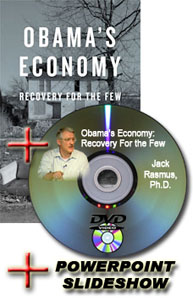
Jack is the author of the 2013 book, ‘Obama’s Economy: Recovery for the Few’, Pluto Press, 2012, and host of the weekly radio show, Alternative Visions, on the Progressive Radio Network online at PRN.FM. His website is, http://www.kyklosproductions.com, and his blog, jackrasmus.com. His twitter handle, @drjackrasmus.

INTRODUCTION:
For readers interested in a discussion of the ‘Strategic Impasse’ confronting unions in the US today, in the following ‘Alternative Vision’ radio shows host, Dr. Jack Rasmus, interviews long-time local labor leaders on the topic of Unions’ political, industrial (bargaining, organizing, strike, etc.), and community alliances strategy today. With unions under attack from all directions, Jack and guests discuss whether labor’s political, industrial, and community alliance strategies of the past two decades are today at an historic impasse requiring a thorough re-evaluation and restructuring.

In the November 20 show, Jack interviews Steve Early and Arun Gupta; in the December 11 show, Jerry Gordon and Alan Benjamin.

(Listen on December 18 to the interview with Ray Rogers. Subsequent shows will continue the interviews with seasoned, long time local union leaders on the topic of ‘Is Union Labor at a Strategic Impasse?’)

ALTERNATIVE VISIONS, 12-11-13 SHOW –
Are US Unions Today at a Strategic Impasse, Part 2

Listen/download radio show interview at:

http://alternativevisions.podbean.com/

12-11-13 Show Announcement:

“Continuing the discussion initiated on November 20 with guests with long-time grass roots experience in the American union movement, Dr. Jack Rasmus invites Jerry Gordon and Alan Benjamin, to discuss the general topic: Have the basic strategies of US Labor employed since the 1980s now reached an impasse and dead end?. Both guests have more than 40 years of experience each in the union movement, and offer their comments on the state, and future direction, of union labor’s current political, industrial (bargaining, organizing, strikes), and community alliance strategies. Topics addressed include the recent Chicago teachers strike, the fight to protect jobs at Boeing in Seattle, the recent AFLCIO convention, organizing the south, labor’s increasingly shabby treatment by the Democratic Party, and other examples, as discussants take on the topic of ‘what needs to change strategically and organizationally for union labor in America to reverse its decades-long decline.”

“Jerry Gordon is a former representative of the United Food & Commercial Workers for decades, now retired, and currently secretary of the Emergency Labor Network and the Labor Fightback coalition. Alan Benjamin is a long time delegate to the San Francisco Central Labor Council, AFLCIO, a member of OPEIU, and active in labor immigration coalition work.”

ALTERNATIVE VISIONS, 11-20-13 SHOW –
Is Union Labor At a Strategic Impasse?

Listen/download radio show interview at:

http://alternativevisions.podbean.com/

11-20-13 SHOW ANNOUNCEMENT:

“Jack Rasmus invites guests, Steve Early and Arun Gupta, to discuss ‘What Strategy for Union Labor in America’. Dr. Rasmus notes how union membership is now in freefall despite tens of millions of workers wanting to have a union today, how collective bargaining is in retreat now on the benefits as well as wages front, and how Labor’s political and industrial strategies of the past two decades have both produced little positive result. Dr. Rasmus and guests discuss how US Labor’s political strategy of ever closer ties to the Democratic Party has resulted in virtually no gains for workers the past 6 years despite billions of dollars of union contributions to the party. And how Labor’s industrial-bargaining strategy, focused on maintaining health and pension benefits in lieu of wage increases, is now being ripped apart as well by legislated health care and pension changes. With political-industrial strategies of the last two decades now in disarray, what are the alternatives for forging new strategies for organized labor in America? Jack and guests discuss what it means to say labor should embark on a path of more ‘independent political action’ and/or initiate new forms of industrial and bargaining, while reducing its reliance on the Democratic party and its primary focus on maintenance of benefits bargaining.”

“Steve Early was a long time CWA staff member in the Boston area and now author of several books on the present condition of labor, workers and their unions in America today. Arun Gupta is an activist with the Occupy movement.”

In parts 1 and 2 of this series on how US corporations have succeeded in avoiding paying taxes, the focus has been on how corporations have avoided paying taxes at the US federal level and on their corporate income earned abroad. The US federal corporate tax has been in freefall for decades. Elsewhere globally, there has also been a ‘race to the bottom’ between countries to see who can cut corporate taxes the most and fastest. In addition to the US federal corporate tax freefall and the global corporate tax ‘race to the bottom’ between countries, there has been a freefall and ‘race to the bottom’ between the 50 states in the US as well that’s been going on for decades.

The following Part 3 therefore briefly examines this within the US corporate tax ‘race to the bottom’, as state legislatures have in recent decades between competing to offer more tax cuts to corporations (and even ‘reverse taxation’–i.e. direct subsidies, awards, and payments to corporations), in an increasing state level desperate effort to lure business headquarters from another state to their own. The outcome is that US Corporations now pay on average a mere 2% or so in effective taxes to the US states as a group.
This Part 3 concludes with a short list of priority proposals for reversing the ‘Great Corporate Tax Shift’, at the federal level in the US, between the US and other countries, and between the US states.

The State to State ‘Race to the Bottom’

Behind the decline in the corporate income tax as a share of total tax revenues lies the growing proliferation of corporate tax exemptions, credits, deferral of payments, and various other ‘loopholes’. This is the explanation of why the effective corporate tax rate has consistently declined while the official rate has not. This trend of declining effective rate is occurring at the state level as well as the US federal level.

While the official state corporate tax rates range from 5% to 10%, states in aggregate are averaging only about 2% effectively in corporate tax payments. States across the US have been in a ‘race to the bottom’ to grant more and more corporate tax loopholes and exceptions in order to lure corporations from other states to their state.

A recent New York Times survey showed that states are not only lowering their corporate tax rate to lure corporate headquarters and operations, but are granting corporations cash, free use of public buildings, exemption from property taxes, and diverse other ‘awards’ in a desperate attempt to bring jobs to their states from other states. The New York Times article estimated the cost in state corporate tax revenues at around $80 billion a year. In many cases the corporations take advantage of the ‘awards’ and then create few jobs or cease operations afterward anyways.

The $80 billion a year average since 2009 amounts to more than $300 billion in reduced state corporate tax revenues. That has occurred despite a cumulative budget deficit total among all 50 states of $581 billion during 2008-2012. In a sense then, more than half of the states’ budget deficits during the past four years may be attributable to corporate tax breaks, resulting in only 2% collected of the official 5%-10% state corporate tax. But instead of targeting a restoration of corporate taxation, most of the states have targeted reducing public workers’ pensions, benefits, and wages as the solution to their budget deficits.

Among the most egregious states lowering corporate tax revenues are Texas, which provides $18 billion a year in such concessions. Oklahoma and West Virginia have granted corporate tax concessions equivalent to one-third of their annual state budgets.

The industries and corporations that are the main beneficiaries of this ‘race to the bottom’ trend in state corporate taxation are oil & gas companies, film & entertainment, technology companies, and auto companies—the latter of which pioneered the trend back in the 1980s. Since 1985, auto companies have received $13.9 billion in state corporate income tax concessions. More than 267 auto plants have been shutdown in the US nonetheless.

The trend toward declining state income taxation continues to accelerate. A number of states have, and are proposing, to eliminate corporate income taxation altogether. Most recently, Louisiana, Kansas and Nebraska. The inter-state US corporate income tax ‘race to the bottom’ thus continues.

Solutions to the Corporate Tax ‘Race to the Bottom’

Solutions to the ‘Great Corporate Tax Shift’ are not economic rocket science. To address the ways in which US corporations today avoid paying taxes—state to state, country to country, and US federal—the following short list of measures should be legislated.

1. The State-to-State Corporate Tax ‘Race to the Bottom’

To avoid the state-state ‘race to the bottom’, an ‘Interstate Corporate Equalization Tax’ should be implemented. Corporations that move their (taxable) headquarters from one state to another should be required to pay the ‘losing’ state a fee equal to the difference in the two states’ corporate income tax for a period of three years into a special fund. Corporate subsidies and other ‘awards’ should be included in the fee calculation. The ‘gaining’ state should be required to deposit as well an equivalent amount of the corporate fee into the fund. All the funds from the corporate fee and state equivalent contribution should be deposited in a special worker benefits fund, administered by the losing state, to be used solely for supplemental unemployment, job training, and job relocation expenses for those workers who lost their employment when the corporation moved to the lower tax paying (‘gaining’) state.

2. The Country-to-Country Corporate Tax ‘Race to the Bottom’

To avoid the growing country-by-country corporate tax ‘race to the bottom’ that is occurring globally as well, measures are necessary to discourage US corporations’ avoidance of US taxes as result of shifting investment and jobs offshore. All current, numerous tax incentives that the US federal government grants corporations today to invest and shift jobs offshore should be immediately repealed. For example, US corporations should be eligible for the current investment tax credit only after the corporation has proven it has invested in the US. No US investment…no tax credit. Furthermore, the investment tax credit should be conditioned upon proving that 50% of the credit has been spent on accompanying US job creation associated with the investment. No US job creation…no tax credit.
Enforce the collection of foreign profits tax at a US effective corporate rate of 35%, not the current 2.2% rate. Companies that refuse to comply and continue to hoard their cash offshore in subsidiaries should be slapped with a rising progressive tariff on the goods they produce offshore and import back to the US until the foreign profits tax is fully collected. If they don’t pay your foreign taxes, then they can’t import back and sell your foreign made goods in the US.

Subsidiaries of foreign corporations operating in the US, with origins in those countries that engage in egregious corporate tax avoidance assistance—e.g. Ireland, Netherlands, Bermuda, and others—should be required to pay a supplemental corporate tax to the US federal government. Similarly, foreign corporations of those countries exporting their goods to the US should be required to pay an additional tariff on sales to the US.

US Multinational Corporations that practice ‘intra-company pricing’ designed to minimize their US based taxable profits, and to divert those taxable profits to offshore subsidiaries for the purpose of avoiding US taxes, should be considered as engaging in financial fraud, and thus subject to prosecution by the US Securities & Exchange Commission and other relevant regulatory bodies.

3. Select Measures Further Restoring US Federal Corporate Taxation

In addition to ending the corporate tax ‘race to the bottom’, both between US states and between countries, a priority short list of additional changes to federal US corporate taxation are also necessary. These include:

Make the ‘effective rate’ the nominal top rate for corporations. Corporations should pay an effective top corporate tax rate of 35%, not the actual 12% they do today. That means ending all corporate tax loopholes across the board except those that result in annually confirmed and proven US job creation.

All corporate depreciation allowances should be rolled back to definitions and standards in effect in 1980. All research & development corporate tax credits should be allowed only for R&D work shown actually conducted in the US, not by foreign US corporate subsidiaries.

Not least, for both US financial corporations and for ‘portfolio’ financial investments by US non-financial corporations, a financial transactions tax should be introduced that taxes stock and bond sales at 0.1% per value of the purchase for all stock purchases of 100 share or more; 0.5% for purchases of 1000 shares or more; and 1% for all shares of 10,000 or more. For bonds, a financial tax of $100 per each $10,000 value for Investment Grade corporate bond purchases, and $200 per each $10,000 for High Yield (Junk) Grade corporate bond purchases. A 1% tax on all foreign exchange trading by corporations. And a 1% tax on all third party derivative trading by corporations.

Collectively, these various measures would raise approximately $1 trillion a year, every year, eliminating all US federal deficits, as well as deficits for most US states. Their secondary effects would include re-directing the decades-long outflow of US corporate investment abroad and creating millions of jobs again in the US.

Jack Rasmus

Jack is the author of the 2012 book, ‘Obama’s Economy: Recovery for the Few’, published by Pluto Press and Palgrave. He hosts the weekly radio show, Alternative Visions, on the Progressive Radio Network. His website and blog are: http://www.kyklosproductions.com and jackrasmus.com, and his twitter handle, @drjackrasmus.

In a contribution last week, it was shown how Corporate Taxes in America have been in decline now for more than three decades. Contrary to the drumbeat of corporate media throughout this year, and their false claims that US corporations are paying far more than their foreign capitalist cousins, US corporations pay an effective (i.e. actual) tax rate of only about 16-17%. That’s a combined US federal, foreign states, and US states ‘effective’ tax rate, only 2.2% of which represents the ‘effective rate’ paid on offshore earnings today.

The rising crescendo of demands for still more tax cuts for corporations by virtually all Republicans in Congress, and a good number of Democrats as well, is being whipped up in a joint effort to push through an overhaul of the US tax code. The timing is apropos. Midterm 2014 Congressional elections are approaching, and politicians once again begun to solicit campaign spending ‘indulgences’ (aka campaign spending contributions) from their corporate friends.

The tax code overhaul idea is also timely, this writer has previously argued, given the still unresolved budget-debt ceiling debates. Those debates were kicked down the road this past October 2013 and are due to come to a head January-February 2014 once again. Should the Republicans decide to agree to any of Obama’s current ‘smoke & mirror’ proposals to reduce some showcase corporate tax loopholes, that token reduction will almost certainly be accompanied by lowering the corporate tax rate in exchange. Obama has already proposed to do just that, reducing the top corporate tax rate from 35% to 28%. So the political stage is well set to ‘slip in’ the corporate tax and tax code overhaul discussions into the upcoming debates. The tax code overhaul discussions need not necessarily reflect the entire code. It could prove a ‘tax code light’, focusing primarily on the corporate income tax.

Senator Baucus’s $1.8 Trillion Multinational Corporate Gift

The ink was hardly dry on our last week’s contribution, ‘The Great Corporate Tax Shift, Part 1’, when Democrat Senator, Max Baucus, head of the Senate Finance Committee proposed last Tuesday, November 19, to “exempt much of the profits earned by American corporate subsidies in foreign countries”, according to a November 20, 2013 article in the New York Times.
Baucus’s proposal would in effect end all taxes on US Multinational Corporations earnings abroad, in exchange for what amounts to a $200 billion payment in back corporate taxes on those companies’ currently estimated more than $2 trillion offshore profits hoard. Baucus claims his proposal represents a 20% tax rate (compared to the current 35%). But $200 billion of $2 trillion looks more like a 10% tax rate to me.

The Baucus proposal, moreover, would mean the $200 billion is paid only slowly over the course of 8 years—thus leaving the companies to collect interest and reinvest the amount over the 8 year period to earn still more profits. And it’s likely that $200 billion would silently be dropped somewhere down the political road after 2016 when the public is not looking. However, what would remain permanent in the Baucus proposal is US multinationals wouldn’t have to pay a penny any longer on their earnings offshore that they kept there.

Amazingly, Baucus offered his proposal as a solution to discourage companies to divert their operations and jobs from the US to their offshore subsidiaries. But if they no longer have to pay taxes on offshore earnings, seems to me that’s a strong incentive to shift even more investment and jobs offshore, not less. Or, at minimum, to reinvest there the profits made there instead of repatriating the profits back to the US, pay the current US corporate tax rate of 35%, and invest the remainder in the US and jobs.

It’s not surprising that the response of the Business Roundtable, the premier big business lobbying arm, was warm to Baucus’s idea. It’s Vice-President, Matt Miller, noted “It’s good that they are continuing to have these discussions”, as quoted by the global business press source, The Financial Times. On the other hand, lobbying groups for the most egregious industries and corporations now hoarding the lion’s share of the $2 trillion offshore, want more.

In this following ‘Part 2’ contribution to the ‘Great Corporate Tax Shift’ theme, how multinational US corporations now get away with paying only 2.2% on their foreign earnings is explained. Keep in mind, the Baucus proposal would eliminate even that, replacing it with a one time $200 billion, paid over 8 years, in exchange for no more taxes on foreign earnings ever.

Gimme A ‘Dutch Sandwich’, with a ‘Double Irish’, & some Bermuda ‘On the Side’

Multinational Corporations have been engaging in a public relations full court press for the past two years, attempting to convince the public and politicians that the US corporate income tax is the highest in the world. They repeatedly point to lower official corporate tax rates throughout the advanced economies. It is true, most official corporate tax rates in Europe, Japan and elsewhere are lower than the US 35% official rate. But their corporate tax loopholes are nowhere near as generous as in the US. In addition, the ‘state’ or ‘provincial’ jurisdictions within many of these countries have higher official and effective corporate tax rates as well. Corporations pay more at the ‘state-province-district’ levels than the average effective rate of around 2% in the US.

The most telling rebuttal to US multinational corporate claims of US taxation at 35% as among the ‘highest in the world’ is that US corporations have been paying almost no tax on corporate profits earned offshore—while they have simultaneously been redirecting US earned corporate profits to their offshore subsidiaries to avoid paying US taxes as well. This game is made possible by ‘internal corporate pricing’ maneuvers. It works like this: charge the US operations high prices for goods made offshore and imported back to the US, so that there are little profits to book in the US. Then shuffle foreign made profits around to those countries with super-low tax rules and rates. Book the profits there and pay the lowest rates. Finally, refuse to pay the US foreign profits tax on even those reduced profits booked offshore.

The corporate pricing games that shift profits to offshore subsidiaries was made possible in large part by an IRS tax rule created early in the Clinton administration in 1995. This rule is referred to as the ‘Check the Box’ loophole. It enables multinational US companies to check a ‘box’ on its US tax forms that identifies a foreign subsidiary of the company as a ‘disregarded entity’ for purposes of paying taxes. The related ‘Look Through’ loophole, then allows the company to move profits between subsidiaries in its offshore operations.

Favorite places to shuffle foreign earned profits are Ireland, the Netherlands, and Bermuda. The Netherlands is preferred because it allows a company to avoid all withholding taxes. That’s called the ‘Dutch Sandwich’. Shuffle the profits there, and then on to Ireland with its 5-6% effective tax rate. Better yet, incorporate the company in Ireland in the first place and book all offshore profits there to begin with. Shuttle the profits through Ireland to Bermuda, where the effective rate is almost zero, and the combined loophole is called the ‘Double Irish’. Or how about a ‘Dutch Sandwich’ with a ‘Double Irish’?

It all sounds humorous but it isn’t. Apple Corporation last year avoided $9 billion in US taxes manipulating its profits in this manner. And remember, it’s not just actual profits earned offshore, but US de facto profits switched to offshore subsidiaries by means of ‘internal company pricing’, profits then shuffled around to low tax locations like Netherlands, Ireland, and Bermuda. Google Corp. is another clever manipulator of the arrangements, earning all its foreign income in Ireland, which its then routes through the Netherlands to avoid all withholding taxes. It thus employs a ‘Dutch Sandwich with a Double Irish’ to go.

This has all been going on since the Clinton years. The result by 2004 was the accumulation of more than $650 billion of U.S. multinational corporation profits in their offshore subsidiaries, retained there and not brought back to reinvest in the US or to pay corporate income taxes to the US government, as US politicians simply looked the other way and allowed it to continue.
During 2001-03 George W. Bush pushed a massive tax cut through Congress, involving tax cuts to personal incomes in general and in capital gains and dividend taxes for wealthy investors in particular. It has been estimated those tax cuts amounted to more than $3 trillion over the following decade, more than 80% of which went to the wealthiest US households. In 2002, Bush cut corporate taxes as well by hundreds of billions of dollars, in the form of new rules for accelerating corporate depreciation write offs. Depreciation write-offs on business equipment is another kind of corporate after tax profits that doesn’t show up in the latter totals. It is income that corporations ‘retain’, but must be used for subsequent re-investment in plant and equipment. But that reinvestment can occur offshore, not necessarily in the US. And so it has, as US corporations ‘foreign direct investment’ has surged since 2001, as investment in the US has stagnated.

The Bush administration then followed up its 2002 business tax cuts via depreciation acceleration, with another round of major corporate tax cuts in 2004. At the same time, in 2004, Bush declared a ‘tax holiday’ for multinational corporations on their foreign profits, now accumulated to more than $650 billion. The multinationals were then offered a sweet deal: repatriate some of the $650 billion back to the US and pay only a 5.25% official corporate tax rate instead of the official 35% rate. The precondition of the deal was that the repatriated funds had to be reinvested in the US to create jobs.

About $300 billion of the total was repatriated, but the effective rate paid was only 3.6%, not the even reduced 5.25%. And the money was not spent on investment and job creation in the US. Instead, it was used mostly to buyback stock and to finance mergers and acquisitions of competitors. This sweet deal set a precedent. Multinational corporations returned to the pricing practices loopholes noted above and continued to amass even greater profits. Today, the profits and cash hoarded offshore in non-taxable subsidiary ‘disregarded entities’ and shuffled around to Ireland and other places is no less than $2 trillion. The practices were allowed to continue under Obama in 2009 and again in 2012 with the latest ‘Fiscal Cliff’ tax deal of last January 2013. In 2012 alone, another $183 billion was added to the multinational corporate offshore cash pile.

For the past two years at least, multinational corporations have attempted to repeat the 2004 sweet deal they got from Bush. They got away with it before. Why not do it again? Instead of paying 2.2%, they want to pay nothing. This time on $2 trillion, instead of $700 billion. Baucus would have them pay 10% or $200 billion—though it’s unlikely anything near that would be collected over the 8 years they have to pay it. But even that is ‘too much’ to their liking. They want tax rules that in effect remove all taxes on US corporate income offshore income, by moving the US to what is called a ‘territorial’ tax system. That would result in an incentive to redirect even more US earned profits to offshore subsidiaries via ‘internal pricing games’. Today’s effective 12% US corporate tax rate would thus fall even further. That almost total elimination of the US Corporate Tax on offshore earnings would reduce US total federal tax revenues by $60 to $100 billion annually. Over 8 years, that amounts to more than $500 billion lost revenue—in exchange for ‘maybe’ $200 billion. A net loss of $300 billion, should the Baucus proposal be adopted. Equally important, it would introduce a major new and further incentive for Multinational Corporations to shift even more US jobs offshore.

Jack Rasmus
Jack is the author of the 2012 book, ‘Obama’s Economy: Recovery for the Few’, published by Pluto Press and Palgrave USA. He is host to the weekly radio show, ‘Alternative Visions’, on the Progressive Radio Network. His website is: http://www.kyklosproductions. He blogs at jackrasmus.com, and his twitter handle is @drjackrasmus.

Note: The full version of this article, ‘The Great Corporate Tax Shift’, complete with graphs and tables will appear in the December 2013 issue of ‘Z’ Magazine.

The great corporate myth-making machine has been hard at work of late, attempting to create the false impression that US corporations are increasingly uncompetitive with their foreign rivals due to the fact they pay much higher corporate taxes in the US and abroad than their capitalist counterparts. But that is one of the great myths perpetrated by corporate apologists, pundits and their politician friends. The myth is high in the pantheon of conscious falsifications their marketing machines feed the American public, right up there along with such other false notions that ‘business tax cuts create jobs’, ‘free trade benefits everyone’, ‘income inequality is due to a worker’s own low productivity contribution’, ‘overpaid public workers are the cause of states’ budget deficits’, or that ‘social security and medicare are going broke’.

If corporate America can create and sell the idea that they pay more taxes than their offshore capitalist cousins, then they are half way home to getting their paid politicians to provide them still more corporate tax cuts—a proposal by the way that both Republicans and Obama are on record for, in their joint proposal to reduce the top corporate tax rate from 35% to 28% (Obama) or 25% (Republicans).

The message of too high corporate taxes is appearing more frequently nowadays, since actual legislation for big corporate tax cuts is now working its way through Congress. Driving the legislation are Teaparty favorites in the House of Representatives, like David Camp, head of the Ways & Means Committee, and Max Baucus, Democrat in the Senate, who is set to retire in 2014 and wants to give his business buddies yet another big cash freebie (you know Max, the guy who rode herd on that Health Insurance Corporation subsidy bill called Obamacare?).

So it’s time to debunk the ‘US Corporations Pay Too Much Taxes’ (and thus need another tax cut) myth. What follows is the first segment of a longer essay—with tables and graphs—on the same topic that will appear shortly in the December issue of ‘Z’ magazine. More segments of that essay will follow.

US corporations don’t pay the nominal corporate tax rate of 35% today; they pay an effective (i.e. actual) rate of only 12%. The additional effective state-wide corporate income tax they pay amounts to only a 2% or so—not the 10% they claim. And the effective corporate tax on offshore earnings is only another 2.2% or so—not the 20% average they’ll complain. So the total US tax for US corporations is barely 16%–not the 35% plus 10% (state) plus 20% (offshore) nominal tax rate. And however you cut it, the story is the same: US corporations’ share of total federal tax revenues have been in freefall for decades. The share of corporate taxes as a percent of GDP and national income has halved over the decades. And corporations since 2008 have realized record level profits during the ‘Obama Recovery’—while their taxes as a percent of profits since 2008 is half that of the average paid as recently as 1987-2007. Okay, more detail on all that in parts 2 and 3 to follow.
For the moment, what all the corporate tax cutting to date has produced is a mountain of corporate cash.

US Corporations today in fact are sitting on more than $10 TRILLION in cash!

For example, even the US business press admits today that US multinational corporations have diverted more than $2 trillion to their offshore subsidiaries, to avoid paying the U.S. Corporate Income Tax. (watch for parts 2 and 3 of to follow for how they do this).

In addition to the $2 trillion now diverted by US multinational corporations offshore, after having paid federal taxes another $1 trillion is now held as cash on hand by the 1,000 largest nonfinancial companies based in the U.S. as of mid-2013, an increase of 61% in the past five years, according to a study by the REL Consulting Group.

For financial companies, deposits in US banks are currently at a record $10.6 trillion, while bank loans outstanding have been declining since 2008 and are now at a record low of $7.58 trillion—thus leaving US banks sitting on a cash hoard of nearly $3 trillion according to the Wall St. Journal. That’s a total approaching $7 trillion so far.

This record after-tax cash exists despite corporations having bought back their stock and paid dividends worth trillions more since 2008. Corporate buybacks of stock since 2009 passed the $1 trillion mark in 2012, according to a survey by Rosenblatt Securities—with projections to increase at an even faster rate of $400-$500 billion more in 2013. Corporate dividend payouts equaled another $282 billion in 2012 alone, perhaps at least that amount in years prior, and are today projected to exceed $300 billion in 2013. That’s another $2.5 trillion.

Include hundreds of thousands of US corporations and businesses that are not part of the largest 1000 or who don’t operate offshore—plus cash socked away in depreciation funds and other special funds for all the above—and that comes to at least another $500 billion.

That $10 trillion corporate total, moreover, doesn’t include still further additional dollars that have been spent by US corporations abroad. While business investment in the US has been declining, total US corporate foreign direct investment is estimated at $4.4 trillion in 2012, up from $3 trillion in 2007 and from $1.3 trillion in 2000. So that’s another roughly $1.4 trillion in corporate income committed offshore since the official ‘end’ of the recession in June 2009.

Add all that up and its well more than $10 trillion in buybacks, payouts, and hoarded cash (onshore and offshore) by US corporations since 2009—i.e. during the sub-par economic recovery (for the rest of us) of the past four years. That’s corporate income and cash that has been diverted, hoarded, or otherwise not committed to US real investment, and therefore never contributing to jobs, income creation and consumption in the US. No wonder consumption (70% of the US economy) for the bottom 80% households in the US has been stagnating, stalling, or declining in the US in recent years. No wonder all the US economy can do is create low wage, contingent, service jobs, while more than 20 million are still unemployed and uncounted millions more have left the US labor force altogether. No consumption recovery follows declining US investment, while tens of trillions of dollars go elsewhere or sit on the sidelines.

To summarize, at least as much as $10 trillion—and perhaps approaching $12 trillion—has been taken out, redirected, diverted, or otherwise hoarded by US corporations since the 2008 crash. Keep all that in mind when you next hear politicians from the two wings of the one party system in America—Republicans and Democrats—and their friends in mainstream media trying to justify proposals for still more corporate tax cuts.

Jack Rasmus
November 19, 2013

Jack is the author of the 2012 book, ‘Obama’s Economy: Recovery for the Few’ (Pluto press), and host of the weekly radio show, Alternative Visions, on the Progressive Radio Network. His website is http://www.kyklosproductions and blog, jackrasmus.com. His twitter handle, @drjackrasmus.