Feeds:
Posts
Comments

The following ALTERNATIVE VISIONS radio show is available for listening and download at:

http://prn.fm/alternative-visions-japans-recession-contradictions-global-capital-11-29-14/

or at:

http://www.alternativevisions.podbean.com

SHOW ANNOUNCEMENT:

Dr. Jack Rasmus describes Japan’s latest 2014 recession as yet another example of growing global Capitalist economic contradictions. With its stock markets booming, exports rising, unemployment at a 16 year low, interest rates at zero and massive money injections by its central bank—how is it that Japan’s economy has plunged again the last six months into a severe recession once again? Is it that it has introduced QE monetary policies too ‘late’, as one wing of mainstream economists argue (i.e. ‘retro classicalists’)? Or is it because it has not introduced fiscal stimulus government spending, as another wing of economists argue (i.e. ‘hybrid keynesians’)? Jack challenges both explanations. Real wages and real household income continues to decline, and consumption falter in turn, Jack argues, because job growth has been largely ‘contingent’(part time/temp), because Japan QE/monetary policy has depressed its currency by 35% and raise the cost of consumer imports that reduces real wages still further, and because Japan fiscal policy raised consumer taxes and reduced household income still further in turn. Jack argues Japan is yet another ‘model’ and example of how capitalist monetary policies driving the world economy today bail out wealthy investors, bankers, and multinational companies first and quickly, but result in a failure to boost real investment, jobs and average consumer incomes as well in the process. With little household demand for real goods and services, businesses cut labor costs (wages) instead to boost profit margins and then hoard their cash, or invest it offshore, or divert it to financial asset speculation globally. Capitalist monetary policies bail out the rich, but simultaneously cause the rest of the global economy to gradually grind to a halt—Japan being but the latest, and most extreme, example of the growing contradictions of global capital today.

On April 30, 2014 the International Monetary Fund (IMF) provided Ukraine a two year, $17.1 billion standby loan, justified at the time as necessary to stem the country’s accelerating economic decline. In exchange, Ukraine turned over the macro-management, restructuring, and the future of its economy to the IMF.

Today, six months later, it is reasonable to ask how Ukraine’s economy has fared in the interim? How has the IMF plan performed thus far? And what are the prospects for Ukraine’s economy in the months immediately ahead under continuing IMF management?

For the six quarters (18 months) prior to April 30, 2014 Ukraine’s economy declined 1%-3% every quarter except one. In the first three months of 2014 its GDP fell another -1.1%. But since the IMF deal was signed in April, the decline has accelerated: In the April-June 2014 period Ukraine’s GDP fell a more rapid -4.6%. GDP figures are not yet available for the most recent, July-September 2014 period, but it appears very likely the economy is now deteriorating even faster.

For example, according to World Bank data, while industrial production fell -5.8% in the first half of 2014, in July and August its decline accelerated to -12.1% and -20.1%, respectively. Other key indicators of the economy reveal a deterioration from January through August, especially business investment (-25.6%), construction (-15.6%), trade (-13.8%), exports (-14.4%) and imports (-21.2%). Those figures do not yet include the two most recent, and no doubt even worse, performing months of September-October.

During the same January-August period, inflation also rose by 20%, Ukraine’s currency plummeted by 36% (the most globally of any economy), and Ukraine central bank’s foreign currency reserves—needed to stem its currency collapse, to finance desperately needed exports & imports, and to provide essential credit to its increasingly fragile private banking system—began evaporating. Foreign reserves fell $4 billion in October alone, to a nine year low of barely $12 billion. With currency, reserves, and credit all collapsing, capital flight continues to intensify, recently prompting Ukraine’s government in desperation to impose a $200/day limit on withdrawals.

Last April the IMF assured its initial $17.1 program would result in only a -5% fall in Ukraine’s GDP this year, with a return to 2% positive growth in 2015.

However, an IMF preliminary review in mid-July of the program’s progress concluded that while “all performance criteria and benchmarks were being met” nonetheless, along a number of fronts the economy was deteriorating rapidly. The IMF therefore raised its GDP decline estimate to -6.5%.

In August, as the economy continued to further deteriorate, the IMF revised its April estimate again, predicting a -7.3% decline in 2014 and this time a -4.6% in 2015 instead of 2% growth.

An indication of just how fast the economy has been deteriorating, just last month, in early October, the World Bank raised that number to an -8.0% GDP drop for 2014. The Bank noted an even worse scenario was likely, if gas prices continued to rise in 2014(which they will with the onset of weather and the recent Ukraine-Russia gas deal) and if military conflict continues in the eastern regions (which has been intensifying anew). The only growth sector of the Ukraine economy is government military spending, as it battles separatists in its eastern Donetsk-Luhansk regions.

Many economists considered the IMF’s initial April estimates for Ukraine absurdly optimistic, this writer included, who predicted last March that Ukraine’s GDP would collapse at least -10% to -15% in the coming twelve months; furthermore, Ukraine would need a $50 billion bail-out in the next two years, not the IMF’s $17 billion. That 8% GDP drop so far amounts to $14 billion reduction in Ukraine’s 2013 GDP of $177 billion.
To date, the IMF has only distributed to Ukraine $4.5 billion of the $17 billion. But that $4.5 billion disbursement has had little positive impact on Ukraine’s real economy and provides essentially no ‘offset’ to the $14 billion real decline to date.

A significant percentage of that $4.5 billion has already been paid by the IMF to itself and to western bankers for debt previously incurred. In fact, according to Bloomberg business, Ukraine has more than $15 billion in payments coming due between now and the end of 2015. One could logically argue that the IMF’s initial $17.1 billion will be used to pay back $15 billion.

Another part of the IMF’s paltry $4.5 billion disbursement to date is directed to Ukraine’s central bank, in order to try to stabilize Ukraine’s currency, the hryvnia, that has been in freefall for months. And yet another $2.7 billion disbursement, scheduled for later in 2014, will likely be used by Ukraine’s state owned gas company, Naftogaz, to pay Russia for natural gas through next winter, and for payments owed for past gas deliveries, both as part of an agreement recently reached with Russia’s Gazprom.

Concerning the impact of IMF policies involving natural gas, gas prices have already risen 50% for many consumers, devastating incomes and depressing consumption. But the other foot will fall after January 1, when subsidies to households, now covering up to 7/8ths of the cost for gas, will start being discontinued.

So most of the $17.1 billion original IMF deal has had, and will have, little positive impact on Ukraine’s real economy. The lion’s share of the $17.1 billion goes to service past debts to creditors outside the country. And what remains in funding, i.e. what doesn’t go to creditors, goes mostly to Ukraine’s central bank—i.e. to try to stabilize its currency, to finance external trade (exports-imports), and to replenish evaporating foreign exchange reserves. Meanwhile, gas policies, as well as government spending cuts, tax hikes on consumers, and other ‘fiscal’ measures in the IMF plan directly impact both household consumption and government spending.

The IMF’s $17.1 billion April loan is classic IMF strategy, designed to take over an economy and manage it in the interests of western banking and multinational corporate interests. IMF lending is foremost about ensuring interest and principal payments are made on schedule. The first priority is to provide loans to ensure repayments. Bankers get paid first, along with the IMF. Second priority is to provide the country’s central bank funds necessary to stabilize its currency. A stable currency is needed to encourage western foreign direct investment into the country, i.e. to buy up and take over its domestic industry. Third priority is to enable indigenous businesses and consumers to purchase exports to the country from the west.

Thereafter the IMF plan is to fundamentally restructure the economy so that social spending programs are cut massively and wage pressures are reduced on business as layoffs take place as part of restructuring to make business more ‘efficient’. Social program cuts and layoffs tame the working classes to accept lower wages and to work harder, increasing productivity, if they want to keep their jobs. Finally, the classic IMF intervention program aims to reduce the size of the government and the public sector, so that it doesn’t compete with private businesses for credit or directly in markets. Reducing government spending and deficits also creates more budget room for business and investor tax reduction. That model is precisely what occurred in Greece, Portugal and elsewhere in recent years. And it’s being implemented today in Ukraine.

Contrary to IMF assurances last April, nearly everywhere since April the Ukraine economy is declining at double digits rates—industrial production, investment, consumption, trade, currency values, foreign exchange, and now GDP itself. So the Ukraine economy is currently spinning out of control—not stabilizing as the IMF April 2014 plan and deal originally assured—heading toward the 10%-15% GDP collapse and the need for $50 billion in bailout.

The IMF itself has recently recognized the seriousness of the situation, indicating it may have to add another $19 billion in bailout. But that doesn’t mean it will provide it. Western Europe is descending into a third recession in five years and is in no mood to give more. And the USA is preoccupied with ISIL, Iran, and domestic politics.

Ukraine’s President Poroshenko recently toured European capitals and Washington with his ‘hat in hand’. He reportedly “gave the speech of his life and got $53 million. That funds the cost of the war in the East for 9 days”, to quote the USA newspaper, The Washington Post.

The IMF’s cover for the failure of its program in the Ukraine is to blame the accelerating decline on the continuing military conflict in the East and on the natural gas crisis, escalating prices, and growing Naftogaz debt. While military conflict has contributed, the scope and magnitude of the Ukraine economic collapse now underway is attributable to various economic forces well beyond the military conflict—not least of which is the IMF program itself.

The fact that the IMF continues to revise its economic estimates downward, almost monthly, and that it is raising the possibility of the need to provide as much as $19 billion more in bailout, is ample testimony of the failure of the program.

Meanwhile, Ukraine’s real economy and its citizens suffer severely as a result, with all indications that the economic crisis there will get worse, perhaps much worse, before it ever begins to get better.

Dr. Jack Rasmus

Dr. Rasmus is the author of ‘Epic Recession: Prelude to Global Depression’, 2010, and ‘Obama’s Economy’, 2012, both published by Pluto Press; and the forthcoming ‘Transitions to Global Depression’, by Clarity Press, 2015. His website is http://www.kyklosproductions.com and blog, jackrasmus.com.

Dr. jack Rasmus on the Republican Congress’s Emerging Corporate Agenda, listen to ALTERNATIVE VISIONS radio show of November 22, 2014 at:

http://prn.fm/alternative-visions-new-republican-congresss-4th-corporate-offensive-11-22-14/

or at:

http://alternativevisions.podbean.com/

SHOW ANNOUNCEMENT:

In the wake of the recent midterm elections, Dr. Rasmus describes how the new Republican controlled Congress is about to develop new policies on behalf of Corporate America, many of which represent a resurrection of past policies of the Bush administration—i.e. old wine in new bottles. Rasmus identifies and explains the likely emerging new policy initiatives in the weeks and months immediately ahead: more corporate tax cuts, accelerated push for free trade for pacific rim countries and europe, immigration reform defined as more policing and fences, rollbacks of environmental protection initiatives (XL pipeline, industrial plant emissions, public lands fracking, EPA funding, international CO2 limits), Affordable Care Act revisions (more business exemptions, cost shifting to consumers, limits on Medicaid), limits on financial regulation under the Dodd-Frank Act, more aggressive foreign policy action (green light for conflicts and funding of proxies in Syria, US troops to Iraq again, Ukraine (US advisers, special ops, money), NATO push into east Europe (Ukraine, Moldova, Georgia), more freedom of action for NSA spying on US citizens and limits on free speech and assembly. Jack explains how the new emerging policy offensive fits in the four decade long current pro-corporate offensive in America by US government and institutions. Jack provides an historical context for it all and how resistance represents the latest effort in a centuries long struggle by American people to expand and defend their democratic, civil and economic rights since the American revolution period of 1776-1787.

Listen to Dr. Jack Rasmus on this archived podcast of the ALTERNATIVE VISIONS RADIO show, on the topic ‘Why Austerity Continues’, Nov. 15, 2014 at:

http://prn.fm/category/archives/alternative-visions/#axzz26ySyu8Fl

or at:

http://www.alternativevisions.podbean.com

SHOW ANNOUNCEMENT

Jack Rasmus takes a look at why Austerity policies were introduced in 2008-09 and why they continue still today, evolving into new forms, despite their proven negative impact on economic recovery. Jack challenges liberal economists like Paul Krugman who lament the continuation of such policies, explaining Liberals don’t understand the purpose and function of austerity policies, which are integral to capitalist recovery strategies since 2008. Austerity is the complement to a primary focus in advanced capitalist economies on monetary policy as the preferred strategy for economic recovery—i.e. central banks’ bailouts of private banks and investors via QE, zero rates, auctions and forward guidelines. While monetary policy is primary, austerity is a necessary complement, Jack explains, to bank bailouts which produce slow, intermittent, and 5-10 year or more economic recovery trajectories. Jack looks at how Austerity has functioned so far in Europe, USA, Japan and now Ukraine, why it has continued and why it will continue, morphing in to new forms. Austerity policy is a class policy and integral to capitalists’ view of how recovery should be engineered, Jack explains. That’s why Krugman and others don’t understand why it continues. (Next week’s show is ‘Back to the Future’, a detailed look at the new Republican Congress’s 10 priorities for the next two years, that are just a rehash and resurrection of George W. Bush policies in new form going forward).

published teleSUR English Edition, November 13, 2014

All the advanced economies (AEs)—USA, Europe, Japan—have implemented some form of ‘austerity policy’ in the wake of the 2008-09 global financial crash and deep recession that followed. Five years later, austerity continues as a centerpiece of their policy mix even as their economies continue to struggle with recurrent double and triple dip recessions (Eurozone, Japan) and, in the case of the USA, periodic relapses into single quarter negative GDP and ‘stop-go’ recovery. Real investment continues to gradually slow everywhere in the AEs, with insufficient wage growth, stagnating household consumption, and a slow but steady drift toward deflation everywhere.

One of the key global economic questions today is: ‘why austerity?’ More specifically, why do AE capitalist policy makers continue with austerity policy when it clearly hasn’t worked? Indeed, what does it really mean to say austerity ‘hasn’t worked’?

Professional economists are generally confused about these questions. Mainstream liberal economists like Paul Krugman, Alan Blinder, and Martin Wolf scratch their heads, perplexed, and wonder out loud in their weekly newspaper columns why politicians in the AE economies continue with their austerity policies, when it is clear such policies are contributing to preventing economic recovery.

Three Blind Economic Mice

In one of the more recent of his many New York Times columns criticizing austerity policies, entitled ‘Revenge of the Unforgiven’, Krugman notes that “The world economy appears to be stumbling” and that “growth is stalling, and the specter of deflation looms”. For Krugman austerity policies are one of the big causes, perhaps the main cause of this global slowdown, and especially the cause behind Europe’s current emerging third recession since 2009.

Krugman condemns austerity and asks “why do governments keep making these mistakes? In particular, why do they keep making the same mistakes, year after year?” In other words, austerity policies are the consequence of some kind of error or bad economic judgment. That error in judgment is attributed in turn to a moral failure on the part of policy makers, according to Krugman. Austerity policies continue due to “an excess of virtue. Righteousness is killing the world economy”. In the Eurozone the root of that excess virtue and righteousness is Germany, according to Krugman. It insists on maintaining an attitude of “moral indignation” toward debtors who refuse to pay their bills. If Germany would only not insist its neighbors pay their debts (to Euro Commissions, the IMF, and of course to German banks), its Euro neighbors could then abandon austerity and re-stimulate their economies with government spending. Krugman’s solution therefore is to get German policymakers to overcome their excessive virtue and sense of righteousness toward their neighbors, and just let them forego paying their debts (to German bankers and others). Better yet, expunge the debts. But that’s not likely to happen, Krugman adds, until a recession in Germany “will finally bring an end to this destructive reign of virtue”.

So the loss of virtue, excess righteousness—i.e. moral failure—explains why AE policymakers in general, and in the Eurozone and Germany in particular, have stuck to austerity for so long and want to continue it. And it was just a ‘mistake’ to introduce it in the first place. In this Krugman view, there’s no need to consider an analysis of political or economic interests—and especially class interests—as the source of austerity policies, or to explain why such policies have continued for more than five years now, or why they don’t appear about to be abandoned anytime soon. It’s all been just a mistake and continuation of austerity is due to moral stubbornness.

The UK economist and feature writer for the Financial Times, Martin Wolf, echoes the same themes of Krugman with regard to the UK economic experience since 2010: Its origins circa 2010 in the UK were “ a blunder” and “a huge mistake”. Its continuation “worse than a crime”. And those who insist on still pursuing it, like US president Hoover in the 1930s, are “both stupid and wicked” (moral arguments).

In a similar recent editorial in the Wall St. Journal attacking austerity programs, in a piece entitled “Enough with European Austerity, Bring On the Stimulus”, economist Alan Blinder, a former vice-chairman of the Federal Reserve in the USA, also declared that Euro austerity policy was due to a ‘mistake’. Once again the focus of attack is “German obsession with austerity” that “is holding back growth”. Germany is again the ‘bogeyman’ here, standing in the way of the heroic European Central Bank chairman, Mario Draghi. Blinder laments that instead of QE and more liquidity for the Euro banks, Europe is instead moving toward more ‘structural reforms’. But structural reforms are just “a potpourri of pro-market policies”, in his view, and will not lead to recovery. True enough. But what Blinder, the former USA central banker, proposes is dear to the heart of all central bankers: more free money to bankers and investors in the Eurozone—that is, more QE. If only the Germans would let poor Mario do his job! But the German central bank president, Jens Weidmann, “won’t budge—at least not yet”, according to Blinder.

Explanations of why austerity originated and why it continues like the foregoing, that are explained by ‘mistakes’ and the ‘moral attitudes’ of policy makers, tell us really nothing about the origins of and reasons for austerity policy’s origins, or why it has continued for more than five years now and continues still to morph into new forms today.

In fact, Krugman & Co. are asking the wrong question. More precisely, they are asking only half of the right question. When they concur that ‘austerity doesn’t work’, the sentence is incomplete. They should be asking ‘For whom does it not work’? For austerity does work, indeed is essential—for bankers, investors, corporations and the wealthiest households. It just doesn’t work for the rest.
Monetary Policy as Capitalist Preferred Solution
Austerity is a blatant class-based program. Its purpose is to enable capitalist policy makers to pursue their primary and preferred economic recovery strategy. That preferred strategy is based on monetary policy—not fiscal policy.

Back in 2008-09 AE policy makers jointly decided to rely primarily on AE central banks—the Federal Reserve, Bank of England, Bank of Japan, and the European Central Bank—as the prime institutions for managing economic recovery. The central banks, led by the USA Federal Reserve, together pumped massive liquidity (money) into the their banking systems in the belief that capitalist finance will then lead the way to economic recovery. The central bank tools employed were quantitative easing (QE), zero interest loans (ZIRP), special auctions where needed in severe emergencies, and what was called ‘forward guidance’ whereby central bank bureaucrats signal bankers and other big capitalists their direction and plans beforehand. Tens of trillions of dollars and other AE currencies were printed and otherwise provided to the private capitalist banking system. Private banks were thereafter supposed to lend to non-bank businesses, who would in turn invest and expand and hire new workers. Incomes would subsequently grow, consumer spending would rise, and GDP and economic growth return. At least that was the theory. Fiscal stimulus as government spending was considered unnecessary for recovery. Even when offered, it was token, temporary, and soon withdrawn once again.

The problem was, and still is, that despite tens of trillions of dollars provided to the private banking system, the private banks were not eager to lend to the vast majority of businesses, especially small and medium businesses. They loaned their central bank provided funds to other shadow banks globally, who speculated in various financial asset markets instead. Of course, that didn’t generate much in the way of real investment, jobs, incomes, consumer spending, and economic growth in the AEs. Much of that lending for financial investment went off shore to emerging markets in any event.

Bankers also loaned to non-financial investment projects, but mostly again offshore to multinational corporations and to China and emerging markets. That too did not generate much real recovery in the AEs. A third thing bankers did with the central bank trillions given them was to buyback their stock and payout dividends. That raised their valuations and got bank senior managers nice bonuses. Thereafter the banks sat on their remaining cash—not insignificant sums—and hoarded it. In the USA alone that remaining cash hoard is reportedly today at around $2 trillion.

Given this scenario of the trillions of dollars provided by central banks to AE private banks, that did not direct it to the real economy to create investment, jobs, incomes, etc., AE policy makers ‘doubled down’ and provided the private banking system and investors even more liquidity in the hope that more liquidity would ensure some getting through. Zero interest rates were continued year after year and even more quantitative easing (QE) programs were introduced. In short, more monetary policy has always been the preferred policy of choice of all the AEs, even when it has produced few results.

After five years, it is now absolutely clear that everywhere in the AEs monetary policy in the form of central bank massive liquidity injections have been the primary policy choice for attempting to restart their economies after the 2008-09 crash. Fiscal policy in the form of government spending or even household tax reduction has never been on AE policy makers agenda anywhere for the past five years, regardless how much Krugman & Co. wish it were so. Monetary policy has always been—and still continues to be—prime. It has been the preferred policy choice of AE policy makers from the very beginning in 2009-10, and continues to be so today.

Austerity Policy as Necessary Complement

But that still doesn’t explain why cutting government spending, ‘negative fiscal policy’, or fiscal policy ‘in reverse’—i.e. austerity—has been part of AE policy mix for the past five years. The general answer to that is that austerity has accompanied the massive central bank liquidity expansion, the prime strategy of the AE policy makers, because austerity functions as a necessary complement to central bank massive liquidity injections.

Austerity is about keeping the lid on rising government debt and making ‘the rest of us’ pay for that debt, while waiting for monetary policy to restart financial markets and for the market system itself at some subsequent point to eventually generate economic growth. The problem is that this ‘monetary policy first’ approach and path to recovery only results in recovery very slowly, with significant delays, and with repeated relapses into short and shallow recessions. Monetary policy based recovery thus takes potentially a long period of time, typically five to ten years. It may prove even longer, as Japan’s economy since the early 1990s is a prime example.

Capitalists and their policy makers truly believe that the capitalist market will ‘correct itself’ in the longer run. They believe that the way to jump start that market-driven recovery is to do it via supply side policies. They believe that pumping massive money injections into the banks starts the supply side process. It’s the first step. After that, banks will lend, businesses will invest, jobs will return and consumers will spend once again. To put money directly into workers’ paychecks and consumer households first by government spending and investing (i.e. Krugman & Co. ‘Demand-Side’ view) relegates bankers and businesses to a secondary recovery position. Demand-side government spending policy means households, consumers and workers recover first, then it spreads to bankers and businesses as the former buy their products. For capitalist policy makers it is preferable to reverse that process: ensure that bankers and big businesses recover first and rapidly, then wait for the market system to eventually bring the rest along.

And if it takes long, 5 years, 10 years, if the recovery is slow and intermittent, then rising government debt must be contained in the meantime. That’s where austerity policy comes in. If that debt is not contained the government debt rise may offset and even negate the monetary policy’s effect. So austerity must accompany a preferred monetary driven recovery policy. It is complementary and necessary to the primary and preferred monetary policy.

To the extent that austerity policies serve this function of containing the rise in government deficit and debt, then austerity policies ‘work’. Austerity policy therefore is not an ‘error’ or a moral failing when class interests are considered. AE capitalists and policy makers are not blind fools, or excessively righteous, or ‘wicked’, as Krugman and others would suggest. It is Krugman & Co. who are blind—to the real class based origins and functional purpose of austerity policies. They think that austerity policy is about a failed strategy for stimulating the economy. But that’s not what austerity is about. Nor is it a ‘mistake’ or due to moral failings. To put it succinctly, austerity is about making the general populace and the working classes pay for the monetary policy strategy’s slow, often interrupted, and limited impact on the real economic recovery.

So has ‘austerity’ failed? The answer is ‘failed for whom?’ In other words, it can’t be determined if it has failed apart from a class analysis of it. And that’s where the Krugman and others miss the whole purpose of austerity in the first place. And why are austerity policies continuing? Because so long as monetary policy continues to fail to generate a sustained and normal economic recovery, AE policymakers will continue with some form of austerity policy.

Dr. Jack Rasmus, November 12, 2014

published TeleSUR English, October 18, 2014

The Eurozone economy has never really recovered from the 2008-09 financial crash and recession. Austerity policies—that played a major role in preventing a sustained Eurozone economic recovery for the past five years—are now evolving into still newer forms.

Events in the recent past in Spain, measures approved in just the past week by the newly formed Renzi government in Italy, and proposals being debated at this very moment by the Holland government in France all point the way to the new forms of austerity now taking shape in the Eurozone.

No longer just cuts in government social programs and elimination of subsidies for the working poor, as before, the ‘New Model’ for Austerity emerging in the Eurozone consists of direct attacks on workers’ wages and incomes. The plan is to hold down wages in order to lower business costs and price of exports. Boosting exports in turn, it is hoped, will lead to more investment which has been steadily declining for years in the Eurozone. This scenario takes place under the cover of what is being called ‘structural economic reforms’ in general and, specifically, ‘labor market reform’ as the central element of general structural reforms.

Eurozone Recessions: What’s Different This Time

The Eurozone’s 18 economies have already experienced two recessions since 2008. Sandwiched in between were two very brief, shallow and weak recoveries. This past spring, the region descended once again into recession, its third. The first recession represented the region’s participation in the global financial and economic crash of 2008-09. The second recession of 2011-12 was concentrated largely in the region’s periphery economies— especially Greece, Italy, Spain and Portugal. The current 2014 recession appears will have even a wider potential impact. Now France and Germany—the latter comprising 29% of all Eurozone output—appear leading the way and slipping into recession.

Germany’s economy grew and thus dampened the decline of the second Eurozone recession. But it declined in the second quarter this year, 2014, and almost certainly will do so again in the 3rd quarter just concluded on September 30.

Recent monthly data show German factory orders falling -5.7% last month, the most since 2009; its industrial production fell -4%, and its exports declined by -5.8%. With the ‘core’ Eurozone economies like Germany weakening this time, leading the way, the Eurozone’s 3rd recession may thus prove not only qualitatively different, but potentially even more severe.

The 2014 recession comes at a point in which the entire region is still collectively more than -2% below its peak in 2008. Spain’s economy today, in 2014, remains -6.5% below its peak and Italy’s still 9% below peak. After five years of ‘recovery’, France’s output is only 1% higher than five years ago in 2008, and Germany’s only 3%. That’s less than a half percent growth per year after five consecutive years for the two largest economies, Germany and France. Best case, that’s a five year stagnation in the region’s two largest economies, while Italy and Spain, the next largest economies, still remain mired in deep recession and depression, respectively, after five years with no real recovery for either on the horizon.

Perhaps the best indicator of the deep weakness of the Eurozone economy today is its labor market. In the region overall, unemployment has remained consistently in the 11%-12% range now for more than five years now. In Italy more than 12%, France 10.5%, and in Spain still nearly 25%. But the picture is even worse than these often reported general job statistics. Youth unemployment rates in both Italy and Spain, for example, are 45% plus. And those youth who have been able to obtain work, have been largely limited to part time and temp work. In France the percent of youth in the workforce age 15-24 who are employed as temps has risen to 59%. In Germany 52%, Italy 54%, and in Spain an incredible 65% can only find temp work, when any work at all. And it’s not just age 15-24 youth workers. In Italy, 70% of all new hires have been temp workers. Temp means lower wages, fewer benefits, far less job security, and employer ‘rights’ to layoff and fire at will. The chronic high unemployment and the large number of low wage temp jobs translates into wage compression in general, with few exceptions, for the rest of the Eurozone working class.

Nevertheless, the target of the ‘new model’ austerity now on the Eurozone agenda is designed to extend and deepen that wage compression by introducing what is being called ‘labor market reform’. In addition to high unemployment and temp hiring, which will continue as a dual force already depressing wages, the new 3rd force of ‘labor market reform’ will extend wage cutting further, targeting the non-temp, permanent Eurozone working class in Italy, France, and elsewhere in particular.

The rationale behind the new direct attack on wages is the argument by a growing number of Euro capitalist elite and politicians that Europe must somehow ‘export’ its way out of its latest recession. Central bank monetary policies have failed for five years to get the Euro banks to lend. And prior forms of austerity policy have not reduced the growth of government and private sector debt. So exports must be the answer. The focus on exports means that the costs of production must be reduced. That means in turn a reduction of labor costs—i.e. by cutting wages and by finding other ways to raise productivity. And that means so-called ‘labor market reform’—i.e. the cover phrase for wage reduction.

Spain: Testing ‘Internal Devaluation’ by Wage Reduction

The forerunner to this new model austerity has been tested in the past two years in Spain. Depression level unemployment of 25% has driven down wages. Hiring of mostly temp workers in the past five years has further kept wages depressed. Other ‘labor market reforms’ have been tested as well by Spain’s conservative Rajoy government, including introducing limits on collective wage bargaining by workers.

The result in Spain has been lower production costs that have made Spanish exports more competitive in recent years. To the extent that Spain’s economy has ceased declining recently, it is largely because of its exports rising—export gains made possible by steep wage reduction that have lowered costs and therefore prices of exports. While economic growth has only risen 0.6% in latest figures, it has halted the further decline of Spain’s economy. This fact has not been lost to capitalist policy makers elsewhere in Europe. The Spanish policy of reducing costs and prices of exports by reducing wages is sometimes referred to as ‘internal devaluation’. With the Euro as its currency, Spain cannot formally devalue its currency by itself to get a cost-price advantage to boost exports. But it can ‘internally devalue’ and boost exports by labor cost reduction, which it has.

But pushing unemployment up to 25% levels in France, Italy and elsewhere—as currently exists in Spain, Greece, and lesser extent in Portugal—is not a political option for Italy, France and the core economies of northern Eurozone.

Unemployment of around 12% today throughout the Eurozone for the past five years is already leading to a distinct rightward shift in politics throughout the continent. Nascent far right and fascist parties are growing everywhere. Eurozone capitalist elites realize that future political instability will not help economic recovery in Italy, France and the ‘core’ Euro economies. They recognize that a similar political upheaval on their eastern border, in the Ukraine, has already taken a serious toll on their economies. So engineering a 25% unemployment level as a means to deeply depress wages—as in Spain and elsewhere is not possible in the core economies of the region.

Another way must therefore be found in France, Italy, and the core northern economies now slipping into recession in order to generate an export-driven recovery. ‘Internal devaluation’ to reduce labor costs will have to take another form. That ‘other way’ is ‘labor market reform’—i.e. wage reduction by another name targeting the non-temp permanent employed workforce.

Italy’s Labor Market Reform

Last February a new prime minister, 39 year old Matteo Renzi, was elected and assumed control of government policy. Renzi immediately proposed structural and labor market reforms upon entering office. In fact, he made the ‘labor market reform’ his first announced and first priority. Renzi’s reform proposals were adopted by the Italian Senate just last week, in early October 2014. They are expected to pass the Italian legislature by year end and are scheduled to take effect sometime in 2015.

Not all the details are apparent as yet, but some outlines are. About one fourth of all of Italy’s 25 million workers are the target of the new reforms. What is known so far is that Italy’s new ‘labor market reform’ rules will make it easier for employers to hire and fire workers—both newly hired permanent workers as well as temp workers. Permanent workers now will also be easier to layoff and fire. Workers will have less access to court action if they are fired. No doubt anticipating a rise in permanent jobless as employers are given a freer hand to shed workers, Renzi’s measures call for a big increase in spending on unemployment benefits of 18 billion Euros. New hires’ benefits, severance pay, and rights will also be reduced when initially hired, and only slowly ‘phased in’ as they gain seniority on the job. Limits on workers’ collective ability to wage bargain are reportedly to be part of the new ‘reforms’ as well, although details so far are lacking what this will mean. Spain’s previous implemented similar measures to limit wage bargaining may serve as a start point or template perhaps. Not only will the labor market reforms lower business costs by compressing wages for new segments of the working class, but Renzi’s reforms include reducing costs by business tax reduction. Business labor tax cuts equivalent to 32 billion Euros are part of the Renzi reforms. Declining tax revenues will likely require more government spending reductions, thereby ensuring traditional austerity measures will continue as well.

It is important to note that previous forms of austerity are projected to continue, both in Spain and Italy. The new structural and labor market reforms are in addition to, not in lieu of, previous forms of austerity. Up to now, Eurozone Austerity measures have assumed three basic forms. Austerity has meant deep reduction in government spending, especially on social programs, with corresponding deep cuts in government jobs and government infrastructure investment. Austerity has also taken the form of governments selling off public assets to private investors to then exploit for profit. ‘Privatizing’ public assets means selling parts of the national health care systems, previously nationalized companies, nationalized utilities, public banks, etc. Austerity to date has also meant raising fees, government charges, new taxes of various kinds imposed on consumers and working class households, while simultaneously eliminating essential food, transport, and other subsidies for the working poor.

These are the ‘old’ traditional forms of Austerity; the new forms will occur under the cover of so-called ‘labor market reform’ and other structural economic reforms. Previous forms have been designed to make workers pay indirectly for the recession and failed Eurozone central bank recovery policies since 2009. With labor market reform, the new focus is on more direct wage and income reduction.

France to Follow Italy–Slowly

The push for structural and labor market reform is part of a growing consensus among Eurozone capitalist elites in general that a shift to some kind of growth policy is necessary if Europe is not to descend even faster and deeper into recession.

Labor market reform, and broader structural economic reform, is increasingly viewed as the way to generate investment and growth. Prior strategies since 2009 aimed at stimulating bank lending by massive central bank money injection have clearly failed in the Eurozone (as they have in Japan and the USA). Government and private debt levels have also continued to rise despite five years of monetary injections. So another way to ‘grow out of the crisis’ is being debated across the region. One element coming out of that ‘growth debate’ is that the Eurozone in general, and economies like France, Italy, Spain and others should expand exports in order to stimulate in turn new investment. But first wage and labor costs must first be reduced to boost exports. That’s where ‘labor market reform’ and labor cost reduction, i.e. ‘internal devaluation’, comes into the policy and new strategy mix now in development and roll out.

With Italy well on its way to implementing ‘labor market reform’ as a new form of Austerity, France is close behind but has not yet launched a similar labor policy. Pressure by Eurozone capitalists and elites across the region—especially central bankers—is now growing and demanding that France speed up the process. Indicative of this pressure are recent public statements by Jyrki Katainen, who will assume the role of vice president for jobs, growth, investment and competitiveness on November 1 for the European Commission. Katainen last week praised Italy’s new labor market reforms, declaring “it is a very good thing they are dong”. On the other hand, he criticized France, saying France should do more”.

The IMF, Germany’s government, and central bankers throughout the Eurozone have all added their voice, in a growing drumbeat of demands that France more quickly introduce serious labor market reforms and other structural reforms.

While France lags behind Spain and Italy in implementing labor market reform, French President, Francois Holland, has promised to announce labor market reforms, and broader economic structure reforms in France, later this year and early in 2015. Early indications are reforms will include proposals to deregulate various industries and to sell 100 billion euros of public assets—i.e. state owned companies—and to cut business tax cuts by 40 billion Euros.

France will also expand weekend and holiday shopping. That will mean more part time and temp work and possibly making workers work more overtime without being paid premiums for weekend and holiday work. Both would reduce general wage levels. Further reform announcements in 2015 will almost certainly include further reductions in pensions. At the same time, as in Italy and Spain, other prior forms of austerity apparently will continue, as France has indicated it will proceed with previously committed spending cuts of 50 billion Euros.

In the coming weeks and months, as the Eurozone economy weakens still further, it is likely that debates and splits within the Eurozone capitalist elites will continue to intensify. Some will argue still more central bank QE money injection is the answer to stem the new economic decline. Germany and central bankers will push back on this. Other new voices will continue to argue for more investment and government spending. But rising government debt levels and opposition to this by political forces in the European Commission, in Germany, and elsewhere, make the increase in government spending option unlikely. The ‘compromise’ new direction and new policy most likely to be agreed to by the different divisions within the Eurozone capitalist elite is the growth path initially pioneered by Spain and now being followed by Italy—i.e. export-driven growth via labor cost and wage reduction under the ideological cover called ‘labor market reform’. Exports to drive private, not government, investment. And still more labor cost reduction and wage compression—i.e. more ‘internal devaluation’—to drive exports

But boosting exports by labor market reform and wage compression raises the still deeper question of ‘who will they increase exports to? If the global economy—from China to Japan to Latin America, and even the USA in 2015 should it raise interest rates—continues to slow, as it clearly is now doing, who will buy the Eurozone’s exports?

Jack Rasmus

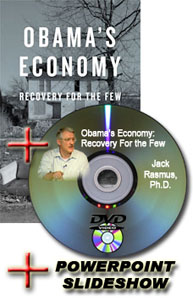
Jack is the author of ‘Epic Recession: Prelude to Global Depression’, Pluto Press 2010; ‘Obama’s Economy: Recovery for the Few’, Pluto, 2012; and the forthcoming ‘Transitions to Global Depression’, Clarity Press, 2015. His website is: http://www.kyklosproductions.com and blog, jackrasmus.com.

Listen to the first half hour of the November 8 ‘Alternative Visions’ radio show on Dr.Jack Rasmus’s initial take on the midterm elections vote last week, at:

http://www.alternativeisions.podbean.com

or at:

http://prn.fm/alternative-visions-post-usa-midterm-election-debacle-discussion-us-labor-party

SHOW ANNOUNCEMENT:

“Jack Rasmus gives his initial commentary on the Nov. 4 US midterm elections and what comes next in 2015-16. Prior predictions that Republicans would win at least 7 seats in the Senate have been confirmed (but two more seats, Alaska and Louisiana, most likely to soon go Republican as well. The roots of the ‘shellacking 2’ on Nov. 4 lay in Obama and Democrat policies adopted in summer 2010, Jack explains in detail, as well as Democrat refusal to act decisively since 2012 on immigration reform, youth jobs and education debt, and on union labor issues—the three key constituencies that gave Obama one more chance in 2012 but abandoned him and Democrats last week. Jack contrasts Obama’s midterm 2010 weak response to help ‘main street’ to Roosevelt’s 1934 midterm election decision to press ahead, despite intense business opposition, with ‘bailing out main street’ with his(FDR’s) New Deal announced in 1934 and launched 1935 after Democrats swept their ‘midterms’ in Nov. 1934. Now emboldened Republicans will go on the offensive in 2015-16, Jack predicts, making their past (2010-14)attitudes appear friendly in comparison. More George W. Bush initiatives now return. High on agenda—corporate tax cuts, free trade, deficit cuts, immigration reform mothballing, more support for wars in middle east, Ukraine, and elsewhere. Will Obama stand up and veto and initiate executive action and orders? Don’t count on it. Jack’s prediction: he’ll turn to Clinton ‘triangulation’ (i.e concessions) politics more likely, as Mr. President ‘Jello’ (i.e. stands in place, makes believe he’s moving but doesn’t) likely becomes a Bill Clinton ‘retread’ in final two years. In the second half of show, Jack continues his interview with Mark Dudzic, main organizer of the 1993-2007 ‘labor party’ initiative in the USA. Both discuss what are the lessons of that failed labor party effort, can it ever be revived and, if so, how in practical terms?

To Listen to today’s long hour radio commentary by Dr. Jack Rasmus, on why Republicans and the Right are highly likely to win control of the Senate next tuesday, download the Alternative Visions show of saturday, Nov. 1, at:

http://www.alternativevisions.podbean.com

or from the Progressive Radio Network at:

http://prn.fm/alternative-visions-predicting-upcoming-us-midterm-elections-110114/

SHOW ANNOUNCEMENT:

Jack Rasmus gives his view and analysis of the likely outcome of next week’s US midterm elections, providing reasons why the Democrats will lose the Senate this time around. The 2014 midterms should be viewed as a continuation of the 2010 midterms he argues: in 2010 the Democrats lost the House of Representatives largely because of failure to address the major economic problems of that preceding summer—with job losses rising, 300,000 monthly housing foreclosures, and falling middle class incomes in 2010 on the eve of the 2010 midterms. Jack argues that, notwithstanding recent reports in the US mainstream press, jobs, housing and incomes have not recovered much today in 2014. 6 million official new hires have been offset by 8 million leaving the labor force; 76% of the new jobs have been part time and temp; and low wage growth has been the norm, as housing has stalled after only half recovery and working incomes continue to decline. The key constituencies that put Obama and Democrats back in office are more discontent today as well: Hispanic and latino voters, students and youth, and union labor in the Midwest have all been greatly disappointed, Rasmus argues. More deportations, rising student debt and poor job prospects for youth, and betrayals of union workers by the administration—coupled with continuing economic stress—will lead to Republican Senate control next week. The key constituencies won’t vote Republican; they will simply stay home and not vote Democrat. Loss of the Senate will lead to new aggressive right wing economic, domestic, and more military oriented foreign policy proposals by the new Republican-Right Wing controlled US Congress, Rasmus notes. (See Rasmus’ recent article, ‘USA Midterm Elections: Past and Present’, posted on the PRN website for more detailed analysis).

published teleSUR English, October 27, 2014

With the USA midterm Congressional elections barely a week away on November 4, it appears now almost certain that Republicans will win the minimum six key Senate races they need in order take control of the U.S. Senate from the Democrats and the Obama administration.

In a previous essay written in September, when the Democrats and the U.S. mainstream press were still maintaining the Democrats would hold on to the U.S. Senate, this writer predicted that “Obama and the Democrats face the very real possibility of losing control of the U.S. Senate in November” (see ‘Barack Obama as Jimmy Clinton’, teleSUR English, September 28, 2014).

Now it is almost certain they will.

Why Democrats May Lose the US Senate
Republicans need to take back only 6 seats from the Democrats in the Senate to gain control of that institution. A week before the elections, they now hold comfortable leads in at least six and are favored to win in two more. The final outcome could be as high as ten Senate seat losses for the Democrats, as Democrats hold only slight leads in traditionally Republican states like North Carolina and Louisiana.

As the election comes down to the wire, Democrats are becoming increasingly desperate, pinning their hopes on long shot wins in historically Republican bastion states like Kansas and Georgia. Even lead editorials in the New York Times now raise the specter, in bold headlines, of a ‘The Democratic Panic’ now in progress.
Elsewhere high ranking party insiders, like Jim Manley, former spokesperson for the Senate Democratic Party leader, Harry Reid, are quoted publicly saying that “There is a decent shot that we are going to lose the Senate”.

With the U.S. House of Representatives already firmly in control of the Republicans, and dominated by their ultra-conservative Teaparty faction, should Republicans in 2014 now also take the Senate the U.S. Congress will quickly become even more aggressively pro-corporate, pro-military adventurist, and even more anti-US worker than it has been to date.

It is estimated that spending on the 2014 midterm elections will exceed $4 billion, about $2 billion raised each by Republican and Democrat candidates.

For that $4 billion, the American public can expect a new policy aggressiveness to emerge immediately after the election, driven by a newly confident, even more conservative, pro-corporate right wing with firm control of both houses of the U.S. Congress.

With the U.S. House of Representatives already firmly in control of the Republicans, and dominated by their ultra-conservative Teaparty faction, should Republicans in 2014 now also take the Senate the U.S. Congress will quickly become even more aggressively pro-corporate, pro-military adventurist, and even more anti-US worker than it has been to date.

High on the agenda of new policies that will quickly emerge from the midterm elections, should the Republicans take the Senate, will be the following policy initiatives: new tax cuts for U.S. multinational businesses, harsher treatment of immigrant workers in the USA, more anti-environmental actions favoring shale fracking, offshore drilling, pipelines, and CO2 industrial emissions rollbacks, renewed attacks on the Medicaid health system for the poor and Medicare health services for the retired, proposals for more funding for wars in the middle east, demands for more aggressive military support for the USA engineered coup d’etat government in the Ukraine, and perhaps even a renewed attack on social security retirement benefits in the USA.

Strategists for both Republicans and Democrats agree that the 2014 midterm election is about jobs and the economy. While the stock and bond markets in the USA continue their five year surge to new record heights, providing even more capital gains income to the wealthy and their corporations, the bottom 90% of USA households continue to languish after more than five years of so-called economic recovery.

While the rich get ever richer and corporations ever more profitable, the Obama administration and the mainstream press daily trumpet that more than six million new jobs have been created since 2009. However, that same mainstream press remains conspicuously silent about the real facts about jobs and incomes in the USA. For example, in a Bloomberg News interview this past week, it was reported that 76% of the U.S. jobs created since 2009 have been what is called ‘contingent’ jobs—i.e. 60% part time and another 16% temporary jobs. Jobs that are paid 50%-65% less than full time jobs. Jobs with no benefits, substandard working conditions, and no job security.

Furthermore, while 6 million jobs have been created, according to the mainstream press, little or no mention by that same press is made about the 8 million USA workers who have dropped out and left the labor force altogether, disillusioned they could ever find work sufficient to support themselves. If the latter 8 million were considered in the unemployment rate in the USA—which they are not given the way the USA underestimates its jobless—the true unemployment rate in the USA would be in excess of 12% today instead of the current official rate of about half that.

That’s 8 million potentially unhappy voters. Add to their ranks the 4.5 million who were able only to get part time and temp jobs; add the millions whose homes have been foreclosed since 2009; add the millions of union workers who now increasingly realize they will get no benefit from Obama’s health care act and instead will have their own costs of health insurance doubled; add the millions of students now in debt to the tune of more than $1 trillion in the USA; add those millions fed up with the continued militarist policies of the administration; and, not least, add to all the above the key constituency that more than any other enabled Obama to win a second term in 2012—i.e. the tens of millions of Hispanic workers in the USA that Obama has recently turned his back on once again.

The Strategic Latino-Hispanic Vote

The Obama administration since 2009 has deported more undocumented Latin American immigrant workers, and broken up more of their families as a result, than all preceding presidents combined. More than 2 million have been deported on Obama’s watch. 438,000 in just 2013, which was 50,000 more than 2012, which in turn was 30,000 more than in 2011. That’s millions of potential family members and friends who will not forget the hurt come November 4.

And after promising to end deportations and take executive action himself on immigration earlier this year, Obama has since retreated this past June and put all promises about immigration reform on hold.

Not surprising, a September 2014 NBC/Telemundo poll showed only 13% of Latino voters in the USA felt “very positive” about the Democratic Party.

The Hispanic vote was key in 2012 to winning those states that put Obama back into the White House. Today it is those same states—Colorado, North Carolina, Georgia, Florida, etc.—that are the key swing states up for grabs in the race for the Senate.

It is those same states in which Democrats running for the Senate are trailing well behind in voter polls. And if most Latino and Hispanic voters stay home and don’t turn out to vote, which appears the likely case next week, then Democrat Senate candidates are doomed in those same key states and Democrats will lose the U.S. Senate ‘hands down’, as they say.

Indicative of this likelihood was the headline in a Wall St. Journal this past week that declared ‘Hispanic Voter Frustration Threatens Democrats Most’. The story included a report by organizers of the National Council of La Raza, who talked to prospective Latino voters house to house in Florida. The story noted that “many seemed to not be paying attention to this election. ‘We’ve been let down so many times, I don’t know who to support’, said Maria Molina, ‘I don’t know if I’m going to vote’.”

A Tale of Two Midterm Debacles: 2010 and 2014
The two midterm elections—2010 and 2014— are linked. They are part of the same dynamic and process, begun in 2010 and continuing to this day. And both the loss of the U.S. House in 2010, and likely the U.S. Senate in 2014, have their roots in the policies adopted by the Obama administration in the summer of 2010.

Obama’s token fiscal stimulus in 2009, which was barely 5% of USA GDP at a time the U.S. economy was declining 15% in 2008-09, was insufficient to ensure a sustained economic recovery. (Compare his to China’s 15% of GDP fiscal stimulus package at the time).

By the summer of 2010 more fiscal stimulus for the U.S. economy was clearly called for, as the 2009 stimulus began to dissipate and the U.S. economy to stall out. Unemployment began to rise once again by the tens of thousands every month throughout the summer of 2010. 25 million were still unemployed. Homeowners’ foreclosures were accelerating at an average rate of 300,000 a month. Economic output was slowing everywhere, with business, consumer, and local government spending in retreat.

But despite this 2010 summer scenario, the Obama administration ignored the rising housing foreclosures, turning it over to the States’ attorneys general deal with the problem.

Concerning jobs, he appointed the CEO of the General Electric Corp, Jeff Immelt, to head up his ‘jobs program’. Immelt’s jobs program turned out to be more free trade, more tax benefits for multinational corporations, and patent reform. Job losses and home foreclosures not surprisingly continued to rise.

Instead of directly addressing the continuing dual jobs and housing crises at the time, Obama turned to providing even more free money to bankers and investors. Following the ‘quantitative easing’ (QE) U.S. central bank program of 2009 that bought $1.7 trillion in bad assets from bankers and wealthy investors, Obama had the U.S. central bank provide an additional $600 billion in late 2010. He then proposed another $800 billion more in tax cuts for business as well.
In just two years, 2009-2010, bankers and big capital would receive at minimum a total of nearly $4 trillion in direct subsidies, tax cuts, and free ‘no interest’ money. (Since 2010 they have received at least $500 billion dollars more in further business tax cuts, $2.2 trillion more in QE free money, and hundreds of billions more in direct subsidies).

This focus on recovery for bankers and big business, while doing virtually nothing to address working and middle classes crises in jobs, housing, and declining wages and income, was not lost on American voters in the fall of 2010. With business and investors being bailed out without limit, working and middle class America were receiving little, if anything, in terms of jobs, housing rescue, or any other substantive assistance. The November 2010 elections consequently resulted in a debacle for Democrats, who lost control of the U.S. House of Representatives by historic margins.

Democrats also lost the majority of State governorships up for election in 2010. 2010 was a census year. That meant the states, now mostly under Republican rule after the 2010 elections, could and did proceed to ‘gerrymander’ safe jurisdictions for Republicans in future U.S. House elections. Gerrymandering would ensure Republicans would hereafter have to worry little about ever losing the U.S. House again.

The jobs crisis in the USA has therefore still not been solved. There is only a massive ‘jobs churn’—from full time to contingent jobs, from high pay to low pay, and from new entrants to the labor force to millions leaving the labor force.

The same Obama policies in 2010 that led to the Democrats loss of the U.S. House of Representatives in that year’s midterm Congressional elections still continue to haunt Democrat Senate candidates this year, 2014: Jobs, housing, stagnant and declining working class wages and incomes, rising working class debt, and slowing consumption by the vast majority of U.S. households.

While Obama and the Democrats repeatedly refer to 6 million jobs having been created since 2010, they are silent on the fact that 4 million of those are part time, temporary, and thus low paid. Nor do they mention that 8 million have left the labor force altogether. The jobs crisis in the USA has therefore still not be solved. There is only a massive ‘jobs churn’—from full time to contingent jobs, from high pay to low pay, and from new entrants to the labor force to millions leaving the labor force.

Nor has the Housing crisis been solved—at least for working and middle class Americans. A brief period of housing recovery in 2011-12 has resulted in a new slowdown. In the interim, housing sales were mostly to the wealthiest households or to institutional investors and foreign buyers—not the normal middle class buyer. Meanwhile, median working class families’ wages and incomes have continued to decline 1%-2% every year for the past four years, and household debt levels for median families have continued to rise.

This basically stagnant state of economic affairs affecting the vast majority of U.S. workers and households has not been lost on the average voter today, in 2014, any more than it was lost on the same voter in 2010.

This time, in 2014, the large number of Senate seats that were won by Democrats in 2008 are up for re-election. Those Democrats won Senate seats in 2008 from what had been historically traditional Republican seats in pro-Republican states. Now, in 2014, most of those seats will likely revert back to Republicans again.

The Legacies of 2010 + New Grievances

The Obama and Democrat policies and programs of 2010 that led to their midterm 2010 election debacle have never really changed. Those policies in 2010 did little to create jobs, ignored the foreclosure crisis and failed to generate a sustained housing recovery, and did nothing about working families’ steady decline in wages and incomes. That cost the Democrats the U.S. House of Representatives in 2010.

Today in 2014 little is fundamentally different after four years, except that the key voter constituencies Democrats are courting in 2014 Senate races—i.e. Hispanic, student youth, and union workers—have been even more abused in the interim. This time voter response could be even worse, given the overlay of other, additional legitimate grievances by large voter constituencies that previously voted for Democrats.

A close look at the 2012 elections shows that Obama won re-election largely because of Hispanic, student youth, and union labor votes delivered him the key states that made the difference in his U.S. electoral college vote results. In addition to the continuing economic legacies of 2010, these key constituencies now have additional grievances with the Democrats.

Millions of Latino immigrants and Hispanics who had high hopes that Democrats and Obama would address their needs and grievances no longer believe Democrats and Obama can deliver a solution. Millions of students with a combined more than $1 trillion in loan debt, who are now paying tens of billions a year in excess above-market interest to the U.S. government no longer believe meaningful debt relief is possible, even though it could with a mere stroke of Obama’s pen.

And union workers who delivered key Midwest states to Democrats and Obama in 2012, and have received virtually nothing from Obama since 2008 in return (except perhaps the very real prospect of losing their negotiated health benefits in the next few years due to the Obamacare health act) have seen the Obama administration reject their unions’ every appeal for assistance and reconsideration since 2012.

It’s not that these key constituencies will vote Republican. It’s that they will likely not vote Democrat. They will vote with ‘the seat of their pants’, as they say, and stay home. And that means the loss of the Senate for Democrats next week.

(The following is an interview of Dr. Jack Rasmus, by Taylan Tosun, of Turkey, on the topic of how global recessions transition to global depressions and the current global economy today. This interview appears in TeleSUR TV’s, the Latin American media outlets’s website. The full interview is available on Dr. Rasmus’s website, http://www.kyklosproductions.com, accessible from this blog.)

Published 18 October 2014
by Taylan Tosun, Turkey

TAYLAN TOSUN: Your 2010 book, ‘Epic Recession: Prelude to Global Depression’ provides a unique interpretation of the causes of the economic crash that occurred in 2008-09. You predicted the global economy would not fully recover from the crisis. You also warned this ‘Type II epic recession’, as you call it, could lead somewhat sooner to yet another financial crisis and this time a true global depression.

My first question is, what has changed essentially in the global capitalist system since the late 1970s that seems to suggest the system is shifting from productive investment to more financial asset speculative investing which you argue is fundamental to the instability in the global economy?

JACK RASMUS: The decade of the 1970s was one of severe economic crisis, especially for the advanced economies of the USA and Europe. A quarter century of USA economic dominance and easy growth since 1945 was coming to an end.

Competition between capitalist economies was beginning to intensify, with the recoveries of Europe and Japan. Internally, unions and labor parties were demanding a bigger share of national income and were having some successes. In response, key capitalist sectors and politicians began restructuring internally and developing new strategies. The first fundamental change was the USA’s abandonment of the old Bretton Woods international monetary system, where the US dollar was pegged to gold and other currencies loosely to the dollar in turn. That would have the result of capitalist economies’ central banks, especially the US Federal Reserve, constantly pumping fiat money supply into the US and global economy. Over time this led to the rapid over-expansion of liquidity in the global economy, to the creation of new highly liquid financial asset markets, to new forms of financial securities traded in these markets, and to the rise of a new global financial elite with massive economic power and eventual unprecedented political influence as well.

Further developments thereafter intensified these trends: controls on international money capital flows were eliminated in the 1970s and 1980s, led by the USA but quickly followed by others. That opened the door to a more rapid expansion of finance capital worldwide. Then in the 1990s a revolution in digital technology created the internet that further accelerated the globalization of forms of speculative finance. Concurrently, regulations on banks were removed to clear the obstacles from the global expansion of finance capital. So financial deregulation was the consequence, not the fundamental cause, of the growth of finance capital.

The more fundamental causes were the end of Bretton Woods, the shift of central banks thereafter to excessive liquidity creation, end of controls on international capital flows, and technology.
All of this accelerated the development of global speculative finance, since it paved the way for its true globalization. Capitalist investors discovered that it was easier to make money by creating money and speculating in financial assets they created instead of making (producing) real goods and assets.

Financial asset investment is therefore ‘crowding out’ real asset investment slowly worldwide. Global capitalism is slowing its rate of real investment. That’s why it is having trouble creating jobs and incomes for the rest. That’s why consumption is stagnating in the west, and why consumer debt is being offered as a substitute to households lagging in income growth. And that’s why the AEs are experiencing this ‘stop-go’ economic growth that continues. It’s a lack of real investment. But that slowing of real investment, it should be understood, is directly related to the shift to speculative financial investment by the global capitalist elite since the 1970s. The proliferation of shadow banks globally, the establishment of numerous highly liquid financial asset markets, and the creation of countless new financial security instruments to trade in those markets are all an expression, a reflection, of these changes. Together, they constitute what I call the new ‘global money parade’.
TOSUN: My second question is why do you define the last financial crisis as an ‘epic’ recession’, as a separate phenomenon from ‘normal’ recession?
RASMUS: I chose the term ‘epic’ recession to distinguish it from what has been called the ‘great recession’ that happened in 2007-09. I have a problem with that latter term. It was created by mainstream economists in 2009 in order to explain how that recession was different from the prior 10 recessions in the USA since 1948—i.e. that were ‘normal’. But the ‘great recession’ concept used by Krugman and others simply means it was ‘worse than’ a normal recession and ‘not as bad as’ a depression. That really tells you nothing. If one is to explain how the 2007-09 was different from previous recessions, it is important to explain how it was different both quantitatively and qualitatively. This I did in the first two chapters of my ‘Epic Recession’ book in 2010. In those chapters I provide a list of variables, both quantitative and qualitative, that constitute an ‘epic’ recession.
Because ‘normal’ recessions are due to shocks that destabilize the economy, traditional fiscal-monetary policies in capitalist economies since 1948 were able to restore stability. But depressions don’t respond to traditional fiscal-monetary policies very well. Nor do what I call ‘type II’ epic recessions, which I explain are ‘anterooms’ to a possible eventual depression. ‘Type I’ epic recessions are not as severe and can return to a normal recession condition. But ‘Type II’ epic recessions have a tendency to transform into depressions.

TOSUN: In your 2010 ‘Epic Recession’ book you describe inner dynamics of three successive phases: debt-deflation-default. Could you explain how this sequence leads to a big financial crisis?

RASMUS: To start, the explosion of excess liquidity globally by central banks and the expansion of ‘inside credit’ by the private banking system related to financial engineering and new securities creation together mean there is now massive total credit available for borrowing—far more than is needed to finance real asset investment. Investors and financial speculators put up part of their own money capital, but borrow the larger percentage. That leads to excessive debt creation.

When financial assets collapse in a banking crash, as happened in 2008, asset deflation occurs. Asset deflation then spills over to goods deflation, as lending by banks to non-bank businesses dries up and those businesses have to lay off millions. Mass layoffs mean less household income to purchase real goods and services. That in turn leads to rising business inventories and business reducing prices for real goods—i.e. deflation. The deflation in turn leads to rising defaults, as businesses can’t generate income to service their debt and previous loans.

TOSUN: In your book you refer to the ‘shadow banking system’ as a vehicle of the financial crisis. How’s that different from the classical banking system and how do shadow banks contribute to financial breakdown?

RASMUS: Shadow banks are the preferred financial investment institutions of the finance capital elite. That’s because they are basically unregulated. When a crisis occurs and the State intervenes to bail out the banking system with massive liquidity injections, a period follows when the State imposes some degree of financial regulation on the banking system, including the shadow banks. But capitalist investors eventually find a way to do a ‘run around’ the regulated banking system and create new, unregulated financial institutions again. They prefer the unregulated because they allow them, the investors, to take big risks and speculate big time. Big risks mean big profits. So following a crisis, investors rebuild their shadow banking system again. As this occurs the former, regulated banking sector demands the State allow them to engage in the risky high profit return speculative investing again. They demand financial deregulation and they eventually get it from the State. Then the two sectors, commercial regulated and shadow unregulated merge in various ways.

Because the shadow banks are linked to the commercial banks and in turn the real sector of the economy, when the shadow banks go bust in a crash, it spreads to the entire financial system and drags the entire edifice down. The banking system ‘freezes up’ in the wake of a crash and no one can get credit—including non-bank businesses, households, and even local government. The bigger the shadow system, the greater that the percentage of total investing is in financial asset speculation, the greater the risk factor of those investments, the more that debt has been used to finance the speculation—the greater the eventual financial bust when it comes.

TOSUN: How did the mortgage crisis in the USA turn into an ‘epic recession’ in the real economies of the many advanced capitalist countries?

RASMUS: The mortgage crisis occurred when the subprime mortgage securities market collapsed in price. About $4 trillion were issued in the period from around 2002-07. The mortgage crash did not ‘cause’ the crisis; it was the precipitating event for the financial crash. To understand the process, it is essential to understand the idea of ‘securitization’. Securitization occurs when a financial asset is combined with other financial assets to create a new security, a new financial asset. So securities are bundled together and then resold, often with a markup. Financial assets are based on real assets to begin with. A house is a real asset. The mortgage is the financial asset for it. But mortgages combined together create a mortgage bond. When the bond is sold, it means money is made on the bond as well as the original mortgage. When mortgage bonds are then combined with other financial assets, like an Asset Back Security, for example, it creates what’s called a Collateralized Debt Obligation (CDO). Some other ‘derivative’ instruments are also created in the same way, each built upon the other. This pyramid of securities is based, however, still on the original ‘house’ and mortgage, a real asset.
So we begin with financial assets based on real assets, but then financial assets based on other financial assets in the pyramid. But when the base of the period declines in value—i.e. the house—then the prices of all the financial assets built on it also eventually decline. That’s what happened with the subprime mortgage crash. Because many shadow and commercial banks were all in the game, lending each other to make subprime mortgages, the crash spread to all of them. Because other forms of credit were also connected, those too were afflicted with financial asset price deflation. A general credit crash set in. As credit dried up everywhere, the financial crash transformed into a sharp contraction of the real economy. Non-financial companies and households could not get loans from banks.

Payments on previous debt and loans could not be made, and defaults followed. That caused financial asset deflation to intensify. As the rest of the real economy contracts, asset deflation spreads to price deflation of goods and services in turn. Deflation leads to defaults and vice-versa, and in the process real debt rises. It becomes a vicious mutual self-amplifying process.

TOSUN: I’m living in an ‘emerging market’, Turkey, where after the short contraction of 2009 for us, and other emerging markets, our economies grew remarkably. How could such remarkable growth rates have been possible and to what extent were they healthy?

RASMUS: That’s because the massive liquidity injections by the central banks of the advanced economies—the USA, UK and now the Bank of Japan and soon the ECB—flowed out of those economies to a large degree to finance investment in the emerging markets (EMEs), especially China. China’s initial response to the 2009 crash was a massive fiscal stimulus, equal to around 15% of its GDP, which focused on direct government investment. China recovered rapidly. Because China’s recovery stimulated demand for commodities and other resources and goods produced by the EMEs, China ‘pulled up’ the EMEs. The EMEs were also the direct beneficiaries of the money capital inflows from the AE central banks. AE banks diverted the QE and zero rate loans to offshore markets, both into real asset investment and financial asset investment. Because the EMEs and China were growing, the stock and corporate bond markets in the EMEs boomed. The AE liquidity flowed also into speculation in foreign exchange currencies of the EMEs, real estate markets in the EMEs, and so on. So the combination of China rapid recovery and the US-UK-Europe monetary policies together benefited the emerging market economies like Turkey, the BRICS, and others like Mexico, Indonesia, etc.

Was this growth healthy? So long as the money capital flowed into these EME economies from the AEs and so long as China boomed. But now China is rapidly slowing in terms of growth, so demand for EME commodities, resources, and imports is slowing there. At the same time, the USA and UK are phasing out their QEs and are about to raise interest rates. That will reverse the money capital flows back to the AEs and slow the growth rates in the EMEs as well still further.

TOSUN: In a series of articles you wrote recently you observe that the center of the global crisis is shifting to the EMEs. Can you explain the reasons behind this shift?

RASMUS: It’s basically what I described above. Now that the central banks of the USA and UK have fully bailed out their banking systems via QE and zero rates, they realize there is no need to continue to do so by these monetary measures. The governors of the central banks realize that more liquidity injection won’t deliver much more results and, more importantly, that it is beginning to create new financial asset bubbles worldwide again. So they are reversing these policies. What it means is that, as interest rates rise in the USA-UK in 2015, money capital will start to flow out of the EMEs and back to the AEs. The stock and bond markets in the EMEs will begin to decline. Capital will leave the EMEs for the higher returns in the USA-UK. In turn, less capital in the form of foreign direct investment into the EMEs will also take place. The EME currencies will then decline and have already begun to do so. The EMEs will attempt to stem the capital outflows and currency declines by raising their own domestic interest rates to attract capital. But that will slow their domestic economies further. Those EMEs weakest in terms of exports to the AEs and China, will be hit the hardest. So we are entering another ‘phase’ of the epic recession globally.

TOSUN: Recent data shows the Eurozone, including France, Italy and even Germany are entering a recession and the Japan economy can’t bring about a recovery in any way. You claim that this state of affairs in Europe and Japan can interact with a weak recovery in the US and financial instabilities in China that may mean a new global recession. Can you explain the reasons why we can expect a new global recession?

For the remainder of this interview, go to Dr. Rasmus’s website, http://www.kyklosproductions.com