Feeds:
Posts
Comments

On May 8 the Conservative Party in the UK won an upset electoral victory, gaining an unexpected outright majority of seats in the British Parliament. The big losers in the election were the UK Labour Party and Liberal Party, both of which occupied ‘centrist’ positions in the election, as they both had consistently for the past several years. Big winners were also the Scottish National Party (SNP) and the emerging UK Independence Party (UKIP), both of which championed independence positions—SNP calling for independence from the UK and UKIP from the European Union (EU). Significant support for the idea of breaking from the EU has also been growing within the Conservative Party itself, where a well-organized wing now calls for an outright break from the EU as well.

Two years ago, in 2013, this writer predicted publicly that Britain’s exit from the EU was inevitable. As noted in Z magazine: “more economies in the Eurozone will slip into recession…and the UK will vote to leave the European Union” (Z magazine, ‘Predicting the US and Global Economy, 2013-14’, July 2013).

The logic behind this prediction was that the British economy would continue to grow poorly over the long run. Hot money inflows from foreign investors might temporarily boost London and south England real estate, but it would have little positive impact longer term on the rest of the UK. The UK recovery would prove short and shallow, as it in fact has, registering a meager 0.3% growth rate in its latest quarter GDP. In light of this fact, logic further suggested UK corporations and media would deflect public opinion from the real causes of the poor economic performance, and blame foreign immigrants for the problem, claiming they were responsible for over-loaded public services and for weak job and wage creation. And that’s pretty much what has happened in the interim since 2013.

Party Alignments on Brexit

The UKIP and the Conservatives played the EU-immigration card well in the run-up to the recent election. In contrast, the Labor Party and Liberals did not, failing to raise an effective campaign to convince voters the real problems lay in the pro-corporate, and especially pro-banker, policies of the Conservative party itself. Simultaneously, Labour took a weak position on the matter of remaining in the EU and openly opposed Scottish independence. The Liberals strongly supported remaining in the EU and opposed Scottish independence. Labour was swept from its former northern, Scottish stronghold and lost scores of seats to the Scottish National Party (SNP) which won 56 of 59 seats in Scotland. The Liberals lost mostly to the Conservative Party. The Liberals were virtually wiped out and will likely disappear soon from the British political party landscape. Meanwhile, the UKIP posted a major challenge to the Conservatives, which the latter barely averted.

Although the UKIP did not win significant seats, due to the UK’s peculiar method of assigning seats in parliamentary elections, UKIP won more than 3 million and 13% of the UK popular vote. It also came second in more than 90 of the 650 contested Parliament seats, most of them contested against Conservatives who won. Cameron’s conservatives will not lose sight of the fact the UKIP is poised to take from it a meaningful number of seats in future elections should it, the Conservatives, allow themselves to be outflanked on the EU and immigration issues. They didn’t during the election, and they won’t now on the matter of policy.

What the recent UK election reflects is that centrist conservative and social democratic parties throughout Europe are now in an undeniable decline, giving way either to challengers on the left or on the right depending on political formations and their strategies. As the European economic crisis drags on into its sixth year, European electorates want a solution to the grinding economic stagnation that seems only to benefit investors, the corporate elite, and bankers. And they aren’t getting solutions from centrist parties, like the Labour or Liberal parties in the UK, or their counterparts elsewhere in Europe.
The UK conservative party was able to sidestep the anti-centrist parties’ trend by cleverly leaning right during the election, promising a referendum by voters on the EU and immigration issues if they won. That promise resonated, even if it represents an economic dead end. The Conservatives electoral victory was therefore more a self-inflicted defeat by their traditional opponents, the Labour and Liberals. It’s not so much the Conservatives won; it’s that the more centrist Labour and Liberals lost. The Conservative party will therefore undoubtedly continue to move right on the policy issues in the months to come.

But proposals Cameron will likely raise in his promise to negotiate with the EU are demands the EU cannot, according to the EU Treaty, agree to. EU member states in eastern Europe in particular will vigorously oppose Cameron’s plans. The conservative party gained seats because it was politically astute enough to head off the UKIP on the topic of EU exit (Brexit) and immigration during the election. It is unlikely therefore Cameron and the conservatives will allow the UKIP to continue to outflank them on EU and immigration policy in the months to come. Especially since there’s the matter of the growing wing within the conservative party advocating the same as UKIP.

The SNP was ‘hard’ on the issue of its own independence from the rest of the UK, but up to now ‘soft’ on the matter of EU independence. It is quite possible that it will now shift on the matter of UK independence from the EU. Should Britain exit from the EU, it will serve as a solid pretext for the SNP again raising the necessity for conducting another vote for Scotland’s independence from the UK. Add to that the continued pressure by the UKIP in favor of leaving the EU, the growing vocal minority within the Conservatives in favor of the same, and the now almost silenced voice for EU continued membership by the diminished Labour and Liberal parties, and it is extremely likely that Britain will vote to leave the EU when the referendum is conducted. The question of a referendum is now not whether, but how soon.
Initial talk of a date for the referendum was 2017. But it is more likely to occur in 2016, perhaps even before next summer 2016.

Class Forces & Brexit

Given party alignments and public opinion growing in favor of exit, the deciding factor will be the position assumed on the question of Brexit by British Capital, and especially the politically over-weighted British banking sector that is tightly connected with prime minister, David Cameron, and the Conservative party itself. While some export oriented UK companies are worried about a Brexit, more companies would welcome less competition from EU companies.

Britain’s share of exports to the EU has been declining significantly in recent years, falling from 57% of the UK’s total exports to only 50% in 2014. Britain is clearly trying to ‘pivot’ economically to Asia, China, and elsewhere. It is more interested in attracting Chinese capital than it is in selling more exports to the EU.

Then there’s the British banks. They have already expressed a strong dislike of forthcoming EU banking regulations in the works. Some big Brit banks, like HSBC and Standard Chartered, have already raised a warning they are considering or planning to move headquarters from London. And it is well known that British banks, desperate to remain a global center for banking, want to turn London into a freewheeling center for the more aggressive forms of financial speculation in order to head off growing competitive pressures from rising banking circles in Asia, the Saudi peninsula, and New York.

Not surprising, therefore, Bank of England’s governor, Mark Carney, recently appeared on BBC television calling for Cameron and the new government to hold the referendum well before 2017, urging a vote in the summer 2016. The longer the delay, according to Carney, the more the economic uncertainty. And the UK cannot afford more economic uncertainty, with its most recent GDP at only 0.3% growth and given growing signs the recent artificial real estate and hot foreign money inflow to UK recovery is wearing thin.

Heeding the Bank of England’s warning, prime minister Cameron will no doubt quickly try to negotiate a ‘new deal’ with the Eurozone on immigration and related matters, in the hope of preventing the need to leave the EU altogether. But his plan to renegotiate will undoubtedly fail, as the EU won’t retreat on what will in effect require a revision of the EU treaty itself that could never pass an EU membership vote. Already other EU countries like Poland and Hungary have declared the ‘open immigration’ provision of the EU treaty represents a “red line” (Hungary) and is “sacrosanct” (Poland). Cameron can promise to negotiate all he wants, but he won’t be able to deliver.

To sum up then, UK exit (Brexit) from the EU is just a matter of time, as a result of the recent elections. Cameron and the conservatives won’t allow the UKIP to outflank them on the issue. If they do, next election the UKIP’s 90+ second place seats may well turn into UKIP capturing 50 or more seats from the Conservatives. A growing wing within the Conservatives wants Brexit. Cameron will fail to provide an acceptable negotiated compromise solution with the EU. The party voices for remaining in the EU, the Labour and Liberals, have been significantly muted. And the SNP may very possibly add its voice to Brexit as well, as it strategically reorients itself given its new significant power base.
The key question for the future is what are the implications for a Brexit, if held in mid-2016 and should UK voters to leave the EU? What happens economically to the EU, with the departure of such a major participant? Not likely anything good, in economic terms.

Brexit + Grexit 2016

Brexit also raises questions about Greece remaining in the Eurozone. While Greece’s exit (Grexit) does not appear on the agenda in the short term, it could very well become the case a year from now. A Brexit would almost certainly encourage the forces in favor of Grexit. And the timing may not be totally coincidental.

As Greece’s current negotiations with the Troika (European Central Bank, IMF, European Commission and Eurozone Finance Ministers) approaches the critical month of June 2015 and the expiration of the extension of the past debt agreement at the end of June, the possibility of Greece’s default on debt payments to the Troika appears increasingly likely.

The Troika, and finance ministers in particular, have continued to assume a very hard line in negotiations with Greece. They refuse to provide funding that has been due to Greece under the prior agreement they agreed themselves to extend. Greece must make concessions, while the finance ministers and Troika violate the terms of the prior agreement themselves.

Greece has been ‘scraping the barrel’, as they say, to come up with money to make debt payments that have come due in May. Local government treasuries have been emptied of cash and Greece has borrowed the last of its credit line from the IMF to raise what is additionally needed to make payments in May. But even larger debt payments are coming due in June and July and it doesn’t appear Greece has the funds.

The Troika, in other words, is making Greece bleed and force it to capitulate. What it, the Troika, really wants is for Greece to formally commit before the end of June to the labor market reforms it is demanding Greece implement as a condition for releasing money and funds due Greece under the terms of the old agreement. Labor market reforms int his case means pension cuts, layoffs, and more flexibility for companies to fire workers. Thus far, Greece has resisted.

The current direction of negotiations suggests Greece will more than likely agree to a bad deal at the end of June, in order to avoid a default. But that won’t be the end. The Troika and euro finance ministers will continue to squeeze Greece as future debt payments come due later this summer. Any agreement by June will likely be short term. So more concessions will be demanded, in exchange for future release of funds. The Troika will hold Greece’s ‘hand to the fire’ to ensure it, Greece, continues to implement the labor market reforms and other demands. Agreeing on paper that it will do so, will not prove sufficient for the Troika to release funds. So the interminable negotiating will likely continue.

Meanwhile, the Greek economy will continue to deteriorate further, as it already has begun to do. Late 2014 it appeared to have stabilized. But no longer. It will now get worse. Eventually the Greek people will realize there will be no final solution from negotiations with the Troika. The current crisis represents the new norm. Once that occurs, the only alternative is Grexit. That process of realization could take months, perhaps a year. Perhaps next summer 2016—coincident with the UK’s Brexit. One can only speculate what the convergence of these two possibilities might represent politically, and economically.

Preparing for Grexit

So how might Greece prepare for a possible Grexit? One doesn’t simply declare it is leaving the Eurozone. That’s not how it works. And it’s certainly a formula for economic crisis. An alternative, however, is for Greece to begin to prepare to introduce a parallel currency to the Euro.

A ‘new drachma’ or other currency might be introduced into the Greek economy. Its exchange rate with the Euro should be set higher than the Euro and its introduction include economic measures to ensure the parallel currency assumes, and retains, an exchange rate value greater than the Euro. Perhaps designating the new currency as the currency with which taxes are paid could ensure a demand for it, and thus a higher exchange rate than the Euro. Or the parallel currency might be designated as the currency for all international trading transactions, with the same effect. Releasing the currency slowly to ensure a limited supply could also ensure its greater exchange value. Euros might be used only for payment of past debt to the Troika. That would reduce the demand for Euros internally within Greece, and conversely lower the value of the Euro in Greece in competition with the new currency. Businesses and consumers might then trade in their Euros for the new drachmas. With the convertibility between the currencies favoring the stronger parallel currency, the Greek government could then buy up Euros within Greece, and then make payments to the Troika in what are depreciated Euros. Greece would thus reduce its debt and debt payments in real terms.
Strict controls on outflows of Euros would be required. And if the Troika refused to go along with the plan, Greece could simply pay them what Euros it had left and tell them all Greece has to pay debt with in the future are the ‘new drachmas’. The Troika can either payment with new drachmas or nothing. The Troika could then throw Greece out of a Eurozone that Greece has already effectively already left.

The preceding, of course, represents just one plan for Grexit. The point is that Greece must realize it must develop some kind of plan. The Greek economy will only get worse, given the current scenario of continuing Troika negotiations after June. For the Troika will not let go, and will continue to squeeze Greece until it returns its economy back to the austerity driven depression condition it was in before the January 2015 elections and Syriza’s assuming the government. But then, maybe that’s what the Troika also wants—i.e. to squeeze from Syriza any programs and proposals that differentiated it from its predecessor, Pasok, which was the appendage of the Troika in Greece. Syriza will therefore soon have to choose: does it want to become ‘Pasok Light’, or remain Syriza? Does it want to confront default on July 1, or Grexit in 2016? It doesn’t appear the Troika is willing to give Greece any other choice. Just as the UK will have no other choice in 2016 as well.

The consequences of a dual exit, a Brexit and a Grexit, in 2016 for Europe and the global economy would prove interesting, to say the least.

Jack Rasmus
May 17, 2015

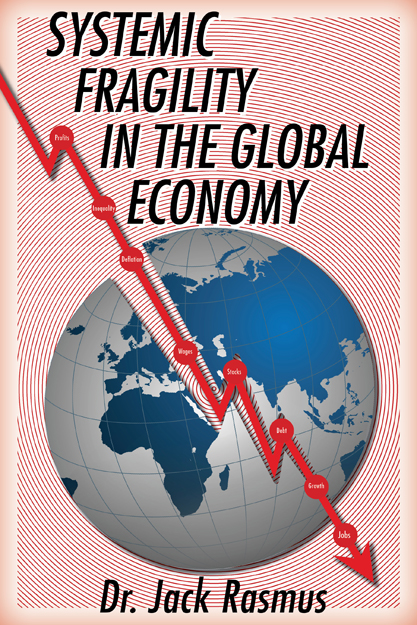
Jack Rasmus is the author of the forthcoming book, ‘Systemic Fragility in the Global Economy’, by Clarity Press, 2015. He blogs at jackrasmus.com. His website is http://www.kyklosproductions.com and twitter handle, @drjackrasmus.

published in teleSUR May 20, 2015

How likely are the UK and Greece to exit the EU and Euro? Read my just published analysis, including how Greece must prepare a parallel currency before exit.

On May 8 the Conservative Party in the UK won an upset electoral victory, gaining an unexpected outright majority of seats in the British Parliament. The big losers in the election were the UK Labour Party and Liberal Party, both of which occupied ‘centrist’ positions in the election, as they both had consistently for the past several years. Big winners were also the Scottish National Party (SNP) and the emerging UK Independence Party (UKIP), both of which championed independence positions—SNP calling for independence from the UK and UKIP from the European Union (EU). Significant support for the idea of breaking from the EU has also been growing within the Conservative Party itself, where a well-organized wing now calls for an outright break from the EU as well.

Two years ago, in 2013, this writer predicted publicly that Britain’s exit from the EU was inevitable. As noted in Z magazine: “more economies in the Eurozone will slip into recession…and the UK will vote to leave the European Union” (Z magazine, ‘Predicting the US and Global Economy, 2013-14’, July 2013). The logic behind this prediction was that the British economy would continue to grow poorly over the long run. Hot money inflows from foreign investors might temporarily boost London and south England real estate, but it would have little positive impact longer term on the rest of the UK. The UK recovery would prove short and shallow, as it in fact has, registering a meager 0.3% growth rate in its latest quarter GDP. In light of this fact, logic further suggested UK corporations and media would deflect public opinion from the real causes of the poor economic performance, and blame foreign immigrants for the problem, claiming they were responsible for over-loaded public services and for weak job and wage creation. And that’s pretty much what has happened in the interim since 2013.

Party Alignments on Brexit

The UKIP and the Conservatives played the EU-immigration card well in the run-up to the recent election. In contrast, the Labor Party and Liberals did not, failing to raise an effective campaign to convince voters the real problems lay in the pro-corporate, and especially pro-banker, policies of the Conservative party itself. Simultaneously, Labour took a weak position on the matter of remaining in the EU and openly opposed Scottish independence. The Liberals strongly supported remaining in the EU and opposed Scottish independence. Labour was swept from its former northern, Scottish stronghold and lost scores of seats to the Scottish National Party (SNP) which won 56 of 59 seats in Scotland. The Liberals lost mostly to the Conservative Party. The Liberals were virtually wiped out and will likely disappear soon from the British political party landscape. Meanwhile, the UKIP posted a major challenge to the Conservatives, which the latter barely averted.

Although the UKIP did not win significant seats, due to the UK’s peculiar method of assigning seats in parliamentary elections, UKIP won more than 3 million and 13% of the UK popular vote. It also came second in more than 90 of the 650 contested Parliament seats, most of them contested against Conservatives who won. Cameron’s conservatives will not lose sight of the fact the UKIP is poised to take from it a meaningful number of seats in future elections should it, the Conservatives, allow themselves to be outflanked on the EU and immigration issues. They didn’t during the election, and they won’t now on the matter of policy.

What the recent UK election reflects is that centrist conservative and social democratic parties throughout Europe are now in an undeniable decline, giving way either to challengers on the left or on the right depending on political formations and their strategies. As the European economic crisis drags on into its sixth year, European electorates want a solution to the grinding economic stagnation that seems only to benefit investors, the corporate elite, and bankers. And they aren’t getting solutions from centrist parties, like the Labour or Liberal parties in the UK, or their counterparts elsewhere in Europe.

The UK conservative party was able to sidestep the anti-centrist parties’ trend by cleverly leaning right during the election, promising a referendum by voters on the EU and immigration issues if they won. That promise resonated, even if it represents an economic dead end. The Conservatives electoral victory was therefore more a self-inflicted defeat by their traditional opponents, the Labour and Liberals. It’s not so much the Conservatives won; it’s that the more centrist Labour and Liberals lost. The Conservative party will therefore undoubtedly continue to move right on the policy issues in the months to come.

But proposals Cameron will likely raise in his promise to negotiate with the EU are demands the EU cannot, according to the EU Treaty, agree to. EU member states in eastern Europe in particular will vigorously oppose Cameron’s plans. The conservative party gained seats because it was politically astute enough to head off the UKIP on the topic of EU exit (Brexit) and immigration during the election. It is unlikely therefore Cameron and the conservatives will allow the UKIP to continue to outflank them on EU and immigration policy in the months to come. Especially since there’s the matter of the growing wing within the conservative party advocating the same as UKIP.

The SNP was ‘hard’ on the issue of its own independence from the rest of the UK, but up to now ‘soft’ on the matter of EU independence. It is quite possible that it will now shift on the matter of UK independence from the EU. Should Britain exit from the EU, it will serve as a solid pretext for the SNP again raising the necessity for conducting another vote for Scotland’s independence from the UK. Add to that the continued pressure by the UKIP in favor of leaving the EU, the growing vocal minority within the Conservatives in favor of the same, and the now almost silenced voice for EU continued membership by the diminished Labour and Liberal parties, and it is extremely likely that Britain will vote to leave the EU when the referendum is conducted. The question of a referendum is now not whether, but how soon.

Initial talk of a date for the referendum was 2017. But it is more likely to occur in 2016, perhaps even before next summer 2016.

Class Alignments & Brexit

Given party alignments and public opinion growing in favor of exit, the deciding factor will be the position assumed on the question of Brexit by British Capital, and especially the politically over-weighted British banking sector that is tightly connected with prime minister, David Cameron, and the Conservative party itself. While some export oriented UK companies are worried about a Brexit, more companies would welcome less competition from EU companies. Britain’s share of exports to the EU has been declining significantly in recent years, falling from 57% of the UK’s total exports to only 50% in 2014. Britain is clearly trying to ‘pivot’ economically to Asia, China, and elsewhere. It is more interested in attracting Chinese capital than it is in selling more exports to the EU.

Then there’s the British banks. They have already expressed a strong dislike of forthcoming EU banking regulations in the works. Some big Brit banks, like HSBC and Standard Chartered, have already raised a warning they are considering or planning to move headquarters from London. And it is well known that British banks, desperate to remain a global center for banking, want to turn London into a freewheeling center for the more aggressive forms of financial speculation in order to head off growing competitive pressures from rising banking circles in Asia, the Saudi peninsula, and New York.

Not surprising, therefore, Bank of England’s governor, Mark Carney, recently appeared on BBC television calling for Cameron and the new government to hold the referendum well before 2017, urging a vote in the summer 2016. The longer the delay, according to Carney, the more the economic uncertainty. And the UK cannot afford more economic uncertainty, with its most recent GDP at only 0.3% growth and given growing signs the recent artificial real estate and hot foreign money inflow to UK recovery is wearing thin.

Heeding the Bank of England’s warning, prime minister Cameron will no doubt quickly try to negotiate a ‘new deal’ with the Eurozone on immigration and related matters, in the hope of preventing the need to leave the EU altogether. But his plan to renegotiate will undoubtedly fail, as the EU won’t retreat on what will in effect require a revision of the EU treaty itself that could never pass an EU membership vote. Already other EU countries like Poland and Hungary have declared the ‘open immigration’ provision of the EU treaty represents a “red line” (Hungary) and is “sacrosanct” (Poland). Cameron can promise to negotiate all he wants, but he won’t be able to deliver.

To sum up then, UK exit (Brexit) from the EU is just a matter of time, as a result of the recent elections. Cameron and the conservatives won’t allow the UKIP to outflank them on the issue. If they do, next election the UKIP’s 90+ second place seats may well turn into UKIP capturing 50 or more seats from the Conservatives. A growing wing within the Conservatives wants Brexit. Cameron will fail to provide an acceptable negotiated compromise solution with the EU. The party voices for remaining in the EU, the Labour and Liberals, have been significantly muted. And the SNP may very possibly add its voice to Brexit as well, as it strategically reorients itself given its new significant power base.

The key question for the future is what are the implications for a Brexit, if held in mid-2016 and should UK voters to leave the EU? What happens economically to the EU, with the departure of such a major participant? Not likely anything good, in economic terms.

Brexit + Grexit 2016?

Brexit also raises questions about Greece remaining in the Eurozone. While Greece’s exit (Grexit) does not appear on the agenda in the short term, it could very well become the case a year from now. A Brexit would almost certainly encourage the forces in favor of Grexit. And the timing may not be totally coincidental.

As Greece’s current negotiations with the Troika (European Central Bank, IMF, European Commission and Eurozone Finance Ministers) approaches the critical month of June 2015 and the expiration of the extension of the past debt agreement at the end of June, the possibility of Greece’s default on debt payments to the Troika appears increasingly likely.

The Troika, and finance ministers in particular, have continued to assume a very hard line in negotiations with Greece. They refuse to provide funding that has been due to Greece under the prior agreement they agreed themselves to extend. Greece must make concessions, while the finance ministers and Troika violate the terms of the prior agreement themselves. Greece has been ‘scraping the barrel’, as they say, to come up with money to make debt payments that have come due in May. Local government treasuries have been emptied of cash and Greece has borrowed the last of its credit line from the IMF to raise what is additionally needed to make payments in May. But even larger debt payments are coming due in June and July and it doesn’t appear Greece has the funds. The Troika, in other words, is making Greece bleed and force it to capitulate. What it, the Troika, really wants is for Greece to formally commit before the end of June to the labor market reforms it is demanding Greece implement as a condition for releasing money and funds due Greece under the terms of the old agreement. Labor market reforms int his case means pension cuts, layoffs, and more flexibility for companies to fire workers. Thus far, Greece has resisted.

The current direction of negotiations suggests Greece will more than likely agree to a bad deal at the end of June, in order to avoid a default. But that won’t be the end. The Troika and euro finance ministers will continue to squeeze Greece as future debt payments come due later this summer. Any agreement by June will likely be short term. So more concessions will be demanded, in exchange for future release of funds. The Troika will hold Greece’s ‘hand to the fire’ to ensure it, Greece, continues to implement the labor market reforms and other demands. Agreeing on paper that it will do so, will not prove sufficient for the Troika to release funds. So the interminable negotiating will likely continue.

Meanwhile, the Greek economy will continue to deteriorate further, as it already has begun to do. Late 2014 it appeared to have stabilized. But no longer. It will now get worse. Eventually the Greek people will realize there will be no final solution from negotiations with the Troika. The current crisis represents the new norm. Once that occurs, the only alternative is Grexit. That process of realization could take months, perhaps a year. Perhaps next summer 2016—coincident with the UK’s Brexit. One can only speculate what the convergence of these two possibilities might represent politically, and economically.

Preparing for Grexit: A Suggested Parallel Currency

So how might Greece prepare for a possible Grexit? One doesn’t simply declare it is leaving the Eurozone. That’s not how it works. And it’s certainly a formula for economic crisis. An alternative, however, is for Greece to begin to prepare to introduce a parallel currency to the Euro.

A ‘new drachma’ or other currency might be introduced into the Greek economy. Its exchange rate with the Euro should be set higher than the Euro and its introduction include economic measures to ensure the parallel currency assumes, and retains, an exchange rate value greater than the Euro. Perhaps designating the new currency as the currency with which taxes are paid could ensure a demand for it, and thus a higher exchange rate than the Euro. Or the parallel currency might be designated as the currency for all international trading transactions, with the same effect. Releasing the currency slowly to ensure a limited supply could also ensure its greater exchange value. Euros might be used only for payment of past debt to the Troika. That would reduce the demand for Euros internally within Greece, and conversely lower the value of the Euro in Greece in competition with the new currency. Businesses and consumers might then trade in their Euros for the new drachmas. With the convertibility between the currencies favoring the stronger parallel currency, the Greek government could then buy up Euros within Greece, and then make payments to the Troika in what are depreciated Euros. Greece would thus reduce its debt and debt payments in real terms.

Strict controls on outflows of Euros would be required. And if the Troika refused to go along with the plan, Greece could simply pay them what Euros it had left and tell them all Greece has to pay debt with in the future are the ‘new drachmas’. The Troika can either payment with new drachmas or nothing. The Troika could then throw Greece out of a Eurozone that Greece has already effectively already left.

The preceding, of course, represents just one plan for Grexit. The point is that Greece must realize it must develop some kind of plan. The Greek economy will only get worse, given the current scenario of continuing Troika negotiations after June. For the Troika will not let go, and will continue to squeeze Greece until it returns its economy back to the austerity driven depression condition it was in before the January 2015 elections and Syriza’s assuming the government. But then, maybe that’s what the Troika also wants—i.e. to squeeze from Syriza any programs and proposals that differentiated it from its predecessor, Pasok, which was the appendage of the Troika in Greece. Syriza will therefore soon have to choose: does it want to become ‘Pasok Light’, or remain Syriza? Does it want to confront default on July 1, or Grexit in 2016? It doesn’t appear the Troika is willing to give Greece any other choice. Just as the UK will have no other choice in 2016 as well.

The consequences of a dual exit, a Brexit and a Grexit, in 2016 for Europe and the global economy would prove interesting, to say the least.

Jack Rasmus
Jack Rasmus is the author of the forthcoming book, ‘Systemic Fragility in the Global Economy’, by Clarity Press, 2015. He blogs at jackrasmus.com. His website is http://www.kyklosproductions.com and twitter handle, @drjackrasmus.

In the following hour Alternative Visions show of May 9, Dr. Rasmus discusses evidence of the global economy becoming more financially and economically fragile over the past year. Included are China, Europe, Japan and Emerging Markets. Listen to the show at:

http://www.alternativevisions.podbean.com

SHOW ANNOUNCEMENT:

May 9th, 2015 by progressiveradionetwork

“Jack Rasmus updates last week’s show on the decline in US GDP with new data for trade, productivity and jobs, and reviews events of the global economy in Europe, China and elsewhere including the Euro and global bond market sell off of the past week. A preview of his new book, ‘Systemic Fragility in the Global Economy’ due later this summer, is offered, describing the 9 key trends in the global economy today that represent the ‘dead cat bounce’ recovery: slowing real investment, drift toward deflation, explosion of central bank liquidity and credit, rising global corporate debt, the shift to speculative financial asset investing, the restructuring of financial and labor markets in the 21st century, and why central bank monetary policy and government fiscal policies are failing to generate a sustained real recovery of the global economy. How it is all resulting in rising global income inequality in turn.

The following article was published in early May, when initial reports of 1st Quarter US GDP showed a mere 0.2% quarterly gain. Since then, as of mid-May, more data on the quarter suggest strongly the 1st quarter will show a negative GDP when further revisions are reported later this month, due to even worse data for business inventories, retail sales, and trade. Here’s my ‘first view’ of the initial first quarter US GDP estimates released in early May:

(The following was published by TeleSURTv and Media on May 5, 2015)

“Data released last week by the US government showed the US economy came to a near halt in the first three months of 2015, falling to nearly zero—i.e. a mere 0.2% annual growth rate for the January-March quarter. The collapse was the fourth time that the US economy in the past four years either came to a virtual halt or actually declined. Four times in four years it has stalled out. So what’s going on?

In 2011, the US economy collapsed to 0.1% in terms of annual growth rate. At the end of 2012, to a mere 0.2% initial decline. In early 2014, it actually declined by -2.2%. And now in 2015, it is essentially flat once again at 0.2%.

The numbers are actually even worse, if one discounts the redefinitions of GDP that were made by the US in 2013, counting new categories as contributing to growth, like R&D spending, that for decades were not considered contributors to growth—in effect creating economic growth by statistical manipulation. Those highly questionable 2013 definitional additions to growth added around $500 billion a year to US growth estimates, or about 0.3% of US GDP. Back those redefinitions out, and the US experienced negative GDP four times in the last four years. We get -0.2% in 2011, 0% in 2012, -2.5% in 2014 and -0.1% earlier this year.
It is therefore arguable that the US has also experienced at least one mild ‘double dip’ recession, and perhaps two, since 2010.

All the four US economic relapses occurred following preceding month gains in growth sufficient to generate claims by politicians and pundits alike that the US economy had finally ‘turned the corner’ and was now on a path of sustained economic recovery. Yet every time such claims were made, reality contradicted their predictions within a few months, and the economy collapsed again, creating a scenario not of sustained economic recovery but of a ‘stop-go’ trajectory.

The consequence of this ‘stop-go’ recovery is that the US economy since 2009—the official end of the last recession—has experienced the weakest recovery from recession in the last fifty years, just about half the normal post-recession recovery. And this ‘half normal’ recovery since 2009 occurs after an annual growth averaging only 1.7% during the years 2001-2010 in the US. Something new is happening to the US economy since 2000. What is it?

Recessions in the US have occurred on average every 7 years. It’s now year five since the last one officially ended in June 2009. What happens if the current weak recovery reaches its end at around 7 years, i.e. in mid-2016 a year from now? Will the next recession prove even worse, perhaps much worse, occurring as it will on a base recovery half of normal?

Unfortunately, such questions aren’t asked by most mainstream economists, and certainly not by politicians and business media pundits.

Stop-Go On A Steady Slowing Global Economy
The problem of weak, stop-go, recovery in the US today is further exacerbated by a global economy that continues to slow even more rapidly and, in case after case, slip increasingly into recessions or stagnate at best.

Signs of weakness and stress in the global economy are everywhere and growing. Despite massive money injections by its central bank in 2013, and again in 2014, Japan’s economy has fallen in 2015, a fourth time, into recession.

After having experienced two recessions since 2009, Europe’s economy is also trending toward stagnation once more after it too, like Japan, just introduced a $60 billion a month central bank money injection this past winter. Despite daily hype in the business press, unemployment in the Eurozone is still officially at 11.4%, and in countries like Spain and Greece, still at 24%. Yet we hear Spain is now the ‘poster-boy’ of the Eurozone, having returned to robust growth. Growth for whom? Certainly not the 24% still jobless, a rate that hasn’t changed in years. Euro businesses in Spain are doing better, having imposed severe ‘labor market reforms’ on workers there, in order to drive down wages to help reduce costs and boost Spanish exports. Meanwhile, Italy remains the economic black sheep of the Eurozone, still in recession for years now, while France officially records no growth, but is likely in recession as well.

Elites in both Italy and France hope to copy Spain’s ‘labor market reforms’ (read: cut wages, pensions, and make it easier to layoff full time workers). In order to boost its growth, Italy is considering, or may have already decided, to redefine its way to growth by including the services of prostitutes and drug dealers as part of its GDP. Were the USA to do the same redefinition, it would no doubt mean a record boost to GDP.

Across the Eurozone, the greater economy of its 18 countries still hasn’t reached levels it had in 2007, before the onset of the last recession. Unlike the US’s ‘stop-go’, Europe has been ‘stop-go-stop’.

Even beyond the Eurozone, in the broader Euro area the picture is not much better. After a brief, artificial real estate boom fueled by foreign investment, the UK is now growing again at a mere 0.3% rate. And then there’s China, where economic growth continues to slow, despite multiple fiscal and monetary stimulus programs introduced the past two years to try to boost the economy further. And the global slowdown applies not just the largest economies. Emerging market economies in Latin America, Africa, and elsewhere that are especially dependent on commodities production and exports have been descending one by one into recession, or at best stagnating.

Yet despite this growing global economic weakness, and the US economy’s repeated annual economic relapses and ‘half normal’ recovery rate, we are still being told that the US economy is sound and that it will lead the rest of the world economy toward sustained economic growth this year and next.

It’s the Weather!

We’re told the declines in US growth the last two years—January to March 2015 and before that 2014—have been due to ‘bad weather’. And that this coming summer 2015 the US economy will ‘snap back’ again, as it did last summer 2014.

But is economic forecast by weather metaphor really the cause of the recent US slowdown? Not really. Even economists themselves admit that, at the very most, only 0.5% of last quarter GDP decline can be attributed to weather. If the fourth quarter 2014 US GDP was 2.2%, in other words, then only -0.5% of the drop was due to weather. So what about the other -1.5% drop from the fourth to the first quarter 2015?

A closer look shows that at least -1.25% of that -1.5% was due to the sharp decline in US exports. That decline was due largely to the US dollar’s sharp rise in value compared to other currencies since last fall. A rising dollar makes US exports more expensive. US exporters lose out to European, Japanese and Chinese competitors. Since US exports are largely manufactured goods, that means US manufacturing slows—which it has. And that in turn means US growth slows.

The reason for the dollar’s rise is threefold. First, the US central bank’s repeated signaling of intent to raise US interest rates this year. Second, the collapse of world oil prices that also drive up the dollar. Third, the massive money injections by Europe and Japan central banks in the form of ‘quantitative easing’ (QE) programs that are designed to drive down the value of the Euro and the Yen in order to achieve a competitive advantage for their region’s exports at the expense of US exporters.

What’s going on globally today is rolling ‘competitive devaluations’ of currencies by means of massive central bank monetary injections. In ways this is somewhat like the 1930s depression. Then countries devalued their currencies by legal declaration, as they tried to boost their economies by stealing exports from competitors. The problem with that strategy is that all could do it, and they did. So no one gained in the end and the global economy and trade sank further. Today’s new form of competitive devaluation is no different. It signals the major capitalist regions of the world—i.e. north America, Europe, Japan, and now even China—are beginning to fight over a slower growing global economic pie. The devaluations are just assuming a different form. Not legal declaration but monetary injection by central banks.

In early 2014 Japan introduced its QE and central bank injection. It gained a temporary trade advantage. But then Europe did the same. Japan lost its advantage, which Europe gained. The US lost the most in terms of exports, since its dollar rose for two reasons—Japan and Europe currencies falling and talk of US interest rate hikes as well.

But most recently, the US central bank has signaled that interest rates may not rise this year. Oops. There goes the Euro and Yen losing its advantage once more and their economies slipping again. This see-saw, back and forth, fighting over a shrinking trade pie only reveals a new instability growing in the global economy. Europe in particular will soon be hammered by a potential Greek debt default, a continually imploding Ukrainian economy it has committed to bail out at $40 billion so far, and now the US indicating it won’t raise rates.

Watch Japan, which will likely again devalue still further to offset US and Europe measures. Meanwhile, as China continues to slow, it could eventually reduce the Yuan to boost its exports as well.

What this global scenario means is that the US economy significantly weakened in the first quarter 2015 due not to weather, but because of loss of global exports due to the reasons noted. But trade competition and currency wars are not the only explanation for the near collapse of the US economy last quarter.

Collapse of Oil Prices and US Economic Slowdown

Another major development in 2014 in the US, that disappeared by early 2015, was the Oil/Shale Gas boom. After having surged to record levels in the first half of 2014, contributing largely to the summer 2014 US 5% GDP rise, after mid-year the global price of oil collapsed. By end of year 2014 the collapse was in full swing. Investment in this sector fell by nearly half, regional construction activity in the Dakota-Texas area also fell abruptly, as did the mining activity as oil/gas wells were shut down, and as railroad and trucking transport activity declined. A major contributor to 2014 economic growth in the US thus fell through by early 2015. What’s significant, moreover, is that it won’t come back in 2015. So the ‘recovery’ in the summer of 2014 won’t have this contributing factor behind it in 2015.

One-Time Consumer Spending on Health Care

Another temporary factor that contributed to the summer 2014 surge in US growth, that has also since disappeared, is first time consumer household spending on healthcare services. Last summer was the first full year of sign-ups by 10 million households to Obama’s ‘Affordable Care’ Insurance Program. Spending on new insurance premiums, and on healthcare services by millions of new customers for the first time, together served to give US GDP last summer 2014 another major boost. But those sign-ups have leveled off. Most of those who wanted to sign up have done so. Future growth in health insurance and health care services has therefore leveled off.

So like the shale/oil gas surge and the export-trade advantage, the health care spending surge contribution to US economic growth is most likely temporary as well.
Why the US Economy Will Continue A ‘Stop-Go’ Trajectory
There are three fundamental causes why the US economy will continue on its 5 year long, stop-go recovery trajectory until the next recession in 2016 or after.

First, there is insufficient wage and income growth for the approximate 100 million wage earning households that constitute the bulk of consumer spending in the US, which accounts for roughly 70% of the US economy annually. In turn, the reason for the lack of wage and income growth by these households is the lack of full time, decent paying jobs creation in the US. Jobs that are being created are low pay, no benefit jobs. Part time and temp jobs. Service jobs, and few manufacturing or construction jobs. Working class consumption is also compressed by inability to earn interest on basic savings accounts. Then there’s household debt, for past education borrowing, for auto purchases, and credit cards, which also takes a toll on spending.

Second, there’s the lack of investment spending by business. Large, multinational corporations in particular continue to prefer to invest outside the US rather than in it. When not investing abroad, they prefer to ‘spend’ their record profits on stock buybacks and dividend payouts to shareholders. More than $5 trillion worth since 2009. Another trillion dollars projected in 2015 alone as well. Then there’s their growing investing in financial asset markets and securities, which now constitute about 25% of all multinational corporate investing. And what they don’t invest in financial assets, invest abroad, or spend in buybacks and dividends, they just hoard as cash on their balance sheets, reportedly now in excess of $1.7 trillion in their offshore subsidiaries. None of these alternatives and diversions result in real investment that create real decent paying jobs, at decent pay and benefits. Hence, consumption by the 100 million households stagnates or lags—except for more debt based spending perhaps.

Third, there’s no sustained recovery on the near horizon because the US government has clearly decided on growing only defense spending. The new Republican Party dominated US Congress insists on cutting social programs further, including long time once sacrosanct programs like Medicare for seniors. In the first quarter US GDP numbers, spending by State and Local governments slowed noticeably, as did US federal spending on non-defense products and projects.

Instead of sustained growth, the scenario is ‘stop-go’, as this or that temporary factor occur to boost US GDP and growth temporarily, followed by other temporary developments that in turn subsequently drag US GDP back to zero or negative growth. Add further to this scenario the Eurozone’s continuing economic instability, the UK’s new stagnant growth, Japan’s descent into yet another recession, China’s deepening struggle to maintain 7% growth that is almost certain to fall below that level soon, oil and commodity producing emerging markets that are already in recession, and an historic weak recovery already in its 5th year of an average 7 year cycle—then what remains is a likely further long term, stop-go US economy as the global economy continues to slow as well.

Jack Rasmus is the author of the forthcoming book, ‘Systemic Fragility in the Global Economy’, by Clarity Press, 2015, and the prior book’s, ‘Epic Recession: Prelude to Global Depression’, 2012, and ‘Obama’s Economy: Recovery for the Few’, 2012. He blogs at jackrasmus.com.

In the past two weeks Dr. Jack Rasmus has dedicated his hour long radio show, Alternative Visions, on the Progressive Radio Network, to providing his analysis of why the US economy stalled out in the first quarter of 2015 (May 2 show) and a follow up show (May 9) on the topic again with a presentation of the major arguments presented in his new forthcoming book this summer, ‘Systemic Fragility in the Global Economy’.

The following url will take listeners to Rasmus’s website to download and play the May 2 show:

The show is also available at http://alternativevisions.podbean.com

Here’s the announcement of the show summary. (The May 9 follow up Alternative Visions show will be posted shortly as well).

MAY 2 SHOW ANNOUNCEMENT:

“Dr. Jack Rasmus analyzes US 1st Quarter GDP numbers, where US economic growth flattened out to a mere 0.2%–the fourth such collapse in the US economy in as many years. Is it due to the weather, as some argue? Is there something wrong with US statistics, showing four collapses since 2009 all occurring in the winter? Or are there real economic explanations for why the US economy periodically surges in the summer then stalls out in the winter, as it has since 2011? Will this winter 2015’s stall be followed by another ‘temporary surge’ in growth this summer? Jack looks beneath the numbers for real explanations for the US economy’s continuing ‘stop-go’ trajectory, identifying patters of one-off, temporary factors that typically have occurred in the 3rd quarter (July-September), only to dissipate in the winter quarters, in turn leading to an over-correction and decline in US GDP and growth repeatedly. It’s not the weather. It may be outmoded statistical methods by the US government. But it certainly is due to temporary events that don’t result in a sustained economy recovery, Jack argues. Government pre-election spending, restoration of defense spending, business inventory buildups, the global oil glut and US oil shale boom & bust, the US dollar decline and surge effects on US manufacturing-exports, diversion of US business investment into financial assets and offshore markets better account for the US stop-go trajectory, Jack argues. What’s missing is steady wage and income growth for 90% of US households and real job creating investment by business in the US.”

Since the official end of the last recession in June 2009, the wealthiest 1% households in the USA have captured 91% of all the net income gains, according to university studies based on US income tax records. At the same time, median family real incomes have consistently fallen 1%-2% every year since 2009 in the US—and that’s at the median income level. For those below the median, the real income decline has been even greater. That’s almost 100 million households of ‘production and non-supervisory workers’ in the US, trying to survive on stagnant or falling wage incomes for the past six years.

How has this extreme inequality come about? How is it that wage incomes have been stagnant during a so-called ‘economic recovery’ since 2009, while the wealthiest 1% have captured virtually all the income gains for themselves?

It starts with profits. Compressing wages have allowed corporations to enjoy historic record profit margins—i.e. profits not from increased sales of goods and services but from slimming down operations, from cost cutting, which means mostly labor cost cutting.

Grow Profits by $5 Trillion in 5 years

Official government estimates of US corporate profits amounted to $1.3 trillion in 2008, rising to more than $2.4 trillion in 2014. Cumulatively, over the six years since 2009, that adds up to extra profits of $3.7 trillion over and above the $1.3 trillion level of 2008. But that’s not all. That’s only profits from sales of goods and services.

Not included in the $3.7 trillion are profits from corporations’ speculating in financial assets and securities, which is equal to another fourth of total corporate profits. That’s profits from buying and selling stocks, bonds, derivatives, currencies, real estate properties, and so on. At roughly one fourth, that’s about another $1 trillion dollars .

So US corporations have added about $5 trillion extra profits since 2009, give or take a couple hundred billion dollars here or there. The key question is what’s happened to that $5 trillion?

$3.8 Trillion in Stock Buybacks and Dividends

The lion’s share of the $5 trillion–$3.8 trillion— went to wealthy corporate shareholders, distributed in the form of record corporate stock buybacks and dividend payouts since 2008. As corporations reaped historic, record profits—from squeezing wages and speculating in financial securities—so too did their wealthy ‘owners’ receive record distributions of corporate income in the form of stock buybacks and dividend payouts. That’s how the rich get richer in the USA. Their corporations are the ‘conduit’; stock buybacks and dividend payouts are the ‘pay offs’.

Here’s some interesting facts on corporate stock buybacks and dividend payouts in recent years. Note the figures apply only to the largest 500 US corporations. Totals would be higher if all corporate buybacks and dividends were included.

In 2009, Standard & Poor’s largest 500 corporations distributed stock buybacks of ‘only’ $137 billion to shareholders. Dividend payouts were another $195 billion. That’s a combined $332 billion paid to shareholders in 2008, in what is generally considered the worst year of the recent 2007-09 great recession. Oh, such hard times for shareholders, only $332 billion—while 27 million workers lost their jobs, had their real incomes reduced for the next five year, and 14 million lost their homes.

But the years since 2008 have been even better for shareholders and the wealthiest 1%, in fact much better: escalating ever higher since 2009, by 2014 corporate buybacks rose to $553 billion and dividend payouts by another $350 billion. That’s $903 billion in just the year 2014 alone, or three times the level of combined buybacks and dividends in 2008. And over the five years since 2009, that’s a cumulative total of $3.8 trillion in buybacks and dividends.

That $3.8 trillion combined payout last year leaves just $1.2 trillion of the $5 trillion undistributed—which coincidentally is just about what remains on corporate balance sheets for the largest 500 corporations in hoarded cash at year end 2014.

Forecasts for this year, 2015, project a further 16% rise in corporate stock buybacks and another 14% for dividends. That’s more than $1 trillion that will be paid out in 2015—$604 billion in buybacks and $400 billion in dividends.

Meanwhile, economists try to convince us the gross income inequality in the USA today is the result of lack of workers pursuing better education or simply not being productive any more. The victims of income inequality are the cause, in this perverted logic of the professors. At least their conservative ilk. The more liberal variety of the professorial tribe claim it is excess compensation paid to CEOs or the tax system that has produced the income inequality. Neither liberals or conservatives say anything about inequality resulting from profits from excess financial speculation, and from six years of wage compression, subsequently distributed in the form of annual trillions in stock buybacks and dividends.

Capitalism’s New 21st Century ‘Business Model’

Global capitalism is shifting to a new, even more profitable business model. In decline is the old industrial production model. Fast replacing it is a model focusing on financial asset investing and speculation, on artificially boosting financial asset values like stocks, bonds, derivatives, real estate and the like.
In the post-2000 global world, instead of investing in real things, i.e. real assets, buildings, equipment, etc., in order to produce real goods and services, the new corporate model is squeeze profits from wages and then add to that further profits from speculating in financial securities. Profits from cost cutting or profits from driving up financial asset prices resold for a capital gain, or some combination of both. That’s the new model. Forget making things that require investment and the creation of decent paying jobs and incomes to buy the things.

Create profits by driving up financial asset prices. Buyback stock and payout dividends. That drives up stock prices even further. (In the US the stock markets have tripled in value since 2009). Both stockholders and corporations then get even richer. Complete the new model by arranging for government and ‘bought and paid for’ politicians to reduce taxes on dividends and capital gains from stock sales to 15%, as in the US. That way shareholders can keep the lion’s share of the capital gains from the buybacks and dividends.

General Electric Co., Buybacks, & Blackstone

General Electric Company is one of the largest manufacturing companies in the US and the world. It produces aircraft equipment, transport equipment, medical devices, power and water systems, lighting and appliances, and oil & gas equipment. It also became one of the biggest finance companies in the US in recent decades, earning from its financial subsidiary, GE Capital Assets, $6 billion of its annual $30 billion revenues last year.

But GE represents the classic ‘old business model’ of industrial production, of goods provided to both businesses and consumers. Last week GE announced its plan to buyback $90 billion of its stock over the next three years, starting with $50 billion this year. GE’s stock price has languished since 2007. It promised a mere $10 billion stock buyback in 2012, but that did little to raise its stock price two years ago. However, the $90 billion announcement last week produced an immediate double digit overnight stock gain for the company. GE has thus signaled it is planning to try to join the ranks of the new 21st century business model, where the way to raise stock prices is to buyback stock rather than produce profit gains from making and selling more real things.

To finance the $90 billion in buybacks, GE announced it was selling off much of its GE Capital Assets financial operation. $26 billion of its portfolio of offices, malls, commercial properties, and housing is being sold. The sale is necessary to offset growing losses from GE’s oil and gas equipment business, which is now collapsing in value as the global oil glut continues. Longer term prospects for GE’s old industrial products business model don’t appear very good. But $90 billion in buybacks will go a long way to support GE stock for a while. In the 21st century it is now more important to boost corporate stock prices by whatever means, more important than making profits the old way, investing in real assets, providing jobs and incomes, and making products to sell to customers.

To fund its $90 billion stock buybacks GE is selling off assets to a company that represents the ‘new business model’ of the 21st century global capitalism. The global private equity company, Blackstone, is buying most of GE’s financial real estate assets currently up for sale.

Blackstone doesn’t make things, or employ many workers, or generate income for many except its managers and investors. It fact, it makes nothing at all. It has pure financial speculation business model, as are all private equity companies. Blackstone buys assets and resells them at a higher price, making speculative financial profits. Half of its total profits in 2014 were made from buying real estate and then ‘flipping’ it, i.e. selling at a higher price. Blackstone owns $272 billion in assets it has bought from other companies, $81 billion of which is real estate. It is now the largest ‘landlord’ in the USA with more than 50,000 housing properties which it rents out. It has become far more profitable than General Electric, by speculating in assets rather than producing anything. It represents the far more profitable business model of 21st century global capitalism than does GE. It represents the new face of 21st century capital.

The General Electric vs. Blackstone comparison reflects several key trends underway in 21st century global capitalism: why the global economy today is on a steady, long run slowdown, why real investment is on a slowing trajectory, and why a drift toward deflation in goods and services in settling in everywhere.

The old industrial capital business model represented by GE is under significant pressure. Revenues are slowing. Stock prices are consequently performing poorly. GE and others are thus driven to sell off parts of the company in order to fund buybacks in order to keep their stock prices from declining further. In contrast, financial asset speculators like Blackstone are buying up the assets of the old industrial model companies, and generating more and more profits from pure financial asset investing. Investors are therefore piling in to the Blackstones, knocking on the door, wanting to give it the money capital they are diverting from the GEs.

Their motto: ‘Who cares how profits are made, so long as they can be made faster and greater than before. So give us more stock price increases, more buybacks and more dividends. Who cares about stock or bond bubbles. We can get out before the bust comes again’—or so they say, time and again, until the next financial crash in stock and bond values.

Jack Rasmus is the author of the forthcoming book, ‘Systemic Fragility in the Global Economy’, by Clarity Press, 2015. He blogs at jackrasmus.com. His website is http://www.kyklosproductions.com and twitter handle, @drjackrasmus.

One of the elements of cultural ideology in the USA is that the United States is somehow exceptional compared to other countries; that is, it is different in a number of positive ways that distinguish it from all other countries.
Exceptional in Health, Education & Retirement?

In a perverted way, there is some truth to this. The United States is exceptional in that it is the only advanced economy in the world that has failed to provide universal health care for its citizens. It has a large, parasitical for-profit health care system, dominated by multi-billion dollar profit making private health insurance companies that suck $1 trillion a year from the wallets of US consumers for pushing paper around, a vast network of ‘for profit’ hospital chains that suck another $900 billion a year, pharmaceutical drug companies that charge $94,000 for drugs to treat someone with hepatitis C (that’s $1,125 per pill) and charge patients $14,000 to $64,000 a month for cancer drugs, and it has the highest paid professional medical personnel in the world.

The US spends more than $3 trillion a year, and rising, on health care. That’s about 18% of its $17.4 trillion annual GDP, or almost one dollar out of every five spent on everything is for healthcare. That’s the highest spending on healthcare in the industrial world. In return for that massive spending , it ranks 39th in infant mortality rates, 42nd in adult mortality, and 36th in life expectancy. Yes, the US is exceptional in health care.

It is also exceptional in education. Its college students have become, in effect, indentured servants to the education establishment of overpaid administrators and bankers, owing more than $1.1 trillion in debt just to get a college education—more per capita higher education debt than any other country in the world. The cost of attending a four year college today is, on average, $30,000 to $60,000 a year for a four year undergraduate education. For those who can’t afford college there’s no meaningful job training programs available any longer. Meanwhile, 70% of college professors and instructors in the US are part time/temp workers, many of whom earn poverty wages and have no benefits. That too is ‘exceptional’, I suppose.
US workers work the longest hours among the industrial economies, have the shorted annual paid vacations (on average 7 days paid a year), and face the prospect of poverty when they retire or can no longer work. Social security pensions average only $1,100 a month, private pensions (called 401k plans) average less than $50,000 total savings for those age 60 and approaching retirement, and more than half of US workers live pay check to pay check with no personal savings whatsoever. As 70 million ‘baby boomers’ born after 1945 start to retire, tens of millions of them face the prospect of a penniless, poverty-ridden retirement. No wonder the fastest growing segment of the US workforce is those aged 65-74, as many return to work just to make ends meet.

Income inequality in the US is also the most extreme among the advanced economies, and growing worse every year. CEOs of US corporations make around 400 times the average pay of the average worker in their company—the biggest gap in the industrial world. (In 1980 they made only 35 times).The wealthiest 1% households (investor class nearly all), gained no less than 95% of all the net income growth in the US since 2010, which compares to 65% during the George W. Bush years, 2001-2007, and to 45% during the Clinton years in the 1990s. Meanwhile, the median family income has been declining in the US at 1%-2% every year for the past decade. (Ok, maybe that’s not exceptional, since pay for workers has been steadily declining in Europe and Japan too).

US workers may get only 6 months unemployment benefits, at less than one-third their pay, when they lose their jobs, compared to German workers, for example, who get up to two years in jobless benefits and job retraining to boot. But, what the hell, we got more aircraft carriers than the Germans.

Yes, the US is exceptional. Its workers are the sickest, most indebted, most overworked, insecure, and among the least compensated and the most fearful of the future than any in the advanced industrial world.

The US is also exceptional in that it spends more on its military than all the rest of the advanced economies combined. The US’s true ‘war budget’ is about $1 trillion a year, not the reported $650 billion or so for the Pentagon, which is stuffed away in dozens of corners in its annual economic budget. It has more than 1000 military bases worldwide. It is engaged constantly in more wars worldwide than any other country by far. And it spies every day on more of its, and rest of the world’s, citizens than all the ‘spooks’ in the rest of the world do combined. ‘Exceptional’? You bet.

The Myth of US Economic Exceptionalism

Another favorite focus of late for the ‘US is exceptional’ crowd is the US economy.

Japan may be in its fourth recession since 2009. The Eurozone may be slipping in and out of recession every couple of years. But the US economy is in full recovery. So we’re told. It is growing nicely, while the rest of the world lags behind. Or so the ideological spin goes.

The ‘exceptionalists’ like to refer to last summer 2014’s US economic growth figures of 4% to 5% in GDP growth rates, its 200,000 a month new jobs created in 2014, and its ever-rising stock and bond markets as evidence of such economic exceptionalism. But a closer look, at last year’s much hyped 5% GDP growth in the 3rd quarter 2014, and at the data for most recent months in early 2015, show there is nothing exceptional about the US economy.

Long term, it continues to grow at an annual rate about half of what is normal in past decades. Over the past six years, occasional quarter GDP growth rates of 4-5% typically are followed by a sharp collapse of GDP growth, or even negative GDP, within months. This in fact has happened four times since 2009 resulting in a ‘stop-go’ economic recovery: in the first quarter of 2011, fourth quarter of 2012, first quarter of 2014 last year—and it appears it may happen again a fifth time in the recent first quarter, January-March 2015.

The US economy’s ‘yo-yo’, or ‘seesaw’, economic trajectory is nothing special or exceptional. Japan and Europe have been experiencing the same. Their ‘bouncing’ along the bottom is just at a level closer to the bottom (or even below it) than has been the US economy’s the past five years. Whereas the US economy’s growth spikes up to 4% or so on occasion, only to collapse back again to zero or less growth, the US economic growth longer term has been averaging about 1.7% annually the past five years. That’s about half its normal growth rate compared to US recoveries from recessions in the past. Japan and Europe might spike to only 2% on occasion, but then slip to negative growth—i.e. into a bona fide recession.

So it’s ‘stop-go’ recovery for all three, occurring just at different levels of ‘go’ and of ‘stop’. Nothing exceptional or different economically over the longer term, in other words.

Comparing the US temporary 5% economic growth of last July-September 2014, to what will almost certainly prove to be a 1% or less growth rate for the January-March 2015 period when the final numbers come in later this May, shows that temporary, ‘one-off’ factors occurred last summer 2014 to produce the brief 4%-5% GDP US growth. Those temporary factors have since reversed or disappeared in the first three months of 2015. Take away those one-off factors of nine months ago, and one gets the less than 1% growth likely to register for the most recent three months, January-March 2015. Here’s a brief explanation:

Shale Gas/Oil Industrial Production Boom

In early 2014 the shale gas/oil boom was in full swing in the US. That boosted what is called Industrial Production and much of last year’s jobs growth. But when the global oil price glut began last June, precipitated by Saudi Arabia and its emirate friends attempt to drive the shale gas/oil producers in the US into bankruptcy, the shale boom in the US came to an abrupt halt. Industrial production slowed rapidly after the summer and has continued ever since, turning negative since December. Jobs began to disappear. It is projected that jobs in Texas, the largest shale producer, will decline by 150,000 in early 2015.

Manufacturing & Exports

In early 2015 US manufacturing and exports continued to grow, as the US dollar remained low giving US exports an advantage. But the collapse of world oil prices and the simultaneous talk by the US central bank it would raise interest rates resulted in a 20% rise in the dollar. Japan and Eurozone QEs pushed it still higher. The result was the beginning of a collapse in late 2014 of the contribution of US manufacturing and exports to US economic growth. That continues into 2015. Manufacturing orders have declined every month since December 2014.

Obamacare Consumer Health Spending

Another one-time boost to US GDP in mid-2014 was the signing up of 9 million of US consumers into the government’s new privatized health insurance coverage program, who couldn’t get health insurance. They started paying monthly premiums, and using health care services. That provided a boost to consumer spending that didn’t previously exist. But by 2015 the sign ups have leveled off. No more additional boost consequently in 2015.

Auto Buying Boom Goes Bust

Another consumer spending element that was peaking last summer was the boom in auto sales in the US. That too has now come to an end, as the market in the US has become saturated in terms of auto sales after four years. Auto sales since December, usually a strong month for auto sales, declined and have continued declining through February. The auto boomlet in the US is over.

General US Consumer Spending

Consumer spending in general has turned negative, starting in December. The US indicator, the Personal Consumption Expenditures Index (PCE) declined in December-January, was flat in February and suggests no change in March. Consumer spending was supposed to surge, according to mainstream economists, as consumers enjoyed lower gasoline prices. Instead, consumers saved the lower gasoline prices or used it to help pay off their massive debt loads (which this writer predicted would be the case last year). US retail sales, which constitute the largest part of consumer spending, grew at a 4%-5% rate over last summer. But once again has turned negative since December 2014, falling by -1.0%, -0.9%, -0.6%, December through February, and likely falling again in March 2015. So both retail sales and consumer spending in general have turned negative.

Business Spending

In the third quarter, July-September, of the year for the past five years, businesses in the US have boosted their spending, building up their inventories, in anticipation of a rise in year end holiday consumer spending. But the holiday spending then typically falls short of expectations, and businesses ‘work off’ the inventories in the first quarter, January-March, of the following year. This has happened yet again in 2015. Another element of business spending, on new equipment, is barely inching along, growing only 0.6% in the fourth quarter of 2014 and likely no more or even less in the first quarter.

Government Defense Spending

It is a well-known and documented fact that in the US, every other year in which there is a national election, the federal government holds off spending early in the year so it can release it in the summer before the election. That occurred in 2012 before the national presidential elections and in 2014 before the midterm Congressional elections. That government spending gives an added boost in the July-September quarter, as politicians try to create the impression the economy is doing better than it is longer term. That too happened last summer. But that spending will contract early in 2015 relative to last summer.

US Jobs Creation

Job creation always lags the real economy. And after growing jobs at a rate of 200,000 a month last year (mostly low paid, part time/temp, service jobs), jobs growth in March rose by only 126,000. Preceding months of January-February were also reduced. The employment data thus are now confirming the general economic slowdown in the first quarter 2015 as well. Apologists for the politicians will no doubt use the excuse of ‘bad weather’ for the feeble March jobs numbers. But what’s really happening is job creation is, and will continue, to slow due to real reasons. The ‘canary in the jobs mine’ is jobs in the goods producing sector, which have been slowing rapidly for several months and now turned negative in March. That reflects the collapse in manufacturing, mining, and good production that began late last year and now continues.

The Ideology of US Exceptionalism

In short, there is nothing exceptional about the US economy when one looks behind the ideological spin. It continues on its stop-go trajectory of the past five years. The economy weakens significantly every 4th quarter/1st quarter and the weak growth is ‘made up’ the following summer. Smoothing and averaging it all out over the year produces the longer term sub-historical average growth rate of around 1.8%–i.e. half of normal. And nothing exceptional. Japan and Europe are doing the same, just at a lower level of ‘stop-go’, sub-normal.

Long term US GDP growth is averaging 1.8% vs. 0.5% (Europe) vs. 0% (Japan). Does that make the US economy exceptional? Not really. 20 million are still jobless in the US; roughly the same as in the Eurozone. That’s not exceptional. Prices are now flat in the US (i.e. no change) and heading toward deflation; price stagnation also exists today in Europe and Japan . Real investment is declining in the US as in Europe and Japan—again nothing exceptional. And real wage incomes continue to decline for median income workers in the US—as they do for workers in Europe and Japan.

One of the favorite ideological strategies of ruling elites and classes is to convince their working classes that they are exceptional—i.e. meaning their situation may not be great, and may even be declining, but at least they are not as bad off as others. ‘It could be worse, just look at those poor workers in country X and Y. It may not be great here, but what the hell, we’re not so bad off, are we?’ The appeal to exceptionalism is just another ideological ploy to get working classes to accept their deteriorating conditions. It’s just another ideological tool to immobilize people. To accept their reality as their fate. To make them believe that, as their living conditions are getting worse, it’s not really that bad. But it is….

Jack Rasmus is author of the forthcoming book, ‘Systemic Fragility in the Global Economy’, published by Clarity Press, 2015; and the previous works, ‘Epic Recession: Prelude to Global Depression’, Pluto Press 2010, and ‘Obama’s Economy: Recovery for the Few’, Pluto Press, 2012. He blogs at jackrasmus.com.

If your answer to the above is ‘yes’, then I welcome you to consider joining me and those participating online in a course I have agreed to teach for the newly formed progressive ‘Z School’ collective. The school, and my class, starts April 4, but you can join through next wednesday. This is an online, 8 week class. The description of the content of the 8 weeks is indicated below. Cost for the course range from $100 for full enrollment; $60 for low income enrollment; and $30 for observer. As instructor, I post my interpretations and the readings online, and I and students engage in a forum on fridays online, and a chat session on sundays online.

For more information and enrollment instructions, go to the Z school webpage at:

https://zcomm.org/zschool/moodle/

There you will find a description of my particular course, ‘Finance Capital in the 21st Century’, as well as other courses starting next week in this new Z school, progressive-radical initiative, taught by seasoned activists worldwide:

The 8 Week Topics for my Course are as follows:

Week/Topic #1: Marx on 19th Century Finance Capital

How has Finance Capital changed from the 19th to the 21st century? What is the role of financial instability historically in precipitating banking crashes and economic depressions? Why are most contemporary analyses of ‘financialization’–both left progressive, Marxist, and bourgeois economist–wrong? What are the prospects of another global financial crash in the next ten years, followed by a more serious economic depression ‘next time’? These are the main themes of this course. In the first four weeks, in order to answer these questions, this course will explore the views of the best economists on the subject of finance capital. In the second four weeks, the course will look at actual financial crashes and instability events since the early 1990s, as well as brewing today again, including in Japan, China, Europe, and USA.

Week 1 begins with a review of key chapters of Marx’s unpublished vol. 3 of Capital (read chapters 24-27; 30-31 recommended) on capitalist finance and credit in the mid-19th century.

A link to a free online source of these chapters is: https://www.marxists.org/archive/marx/works/1894-c3/index.htm

The instructor, Jack Rasmus, will also provide a powerpoint summary of the main topics for the first (and remaining seven) class sessions, a week before each of the seven classes. Jack will reply to comments by students in the ‘open forum’ every friday, 1-2 pm pacific time. Real time chat discussions will then be held on Sunday, 11am-12n,for students to ask questions online of Rasmus.

Week/Topic #2: Keynes & Fisher: Finance Capital 1930s

How had Finance Capital changed by the early 20th century? What was its role in precipitating the Great Depression of the 1930s? Who were the professional speculators and how had the escalation of debt in the 1920s and financial speculation led to the stock market crash of 1929, and thereafter to four consecutive banking crashes in the early 1930s?

Keynes’ key chapter 12 of his General Theory, on the role of professional financial speculators in capitalist economies will be read and discussed. As well, will Keynes’ contemporary, Irving Fisher, and his article on the role of debt and price deflation in depressions, ‘The Debt-Deflation Theory of Depressions’. These readings will be posted here on Moodle a week prior to week 2 of the course.

The instructor, Jack Rasmus, will also provide a powerpoint summary of the main topics for the first (and remaining seven) class sessions, a week before each of the seven classes. Jack will reply to comments by students in the ‘open forum’ every friday, 1-2 pm pacific time. Real time chat discussions will then be held on Sunday, 11am-12n,for students to ask questions online of Rasmus.

Week/Topic #3: Minsky & Rasmus: Finance Capital 1970-2000

The progressive return of financial instability in the global capitalist system in the 1970s and after will be the topic, as well as the views of the chronicler of this return, economist Hyman Minsky. How the rise of finance capital from the ashes of the great depression and post-1945 period occurred, and what were the consequences in the 1970s, 1980s, and early 1990s when Minsky wrote of it. Why Minsky believed financial instability was the intrinsic nature of Capitalism. What Minsky did not see coming.

Minsky’s seminal articles, ‘The Financial Instability Hypothesis’, and selections from his book, ‘Stabilizing an Unstable Economy’ will be posted here on Moodle, to read and discuss. Select chapters from Jack Rasmus’s 2010 book, ‘Epic Recession: Prelude to Global Depression’ will be posted for reading, as will a powerpoint by Rasmus summarizing key points from Minsky and himself for discussion.

The instructor, Jack Rasmus, will also provide a powerpoint summary of the main topics for the first (and remaining seven) class sessions, a week before each of the seven classes. Jack will reply to comments by students in the ‘open forum’ every friday, 1-2 pm pacific time. Real time chat discussions will then be held on Sunday, 11am-12n,for students to ask questions online of Rasmus.

Week/Topic #4: Shadow Banks & New Finance Capital Elites

How Finance Capitalism, and the ranks of the global Finance Capital elite have evolved and changed in the last two decades is the topic of this fourth week’s class. What are shadow banks and how are they destabilizing global capitalism? what is the role of debt, leverage, securitization, derivatives, the global liquidity explosion, technology, neoliberal capitalist central bank policies, inside credit, fiscal austerity, competitive currency devaluations, deflation, declining real investment, labor market ‘reform’, and other important developments to understanding the evolution of 21st century Finance Capital? Why is the global capitalist system becoming more financially unstable?

Readings will be posted on Moodle on ‘what is shadow banking’, the scope and magnitude of global debt, and other relevant readings.

The instructor, Jack Rasmus, will also provide a powerpoint summary of the main topics for the first (and remaining seven) class sessions, a week before each of the seven classes. Jack will reply to comments by students in the ‘open forum’ every friday, 1-2 pm pacific time. Real time chat discussions will then be held on Sunday, 11am-12n,for students to ask questions online of Rasmus.

Week/Topic #5: Financial Crises in the 1990s

In weeks 5 through 8 of the course, attention turns to focus on actual financial crashes and their aftermath. Week 5 focuses on the growing frequency, scope and severity of financial instability in the 1990s. Japan’s great crash of 1990-91 and perpetual recession that followed; the USA savings and loan bust of 1990 and recession; Mexico’s ‘Tequila Crisis’; the Asian Meltdown of 1997-99; and the USA ‘dot.com’ bust of 2000.

Select, short readings on each of these events will be posted on Moodle.

The instructor, Jack Rasmus, will also provide a powerpoint summary of the main topics for the first (and remaining seven) class sessions, a week before each of the seven classes. Jack will reply to comments by students in the ‘open forum’ every friday, 1-2 pm pacific time. Real time chat discussions will then be held on Sunday, 11am-12n,for students to ask questions online of Rasmus.

Week/Topic #6: The Crash of 2008-09 & Epic Recessions

Continuing the focus on actual financial crashes and consequences, week #6 investigates the causes and consequences of the great banking crash of 2008-09. The role of financial speculation and shadow banking in the crash, the failure of banking regulation that followed, and the failure of central bank QEs and government fiscal austerity policies to generate full recovery.

Select chapters from the instructor, Jack Rasmus’s, works and other critical analyses of the 2008-09 crash and the recessions that followed, 2010-15, will be posted on Moodle a week prior to class.

The instructor, Jack Rasmus, will also provide a powerpoint summary of the main topics for the first (and remaining seven) class sessions, a week before each of the seven classes. Jack will reply to comments by students in the ‘open forum’ every friday, 1-2 pm pacific time. Real time chat discussions will then be held on Sunday, 11am-12n,for students to ask questions online of Rasmus.

Week/Topic #7: Financial Instability: China & Europe Today

The growing role of shadow banks, financial asset bubbles, rising government-corporate debt, failure of central banks and government policies to check the rising financial instability and slowing economies in China and Europe are the topic of this 7th class. Growing instability in the BRICS and other emerging markets. Is a new phase of global financial instability emerging, with a focus on China and Europe? Based on the theories of writers thus far reviewed, and the prior experiences of financial crashes in both the remote and recent past, what does it all mean today?

The instructor will post select readings on Moodle, including from the global business press and global capitalist financial institutions (BIS, IMF, McKinsey Research, etc.) on financial instability in China and Europe today.

The instructor, Jack Rasmus, will also provide a powerpoint summary of the main topics for the first (and remaining seven) class sessions, a week before each of the seven classes. Jack will reply to comments by students in the ‘open forum’ every friday, 1-2 pm pacific time. Real time chat discussions will then be held on Sunday, 11am-12n,for students to ask questions online of Rasmus.suggest evidence of forces behind a new financial crisis are building in the global economy, especially in China and Europe today.

Week/Topic #8: Financial Instability in the USA: 2010-2020

In this final class, the focus turns to the USA economy in 2015. Is the US economy really ‘exceptional’? On a path to growth and stability, real and financial, while the rest of the world grows more financially unstable and slips into more recessions everywhere? This class examines the claim of American economic exceptionalism and debunks the argument. Sources of growing influence of shadow banks and the new finance capital elite are identified and discussed. Forces of financial instability growing behind the scenes are noted. Possible scenarios, near and future, of increased financial instability are proposed. Why the USA may be on the eve of another financial crises and even deeper downturn than that following 2008-09.

The class will discuss the USA scenarios, and the conditions in China, Europe, the growing crises in emerging markets, the global oil price collapse, in light of both the theoretic views of Marx, Keynes, Minsky, Rasmus and others, as well as the historical examples of financial crashes of the past two decades. The general topic of how has Finance Capital changed today? Is it a dominant force in the 21st century, and a fundamentally destabilizing fact that threatens the global capitalist economy itself?

A draft selection from Jack Rasmus’s forthcoming June 25-26 public presentation in Spain, ‘A Theory of Systemic Fragility in the 21st Century Global Economy’, will be posted as reading on Moodle.

The instructor, Jack Rasmus, will also provide a word or powerpoint summary of the main topics for the first (and remaining seven) class sessions, a week before each of the seven classes. Jack will reply to comments by students in the ‘open forum’ every friday, 1-2 pm pacific time. Real time chat discussions will then be held on Sunday, 11am-12n,for students to ask questions online of Rasmus.

Japan may be in its fourth recession since 2009. The Eurozone may be slipping in and out of recession every couple of years. But the US economy is in full recovery. So we’re told. It is growing nicely, while the rest of the world lags behind. Or so the ideological spin goes.

But even business research departments are now downgrading their 1st quarter GDP reports almost weekly, most now estimate a 1st quarter US GDP growth of 1% to 1.3%. That’s down from 2.2% in the 4th quarter, and from the 5% of last year’s 3rd quarter US GDP numbers that were heralded at the time that the US recovery was now in permanent mode. But we’ve heard that before, several times, since 2010.

A closer look, at last year’s much hyped 5% GDP growth in the 3rd quarter 2014, and at the data for most recent months in early 2015, show there is nothing that has really changed long term for the US economy. It’s back to its ‘stop-go’ scenario. When official figures for US GDP for the first quarter are published in late April, and revised in May more accurately, there may be a big surprise. The recent growth of jobs of only 126,000 in March, a lagging indicator, may be a harbinger of more disappointing news to come.

Long term, the US economy continues to grow at an annual rate about half of what is normal in past decades. Over the past six years, occasional quarter GDP growth rates of 4-5% typically are followed by a sharp collapse of GDP growth, or even negative GDP, within months. This in fact has happened four times since 2009 resulting in a ‘stop-go’ economic recovery: in the first quarter of 2011, fourth quarter of 2012, first quarter of 2014 last year—and it appears it may happen again a fifth time in the recent first quarter, January-March 2015.

The US economy’s ‘yo-yo’, or ‘seesaw’, economic trajectory is nothing special or exceptional. Japan and Europe have been experiencing the same. Their ‘bouncing’ along the bottom is just at a level closer to the bottom (or even below it) than has been the US economy’s the past five years. Whereas the US economy’s growth spikes up to 4% or so on occasion, only to collapse back again to zero or less growth, the US economic growth longer term has been averaging about 1.7% annually the past five years. That’s about half its normal growth rate compared to US recoveries from recessions in the past. Japan and Europe might spike to only 2% on occasion, but then slip to negative growth—i.e. into a bona fide recession.

So it’s ‘stop-go’ recovery for all three, occurring just at different levels of ‘go’ and of ‘stop’. Nothing exceptional or different economically over the longer term, in other words.

Comparing the US temporary 5% economic growth of last July-September 2014, to what will almost certainly prove to be a 1% or less growth rate for the January-March 2015 period when the final numbers come in later this May, shows that temporary, ‘one-off’ factors occurred last summer 2014 to produce the brief 4%-5% GDP US growth. Those temporary factors have since reversed or disappeared in the first three months of 2015. Take away those one-off factors of nine months ago, and one gets the less than 1% growth likely to register for the most recent three months, January-March 2015.

Here’s a brief explanation:

Shale Gas/Oil Industrial Production Boom

In early 2014 the shale gas/oil boom was in full swing in the US. That boosted what is called Industrial Production and much of last year’s jobs growth. But when the global oil price glut began last June, precipitated by Saudi Arabia and its emirate friends attempt to drive the shale gas/oil producers in the US into bankruptcy, the shale boom in the US came to an abrupt halt. Industrial production slowed rapidly after the summer and has continued ever since, turning negative since December. Jobs began to disappear. It is projected that jobs in Texas, the largest shale producer, will decline by 150,000 in early 2015.

Manufacturing & Exports

In early 2015 US manufacturing and exports continued to grow, as the US dollar remained low giving US exports an advantage. But the collapse of world oil prices and the simultaneous talk by the US central bank it would raise interest rates resulted in a 20% rise in the dollar. Japan and Eurozone QEs pushed it still higher. The result was the beginning of a collapse in late 2014 of the contribution of US manufacturing and exports to US economic growth. That continues into 2015. Manufacturing orders have declined every month since December 2014.

Obamacare Consumer Health Spending

Another one-time boost to US GDP in mid-2014 was the signing up of 9 million of US consumers into the government’s new privatized health insurance coverage program, who couldn’t get health insurance. They started paying monthly premiums, and using health care services. That provided a boost to consumer spending that didn’t previously exist. But by 2015 the sign ups have leveled off. No more additional boost consequently in 2015.

Auto Buying Boom Goes Bust

Another consumer spending element that was peaking last summer was the boom in auto sales in the US. That too has now come to an end, as the market in the US has become saturated in terms of auto sales after four years. Auto sales since December, usually a strong month for auto sales, declined and have continued declining through February. The auto boomlet in the US is over.

General US Consumer Spending

Consumer spending in general has turned negative, starting in December. The US indicator, the Personal Consumption Expenditures Index (PCE) declined in December-January, was flat in February and suggests no change in March. Consumer spending was supposed to surge, according to mainstream economists, as consumers enjoyed lower gasoline prices. Instead, consumers saved the lower gasoline prices or used it to help pay off their massive debt loads (which this writer predicted would be the case last year). US retail sales, which constitute the largest part of consumer spending, grew at a 4%-5% rate over last summer. But once again has turned negative since December 2014, falling by -1.0%, -0.9%, -0.6%, December through February, and likely falling again in March 2015. So both retail sales and consumer spending in general have turned negative.

Business Spending

In the third quarter, July-September, of the year for the past five years, businesses in the US have boosted their spending, building up their inventories, in anticipation of a rise in year end holiday consumer spending. But the holiday spending then typically falls short of expectations, and businesses ‘work off’ the inventories in the first quarter, January-March, of the following year. This has happened yet again in 2015. Another element of business spending, on new equipment, is barely inching along, growing only 0.6% in the fourth quarter of 2014 and likely no more or even less in the first quarter.

Government Defense Spending

It is a well-known and documented fact that in the US, every other year in which there is a national election, the federal government holds off spending early in the year so it can release it in the summer before the election. That occurred in 2012 before the national presidential elections and in 2014 before the midterm Congressional elections. That government spending gives an added boost in the July-September quarter, as politicians try to create the impression the economy is doing better than it is longer term. That too happened last summer. But that spending will contract early in 2015 relative to last summer.

US Jobs Creation

Job creation always lags the real economy. And after growing jobs at a rate of 200,000 a month last year (mostly low paid, part time/temp, service jobs), jobs growth in March rose by only 126,000. Preceding months of January-February were also reduced. The employment data thus are now confirming the general economic slowdown in the first quarter 2015 as well. Apologists for the politicians will no doubt use the excuse of ‘bad weather’ for the feeble March jobs numbers. But there’s bad weather every winter. What March jobs are really showing is the lagged response of job creation to the real forces slowing the US economy that started to occur late last year–and the dissipation of those temporary factors that boosted the economy last summer.

But what’s really happening is job creation is, and will continue, to slow. The ‘canary in the jobs mine’ is jobs in the goods producing sector, which have been slowing rapidly for several months and now have finally turned negative in March. That reflects the collapse in manufacturing, mining, and good production that began late last year and now continues.

In short, it appears once again, for the fifth time in as many years, that the US economy continues on its stop-go trajectory of the past five years. The economy weakens significantly every 4th quarter/1st quarter and the weak growth is ‘made up’ the following summer. Smoothing and averaging it all out over the year produces the longer term sub-historical average growth rate of around 1.8%, after convenient redefinitions of US GDP in 2013 are backed out to give the real GDP. That’s about half of normal historic US growth rates in recoveries from recession periods. And it now appears that ‘half normal’ has become the ‘new normal’.

Jack Rasmus, copyright 2015

This article originally published by teleSURtv English Edition, 3-28-15

“Two events occurred last week that mark a further phase in the waning of US global economic hegemony: China introduced its own Economic Development Bank, the ‘Asian Infrastructure Investment Bank’ (AIIB); the IMF simultaneously announced it will decide in May to include the Chinese currency as a global reserve-trading currency alongside the dollar, pound, and euro—an almost certainly ‘done deal’ as well.

The dual moves caught the US off guard, especially as the USA’s erstwhile main economic ally, Britain, was the first to announce it would join China’s AIIB as a founding member. That announcement set off a quick succession of further announcements by major western economies that they too were now joining the AIIB—by Germany, France, Italy, Luxembourg, and Switzerland—as major European capitalist economies scurried to ensure a piece of the Asian economic action and to tap China’s huge foreign currency reserves for investment in their own economies. Singapore and Australia followed within days. South Korea and Canada are now reconsidering joining, as are other once solid USA economic allies.

The initial USA response to Britain was to accuse it of “constant accommodation” of China. US Treasury Secretary, Jack Lew, even made telephone calls to British finance minister, George Osborne, requesting that he ‘hold off’ after Britain’s initial announcement, according to reports in the international business press. That effort was apparently to no avail, however, as British politicians, including prime minister, David Cameron, facing re-election within weeks, chose to leverage the decision for political purposes as well as economic. Reportedly the US also attempted to strong-arm Singapore into not joining, but failed there as well.

The entire affair caught USA political bureaucrats by surprise. The matter of joining the AIIB was thought to have been raised in European centers at low levels, but not at senior financial minister or ambassador levels. No decisions appeared imminent. Events in recent weeks show the Europeans successfully kept USA out of the loop concerning their real intentions, as Britain last week ‘jumped the gun’, as they say, with British government officials giving the reason for their decision to join the AIIB as “We want to be a Chinese partner of choice in international finance”(read: we want a slice of the economic pie before someone else gets to eat it).

The China-UK Connection

In making their announcement, British officials vowed that they want the UK to become the main destination for Chinese investments. In 2013-14, when the British and Euro economies were in particularly bad shape, major trade delegations from China repeatedly visited both Britain and Germany on numerous occasions. Much of Britain’s recent tentative economic recovery the past two years has been driven by infrastructure and property deals that have been heavily financed by massive China private capital inflows into London real estate, infrastructure projects, and south England investments. Deals to revitalize investment in Britain’s nuclear power sector are also being financed by China investment. Without China investments in the UK in recent years, and other capital inflows from emerging markets, British economic ‘recovery’ would have remained British ‘stagnation’ at best.

USA vs. China policies toward British banks offer another example of a growing divergence of interests between the USA and Britain with regard to China.

USA bank regulators have been targeting and fining London banks for their repeated scandals, money laundering, global interest rate (Libor) manipulations, and speculative excesses. London in recent years has become a veritable ‘wild west’ of international banking. The US levying of fines on UK banks has been justified. But banking is one of the few industries that keep Britain from becoming a ‘third tier’ economy. British Prime Minister Cameron therefore has done—and will do—whatever it takes to protect and advance the economic interests of his so-called ‘City of London’ (UK banking sector). He is even prepared to leave the European Union, if necessary, to prevent re-regulation of the British banking sector. So it should not have been a surprise to the USA when Cameron and other conservative British politicians turned to China and quickly joined China’s AIIB. All the signals were there already. British finance capital had already last year, in 2014, announced an agreement with China that London would become the global trading center for China’s currency, the Yuan. And Britain has become increasingly dependent on China money capital inflows in recent years, as noted. So the recent AIIB decision is just a logical consequence of deepening British-China economic relations that have been already underway now for some time, even though the USA didn’t totally ‘see it coming’.

Deepening China-Europe economic relations extend to the Eurozone and eastern Europe economies as well, not just to Britain. Trade integration between China and Germany has been growing sharply. China is Germany’s fourth largest trading partner. China has been setting up investment funds in eastern European economies from the Baltics to the Balkans; China has an offer on the table to buy Greece’s main port at Pireaus; and in recent years has been repeatedly purchasing Italian and other southern European countries sovereign bonds to help those economies weather their recent debt crisis.

Origins of the AIIB

The origins of the AIIB announcement trace back at least to 2010, when the USA quietly agreed to allow China to increase its influence in the USA-dominated international economic institution, the International Monetary Fund (IMF). Since then, however, the USA has reneged on that agreement, in order to ensure that China’s influence in the IMF would remain minimal. So China went off last October 2014 and formed its own AIIB, in what amounts in effect to a fundamental challenge to the IMF’s parallel USA-dominated institution, the World Bank.

With 27 nations having already signed on, including Britain and other Europeans, Australia, Singapore, and others, the AIIB represents a major challenge to the USA-dominated development banks, the World Bank, as well as to the Asian Development Bank (USA and Japan dominated ADB) located in Manila, Philippines. Initially the AIIB is to be funded with $50 billion to invest in Asian infrastructure. That compares with $160 billion in the Asian Development Bank (ADB). However, the near term AIIB target is to provide $100 billion in funding. And by 2020, potentially up to $730 billion. That’s a lot of projects and potential profits for European and British businesses.

Britain and the other European economies were quick to join China’s AIIB because it allows their own companies almost guaranteed participation in the AIIB’s lending projects—thus giving them a ‘leg up’, as they say, in their competition with USA and Japanese companies involving development and infrastructure investment projects in the EMEs. It also gives them, the British and the Europeans, the opportunity to redirect some of that investment capital to companies inside their own economies, where their own companies get to provide semi-finished goods and services to the infrastructure projects in Asia that the AIIB will approve with its initial (and no doubt soon to expand) $50 billion fund.

Indeed, Europeans have become increasingly frustrated with USA dominated World Bank and IMF, in which the USA typically vetoes decisions of those institutions that it dislikes with as little as 20% of the ‘voting rights’ in those bodies. At the same time, conservatives in the US Congress continue to refuse to provide the US’s share of the operating funds for those institutions. China’s AIIB enters the global infrastructure investment field with a promise by China not to veto and to hold no more than 49% of voting rights in the AIIB. It is an attractive alternative to the USA’s World Bank and IMF dominated bodies. Not surprising, Europe and other major economies are therefore seriously interested in participating in the AIIB. However, to the extent they do, it represents a waning of USA economic influence over its once, almost completely economically subservient allies.

The ‘Old Order’ of US Economic Hegemony

The USA’s dominance of the IMF and World Bank since 1945 has provided Washington with great leverage in influencing both political events and economic directions in emerging market economies (EMEs). Often multi-billion dollar lending projects are dangled before an EME, or threatened with suspension, if the EME in question fails to do the bidding of Washington involving a political decision Washington wants, or an investment concession Washington wants from the EME for a US bank or company.

A good example of the kind of ‘economic arm-twisting’ by the USA still going on today is the pressure exerted by USA government and courts to force Argentina to agree to terms demanded by USA shadow banksters with regard to the repayment of loans; or the moves underway by USA government and banksters to drain Venezuela’s currency reserves to effect a collapse of its currency, the Bolivar, to set off import inflation to set the stage for another coup and political intervention. Those are extreme, but not untypical, examples; countless ‘lesser’ forms of pressure on EMEs occur frequently by the USA through its control of decisions by the IMF and World Bank. Ukraine is another, perhaps more traditional example, where the USA has influenced the IMF to install US citizen, shadow bankers, like private equity CEO, Natalia Jaresko, to run the Ukraine’s economy as finance minister as a condition for the Ukraine receiving IMF loans.

But by providing an alternative source of infrastructure project funding, the China AIIB reduces potential USA economic and political influence over EMEs.
From 1944 to 1973 the U.S. maintained more or less total economic hegemony in the global economy. The U.S. dollar was the prime currency for trading and reserve purposes. This dominance was challenged in the post-1973 period briefly, however, as the U.S. economy experienced an economic crisis at that time. The institutional arrangements by which the U.S. retained dominance from 1944 to 1973 were restructured and rearranged. The U.S. economy and its world dominance was restored in a new set of arrangements and relationships with other states and economies starting in the 1980s, which is sometimes referred to as ‘Neoliberalism’. The symbol of that economic dominance, the U.S. dollar, after having seriously weakened in the 1970s was restored again to unchallenged status as the global currency in the 1980s and after.

But the restructuring of the global economy in the 1980s, led by the United States (and a junior partner the UK) has now run its course for a second time.

Once the unchallenged global currency, the U.S. dollar is once again facing challenge as the dominant global currency. US dominated global institutions like the World Bank and IMF are being challenged by alternative institutions, like the AIIB. The focal point of that challenge, today and in the years ahead, is China. The Yuan will not overturn or replace the US dollar tomorrow, or even in the near term. The World Bank and Asian Development Bank won’t be displaced by the AIIB. But in the longer term it is inevitable, should China continue to grow at its recent rates and the USA continue to lag with its recent below historic average growth rates.

Recent events surrounding the AIIB, and the IMF adding the Yuan to its currency mix, are just a subset of the broader and even more strategically significant rise of the Yuan as a global trading and reserve currency and of alternative institutions developed that break the hegemonic control of global economic institutions by the USA.

A Global Economic ‘Grand Game’?
…….

(for the remainder of this article, go to Jack Rasmus’s website, https://kyklosproductions.com/articles.html

Jack Rasmus is the author of the forthcoming book, ‘Systemic Fragility in the Global Economy’, by Clarity Press, 2015, and the prior book’s, ‘Epic Recession: Prelude to Global Depression’, 2012, and ‘Obama’s Economy: Recovery for the Few’, 2012. He has been a local union president, negotiator and representative for several American unions. He blogs at jackrasmus.com.

This content was originally published by teleSUR at the following address:
http://www.telesurtv.net/english/opinion/Chinas-Bank–Waning-USA-Hegemony-20150328-0013.html. If you intend to use it, please cite the source and provide a link to the original article. http://www.teleSURtv.net/english