Feeds:
Posts
Comments

SPECIAL NOTE:

Readers interested in my further analysis of the origins of the current financial instability and economic slowdown in China, beyond the ‘selections’ provided below on this blog, may read a complimentary Chapter 6 from the book, ‘China: Bubbles, Bubbles, Debt & Troubles’, for an explanation of the origins, China’s massive liquidity and debt run-up, its rotating financial asset bubbles, its turn to monetary solutions, and likely contagion effects of China’s growing instability on the rest of the global economy.

TO read the complimentary chapter 6, go to http://www.kyklosproductions.com/articles.html

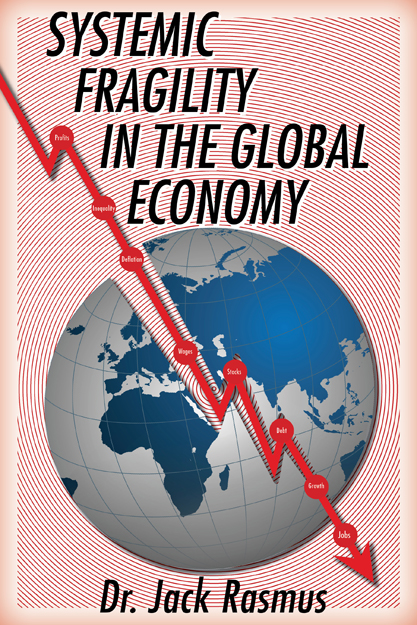
For analyses of the rest of the global economy–US, Europe, Japan, Emerging Markets–and the theoretical bases for the growing global crisis, purchase the book, ‘Systemic Fragility in the Global Economy’, by clicking on the book icon on this blog and purchasing by Paypal. Or, go to Amazon.com.

Author’s Note: With all the news about China this past week, likely to continue this week and next, how did the growing crisis in China originate? What follows is an except from chapter 6 of my just published book, ‘Systemic Fragility in the Global Economy’. That chapter, dedicated to China, is entitled: “Bubbles, Bubbles, Debt and Troubles”. The following are two excerpts from Chapter 6 on China in the book.

(The book may be purchased from the icon of the book front jacket. Just click on it and pay with 10% discount using Paypal, or go to Amazon books to purchase as well).

Chapter Six: China–Bubbles, Bubbles, Debt & Troubles

The Inevitable Debt Crisis

The primary indicator of excess liquidity and financial asset investment and speculation is debt. Debt—i.e. credit extended by lenders—is the mediating element between liquidity and financial asset investing. Excess liquidity is necessary for the availability of excess credit to be loaned out as debt. Debt and its leveraging is the stuff of financial asset over-investment and financial speculation that eventually leads to financial asset bubbles, instability events, and periodic asset bubble crashes. And when those crashes are of sufficient scope and magnitude, an economy-wide—or even global-wide—financial crisis results.

In parallel with China’s exploding liquidity, its total debt has also nearly quadrupled from 2007 to mid-2015. According to a recent 2015 study by McKinsey &Company, the global business research and consulting firm, China’s total debt rose from $7.4 trillion in 2007 to $28.4 trillion through mid-2014. That total represents 282% of China’s GDP at mid-year 2014, among he highest in the world

The problem with China’s debt, however, is not just its magnitude; nor even its rate of increase. Both are impressive enough. The even greater problem is its composition, by which is meant the proportion of the debt that is private business associated debt. China national government debt is not particularly severe as countries go. But private businesses are, and especially older basic industrial companies including the many that are government enterprises.

By far the largest part of the $28.2 trillion in outstanding debt in China, as of mid-2014, was debt held by non-financial businesses. At 125% of China’s $9.4 trillion 2014 GDP, that’s about $11.9 trillion. Add another $6.2 trillion for financial institutions’ debt. That’s more than $18 of the $28 trillion, roughly two-thirds of its total debt as business-financial. Corporate debt is roughly $16 trillion in 2015 of that.

Local government debt is another problem of major dimensions in China, and should be viewed in part as wrapped up with private sector business debt. Over 10,000 local government entities in China set up ‘off balance sheet’ property investment vehicles called LGFVs, local government financing vehicles. Borrowing heavily from shadow banks, they then over-invested in local property markets. LGFV debt was approximately 18% of China GDP in 2008, or $634 billion. According to a China government survey done at the end of 2013, it rose to about $3 trillion for that year. Projections are it will rise further, to 45% of China GDP in 2015, or $4.6 trillion.

Another approximate $3.8 trillion represents household debt in China as of 2014, according to the McKinsey study, about half of which is household mortgage debt. That $3.8 trillion rose from $1.9 trillion in 2010. But the amount today may be actually higher, since the $3.8 trillion McKinsey estimate predates the bubble in China stock markets that began growing rapidly after the 2014 data by the McKinsey study. As the stock bubble grew, ‘margin debt’ lending by brokers to retail stock market investors, i.e. households who constitute 85% of China’s stock buyers, rose by as much as another $.85 trillion in just one year, from July 2014 to June 2015, according to some estimates.

Extrapolating from the mid-2014 figures, China’s total debt therefore likely will exceed $30 trillion in 2015—just about three times China’s nominal annual GDP. About $26.5 trillion is private sector debt or various kinds and related off balance sheet local government, LGFV, real estate debt. The rest is general government debt of about $4 trillion. That private sector + LGFV debt represents a $20 trillion increase in private sector debt alone since the 2008 crash—an unprecedented, historic rise in debt in only five years or so.

That debt would not have been possible without the massive liquidity injection by banks, foreign money capital in-flows, shadow bank source funding, and forms of ‘inside credit’ like margin debt, most of the latter of which is reportedly provided by shadow banks as well. And debt has consequences, especially when of that magnitude and composition. It becomes particularly important when the real economy is slowing or declining and when deflation is a factor, both in financial securities prices as well as in real goods and services prices.

China’s Triple Bubble Machine

Thus far China has faced three financial bubbles since 2013 which are in various stages of collapse and therefore financial asset deflation. The first is the local government property and infrastructure bubble. The second, the corporate junk bond and refinancing bubble involving older industrial companies and SOEs. In both cases, China’s central government has been intervening to prevent a rapid collapse of the bubbles and financial assets, trying to slow them down, prevent contagion, and extend the period of unwinding. The third bubble, in its two major stock markets, Shanghai and Schenzhen, began to form late summer 2014. In a year’s time, the stock markets surged 120%, clearly a bubble, and then began collapsing in June 2015. Since June 2015 the central government has been desperately intervening on an unprecedented scale to prevent the stock collapse from gaining momentum, just as it has been since 2013 to contain the deflating of the previous housing-local infrastructure bubbles that continue to be a problem.

The first bubble, in local real estate property, was driven by local governments, their off balance sheet financing vehicles, the 10,000 or so LGFV funds, and shadow bank financing (domestic and foreign) providing the liquidity and debt that fueled financial speculation in real estate from 2011 to 2014. Real estate prices rose to record levels in 2013. That bubble finally began to deflate in 2013-14. The collapse of the over-investing in housing and local infrastructure meant that a major stimulus to China’s real economy was thus removed after 2013, or at least significantly reduced. It has been estimated that housing constitutes 10% of China’s GDP. So it’s collapse and retreat has taken away a major underpinning to China’s real economy. In other words, the collapse of financial asset prices, and their subsequent deflation, has direct effects on a real economy GDP.

The effect of the housing bubble as it expanded also impacted the real economy. China’s central government intervened several times to slow the housing bubble before 2014 but without much effect. Each time it intervened by raising interest rates it simultaneously slowed the real economy as well as the real estate sector. As this happened, China then lowered rates again and introduced fiscal mini-stimulus packages to get the real economy back on track. This in turn restarted the real estate bubble. This see-saw policy to try to tame the shadow banks and keep the economy growing at the same time happened several times before 2014. Thereafter, China adopted a more targeted approach to attacking its shadow banks, speculators, and their local government official allies feeding the bubble in local real estate and infrastructure. By 2014 real estate prices began to moderate. However, the speculators and the profits they made from the real estate bubble then moved on—to investing and speculating in the new financial asset opportunity associated with the WMPs, the ‘asset management fund’ securities.

The WMPs fueled the continuing bubble in what other economists in the past have called ‘ponzi’ finance, providing high interest loans from ‘trust accounts’ managed by Trusts and other shadow banks to enterprises becoming increasingly fragile. A parallel development in the boom in ‘high yield’ (junk) bonds was occurring simultaneously in the US and AEs. But as China’s real economy has continued to slow, fragile enterprises are increasingly unable to repay even these high cost WMP (junk) loans. On several occasions since 2014, the China central government has had to bail them out and absorb the losses. As China’s real economy slows more rapidly in 2015-16, it is questionable whether the central government can continue to bail out ever-wider potential debt payment defaults by these enterprises. Should it not do so, the market value of the WMPs will also deflate rapidly, just as housing has.

China’s third clear financial bubble has been the acceleration in its stock markets. China’s stock bubble of 2014-15 and its current collapse has several roots. First, it is the outcome of a conscious shift in policy by China made in 2014, to redirect the massive liquidity and deb that had been destabilizing its internal financial system—i.e. in housing, local government investment, real estate, and desperation financing of failing enterprises—into the stock markets. In 2013 a major policy ‘turn’ was decided by China leadership, of which the encouragement by the central government of the stock bubble was one element.

That major policy turn was to move toward encouraging more private investment and private consumption as major drivers of the economy, and to therefore shift away from the prior heavy reliance on direct central government investment and export sales, as was the previous case. That direct investment plus exports growth strategy began to lose momentum by 2013. Future growth based on exports was about to become more difficult, as both Japan and Europe had entered double dip recessions and US growth showed no signs of accelerating. Japan introduced its QE program, designed to drive down its currency exchange rate and make it more competitive in export markets. Europe introduced its own liquidity version, a kind of ‘pre-QE’ called Long Term Refinancing Option (LTRO), with the same objective in mind. The US signaled it would raise interest rates which meant emerging markets would be severely economically impacted at some point and thus reduce their demand for China exports as well. Global trade showed signs of initially slowing. An export-driven strategy was therefore less reliable, China apparently decided. At the same time, it was also growing clear there were limits to China’s government direct investment stimulus to growth. China apparently therefore decided at an important Communist Party conference in 2013 to ‘restructure’ by shifting to more private sector driven growth. That is, to encouraging more private business investment and private consumption. Boosting the stock market was viewed therefore as the solution to enable the transition to more private investment and consumption.

Stimulating the rise of stock prices was also considered to have a double beneficial effect. It would divert money capital out of the over-heated local housing and real estate-infrastructure market, which it did. Higher stock prices would in theory also provide an important funding source for SOEs and other non-financial enterprises in trouble. If their stock price rose, it would reduce their need to borrow more debt at higher rates with more stringent terms of repayment. Debt would be exchanged for equity, reducing their financial fragility. Higher stock prices also meant, in theory at least, that enterprises in general would realize higher capital gain income, from which they could and would invest in expansion. Real asset investment would result, providing jobs and income for more workers and thus more private consumption. Rising stock prices would also have a positive ‘wealth effect’ on high end retail investors in the market, and also promote more private consumption. Higher stock prices would assist in the strategic shift to more private sector investment and consumption as the key drivers of economic growth.

It appeared a stock market boom was therefore the answer to several strategic challenges: first, the stock boom enabled plans to restructure toward more private investment and consumption; second, it addressed the need to tame the shadow banks and the bubbles they were creating by redirecting money flows into stocks; third, the new investment and consumption would get the China economy back on a faster GDP growth path—a path that was clearly slowing as the slowdown in global trade promised to negate an export driven growth strategy.

So China’s government undertook a series of measures in 2014 to rapidly expand stock values. However, the timing was inopportune. Emerging markets were already under growing pressure and slowing. Their income from commodities exports was declining. The domestic real economies of Japan and Europe economies were not recovering as planned and their demand for China exports was not rising sufficiently. Then, in June 2014, the collapse of global oil prices commenced. To boost the markets, China’s central bank, the Peoples Bank of China (PBOC) began lowering interest rates in late 2014, the first of what would be five consecutive cuts. It further injected liquidity into the markets by lowering reserve requirements of banks to get them to lend even more. In mid-November 2014 it introduce several changes to open the economy and markets further to foreign money capital. And, as a clear signal as to where the additional liquidity should flow, it introduced measures to encourage even more aggressive buying of stocks on margin. A flood of ‘retail’ investors came into the market in early 2015 as a result. The margin buying by retail investors was especially getting out of hand. Measures were introduced to slow the trend, to no avail.

After rising 120% in a year, the damn broke in China’s two major equity markets in June 2015. Stock prices crashed by 32% in just two weeks on the Shanghai exchange and by 40% on the Schenzen. Just as it had intervened to help create the stock boom, China policy makers quickly intervened again, this time to try to quell the collapse. Various measures were introduced to prevent selling of stocks, including suspension of trading at one point of nearly three-fourths of all the listed companies on the exchanges. Short selling of stocks was banned. Major shareholders (more than 5% of total shares) were banned from selling. Other measures were initiated to get buyers back into the market to buy stocks. SOEs were required to buy their stock, even if it meant raising more debt. State investment funds were ordered to buy. The PBOC provided more liquidity to brokerages to buy stock. And in another 180 degree turnaround, margin buying terms were again loosened and encouraged. In other words, a return to massive liquidity injections to try to resolve the problem that excess liquidity had helped create in the first place. That additional liquidity would translate into yet more financial debt earmarked for financial asset investment and speculation. The long run problem—too much liquidity and therefore too much leveraged debt feeding financial markets—became the short run solution. But the solution would again add to the long run problem.

China’s strategic policy shift in 2013—away from direct government investment, manufacturing and export driven growth, and monetary policy in service to that real investment and exports approach—amounts in retrospect to a strategy for recovery not unlike that failed approach adopted by the advanced economies from the beginning of the crash of 2008-09. That AE strategy relied primarily on monetary measures that accelerated liquidity in the system. Fiscal policy was token at best (or negative in Europe and Japan), assuming forms of austerity. AE central banks believed that massive money injections would flow into real asset investment as banks resumed lending to non-financial enterprises. Real investment would bring back jobs, and therefore income and consumption. Wealth effects from rising financial asset values would add to consumption. More consumption would stimulate more real investment in turn. But nothing like that happened. The liquidity flowed into financial asset investing and financial markets, boosting stocks and bonds but little else.

China differed from the AEs in the initial period of 2008-10. Fiscal policy came first, and monetary policy and liquidity was primarily accommodative. But that began to reverse as a result of a series of measures, first in 2010 and then in 2013. The liquidity and debt explosions in China thus came later, well after the AEs, and in different forms. The eventual financial asset bubbles occurred in different markets as well. But China’s experience, especially after 2013, shows the same problems with AE recovery strategies that focus on liquidity injection that ultimately lead to excessive debt leveraging that tends to flow into financial asset markets. They lead to financial asset bubbles, to the need for still more liquidity to prop up the financial asset deflation that inevitably occurs when bubbles unwind and prior debt cannot be repaid. Excess liquidity leads to debt leads to more liquidity and yet more debt. It is a vicious circle leading to financial fragility and instability.

Listen to the ALTERNATIVE VISIONS RADIO show of January 8, 2016, and host Jack Rasmus’s latest ‘take’ on China stock markets and financial instability this past week, plus the deepening economic and political crisis brewing in South America. Go to:

http://www.alternativevisions.podbean.com

or to:

http://prn.fm/category/archives/alternative-visions/

SHOW ANNOUNCEMENT:

“Jack Rasmus takes a look at this past week’s major event in the collapse of the China stock market, as well as the resurgence of Neoliberal policies in South America and the US pivot to that continent and destabilization of economies in Venezuela, Brazil and Argentine now underway. What’s behind the most recent stock decline in China? Jack explains its relationship to the slowing real economy there, and the pressure to devalue its currency, the Yuan, that is growing. Devaluation coming in China is reflected in investors attempting to take their money and run, thus the stock decline now underway. China government efforts to slow it via ‘circuit breakers’ is not working as well as before. The real economy-currency-stock nexus will continue. How this all has contagion effects on the rest of the global economy is explained. Jack then looks at the US ‘pivot’ to South America, and specifically how the US destabilizes economies by wrecking its currency. Global oil and commodity crash, slowing China, and US interest rate hikes are all having major negative effects on South American economies. In this scenario, the US is now attempting to exacerbate Venezuela’s currency collapse even further, while attacking it politically and legally. Venezuela is a model of how the US destabilizes a country’s currency and therefore economy, as a prelude to re-establishing more friendly Neoliberal governments and policies.”

For a comprehensive analysis of both China and Emerging Market economies, see chapters 3 and 6 of Jack’s just published book, ‘Systemic Fragility in the Global Economy’, Clarity Press, January 1, 2016, available from this blog (see icon) and Jack’s website (book icon front webpage), purchasable by paypal, or now available on Amazon and at bookstores.

After 9-11, the United States focused its most aggressive foreign policy on the Middle East—from Afghanistan to North Africa. But the deal recently worked out with Iran, the current back-door negotiations over Syria between US Secretary of State, Kerry, and Russia Foreign Minister, Lavrov, and the decision to subsidize, and now export, US shale oil and gas production in a direct reversal of US past policy toward Saudi Arabia—together signal a relative shift of US policy away from the Middle East.

With a Middle East consolidation phase underway, US policy has been shifting since 2013-14 to the more traditional focus that it had for decades: First, to check and contain China; second, to prevent Russia from economically integrating more deeply with Europe; and, third, to reassert more direct US influence once again, as in previous decades, over the economies and governments in Latin America.

Following his re-election in 2012, Obama announced what was called a ‘pivot’ to Asia to contain and check China’s growing economic and political influence. In 2013-14, it was the US-directed Ukraine coup—i.e. a pretext for sanctions on Russia designed to sever that country’s growing economic relations with Europe. But there is yet another US policy shift underway that is perhaps not as evident as the refocus on China or the US new ‘cold war’ offensive against Russia. It is the US pivot toward Latin America, begun in 2014, targeting in particular the key countries and economies of South America—Venezuela, Brazil, and Argentina—for economic and political destabilization as a fundamental requisite for re-introduction of Neoliberal policies in that region.

Venezuela: Case Example of Destabilization

Economic destabilization in its most recent phase has been underway in Venezuela since 2013. The collapse of world oil and commodity prices, a consequence in part of the US vs. Saudi fight that erupted in 2014 over who controls the global price of oil, has caused the Venezuela currency, the Bolivar, to collapse. The US raising its long term interest rates the past year has intensified that currency collapse. But US government and banking forces have further fanned the flames of currency collapse by encouraging speculators, operating out of Colombia and the ‘DollarToday’ website, to ‘short’ the Bolivar and depress it still further. US based media, in particular the arch-conservative CATO institute in Washington, has joined in the effort by consistently reporting exaggerated claims of currency decline, as high as 700%, to panic Venezuelans to further dump Bolivars for dollars, thus causing even more currency collapse. Meanwhile, multinational corporations in Venezuela continue to hoard more than $11 billion in dollars, causing the dollar to rise and the Bolivar to fall even more. The consequence of all these forces contributing to collapse of the currency is a growing black market for dollars and shortages of key consumer and producer goods.

But all that’s just the beginning. Currency collapse in turn means escalating cost of imports and domestic inflation, and thus falling real incomes for small businesses and workers. The black market and dollar shortage due means inability to import critical goods like medicines and food. Rising cost of imports means lack of critical materials needed to continue production, which results in falling production, plant and business closures, and rising unemployment.

Currency collapse, inflation, and recession together result in capital flight from the country, which in turn exacerbates all the above again. A vicious cycle of general economic collapse thus ensues, for which the popular government is blamed but which it has fundamentally not caused.

As this scenario in Venezuela since 2014 has worsened, the US has targeted Venezuela’s state owned oil company, Petroleos de Venezuela, with legal suits. The Obama government in March 2015 also issued executive orders freezing assets of Venezuelan government and military representatives charged with alleged ‘human rights’ abuses. The US then then recently arrested Venezuelan businessmen in the US, holding them without bail, no doubt to send a message to those who might still support the government. The US government has also indicted Venezuelan government and military officials recently with charges of alleged drug conspiracy, including National Guard generals who have supported the Maduro government. This all raises impressions of government corruption with the public, while giving second thoughts to other would-be military and government supporters to ‘think twice’ about their continuing support and perhaps to consider ‘going over’ to the opposition in exchange for a ‘deal’ to drop the legal charges. The popular impression grows that the economic crisis, the inflation, the shortages, the layoffs must all be associated with the corruption, which is associated with the government. It is all classic US destabilization strategy.

As all the above economic dislocation has occurred in Venezuela, money has flowed through countless unofficial channels to the opposition parties and their politicians, enabling them to capture earlier this month control of the national assembly. The leaders of the new assembly, according to media leaks, now have plans to reconstitute the Venezuelan Supreme Court to support their policies and to legally endorse their coming direct attack the Maduro government in 2016. It is clear the goal is to either remove Maduro and his government or to render it impossible to govern.

As Julio Borges, the next president of the national assembly, has declared publicly in recent days: if the Maduro government does not go along with the new policies of the Assembly, “it will have to be changed”. No doubt impeachment proceedings, to try to remove Maduro, will be soon on the agenda in Venezuela—just as it now is in Brazil. But for that, the Venezuelan Supreme Court must be changed, which makes it the immediate next front in the battle.

Argentina & Brazil: Harbinger of Neoliberal Things to Come

Should the new pro-US, pro-Corporate Venezuela National Assembly ever prevail over the Maduro government, the outcome economically would look much like that now unfolding with the Mauricio Macri government in Argentina. Argentina’s new Macri government has already, within days of assuming the presidency, slashed taxes for big farmers and manufacturers, lifted currency controls and devalued the peso by 30%, allowed inflation to rise overnight by 25%, provided $2 billion in dollar denominated bonds for Argentine exporters and speculators, re-opened discussions with US hedge funds as a prelude to paying them excess interest the de Kirchner government previously denied, put thousands of government workers on notice of imminent layoffs, declared the new government’s intent to stack the supreme court in order to rubber stamp its new Neoliberal programs, and took steps to reverse Argentine’s recent media law. And that’s just the beginning.

Politically, the neoliberal vision will mean an overturning of the Supreme Court, possible changes to the existing Constitution, and attempts to remove the duly-elected president from office before his term. Apart from stacking the judiciary, as in Argentina, Venezuela’s new business controlled National Assembly will likely follow their reactionary class compatriots in Brazil, and move soon to impeach Venezuela president, Maduro, and dismantle his popular government, just as they are attempting in Brazil with recently re-elected president, Rousseff.

What happens in Venezuela, Argentina, and Brazil in the weeks ahead, in 2016, is a harbinger of the intense economic and political class war in South America that is about to erupt to another higher stage in 2016.

by Jack Rasmus,
copyright 2016

Jack Rasmus is author of the just published analysis of the global economy, ‘Systemic Fragility in the Global Economy’, by Clarity Press, January 2016, available from Amazon; from http://www.ClarityPress.com/Rasmus.html; and from this blog (see book icon) and website

On December 16, 2015, the US central bank, the Federal Reserve raised short term interest rates. The move ended more than seven years during which the Fed kept rates at a near zero 0.25% or less.

The move raises critical questions about the global economy for 2016, already slowing significantly since 2014. Further global slowdown is now almost certain in 2016—with global oil prices now in the mid-$35 range and projected to go lower, with commodity prices globally still deflating, with Europe’s economy continuing barely growing and Japan’s in yet another recession, and with major emerging market economies experiencing spreading economic instability with collapsing currencies, capital flight, slowing exports, rising import inflation, and growing political unrest.

The rate hike also means the US economy, already not doing all that well, may slow further in 2016 as well, contrary to what US media and ‘spin doctor’ economists are claiming. Ignored in the US press is the fact that, in the past four years in a row, every winter quarter the US economy collapsed to near zero or negative in GDP. Will that now happen again—a fifth time—this coming January-March 2016 as a result of the Fed rate rise? Quite possibly.

The US Fed reduced short term rates to nearly zero in 2008-09. The excuse was the rates were necessary to generate economic recovery. But even recent Fed studies have concluded the zero rates since 2008 have had minimal effect on the US real economy.

Is the US Economy on the Brink?

The real US economy since 2008 has grown at only roughly half to two-thirds its normal rate. Decent paying jobs in manufacturing and construction today are still a million short of 2007 levels. Median wages for non-managers are still below what they were in 2007, and households are piling on new debt again to pay for rising medical costs, rents, autos, and education. Retail sales are slowing. Construction activity is only two-thirds what it was and US manufacturing is contracting again. The gas-oil fracking industrial boom of 2012-2014—a major source of growth—has ended this past year and mass layoffs in the hundreds of thousands are now occurring in mining, manufacturing and transport. Reflecting the true weakness of the US economy, prices are slowing and are now at a historic low of 1.3% and heading lower, as the US—like Japan and Europe—is drifting toward deflation.

The Fed’s 0.25% rate hike will do nothing positive for this scenario for the US economy. It can only have a further negative effect on all the already weakening trends. The only question is how much negative.

The Fed rate hike will raise the value of the dollar as it further drives up long term US interest rates, already having risen by more than 1% the past year. The further rising dollar and interest rates will slow US manufacturing and exports—already contracting—even more. US construction will shift from modest growth to contraction. Job creation will slow. Working class real wage income will decline even more in 2016.

Central Banks in Europe and Japan

Central banks in Europe and Japan, flooding their economies with QE money injections since 2013, waited the Fed’s recent rate rise and held off in recent months from further expanding their QE programs and thus further devaluing their own currencies for the time being. The Fed’s rate hike, by raising the US dollar, has done that for them—for now. Europe and Japan central banks will thus absorb Fed hike, wait a few more months, and then add more QE more devaluations again later in 2016.

That means both current, and more coming, Euro-Yen devaluations that will further intensify global currency wars already underway, as more sectors of the global economy fight over a shrinking global trade pie by trying to ‘beggar their trading neighbors’ by stealing exports from each other.

The central banks of US, Europe and Japan enriched their corporations and financial investors by tens of trillions of dollars since 2008 with their zero rates and QE policies, while leaving the rest of the economy behind and struggling. Their policies failed miserably—for all but the rich—for the past seven years. Now they are about to fail again, with further disastrous results.

As central banks in the advanced economies shift policies again—the US raising rates and Europe-Japan adding to QE programs—the combined effects are intensifying global currency wars, setting in motion economic ‘cat fights’ worldwide over shrinking exports, while running the risk (in the US) of even slower growth and stagnation.

In other words, central banks in the US, Europe and Japan are ‘mucking up’ the global economy again.

China’s Central Bank

Anticipating the rise in US rates, and responding to the QE-driven devaluations by Japan and Europe, the People’s Bank of China, its central bank, last August devalued its currency, the Yuan, by almost 4%. This was the lowest possible, given that China has had a policy of pegging the Yuan to the US dollar since the 2008 crisis. However, China and the IMF last week agreed to have the Yuan become a global trading currency. This means the Yuan will become de-pegged from the dollar. So as Fed rates and the dollar rises, the Yuan will in effect devalue in turn.

With more devaluation of the Yuan inevitable, China has will now fully join the ranks of the global currency war. It cannot continue to allow the Yuan to continue to rise against the Yen or the Euro, as it has in recent years by more than 30% and 20%, respectively, with its own exports and economy slowing. Nor can it allow the Yuan to rise with the dollar, inevitable if it remains pegged.

The Yuan’s devaluation will allow China to recover some of its lost exports. But a declining Yuan will lead to other Asian economies devaluing their currencies as well. That will mean that Japan will expand QE and devalue further in 2016 in response to the Yuan and other Asian currencies. Europe will then almost certain follow. Competitive devaluations and more intense currency war is the outcome.

The Fed’s rate rise has thus sets in motion a further slowing of the US economy, more QEs, further currency devaluations in Europe, Japan, China, resulting in intensifying currency wars, and more in fighting over a slowing global export and trade pie.

Emerging Market Economies

Those impacted the most negatively will be emerging markets—caught between Fed rate hikes and competitive devaluations by Europe, Japan and soon China as well. Emerging markets will be forced to devalue their currencies even further and will do so even more rapidly. That means accelerating import price inflation, faster capital flight out of their economies, slow investment into them, at the cost of jobs, rising unemployment, social services cuts, and even more social and political destabilization and unrest.

In short, central banks in the advanced economies have begun ‘exporting their economic stagnation’ to emerging market economies. Can emerging markets repay the interest on their $40 trillion increase in corporate debt since 2010? Probably not. It is therefore looking increasingly likely the next global financial crisis will originate in emerging markets with more corporate and sovereign debt defaults. It’s just a matter of time, and which comes first. But whichever, the crisis origins is traceable to the central banks of Europe, Japan, and US.

Jack Rasmus is author of the just published analysis of the global economy, ‘Systemic Fragility in the Global Economy’, by Clarity Press, January 1, 2016, available to from

-the publisher at http://www.ClarityPress.com/Rasmus.html,

-from Amazon (go to ‘books’ and enter ‘jack rasmus’)

– Or at discount from the author’s website via the icon on this blog

My new book, ‘Systemic Fragility in the Global Economy’–a description of the current state of the global economy in China, Europe, Japan, Emerging Markets and the US and a theoretical analysis of the coming crisis–is now available from Amazon, from the publisher, Clarity Press, or from my own website, kyklosproductions. com. Check out at either of the following 3 urls:

https://www.amazon.com/s/ref=nb_sb_ss_c_0_11?url=se

http://www.claritypress.com/Rasmus.html

http://www.kyklosproductions.com/homewar.html

ABSTRACT of the Book:

“Six years after the collapse of the global economy in 2008, and the weak and uneven recovery that followed, indications are growing once again that economies are slowing worldwide and financial and economic instability are on the rise.

Just as contemporary economics failed to predict the 2008-09 crash, and over-estimated the subsequent brief recovery that followed, economists today are again failing to accurately forecast the slowing global economic growth, the growing fragility, and therefore rising instability in the global economy. Simultaneously, after more than a half decade of tens of trillions of dollars of central bank money injections to bail out banks and investors, after trillions more in business tax cuts and subsidies, and after crushing fiscal austerity for the rest—fiscal and monetary policy solutions introduced by central banks and governments since 2008-09 have proved mostly ineffective, and even counterproductive, in generating a sustained and broad economic recovery.

This book offers a new approach to explaining why mainstream economic analyses have repeatedly failed and why fiscal and monetary policies have been incapable of producing a sustained recovery.

The new approach is based on a new conceptual framework, centered on a unifying concept called Systemic Fragility. Rooted in 9 key empirical trends, Systemic Fragility consists of the dynamic interaction of three constituent forms –financial, consumption, and government balance sheet fragility. Expanding upon the early contributions of Keynes, Minsky and others, the Theory of Systemic Fragility offers an alternative explanation why the global economy is slowing long term, becoming more unstable, why policies to date have largely failed, and why the next crisis may therefore prove even worse than 2008-09.

The book and theory further describes transmission mechanisms between the three forms of fragility that exacerbate each and lead to a deepening of Systemic Fragility in turn. How the buildup of Systemic Fragility in the pre-crash and recovery phase makes the global economy more prone to frequent and more intense crashes, to deeper real economic contractions, and to weaker recoveries, while rendering fiscal-monetary policies increasingly ineffective. The book further explains how the price system in general, and financial asset prices in particular, function as fundamental destabilizing forces under conditions of Systemic Fragility. How the global system has in recent decades become dependent upon, and even addicted to, massive liquidity injections. How fiscal policies have exacerbated fragility and instability. And how fundamental changes in the structure of the 21st century global capitalist economy—in particular in financial and labor market structures—are fundamentally responsible for making the global economy more systemically fragile and thus in turn prone to more frequent and deeper instability and crises.

The book concludes with an appendix statement that describes three simultaneous equations that express in notational form the variables associated with the Theory of Systemic Fragility.”

Readers interested in joining the first week of January Jack’s online course, “The Global Economy in Crisis, 2015-2016′, based on his just released book, offered by the World Institute for Social Change (WISC), beginning Jan. 2, check it out at: https://zcomm.org/zschool/moodle/

For my perspective on the recent US Federal Reserve rate hike, and its consequences for the US and global economy, listen to my 12-18-15 Alternative Visions radio show podcast below. The first half of the show addresses topical issues of the preceding week as well.

This audio podcast is available at:

http://prn.fm/category/archives/alternative-visions/

or at:

http://alternativevisions.podbean.com

SHOW ANNOUNCEMENT:

Jack reviews the state of the US and global economy, focusing on US interest rate hikes by the Federal Reserve and its consequence for the US and global economies. In the review of this week’s economic events, the arrest of Pharma CEO Skrelli, what’s going on with Argentina and the resurgence of Neoliberalism in South America, and the US Congress’s passing of another $650 billion in tax cuts for corporations and the rich are also addressed.

Next show: Jack continues review of his latest book, ‘Systemic Fragility in the Global Economy’, now available from his blog, jackrasmus.com, discussing why economists and their theorists continue to get the global economic picture wrong.

For free initial chapters of the book, go to Rasmus’s website: http://www.kyklosproductions.com/homewar.html.

Readers interested in joining the first week of January Jack’s online course, “The Global Economy in Crisis, 2015-2016′, based on his just released book, offered by the World Institute for Social Change (WISC), check it out at: https://zcomm.org/zschool/moodle/

Listen to the podcast on the Alternative Visions radio show, for Jack Rasmus summary of his just released book, Systemic Fragility in the Global Economy’. In part one of the review on the 12-11-15 show, Jack discusses the 9 major trends in the global economy that are leading to another economic crisis, now that the brief recoveries post-2009 in China and emerging markets is over (the ‘dead cat bounce’). A brief overview of last week’s major economic trends is presented in the first half of the radio show; Part One follows.

To listen to this show go to:

http://prn.fm/category/archives/alternative-visions/

or

http://www.alternativevisions.podbean.com

SHOW ANNOUNCEMENT

Jack takes a look at the key economic developments of the past week, and then provides the first of a several part analysis this month of the global economy explaining why it is becoming more unstable, both financially and economically—i.e. more ‘systemically fragile’. The analysis of the global economy is based on his just released new book, ‘Systemic Fragility in the Global Economy’ by Clarity Press. (see Jack’s blog, jackrasmus.com, where and how to order). Part 1 on today’s show identifies nine major anomalies that have appeared in the global economy today that mainstream economists can’t or don’t answer—which the new book attempts to explain. Jack reviews chapters 1 and 2, on the topic of the ‘dead cat bounce’ temporary recovery that began 2010-2013 in China and emerging market economies, which has been in decline once again since 2014. Stagnation in Europe and Japan, slow growth in the US, and ‘hard landings’ coming in China and emerging markets are now the prospect, after the ‘dead cat’ global economy has had its bounce. The ‘week in review’ commentary on the show addresses the renewed global oil price decline, junk bond fund defaults, China’s Yuan as global currency, Japan’s falsified GDP revisions, Yahoo’s effort to avoid paying $10 billion in US taxes, and the US Senate’s posturing about pharmaceutical drug company price rip-offs.

Listeners interested in enrolling in an online 8-week course starting in January on Jack’s new book, provided by the progressive-left ‘World Institute for Social Change’ (WISC) ‘Z School’, should check out the WISC website at:https://zcomm.org/zschool/moodle/ for more information. Free copies of the first two chapters of the book are available at the site.

Why Bank of Japan and European Central Bank will intensify ‘devaluation by QE’ even more in 2016, and why China’s central bank will have to devalue further,leading to more currency wars and currency collapse in emerging markets. To listen to Jack’s explanation on the ‘Alternative Vision’ radio show on the progressive radio network on December 4, 2015, go to:

http://www.alternativevisions.podbean.com

or to:

http://prn.fm/category/archives/alternative-visions/

SHOW ANNOUNCEMENT:

Jack Rasmus looks at yesterday’s decision by the European Central Bank to make token changes to its QE policies, Japan’s central bank rumors of more QE, and the US Federal Reserve’s imminent raising of interest rates later this month. Why the ECB did not go ‘all in’ to expand its QE? Reasons: waiting on US Fed to move first, weaken German opposition to a later big QE boost, and ‘holding its powder’ for possible worse deflation and EU economy in 2016. Japan waiting on both US and Europe. Meanwhile, US Fed caves in to political moves by Congress attacking it. Conclusion: more QE in 2016, more currency devaluation, more pain in emerging markets and slowing of US exports and manufacturing, and China need to devaluate further next year. Recent economic news of importance is reviewed: oil price glut to continue despite Vienna OPEC meeting; China’s Yuan approved by IMF as global currency, and Brazil’s economy now tipping over into depression. Jack concludes with latest review of US economic performance: manufacturing and exports contracting, business inventories excess and spending, US residential housing growth now spent and flattening, poor Xmas retail sales emerging, auto sales based on debt reaching peak, savings from gasoline price declines diverting to rents, education and health care price increases, and now service sector growth slowing rapidly. Next Week show theme: ‘Systemic Fragility in the Global Economy, Part 1’, as Jack reviews conclusions of his just published book.

My just published, December 1, 2015, book ‘Systemic Fragility in the Global Economy’, Clarity Press, is now publicly available from various sources (this blog, my website, the publisher, Amazon and other). The following is a complimentary copy of the Introduction Chapter to the book, which explains why the global economy is headed for further instability, both financial and real, especially in emerging markets, with further slowing in China and stagnation (Europe) and recession (Japan)

INTRODUCTION TO ‘SYSTEMIC FRAGILITY IN THE GLOBAL ECONOMY’
copyright Jack Rasmus, 2015

“Half way through the second decade of the 21st century, evidence is growing that the global economy is becoming increasingly fragile. Not just in fact, but in potential as well. And not just in the financial sector but in the non-financial sector—i.e. in the ‘real’ economy.

The notion that the global crash of 2008-09 is over, and that the conditions that led to that severe bout of financial instability and epic contraction of the real economy, are somehow behind us is simply incorrect. The global economic crisis that erupted in 2008-09 is not over; it is merely morphing into new forms and shifting in terms of its primary locus. Initially centered in the USA-UK economies, it shifted to the weak links in the advanced economies between 2010-2014—the Eurozone and Japan. Beginning in 2014, it shifted again, a third time, to China and emerging markets where it has continued to deepen and evolve.

It is true that the main sources of instability today are not located in the real estate sector—the subprime mortgage market—or the credit and derivatives markets that were deeply integrated with that market. Nor is the real economy in a rapid economic contraction. The problem in the real economy is the drift toward economic stagnation, with global trade and real investment slowing, deflation emerging, and more economies slipping in and out of recession—from Japan to Brazil to Russia, to South Asia and Europe’s periphery, even to Canada and beyond. On the financial side, it’s the continued rise of excess liquidity and debt—corporate, government, and household—that is fueling new financial bubbles—in stocks in China, corporate junk bonds, leveraged loans, and exchange traded funds in the US, government bonds in Europe, in currency exchange and financial derivatives everywhere.

Financial instability events and crashes, and the real economic devastation that is typically wrought in their wake, do not necessarily occur in repeat fashion like some pre-recorded video rerun. The particulars and details are always different from one crisis to another. At times it’s real estate and property markets (USA 1980s, Japan 1990s, global 2007). Other times stock markets (tech bust of 2000, China 2015). Or currency markets (Asian Meltdown 1997-98) or government bonds (Europe 2012). But the fundamentals are almost always the same.

What then are those fundamentals? How do they originate and develop, then interact and feed back on each other, creating the fragility in the global economic system that makes that system highly predisposed to the eruption of financial crises and subsequent contraction? What are the fundamentals that ensure, when some precipitating event occurs, that the financial instability and real contraction that follows occurs faster, descends deeper, and has a longer duration than some other more ‘normal’ financial event or normal recession? What are the transmission mechanisms that enable the feedbacks, intensify the instability, and exacerbate the crisis? And how do the fundamentals negate and limit the effectiveness of fiscal-monetary counter measures attempting to restore financial stability and real recovery? Indeed, what is meant by ‘systemic fragility’, why is it important, and why do most economists not address or consider it in their forecasts and analyses?

Fundamental Trends & Determinants

The book will argue there are 9 key fundamental trends underlying the growing fragility in the global economy include:

• the decades-long massive infusion of liquidity by central banks worldwide, especially the US central bank, the Federal Reserve, along with the increasing availability of ‘inside credit’ from the private banking system;

• the corresponding increase in private sector debt as investors leverage that massive liquidity injection and credit for purposes of investment;

• the relative redirection of total investment, from real investment to more profitable financial asset investment;

• a resultant slowing of investment into the real economy, as a shift to financial securities investment diverts and distorts normal investment flows;

• growing volatility in financial asset prices as excess liquidity, debt, and the shift to financial asset investing produces asset bubbles, asset inflation, and then deflation;

• a long run drift from inflation to disinflation of goods and services prices, and subsequently to deflation, as real investment flows are disrupted and real growth slows;

• a basic change in the structure of financial markets as new global financial institutions and new financial markets and securities are created, and an emerging new global finance capital elite arises, to accommodate the rising liquidity, debt, and shift to financial asset investment;

• parallel basic changes in labor markets resulting in stagnation and decline of wage incomes and rising household debt;

• growing ineffectiveness of fiscal and monetary policies as debt and incomes from financial assets rise, incomes from wages and salaries stagnate and household debt rises, and debt on government balance sheets increases while government income (taxes) slows—which together reduce the elasticities of response of investment and consumption to interest rates and multiplier effects from government fiscal policies.

Key Variables and Forms of Fragility

A main theme that emerges is that the preceding nine fundamental trends evolve and develop dynamically over time. Those nine trends also mutually determine each other, in the process contributing to a general condition of fragility in the economy. Systemic Fragility is therefore a dynamic condition that is first and foremost the consequence of the interaction of the above 9 key real factors or trends. In turn, those nine forces act upon three key variables to produce Systemic Fragility: debt, income required to service debt, and the ‘terms and conditions of debt’ (T&C).

Debt, income and T&C dynamically interact to raise fragility within the three main economic sectors—business financial, household consumption, and government balance sheet. However, systemic fragility is dynamic not only within a given form—i.e. the financial, consumption, and government—but also between them. Not only may the level of fragility grow as real trends raise the magnitudes of debt, income and T&C within a sector or form, but the interactions between the three variables within a sector may exacerbate the level of fragility as well. Moreover, the feedback effects between the financial, consumption, and government balance sheet forms of fragility can further exacerbate the intensity of fragility on a systemic level.

Fragility is therefore not a linear process, proceeding from one level to the next higher as debt or income rise and/or fall, respectively, as some have described it. It is a very dynamic process, with multiple feedback effects within and between its primary sectors or forms. Systemic fragility is not a simple adding up of levels of fragility that develop within financial, household, and government sectors of the economy. How fragility between those sectors mutually determine each other and raise fragility at a systemic level is equally important.
This focus on dynamic interactions requires identifying and explaining the ‘transmission mechanisms’ within and between the three fragility forms. Some of the more important ‘transmission mechanisms’ include the price systems associated with both financial assets and real goods, government policy shifts and changes, as well as the psychological expectations of various agents—in particular the investor-finance capital elite, households as consumers, and government policy makers at central banks, legislatures, and executive agencies. Emphasis is placed on the price systems as especially important transmission mechanisms for the development of fragility.

The dynamic interactions—i.e. the feedback effects and the enabling transmission mechanisms — intensify the overall fragility effect. Moreover, the intensity due to interactions or ‘feedback effects’ varies with the phase and condition of the business cycle.

Fragility is therefore more than just the sum of its three parts. It is a dynamic process and that process has a historical trajectory based on real conditions as well as subjective, psychological expectations of real actor-agents. Because fragility is the product of internal trends and variables, it develops and grows endogenously, as economists say.

Another important characteristic is that rising systemic fragility renders the global economy more prone to eruptions of financial instability, on the one hand, and further contributes to accelerated contractions of the real economy in the wake of the instability events when they occur. That acceleration leads to a deeper and therefore often longer duration of real contractions.

Two important corollary themes follow from the general analysis of Systemic Fragility in this book. Both challenge prevailing economic orthodoxy. Both reject the notion that the global capitalist economy, in national or global form, tends to be long run stable and returns to equilibrium due to market forces and/or government policy intervention when unstable.

The first challenged orthodox assumption is that the capitalist price system will work its supply and demand ‘magic’ at the level of markets to restore equilibrium and stability. Contrary to contemporary economic analysis, the analysis of Systemic Fragility that follows maintains the price system is not a force for stabilization. Rather, in the 21st century it has increasingly become a force for destabilizing the system. That is particularly true of the role played by financial asset prices. Not all price systems are the same. There is no ‘one price system’ that fits all, where supply and demand together work to moderate instability, which is a major tenet of mainstream economic analysis. There are instead several price systems. More volatile financial asset prices behave differently and appear increasingly to drive goods (products), factor (wage or labor prices) and even money prices (interest rates) in the 21st century as financial asset investing becomes increasingly dominant within global capitalism and real asset investment in turn declines.

A second challenged orthodox assumption is that government fiscal-monetary policies can stabilize the system when such policy action is used to complement pure market forces and the one price system. However, as the analysis of Systemic Fragility will argue, this is increasingly less the case as fragility builds within the global system. Systemic fragility blunts and reduces fiscal-monetary policies aimed at generating a recovery by negating in part the effects of elasticities of monetary policy and interest rate changes and multiplier effects on government spending and tax policies. Weaker and unsustainable recoveries are the result of the growing ineffectiveness of fiscal-monetary policies in attempts to stabilize the system, whether financially or in real terms. The failure of such policies is manifested in economic growth ‘relapses’ (sharp slowing or negative growth for single quarters) or short and shallow repeated descents into recessions. Those subpar recoveries may also, under certain conditions, descend into bona fide economic depressions.

Instability in the Real Economy

As chapters 1 and 2 that follow will address in more detail, the real side of the global economy is slowing. That slowdown was temporarily masked by the brief surge in China and emerging market economies’ (EMEs) growth that occurred between 2010-13 for specific, but temporary, reasons. Initial signs that regional growth in China-EMEs was beginning to dissipate emerged in late 2013. Since then the forces underpinning that growth have weakened further, and now in 2015 growth is slowing in that region more rapidly.
Globally the real goods producing economy is likely already in a global recession. Industrial production is falling, durable goods and factory output is slowing or declining in many countries. Investment in real assets is down sharply, incomes associated with production are stagnating or declining, productivity is almost stagnant, and a general drift toward disinflation and deflation has been underway for some time.

Perhaps the best indicators of this real slowdown is the collapse of world commodity and oil prices. Key industrial commodity prices like iron ore, copper and other key metals have collapsed by more than half, and crude oil by two-thirds from levels just a few years ago. Non-metal commodity prices have fared little better. Country economies highly dependent on such production and export are nearly all in recession, or quickly approaching it: Brazil, Russia, Venezuela, Nigeria, South Africa, and even Australia and Canada. China’s economy is undoubtedly growing at no more than 5% annually, much less than the officially reported 7%, and well below the 10%-12% of just a few years ago. And as China slows, so too do various South Asia economies, highly integrated and dependent upon China’s economic performance.

Europe has been oscillating at an historical, sub-par rate of growth between -1% to 1%, after having experienced a double-dip recession in 2011-13, and an historic weak recovery in some of its strongest economies thereafter—including France, Italy and even Germany. Today those same economies continue to struggle to fully recover. Meanwhile Europe’s periphery languishes in continued recession, not just the southern but now the northern, Scandinavian and Baltic regions as well.

At the same time, the world’s fourth largest geographic unit, Japan, lapses in and out of recessions—four since the 2008-09 crash, despite having introduced a multi-trillion dollar quantitative easing central bank monetary injection since 2013. That injection produced a brief stock market surge but no substantial effect on its real economy or growth, which is slipping into recession yet again.

The much-hyped ‘healthy recovery’ of the US economy is, moreover, mostly media and politician spin. The US economy has experienced four ‘relapses’ in its real growth since 2010, where growth collapses for a quarter or turns negative. To the extent that real growth has occurred it has been in the shale-oil patch and associated transport and industrial production activity. That has been coming rapidly to an end, however, as global oil prices in 2015 have collapsed a second time, and may fall to as low as $30 a barrel by some estimates. US real unemployment is still around 12%, masked by gains in low pay, part time and temp jobs in the service sector. US exports and manufacturing are slowing, as the dollar rises from long term interest rate upward drift, and soon rises further due to short term rate increases by central bank action expected in late 2015. Construction remains stagnant at levels well below 2006-07’s previous peak, as only high end income households can afford housing purchases. Household consumption remains mostly debt-financed as median incomes decline and wage growth seven years after the 2008 crash still fails to appear. Meanwhile, government agencies redefine what constitutes US GDP and growth as a means of boosting growth figures.

After the weakest recovery in more than a half century itself disappears, growing desperation with the slowing real economy, has led government policy makers to try to obtain for their corporations a slightly higher share of the slowing world trade and production pie. In Europe and Japan, the response has been to de facto devalue their currencies by means of QE and massive money injections in order to lower production costs and stimulate exports. An accompanying hope is that the currency devaluation will also stimulate stock and bond investments that might in turn raise domestic real investment. But neither has succeeded in either economy. So Europe has already begun, and Japan plans, to press for more cost reduction through ‘labor market reforms’ that reduce wage costs—the alternative option.

Dueling QEs and de facto currency devaluations have only set off currency wars. European and Japanese efforts to in effect ‘export’ their slow growth, have only resulted in China, Asia, and EMEs also devaluing their currencies to boost their exports, setting in motion a ‘race to the bottom’—with Europe and Japan almost certain to introduce yet more rounds of QE in 2016 in response.

Unlike in 2010-12 there is no China-EME growth surge mitigating the failed recoveries in Europe, US, and Japan. Now the former are leading the global real economic slowdown. And there is no evidence the advanced economies of US, Europe and Japan will assume the bolstering role previously played by China-EME in turn. In fact, as the China-EME slowdown accelerates, Europe and Japan will be further affected. And US manufacturing and industrial production will slow further as well, as long term interest rates and the value of the US dollar continue to drift upward regardless what the Federal Reserve does with short term rates in 2015 and beyond.

Financial Instability in the Global Economy

No less evident is a growing financial instability in the global economy at mid-year 2015. At the top of that list are the events unfolding in China’s equity markets, and, behind that, continuing instability in financing for local government infrastructure, residential and commercial housing, in asset management financial products, and in the financing of old line industrial companies many of which are now technically bankrupt.

A classic bubble in China’s major stock markets began in 2014, resulting in a 120% increase in stock values in just one year. Implementing government policies intended to redirect excess liquidity and financial speculation away from out of control shadow bank financing in local government infrastructure and housing, China in effect redirected excess liquidity and capital into its equity markets. The strategy had the added objective of finding a way to stimulate real investment from private sources by means of engineering an escalation in financial equity assets. It was hoped the wealth effect from equities inflation would also stimulate private consumption. The increased reliance on private investment and consumption would in turn reduce the need for the Chinese government to generate economic growth by means of the prior strategy: increased government direct investment, with massive central bank and foreign capital money inflows in support, and manufacturing exports growth as well. That prior strategy had run its course by 2012-13 and China began to shift to the new private sector driven strategy. But China central bank money injection, foreign money inflows, and redirection of money capital from China’s bubbles in real estate to China’s equity markets did not produce real economy investment any more than money injection via QEs did in Europe, Japan or the US-UK. Instead, it set off a financial bubble in China stocks.

The China stock bubble then began to unwind in June 2015 with a loss of more than $4 trillion, the consequences of which are still unfolding in global financial markets.

One such consequence has been the intensification of competitive devaluations and a ratcheting up of currency wars in the $5.7 trillion global currency exchange markets. Already festering with the introduction of $1.7 trillion and $1.3 trillion in dueling QEs by Japan in 2014 and the Eurozone in 2015, currency wars have clearly accelerated further with yet unclear consequences for both financial, and real, instability in the global economy. With its stock markets unwinding, China subsequently returned in part to an export driven strategy to boost its already rapidly slowing real economy. That has taken the form of initially a 2%-4% decline in its currency, the Renminbi-Yuan. Currencies quickly responded in Asia and beyond to the China stock decline, currency devaluation, and the likelihood of more of the same as China’s real economy slows.

China events have accelerated the already sharp declines in currency exchange rates, with the Euro and Japanese Yen already down by 30% since 2014, and now major Asian currencies rapidly declining as well from Indonesia to Thailand to Singapore, Taiwan, and even Australia and South Korea.

The obvious spillover and contagion underway by late summer 2015 has been increasing volatility and contraction in stock market prices globally. Collapsing currencies and stock markets mean accelerating capital flight from EMEs and even China. To try to slow the outflow, EMEs raise their domestic interest rates, which slows their domestic real economies further, producing more stock price collapse.

Growing financial instability in stock and currency markets subsequently begin to feed off of each other at some point, a condition which the global economy may have already entered.
Financial instability may be reflected in escalating financial asset price bubbles, or the unwinding and collapse of those bubbles. The collapse of world oil and commodity prices that have been underway since 2013-14, and now appear accelerating once again in summer 2015, are another strong indicator of growing financial instability in the global economy.

Continuing economic stagnation in Europe, Japan, and to a lesser extent in the US economies has resulted in world commodity and oil price weakness. China’s real economic retreat since 2014 has exacerbated that weakness. And in crude oil markets, the intensifying competition between capitalist energy producers in the US shale-oil fields and the Saudi-Gulf led producers has driven oil price decline still further. Collapsing in 2014 from $120 a barrel to $50 in early 2015, crude prices have again begun to descend further and could go as low as $30 a barrel according to some estimates. The collapse of world oil prices—a financial asset as well as a natural resource—will have further negative effects on financial markets no doubt, especially when combined with general commodity price deflation that continues without relief.

Thus at the top of the list of financial instability today are fragile and collapsing equity markets, extreme volatility in currency markets, and the continued collapse of global commodity prices and oil.

But other financial assets are also in bubble ‘range’ in 2015, as a result of the massive excess liquidity injected into the world economy since 2008 and the resulting escalation of debt, especially on the corporate and banking side of total debt.

Record low central bank engineered rates since 2008, virtually zero for bank borrowers, has injected at minimum $15 trillion into the global economy. That’s in addition to the nearly $10 trillion in central bank QE injections. Moreover, both forms of liquidity creation are still continuing. Liquidity has generated record financial asset prices—from stocks, corporate bonds, and sovereign bonds to derivatives, exchange rate speculation, and other forms of financial assets.

Bubbles in corporate bonds are also at a peak, not yet as obvious a problem as stock prices, commodity prices, or currency exchange rates. But they will be. At high risk are corporate junk bonds, which may yet be impacted by collapsing oil prices and corporate defaults in the US shale-oil sector spilling over to other corporations. Less unstable, but no less a ‘bubble’, are corporate investment grade bonds. Global issuance averaged less than $1.5 trillion a year in the half decade leading up to the 2008 crash. In the past five years since 2010, that annual average issuance is more than $2.5 trillion—i.e. more than $5 trillion additional issued compared to historical averages.

Government bonds have entered unknown territory as well, especially in Europe, where they increasingly sell at negative rates. That is, buyers pay governments interest to buy their sovereign bonds, instead of vice-versa, in order to find a temporary safe haven for their excess liquidity. The bond world is turned on its head, with yet unknown consequences for future financial instability, witness the bond ‘flash crash’ of a few years ago, the causes of which are still unknown. There is a growing problem of disappearing liquidity in the bond trader market, as banks exit and more risk taking shadow banks assume their role, amid warnings of the possibility of an even faster collapse of bond prices due to lack of liquidity in the bond trading sector. It is unlikely that a new financial instability event will involve subprime mortgages. A classic stock market crash may prove the precipitating event. Or perhaps a bond market crash. Should the latter happen in the much larger bond sectors of the global economy, it will make a subprime mortgage or even stock market crash appear mild in comparison.

Behind the more obvious stock, bond, commodity, oil, and currency instability—all of which are now rising as of late 2015, there are numerous smaller but perhaps even potentially more unstable financial asset markets globally.

There are leveraged loans and debt markets now helping to fuel a record mergers and acquisition boom. There are exchange traded funds (ETFs) in which retail investors are over-exposed as they desperately search for ‘yield’ (higher returns) on increasingly risky investments. There are localized real estate bubbles in London, US, Scandinavia, Paris, and Australia as wealthy investors flee with their capital from China and emerging markets to invest in preferred high end properties in the advanced economies. There are bank to bank ‘repo’ markets in the US where liquidity appears insufficient and shadow bankers are allowed to play a larger role. And then there are the various unknown conditions in global derivatives trading, where much of the pure ‘betting’ and speculating on financial securities remains still very opaque seven years after the 2008 crash when derivatives played a strategic role in the rapid spread of financial contagion from the subprime bust.

In short, there are any number of growing sources of financial instability in the global economy today. And the direction in nearly all appears to be a continuing drift toward more fragility and instability, not less.

In the book that follows, fragility is viewed as a key condition that leads to financial instability and may itself even precipitate a financial instability event— banking crashes, stock market collapses, credit crises, widespread liquidity and even solvency crises across sectors or major institutions, plunging currency exchange rates and money capital flight, a collapse of financial asset values, and/or defaults and bankruptcies—to name the most obvious. Depending on the scope and severity of the financial instability events, the real economic downturn that follows a financial crisis-precipitated contraction is qualitatively and quantitatively different from what might be called a ‘normal’ recession. Some economists have called this a ‘great recession’. Having taken issue with that term, this writer has referred to it as an ‘epic’ recession—i.e. a kind of muted depression.

Whichever the term chosen, it appears a drift toward another more serious instability event is underway in the global economy. Fragility is growing system-wide, and fragility leads to, and indeed may precipitate, financial instability on a scale sufficient to generate another contraction in the real economy. And while fragility leads to financial instability, which may precipitate and then exacerbate a subsequent contraction in the real economy, the latter contraction in turn tends to exacerbate systemic fragility as well. A self-sustaining negative cycle of financial and real instability can occur. And policy makers today are far less prepared or able to deal with it than previously

Outline of the Book

Following a brief overview addressing the consistently over-optimistic forecasts of global growth by business and international economic bodies in chapters 1-2, recent key global developments are highlighted in chapters 3-6 that reveal the global economy in 2015 is experiencing greater potential for financial instability than ever since 2007-08.

Chapters 3-6 provide selected cases reflecting today’s growing instability in global oil and commodity markets; the steadily intensifying commodity price deflation; Emerging Market Economies’ collapsing currencies, capital flight, growing local financial market instability, rising import inflation, and declining export income necessary to finance dangerously accelerating external debt; the growing desperation of policy makers and central bankers in Europe and Japan to jump start their economies, as they introduce ‘dueling QEs’ and ‘internal devaluations’ designed to reduce labor costs in an effort to drive down their currencies in order to capture a larger share of exports amidst a slowing of total world trade; and the growing financial asset bubbles in China which policy makers there have been unable to contain or reduce. Whether China, Europe-Japan, Emerging Markets, or Global Oil-Commodities—all reflect financial instabilities in the global economy at a time when a growing number of real economies continue to weaken as well. These developments and events serve, one might argue, as the ‘canaries in the global financial coal mine’.

In Part Two of the book, chapters 7 through 15, the discussion moves from selected case narratives highlighting the most obvious contemporary evidence of global instability—in emerging markets, Europe and Japan, and China—to a deeper level discussion focusing on 9 key variables behind the next financial crisis now developing endogenously within the global financial system today. Here discussion focuses on the real, material conditions and forces that underlie the appearances of the crisis.

Part Two provides a transition to the all important need for theory to understand where the global economic has been, is now, and, most important, where it may be going in the coming years. Without the projections enabled by theory, only empirical narratives remain. Without coming to grips with the most important information of the past, descriptions of the present can provide no accurate forecast of the future. Unfortunately, this is the state of much of contemporary economic analysis today.

But what are the limitations of contemporary economic analysis on the subjects of financial instability, investment, and the relationships between financial cycles and real cycles? That is the subject of Part Three and chapters 16-18 of this book. Chapter 16 critiques in detail the two major wings of contemporary mainstream economic analysts—what this writer has termed ‘Hybrid Keynesians’ and ‘Retro-Classicalists’. It is argued that neither wing sufficiently understands the relationships between financial asset investment, real asset investment, and what this book views as the accelerating ‘speculative investment shift’ that is the consequence of those new relationships. Nor does either sufficiently understand how debt and incomes have grown increasingly mutually interdependent in a negative way, instead of functioning individually as positive sources of economic growth. Both misunderstand how financial asset prices destabilize the system. And both have an overly optimistic assessment of the role of traditional policies—the one monetary and the other fiscal. Their largely shared conceptual apparatus thus serves as an obstacle to understanding the new characteristics of the 21st century capitalist economy.

Chapter 17 challenges the dominant wing of Marxist economic analysis today that argues the falling rate of profit from production of real goods (by what Marxists define as productive labor) is the key (and virtually only) driver of the slowing of the global economy and in turn is responsible for the shift to financialization of the economy. This book will argue that this is a kind of ‘mechanical’ application of Marxism that ignores and misunderstands the exchange side of the circuit of capital that Marx himself never fully developed. The falling rate of profit approach (FROP) represents a ‘glass half filled’ theory. It views all instability as determined by the production of real goods by only productive labor—i.e. those workers who produce real goods and related support services. Causation between the real and financial sides of the economy are viewed as a ‘one way street’ only, from production to financial, instead of a more likely mutual interaction between the two sectors. What the falling rate of profit theorists fundamentally fail to understand, it will be argued, is that it is investment that drives the economy—not a particular form of financing—i.e. profits—that drive investment.

Like the two wings of mainstream economists, the FROP wing of Marxist economic analysis thus lacks an adequate conceptual apparatus for properly understanding the relationships between financial asset and real asset investing in the 21st century global economy. In important ways, none of the three wings accurately reflect the richer views and ideas of those economists with whom they are associated. The ‘Hybrid’ Keynesians distort Keynes; the ‘Retro-Classicalists’ also misrepresent Keynes and others in their effort to restore classical economic analysis of the 18th-19th century, and the ‘Mechanical Marxists’ fail to understand Marx’s own method and to recognize where Marx was going in his final thoughts on banking, finance, and new forms of exploitation only beginning to emerge in late 19th century capitalism.

Chapter 18 addresses the major contributions by the economist, Hyman Minsky, whose work is most associated with the idea of what he called financial fragility. Writing mostly in the 1980s and 1990s, Minsky broke new ground in a number of ways on the subject of how financial cycles and real cycles mutually impact. His key contributions are noted. However, much was left unsaid by Minsky, who did not get to see the 21st century’s full manifestation of his initial observations. While noting his contributions, this chapter describes in detail the limits of his theory as of the mid-1990s, suggesting where it might have had to go in order to more fully explain how fragility in general is a major determinant of both financial and real instability of the global economy in the 21st century.

Part Four of this book provides this writer’s own analysis and theory of where the global economic crisis has been, and where it may be headed. That analysis is subsumed under the conceptual notion of ‘Systemic Fragility’, that has been referenced and raised in part in the preceding chapters, and which is summarized in more detail in this final chapter 19, ‘A Theory of Systemic Fragility’. Accompanying this summary chapter is an addendum, consisting of equations that represent the main arguments of chapter 19.

The concluding chapter’s preliminary statement of a theory of Systemic Fragility is envisioned as an effort to begin to develop a new conceptual framework for the analysis of financial and real cycle interactions that represent the dominant characteristics of the capitalist global economy in the 21st century. It is viewed as merely a first step.”

Jack Rasmus, December 1, 2015