Feeds:
Posts
Comments

Today the chairs of the world’s major central banks are meeting in Jackson Hole, Wyoming, to discuss their planned big changes in interest rates and QE policies that have injected more than $20 trillion into the coffers of bankers and investors since 2008. That massive injection of virtually free money for 9 years has produced a doubling and tripling of stock and bond markets and boosted capital gains income to unheard of levels in modern history. It produced tepid improvements in jobs and wage incomes, a weak economic recovery that is now about to end, and set the stage for the next financial crisis within the next 2-3 years.

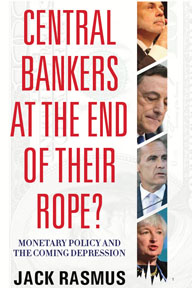
What follows is an excerpt from my just published book, ‘Central Bankers at the End of Their Rope: Monetary Policy and the Coming Depression’, Clarity Press, July 2017, which documents how the Federal Reserve and other central banks have failed and have set the stage for the next crisis. (For more information on the book, go to the publisher, Claritypress.com/RasmusIII.html). Books may be purchased at discount from this blog and my website through Paypal.

EXCERPT FROM CHAPTER ONE:

Why Central Banks Are Failing

Central banks are failing because their ability to perform their primary tasks of lender of last resort, money supply management and bank supervision is in decline. The question then is what are the causes of that decline? What developments and forces in the global economy are disrupting central banks efforts to carry out their primary tasks? The following is a brief introductory overview of the key problems and fundamental contradictions with which central banks today are confronted.

a. Globalization and integration rendering central bank targets and tools ineffective

First, there’s the problem of the rapid globalization and integration of financial institutions and markets that emerged in the 1970s and 1980s which has grown ever since. Central banks are basically national economic institutions. The global financial system is beyond their mandate. Not only that, there is no single central bank capable of bailing out the global banking system during the next inevitable global financial crash. In 2008 it didn’t even happen. The US Federal Reserve and the Bank of England bailed out their respective banking systems, providing more than $10 trillion in direct liquidity injections, loans, guarantees, tax reductions and direct subsidies. The Federal Reserve even provided a loan in the form of a currency swap of $1 trillion to the European Central Bank and its affiliated national central banks. But the Euro banking system has not been effectively bailed out to this day. Nor has Japan’s. Together both have the equivalent of trillions of dollars in non-performing bank loans. Total liquidity injected into the private banking system by the world’s major central banks was in excess of $25 trillion. But non-performing bank loans today are also still more than $15 trillion. So much for the alleged ‘bailout’ of the banking system since 2008. While China’s banks and central bank, the Peoples Bank of China, was not involved in the 2008 banking crash and subsequent bailout, it almost certainly will be involved in the next financial crisis. In fact, China’s financial system may be at the center of it.

The fact that the financial-banking system today is highly integrated and globalized raises another problem for central banks. With today’s banking system composed not only of traditional commercial banks, but of shadow banks, hybrid shadow-commercial banks, non-bank companies engaging increasingly in financial investing, and financial institutions in various new forms serving capital markets in general, no national central bank’s operational tools or policies can control the global money supply or ensure stability in goods and services prices.

The global 21st century financial system is also well beyond the reach of central bank supervision. How does a single central bank supervise banks that operate simultaneously in scores of countries and economies? Or banks that operate solely on the internet, or with a formal headquarters located on some remote island nation? Massive sets of real time data are required for effective supervision by any single central bank. But access may be denied by national political boundaries, or significantly delayed and obscured by the same. To be able to bailout in the event of a crash, to effectively control the global money supply, or to reasonably supervise, national central banks would have to integrate and coordinate their policies and actions across their respective national economies. But they are far from being able to achieve such coordination at present, and in fact appear increasingly fragmented and going in different, and at times, even opposite directions. As the capitalist banking system becomes more complex, more integrated and more globalized, central banking has become less coordinated across national economies, not more.

Even the most influential central bank, the US Federal Reserve, is unable to globally coordinate national central bank actions with regard either to bailout, money supply management, or bank risk activity supervision. As of 2017, the Fed appears even more intent on going its separate way, independent of other major national central banks in Europe and Asia.

b. Technological changes generating instability

A second area of major problems is associated with technological change. Apart from technology enabling the rapid globalization and integration of finance, and the problems that has created for central banks, technology is also changing the very nature of money itself, creating new forms that are difficult to measure and monitor. A gap is also growing between forms of money and forms of credit. Money may be used to provide credit, but credit is increasingly made available without central bank and traditional forms of money. Credit is increasingly issued by banks (and non-banks) independent of money supply provision policies and goals of central banks. Hence, central banks are losing control over the creation of credit regardless of efforts to influence it through money supply manipulation. And credit means debt and debt is critical to instability.

Twenty-first century technology is also upending the manipulation of the supply of money by central banks as well. By various means, technology is accelerating the movement of money capital, speeding up the ‘velocity of money’ flow, both cross-borders and in and out of markets. Technology has also enabled fast trading, split micro-second arbitrage, and is contributing to an increasing frequency of ‘flash crashes’ in recent years, in both stock and bond markets, that are capable of precipitating broader financial instability and crashes. Technology also accelerates the contagion effect across markets and financial institutions when an instability event erupts. Not least, technology makes it possible for banks to avoid central bank general supervision. It is easier to hide data on a server in the internet cloud than it is to store paper records in filing cabinets away from central bank inspectors. Central banks, with relatively small numbers of supervision staff and inspectors, simply cannot compete with banks with technical staffs and leading edge technical knowledge.

c. Loss of control of money supply and declining effect of interest rates

Technology is broadening the very definition and meaning of money, beyond the scope of influence available to central banks’ via the traditional tools they have used to influence money supply. That is one reason why central banks since 2008 have been experimenting so aggressively (and even recklessly) inventing new tools, like quantitative easing (QE), to try desperately to reassert control and influence. But other forces minimizing central bank control over money are at work as well, among them the rise and expansion of shadow banking (see section d. to follow).

Another related source of loss of control is associated with non-bank multinational corporations, which invest on a global scale. Should the US central bank, the Fed, seek to reduce the national money supply by raising national interest rates, multinational corporations can and do simply borrow elsewhere in the world, ignoring US central bank’s efforts. They can even borrow in dollars offshore, since dollar markets exist in Europe, Asia and elsewhere as a consequence of the Federal Reserve having flooding the world with liquidity in dollars for more than a half century.

Since their earliest development in the ‘middle’ period of banking, central banks have attempted to stimulate (or discourage) real investment in construction, factories, mines, transport infrastructure, machinery, etc. by raising (or lowering) benchmark interest rates. Interest rates are simply the ‘price of using or borrowing money’. But the price of money—i.e. the interest rate—is not determined solely by the supply of money; it is also determined by the demand for money and by the velocity of money as well. Both supply and demand
determine price fundamentally. . But central banks have never had much, if any, influence over money determinants of interest rates. Money demand is determined by general economic conditions at large, not by central bank actions.

Furthermore, both the supply and the demand for money (and thus interest rates) are determined also by the velocity of money. The velocity of money, however, is increasingly determined by technology developments.
Both money demand and money velocity are drifting further from central banks’ influence. And to the extent they do so, central banks may be said to be steadily losing control over interest rates since interest rates are determined by all three: money supply, money demand, and money velocity. Central banks are left with trying to influence just one element—money supply—as a means to control interest rates, but their influence here is diminishing as well, as the globalization of financial markets accelerates and multinational companies grow,enabling access to a multitude of forms and sources of credit.

Central banks thus have decreasing influence over even the money supply determinants of interest rates, let alone influence over both money demand and the velocity of money which are equally important determinants of rates. Central banks are steadily losing control of their key operational lever, the interest rate, as the means by which to influence economic activity. As will be addressed in subsequent chapters, this general fact is perhaps why central banks have abandoned the manipulation of interest rates as the means by which they
attempt to influence real economic activity in a given economy.

d. The rise and expansion of shadow banking

Shadow banks constitute a particular problem for central banks along a number of fronts. Shadow banks engage in high risk/high return investing and are thus often at the center of financial crises requiring central bank bailout. Shadow banks exacerbate the decline in central banks’ ability to determine money supply and in turn interest rates. And shadow banks are mostly beyond the scope of central banks’ supervisory activities, although some very minimal central bank supervision has been extended to some segments of the shadow banking world (e.g. mutual funds in the US) since 2008.

A body of academic and central bank literature has developed since 2008 on whether and how central banks (and governments in general) should increase their regulation of shadow banks. Standard financial regulation legislation and agencies’ rules address financial regulation of traditional banks. The new area addressing shadow banks is sometimes referred to as Macroprudential Regulation. But to quote Rubin—a former shadow banker himself—once again, central banks today are still light years away from being able to regulate the
shadow banking world. This is because “no one comes close to having identified the full reach of shadow banking or the systemic risks it poses”, which “would be a monumental undertaking for the United States alone” but “it becomes even more daunting once shadow banking outside of our borders is considered.”

As this writer has previously concluded, thinking that central banks can macro-prudentially regulate or effectively supervise shadow banks—given the magnitude and global scope of operations and growing political influence of shadow banking—is delusional. “Technology, geographic coordination requirements, opacity, bureaucracy, the massive money corruption of lobbying and elections by financial institutions, fragmented regulatory responsibilities, the sorry track record to date of Fed and other agencies’ regulatory efforts, and the multiple interlocking ties involving credit and debt between private banking forms—all point to the futility of regulating shadow banks in the reasonably near future.”

e. The magnitude and frequency of financial asset price bubbles

Central banks are failing to prevent or contain financial asset price bubbles. This particular failure is not just that they lack the tools, but that they lack the will to do so. This is in part political. There’s a lot of money to be made by capitalist investors and institutions when financial bubbles are growing. To intervene when the financial elite is ‘making money’ is to court the ire and intervention in turn by government supporters, political friends, and the corporate media.

As the former head of a major US bank during the 2008-09 crash, Charlie Prince, admitted when interviewed after the crash and asked did he not know the banking system was headed for financial Armageddon? Why did he not stop the excessive and risky investing practices at the time? Prince simply replied, ‘when you come to the dance, you have to dance’. What he meant was he (and likely other banker CEOs) knew the system was headed for a crash. But he couldn’t buck the trend without his shareholders, demanding to participate with other banks in the great profits and returns from the risky speculation in subprime bonds and derivatives. If Prince had swum against the tide, he undoubtedly would have been sacked by his Board and shareholders.

A similar powerful opposition would likely have descended on the Federal Reserve officials at the time in 2007-08, had they acted to ‘prick the asset bubble’ before it burst. But burst it did, causing trillions of dollars in bailouts in its wake. Central banks would rather try to clean up the mess from a bubble and crash than try to prevent it, or even slow it down. They and supporters in the media and academia therefore raise excuses and arguments justifying their non-intervention to prevent destabilizing financial asset price bubbles.

The main arguments include it is not possible to determine whether a bubble is in progress or not, until after the fact. Or it is too difficult to know if it’s a de facto bubble or just a normal financial market price escalation.Or, to deflate a financial bubble in progress is likely to set off a financial panic prematurely, and thus provoke the very condition that it was supposed to prevent. Or, central banks’ monetary tools aren’t designed to stop excessive asset price inflation in any event. Nor is responding to asset price bubbles part of the ‘mission’ of central banking. The mission is to prevent excessive price instability in real goods and services; to stabilize the price of money (e.g. interest rates), or maybe even to modestly encourage wage (factor prices) growth in order to support their mission of encouraging economic growth and employment (through consumption). But ‘hands off’ preventing on financial asset inflation or instability. Without saying it in such direct terms, what is meant is regulating financial asset prices and preventing bubbles is de facto directly regulating the rate of profit realization from financial asset market capital gains!

Nearly fifteen years ago, when just a member of the board of governors of the US Federal Reserve, for example, Ben Bernanke addressed in a formal speech the subject of financial asset bubbles intervention. He made it clear, leaving no doubt as to the policy of the central bank at the time, that it was neither desirable nor
possible to intervene to prevent financial asset bubbles. All a central bank was mandated to do was set a target for inflation, by which he meant a target for inflation in goods and services prices, not financial asset prices. Stabilizing goods prices would eventually stabilize financial asset prices in turn, it was assumed. But: to quote Bernanke at the time, before he was made chair of the US central bank in 2006, “an aggressive inflation-targeting rule [say 2% ?] stabilizes output and inflation when asset prices are volatile, whether the volatility is due to bubbles or to technological shocks…there is no significant additional benefit to responding to asset prices.” Years later, in 2012, as Federal Reserve chair, well after the crash of 2008-09, Bernanke held to the same view: “policy should not respond to changes in asset prices…trying to stabilize asset prices per se is problematic for a variety of reasons”…and it runs the “risk that a bubble, once ‘pricked’, can easily degenerate into a panic.”

What this mistaken view represents, however, is a denial that asset price bubbles are always followed by asset price bust and deflation, and that collapsing asset prices can and do have significant negative effects on the real economy and therefore on production, unemployment, decline in consumer spending and on prices of goods and services. The Bernanke view was simply wrong. But it served as a logical economic justification to not address financial price bubbles. And not a word about how monetary policies depressing interest rates for years, might cause central bank-provided liquidity to flow into financial asset markets and create the very bubbles that, according to Bernanke, the Fed and central banks should do nothing about!

Since Japan’s early financial crash in 1990-91, and its subsequent banking crash in 1997, scores and perhaps hundreds of academic journal articles and books have been written on the futility of doing anything about financial bubbles. Most echo the same logic: just target reasonable inflation for real goods and services and the rest will take care of itself. This traditional central bank view refusing to address financial bubbles continues to this day.

f. The growing political power of the global finance capital elite

Central banks both facilitate and are confronted with the rising political influence and power of the new global finance capital elite. The elite constitute the human agency driving the restructuring of the global economy in the 21st century that is responsible for creating most of the problems and contradictions confronting central banking today. Symptoms of their political influence include the successful deregulation of financial activities by governments, their corralling of an accelerating share of income and financial wealth from financial investing and speculation, and the absence of any prosecution and incarceration of their members when their practices precipitate financial crashes and their disastrous consequences on the public at large. Central banks have been unable thus far to ‘tame’ this new, aggressive, and ultimately destabilizing form of capitalist investment.

To listen to this show, go to:

http://prn.fm/?s=Alternative+Visions

Or go to:

http://alternativevisions.podbean.com

SHOW ANNOUNCEMENT

Alternative Visions radio welcomes guest, Pablo Vivanco, of Telesur Media in Latin America to explain what’s really going on in Venezuela as the Trump administration raises the spectre of possible military intervention in the democratic revolution in that country. Dr. Rasmus describes the measures by which US elites and its deep state since the 1950s typically engineer an overthrow of governments, by wrecking first the economy of the country (precipitating recessions, inflation, food-medical shortages,etc.), funding political opposition parties and groups, then taking over government institutions, generating domestic unrest and conflict, and ultimately counterrevolution regime change. Rasmus argues the US since 2015 has been ‘pivoting’ from the middle east to Latin America, as well as to Asia. Venezuela is now at the point of the US regime change spear in the western hemisphere. Journalist Pablo Vivanco is interviewed at length and explains what’s going on today with the recent election of a new Constituent Assembly in Venezuela and what it aims to accomplish as it blunts counter-revolution and regime change efforts by US and domestic business interests in Venezuela. The popular support for the Constituent Assembly, structured on grass roots organizations, is described by Vivanco and where events may be next leading.

Now publicly available for order from the publisher, Claritypress/RasmusIII.html, from public bookstores, and from this blog, the following is the synopsis of the book, ‘Central Bankers at the End of Their Rope?: Monetary Policy and the Coming Depression’.

BOOK SYNOPSIS

“Central banks of the advanced economies—despite having been
designated by their respective economic and political elites as
their states’ primary economic policy institution—have failed
since 2008 to permanently stabilize the world’s banking systems or
restore pre-2008 economic growth.

Rather, central bank liquidity injections since the 1970s not only
produced the 2008-09 crisis, but they then became the central
banks’ solution to that crisis; and now promise to cause of the
next one, as a further tens of trillions of dollars of liquidity-
enabled debt has since 2008 been piled on the original trillions
before 2008.

Fed policy since 2010 has represented an historically
unprecedented subsidization of the financial system by the State,
implemented via the institutional vehicle of the central bank.
Central banks’ function of lender of last resort, originally
designed to provide excess liquidity in instances of banking
crises, has been transformed into the subsidization of the private
banking system, which today is addicted to, and increasingly
dependent upon, significant continuing infusions of liquidity by
central banks.

Taking away this central bank artificial subsidization of the private
sector, especially the financial side of the private sector, would
almost certainly lead to a financial and real collapse of the global
economy. It is thus highly unlikely that the Fed, Bank of England,
Bank of Japan or European Central Bank will be able any time
soon to retreat much from their massive liquidity injections that
have been the hallmark of central bank policy since 2008. Nor will
they find it possible to raise their interest rates much beyond
brief token adjustments. Nor exit easily from their bloated
balance sheets and extraordinary historic policies of liquidity
provisioning. That liquidity not only bailed out the banks and
financial system in 2007-09, but has been subsidizing the system
ever since in order to prevent a re-collapse.

Truly, as this book addresses in painstaking detail, central
bankers are at the end of their rope. Wrought by various growing
contradictions, central banks, as currently structured, have failed
to keep pace with the more rapid restructuring and change in the
private capitalist banking system. As a result, they have been
failing to perform effectively even their most basic functions, or
to achieve their own declared targets of price stability and
employment.

Official excuses for that failure are critiqued and rejected.
Alternative reasons are offered, including:
• the declining effects of interest rates on investment,
• the relative shift to financial asset investing at the expense
of real investment,
• failure of central banks to intervene and prevent financial
asset bubbles,
• the purposeful fragmentation of bank supervision across
regulatory institutions,
• mismanagement of the traditional money supply,
• rapid technological changes transforming the very nature of
money, credit and financial institutions and markets worldwide,
• monetary tools ineffectiveness and incorrect targets, and
• central bankers’ continuing adherence to ideological
notions of the mid-20th century that no longer hold true in the
21st—like the Taylor Rule, Phillips curves, and, in the case of ZIRP(zero interest rates) and NIRP (negative interest rates), the idea that the cost of borrowing is what first and foremost determines real investment.

Central banks must undergo fundamental restructuring and
change. That restructuring must include the democratization of
decision making and a redirecting of central banks toward a
greater direct service in the public interest. A Constitutional
Amendment is therefore proposed, along with 20 articles of
enabling legislation, addressing what reforms and restructuring
of central banks’ decision making processes, tools, targets,
functions, as well as their very mission and objectives, are
necessary if central banks are to become useful institutions for
society in general. The proposed amendment and legislation
defines a new mission and general goals for the Fed—as well as
new targets, tools and new functions—to create a new kind of
public interest Federal Reserve for the 21st century.

Jack interviews Labor Fightback Network representatives on their recent conference in Cleveland on the Alternative Visions Radio Show, and discusses recent grass roots worker-community movements and debates how to resurrect the US union movement.

To Listen Go To:

http://prn.fm/?s=Alternative+Visions

or to:

http://alternativevisions.podbean.com

SHOW ANNOUNCEMENT

Host Jack Rasmus interviews guest members of the Labor Fightback Network and their recent conference held in Cleveland. The Network is an organization of local union activists, elected officers, and select union representatives attempting to return the US union movement to a tradition of independent political action, progressive economic demands like ‘Medicare for All/Single Payer’, and labor community alliances. Jack interviews Alan Benjamin, a member of the LFN steering committee, on the program of the organization. A lively discussion follows on the need to resurrect the labor movement in the US, now at a nadir, and restore it to the role it once had. Discussion ranged from new forms of independent political action occurring, movements for $15 minimum wage, single payer, efforts to draft Bernie Sanders as a candidate for a Peoples Party, the accelerating rise of membership in the Democratic Socialists of America, DSA, grass roots electoral efforts like the Richmond Alliance, and others. Rasmus argues union resurrection in US history were always associated with new organizational forms—from the Knights of Labor to the AFofL to the industrial union CIO—and today a new organizational form of struggle will be required once again, not just the traditional union structure that remains. Benjamin differs and sees a resurrection and lead by the union movement itself. Both agree new resistance from below, led by young workers, is beginning to occur. (For more information on the Labor Fightback Network and its program, go to the website, http://laborfightback.org.

(Next week’s August 18 Alternative Visions radio show will feature activists from inside Venezuela and a first hand report on what’s really happening there not available in the US mainstream media)

The following article appeared August 10 on Global Research, Canada, and other major blogs. The analysis is based on content from the just published book, ‘Central Bankers at the End of Their Rope?: Monetary Policy and the Coming Depression’, by Dr. Jack Rasmus, Clarity Press, July 2017

“As central bankers, finance ministers, and government policy makers head off to their annual gathering at Jackson Hole, Wyoming, this August, 24-26, 2017, the key topic is whether the leading central banks in North America and Europe will continue to raise interest rates this year; another topic high on the agenda is when the three major central banks – the Federal Reserve, European Central Bank and Bank of England – might begin to sell off their combined $9.8 trillion dollar balance sheets that they accumulated since the 2008-09 banking crisis.

But the more fundamental question – little discussed by central bankers and academics alike – is what are the likely effects of further immediate rate hikes and/or commencement of central banks’ balance sheet reductions? The assumption is further rate hikes and sell-offs will have little negative impact on the real economy or financial markets. But will they? The effects of hikes and sell off will prove the opposite of what they predict.

Central banks in the US and Europe were grossly in error predicting in 2008 that massive liquidity injections and zero interest rates would re-stimulate their economies and return them to pre-crisis real GDP growth rates. They are now about to repeat a similar error, as they presume that raising those rates, and retracting excess liquidity by selling off balance sheets, will not have a significant negative impact on the real economy or financial markets.

Central banks’ balance sheets have been growing for almost nine years, driven by programs of zero-bound (ZIRP) interest rates and the introduction of firehose liquidity injections enabled by quantitative easing, QE, bond and other securities purchases.

After eight years, the official consensus among central bankers and government policy makers is that the 2008 shift to unlimited central bank liquidity and zero (or below) interest rates is now over. The front page business press and media lead story is that central banks are now about to embark collectively in a new direction – raising their benchmark rates and selling off their massive, bloated balance sheets. But don’t bet on it. They may find sooner, rather than later, that rates cannot be raised much higher and that balance sheets—now totaling $9.8 trillion for the US, UK and Europe alone—may not be reduced much, if at all, without provoking a further slowdown of their still chronically weak real economic recoveries, or without precipitating a serious contraction in equity, bond and other financial asset markets.
Image result

Globally, balance sheet totals are actually far greater than the $9.8 trillion accumulated to date by the big 3 central banks—the Fed, Bank of England, and European Central Bank. When other major central banks, like Switzerland’s, Sweden’s, Canada’s and others are added, it’s well more than $10 trillion. And then there’s the nearly $5 trillion balance sheet of the Bank of Japan and the more than $5 trillion of the People’s Bank of China. Worldwide, central banks’ balance sheets therefore exceed well over $20 trillion…with the total still growing.

It’s equally important to understand that the $20 trillion in central bank balance sheet debt essentially represents bad debt from banks, corporations, and private investors that was in effect transferred from their private balance sheets to the balance sheets of the central banks as a result of nine years of bailout via QE (quantitative easing), zero interest rate free money, and other policies of the central banks. The central banks bailed out the capitalist system in 2008-09 by shifting the bad debts to themselves. In the course of the last 9 years, the private system loaded itself up on still more debt than it had in 2007. Can the central banks, already bloated with $20 trillion bail out bankers and friends once again? That’s the question. Attempting to unload the $20 trillion to make room for the next bailout—as the central banks now propose to do—may result, however, in precipitating the next crisis. That’s the contradiction.

Attempting to sell off such massive balance sheet holdings will prove far more daunting than those central banks now anticipate. And their coordinated raising of interest rates risks precipitating another recession – given their fundamentally weak economies with chronic low bank lending, slowing investment, stagnating productivity, contracting public investment, and lack of real wage income gains. For the global economy has undergone a major structural change in recent decades that has been rendering central bank interest rate policies increasingly ineffective with regard to stimulating real investment and growth, while simultaneously contributing to further financial fragility as well.1

The US Economy is Fragile and Weakening—Not Robust and Stable

All eyes are on the US central bank, the Fed, and what signals it gives at the Jackson Hole August 24-26 gathering, and the Fed’s subsequent policy committee in September. Will it continue to raise rates? Will it announce formally a schedule for balance sheet reduction in September? If the latter, will the announcement of sell-off be so minimal and token that it will generate a mere 0.25% hike in rates by year end 2018, as some pundits predict? Or will the psychological effects on investors – who have enjoyed eight years of record equity, bond, property, and derivatives asset price and thus extraordinary capital gains – consider the announcement as the signal to “cash in” and take their money and run, given the bubble levels already attained in equities, some bond markets, and real estate? And should the Fed continue to raise interest rates at a pace of 3 to 4 a year, what will be the impact on the US real economy?

Economic potholes are beginning to appear in a number of places. Bank lending to US business has declined sharply, now growing at only 2%; consumer loans for auto, mortgages and credit cards have halved over the past year; real investment and productivity have nearly collapsed; the so-called “Trump Bump” has dissipated; government investment has contracted below 2007 levels and infrastructure spending is still but a discussion envisioned for 2019 at the earliest, if at all; and job growth has been consistently low quality, resulting in wage stagnation or worse for the vast majority of the labor force.

In this unstable environment the Fed has nonetheless has announced plans to continue to raise interest rates and to begin selling off its balance sheet. The question is just how much and when? Consensus thinking at the Fed is that rates can continue rising 3 to 4 times a year at .25 basis points a crack through 2019 without serious negative effects. And that the Fed’s balance sheet can start selling off immediately in 2017, initially at a modest rate of $10 billion a month, accelerating further at a later date.

But these were the same central bankers who believed their QE and zero bound rate programs would return the US real economy to robust growth by 2010 but didn’t; who maintained the Fed’s massive liquidity injections would attain a 2% goods and services inflation rate, which it still hasn’t; who argued that once unemployment fell to 4.5% (in the US), wage growth and consumption would return to past trends and stimulate the economy, which has yet to occur; and who argued in 2008, also incorrectly, that Fed QE programs providing bankers virtually free money would stimulate bank lending and in turn real investment and growth. The Fed’s latest predictions could prove no more correct about the consequences of further rate hikes and balance sheet reductions than they were about QE, ZIRP, and all the rest for the past eight years.

It’s Not Your Grandpa’s Global Economy

To assume that selling off that magnitude of securities – even if slowly and over extended time – will not have an appreciable impact on nominal interest rates is the kind of assumption that resulted in previous predictive errors circa 2008 since the possible effects on investors’ psychological expectations of more rate hikes and balance sheet selling are completely unknown.
Image result

After eight years of treating symptoms and not the disease, the global financial system has become addicted to super-low rates and to continued central bank excess liquidity provisioning. What started in 2008 as a massive, somewhat coordinated central bank lender of last resort experiment – i.e. global bank bailout – has over the past eight years evolved into a more or less permanent subsidisation of the private banking and financial systems by central banks. The system has become addicted to free money. And like all addictions, the habit won’t be broken easily. That means central bankers’ plans to raise interest rates in the immediate months ahead will likely “hit a wall” well before the announced rate levels they are projecting. Plans to sell off balance sheets will almost certainly be limited to the US Fed for some time. The ECB and BOE – as well as Bank of Japan and others – will wait and see what the Fed does. The Fed will proceed at a snails pace that will represent little more than mere tokenism, and in the event of further slowing of real GDP growth, or US financial markets correcting in a major way, it will halt selling altogether. In short, there will be little Fed balance sheet reduction before the next recession, and a continued escalation of balance sheets by central banks globally. Central banks will enter the next recession with further bloated balance sheets.

After eight years of treating symptoms and not the disease, the global financial system has become addicted to super-low rates and to continued central bank excess liquidity provisioning.

The Fed is thus on the verge of another major disastrous monetary policy shift and experiment. It will be unable to raise interest rates as it has announced, by 3 to 4 times a year for the next two years. Nor will it be able to sell off much of its current balance sheet, since anything but token adjustments will accelerate rates even higher. In this writer’s opinion, the federal funds rate cannot be raised above 2%, or the 10 year Treasury yield much above 3%, without precipitating either a serious financial market correction or an abrupt slowing of real economic growth, or both.

What the eight years since the 2008-09 financial crash and great recession reveals is that the major central banks, led by the Fed, have painted themselves in a corner. The massive liquidity provided to their banking systems – engineered by zero rates and QEs – failed even to adequately bail out their banks. Today more than $10 trillion in non-performing bank loans still overhang the major economies, despite the more than $20 trillion added to their central bank balance sheets in just the past eight years.

The fundamental changes in the global economy and radical restructuring of financial, capital and labor markets have severely blunted central banks’ main monetary tool of interest rate management. Just as reduction of rates have little positive effect on stimulating real investment and economic growth, rising rates will have a greater negative impact than anticipated on investment and growth. The Fed and other central banks may soon discover this should they raise rates much faster and further or engage in more than token balance sheet reduction.
Central bankers at the Fed, the BOE and ECB will of course argue the contrary.

They will promise the economy can sustain further significant rate hikes and can commence selling its balance sheet without severe negative consequences. But these are the same people who in 2008 promised rapid and robust recovery from QE and ZIRP programs that didn’t happen. What happened was an unprecedented acceleration in financial asset markets as equity and bond prices surged for eight years, high end real estate prices rose to prior levels, derivatives boomed, gold and crypto-currencies escalated in value, and income inequality soared to record levels – all fueled by the massive $10 trillion central bank liquidity injections that drove interest rates to zero or below. And now they tell us they plan to raise those rates without serious negative effects. Anyone want to buy the Brooklyn bridge? I think they’re also trying to sell that as well.

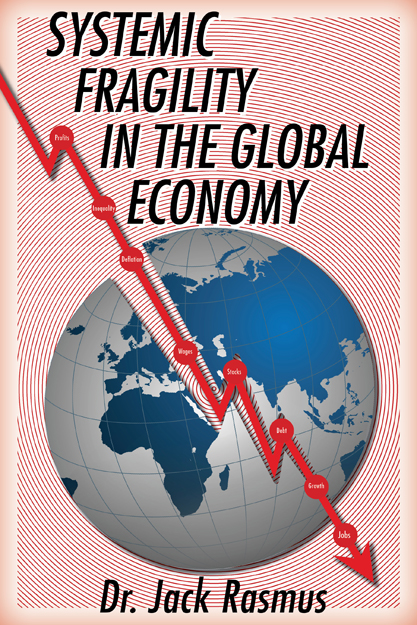
Dr. Jack Rasmus is author of the just published book, “Central Bankers at the End of Their Ropes? Monetary Policy and the Next Depression”, Clarity Press, July 2017, and the previously published “Systemic Fragility in the Global Economy”, also by Clarity Press, January 2016. For more information: http://ClarityPress.com/RasmusIII.html.

He hosts the radio show, Alternative Visions, on the Progressive Radio Network. He blogs at jackrasmus.com.

Source

1. For the author’s 2016 analysis of global financial restructuring, Systemic Fragility in the Global Economy, Clarity Press, January 2016. How central banks’ policies are failing is addressed in more detail in the just published book, Central Bankers at the End of Their Ropes: Monetary Policy and the Next Depression, by Jack Rasmus, Clarity Press, July 2017.

My August 4, 2017 Alternative Visions radio show was dedicated to providing an overview of the 35 year neoliberal strategy of corporate-investor tax cutting in the USA and the shifting tax burden to the working and middle class. A new major round of tax cuts has now risen to the top of the Congress-Trump agenda, with a target for passage either late this year or, if not, certainly before the 2018 midterm Congressional elections. To understand the background history and trends to the latest in neoliberal tax cutting 2017-18, access the podcast.

To Listen to the Show

Go to:

http://prn.fm/?s=Alternative+Visions

Or go to:

http://alternativevisions.podbean.com/

SHOW ANNOUNCEMENT

Multi-trillion dollar corporate and investor tax cuts by December have moved to the top of the Republican Congress-Trump legislative agenda. Dr. Rasmus puts the proposals in historical context, describing the corporate-investor tax cuts from Reagan through Clinton and GW Bush to Obama and now Trump. From the $750 billion Reagan bill in 1981-82 to Bush’s $3.7 trillion to Bush-Obama $480 billion in 2008-09 to Obama’s $1.245 trillion in 2010-12 and Obama’s continuation of the Bush tax cuts in 2013 for another decade that cost $5 trillion. Corporate-investor tax cutting as an essential element of Neoliberal economic policy since 1978. How Congress alternates between nominal tax rate reduction and token tax loophole reduction, then raises nominal tax rates and expands tax loopholes. How for 40 years the share of total taxes paid by corporations and wealthy household investors has declined, while the share of taxes for working and middle class has accelerated. The key elements of the Trump-Ryan tax proposals to date are reviewed.

(Listen to my Alternative Visions radio show this coming week, August 11, 2pm new york time, on the progressive radio network, when I interview a guest from Venezuela, to discuss events underway in that country as class conflicts intensify: see the link above to the radio show)

The following article was published in the European Financial Review, July 20, 2017, summarizing and presenting major themes from my just published, latest book, ‘Central Bankers at the End of Their Ropes’, Clarity Press, July 2017. (The book may be ordered from this blog or my website at discount. See the book icon. Or from the publisher, Clarity press at http://www.claritypress.com/RasmusIII.html. )

THE LIMITS OF CENTRAL BANKS’ EMERGING POLICY SHIFT’, by Dr. Jack Rasmus, European Financial Review, July 20, 2017.

“The major central banks have a plan, but its consequences are questionable. In this article, Dr. Jack Rasmus analyses past and present factors of the global economy, from balance sheets to policy shifts, which have significant influence on the possible future of the financial industry and the global society as a whole.
As central bankers, finance ministers, and government policy makers head off to their annual gathering at Jackson Hole, Wyoming, this August, 24-26, 2017, the key topic is whether the leading central banks in North America and Europe will continue to raise interest rates this year; another topic high on the agenda is when the three major central banks – the Federal Reserve, European Central Bank and Bank of England – might begin to sell off their combined $9.8 trillion dollar balance sheets that they accumulated since the 2008-09 banking crisis.
But the more fundamental question – little discussed by central bankers and academics alike – is what are the likely effects of further immediate rate hikes and/or commencement of central banks’ balance sheet reductions? The assumption is further rate hikes and sell-offs will have little negative impact on the real economy or financial markets. But will they?

Central banks in the US and Europe were grossly in error predicting in 2008 that massive liquidity injections and zero interest rates would re-stimulate their economies and return them to pre-crisis real GDP growth rates. They are now about to repeat a similar error, as they presume that raising those rates, and retracting excess liquidity by selling off balance sheets, will not have a significant negative impact on the real economy or financial markets.

The Central Banks Monetary Policy Shift

Central banks’ balance sheets have been growing for almost nine years, driven by programmes of zero-bound (ZIRP) interest rates and the introduction of firehose liquidity injections enabled by quantitative easing, QE, bond and other securities purchases.

After eight years, the official consensus among central bankers and government policy makers is that the 2008 shift to unlimited central bank liquidity and zero (or below) interest rates is now over. The front page business press and media lead story is that central banks are now about to embark collectively in a new direction – raising their benchmark rates and selling off their massive, bloated balance sheets. But don’t bet on it. They may find sooner, rather than later, that rates cannot be raised much higher and that balance sheets may not be reduced much, if at all, without provoking a further slowdown of their still chronically weak real economic recoveries, or without precipitating a serious contraction in equity, bond and other financial asset markets.

In 2008-09 the Federal Reserve quickly dropped its benchmark federal funds rate from 5.25% to a mere 0.15% by January 2009. It followed with its initial bond buying QE1 programme in early 2009. By 2013 the Fed’s net balance sheet rose to $4.5 trillion.

The front page business press and media lead story is that central banks are now about to embark collectively in a new direction – raising their benchmark rates and selling off their massive, bloated balance sheets. But don’t bet on it.
The Bank of England promptly followed the Fed. It reduced its rates from 5% in September 2008 to 0.5% by early 2009, followed by a launch of several QE-like bond and equity buying programmes and then its formal QE “Asset Purchase Plan” in early 2009. Its net balance sheet level rose to approximately $600 billion.

Lacking full central bank authority at the time of the 2008 crash, the European Central Bank lowered rates initially more slowly while injecting more than $2 trillion in liquidity by various pre-QE programmes from 2010 to 2014, eventually introducing its highly aggressive QE programme beginning early 2015. Its rate and liquidity programmes drove Eurozone sovereign nominal bond rates to negative levels, as its aggressive $2.5 trillion QE programme raised its balance sheet to more than $4.7 trillion.

That’s a combined balance sheet total of roughly $9.8 trillion as of mid-2017 for the three major central banks alone.

Globally, however, balance sheet totals are actually far greater than the $9.8 trillion. When other major central banks, like Switzerland’s, Sweden’s, Canada’s and others are added, it’s well more than $10 trillion. And then there’s the nearly $5 trillion balance sheet of the Bank of Japan and the more than $5 trillion of the People’s Bank of China. Worldwide, central banks’ balance sheets therefore exceed well over $20 trillion…with the total still growing.

Attempting to sell off such massive balance sheet holdings – even the $9.8 trillion of the three central banks in Europe and America – may prove far more daunting than those central banks now anticipate. And their coordinated raising of interest rates risks precipitating another recession – given their fundamentally weak economies with chronic low bank lending, slowing investment, stagnating productivity, contracting public investment, and lack of real wage income gains. For the global economy has undergone a major structural change in recent decades that has been rendering central bank interest rate policies increasingly ineffective with regard to stimulating real investment and growth, while simultaneously contributing to further financial fragility as well.1

The New Normal: Unstable Interest Rate Elasticity Effects

In 2008-09 all three central banks quickly reduced their benchmark rates and began to add trillions of dollars, pounds and euros to their balance sheets. But real investment and GDP growth lagged, and periodically stagnated in the US and UK, and even contracted again in the Eurozone. In economists’ jargon, the elasticity of real investment to interest rate cuts was highly “inelastic” – i.e. the collapse of rates and accelerated central bank liquidity produced insufficient real investment, employment, and wage incomes necessary to restore pre-crisis GDP growth.

Now that central banks are reversing those policies – with the Fed in the lead and the BOE and ECB expected to follow – a “mirror image” of the error of the past eight years may emerge: it will take very little in terms of rate hikes or balance sheet reductions (which will also raise rates) to generate a further contraction in real investment and growth, and may even precipitate a major correction in financial market prices.

In other words, the negative impact of pending rate hikes on investment may prove highly elastic, just as it proved in the past that rate cuts’ positive effects on real investment were highly inelastic.

This may seem anomalous – i.e. rate reductions post-2008 had little positive effect on real investment and growth, but rate hikes now will have a quick and major negative impact on investment and growth. But it is not. The same global forces and restructuring in financial, capital, and labour markets that have taken place in recent decades causally underlie both effects. The global economy crossed a threshold in 2008-09 that is still not very well understood by central bankers and economists alike. The anomaly is only apparent.2 The causes are the same.

What then are the likely scenarios with regard to the three central banks – Fed, ECB and BOE – in the next six to twelve months as they attempt to shift their policies of the preceding eight years by raising rates and selling off balance sheets?

Three Scenarios: BOE, ECB & the Fed

The Bank of England’s (BOE) initial QE experiment was temporarily halted when the Fed suspended expanding its QE programmes in 2013, but QE was re-introduced in 2016 in the wake of Brexit. As of mid-2017, moreover, the BOE shows no indication that it will not continue its QE programme and thereby expand its balance sheet. Embroiled an in increasing difficult implementation of Brexit, and what appears to be several more years of growing economic uncertainty, the UK economy has begun to show signs of weakening in recent months. The BOE will therefore continue to add liquidity, both by QE and traditional means, in order to prop up UK financial markets in the interim. Balance sheet sell off is thus not imminent anytime soon.

On the other hand, more likely is the BOE will follow the Fed should the latter continue to raise rates, raising its benchmark marginal lending or discount rate to prevent a further decline of the UK currency to ensure much needed money capital inflows and to slow rising import inflation that comes with currency decline. So expect more rate hikes from the BOE, as well as more balance sheet accumulation.

Nor will the ECB’s balance sheet be appreciably reduced any time soon. European Central Bank chair, Mario Draghi, plans to attend the Jackson Hole gathering of central bankers and friends. It will be his first appearance since three years ago, where in 2014 he signalled the ECB was planning to introduce its version of quantitative easing, QE, which it did in early 2015. But this time it is highly unlikely Draghi will signal the ECB to follow the Fed in any reduction of its own $4.7 trillion balance sheet. More likely is some ECB intent to slow its QE bond accumulation programme in 2018 – i.e. after it sees what the US Fed will do in what remains in 2017 and after it replaces current chair, Janet Yellen, with former Goldman Sachs banker, Gary Cohn, next February 2018. Meanwhile, the ECB will allow rates to drift upward from their former negative and zero levels. Like the BOE’s, the ECB’s balance sheet will therefore continue to grow, as rates are allowed to rise in coordination with the Fed.

All eyes are therefore on the US central bank, the Fed, and what signals it gives, and its follow up, to the Jackson Hole August gathering, and the Fed’s policy committee in September. Will it continue to raise rates? Will it announce formally a schedule for balance sheet reduction in September? If the latter, will the announcement of sell-off be so minimal and token that it will generate a mere 0.25% hike in rates by year end 2018, as some pundits predict? Or will the psychological effects on investors – who have enjoyed eight years of record equity, bond, property, and derivatives asset price and thus extraordinary capital gains – consider the announcement as the signal to “cash in” and take their money and run, given the bubble levels already attained in equities, some bond markets, and real estate? And should the Fed continue to raise interest rates at a pace of 3 to 4 a year, what will be the impact on the US real economy?

Economic potholes are beginning to appear in a number of places. Bank lending to US business has declined sharply, now growing at only 2%; consumer loans for auto, mortgages and credit cards have halved over the past year; real investment and productivity have nearly collapsed; the so-called “Trump Bump” has dissipated; government investment has contracted below 2007 levels and infrastructure spending is still but a discussion envisioned for 2019 at the earliest, if at all; and job growth has been consistently low quality, resulting in wage stagnation or worse for the vast majority of the labour force.

In this unstable environment the Fed has nonetheless has announced plans to continue to raise interest rates and to begin selling off its balance sheet. The question is just how much and when? Consensus thinking at the Fed is that rates can continue rising 3 to 4 times a year at .25 basis points a crack through 2019 without serious negative effects. And that the Fed’s balance sheet can start selling off immediately in 2017, initially at a modest rate of $10 billion a month, accelerating further at a later date.

But these were the same central bankers who believed their QE and zero bound rate programmes would return the US real economy to robust growth by 2010 but didn’t; who maintained the Fed’s massive liquidity injections would attain a 2% goods and services inflation rate, which it still hasn’t; who argued that once unemployment fell to 4.5% (in the US), wage growth and consumption would return to past trends and stimulate the economy, which has yet to occur; and who argued in 2008, also incorrectly, that Fed QE programmes providing bankers virtually free money would stimulate bank lending and in turn real investment and growth. The Fed’s latest predictions could prove no more correct about the consequences of further rate hikes and balance sheet reductions than they were about QE, ZIRP, and all the rest for the past eight years.

It’s Not Your Grandpa’s Global Economy

To assume that selling off that magnitude of securities – even if slowly and over extended time – will not have an appreciable impact on nominal interest rates is the kind of assumption that resulted in previous predictive errors circa 2008 since the possible effects on investors’ psychological expectations of more rate hikes and balance sheet selling are completely unknown.

After eight years of treating symptoms and not the disease, the global financial system has become addicted to super-low rates and to continued central bank excess liquidity provisioning. What started in 2008 as a massive, somewhat coordinated central bank lender of last resort experiment – i.e. global bank bailout – has over the past eight years evolved into a more or less permanent subsidisation of the private banking and financial systems by central banks. The system has become addicted to free money. And like all addictions, the habit won’t be broken easily. That means central bankers’ plans to raise interest rates in the immediate months ahead will likely “hit a wall” well before the announced rate levels they are projecting. Plans to sell off balance sheets will almost certainly be limited to the US Fed for some time. The ECB and BOE – as well as Bank of Japan and others – will wait and see what the Fed does. The Fed will proceed at a snails pace that will represent little more than mere tokenism, and in the event of further slowing of real GDP growth, or US financial markets correcting in a major way, it will halt selling altogether. In short, there will be little Fed balance sheet reduction before the next recession, and a continued escalation of balance sheets by central banks globally. Central banks will enter the next recession with further bloated balance sheets.

After eight years of treating symptoms and not the disease, the global financial system has become addicted to super-low rates and to continued central bank excess liquidity provisioning.

The Fed is thus on the verge of another major disastrous monetary policy shift and experiment. It will be unable to raise interest rates as it has announced, by 3 to 4 times a year for the next two years. Nor will it be able to sell off much of its current balance sheet, since anything but token adjustments will accelerate rates even higher. In this writer’s opinion, the federal funds rate cannot be raised above 2%, or the 10 year Treasury yield much above 3%, without precipitating either a serious financial market correction or an abrupt slowing of real economic growth, or both.

What the eight years since the 2008-09 financial crash and great recession reveals is that the major central banks, led by the Fed, have painted themselves in a corner. The massive liquidity provided to their banking systems – engineered by zero rates and QEs – failed even to adequately bail out their banks. Today more than $10 trillion in non-performing bank loans still overhang the major economies, despite the more than $20 trillion added to their central bank balance sheets in just the past eight years.

The fundamental changes in the global economy and radical restructuring of financial, capital and labour markets have severely blunted central banks’ main monetary tool of interest rate management.

The fundamental changes in the global economy and radical restructuring of financial, capital and labour markets have severely blunted central banks’ main monetary tool of interest rate management. Just as reduction of rates have little positive effect on stimulating real investment and economic growth, rising rates will have a greater negative impact than anticipated on investment and growth. The Fed and other central banks may soon discover this should they raise rates much faster and further or engage in more than token balance sheet reduction.
Central bankers at the Fed, the BOE and ECB will of course argue the contrary.

They will promise the economy can sustain further significant rate hikes and can commence selling its balance sheet without severe negative consequences. But these are the same people who in 2008 promised rapid and robust recovery from QE and ZIRP programmes that didn’t happen. What happened was an unprecedented acceleration in financial asset markets as equity and bond prices surged for eight years, high end real estate prices rose to prior levels, derivatives boomed, gold and crypto-currencies escalated in value, and income inequality soared to record levels – all fueled by the massive $10 trillion central bank liquidity injections that drove interest rates to zero or below. And now they tell us they plan to raise those rates without serious negative effects. Anyone want to buy the Brooklyn bridge? I think they’re also trying to sell that as well.

About the Author

Dr. Jack Rasmus is author of the just published book, “Central Bankers at the End of Their Ropes? Monetary Policy and the Next Depression”, Clarity Press, July 2017, and the previously published “Systemic Fragility in the Global Economy”, also by Clarity Press, January 2016. For more information: http://ClarityPress.com/RasmusIII.html. He teaches economics at St. Marys College in Moraga, California, and hosts the radio show, Alternative Visions, on the Progressive Radio Network. He blogs at jackrasmus.com and his twitter handle is @drjackrasmus.

References
1. For the author’s 2016 analysis of global financial restructuring, Systemic Fragility in the Global Economy, Clarity Press, January 2016.
2. The theme of how central banks’ interest rate policies are failing is addressed in more detail in the just published book, Central Bankers at the End of Their Ropes: Monetary Policy and the Next Depression, by Jack Rasmus, Clarity Press, July 2017.

To listen to my Alternative Visions show and discussion of the ways the global economy has crossed an economic rubicon after 2008, unable to restore neoliberal policies and trends, GO TO:

http://prn.fm/alternative-visions-global-economy-crossed-rubicon/

Or Go To:

https://alternativevisions.podbean.com/e/alternative-visions/

SHOW ANNOUNCEMENT

Dr. Rasmus explains how the global capitalist economy crossed a kind of economic rubicon with the 2008-09 global crash and has not been able to restore itself to pre-crisis trends. With 2008, the growth in global trade as a percent of global GDP hit a wall, stagnated after, and is now declining as a percent of global GDP which itself has been slowing. Rasmus explains further how total investment has been shifting from real investment to financial asset markets, reflecting the continuing post-2008 financialization trend globally. Another post-2008 development noted is that central banks worldwide have had to step in to subsidize banks and the system since 2008 at a cost of $15 to $20 trillion. Another trend is household real incomes and global productivity. How new corporate practices since 1980 have simultaneously driven down wages are noted. Studies show 80% of household incomes in the US have stagnated or declined since 2008; 75% in Europe; and 70% in all advanced economies, according to McKinsey reports. Meanwhile, productivity has collapsed from long term 2% per year average to only 0.4% in US by 2014 and lower still. Rasmus raises the question: have ‘neoliberal’ policies—at the heart of which are free trade, central bank subsidization of capital, wage compression, and global financialization—thus now approach a limit?

To listen to my Alternative Visions Radio show of July 14, 2017, how central banks and political elites since 2008 have emphasized monetary policy (and imposed fiscal austerity) as the strategy to provide permanent subsidization of the private, capitalist banking system to the tune of more than $20 trillion. And how this subsidization strategy is leading to the next financial crisis. It’s not about bailing out banks, but about subsidizing them even after they’ve been bailed out.

Go To:

http://prn.fm/?s=Alternative+Visions

or Go to:

http://alternativevisions.podbean.com

SHOW ANNOUNCEMENT

Dr. Rasmus explains how the advanced capitalist economies—US, UK, Europe, Japan—have made monetary policy and their central banks the ‘only game in town’ since 2008, and provided more than $20 trillion in virtually free money to their capitalist banking systems, in effect creating a permanent subsidization of the banks since 2008. Now the Fed and other central banks are attempting to reduce the free money a little by raising interest rates and selling off their $15 trillion plus balance sheets of accumulated prior bank bailouts. Rasmus argues that having continued too long with too low rates (8 years), central banks now face a ‘grand contradiction’: they cannot raise rates or sell off very much without precipitating another crisis. He predicts a 2% federal funds rate and 3% 10 year Treasury bond rate are likely the limits. That means central banks’ solution to the last crisis, and the permanent subsidization of the banks since 2008, has created the conditions for the next crisis. Rasmus explains how and why this permanent subsidization of the banks regime has come about, including the takeover of the central banks, and their governments’ economic institutions, by the big banks themselves. Goldman Sachs now runs US economic policy from the Treasury to the Fed (and Cohn will soon replace Yellen). Rasmus challenges Yellen’s view that falling US prices are ‘transitory’ and will soon rise, and the US economy is strong, despite collapsing bank lending, government tax revenues, and stagnant prices and real wages.

How central banks have assumed a new primary function, no longer just ‘lender of last resort’ (bank bailout) but ‘permanent subsidization of the private banking system’ in the post-2008 period, when central bank monetary policy has become primary and austerity the policy for government spending. Dr. Rasmus reviews the 5 main themes of his just released book, ‘Central Bankers at the End of Their Ropes: Monetary Policy and the Next Depression’ and explains why Fed and other central banks’ now raising interest rates and planning to sell off their balance sheet debt will precipitate another crisis if rates are raised much further or sell-offs are substantial. Central banks today confront a ‘Great Contradiction’.

TO listen go to:

http://prn.fm/?s=Alternative+Visions

Or go to:

http://alternativevisions.podbean.com

SHOW ANNOUNCEMENT:

Dr. Rasmus explains how the global capitalist economy entered a new phase of evolution with the 2008-09 global financial crash and recession, and how central banks have become the primary economic policy institution for the advanced economies. Central banks have been transformed since 2008 from institutions designed to bail out the private banks in periods of crises, into institutions that permanently subsidize the capitalist banking system by means of constant, massive liquidity injections to the private banks, shadow banks, and their investors. About $15 trillion in central bank liquidity has been provided by means of QE alone, and capitalist banking has become addicted to, and chronically dependent upon, central banks’ free money. Rasmus notes corporate debt has not been removed but only transferred to central banks’ balance sheets, and the global financial and real economy remains fragile and in the late phase of a real growth cycles that are now ending. Rasmus explains the ‘Great Contradiction’ of central bank monetary policy, as the only policy game in town, is that the subsidization of the banking system since 2008 is providing the conditions for the next financial crisis of that system. The 5 major themes of his just released book, ‘Central Bankers at the End of Their Ropes?: Monetary Policy and the Next Depression”, Clarity Press, July 2017, are reviewed. For more book information, go to: http://www.claritypress.com/RasmusIII.html