For those who prefer to hear instead of read, listen to my Alternative Visions radio show last friday, November 8, for my analysis ‘Why Trump Won-And Some Consequences’. Supplements the print article (more ad-libbing as well for what it’s worth).
Here’s my latest, and first post-election, analysis of the recent Trump and Republican victory this past week. And some of what may be soon coming. Jack Rasmus, copyright 2024
“It’s now more than 48 hours after the election, the dust has settled, and the results are in except for a late counting in the state of Arizona–the outcome of which won’t affect the results of the election. Trump has won an undeniable victory, both in the electoral college and in the popular vote.
Political pundits, pollsters, and over-paid political strategists who seem to get it wrong repeatedly every election cycle are now concocting all manner of explanations and mightily spinning their excuses. Some say Harris lost because the Democrats’ ‘ground game’—i.e. get out the vote efforts—failed; or that the $1 billion in campaign contributions she received during the summer was ill spent; or her TV ads were poorly focused; or her ‘politics of joy’ theme grated on the mood of voters who were anything but happy. But all these tactical explanations of the Democrats’ devastating defeat—which was across the board and not just for Harris—are obviously irrelevant.
The pundits and political strategists who forecast the election wrong are now failing to understand its results as well. Here are the more important takeaways from the election:
A Popular Vote Anomaly?
The electoral college result thus far, with Arizona’s 11 votes pending, is 301 for Trump and 226 for Harris (270 needed to win). Trump also won the popular vote with 73.4 million vs. 69.1 million for Harris—as of the popular vote count late November 8.
Perhaps the most glaring indicator of what went wrong for Harris, however, is the big shift in the popular vote away from Democrats in 2024. In 2020 the Democrats polled 81 million votes in the presidential race. In 2024 so far only 69.1 million. That’s 12 million fewer votes for Democrats! How to explain that fact?
Did all the 12 million cross over to Trump? Apparently not. Trump’s 2024 popular vote was not that much different from 2020. He received 74 million in 2020 and in 2024 so far about 73.4 million.
These contrasting numbers raise two interesting questions:
Where did Harris’s missing 12 million popular votes go, if not to Trump? The corollary question also arises: did Biden and the Democrats really receive 81 million votes in 2020?
Whichever the explanation, the mainstream legacy media (CNN, MSNBC, NY Times, WAPO, etc) are conspicuously avoiding any analysis of this missing 12 million or the apparent vote count anomaly.
But one thing is irrefutable in the official vote tally: roughly 13 million fewer turned out to vote for either candidate in 2024 and 12 million were Democrat voters. The only logical conclusion therefore is that 12 million Democrrat voters apparently stayed home and did not vote. So why?
Whatever the popular vote, it is irrelevant for US presidential elections. Only the archaic electoral college vote matters. Why the USA keeps that institution when it allows ‘one person one vote’ for all other voting for members of Congress is interesting. Two-thirds of voters have indicated in multiple surveys recently that they want a direct vote for the president and an end to the Electoral College. Why both parties continue with the system says much. Nevertheless it’s a question—like a Florida 2000 election ballot ‘chad’—that will be left hanging for now.
Electoral College Vote Repeat
Trump’s 301 (eventual 312) electoral college votes confirms this writer’s prediction this past summer that the swing states would flip back to 2016 numbers and Trump. 2024 would be a 2016 swing states déjà vu election.
In the 2020 election, Biden’s electoral college vote was 306 to Trump’s 232. In 2016 Trump won 304 electoral college votes to Hillary Clinton’s 227. The winning margins of 304 (2016), then 306 (2020), now 301 (312) in 2024 is not merely coincidental.
The largely similar electoral college counts in 2016, 2020, and 2024 suggests strongly that deeper forces in the US political system created a shift beginning 2016 and have continued ever since.
Trump’s election in 2016 was therefore not the aberration as many Democrats and mainstream media argued in 2020; Biden’s in 2020 was.
Events of the past decade suggests the fallout from the economic crash and crisis of 2008-10 is still having its longer term political impact. Voters’ overwhelming concern with economic issues in 2024 reveal it is still reverberating. In 2024 it was manifested in inflation. In 2020 it was massive Covid job loss. Since 2008 it’s been the steady decline in real income and living standards for tens of millions of American households—amidst the accelerating income and wealth for the 1% or 5% households largely attributable to accelerating financial asset markets and values. As one famous pundit said more than three decades ago: “It’s the economy, stupid!”
One might clarify that: “it’s the lopsided economy, stupid!” Economic conditions have deteriorated much further since the 1990s when that statement was made, especially after the 2008-10 crash and crisis followed by the Covid induced crash. Some political elites apparently never learned the economic lesson.
Throughout this past summer this writer has been predicting Trump would win the electoral college vote by slightly more than 300—by 302 to 236 to be exact. This forecast was based on the assumption he would win all the seven swing states, except for Michigan. In retrospect he has won the latter state as well. (see my piece “November 2024: A Swing States Déjà vu Election?” at the LA Progressive website last week).
Inflation and other economic conditions during the Biden years were firmly established by opinion polls since the start of 2024 as the primary concerns of voters, thereafter strongly confirmed again in the September Gallup poll.
Put in a long term perspective, Trump’s victory over Hillary Clinton in 2016 and her loss of the ‘blue wall’ states in the north can be largely attributed to the weak GDP economic recovery after 2010 and the even weaker related job recovery during the Obama years. GDP grew around only 60% of normal after 2010 when compared to the prior nine US recessions since 1948. More importantly, jobs lost after 2007 due to the 2008-09 crash did not recover to 2007 levels until 2015. It took six years just to get back to pre-recession job levels. Add to this Hillary Clinton’s well known approval of free trade treaties and its offshoring of jobs effect—as well as her strategic error of not even bothering to campaign in the blue wall states—and the result was a predictable 2016 Trump sweep of Wisconsin, Michigan and Pennsylvania and victory. It was still ‘the economy, stupid’.
In 2020 Biden also largely won for economic reasons—specifically the severe recession and job losses of 2020 due to the Covid pandemic economy partial shutdown. Biden swept back the blue wall states and won handily—almost exactly with the same electoral college votes that Trump had won with four years earlier! That stupid old economy had not gone away.
In 2024, the Covid induced mass layoffs in 2020 no longer prevailed but were replaced by another Covid induced economic consequence: inflation which erupted in fall of 2021. Prices for goods started abating by 2023 but inflation in the much more ubiquitous services sector of the US economy remained chronically high throughout 2023 and into early 2024.
Official government statistics estimate the price level rose 24% over the four Biden years but real inflation adjusted take home pay for tens of millions of households was impacted more severely than the statistics or politicians and media suggested during the recent election.
Actual inflation impact on family budgets was more like 30%-35%, especially after considering the sharp rise in interest rates starting March-June 2023 and rise in taxes, neither of which are included in calculations of the government’s price statistics. Households also pay for interest out of their take home pay and family disposable income. Mortgage rates rose 114% under Biden. Credit card average rates rose from 16% to 23% and households carried over record level of that debt monthly. New student loan rates rose from 4% to around 7%. And new auto loans from4% to 9%. And that’s not considering local taxes and fee hikes. Or problems with the methodologies and assumptions in government price calculations that tend to under-estimate actual inflation.
Households and voters knew what the real picture of affordability was the past four years—even if politicians, media, and mainstream economists did not!
This background of the voting outcomes since 2016 and longer term economic causes raises the more immediate question ‘why Harris’ lost in 2024. It certainly wasn’t due to irrelevant tactical explanations as the media and pundits now argue. And while jobs and inflation were the critical, even key, longer term causes determining election outcomes, in themselves they still don’t explain it all.
There were strategic failures for Harris’s defeat’; nor indeed defeat for the Democrat party in general since its losses in November were across the board in both houses of Congress, governorships, and other local elections. In addition, Trump’s strategy targeting disaffected you males, mostly working class and across racial lines, proved effective in turn.
Why Harris & Democrats Lost
Failure to Differentiate from Biden…
High on the list of why Harris lost must be her failure to differentiate her proposals from those of Biden, especially on economic issues. When directly asked in an interview during the campaign what she would change from Biden’s policies she replied: “nothing”. That was perhaps the turning point of sorts in the campaign. Voters weren’t looking for ‘nothing new’. They wanted economic change that directly affected their declining real take home pay that had been slashed by 30%-35% inflation since 2020.
Harris this past week experienced what might be called the ‘Hubert Humphrey’ effect. In 1968, Democrat Lyndon Johnson decided not to run for re-election. His policy for escalating the war in Vietnam, combined with the inflation of the late 1960s, meant it likely would not win. His VP was Humphrey who became the Democrat party presidential candidate that year. But Humphrey would not break with Johnson’s war policy nor did he offer any answer to the rising inflation of the mid 1960s. War and inflation doomed his campaign in 1968, which he lost convincingly to Richard Nixon. Similarly, Harris’s refusal to break from Biden war policies in 2024 or to offer any answer how she’d lower prices for households played a big role in her defeat. Both she and Humphrey were convincingly defeated.
The Hubert Humphrey Effect should consequently be renamed the Humphrey-Harris Effect.
US voters wanted to hear specifics on how the candidates proposed to reverse the decline in their living standards. Harris gave them mostly platitudes. The Democrat party leaders may have removed Biden as their candidate over the summer, replacing him with Harris, but they left his policies intact. Voters understood they were still voting for Biden. Especially Democrat voters as 12 million of them stayed home.
Some traditional Democrat constituencies jumped ship. Election data already show that many more black male voters voted Trump than in prior elections. So too did Hispanic voters in key swing states like Pennsylvania. Even Puerto Rican voters—who the mainstream media hyped would turn on Trump because of some comic at one of his rallies made disparaging remarks about Puerto Ricans—voted Trump in key constituencies. And there were the white suburban women who the Democrats bet would vote Democrat based on the reproductive and women’s rights issues. In key swing states like Pennsylvania it appears they too voted by narrow margins for Trump.
Identity Politics Themes No Longer Resonate….
What all this may mean is economic issues and questions of class trumped identity issues of gender, sexual orientation, and race on which Democrats had based their campaigns in recent years had become of secondary at best importance to voters. Legitimate polls like Gallup were shouting this message all year and especially in latter months of the campaign. Democrat leaders were deaf, however. They apparently believed just changing the face of their candidate and throwing billions of dollars into the race this past summer would ensure re-election. It was another big strategic error.
If Harris failed to differentiate herself from Biden, then the Democrat party leadership kept her largely campaigning on issues of identity—gender, race, and sexual orientation.
January 2021 Is Not the Issue…
A third related strategy failure was the Democrat elevation of the January 6, 2021 events and Trump’s often out of context rally statements as a key issue. It wasn’t. It ranked well down the list in almost all voter opinion polls. Just as in 2016 allegations that the Russians were interfering in the election and had Trump in their pocket had little influence on voters choices. In 2024 did voters didn’t believe the charge that Trump was the destroyer of American democracy incarnate, a felon, or closet fascist—or just didn’t care even if true—any more than they believed in 2015 Trump was the puppet of Putin.
Both the Democrats pushing of identity issues and the personality attacks on Trump as either foreign agent or a felonious fascist gained much traction. The economy was paramount in both 2016 and 2024, as it was in 2020. But Harris and the Democrats just couldn’t let go of the old saws and themes that no longer worked, and get focused on the economy.
Emerging Electorate & Party Realignment…
Another strategic reason why Harris and Democrats lost has to do with the shift in constituencies in the past decade. It’s now clear that Trump has been able to start building a base in the working class, especially among young male voters. This is now being called the ‘Bros Vote’. But it’s mostly young, non-college, males who have been among the most disaffected segments of the voting population in recent decades. They are young millennials and GenZers who have experienced the most negative effects of low wages, housing unaffordability, low paying jobs at which they must work two and sometimes three to get by, and other related issues. Democrats appear to have abandoned them, as the party has drifted steadily away from the traditional working class since the 1990s and toward suburban women, LGBTQ voter constituencies, professionals, and college graduates. This is a cultural thing that sometimes gets expressed in elites’ slips of the tongue—like Hillary’s calling them ‘deplorables’ in 2016 and Biden recently referring to them as Trump’s ‘garbage’.
Not all of Harris’s lost is attributable to her failures or Democrat party leaders failures. Some of the loss is explainable by Trump’s own personal appeal, his policy initiatives during the campaign, and his political strategy in general.
Trump Talks & Appears Like They Do…
Part of Trump’s appeal is evident when he speaks. He’s crude, sometimes incoherent, makes off the wall statements, insults people he doesn’t like, embarrasses himself. In other words, he often sounds like them in their own every day conversations. It makes him appear authentic to them. Democrats and their intellectual, educated supporters are often shocked by this behavior. They find it abhorrent. They are turned off by the crude working class ‘banter’ that is part of normal communication for this constituency. But they live in a different cultural world than the Bros constituency as well as the working class black and Hispanics.
The difference could be viewed in Harris rally speeches and even her final concession. It was all too perfect. Not a missed phrase. Straight from the teleprompter. As if she’s reading her comments, which of course she was. Too many platitudes, canned metaphors, and planned anecdotes. In other words, not natural or authentic.
Trump’s Working Class Policy Proposals…
Overlaid on this class cultural divide is the fact that Trump appealed to working class voters with policy measures that should have been Democrat, and often were in decades past but no more. Trump proposed no taxes on tip income, which Harris quickly copied; he proposed no tax on overtime pay and to remove taxing of social security benefits—which Harris conspicuously did not copy. Trump’s proposal for child care credits were more generous than Harris’s. And his proposals on tariffs as way to force corporations to relocate jobs back to the US seemed more convincing than Harris’s which was ‘no different’ than Biden’s which was to shower grants of tens of billions on companies to bribe them to ‘onshore’ back to the US. Even Trump’s immigration proposals were often stated as job creating, even if somewhat questionable in that effect.
In short, Trump at least verbally turned toward working class voters in the election, while Harris and Democrats seemed to further champion suburban women, identity issues, and push the worn out hackneyed line ‘Trump is a Russian pawn and closet fascist who’ll destroy democracy, the country and civilization itself’.
Widening Generational Divide…
But for the tens of millions of new younger voters who came of voting age a decade ago, the Democrats’ leading election themes tying Trump to Russians and autocratic behavior are dead. Perhaps not dead but dying as well are the various themes associated with identity politics. Identity issues will not go away but they will no longer be predominant. The focus on identity does not resonate with the Bros swing vote and has even become antagonistic. Nor do they elicit the same tacit approval within the Hispanic and Black voting constituencies in a period when the economic stress for tens of millions of working class households is approaching a breaking point after decades. A quarter century later it’s still ‘the economy, stupid!’. In fact, more so than ever before.
Some Likely Consequences
It’s somewhat early to define what Trump will now do as president in a second term. But there are outlines from the campaign and his own issues focus in his statement.
Most likely the initial actions will be associated with what he can do without Congressional legislation by means of his own Executive Orders.
At the top of his initial list will be EOs related to illegal immigrants’ deportations and rebuilding his border wall. EOs related to alternative energy matters and the environment will also take an early hit. Oil drilling permits are included in the latter action list.
Deregulation in general will also appear early. Elon Musk will make recommendations cutting government regulations to save spending and Trump will act more or less perfunctorily on Musk’s recommendations. Much of that can be done via EOs as well.
A third area is tariffs. Trump’s promise to raise tariffs 10%-60% (latter on China imports) will come quickly. It’s not coincidental among his first appointments already is Robert Lighthizer as Trade commission.
Trump believes that an increase in government revenue from raising tariffs and a big cut to social programs spending and deregulation will result in a major offset to US budget deficits, which rose last year to $1.8 trillion and is currently running at a $2 trillion estimate for 2025. Tariff revenues, deregulation and even general Austerity social spending program cuts (coming in the spring by Congress) will not even come close to cutting the deficit by a $1 trillion!
Trump believes the fiction that cutting business taxes further in 2025 will result in stimulating economic growth and thus tax revenues. He believed that when he cut taxes in 2018 by $4.5 trillion. It didn’t have the effect on economic growth then. Continuing his 2018 tax cuts (estimated by the Congressional Budget Office to cost the government $5 trillion over the next decade) and even adding to more cuts in 2025 will not even come close to resolving the fiscal crisis and economic train wreck that’s around the corner in 2025 and after. But tax cutting will again be his and his Republican Congress’s priority in 2025 nevertheless. That too will come this spring.
Voters who put their hopes in a fundamental change in direction for the country voting for Trump and Republicans may be therefore disappointed. Not that that’s anything new. The economy will therefore continue as the number one issue of voters come the 2028 election.
Jack Rasmus
November 8, 2024
Posted in Uncategorized | Leave a Comment »
My following article was published on Monday, November 3, by the CANADIAN DIMENSION magazine. What are they saying about the main issues polls show are priority for American voters? And what have they remained silent about during the campaign that may prove even more important to American voters and families in the next four years?
“National opinion polls show that with just one week to go in the US presidential election, Trump and Harris are virtually tied at 47 percent each. But national opinion polls are irrelevant as they predict little in terms of the actual outcome. This is because, in America’s archaic election system, it is not the people but the Electoral College (EC) delegates, appointed by their respective states, who decide who wins.
Technically, these delegates cast their votes for president based on whichever candidate receives the majority of the votes in their respective states. However, as the world witnessed in the 2020 US election, some EC delegates were prepared to vote contrary to the voters in their state; and some governors and legislatures were prepared to send competing delegations to the EC.
The election is still not over when the EC delegates meet in December to cast their states’ votes. The delegates’ votes are recorded and the results are sent to Congress on January 6. Technically, Congress could choose not to accept the delegates’ votes—as nearly occurred on January 6, 2021. Since 2021, Congress has passed new rules to seek to clarify the process—but those rules are still untested and remain unclear, in some respects, as to how Congress will confirm the EC tally this December to determine the final outcome of the Harris versus Trump contest. The Congress has the final say in regard to accepting the EC delegates’ votes.
Further uncertainties may arise after November 5, should either party challenge the state vote outcomes in court, delay sending delegates to the EC counting in December, or otherwise tie up the new procedure in the courts before the January 6 final confirmation by Congress. It is well known that both parties have been preparing to spend millions to legally challenge the results in several states, in particular the “swing states,” either to delay or even overturn the vote results or EC delegate appointments. In other words, post-November 5, events may prove even more dramatic than those that followed the November 2020 election.
Decision by swing states, not popular vote
However the process unfolds, it is in the seven swing states that this year’s outcome will be decided—just as it was in 2020 and 2016. And if current trends continue through the final week before the election, the result may turn out a close repeat of the 2016 one. In that election, the outcome was determined, essentially, in the swing states.
The seven swing states are: Nevada, Arizona, Georgia, North Carolina, Wisconsin, Michigan, and Pennsylvania. Some analysts say that Virginia—once solidly Republican but lately shifted to the Democrats in slim margins—should be included in the swing state column this time as well.
To reiterate a key point: what happens in those seven (or eight) swing states will determine the election, not the popular vote as predicted by the polls. And perhaps not simply by the voters in those key states, but by the two parties’ legal teams and other behind-the-scenes political machinations by the political elites.
So, the likelihood is great that the American public will not know on November 6 who their president will be in 2025. That may take weeks. Or months.
Such is the legacy of the limited electoral democracy in the United States, where “one person, one vote” is not, nor ever was, the rule for electing presidents. At one point in the past, senators were selected in backroom wheeling and dealing by state legislatures and governors.
Changing that “system,” and bringing in “one person, one vote,” took longer than a century. That this has not been done for the presidential election testifies to the fact that neither of the two main parties has any serious interest in abolishing the Electoral College and switching to direct election of the president. The parties like it this way. Direct election would eliminate the many possibilities to manipulate the election that the EC system enables (possibilities we saw play out in 2020 and may see again this year).
Several other important trends may also influence the election outcome. One of these, not surprisingly, is money.
Political party realignments
In 2010, the US Supreme Court’s Citizens United decision opened the floodgates to allow virtually unlimited campaign contributions by wealthy donors and corporations, a trend that has continued to escalate ever since. Billions of dollars are now spent on the elections. In recent weeks, for example, Kamala Harris and the Democrats reportedly raised $1 billion in just three months (July–September). And, in the past week, another $97 million. In contrast, Trump spent $417 million during the summer and just $16 million in recent weeks. This represents a historic shift: traditionally, it was the Republican Party that received the big-money contributions. With 2024, that mantle has been passed. Today, the Democrats are the party of big money.
At the same time, money flows from or on behalf of foreign nations have also accelerated. For example, the American Israel Public Affairs Committee (AIPAC) has admitted to spending more than $100 million on 2024 election candidates—and that is only what’s admitted publicly. Of the organizations that make election contributions on behalf of foreign powers, AIPAC is the only one exempt under US law from registering as a foreign agent.
There may also be, since 2016, another party realignment underway—not simply in regard to support from wealthy donors but also from other constituencies. Trump and his running mate, J.D. Vance, are clearly making a bid for working class support, with proposals to cut taxes on tip income, overtime pay, Social Security benefit payments, childcare tax credits, state and local tax deductions, and other measures. To a limited extent, Harris has mimicked some of these proposals. Perhaps most interesting is Trump’s proposal to eliminate the tax on Social Security benefits (not to be confused with the payroll tax). Although this tax is still a relatively recent one, introduced under Reagan in the 1980s, Trump now proposes to repeal it. Meanwhile, Harris and the Dems—once the champions of Social Security—are conspicuously silent. Can it be that the Trump Republicans are now shifting toward working class constituencies, while Harris and the Democrats focus on identity issues and Trump’s personality? Further evidence that such a realignment is underway, if still in the early stages, comes from key neocons and anti-democracy political characters such as Dick Cheney and John Bolton, who now support Harris and campaign with her. Are today’s Democrats now the party of war and empire?
Another important trend is the recent emergence of social media channels and personalities as key outlets of communication to voters. It is well known by now that voters under 35 don’t watch mainstream outlets like CNN, MSNBC, and the like; nor do they read the New York Times or the Washington Post—or any print media, for that matter. Instead, candidates are seeking out interviews with social media celebrities as never before.
Defining issues for 2024
The current election is notable not only for the issues being raised by Trump and Harris, but for the issues the candidates decline to address. Since the start of this year, national polls have indicated that the economy—and specifically inflation—is the number-one issue. A recent Gallup poll showed the economy to be the most important issue by far, with a huge majority of respondents calling it either “very important” or “extremely important.”
The issue of second-highest concern is democracy. This is a more complex issue, one that means different things to different voters. For Democrats, this means concerns about Supreme Court decisions and the future of abortion and women’s rights, but also points to support for the Democratic Party’s incessant focus on Trump and the January 6, 2021 Capitol riots. For Republicans, it means concerns about the Democrats in relation to censorship, widespread “ballot denialism” against challengers (whether former Democratic Party members or third-party challengers), Democrat manipulation of their own party’s primaries, the Dems’ use of “lawfare” (in particular legal attacks on Trump), and general concerns regarding manipulation of election vote counts.
The number-three concern, according to the Gallup poll, is immigration, often linked by Trump to issues, real or imagined, such as crime, loss of jobs to “illegals,” privileging of immigrants over US citizens for welfare assistance, housing availability, and other social conditions.
All other issues—from education and health care to taxes and abortion, climate change, race, transgender rights, and foreign policy—rate lower in terms of voter interest. Foreign policy issues, it seems, are not much on US voters’ minds this cycle.
Notably, among the Gallup respondents, Democrats did not list the economy among their top-five concerns—or immigration, crime, taxes, or war. For Democrat voters, this election is mostly about Trump, January 6, the Supreme Court, and women’s and transgender rights. In other words, the Democrats’ messaging centres mostly around what Republicans call “woke” issues and a personal focus on Trump. In contrast, Trump supporters focus on more traditional “pocketbook” concerns: inflation, wages, taxes, crime, and national security issues like war and terrorism.
A deeper inspection of these issues suggests the Democrats may again be “fighting the last war,” as the saying goes. Polls show undecided voters in swing states—in contrast to hardcore party loyalists—just don’t care that much about January 6. Neither are charges regarding Trump’s behaviour among their greatest concerns. Yet the Democrats, nonetheless, continue to hammer away at the personality issue: Trump instigated the January 6 Capitol riot, or Trump is a felon, a womanizer, a Putin pawn, and a Hitler lover. Or, more lately (and with some irony given recent events), Trump suffers from early dementia. Not be outdone, Trumps calls Harris a “fake Black,” unintelligent, and a Biden puppet. For undecided voters in the swing states, however, all this personality bashing, on both sides, is likely just so much political “noise.” And, at this point in the campaign, they are the voters who matter.
Yet the candidates address economic issues like inflation with political platitudes, focus on their distorted interpretations of “democracy,” and continue to engage in personality bashing. Perhaps even more important, there’s been no discussion of the existential issues that will impact voters—and the country’s very stability—even more dramatically in the months immediately following the election.
Such existential issues include the growing fiscal crisis, as US deficits approach $2 trillion per year and the national debt spirals toward $40 trillion and beyond; the near certainty of severe austerity measures including program spending cuts in 2025, regardless of who wins the election; an escalating series of proxy wars leading to region-wide conflicts, perhaps even nuclear ones, in Europe and the Middle East; and the expansion of the BRICS economic block, which threatens to replace US/G7 dominance over the global economy and would bring a deep contraction of living standards in the US and the G7 countries.
It is notable that issues so critical as these are barely ever mentioned by either candidate. Nor were they raised by moderators in the presidential debates. Nor are they addressed in the mainstream media, even at this late date.
What follows is an analysis of such key, often existential issues, which have either received scant mention by the candidates or simply not been addressed at all.
Inflation and the economy
Since the beginning of 2024, polls have shown that the economy, chiefly inflation, is the number-one voter issue for voters. The Democrats tout a slowdown in the rate of price increases to approximately 2.5 percent in the past year. But is it this recent slowdown, or the cumulative rise in the general price level, that is giving voters the impression that inflation is the biggest issue?
Harris and the Democrats focus on the leveling-off of gasoline prices over the last year and the official government inflation index showing food prices have risen only one percent in the last twelve months. Harris has proposed a $25,000 credit toward down payments for new home buyers to partially offset increasingly unaffordable house prices, and touts the Biden program for reducing expensive drug prices for ten new itemized prescription drugs to take effect in 2026.
Trump and the Republicans charge these are just economic band aids and argue the general price-level rise since 2020 is the key inflation indicator, despite the recent slowdown. Households face prices that have levelled off some, yet remain 30–35 percent higher than in 2020.
The reality appears closer to the Republican view. Prices of the most frequently purchased grocery items are up 21 percent since 2020, according to the Wall Street Journal. A few of these increases include: gasoline at the pump (+38 percent), eggs (+113 percent), milk (+24 percent), loaf of bread (54 percent), chicken breast (+37 percent). Even the price of fast food meals at McDonald’s is up 40 percent since 2019. Premiums have risen for home, health, and automobile insurance—the latter by more than 20 percent in just the past year. And housing prices are up 47 percent, according to the national Case–Shiller index. And that doesn’t count what working class voters actually pay for their homes each month in mortgage payments, which have risen 114 percent since 2020 due to interest rates and other fees.
The Democrats conveniently ignore the fact that the government’s official 2.5 percent consumer price index rise over the past year doesn’t include mortgage rates or fees. Nor do official inflation indexes include any other interest rate hikes, for that matter. Average credit card rates have risen from 16 percent in 2020 to 23 percent today, as US households carry over bigger-than-ever unpaid balances on their cards from month to month. The same can be said for student loan rates, auto loan interest, and installment loans—all of which have risen sharply since 2022.
This surge in price levels has devastated real disposable income for US households. And that’s what they’ll remember when they vote.
The inflation level might not be an issue if real wages increased at a similar rate. But they haven’t for four years. Real median weekly earnings (i.e., hourly wage x hours worked) have contracted slightly.
They decline even faster if you count the more than 50 million part-time, temporary and gig workers in the US economy, per federal government figures. And real weekly earnings would decline further yet if interest rates and tax increases were included in the government’s inflation adjustment, which they aren’t.
Even official government data for full-time workers’ median weekly earnings, when adjusted for inflation in 1983–84 prices (the base year the government uses to measure long-term real wages), show that real wages declined by 2.8 percent in 2021–23, levelling off at 0.4 percent the past year; whereas during Trump’s first three years (2017–19), they rose a modest one to two percent.
Not surprisingly, Trump and Vance talk about the reduction in real take-home pay impacting all workers, not the average hourly full-time wage, unadjusted for inflation, touted in the Harris-Walz campaign messaging.
Decline of democracy
The second-most important issue to voters is the very real impression that the norms and practices of democracy in America have been subtly but steadily dismantled over recent decades. This problem surfaced in the public consciousness during the 2000 election when the Supreme Court, in its Bush v. Gore decision, in effect “selected” George W. Bush as president by halting the Florida vote recount. The threat to democracy intensified the following year in the wake of the 9/11 terrorist attacks, which US neocons leveraged to impose the Patriot Act, reversing long-standing civil liberties, and launched a program of intensified surveillance of US citizens that continues to this day. A decade later, in 2010, the Supreme Court issued its Citizens United ruling and gutted the 1965 Voting Rights Act, effectively endorsing widespread gerrymandering of House of Representatives districts by both parties. Then came the court’s decision that the two main parties need not abide by any democratic principles in running their respective organizations. The parties, it would seem, are essentially private clubs.
Neither party nor their candidates offer any concrete proposals to rescind the Patriot Act and its attack on civil liberties. Or to pass legislation to override the Supreme Court’s disastrous green-lighting of unlimited campaign contributions. Or to abolish the Electoral College. Or to reverse the Congressional gerrymandering, which has ensured that no more than 50 House seats are ever competitive contests. Or to restore the Voting Rights Act. Or to undo voter suppression. Or to reform their own organizations democratically, to ensure the party members actually choose the candidates.
The Democrats, in 2024, have reduced the issue of the decline in democracy to the events of January 6, 2021, in order to tag Trump as a “demon of democracy” who, if elected, will open the floodgates to authoritarian and even dictatorial rule. The Republicans remain silent about their voter suppression initiatives, seek to reverse mail-in ballots, and complain about Democrats’ ballot denialism, plans for social media censorship, and politically weaponized “lawfare,” but propose no action.
Illegal immigration
The third issue of greatest interest to voters is, according to Gallup and other polls, the issue of illegal immigration along the country’s southern border. Government data shows that an average of two million people per year crossed into the US in 2022 and 2023. Data for 2024 are not available yet. Immigration slowed in 2020–21, due largely to a weak US economy during the COVID-19 pandemic.
Democrats focus on Trump’s demand to deport the “illegals,” specifically the cost and likely impossibility of physically enforcing such measures. Trump focuses on the consequences of the Biden-Harris policies of the past four years, impacting jobs, housing, and crime. Both accuse the other for the thousands of children of immigrants that have gone unaccounted for during both administrations. Trump takes a page from the old “welfare reform abuses” playbook, accusing the Democrats of giving each “illegal” a $2,000 cash debit card and setting them up with free housing, while millions of Americans languish with little to no housing and without cash resources. Democrats accuse Trump of sabotaging a recent bipartisan congressional bill to regulate immigration simply to boost his campaign.
While Trump and Harris push their respective positions at rallies and appearances across the northern swing states over the election’s closing weeks, neither says anything about the existential issues noted previously: the deficit and debt, the coming austerity program cuts, the escalating proxy wars and slide toward potential nuclear confrontations with Russia or Iran, and the BRICS challenge to US global economic hegemony.
Deficits and debt
Neither candidate admits how much each party has contributed to the deficits and debt during their recent administrations. In 2000, the US national debt was $5.674 trillion when George W. Bush entered office; when he left, it was $10.024 trillion—nearly double. Starting with Bush’s $10.024 trillion as a base, when Obama left office at the end of 2016 the national debt had risen to $19.573 trillion, nearly doubling again. By the time Trump left office at the end of 2020, it had risen to $26.945 trillion in just four years. As of October 2, 2024, under Biden—just another four years—the national debt rose to $35.680 trillion. By year’s end, it is expected to be $36.260 trillion.
So, if we compare who performed worse, Trump or Biden, in their four years in office: Trump added $7.372 trillion to the national debt and Biden added $9.315 trillion.
For both presidents—and, indeed, since 2000 generally—the rise in deficits and debt is attributable to four factors:
• $16 trillion in tax cuts, at least three quarters of which have accrued to corporations, businesses, and wealthy investors (as well as slow growth of the US economy, and therefore also tax revenues, after 2008).
• $8.5 trillion for US wars, the Pentagon, and US defense spending in general, which now costs more than $1.2 trillion per year.
• Price gouging by health insurance and Big Pharma companies, which have driven up the cost of government-subsidized health care programs.
• Crisis-related government spending programs in 2008–10 ($1 trillion) and again in 2021–22 ($3 trillion).
None of the $36 trillion national debt, by the way, includes spending by the Federal Reserve, America’s central bank, whose total balance sheet debt rose from $0.8 trillion in 2007 to $5 trillion by 2016 and then to $9 trillion by 2021. Nor does the $36 trillion figure include state and local debt, which averages around another $2–3 trillion. (Shortfalls in the Social Security and Medicare programs do not form part of the annual budget deficit or national debt figures above.)
The growing fiscal crisis will likely erupt at some point during the next president’s term in office. On average, deficits have exceeded $1 trillion and been rising every year under both Republicans and Democrats since 2016. In 2024 alone, the official US deficit figure was $1.8 trillion. This has meant that annual interest payments to wealthy bondholders, domestic and foreign, this year cost $950 billion—more than the Pentagon budget. The deficit acceleration will continue. The Congressional Budget Office, the research arm of Congress, estimated this year that another $20 trillion will be added to deficits, rising to $56 trillion in 2034. That’s a continuing average of $2 trillion per year and means that, by 2034, interest payments on the debt will rise to $1.7 trillion.
That’s $0.95 trillion today, and $1.7 trillion in a decade, rushing out of the annual budget and into the pockets of wealthy bondholders! That’s more than Social Security and more than even the Pentagon. A fiscal train wreck is around the corner in America.
In short, deficits and debt are issues of immense importance to the stability of the economy and standard of living for millions of Americans over the next decade. But neither candidate, Harris or Trump, has spoken a word about it. And neither candidate will, because they would in effect be pointing the finger at themselves.
Austerity and program cuts
In terms of solutions to the fiscal crisis, neither party will raise taxes for the wealthy and their corporations to reduce the deficit. Democrats have shown over the last four years that, despite promises to the contrary, their actions have been fully in accord with Trump’s $4.5 trillion in tax cuts in 2018, which contributed greatly to the rising deficit. Trump favours the permanent extension of these cuts (80 percent of which accrue to investors and businesses) when they come up for renewal in 2025. The Congressional Budget Office estimates this will represent an additional $5 trillion hit to the deficit and debt. The Democrats’ big-money donors will not permit them to reverse the tax cuts either.
Neither Harris nor Trump will address the root causes of the annual trillion-dollar-plus deficits and escalating national debt. Whoever wins in November will continue to raise Pentagon spending to support America’s imperial proxy wars. They will ensure that the Treasury continues to pay bondholders $1–1.7 trillion each year to prevent a collapse of the US dollar. And they will enact even more tax cuts for businesses and investors.
Instead of reversing tax cuts, they will implement social spending cuts—and these will include Social Security—even as they have said nothing about the coming austerity cuts and tell lies about how they won’t cut Social Security.
The BRICS challenge and the decline of empire
While Trump and Harris campaign, the economic foundations of their very system are fracturing. Formed in 2009 by five countries— Brazil, Russia, India, China, and South Africa—the BRICS was initially created to bring together the leading economies of the Global South to address the consequences of the global financial crash and recession of 2008–09. By that time, the world had moved on from the 1980s, when the leading global financial and economic powers, the US and the UK, introduced what has been called the neoliberal policy revolution in response to the economic and political crises of the 1970s.
US capitalism was not only rescued in the 1980s but set out upon a massive worldwide economic expansion. America’s global hegemony was restored and its empire grew. That growth accelerated in the 1990s with the collapse of the Soviet Union, the opening of China to Western investment, and the further deepening of neoliberal policies. In 2008, however, the expansion and its associated policies hit a wall from which the US global economic empire has still to recover fully. Trump tried to restore it, but failed. History will show the same for Biden.
In the 21st century, the US has sustained itself on the strength of its foreign investments, financialization of the economic system, and new technologies. However, the Global South has expanded economically. It is no longer the Global South of the 1980s, which was largely dependent on the West economically, and much weaker politically and militarily than the US and its G7 allies.
With the advent of neocon control over US foreign policy beginning in the late 1990s, US elites have resorted to wars and violence to maintain their empire. In the face of crises in 2008 and 2020, they have struggled with the rise of the BRICS—particularly the competitive challenge from China, Russia’s recovery from its post-USSR depression of the 1990s, and growing assertiveness by Middle Eastern countries like Saudi Arabia as well as India, Brazil, and others. The Global South wants a bigger voice in the institutions of empire. So far, however, the US and its G7 allies have allowed them only token participation in those institutions.
In the midst of the 2024 election, therefore, the rise of the BRICS is moving to a new stage, as its current and prospective members met in Kazan, Russia, this past October. Twelve new member countries are in the process of joining the current nine. Notable among the new additions are several important nations and economies: Indonesia, Malaysia, Thailand, and Vietnam, in Southeast Asia; Algeria and Nigeria, in Africa; several Central Asian countries and Turkey; and Bolivia and Cuba, in Latin America. And it is reported that as many as 80 countries are interested at least to some degree.
The eventual outcome of the BRICS challenge will be the displacement of the key institutions underlying the US global empire: the SWIFT payments system, the International Monetary Fund, the World Bank and, eventually, the US dollar as the dominant global reserve and transactions currency. The recent BRICS Kazan Declaration is a 108-clause blueprint that outlines where the organization is headed and describes a set of global economic institutions parallel to the Bretton Woods system created in 1944, upon which the US post-war economic empire has been based ever since.
The BRICS represents an existential challenge to the United States. However, neither Trump nor Harris, nor their respective Republican and Democrat leaderships, are saying anything about it during this election. Perhaps to do so would be too dangerous for their political aspirations, the consequences too great? Or perhaps they simply haven’t formed a consensus on a strategy yet, beyond “strong-arming” the Global South into submitting once again to their “rules-based international order”?
It is likely, however, that once the election is over the BRICS will become the key topic of debate among the US elites and their G7 allies concerning “what is to be done.” By then, the November 2024 election will be history. And voters will have had no say on what actions the US imperial elites and their allies will take in response to the existential challenges currently on the horizon.
Jack Rasmus
November 4, 2024
Dr. Jack Rasmus is the author of several books on the United States and the global economy, including The Scourge of Neoliberalism: US Economic Policy from Reagan to Trump (2020), Systemic Fragility in the Global Economy (2016), and The Twilight of American Imperialism (forthcoming later this year form Clarity Press). He is a host for the radio show Alternative Visions on the Progressive Radio Network, a journalist, a playwright, and a former professor of economics at St. Mary’s College (retired). He worked for 20 years for various tech start-ups and global companies, prior to which he served for 15 years as an organizer and local union president with several American unions.
Posted in Uncategorized | 3 Comments »
With the November 2024 election now just days away, the political marketing passing as political polling is intensifying. If one were to believe the in-house CNN or Bloomberg polls, Harris is leading. If Emerson and other polls, Trump is enjoying a late surge and leads. Most put national public opinion about even or at most one percentage point either way in favor of Trump or Harris. But all that’s just political ‘white noise’. National opinion polls mean nothing; swing states voting will determine the outcome of the national election next week just as they did in 2020 and 2016 before.
In between the national opinion ‘white noise’ there are some polls focusing on the seven swing states. But they are see-sawing as well, depending on their political leaning. The swing states come in two ‘tiers’. The southern tier is Nevada (NV), Arizona (AZ), Georgia (GA) and North Carolina (NC). The northern tier is Wisconsin (WI), Michigan (MI) and Pennsylvania (PA). There is some early indications that Virginia (VA) and perhaps even New Hampshire (NH) may become swing states this election cycle, although that evidence is still perhaps too tenuous to conclude so.
It remains to be seen within another week in the swing states which concerns are most on voters minds: either economic and pocketbook issues, as the Trump-Vance team seems to be emphasizing; or on social issues like women’s and reproductive rights as the Harris-Walz team emphasizes. Meanwhile, both sides are slinging mud at each other in the form of personality attacks, claiming the other is outright evil and, if elected, will mean the end of the USA and even civilization itself! It’s perhaps more reminiscent of a high school cafeteria food fight than a normal national political campaign.
Both sides are also driving their respective versions of the threat to democracy, an issue that, after the economy and inflation, seems to be uppermost to voters as well. However, the supporters of the Democratic Party ticket and of the Republican ticket seem to be talking past each other on this topic. Democrats define the issue as the Supreme Court’s various decisions circumscribing voters rights, opening up the role of money in elections even further, and Trump’s behavior on January 6, 2021, and statements during the current campaign. For Republicans, the democracy issue boils down to Democrats’ ‘lawfare’ against Trump, their ballot denialism of Republican and independent candidates alike, their internal manipulations of their own primaries selecting and then de-selecting their candidate, as well as alleged censorship initiatives of late.
Neither party bothers to mention their mutual support in recent decades in gerrymandering safe seats for themselves in the US House of Representatives. As the New York Times just this past Saturday, November 2, noted in its front page article by Catie Edmondson: Out of 435 seats contested in the US House of Representatives, only 22 are actually competitive. Both parties in recent decades have thus safely engineered themselves near ensured majorities. The US Senate has also become virtually grid-locked at a 50-50 party split.
More important than even the issues of Democracy, immigration, and womens rights, the economic issue has polled in the top of voter concerns ever since the start of 2024. In September, the Gallup poll listed it as continuing to represent the voters’ number one concern.
The ‘economy’ is also virtually congruent with inflation. Democrats point to success in the past year in bringing inflation rate down. But voters seem to be focusing on the LEVEL of prices, which, while they have plateaued over the past year, remain especially high. The estimates of how much range from 24% to 35%, depending on the source and what is contained in the survey or index. As another New York Times front page feature story admitted just days ago entitled ‘Inflation Has Cooled, but Americans Are Still Seething Over Prices,’ the authors of the piece remarked, “Even though the growth in prices has eased significantly, prices themselves aren’t getting lower”.
Official US government data show that nominal hourly wages have risen during the recent inflation surge. But when adjusted for inflation, considered for all workers, not just full time employed, not estimated as an average but as a median, and considered as weekly earnings, not just hourly wage, then other government data show real pay has been declining the past two years. And that’s even before higher costs of rising interest rates and taxes are factored in, which the price indexes don’t include. It’s not surprising that the Trump-Vance team talk about ‘take home pay’ and not unadjusted hourly wages as the Harris-Walz camp point out.
It is interesting that the September Gallup poll showed that the economy issue was not among the top five concerns for Democrat voters, while it ranked especially high for Republicans and most independents. This may prove the Harris-Walz team’s ultimate political ‘Achilles Heel’, especially in the three northern swing states, WI-MI-PA, which for decades have struggled with the impact of de-industrialization, offshored jobs, free trade, small business decline, and related issues associated with economic decline.
It is perhaps a characteristic of human beings to selectively remember the good times and block out the bad. It’s also a characteristic to recall more recent events more clearly than the more distant. If true, it means they as voters are apt to remember the more pleasant events of Trump’s prior term than the more negative; and focus on the more negative of Biden’s more recent term and the positive events less so.
If so, then the current 2024 election will be more or less a repeat of the 2016 when Trump flipped the seven swing states—and especially the northern tier—from the Democrats. If not, then the election in the swing states will appear more like the 2020 election when the opposite happened and Trump lost control of most of the swing states.
It’s perhaps interesting on this even of the 2024 election to consider what happened in the critical swing states in both the 2016 and 2020 elections. What can be learned from those experiences, in particular in the critical swing states that will determine the 2024 election again, as they did in 2016 and 2024.
Swing States in the 2020 Election
In 2020, Trump narrowly lost the electoral college (EC) and thus the election. The EC tally was 306 for Biden and 232 for Trump. In 2020, Arizona and Georgia were lost to Biden and to the Democrats by the narrowest of margins. In the case of Georgia, it was by less than .01 of votes cast. Trump also lost Nevada narrowly by a 16,000 vote swing out of 1.7m votes but won North Carolina handily. In contrast to Trump’s narrow losses in 2020 in three of the four southern swing states (Nevada, Arizona, and Georgia) in 2024 Trump now has comfortable margins in all four in the southern tier once again just weeks before November 5.However, even if he wins all four, it is not sufficient to get to 270 electoral votes. That means the election’s final outcome will be determined in the northern tier states in 2024—just as it had in 2020 and 2016.
In 2016, Trump won all three northern tier swing states of Wisconsin, Michigan and Pennsylvania (along with three of the four southern tier). Then in 2020 lost all the ‘northern tier’ swing states again.
The northern tier states have together 46 electoral college votes. 270 EC votes are required to win. In 2020, Biden won 306. Without all three northern states, Biden would have tallied only 260 EC votes and thus lost the election. Trump would have tallied 276 and won it. So it is clear whoever hopes to win the presidency must carry all three northern states—especially if they can’t carry any of the four ‘southern tier’ states of Nevada, Arizona, Georgia, and North Carolina.
After Trump won the three northern states in 2016, Biden flipped the northern tier by having no standout negative track record of his own for Trump to attack. Moreover, Biden had Trump’s 2020 vacillating Covid response record plus the deep economic contraction of 2020 to hang over Trump’s head. Another positive for Biden in 2020 was direct campaign rallies, and physical appearances were not a factor in summer-fall 2020 as the Covid epidemic raged. Biden could and did run his 2020 campaign mostly via media, his appearances recorded from his home in Delaware.
In short, Trump’s political stumbles addressing Covid, the deep recession in 2020 he got tagged with despite bipartisan Congressional support for the shutdown of the economy, and the interruption to normal campaigning gave Biden and the Democrats enough edge to take back the northern tier states again in 2020. However, none of those factors prevail today in 2024.
The Democrats no longer have today any of these advantages they had in 2020—Covid is not an issue, the 2020 bipartisan induced economic recession is in the past as far as voters are concerned (as probably are the January 6, 2021 events as well), and Democrats themselves are now carrying significant economic baggage of their own in the form of an inflation surge the past four years between 24% to 35%, depending on the source cited. In addition, 4 to 5 million undocumented immigrations have entered the USA the past four years, according to US government statistics, lending credence to Trump’s claims it’s an issue (which a number of polls confirm is in the top 5 issues for voters).
The Swing States in the 2016 Election
The importance of the northern swing states was evident in 2016 as well as in 2020 and played a major part in Hillary Clinton’s upset loss in 2016 to Trump. Most analysts agree she lost the 2016 election because she hardly campaigned at all in the northern tier states, thinking they were solidly Democrat as they had been under Obama and in decades past.
But the US political and election landscape began changing dramatically in the 21st century and especially after 2008, which Hillary failed to consider in her 2016 campaign strategy and her ignoring of the northern tier:
Many traditional union and blue collar voters had left the northern swing states in the previous two decades before 2016, largely due to the prior deindustrialization and trade policies of the Democrats since 1992. Nor did the economic policies of the Democrats following the 2008 economic crash and election benefit workers in the northern tier states very much (or workers in general, for that matter). Obama’s $787 billion rescue plan response to the 2008-09 economic crash that he introduced in February 2009 did not filter down to working and middle class families, composed as it was largely of business tax cuts and grants to the states. As result, it took seven years, until 2015, for jobs lost during the 2008-09 recession to return to the level of 2007. Moreover, economic growth rates in GDP terms post-2008 were barely half normal under Obama from 2009 to 2015 compared to what they averaged after the ten prior US recessions since 1948. Free trade policies under Obama in the post-2008 period continued to offshore good paying manufacturing jobs. And his Affordable HealthCare Act passed in 2010 did not get implemented until 2015; in the interim health care costs surged.
By the 2016 election, Democrat policies since 1992 thus undermined Democrats’ own traditional blue collar base in the northern tier swing states—just as Hillary erroneously assumed the so-called ‘blue wall’ of Democrat support was still solid in the region and didn’t bother campaigning there much. Hillary’s excuse after the election was to ignore her strategic error in the campaign and instead blame the Russians for interfering with the election on behalf of Trump—without explaining exactly how that cause and effect occurred. That campaign theme of ‘Putin’s the reason’ continued into the 2020 campaign and still reverberates to this day in 2024.
As the French saying goes, ‘everything changes but nothing changes’ (plus ca change, plus c’est la meme chose). That saying applies to US the last three national election cycles since 2016. Midterm Congressional elections as well, where Congressional control has shifted between the two parties by single digit seats in both the US House and the US Senate. It is highly likely therefore that the 2024 election will reveal a swing back of more of the seven (or eight) key swing states from the Democrats, just as those states wobbled back and forth between Republicans and Democrats since 2016 (and one might loosely argue since 2012 as well perhaps).
Is November 2024 a Déjà vu Election?
In the pending November 5 election, the Democrats can write off the swing states of Arizona and Georgia for Harris, where additionally this time around Trump forces have also re-established an iron tight grip over Georgia’s and Arizona’s election commissions. There will be no close vote tally in either state this time.
Trump’s aggressive stand on Immigration also may help him in Arizona, and perhaps to some lesser extent in Nevada and Georgia perhaps. So too will his various tax proposals targeting working class voters, employed and retired: i.e. to end taxing social security monthly benefit payments (imposed in the 1980s by Reagan)—which plays especially well among the retiree population in Arizona; and ending taxes on tip wages and overtime pay that is popular among the large population of leisure & hospitality service workers in Las Vegas and Reno, Nevada.
As for North Carolina, it hasn’t voted Democrat in national elections for some time and most likely won’t in 2024. The recent Hurricane Helene and slow response by the Biden administration providing federal government aid, just as the voting cycle begins, is not a positive for Democrat votes in that state. As for Georgia, as noted, Democrats barely won in 2020 by the narrowest margin and due no doubt to the special circumstances of the 2020 election and the economy. Georgia voters almost certainly won’t vote Democrat again in 2024 either.
In short, it appears Trump has a strong advantage in all the four ‘southern tier’ swing states going into the final weeks of the 2024 election. That means the election will come down to which candidate prevails in the three ‘northern tier’ swing states of Wisconsin, Michigan, and Pennsylvania—just as the three proved critical in the 2020 and 2016 elections.
And here’s an important arithmetic fact: Should Trump take the four southern tier states—which is more likely than not—that means Trump only has to win one of the three northern tier states of Wisconsin, Michigan, and Pennsylvania in order to win 270 Electoral College votes and the election. In contrast, should Harris lose all the four southern tier states, she has to win all three of the northern tier to get to the required 270 Electoral College votes.
Since the history of both the 2016 and 2020 presidential elections shows that outcomes are largely determined by what happens in the northern tier states (and to the southern tier to some extent as well), it’s not coincidental therefore that both candidates, Trump and Harris, are now in 2024 spending most of their funds and time campaigning in person up and down the three northern states, with occasional forays into the four southern states. Or their brief appearances raising money in the rich donor states of California or New York.
Meanwhile, voters in the rest of the country remain mostly spectators as the two candidates rarely visit the remaining 43 states that are solidly in the candidates’ respective camps.
Dr. Jack Rasmus
November 3, 2024
Posted in Uncategorized | Tagged donald-trump, kamala-harris | 1 Comment »
Interested in what happened in the recent BRICS Kazan, Russia conference last week and what it means for the future of the US Global economic empire? Watch my interview on Kikos FreeThinkers Forum with Indian economist S. L. Kanthan as week. A 2 hr. discussion with S.L. and I, with Q&A.
To Watch Go To:
https://www.youtube.com/live/veY2FoKsyuY?si=Lq6zBzYs9poHXZHd
To Watch Go To:
https://www.youtube.com/live/veY2FoKsyuY?si=Lq6zBzYs9poHXZHd
Posted in Uncategorized | 1 Comment »
Watch the video of my interview today October 30 with Garland Nixon on how exploitation of labor has intensified under the Neoliberal policy regime since the late 1970s/early 1980s. The discussion concludes with a detailed explanation of how the current BRICS expansion challenges US global hegemony and the US dollar. And how the decline of the $ will blowback on the US economy and disrupt US elites from financing their $2 trillion a year now deficit and $36T national debt (projected to rise to $56T with annual $1.7T interest payments to wealthy bond holders, according to the Congressional Budget Office research arm of Congress).
To Watch go to: https://www.youtube.com/live/RCG-IXO79Yg
For a print version of ‘Labor Exploitation in the Neoliberal Era’ read my forthcoming article re. same in URPE Newsletters (Union of Radical Political Economics News letter)
Posted in Uncategorized | Leave a Comment »
Earlier this month de facto president of Ukraine, Volodymyr Zelensky, visited the White House to present his new Victory Plan to US president Joe Biden. Days before the meeting, Zelensky announced to the world he had a new comprehensive plan for Ukraine’s victory in its war with Russia but provided no details. Biden was the first to learn of it, before Zelensky publicly revealed its contents this past week when he finally shared details of his plan with the world in his speech to the Ukrainian parliament on October 16, 2024.
So what are the details of the Zelensky Victory Plan? Is it a roadmap to eventually winning the war militarily? How different—or not—is it from his and Ukraine’s previous plan and strategy for conducting the war?
The first thing to know about it is the Victory Plan has five critical points Zelensky described in his speech—AND three other critical points he didn’t reveal. Three of the plan’s key elements must remain a ‘secret’, he said.
So what we got from Zelensky on October 16 was a 5/8ths Victory Plan. Or, to restate: a 62.5% roadmap to winning the war with Russia. More on the ‘secret three’ shortly.
Joe Biden certainly knows of the three ‘secret’ points. Undoubtedly Zelensky share all eight points with him in his recent meeting. And just as certain, Biden and Zelensky must have mutually agreed not to make the ‘secret three’ points public.
It’s also likely the leaders of other main European NATO countries who Zelensky visited after his meeting with Biden weeks ago—Starmer in the UK, Sholtz in Germany, Macron in France—are aware of the full picture but are remaining mute.
But we the public in the USA and Europe, and the rest of the world as well, only get to hear 5/8ths of the Victory Plan. The three secrets are obviously too dangerous or outrageous to share.
Zelensky’s 5-Point Victory Plan
Of the five points he did describe in his speech, at the top of his list as point number one, Zelensky said Ukraine was inviting NATO to offer it immediate membership in NATO. Note this meant that Ukraine was no longer waiting for NATO to invite it, Ukraine, to join; Ukraine was inviting NATO to ask it to join. The Zelensky Plan’s precondition for victory was thus immediate NATO membership!
Zelensky called his second point Defense. That meant NATO providing Ukraine still more weapons, especially more missiles, planes and drones. To quote him directly, Zelensky called for “joint shooting down of Russian planes and missiles”. That suggests direct involvement by NATO planes and NATO manned anti-missile systems. It perhaps even suggests a NATO enforced ‘no fly’ zone, a demand that Zelensky has been proposing for quite some time.
Even more ominous, Zelensky’s point two included “removal of restrictions on (Ukraine’s) use of weapons”. That statement was undoubtedly a reference to Ukraine’s long standing demand that NATO (UK and Germany) give it long range cruise missiles to let it strike with them deep into Russia, including presumably as far as Moscow which would be within their range.
Point three of the Victory Plan was called Deterrence. By Deterrence Zelensky meant stationing a permanent, albeit non-nuclear, NATO military force within Ukraine. As he said, to ensure victory Ukraine proposed to host a NATO “strategic deterrence package on its soil.” To put it bluntly this could only mean permanent NATO troop ‘boots on the ground’.
The fourth point of the Victory Plan called for the West to tighten sanctions on Russian oil prices and shipments. To date these measures have not had much effect on Russian oil production or sales. The ‘Russian oil price caps’ sanction issued earlier this year has had no effect on Russian oil prices. And Western media largely admits Russia has found various ways around shipping its oil. Russian natural gas continues to ship via two southern Europe pipelines into Europe, one through Turkey and the other actually through Ukraine, both transporting Russian natural gas into Hungary, Bulgaria, the Balkans and even Italy. And from those countries, some of the gas gets resold to elsewhere in Europe. Russian liquefied natural gas has also continued to flow via by sea into western Europe ports. Other official sanctions have proved no less ineffective. Point four wants all that to stop.
Point four also made reference to Ukraine strengthening its economy. Most economic indicators show Ukraine’s economy has continued to deteriorate steadily in 2023-24 as the war has intensified. Ukraine has publicly admitted, for example, it requires $8 billion/month just to keep its government functioning and pay the salaries, pensions and benefits of government employees, among other costs.
The US $61B aid package passed by the US Congress last April will soon be spent. US Speaker of the House, Johnson, has publicly said there’s no more money from Congress for Ukraine. He won’t bring another proposal to the House floor.
Meanwhile, Europe is struggling to pass some kind of measure to raise bonds to fund Ukraine and the war in 2025 by either using the $260 billion of frozen Russian assets in its banks or by using the $260 billion as collateral for raising private money to buy new Euro bonds it would issue. However, neither measure has gained much political traction in Europe which itself is steadily slipping into recession. Either requires the approval of other EU members like Hungary and Slovakia both of which continue to block such measures. Euro neocons are so frustrated they are proposing to throw Hungary and Slovakia out of the EU entirely.
If the preceding four points appear wishful thinking—given that recent US and NATO statements that have rejected all of them—point five is even more fantastic: in it Zelensky said that points one to four would assure Ukraine’s victory. That would then leave Ukraine’s military one of the largest, most experienced and effective military forces in Europe and NATO after the war. A victorious Ukraine would “strengthen NATO” and represent a “guarantee of security in Europe”. Furthermore, the USA would no longer have to keep its forces in Europe since Ukraine’s forces could “replace the US contingent”.
Zelensky summarized his five points by saying if the US, NATO and the West adopted these five points it would result in the “end of the war no later than next year”! (Zelensky’s full speech is in writing on the Ukraine government’s website).
One can hardly call Zelensky’s Victory Plan a roadmap for military victory. Zelensky’s position remains as it has been since the start of the war: all Russian forces must be driven from Ukraine, including from Crimea, and Ukraine’s 1991 borders restored. His position has been—and remains—Ukraine will commence negotiations with Russia only after it leaves Ukraine. In other words, no negotiations unless Russia first capitulates. Still remains Ukraine’s position even as continues to steadily retreat from territory in its former eastern provinces as its forces are encircled and are being now pushed out of Russia’s Kursk region that Ukraine invaded this past August.
All along the eastern Donbass front Ukraine’s military has been forced out of its former strongholds in key cities like Vuledar, Andeyevka, Robotyne, Toretsk, and is being encircled there as well in various locations like Kourakova, Chasov Yar, Kupiansk and elsewhere. In Kursk three current encirclements have threatened the capture of four Ukraine battalions and Ukraine has given back more than 500 square kilometers of former captured territory. It may have to exit Kursk before the US November election.
In short, the reality is that Zelensky’s Victory Plan is a political wish list, not a military roadmap to a victory that continues to slip away for Ukraine by the day.
The Victory Plan, moreover, is not just a political plan. It is a plan to get NATO into the war more directly in order for Ukraine to win. It represents an ultimatum to NATO: either accept the Plan’s five points or else Ukraine may lose, Zelensky seems to be saying. And if Ukraine loses, so does NATO lose. NATO may even unravel if that happens.
In addition, Zelensky indirectly is saying the economic cost to the West will be significant. It may lose all the funds thus far invested in Ukraine and all the West’s corporations who have also committed heavily to investing in Ukraine will lose their money as well.
The Zelensky 5-Point Victory Plan is therefore not just an ‘ultimatum’ to NATO but a form of political blackmail to it: either accept the Victory Plan, Zelensky seems to say, or Ukraine will lose the war and so will you NATO!
Russia’s Hardening Position
From the very beginning of the war Russia’s number one demand has always been ‘No NATO’ in Ukraine and Ukraine must remain politically neutral. Its second demand, cemented in concrete in the fall of 2022 as well is that Crimea and the four other provinces are now part of Russia. That will never be reversed. That too is non-negotiable now. After that, according to Putin, remaining issues are negotiable. He called it, ‘Istanbul II’, last June. It is the start pointing for negotiating. Instanbul is a reference to the first deal agreed to in April 2022 between Russia and Ukraine as result of discussions in Instanbul Turkey. That tentative deal Zelensky subsequently backed out of as result of NATO urging him to reject it outright in April 2022 and to resort to a military solution to the war backed by NATO weapons and money.
Russia has recently added to its Instanbul II position in its latest warning and red line it recently communicated directly to NATO and the US Pentagon: giving Ukraine the green light to use NATO long range missiles to attack deep into Russia and its major cities means Russia will attack NATO forces directly as well. Putin added to this warning intimating that Russia response might include using tactical nuclear weapons if necessary. Apparently this warning was taken seriously by most NATO military establishments, including the US Pentagon.
US Neocons vs the Pentagon
When Zelensky visited Washington DC to meet with Biden earlier this month he was accompanied by the newly elected UK prime minister, Keir Starmer. Both he and Starmer were reportedly assured by US Secretary of State, Tony Blinken, that Biden would approve the delivery of UK long range ‘storm shadow’ missiles to Ukraine and their use to strike deep into Russia. But Zelensky-Starmer and Blinken went away empty handed. Biden did not give his approval. The reason was the Pentagon and US military Joint Chiefs of Staff generals pushed back and US neocons broke rank. Neocon Jake Sullivan sided with the Pentagon and generals and together they convinced Biden to hold off granting Ukraine and UK approval to deploy and use UK’s storm shadow long distance missiles. That remains the tentative status quo, at least until the US November election after which Biden may change his mind—especially if Trump wins the election.
USA’s Split Positions
The USA notably has not endorsed Zelensky’s Victory Plan. In fact, it has reaffirmed its prior position it does not agree to green light Zelensky’s request for long distance missiles to attack Russia. The USA—and for that matter NATO in general—has not agreed to fast track Ukraine’s membership into NATO either.
As for the other elements of Zelensky’s 5 point plan, there’s clearly no more money from Congress for Ukraine. The USA position is and remains: Europe is sitting on $260 billion of Russian assets. It should find a way for it to use those assets to fund Ukraine. That possibility is easier said than done, however, since Hungary, Slovakia and soon perhaps Spain and Italy are not too happy about stealing Russia’s assets. Russia has threatened to seize those countries’ business assets in Russia in turn and may have already begun some action in that regard. And then there’s the question of Russian natural gas that continues to flow into southern Europe, Italy in particular.
There is not a single unified position among the US elite on continuing to fund or militarily support Ukraine, however. The US neocons are looking for a formula to revive it. And they are increasingly on the defensive in that regard.
Another faction in the elite want to push Ukraine to negotiate with Russia on the basis of proposing a ceasefire and NATO membership in exchange for conceding the territory already virtually won by Russia on the ground so far: Crimea and the four east Ukraine provinces that Russia has legally annexed as part of Russia. But the US doesn’t want to initiate negotiations; it wants Ukraine to do so and offer the ‘land for NATO’ proposal. That proposal, however, is a non-starter for Russia. It will never agree to a NATO presence in even part of Ukraine. It sees that as just a hiatus in the war that will eventually resume later.
Then there is a faction among the US military that wants to focus on preparing for military conflict with China, which it sees as the real challenge to USA hegemony. More than one general has slipped up and publicly admitted war with China was likely by 2030. The longer the Ukraine Project goes on the more the delay in confronting China. Were it over in one year was accepted, but it’s now going on three and the generals and admirals are getting nervous.
Last, and not least, there’s the Israel faction. They see an imminent and costly conflict in the middle east on the horizon. Israel has more political influence by far in the USA than Ukraine. This faction wants to dump Project Ukraine on the Europeans and focus on Israel-Iran.
For now the dominant US position with regard to continuing ‘Project Ukraine’ is twofold:
First, in the very short term keep the status quo in Ukraine as is until the US November 5 elections. The US and Biden regime do not want a collapse of Ukraine before the election. Nor do they want an unforeseen major escalation precipitated by either Ukraine or Russia should the former start launching long range UK missiles into Moscow.
The slightly longer term period from November 5 to January 20, 2025 is less clear. Will Biden still not want a collapse of Ukraine ‘on his watch’, as they say? Or will he allow Ukraine to escalate and leave the mess for his successor, especially if Trump, which now seems likely.
Biden has a visceral dislike of Putin and Russia. And who knows how deep his resentment of his own Democrat party goes after they unceremoniously dumped him as their candidate this summer. Then there’s his unknown mental state of mind as a factor. In short, Biden could ‘go all in’ after November 5, as they saying goes, and give Ukraine a green light to further escalate using the long range missiles… or worse.
Which brings the situation of Project Ukraine to the latest event.
Zelensky & Biden in Berlin
It is strange that both the mainstream media in the US and West, as well as those sources more favorably disposed to Russia’s position, have largely ignored discussing the issue of the ‘three secret’ points of Zelensky’s Victory Plan.
Perhaps some light has just been thrown on the ‘three secrets’ by Zelensky himself the day after his speech to his parliament. He attended a general NATO meeting in Brussels yesterday, the 17th of October, after which he gave a press interview. In that interview Zelensky made a remarkable statement. He said that when he was last in New York he spoke with Trump as well as Harris. He then said that Trump told him, after Zelensky apparently shared some of the elements of his Victory Plan, that Trump said Ukraine should either be admitted to NATO or be allowed to have a nuclear weapon!
Zelensky added in the interview that he told Trump he’d rather have NATO membership than the nuclear weapon. This is a remarkable exchange. Did Trump actually say that? Or is Zelensky trying to undermine Trump on behalf of Biden and the Dems? Trump has yet to reply. Regardless it shows something of Zelensky’s thinking, state of desperation, and potentially how far he’s prepared to go.
What is especially curious about this exchange is that the same day of his interview and statement about choosing the nuclear weapon or NATO, the politically well positioned German magazine BILD said Ukraine had all the knowledge and materials to build a nuclear weapon in just weeks! And most likely it would build one in the vicinity of one of its several Nuclear Power Plants.
To make matters even more intriguing, Ukraine’s foreign minister on the same day as Zelensky’s interview and the BILD article said Russia was planning soon to attack and destroy Ukraine’s nuclear power plants.
This all coincidentally sounds like Zelensky and Ukraine resorting indirectly to nuclear blackmail of NATO and the West, and not just Russia.
In his interview after yesterday’s NATO meeting in Brussels, is Zelensky (with assistance of European neocons) telling NATO: either let us into NATO now or we will build a nuclear weapon as a last resort to try to force Russia to capitulate! Is he bluffing? Or is he saying Ukraine has nothing to lose if Russia advances on Kiev and it is about to be defeated.
In conclusion, maybe…just maybe…something similar to what Zelensky revealed in his interview is hidden in the ‘three secret’ points of Zelensky’s Victory Plan that Biden and US neocons don’t want publicly? At least not until after the November 5 election perhaps.
Dr. Jack Rasmus
October 18, 2024
So what are the details of the Zelensky Victory Plan? Is it a roadmap to eventually winning the war militarily? How different—or not—is it from his and Ukraine’s previous plan and strategy for conducting the war?
The first thing to know about it is the Victory Plan has five critical points Zelensky described in his speech—AND three other critical points he didn’t reveal. Three of the plan’s key elements must remain a ‘secret’, he said.
So what we got from Zelensky on October 16 was a 5/8ths Victory Plan. Or, to restate: a 62.5% roadmap to winning the war with Russia. More on the ‘secret three’ shortly.
Joe Biden certainly knows of the three ‘secret’ points. Undoubtedly Zelensky share all eight points with him in his recent meeting. And just as certain, Biden and Zelensky must have mutually agreed not to make the ‘secret three’ points public.
It’s also likely the leaders of other main European NATO countries who Zelensky visited after his meeting with Biden weeks ago—Starmer in the UK, Sholtz in Germany, Macron in France—are aware of the full picture but are remaining mute.
But we the public in the USA and Europe, and the rest of the world as well, only get to hear 5/8ths of the Victory Plan. The three secrets are obviously too dangerous or outrageous to share.
Zelensky’s 5-Point Victory Plan
Of the five points he did describe in his speech, at the top of his list as point number one, Zelensky said Ukraine was inviting NATO to offer it immediate membership in NATO. Note this meant that Ukraine was no longer waiting for NATO to invite it, Ukraine, to join; Ukraine was inviting NATO to ask it to join. The Zelensky Plan’s precondition for victory was thus immediate NATO membership!
Zelensky called his second point Defense. That meant NATO providing Ukraine still more weapons, especially more missiles, planes and drones. To quote him directly, Zelensky called for “joint shooting down of Russian planes and missiles”. That suggests direct involvement by NATO planes and NATO manned anti-missile systems. It perhaps even suggests a NATO enforced ‘no fly’ zone, a demand that Zelensky has been proposing for quite some time.
Even more ominous, Zelensky’s point two included “removal of restrictions on (Ukraine’s) use of weapons”. That statement was undoubtedly a reference to Ukraine’s long standing demand that NATO (UK and Germany) give it long range cruise missiles to let it strike with them deep into Russia, including presumably as far as Moscow which would be within their range.
Point three of the Victory Plan was called Deterrence. By Deterrence Zelensky meant stationing a permanent, albeit non-nuclear, NATO military force within Ukraine. As he said, to ensure victory Ukraine proposed to host a NATO “strategic deterrence package on its soil.” To put it bluntly this could only mean permanent NATO troop ‘boots on the ground’.
The fourth point of the Victory Plan called for the West to tighten sanctions on Russian oil prices and shipments. To date these measures have not had much effect on Russian oil production or sales. The ‘Russian oil price caps’ sanction issued earlier this year has had no effect on Russian oil prices. And Western media largely admits Russia has found various ways around shipping its oil. Russian natural gas continues to ship via two southern Europe pipelines into Europe, one through Turkey and the other actually through Ukraine, both transporting Russian natural gas into Hungary, Bulgaria, the Balkans and even Italy. And from those countries, some of the gas gets resold to elsewhere in Europe. Russian liquefied natural gas has also continued to flow via by sea into western Europe ports. Other official sanctions have proved no less ineffective. Point four wants all that to stop.
Point four also made reference to Ukraine strengthening its economy. Most economic indicators show Ukraine’s economy has continued to deteriorate steadily in 2023-24 as the war has intensified. Ukraine has publicly admitted, for example, it requires $8 billion/month just to keep its government functioning and pay the salaries, pensions and benefits of government employees, among other costs.
The US $61B aid package passed by the US Congress last April will soon be spent. US Speaker of the House, Johnson, has publicly said there’s no more money from Congress for Ukraine. He won’t bring another proposal to the House floor.
Meanwhile, Europe is struggling to pass some kind of measure to raise bonds to fund Ukraine and the war in 2025 by either using the $260 billion of frozen Russian assets in its banks or by using the $260 billion as collateral for raising private money to buy new Euro bonds it would issue. However, neither measure has gained much political traction in Europe which itself is steadily slipping into recession. Either requires the approval of other EU members like Hungary and Slovakia both of which continue to block such measures. Euro neocons are so frustrated they are proposing to throw Hungary and Slovakia out of the EU entirely.
If the preceding four points appear wishful thinking—given that recent US and NATO statements that have rejected all of them—point five is even more fantastic: in it Zelensky said that points one to four would assure Ukraine’s victory. That would then leave Ukraine’s military one of the largest, most experienced and effective military forces in Europe and NATO after the war. A victorious Ukraine would “strengthen NATO” and represent a “guarantee of security in Europe”. Furthermore, the USA would no longer have to keep its forces in Europe since Ukraine’s forces could “replace the US contingent”.
Zelensky summarized his five points by saying if the US, NATO and the West adopted these five points it would result in the “end of the war no later than next year”! (Zelensky’s full speech is in writing on the Ukraine government’s website).
One can hardly call Zelensky’s Victory Plan a roadmap for military victory. Zelensky’s position remains as it has been since the start of the war: all Russian forces must be driven from Ukraine, including from Crimea, and Ukraine’s 1991 borders restored. His position has been—and remains—Ukraine will commence negotiations with Russia only after it leaves Ukraine. In other words, no negotiations unless Russia first capitulates. Still remains Ukraine’s position even as continues to steadily retreat from territory in its former eastern provinces as its forces are encircled and are being now pushed out of Russia’s Kursk region that Ukraine invaded this past August.
All along the eastern Donbass front Ukraine’s military has been forced out of its former strongholds in key cities like Vuledar, Andeyevka, Robotyne, Toretsk, and is being encircled there as well in various locations like Kourakova, Chasov Yar, Kupiansk and elsewhere. In Kursk three current encirclements have threatened the capture of four Ukraine battalions and Ukraine has given back more than 500 square kilometers of former captured territory. It may have to exit Kursk before the US November election.
In short, the reality is that Zelensky’s Victory Plan is a political wish list, not a military roadmap to a victory that continues to slip away for Ukraine by the day.
The Victory Plan, moreover, is not just a political plan. It is a plan to get NATO into the war more directly in order for Ukraine to win. It represents an ultimatum to NATO: either accept the Plan’s five points or else Ukraine may lose, Zelensky seems to be saying. And if Ukraine loses, so does NATO lose. NATO may even unravel if that happens.
In addition, Zelensky indirectly is saying the economic cost to the West will be significant. It may lose all the funds thus far invested in Ukraine and all the West’s corporations who have also committed heavily to investing in Ukraine will lose their money as well.
The Zelensky 5-Point Victory Plan is therefore not just an ‘ultimatum’ to NATO but a form of political blackmail to it: either accept the Victory Plan, Zelensky seems to say, or Ukraine will lose the war and so will you NATO!
Russia’s Hardening Position
From the very beginning of the war Russia’s number one demand has always been ‘No NATO’ in Ukraine and Ukraine must remain politically neutral. Its second demand, cemented in concrete in the fall of 2022 as well is that Crimea and the four other provinces are now part of Russia. That will never be reversed. That too is non-negotiable now. After that, according to Putin, remaining issues are negotiable. He called it, ‘Istanbul II’, last June. It is the start pointing for negotiating. Instanbul is a reference to the first deal agreed to in April 2022 between Russia and Ukraine as result of discussions in Instanbul Turkey. That tentative deal Zelensky subsequently backed out of as result of NATO urging him to reject it outright in April 2022 and to resort to a military solution to the war backed by NATO weapons and money.
Russia has recently added to its Instanbul II position in its latest warning and red line it recently communicated directly to NATO and the US Pentagon: giving Ukraine the green light to use NATO long range missiles to attack deep into Russia and its major cities means Russia will attack NATO forces directly as well. Putin added to this warning intimating that Russia response might include using tactical nuclear weapons if necessary. Apparently this warning was taken seriously by most NATO military establishments, including the US Pentagon.
US Neocons vs the Pentagon
When Zelensky visited Washington DC to meet with Biden earlier this month he was accompanied by the newly elected UK prime minister, Keir Starmer. Both he and Starmer were reportedly assured by US Secretary of State, Tony Blinken, that Biden would approve the delivery of UK long range ‘storm shadow’ missiles to Ukraine and their use to strike deep into Russia. But Zelensky-Starmer and Blinken went away empty handed. Biden did not give his approval. The reason was the Pentagon and US military Joint Chiefs of Staff generals pushed back and US neocons broke rank. Neocon Jake Sullivan sided with the Pentagon and generals and together they convinced Biden to hold off granting Ukraine and UK approval to deploy and use UK’s storm shadow long distance missiles. That remains the tentative status quo, at least until the US November election after which Biden may change his mind—especially if Trump wins the election.
USA’s Split Positions
The USA notably has not endorsed Zelensky’s Victory Plan. In fact, it has reaffirmed its prior position it does not agree to green light Zelensky’s request for long distance missiles to attack Russia. The USA—and for that matter NATO in general—has not agreed to fast track Ukraine’s membership into NATO either.
As for the other elements of Zelensky’s 5 point plan, there’s clearly no more money from Congress for Ukraine. The USA position is and remains: Europe is sitting on $260 billion of Russian assets. It should find a way for it to use those assets to fund Ukraine. That possibility is easier said than done, however, since Hungary, Slovakia and soon perhaps Spain and Italy are not too happy about stealing Russia’s assets. Russia has threatened to seize those countries’ business assets in Russia in turn and may have already begun some action in that regard. And then there’s the question of Russian natural gas that continues to flow into southern Europe, Italy in particular.
There is not a single unified position among the US elite on continuing to fund or militarily support Ukraine, however. The US neocons are looking for a formula to revive it. And they are increasingly on the defensive in that regard.
Another faction in the elite want to push Ukraine to negotiate with Russia on the basis of proposing a ceasefire and NATO membership in exchange for conceding the territory already virtually won by Russia on the ground so far: Crimea and the four east Ukraine provinces that Russia has legally annexed as part of Russia. But the US doesn’t want to initiate negotiations; it wants Ukraine to do so and offer the ‘land for NATO’ proposal. That proposal, however, is a non-starter for Russia. It will never agree to a NATO presence in even part of Ukraine. It sees that as just a hiatus in the war that will eventually resume later.
Then there is a faction among the US military that wants to focus on preparing for military conflict with China, which it sees as the real challenge to USA hegemony. More than one general has slipped up and publicly admitted war with China was likely by 2030. The longer the Ukraine Project goes on the more the delay in confronting China. Were it over in one year was accepted, but it’s now going on three and the generals and admirals are getting nervous.
Last, and not least, there’s the Israel faction. They see an imminent and costly conflict in the middle east on the horizon. Israel has more political influence by far in the USA than Ukraine. This faction wants to dump Project Ukraine on the Europeans and focus on Israel-Iran.
For now the dominant US position with regard to continuing ‘Project Ukraine’ is twofold:
First, in the very short term keep the status quo in Ukraine as is until the US November 5 elections. The US and Biden regime do not want a collapse of Ukraine before the election. Nor do they want an unforeseen major escalation precipitated by either Ukraine or Russia should the former start launching long range UK missiles into Moscow.
The slightly longer term period from November 5 to January 20, 2025 is less clear. Will Biden still not want a collapse of Ukraine ‘on his watch’, as they say? Or will he allow Ukraine to escalate and leave the mess for his successor, especially if Trump, which now seems likely.
Biden has a visceral dislike of Putin and Russia. And who knows how deep his resentment of his own Democrat party goes after they unceremoniously dumped him as their candidate this summer. Then there’s his unknown mental state of mind as a factor. In short, Biden could ‘go all in’ after November 5, as they saying goes, and give Ukraine a green light to further escalate using the long range missiles… or worse.
Which brings the situation of Project Ukraine to the latest event.
Zelensky & Biden in Berlin
It is strange that both the mainstream media in the US and West, as well as those sources more favorably disposed to Russia’s position, have largely ignored discussing the issue of the ‘three secret’ points of Zelensky’s Victory Plan.
Perhaps some light has just been thrown on the ‘three secrets’ by Zelensky himself the day after his speech to his parliament. He attended a general NATO meeting in Brussels yesterday, the 17th of October, after which he gave a press interview. In that interview Zelensky made a remarkable statement. He said that when he was last in New York he spoke with Trump as well as Harris. He then said that Trump told him, after Zelensky apparently shared some of the elements of his Victory Plan, that Trump said Ukraine should either be admitted to NATO or be allowed to have a nuclear weapon!
Zelensky added in the interview that he told Trump he’d rather have NATO membership than the nuclear weapon. This is a remarkable exchange. Did Trump actually say that? Or is Zelensky trying to undermine Trump on behalf of Biden and the Dems? Trump has yet to reply. Regardless it shows something of Zelensky’s thinking, state of desperation, and potentially how far he’s prepared to go.
What is especially curious about this exchange is that the same day of his interview and statement about choosing the nuclear weapon or NATO, the politically well positioned German magazine BILD said Ukraine had all the knowledge and materials to build a nuclear weapon in just weeks! And most likely it would build one in the vicinity of one of its several Nuclear Power Plants.
To make matters even more intriguing, Ukraine’s foreign minister on the same day as Zelensky’s interview and the BILD article said Russia was planning soon to attack and destroy Ukraine’s nuclear power plants.
This all coincidentally sounds like Zelensky and Ukraine resorting indirectly to nuclear blackmail of NATO and the West, and not just Russia.
In his interview after yesterday’s NATO meeting in Brussels, is Zelensky (with assistance of European neocons) telling NATO: either let us into NATO now or we will build a nuclear weapon as a last resort to try to force Russia to capitulate! Is he bluffing? Or is he saying Ukraine has nothing to lose if Russia advances on Kiev and it is about to be defeated.
In conclusion, maybe…just maybe…something similar to what Zelensky revealed in his interview is hidden in the ‘three secret’ points of Zelensky’s Victory Plan that Biden and US neocons don’t want publicly? At least not until after the November 5 election perhaps.
Dr. Jack Rasmus
October 18, 2024
Posted in Uncategorized | 1 Comment »
By Dr. Jack Rasmus, copyright 2024
“Yesterday’s Vice Presidential debate between Republican J.D. Vance and Democrat Tim Walz might have been called the ‘First Presidential Debate of 2028’. Based on the reasonable debate performances by both, Vance and Walz are clearly now the front runners as presidential candidates for their parties in the next 2028 national election.
Of course, the bar for a reasonable debate was quite low in yesterday’ event, given the poor debate performances by their presidential partners earlier this summer and, for that matter, reaching back as far as the 2016 national elections. TV audiences watching must have been surprised that an actual debate occurred.
Vance and Walz were both reasonably well prepared. They spoke to a number of issues, even if not at a high debating skill level. Noticeably absent in the Walz-Vance debate were the vacuous generalities of presidential candidate Kamala Harris in the preceding presidential debate; or the too oft-repeated zingers and one-liners of Trump that were perhaps more appropriate for outdoor rally venues than one on one debates.
In the Vance-Walz debate factual errors were kept to a relative minimum, unlike the volley of fact-checkable claims made by Trump and Harris in the prior presidential debate, thrown at the viewing audience like a food fight in a high school cafeteria.
So how did each VP candidate perform? Had either succeeded in their objectives in the debate? VP debates are not about convincing significant percentages of still undecided voters to decide to vote for their side. In that they are quite unlike the presidential debates which are, theoretically at least, designed to sway last minute voters.
Vance’s objective in the debate was first and foremost to rehab and repackage Trump. And to reiterate the Republican team’s main themes and messages, perhaps backed up with some facts and figures this time instead of opinions and vague phrases. In both regards Vance’s performance can be said to have succeeded.
Walz’s main objective was to convince the audience that Harris, as current vice-president, had her own program that was not the Biden administration’s. In that goal he may have succeeded with regard to US domestic policy but clearly did not with regard to US foreign policy. Harris foreign policy remains clearly the same as Biden’s, especially with regard to policies toward Russia, China and currently escalating war in the middle east.
Harris thus remains tied to Biden’s war policies and risks experiencing the ‘Hubert Humphrey Effect’ in the election. Lyndon Johnson’s VP during the 1960s and Vietnam War, Humphrey lost the 1968 presidential race by a narrow margin to Richard Nixon largely as a result, many political analysts argue, due to his continuing support for Johnson’s Vietnam war policy during the 1968 election.
Both Vance and Walz came across as actually prepared. Even with a few statistics in hand. Vance’s delivery was composed and his remarks to the point in most cases. He appeared personable—an important characteristic for a good many American voters who, unfortunately, decide based on appearance and personality. Walz was similarly prepared but seemed at times a little overly excitable.
Walz clearly stumbled when asked by moderators of his past trips to and views toward China. He confused travel dates and his reply was unconvincing. His concluding remark as to recent criticisms to his inconsistent explanations in his past views toward China was simply “I mis-spoke on this”.
Vance similarly stumbled when asked by moderators about his recent flip flop in his personal views before 2017 about Trump’s qualifications as president. His reply was he was misled by the mainstream US media, that he came to realize he was “wrong about Trump” and that he “changed his mind” after Trump’s first term accomplishments. Vance failed to raise the critique of Walz about his dates of military service which might have gained some points.
In the first half of the debate Vance prevailed on several points over Walz—on the economy, inflation, and immigration. In the second half, however, Walz appeared to have won points when topics of reproductive rights and housing crisis solutions were discussed.
In his first reply of the night, Vance took his time answering the moderators’ first question by providing an introduction of himself in which he emphasized his working class roots and provided anecdotal examples of some of the typical hardships working class folks—single mom households in particular—have to deal with to make ends meet in 21st century USA. He established his class credentials, an important move perhaps in a campaign focusing on working class households in the key northern swing states of Wisconsin, Michigan, and Pennsylvania. Vance also alluded to his ‘southern’ Appalachia roots, no doubt plugging his southern pedigree to voters in other swing states like Georgia and North Carolina.
Walz attempted the same, claiming to have middle class roots, but did not develop that message as effectively and to the extent Vance did.
(Foreign Policy)
The first question posed by the moderators addressed foreign policy. And the way it was structured revealed much about the state of the mainstream media and the governing US elites’ biases and politics on foreign issues at present. The moderators posed the question to each candidate: “Would you support a pre-emptive strike against Iran?”
It was a query that might have been written for them by AIPAC itself. A less loaded inquiry might have been: “The conflict in the middle east is escalating toward a region wide war. What are your proposals for de-escalation and bringing peace to the region”? “And how specifically would your proposals differ from the current Biden administration’s to date”? The topic was possibly the most important raised given the extreme war escalation going on in the middle east as the debate took place.
As did their presidential partners, Trump and Harris, the two vice-president candidates competed with answers that challenged the other as to who was more supportive of Israel.
Walz accused Trump of being “fickle” and (ironically) of being “too old” at 80 to conduct a vigorous foreign policy in general and in defense of Israel in particular. In contrast, according to Walz, Harris represented “steady leadership”. But no mention here of any change in current Biden administration’s unqualified support for anything Israel might do.
Vance’s reply to the foreign policy question emphasized that no new war occurred while Trump was president in 2017-20 in contrast to multiple wars under Biden-Harris. He charged Democrats had given Iran $100B with which it has been arming its proxies. Vance added Republicans would not intervene in any way to interfere with whatever Israel decided to do.
Both Vance and Walz and Republicans and Democrats have essentially the same policy toward Israel. Both VP candidates ducked the issue of the current rapid escalation to a regional war in the middle east or the increasing likelihood of the US being sucked into the war in the region in support of Israel and against Iran, the latter of which now appears de facto supported by Russia and perhaps China as well.
Following their exchange on Israel and war in the middle east, not one question was asked by moderators—nor did either candidate say anything throughout the rest of the debate—about the war in Ukraine. Vance did not raise his past comments on the Ukraine war that declared Ukraine must agree to a compromise and negotiations with Russia to end the war; nor did Walz in any way raise a comment of that view. Neither VP candidate mentioned US preparation long term for war with China over Taiwan, or US Biden policy currently ramping up its economic war with that country.
Nor was there a whisper about the rapid rise and expansion of the BRICS and its soon to be announced global alternative financial structure that represents the most serious foreign policy development challenging US global economic interests. It’s as if the US elite and their media don’t have a clue about the crumbling US global economic hegemony now underway—a development that may prove as disastrous to US global dominance as any of the wars.
(Climate Change)
Both candidates seem to agree on the need to produce more fossil fuels while both advocated more alternative energy as well. Both said they were in favor of clean water and air in the USA.
Vance argued the Biden-Harris team allowed China to take the lead in alternative energy development. He and Trump would relocate that investment back to the US. Walz countered that Biden’s Inflation Reduction Act of 2022 was the biggest investment in alternative energy in the US in history and had already created 200,000 new jobs—a claim that at best might reflect a correlation but cannot be verified by any economic analysis as directly resulting from the IRA.
Both candidates competed in favor of more drilling of natural gas. However, Vance did not take full advantage of Harris’ flip flop on fracking policy as he might have.
Neither candidate replied with specifics to the moderators’ question what would they do to reverse the clearly accelerating trend in global warming. Neither had anything to say about the world having reached the tipping point of 1.5 degree centigrade rise in world temperature already, instead of 2040 as scientists previously forecasted.
(Immigration)
The immigration issue was next debated. Vance predictably argued, like Trump, that 25 million illegal immigrants have entered the US—millions of whom were criminals, the result of which is a devastating effect on housing shortages and prices, availability of jobs, over-whelming of hospital services. The illegals were largely responsible for illegal drug flows and crime in cities across America, according to Vance. But not a word from Vance about immigrants eating cats in Ohio. Walz countered that Trump blocked the bipartisan immigration bill Congress had negotiated. Indirectly Walz suggested the passing of the bill was all that was needed to resolve the social impact of illegal immigrants.
Now it got more interesting. The moderators noted that now more than 50% of US public supported deportation, so how might they, the candidates in office, actually deport millions of them? Vance ducked the question of the mechanics of deportation. His answer was Biden-Harris had reversed 94 Trump executive orders that had stopped the illegals inflow under Trump and Democrats halted building of Trump’s border wall. Trump policy, per Vance, would be to empower the US border patrol more. Walz’s remarks as to what a Harris policy might do to address the illegal immigrant inflow offered nothing new from Biden’s. Instead he emphasized the humanitarian treatment of immigrants was important. That of course was an indirect statement that Harris-Walz policy might not offer any new solution to illegal immigration and its social impact, apart from passing the stalled immigration bill.
(Inflation)
It was only well into the first hour of the debate that the moderators asked a question on the economy, a topic which just about every poll shows is has been, and continues to be, voters’ number one issue.
Vance dove into discussing economic issues by emphasizing the 20% plus rise in food prices and 60% rise in housing prices under Biden and how real take home pay (note he didn’t say wages) rose under Trump’s previous administration but barely, if at all, has risen under Biden-Harris. Trump’s tariff proposals, he added, were designed to bring back jobs that have been offshored under Biden-Harris.
On direct economic issues Walz avoided any debate on inflation specifics or countered Vance’s take home pay claims and focused more on topics of housing affordability, child care, and corporate taxes. Instead of pinning him down ad keeping the discussion focused on inflation, however, Vance let him slide. Not once did Vance raise the favorite election debate phrase, invented by Reagan with great effect, ‘are you better off today than you were four years ago’? But then, his team-mate Trump failed to do that as well. Both Vance and Trump too briefly mentioned, and consequently failed to drive home the message, the full negative effect of inflation on households, the #1 issue to voters.
They could have repeated the facts that inflation has plateaued at a level 25-35% above what it was in 2019, depending on sources. That monthly mortgage payments were up 114%. Gasoline at the pump 38%. And various food prices 20-37% over what they were four years ago. Walz did not go there either apart from admitting inflation was too high. Then offered little by way of bringing prices down apart from noting 10 prescription drugs prices would be modestly reduced two years from now as result of Biden-Harris recent negotiations with drug companies.
(Jobs)
When it came to jobs both candidates seemed to agree on some points more than disagreed. The agreement on something, even if tenuous, was a welcome addition to the debate absent since 2016. Both VP candidates agreed on the need to bring jobs back to the US from offshore. In how to do that they differed.
Vance’s main point was Trump’s tariffs would force US companies to return jobs to the US. Walz’s argument was the Biden ‘Inflation Reduction Act’ was doing it already. Walz even claimed that the IRA had already created 250,000 jobs in just the 18 months since its passage—a very dubious claim that Vance did not rise up and challenge and the moderators also let slide. Too often politicians allow correlations to pass as causations—a problem in the mainstream media as well.
Notably absent in the jobs discussion was any claim by Walz that the Biden administration had created 12 million jobs, which Harris had made and which was a gross misrepresentation of fact. Nine of the 12 million jobs Biden (and Harris) claims were created since 2020 were jobs workers simply returned to after the government mandated Covid shutdowns. Net new actual job creation is measurable only after the economy had fully reopened after 21, starting in 2022.
Vance could have rebutted claims of Biden-Harris job creation by noting most new jobs the past two years have been part time and gig work. Vance lost another opportunity to make a point in the debate by referencing the weak job creation this past summer as well as by noting the government’s corrected statistics showing nearly a million fewer jobs were created in 2023-24 than previously reported and claimed by the Democrats. It was interesting that neither candidate dwelled much on the job market situation which is, along with inflation, typically the number one economic issue for working class voters.
(Housing Crisis)
Both VP candidates did spend some time talking about housing although their comments focused on home owners and said nothing about renters. Both candidates acknowledged the serious problem in America with housing availability…and affordability.
Walz addressed the housing affordability issue with Harris’s proposal to provide tax credits for first time homebuyers and a $25k help on closing costs for the same. But the housing issue impacts not just first time homebuyers. No mention was made about assistance for the millions who were not first time buyers. Nor how the $25k might be gamed by real estate manipulators who might just add the $25k to the price of the house sale.
Vance tied the problem of affordability to failure of Biden to control home prices which rose 60%, also like Walz saying nothing about renters. If Vance had better economic advisers he might have also noted that the 60% rise in house prices was a low estimate of what households actually pay for shelter or from monthly budgets in general. What households actually pay for shelter is monthly mortgages which have risen 114% since 2019 not 60%. Unlike just house prices, mortgages include interest rates and other fees. But interest rates are not included in any government calculation of inflation which means both the CPI and PCE government inflation indexes are grossly underestimated. That goes for credit cards, auto, student and other loans as well, all of which have devastated household real incomes in the past two and a half years. So the housing affordability issue is in fact worse than officially reported, and worse than either candidate has noted.
The Federal Reserve central bank has been largely responsible for the sharp rise in interest rates across the board. But not a word from either VP candidate on the Fed and what might be their administrations’ monetary policies.
Vance’s answer to the lack of housing affordability was to argue the 25 million illegal immigrants were driving up housing costs—a not convincing argument that alleges somehow immigrant demand for home ownership is largely responsible for runaway home and mortgage prices. But illegal immigrants excess demand for home ownership is clearly not driving up shelter inflation.
Vance’s other solution to unaffordable home prices was to increase supply by opening up and selling federal lands—an even more unconvincing argument. It’s true that in general prices are determined by supply as well as demand. But what builders would construct housing supply on federal lands, most of which are not located near population centers where most people who want a home or rent reside? And if houses were constructed on federal lands in the hinterland, how would people make a living to pay for them there since there are few if any jobs on remote available federal lands. Walz clearly missed an opportunity to debunk the Trump-Vance supply and demand theory of unaffordable housing costs.
The moderators even asked Vance where he would have the US government provide the lands but he ducked the question. On the other hand, Walz-Harris proposal they would increase home supply (and thus lower prices) by creating 3 million new homes was hardly more convincing than Vance’s. Neither Harris or Walz has ever answered ‘how’, ‘where’ and at what ‘price’ 3 million new homes might be built. It’s just a vague claim posing as a program. Vance could have punctured that balloon easily but never challenged Walz to provide specifics about the 3 million.
(Taxes)
The debate on the tax question was more interesting—both for what was covered and what was omitted.
Trump’s 2017 tax cuts were addressed only briefly. Both candidates, as well as the moderators, referred to the cost of those cuts amounting to only $1.7 to $2 trillion. However, the actual cost was more than $4 trillion. Why? The politicians of both parties and mainstream media kept avoiding reference to the fact that the lower $1.7 trillion estimate was based on the assumption that the US economy would grow at an average of 3.5% in GDP terms every year starting in 2018 through 2027. Economic growth would reduce the $4.5T net tax revenue loss. Of course that never happened, starting with the 2020-21 US economic collapse. In addition, the $1.7 trillion low ball estimate excluded a full calculation of the tax cuts accrued by US multinational corporations’ offshore operations. That the Trump tax cuts were $4.5 trillion not $1.7 trillion is evidenced by the Congressional Budget Office research that estimates a continuation of Trump’s 2017 tax cuts for another decade, starting in 2025, will reduce US tax revenues by another $5 trillion.
The ignoring of the full impact of the Trump tax cuts by the candidates, VP and presidential alike, as well as the US media, suggests that neither party of the US elite is really interested in reducing the Trump tax cuts—then or in the future. Corporate campaign contributors to both parties like it as it is. Despite Biden-Harris promises in the 2020 election, the Dems did not reduce the Trump 2017 cuts despite having majorities in both houses of Congress for a period.
(Deficits and National Debt)
Neither candidate, Vance or Walz, discussed the consequence of the massive tax cutting that has gone on for decades now for the chronic multi-trillion dollar annual US budget deficits. Studies show deficits are 60% due to insufficient tax revenues (due to cuts and/or slower than normal GDP growth). Another 20-30% is due to excess spending, of which $8 trillion has been due to war spending in recent decades. Another 10-20% due to recession bailouts in 2008-09 and 2020-21 and price gouging by health insurance companies driving up Medicare and other government health costs. Recently the Fed’s hike in rates has introduced yet another major cause of runaway budget deficits, now around $2 trillion annually. That’s interest payments to US Treasury bond holders due to rate increases since March 2022. That interest rate cost contribution to the annual $2 trillion now budget deficit and consequent $35 trillion US national debt is now more than $1 trillion a year as well.
So what did either VP candidate propose to address the emerging fiscal crisis of the US? Not a word was offered; nor even asked by the moderators.
(Working Class Tax Cuts)
Perhaps as notably missing as discussion of deficits and debt in the debate was the candidates failure to mention the tax cut proposals that might actually benefit working class households.
Trump has raised during the campaign several interesting tax proposals benefitting workers and middle class households. But he didn’t discuss them in his first debate with Harris. Nor did Vance in his VP debate. Which makes one doubt perhaps the seriousness of the proposals in the first place. These tax initiatives include: eliminating taxes on workers’ tipped wages; on overtime pay, and on retirees social security monthly checks. Taxes on the latter was introduced only recently by Reagan, by the way. Conspicuously missing in Vance’s discussion all night was any reference to these obvious pro-worker household cuts. Nor did Walz bother to either mention or critique them.
Both did debate briefly the tax credits for child care, an important big assistance to middle and working class households. But neither Vance or Walz bothered to critique the shortcomings in either of their respective proposals. Vance did reference the child care program could be paid out of Trump’s tariff revenue increase. Walz never explained how Harris’s child care program might be financed.
Walz mentioned Harris’s proposal for a $50k cost tax deduction for small business start ups, already receiving a $5k annual deduction. One wonders why no one has proposed a similar benefit for workers: perhaps a six month income or payroll tax suspension for workers trying to ‘start up’ after a long term period of unemployment?
(Reproductive Rights)
When this topic came up late in the debate Walz clearly made points at Vance (and Trump’s) expense. This was a clear win. Walz advocated restoring Roe v. Wade nationally as the solution to womens’ health needs. Vance echoed Trump’s view of leaving it to the states to decide. Walz successfully rebutted the negative consequences of that. Vance danced around the topic of a national abortion ban he allegedly had once supported, unconvincingly. Both he and Walz, in one of their agreements, supported IV birth assistance—which distanced Vance from some of the more extreme Republican advocacies.
Both candidates seemed to occupy a middle ground on gun control. Both said they were hunters, a perfunctory politician comment nowadays. Even Harris admits she owns guns. To say otherwise is like refusing to say the pledge of allegiance for politicians.
Another curious discussion also turned around the Affordable Care Act, or Obamacare. The candidates debated the ACA as if it was the 2016 election. Polls show health care and ACA are well down the list of voters’ concerned. Perhaps somewhere around 8th or 10th most important. Vance argued incredibly that Trump saved the ACA. While Walz successfully rebutted that claim. Both said they supported the idea of retaining ‘pre-existing conditions’ feature of the ACA.
(Threats to Democracy)
The debate concluded around the question which was the greater threat to Democracy. Walz again parroted the Democrat theme that Trump’s behavior around the January 6 riot in the Capitol reflected his danger to democracy. This has been the Democrats main theme in the campaign to personalize and demonize Trump. It may have played a role in the 2020 election but it is questionable whether it will similarly fly today. Democrats are likely over playing their hand with this issue. Most polls show voters have more serious concerns.
Vance lost an opportunity to emphasize Democrats’ own roughshod treatment of Democracy: how they removed their own candidate by backroom maneuvers by party leaders; rigged their own primary elections; how Democrats have been spending millions to knock third parties off the ballots in numerous states; their agreements with big Tech social media company campaign contributors (META, Google, Instagram, etc.) to censor pro-Trump commentary on their networks; Democrats raising big corporate money at a rate 2 to 1 compared to the Republicans; their proposing to stack the Supreme Court and so on.
Vance did raise the recent proposals of some leading Democrats, John Kerry and others, to limit the right to free speech in the first amendment to the US Constitution. This issue is just arising, however, as Vance made reference to it. However, it is doubtful voters have any idea what it means. In general, Vance’s come back to Walz’s emphasizing of Trump and January 6 was not as effective as it might have been.
(Closing Statements)
In their closing statements Walz reiterated the Harris theme of trying to inject a ‘politics of joy’ into the campaign. Given what’s happening in the US domestically, and the erupting and intensifying wars that risk increasingly worse consequences, trying to be ‘joyful’ seems absurd.
Walz said “we don’t need to be afraid”.
But yes, we do. Very much so.
In contrast, Vance closed with repeating how most middle class voters were experiencing great stress economically and many even socially in their neighborhoods. He noted there was ‘broken leadership’ in Washington, a theme with which many voters agree, according to polls. And many no doubt relate to Vance’s comment: “We need change in Washington. We need a new direction”.
In summary, this writer would give Vance a slight advantage over Walz in the debate. His delivery and appearance was a plus. He brought the image of a stable personality to the Republican side and someone who was aware of the issues, domestic at least. He successfully rehabilitated Trump. Vance ‘won’ on pocket book issues and immigration. Walz ‘won’ on reproductive rights and housing crisis solutions. Neither impressed on climate change or the imminent US fiscal crisis. And both left voters with a justifiable growing concern about both parties’ behavior which is undermining democracy in the country.
Most important, like their presidential partners, both VP candidates failed miserably to address the growing crisis in US foreign policy, the world’s drift toward more war and escalating military violence, and the BRICS’ existential challenge to the continuation of the US global economic empire.
In short, neither Vance nor Walz clearly won the debate. On the other hand neither lost it. Unfortunately, the same can’t be said for American voters, the working class, or for America in general as world events today appear a runaway train on track and accelerating toward a colossal wreck in the middle east and elsewhere.
Dr. Jack Rasmus
October 2, 2024
Posted in Uncategorized | Leave a Comment »
I recently received a comment to the post of my article ‘The 2nd First Presidential Debate’ that criticized me for leaning in favor of Trump, of even being a ‘closet Trumpist’. The comment went on to repeat ad nauseum the typical Democrat party election ‘talking points’ that pretty much just say ‘don’t vote for Trump because he’s crazy, a moral degenerate, etc.’ In other words, commentary that reflects a personalization and demonization of the issues and a failure to consider that much more may be at stake in this election besides personality traits.
The commentator reflects the intense, fear mongering Democrat party messaging underway that so many Liberals in the Democrat camp regurgitate nowadays. The Democrats and mainstream media have guys like him so worked up over the prospect of ‘the end of the world if Trump is elected’ that they can’t think straight about anything else. In one big gulp, they drink the Democrat party kool aide political marketing that’s spiked with an antidote against even considering, let alone discussing or debating other policies. That’s especially true of Biden-Harris policies of chronic war mongering, genocide, and allowing party neocons like Blinken, Sullivan and others to drag us into a direct conflict, and possibly a nuclear war, with Russia… or Iran… or later China.
By totally focusing on personality trashing these commentators fail to raise even a word about Democrat foreign policy—perhaps the most important issue in this election. I’m referring to policies of war and genocide that may eliminate the need for even another election in 2028 since few of us might still be around to vote.
Makes one wonder who’s really the ‘crazy’ in the room in this election.
Here’s the essential excerpt from the commentator in question who accused me of being a ‘closet Trumpist’ for not parroting the Democrat/Harris line that Trump’s a personal demon who will definitely end the USA and maybe the world if elected:
Manny Katz commenting on The Second 1st Presidential Debate.
“I don’t know what to make of this analysis in terms of favoring one candidate over another. Your article seems to be a “normalizing” or “sanewashing” attempt for Trump. Are you actually a closet “Trumpista?”, trying to “even out” what you interpret as a tranch of “unfairness” to the bully in chief? A right-winger in left-winger clothing?
…It is beyond my belief system that you actually want to make excuses for a deleterious, deranged, demented candidate who has never had the slightest moral, intellectual, ethical or governmental qualifications to be a POTUS or anything else.”
And here’s my reply to Mr. Katz:
Your comment reflects the main messaging of the Democrat party: to demonize and personalize the campaign. You make not one mention of the Biden-Harris foreign policy that is bringing us closer by the day to a US direct conflict with Russia or with Iran on behalf of Israel in the middle east. Are you politically deaf and blind? Does foreign policy not enter in your calculation? Harris policy is Biden policy is the policy of the US empire and deep state taking us to the brink, including nuclear war potentially.
And how about talking about domestic policy? I’m a former long term union organizer. What I see is Trump offering to end taxing social security income (that Reagan introduced). I don’t hear a thing re. same from Harris? I hear Trump talking no tax on tips (which Harris quickly added so she wouldn’t get wiped out in Nevada in November). Trump talks about no tax on overtime pay. Harris is silent on that one. Harris wants to re-institute $3k for child care that Biden ended after only six months in order to redirect the money for child care to tech semiconductor corps and infrastructure investors. Before Harris mentioned her $3K JD Vance had already proposed $5k. Then Harris even backtracks even on Biden’s 37% corporate tax and proposes 28% tax rate, plus $50k for start up companies’ tax deduction. How about giving workers a ‘start up’ deduction? How about any worker returning from unemployment having his wages tax free for the first six months on the new job? How about helping him/her ‘starting back up’?
I don’t apologize for Trump. His corporate tax cuts are massively pro-business. And he’s no better than Biden-Harris on Israel. Both would continue writing a blank check for Netanyahu, whose strategy to stay in office and avoid jail is to suck the US into a war with Iran. Trump would likely be no better. Ukraine appears another matter. Clearly Trump wants to end it and Biden-Harris to continue it. Perhaps for another 20 years, like Afghanistan? Russia has intercontinental ballistic missiles that can land on my house; Iran doesn’t. So, yes, I prefer Trump’s policy on Ukraine to the Biden-Harris policy of let’s keep crossing Russia red lines in Ukraine until we go to war with them (of course hiding behind Ukraine and NATO).
In short, you think because I criticize Harris’s Biden war and foreign policies that I am pro Trump. You’re incapable of seeing that a critique of Harris is not necessarily a pro Trump position. That logic is like saying if you’re anti-Zionist you’re ipso facto anti-semitic, which is another nonsense argument.
Fact is I wouldn’t vote for either Harris or Trump, as I’ve said on many occasions if you did your research better. I’ve never voted Republican in my life and not about to do so. But I’ll never vote again for Democrats the champions of forever war and genocide.
Since the end of campaign finance reform and Citizens United, big corporate and investor money have taken complete control of the Democrat party. They’ve evolved positions and policies that were once traditional Republican. They are the Republicans now. Even that chief war monger and neocon of the Republicans, Dick Cheney, has joined their camp. The Democrats are the party of war and big business now in the 21st century. But I guess that’s all too much for you to consider. Keeping it all personalized and demonized makes it easier for guys like you to vote.
In conclusion, I find it particularly tiresome to read the constant personalizing of Trump as the beginning of the end of civilization if elected. That’s just so much Democrat fear mongering instead of policy consideration. Yeah, Trump would probably make things worse domestically. But at least my kids and grandkids would be alive the next four years. Our families would not have to deal with a direct war, and likely nuclear confrontation, with Russia that was set in motion by the Biden-Deep State plan launched in 2021 to break up Russia via a proxy war in Ukraine. Or the Biden policy to continue to support genocide in Gaza. (Bet you didn’t like that one, right!). Or their obvious plans to provoke a confrontation with China over some islands near China. All three war policies which Harris of course supports but avoids talking about in the election.
If you can’t address the Democrats imperial war mongering and the foreign policy debacle of the Biden/Democrats—which Harris completely embraces— then don’t waste my time with your liberal, Democrat party ‘talking points’.
Jack Rasmus (neither Trumpist or WarCrat)
copyright 2024
Posted in Uncategorized | 3 Comments »
Listen to my Sept. 13 Alternative Visions radio show latest updates on the Ukraine War escalation as US/UK neocons continue to push for Ukraine to use NATO long range missiles deep into Russia and why Putin says it means Russia at war with NATO. Biden suspends decision two weeks temporarily as Pentagon & Brit military opposed to neocons’ plans. Show also discusses my analysis of the recent Trump-Harris presidential debate. Plus initial comments on the Boeing strike and why workers reject the Teamster-UAW ‘pattern’ settlement of last year.
To Listen GO TO:
Posted in Uncategorized | 1 Comment »
Dr. Rasmus on Twitter
Jack’s Weekly Radio Show, ALTERNATIVE VISIONS
NEW BOOK
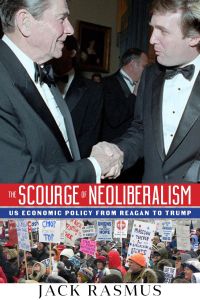
While the capitalist system has undergone numerous restructurings throughout its history, capitalist elites purpose in restructuring has remained the same: to restore and/or extend their hegemony. The current restructuring, operative since 1978, is called Neoliberalism. The book examines Neoliberalism as both an Idea and an historical practice composed of a particular mix of fiscal-monetary-trade-industrial policies that began with the latest US capitalist restructuring in the late 1970s, continuing to evolve to this day. The book further explains the deeper material forces giving rise to - as well as now undermining - the Neoliberal policy regime, with special focus given to the crisis of Neoliberalism in the wake of the 2008-09 global crash, Obama's failure to resurrect it, and Trump's current doomed effort to restore it in a new, more aggressive form. Evidence why Neoliberalism is destroying US Democracy concludes the book's analysis.
NEW BOOK
Describes how US federal governments, often in cooperation with the largest US private banks, introduced and expanded central banking functions from 1781 through the creation of the Federal Reserve Act of 1913. Based on an analysis of the evolution of the US banking system - from pre-1781, through the 1787 US Constitutional Convention, Congressional debates on Hamilton's reports to Congress, the rise and fall of the 1st and 2nd Banks of the United States, and through the long period of the National Banking System form 1862-1913, the book shows how central banking in the US evolved out of the private banking system, and how following the financial crash of 1907 big New York banks pushed through Congress the Federal Reserve Act of 1913, creating a central bank which they then managed for their interests.
BOOK
(Click on image) CENTRAL BANKERS is a comprehensive critique of central banks’ policies in the 21st century, explaining why the massive injections of free money to the banking system since the 1970s enabled the creation of excess corporate debt that has led to financial bubbles and repeated crises. The book addresses the growing contradictions of central banking, why they are failing in their functions, targets and tools, and proposes a radical democratization and restructuring to transform them to serve the public interest and not the private banks.
Book:

(Click on image) LOOTING GREECE, A New Financial Imperialism Emerges. This book - Reveals clearly who calls the shots in the Eurozone—the hardliners, not the remnants and political residue of what was once European social democracy, - Follows the negotiations in their excruciating detail as the Troika tightens the screws from 2009 to the present, - Shows how Europe’s financial elite enriches itself on Greek debt, privatizations and financial manipulations, turning Greece into an Economic Protectorate.
Book:
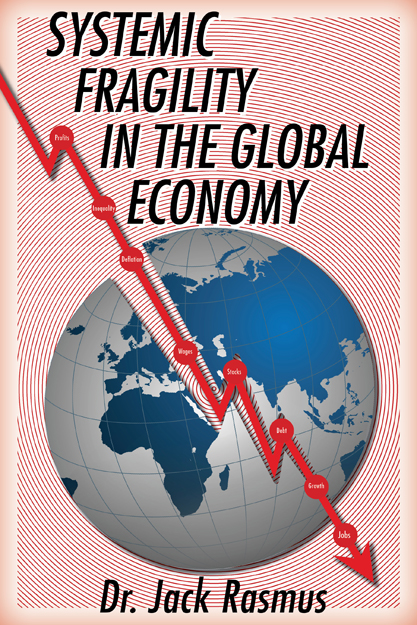
(Click on image): This book offers a new approach to explaining why mainstream economic analyses have repeatedly failed and why fiscal and monetary policies have been incapable of producing a sustained recovery. It explains why the global economy is slowing long term and becoming more unstable, why policies to date have largely failed the trend, and why the next crisis may therefore prove even worse than that of 2008-09.
Book plus DVD and Powerpoint slideshow
(Click on image) Obama's Economy: Recovery for the Few, explains how the weakest and most lopsided economic recovery since 1947 has been the direct outcome of failed economic policies of the Obama administration and US Federal Reserve bank since February 2009. Includes a detailed 'alternative program' in the final chapter. Includes the book, a video DVD presentation, and 66-slide PPT slideshow.
Book

(Click on image) Obama's Economy: Recovery for the Few, explains how the weakest and most lopsided economic recovery since 1947 has been the direct outcome of failed economic policies of the Obama administration and US Federal Reserve bank since February 2009. Includes a detailed 'alternative program' in the final chapter.
Book

(Click on image) A theoretical analysis, with historical case examples, of origins, causes and future evolution of the recent--and continuing--economic crisis in the U.S. and global economy. Includes predictions in 2009 of the inevitable failure of Obama policies and more serious crisis to come, 2013-15.
Book

(Click on image) Seven specific reasons why economic recovery under Obama since 2009 has failed for all but the wealthiest few and largest corporations. The book spells out eight specific areas as an Alternative Economic Recovery Program.
Book

(Click on image) The War At Home: The Corporate Offensive From Ronald Reagan to George W. Bush, is a 534 page, extensively researched, nonfiction book that describes the evolution of corporate-government policies from 1980 to 2005 that have shifted more than a $1 trillion dollars a year, every year, from 90 million American middle and working class households to the wealthiest 10% and corporations.
Search
-
Join 454 other subscribers
Jack Rasmus Site: KYKLOS PRODUCTIONS
 Dr. Jack Rasmus @drjackrasmus
 Jack Rasmus