Feeds:
Posts
Comments

The following is the latest post of my interview with Mohsen Abdelmoumum of the American Herald Tribune. Here brief comment on how US financial imperialism works in Venezuela, just as German-Northern Europe financial imperialism works in the southern Europe periphery of the Eurozone (e.g. Greece, Italy, etc.)

Mohsen Abdelmoumen:

Your article Financial Imperialism: The case of Venezuela dated last March caught my attention, as all your work that I advise our readership to read. You wrote: “Venezuela today is a classic case how US imperialism in the 21st century employs financial measures to crush a state and country that dares to break away from the US global economic empire and pursue an independent course outside the US empire’s web of entangling economic and financial relations.” In your opinion, how can Venezuela resist the US-led imperialist war against it?

Jack Rasmus:

It’s important to understand how in 21st century capitalism, where the US is clearly the hegemonic power, how the US expands, maintains, and intervenes to maintain its economic empire. If 21st century global capitalism is increasingly a financial capitalism, and depends increasingly more on financial means to expand, then its imperialism is more financial than ever before.

Unfortunately, the ‘left’ and progressives, even Marxists, are looking in the rear view mirror at imperialism.They still see it in the prism of 19th century, or early 20th century, in its forms. One of my projects is to analyze and explain how financial measures are used by US to maintain its economic empire. It is quite different from classical British imperialism, which collapsed fully after world war II and was replaced by the American empire.

In my article, ‘Financial Imperialism: The Case of Venezuela’ I explained how some of these financial measures work, and continue to work, to destabilize Venezuela’s economy and set it up for violent political change, either from within or without via invasion of some kind that is organized and managed by the US.

My 2016 book, ‘Looting Greece: A New Financial Imperialism Emerges’, looked at how it works in the Eurozone as well, with Greece a microcosm case example that has implications elsewhere. Financial Imperialism works as well within the advanced capitalist economies, where the periphery (like southern Europe) is financially exploited by the northern Europe bankers and their political elites in the European Central Bank, European Commission, etc. Trade zones and currency unions (like the Eurozone) function in this way.

What can Venezuela do to resist the US-led imperialist war against it is your question. First, it is essential for Venezuela to organize, mobilize and arm its base of popular support. This I think it has been doing. But I’m not sure it has a strategy how to use that mobilized base against its opponents, internal and external. It’s been mostly a defensive action, not going on the offensive. But I may be wrong there, since I have no way of knowing what it may be doing internally in that regard.

Second, the Maduro regime must retain support of the Venezuelan military.So far it appears it is succeeding in that regard. The recent attempted uprising by the US-puppet, Gaido, failed miserably in its attempt to co-opt and ‘turn’ the military against the government.

Third, its important that popular forces find a way to throw out Bolsonaro in Brazil and Macri in Argentina.Those two US-assisted governments would probably send the military forces should a military invasion occur in Venezuela. The US will use the OAS (note: Organization of American States)and their militaries as proxies. But if they’re out of the picture or preoccupied with serious problems at home, its unlikely they could be used.The people of Brazil and Argentina can thus play a role here as well. State allies of Venezuela could help significantly as well by trade and loans to help Venezuela. And by purchasing its oil and restoring its refinery production to offset US sabotage and sanctions. Notably here are China, Russia, Cuba and other South American countries not already the clients of Washington like Brazil, Argentina, and perhaps now Ecuador.

Finally, within the US progressive forces can work more aggressively and coordinate better their efforts to reveal to American people what’s really going on in Venezuela, how the US neocons are intensifying the attack in preparation for invasion, what’s really behind the problems in the country’s economy, etc. There needs to be something similar to the Latin American defense movement that arose in the 1970s after the Chilean coup engineered by the US and the defense of central American progressive forces in the 1980s.

Another ‘target’ of intensifying US financial imperialism is, of course, Iran. Here you can see the strategy and program how it is implemented from the beginning.

Facebook’s announcement yesterday of its plan to enter Cryptocurrency market with its Libra digital token marks its entry into a new product line of financial transactions. The announcement represents an expansion of the shadow banking system, as more and more tech companies enter financial services (Amazon has also become a financial lender). Will you buy your next house from Facebook? Why would Facebook, facing regulatory scrutiny already, enter yet another business that is increasingly coming under central bank regulatory investigation (e.g. all crypto currencies, including Bitcoin)? What’s Facebook’s longer range plan to become a financial services company? Will hackers (of Facebook) now get into your personal transactions and borrowing history? Why setting up a separate subsidiary or locating the development in Switzerland (notorious for opaque finance), will not prevent hackers from accessing your personal transactions or borrowing history! What’s Facebook’s competition in the crypto market (try Tencent in China and Telegram)? Crypto currencies as digital money and threat to central bank money supply control–already in decline and effectiveness, as I’ve argued at length in ‘Central Bankers at the End of Their Ropes’ book.

For my comments on this, check out my recent TV interview.

GO TO Toutube at:

The following is an excerpt from the interview by the American Herald Tribune and reporter, Mohsen Abdelmoumen, with Dr. Jack Rasmus. The subject focus is the decline of organized labor in the US and advanced capitalist economies under Neoliberal offensives since the 1970s, and what might be done to begin a resurrection of a unionized working class.

Mohsen Abdelmoumen:

You have worked on trade union issues and you have been a trade unionist yourself. In the face of the fierce neoliberal offensive, do we not have a vital need for a very strong trade union movement to defend the working class?

Jack Rasmus:

Absolutely. One of the great tragedies in recent decades is the destruction and co-optation of what’s left of that trade union movement. The destruction was planned in the 1970s and the implementation of a strategy of union destruction began in earnest under Reagan and has not ceased ever since. One of the greatest and most successful union strike waves in the US occurred in 1969-71 (second in scope only to 1946). Workers won wage and benefit gains of 25% in the first year of contracts at that time (1970-71). First construction trades, then teamsters, then auto and steel, then port dockworkers. Employers could not stop them. They were too well organized and remembered how still to fight from the traditions left over from the 30s and 40s. That’s when a plan was developed first to destroy the building trades. That was implemented back in the late 1970s, even before Reagan. Under Reagan the attack was directed at manufacturing and transport unions. At its core was the offshoring of their jobs and the deregulation of their industries to intensify competition to drive down wages. The beginning of the ‘contingent’ labor transformation began in the 1980s as well, then accelerated. Free trade wiped out more jobs, especially under Clinton in the 1990s. Pensions were destroyed in the private sector in the 80s and 90s. Minimum wages were allowed to lag. Healthcare costs were privatized and shifted to workers. Some workers fought back, a rear-guard action.

But the explanation for the demise of unionization in America in the private sector cannot be understood as solely the result of capitalist offensives. That was important. But so was the lack of leadership by unions at the top. They thought it would temporary, under Reagan, and they could recoup losses thereafter in membership, wages, and benefits. But it was not temporary. It continued under Democrats in the 1990s. The problem was that unions, as they weakened, turned to the Democratic Party to save them. It didn’t. As they got weaker they pleaded with Democrats even more, but the latter simply took their support for granted and did little in return. The Democrat party insisted the Unions not embarrass them by strikes, especially under Clinton. The leadership abided by the party’s request. And got weaker still, losing more members. Then came NAFTA, China, and H1-B visas giving hundreds of thousands of jobs to skilled labor coming to the US. Millions of jobs were lost after 1997 to trade. Then came tax cuts for business that subsidized the replacement of labor by capital and machinery. That devastated at least as many jobs as free trade deals. Then came the collapse of housing markets and permanent loss of millions of construction jobs. Filling the gap of jobs were more low paid service employment and more contingent part time, temp work, at lower pay and no benefits. All the while the leaders of unions pleaded with Democrats to help them. Obama promised reforms to help unions organize new members in 2008, then buried the promise once elected and having received union members’ contributions in the millions for his campaign.

The problem of declining unions is a problem of capitalist restructuring and change, of capitalist offensives to de-unionize and weaken collective bargaining. But it’s also a consequence of wrong union strategies, especially becoming more dependent on Democratic party leaders who abandoned unions once they took their campaign contributions. If unions are to resurrect themselves, and I believe they will, it will have to be an independent union movement, not depending on either wings of the corporate party of America—aka the Democrats and the Republican wings of this single, essentially capitalist party. It will probably have to assume a new kind of organizational form as well. Not organized along lines of ‘smokestacks’, for this or that industry, and not placing contracts as its key objective but forming alliances and new organizations that include allies outside of work and pursuing political-legislative objectives as equally important strategies.

Having personally lived and worked in unions when they were at their peak, and then experienced and witnessed the decline, from within and from afar, it is clear union labor will have to undergo a major organizational and strategic restructuring of its own if it is to become a force it once was. But this is not the first time historically it has undergone such a transformation and arose to resume its critical economic and political role. I’m convinced it will do it again. But only if that resurrection attempt is done independently and it breaks as an appendage of either of the wings of the corporate party of America.

For my recent interview with ‘Loud & Clear’ radio this past week on the revolt of New York renters against manipulation of rent controls by landlords, and the mobilizations going on to restore rent controls,

GO TO:

https://www.spreaker.com/user/radiosputnik/new-york-law-aims-to-tackle-affordable-h

The following is the third excerpt from my recent interview with The American Herald Tribune. The subject is the growing influence and power of Neocons in US government, and the nature of the Trump regime and the constitutional and economic crisis to which it is inevitably leading.

Mohsen Abdelmoumen:

How to explain why the influence of neocons in the US continues despite changes in presidents and administrations?

Jack Rasmus:

The neocons represent a particular right wing radical social and political base in America that has existed for some time. In fact, it’s always been there, going back at least to McCarthyism in the early 1950s, and even before. This is a radical ideological right, even pro- or proto-fascism base in the US. It was checked by the great depression and world war II temporarily but quickly arose again in the late 1940s with the advent of the cold war and China’s successful war for independence. It formed around Barry Goldwater in the 1960s. It arose again in the 1970s with Nixon.When Nixon was thrown out, it reorganized and set forth a plan to take over the American government and political institutions.It even developed position papers and internal proposals how this takeover might be achieved. Ideologues like Dick Cheney, Donald Rumsfeld, and others assumed positions of power in the Reagan administration. Their movement took over the US House of Representatives in 1994 and vowed to create a dysfunctional government that would be blamed for gridlock and give their more radical proposals a hearing as to how to break the gridlock and govern again in their interests. We saw them reassert their influence when Cheney was made vice president in 2000. He was actually a co-president, and perhaps more, as George W. Bush, was the publicized president but really a playboy figurehead. Cheney and his radical right ran foreign policy, giving us Iraq and setting the entire Middle East afire in its wake.This radical right is also behind the decline of democratic and civil rights since 2000, using the 9-11 events as excuse to push their anti-democratic agenda. The Koch brothers, the Adelman and Mercer families, and scores of others are the moneybags in their ranks.They funded the teaparty movement that has since entered the Republican party, terrorized the party’s moderates and driven them out of office and the party itself. Without them, their money, their grass roots organizations, their control now of scores of states’ legislatures, their stacking of judgeships across the country, the Trump phenomenon would not have been possible in 2016. Ideologues like Steve Bannon, John Bolton, Navarro, Abrams, Miller and others are now running the Trump administration and its domestic (immigration) and foreign (trade fights, Israel, No. Korea, Venezuela, Iran) policies.

The point is they’ve always been there, a current in US politics below the radar, but since 1994 aggressively asserting itself and penetrating US institutions with increasing success—aided by media like Fox News and their analogues in radio and on the internet.

Mohsen Abdelmoumen:

Trump made promises of employment during his election campaign and was elected on the slogan “America first” by the disadvantaged classes, especially in rural areas. Isn’t Donald Trump the president of the rich in the United States? What is your assessment of Trump’s governance?

Jack Rasmus:

That assessment must first distinguish between governance in the interest of whom? It’s been a disaster for working-class America. All Trump’s promises of bringing jobs back is just a manipulation of concerns by workers of massive job losses and wage stagnation due to offshoring of US jobs and free trade. While Trump talks of bringing jobs back, he opens the floodgates to skilled foreign engineers and workers taking more jobs based on H1-B and L-1 visas, covered up by cuts to unskilled workers entering from Central America.

Trump is a free trader, just a bilateral free trader not a multilateral one. Trump’s trade offensive is about the US reasserting its hegemony in global markets and trade for another decade as the global economy weakens. It’s a phony trade war against US allies. Just look at the deals made with South Korea, the exemptions given for steel and aluminum tariffs, the go slow and go soft with Japan and Europe. Contrast that with the increasingly aggressive attack on China trade relations—which is really about the US trying to stop next generation technology development by China in AI, cyber security, and 5G wireless. These are technologies that are also the military technologies of the 2020s. The neocons and military industrial complex in the US, along with the Pentagon and key pro-military chairpersons in Congress, want to stop China’s tech development. It’s really a two country race in tech now, with almost all the patents roughly equally issued by China and the US and everyone else way behind. So the trade war has delivered nothing for the working classes except rising prices now, and even for farmers who are the losers (but they’re given direct subsidies to offset their losses, unlike working families that have to bear the brunt of the tariff effects).

Look at the tax legislation of 2018 and the deregulation actions of 2017 by Trump. Who benefited. Business got big cost cuts. The rest of us got higher taxes to offset the $4 trillion actual Trump tax cuts for business and investors and wealthy households.US multinational corps got $2 trillion of that $4 trillion. And households will have to pay $1.5 trillion in more taxes, starting this year and accelerating by 2025. In deregulation, we get the collapse of Obamacare and accelerating premiums, while the bankers got financial regulations of 2008-10 repealed. As far as political ‘governance’ is concerned, what we’ve seen under Trump is widespread voter suppression, gerrymandering by his ‘red states’ to help him get re-elected next time, the approval of two conservative judges to the US Supreme court engineered by Trump’s puppy, McConnell, in the Senate. Then there’s the now emerging attacks on immigrants, including jailing their kids, and the attacks on womens’ rights that was once considered unimaginable.

Politically Trump has been engineering a bona fide constitutional crisis. He’s appeared to have gotten away with the Mueller investigation which should have led to his impeachment but hasn’t. He continually undermines US political institutions verbally. He clearly is moving toward bypassing Congress and governing directly by ‘national emergency’ declarations, refusing to allow executive branch employees to testify to Congress despite subpoenas, ordering the launching of a new McCarthyism by ordering his Justice dept. to start investigating opponents, etc.—i.e. all of which were the basis of Nixon’s impeachment.

In short, Trump’s governance has been a disaster for working-class America, immigrants of color, small farmers and even manufacturing companies, but a boon to far right and white nationalists whom he publicly supports. It’s been especially beneficial to wealthy households, businesses and investors, moreover. And maybe that’s the most important reason why the capitalists still tolerate him and let him remain in office. If they really wanted to impeach and remove him from office they could find a way. But he’s delivering for them financially and economically. He’s ‘good for business’, in other words. But so was Hitler.

The following is another excerpt from my interview with the American Herald Tribune earlier this month on the subject of what are the causes of capitalist crises in the 21st century and the connections between financial cycles and real cycles. The interview, Mohsen Abdelmoumen, refers to my various publications since 2010 and the evolution of my analyses.

Mohsen Abdelmoumen:

In your very interesting book, Epic Recession: Prelude to Global Depression, you make a wise review and provide solutions. Why is the crisis inevitable?

Dr. Jack Rasmus:

Because the solutions applied to the last crisis will inevitably lead to a more generalized, and potentially deeper and more serious crisis next time. Here’s how: the excess liquidity injected by the central banks to stabilize the financial markets after 2008-09 has been generating even more debt and debt leveraged investment. That has created financial asset bubbles today in global stocks, junk bonds, leveraged loans, triple BBB (junk) rated investment grade bonds, bubbles in derivatives and other asset markets, commercial real estate, etc. The debt levels have reached a magnitude such that once asset market prices begin to unwind and contract (some of which are now occurring), servicing of the excess debt will fail. That unwinding will contract asset prices further, causes defaults and bankruptcies, and generates a credit crash. The contagion then spills over to the real economy. Non-financial sectors of the economy then begin to contract in turn, as credit availability disappears. Production cutbacks, cost cutting, and layoffs follow. Households, already carrying severe debt loads ($13.5 trillion in US alone) default on their loans. Banks with existing severe non-performing loans (more than $10 trillion globally, centered in Europe, Japan, and India will have to write them off en masse. Business and household defaults result in the collapse of bank lending. Business confidence plummets, real investment dries up further, and prices for assets, goods, and inputs deflate, causing a still further deterioration. In other words, the excess liquidity injected into the global economy by central banks after 2008 (more than $25 trillion) temporarily stabilized the financial system. But in doing so it generated more even cheaper credit and debt that flowed into highly leveraged investment in both financial assets and real assets. The solution—i.e. excess liquidity and more debt and leveraging—thus becomes the basis for renewed bubbles and financial crisis. The now even greater debt and leveraging intensifies contagion effects, amplifies the scope and magnitude of the next crisis, and accelerates the propagation across markets and economies. The solution to the last crisis becomes the fundamental cause of the next. That’s why it’s inevitable. Again, watch the most fragile financial markets associated with junk bonds, leveraged loans, BBB corporate bonds, stock markets, already non-performing loans in Europe and Asia, and government bonds of economies like Argentina, Turkey, and others. I’d throw in exchange traded funds, a form of derivatives, probably as well once stock markets correct more than 20% next time. Another problem is that central banks in Europe and Japan already have negative interest rates. Once the next crisis appears they will be limited as to what they can do. They’ll likely double down on even more QE (note: Quantitative Easing), interest free loans to businesses and other banks, and even more draconian measures like bail-ins of depositors money where depositors are forced to convert their cash to near worthless bank stock.

Mohsen Abdelmoumen:

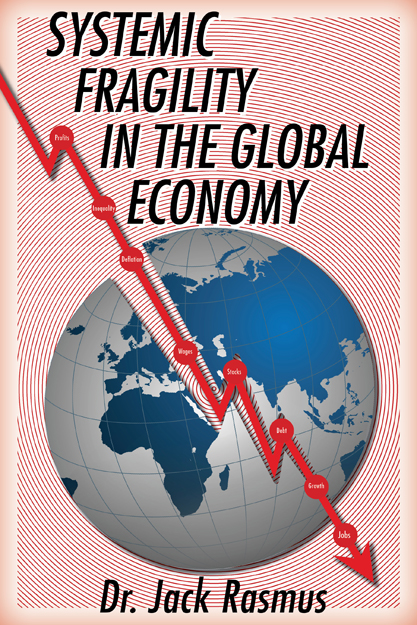
In your book Systemic Fragility in the Global Economy, you explain that traditional economic policies have failed and that the next crisis may be worse than 2008-09. Is not the capitalist system out of breath and unable to regenerate itself?

Jack Rasmus:

Thus far, it has been able to regenerate—but only temporarily. As the economy is restructured following a major crisis—as it was in 1909-14, 1944-53, and again 1979-88—the restructuring regenerates the leading capitalist economy (e.g. the US) but at the expense of working classes and some capitalist competitors. The recovery thereafter dissipates and the crisis then reappears in more severe form. This has been the case since the early 1970s in particular. Reagan’s restructuring succeeded in generating a recovery—at the expense of Europe, Japan, and American working class—but the same restructuring led to financial instability and crises in all three sectors of global capital and culminated in the crash of 2008-09. The US recovery thereafter was rapid for capital incomes, but slow and tepid for wage incomes. And the recovery never really took hold in the weak links of Europe and Japan where subsequent recessions occurred after 2008-09, in a kind of ‘stop-go’ slow and shallow recovery punctuated by recessions—i.e. what I’ve called a classic ‘epic recession’.

Mohsen Abdelmoumen:

You also wrote Central Bankers at the End of Their Rope ? : Monetary Policy and the Coming Depression. Your analyzes and your work constantly warn about a major economic crisis to come. Why, in your opinion, can’t the capitalist system learn the lessons of previous crises?

Jack Rasmus:

After a crisis capitalists do find a way to restore profitability and expand capital. However, the restoration is only temporary, as I’ve said. But that’s acceptable for them. They’ll take a temporary recovery for all so long as it’s a significant temporary recovery for capital incomes. An alternative, longer term solution to the crisis would not as quickly restore profitability and growth, so they do not undertake it. A broader based, longer term restoration also risks strengthening opposition (to capitalism) forces and they don’t want to ‘go there’, as they say. For example, the US policy makers after 2008-09 embarked on a massive central bank money injection to bail out the banks and large corporations to the tune of more than $10 trillion, half of which was QE direct subsidy by the Fed buying bad securities. Tens of trillions in tax cuts for corporations and investors followed as well. Profits and capital incomes accelerated, as the bailout by the Fed (monetary) and Congress (fiscal tax cuts) was redistributed by corporations to shareholders.

More than $1 trillion a year was thus redistributed in the form of stock buybacks and dividend payouts just from the Fortune 500 alone. In 2018 it was $1.4 trillion. In 2019 it’s running at more than $1.5 trillion. Meanwhile, wage incomes are stagnating for the bottom 90% of the 162 million labor force in the US due to the restructuring of labor markets to the disadvantage of working class folks. So the ‘lesson’ capitalists have learned is how to quickly ensure they recover from a crisis by using monetary and fiscal policies to directly subsidize their incomes. Such policies in the 21st century are more about the State subsidizing capital incomes than they are about stabilizing the unstable, crisis prone economy.

Mohsen Abdelmoumen:

You wrote The Scourge of Neoliberalism: US Economic Policy from Reagan to Trump, to appear this September 2019. Why in your opinion can the capitalist system only generate crises?

Jack Rasmus:

Crisis generation is embedded in the very ‘economic DNA’ of 21st century capitalism. It constantly over-expands (externally & geographically and internally & technologically). The over-expansion gets away with itself and results in severe global imbalances of various kinds: financial investment over real investment; money capital outflow excesses from the advanced capitalist core economies (US, Europe, Japan) to the emerging market economies; labor inflows from the periphery economies to the advanced core; trade imbalances or goods flow imbalances; technological change imbalances within the advanced economies; imbalances in the price systems as asset bubbles expand faster than goods or factor input prices; employment imbalances as need for skilled labor goes unfulfilled as unskilled labor accumulates on the sidelines as unemployed, underemployed, and contingent-gig service workers. All these, related imbalances generate the crises.

But capitalism feeds off the crises it creates. It feeds off its ‘dead and rotten’ destruction it creates during the. It creates a kind of ‘carrion capital’ during the crisis which it then devours in order to jump start a re-expansion process once again. Capital is by nature cannibalistic. It needs periodic destruction in order to resuscitate itself. The problem is the destruction is growing in magnitude and severity and causing increasingly severe consequences for the working classes, while leading to more intense competition among capitalists sectors globally as well. To use a metaphor, Capitalism is like sharks. It is reborn after a crisis like fetal sharks in the belly of the mama shark. The larger devour their smaller brethren while still in the womb. The few then emerge and reborn even stronger, larger, and more voracious than before.

Once again I have been asked to comment on Modern Money Theory, MMT, and the growing interest in it on the ‘left’. What follows is a further, albeit still preliminary, comment on it, as I replied to one of the readers of this blog. (More forthcoming in depth later this summer).

“I’ve been following the various ‘forms’ of MMT being proposed. I intend to join the debate once I finish my next forthcoming book, The Scourge of Neoliberalism, due out in September. My initial impression to date, however, is not positive about monetary solutions of any kind to crises or restoration of economy growth, and that includes MMT.

I sense that MMT is in part Quantitative Easing turned on its head, and I’ve been a strong opponent of QE and all forms of ‘monetarism’ in economics which has always been more ideology than economic science. There’s thus the matter of how much of MMT is economic science and how much of it is economic ideology (meaning misrepresentation of reality in service of particular economic interests).

Another problem with MMT is that it leaves recent capitalist fiscal policy—i.e. massive cuts in taxes to investors, businesses and wealthy 1% unaddressed and in place. That is, the solution is not reversing the $15 trillion in tax cuts for investors, corporations and the rich since 2001, or reversing social program austerity policies; for MMT the solution is just creating more money and using that in lieu of reversing tax and spending trends that have increasingly benefited capital incomes. Furthermore, contrary to MMT, deficits do matter, I believe. Especially when they get exceptionally large. The federal debt will reach $34 trillion by 2028 (due to tax cuts and defense spending mostly). And interest on it will reach $900 billion a year. It’s not the deficit that matters, but the cost of financing, i.e. paying for, that deficit that does matter. To pay for that $900 billion, they’ll have to attack social programs even more aggressively and raise even more taxes on the middle class, the latter of which has now begun this year and will intensify after 2024.

Finally, another initial impression is that MMT strikes me as a kind of ‘accounting ledger’ and/or de facto ‘equilibrium’ approach to economic analysis, neither of which I find very useful to understanding the real world of the economy.

the following is an excerpt from my recent May 2019 interview, just published June 8 by the American Herald Tribune by its reporter and interviewer Mohsen Abdelmoumen of Algeria. The excerpt addresses the subject of the general transformation of global capitalism in recent decades, in particular the six major changes since the 1970s and the four big challenges it faces in coming decades that may disrupt and derail its trajectory in the decade ahead.

(Subsequent postings of the interview to follow will address what are the fundamental, enabling, and precipitating causes of the repeated crises of capital since the 1970s and why more instability is inevitable and forthcoming. For a single posting of the entire interview, go to the website http://kyklosproductions.com)

(ON THE 6 MAJOR CHANGES TO GLOBAL CAPITALISM SINCE THE 1970S)

    Mohsen Abdelmoumen:

Why in your opinion can the capitalist system only generate crises?

    Jack Rasmus:

There are six major changes in the global capitalist economy since the 1970s that increase the potential fragility, instability, and the amplification and propagation rate of the fragility-instability events:

1. Greater Integration of the Former Colonial Elites into the Capitalist Global Economy as Partners

This began in the 1970s as global capitalism integrated the petro-economies, allowing them to nationalize oil and related resource production and share significantly in the revenues from that production—so long as it was understood those elites would recycle much of their income back to the capitalist core economies through direct purchases or the global banking system. In the 1980s, the US added Japan to this wealth recycling arrangement with the Plaza accords of 1986. Europe was to a lesser extent thus integrated as well via the Louvre agreements of that decade. In the 1990s it was Eastern Europe and to a lesser extent south Asia. In the 2000s it was China in part. The recycling benefited US capital greatly. US dominated institutions like the IMF and World Bank were put in service of helping facilitate the integration. The recycling was accompanied by a major acceleration of US foreign direct investment into the economies of the new partners. The dollars flowing back to the US in the form of US Treasury bonds and bills purchases allowed the US to run chronic massive budget deficits, caused by accelerating defense-war spending and simultaneous business-investor tax cutting in the amount of tens of trillions of dollars. The recycling allowed the US to build up its military into a global force on nearly all continents, with a budget of a $trillion a year, the most advanced technology, and more than 900 bases worldwide. Integration economically with the US enabled the US to more effectively wield a ‘carrot and stick’ policy within its global empire to ensure partners would adhere to its fundamental political interests in turn. But global financial and economic integration also means that crises that build and erupt in the US and/or within the key core partners of the US economic empire (aka Canada-Mexico, Japan, Europe), now more quickly spread across the integrated markets and economies. Integration increases the amplification magnitudes and propagation rates of crises.

2. Financial Restructuring of the Global Economy and the Relative Shift to Financial Asset Investing

I argued in some detail in ‘Systemic Fragility in the Global Economy’ that what has been underway since the early 1980s decade is a relative shift toward financial asset investing. This shift is structural and has not abated. In fact, technology is accelerating it. The opportunity for greater financial market profits is also a key driver. The financial asset investing shift, as I call it, has had the result of distorting real investment in plant, equipment, etc. The latter still goes on and may also grow during periods, but in relative terms it is slowing and even declining compared to financial asset investing. At the core of this is the explosion of free money provided by the central banks, made possible by the collapse of the Bretton Woods International monetary system in the 1970s.

Technology and new forms of what is money have also contributed, and increasingly so after 2000, to the explosion of credit enabled by money and near money forms. With excess credit comes excess debt—at all levels: government, banking, non-bank businesses, households, ‘external’, etc.

The magnitude of debt is not per se the problem. The failure to service that debt (i.e. pay interest and principal) is the problem, and that occurs when prices collapse (asset and goods and inputs prices). Price deflation occurs when financial asset bubbles implode. Assets are all substitutes for each other, and when one key asset collapses it has a contagion effect across others. So the price system is the transmission mechanism. This idea is quite counter to mainstream economics which purports the price system stabilizes the economy and markets via supply and demand. But that’s a myth. The price system is a destabilizer. And there isn’t just ‘one price system’, another mainstream error. There are three key price systems that are inter-related but behave differently. They are financial asset prices, goods & services prices, and in put prices (e.g. wages). The relative shift to financial asset investing tends to drive up financial asset prices into bubble range, that then bust and drag down goods and input prices in turn, causing the recession to deepen and recovery to occur slowly. But the financial asset shift and inflation has a further negative effect: it reduces productivity as real investment slows. That slows wages (price for labor) while causing greater unemployment or underemployment (especially the latter).

Financialization is measured not by the share of profits or jobs going to the banking sector. It is defined by the explosion of financial asset securities (especially derivatives), the new highly liquid markets worldwide created in which to trade those securities, and the new financial institutions that dominate that trade—i.e. what are called the shadow banking system. Around this securities, markets, and institutional new framework (that functions globally due to technology) a new global finance capital elite has emerged as the human ‘agents’ of this new global financial structure that I define as ‘financialization’. That global finance capital elite now manages more investible assets than do the traditional commercial banking system (which by the way is increasingly integrated with the shadow banking system). But the shadow banks are virtually unregulated and thus prone to engage in excess risky financial investing, which is behind the chronic shift to financial investing and the financial instability globally it is creating.

3. Global Restructuring of Labor Markets & Collapse of Unionized Labor

Not all of contemporary capitalism is of course financialized. There is still much non-financial production going on and, in the (non-financial) services sectors, actually growing. It’s just that it isn’t as profitable as financial investing and thus is getting relatively less money capital than it otherwise would for purposes of expansion. Financialization is diverting more money capital to itself relative to non-financial investing—i.e. a shift that is slowing productivity gains in the latter and, as a consequence, wages and raising underemployment as businesses cut costs in order to offset the slowing productivity and higher costs of investing in real assets.

We thus now see major transformations in labor markets worldwide that is resulting in lower wage income gains. The ‘global integration’ process in item #1 above is accompanied by the ‘offshoring’ of higher wage manufacturing and other sector jobs to the emerging markets, following the capital outflow from the capitalist core (US, Europe, Japan) to the periphery of EMEs (note: Emerging market economies). Simultaneously, businesses still producing in the core intensify their cost cutting to compete with producers in the EMEs. That means the rise of contingent labor (part time, temp, gig, etc.) which is paid less and paid fewer benefits. The rise of contingency and offshoring reduces union membership and in turn bargaining power. Whereas in the past unions recovered some of income lost during the recession and downturns during the business cycle upswing, this is no longer occurring as unionization has collapsed. The offshoring of jobs also increases worker insecurity and means less likely worker resistance to wage compression by strikes and collective bargaining. As unions decline their political influence also wanes, and with it the ability to achieve wage and benefit improvements via political action. Minimum wage legislation in particular suffers.

Labor market restructuring thus becomes a popular project of business elites and their politicians. It takes the form of job offshoring as the State increasingly subsidizes foreign direct investment. It takes the form of job creation that is now almost totally contingent in character in the advanced capitalist core of US-Japan-Europe (60%-80% of jobs created in Europe in recent decades have been contingent—part time, temp, etc.). As unions weaken economically, it means the restricting and limiting of what union labor may legally negotiate over. As unions weaken politically, it means slower legislated wage adjustments (min. wages) and cut backs in ‘social wages’ like pensions, national health insurance, etc. As union effectiveness weakens, they are attacked and removed by business action or abandoned by workers who see them ineffective in defending their interests. Business led political parties then propose national legislation to, in part, codify the changes and in part to drive them deeper.

Just as the financial restructuring of the capitalist economy leads to accelerating income and wealth accumulation by the financial elite and business class, the restructuring of labor markets had the effect of compressing and stagnation (or for some sectors of the working class even reducing) wage incomes. The former financial restructuring causes income and wealth inequality to accelerate even faster than the labor market restructuring causes wage, working class, incomes to stagnate and decline. Both restructurings result in accelerating income inequality that we see today. And with income inequality, wealth (i.e. assets) grows in turn. Conversely, more asset accumulation produces even more non-asset income inequality. So the two, income and wealth, inequality in favor of financial and business classes feed off each other to expand even further. Meanwhile wage income stagnates.

Thus de-unionization, wage compression, social benefits cut backs, job offshoring, decline of collective bargaining and strike activity, labor market ‘reform’ legislation, etc. are all the consequence (and objectives) of labor market restructuring. Labor market restructuring is largely for the benefit of those sectors of capital still mostly doing business in the domestic economy.

Financialization, subsidization by the State of foreign direct investment, and free trade agreements are largely for the benefit of the multinational corporate sector. Free trade agreements subsidize multinational corporations in two major ways: They are primarily about legalizing terms and conditions for US multinational corporate and banking penetration of other economies on favorable terms. Free trade deals also serve as a multinational corporation cost cutting aid, as corporations are able to bring back their goods and services and not pay the tariff (tax) to re-import back to the US. For example, 49% of the US’s more than $500 billion a year in goods trade deficit with China involves goods made by US corporations in China.

4. Destruction of Former Social Democratic Parties and Movements

Everywhere globally we see the collapse of social democratic parties that once dominated government. This has been true even in the ‘heartland’ of social democracy, in Europe, but also in USA, in South America, Israel, and select economies in Asia where ‘weak forms’ of social democracy previously participated. The rise of right wing ‘populism’ should be viewed as a direct result of the political vacuum created by the demise of social democracy. It is the consequence. So why have they declined? And how has this decline fueled the global integration, financial restructuring, restructuring of labor markets, the financial investing shift, and the accelerating income and wealth inequality? Those are key questions that remain largely unanswered still today among the so-called ‘left’ or ‘progressive’ movements everywhere. Some likely causes of the collapse of social democracy at the political level parallels include the destruction of their political base, the unions, and their significant loss of political influence. To some extent it has been the result of strategic errors by these parties, allowing themselves to become too closely associated with the neoliberal offensive that began circa 1980. But whatever the cause, their decline has opened the floodgates to legislative and other capitalist initiatives to restructure the capitalist financial system and capitalist labor markets globally along lines noted above. Capital has never been more powerful relative to labor than it is today. That’s why, in desperation, working classes vote in mere protest of conditions without being able to propose and promote solutions in their interest. Thus we get Brexits. Support for far right parties that promise to change the system and argue falsely the change will better the conditions of workers. That’s why we get Donald Trump. Bolsonaros and Macris in South America. Salvinis and Orbans in Europe. Dutertes in Asia. Etc. Working classes worldwide have been ‘de-organized’ both economically and politically. Into the vacuum step the far right movements, ideologues, and their parties, who take power often by default. The working classes are left with mere periodic protest votes and they vote for parties and movements that say they are going to ‘stick it to’ the capitalists that have created their declining working conditions and standard of living—even if they know little will come of that pledge.

5. Transformation of Mainstream Capitalist Political Parties

Political change has taken the form not only of the demise or rise of certain political movements and parties, but also the change in formerly ruling parties.In the US the Republican party has assumed the mantle of the far right populism. Its former challenger of the past decade, the Teaparty, has been integrated and transformed that party fundamentally.Its ideology, policy mix, and willingness to undermine democratic norms and even institutions has signified a basic change in the composition and strategy (and tactics) of the Republican party. A similar transformation to the ‘left of center’ is in the early stages with the US Democratic party.Not just in the US is this process occurring. In the UK the formerly dominant parties are in crisis and losing popular support.A ‘Brexit’ right wing populist party is emerging within the Conservative party, while the Labor party continues to lose support to nationalists and environmentalists in its ranks as well.At earlier stages a similar development is occurring in France and even Germany, where both the national front and AfD are growing support. And of course, Italy is well ahead in the rightward shift. The parties of the ‘center’ are collapsing in various stages everywhere.

These political party changes are the consequence of the intensifying income and wealth inequality, and the forces driving it associated with global capitalist economic integration, financial restructuring, and labor market restructuring.On the periphery of the political system are the demise of social democracy and rise of the populist right parties;but ‘in the middle’ as well the traditional capitalist parties are becoming fluid and experiencing internal instability.

6. Increasing Subsidization of Capital Incomes by Capitalist States

Capitalists have totally captured the direction of fiscal and monetary policy and have turned it to the benefit of their direct interests.In past periods, the primary mission of fiscal-monetary policy was to stabilize capitalist economies when recessions or goods inflation occurred. Fiscal-monetary policy was also employed in a manner that shared the benefits of such policy with working classes and other sectors. But 21st century capitalist fiscal-monetary policy (taxation, government spending, budget-national debt management, interest rates, inflation targeting, employment, etc.) has been transformed. Today the primary mission of such policy is to directly subsidize capital incomes, both in periods of economic contraction and in subsequent periods of recovery.Keeping interest rates low chronically allows constant cheap credit and the issuance of multi-trillions of dollars of corporate and household debt.Providing excess liquidity fuels financial asset market (stocks, bond, derivatives, etc.) bubbles that boom capital incomes from financial investing. Equally massive, multi-trillion dollar tax cuts for businesses, corporations and investors, bankers and shadow bankers, results in the US alone more than a $1 trillion a year annually in redistribution to shareholders from stock buybacks and dividend payouts (in 2018 rising to $1.4 trillion in US alone). Ever more funding is simultaneously provided for defense and war production.

The direct subsidization fuels the financial asset investing shift and in turn the financial asset bubbles, corporate and household excess debt, and generates the financial fragility and instability in the form of the next crisis. It also results in escalating government sector debt and rising debt servicing costs.

Thus all three major sectors of capitalist economy—business, households, government—keep loading up on debt and leverage. In the US, government debt (national and local, central bank and government agency) is well over $30 trillion. Another $20 trillion could easily be added by 2030. Corporate and business bond and loan debt may be as high as $20 trillion today.And household debt nearly $14 trillion and rising rapidly. The problem of debt is multiplied many fold across the global capitalist economy, with areas of high concentration of either corporate and/or government debt.The amount is easily more than $75 trillion. It is worth repeating, however, that the sheer magnitude of debt is not by itself the problem.The problem is when the incomes for servicing the debt cannot keep up.And that gap widens rapidly when financial asset prices, and other prices, rapidly collapse and contagion spread just as rapidly from the financial to the real economy. Price collapse, beginning with financial markets, is the critical chemical additive that makes the debt problem explode. And when that explosion takes place, the massive debt accumulation at government levels prevents traditional fiscal-monetary policy from playing an economic stabilization role. All it is then used for is to subsidize the losses incurred by owners of capital incomes.

(ON REFORMS & 4 FUNDAMENTAL CHALLENGES TO CAPITALISM TODAY)

    Mohsen Abdelmoumen:

You are a brilliant economist and a prolific author. Unlike most economists linked to the establishment who see nothing, you keep warning with very solid arguments and careful work that we are heading for another cycle of crises more serious than the previous ones. Is the capitalist system reformable or should we not seek an alternative as soon as possible?

    Jack Rasmus:

It depends what you mean by ‘reforms’. There are obviously minor reforms that, while important for protecting average folks income, their standard of living, protecting their basic rights and civil liberties, etc., don’t challenge or stop the fundamental drift of US and global capitalism, including its growing tendency toward crises that I noted above. These should be distinguished from structural ‘reforms’ that do attempt to fundamentally change the direction of 21st century global capitalism. These fundamental reforms are, of course, strongly resisted by capitalists and their political representatives. What then are these transformable ‘reforms’?

They would be changes that halt and roll back the financialization and the multiple forces now accelerating income and wealth economy, with emphasis on ‘roll back’ here.They would reverse the changes in the labor markets of recent decades, by prohibiting for example the excess hiring of part time, temp and otherwise ‘contingent’ labor. They would restore an even field for the recovery of unions and collective bargaining.They would democratize the central banks and give them a new mission to serve not only the banks but the rest of society; central banks would become part of a broader public banking system and their decisions made by elected representatives accountable to all of society (my recent book provides proposals of legislation that would do this). The tax shift of recent decades that gave ever more income to businesses, investors and wealthy 1% would be reversed, perhaps via a financial transaction tax system and would make tax fraud and offshore tax sheltering a criminal offense with guaranteed jail time. And of course the massive $ trillion a year war budget would be significantly reduced by fundamental reforms. All these fundamental reforms challenge the trajectory and dynamics of 21st century capitalism. Capitalists and politicians would vigorously resist them. In that sense the system is not ‘reformable’. Minor reforms are sometimes allowed, and concessions granted especially in times of system crisis. But both kinds of reforms should be aggressively pursued.

There are four great challenges confronting 21st century US dominated global capitalism.It is questionable whether the system can overcome them. If it can’t it will be perceived by the general, non-capitalist populace that it is failing and no long can deliver on improving standards of living or even maintaining past levels of living standards. If that occurs, it’s a game changer. Here are the four great challenges it faces:

1. Will Capitalism be able to resolve the crisis of climate change in the next two decades.

If it can’t do that, the economic negative impacts of climate change by 2040 will have reached such a level that they will become economically unresolvable.The system will be appropriately blamed for not resolving the problem. It remains to be seen if the private profit and capital expansion system of capitalism can co-exist with the climate crisis. Can profits be maintained and the climate crisis simultaneously resolved? We shall see, but I’m not optimistic the two can coexist.

2. Can the system control the coming huge negative impacts of technological change?

We’ve seen how technology has transformed financial and labor markets, to the great detriment of 80%-90% of the working classes. It has spawned new business models like Amazon, Uber, and others that have devastated jobs and wage incomes.In the US more than 50 million are already ‘contingent’ labor of some kind (in Europe and Japan even more) and it’s just the beginning. The real crisis will begin when next decade the technological effects of Artificial Intelligence and machine learning software have an even greater impact. A recent Mckinsey Consultant study predicts a minimum of 30% of all occupations and jobs will be replaced or reduced. How are these people going to earn a decent living, start families, afford housing, etc.? Some say a Guaranteed Basic Income will have to be the answer. I don’t see capitalists going along with that.It’s a ‘structural reform’ they’ll resist tooth and nail. What are the economic and political consequences of AI (note: Artificial Intelligence) if they allow it to happen and drive down living standards for hundreds of millions of workers worldwide? Here again I don’t see the capitalist system, as it pursues profits via AI, being able or willing to soften its massive negative effects on jobs, income and living standards.

3. Will They do anything about accelerating Income Inequality?

Capitalists and politicians talk about this but so far put forward no solutions to it.And the realization of ‘them vs. us’ is beginning to deepen in the consciousness of more workers. That resentment is fueling the right wing populism globally. It is also making the young workers, the millennials and next ‘generation Z’ coming, to turn against the system in droves. Polls in the US show a majority of under 30 year olds now reject the capitalist system as it is and prefer some kind of ‘socialism’. We shouldn’t make too much of this yet, but ‘socialism’ means to them ‘none of the above’ currently.

4. Can capitalists ‘manage’ the radical right populist surge underway?

They think they can but are losing in that effort thus far. They thought they could control Trump, but he is transforming the Republican party by driving out traditional capitalist representative from it and from their initial placement in his administration.He is terrorizing the opposition from within. It’s not unlike what’s going on elsewhere in Europe and South Asia countries where authoritarian right ideologues like Trump and his neocons are slowing changing the political rules of the game in their favor, at the expense of the traditionalists, sometimes called ‘globalists’. But it’s really about an internal internecine intra-capitalist class fight going on the US and elsewhere.A more aggressive and violent wing views the crisis of living standards as an opportunity to assert itself, take control of the institutions of government, transform the State apparatus and bureaucracy to serve it and not the traditionalists, and govern in a more direct way, even approaching a kind of dictatorship of its wing over the formal institutions of government and state. In short, I don’t see that the capitalists have had much success so far in containing this development, this shift toward a more radical right. There are of course some historical parallels here. It’s what Hitler was able to do in the early 1930s. There are numerous disturbing historical parallels between Trump and his movement and Hitler’s early strategies. Of course, the process was accelerating in Germany as the economic and social crisis was more intense and concentrated in a shorter time frame in the 1920s there. The crisis is not as intense yet in the US and the process of Trump’s take over of the political system is more drawn out and protracted. But there are similarities to the process nonetheless. The traditionalist capitalist wing and globalists are clearly ‘losing’ in the US. And if Trump should win another term in 2020, which he might if there’s no recession in the US in the interim, then this transformation of American democracy and American political institutions and culture will then become quite obvious. Meanwhile, we see a similar rightward drift and transformation of the capitalist political systems occurring in the UK, in central Europe, maybe even France soon, in the Philippines, in India, in Brazil-Argentina, in places in Africa and elsewhere. I think the traditionalists have no idea or strategy of how to stop it.

Central banks are lowering interest rates worldwide, in anticipation of the US Federal Reserve soon to do so, as the global economy continues to weaken.

Both the IMF and World Bank have this past week cut their estimates of economic growth… again. Global oil prices continue to decline (as I predicted earlier this year after prices rose following last year’s 40% collapse). US and Europe factory orders and output are flat. Manufacturing globally is stagnating. (Watch for US jobs, a lagging indicator, likely to soon retreat as well). Emerging market economies are slipping into recession, one by one. Advanced economies like UK and Australia now beginning to contract. Bond prices worldwide are booming as bond (long term) rates fall everywhere due to weakening global economies, dragging down short term rates, as the Fed prepares to ‘catch up’ by cutting its own benchmark rate now lagging behind the real economy.

Can the Fed and other central banks boost the sagging US and global economy? Can European central banks even try–with more than $10 trillion in negative interest rates already, with trillions of dollar equivalent in non-performing bank loans(NPLs)? With trillions $ more in bad bank debt and NPLs in Japan, India and China?

Why the Fed’s official 2% inflation target is, and has always been, a phony target and number. And subsidizing capital markets and incomes always its true target. Why monetary policy and central banks are at the end of their fraying ropes and their imminent rate cutting moves will prove ineffective.

For my discussion of these and related questions about the ineffectiveness of monetary policy approaches to the economy (including the emerging popular notion of modern monetary theory–i.e. ‘QE turned on its head’–listen to my 2-part hour long interview with Radio4All on my 2017 book, ‘Central Bankers at the End of Their Ropes: Monetary Policy and the Coming Depression’.

    GO TO: (for part 1 of the interview)

http://www.radio4all.net/index.php/program/102429

    GO TO: (for part 2 of the interview)

http://www.radio4all.net/index.php/program/102732

In a recent radio interview on May 31, 2019 I was queried by Global Research interviewer, Michael Welch, on a number of topics, including the US-China trade war’s longer term meaning.

Here’s my segment of the interview. Download the MP3 podcast below.

(Go to 7:30 minutes into the interview and listen up to 29:30)

http://www.radio4all.net/files/scottprice666@hotmail.com/4319-1-GRNH_262_may_31_2019_.mp3