Feeds:
Posts
Comments

For my update on the most recent US GDP and April Jobs reports, and what the real numbers behind the reports, and trends, indicate, listen to my Wednesday, May 8, Alternative Visions radio show on the progressive radio network online, at PRN.FM. Why the real GDP growth numbers are closer to 1% per quarter and the long term average for jobs in the US is no more than 150,000 and paying lower and lower wages.

IN PART 1 TO ‘DEBATING THE ECONOMIC CRISIS’, I EXPLAINED WHY NEITHER MAINSTREAM ECONOMISTS NOR TRADITIONAL MARXIST ECONOMISTS ARE ABLE TO EXPLAIN THE CAUSES AND EVOLUTION OF THE CURRENT GLOBAL CRISIS. IN PART 2 THAT FOLLOWS, AS PROMISED IN PART 1, I STATE BRIEFLY IN 20 BASIC PROPOSITIONS MY OWN ALTERNATIVE APPROACH TO EXPLAINING THE CRISIS THAT ACCOUNTS FOR FINANCE CAPITAL IN WAYS NEITHER MAINSTREAM NOR MARXIST ECONOMISTS DO.

The following 2nd contribution to the debate summarizes in brief my perspective—neither Mainstream nor contemporary Marxist—on the causes and consequences of the crisis in general, and specifically how financial cycles and real cycles interact to create a crisis that is not a normal recession and not yet a bona fide depression—or what I have called an ‘Epic Recession’. The latter cannot be resolved, I argue, by traditional fiscal-monetary policies, and so long as it remains unresolved the potential increases for it transforming into a bona fide global depression. My perspective is presented in the form of 20 propositions, which I apologize for beforehand as, due to the requirements of debate, are necessarily too brief and general.

Proposition 1:

Deep capitalist cycle contractions (depressions and epic recessions) are driven by endogenous forces, both real and financial, that mutually determine each other, with different relative magnitudes and directions of causality that vary with the phase of the long run boom-bust cycle.

Proposition 2:

The key endogenous Independent variable is not profits but Investment—the latter comprised of two fundamental components: real asset investment (Ig) and financial asset investment (If).

Proposition 3:

Over the boom phase of the cycle, the composition and relative weight of total investment shifts from Ig to If. In the early boom phase, financial assets are created as a one-to-one representation of the market value of real assets. A mortgage is equivalent to the original market value of a new structure, for example. But as the boom phase of the cycle progresses, If expansion becomes increasingly independent of Ig—driven by excess money liquidity, proliferating forms of credit decoupled from money, increasingly leveraged debt financing, and the increasing demand driven character of financial asset price inflation over the boom phase of the cycle.

Proposition 4:

Money may serve as credit; but credit is not limited to the money form. Credit is simultaneously money and more than money. Money may function as ‘outside credit’, but credit is also created ‘inside’ and autonomous of money. Money and autonomous credit are key to understanding the relative shift from Ig to If over the boom phase of the cycle.

Proposition 5:

The relative and absolute shift from Ig to If over the boom phase of the cycle creates destabilizing asset price bubbles and financial crashes that in turn produce deeper and more durable contractions of the real economy than typically occurs in the case of ‘normal’ recessions that are not precipitated by, or associated with, financial instability events. Depressions and epic recessions are not normal recessions ‘writ large’, but reflect the outcome of unique qualitative forces associated with financial cycle volatility.

Proposition 6:

An explosion of both money credit and autonomous credit has been occurring since 1945—the process accelerating with the collapse of the Bretton Woods International Monetary System after 1973; with the global ending of international capital flow controls in the 1980s; with the digitization of financial transfers in the 1990s; and with the global expansion of shadow banking institutions, very high net worth professional investors, highly liquid secondary financial markets, and the proliferation of multiple new forms of financial asset instruments.

Proposition 7:

Decades of excessive liquidity and autonomous credit creation has resulted in a shift to greater debt and growing debt-leveraged financing, which accelerates If forms of investment more than Ig, and short term speculative financial forms of If in particular. Rising debt leveraged financing results in more frequent, larger, and more globalized asset price bubbles and corresponding financial instability.

Proposition 8:

There is no such thing as ‘the’ capitalist price system. There are several price systems. They do not behave alike. The system of financial asset prices is more volatile, in terms of both inflation and deflation, than product or factor (e.g. wage) input prices. Unlike the latter, financial asset prices are driven increasingly by speculative demand over the course of the boom phase of the cycle, and late boom phase in particular. Financial asset prices are subject to little or no supply force constraints during the boom phase, unlike product or factor prices. As financial asset inflation occurs, demand drives prices higher, invoking still more demand, until further price increases are unsustainable and the asset price bubble collapses. Asset price deflation following the financial bust in turn drives product and factor (wage) deflation. All three price systems mutually determine each other in a negatively reinforcing way during the initial stage of the bust phase of the cycle. Asset and product price deflation together dampen Ig, leading to employment declines, wage deflation, and falling household income and consumption. Business and household defaults follow, in turning provoking more asset, product, and factor price deflation that result in rising real debt levels. A generalized downward spiral of debt-deflation-default sets in, resulting in a deeper and more durable contraction of the real economy. The capitalist price mechanism thus plays a central role in destabilizing the system—both in the boom and bust phase—contrary to prevailing mainstream economic ideology that the price system works to restore equilibrium and stability.

Proposition 9:

The forces driving financial asset investment, If, slow real asset investment, Ig, during the late boom phase by diverting financing from Ig to If, and thereafter subsequently accelerating the already declining Ig during the initial bust phase. The growing frequency, magnitude, scope, and duration of financial investment, bubbles, and crashes over the long run thus have a combined negative impact on Ig—i. e. more slowly during the boom phase (a structural effect) and more rapidly during the bust phase (a cyclical effect). This long run decline of Ig relative to If due to both structural and cyclical causes convinces successful real asset investment companies to shift more toward If forms of investment. Thus, a company like General Electric, for example, perhaps the largest manufacturer in the world, increasingly shifts to and relies upon portfolio (e.g. financial asset) investing over the longer term.

Proposition 10:

This overall ‘Financial Shift Effect’ further results in non-financial capitalist enterprises seeking to reduce labor and other factor input costs over the longer term by various measures—i.e. reducing labor costs by moving to offshore markets, demanding further tax concessions and subsidies from the state, reducing inter-capitalist competition costs (free trade), shifting operating cost burden to workers and consumers (industry deregulation), and restructuring labor costs in the home market (de-unionization, more part time-temp labor, cutting social security-medicare and private pension ‘deferred’ wages, shifting medical costs to its workforce, reducing paid time off, delaying minimum wage adjustments, etc.), to name but the most obvious.

Proposition 11:

Income for the ‘bottom 80%’ primarily wage earning households progressively stagnates and declines over the boom phase of the cycle, as operating income for both financial and non-financial corporations in contrast rises. To offset declining real income for the 80%, consumer household credit and debt grow—especially mortgage, student loan, credit card, and installment loan forms. Terms and conditions of debt repayment are typically ‘lenient’ during the boom phase, thus serving to accelerate credit and debt accumulation. Financial institutions are more than willing to extend credit and debt to such households, charging interest that in effect represents a claim on future, not yet paid wages.

Proposition 12

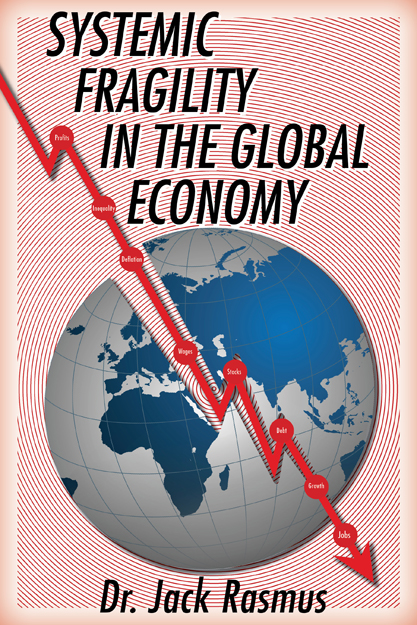
Systemic Fragility grows over the boom phase, accelerating in its later stages, composed initially of both business Financial Fragility and household Consumption Fragility. Fragility is a ratio and a function of three elements: rising indebtedness, declining liquid income, and the terms and conditions for which payment on incurred debt is made. Mainstream economics bifurcates this ratio: the Hybrid Keynesian wing considers income but largely disregards finance, credit and debt as equivalently important variables; the Retro Classicalist wing considers credit and debt but de-emphasizes the role of income. Both minimize the importance of ‘terms and conditions’ of repayment by focusing only on a subset—the interest rate—of this third element determining fragility.

Proposition 13:

Over the boom phase, rising household indebtedness amidst stagnating and declining household income represents rising ‘Consumption Fragility’ (CF) within the system. Similarly over the boom phase, rising financial institution (banks, shadow banks, and portfolio operations of large corporations) indebtedness that occurs with the increasing shift to debt-leveraging financing of If, represents ‘Financial Fragility’ (FF). Financial fragility during the boom phase is obscured by rising financial asset inflation. Consumption fragility is obscured by the continuing growth of consumption driven by debt. Both obscured effects disappear with the onset of the boom phase, revealing the true condition of fragility deterioration during the boom.

Proposition 14:

During the boom phase, a third form of fragility—Government Balance Sheet Fragility (GBSF)—also grows, as successive financial instability events of growing intensity require repeated government bailouts of financial institutions and as fiscal stimulus policies are introduced in successive (normal) recessions to assist recovery of non-financial corporations. In addition to these cyclical contributions to GBSF, structural causes also contribute to GBSF, as legislated tax cuts and subsidies for corporations adds further to government debt and thus GBSF. Thirdly, in the particular case of the United States, the policy choice since the 1980s to run annual and growing trade deficits adds still further to total deficits and debt levels. Dollars accumulate abroad due to the trade deficits and US trading partners agree to recycle the dollars back to the US by purchasing US Treasury bonds. Knowing the bond purchases will continue, the US federal government cuts taxes and increases spending further still, thus raising the deficit and total government debt. Federal debt consequently grows from less than $1 trillion to more than $15 trillion in the process. GBSF rises due to rising debt and falling (tax revenue) income.

Proposition 15:

During the initial bust phase following a financial crash, financial asset prices collapse and financial fragility accelerates, with its consequent effects on real Ig, employment declines, and the debt-deflation-default processes previously noted. Simultaneously, Consumption Fragility—already rising during the boom phase—deteriorates even more rapidly, driven by income declines due to mass layoffs, wage-benefit reductions, shorter hours of work and weekly earnings, and negative wealth effects as savings levels and rates of growth collapse. The financial crash thus precipitates a further ‘fracturing’ of both financial and consumption fragility. By means of the price system and the debt-deflation-default process, Financial and Consumption Fragility thus exacerbate each other in the course of the downturn. Just as the financial side of the economy causes a deterioration of real side conditions, the latter in turn cause a further deterioration of the financial side. The internal transmission mechanism of this mutual feedback is the debt-deflation-default process, which also contains its own inter-causal feedback effects.

Proposition 16:

Rising real debt, deflation across the three price systems, declining cash flow and disposable income, and the corresponding collapse of available credit transmits to the real economy in the form of a rapid decline in business and consumer spending, which in turn feedback upon each other. A faster, deeper and more protracted recession results, not a ‘normal’ recession precipitated by external demand or supply shocks, but an ‘epic’ recession precipitated by a financial crash and accelerated by an endogenous condition of extreme ‘systemic fragility’.

Proposition 17:

As the bust phase of the cycle continues and recession deepens, Government Balance Sheet Fragility—already growing per forces noted in proposition #14 above—rises further as well, as government fiscal-monetary stimulus policies attempt to halt the downturn. However, GBSF is not without limits. Under particularly severe conditions of Financial and Consumption Fragility, attempts to halt the momentum of decline by means of tax cuts and spending may prove insufficient while nonetheless adding to GBSF. The result is an extended period of ‘stop-go’ recovery, with short and brief real economic growth punctuated by repeated relapses, and even double dip recessions. This ‘stop-go’ recovery trajectory may continue for years, and even decades, should Systemic Fragility rise or remain high.

Proposition 18:

Systemic fragility in its three basic forms, and their mutual amplifying feedback effects, transmit to the real economy by means of reductions in fiscal and monetary multiplier effects. In the attempted recovery phase, the State engages in fiscal stimuli to bail out banks, corporations and investors. However, Systemic Fragility means business tax cut multipliers have sharply declined, to less than 1.0. State fiscal stimulus consequently results in business, and especially Multinational Corporations, cash hoarding. Cash hoarded is then diverted to corporate stock buybacks and dividend payouts, diversion of real asset investment to offshore emerging markets, and into new financial asset speculative investing in an effort to resort collapsed asset values and corporate balance sheets. Real investment and thus job creation subsequently lags and a stagnant stop-go recovery results.

Proposition 19:

Systemic fragility and its amplifying effects also serves to reduce money multipliers. Massive money supply injections by central banks are initially hoarded, then redirected to lending offshore, to financial speculation, and to ‘safer’ large corporations. Banks reduce lending to ‘less safe’ smaller businesses and households, further reducing investment, jobs and consumption demand. Money demand and money velocity thus offset money supply injection by central banks. Central bank QE and zero interest policies provoke instead new financial bubbles in stocks, junk bonds, real estate, foreign exchange and derivatives trading. Currency wars erupt as money injection policies depress currency exchange rates. Banks and financial markets become increasingly addicted (dependent upon) central banks money injections. Globally, financial speculation raises the specter of further financial instability on a real economy base further weakened by the preceding cycle of economic contraction. The risk of bona fide global depression rises in time.

Proposition 20:

In the context of conditions noted above—of systemic fragility and growing feedback amplitude effects—traditional fiscal-monetary policy tools attempting to expand the economy are rendered increasingly ‘inelastic’ (i.e. less sensitive or effective) in generating a sustained economic recovery. Conversely, when such tools are employed to contract the economy, via austerity fiscal policies and/or central bank raising of interest rates, the effects are more ‘elastic’ (i.e. more sensitive and effective) in contracting the real economy. Fiscal-monetary policies are therefore not simply increasingly non-productive but, over time, become counter-productive in generating recovery. Solutions to recovery consequently lie in the necessity of a major restructuring of the economy along multiple key sectors including, but not limited to, the tax system, banking system, retirement and healthcare systems, labor markets and public investment—with the purpose of redistributing income while simultaneously reducing debt. That is, reducing systemic fragility in aggregate as well as its mutual amplifying effects.

Jack Rasmus, copyright April 2013

AS AN AUTHOR PUBLISHED BY PLUTO BOOKS, I HAVE RECENTLY ENGAGED IN A DEBATE WITH OTHER PLUTO AUTHORS ON THE CAUSES, CONSEQUENCES, AND SOLUTIONS TO THE GLOBAL ECONOMIC CRISIS. THE FOLLOWING IS MY FIRST ENTRY IN THAT DEBATE.

A correct identification and analysis of the causes of the crisis is important. It is essential for proposing effective solutions. Failure to understand true causes leads to proposing ineffective solutions and, in turn, to adopting wrong strategies.

Allow me to begin this debate with a brief overview of mainstream-bourgeois, left-liberal, and contemporary Marxist explanations of the causes of the crisis, and explain why they are in error. Following that, I will offer a brief outline of my own view of the fundamental causes of the crisis, represented by 20 fundamental propositions.

Contending explanations of the global economic crisis that surfaced in 2007-08 reduce to the key question: what is the relationship between the financial and non-financial (real) sectors of the economy in the origination, precipitation, and continuing evolution of the current global economic crisis? Is the crisis essentially a financial event, that subsequently negatively impacted the real economy; or is the financial crisis just the appearance of a more essential development originating in the real side of the economy.

Simple observation shows that Finance Capital has had something fundamental to do with the current crisis. Nevertheless some argue it is not fundamental and that the originating locus of the crisis resides with variables on the real side of the economy—i.e. profits, wages, private real asset investment(structures, equipment, inventories, etc.). But to argue that such real side forces are solely—or even primarily—responsible for the crisis, and that financial forces (global financial institutions, new liquid markets, new securities creation, exploding credit-debt relationships, etc.) and financial instability (number, frequency and magnitude of financial bubbles and crashes) are merely derivative of those real forces, is as incorrect as to argue that financial forces solely explain the current crisis.

More precisely: to argue that a falling rate of profit is responsible for the crisis of 2007-08 is as simplistically incorrect as to argue the mortgage market bust caused the deep collapse of the real economy post-2007, and the subsequent double and triple dip recessions, and bona fide depressions in the Euro periphery, now beginning to appear globally .

There is no simple linear causal relationship from profits to crisis. Profits are not the sole, or even primary, determinant of investment and the current global crisis is fundamentally about investment—both declining real asset investment and escalating financial asset investment. The fundamental driving force behind the crisis are the changing causal relationships between the two forms of Investment—real asset and financial asset—and the mutually reinforcing transmission mechanisms between them. (A more detailed initial treatment of the relationships between real and financial asset investment is available in my 2010 book, ‘Epic Recession: Prelude to Global Depression’, by Pluto).

The task of analysis therefore is to explain the relationship between the financial and the real forces in the crisis, beginning with the two forms of investment. To explain to what extent financial and real forces are autonomous of each other and to what extent they determine each other. Precisely how do those mutual determinations occur; that is, what exactly are the empirical ‘transmission mechanisms’ that represent the feedback effects between financial and real?
It is unfortunate that much of economic analysis today (left, right and mainstream academic) claiming to have identified causes of the crisis is mostly identification of simple correlation relationships assumed to reflect causal relationships. Moreover, the ‘correlations as causation’ are typically one-directional, from real to financial or financial to real. Nor do the unidirectional ‘correlations as causation’ claims both to explain the transmission mechanisms by which the real side variables determine the financial.

For example: One wing of mainstream economists claim the collapse of the real economy is correlated strongly with central banks’ money supply mismanagement; therefore money supply mismanagement caused both the financial crash and the consequent deep contraction of the real economy. This views the capitalist economy as fundamentally stable and that (monetary) policy makers simply screwed it up. Another wing of mainstream economists argue regulatory policy was the cause of the crisis, as financial deregulation provoked the crisis that began 2007-08. Similar ‘single correlations’ analyses abound in mainstream economic analyses of the crisis, mostly associated with ‘this or that’ policy error that appears correlated with the crisis and therefore assumed to be causative. Fundamental systemic forces endogenous to the capitalist system are never considered. Neither real nor financial forces are considered primary determinants of crisis. (For my critique of these views, see ‘Obama’s Economy: Recovery for the Few’, 2012, Pluto Books).

Views on the left correctly reject this view that the system is basically stable and crises are due to policy errors. Left views recognizes endogenous forces are responsible for the crisis. However, endogenous forces are always ‘real’ and ‘financial’ forces always derivative, as in the case of mainstream analysis. Correlations are assumed causative and no transmission mechanisms from the real to the financial are described—let alone mechanisms that represent mutual feedbacks and inter-determinations.

For example, the prevailing left-progressive critique of Neoliberalism identifies the compression and stagnation of wages since the 1980s as responsible for the recovery of corporate profits thereafter. Above historical average excess profits obtained at the direct expense of wages consequently fueled the expansion of profits and in turn the financial excesses that followed that eventually caused financial instability.

Disagreement with the Neoliberal critique view on the timing and direction of profits and wage change, but still agreeing with the idea that real forces are primary and financial forces derivative, a variant of contemporary Marxist analysis argues wage and profit decline actually preceded the 1980s by a decade. By means of various convenient redefinitions of what constitutes profits and adopting a very narrow definition of wages, this view argues real wages have not really stagnated and therefore profits from real asset investment have continued to steadily decline since the 1980s. Thus, profits decline on the real side of the economy, not profit expansion, is behind financialization and financial profits as Capitalists have offset the tendency toward real profits decline by turning to financial profits. (For my more detailed critique of this view, readers are referred to the forthcoming article, “The Bifurcation of Marxist Economic Analysis”, in the March 2013 issue of the World Review of Political Economy).

In all the preceding explanations, moreover, terms of analysis are left vague and undefined, on both the real and financial side. On the left, problems of profit definition, global profits data access, and profits under-reporting are ignored. Wages are narrowly defined, excluding various categories of labor and pay. For the mainstream view, explanation occurs in the ‘conceptual ether’ above all reference even to profits, wages, or any other real variables. Money supply mismanagement thus occurs in a theoretical ‘black box’.

Linear correlations passed off as causation, high level generalizations without explanation of ‘transmission mechanisms’ and feedback effects, vague definitions of key terms, reference to insufficient data—all these fundamental errors of analysis characterize bourgeois, left-liberal, and even some contemporary Marxist analyses of the current crisis. The crisis is not viewed as the result of mutually determining real and financial forces. The fundamental variable of investment in its two key elements—real asset and financial asset—and their shifting causal interrelationships are not considered primary. The role of the capitalist price system as a major system destabilizer is not considered in any of the above approaches to ‘real side only’ analysis.

In my follow-up second contribution to this debate, I will review 20 ‘fundamental propositions’ that summarize my alternative perspective on the causes and consequences of the crisis—a perspective that integrates real and financial variables, the price system, and the new realities of 21st century Finance Capital to produce what will be referred to as a growing ‘systemic fragility’ in the global Capitalist System today. A perspective that explains why no sustained recovery has occurred after five years of crisis, why double and triple dip recessions are now appearing globally, and why the current ‘Epic’ recession is drifting toward a bona fide depression.

Jack Rasmus
March 2, 2013

comment: THE FOLLOWING ARTICLE WAS WRITTEN TWO DAYS PRIOR TO PRESIDENT OBAMA’S ANNOUNCEMENT OF HIS 2014 BUDGET, AND PREDICTED MOSTLY WHAT HE PROPOSED RE. CUTS IN SOCIAL SECURITY-MEDICARE AND RESTORATION OF CUTS IN DEFENSE SPENDING. THE ARTICLE SUMMARIZES THE HISTORY OF DEFICIT CUTTING FROM OBAMA’S ORIGINAL PROPOSAL OF A ‘GRAND BARGAIN’ IN SUMMER 2011 TO HIS CURRENT ‘COLLUSION’ WITH HOUSE REPUBLICATIONS TO CUT SOCIAL SECURITY AND RESTORE SEQUESTERED DEFENSE SPENDING CUTS.

ON APRIL 10, PRESIDENT Obama released his formal budget for Fiscal 2014 beginning this October. Liberals should not act shocked and surprised: Obama’s repeated offers to cut Social Security cost-of-living adjustments, and other yet undefined Medicare measures, are a continuation of his practice and approach for the past two years.

The budget will usher in the final stage of negotiations over the proposed deficit cuts — Austerity American Style — that began with the recommendations of Obama’s Deficit Cutting Commission, referred to as the Simpson-Bowles report, that was made public in November 2010.

The Simpson-Bowles Commission — chaired by arch-conservative retired Senator Alan Simpson, and Bill Clinton’s chief of staff, now investment banker Erskine Bowles — proposed an approximate $4 trillion cut in U.S. deficits and debt for the subsequent decade. Their report has been the ‘template’ for deficit cutting negotiations ever since.

Issued around the time the Teapublicans took over the U.S. House of Representatives in late 2010, the report was offered by the Obama administration as the basis for negotiating a “grand bargain” of $4 trillion in deficit cuts in summer of 2011. The $4 trillion target was agreed by virtually all parties in Congress and the administration at that time — and ever since. The only difference was, and remains, “the mix:” how much in spending cuts vs. how much tax revenue hikes; how much to cut defense spending vs. how much social programs; and how much to tax the wealthiest 2% vs. the middle class.

In June 2011, Vice-President Biden was assigned by Obama to begin negotiating the basis for the “grand bargain.” He and House Speaker John Boehner attempted and failed to do so, even though Biden had offered a package of 87% spending cuts to only 13% tax hikes — even more onerous than Simpson-Bowles’ recommended 75%-25% mix.

Obama then took over negotiations with Boehner directly in July 2011. He unilaterally — i.e. with no counter concession from Boehner — offered to cut Social Security and Medicare by $700 billion to entice Boehner and House Teapublicans into a deal. Offering big cuts in Social Security-Medicare has thus been a bargaining tactic by Obama, the “carrot” dangled to the Teapublicans to entice them to agree to a $4 trillion Grand Bargain from the very beginning.

Boehner and the Teapublicans did not bite on Obama’s grand bargain offer in July 2011, however. They held firm and demanded an “all spending cuts” agreement in exchange for raising the federal government the debt ceiling in August 2011. They got their way. Obama and the Democrats caved in on all his demands by August for some tax revenue hikes. All they got from the August 2011 debt ceiling deal was agreement from the Teapublicans not to raise the debt ceiling issue again until after the November 2012 elections. Very convenient for the president and the Democrats; not so for the rest of us since the August deal involved $1 trillion in immediate social spending only cuts, mostly in public education, with another $1.2 trillion in spending only cuts — the “sequester cuts” — that would take effect on January 1, 2013.
As part of that August 2011 $2.2 trillion deal, Congress was given the option to cut even more than the $1.2 trillion ‘sequester’ part of the total. A special committee of Congress (the so- called Supercommittee of House and Senate leaders) was established and given the option to cut more than the $1.2 trillion by year end 2011. The Supercommittee, however, not surprisingly decided to “kick the can down the road,” shelvingf all deficit cutting during the 2012 election year.
Instead, in 2012 both parties and their candidates talked about economic programs neither had any intention of introducing. Regardless of who won the November 2012 election, the Simpson- Bowles “template” was waiting in the desk top drawer, to be resurrected after November 2012. And that’s just what happened: Within days following the election, Obama immediately offered $340 billion in “entitlement” program cuts in his attempt once again to resurrect the grand bargain negotiations.

Phony Fiscal Cliff: It’s the Tax Cuts, Stupid!

But the Teapublicans and big corporate interests, in the form of the Business Roundtable in particular — the biggest and most influence U.S. corporate lobbying group, composed of CEOs of the largest corporations — were neither interested in a “grand bargain” at that time. The Business Roundtable preferred to focus initially only on the Bush tax cuts that were also scheduled to expire January 1 — not the “sequestered” $1.2 trillion in spending cuts also scheduled to take effect on January 1, 2013.

The Bush tax cuts — more than 80% accruing to wealthy households and investors — were far more important to them than the spending cuts. Their primary goal has always been to protect and extend the Bush tax cuts; cutting spending and deficits has always been secondary, and the cuts should be at the expense of social programs.

The Bush tax cuts amounted to $4.6 trillion for the coming decade, according to the Congressional Budget Office. The CBO’s projected deficits for the coming decade, should the Bush tax cuts be totally repealed, amounted to only $2.5 trillion. Extending the tax cuts meant the projected deficit would amount to around $7 trillion. To borrow the popular phrase: It’s not about deficits; it’s the Bush tax cuts, stupid!

Following last November 2012’s elections, the Teapublicans initially wanted all the Bush cuts extended permanently, but the Business Roundtable wanted some kind of a settlement on the tax issue first. Without that happening, the Roundtable’s even bigger objective of a major revision of the entire tax code, including cuts in the top rate of corporate taxes from 35% to 26%, already working its way through Congress, could not proceed. To preserve as much of the Bush tax cuts as possible the issue had to be decoupled from the sequester. Furthermore, the Bush tax cuts had to be resolved before the tax code could be revised and corporate tax rates reduced.
Following the November elections, the Roundtable therefore blocked with Obama and against the House Teapublicans. To get the public on board, the media spin given to the Bush tax cuts extension was labeled the “Fiscal Cliff.” Although the media included the sequestered spending cuts as part of the “Fiscal Cliff,” that issue was separated tactically by both the Roundtable and Obama weeks before January 1, 2013.

With the assistance of House Speaker Boehner, Obama plus the Roundtable prevailed over the Teapublicans. It was touch and go, with Teapublican leaders like Ryan and Cantor wavering and striking a neutral pose to protect their ultra-conservative credentials. But no doubt in the end, campaign finance spending by the Roundtable big corporations prevailed and the Obama- Roundtable-Boehner nexus were able to swing a sufficient number of House Republicans to get a “tax deal” on January 1, 2013.

And how sweet a deal it was. Only $60 billion a year of the deficit was reduced, impacting less than 0.7% of the wealthiest households — far fewer than Obama’s promised 2%. Moreover, as part of the deal, the Alternative Minimum Tax was permanently repealed (amounting to about $100 billion a year tax cut benefit to the wealthy), the Inheritance Tax was cut even more generously than under Bush, and all the other Bush tax cuts were made permanent. No need to extend them ever again.

The total cost in revenue loss and therefore deficit increase that remained was $4 trillion over the coming decade. Ironically, that’s just about what the Simpson-Bowles commission recommended in deficit reduction. The deficit for the coming decade was thus raised from $2.5 trillion to now about $7 trillion as result of the Bush tax cut deal — billed as “avoiding the Fiscal Cliff” — of January 1, 2013. Now the attack on spending could begin in earnest once again, and focusing on entitlements in particular.

As part of the January 1 deal, the sequestered additional $1.2 trillion in spending cuts were postponed for two more months, until March 1, 2013. In signing the deal on January 2, Obama declared that more tax revenue hikes would have to be negotiated in future deals. No doubt he and Democrats believed that the March 1 date would put pressure on the Teapublicans to compromise on more tax hikes in exchange for avoiding the approximate $500 billion in defense spending cuts that were part of the sequestered $1.2 trillion going into effect on March 1.

There was also the March 27, 2013 date when the Federal government would run out of money to pay its bills. Surely, the Teapublicans didn’t want to get blamed again for that fiasco, as they had been in the past? And thereafter there was the May 18, 2013 revisiting of the debt ceiling extension. Obama undoubtedly believed that somewhere along this line the Republicans would give him the token tax hikes he needed as cover to agree to his massive cuts in Social Security, Medicare and Medicaid he was always willing to make as part of a Grand Bargain.

But the Teapublicans again called his bluff. They let the sequestered spending cuts, including the defense cuts, go into effect on March 1, 2013. They then agreed to fund the government past March 27 and suggested as well the debt ceiling would not be an issue. This left Obama with no bargaining leverage for insisting on tax revenue hikes. His answer has been his increasingly desperate re-offering of big Social Security and Medicare cuts in recent weeks, some of which appear in part in his April 10 budget. That will serve as a base from which he will then agree to even further cuts in subsequent negotiations with Teapublicans in the House (and Roundtable CEOs in the background).

Some Key Strategic Questions

The question is why have the Teapublicans agreed to the token January 1 tax hikes? Why did they agree to allow the $1.2 trillion sequestered cuts, including defense spending, go into effect? Why did they not engage in brinksmanship again on March 1 or March 27, unlike wqhat they did in August 2011? And why will they not go to the brink again on the debt ceiling issue when it arises once more in May?

The answer to the first question is that they got a tax deal they simply couldn’t refuse on January 1, and one which their big corporate campaign benefactors, the Business Roundtable, wanted. After having blocked with Obama prior to the January 1 deal, however, the Roundtable has since shifted gears and adopted in total the Teapublicans’ position on subsequent spending cuts.
In February 2013, the Roundtable came out with its position paper on the matter of sequestered cuts and entitlement spending. It proposed to cut the Social Security COLA (cost of living adjustment), introduce a means test for Medicare, raise the eligibility age for both Medicare AND social security to 70, and convert Medicare into a voucher system in 2022. That’s exactly the Teapublican-Paul Ryan program.

With big corporate interests now in their corner firmly with regard to entitlement cuts as the primary focus of deficit cutting, why should the Teapublicans agree to any further tax hikes on the rich? And with the Roundtable and CEOs now firmly on their side, and the tax cuts successfully decoupled from the spending cuts, why should the Teapublicans go to the brink over shutting down the government on March 27? By March 1 they were already almost three- fourths of the way to the $4 trillion deficit target, with a total of $2.8 trillion in spending cuts and token tax hikes!
By letting the March 1 sequestered cuts take effect, the Teapublicans in effect did to Obama on the topic of defense spending what Obama had the opportunity – but didn‘t take — to do to them on the topic of Bush tax cuts on January 1. Obama could have let all the Bush tax cuts expire January 1, and then reintroduced middle class tax cuts only on January 2. That would have put the Teapublicans in the position of having to vote down middle class tax cuts. But he didn’t, and settled for the paltry 0.7% hike on taxes on the wealthy, some of which will undoubtedly be reversed again, buried deep in the legislation, when the major tax code negotiations conclude later this year.

The Teapublicans, by allowing the sequestered defense cuts to take effect on March 1, can also always reintroduce legislation piecemeal later this year to restore many of the defense cuts.
It’s not surprising that Republican Senator, Lindsey Graham, and others in Congress, in recent weeks have offered “deals” amounting to another $1.2 trillion in deficit reduction. That number is not coincidental, as $1.2 trillion is now the remaining “target” number . Graham’s proposal is for $600 billion in Social Security and Medicare cuts and another $600 billion in unspecified tax revenues.

So why should Teapublicans precipitate a political crisis over the March 1 or March 27 deadlines? Why should they repeat the debt ceiling crisis on May 18? They’re winning hands down.

What Obama May Propose

Having agreed to decouple tax cuts on January 1 and having been outmaneuvered on March 1 and March 27, and with Teapublicans signaling there will be no debt ceiling crisis in May, Obama has been stripped of all his leverage points in bargaining. Obama has left only the option to offer even more Social security, Medicare and Medicaid cuts. And throughout March he continued to do so, once again unilaterally — not just offering again to cut COLA adjustments for Social Security but suggesting his willingness to confront big cuts in the $600-$700 billion range for Medicare and Social Security and more for Medicaid.

But Obama has planned all along to cut Social Security and Medicare. He made that clear in his signing of the Bush tax cuts deal on January 2, 2013, during which he stated: “Medicare is the main cause of deficits.” Again in his February State of the Union address, the president publicly noted he “liked the Simpson-Bowles” recommendations concerning Medicare cuts.

And what are those recommendations? Instituting a new $550 a year deductible for Parts A and B of Medicare, and providing only 80% coverage for Part A instead of the current 100% (which would require another $150-$300 a month in private insurance to cover the remaining 20%, much like Part B now). That together amounts to another $195-$350 taken out of monthly Social Security checks, when the average for social security benefit payments is only $1100 a month today.

In other words, Medicare benefits will not be cut – but if seniors want to maintain current levels of benefits they’ll have to pay even more for them. Alternatively, they can choose to have fewer benefits and not pay more. It’s all about rationing health care, just as Obamacare for those under 65 is essentially about rationing — as were Bush’s proposals to expand health savings accounts (HSAs) and Bill Clinton’s health maintenance organization (HMOs) solution.

With only $1.2 more to cut in deficit spending to reach the Simpson-Bowles $4 trillion target, and Obama offering again his $600-$700 billion enticement in entitlement spending cuts, a deal is closer than ever before. Watch therefore for the full $600 billion in Social security, Medicare and Medicaid to take effect, the effective date of the changes to be backloaded in later years of the decade and certainly not before the 2014 midterm elections.

Expect defense spending cuts of no more than half the $500 billion proposed in the sequester, and nearly all of which will be from withdrawals from Afghanistan and Iraq operations, not from equipment spending. After 2014, most will be recouped as defense spending on naval and air force equipment and operations will ramp up for the shift of U.S. military focus to the Pacific. They Army brass haqs had its land wars in Asia; now it’s the turn of Navy and Air Force.

That leaves only a “token” tax revenue increase of about $200 billion over the coming decade, or a paltry $20 billion a year, which will come in difficult to estimate phony “loophole” closings. Major cuts in corporate taxes later in 2013 will not be factored into the Grand Bargain $4 trillion official calculations. In addition to big cuts in the top corporate tax rate, look as well for multinational corporations’ tax breaks and tax forgiveness on the $1.4 trillion they are presently sheltering in offshore subsidiaries. Of course, small-to-medium business will be thrown yet another tax cut bone to buy into the deal. In exchange, the middle class will pay more in terms of limits on deductions and exemptions.

Grand Collusion

In retrospect over the past three years, and especially since November 2012, the Grand Bargain looks less like a bargain and more like a “grand collusion” among the various parties — Teapublican, Big Corporate, Obama, and the pro-corporate wing of Democrats in Congress that have had a stranglehold on the Democratic party since the late 1980s.

This is not the Democratic Party of your grandfather that agreed to introduce Social Security in the 1930s and that proposed Medicare in the 1960s. This is the Democratic Party, and the Democratic President, that has agreed with Republicans and Corporate America to begin the repealing in stages of these very same programs — programs that are not “entitlements” but are in fact deferred wages earned by Americans over the decades, are now being “concession bargained” away.

Not content with concessions from those workers still in the labor force, capitalist policymakers are intent on concessions on social wages now coming due in the form of Social Security and Medicare benefits. It’s a charade from Simpson-Bowles to the present.

What should be done? Writing letters to Congress won’t change anything. What is now necessary is to begin the formation nationwide of Social Security-Medicare Defense Clubs. After all, that’s how Social Security started in the first place. Neither party proposed it in the 1930s initially.

In fact, Roosevelt initially publicly advocated that Social Security should not be part of the New Deal. A grassroots protest organized by the clubs forced him and the Democrats to reverse this position just before the midterm 1934 elections and support the proposal for Social Security. Now it’s time to reform the clubs to defend Social Security — and the first action should be to call for a million person march on Washington to reverse whatever cuts are surely ahead.

Jack is the author of Obama’s Economy: Recovery for the Few (2012), which provides a history of deficit cutting in the US and predictions of its impact. His blog is jackrasmus.com. For a video presentation on Social Security and Medicare given recently to the Progressive Democrats of America, see his website at http://kyklosproductions.com/video/130228_PDA-forum_rasmus/.

AS THE ‘SHADOW’ US FEDERAL RESERVE CHAIRMAN OF THE NEWLY FORMED US ‘GREEN SHADOW CABINET’, THE FOLLOWING IS MY INITIAL OPED STATEMENT ON FISCAL-MONETARY POLICY IN THE US, ITS FAILURE, AND WHAT NEEDS TO CHANGE CONCERNING THE US FEDERAL RESERVE AND MONETARY POLICY. (Dr. Jack Rasmus)

“OpEd Contribution
‘The Failure of Fiscal-Monetary Policy, 2008-2013’
By Dr. Jack Rasmus
‘Shadow’ U.S. Federal Reserve Chairman’
GREEN SHADOW CABINET

“Fiscal and Monetary policies since the financial crisis and the protracted recession that began in 2008 have failed to generate a sustained recovery of the US economy—except for big banks, big corporations, investors and speculators, and the wealthiest 10% households. All have benefited significantly from record profits growth and record returns on stock, corporate bonds, derivatives and other financial securities’ investments since 2009, while median family earnings have continued to decline every year and Main St. America has been left behind.

Fiscal Policy Failures

Obama’s fiscal stimulus spending programs of 2009-2012 have been grossly insufficient—not just in terms of levels of spending, but in the composition and timing of that spending as well. On the tax side, Obama programs have been grossly over-weighted toward business tax cuts and personal income and inheritance tax reductions for wealthy investors and households.
.
Instead of leading to investment and jobs in the US, the business tax cut bias has resulted in record cash hoarding by big business and multinational corporations in excess of $3 trillion. Instead investment and jobs in the US, that corporate cash hoard has been, and continues to be, diverted to record stock buybacks and dividends payouts, to investment and job creation in offshore emerging markets, and to investment in speculative financial securities.

The failure of Obama fiscal stimulus programs to create jobs has contributed significantly to the weakest job recovery from recession of the 11 prior recessions since 1945. In addition to hoarded business tax cuts, hundreds of billions of dollars distributed in subsidies to the States since 2009 were promised first ‘to create jobs’ and then at least ‘to save jobs’. Neither happened. State and Local governments instead laid off 700,000, engaging in massive job destruction instead of job creation which continues to date. $100 billion in stimulus spending targeted for infrastructure investment—promised for ‘shovel ready’ projects—were instead redirected to long term, capital intensive projects and little job creation.

In 2013 more than 21 million still officially remain jobless; in actual fact, more than 25 million. While the administration touts the creation of 5 million new jobs, it remains silent on the 5 million who have left the labor force unable to find any form of work. Full time permanent jobs have disappeared while more than 6 million involuntary part time jobs were created and millions more temporary jobs. Of the jobs lost since 2009, 60% were top tier jobs paying more than $18/hr. while 58% of the jobs created since 2009 were the lowest paying jobs at less than $12/hr. Not surprising, as a consequence of continuing massive unemployment and falling real wages, median wage earner families’ real income has fallen consistently since 2008.

Administration housing policies have been no less a disaster. Token spending programs promised to save US homeowners in 2009 were in fact mostly incentives to banks and mortgage companies to move owners out of their homes to resell to new buyers. Foreclosures escalated to more than 14 million to date, about 1 out of every 4 homeowners with a mortgage, while more than ten million homeowners still languish in negative equity. State attorney generals’ legal suits against banks and lenders in response to the ‘robo-signing scandal’ in 2010 were subsequently brokered by the Obama administration in 2011-12 in favor of the banks, allowing the latter protection from all future liability in exchange for a pittance settlement providing illegally foreclosed homeowners damages averaging a mere $1500. Further administration subsidies to banks and mortgage lenders in the form of the 2012 ‘HARP 2.0’ program have fattened bank profits while providing a minimal number of homeowners in negative equity any relief. The recent much-hyped housing recovery is largely the result of purchases of banks’ foreclosed housing stock by wealthy speculators (US and foreign), private equity and hedge funds, who area loaned money by the banks who in turn borrow the funds at zero interest from the Federal Reserve—or, alternatively, the building of apartments at a feverish pace to house the 13 million plus foreclosed former homeowners.

Monetary Policy Failures

Monetary policy, driven by the US Federal Reserve, the central bank of the US, has amounted to more than five years and $3 trillion of ‘Quantitative Easing (QE)’ printing of money by the Fed, which has been then directly used to buy collapsed mortgage bonds and other instruments owned by banks, shadow banks, and wealthy individual investors—most probably at prices above their true depressed market values. In addition, the Fed has provided tens of trillions of dollars more to banks and shadow banks in essentially free money, zero interest loans. The Fed has even allowed banks to redeposit the free money with it, for which it pays the banks interest. In short, the Fed policy has been to subsidize purchases of investors with QE while additionally paying banks to borrow money from it for free.

QE and Zero rate policies have had virtually no effect on the real economy and recovery, while creating bubbles in the stock market, corporate junk bond market, farmland real estate prices, derivatives trading and foreign currency exchange speculation. QE and free money flows directly from the Fed into financial speculation and investment in the various liquid, short term, price driven financial markets globally. While fattening the wallets of professional speculators, banks, and ‘portfolio’ operations of multinational companies, monetary policies have created numerous negative effects and have hindered, not stimulated, the recovery of the real non-financial economy.

Five years of near zero rates have mean zero returns and income growth for seniors and households dependent on fixed incomes; have accelerated the collapse of pension funds and even 401k matching contributions by employers; have resulted in real income decline for tens of millions of households; have diverted much needed potential lending to small businesses into stocks and other speculative markets; and has set off a global ‘currency war’ as economies worldwide in recession attempt to use QE to lower their currency values to gain export advantages vis-à-vis competitors. Monetary policy is thus slowing much needed investment, serving as a drag on consumption, and destabilizing once again the global financial system.

The Alternatives To Traditional Fiscal-Monetary Policy

Traditional Fiscal-Monetary policies implemented by the Obama administration result in lopsided recovery on behalf of the wealthy and corporations, and stagnation at best for the rest. The consequence is a ‘stop-go’ recovery, of short and shallow periods of growth followed by relapses and stalling in the rate of growth and even double (and triple) dip recessions. This scenario will continue so long as the policies of the past five years continue.

The failure of traditional policies is the consequence of their inability to adequately address the mountain of debt burdening the majority of households (bottom 80%), on the one hand, and the steady decline of real disposable income by those same households as well. Major structural reforms of the economy must replace reliance on failed Fiscal-Monetary policies above. These structural reforms must target the reduction of excess household debt while reversing the declining share of income by the 80% in favor of the top 10%, and especially top 1%, and their corporations, which serve as the conduit through which the wealthiest have been consistently accruing more and more share of national income.

Restructuring can only be achieved by means of a series of major overhauls of the US tax system, the banking system, the retirement and health care systems, by reversing the immense damage wrought on US jobs and incomes by Free Trade policies and offshoring, and by restoring a balance in union-management power destroyed over the past three decades by various legislative, court and technological measures and developments.

An initial ‘short list’ of overhaul-restructuring policies along the several ‘economic fronts’ noted above include: restoring the tax structure back to 1978 levels at minimum and introducing a Financial Transactions Tax of 1% on stock, bond, derivative and forex trades; introducing a public banking system for all forms of consumer credit to provide loans at ‘no profit’ cost of money for mortgages, autos, education, consumer installment, and small businesses. Nationalizing all 401k and private pension plans into a new expanded national social security system that provides a minimum of two-thirds of wage income; a medicare for all health system funded by a payroll tax of 15% on all forms of incomes, wages and capital; an immediate suspension and renegotiation of all Free Trade agreements; national legislation creating a ‘card check’ system for union recognition and bargaining; and selective expunging of bank financed student loans and predatory mortgage and credit card loans.

To Conclude:

Excess household debt and declining real disposable income has resulted in a collapse of spending and tax multipliers that have rendered traditional fiscal policy ineffective. Similarly, Federal Reserve monetary policies of QE and zero rates have result in a resurgence of speculative finance that is collapsing money multipliers for real asset investment by diverting credit from real investment and job creation. Only policies and measures that restructure the US economy fundamentally across critical sectors, and thereby reduce debt loads for the bottom 80% households while raising real disposable income for the same, will prove successful long term in overcoming the current general stagnation of the US and global economy and ensure a return to a trajectory of sustained economic growth.

Liberal mainstream economists’ claim that all that is needed is simply more spending will mean more of the same stagnation. Conservative mainstream economists’ claim that more business tax cuts, more deregulation, and more deficit spending cuts will mean a transition from current stagnation to another deeper economic contraction and perhaps financial crisis and even depression. Both are incorrect. Both seek simply to readjust the relative mix of the same policies. More of the same Fiscal-Monetary policies of the past decade will prove as ineffective in the future as they have been in the past. A fundamental restructuring of key sectors of the economy is necessary for long term recovery.

Dr. Jack Rasmus, April 18, 2013
Green Shadow Cabinet
Federal Reserve Chairman

AS A MEMBER OF THE JUST FORMED ‘U.S. GREEN SHADOW CABINET’, THE FOLLOWING IS A BRIEF INTRODUCTION BY THE ORGANIZATION, ON APRIL 22, 2013 AS A PRESS RELEASE. THE PURPOSE OF THE GREEN SHADOW CABINET IS TO PRODUCE, PUBLICIZE, AND PROMOTE ALTERNATIVE POLICIES TO THE FAILED REPUBLICAN-DEMOCRATIC SOLUTIONS OF RECENT YEARS. FOR MORE ON WHO COMPRISES THE GREEN SHADOW CABINET, AND STATEMENTS BY ITS MORE THAN 80 MEMBERS, ON THE SIDEBAR, SCROLL DOWN AND CLICK ON  ‘Jack Rasmus Website’ ACCESSING MY WEBPAGE.

AS THE ‘SHADOW’ CHAIRMAN OF THE U.S. FEDERAL RESERVE BANK, YOU CAN READ MY INTRODUCTORY OPED STATEMENT ON THIS BLOG (TO FOLLOW ABOVE) ALSO AVAILABLE ON MY WEBSITE, ENTITLED “THE FAILURE OF FISCAL & MONETARY POLICIES, 2008-2013”. MORE OF MY ANALYSES WILL FOLLOW AS TO WHAT NEEDS TO CHANGE CONCERNING THE US CENTRAL BANK, THE FEDERAL RESERVE, AND MONETARY POLICY. Dr. Jack Rasmus

INITIAL PUBLIC PRESS RELEASE BY THE U.S. GREEN SHADOW CABINET:

“This Earth Week, another government is possible . . .
Meet the new Green Shadow Cabinet

Dr. Jill Stein and Cheri Honkala, the 2012 Green Party presidential and vice-presidential nominees, have marked the beginning of Earth Week by announcing a new Green Shadow Cabinet that will serve as an independent voice in U.S. politics, putting the needs of people and protection of the planet ahead of profits for big corporations. The Cabinet will operate in the tradition of shadow cabinets in other countries, such as the United Kingdom and Mexico, responding to actions of the government in office, and demonstrating that another government is possible.

The Green Shadow Cabinet, which is viewable at http://www.GreenShadowCabinet.US, includes nearly 100 prominent scientists, community and labor leaders, physicians, cultural workers, veterans, and more, and will provide an ongoing opposition and alternative voice to the dysfunctional government in Washington D.C..

The Cabinet is organized into six federal branches: Democracy, Economy, Ecology, Foreign Affairs, General Welfare, and Justice. Topics include the economy, environment and climate change, health and general welfare, democratization, rights of workers, wages and labor, community power, closing military bases, ending wars for resources and restoring the rule of law. Among the top priorities will be advocating for full employment through a Green New Deal and confronting climate change and the ecological crisis through a program of creating a carbon-free and nuclear free energy economy.

Public statements from Cabinet members . . .

In honor of the launch of the Green Shadow Cabinet, twenty members of the Cabinet have issued public statements for Earth Week. These are available for republication at http://greenshadowcabinet.us/statements

The Green Shadow Cabinet includes not only scientists and leaders of social change organizations, but also artists and writers. The talented comedian Lee Camp offers this video “statement” on the need for the Cabinet: http://youtu.be/m3zNyEIR-Ww

What you can do . . .

Tell everyone you know about the Green Shadow Cabinet, and get them to sign up for news at http://greenshadowcabinet.us/subscribe-our-newsletter

Make a donation toward getting this Cabinet moving – send a donation made out to Green Shadow Cabinet, Attention: Ben Manski, PO Box 260217, Madison, WI 53726-0217
Urge blogs, newspapers, and others in the media to contact the Green Shadow Cabinet to schedule interviews and to publish articles.

There will be more in the weeks and months to come. Thank you.”

It’s now been more than a week since the Cyprus banking crisis erupted, and patterns are beginning to appear for the Eurozone and greater global financial system that are of some interest.

As predicted by this writer in a commentary on the Cyprus crisis earlier in April , the condition in Cyprus continues to worsen by the day.  What was initially estimated to cost 7 billion Euros to Cyprus  in order to obtain an additional 10 billion euro bailout by the European ‘Troika’ (i.e. Euro Commission, IMF, and ESM fund), rose last week to a 13 billion Euros cost to Cyprus.  ‘Cost’ means the government of Cyprus must raise taxes, increase spending cuts, and accelerate the sell off of government assets. 

But that’s not all. Since the Cyprus crisis represents not just a government debt crisis but clearly, first and foremost, a banking crisis, the additional cost required by the ‘Troika’  is to make depositors in Cyprus’s two main banks pay for the bailout in part as well—in the form of an expropriation of their savings deposits.

The Cyprus situation therefore represents a strategic shift by big Euro bankers, by their executive committee the Troika, and by Euro government policymakers in general. It is a recognition that prior policy solutions, of austerity fiscal policies and liquidity injection monetary policies, will likely not prove sufficient in the event of another banking crisis elsewhere in Europe to keep the Euro banking system afloat.  Confiscation of depositors’ savings are therefore now projected to serve as a ‘third way’ to pay for Troika engineered banking bail outs.

When the Cyprus crisis first erupted, Eurozone financial minister, Djisselboem, let the cat out of the bag by letting it slip in a public comment to the press that confiscation of part of Cyprus depositors savings (called ‘bail ins’) now represented the ‘template’, as he put it, for future euro bank bailouts.  He quickly back-tracked, however, since to publicly admit such was to encourage an old-fashioned retail ‘run on the banks’, not only in Cyprus but potentially in the Eurozone periphery of Spain, Portugal, Ireland, Greece, and even Italy—not to mention in the latest banking instability event now emerging in Slovenia.


The Troika therefore quickly clarified Djisselboem’s statement, and amended its initial position that all Cyprus depositors’ savings would have to contribute in part to pay for bailouts, adopting the position that only depositors with 100,000 euros or more in the bank of Cyprus would have to pay. 

At last count, as of last week estimates were that only depositors with 100,000 or more Euros ($130,000) in the remaining Bank of Cyprus could expect a ‘haircut’–up to 60% of their deposit balances. 

But that was a week ago, at the beginning of April.  By mid-April the situation has no doubt deteriorated further.  That means the cost of bailout continues to rise daily, before the ink has even dried on the 23 billion Euro bailout deal.  That in turn means the 60% confiscation of depositors with more than 100,000 Euros will have to be further raised, the Troika will have to provide more than 10 billion euros bailout, or that the exemption of savers with deposits less than 100,000 euros will eventually have to start paying something as well.

The situation in Cyprus in terms of both government and bank bailouts will inevitably grow worse. Why? Because the real economy will now continue to grow worse.  Austerity will mean even less government revenue collection and thus even greater government debt cost.  More Troika bailout funding will increase that debt cost still further.  The parallel on-going bank crisis in Cyprus will also grow worse, as depositors withdraw as much money as quickly as possible from the Cyprus bank and start hoarding it and/or find ways to move it out of the country,  notwithstanding recent controls imposed on withdrawals and capital flight. 

To put it in economist jargon, money supply in the system will collapse despite the Troika bailout, as money demand and money hoarding escalate and money velocity plummets.  Bank lending to business will dry up. Further layoffs will occur. Unemployment will rapidly reach depression levels in excess of 20%, and tax revenues correspondingly fall even further.  With depression, prices will collapse. Debt and deflation will lead to more business and consumer defaults.

In a futile attempt to stem the collapse of money and the economy in the private sector, the Cyprus government in early April initially instituted draconian controls on bank deposit withdrawals and money transfer from the country.  The government has recently announced these initial limits and controls are now being tightened further, and extended to the end of May. Limits and controls on withdrawals of deposits and money transfer will remain for quite some time. That means a two tier Euro system, with Euros in Cyprus worth far less than Euros elsewhere.

Over the next six weeks the situation in Cyprus will deteriorate significantly. By this summer, the cost of the Cyprus bailout could rise to 30 billion, from the current 23 billion total.  The Troika will have to add more bailout, the Cyprus government introduce even more draconian austerity measures, and depositors will have to pay even more—or some combination of all the above.

Elsewhere in Europe, calls are consequently rising for the EU to provide additional funds to Cyprus out of the Eurozone’s  ‘structural fund’, i.e. its long term infrastructure spending assistance fund available to Eurozone members, as an emergency solution.  But such funding assistance will amount to ‘too little too late’ to make a difference to the downward spiral that will continue to hit Cyprus over the coming months.  Moreover, if and when structured funds are made available to Cyprus, much could simply be hoarded by lenders and investors, given the dire economic situation in Cyprus, and therefore have little positive effect.

Last week the Euro financial ministers met in Dublin, in part to deal with the Cyprus situation and in part to address continuing debt problems elsewhere in the periphery as well as weakening of banks in the Euro ‘core’ economies. They quickly agreed in the midst of last week’s worsening events in Cyprus to extend terms of bailout payments by Portugal, Ireland and Spain for several more years. Absence the Cyprus events, the Euro financial ministers would no doubt have been tougher with Portugal and the others, requiring them to introduce even more austerity measures in exchange for extending the debt payment schedules.  That they didn’t take that hard line is an indication they recognize the banking situation throughout the Eurozone is continuing to deteriorate.

On the agenda in Dublin as well was the question of establishing a true banking union in the Eurozone and broader EU.  Little was accomplished on that question, however. Unlike the US central bank, the Federal Reserve, or the Bank of England or Bank of Japan, the European Central Bank, ECB, is not a true central bank.  It can only engage in central bank money injection and bail out of individual banks in trouble if all the financial ministers of the Eurozone countries (i.e. their respective central banks) agree to allow the ECB to do so.  Thus, unlike the US, UK, or Japan, the ECB cannot engage in a massive liquidity injection in the form of ‘Quantitative Easing’, or QE, as a means to engineer bank bailouts. The Eurozone in part must therefore lean more toward confiscating depositors’ savings in the banks in trouble as a solution.

Last summer 2012, ECB head, Mario Draghi, promised to move forward on a banking union and the first step toward such a union, the establishment of the ECB as a true ‘banking supervisor’ of private sector banks. That temporarily quelled last year’s Euro banking crisis.  But it was apparently mostly just talk and mere talk can only last so long.  As was made clear from the recent Dublin meeting of Euro financial ministers, the Eurozone has made little to no progress toward even granting the ECB ‘banking supervisor’ powers—i.e. a necessary precondition to becoming a true central bank. Nor is that likely to happen before the next German national elections in September 2013, or even after. Germany will continue to thwart and oppose the ECB assuming central bank-like supervision powers or becoming a true central bank capable of independently introdcuing massive QE injections.  Germany in its present position can far better call the shots on the entire Eurozone economy.  Giving authority to a true ECB central bank would only dilute its present authority and role.  So don’t expect any real changes in the Eurozone, Mario Draghi’s pronouncements notwithstanding.

All that likely means that the Euro banking system in general will continue to drift toward more instability.  Watch for Slovenia as the next crisis center. And behind the scenes, investors throughout the Eurozone’s periphery are no doubt looking at Cyprus and preparing to move their money out of their own national banks in Spain, Portugal, and elsewhere in anticipation of likely ‘depositors’ confiscations’ should a banking crisis erupt in their respective countries. That money will most likely flow into Germany, New York, or even Tokyo.

Meanwhile, elsewhere globally the US, the UK, and now Japan continue their headlong rush toward ever more quantitative easing, QE—that is liquidity injection to banks, shadow banks, and wealthy private investors—by printing money. 

The US has led the way with multi-trillions of QE, continuing at the rate of $80 billion a month with no end in sight.  The Bank of Japan has just announced its equivalent, even larger than the US QE, per its GDP, and soon the Bank of England will announce another round of QE when its new chair, Mark Carney, comes on board this summer. Outside Europe, capitalists are clearly rolling the dice on QE as the solution.

It is becoming increasingly clear in fact that global policy makers and capitalists are moving toward a general policy mix of ever more QE combined with continuing fiscal austerity.  But austerity is clearly causing problems and is a drag on economic recovery. QE is also having a net negative effect on real economic growth and financial instability, contrary to its announced intent, as will be explained in a subsequent article by this writer. 

Without the option of a true QE, the Eurozone has had to rely more on austerity. In contrast to Europe, the US has relied more on QE and is only now moving toward more fiscal austerity after putting that on hold during the 2012 election year.  The UK has introduced austerity and a moderate QE policy, neither of which has prevented it from descending into recession again. Japan initially did nothing, neither QE or austerity, but is now betting heavily on a massive QE policy that has begun to roil financial markets globally and intensify an emerging ‘currency war’ via QE-driven competitive currency devaluations.

So all are major capitalist sectors globally are converging  toward ‘Austerity + QE’ as the policy solution.  But neither QE or Austerity will resurrect the global economy as it drifts toward slower growth, more recessions, and more banking instability in the months ahead.

A growing focus on confiscating depositors savings will therefore become more of an option by all over the longer run. Not just in Cyprus. Not even just in the Europe. But in the US as well. Confidential memos recently released show plans by the US FDIC and the Bank of England in a meeting last December 2012 open to the idea of confiscating depositors’ savings as yet another means by which to bail out banks in the event of another banking crisis.

But more on the contradictions of QE, ‘Austerity American Style’, and bank savings confiscations in a follow up to this article.

Jack Rasmus
April 16, 2013

ABOUT A MONTH AGO, ON MARCH 6, THIS WRITER WAS INTERVIEWED BY RUSSIA RADIO TODAY ON THE MARCH 1 SEQUESTERED SPENDING CUTS AND CONDITION OF THE US ECONOMY. THE FOLLOWING IS THE TRANSCRIPT OF THAT INTERVIEW, WITH RADIO HOST, CARMEN RUSSELL-SLUCHANSKY.

Sluchansky: Jack, thank you so much for coming back on the program.

Rasmus: My pleasure.

Sluchansky: Absolutely my pleasure! So, a lot of people are talking about the impact that this is going to have, particularly the economic impact. And it seems that a lot of people think that this really is not that big of a deal. Surely we might see delays awaiting for our tax returns, there may be some furloughs for government employees and so on. Is this going to impact the rest of us?

Rasmus: Well, I think we may be underestimating the impact because it’s not just the dollar value here, it is the impact on a consumer and business confidence and it is going to play a role as well. And the economy is in a very-very fragile state right now. As you know last quarter it pretty much flattened out, the fourth quarter of 2012. And the question of whether it will robustly snap back from that very fragile situation of last year – some say it was a one-time aberration because the government spending collapsed and inventories collapsed and therefore they will snap back.

But if you look elsewhere, consumer spending and confidence, except for auto and apartment spending, looks very fragile. And we won’t know until the end of March whether the first quarter is another very weak quarter. And remember, we always underestimate the decline in GDP because we underestimate the inflation, and therefore real GDP is larger. So actually we had negative last quarter, and if the IMF and others are correct that this could have a 0.5% impact on the economy, then we may come in another almost flat quarter here.

So, I am not too convinced that this will have no effect, because this is not just a dollar-dollar effect, it is accumulative psychological effect on the economy. And talking about spending, the multipliers are larger for spending then they are for tax cuts. The Bush cuts didn’t stimulate the economy much, therefore when we took a little bit out of them on January 1, only $60 billion, it didn’t have much impact. But the payroll tax cut elimination did have a big impact. So, carrying through this first quarter, I’m not so sure this may not have a cumulative impact on the economy and keep us at a flat growth rate here.

At the very least the stock market doesn’t seem to be worrying very much at all, right? Does that mean anything?

The stock market follows the Federal Reserve and quantitative easing. If you remember, about a week ago the Fed minutes from its last meeting were reported and it looked like they may end QE or slow it down, and the stock market took a huge dive in a couple of days. And quickly the Fed rolled out its governors and they said – no, we are not really meaning that, and the stock market took off again. So the stock market is really keen after the free money from the Federal Reserve, the quantitative easing and whether that will continue. And all the indications are that it will.

On January 1 we had the Bush tax cuts expiring and the payroll tax cuts. That would have saved the Government over the next decade, if we just let them expire, $4.6 trillion. Because we only got $60 billion, $4 trillion are going to be added the deficit and the debt over the next decade. And I believe a big error was made by Obama and they are making another error right now.

What Obama should have done on January 1, was let it to go over the first fiscal tax cliff, and then reintroduce a middle-class tax cut only. But instead the Democrats and Obama just grabbed that miniscule $60 billion and settled the tax issue and allowed the Republicans to say – ok, now it’s only spending that we are going to talk about. And of course the sequester that just happened was a spending only bill.

So what happened is that the Republicans have flipped the whole strategy and have done what Obama should have and didn’t do on January 1. That is – they are allowing the defense cuts to go through, and Obama and the Democrats thought that they would never do that. Yes, they are allowing it to go through but in a few days or weeks they will turn around and put bills in Congress to restore the defense cuts only. So, what will be left is just spending cuts, which is what they want.

The economy is a psychological thing. You can’t just look at the numbers, dollar to dollar. What people perceive happening has an impact on their economic behavior. And I’m not so sanguine on the future prospects for consumption over the next six months with falling real disposable income going on, and now we’ve got rising gasoline prices and still have runaway healthcare costs etc, the impact on the average consumer is greater than people think.

Sluchansky: And also this is not helping to create those jobs, the jobs that everybody says we want to be creating in order to get us back to pre-crash levels of unemployment and so on. And I have to imagine this is going to seriously hurt that effort.

Rasmus: Yes, I think it does anything for job recovery. And you know, we have created 5 million jobs as the hype but if you look at it what do with those jobs pay, there was a recent study that was done, that showed that 60% of the jobs we lost since 2008 there are high-paying jobs, in other words $18 in hour and above. And 58% of the jobs we have created, these 5 million jobs that everyone is making this big hullabaloo about, are the various low-paying jobs between $7 and $13 in hour.

In the last quarter we had a big surge in credit, once again spending by consumers. You can’t keep that up. And consumers are still dragging their money out of their savings to finance spending. That’s not a long term sustainable situation. That’s why I predicted in my book “Obama’s Economy” and my prior book “Epic Recession” that we will not get a robust recovery, we are going to bounce along the bottom this growth rates between 0-1%. Sometimes we go up to 2%, sometimes we go are down to 0%. And that’s not really a real recovery, and that’s not enough to really do something about the labour markets.

Obama’s bargaining strategy and tactics with regard to deficit cutting over the past three years have proven to be an unmitigated disaster. From the idea of seeking a ‘grand bargain’ with Teapublicans in the House of Representatives in 2011, to the debt ceiling and sequester deals of August 2011 that resulted in $2.2 trillion in spending-only cuts and no tax hikes whatsoever on the rich, to caving in on the so-called ‘Fiscal Cliff’ this past January 1 that resulted in taxing only the richest 0.7% and allowing $4 trillion in Bush tax cuts to continue permanently—Obama’s bargaining strategy and tactics have proven a case example of exactly what not to do in negotiations.

Obama’s first error was to believe that by offering hundreds of billions in entitlement cuts back in the summer of 2011 in exchange for revenue hikes that Republicans would agree to raise taxes a mere year before the 2012 elections. Obama and the Democrats subsequently further believed that by linking $1.2 trillion in sequestered spending-only cuts in August 2011, as part of the debt ceiling deal that Republicans would not allow $500 billion in sequestered defense spending cuts take effect and would agree to some tax hikes in exchange. Obama then made the error this past December thinking Republicans would discuss tax revenue proposals after they agreed to the minimal $60 billion in Bush tax cut extensions (aka ‘Fiscal Cliff’) on January 1, 2013. Or that Republicans would have to agree to some kind of tax revenue enhancement deal on March 1 when the sequestered defense cuts would take effect, or March 27 when the government ran out of money. But the Teapublicans proved him wrong in every one of these accounts. How and why did this all happen? And will Obama and the Democrats continue to get outmaneuvered in the coming final round of deficit negotiations that commences with Obama’s latest budget, to be announced on April 10?

Some Key Questions of Strategy

The question is why have the Teapublicans agreed to the token January 1 tax hikes? Why did they agree to allow the $1.2 trillion sequestered cuts, including defense spending, go into effect? Why did they not engage in brinksmanship again on March 1 or March 27, unlike they did in August 2011? And why will they not go to the brink again on the debt ceiling issue when it arises once more in May?

The answer to the first question is Teapublicans in the House got a tax deal they simply couldn’t refuse on January 1, a deal which their big corporate campaign benefactors, the Business Roundtable, wanted and helped engineer together with the Obama administration. They got to keep $4 trillion of the Bush tax cuts, which are now permanent and which include nice ‘sweeteners’ (i.e. further tax cuts) like no more Alternative Minimum Tax and an even more generous Inheritance tax than Bush himself had introduced.

However, after having blocked with Obama prior to the January 1 deal to push through token tax hikes on only the wealthiest 0.7%, the Roundtable has since ‘switched sides’ and adopted the Teapublicans position with regard to subsequent entitlement spending cuts.

In February 2013, the Roundtable came out with its position paper on the matter of sequestered cuts and entitlement spending. It proposed to cut the social security COLA adjustment, introduce a means test for Medicare, raise the eligibility age for both Medicare AND social security to 70, and convert Medicare into a voucher system in 2022. That’s exactly the Teapublican-Paul Ryan program. With big corporate interests now in their corner firmly with regard to entitlement cuts as the primary focus of deficit cutting, why should the Teapublicans agree to any further tax hikes on the rich? And with the Roundtable and CEOs now firmly on their side, and the tax cuts successfully decoupled from the spending cuts, why should the Teapublicans go to the brink over shutting down the government on March 27? By March 1 they were already almost three-fourths of the way to the $4 trillion deficit target, with a total of $2.8 trillion in spending cuts and token tax hikes. That leaves only $1.2 trillion to go!

By letting the March 1 sequestered cuts take effect, the Teapublicans in effect did to Obama on the topic of defense spending what Obama had the opportunity to do to them on the topic of Bush tax cuts on January 1 but didn’t take. Obama could have let all the Bush tax cuts expire on January 1, and then reintroduced middle class tax cuts only on January 2. That would have put the Teapublicans in the position of having to vote down middle class tax cuts. But he didn’t, and settled for the paltry 0.7% hike on taxes on the wealthy, some of which will undoubtedly be reversed again, buried deep in the legislation, when the major tax code negotiations conclude later this year. The Teapublicans, by allowing the sequestered defense cuts to take effect on March 1, can also always reintroduce legislation piecemeal later this year to restore many of the defense cuts.

It’s not surprising that Republican Senator, Lindsey Graham, and others in Congress, in recent weeks have offered ‘deals’ amounting to another $1.2 trillion in deficit reduction. That number is not coincidental. Graham’s proposal is for $600 billion in social security and medicare cuts and another $600 billion in unspecified tax revenues. $1.2 trillion is now the remaining ‘target’ number.

To repeat: Why should Teapublicans precipitate a political crisis over the March 1 or March 27 deadlines? Why should they repeat the debt ceiling crisis on May 18? They’re winning hands down.

What Obama May Propose

Having agreed to decouple tax cuts on January 1 and having been outmaneuvered on March 1 and March 27, and with Teapublicans signaling there will be debt ceiling crisis in May, Obama has been stripped of all his leverage points in bargaining. He has no ‘stick’, only more ‘carrots’ to offer and his opposition knows it. Obama has left only the option to offer even more social security, medicare and Medicaid cuts. And throughout March he has continued to do so unilaterally once again. Not just offering once again to cut COLA adjustments for social security but to suggest his willingness to confront big cuts—in the $600 to $700 billion range—for medicare and social security and more for Medicaid. Even more specific reductions will be forthcoming in weeks to come.

But Obama has planned all along to cut social security and Medicare. He made that clear in his signing of the Bush tax cuts deal on January 2, 2013, during which he stated: “Medicare is the Main Cause of Deficits”. And again, in his February State of the Union address, Obama publicly noted he ‘liked the Simpson-Bowles’ recommendations concerning Medicare cuts.

And what are the Simpson-Bowles recommendations for Medicare cuts?

A new $550 a year deductible for Parts A and B of Medicare and provide only 80% coverage for Part A instead of the current 100% (which would require another $150-$300 a month in private insurance to cover the remaining 20%, much like Part B now). That together amounts to another $195-$350 taken out of monthly social security checks to cover, when the average for social security benefit payments is only $1100 a month today. In other words, Medicare benefits will not be cut. Its just that if seniors want to maintain current levels of benefits they’ll have to pay even more for them. Alternatively, they can choose to have fewer benefits and not pay more. It’s all about rationing health care, just as Obamacare for those under 65 is essentially about rationing—as were Bush’s proposals to expand health savings accounts (HSAs) and Bill Clinton’s health maintenance organization (HMOs) solution.

In his typical bargaining approach of ‘let’s make a unilateral offer and see what the Teapublicans do’, in recent weeks Obama has again unilaterally offered to reduce social security COLA increases that will take more than $230 billion out of the pockets of seniors. He has also proposed to introduce a means test for the wealthy, which Teapublicans will begin to extend down to the middle class. As for Medicare, watch for the Simpson-Bowles recommendations in some form to appear, likely scaled in over time. If not in the budget itself, then surely in negotiations that follow. Readers should also note that Obama last week announced higher payments to medicare health providers, while simultaneously planning in his budget cuts for seniors. But Medicare ‘cuts’ will not be mandated benefit reductions. Instead, seniors will have to pay more for the benefits they have, or opt for lower benefit coverage. Social Security Disability recipients will be also significantly impacted by the forthcoming proposals. And Republican state governors will be permitted to reduce their spending in part on Medicaid. And of course, almost certainly there will be the changes to social security: reduction of cost of living adjustments, means testing, and a raising of the eligibility age at least to 67 and later possibly even higher.
With only $1.2 more to cut in deficit spending to reach the Simpson-Bowles $4 trillion target, and Obama offering again his $600-$700 billion enticement in entitlement spending cuts, a deal is closer than ever before. Watch therefore for the full $600 billion in social security, medicare, and Medicaid to take effect, the effective date of the changes to be ‘backloaded’ in later years of the decade and certainly not before the next midterm elections in 2014.

Expect defense spending cuts of no more than half the $500 billion proposed in the sequester, and nearly all of which will be from withdrawals from middle east (Afghanistan, Iraq) operations and not equipment spending. After 2014, most will be recouped as defense spending on naval and air force equipment and operations will ‘ramp up’ for the shift of US military focus to the pacific. The Army brass had its land wars in Asia; now it’s the turn of Navy and Air Force in the pacific.

That leaves only a ‘token’ tax revenue increase of about $200 billion over the coming decade, or a paltry $20 billion a year, which will come in difficult to estimate phony tax ‘loophole’ closings. Major cuts in corporate taxes later in 2013 will not be included or ‘calculated’ in the grand bargain $4 trillion deal. In addition to big cuts in the top corporate tax rate, look for multinational corporations’ tax breaks and tax forgiveness on the $1.4 trillion they are presently sheltering in offshore subsidiaries as well. And of course small-medium business will be thrown yet another tax cut bone to buy into the deal. In exchange, the middle class will pay more in terms of limits on deductions and exemptions.

In retrospect over the past three years, and especially since November 2012 elections, the ‘grand bargain’ looks less like a bargain and more like a ‘grand collusion’ between the various parties—Teapublican, Big Corporate, Obama, and the pro-corporate wing of Democrats in Congress that have had a stranglehold on the Democratic party since the late 1980s.

This is not the Democratic Party of your grandfather that agreed to introduce Social Security in the 1930s and that proposed Medicare in the 1960s. This is the Democratic Party, and the Democratic President, that has agreed with Republicans and Corporate America to begin the repealing in stages of these very same programs—programs that are not ‘entitlements’ but are in fact ‘deferred wages’ earned by Americans over the decades that are now being ‘concession bargained’ away without any say or input. Not content with concessions from those workers still in the labor force, capitalist policymakers are intent on concessions on social wages now coming due in the form of social security and medicare benefits.

It’s not a grand bargain; it’s a charade and a ‘grand collusion’ from the very beginning from Simpson-Bowles to the present.

What Should Be Done

Writing letters to Congress won’t change anything. What is now necessary is to begin the formation nationwide of ‘Social Security-Medicare Defense Clubs’. After all, that’s how Social Security started in the first place. Neither party proposed it in the 1930s initially. In fact, Roosevelt initially publicly advocated Social Security should not be part of the New Deal. A grass roots protest, organized by the clubs forced him and the Democrats to reverse this position just before the midterm 1934 elections and support the proposal for Social Security. Now it’s time to reform the clubs to defend social security. And the first action should be to call for a million person march on Washington to reverse whatever cuts are surely forthcoming in the weeks ahead.

Jack Rasmus

Jack is the author of ‘Obama’s Economy: Recovery for the Few’, 2012, which provides a history of deficit cutting in the US and predictions of its impact. His blog is jackrasmus.com. For a video presentation on social security and medicare given recently to the Progressive Democrats of America, see his website at http://www.kyklosproductions.com/videos.html.

Cyprus represents the recognition by the system’s quack policymaking physicians that more than zero interest loans and QE is now needed. The new diagnosis is the patient needs a fundamental new blood transfusion. That ‘blood’ is average depositors’ savings in the banks. Their blood (savings) must be diverted in part in order to provide a transfusion to the banking system itself. But such a medical procedure is not without its risks. That risk is called a ‘bank run’, as depositors refuse to lay down on the central bankers’ operating table and decide to take their money (i.e. life-blood savings) and run.

The significance of Cyprus is that the IMF and the European Commission together decided that a bailing out of Cyprus’ two main banks, the Laiki Bank and larger Bank of Cyprus, would require a 10 billion Euro loan to Cyprus. In exchange, the Laiki Bank would be dissolved completely, and all its depositors would thus lose all their deposited funds—i.e. an old fashioned bank collapse a la the 1930s. For the larger Cyprus bank, initially the IMF and Commission decided small ‘retail’ depositors—i.e. those with less than 100,000 Euros ($130,000) would be ‘taxed’ (i.e. expropriated) at the 6.75% rate. Larger depositors expropriated at 10%.

The 6.75% rate was a direct violation of European Union legal guarantees that deposits up to $130,000 would be insured. So much for legal protections in a banking crisis! Popular protests exploded immediately across the island nation. The initial deal collapsed. Then the cat was really let out of the bag as to what IMF and Commission were really considering. The Dutch Commission spokesman, Joeren Dijsselbloem, the following day publicly stated the Cyprus bank bailout deal would serve as a ‘template’ for future bank bailouts—presumably in the Euro periphery region like Spain, Portugal, even Italy perhaps. That’s when it ‘hit the fan’ as they say. Apparently, secret understandings by northern Europe bankers and central bankers included making ‘retail depositors’, average citizens with small deposits, pay in significant part for the bank bailouts anticipated should the Eurozone banking system continued to deteriorate.
No longer are fiscal ‘austerity’ policies to make average citizens pay (with higher taxes, less services, job cuts, pensions reductions, selling off of public assets) to bail out their governments’ debt sufficient; no longer are monetary policies of zero interest loans and QE to banks sufficient. Now households will in the future pay directly with deposit expropriations. This is a dramatic new phase in determining ‘who pays for the continuing crisis’.

Moreover, the new phase involves not only partial deposit expropriations, but subsequent ‘capital controls’ and limits on bank withdrawals of the rest of the remaining deposits as well. Withdrawal limits in the Cyprus deal were extremely strict. In effect, your remaining money in the bank was still yours, but you just couldn’t get it out except in a dribble. Furthermore, if you did get it out, you couldn’t take it out of the country. All this meant the de facto creation of a ‘two tier Euro system’, with Cyprus Euros worth less than Euros elsewhere—i.e. a de facto decline in the value of the remaining deposits and thus further losses to depositors.

A second deal was eventually made. Depositors with $130,000 or less were now exempt from the 6.75%. And those with more than $130,000 would pay more. How much more has varied according to different estimates. Some are as high as 65% in confiscated deposits.

However much more is of little matter. For deposits now will be drained almost totally from the Cyprus banking system. The banking system that remains will collapse further, requiring still more bail out loans and even more stringent terms. Money will not remain in the Cyprus banks; and money cannot leave Cyprus. It will be hoarded by depositors and businesses alike. The recession in Cyprus in the real economy will rapidly descend into a massive depression.
The greater danger of Cyprus to the Euro and global banking system is a further great loss of confidence in the banking system. The contagion will inevitably spread. Depositors in Italy, Greece, Spain, Portugal and even in northern Europe will no longer trust leaving their deposits in their banks. They will no longer trust the ‘insured deposits’ system. At the first indication of a possible major problem in a private bank—perhaps Unicredit or Monte Dei Paschi in Italy, Santander in Spain, or some Belgium or even French bank (Credit Agricole?)—depositors will not trust that a ‘secret deal’ has not been made. Deposits, lending, and money velocity will decline first in the periphery Euro economies. Perhaps a ‘three tier’ Euro currency system will emerge, with Cyprus and Greece Euros trading in the black market at a fraction of northern Europe ‘Euros’, and with Spain-Portugal Euros somewhere between.

Not just deposit security, but capital controls put in place in the final Cyprus deal will also mean greater distrust that savings might not be moveable from one Euro economy and bank to another. This will mean wealthy depositors and savers in the southern tier of the Eurozone may have a short term incentive to move their money now to northern Europe (Germany in particular) in anticipation of future capital controls.

None of this portends well for the Eurozone and UK economies already accelerating into recession throughout Europe, as a consequence of ‘Austerity’ fiscal policies and QE monetary policies, on the other hand, that only stimulate speculative investing and the profits and wealth of companies and wealthy investors.

To sum up, Cyprus represents a new desperation on the part of central bankers and capitalist policy makers in Europe. The Cyprus debt deal has backfired. It will result in less banking stability. And more real economic depression, job loss and income decline. Cyprus banks and its government will soon require even more loans. The Cyprus crisis and bailout deal will accelerate the decline in confidence in banks throughout Europe, slowly perhaps but nonetheless. Contagion is a psychological process and how and what people think (especially fear) is not easily checked by controls on cross-border flows. The contagion cannot be contained, only perhaps slowed somewhat.

(For a more detailed in depth analysis of the strategic significance of Cyprus to current capitalist policy, read this author’s forthcoming feature article in the May issue of ‘Z’ magazine, ‘Cyprus and Global Banking Instability’)

Jack Rasmus

Jack is the author of the books, ‘Obama’s Economy: Recovery for the Few’, 2012, and ‘Epic Recession: Prelude to Global Depression’ 2010. He hosts the weekly radio show, Alternative Visions, every Wednesday at 2pm est on the Progressive Radio Network. His blog is jackrasmus.com, website: http://www.kyklosproductions, and twitter handle #drjackrasmus.