Feeds:
Posts
Comments

Archive for the ‘Uncategorized’ Category

What’s Happening to the $1.2 Trillion “Sequester Cuts”?

Alternative Visions Radio Show, Oct 23, 2013 on Progressive Radio Network

“Dr. Jack Rasmus provides an update on last week’s interim ‘Government Shutdown-Debt Ceiling Extension’ deal in Washington and explains the real role and strategy of the Teaparty faction in recent months and going forward to the 2014 elections. With the Teaparty no longer the driving force, now the real negotiations begin (again) between Obama/Congressional Democrats and Congressional Republicans, returning to the ‘well orchestrated dance 2.0’ laid out this past summer before the Teaparty’s intervention. Rasmus predicts there will be a government funding deal by the next January 2014 budget deadline, and there will be no repeated debt ceiling crisis on February 7, 2014. The coming Obama-Republican deal will now include major cuts to social security and medicare, and possibly more tax cuts for corporate America as well. In addition, the $500 billion in proposed sequester defense spending cuts will be further restored in the coming deal, and that restoration has in fact already begun. ”

(For a 35 min. video presentation on “Why Social Security and Medicare Are Not in Crisis”, download Jack’s presentation at: http://www.kyklosproductions.com/videos.html

Also available at http://alternativevisions.podbean.com

Read Full Post »

With the interim ‘debt ceiling/government shutdown’ agreement reached last week between the Obama administration and the Teaparty-driven US House of Representatives, the real negotiations on deficit cutting—aka Austerity American Style—are about to begin again, now that the Teaparty has retreated on its demand to defund Obamacare.

A committee will now recommend further spending cuts by December 13, with a deadline in January 2014. The next debt ceiling deadline has been pushed even further out, to February 7, 2014. That means the parties will clearly now focus specifically in the coming months just on deficit cutting.

At the center of coming negotiations will be hundreds of billions of dollars in proposed cuts to social security and medicare, in exchange for a longer term debt ceiling extension beyond the November 2014 midterm congressional elections.

In the ‘ mix’ for an agreement may also be big corporate tax cuts in exchange for token, ‘smoke and mirror’ tax loophole closings, as Tax Code legislation moving through Congress comes to a concurrent vote.

Both Obama and the Republicans in the House were agreed last summer, before the Teaparty faction upset the negotiations agenda in September by injecting the Obamacare issue, to proceed toward cutting ‘entitlements’ and seeking Tax Code Overhaul.

With the Teapartyers in temporary retreat, Boehner and the Republicans have now returned to their initial strategy of this past summer of demanding entitlement cuts for a budget deal. And Obama is prepared to meet them half way, already on record to date to cut social security and medicare in his 2014 budget by $630 billion, as well as on record to cut the top corporate tax rate from 35% to 28%.

For my analysis of Obama’s 2014 Budget—which includes hundreds of billions in social security-medicare cuts—listen to my June 5, 2013 radio show, Alternative Visions, commentary at the following url:

http://prn.fm/?p=5807

See also my June 2013 blog entry and analysis of Obama’s Budget, plus the longer historical piece on US deficit cutting entitled, ‘Austerity American Style’.

It is important for readers to know that neither social security nor medicare are facing a long term financial crisis. A closer look at the 2014 budget and at reports by social security-medicare trustees shows that problems exist for financial of Social Security Disability Insurance (SSDI) within the social security program, but do not the retirement benefits program in social security. Nevertheless, Obama is proposing to cut future social security retirement benefits. Similarly, problems exist with funding for Part D prescription drugs program within medicare, which has never been funded by a tax since its inception in 2005 and under which drug companies are allowed to price gouge everyone on drug costs. But Medicare’s basic hospital and physicians, Part A and Part B, programs are fully funded for the next decade.

For a clarification of the real status of social security and medicare, watch my 35 minute video presentation earlier this year to the Progressive Democrats of America in San Francisco, on this topic. That video is available on my website at:

http://www.kyklosproductions.com/videos.html (note: click on the TV icon that is second from the top, for the PDA presentation).

It is time to get the facts straight, before the hype and lies start to flow once again in the run up to the next deficit cutting-tax cuts for the rich deal that is now on the agenda once again.

Dr. Jack Rasmus
October 21, 2013

Read Full Post »

Readers interested in a more detailed, in depth analysis of the debt ceiling deal reached October 16, 2013, can listen to my 10-16-13 radio commentary by accessing the url:

http://www.kyklosproductions.com/audiocds.html

(or at alternativevisions.podbean.com)

The following is the summary introduction to the content of the show, the duration of which is 55 min.

“Dr. Jack Rasmus focuses on the latest debt ceiling-government shutdown negotiations in Washington, and his prediction of the past weeks that a deal would be reached. That deal appears will occur today, October 16, 2013—at least the first phase. The real negotiations now begin, Rasmus predicts, involving trading off major spending cuts targeting social security and medicare—plus more corporate tax cuts in the pending “Tax Code Overhaul” bill moving through the US House—for a still longer term debt ceiling and government budget agreement that will all occur early next year. Dr. Rasmus explains how Obamacare was never a real issue in the negotiations, and how the real strategy was deficit cuts for debt ceiling. Also explained is how the current settlement is a repeat of the August 2011 debt ceiling 1.0 agreement, cutting spending by $1 trillion, and the 2012 fiscal cliff settlement cutting spending by another $1.2 trillion (the sequester) along with $4 trillion in permanent extension of the Bush tax cuts. It represents what Dr. Rasmus calls the “Well Orchestrated Dance” (2.0) between the two wings of the ruling capitalist party. (see Dr. Rasmus’s blog, jackrasmus.com, for prior articles on the fiscal cliff of December 2012 and debt ceiling 1.0 deal of August 2011).

Read Full Post »

History repeats itself, but always in combinations of past events.

What today’s debt-ceiling/government shutdown dual crisis represents is a telescoping, within a time period of two months, of similar events that rolled out over an extended two year period in 2011-2012. What took two years to conclude previously, between 2011-2012, in a prior debt ceiling + deficit cutting settlement is now happening in the course of two months, September-October 2013, in today’s repeat of debt ceiling + government budget fight.

Today’s debt-ceiling 2.0 + refusal to approve a government budget October 2013 is similar to events of 2011-2012—i.e. the debt ceiling fiasco of August 2011 and the Fiscal Cliff ‘crisis’ of December 2012, consisting of trillions of dollars of sequestered spending cuts and Bush tax cut extensions.

The prediction here is that, in the settlement to the current crisis coming in the next few days, or week or so at the most, the final terms and details will likely prove remarkably similar to that concluded in August 2011 and December 2012: Massive social spending cuts combined with tax cuts for the few, in exchange for an extension of the debt ceiling and a political ‘armistice’ for Obama and Democrats until after the next Congressional elections.

The differences between the 2011-2012 and today’s 2013 settlement will be the particular focus of tax cuts and spending cuts in exchange for extending the debt ceiling.

In August 2011 the settlement was debt ceiling extension in exchange for an immediate $1 trillion in social program only spending cuts, plus another $1.2 trillion in the so-called ‘sequestered’ spending taking effect January 1, 2013. That was more than $2.2 trillion—or more than twice Obama’s original 2009 stimulus spending of $787 billion. Overlaid upon the August 2011 deal was the permanent extension of $4 trillion of the $4.6 trillion Bush tax cuts that also took effect January 1, 2013. Together the two—sequestered cuts and Bush tax cuts extension—were referred to as the ‘fiscal cliff’.

What the Republicans and its House Teaparty faction together got out of the 2011-2012 debt ceiling plus fiscal cliff settlements was a total of $6.2 trillion in spending cuts and Bush tax cuts (80% of which benefited wealthy households and investors)—$2.2 trillion in spending and another $4 trillion in tax cuts.

What Obama and the Democrats got out of the 2011-2012 deal was a politically convenient agreement in August 2011 from the Republicans not to raise the debt ceiling issue again until after the November 2012 national elections. What Obama and Democrats didn’t get was any tax hikes on the rich in August 2011 they had said was a deal breaker.

What Obama got from the December 2012 fiscal cliff part of the settlement was mere $60 billion a year in tax hikes on wealthy investors. (Actually, it was not even $60 billion, as the fiscal cliff deal included a generous liberalization of the inheritance tax for multimillionaire households, a liberalization of the Alternative Minimum Tax for them, and the ‘super-sweetener’ of the remaining $4 trillion in tax cuts now made permanent forever). Obama and democrats also failed to achieve any reduction in the $1.2 trillion sequestered spending cuts that they had expected, not believing the Republicans would allow those cuts, involving defense spending as well as social programs, to take effect. But those sequestered cuts began taking effect in March 2013. Now, post-October 2013, they are beginning to have their full negative impact on the economy.

No wonder the Teapublican faction in the Republican party eventually went along with both the 2011 debt ceiling and 2012 fiscal cliff deals. They got a big bite of the apple, and a chance for another down the road today. The Obama-Democrat ‘cave-ins’ on both the August 2011 debt ceiling agreement and subsequent fiscal cliff no doubt emboldened the faction to take the even more aggressive stance they have recently assumed in today’s crisis.

Notice in the foregoing remarks there is no reference to cutting Obamacare as key to the settlement deal today. It never was part of any deal. Last August 2013 the Republican strategy was to use the debt ceiling extension as a hammer to further pound out social spending, especially entitlements like social security and medicare, cuts that were left out of the 2011-2012 spending reductions deal of $2.2 trillion. Another difference in today’s repeat of the debt-ceiling debacle will be that the corresponding tax cuts eventually agreed to probably will focus on corporate taxes instead of individual wealthy taxes—the latter now being set up in the tax code overhaul bill moving rapidly through Congress. That tax cut part of today’s deal may also not be made public in an eventual deal, but will be agreed to in principle by the parties for when the legislation on corporate tax cuts (keyword: Tax Code Overhaul) reaches the House and Senate for a vote.

That 2011-2012 Republican-Teapublican strategy resurrected again by the Republican leadership this past August 2013 was essentially the same as its prior 2011-2012 strategy. What happened was the Teapublican faction of the party intervened in September 2013 and injected its pet provision of defunding Obamacare into the mix, thereby upsetting the timetable and the process for another second debt-ceiling/spending reduction deal this second time around. Negotiations since September may therefore be viewed as attempts by the Republican, Obama and Democrat leadership—with massive corporate lobbying and pressure in the background—trying to get the negotiations back on track with the original process and objective of debt ceiling extension for entitlement cuts plus corporate tax reduction.

The recent Teaparty grandstanding on Obamacare has been for the media and public, with the goal of enhancing their 2014 midterm election results within the Republican party as well as in general. They have now accomplished this. The Obamacare issue was never a serious possibility. They will now retreat.

In the past week a shift back to the original strategy and process—of trading off debt ceiling extension for spending (entitlement) cuts and taxes (cuts for corporate America) has begun to emerge. A weekend ago Boehner signaled such in his round of TV press show appearances. Teapublican presidential candidate, Paul Ryan, trying to keep a foot in both Teapublican and Republican leadership camps, followed Boehner with a similar focus of ‘lets focus more on general spending and entitlement cuts’ in a lengthy Wall St. Journal editorial. Even Corporate radicals like the billionaire Koch brothers, supporters and funders of various radical right causes, published a widespread commentary that Obamacare was not the real issue—that spending and tax cuts for corporations were the key issue.

And today, Senators of both parties are trotting out to give press interviews to the same effect. As conservative Republican Senator, Bob Corker of Tennessee, declared today to a Bloomberg interview: “for the past two months we’ve been focused on the wrong subject”. That correct focus “is spending cuts”.

On Monday, October 14, the real bargaining and ‘end-game’ to the current crisis began. Obama held closed door meetings with Boehner and Senate Republican leader, Mitch McConnell, and with Senate-House Democrat leaders, Harry Reid and Nancy Pelosi. Now the real deal details and terms will be hammered out. It will, this writer predicts, result in more spending cuts, especially social security, medicare and Medicaid, as well as an understanding and consensus to cut corporate taxes when the tax code overhaul bill comes to votes in Congress and for Obama’s signature.

One should not forget that Obama has been, and continues to be, a strong advocate of cutting the corporate tax rate from 35% to 28% and providing ‘relief’ for multinational corporations’ tax rates. Obama has also already indicated cuts of $630 billion in social security and medicare in his 2014 budget. This is the starting point for the ‘original process’ negotiations that have been temporarily derailed by Teapublican grandstanding, now coming to an end.

The deal may include some token concessions to Teapublicans in the House as well. Perhaps the already offered repeal of the medical device tax. Perhaps some further exemptions to Obamacare for business and wealthy individuals. A long list of such concessions to exempting and postponing parts of Obamacare have already been unilaterally made by Obama since the beginning of this year. Difficulties in the rollout of Obamacare may encourage him to agree to more. There may even be a short delay of a few months in the implementation deadline for the Obamacare act.

But the final deal to be struck in 2013 will appear more like the prior 2011-2012 deal of spending cuts and tax largesse for the wealthy. This time seniors and retirees will be the primary target of the spending cuts, while corporations get the tax cuts instead of wealthy individuals.

As this writer wrote in late 2012 when the fiscal cliff fears were being whipped up by both parties and the press, what was going on at the time was a ‘Well Orchestrated Dance’ between Obama and the Republicans. (see ‘Fiscal Cliff: A Well-Orchestrated Dance’, December 18, 2012, at the blog jackrasmus.com). A deal was inevitable by year end 2012, it was predicted.

Today the leadership of the two wings of the single corporate party have entered into final negotiations again, after a brief interruption by the Teapublicans ‘cutting into’ their cozy dance. The latter are about to leave the dance floor, however, and the well orchestrated dance now begins anew.

Dr. Jack Rasmus
Monday, October 14, 2013

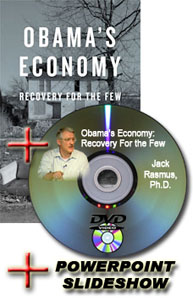
Jack Rasmus is author of the 2012 book, ‘Obama’s Economy: Recovery for the Few’, Pluto Press, and host of the weekly online radio show, Alternative Visions, on the progressive radio network. His website is http://www.kyklosproductions.com, his blog, jackrasmus.com, and twitter handle @drjackrasmus.

Read Full Post »

On October 9, 2013, President Obama announced his nomination of Janet Yellen, current vice-chair of the Federal Reserve, as the new Fed chair, to replace Ben Bernanke expected to retire at year’s end.

Obama’s appointment, subject to Senate confirmation that is likely, comes after a general consensus in recent weeks that Yellen would be the President’s choice. That followed weeks of heated public debate and maneuvering, identifying Yellen as the favorite of liberals in and out of Congress, and Larry Summers the prefered choice of Obama administration staffers and insiders. Summers withdrew his candidacy several weeks ago, however, under pressure from conservative elements, who viewed his role as former Obama adviser, as too liberal on fiscal spending in Obama’s administration, and liberal elements, who viewed his role as former Clinton administration Secretary of the Treasury as too accommodating to bankers and financial deregulation.

It has been interesting to watch how liberals, within and without the Obama administration in recent weeks organized aggressively on behalf of Yellen. Yellen was the ‘Fed Dove’, willing to continue Ben Bernanke’s generous free money policies of QE (quantitative easing) and near zero interest rates. In contrast, Summers was the monetary ‘hawk’ that would likely accelerate a withdrawal from QE faster. Of course, both profiles were mostly spin.

Noted liberal economists, like Paul Krugman of the New York Times, fell completely into the Yellen camp, praising her policies and more liberal credentials. Even progressives of the moderate persuasion fell for the ‘Yellen as Fed Dove’ fiction. But a closer inspection would have revealed that neither Summers nor Yellen would have departed much, if at all, from current chair Bernanke’s policies.

Those policies, in the form of QE and ‘zero bound interest rates’, since 2009 have had little if any impact or effect on the real economy—and therefore on housing recovery, jobs, or middle class incomes.

In the course of four years of both QE and zero rates, the Federal Reserve has pumped more than $13 trillion in liquidity (money) into the US and global banking system (and shadow banking system) to bailout the banks. In terms of QE alone, this occurred in at least three versions—QE1, QE2, and now currently QE3—which together will have provided by year end 2013 (along with QE 2.5—called ‘operation twist’), nearly $4 trillion of liquidity injections to bankers as well as individual wealthy investors seeking to dump their collapse subprime mortgage bonds on the Federal Reserve.

QE and the $13 trillion resulted in record booms in the stock and bond markets in the US and globally. Much of that likely flowed out of the US into the global economy, serving to stimulate real growth in emerging markets and generating financial asset speculative bubbles around the world. There is in fact a very high correlation between the announcement, introduction, and conclusion of QE programs and stock-bond, derivative, and other financial asset booms and declines since 2009. Conversely, there is virtually no such connection between housing, jobs, and other real sectors of the US economy.
Bernanke Fed monetary policies have thus boosted financial capital gains and in turn the incomes of the wealthiest in the US and globally, as real disposable income for US households has consistently declined for four consecutive years.

As recent data on income distribution from studies of economists at the University of California have shown this past summer: The wealthiest US 1% households have accrued for themselves no less than 95% of all the income gains in the US since 2009.

Yellen has been perhaps the strongest supporter of out-going Fed Chair, Ben Bernanke’s policies of QE and zero bound rates, which have directly resulted in this lopsided income inequality. So why were liberals so impressed with her as the preferred choice for next Fed chair? It certainly wasn’t for her policies. Or was it?

Perhaps some still labor under the false notion that, in the world of 21st century global finance capitalism, low interest rates create jobs. But that academic economics fiction no longer has evidence in reality. It belongs in the same trash bin with other fictions, like business tax cuts create jobs. Or that more free trade agreements , like the pending Trans-Pacific Partnership, pushed by the Obama administration and liberals, will create jobs. Here again, the empirical track record shows that neither have, or will, create jobs. Liberals nonetheless adhere to these false notions, in essence believing in the various forms of ‘trickle down’ economics. Regardless, Yellen was given the ‘dove’ tag, and therefore the liberal endorsement.

Yellen as Fed Chair will continue policies no different in content than has Ben Bernanke. Yellen will continue to pump QE into bankers and investors, stocks and bond markets, global speculators and offshore investors, as had Bernanke. If she really were liberal, she’d take the $1 trillion given them in just the past year of QE3 liquidity injections and use it to fund a government direct job creation program. That would create 20 million $50k a year jobs, and jump start the economic recovery overnight.

But the Bernanke-Yellen policy of giving that $1 trillion (and $12 trillion more) to bankers and investors will instead continue to prop up the stock, bond and other speculative financial markets. Just as Bernanke ‘chickened out’ this past summer when he rapidly backed off suggesting the $85 billion a month QE3 injections might be reduced by modest $5 billion, so too will Yellen.

There will be no fundamental change, in other words, from a Bernanke Fed to a Yellen Fed. The US Federal Reserve under its current structure and leadership is an institution serving bankers and wealthy investors. Before the Fed can ever begin serving the rest of the economy, the country and its citizens, it will have to be radically restructured.

The Federal Reserve will have to be democratized and become an institution that functions as a ‘public banking entity’, not a private banking conduit. It will then provide low money cost loans to households, small businesses, students, and workers—instead of wealthy investors, bankers, and speculators.

Instead of issuing QE for the 1%, the Fed could issue QE designed to create jobs, raise incomes, and generate a sustained economic recovery for all. But that won’t happen under a Yellen Fed. The false ‘hawk/dove’ options for leadership in the Fed Reserve reflects the U.S. political system – a dual one-party system with corporate interest at its heart. It will take a new, grassroots movement calling for real choice, and real democracy to fix our government, and institutions like the Federal Reserve.

~ Jack Rasmus serves as the Chairman of the Federal Reserve System in the Economy Branch of the Green Shadow Cabinet of the United States

Read Full Post »

The economic ignorance of the Teapublican faction of the Republican party in the US House and Senate is perhaps exceeded only by the similar ignorance of its economic advisers.

Appearing in the public press in recent days is the latest ‘brilliant’ Teapublican view that a default by the US government on paying interest on its debt would not have a negative impact on the US or global economy.

Both the US and global economies are already slowing noticeably, with the Federal Reserve in the US continuing to downgrade and lower its estimates of future US growth, and the IMF doing the same for growth rates in China and the rest of the world. The Teapublicans claim a US debt default would not impact these already negative trends.

While it is true that the US government will not completely run out of money with which to pay its debts on October 17, 2013, as Treasury Secretary, Jack Lew, has publicly stated, it is equally true that it will definitely do so sometime between October 24 and early November. Thereafter, some funds will continue to come into the government, but not nearly enough to pay all its bills. That will force the Obama administration to choose between what it will pay: either bondholders who own US debt or grandma and grandpa on social security. Teapublicans no doubt want to force Obama to make that ‘Hobsons’ Choice’ (i.e. damned if you do and damned if you don’t). Teapublicans will argue he should pay the bondholders first, and forego paying social security. It’s their way to start cutting social security before they even negotiate an official reduction in it with Obama.

To quote one Teapartyer’s statement today, Republican Representative, Joe Barton, of Texas: “We have more than enough cash flow to pay interest on the public debt, so there is no way we’re gong to default on the public debt unless the president of the United States intentionally does so”.

Such statements by lesser known Teapublicans were followed up today in the business press with an article by Teapublican notable, Paul Ryan. Ryan made it clear that the focus of the debt ceiling discussion was to provoke further concessions by Obama on Social Security-Medicare cuts. US House radicals thus are attempting to put Obama in a negotiating box: either he agree to cut Obamacare or to cut Social Security-Medicare.
What the Teapublican faction in all their economic ignorance don’t understand, however, is that the psychological effects of a default—or even a near default—on the US and global economy will prove significant. One does not have to wait for a complete default for that to happen.

What then are some of the possible impacts?

First is the prospect of rising interest rates. Interest rates have already begun to rise, starting on a base that has already risen since the US Federal Reserve’s bungled attempt to signal over the past summer its intent to begin reducing (tapering) its Quantitative Easing (QE) $85 billion a month liquidity injections. That Fed ‘faux pas’ has already driven up long term rates by more than 1%, thereby causing an abrupt halt to a very timid US housing recovery earlier this year. In the past month banks and mortgage servicing companies have already announced thousands of layoffs in their mortgage departments, signaling the virtual end of that housing recovery. Further interest rate hikes, short and long term, on top of the Fed’s recent bungling—which will now certainly occur as the default approaches—will all but ensure the end of any housing recovery in the US.

Short term rate increases will most likely accelerate further throughout the month of October. That includes, in particular, Treasury bill rates which will in turn impact other rates. ‘Other rates’ include the critically important ‘Repo Market’ rates. Destabilizing the repo market is a dangerous game. It is likely the locus for the next financial crash, the analog to the subprime market that was the center of the last financial crash. Teapublicans are thus playing a dangerous game, one that may well in a worst case scenario precipitate another financial instability event on the scale of 2008.

Rising interest rates also mean the end of the latest stock price and junk bond booms. In itself, that doesn’t affect average folks much. But the psychological impact of a rapid decline in asset prices can, and does, spill over to consumer and business spending. That leads to layoffs, in a US job market that is, at best, producing only part time, temp, and low paid jobs as it is.

Rising rates and an even weaker job market in November-December will translate into slowing consumption, which is already showing signs of weakness in August-September. Retail sales in general will weaken still further as a consequence of the debt ceiling default, as will an already ‘long in the tooth’ auto sales cycle.

The negative impact of debt default on consumption is already becoming evident in recent weeks. A Gallup Poll in recent days showed consumer confidence dropping precipitously. While some argue confidence surveys are typically volatile and unreliable as indicators of consumer spending, that is not as true for abrupt and significant movements in confidence indicators. That may now be happening, as the public begins to focus on the dual crises events.

The recent Gallup poll in question fell to -35 from a prior -15. This compares to -56 during the August 2011 worst period of that prior debt ceiling debacle. During the worst period of October 2008 the index was -66. Already falling significantly early in the current crisis, one can estimate where the -35 current poll will be by October 17-24 should the crisis not be resolved by then. We will almost certainly be in the August 2011 territory, when the third quarter US GDP nearly went negative (and did so if the GDP deflator was substituted with the CPI index for that quarter).

Globally, the approaching debt ceiling crisis has already provoked widespread public responses by foreign governments, warning a potential default by the US would have dire consequences for US debt holdings and future purchases. China, Japan, and the IMF have all raised warnings in recent days. If default occurs, then US bond rates will rise even further and faster than at present, raising a real question whether they will continue to purchase US Treasury debt when the price of their holdings are declining significantly in the wake of a default.

There are also important implications of a default (or even near default) for the Eurozone’s own current economic recovery and its still very fragile banking system.

Yet another negative impact globally will be a decline in Euro exports. A default situation would result in the US currency losing value, causing a further rise in the already fast appreciating Euro currency. That trend would challenge German and Euro export growth and therefore that region’s tepid 0.3% last quarter’s recovery.

Another problem potentially to grow worse is the Euro banking system. The Eurozone’s version of QE-the LTRO liquidity injection policy of the past year amounting to more than $1.5 trillion-will soon need another LTRO II injection by the European Central Bank in a matter of months. In addition, more than $1 trillion of the LTRO I will need to be refinanced soon. Nearly all the major banks in Italy, for example, have yet to repay anything of their share of the LTRO $1.5 trillion and will need further liquidity in coming months. Rising interest rates from a debt default in the US will spill over to Europe, thus raising the costs of LTRO II, as well as the financing of much of LTRO I. That will cause further fragility in the Euro banking system and economic recovery there, especially for the highly fragile Italian banks.

For Japan, its recent export gains would also slow, at a time when it has decided to raise taxes while suspending structural economic reforms.
Currency volatility in emerging markets would also intensify from a debt default in the US, likely causing a retreat once again in real growth in those markets, just a few months after their recent ‘stop-go’ provoked by US Fed QE policy uncertainties this past summer.

Throughout the past 18 months, this writer has forewarned that a fragile US economic and global recovery-not nearly as robust as some maintain-is susceptible to a ‘double dip’ recession in 2013-14 should one or more of the following negative ‘tail events’ occur: first, a renewed banking crisis in the Eurozone or elsewhere; second, significant further deficit cutting in the US; and thirdly a continued drift upward in US long term interest rates as a consequence of QE tapering or other events. While it appears the Euro banking crisis has temporarily stabilized—except for Italian banks perhaps—the deficit cutting and interest rate trajectory in the US are very real and serious trends that may yet precipitate a descent into a double dip condition in the US economy.

And if the Teapublican faction in the US House of Representatives managers to prevent a resolution of the debt ceiling issue into the latter part of October, then the economic consequences for both the US and global economies will be severe, and may even prove sufficient to precipitate a double dip recession in the US.

Read Full Post »

Transcript of Radio Interview: October 4, 2013

How Will the US Government Shutdown Impact Markets?

As the government shutdown, the stock market largely shrugged. Yesterday the Dow Jones actually rose 62 points suggesting investors don’t see the current shutdown as a long-term problem. Here with more analysis is Jack Rasmus. He’s a Political economist as well as the author of “Obama’s Economy: Recovery for the Few”

Rob Sachs, Host of Russia Radio American Edition:

‘This shutdown occurs and the stock market actually gains a little bit. It doesn’t seem to be congruent with the thoughts of what stock market would do. Why did they gain?’

Dr. Jack Rasmus:

The stock markets are more concerned with what is happening with the Fed taper of its QE and on September 17th the Fed made it very clear it was going to continue pumping 85 billion a month into the economy. That is their first and foremost major concern. Second, the markets are concerned about real data on economies in the US, Chinese, Eurozone economies, jobs, retail, sales; and what is happening with banks in Eurozone, Italy, China, manufacturing exports, emerging markets etc. Third in line of concern at the moment, I would say would be the debt ceiling situation . But that is still several weeks off, plenty of time to deal with that.

In contrast, the government shutdown really doesn’t affect markets that much, which is not surprising. The last time we had a government shutdown in 1995-1996, stocks and bond markets were totally unaffected by it and were hardly impact at all by the crisis. So it is not strange that we see the same development going on here today.

Now the real risk is if the shutdown continues for whatever reasons, which I don’t think it will, for another 2-3 weeks, and then it converges with the debt ceiling deadline. That deadline for the debt ceiling is probably closer to the end of October than the October 17th date, the Obama administration is now saying. Then you have a different scenario in terms of impact on financial markets and the US economy.

Rob Sachs:

‘We came to that before when we had this debt ceiling debate and people were saying this would be Armageddon, it is outrageous – the idea that the US would not pay its debts. But what was the role of Wall Street before in preventing that from happening? What can Wall Street do now to urge congressmen and those on Capitol Hill to come to some type of agreement?’

Dr. Jack Rasmus:

I am sure Wall St. and its lobbyists are putting increasing pressure already on politicians to come to some kind of agreement. Last time we had a debt ceiling confrontation, in August 2011, they waited till the last minute and didn’t leave themselves enough time to really lobby. But now I am sure there is a lot of intense lobbying going on at this particular stage before the October 24th or so ceiling deadline, when the government may not make an interest payment on its debt, which creates a default. That’s when a technical default happens.

I think an indicator of how things may be going as we approach that deadline will be what starts to happen with short-term interest rates. If you see the bank-to-bank federal funds rate, short term Treasury bills, or especially the bank repo market began to rise, then those rising rates will have an impact on stocks and bonds. That’s what investors are concerned about. That’s what will cost them money—not the government shutdown that impacts mostly workers and households. But I don’t see that happening at this stage. Not yet.

Rob Sachs:

‘When you look though at what is at stake, a lot of people say the shutdown is not so much a big deal but what really gets people nervous when we talk about inaction on Capitol Hill? Is it something more than just not getting a legislation passed?’

Dr. Jack Rasmus:

What makes the markets (i.e. banks and investors) nervous is they can’t necessarily count on getting paid their interest at the time it comes due should a default occur. If you don’t get paid for your investments, then you are not going to make investments. When interest rates rise in anticipation of, or a result of, a default by the government, that reduces the demand for government bonds that spills over and so forth and causes problems with rising interest rates in general. It is the translation of all this into rising rates that is important in terms of impact.

That is the key and we already see that the US economy is becoming increasingly sensitive to increases in rates, bond rates and so forth. We saw that over this past summer with the Fed trying to taper its QE buying, and how long-term interest rates immediately shut up over 1% and caused serious problems in the US and global economy. With emerging markets capital flight and so forth and the slowing of the housing market in the US. So, the global system is extremely sensitive right now to interest rate hikes after 5 years of QE. Not just long-term rates but as we will see with the debt ceiling issue, also with short-term rates if it comes to a crisis. It could all have a significant impact and more quickly than people think right now.

Rob Sachs:

‘Your book “Obama’s Economy: Recovery for the Few” talks about a lot of the benefits that we’ve seen have not been spread out and when we think about this economic recovery we’ve had, it has really not been felt in the middle class. Is that something where if we default, it is going to be impact on the middle class the most, or is this something where the stock market, these kinds of things are for investors to worry about and those who are throwing around tens of millions of dollars each day?’

Dr. Jack Rasmus:

It will primarily affect stock and bond markets and the investor class in a very short term that has a little effect on the real economy and real folks. But what could happened over time is that when investors pull back, then you have business investment pulling back, which is not that great in the US right now anyway. That starts to affect jobs, which are not really rising much at the moment, and incomes for the middle class and so forth, which are already falling in the US. For most US household we already have real disposable income declining at 1 and 1.5% per year for the last 4 years. And as recent data shows, the wealthiest 1% have accrued 95% of all the additional income gains since 2009. So, we are already growing increasingly income lopsided and consumers have a hard time spending, as we are now seeing with retail sales struggling in the US. So, this debt ceiling thing can have a important psychological impact. It can have a psychological impact on consumers and consumer spending and on businesses and business spending, and that is how it will mostly transmit into the real economy. The psychological impact is really important.

Read Full Post »

RADIO SHOW RECORDING

Alternative Visions – The US Fiscal-Monetary Crisis Intensifies – 10/02/13

Oct 2nd, 2013 by progressiveradionetwork

Dr. Jack Rasmus provides his analysis on the current government shutdown and the repeat of the debt ceiling crisis coming by mid-October and their possible negative impacts on the economy. Rasmus then considers the ‘other policy crisis’–i.e. the US Federal Reserve’s QE and zero interest rate monetary policies. He explains why US monetary policy has also entered a crisis stage in recent months–i.e. proving increasingly ineffective at stimulating the real economy while simultaneously generating financial bubbles. QE and austerity policies elsewhere in the world are discussed, with similar counterproductive effects on the real economy. Rasmus concludes the US and global economy is now entering a period of growing ineffectiveness of traditional fiscal-monetary policies generating a sustained economic recovery, at a time during which the US and global economies continue to slow or stagnate long term.

LISTEN TO THE FULL 56MIN. SHOW ON THE ‘ALTERNATIVE VISIONS’ WEBSITE AT:

http://prn.fm/category/archives/alternative-visions/

OR ALSO AT:

http://alternativevisions.podbean.com/

Read Full Post »

Listen to the two latest ‘Alternative Visions’ radio shows, hosted by Dr. Jack Rasmus, on the Progressive Radio Network. The first show, airing September 18, interviews guests Steve Early and Carl Finamore who attended the recent AFLCIO convention in LA . The show focuses on the topic of Union-Community Alliances and the AFLCIO’s recent discussion on creating new forms of partnerships between unions and community groups. The second show, that airs September 25, interviews immigrant rights and labor activist, Alan Benjamin, on new realignments of immigration rights groups in progress given the collapse of the Immigrant Rights bill in Congress and Obama’s refusal to take executive action on behalf of immigrant rights.

Both shows and interviews are available for download on the progressive radio network, accessible at http://prn.fm/category/archives/alternative-visions/. The shows are also archived and available at alternativevisions.podbean.com.

1. September 18 show: ‘The AFLCIO Convention & New Union-Community Alliances

Show Description: ‘Dr. Jack Rasmus welcomes two long-time union officers, Steve Early of the CWA and Carl Finamore of the Machinists, who attended the recent AFLCIO convention where delegates recently discussed and voted on whether to bring community groups (NAACP, La Raza, Sierra Club, etc.) into the union federation as a new kind of membership. Both Steve and Carl have more than 30 years each of experience in the US labor movement, which they bring to the discussion. Jack introduces the show and discussion with an explanation of the dimensions of the deep decline in union labor in the USA, its failing organizing and bargaining strategies at the company level and the political level with its alliance with the Democratic Party, as well as the consequences of both. Steve and Carl discuss the resolution and scope of the decision at the AFLCIO convention to forge a deeper partnership with community organizations. How can union labor stop and reverse its slide? Jack and guests debate whether some kind of new grass roots organizational structure uniting labor and community organizations must occur if union labor in the US is to survive and grow.

Guest bios: Steve Early is a retired, long time staff representative for the Communications Workers of America and an author of several recent books on the US union movement today, including ‘Embedded With Organized Labor’ and ‘The Civil Wars in US Labor’. Carl Finamore is a former president of Local 1781 of the machinists union representing workers in the airlines industry and a frequent writer to various magazines and blogs on labor and other issues. Check out both their recent articles on the widely read blog, Counterpunch.org, on the recent AFLCIO convention and other labor topics.’

2. September 24/25 show: Immigrants Rights Movement at Historical Juncture

Show Description: Dr. Jack Rasmus invites long-time immigrant rights and union activist, Alan Benjamin, to discuss current and possible realignments in immigrant rights groups’ strategies in the wake of the collapsed Obama legislative proposals in Congress. Benjamin explains in detail the onerous provisions of the recent immigrant rights bill that is now dead on arrival, the new emerging demands of immigrant rights groups’ as 400,000 a year deportations continue under the current administration. Jack and Alan discuss the just formed ‘United Front for Justice & Dignity’ this September 7 of 100 founding members from 40 different groups, and the AFL-CIO convention’s recent internal debates over resolution #4 vs. resolution #23. New directions in grass roots organizing and new demands by immigrant rights groups for Obama to enact immigration reform by executive order are considered. The demands of the recently formed ‘United Front for Justice & Dignity’ above can be viewed at http://www.todopoderalpueblo.org.

Guest bio: Alan Benjamin is a delegate to the San Francisco AFLCIO central labor council, a long time union member, and a leading activist with several groups advocating rights and citizenship for 11 million undocumented workers in the US.

Access both shows for download at:

http://prn.fm/category/archives/alternative-visions/.

or at:

http://www.alternativevisions.podbean.com.

Read Full Post »

This past week the US central bank, the Federal Reserve (Fed), opted not to change its current 3rd Quantitative Easing (QE) policy providing $85 billion a month in bond purchases from bankers and investors. The Fed’s QE3 policy has been in effect for about a year, injecting in excess of $1 trillion in subsidized money into the US and global economy. Since QEs began in 2009, the total injection will have exceeded $4 trillion by the end of this year.

Consensus was strong in recent weeks that the Fed would at least slightly reduce that $85 billion, by a token $5-$10 billion a month. That would have provided a mild, second signal it would begin reducing its $85 billion a month money injection.

Last May-June 2013, the Fed’s chairman, Ben Bernanke, initially signaled to the markets the Fed might soon start ‘reducing QE. That set off what has been called the ‘taper tantrum’ by investors. Almost immediately in response to the Fed’s suggestion, rates on bonds in the US began to escalate, including mortgage rates, corporate bond rates and US Treasury bonds—all of which surged by more than a full 1% in a matter of weeks.

The outcome of the rapid rate rise was the tepid US housing market recovery almost stalled, stock and bond prices began to tank, and investment into ‘emerging markets’—where much of the total $4 trillion in QEs since 2009 has gone—began to reverse and flow back from abroad to the US and Europe. Emerging markets’ currencies in turn began to decline, the global currency war ratcheted up another notch, and capital flight from those economies to the west accelerated.

Faced with the ‘taper tantrum’ by global high net worth investors and their institutions—aka ‘the markets’—the Fed and Bernanke quickly changed their tune by early July, reassuring investors and speculators that s significant retraction of QE3’s $85 billion wasn’t really their intention. The ‘markets’ quickly sighed with relief and stock, bond, property, and other financial asset prices rose again.

As part of its so-called ‘forward guidance’ policy—notifying markets of its future intentions—the Fed in August took another shot, this time more cautiously, at trying to extricate itself once again from its massive, five year, $4 trillion QE program.

The extrication has become increasingly necessary, since QEs—together with the Fed’s accompanying policy of ‘zero bound’ interest rates—have been force-feeding financial asset bubbles globally—threatening to destabilize the global money system. Simultaneously, it has become no less clear that these dual Fed policies have become increasingly ‘inefficient’—that is, while feeding financial speculation and asset bubbles they have not resulted in much real investment in goods and services.

As more and more reports and articles have begun to show, as QE continues to grow and financial asset market prices rise, the growth of real investment in goods and services continue to slow. According to one report, only 15% of financial flows since 2009 are now going into real investment in goods and services, according to a recent article in the global news daily, the Financial Times, this past September 20.

However, the Fed’s second ‘forward guidance’ second suggestion to taper in August led to still more capital flight and currency declines in emerging markets. At the same time, by late summer in the US, a number of economic indicators began to show that the US economic recovery is not as strong as the press hype has been suggesting. Even the Fed itself has been lowering its own forecast for the US economy, from 2.5% earlier in 2013 down, most recently, to 2% GDP growth. (That downward revised forecast was not the first. In fact, the Fed has consistently reduced its US economic forecasts for the past three years, from an originally predicted 4.3% annual GDP growth).
Given the obvious concern with Fed monetary policies’ growing ‘inefficiency’ stimulating the real economy and the growing effects of QE and zero rates feeding financial speculation and bubbles, the Fed last week on September 16, shook markets and investors by deciding not to ‘taper’ at all for the moment, suspending its August implied ‘token taper’ of $5 or $10 billion a month.

To recap these Fed events over the summer: in a matter of just a few months the Fed has shifted from responding to the ‘Taper Tantrum’ to the ‘Token Taper’ retreat. This has left its policy of ‘forward guidance’—i.e. signaling its intentions to the markets—in a shambles. In recent days, several Fed board governors have returned to suggesting a third time that a reduction of the $85 billion will occur before year end, and perhaps even start in October—i.e. what might be called a ‘Taper Tomorrow’.

What all this policy shifting signifies is, in the last several months, Fed monetary policy is perhaps beginning to unwind in more ways than one.
On the other hand, the Fed’s retreat from the ‘Tantrum’ and the ‘Token’ has left speculators, investors and banksters quite happy. The stock and bond markets surged in September once again, emerging market currencies recovered a little, and other financial markets moved once more to the upside—illustrating the tight positive correlation that has evident for four years now between financial asset inflation and Fed QE policies (and the equal lack of any correlation between QEs and the real economy).

To employ a metaphor, as a consequence of its ‘on-off’ QE policy the Fed is beginning to appear like the drunk driver stopped by police after appearing to ‘weave back and forth’ on the highway. It is being asked to hold its finger to its nose and walk a straight line, to give evidence if it is indeed drunk or not. And it’s not succeeding. Instead, its stumbling to either side of the line.

What the Fed’s ‘stop-go’, on and off, QE policy signifies in a broader sense is threefold:

First, that investors and banksters have become addicted to the QE, low interest and free money policies of the Fed that have been in effect the past five years. (see this writer’s March 7, 2012 article and prediction, ‘Are Capitalists Becoming Addicted to Free Money’, on his blog at jackrasmus.com). The mere suggestion of a QE retraction, even when token, results in financial asset price declines and rising interest rates. Banksters-investors simply want the free subsidies to continue and they expect that to happen. A ‘cold-turkey’ withdrawal of liquidity sends them into ‘financial fits’.

Moreover, each time the Fed retreats on its signal to taper, it makes the next attempt even more difficult as investors anticipate and become even more predisposed to quickly respond to counter any Fed suggested move. As the Fed repeatedly retreats, the financial bubbles continue, emerging markets’ problems of currency volatility and capital flight grow, China’s real estate market becomes more fragile as hot money inflows return from the west to Chinese ‘shadow’ banks, and US monetary policy becomes even less ‘efficient’ stimulating the real US economy.

Secondly, Fed recent stop-go policies suggest the real economy has become super-sensitive to interest rate hikes—just as it has become ‘super-Insensitive’ to interest rate reductions over the past five years. (In economists’ parlance, this is expressed as the economy having become ‘increasingly inelastic’ to interest rate declines—i.e. falling rates generating little real growth—while conversely becoming ‘increasingly elastic’—rising rates quickly slowing real growth—to interest rate hikes).

QE is showing the real economy is responding less and less positively to money supply injections and interest rate declines, while more and more negatively to money supply reductions and interest rate hikes. Furthermore, the Fed’s key policy of ‘forward guidance’—i.e. telling the markets what it plans to do in order to avoid severe volatility response by investors—is now unraveling as well. No one really knows what the Fed is going to do now, how it plans to do it, and when and at what rate it plans to begin doing it. In short, the Fed is losing control of the monetary tools by which it has been stabilizing the banking and financial system the past five years.

Thirdly, it all means it will be even more difficult for the Fed to ‘taper tomorrow’, which is apparently its latest message being delivered by select Fed governors. Emerging markets may react even more volatilely to the next taper iteration by the Fed, producing even more currency volatility, capital flight, and economic slowdown. More hot money will flow into China’s increasingly fragile local property markets via its growing ‘shadow’ bank network there. Financial asset bubbles, having returned in the interim, will pose an even greater risk of too rapid asset price contraction at some later date.

Apart from problems of feeding financial speculation, asset prices, and continuing financial bubbles, the US and global real economy will now become even more ‘super-sensitive’ to QE withdrawal and resulting interest rate hikes.

Dr. Jack Rasmus
September 20, 2013

Read Full Post »

« Newer Posts - Older Posts »