Feeds:
Posts
Comments

Archive for the ‘Uncategorized’ Category

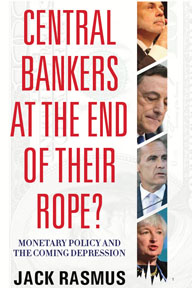
With a new era in central bank policies about to emerge in 2018 with the appointment of Powell as US Federal Reserve chair in February, my analysis of the role of central banks–US and others–past policies’ contributing to another financial crisis by 2020, as argued in my book, “Central Bankers at the End of Their Ropes”, was aptly summarized in the following review of the book by Dr. Larry Souza. The Review appears in the current December issue of the European Financial Review. It is an extensive summary of the book with Souza’s reflections. Key central bank chapters addressing the evolution of the Fed, ECB, central banks of England and Japan, and China’s PBOC are summarized in detail, as well as my concluding recommendations for a fundamental change of the structure, targets, and tools of the Fed and other central banks. Souza’s review aptly summarizes as well my call for a constitutional amendment to democratize the Fed and broaden its mission to provide for more accountability to society at large and not just to the private banking sector.

Here’s Souza’s extended 6,000 word long review, which provides the best review of my book to date:

“INTRODUCTION

If you talk to some monetary, fiscal, macroeconomic, and financial institutional and capital market economists, some would argue that Central Banks are at the end of their rope; have lost their credibility and risk losing their independence.

Dr. Jack Rasmus book, “Central Bankers at the End of Their Rope? Monetary Policy and the Coming Depression” is the latest in a growing literature building the case against the U.S. Federal Reserve (the Central Bank of Central Banks), European Central Bank, Japanese Central Bank, The Bank of England, People’s Bank of China, etc.; their unorthodox monetary policy response to the financial crisis; policy response to asset price bubbles, financial (market) crisis (crashes), and recessions since 1995; lack of macro-prudential supervision and oversight; and consistent policy mistakes based on their lack of understanding of how the world and economy works, dating back as far as 1929 (See supporting Literature in the Appendix).

In Dr. Rasmus book, he looks at:

1. Problems and Contradictions of Central Banking
2. A Brief History of Central Banking
3. The U.S. Federal Reserve Bank: Origins and Toxic Legacies
4. Greenspan’s Bank: The Typhon Monster Released
5. Bernanke’s Bank: Greenspan’s Put (Option) on Steroids
6. The Bank of Japan: Harbinger of Things That Came
7. The European Central Bank under German Hegemony
8. The Bank of England’s Last Hurrah: From QE to BREXIT
9. The People’s Bank of China Chases Its Shadows
10. Yellen’s Bank: From Taper Tantrums to Trump Trade
11. Why Central Banks Fail
12. Revolutionizing Central Banking in the Public Interest: Embedding Change Via Constitutional Amendment

Dr. Rasmus builds a methodical case against historical and current central bank ideologies and orthodoxy; and makes prudent and wise recommendations for structural and institutional macroeconomic, monetary policy and political change.
The conclusion, is not too late to address the systemic and systematic risks to central banking, regulation and supervision, financial institutions and capital markets, and the real economy and labor markets.

However, considering the real economic realities of the current political, party and policy environment, along with the Wall Streets control over monetary (Federal Reserve), fiscal (Treasury) and regulatory (Comptroller/SEC/FDIC/etc.) policy in Washington, that a political solution could actually be accomplished. Dr. Rasmus is correct in his recommendations and his analysis.

We are all at the end of our rope, and thank you Dr. Jack Rasmus from bringing another critical analysis of the current and future state of global central banking, and for proposing bold policy recommendations to avert another severe financial crisis, great recession and depression.

REVIEW

Rapid technological, demographic, economic, cultural, sociological and political change has changed the way central banks analyze, manage and respond to business cycle peaks, troughs (recessions), financial crisis, and macro-prudential bank supervision; and central bank policy responses have failed consistently over time, due to limitations of their data, models, ideology, epistemology, bureaucracy, and politics.

But one modern response to these limitations has been consistent over time, inject or try to inject massive amounts (trillions of U.S. Dollars, Yen, Euros, Pounds, Yuan, Peso, Rubble, etc.) of liquidity (credit) to back-stop and set a support under asset prices. Since these asset price bubbles and asset price collapse (financial/currency crisis) have become more frequent since 1995 (Peso Crisis, Thai Baht, Russian Default, Y2K/911, Housing Bubble, Financial Crisis, etc.), global central bankers do not have the intellect, culture, knowledge, data, models, tools, resources, balance sheet, etc. to deal with crisis going forward.
Dr. Rasmus recommends limiting the independence (ad hoc decision making) of central banks by instituting a (rules based) Constitutional Amendment defining new functions for the central bank, new monetary targets and tools to modernize and drive global central banks into the 21st century.

Chapter: Problems and Contradictions of Central Banking

Globalization, technologicalization and deregulation/integration has accelerated capital flows and accumulation, and concentration to targeted and non-targeted markets across the world. This process continues at a rapid pace, and depending on the recipient, can be economically, financially and politically (institutionally) destabilizing, destructive and deconstructive. It is not a matter if this will happen, but when, again! Which country? Industry? Company? Demographic? will be affected, disrupted, destroyed, and wrecked.

In response to these economic and financial disruptions, central banks have responded consistently by injecting massive amounts of liquidity into the system, with no limitations due to their misunderstanding of how the economic and financial system really works, and has become, through the use of unorthodox monetary policy tools and targets, in the face of total deregulation and free flow of capital (shadow banking and derivatives trading), is at this point, where they cannot control or manage the system. We are in unchartered territory.
Only to bail it out the private banking system — other strategic affiliated institutions, corporations, businesses and brokerages — again and again, by printing massive amounts of fiat currency (seigniorage), to buy (defective/defaulted) securities product (derivatives), accumulate more sovereign-corporate-personal debt, with even more crowding out effects, has had no real eventual long-term impacts on real economic growth, wages, and productivity; and social welfare or standards of living. Only asset prices bubbles and a massive redistribution and concentration of wealth.

It is estimated, between the U.S Federal Reserve Bank, Bank of England, and European Central Bank, $15 trillion direct liquidity injections, loans, guarantees, tax reductions, direct subsidies, etc. have been used. If you add in China and Japan, the total gets to as high as $25 trillion, and if you add in other emerging country (Asian, Latin America, and Middle-East) central banks, the total gets as high $40 trillion.

This is only the present value (cost basis), if you project the total cost (interest and principal payments) out over a 30-to-40 year period, the estimate total cost is as high as $80-to-$100 trillion. Thereby, making the global financial and economic system eventually insolvent and bankrupt, and central banking ineffective and perpetually in a liquidity trap, as the velocity of money has collapsed. There is not money going into real long-term (capital budgets) assets, only short-term financial assets.

This is the contradiction of Central Banking: liquidity-debt-insolvency nexus, the moral (immoral) hazard of perpetual bail-outs, growing concentration of wealth at the extremes, growing perception that Negative/Zero Interest Rate Policy (N/ZIRP) can fix under-investment in capital (human/physical) and deflationary (disinflationary) trends, and that bank regulation-supervision is bad for the economy, financial services (institutions) industry, and for institutional and retail investors (savers) in the long run.

Chapter: A Brief History of Central Banking

A Brief History of Central Banking, walks us through the origins of central banking, from the Bank of England (1694) as the lender of last resort for private banks, and its monopoly position in issuing government bank notes and currency (1844/1870s), and bailing out the banking system due to crashes and development of new types of currencies (paper, gold, notes, etc.).

An uncontrolled growth in the money supply in the U.S. led to financial speculation in gold and bonds (1830), and depression (1837-43). No central bank was established, not even after banking crashes (1870/1890s/1907-08), but only by 1914 as the U.S. entered WWI, and needed to decouple its currency from gold, raise tax revenues, and be able to monetize its sovereign debt through the use of a fractional reserve banking system, did the government then decide that they needed a central bank.

The role of the central banks were to maintain monopoly control over the production of money, act a lender of last resort and fund raising agents, provide a clearing-payment services system between banks, and supervise bank behavior.
The goal, was price stability, supply of money growth targets, full employment, interest rate and currency exchange rate determination. They were to do this though the use of tools (rules): reserve requirements, discount rates, and Open Market Operations (OMO); and now, Quantitative Easing (QE)/Tightening (QT) and special auctions and re-purchase agreements.

The U.S. Federal Reserve Bank(s) was also given this monopoly position, along with tools and independence. This has led to some toxic legacies (credibility issues).

Chapter: The U.S. Federal Reserve Bank: Origins and Toxic Legacies

The U.S. Federal Reserve Bank system was originated from a consortium of private banks looking to centralize the Federal Reserve System: JP Morgan, Kuhn, Loeb, Chase, Bankers Trust, First National, etc. Particularly after financial instability (illiquidity/capital/reserves), bank crashes (lack of supervision) – 1890s/1907, and the rise of the U.S. as a global economic power.

Congress passed the Federal Reserve Act on December 13th 1913: twelve district banks and national board located in Washington D.C. The real power resided in the member banks that owned their respective districts. They could issue their own currency and notes, exchange for gold and foreign currency, invest in agricultural and industrial loans, and received dividends from earnings.

After the Great Depression and bank reform acts (1933/1935), the Federal Reserve Board of Governors and the Open Market Committee became the two powerful institutions within the Federal Reserve System.

However, the Fed experienced two decades of failure (1913-1933) due to lack of supervision, stock market and loan speculation, asset price bubbles/crashes, depressions, bank closures and bailouts, excessive extension of liquidity (margin), protection of government finance and wealthy investors, hyperinflation (deflation/disinflation), false targets (gold peg/production/employment), inaction and incompetence (discount rate/open market operations), institutional narcissism and egotism, power and elitism, bureaucratic control, etc.

Bank acts were put in place by Roosevelt, and other regulation and operations were put in place through the 1970s and 1980s: Glass-Stegall, 1935 Bank Act, Reg U, tax reform, policy, Treasury-Fed Accord, Operation Twist, Bretton Woods, Humphrey-Hawkins/Resolution 133, fighting hyperinflation-stagflation-recessions, Reg D, Plaza Accords, state and shadow bank regulatory efforts, international banking (currency/note) issues, liquidity escalations, and eventually the Greenspan typhon.

From 1913 to 1933, the two decades of failure after the Federal Reserve was created; it continued into the 1940s-1950s, 1960s-1970s, 1980s-1990s, 1990s-2000s, it continued and continues to this day, and looks like it will continue into the future.

Chapter: Greenspan’s Bank: The Typhon Monster Released

Greenspan, influenced by Ian Rand — liberal-post-modern philosophy – set in motion an un-orthodoxy in Federal Reserve, Monetary Policy, and Macro/Political Economic rationalization, a stark contrast to the Volker era. Greenspan believed in markets, and lase fair-free hand economic ideology (deregulation); and did not believe in limits to the Market and Technology-Labor Productivity, limits to the Federal Reserve’s power to dictate markets and the economy, and limits — in the end – to the ability to inject massive amounts of liquidity into the financial system to drive (support) asset price bubbles. This believe, or lack of, lead to multiple crisis and bailouts of the system.

The continual mismanagement, ideological mistakes, and lack of understanding of how the real world works, was witnessed again under Bernanke, now Yellen, and who knows who is next.

Chapter: Bernanke’s Bank: Greenspan’s Put on Steroids

Bernanke was minted from the same Greenspan mold, a true believer that excessive liquidity injections cold solve massive capital market and economic failures with little cost. It was the financial crisis and the coordinated efforts between the Federal Reserve and the Treasury (and other hidden interests), that was the test case in the Federal Reserve ability to manage severe man-made financial-economic crisis. The result, a new nationalization-corporatist-financial oligopoly industrial model, leveraged through Zero Interest Rate Policy (ZIRP)/Negative Real Interest Rate Policy (NRIRP), Quantitative Easing (QE), and Credit Enhancements/Liquidity Injections.

However, the outcomes from these efforts were disastrous:

1. Political Populism (Political-Economic Institutional Deconstruction/Destruction)
2. Massive Capital-Labor Substitution (Productivity Lag)
3. Massive Concentrations of Wealth (Inter-Generational Wealth Transfer)
4. Flat-Declining Real Wages (Social Welfare/Standards of Living/Poverty)
5. Unfunded Pension Liabilities (Crisis)
6. Recession(s) Twice as Deep/Twice as Long (Structural)
7. Rising Un-Funded Pension Liabilities
8. Collapse in Labor Participation Rates (High Under-Employment)
9. Collapse in Velocity of Money (Currency Turnover)
10. Rise of Shadow (Unregulated) Banking System (Disintermediation)
11. Massive Use-Trading of Un-Collateralized (Over-The-Counter/OTC) Derivative Trading
Excessive Use of Financial Engineering to Support Asset Prices
12. Global Economic-Political Instability (Global Cyber-Cold War)
13. Global Hyper-Inflation/Banking Crisis/Credit Defaults (Sovereign)
14. Massive Over-Leveraging of Government, Corporate and Personal Balance Sheets
15. Over Accommodative Monetary/Fiscal Policy (Negative Nominal/Real Interest Rates/Change Accounting Rules/Low Effective Tax Rates)
16. Global Tax Evasion (Avoidance)
17. Ballooning of the Federal Reserve Balance Sheet (Bonds/Reserves)
• Ballooning of the Federal Budget Deficit and Debt ($500-800 Billion Per Year/+$20 Trillion)
• Continuous Belief in Supply Side Economics (Trickle Down Theory/Deregulation)
• Continuous Belief in Monetary System/Real Economy Aggregates (Inflation/Interest)
• Continuous Bail-Outs of Financial/Economic System (Insolvency/Bankruptcy)
• Etc. Etc. Etc.

All of these beliefs, techniques and tools have been used by other Global Central Governments and Banks (BOJ/ECB/BOE/PBOC), with similar, disastrous, and disappointing outcomes. A focus is on saving the financial institutional system in the short-run, using extreme and un-orthodox monetary policies (tools), with a lack of concern or understanding of long-run economic, social, cultural, and political consequences and outcomes.

A perfect example, are policy responses of the Bank of Japan (BOJ).

Chapter: The Bank of Japan (BOJ): Harbinger of Things That Came

Over the last 17 years (1990 – 2017) the BOJ has implemented an aggressive form of unorthodox monetary policy (Negative – Nominal/Real — Interest Rate Policy/Quantitative Easing): printing massive amounts of money, buying massive amounts of sovereign-corporate (infrastructure) bonds, driving bonds yields negative, and driving domestic investors/savers and financial institutions literally crazy.

With no real effect on the Real Business Cycle (RBC), resulting in perpetual recessions and disinflation/deflation. These unorthodox monetary policies (mistakes/failures) have had the effect of causing asset price bubbles/busts (banking crisis), negative effects on standards of living, and negative effects on financial (dis)intermediation and fiscal policy (mistakes).

The BOJ has responded to these failures by introducing more accommodative (QE) policies, along with over accommodative fiscal policies (sovereign debt levels at historical levels) with no real positive effects. Fiscal policy mistakes (tax increases in a recession), have only exacerbated economic outcomes.

Japan will be the ultimate experiment in monetary-fiscal policy mistakes, as they will have to resort to even more extreme measures to try to get themselves out of their existential structural crisis. The ultimate fiscal-monetary response could be, with unintended political-economic-cultural consequences, associate with a massive and coordinated debt forgiveness, by both fiscal/monetary authorities.
At some point they will not have the tax revenues to service the sovereign debt payments, and will theoretically fall into default, and will ask for forgiveness, not from bond holders, but from the BOJ, that owns the majority of the debt.

Monkey see, monkey do. The BOJ has set the (bad) model for other central banks to follow, not only the U.S., but also the European Central Bank (ECB).

Chapter: The European Central Bank (ECB) under German Hegemony

Years after the financial crisis, the ECB finally started the process of cleaning up its banking system, and started and aggressive process of Quantitative Easing (QE), introduction of other unorthodox policies (Refinance Options/Covered Bond Purchase/Securities Markets, etc.), and drove nominal interest rates as far out as 10 year maturities, negative; with a limited effect of driving down the value of the Euro to stimulate exports, economic growth, and hit inflation and unemployment targets.

The actual ECB structure (dominated by Germany – Bundesbank) was a major impediment its ability to respond to the crisis: fiscal austerity, inability to devalue the Euro, fear of hyper-inflationary trends, and misspecification of monetary policy targets: inflation, productivity, employment, wages, and exchange rates.
Poor performance (contagion), bank crisis (runs on banks), social unrest (populism), massive debt issuance, and deflation (liquidity trap/collapse of money velocity) was the costly (stagnation) result of these policy mistakes. This — along with their lack and hesitant response to bank runs in Spain-Greece-other EU countries — has had a negative impact on the central bank’s independence and credibility, in regards to their ability to respond to future financial and economic crisis.

When the ECB was dealing with the aftermath of the financial crisis, the Bank of England (BOE) across the pond, was trying to immunize itself from the global crisis and its aftermath, only to vote itself into another existential crisis of national identity (BREXIT from the European Union), with long-term economic consequences, testing the limitation of the BOE.

Chapter: The Bank of England’s (BOE) Last Hurrah: From QE to BREXIT

The Bank of England (BOE) was founded in 1694, the first central bank, and in 1844 under the Bank Charter Act, was given independent monopoly control over bank notes and currency, money supply, bank supervision, lending of last resort, and fiscal government bond-placement agency. By the 1990s, monetarism took hold and the main target was inflation (price stability), and the Monetary Policy Committee was established to conduct open market operations, set interest rates, and reserve requirements.

Globalization, and having London as the center of money center global trading — currency, credit and interest rate derivatives and floating rate Euro notes and bonds – created excessive liquidity/credit and asset price bubbles, particularly in the U.S. commercial property markets from 2004-2007, eventually led and met with an asset price (housing/mortgage/RMBS/CMBS/equity) bubble and banking collapse (insolvency/QE, nationalization, etc.), similar to the other industrialized economies.

The total cost of these QE (negative real and nominal interest rates) programs, in addition to other credit facility programs, is well over a trillion pounds, with no real ability to achieve their inflation, Gross Domestic Product (GDP), or employment/labor participation targets. The global push toward deregulation (giving Wall Street back its ability to lever up and take down the system, again) and BREXIT, is certainly making the BOE’s job of conducting monetary policy problematic, leading to policy ineffectiveness (failure), lack of credibility and jeopardizing its independence.

These events, have contributed to the significant devaluation of the pound; yes, making U.K. exports cheaper, stimulating export growth as a contribution to GDP; but has caused political-populous parliamentary uncertainty and economic stagnation (high deficits/debt levels); and import price inflation, pushing down consumer purchasing power, standards of living and social welfare in the short and long run.

The big worry, not only for the BOE, but also for the Fed, ECB, BOJ, etc., is the coordinated unwinding of the bank balance sheets (sovereign and MBS bond portfolios), one mistake, could shift and invert global yield curves, pop asset price bubbles in stocks, bonds and real estate, and send us all into a global recession-depression.

Similar policy responses to the global economic-banking crisis, is also being witnessed in Asia. Yes, we already talked about the BOJ being the first mover in applications of unorthodox monetary and fiscal policy, with no real outcomes on wages, growth or inflation, other than fiscal debt levels and continued stagnation, the other, is the People’s Bank of China (PBOC).

The real difference between the PBC and the rest of the global central banks, is total lack of transparency (opaque) into the balance sheets of the government, financial institutions, government (State-Owned Enterprises – SOEs) owned corporations, public and private Multinational Corporations (MNC), and state and local finance.

Chapter: The People’s Bank of China (PBOC) Chases Its Shadows

The modern era of the PBOC started in the early 1980s – as a fiscal agent (under Ministry of Finance), public-private bank, clearing foreign currency exchange transactions, etc. in coordination with the China Construction Bank, Industrial and Commercial Bank of China, and Agricultural Bank of China.

Opening up the economy to massive (speculative) extension of credit and Foreign Direct Investment (FDI), under a neo-liberal model, resulted in speculative asset price (real estate, equity and debt) bubbles and busts (defaults) in the 1980s and 1990s, resulting in government intervention and deflation.
The Asian Contagion of the late 1990s required massive bank and corporate bailouts (recapitalizations). The 2000s, have seen a modernization of the PBOC as a central banking institution through banking reforms, conversion of SOEs to private-public firms (privatization toward a more Japanese Keiretsu system), push for more export oriented policies (higher-value commodities-services), and large government sponsored infrastructure projects (commercial-residential-dams-roads-power plants, etc.),

Prior to the Financial Crisis (FC), the PBOJ was moving to a modern rules-tools oriented application of monetary policy: interest rate and price targeting, constant growth in the money supply, and use of open market operations. Low borrowing costs spurred massive amounts of lending and borrowing (money supply growth) by both fiscal institutions, government and state-private owned enterprises, leading to asset price bubbles.

Which also lead to over-capacity, miss-allocation of resources, inflation, environmental degradation, political-economic corruption, currency manipulation (peg), etc. Since the China economy was still at this time decoupled from the Western global financial system, it was able to avoid most of the damage caused before the Financial Crisis.

But after the Financial Crisis, the PBOC had to accelerate the move toward liberal monetary finance, driving interest rates extremely low (real interest rates negative) to keep government and corporate (personal) borrowing costs low, to stimulate the economy/consumption/investment, to keep it from falling into a severe recession (depression/deflation), and had to deal with Non-Performing bank Loan (NPL) portfolios to avert a banking crisis. Rapid growth helped to mask these problems, but these were only land mines, waiting to be found and dealt with at a future date.

Banks and asset management companies had to be bailed out, dissolved, liquidated, etc. Trillions and trillions monetary liquidity and fiscal stimulus had to be injected to the economy, targeted toward housing, infrastructure and manufacturing, causing asset prices again to inflate. By 2014, only to deflate again by 2016. These injections of fiscal and monetary stimulus exacerbated asset price volatility (real estate/equities/bonds).

The next financial crisis in China will come from the excessive extension of credit from both fiscal and monetary authorities, and will come from government and corporate bond market defaults, as the system is severely over-leveraged. China is using more and more debt to fix bad debt problems, and the simulative multiplier-accelerator effect on the economy is deteriorating (decelerating) quickly.

Global central banks have been coordinating their monetary policy efforts over the past 10 years, and the U.S. Federal Reserve Bank has become the de facto Central Bank of Central Banks (CBCB). Based on new disclosures, we have found out that the U.S. Federal Reserve conducted global QE by buying other foreign sovereign debt during the financial crisis, and provided credit-liquidity facilities to global banks.

Chapter: Yellen’s Bank: From Taper Tantrums to Trump Trade

There was Paul Volker, then there was Alan Greenspan, then Ben Bernanke, now Janet Yellen, and who knows who is next (Jerome Powell). All of these Fed presidents dealt with extraordinary conditions (some self-inflicted), wars, financial crisis, recessions, asset price bubbles/bursts, etc.

It was not till Alan Greenspan, that the Federal Reserve decided excessive accommodation and liquidity was the solution to all crisis, and asset price bubbles were not a concern if they were real, and not a monetary illusion. However, he now admits that he was wrong in the way he understood how the world really works, which means he made policy errors and mistakes.
Bernanke was a protégé of Greenspan, and responded to the Financial Crisis with the largest monetary response (QE Infinity) in modern monetary history combined; and Yellen, continued his legacy of over accommodation, to escort us into one of the biggest debt-asset price bubbles in modern Fed history.

And if history is any indicator of the future, once the Fed(s) decide to conduct a coordinated unwind of their balance sheets, the popping of asset price bubbles will be like balloons at New Year’s Eve party in Time’s Square, only everyone will walk away from the party with the worst hangover of their life, and no one will be able to sober up fast enough to drive to the next party.

In the end, the Fed accumulated over $4.5 trillion in bank reserves/balance sheet (bonds), made up mostly of mortgage backed securities and U.S. government Treasury notes and bonds, the average size of the balance sheet prior to the financial crisis was $500-to-$800 billion. This is the largest subsidization, and theoretically (and really) the largest nationalization (Fed implemented) process, of the financial system and the economy in modern post-WWI history.

This could also be considered Fascist Finance (FF), as it involves the largest global money center banks, multinational corporations, and governments in the world — now a Global Corporatist System — operating under unorthodox monetary policy, outside pluralistic-democratic institutional oversight. As we can now see, again, the systematic dismantling, deconstruction and destruction of financial institutional governmental regulatory oversight, is in place.

Since these were mainly reserves creation, and an addition to the monetary base, and not really the money supply, the policy effects (QE/(Zero-Negative Real Interest Rate policy) have been mute.

The Fed has not been able to hit its inflation or GDP targets for the past 10 years (well below potential), there is secular and cyclical productivity declines, extremely low labor participation rates (high under employment rates), real wages are stagnant and still declining, and we are in a disinflationary/deflationary secular trend.

The cause is a collapse in the velocity of money, driven by alternative forms of money creation and flows across the globe (cryptic-digital currencies-shadow banking, etc.); the lack of fiscal labor market policy to lower under-employment and raise labor market participation rates; and other social, cultural, political and economic disruptions. Making it now impossible to conduct monetary policy.
The real risk going forward will be from a series of financial deregulation, coming from the Trump Administration and the Republican controlled House and Senate; along with a coordinated effort to unwind (Quantitative Tightening – QT) the Feds (and other global central banks) balance sheet, and a race toward interest rate normalization, sucking liquidity out of the system, only to lead to a stock, bond and real estate bubble burst.

With the Fiscal Debt totaling over $20 trillion, the Feds Balance Sheet totaling $4.5 trillion, the potential for continued -perpetual war (defense spending) and entitlement expenditures, and political and policy uncertainty (next Federal Reserve President) there is little room for monetary and fiscal solutions to fight the next financial and economic crisis. Leading to the conclusion of continued stagnation, crisis, recession, wars and depression.

It is now obvious why Central Banks fail.

Chapter: Why Central Banks Fail

After reading Dr. Jack Rasmus book, “Central Bankers at the End of Their Rope?” and if you read his book, “Systematic Fragility in the Global Economy,” along with other books and interviews surrounding this literature, it has been clear, and it is now crystal clear, why central banks fail, they:

• Are a creature of the global capitalist system;
• Support, promote and protect financial institutions and companies;
• Use myopic (static) intellectual and epistemological frames (models) to analyze economic data, markets, and institutions to develop and implement monetary policy;
• Are influenced by political (executive/legislative) parties and lobby when making and communicating policy;
• Are expected to support (moral hazard) and coordinate national fiscal policies (debt) and priorities (compromising their independence and credibility);
• And be the lender, portfolio manager, and market maker of last resort to mitigate capital market (economic) failures;

Their failures emanate from the fact that they are given (have been given over) the monopoly power and authority (independence) to control the money supply, clearing system, exchange rates, interest rates, supervision, etc. However, we are finding out, that they are not as in control as we think, and are not looking out for our best interest.

There is a mythology surrounding the Fed, and illusion of omnipotence, and control, this is evident when measured by its balance sheet, lack of understanding how the world really works, and inability to hit monetary and real economic targets: inflation, labor participation rates, real wage growth, and higher broad based social welfare and standards of living.

We are finding that our Keynesian (Keynes) and Monetarist (Fisher/Friedman) economic ideologies are not correct, and are not working, deregulation and printing of massive amounts of money to bail out and subsidize inefficient and corrupt financial institutions (lobby), after every man-made and self-inflicted crisis, is not working, and we are at the end of our rope.

We now, cannot keep doing this, we are out of money. However, with Crypto-currencies, and other unproven systems of monetary accounting, could set the stage for monetary collapse, if this experiment turns out wrong.

The solution to the existential crisis in global central banking is not a technological solution, but a democratic-pluralistic political solution. Based on moral philosophy and ethical outcomes.

Chapter: Revolutionizing Central Banking in the Public Interest: Embedding Change Via Constitutional Amendment

What is needed is a revolution in central bank thinking.

There are many excuses for monetary (central bank) failures:

• Too much discretion (money supply growth/credit expansion/asset price bubbles), and not enough adherence to monetary policy rules (money growth targets);
• Conflicting fiscal (expenditures/spending) vs. monetary (inflation/interest rate) policy;
• Asymmetric information (capital) flows (bottleneck) through banking system (adverse selection/moral hazard/principal agent problem);
• Wrong monetary targets (inflation); dual mandates (production/employment/inflation/wage trade-off);
• Global savings glut (uncontrollable off shore capital inflow);
• Need for new monetary tools (open market operations/QE/QT/discount rates/reserve requirements, etc.);
• Executive/legislative intrusion in monetary policy functioning;
• Etc.
However, the real reason why central banks fail are:
• Mismanagement of money supply (credit) growth and allowing banks, and other near- bank institutions, to access Federal Reserve credit/liquidity facilities;
• Fragmented, failed and non-existent systemic and macro-micro prudential systemic bank supervision (Dodd-Frank);
• Inability to achieve (real-nominal wage) inflation (labor participation) rates;
• Failure to address, mitigate and/or control run-away asset (real estate/equity/bond/commodity) price inflation (bubbles/bust);
• Deterioration, decomposition, and failure in the elasticity of (zero-negative) interest rates (liquidity trap/technology) to stimulate real economic growth (employment/wages);
• Re-direction of investment capital away from higher yielding real (long-term) capital investments to lower yielding-speculative monetary (short-term) financial investments (derivatives/floating-rate notes);
• Ineffectiveness of traditional monetary policy tools (federal funds rate/discount window/reserve requirements), and reliance on non-traditional un-orthodox (QE/credit-liquidity facilities) monetary policy tools with unintended negative consequences (deflation/asset price bubbles);
• Myopic political-economic monetary policy ideologies and errors in epistemological thinking (Taylor Rules/Philips Curve/Zero-Negative Interest Rate Policy/unlimited balance sheet expansion).
• Etc.

What is needed is a revolution in central bank thinking.

Chapter: CONCLUSIONS

A revolution is needed, in main-stream ideological thought, in regards to Global Central Banking. A revolution in accepted institutional norms and beliefs of how central banking actually works. There needs to be a dialectical shift from the established and accepted thesis of central banking authority. If there is not, there will be a revolution against central banks, and a battle will occur to wrestle authority, control and independence from central banks. And this battle will no doubt be destructive and deconstructive, leading to economic and financial crisis, and eventually lead to some anti-thesis (executive or legislative branch control) over the central bank(s) for the next 30-to-60 years.

Currently, the Federal Reserve is

• Controlled by private sector banker interests,
• Control of the Federal Reserve Bank of New York (Open Market Operations),
• Private sector banker selected leadership of Federal Open Market Committee,
• Private sector bank access to insider information on monetary policy,
• Iron-Triangles between Fed staff and private banking sector and lobby,
• Circularity between Fed private sector banks,
• Influence of private sector bank lobby in Fed Chair selection,
• Record campaign finance contributions to congressional committee members,
• Revolving door between the Fed, bank supervisors, Treasury, and banks,
• Etc.

Regulatory and legislative proposals have been brought, only to be blocked and abandoned, due to pressure from Wall Street lobby. And those policies that have been enacted (Dodd-Frank), the bank lobby has systematically reversed and repealed oversight other the years, or implemented bank friendly legislation. This legislation, and lack of supervisory regulatory oversight, has been passed through (and ignored by) executive and congressional initiatives, and the public administrative bureaucracy.

The solution, is the democratization of the central bank, bringing it into pluralistic (public) oversight, with a focus on real, not financial, economic outcomes.

Chapter: Proposed Constitutional Amendment

The solution, a proposed constitutional amendment to require the democratic election of the national Fed governors by U.S. citizens, serving six years; and the Treasury secretary shall decide monetary policy in the public interest; and be proactive in achieving stability for labor, households, businesses, local governments, and financial institutions and industry, etc.

Dr. Rasmus, recommends a constitutional amendment enabling legislation through five sections, and 20 articles:

SECTION #1: Democratic Restructuring

Article #1: Replace 12 Fed districts with four, presidents elected at large.
Article #2: FOMC replaced by National Fed Council (NFC), members limited to six-year terms, and 10 year limit on returning to private banking sector.
Article #3: Fed districts to not be corporation, and issue stock, pay dividends, retain no profits. Taxes to be levied on Fed transactions to pay for operating costs.
Article #4: No additions to Fed districts by legislative or executive orders, or appointments.

SECTION #2: Decision Making Authority

Article #5: NFC and Treasury Secretary to determine monetary policy (tools).
Article #6: QE to be used to invest in real assets.
Article #7: NFC purchase of private sector stocks and bonds, and derivatives, prohibited.
Article #8: No Fed bank supervision, a new consolidated banking institution created.

SECTION III: Banking Supervision

Article #9: Same as Article #8.
Article #10: Separate supervisory departments by banking and financial services industry segments.
Article #11: Separate legislation by depository from non-depository institutions.
Article #12: Supervision includes all markets and companies in derivative industry.
Article #13: Conduct regular stress tests on banks and non-banks.
SECTION IV: Mandates and Targets
Article #14: Replace current Fed targets with those targeting real wage growth.
Article #15: Expand authority of NFC to lend directly to businesses and households.
SECTION V: Expand Lender of Last Resort Authority
Article #16: Expanded to include non-banks businesses, local-state governments, etc.
Article #17: Non-bailout of Non-U.S. domiciled banks and financial institutions.
Article #18: Create a Public Investment Bank (PIB) as lender of last resort to provide liquidity to households and non-banks.
Article #19: Create a National Public Bank (NPB) for direct lending to households and non-banks.
Article #20: Bain-ins thresholds and limits protect depository diluted from bail-outs.

FINAL COMMENTS

In the post-World War II (WWII) era the economy and financial markets and institutions have gone through nine cycles. Over time the amplitude and volatility of these cycles have narrowed as our cultural, social, political and economic institutions developed. However, the most recent business, financial institution and credit cycle experienced a significant drop – and volatility — in aggregate demand and asset prices, not seen since 1949, a point in history when our central banking and financial institutions were developing.

The reality is we have witnessed the systematic deconstruction of pluralistic, democratic and capitalistic institutions — through the political process — by private interest in society and economy, creating perverse redistribution of wealth and resources, to the point of massive social and cultural, and economic and capital market failures.

It is believed by most neo-post Keynesian economists, that the current economic, institutional, and capital market failures could have been avoided through centrist political, monetary and fiscal policies, and that the recent financial crisis could have been averted through the separation of investment and commercial banking activities, and enforcement of public and private property rights through effective enforcement.

The long-term goal of effective formulation and administration of public, monetary and fiscal policies is efficient allocation of capital and resources, higher risk-adjusted returns, social and economic stability, and high and rising standards of living and social welfare.

Dr. Jack Rasmus’s book, Central Bankers at the End of Their Rope?: Monetary Policy and the Coming Depression, enables us to understand historical and recent economic and capital market crisis, and how to recognize and understand the development, administration and deconstruction of financial institutions and markets.

Institutions were built on pluralistic political and capitalistic economic ideologies, and when these ideologies are confronted, come under attack by private interests, policy outcomes are distorted or destroyed.

The process of pluralistic, democratic and capitalistic institutional construction and development has taken 80 years; however, it took 30 years, and particularly the last ten years, to deconstruct these institutions to the point of systematic failure.

The process associated with institutional destruction, deconstruction and distortion, manifests in the extreme redistribution of political power, social benefits and economic wealth, and can reach the point where redistributions become so extreme, they cause systematic social, economic and market failure.
These failures are reflected in increased volatility in social and economic indicators, capital market pricing and investment risk, and resulting reductions risk-adjusted returns, inefficient allocation investment capital and resources, and falling employment and real income growth rates, standards of living and overall social welfare.”

Dr. Larry Souza
European Financial Review
December 15, 2017

Read Full Post »

Like sophisticated thieves in the night, Trump and Congressional Republicans last week smashed their way into the US Budget, grabbed and ran off with $ trillions for themselves, Corporate America, and the wealthiest 1% friends. Listen to my Alternative Visions Radio show of Friday, December 22, for how the greatest theft in US economic history was pulled off and what it means. TO LISTEN:

Go to:

http://prn.fm/alternative-visions-trumps-smash-grab-tax-cuts-12-22-17/

Or Go to:

http://alternativevisions.podbean.com

SHOW ANNOUNCEMENT:

Dr. Rasmus explains and critiques the Trump-Republican $4 trillion plus tax cuts passed and signed this week, describing it as thieves ‘smashing’ their way into the US Treasury and ‘grabbing’ as much of government revenue as they can get away with. The tax cuts are put in historical context, as a continuation of the ‘tax shell’ game since Reagan, and as an example of the escalating efforts by politicians, paid for and bought by big business, to subsidize capital incomes at an increasing rate in the 21st century. Various details of the tax cuts are considered, mostly for corporations, businesses, and investors, with token concessions for the very poor, but with the middle and working classes paying the bill for both. How the token concessions to the poor will be taken away by other measures as well. The show focuses, however, on the false claims that tax cuts will create jobs and raise wages. Rasmus explains how this is false in theory and in fact. How the tax cuts will not only NOT increase investment, jobs, and wage growth but will actually result in the loss of jobs and no wage growth. (Next week: roundup of Trump’s economic policies in his first year in office, and what’s coming in 2018)

Read Full Post »

Watch my debate with Max Keiser on bitcoin: is it a currency going to replace the dollar (Max view) or is it a classical commodity speculative financial bubble, along with emerging bubbles in stocks, emerging market bonds, and other markets today as the global economy enters a late credit cycle (Rasmus view). Is it driven by technies and philosophy nerds, or is it driven by retail buyers in Asia buying on margin. What are the contagion potentials to other financial asset markets (Rasmus explains). Is it an answer to the massive central bank liquidity explosion of recent decades (Max) or is it just another reflection of the flood of currency ($25 trillion) by central banks (Rasmus view)

To listen to the 15 minute Youtube debate on RT, go to:

Read Full Post »

For my view of the potential contagion effects of Bitcoin, via the ETF channel, on the stock market and commodity futures market, read the full text of my article, “Bitcoins, Cryptos and Financial Asset Bubbles” in the December issue of the European Financial Review, now available at:.

http://www.europeanfinancialreview.com/?p=20652

Read Full Post »

What do the Trump Tax cuts and the US Federal Reserve Bank’s 8 years of near zero interest rates 0.15% have in common? Both policies’ primary objective is to subsidize capital incomes–i.e. profits, stock buybacks and equity prices, dividend payouts, bonds prices, pass through business income, corporate interest payments, business rents, and other capital gains. Listen to my Alternative Visions radio show of Friday, December 15, 2017 discussion how the State (Congress, president, central bank, etc.) in the 21st century are playing an increasing direct role in subsidizing capital incomes of the wealthiest 1% households and their corporations. Is the increasing subsidization due to slowing of capital incomes growth, or is the acceleration of capital incomes occurring simply because they can?

To Listen to the show, Go To:

http://prn.fm/?s=Alternative+Visions

Or go to:

http://alternativevisions.podbean.com

SHOW ANNOUNCEMENT

The two major economic US events of the past week were the Trump tax cuts and the Federal Reserve’s latest interest rate hike. What do they have in common? Dr. Rasmus explains both share the common result of an escalating subsidization of capital (corporations, investors, and the wealthiest 1% households) by the State in the 21st century: Congress and the president subsidizing via increasingly massive tax cuts, as the central bank slows its rate of subsidization by raising rates. Rasmus explains how the Fed policy since 2008 has resulted in $6 trillion in direct purchases of investor securities through its ‘QE’ program while enabling, via its low 0.15% interest rate policy, corporate America to issue more than another $6 trillion in low interest bonds. Together with tripling of corporate profits, the $12-$15 trillion has enabled corporations to distribute $6 trillion plus to investors in dividend payouts and stock buybacks. Now that Fed rates are rising (but won’t exceed 3% without a credit crunch), the policy shift is to subsidize corporate America via even more tax cuts–$4.5 trillion in the Trump bill. With corporations hoarding $4.8 trillion still, Rasmus debunks Trump claims the tax cuts will result in more investment, jobs, and $4000 wage increases. If $4.8 trillion hasn’t had the result, why will $4.5 trillion more achieve it? Rasmus debunks the notion of the ‘wage conundrum’, explaining why wages are not really growing. (Next week: dissecting the final version Trump corporate hand out).

Read Full Post »

Here’s a thought on the financial asset bubbles and Bitcoin-Exchange Traded Funds toxic derivatives today in historical context to 2008 events:

Is Bitcoin the new ‘Subprime Mortgage Bomb’? Just as subprime mortgage bonds precipitated a crash in the derivative, Credit Default Swaps (CDS), at the giant insurance company, AIG, in September 2008, setting off the global financial crash that year—will the Bitcoin and crypto-currency bubble precipitate a collapse in the new derivative, Exchange Traded Funds (ETFs) in stock and bond markets in 2018-19, ushering in yet another general financial crisis?

The US and global economy are approaching the latter stages in the credit cycle, during which financial asset bubbles begin to appear and the real economy appears to be at peak performance (the calm before the storm). This scenario was explained in my 2016 book, Systemic Fragility in the Global Economy, Clarity Press, 2016. And in my follow-on, just published August 2017 book, ‘Central Bankers at the End of Their Ropes: Monetary Policy and the Coming Depression, Clarity Press, in which I predict should the Federal Reserve raise short term US interest rates another 1% in 2018 (1.25% now),that the rate hikes will set off a credit crash leading to Bitcoin, stock, and bond asset price bubbles bursting by late 2018.

Today, in testifying to Congress, outgoing Federal Reserve Chair, Janet Yellen, announced the Fed will raise interest rates today another 0.25%,bringing them to 1.5%, with three more raises in 2018. That will mean an additional 1% rate hike–and beyond the 2% threshold I predict that will set off another credit crunch a year from now. Recession 2019 is growing increasingly likely.

Dr.Jack Rasmus
copyright 2017

Read Full Post »

The following is an excerpt from my forthcoming article by the same title in the december-january issue of the European Financial Review. Many of the themes covered in my last friday’s Alternative Visions radio show on the topic of the Bitcoin-Crypto bubble are addressed in the article in print form.

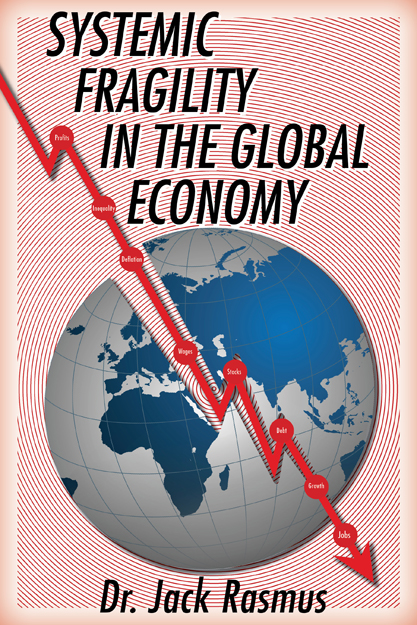
The US and global economy are approached the latter stages in the credit cycle, during which financial asset bubbles begin to appear and the real economy appears to be at peak performance (the calm before the storm). This scenario was explained in my 2016 book, ‘Systemic Fragility in the Global Economy‘. In coming weeks I will be posting in serial form the concluding chapter of that book for readers on this blog, entitled ‘A Theory of Systemic Global Fragility‘.

Here’s the excerpt from the forthcoming European Financial Review article; (a book review of my most recent book, ‘Central Bankers at the End of Their Ropes?’ by Dr. Larry Souza will also appear in that coming EFR issue).

………………………..
Is Bitcoin a Bona Fide ‘Bubble’?
……………………………
“What’s a financial asset bubble? Few agree. But few would argue that Bitcoins and other crypto currencies are today clearly in a global financial asset bubble. Bitcoin and other crypto currencies are the speculative investing canary in the global financial asset coalmine.

One can debate what constitutes a financial bubble—i.e. how much prices must rise short term or how much above long term average rates of increase—but there’s no doubt that Bitcoin price appreciation in 2017 is a bubble by any definition. At less than $1000 per coin in January, Bitcoin prices surged past $11,000 this past November. It then corrected back to $9,000, only to surge again by early December to more than $15,000. Given the forces behind Bitcoin, that scenario is likely to continue into 2018 before the bubble bursts. The question of the moment, however, is what might be the contagion effects on other markets?”

……………………………..
What’s Driving the Bitcoin Bubble?
……………………………..
If Blockchain and software tech company ICOs are driving Bitcoin and other crypto pricing, what’s additionally creating the bubble?…..Who is buying Bitcoin and cryptos, driving up prices, apart from early investors in the companies? ……the absence of government regulation and potential taxation of speculative profits from price appreciation has served as another important driver of the Bitcoin bubble bringing in still more investors and demand and therefore price appreciation. No regulation, no taxation has also led to price manipulation by ‘pumping and dumping’ by well positioned investors….. Another factor driving price is that Bitcoin has become a substitute product for Gold and Gold futures……But what’s really driving Bitcoin pricing in recent months well into bubble territory is its emerging legitimation by traditional financial institutions………futures and derivatives trading on Bitcoin are set to begin in December 2017 in official commodity futures clearing houses, like CME and CBOE…..Bitcoin ETFs derivatives trading are likely not far behind……….big US hedge funds are also poised to go ‘all in’ once CME options and futures trading is established…… Declarations of support for Bitcoin has also come lately from some sovereign countries………While CEOs of big traditional commercial banks, like JPM Chase’s Jamie Dimon, have called Bitcoin “a fraud”, they simultaneously have declared plans to facilitate trading in the Bitcoin-Crypto market.

…………………………………………….
Bitcoin as ‘Digital Tulips’
…………………………………………….
Bitcoin demand and price appreciation may also be understood as the consequence of the historic levels of excess liquidity in financial markets today. Like technology forces, that liquidity is the second fundamental force behind its bubble. To explain the fundamental role of excess liquidity driving the bubble, one should understand Bitcoin as ‘digital tulips’, to employ a metaphor.

The Bitcoin bubble is not much different from the 17th century Dutch tulip bulb mania. Tulips had no intrinsic use value but did have a ‘store of value’ simply because Dutch society of financial speculators assigned and accepted it as having such. Once the price of tulips collapsed, however, it no longer had any form of value, save for horticultural enthusiasts.

What fundamentally drove the tulip bubble was the massive inflow of money capital to Holland that came from its colonial trade in spices and other commodities in Asia. The excess liquidity generated could not be fully re-invested in real projects in Holland. When that happens, holders of the excess liquidity create new financial markets in which to invest the liquidity—not unlike what’s happened in recent decades with the rise of unregulated global shadow banking, financial engineering of new securities, proliferating liquid markets in which securities are exchanged, and a new layer of professional financial elite as ‘agents’ behind the proliferating new markets for the new securities.

……………………………………………
Bitcoin Potential Contagion Effects to Other Markets
…………………………………………….
A subject of current debate is whether Bitcoin and other cryptos can destabilize other financial asset markets and therefore the banking system in turn, in effect provoking a 2008-09 like financial crisis………….Deniers of the prospect point to the fact that Cryptos constitute only about $400 billion in market capitalization today. That is dwarfed by the $55 Trillion equities and $94 trillion bond markets. The ‘tail’ cannot wag the dog, it is argued. But quantitative measures are irrelevant. What matters is investor psychology. ……For example, should cryptos develop their own ETFs, a collapse of crypto ETFs might very easily spill over to stock and bond ETFs—which are a source themselves of inherent instability today in the equities market. A related contagion effect may occur within the Clearing Houses themselves. If trading in Bitcoin and cryptos as a commodity becomes particularly large, and then the price collapses deeply and at a rapid rate, it might well raise issues of Clearing House liquidity available for non-crypto commodities trading. A bitcoin-crypto crash could thus have a contagion effect on other commodity prices; or on ETFs in general and thus stock and bond ETF prices.”

copyright Jack Rasmus, 2017

Read Full Post »

Bitcoin prices surge over $15,000 (a 1500% rise in 2017) while real wages rise only 0.5% the past year. That sums up succinctly what the 21st century US Trump economy is fundamentally about!

Listen to my Friday, December 8, 2017 Alternative Visions radio show for an in depth analysis of what’s behind the bubble in Bitcoin, and where it’s going.

GO TO:

http://prn.fm/?s=Alternative+Visions

or Go To

http://alternativevisions.podbean.com

SHOW ANNOUNCEMENT

Dr. Rasmus goes in depth on the bitcoin mania and the bubble, now at more than $15,000 a coin—a 1500% increase in speculative profits in 2017…and rising. What are the determinants and drivers of the Bitcoin mania, the ‘digital tulips’ bubble of today? Rasmus discusses the fundamental causes as blockchain technology and central bankers’ decades of massive liquidity injection into the global economy, incenting speculative investors to search ever more desperately for ‘yield’, with inflows to digital currencies absorbing more and more of the massive liquidity accumulated on the sidelines today by the professional investing class (aka new global finance capital elite). Additional ‘enabling’ factors have been driving prices as well, including proliferating ICOs, entry of traditional investor-speculators, diversion of financing from gold futures, and most important, increasing legitimation of Bitcoin and crypto currencies by established commodity clearing houses in the US (CME, CBOE), some countries’ direct endorsement and plans(Japan), hedge funds preparation to enter the market, and even commercial banks (Chase, Goldman) announcing partial participation. Bitcoin is a commodity, not yet a currency, and a speculative ‘play’ not unlike oil futures, gold futures (as were tulips in 17th century Holland). Rasmus concludes with a discussion of government regulation, taxation, and potential channels of contagion to other financial asset markets (also approaching bubble territory), when the Bitcoin and cryptos price busts occur. Capital gains from Bitcoin commodity speculation at 1500% contrasts sharply with today’s just announced real wage gains of only 0.5% in the US. (Next week: the House-Senate final Trump Tax Cuts and latest acceleration of income inequality)

Read Full Post »

Trump has often been described as playing ‘fast and loose’ with the facts. That would be too polite a description. When it comes to statements about the economy, what we get from ‘The Trump-et’ is more often inane and absurd statements and declarations.

On my twitter account (@drjackrasmus) I’ve initiated a running commentary on the Trumpet’s continuing stupidities concerning economics.

Here’s the first five, commenting on his press conference today, Wednesday, December 5, where he bragged about the (‘very, very, great, incredible, fabulous, very great, very fabulous) US economy that doesn’t exist except in his own mind:

“Trump Economic Absurdity #5
: most ridiculous of all Trump claims today is that a 6% GDP growth rate will now occur. What can one say besides, just more inane hyperbole from the ‘Trump-et’!

“Trump Economic Absurdity #4: Trump says he’ll now focus on getting jobs for 100 million not working. With US labor force at 166m and population 320m, that means all retirees, prisoners, and mentally ill will go back to work.

“Trump Economic Absurdity #3: In press conference today Trump declares his tax cut will mean middle class gets “tremendous benefit”. In fact, middle class taxes will rise $3 trillion from ending exemptions, deductions, education credit, & raising rates from 10% to 12% for poorest

“Trump Economic Absurdity #2: Trump today claimed more than $4T in cash is held by US multinational corps offshore to avoid paying taxes. Trump tax cuts will bring all that back per Trump. Actual cash hoard by MNCs is $2.8T. How they will bring back >$4T is another Trump mystery.

“Trump Economic Absurdities #1: today in his press conference Trump claims he’s created 2mil jobs so far. Then says for every 1% rise in US GDP, 10 mil. jobs are created. 1% further rise in GDP in 2017 over 2016 produced 2mil. 10m minus 2m = 8 mil. shortfall in Trump logic”

To get all my daily tweets on Trump and the US economy, sign on to my twitter account at: @drjackrasmus

Read Full Post »

With the Senate and House all but assured to pass the US$4.5 trillion in tax cuts for businesses, investors, and the wealthiest 1 percent households by the end of this week, phases two and three of the Trump-Republican fiscal strategy have begun quickly to take shape.

Phase two is to maneuver the inept Democrats in Congress into passing a temporary budget deficit-debt extension in order to allow the tax cuts to be implemented quickly. That’s already a ‘done deal’.

Phase three is the drumbeat growing to attack social security, Medicare, food stamps, Medicaid, and other ‘safety net’ laws, in order to pay for the deficit created by cutting taxes on the rich. To justify the attack, a whole new set of lies are resurrected and being peddled by the media and pro-business pundits and politicians.

Deficits and Debt: Resurrecting Old Lies and Misrepresentations

Nonsense like social security and Medicare will be insolvent by 2030. When in fact social security retirement fund has created a multi-trillion dollar surplus since 1986, which the U.S. government has annually ‘borrowed’, exchanging the real money in the fund created by the payroll tax and its indexed threshold, for Treasury bonds deposited in the fund. The government then uses the social security surplus to pay for decades of tax cuts for the rich and corporations and to fund endless war in the middle east.

As for Medicare, the real culprit undermining the Medicare part A and B funds has been the decades-long escalating of prices charged by insurance companies, for-profit hospital chains (financed by Wall St.), medical devices companies, and doctor partnerships investing in real estate and other speculative markets and raising their prices to pay for it.

As for Part D, prescription drugs for Medicare, the big Pharma price gouging is even more rampant, driving up the cost of the Part D fund. By the way, the prescription drug provision, Part D, passed in 2005, was intentionally never funded by Congress and George Bush. It became law without any dedicated tax, payroll or other, to fund it. Its US$50 billion plus a year costs were thus designed from the outset to be paid by means of the deficit and not funded with any tax.

Social Security Disability, SSI, has risen in costs, as a million more have joined its numbers since the 2008 crisis. That rise coincides with Congress and Obama cutting unemployment insurance benefits. A million workers today, who would otherwise be unemployed (and raising the unemployment rate by a million) went on SSI instead of risking cuts in unemployment benefits. So Congress’s reducing the cost of unemployment benefits in effect raised the cost of SSI. And now conservatives like Congressman Paul Ryan, the would be social security ‘hatchet man’ for the rich, want to slash SSI as well as social security retirement, Medicare benefits for grandma and grandpa, Medicaid for single moms and the disabled (the largest group by far on Medicaid), as well as for food stamps.

Food stamp costs have also risen sharply since 2008. But that’s because real wages have stagnated or fallen for tens of millions of workers, making them eligible under Congress’s own rules for food stamp distribution. Now Ryan and his friends want to literally take food out of the mouths of the poorest by changing eligibility rules.

They want to cut and end benefits and take an already shredded social safety net completely apart–while giving US$4.5 trillion to their rich friends (who are their election campaign contributors). The rich and their businesses are getting $4.5 trillion in tax cuts in Trump’s tax proposal—not the $1.4 trillion referenced in the corporate press. The $1.4 trillion is after they raise $3 trillion in tax hikes on the middle class.

Whatever financing issues exist for Social Security retirement, Medicare, Medicaid, disability insurance, food stamps, etc., they can be simply and easily adjusted, and without cutting any benefits and making average households pay for the tax cuts for the rich in Trump’s tax cut bill.

Social security retirement, still in surplus, can be kept in surplus by simply one measure: raise the ‘cap’ on social security to cover all earned wage income. Today the ‘cap’, at roughly US$118,000 a year, exempts almost 20 percent of the highest paid wage earners. Once their annual salary exceeds that amount, they no longer pay any payroll tax. They get a nice tax cut of 6.2 percent for the rest of the year. (Businesses also get to keep 6.2% more). Furthermore, if capital income earners (interest, rent, dividends, etc.) were to pay the same 6.2% it would permit social security retirement benefits to be paid at two thirds one’s prior earned wages, and starting with age 62. The retirement age could thus be lowered by five years, instead of raised as Ryan and others propose.

As for Medicare Parts A and B, raising the ridiculously low 1.45 percent tax just another 0.25 percent would end all financial stress in the A & B Medicare funds for decades to come.

For SSI, if Congress would restore the real value of unemployment benefits back to what it was in the 1960s, maybe millions more would return to work. (It’s also one of the reasons why the labor force participation rate in the U.S. has collapsed the past decade). But then Congress would have to admit the real unemployment rate is not 4.2 percent but several percentages higher. (Actually, it’s still over 10 percent, once other forms of ‘hidden unemployment’ and underemployment are accurately accounted for).

As for food stamps’ rising costs, if there were a decent minimum wage (at least US$15 an hour), then millions would no longer be eligible for food stamps and those on it would significantly decline.

In other words, the U.S. Congress and Republican-Democrat administrations have caused the Medicare, Part D, SSI, and food stamp cost problems. They also permitted Wall St. to get its claws into the health insurance, prescription drugs, and hospital industries–financing mergers and acquisitions activity and demanding in exchange for lending to companies in those industries that the companies raise their prices to generate excess profits to repay Wall St. for the loans for the M&A activity.

The Real Causes of Deficits and the Debt

So if social security, Medicare-Medicaid, SSI, food stamps, and other social safety net programs are not the cause of the deficits, what then are the causes?

In the year 2000, the U.S. federal government debt was about US$4 trillion. By 2008 under George Bush it had risen to nearly US$9 trillion. The rise was due to the US$3.4 trillion in Bush tax cuts, 80 percent of which went to investors and businesses, plus another US$300 billion to U.S. multinational corporations due to Bush’s offshore repatriation tax cut. Multinationals were allowed to bring US$320 billion of their US$750 billion offshore cash hoard back to the U.S. and pay only a 5.25 percent tax rate instead of the normal 35 percent. (By the way, they accumulated the US$750 billion hoard was a result of Bill Clinton in 1997 allowing them to keep profits offshore untaxed if not brought back to the U.S. Thus the Democrats originally created the problem of refusing to pay taxes on offshore profits, and then George Bush, Obama, and now Trump simply used it as an excuse to propose lower tax rates for repatriated the offshore profits cash hoard of US multinational companies. From $750 billion in 2004, it’s now $2.8 trillion).

So the Bush tax cuts whacked the U.S. deficit and debt. The Bush wars in the middle east did as well. By 2008 an additional US$2 to US$3 trillion was spent on the wars. Then Bush policies of financial deregulation precipitated the 2007-09 crash and recession. That reduced federal tax revenue collection due to collapse economic growth further. Then there was Bush’s 2008 futile $180 billion tax cut to stem the crisis, which it didn’t. And let’s not forget Bush’s 2005 prescription drug plan–a boondoggle for big pharmaceutical companies–that added US$50 billion a year more. As did a new Homeland Security $50 billion a year and rising budget costs.

There’s your additional US$5 trillion added by Bush to the budget deficit and U.S. debt–from largely wars, defense spending, tax cuts, and windfalls for various sectors of the healthcare industry.

Obama would go beyond Bush. First, there was the US$300 billion tax cuts in his 2009 so-called ‘recovery act’, mostly again to businesses and investors. (The Democrat Congress in 2009 wanted an additional US$120 billion in consumer tax cuts but Obama, on advice of Larry Summers, rejected that). What followed 2009 was the weakest recovery from recession in the post-1945 period, as Obama policies failed to implement a serious fiscal stimulus. Slow recovery meant lower federal tax revenues for years thereafter.

Studies show that at least 60 percent of the deficit and debt since 2000 is attributable to insufficient taxation, due both to tax cutting and slow economic growth below historical rates.

Obama then extended the Bush-era tax cuts another US$803 billion at year-end 2010 and then agreed to extend them another decade in January 2013, at a cost of US$5 trillion. The middle east war spending continued as well to the tune of another $3 trillion at minimum. Continuing the prescription drug subsidy to big Pharma and Homeland Security costs added another $500 billion.

In short, Bush added US$5 trillion to the US debt and Obama another US$10 trillion. That’s how we get from US$4 trillion in 2000 to US$19 trillion at the end of 2016. (US$20 trillion today, about to rise another US$10 trillion by 2027 once again with the Trump tax cuts fast-tracking through Congress today).

To sum up, the problem with chronic U.S. federal deficits and escalating Debt is not social security, Medicare, or any of the other social programs. The causes of the deficits and debt are directly the consequence of financing wars in the middle east without raising taxes to pay for them (the first time in U.S. history of war financing), rising homeland security and other non-war defense costs, massive tax cuts for businesses and investors since 2001, economic growth at two thirds of normal the past decade (generating less tax revenues), government health program costs escalation due to healthcare sector price gouging, and no real wage growth for the 80 percent of the labor force resulting in rising costs for food stamps, SSI, and other benefits.

Notwithstanding all these facts, what we’ll hear increasingly from the Paul Ryans and other paid-for politicians of the rich is that the victims (retirees, single moms, disabled, underemployed, jobless, etc.) are the cause of the deficits and debt. Therefore they must pay for it.

But what they’re really paying for will be more tax cuts for the wealthy, more war spending (in various forms), and more subsidization of price-gouging big pharmaceuticals, health insurance companies, and for-profit hospitals which now front for, and are indirectly run by, Wall St.

Jack Rasmus is the author of the recently published book, “Central Bankers at the End of Their Ropes: Monetary Policy and the Coming Depression.” He blogs at jackrasmus.com and his twitter handle is @drjackrasmus.

.

Read Full Post »

« Newer Posts - Older Posts »