With McConnell & Republicans stonewalling any settlement on passing a fiscal stimulus bill in Congress, the real economy continues to deteriorate (while 651 US billionaires increase their wealth by $1T since March and US stock markets reach daily record highs). The consequences of failure to pass a fiscal stimulus bill in Congress reaps daily ever-deepening hardships on real people–especially the 25m still unemployed (now rising weekly), the 11.4m renters unable to make payments, the 3.6m homeowners behind on the mortgages, the 35m students who soon will have to repay $777B in student loans in arrears, the more than 3.3m small businesses already permanently closed as of October, and the millions of workers who will have to start paying double payroll taxes come January. Despite the crisis, McConnell & Republicans refuse to budge off of their $500B offer unchanged since last June, as Democrats agree to reduce their $2.2T to the $908B ‘bipartisan’ Senate proposal (a second time they reduced proposals by $1T since August). What’s behind the refusal to negotiate by McConnell & Trumpublicans? Why no stimulus deal will mean a relapse into a double dip recession in January-March (predicted as well by Chase bank).
Listen to my two radio discussions on this last friday, December 11, 2020. The first in my hour long Alternative Visions radio show; the second a 15 min. short version interview with Critical Hour radio host, Wilmer Leon.
TO LISTEN GO TO:
https://alternativevisions.podbean.com/e/alternative-visions-economics-consequences-of-a-failed-stimulus-trump-s-plan-b/
https://drive.google.com/file/d/1FBlp7JhdTWauobJSIrt_wo–ZuRaTbDQ/view
Archive for the ‘Uncategorized’ Category
Economic Consequences of Failing Stimulus–audio (2)
Posted in Uncategorized on December 12, 2020| 1 Comment »
Stimulus Negotiations Update: McConnell Playing Democrats Like a Violin–radio interview
Posted in Uncategorized on December 8, 2020| Leave a Comment »
Listen to my 12 min. interview today with Critical Hour radio explaining how Mitch McConnell is successfully manipulating splits in the Democrat party to get Pelosi-Shumer to lower their proposals still further. Meanwhile, the real US economy stumbles toward a brink as unemployment rises, benefits run out, rent forebearance ends, rent payments double, and evictions grow, and 35m students face double payments in January. In first quarter 2021 US economy will take a hit to GDP of more than $500B throwing it into a double dip recession, according to JP Morgan Bank research
TO LISTEN GO TO:
https://drive.google.com/file/d/1I0oqfwuUmYA1j2ePxbgjdfBSj_zrxMvy/view
A Coming Fiscal Stimulus–Or Just Another Short Term ‘Mitigation’ Bill?–audio
Posted in Uncategorized on December 6, 2020| Leave a Comment »
Three Radio Interviews: Equal Time Radio of Vermont, Critical Hour Radio, & By Any Means Necessary Radio in Washington DC.
Why last Friday’s Labor Dept. ‘Jobs Numbers’ Grossly Understate the 20 million plus Unemployment, why the stimulus program in Congress will be an insufficient ‘mitigation 2.0’ bill, and why new wireless technology being trialed by the USAF will expand government spying of citizens. Listen to Critical Hour Radio at:
https://drive.google.com/file/d/17t-TGVpEYoBAtG19i5soCAfHItMAtTYx/view
Dr. Jack Rasmus about the Prospects for Coronavirus Stimulus, the Economy & the Impending Loss of Unemployment Benefits & Paid Sick/Family leave for Millions of Workers, plus an Assessment of Biden’s policies and appointments. Listen to Equal Time Radio at:
https://equaltimeradio.transistor.fm/episodes/2020-election-and-the-prospects-for-coronavirus-stimulus
Why Congress Will ‘Low-Ball’ the next fiscal ‘stimulus’. Listen to By Any Means Necessary Radio at:
https://www.spreaker.com/user/radiosputnik/help-from-congress-looking-less-likely-a
3 Radio Interviews on US Economy Last Week in November
Posted in Uncategorized on November 29, 2020| Leave a Comment »
Following are 3 short (15-20 min.) radio interviews of this past week on topics of the US economy, jobs, stimulus, Fed, and other
https://drive.google.com/file/d/1EZ4tWVvrXHMGqW_TqSDEnCo08GZeFX_O/view
Critical_Hour_606_Seg_2.mp3
https://www.spreaker.com/user/radiosputnik/economist-explains-why-little-coronaviru
A Short Comment on a Big Danger
Posted in Uncategorized on November 28, 2020| 4 Comments »
If you’re worried about the capability of government to conduct surveillance of citizens engaged in political assembly and protest, or even just personal activity, then you should be aware the technological capability of government surveillance is about to expand exponentially.
The US Air Force’s Research Lab (yes, it has its own lab) has recently signed a contract to test new software of a company called SignalFrame, a Washington DC wireless tech company. The company’s new software is able to access smartphones, and from your phone jump off to access any other wireless or bluetooth device in the near vicinity. To quote from the article today in the Wall St. Journal, the smartphone is used “as a window onto usage of hundreds of millions of computers,s routers, fitness trackers, modern automobiles and other networked devices, known collectively as the ‘Internet of Things’.”
Your smartphone in effect becomes a government listening device that detects and accesses all nearby wireless or bluetooth devices, or anything that has a MAC address for that matter. How ‘near’ is nearby is not revealed by the company, or the Air Force, both of which refused to comment on the Wall St. Journal story. But with the expansion of 5G wireless, it should be assumed it’s more than just a couple steps from your smartphone.
One can imagine some scary scenarios with this capability in the hands of government snoops:
Not only would the government know your geographical location via the GPS signal to your cellphone. They’d know what you are doing. And with whom.
A political gathering would allow them to see all the owners of other cellphones in the vicinity of a protest or demonstration. How many are gathering at a particular street or location. The direction they might be heading. Or whether there’s an organization meeting in a hall or room and who (with a cellphone as well) might be attending.
If you’re driving on a winding coastal or mountain road, it would know, and could possibly access, your car’s various electronic systems to turn them off. It might access your car’s circuit board that governs your power steering when you’re driving in an area of winding roads. Or it might be able to just shut down your car’s electrical system and remotely lock all your doors. The police no longer have to engage in highway chases until capture.
The new tech would allow the government to access the data on your fitbit device while you’re jogging. Or worse, maybe even interfere with the signal on your heart pacemaker device.
The technology might be used to access your smartphone, and from there to turn on your home Alexa device to listen in and record conversations without you ever knowing. Or to listen in on your zoom conferencing on your laptop. Or maybe even worse, to shut down or bypass the safety features on your home furnace equipment. Or turn off your home security system.
And with 5G wireless broadband, the tracking might be extended well beyond the range of a bluetooth device. Add 5G broadband wireless to SignalFrame’s technology, and then wed that to the capability of machine learning and artificial intelligence, and you get instant processing of a massive amount of data on any targeted person or gathering!
This problem of government surveillance on free citizen activity is not new. It took a giant leap after 9-11 with the Patriot Act and acquisition of phone data by Homeland Security and other government agencies. It was supposed to have stopped. But it hasn’t. The snoops have continued to ignore Congressional resolutions and court decisions on privacy invasion of citizens. The latest Air Force lab testing is likely just a recent ‘tip of the iceberg’ revelation. And if the Air Force is doing it, be assured so are the Army, Navy, the NSA, CIA, FBI and all the other government snoops.
Certainly this kind of technology would be used not only by the US government. If the USA has it, you can bet other governments do too–especially China, Russia, Israel, and probably some of the Europeans as well.
Unlike in 2001, in 2020 SignalFrame’s technology takes government surveillance to a new level–given the ubiquity of smartphones, Internet of Things (IOT) devices, digital circuit board dependent autos, and all the many household devices now with MAC wireless access addresses. And now, unlike circa 2001 and the passage of the Patriot Act (and its continuation in annual NDAA legislation), we have AI, machine learning, neural nets everywhere, and massive government data processing power.
In short, Technology is becoming a growing tool and power in the hands of governments, to use to thwart democratic and constitutional rights–as well as to detect, apprehend, and ‘deal with’ those who protest and oppose those governments.
The coming decade in the USA will be increasingly difficult economically, increasingly unstable politically, but will be a decade in which technology is increasingly threatening basic civil and constitutional rights.
Dr. Jack Rasmus
November 28, 2020
US Treasury v. the Fed: the Mnuchin-Powell ‘Rift’-audio
Posted in Uncategorized on November 27, 2020| Leave a Comment »
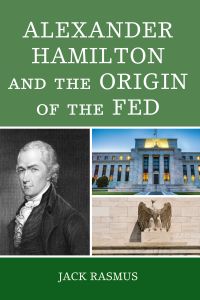
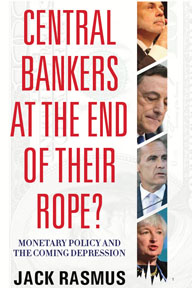
Last week US Treasury Secretary, Mnuchin, ordered the Federal Reserve to Return $455 billion of unspent stimulus funds given the Fed in last March’s ‘Cares Act’ passed by Congress. Today’s Alternative Visions show discusses the politics of the move within the context of the history of the relationship between the Treasury and the Fed, going back to the early attempts to create a central bank in the 1780s, 1790s, and beyond up to the creation of the Fed finally in 1913. Dr. Rasmus restates some of these major themes in his recent book, ‘Alexander Hamilton and the Origins of the Fed’ (2019) and its sequel book, ‘Central Bankers at the End of Their Ropes: Monetary Policy and the coming Depressions’ (2017). What are the central bank ‘functions’, whether administered by a formal central bank, like the Fed, or by the Treasury? Why the Fed was created by the big private bankers. How it functions today in 21st century US global capitalism to ensure the subsidization of financial interests and corporations among the US capitalist class. Why the so-called ‘rift’ is no rift at all. And what are the politics of Mnuchin’s recall of the $455 billion given to the Fed last March and still unspent–even as unemployment remains in excess of 25m today in the US, food lines grow, rent evictions accelerate, and hundreds of thousands of small businesses are failing and closing.
To Listen to the Hour Long Alternative Visions show GO TO:
https://alternativevisions.podbean.com/e/alternative-visions-us-treasury-vs-us-federal-reserve-rift-functions-of-capitalist-central-banks/
Behind the US Treasury vs. Fed ‘Rift’
Posted in Uncategorized on November 24, 2020| 1 Comment »
This past week the US Treasury and the US Federal Reserve Bank engaged in a rare public disagreement. US Treasury Secretary, Mnuchin, in a letter to Jerome Powell, chair of the Federal Reserve, last week directed the Fed to return $455 billion that the Fed was holding in reserve should future lending to banks and non-bank businesses become necessary if the US economy and markets further deteriorate in 2021.
Fed chair Powell initially balked at Mnuchin’s request, replying that the Fed needed the funds to ensure market stability since the US economy was entering a “difficult period” in late 2020 and early 2021. According to Powell, the $455 billion was essential “as a backstop for our ill-stressed and vulnerable economy”. Returning the funds therefore was “not appropriate”. To do so now was not the right time. Not “yet”, replied Powell. Not even “very soon.”
The Fed’s initial response to Mnuchin no doubt reflected Powell’s concern the US economy may very likely weaken in the current 4th quarter, compared to the 3rd. That means possibly more defaults and bankruptcies could be on the agenda for the 1st quarter 2021—in particular for junk bond heavy businesses and state and local governments that appear most vulnerable at the moment. The Fed therefore needs to keep the $455 billion funds in reserve to address a potentially worsening economic situation.
If the differences between Mnuchin and Powell represented a ‘rift’, as the mainstream media often reported, it was undoubtedly the shortest Treasury-Fed rift on record. It wasn’t twenty-four hours after Powell’s initial resistance statement that the Fed capitulated to the US Treasury. Powell quickly retreated publicly, saying the Fed would comply. In retracting his position of the day before, Powell declared the US Treasury had “sole authority”. The Fed would return the funds. The ‘rift’ was over in less than 24 hours.
What then were Mnuchin’s rationale for insisting the funds be returned to the US Treasury? What were his public reasons given for taking back $455 billion at a time of intensifying Covid impact on the economy; as fiscal stimulus appeared dead for months to come; and as 12 million workers were about to lose unemployment benefits in December while simultaneously hundreds of thousands were experiencing rent evictions, lines for food banks were growing throughout the country, and student loan forebearance for millions was about to end?
Mnuchin’s Rationale
To deflect critics Mnuchin floated a number of obviously false narratives to justify his decision to take back the $455 billion. He said it was Congress’s intent to end all the funding by December 31, 2020. Even so, he added, he was allowing Fed programs like the Fed’s commercial paper and money market mutual fund special lending facilities to continue for an additional 90 days into 2021. Then there was the $74 billion in the Fed’s Financial Stabilization Fund (FSF) which would remain at the Fed. He puffed up the $74 billon saying the Fed “would still have $800 billion”, assuming the $74 billion represented a fractional reserve that allowed the Fed to fund up to 10X that amount. The central bank could also keep another $25 billion to cover distribution of funds in progress. He further noted that the $455 billion was needed to fund spending in what might be an eventual fiscal stimulus bill later negotiated in 2021 between the US House and the Senate.
It is perhaps interesting to note that Mnuchin’s retraction of the funds came barely a month after in October he wrote a letter indicating that all the Fed’s funds, including the $455 billion, could be retained by the Fed into 2021. The October letter, followed by his November decision to retract the $455 billion, suggests strongly that some kind of decision was made by the Trump administration, or McConnell in the Republican Senate, or perhaps both, sometime after the November 3 election in order to make it as difficult as possible for the incoming Biden administration to address the deteriorating US economic situation.
McConnell had signaled quickly after November 3 there was no chance for a new fiscal stimulus in 2020; Mnuchin then retracted the $455 billion and McConnell was among the first to publicly endorse his move. The timing of both was unlikely merely coincidental.
The Reactions
The Democrat and mainstream media reactions to Mnuchin’s move were swift and to the point.
Typical was Democrat Maxine Waters’, a key player in the US House of Representatives: “It is clear that Trump and Mnuchin are willing to spitefully destroy the economy and make it difficult as possible for the incoming Biden administration”.
Even more to the point were business media editorialists and comments that followed Mnuchin’s announcement: The Financial Times declared Mnuchin has “aligned himself with Mr. Trump’s ‘burn the house down’.” The Wall St. Journal added “The termination is also important to limite the demands by politicians to use the Fed for policies they can’t get through Congress”. Fidelity Investments’ Market Watch online news service concluded the “intent of the Mnuchin move appears to be to prevent the next Treasury Secretary extending relief to state and local governments”.
In other words, the real rationale of Mnuchin was Politics, first and foremost. One might add a close second: i.e. improving Bank profits. Stripping the funds from the Fed would now force borrowers to turn more to capital markets to raise funds, instead of relying on government funding programs made available through the Fed.
The Politics of $455 Billion
Despite Mnuchin’s various explanations to the contrary, his withdrawal of the funds from the Fed is clearly about denying the incoming Biden administration from perhaps convincing the Fed to expend the $455 billion to provide loans to hard pressed state and local governments in 2021 and/or for making additional loans & grants available to small businesses.
For the Biden administration, getting the Fed to provide the financial assistance in loans to local governments and small business would obviate the need for the Biden administration to have to fight a Republican Senate, led by McConnell, to pass the same amount of aid targeting local governments and small businesses as part of an eventual Biden fiscal legislative package.
Mnuchin and McConnell have long opposed fiscal support for state and local governments, which they view as heavily weighted toward Democrat ‘blue’ states and cities. They preferred these governments raise money in capital markets instead of getting financial aid via government programs. Providing loans via government programs, with terms and conditions more favorable to borrowers (and not to banks), means less profits for private banks and private lenders. The same applies to small businesses as well as local governments. Republicans want to redirect their financing needs to private markets, instead of through government programs.
That economic motive fits nicely with the political objective of Mnuchin, McConnell, and other Republicans to deny the Biden administration access to funding already on the Fed ‘books’, i.e. funding that was already established in March 2020 as part of the Cares Act passed at the time.
The fact that $455 billion has not been spent as part of Cores Act after almost nine months is of course a related question of importance. Given the great distress of small businesses and 22 million still unemployed in the US as of late November, one might well ask why hasn’t that $455 billion been provided to businesses and their employees still in need? Why has the Trump administration not comitted it, given the growing stress on small business and expiring unemployment benefits? And why have the Democrats not more insisted it be spent, as was intended in March. Congress and the Trump administration have been at stalemate for months over passing a new fiscal stimulus bill, when $455 billion in funds was, and still remains, available.
In recalling the Fed’s funds back to his Treasury, Mnuchin’s strategy is clearly to force the Democrats to confront McConnell and Republicans directly via renewed fiscal stimulus negotiations sometime in 2021, and to do so starting from scratch. Biden and the Democrats won’t have that $455 billion potentially available from the Fed. And they’ll have to in effect ‘renegotiate it all over again’.
Moreover, should the Republicans retain control of the majority of the Senate in 2021—to be determined after the Georgia state Republican Senator election runoffs—McConnell can dictate with his Senate veto the scope and magnitude of any future fiscal stimulus in 2021. The Fed and its $455 billion ‘back door’ possible funding source for state and local governments and small businesses will be denied to Biden and the Democrats.
The Mnuchin move is therefore political—i.e. to deny Biden the availability of nearly a half trillion in bailout financing especially for small businesses and state and local governments—and to force the Democrats to renegotiate it with McConnell again. A corollary gain for the Republicans is to force the same governments and small businesses to access the private capital markets for future financing needs, thus benefiting private lenders more than they would otherwise by simply playing ‘middle men’ distributing government program loans for a fee.
Banks have consistently complained since March that the Cares Act lending programs did not provide them sufficient profits. Their interest rate spreads are too narrow. Redirecting lending from Fed programs to private capital markets would prove more profitable.
Just What is the $455 Billion?
The $455 billion represents the unspent funds left over from the Cares Act passed in March 2020. That Act consisted of four parts. One part provided $500 billion in emergency unemployment assistance and $1200 per person checks for households whose annual income was less than $75,000. The checks were spent within 60 days. A good part of the unemployment benefits later expired at the end of July 2020; the rest will expire around Christmas and thus leave 12 million workers without any unemployment benefits any longer. It is estimated the August partial ending of the benefits reduced US GDP household spending by $65 billion a month; the December expirations will reduce it another $150 billion per month.
Another part of the Cares Act amounted to $350 billion to provide loans to small businesses, called the Payroll Protection Program or PPP. That $350 billion initially proved insufficient, as larger businesses quickly scammed and exhausted the funds with the help of their banks that were responsible for distributing the funds. Many of the banks simply disbursed the funds first to their larger, preferred customers even if they didn’t qualify as ‘small business’ under the PPP program. As a result, another $320 billion supplement to the PPP was passed by Congress in April. That brought the total available in the PPP to $660 billion ($10B of which was put aside for administration). The PPP was shut down in early August 2020, even when only $525 of the $660 billion was distributed. So $135 billion of the PPP remains unspent. That remainder is apparently part of Mnuchin’s order for the Fed to return $455 billion.
As a third element, the March Cares Act provided for another $600 billion for medium sized corporations, and for a host of special directed financial bailouts of financial institutions and corporations. A number of the bailouts were created under the umbrella of what is called the ‘Main St. Program’.
The Main St. program included Fed purchases of corporate bonds for the first time in its history, including Exchange Traded Funds (ETFs) which are traded like stocks. It also included Fed financial support for the Municipal Bond market, for asset backed securities, for nonprofit businesses, commercial paper issuers, and for money market mutual funds, among others.
Most of these were special lending facilities resurrect from the 2008-09 experience, with the exception of funding for corporate bonds and ETFs which were historically new and unprecedented. What was also precedent setting was none of the above markets had actually collapsed in March. The Fed resurrecting of the special lending facilities was in anticipation of a possible collapse. So much of the Fed lending to big corporations and financial markets was a pre-emptive bailout before an actual crash! So too was the Fed lending to non-financial corporations!
In short, there was at least $1.1 trillion put aside in the Fed—supported by Treasury funding—for the purpose of bailing out medium and larger corporations and targeted financial asset markets like commercial paper, asset backed securities, corporate bonds, municipal bonds, etc. But it mostly wasn’t used.
Why Big US Corporations Didn’t Need Fed Loans
Medium and large corporations didn’t require emergency liquidity from the Fed. They were able to accumulate trillions of dollars to add to their balance sheets quickly as the real economy began to crash in March-April. The Fed enabled their liquidity accumulation in significant part by pumping $120 billion a month via its QE program into the economy, and by other measures, which drove interest rates to record lows. That enabled large businesses to issue record levels of new corporate bonds. For the Fortune 500 alone it raised $2 trillion in funds. Hundreds of billions of dollars more were added by big firms drawing down their credit lines at their banks, again enabled by low rates thanks to the Fed. Nearly all big corporations suspended their dividend payouts, which in prior years had exceed more than $500 billion a year. Still other firms boosted available liquidity by saving on their daily costs of operations as workers were either laid off or allowed work remotely and facilities were shuttered.
In other words, most medium and large US businesses were fat with cash, could borrow at lower rates in private markets, and simply didn’t need the $1.1 trillion in emergency loans provided for them, through the Fed, as a result of the March Cares Act. So Mnuchin’s request for the $455 billion returned from the Fed included the funds the Treasury had given the Fed in March for possible lending to medium and large corporations—lending that never materialized because it was never needed.
About $100 billion was loaned by the Fed to date for various ‘Main St.’ lending facilities and other programs. In March the US Treasury provided $195 billion for Main St. programs. Another $25 billion was allowed the Fed to complete funding in progress. That left $70 billion of the $195 billion that Mnuchin now wants back. Add to that $70 billion the roughly $135 billion in unused PPP funds. And to that total ($70 + $135) another approximate $250 billion in funds allocated for large corporations and for other sources, and the grand total is the $455 billion that Mnuchin told Powell he wants back.
Jerome Powell’s Conundrum
The Fed will be left with the $25 billion to cover Main St. loans still being disbursed, as well as $74 billion in its ‘Financial Stabilization Fund’ (FSB) for future emergencies.
Cleaned out of most of its emergency funding originally allocated under the Cares Act, the Fed will be forced to address any future financial instability and emergencies by providing even more QE in addition to the $120 billion a month already. But that’s quite ok with financial investors and markets, since it will mean even lower (and longer duration) interest rates on Fed government securities. It may even force the Fed to introduce nominal negative interest rates, as have other central banks in Europe and Japan.
By his action, Mnuchin signaled the Republican preferred policy is to force monetary policy to again play the lead role in any future recovery. Fiscal stimulus is not primary, or even likely, in 2021. That explains in large part why both the Trump administration and McConnell’s Republican Senate have stonewalled any fiscal stimulus package subsequent to the March Cares Act. The Democrats’ ‘Heroes Act’ of $2.4 trillion passed back in June 2020 by the Democrat majority US House of Representatives has been thwarted and delayed by various tactics and means by McConnell and Trump coordinated maneuvers. Nor will McConnell permit any reasonable fiscal stimulus in what remains of 2020. Should he agree on anything, moreover, it will be to ‘give’ the Democrats back the $455 billion he took from the Fed with the assistance of Mnuchin. Moreover, should the Republicans retain control of the Senate by winning the run off elections in Georgia on January 5, 2021, McConnell’s Republican Senate majority will continue to oppose any fiscal stimulus proposed by the new Biden administration. It will mean a continuation of virtual veto of fiscal stimulus proposals that McConnell and Republicans have adhered to since at least 2012-14.
The Cares Act March 2020 fiscal stimulus was an aberration to this strategy. Immediately after, the Republicans returned to their monetary policy/central bank as primacy policy that has been in effect ever since the 2008-09 great recession 1.0. But even that generalization may be an exaggeration, since by monetary policy in this Republican strategic view is meant only QE and near zero rates—and does not include special lending to small businesses or employment assistance. In short, soon after the passage of the Cares Act it was back to monetary policy designed to benefit private markets and investors and not to benefit small business or wage earners.
The GDP Effect of Fiscal-Monetary Policy in 2020
The Cares Act has been consistently estimated as a $2.4 trillion stimulus event (or $3 trillion if one counts the $650 billion in business-investor tax cutting also provided by that legislation). But in fact the actual fiscal stimulus—in the form of PPP $525 billion and $500B employment assistance—amounted only to around $1 trillion! Add another $200 billion in direct spending assistance to hospitals and for Covid emergency health care, plus the minimal $125 billion or so in Main St. and other corporate lending, and the total actual fiscal stimulus to the general economy has totaled less than $1.5 trillion under the Cares Act. That’s around only 7% of GDP!
That compares to roughly $5.5% stimulus in the 2009 Obama recovery act, which proved grossly insufficient to generating a sustained economic recovery for most of the real economy after 2009. The 2020 contraction of the real economy has been at least four times as deep as the 2008-09 contraction. So the stimulus in GDP terms in the Cares Act was even less sufficient than was the Obama 2009 recovery package. How long it will take the 2020 great recession to recovery in employment and business activity terms with this even less sufficient stimulus to date remains to be seen. But history suggests recovery in the current great recession 2.0 will be measured in more years than the last 2008-09 great recession 1.0.
There has been much hype by politicians and media about the so-called economic recovery 3rd quarter in the USA. But the facts show the economy contracted sharply by 10.8% from March through June. It then ‘rebounded’ (not to be confused with ‘recovered’)in the 3rd quarter by 7.4%. More importantly, many key economic indicators have been flashing in the 4th quarter that the 3rd quarter recovery will weaken appreciable in the 4th. And some predict even more so in the 1st quarter 2021. Like Europe, the US Economy may be headed toward a double dip contraction over the winter months ahead. That will result in a clear ‘W-shape’ recovery (not V-shape) that is typical of all great recessions—which this writer has been predicting since last March.
The economic ‘relapse’ to a slower growth path in the 4th quarter is all but ensured by the current failure to quickly pass a sufficient fiscal stimulus bill at year’s end 2020, by the intensifying negative impact on the US economy by the Covid 3rd wave surging in America today, and for months still to come, and by the continuing political instability and gridlock in policy impacting the economy as well.
Much is made by optimists of the strength of recovery of US manufacturing and Construction sectors—i.e. the goods sectors—in the US economy. But together they constitute only 20% at best of the total US economy and GDP. Moreover, the recovery here is deceptive. Manufacturing is still 5.6% below 2019 and employment not recovered by any estimate. And Construction recovery is limited to new single family housing—with apartment and multiple housing barely improving—and commercial property construction still mired in a deep recession with no end in sight. This is not the basis for a sustained full economic recovery by any means. Especially since much of the services sector will lag in recovery for some time as well.
It is in the context of this questionable ‘recovery’ of the US economy in late 4th quarter 2020 that a fiscal stimulus package appears dead on arrival in Congress for the rest of the year; that Covid continues to surge with its expected economic impact; that the last vestiges of the Cares Act will soon expire before year end; and political instability threatens to create more business investment uncertainty.
In the midst of all this, Mnuchin and Republicans have acted to pull much needed funding from the Fed, making it even more difficult to restore economic resources needed in 2021.
Dr. Jack Rasmus
November 24, 2020
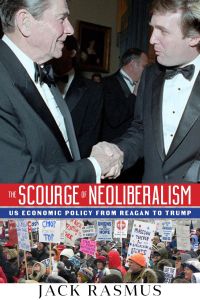
Dr. Rasmus is author of the recently published book, ‘The Scourge of Neoliberalism: US Economic Policy from Reagan to Trump’, Clarity Press, January 2020. He blogs at jackrasmus.com. His website is http://kyklosproductions.com and his twitter handle @drjackrasmus.
US Political Crisis Just Entered More Dangerous Phase
Posted in Uncategorized on November 19, 2020| Leave a Comment »
Today the political crisis in America may be entering an even more dangerous phase–a phase that I predicted was possible months ago. Today reportedly Trump has asked Republican state legislators in Michigan, where he lost the popular vote, to come to the White House. Trump no doubt wants them to select electors who will vote for him, not for the winner of the vote in Michigan, Biden.
The veil of Democracy in America is being ripped away from the body politic right before our eyes. Not only can the Electoral College thwart the popular vote for president; but there are even more nefarious ways for political elites to circumvent the Electoral College if they don’t like it.
The electoral college is, of course, the means by which the popular vote for the president is prevented. Instead of Democracy’s principle of ‘one person, one vote’, we have electors who are selected by their state legislatures who then cast their vote for president. That’s the appearance. But it’s even worse than that.
The timeline for the Electoral College to meet and cast their votes for president is December 8. Each state’s vote in the Electoral College’s must then be sent by December 14 to their state’s governor, who must send that decision to Congress by December 23. Congress then confirms the president by January 6. That’s the actual process how presidents are ‘elected’.
The problem is that state legislatures select the electors who vote in the electoral college. But the electors they select don’t necessarily have to vote for the candidate the majority of the people of their state vote for. The legislature can select electors, or direct the electors they already selected, to vote for a candidate who the people of the state didn’t vote for. Court decisions prohibiting this are not clear cut, so it can be argued the legislatures can select the electors who can vote for whatever candidate they want. Even recent US Supreme Court decisions on this are ambiguous.
By calling Republican state legislatures from Michigan today to the White House–an act that in itself is intimidating, since Republican politicians know Trump can unseat them next primary–Trump is clearly attempting to ‘convince’ them to select, or order, electors to vote for him instead of Biden. If successful in Michigan, Trump will no doubt target another couple Republican majority state legislatures to do the same between now and December 14. Like Michigan, Wisconsin, Pennsylvania, and Georgia are all Republican state majority legislatures. That’s how he’ll try to ‘reverse’ the electoral college vote in his favor, or at least he clearly now thinks he can or he wouldn’t bother ‘inviting’ Republican state legislatures from Michigan to the White House. He’s not doing so for any other obvious reason.
Those who disagree with this analysis may say, ‘even if he convinces Republican state legislators to select electors for him, the governors of those states will not send the vote of those ‘reversed’ electors to Congress on December 23′. So he won’t get away with that maneuver.
But wait. Not so fast. Trump can then use that refusal of a governor to send Trump electors to Congress as an excuse to call in the US Supreme Court to decide the issue. Trump’s lawyers will then argue to the Court there isn’t a complete electoral college vote total to determine the outcome of the election if one or more governors don’t send in the results. The Supreme Court would then likely ‘pass the buck’ and order the decision on the election referred to the US House of Representatives, per the US Constitution.
Here’s where US Democracy is further revealed as the ‘fig leaf’ it is. In the House of Representatives the vote for president is done by one vote per state, not by total representatives. 435 Representatives don’t vote if the election is thrown into the House, which has a majority of Democrat legislators. No. Each state in the House gets just one vote. All the states with a majority Republican state legislature get to cast one vote for president. With Republican politicians cowering everywhere, fearful of Trump’s 70 million Republican voters, guess how they’ll vote in the House?
And if Trump has more red state Republican majority legislatures–which he does–the majority of red states would out-vote blue states by a vote of around 27 or so to 23. Trump wins!
If this sounds incredible it is nevertheless arguably legal and politically possible. And we know Trump will go to any length over the next 60 days–regardless if it results in the destruction what’s left of even the fig leaf of Democracy in America. Even if it leads to a political breakdown of the system or violence in the streets between Trump’s supporters and the rest of the country’s voters and citizenry (which Trump would no doubt like to see as well).
By calling Michigan state legislatures to the White House today it is clear this is the trajectory Trump now has in mind. We should all be forewarned! The fight to restore what’s little left of American Democracy may just be beginning.
Dr. Jack Rasmus
November 19, 2020
The Fed Man Song (to the music of Beatles ‘The Taxman’)
Posted in Uncategorized on November 16, 2020| 4 Comments »
On the lighter side, I was recently asked by a twitter friend why the US stock market is at record high levels and now more than fully recovered from its lows in March. I explained it was because the Fed so far this year has pumped more than $7 trillion into investors, bankers, and big corporations, who then conveniently diverted most of that ‘free money’ into financial markets, driving up stock price values to current record levels.
The Fed’s $7T breaks down thus:
* $3.2T of QE bond buying from the Fed so far this year (including $120B more each month for Nov.-Dec.)
* $1.5T more the Fed pumped into Repo markets for banks and shadow banks this past year
* $2T in corporations’ issuing new corporate bonds at super low interest rates since February, made possible by the Fed reducing interest rates to near zero
* $300B in corporations borrowing down their credit lines at banks due to Fed enabled super low rates.
That’s $7.0 trillion, compared to the $.5T that small businesses got in PPP loans and $.5T workers got in unemployment benefits and checks from the Cares Act in March which is now totally expired.
That ‘$7 for you and $1 for me’ reminded me of the 1960s Beatles Song, ‘The Taxman’–a period when the rich actually were taxed at least a little, unlike today, when Fed rates were always more than 5%, and there was no such thing as QE. The US alone has reduced investor-business taxes by $15 Trillion since 2001, including Trump’s 2018 tax cuts costing more than $4T. Then there’s another $650B in taxes that were cut just this past March in the Cares Act as well. QE and low rates have been the norm since at least 2009.
By the way, $15T in tax cuts since 2001 would reduce the federal debt almost exactly back to its $4T level in 2000. Federal Reserve bank monetary policies and the $15T tax cuts for business fiscal policies since 2001 together account not only for most of the US federal government’s roughly $20T debt before 2020, but also account for 3/4s of the escalation in income inequality in the USA since 2000.
So to illustrate the Fed’s role in providing ever increasing amounts of virtually free money to bankers & investors in order to pump up financial markets, I re-wrote the lyrics to ‘The Taxman’ song below and renamed the song, ‘The Fed Man’.
The new lyrics go like this (using the Beatles’ Tax Man musical score):
THE FED MAN
“One Two Three Four One Two….
“Let me tell you how it will be
No money for you, for them it’s free
‘Cause I’m the Fed Man, yeah, I’m the Fed Man
Should your bailout appear too small
Be thankful or you get nothing at all
‘Cause I’m the Fed Man, yeah, I’m the Fed Man
If you own a Bank, the money is free
If you own a Fund, whatever you need
If you own a Bond, I’ll guarantee
If you want more Stock, come see me
‘Cause I’m the Fed Man, yeah, I’m the Fed Man
Don’t ask me why I give them more
Just go and vote, we own the store
I’m the Fed Man, yeah, I’m the Fed Man
(Jack Rasmus
Lyrics, copyright 2020)
3 Post-November 3 Election Radio Interviews
Posted in Uncategorized on November 16, 2020| 1 Comment »
Critical_Hour_593_Seg_3.mp3
https://www.spreaker.com/user/radiosputnik/economist-says-gop-voter-suppression-sch
https://soundcloud.com/wpkn895/wpkns-election-coverage-2020 (Go to timeline 34:30 for my segment of the election night coverage)
Dr. Jack Rasmus @drjackrasmus